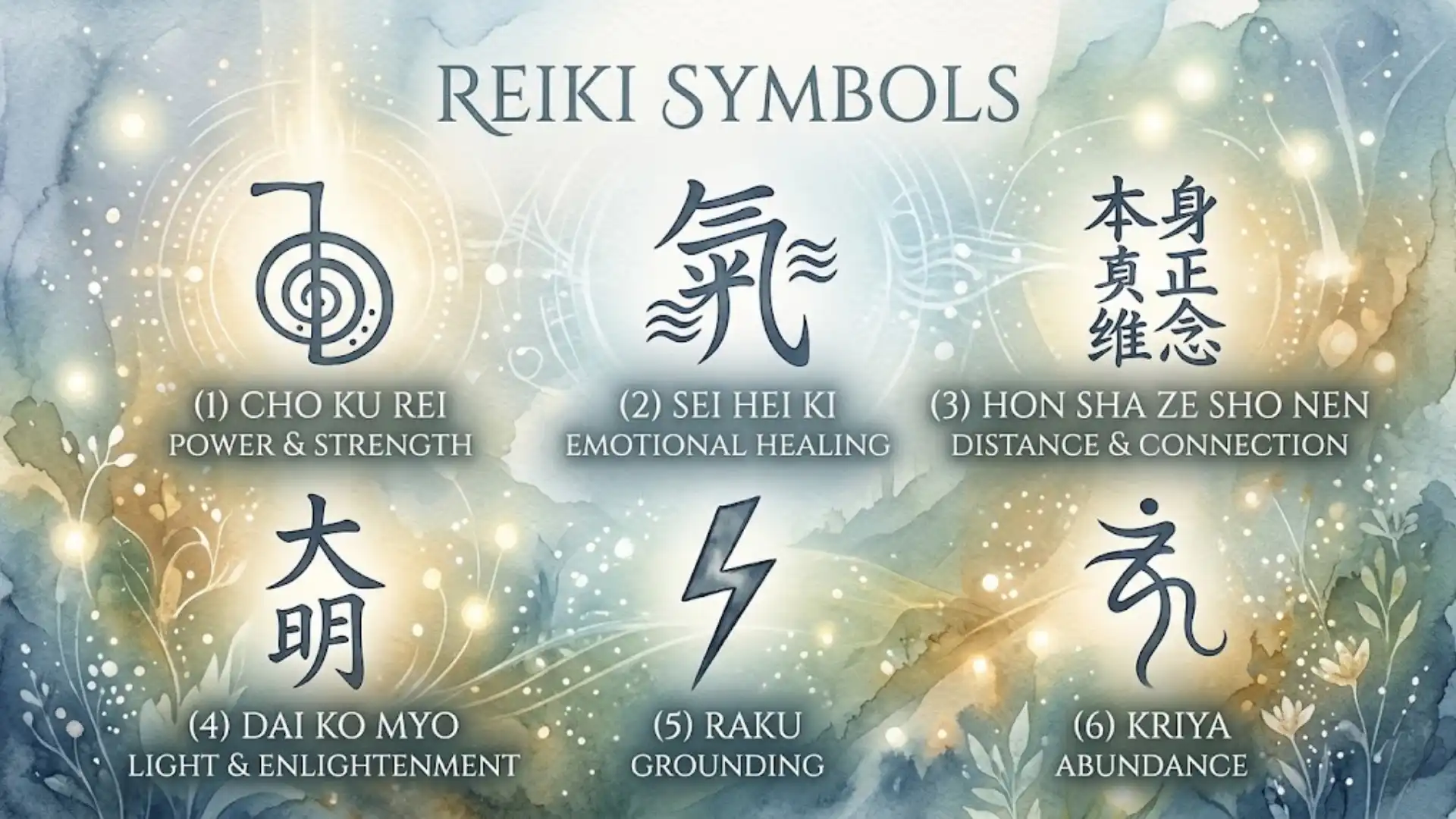
Reiki symbols are an important part of several Reiki traditions. Practitioners use them during meditation, energy work, and spiritual healing practices. Each symbol has its own name, traditional meaning, and method of use.
Some Reiki symbols are associated with protection, emotional balance, mental clarity, distance healing, and spiritual growth. Others are taught in advanced Reiki training and master-level courses.
The meaning and use of a symbol can vary between teachers and Reiki lineages. The four best-known symbols in the Usui Reiki tradition are Cho Ku Rei, Sei He Ki, Hon Sha Ze Sho Nen, and Dai Ko Myo.
This guide explores Reiki symbols and meanings, including traditional Usui symbols, Karuna Reiki symbols, Shamballa Reiki symbols, and additional symbols taught in certain lineages. You’ll also learn how practitioners use them, when they’re introduced during training, and how to approach them respectfully.
Important note: Reiki is a complementary spiritual practice. Scientific evidence has not established the existence of the energy field proposed by Reiki theory or shown Reiki to be an effective treatment for medical conditions. Reiki should not replace professional medical care. Source:
What Are Reiki Symbols?
Reiki symbols are traditional signs used in some forms of Reiki practice. Practitioners may draw them by hand, visualize them mentally, or focus on them during a session.
In Reiki traditions, these symbols are associated with particular intentions. For example, a practitioner might use a symbol connected with power before beginning a session or one associated with mental and emotional harmony during meditation.
Reiki symbols aren’t simply decorative drawings. Within their traditions, practitioners learn their names, forms, intended uses, and the practices associated with them.
However, Reiki doesn’t have one universal system followed by every teacher. Different schools may teach different symbols, spellings, pronunciations, and interpretations.
What Do Reiki Symbols Represent?
The meaning of a Reiki symbol depends on the tradition in which it appears. Common associations include:
- Power and focus: Directing attention toward a specific intention.
- Emotional harmony: Supporting reflection and calm during spiritual practice.
- Distance healing: Representing an intention to offer Reiki beyond physical proximity.
- Spiritual development: Supporting meditation and advanced Reiki study.
- Protection: Serving as a focus for a practitioner’s intention to create a sense of safety.
- Grounding: Encouraging awareness of the present moment and a feeling of stability.
These descriptions explain traditional spiritual associations, not proven effects on the body or mind.
The Four Main Usui Reiki Symbols and Their Meanings
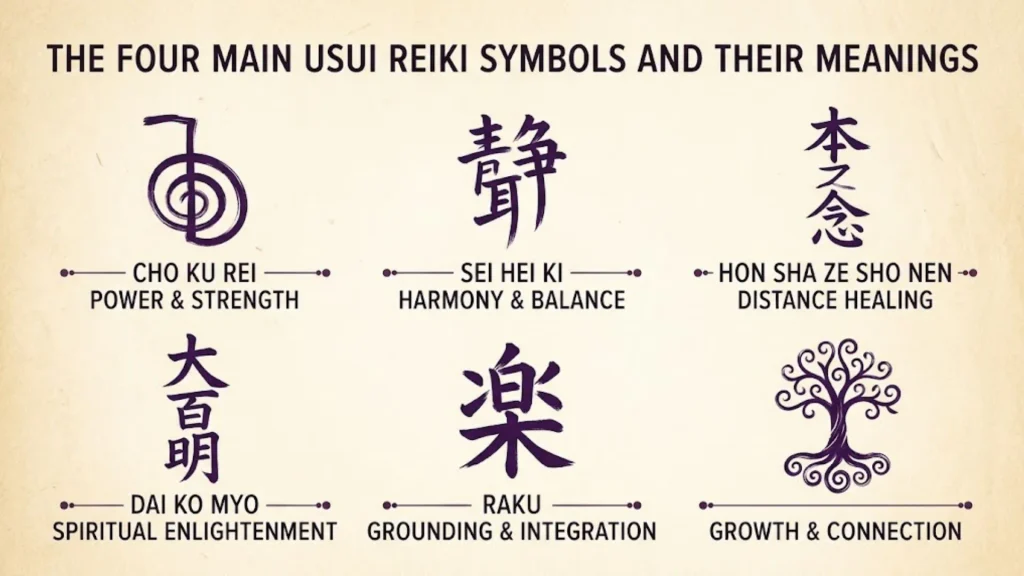
The following symbols are commonly taught in Usui Reiki training. Their exact forms and interpretations can differ among teachers and lineages.
Cho Ku Rei: The Reiki Power Symbol
Common association: Power, focus, and intention
Cho Ku Rei is widely known as the Reiki power symbol. Practitioners often introduce it as a way to focus their attention and intention during a Reiki session.
Its familiar form includes a central line and a spiral. The spiral’s direction and the symbol’s exact drawing can vary depending on the school.
The phrase Cho Ku Rei is commonly interpreted in Reiki communities as an expression related to bringing power into a particular place or focus. Translations aren’t fully standardized, so explanations can vary.
Traditional uses of Cho Ku Rei include:
- Beginning or ending a Reiki session.
- Focusing attention on a particular area during practice.
- Supporting a meditation focused on clarity and intention.
- Representing protection or energetic cleansing in some Reiki lineages.
- Reinforcing a practitioner’s focus during self-Reiki.
For example, someone practicing self-Reiki might visualize Cho Ku Rei before placing their hands over their chest or abdomen. The symbol serves as a reminder to slow down and focus on the session.
Some practitioners also use Cho Ku Rei when working with objects or rooms as part of their spiritual practice. These uses reflect Reiki beliefs rather than established scientific effects.
Sei He Ki: The Mental and Emotional Harmony Symbol
Common association: Emotional balance, harmony, and mental focus
Sei He Ki is commonly called the mental and emotional symbol in Usui Reiki. It is associated with harmony between thoughts, emotions, and personal awareness.
Practitioners may include Sei He Ki in sessions centered on relaxation, reflection, or emotional well-being. They may also use it during meditation when they want to pay closer attention to their thoughts and feelings.
Common traditional applications include:
- Meditation focused on emotional awareness.
- Spiritual practices intended to encourage calm and balance.
- Reflecting on habits, memories, or recurring thoughts.
- Combining it with other Usui Reiki symbols during a session.
- Setting an intention to respond thoughtfully rather than react automatically.
Suppose someone feels overwhelmed after a stressful day. During a quiet meditation, they might visualize Sei He Ki while breathing slowly and acknowledging their feelings.
The symbol can provide a structured focus for reflection. However, it isn’t a proven treatment for anxiety, depression, trauma, or other mental health conditions.
Hon Sha Ze Sho Nen: The Distance Reiki Symbol
Common association: Distance healing and connection beyond physical proximity
Hon Sha Ze Sho Nen is widely associated with distance Reiki. In some Reiki traditions, practitioners use it when directing their intention toward someone who isn’t physically present.
The symbol is often introduced in Level Two Reiki training, although teaching structures differ.
Practitioners may use it while thinking about a person, a past event, or a future situation. Some schools also teach it as part of practices that focus on experiences across time.
Traditional uses include:
- Distance Reiki sessions.
- Meditation focused on compassion for someone who is far away.
- Reflective practices related to past experiences.
- Setting an intention before a remote spiritual session.
- Combining distance practice with other Reiki symbols.
For instance, a practitioner may arrange a scheduled remote session with someone who has agreed to participate. The practitioner then uses the symbol as part of their established Reiki method.
Distance Reiki is a spiritual practice. Scientific evidence has not established that the symbol can transmit healing energy over a distance or treat another person’s health condition remotely.
Dai Ko Myo: The Reiki Master Symbol
Common association: Spiritual growth, illumination, and advanced practice
Dai Ko Myo is commonly known as the Reiki master symbol in several Usui Reiki lineages. It is often introduced during advanced or master-level training.
Its traditional associations include spiritual development, inner awareness, and a deeper commitment to Reiki practice.
Some schools teach Dai Ko Myo primarily at the master level. Others introduce different versions or interpretations, including a Tibetan Dai Ko Myo used in certain systems.
Practitioners may associate Dai Ko Myo with:
- Advanced Reiki meditation.
- Master-level training and teaching.
- Spiritual reflection and personal development.
- Supporting the focus of a Reiki session.
- Traditional attunement practices within a particular lineage.
An attunement is a ceremony or teaching practice used in many Reiki schools to introduce students to a particular level or system. Its meaning and method depend on the teacher and tradition.
Dai Ko Myo doesn’t automatically make someone a Reiki master. Training, practice, ethical conduct, and the requirements of a particular school also matter.
Additional Usui Reiki Symbols
Beyond the four commonly recognized symbols, some teachers introduce additional symbols or variations. These may be linked to particular lineages, regional teaching methods, or later developments in Reiki practice.
Shika Sei Ki
Shika Sei Ki appears in some Reiki teachings as an additional symbol associated with the heart or emotional awareness.
Its name and intended application aren’t consistent across all Usui Reiki schools. If your teacher includes it, ask how it fits into that specific lineage rather than assuming every Reiki practitioner uses it.
Shika So
Shika So is another symbol found in certain Reiki teachings. Some sources associate it with the heart or spiritual focus, but these interpretations aren’t universal.
Students should learn its form and intended use directly from a teacher who can explain the relevant tradition.
Tibetan Dai Ko Myo
Some Reiki lineages teach a Tibetan version of Dai Ko Myo alongside or instead of the familiar Usui master symbol.
Although the names overlap, the forms and methods of use may differ. A teacher should clarify which version is being taught and how it relates to the school’s overall practice.
Dumo
Dumo is associated with some Tibetan-influenced Reiki systems. It is sometimes described as a symbol connected with spiritual energy or advanced practice.
It isn’t part of every traditional Usui curriculum, so its role depends on the lineage.
Fire Serpent or Serpent of Fire
The Fire Serpent, also called the Serpent of Fire in some teachings, appears in certain Reiki systems influenced by Tibetan practices.
Some teachers associate it with grounding, alignment, or attunement ceremonies. Its meaning and use vary, so it shouldn’t be presented as a universal Usui Reiki symbol.
Raku
Raku is commonly associated with certain Reiki attunement practices, particularly in some Western Reiki lineages. It is sometimes described as a grounding symbol used at the conclusion of an attunement.
Not all Reiki schools teach Raku, and its use isn’t identical across traditions.
Karuna Reiki Symbols and Their Meanings
Karuna Reiki is a distinct Reiki system that builds on previous Reiki training. The word karuna is commonly translated as “compassionate action” in spiritual contexts.
In the Karuna Reiki system taught by the International Center for Reiki Training, practitioners learn additional symbols and practices. The system has its own training requirements and isn’t simply another name for Usui Reiki.
Reiki
+1
The eight commonly taught Karuna Reiki practitioner symbols are Zonar, Halu, Harth, Rama, Gnosa, Kriya, Iava, and Shanti.
Zonar: A Symbol Associated With Deep Healing
Zonar is one of the principal symbols taught in Karuna Reiki. Some practitioners associate it with deep emotional work, compassion, and reflection on difficult experiences.
Traditional descriptions may connect Zonar with painful memories or experiences that feel difficult to process. These interpretations belong to Reiki teachings and aren’t evidence that the symbol can resolve trauma.
Practitioners may include Zonar in a session when their intention centers on compassion and emotional awareness.
Common spiritual associations include:
- Compassion toward yourself and others.
- Reflection on challenging experiences.
- Emotional awareness during meditation.
- A sense of support during personal growth.
Anyone dealing with trauma or persistent emotional distress should consider qualified mental health support rather than relying on Reiki alone.
Halu: A Symbol of Clarity and Awareness
Halu is another Karuna Reiki symbol. Some practitioners describe it as a symbol connected with deeper awareness, clarity, and recognizing unhelpful patterns.
During a session, a practitioner might use Halu as a focus for meditation or quiet reflection.
For example, someone who wants to understand a recurring personal habit could use the symbol as a reminder to observe their thoughts without immediate judgment.
Its meaning depends on the teacher and the specific Karuna Reiki curriculum.
Harth: The Karuna Reiki Symbol of Compassion
Harth is commonly associated with love, compassion, and emotional openness in Karuna Reiki.
Practitioners may use it when focusing on kindness, gratitude, relationships, or self-acceptance. It can also serve as a meditation focus for someone who wants to develop a more compassionate attitude toward themselves.
Traditional uses may include:
- Practicing self-compassion.
- Reflecting on relationships.
- Focusing on kindness and forgiveness.
- Setting intentions for personal growth.
Harth doesn’t guarantee that a relationship will improve or that another person will change. Its practical value may lie in helping a practitioner focus on their own intentions and behavior.
Rama: A Symbol Associated With Grounding
Rama is often linked with grounding, balance, and bringing attention back to the present moment.
Some Karuna Reiki practitioners use Rama during sessions intended to encourage a feeling of stability. Others associate it with the balance between spiritual reflection and everyday responsibilities.
A simple grounding exercise can include sitting comfortably, breathing slowly, and noticing the contact between your feet and the floor.
A practitioner might incorporate Rama into this routine as part of their spiritual tradition.
Gnosa: A Symbol of Knowledge and Understanding
Gnosa is associated in some Karuna Reiki teachings with knowledge, understanding, and awareness.
Practitioners may use it during meditation when reflecting on a difficult decision or learning something new.
For example, a student might meditate quietly before studying. The symbol could represent their intention to approach the material with patience and an open mind.
It doesn’t replace studying, critical thinking, or professional guidance. Instead, its role is spiritual and reflective.
Kriya: A Symbol of Action and Balance
Kriya is commonly described in Karuna Reiki as a symbol connected with action, manifestation, or bringing intentions into practical life.
Some practitioners use it when setting goals or thinking about the steps needed to achieve them.
Consider someone who wants to establish a regular meditation habit. They could use Kriya as a reminder to move beyond intention and practice consistently.
A practical approach to goal setting includes:
- Identify one clear goal.
- Break it into manageable steps.
- Set a realistic schedule.
- Review your progress regularly.
- Adjust the plan when needed.
The symbol’s traditional meaning can support reflection, but results depend on real-world actions and circumstances.
Iava: A Symbol Associated With Awareness
Iava is another symbol taught in Karuna Reiki. Some practitioners associate it with awareness, personal responsibility, and recognizing how thoughts influence behavior.
It may serve as a focus during meditation about personal boundaries, choices, or relationships.
For instance, someone could use a quiet meditation to consider whether their daily habits reflect their values.
Different teachers may explain Iava in different ways. Students should follow the definitions and practices taught within their own training system.
Shanti: The Reiki Symbol of Peace
Shanti is commonly associated with peace, calm, and harmony in Karuna Reiki.
Practitioners may use it during meditation or sessions focused on relaxation and emotional steadiness.
Traditional applications can include:
- Quiet reflection before sleep.
- Meditation focused on peace.
- Setting intentions during stressful periods.
- Reflecting on forgiveness and acceptance.
Shanti isn’t a treatment for insomnia, anxiety, or other medical conditions. If sleep problems or emotional distress persist, professional care may be helpful.
AUM or OM in Reiki Practices
AUM, also written as OM, is a sacred syllable associated with several Indian spiritual traditions. It isn’t exclusive to Reiki.
Some Reiki lineages incorporate OM into meditation or advanced spiritual practices. Its role varies depending on the system and teacher.
Because OM has a broader religious and philosophical history, it’s important not to present every use of it as a traditional Usui Reiki practice.
Hosanna and Len So My
Hosanna and Len So My appear in some expanded Reiki symbol lists, but they aren’t universal symbols in the standard four-symbol Usui system or the core eight-symbol Karuna practitioner curriculum described above.
Their meanings and origins may be unclear or inconsistent across sources. If you encounter them in a course or article, ask which lineage teaches them and what source supports the interpretation.
This distinction matters because online lists sometimes combine symbols from unrelated systems without explaining their origins.
For a recognized Karuna Reiki curriculum, the provides information about its training manuals.
Shamballa Reiki Symbols and Their Meanings
Shamballa Reiki, sometimes called Shamballa Multidimensional Healing, is associated with modern spiritual healing systems that use their own teachings and symbol sets.
Unlike the four main Usui symbols, Shamballa symbols don’t have one universally accepted list shared by every teacher. The names, interpretations, and methods can vary considerably.
For this reason, it helps to distinguish symbols taught within a particular Shamballa system from symbols that belong to established Usui Reiki training.
Mer Ka Fa Ka Lish Ma
Mer Ka Fa Ka Lish Ma is a name found in some expanded Shamballa-related symbol lists.
Descriptions of its meaning and application aren’t consistent across Reiki sources. It’s therefore best to learn it within the specific system that teaches it instead of treating one interpretation as universal.
Motor Zanon
Motor Zanon also appears in some lists of additional Reiki symbols. Its precise meaning and lineage aren’t standardized across the wider Reiki community.
If a teacher includes it in Shamballa training, ask for an explanation of its traditional role and how it differs from symbols taught in other systems.
Anti-Viral Symbol
Some online symbol lists use the label “Anti-Viral Symbol” for a symbol associated with particular alternative healing practices.
This name should not be interpreted as evidence of antiviral activity. There is no established scientific basis for claiming that a Reiki symbol can prevent or treat viral infections.
People with infections should follow appropriate medical guidance, including recommended testing, vaccination, and treatment where applicable.
Palm Master Symbol
The Palm Master Symbol appears in some expanded Reiki symbol collections. Its role depends on the lineage in which it is taught.
The name alone doesn’t establish its historical origin or demonstrate a particular effect. Students should verify the symbol’s source before including it in a description of traditional Reiki.
Amsui and Ho Ka O Ili Ili
Amsui and Ho Ka O Ili Ili are names found in some extended lists of spiritual healing symbols. Their meanings and origins aren’t standardized throughout Usui Reiki, Karuna Reiki, and Shamballa Reiki.
If you encounter either name, check the course materials and ask the teacher to identify the system in which it belongs.
Abundance Reiki Symbol
Some contemporary Reiki teachers use an abundance Reiki symbol or related visualization as part of spiritual practices focused on prosperity, gratitude, or personal goals.
There isn’t one universal abundance symbol recognized across all Reiki traditions.
Practitioners may use a symbol as a reminder to reflect on their relationship with money, opportunity, and generosity. It shouldn’t be presented as a method that guarantees wealth or financial success.
Traditional Reiki Symbols vs. Additional Reiki Symbols
The table below separates commonly taught symbols from symbols associated with particular systems or less standardized teachings.
| Symbol or group | Associated system | Common traditional association |
| Cho Ku Rei | Usui Reiki | Power and focus |
| Sei He Ki | Usui Reiki | Mental and emotional harmony |
| Hon Sha Ze Sho Nen | Usui Reiki | Distance Reiki |
| Dai Ko Myo | Usui Reiki | Master-level practice and spiritual development |
| Zonar | Karuna Reiki | Deep reflection and compassion |
| Halu | Karuna Reiki | Awareness and clarity |
| Harth | Karuna Reiki | Compassion and love |
| Rama | Karuna Reiki | Grounding and balance |
| Gnosa | Karuna Reiki | Knowledge and understanding |
| Kriya | Karuna Reiki | Action and intention |
| Iava | Karuna Reiki | Awareness and personal responsibility |
| Shanti | Karuna Reiki | Peace and calm |
| Raku | Some Usui/Tibetan lineages | Grounding in certain attunement practices |
| Dumo | Some Tibetan-influenced systems | Advanced spiritual practice |
| Shamballa-related symbols | Shamballa systems | Depends on the specific teaching |
These are common associations, not standardized definitions shared by every Reiki teacher. The International Center for Reiki Training’s explanation of Usui symbols also discusses differences between traditional Usui symbols and additions used by other branches.
Reiki Symbols by Level: Reiki Level 1, Level 2, and Master Level
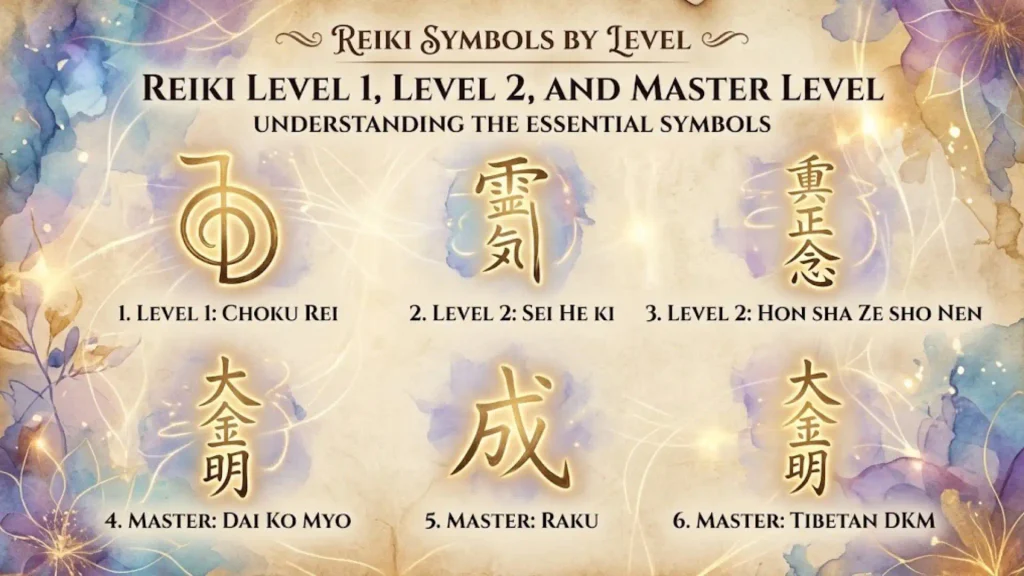
Reiki training often follows a progression from introductory practice to more advanced study. The names and requirements of each level depend on the school.
Reiki Level 1 Symbols
Reiki Level One, sometimes called Shoden in Japanese Reiki contexts, usually introduces the foundations of Reiki practice.
Training often focuses on hand positions, self-practice, giving a basic session, and understanding the teacher’s approach to Reiki.
In many Western Usui Reiki curricula, students don’t receive the complete set of traditional Usui symbols at Level One.
Typical Level One topics include:
- The history and principles of Reiki.
- Basic hand placements.
- Self-Reiki practice.
- Giving a session to another person.
- Meditation and personal reflection.
- The school’s approach to Reiki initiation or attunement.
Some lineages organize training differently, so check the curriculum before assuming every school follows the same structure.
Reiki Level 2 Symbols
Reiki Level Two is often called Okuden. In many Usui Reiki schools, this is where students learn the first three commonly taught symbols.
These include:
- Cho Ku Rei: Associated with power and focus.
- Sei He Ki: Associated with mental and emotional harmony.
- Hon Sha Ze Sho Nen: Associated with distance Reiki.
Students may also learn how to incorporate these symbols into a session, practice distance Reiki according to their school’s methods, and develop a more structured personal practice.
The symbols’ role is taught within a specific spiritual framework. Learning them doesn’t establish that they transmit energy or treat health conditions through a scientifically verified mechanism.
Reiki Level 3 and Master-Level Symbols
Master-level training often introduces Dai Ko Myo and more advanced teaching methods.
Depending on the lineage, the course may cover:
- Advanced Reiki practice.
- Master-level meditation.
- Attunement or initiation methods.
- Teaching students.
- Reiki ethics and professional boundaries.
- The history and interpretation of the school’s symbols.
Some schools separate advanced practitioner training from master-teacher training. Others combine them into one course.
If you want to become a Reiki teacher, ask what the course qualifies you to do, what supervised practice is included, and whether its certification is recognized by any organization you plan to join.
How Do Reiki Symbols Work?
In Reiki traditions, symbols are generally understood as tools that help practitioners focus intention and engage with the practice’s spiritual framework.
A practitioner may draw a symbol in the air, visualize it, trace it over their hands, or silently repeat its name. Some schools also teach specific ways to introduce symbols during an attunement.
However, explanations of how symbols work are based on Reiki beliefs. Scientific research has not established that the symbols activate a measurable healing energy field.
Intention and Visualization
Intention is central to how many Reiki practitioners use symbols. Before a session, a practitioner may choose a symbol that matches the session’s purpose.
For example, Cho Ku Rei may serve as a reminder to focus, while Sei He Ki may be used during a meditation centered on emotional awareness.
Visualization can also give a session a clear structure. A person might picture a symbol while breathing slowly and returning their attention to the present moment.
These activities can form part of a personal spiritual routine. They don’t prove that a symbol produces a particular physiological effect.
Drawing Reiki Symbols
Some teachers ask students to practice drawing their symbols until they can reproduce the forms taught in class.
A student might practice on paper, trace a symbol in the air, or visualize it during meditation.
Drawing methods can vary by lineage. If you receive formal training, follow the version your teacher provides and ask about any differences between versions found online.
Attunement and Activation
In many Reiki schools, an attunement is a ceremony through which a teacher introduces students to Reiki practice and the symbols associated with a particular level.
Some teachers describe attunement as a spiritual connection that enables students to use specific symbols. Other approaches use different terminology or teaching methods.
Attunement is part of Reiki tradition, not a scientifically established process for activating a measurable energy field.
If you’re considering training, ask about the teacher’s experience, course structure, ethics, and ongoing support.
How to Use Reiki Symbols in a Spiritual Practice
The exact method depends on the Reiki system and your training. The following example describes a simple reflective routine rather than a proven healing technique.
A Simple Reiki Symbol Meditation
- Choose a quiet space. Sit comfortably somewhere you can focus without interruptions.
- Set an intention. Decide whether you want to focus on calm, compassion, or general reflection.
- Select a symbol you have learned. Use the version taught within your Reiki lineage.
- Draw or visualize it. Follow your teacher’s instructions, or visualize the symbol if that is part of your practice.
- Breathe naturally. Notice your breathing without forcing it to change.
- Observe your thoughts. Let them come and go without judging yourself.
- Close the session. Take a moment to notice how you feel and return your attention to your surroundings.
You can keep a short journal after each session. Write down which symbol you used, the intention you set, and what you noticed.
Avoid assuming that a particular sensation proves the symbol is working. Warmth, tingling, relaxation, and emotional responses can have many explanations.
Using Reiki Symbols During Self-Reiki
Some practitioners incorporate symbols into self-Reiki by placing their hands on or near different parts of the body.
A typical session might include sitting quietly, choosing an intention, placing the hands comfortably, and spending a few minutes in reflection.
Always respect your own comfort. Don’t press on painful areas or delay medical assessment because you expect Reiki to resolve a symptom.
Distance Reiki and Consent
Hon Sha Ze Sho Nen is traditionally associated with distance Reiki. Some practitioners use it during sessions for people who aren’t physically present.
If you’re offering a session to someone else, obtain their permission and explain what the practice involves. Respect their choice if they decline.
Don’t promise that distance Reiki can diagnose a condition, change another person’s thoughts, or guarantee a health outcome.
Reiki Symbols for Protection and Cleansing
Protection and cleansing are common themes in contemporary Reiki practice. Cho Ku Rei, in particular, is associated with protection or the creation of a sacred space in some teachings.
Reiki
Practitioners may visualize a symbol before meditation, during a personal ritual, or when preparing a quiet room.
For example, someone might take a few slow breaths, visualize Cho Ku Rei, and use the moment to set an intention to feel grounded and focused.
This can be meaningful as a spiritual routine, but it doesn’t establish that the symbol creates a measurable protective barrier or removes harmful substances.
For practical safety, use real-world precautions. Lock doors, follow workplace safety procedures, and address environmental hazards directly.
Reiki Symbols and Chakras
Some Reiki practitioners combine symbols with the chakra system, a spiritual framework associated with centers of energy in the body.
Chakras are not recognized as anatomical structures in modern medicine. Their use belongs to spiritual and contemplative traditions.
The table below describes common associations found in contemporary energy-work practices, rather than scientifically established connections between specific Reiki symbols and body systems.
| Chakra | Common spiritual theme | Possible meditation focus |
| Root chakra | Stability and security | Grounding and present-moment awareness |
| Sacral chakra | Creativity and emotions | Emotional reflection |
| Solar plexus chakra | Confidence and personal agency | Intentions and choices |
| Heart chakra | Compassion and connection | Kindness and relationships |
| Throat chakra | Communication and expression | Honest communication |
| Third eye chakra | Insight and awareness | Reflection and concentration |
| Crown chakra | Spiritual connection | Meditation and meaning |
Some practitioners choose symbols based on the intention of a session rather than assigning one symbol to each chakra.
For example, a person may use Sei He Ki during a meditation about emotional awareness or Cho Ku Rei as a focus for general concentration.
There is no universal Reiki rule requiring a particular symbol for each chakra.
Can Reiki Symbols Be Used for Animals, Rooms, or Objects?
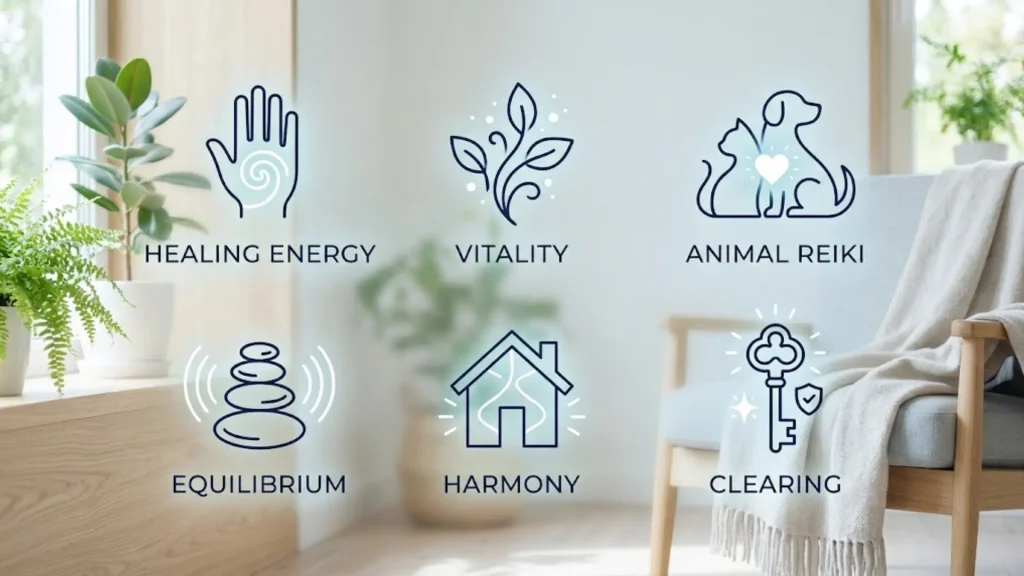
Some practitioners extend Reiki rituals beyond individual sessions. They may use symbols during meditation involving a pet, a room, a personal object, or a meaningful activity.
These practices differ by teacher and tradition.
Reiki Symbols for Animals
Animal Reiki practitioners may use symbols during calm, gentle sessions with pets. The focus is usually on a quiet environment and respectful interaction.
Animals should never be restrained or forced to participate. Stop if an animal shows signs of distress.
Reiki doesn’t replace veterinary care, medication, or professional advice about an animal’s health.
Reiki Symbols for Rooms
Some practitioners visualize symbols while preparing a meditation area or creating a sense of spiritual calm in a room.
This ritual can mark the beginning of a personal practice. It doesn’t physically disinfect a space or remove dangerous chemicals.
Use appropriate cleaning products and follow public health guidance when you need to clean or sanitize an area.
Reiki Symbols for Relationships
A person may use a symbol such as Harth or Sei He Ki as part of a meditation focused on compassion and emotional awareness.
The goal should be to reflect on one’s own behavior and intentions, not to control another person.
Healthy relationships still require communication, boundaries, mutual respect, and accountability.
Usui Reiki vs. Karuna Reiki vs. Shamballa Reiki
Although these systems share some spiritual themes, they aren’t identical. They differ in their symbol sets, teaching structures, and histories.
| Feature | Usui Reiki | Karuna Reiki | Shamballa Reiki |
| Background | Reiki system associated with Mikao Usui | A later system that builds on prior Reiki training | A family of modern spiritual healing teachings |
| Symbol set | Four commonly taught core symbols in many Western lineages | Eight commonly taught practitioner symbols in the ICRT system | Varies by school |
| Typical training | Introductory, practitioner, and master levels | Usually requires prior Reiki training, with specific requirements depending on the course | Depends on the teacher and system |
| Common themes | Focus, emotional harmony, distance practice, spiritual development | Compassion, awareness, peace, and personal growth | Varies across Shamballa teachings |
| Standardization | Differences exist between lineages | More structured within particular teaching organizations | Symbol lists and explanations can vary widely |
The ICRT history of Reiki discusses how additional symbols and systems developed. Its Karuna Reiki training information explains the relationship between Karuna Reiki and prior Usui Reiki training.
Reiki
+1
Common Misconceptions About Reiki Symbols
Online descriptions sometimes make claims that go beyond what Reiki traditions or scientific evidence support. Understanding the difference helps readers make informed choices.
All Reiki Symbols Belong to One System
Fact: Different Reiki lineages teach different symbols. The four main Usui symbols aren’t the same as the Karuna Reiki set or every symbol associated with Shamballa Reiki.
Reiki Symbols Guarantee Healing
Fact: Reiki is a complementary spiritual practice. Its symbols have traditional meanings, but they aren’t proven treatments for disease or injury.
Every Teacher Draws Symbols Exactly the Same Way
Fact: Symbol forms and teaching methods can vary between lineages. Students should learn the version used in their own course.
Reiki Symbols Can Replace Medical Treatment
Fact: Reiki should not replace diagnosis, medication, psychotherapy, surgery, or other appropriate medical care.
Every Reiki Symbol Has One Fixed Meaning
Fact: Some symbols have widely shared associations, while others have different interpretations across schools. Less standardized symbols should be described with particular care.
Frequently Asked Questions About Reiki Symbols
What are the four main Reiki symbols?
The four symbols commonly taught in Western Usui Reiki lineages are Cho Ku Rei, Sei He Ki, Hon Sha Ze Sho Nen, and Dai Ko Myo. They are traditionally associated with power and focus, mental and emotional harmony, distance Reiki, and master-level practice.
What is the most powerful Reiki symbol?
There is no scientifically established ranking of Reiki symbols by power. Cho Ku Rei is often called the power symbol, while Dai Ko Myo is commonly associated with master-level practice.
Which symbol a practitioner chooses depends on the purpose of the session and the teachings of their lineage.
Which Reiki symbol is used for protection?
Cho Ku Rei is associated with protection in some Reiki traditions. Practitioners may visualize it while preparing a quiet space or setting an intention to feel grounded.
This is a spiritual interpretation, not evidence that the symbol creates a physical barrier or prevents harm.
Which Reiki symbol is used for distance healing?
Hon Sha Ze Sho Nen is commonly associated with distance Reiki. Practitioners use it in traditions that include sessions focused on people who aren’t physically present.
Distance Reiki is not a proven method for transmitting healing energy or treating a medical condition remotely.
Are Reiki symbols secret?
Some Reiki teachers have traditionally taught symbols during formal training rather than publishing them widely. Other teachers and organizations share symbol information openly.
Practices around confidentiality differ. Students should respect the agreements and expectations of their particular teacher.
Can beginners use Reiki symbols?
Beginners can learn about the symbols and their traditional meanings. In many Usui Reiki curricula, however, the main symbols are introduced at Level Two or master level rather than Level One.
Check your school’s training structure to understand when each symbol is taught.
Do Reiki symbols have scientific proof?
The spiritual meanings of Reiki symbols come from Reiki traditions. Scientific evidence has not established that they activate a measurable healing energy field or reliably treat medical conditions.
Some people find Reiki sessions relaxing or personally meaningful, but those experiences don’t prove the proposed mechanism of action.
For a medical overview, see the National Center for Complementary and Integrative Health’s Reiki information.
Can I draw Reiki symbols without an attunement?
The answer depends on the teaching tradition. Some Reiki schools consider attunement or initiation an important part of learning and using their symbols, while approaches to sharing symbols differ.
If you want to follow a particular lineage, ask its teacher about the training requirements instead of assuming every school follows the same rules.
What is the difference between Usui and Karuna Reiki symbols?
Usui Reiki commonly teaches four core symbols in many Western lineages. The Karuna Reiki system taught by the ICRT includes eight practitioner symbols and additional master-level teachings.
Karuna Reiki is a separate system that builds on prior Reiki training, not simply another name for Usui Reiki.
Final Thoughts on Reiki Symbols and Their Meanings
Reiki symbols hold an important place in many Reiki traditions. Cho Ku Rei, Sei He Ki, Hon Sha Ze Sho Nen, and Dai Ko Myo are the four core symbols commonly taught in Western Usui Reiki lineages.
Karuna Reiki adds symbols such as Zonar, Halu, Harth, Rama, Gnosa, Kriya, Iava, and Shanti. Shamballa Reiki and other spiritual systems may use additional symbols, but their names and interpretations aren’t universally standardized.
If you’re learning Reiki, focus on understanding the history, traditional meaning, and context of each symbol. Learn from a qualified teacher if you want to follow a particular lineage, and be cautious about claims that promise guaranteed results.
Most importantly, keep spiritual practice separate from medical claims. Reiki symbols can serve as meaningful tools for meditation and personal reflection, but they should never replace appropriate professional care.

Hello, I’m Rowan Sinclair, a passionate writer and lifelong admirer of the wisdom found in great quotes. I believe that words have the ability to inspire change, spark creativity, and connect people across cultures and generations.
I enjoy writing about motivational quotes, famous sayings, and lessons from history’s most influential thinkers. Every article I create is driven by my desire to help readers discover meaningful insights that they can apply to their own lives.
When I’m not writing, I spend my time reading biographies, exploring classic literature, and collecting memorable quotes that deserve to be shared with the world.
I am the author of Voices That Inspire and A Collection of Timeless Thoughts, two books that celebrate the enduring power of words and the stories behind them.
 Asher Monroe
 Sienna Brooks