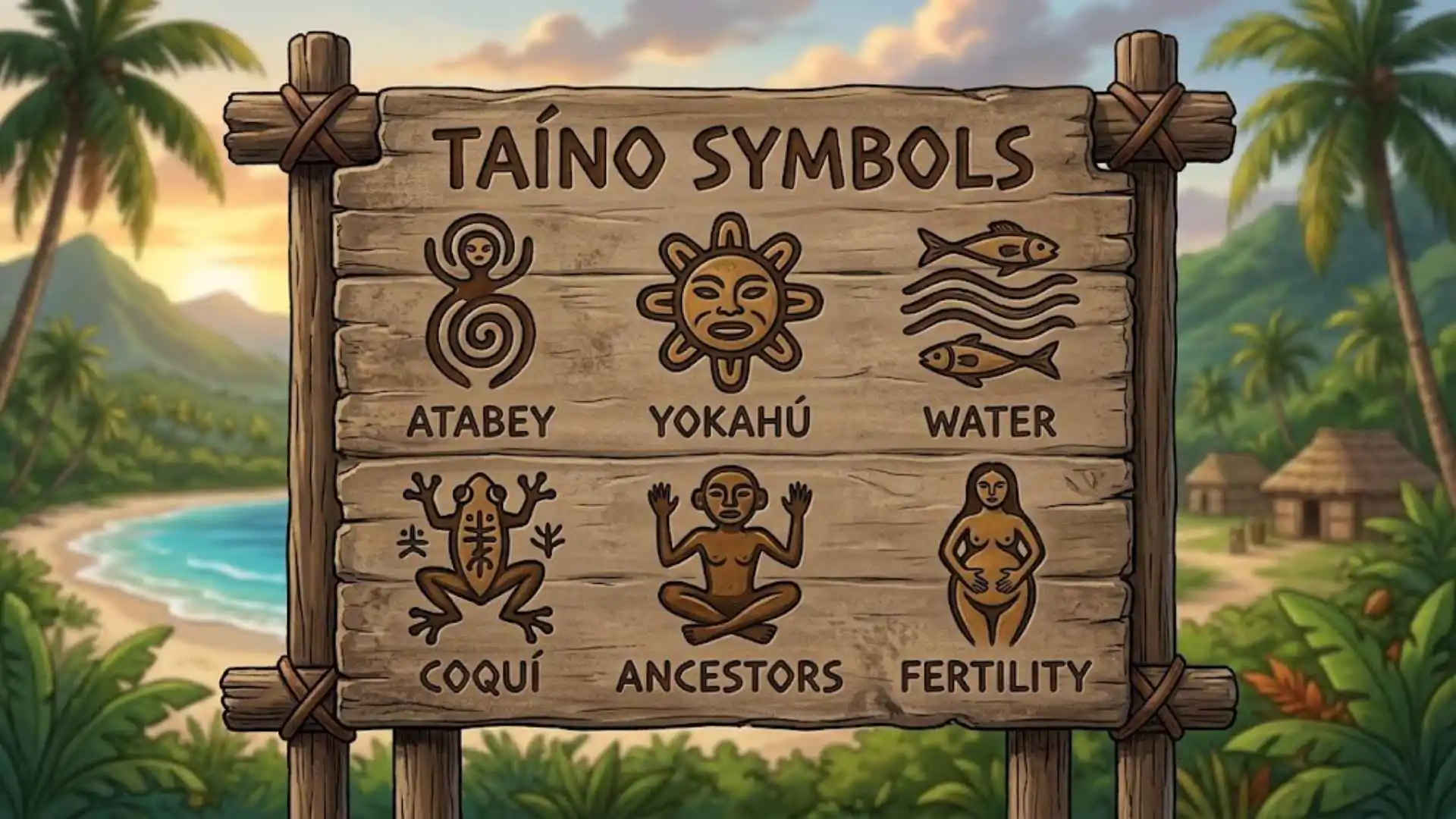
Taíno symbols offer a glimpse into the beliefs, art, and cultural heritage of the Indigenous Taíno people of the Caribbean. Their visual traditions include petroglyphs carved into stone, images found on archaeological objects, and designs associated with nature, animals, and spiritual life. These symbols are especially important to people exploring the history of Puerto Rico, the Dominican Republic, Cuba, and other Caribbean islands.
Many people search for Taíno symbols and meanings to understand traditional designs, discover the Taíno sun symbol, or find inspiration for a meaningful tattoo. However, not every design circulating online has a confirmed historical meaning. Learning about archaeological evidence and the cultural context behind a symbol helps distinguish documented examples from modern interpretations.
This guide explores well-known Taíno motifs, their historical context, their connections to Puerto Rican and Dominican heritage, and their use in contemporary art. It also explains how to approach Taíno-inspired tattoos respectfully and how to interpret symbol images without assuming that every design has one universally accepted meaning.
Taíno symbols and meanings
Taíno symbols are visual motifs associated with the Indigenous peoples who lived across much of the Caribbean before and during European colonization. Archaeologists have documented carved figures, geometric patterns, human-like faces, and animal imagery on rocks, cave walls, pottery, and other objects.
The Taíno were not a single isolated community with an identical artistic vocabulary everywhere. Communities across the Greater Antilles and neighboring islands developed related but locally distinctive traditions. For that reason, a design found in Puerto Rico may not have exactly the same context as a similar-looking image found elsewhere.
Here are some important categories of Taíno imagery:
| Symbol or Motif | Common Modern Interpretation | Historical Context |
| Sun-like face | Life, energy, or the sun | Meaning depends on the specific artifact and design |
| Human face | Ancestral or spiritual associations | Human figures occur in different artistic and ritual contexts |
| Coquí or frog-like imagery | Caribbean identity and nature | Animal imagery must be identified from the actual design |
| Bird motif | Nature, animals, or spiritual associations | Species and meaning depend on archaeological context |
| Geometric patterns | Balance, decoration, or cultural identity | Not every pattern has a documented symbolic meaning |
| Spiral or circular motif | Cycles or continuity in modern interpretations | Specific historical meanings cannot be assumed without evidence |
One important figure in Taíno religious history is Yúcahu, a deity associated with cassava and agricultural abundance. Atabey is associated with waters, fertility, and motherhood in accounts of Taíno religion. These figures are part of the broader cultural context, but a particular carved image should not automatically be labeled as either deity without supporting evidence.
When researching a Taíno symbol, look for its archaeological location, the object on which it appears, and credible museum or scholarly descriptions. This is more reliable than assigning a meaning based only on its modern name.
Taíno symbols tattoos
Taíno-inspired tattoos are popular among people who want to express Caribbean heritage, family connections, Indigenous history, or a personal relationship with the natural world. Designs often draw inspiration from petroglyphs, carved faces, animal forms, and repeating geometric patterns.
Common tattoo ideas include:
- Sun-Inspired Design: A circular motif with rays or a face, often interpreted today as representing vitality or connection with nature.
- Human Face Motif: Inspired by figures found in Caribbean archaeological art.
- Animal-Inspired Design: A motif based on a documented animal image or a contemporary Caribbean design.
- Geometric Band: Repeating lines and shapes that create a bold pattern around the arm or leg.
- Petroglyph-Inspired Tattoo: A design based on an identifiable carving, ideally with a record of where it was found.
Before choosing a tattoo, check whether the design reproduces a documented archaeological image or is a modern creation marketed as Taíno. These are not the same thing. A tattoo artist can help adapt the size and placement, but historical claims should be checked separately.
For a small tattoo, a simple outline may remain clearer over time than a highly detailed carving. For a larger design, consider incorporating the motif into a composition that acknowledges its Caribbean origins rather than presenting it as a generic tribal pattern.
Taíno symbols in english
People searching for Taíno symbols in English often want to know what a design is called and what it represents. Some online collections use Spanish names, Indigenous terms, or modern English labels for the same visual motif.
Here are useful terms to understand:
| Term | English Explanation |
| Taíno | The name commonly used for Indigenous peoples of the Caribbean |
| Petroglyph | An image or design carved into rock |
| Pictograph | An image drawn or painted on a surface |
| Sun motif | A design resembling a sun, sometimes with rays or a face |
| Anthropomorphic figure | A figure with human-like features |
| Zoomorphic figure | A figure representing an animal |
| Geometric motif | A pattern built from lines, circles, or repeated shapes |
These are descriptive terms, not necessarily traditional Taíno names. English labels such as “sun symbol” or “warrior symbol” may have been created by modern writers, artists, or tattoo websites rather than inherited from a documented Taíno vocabulary.
When translating a symbol, preserve any verified Indigenous name alongside the English explanation. This helps readers understand both the visual form and the cultural context without suggesting that a modern label is an ancient original name.
Taíno sun symbol
The Taíno sun symbol is a popular design in contemporary Caribbean art and tattoo culture. It is commonly represented as a circle with rays, a face, or a combination of rounded and angular features.
Sun-like imagery is often interpreted in modern designs as a symbol of life, energy, nature, or the relationship between people and the natural world. These interpretations can be meaningful, particularly when used to express Caribbean identity.
However, there is no single universal Taíno sun symbol with one meaning accepted for every historical example. A circular carving with rays might be categorized differently depending on its location, age, associated imagery, and scholarly interpretation.
If you want an authentic historical design, look for a sun-like motif in a documented archaeological collection. If you prefer a contemporary design, it is reasonable to use an artist’s interpretation, provided it is not incorrectly presented as a verified ancient symbol.
Taíno sun symbol meaning
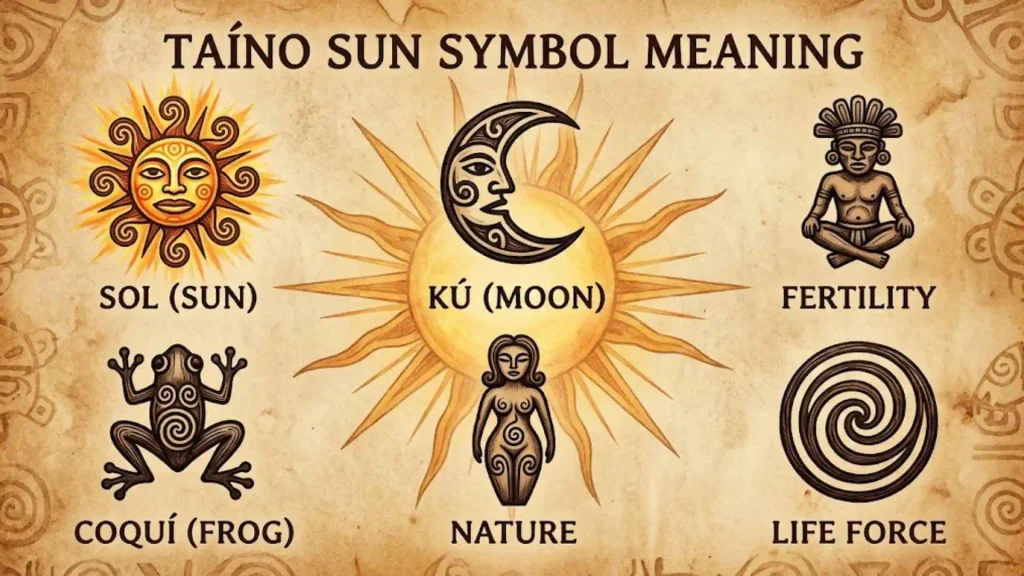
The meaning of a Taíno sun symbol depends on whether the design is an identifiable historical carving or a modern interpretation.
In contemporary use, people may associate a sun-inspired Taíno design with:
- Life and Vitality: The sun provides light and warmth, making it a natural image for energy and growth.
- Nature: Sun imagery can express a personal connection with the Caribbean environment.
- Cultural Identity: A Taíno-inspired sun may represent Indigenous ancestry or an interest in Caribbean history.
- Renewal: The daily return of sunlight can suggest a new beginning in modern artistic interpretations.
- Family Heritage: Some people choose the design as a personal reminder of their roots.
These are possible contemporary meanings, not a definitive translation of every ancient carving. The Taíno religious world included beliefs and traditions that cannot be fully reconstructed from a single image.
For a tattoo, pendant, or personal emblem, you can choose the meaning that resonates with you while being clear about whether it is a personal interpretation or one supported by historical research.
Warrior fighter Taíno symbols
Searches for warrior or fighter Taíno symbols often come from people seeking tattoo designs associated with strength, bravery, resilience, or resistance. These qualities can be meaningful themes for a modern design, but they should not be confused with a confirmed historical symbol system.
Taíno communities had leaders, skilled defenders, and complex political relationships before and during European colonization. Historical accounts also describe resistance to Spanish conquest. Yet there is no universally established Taíno glyph that can confidently be translated simply as “warrior symbol” across all communities.
For a warrior-inspired design, consider:
- A documented human figure from an archaeological site.
- A historically grounded motif incorporated into a contemporary composition.
- Geometric patterns chosen for visual strength without claiming an unsupported ancient meaning.
- A design that commemorates a particular historical person or event, with the details researched carefully.
A respectful design can express courage and perseverance without inventing an ancient translation. If a seller claims that a particular glyph specifically means “fighter,” “warrior,” or “protection,” ask for the historical source supporting that interpretation.
Dominican Taíno symbols
Taíno heritage is an important part of the Indigenous history of the island of Hispaniola, which is shared today by the Dominican Republic and Haiti. Archaeological sites, rock art, and material culture provide evidence of Indigenous communities and their artistic traditions.
Dominican Taíno-related designs may include human faces, animal forms, geometric patterns, and other motifs associated with archaeological finds from Hispaniola. The exact meaning of each image depends on its source and context.
People may use these designs today to celebrate Dominican heritage, learn about Indigenous history, or create artwork inspired by the island’s past. A design associated with the Dominican Republic may resemble one found in Puerto Rico because the islands shared aspects of Taíno culture, but the images should not automatically be treated as identical.
For accurate research, look for collections and archaeological information from Dominican museums and cultural institutions. Provenance is especially useful when a modern image is described as an authentic ancient carving.
Taíno symbols tattoos
Taíno symbol tattoos can serve as personal expressions of identity, memory, and connection to the Caribbean. This section focuses on the practical side of selecting a design rather than repeating the historical meanings of specific motifs.
Before getting a tattoo, consider these points:
- Identify the Original Image: Find out whether the design comes from a documented petroglyph, a museum object, or a contemporary illustration.
- Check the Meaning: Look for reliable historical context instead of relying solely on social media captions.
- Choose the Right Scale: Fine lines and tiny details may become less distinct as a tattoo ages.
- Ask About Adaptations: A tattoo artist may simplify a carving for clarity, but the adaptation should not be misrepresented as an exact reproduction.
- Consider Cultural Respect: Think about how the design is presented and whether its use honors the heritage it represents.
A small geometric design may suit a wrist or ankle, while a detailed petroglyph-inspired composition may work better on a larger area. Placement is a personal choice; historical accuracy and clear communication about the design are the more important considerations.
Puerto Rican Taíno symbols tattoo
Puerto Rican Taíno symbols tattoos are often chosen to express Boricua identity, family heritage, and an interest in the island’s Indigenous history. The word Boricua is widely used as a cultural identifier connected with Puerto Rico.
Popular design directions include sun-like faces, human figures inspired by petroglyphs, and motifs based on documented archaeological objects. Some people also combine a Taíno-inspired image with the outline of Puerto Rico or other personal elements.
If you want the tattoo to represent a specific part of Puerto Rican history, research the original image before choosing it. A cemí is a term associated with spiritual beings or objects in Taíno culture, but it should not be used as a generic label for every carved face or decorative pattern.
A strong design begins with a clear purpose. Decide whether your main goal is to honor ancestry, commemorate family, represent resilience, or appreciate traditional art. Then select an image with a history that fits that purpose.
Taíno symbols and meanings PDF
A PDF can be a convenient way to organize reference images, names, and historical notes about Taíno symbols. For reliable research, prioritize museum catalogues, archaeological publications, and educational resources that identify where each image came from.
When reviewing a symbol reference, check whether it includes:
- The original location or archaeological site.
- The object or rock surface on which the image appears.
- A photograph or drawing that matches the documented artifact.
- The source of the proposed meaning.
- A clear distinction between historical evidence and modern interpretation.
Be cautious with collections that label every image with a definite meaning such as “love,” “warrior,” or “protection” without explaining how that translation was established. A downloadable chart is not automatically a reliable historical source.
For artwork or tattoos, retain the original source information so that the design can be traced back to its cultural and archaeological context.
Taíno symbols in English
English-language descriptions make Taíno designs easier to research, especially when a source originally uses Spanish or another language. However, a translated label does not necessarily preserve the original Indigenous name or explain the full cultural meaning.
For example, an English caption might call an image a “human face,” “frog-like figure,” or “sun motif.” These terms describe what the image resembles, but they do not establish what the artist intended it to represent.
A useful way to document a symbol is to record three details:
- Visual Description: What can actually be seen in the carving?
- Historical Source: Where was it found, and how has it been documented?
- Interpretation: What do researchers say about its possible meaning?
This approach is more accurate than treating every English label as a literal translation from the Taíno language. It also helps readers compare related designs without assuming that they all served the same purpose.
Taíno symbols sun
The sun is one of the most frequently requested themes in Taíno-inspired art. Contemporary versions range from simple circular shapes to elaborate faces with rays, curved lines, or geometric borders.
A sun design may be used for jewelry, decorative artwork, clothing, or tattoos. People often choose it to express energy, life, connection with the Caribbean, or personal heritage.
When researching a sun motif, distinguish between a modern design inspired by Taíno art and a specific ancient carving. A contemporary artist may combine several elements into a new design. That can be a valid artistic choice, but it should not be described as an exact reproduction of an archaeological artifact unless the source confirms it.
The same principle applies to sun images from other cultures. A Taíno-inspired sun should not automatically be identified with an Aztec, Maya, or other Mesoamerican sun symbol simply because the designs share circular shapes or rays.
Cuban Taíno symbols
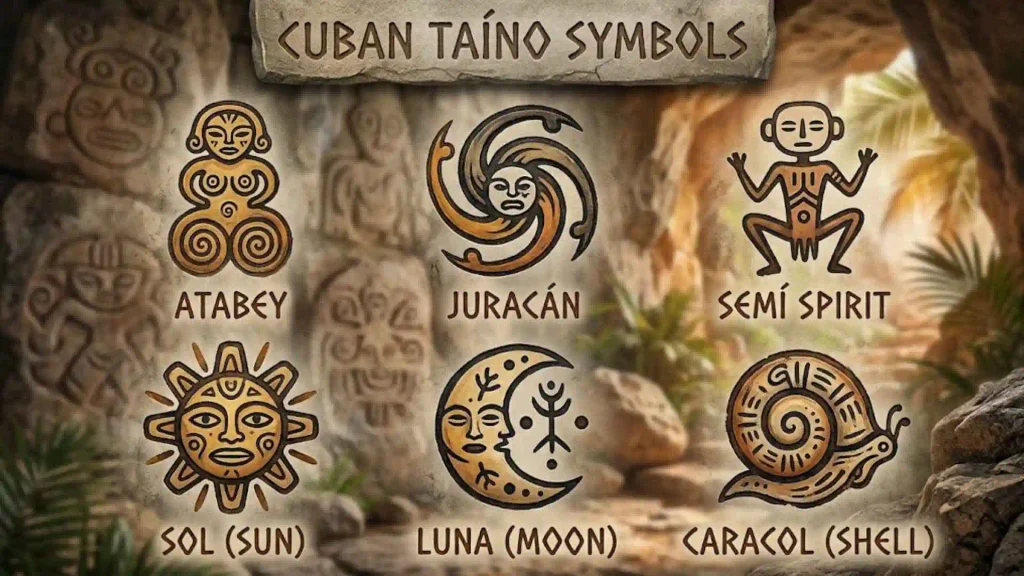
Cuba is part of the Greater Antilles and has a significant Indigenous archaeological record. Taíno-related history forms part of the broader story of Indigenous communities across the Caribbean, alongside evidence of other communities and cultural traditions.
Cuban Indigenous imagery includes rock art and archaeological objects that researchers study to understand earlier cultural life. Some images are discussed in connection with Taíno traditions, but the identification of a particular carving should be based on archaeological evidence rather than appearance alone.
Modern artists may use Cuban Taíno-inspired motifs to celebrate Cuban heritage, Caribbean identity, and Indigenous history. Human-like figures, geometric patterns, and natural forms can provide visual inspiration.
If you are looking for a historically grounded Cuban design, try to identify the specific site, artifact, or museum collection behind the image. This makes it easier to distinguish a documented carving from a contemporary illustration that simply uses the Taíno label.
Taíno symbols and meanings
Taíno symbols and meanings are often presented online as short translations, but a responsible interpretation requires more context. Some images have been studied extensively, while others remain difficult to interpret with certainty.
The following distinctions can help when reading a symbol guide:
- Documented Motif: An image that can be traced to a particular archaeological object or site.
- Scholarly Interpretation: A meaning proposed by researchers based on evidence and comparison.
- Modern Cultural Meaning: An interpretation used by contemporary artists or communities.
- Personal Meaning: A message an individual chooses for a tattoo, piece of jewelry, or artwork.
For instance, a sun-like face may symbolize cultural identity or vitality for a modern wearer. That personal meaning is valid as an expression of identity, but it does not prove that every similar ancient carving meant “life” or “energy.”
Keeping these categories separate makes Taíno art easier to appreciate and reduces the spread of unsupported claims.
Taíno symbols Puerto Rico
Puerto Rico has numerous archaeological sites and collections associated with Indigenous Caribbean history. Taíno heritage is visible in the study of petroglyphs, pottery, carved objects, and place names, and it continues to influence contemporary Puerto Rican culture.
One well-known place for learning about this heritage is Caguana Indigenous Ceremonial Park in Utuado, Puerto Rico. Its archaeological features and carved stones provide important context for understanding Indigenous ceremonial spaces and material culture.
Taíno-inspired designs are also used in modern artwork, clothing, jewelry, and tattoos. They can represent a connection to the island, interest in Indigenous history, or a broader Caribbean identity.
When identifying a Puerto Rican symbol, try to connect it to a documented site or artifact. This is especially useful when the same design appears online with several conflicting names or meanings.
Taíno symbols meaning
The meaning of a Taíno symbol cannot always be established from its shape alone. Researchers consider where the image was found, how it was made, what other objects were nearby, and whether similar designs appear in related archaeological contexts.
Some important concepts help explain Taíno visual culture:
- Cemí: A term associated with spiritual beings and representations or objects connected with them in Taíno traditions. It does not simply mean any decorative symbol.
- Yúcahu: A deity associated with cassava and agricultural abundance in accounts of Taíno religion.
- Atabey: A figure associated with water, fertility, and motherhood in descriptions of Taíno beliefs.
- Petroglyph: A carved image that provides evidence of artistic and cultural practices.
- Anthropomorphic Motif: An image with human-like characteristics.
These terms offer cultural context, but they should not be used to assign a definite meaning to an unidentified carving. A human face, for example, might be interpreted in different ways depending on the evidence surrounding it.
For an accurate symbol reference, distinguish between the image’s documented identity and interpretations proposed by modern artists or writers.
Puerto Rico Taíno symbols and meanings
Puerto Rico’s Taíno-related symbols are often associated with petroglyphs, ceremonial sites, and archaeological objects. They provide a connection to the island’s Indigenous past and are important in contemporary discussions of cultural heritage.
Commonly discussed motifs include:
- Carved Faces: Human-like features found on rocks or artifacts. Their individual meanings depend on archaeological context.
- Circular and Sun-Like Designs: Frequently used in contemporary art to express nature, vitality, or identity.
- Animal Figures: Images that may represent animals or animal-like forms, depending on their details.
- Geometric Patterns: Repeated lines, curves, and shapes used in artistic compositions.
- Cemí-Related Imagery: Images or objects discussed in connection with Taíno spiritual beliefs when the evidence supports that identification.
The significance of these motifs varies. Some modern interpretations are personal or symbolic rather than confirmed translations of an ancient visual language.
If you are researching Puerto Rican heritage, look for images from identified archaeological sites and compare the accompanying descriptions. That helps preserve the difference between historical evidence and present-day cultural expression.
Taíno symbols and meaning
Taíno symbols can be understood through both their historical context and the meanings people give them today. These two approaches are related, but they should not be confused.
A documented carving may be important because of its archaeological location, materials, or association with a particular site. A contemporary person may choose a similar design to represent family, perseverance, or cultural pride.
For example, someone might use a circular Taíno-inspired design as a reminder of renewal. Another person may select a carved human figure because it connects them with Caribbean Indigenous history. Both can explain their personal choices without claiming that the meanings are proven ancient translations.
When researching or sharing a design, ask three questions: Where did it come from? What evidence supports its interpretation? Is the stated meaning historical, modern, or personal? These questions make symbol descriptions clearer and more trustworthy.
Taíno symbols
Taíno symbols are part of a wider visual tradition that includes rock carvings, pottery designs, ceremonial objects, and other forms of Indigenous Caribbean art. Their study helps researchers explore the cultural and spiritual lives of communities before European colonization.
The word Taíno is commonly used today for Indigenous peoples associated with parts of the Caribbean, especially the Greater Antilles. Historical identities and languages were more complex than a single modern label might suggest.
Taíno visual motifs are now used in many settings, including museum education, cultural events, public art, jewelry, and personal designs. Some reproduce historical images, while others are contemporary works inspired by them.
When choosing a motif, use a reliable source if historical authenticity matters to you. A modern illustration can still be meaningful, but identifying it honestly helps protect the distinction between archaeological heritage and contemporary creativity.
Tattoo Taíno symbols
When exploring tattoo Taíno symbols, it helps to start with the image rather than a list of popular meanings. Many online tattoo collections reuse the same motifs, sometimes attaching different explanations to an identical design.
A thoughtful design process can include:
- Finding an identifiable historical image or selecting a clearly labeled contemporary design.
- Checking the source and the proposed interpretation.
- Deciding whether you want a small symbol, a geometric band, or a larger composition.
- Asking the tattoo artist to preserve the important shapes when adapting the image.
- Keeping a record of the source if the tattoo is based on a specific archaeological carving.
Avoid assuming that all Taíno-inspired designs were traditional tattoos. Rock art, pottery decoration, carved objects, and body art are different forms of cultural expression, and evidence for one does not automatically prove the historical use of another.
A tattoo can honor Caribbean heritage without making unsupported claims about ancient practices.
Puerto Rican Taíno symbols and meanings
Puerto Rican Taíno symbols are often explored as a way to learn about Indigenous history and express a connection to the island. Their meanings depend on the particular motif and the evidence associated with it.
Three useful categories are:
- Archaeological Symbols: Images documented on rocks, pottery, or other historical objects.
- Religious and Ceremonial Imagery: Motifs discussed in relation to spiritual practices when supported by historical or archaeological evidence.
- Contemporary Heritage Designs: Modern artwork inspired by Taíno motifs and used to represent Puerto Rican identity.
A sun-like face, for example, may be chosen today to represent vitality or cultural pride. A documented petroglyph, however, should be interpreted in light of its original setting rather than assigned a meaning based only on its appearance.
People researching Puerto Rican Taíno symbols can learn more by consulting archaeological collections, cultural institutions, and educational resources that explain where particular images were found.
Taíno symbols Dominican Republic
The Dominican Republic occupies the eastern part of Hispaniola, an island with a long Indigenous history. Taíno-related archaeological remains and historical accounts help researchers understand the people who lived there before and during European colonization.
Symbols associated with the island’s Indigenous heritage include carved human figures, geometric motifs, and other images documented in archaeological contexts. Their interpretation varies according to the individual artifact and its history.
Contemporary artists may draw inspiration from these designs for paintings, jewelry, tattoos, and cultural projects. Such work can celebrate Dominican identity while bringing attention to the island’s Indigenous past.
For anyone researching a particular symbol, it is helpful to identify the site or collection where it was recorded. Similar-looking motifs from different Caribbean islands may share artistic features, but that does not establish that they have precisely the same meaning.
Taíno symbols PNG
PNG images are useful when you want to include a Taíno-inspired design in a website, presentation, digital artwork, or personal project. A PNG file can support transparent backgrounds, making it convenient to place a symbol over a colored background.
When looking for Taíno symbol images, consider these points:
- Historical Accuracy: Check whether the image is based on a documented carving or a modern interpretation.
- Image Quality: Choose a clear, high-resolution image if it will be enlarged or printed.
- Transparency: A transparent background can make a PNG easier to incorporate into a design.
- Copyright: Check the image’s license before using it commercially.
- Attribution: Record the museum, photographer, artist, or source when required.
A PNG image is a graphic file, not a Unicode text character. If you want to insert an exact historical petroglyph, use an image with a documented source rather than a generic graphic labeled only “Taíno symbol.”
Taíno symbols tattoo
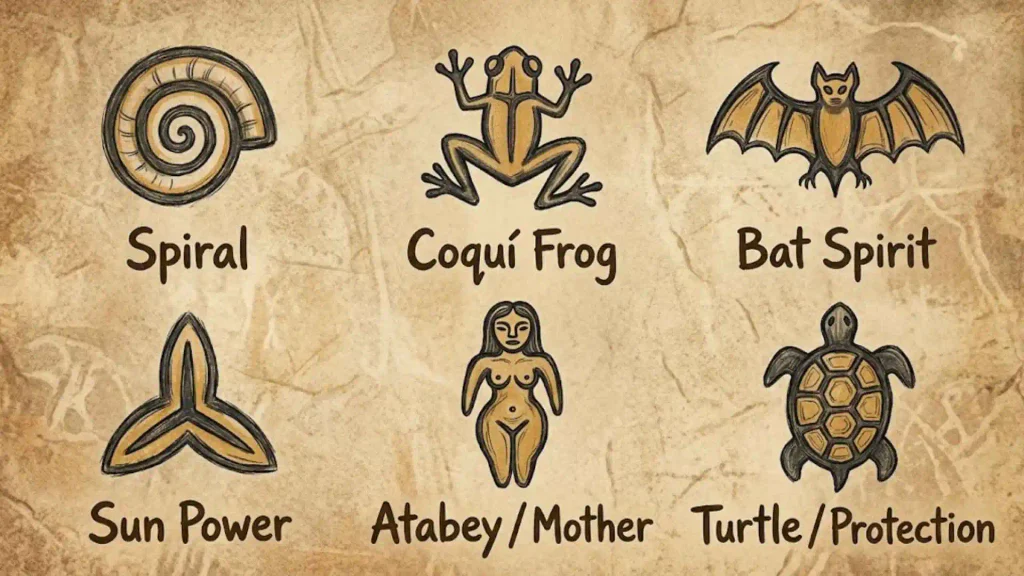
A Taíno symbols tattoo can be a personal tribute to Indigenous Caribbean history, family heritage, or an appreciation of traditional art. The right design depends on what you want it to communicate.
Some people prefer a small sun-inspired motif, while others choose a larger composition based on documented rock art. Geometric designs can work well as bands or borders, while detailed carved faces may need more space to remain recognizable.
Before committing to a design, ask the artist where the reference image came from and whether any changes are being made. If historical authenticity is important, keep a copy of the original source and avoid adding meanings that are not supported by evidence.
Most importantly, remember that a modern tattoo interpretation does not have to be presented as an exact ancient translation to be personally meaningful.
Taíno symbols sun
Sun-inspired Taíno designs are widely used in contemporary Caribbean artwork. Their appearance may include a circular center, rays, a face, or decorative lines around the outer edge.
The design is often selected to represent life, vitality, nature, renewal, or a connection to Puerto Rican and broader Caribbean heritage. These associations are common modern interpretations rather than universal translations of ancient imagery.
When comparing sun motifs, pay attention to the details. A particular carved image may have a documented archaeological identity, while a simplified circle with rays may be a contemporary design inspired by traditional art.
If you plan to use the motif in a tattoo, logo, or cultural project, choose an image whose source and intended meaning are clear. That allows you to appreciate the design without confusing artistic inspiration with established historical evidence.
Frequently Asked Questions
What do Taíno symbols represent?
Taíno symbols are visual motifs found in Indigenous Caribbean art and archaeological materials. Their meanings depend on the specific image, its historical context, and the evidence available.
What does the Taíno sun symbol mean?
Modern interpretations often associate sun-inspired designs with life, vitality, renewal, and cultural identity. However, not every historical sun-like carving has a confirmed meaning.
Which Taíno symbols are popular for tattoos?
Sun-like faces, human figures, geometric patterns, and designs based on documented petroglyphs are popular choices. Research the original source before treating a design as historically authentic.
Are Taíno symbols from Puerto Rico and the Dominican Republic the same?
The islands share aspects of Indigenous Caribbean history, and some artistic motifs are similar. However, individual designs may differ in their archaeological context and interpretation.
How can I identify an authentic Taíno symbol?
Look for a documented archaeological source, museum record, or scholarly description. Be cautious when a website gives a definite meaning without explaining where the image came from or how it was interpreted.
Conclusion
Taíno symbols provide a valuable connection to the Indigenous history and artistic traditions of the Caribbean. From carved faces and geometric motifs to sun-inspired designs, these images continue to attract interest from people researching Puerto Rican, Dominican, Cuban, and wider Caribbean heritage.
For tattoos, digital artwork, and personal designs, understanding the difference between documented historical motifs and contemporary interpretations is essential. It helps you choose images that reflect your interests while respecting the cultures from which they draw inspiration.
The best approach is to research the source, consider the context, and be honest about what is known. This makes it possible to appreciate Taíno visual traditions without assigning unsupported meanings to every symbol.

Hi, I’m Asher Monroe, a writer who believes that meaningful words have the power to inspire change and bring people closer to their dreams. I have always been fascinated by the beauty of quotes and the way a simple message can provide motivation, hope, and comfort.
I enjoy creating content around inspirational quotes, life lessons, success stories, and positive thoughts that help readers find encouragement in their everyday lives. My goal is to share words that connect with people and remind them of their inner strength.
Through my writing, I explore the ideas of personal growth, confidence, and the importance of staying inspired through every chapter of life.
I am the author of Words That Move the Soul and The Path of Endless Inspiration, two books focused on the power of wisdom, positivity, and meaningful thoughts.
 Sienna Brooks
 Rowan Sinclair Rowan Sinclair