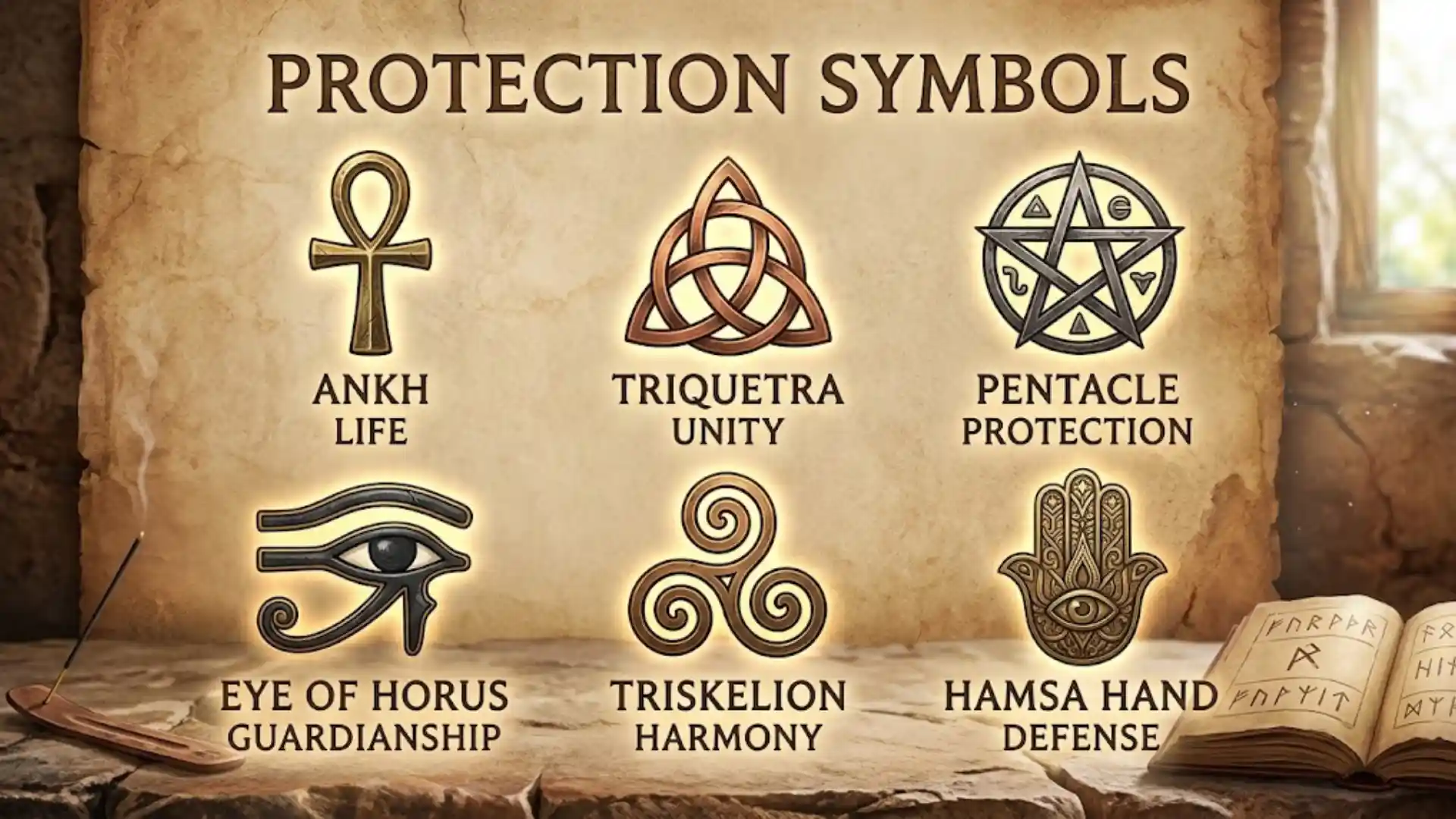
Protection symbols have played an important role in human history for thousands of years. People have used them in jewelry, religious objects, home decorations, clothing, and personal rituals to represent safety, strength, healing, and spiritual guidance.
Different cultures developed their own protection symbols based on religious beliefs, mythology, and traditional ideas about good fortune. Some symbols were worn as protective amulets, while others appeared in temples, sacred texts, and everyday objects.
Today, people continue to wear or display these symbols for cultural, spiritual, decorative, or personal reasons. However, their meanings can differ across traditions, and their protective powers are matters of belief rather than scientifically established facts.
This guide explores 12 well-known symbols of protection, their historical origins, traditional meanings, and common uses.
What Are Protection Symbols?
Protection symbols are signs, shapes, images, or objects that represent safety, defense, spiritual strength, or protection from harm. Many have roots in ancient civilizations, while others developed through religious traditions and folklore.
Historically, people used these symbols to express their hopes for protection against illness, accidents, misfortune, hostile forces, or the evil eye. Their meanings often reflected the beliefs and values of the communities that used them.
For example, ancient Egyptians wore protective amulets, while some Mediterranean communities displayed blue eye-shaped beads to guard against the evil eye. Celtic designs also incorporated knots and spirals associated with continuity, identity, and spiritual traditions.
Protection symbols can serve several purposes:
- Spiritual protection: Representing faith, divine guidance, or a connection with the sacred.
- Cultural identity: Reflecting a community’s history, heritage, and traditional beliefs.
- Personal strength: Reminding people of courage, resilience, or emotional balance.
- Good fortune: Expressing hopes for safety, prosperity, or positive experiences.
- Decorative meaning: Adding symbolic significance to jewelry, artwork, and home decorations.
A symbol’s meaning depends on its cultural and historical context. The same design may carry different meanings for different communities.
Protection Symbols vs. Amulets vs. Talismans
People often use the terms protection symbols, amulets, and talismans interchangeably. However, they can refer to slightly different things.
| Term | Meaning | Common example |
| Protection symbol | An image or design associated with safety or spiritual defense | Hamsa hand |
| Amulet | An object traditionally carried or worn for protection | Eye-shaped pendant |
| Talisman | An object believed to bring a particular benefit or influence | A symbol chosen to represent good fortune |
| Sacred symbol | An image connected with a religious or spiritual tradition | Christian cross or Om |
| Protective charm | An object used in folklore or personal traditions to represent protection | Nazar bead |
The distinction is not always strict. A Hamsa pendant, for example, can be a decorative object, a cultural symbol, or a protective amulet depending on the person and tradition.
Important: These objects can carry meaningful cultural, religious, or personal significance, but their traditional associations should not be confused with scientifically proven protection against physical danger.
The 12 Most Powerful Protection Symbols and Their Meanings
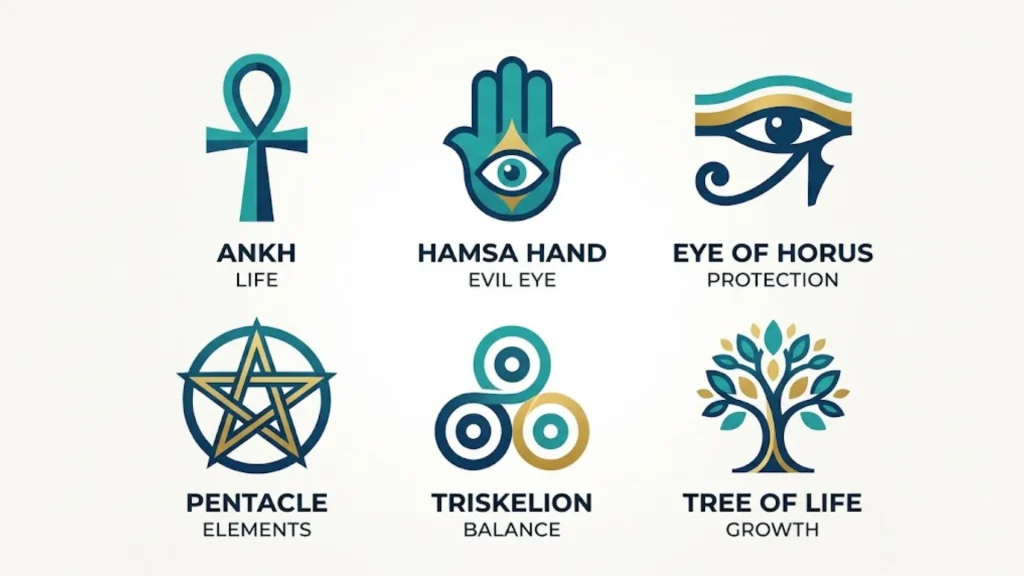
The following symbols come from different historical and cultural traditions. Each has its own story, symbolism, and modern uses.
Eye of Horus: Ancient Egyptian Symbol of Protection
The Eye of Horus, also called the Wedjat Eye, is one of the best-known ancient Egyptian protection symbols. It represents protection, healing, restoration, and well-being.
In Egyptian mythology, Horus was a deity associated with kingship and the sky. Stories about Horus describe an injured eye that was restored, giving the symbol a connection with healing and renewal.
Ancient Egyptians used eye-shaped amulets in everyday life and funerary practices. Archaeological collections preserve examples of these objects, demonstrating their importance in Egyptian material culture.
The symbol’s recognizable design includes a stylized eye, curved markings, and distinctive lines beneath it.
Traditional meanings of the Eye of Horus include:
- Protection against harm and misfortune.
- Healing and restoration after injury or difficulty.
- Renewal, well-being, and completeness.
- Safety during life and in the afterlife, according to ancient Egyptian beliefs.
Today, the Eye of Horus appears in necklaces, rings, tattoos, artwork, and decorative objects. Some people choose it as a reminder of resilience or personal recovery.
It is important to distinguish the Eye of Horus from the Eye of Ra. Both are associated with Egyptian mythology, but they have different mythological roles and interpretations.
Hamsa Hand: Symbol of Protection From the Evil Eye
The Hamsa hand is a palm-shaped symbol associated with protection, blessings, and good fortune in several Middle Eastern and North African cultural traditions.
It is also commonly called the Hand of Fatima in some Muslim contexts and the Hand of Miriam in some Jewish contexts. The name and interpretation depend on the tradition in which it appears.
The Hamsa often features an open hand with an eye in the center. The eye is frequently connected with protection against the evil eye, a traditional belief that envy or a hostile gaze can bring misfortune.
The symbol appears in jewelry, wall hangings, ceramics, textiles, and decorative artwork.
Common meanings of the Hamsa include:
- Protection from the evil eye.
- Blessings and good fortune.
- Peace, happiness, and well-being.
- Spiritual reassurance and cultural identity.
Some designs feature fingers pointing upward, while others point downward. Interpretations of these variations differ, so there is no single universal meaning for every Hamsa design.
Although the Hamsa appears in multiple religious and cultural settings, it should not be treated as having exactly the same significance in every community.
Nazar Boncuk: The Blue Evil Eye Protection Symbol
The Nazar Boncuk is a blue, eye-shaped bead widely associated with protection against the evil eye in Turkish and neighboring cultural traditions.
The familiar design usually contains concentric circles of dark blue, white, light blue, and black. These layers create the appearance of an eye.
The Turkish word nazar refers to a gaze or look, particularly in the context of the evil-eye belief. Boncuk means bead.
People commonly display Nazar beads in homes, shops, cars, and workplaces. They may also wear them as bracelets, necklaces, or keychains.
The symbol is especially recognizable in Turkish cultural settings, where glass evil-eye beads have a long-standing craft tradition.
Traditional meanings of the Nazar Boncuk include:
- Guarding against envy or the evil eye.
- Representing good luck and well-being.
- Offering a symbolic sense of safety.
- Expressing cultural heritage and traditional craftsmanship.
Some people hang the bead near an entrance or give it as a gift for a new home, business, or major life event.
The Nazar bead is sometimes confused with the Eye of Horus because both feature an eye. However, they come from different cultural histories and should not be treated as the same symbol.
Pentacle: A Five-Pointed Star Associated With Protection
The pentacle is a symbol consisting of a five-pointed star, usually enclosed within a circle. It is associated with several spiritual and esoteric traditions, including modern Wicca.
The five-pointed star is also known as a pentagram. The words pentagram and pentacle are related, but they are not always interchangeable: a pentacle often refers specifically to a pentagram or other design enclosed in a circle or used as a ritual object.
In modern Wiccan interpretations, the five points are often connected with earth, air, fire, water, and spirit. The circle may represent unity, continuity, or the interconnectedness of these elements.
The symbol’s meaning has changed throughout history. It appeared in different contexts in ancient times and has not always carried the same religious or spiritual associations.
Common modern interpretations include:
- Spiritual protection.
- Balance among different elements of life.
- Unity and wholeness.
- Connection with nature and spiritual practice.
Some people wear pentacle necklaces or use the symbol on personal altars. Others value it as a sign of religious identity.
The pentacle should not automatically be interpreted as an evil symbol. Its meaning depends on the context and the beliefs of the person or group using it.
Flower of Life: A Sacred Geometry Symbol
The Flower of Life is a geometric pattern made from multiple evenly spaced, overlapping circles. Together, the circles form a symmetrical design that resembles a flower.
The pattern is popular in modern sacred geometry, a broad area of spiritual interpretation that assigns symbolic meaning to geometric forms.
People who use the Flower of Life spiritually may connect it with creation, unity, harmony, and the relationship between individual parts and a larger whole.
However, the modern name and spiritual interpretations should not automatically be projected onto every historical example of similar circular patterns. Geometric designs can appear in different cultures without having identical meanings.
Common symbolic interpretations include:
- Unity and interconnectedness.
- Creation and the patterns of nature.
- Harmony and balance.
- Spiritual growth and contemplation.
Today, the Flower of Life appears on wall art, meditation accessories, clothing, jewelry, and tattoos. Some people use it as a visual focus during meditation or as a reminder of their spiritual beliefs.
Unlike an ancient amulet with a documented historical role, the Flower of Life’s modern protective associations are often rooted in contemporary spiritual interpretations.
Metatron’s Cube: A Symbol of Sacred Geometry
Metatron’s Cube is a geometric design made from connected lines and circles. It is popular in modern sacred geometry and spiritual artwork.
The symbol is named after Metatron, a figure found in some Jewish mystical traditions. However, the familiar geometric diagram is commonly associated with modern esoteric interpretations, and its relationship to historical Jewish mysticism should be described carefully.
In contemporary spiritual settings, people sometimes connect Metatron’s Cube with order, balance, interconnectedness, and the structure of creation.
The pattern’s detailed lines make it visually striking, which is one reason it appears frequently in jewelry and geometric artwork.
Common modern interpretations include:
- Spiritual awareness and personal growth.
- Harmony and balance.
- The relationship between different parts of a larger whole.
- A sense of order within complexity.
Some people regard the design as a spiritual protection symbol and display it in meditation spaces or wear it as jewelry.
These interpretations reflect modern spiritual beliefs rather than a universal historical meaning shared by all traditions.
Triskelion: Celtic Symbol of Movement and Cycles
The Triskelion, also spelled triskele, is a three-part spiral or rotational design. It appears in ancient European art and is often associated with Celtic symbolism today.
The name relates to the Greek idea of three legs, although the design takes several forms. Some versions feature three curved spirals, while others resemble three bent arms extending from a central point.
The symbol appears in archaeological contexts, including the prehistoric monument of Newgrange in Ireland. Its original meaning in such ancient settings is not fully established, so modern interpretations should be distinguished from historical evidence.
Today, the Triskelion is commonly associated with movement, cycles, and the relationship among three connected elements.
Common interpretations include:
- The cycles of life.
- Past, present, and future.
- Growth and transformation.
- The balance of three forces or aspects of existence.
Some modern spiritual practitioners use the Triskelion as a symbol of personal strength or protection during periods of change.
It is also popular in Celtic-inspired jewelry, tattoos, and decorative art. Its meaning can vary depending on the specific design and cultural context.
Tree of Life: A Symbol of Strength and Connection
The Tree of Life is a widespread symbol found in many cultures and belief systems. Its exact meaning varies, but trees commonly provide a way to represent life, growth, continuity, and the connection between different parts of the world.
In Norse mythology, Yggdrasil is a great tree associated with the structure of the cosmos and the connection between different realms. It is a specific mythological tree, not simply another name for every Tree of Life design.
Other traditions use tree imagery to represent family ancestry, spiritual development, fertility, or the cycle of life.
The design often includes deep roots, a strong trunk, and spreading branches. These elements lend themselves to interpretations about stability and growth.
Common meanings of the Tree of Life include:
- Strength and resilience.
- Family connections and ancestry.
- Growth, renewal, and continuity.
- The relationship between the earth and the heavens.
- Balance and interconnectedness.
Some people choose Tree of Life jewelry to represent family bonds or personal development. Others display it in their homes as a reminder of stability and connection.
The symbol is not limited to one religion or culture. When discussing a specific Tree of Life design, its own cultural background matters.
Ankh: Ancient Egyptian Symbol of Life
The Ankh is an ancient Egyptian symbol shaped like a cross with a loop at the top. It is widely associated with life and, in many contexts, eternal life.
The symbol appears in ancient Egyptian art, inscriptions, and religious imagery. Egyptian deities are frequently depicted holding an ankh or offering it to a ruler.
Its form is distinctive: a loop above a vertical stem, with horizontal arms near the top. Although its exact origins remain a subject of discussion, its association with life is well established in ancient Egyptian contexts.
Traditional meanings of the Ankh include:
- Life and vitality.
- Eternal life in ancient Egyptian religious belief.
- Divine power and blessings.
- Continuity and renewal.
The Ankh is sometimes called the key of life, although this phrase is a popular descriptive label rather than a complete explanation of its historical use.
Today, the Ankh appears in jewelry, tattoos, fashion, and Egyptian-inspired art. Some people choose it to express an interest in ancient Egyptian history, while others connect it with spiritual ideas about life and renewal.
The Ankh and the Christian cross may look similar in broad outline, but they have different histories and religious associations.
Om or Aum: A Sacred Symbol in Indian Religions
Om, also written Aum, is a sacred syllable and symbol with a central place in Hindu traditions. It is also significant in some other Indian religious and philosophical contexts, though interpretations differ.
Om is used in prayers, recitations, meditation, and religious ceremonies. In Hindu thought, it is often understood as a sacred sound connected with ultimate reality and the deeper nature of existence.
The written symbol ॐ is visually distinctive, but the sound itself is also important. It is not simply a decorative sign; it has a place in living religious practice.
Common spiritual associations include:
- Peace and contemplation.
- Connection with the sacred.
- Awareness and meditation.
- The relationship between the individual and ultimate reality.
Some people use Om as a focus during meditation or include it in artwork and jewelry. For many Hindus, however, the symbol carries specific religious significance that goes beyond general wellness or decoration.
If you choose to use Om, it is helpful to understand its religious context and treat it respectfully.
Om is not universally defined as a protection symbol. Its connection with protection or spiritual safety depends on the particular belief or practice.
Celtic Shield Knot: Symbol of Defense and Continuity
The Celtic shield knot is a modern name commonly used for certain interlaced knot designs associated with protection. Celtic-inspired knotwork appears in historic Irish and other Insular art, including manuscripts and stone carvings.
Some modern shield-knot designs feature a closed, interwoven pattern that suggests a boundary or barrier. This appearance has encouraged contemporary interpretations involving defense, strength, and continuity.
However, it is important not to assume that every historical knot design was specifically created as a protective charm. Many interlaced patterns served decorative or artistic purposes, and the original meaning of individual designs is not always known.
Common modern interpretations include:
- Protection and defense.
- Strength and resilience.
- Continuity and interconnectedness.
- Cultural heritage and identity.
The Celtic shield knot appears in pendants, rings, tattoos, and decorative objects. People may choose it to express a connection with Celtic heritage or to represent their personal commitment to strength and perseverance.
When buying or using a Celtic-inspired design, consider whether its meaning comes from documented history or from a modern symbolic interpretation.
Christian Cross: A Symbol of Faith and Hope
The Christian cross is the central symbol of Christianity. It represents the crucifixion of Jesus Christ and, within Christian belief, is closely connected with salvation, resurrection, hope, and God’s love.
For Christians, the cross is much more than a general symbol of protection. Its meaning is rooted in the story of Jesus and the beliefs of Christian communities.
Crosses appear in churches, homes, religious artwork, cemeteries, jewelry, and personal devotional objects. Different Christian traditions use different cross designs, including the Latin cross, Orthodox cross, and other historical forms.
Common Christian meanings include:
- Faith in Jesus Christ.
- Salvation and redemption.
- Hope through suffering.
- God’s love and grace.
- Spiritual comfort and guidance.
Some Christians wear a cross necklace or keep a cross in their homes as an expression of faith. They may also associate it with God’s protection, prayer, or reassurance during difficult times.
The cross does not have exactly the same meaning for everyone who wears it. Its significance depends on personal belief, religious tradition, and cultural context.
What Do Different Protection Symbols Represent?
Although many protective symbols share themes of safety and well-being, each has its own associations. Some are connected with ancient mythology, while others express religious faith or modern spiritual beliefs.
The following table provides a quick comparison of the 12 symbols discussed above.
| Protection symbol | Cultural or spiritual context | Common symbolic meaning |
| Eye of Horus | Ancient Egyptian | Healing, restoration, protection |
| Hamsa hand | Middle Eastern and North African traditions | Blessings, protection from the evil eye |
| Nazar Boncuk | Turkish and neighboring traditions | Protection from the evil eye |
| Pentacle | Modern Wiccan and esoteric traditions | Balance, unity, spiritual protection |
| Flower of Life | Modern sacred geometry | Harmony, creation, interconnectedness |
| Metatron’s Cube | Modern sacred geometry and esoteric traditions | Order, balance, spiritual awareness |
| Triskelion | Ancient European art and modern Celtic symbolism | Cycles, movement, transformation |
| Tree of Life | Multiple cultural and religious traditions | Growth, strength, connection |
| Ankh | Ancient Egyptian | Life, vitality, eternal life |
| Om or Aum | Hinduism and other Indian religious contexts | Sacred sound, contemplation, spiritual connection |
| Celtic shield knot | Celtic-inspired art and modern symbolism | Defense, continuity, strength |
| Christian cross | Christianity | Faith, salvation, hope, divine love |
These meanings are general interpretations, not universal definitions. A symbol can have different meanings depending on its design, historical period, and the person using it.
For example, the Eye of Horus has a documented role in ancient Egyptian amulet traditions. The Metropolitan Museum of Art identifies it with healing, rebirth, and protection.
The Metropolitan Museum of Art
+1
In contrast, many modern interpretations of sacred geometry reflect contemporary spiritual practices rather than a single, well-established ancient meaning.
Protection Symbols From Different Cultures
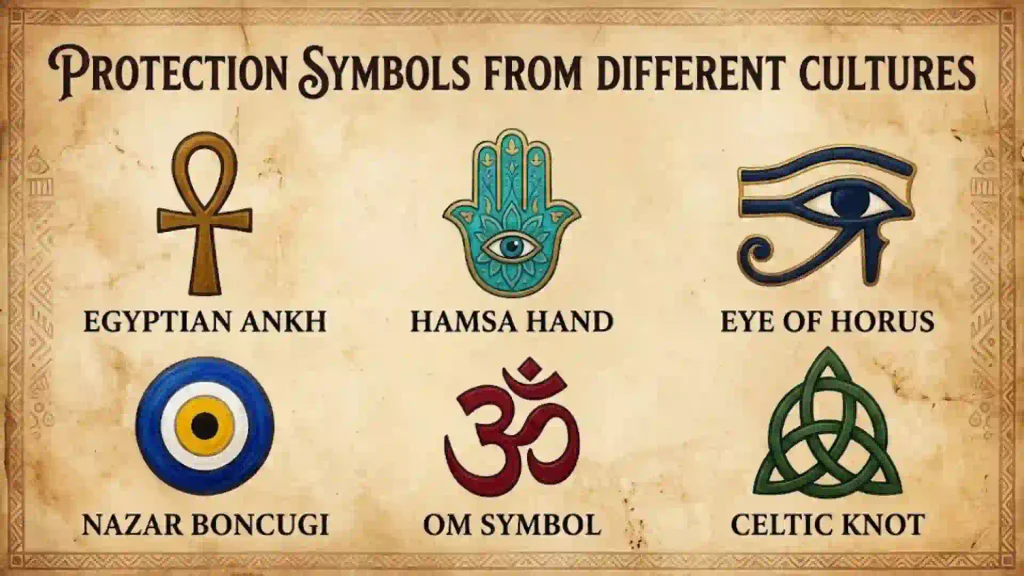
Protection symbols appear across many societies, but they did not all develop for the same reasons. Understanding their cultural backgrounds helps prevent confusion between symbols that look similar.
Ancient Egyptian Protection Symbols
Ancient Egyptian religious life included amulets, images of deities, and objects associated with health, renewal, and protection.
Two important examples are the Eye of Horus and the Ankh.
- The Eye of Horus represented a restored eye and became associated with healing, completeness, and protection.
- The Ankh represented life and appears in Egyptian religious art, often held by deities.
- Other Egyptian protective objects included amulets shaped like animals, deities, and sacred signs.
Archaeological collections show that Eye of Horus amulets were made from different materials and used across multiple periods of Egyptian history.
The Metropolitan Museum of Art
+1
These objects reveal how ancient Egyptians expressed religious beliefs through everyday items and funerary practices.
Celtic Protection Symbols
Celtic-inspired protection designs often feature interlaced lines, spirals, and repeating patterns.
The Triskelion and Celtic knotwork are especially popular in modern jewelry and tattoos. They are frequently interpreted through ideas of continuity, strength, cycles, and interconnectedness.
However, not every knot or spiral has a proven protective meaning. Some designs are known primarily through their artistic or archaeological context, while other interpretations developed much later.
When choosing a Celtic symbol, consider whether you want a historically documented design or a modern interpretation inspired by Celtic art.
Middle Eastern and North African Protection Symbols
The Hamsa hand and the Nazar Boncuk are widely recognized symbols associated with protection from the evil eye.
The Hamsa is a hand-shaped motif used in different cultural and religious settings. The Nazar Boncuk is especially associated with Turkish traditions and is commonly made as a blue glass bead.
Both appear in jewelry and home decorations, but they are not identical symbols. Their histories and cultural associations differ.
People may display them near entrances, wear them as pendants, or give them as gifts. Their significance can range from religious or cultural meaning to personal symbolism and decoration.
Hindu and Other Indian Religious Symbols
Om or Aum has a significant place in Hindu religious practice and is also meaningful in other Indian religious and philosophical contexts.
It is associated with sacred recitation, contemplation, and spiritual understanding. Its meaning is more specific than a general idea of good luck or protection.
Some people display Om in meditation areas or use it during religious practices. Others wear it as jewelry to express their faith or cultural connection.
Because Om is sacred to many practitioners, it is worth learning about its context rather than treating it as a purely decorative design.
Christian Protection Symbols
The Christian cross represents the crucifixion of Jesus Christ and carries central significance in Christian belief.
Many Christians associate the cross with salvation, hope, God’s love, and spiritual comfort. Some also connect it with protection through prayer and faith.
Crosses appear in churches, homes, cemeteries, and personal jewelry. Their significance depends on the beliefs and practices of the people who use them.
How to Use Protection Symbols in Everyday Life
People incorporate symbols of protection into everyday life in different ways. Some use them to express faith, others value their cultural history, and many appreciate their personal meaning.
Here are several common approaches.
Wear Protection Symbols as Jewelry
Necklaces, rings, bracelets, and pendants are popular ways to wear protective symbols.
A symbol can serve as a personal reminder of courage, faith, or a meaningful life experience. It can also represent a connection to a particular culture or tradition.
Common choices include:
- Eye of Horus jewelry: Often selected for its associations with healing and restoration.
- Hamsa necklaces: Commonly associated with blessings and protection from the evil eye.
- Nazar bracelets: Frequently worn as traditional evil-eye charms.
- Ankh pendants: Associated with life and ancient Egyptian symbolism.
- Cross necklaces: Often worn as an expression of Christian faith.
- Celtic knot jewelry: Sometimes chosen to represent heritage, continuity, or strength.
When purchasing symbolic jewelry, consider the design, materials, cultural background, and the meaning it holds for you.
Display Protection Symbols at Home
Some people display protective symbols in their homes to express their beliefs or create a meaningful environment.
For example, a Hamsa wall hanging may represent blessings, while a Tree of Life design can symbolize family connections and personal growth.
You might place a meaningful object:
- Near an entrance as a symbolic welcome or protective gesture.
- In a living room as a conversation piece.
- In a personal study or meditation space.
- On a shelf with other cultural or religious objects.
- In a bedroom as a reminder of comfort and peace.
There is no universal placement rule for every symbol. Follow the customs of the tradition it comes from when specific practices matter to you.
Use Symbols During Meditation or Reflection
Some people use a symbol as a focus for meditation, prayer, or personal reflection.
For example, the Flower of Life may remind someone of harmony and interconnectedness. Om may be used within a religious recitation or meditation practice. A cross can serve as a focus for Christian prayer.
You can also connect a symbol with a personal intention, such as becoming more resilient, practicing patience, or staying connected to your values.
A simple reflective practice might involve:
- Choosing a symbol that has a meaningful association.
- Learning about its cultural or religious background.
- Spending a few quiet minutes reflecting on its meaning.
- Connecting that meaning with a practical goal.
- Revisiting the goal when you need encouragement.
This approach treats the symbol as a tool for reflection rather than a guaranteed way to prevent harm.
How to Choose the Right Protection Symbol for You
The best protection symbol is one whose meaning you understand and respect. There is no single symbol that is universally best for everyone.
Use these questions to help you decide.
Consider What You Want the Symbol to Represent
Start by identifying the quality or belief you want the symbol to express.
| Your intention | Symbols to explore | Common association |
| Healing and renewal | Eye of Horus | Restoration and well-being |
| Protection from the evil eye | Hamsa or Nazar Boncuk | Traditional protective beliefs |
| Spiritual faith | Christian cross or Om | Religious devotion and spiritual connection |
| Strength and resilience | Tree of Life | Growth and stability |
| Balance and unity | Pentacle or Flower of Life | Harmony and interconnectedness |
| Life and renewal | Ankh | Life and vitality |
| Heritage and continuity | Triskelion or Celtic knotwork | Cycles, connection, and tradition |
These are starting points rather than strict rules. A symbol may have several meanings, and your interpretation may differ from someone else’s.
Learn About Its Cultural Background
Before wearing or displaying a symbol, research its origins and meaning.
This matters especially when a symbol belongs to a living religious tradition. A design that appears decorative to one person may be sacred to another.
Ask yourself:
- Which culture or tradition is associated with this symbol?
- What does it mean in that setting?
- Is the meaning historically documented or mainly modern?
- Are there customs about how the symbol should be used?
- Am I representing the symbol accurately and respectfully?
Understanding these details helps you make a more informed choice.
Choose a Design You Can Explain
A symbol becomes more meaningful when you understand why you chose it.
Instead of selecting a design solely because it looks mysterious or fashionable, learn what it represents. You may then decide to wear it, display it, or simply appreciate its historical significance.
You do not need to believe that a symbol has supernatural power to value its history or personal meaning.
How to Care for Protective Amulets and Symbolic Jewelry
If you own a protective amulet or symbolic piece of jewelry, basic care can help preserve it.
The appropriate method depends on the material. Glass beads, silver pendants, painted wood, gemstones, and delicate textiles require different care.
Clean It According to Its Material
- Metal jewelry: Follow the cleaning instructions for the specific metal and finish.
- Glass beads: Use a soft cloth and avoid harsh chemicals.
- Wooden objects: Keep them away from excess moisture unless the finish is designed for it.
- Painted or delicate items: Avoid abrasive cleaners that may damage the surface.
- Textiles: Follow the care instructions for the fabric and any decorative elements.
Do not assume that every amulet can safely be soaked in water, exposed to sunlight, or cleaned with salt.
Follow Tradition-Specific Practices Respectfully
Some religious and spiritual traditions include particular practices for caring for sacred objects. Others place greater emphasis on the object’s religious meaning than on physical cleansing rituals.
If an object belongs to a specific tradition, consult reliable guidance from that community rather than assuming one cleansing method applies to every symbol.
Most importantly, keep practical safety in mind. A charm or amulet should not replace appropriate precautions, medical treatment, security measures, or professional advice.
Can You Combine Different Protection Symbols?
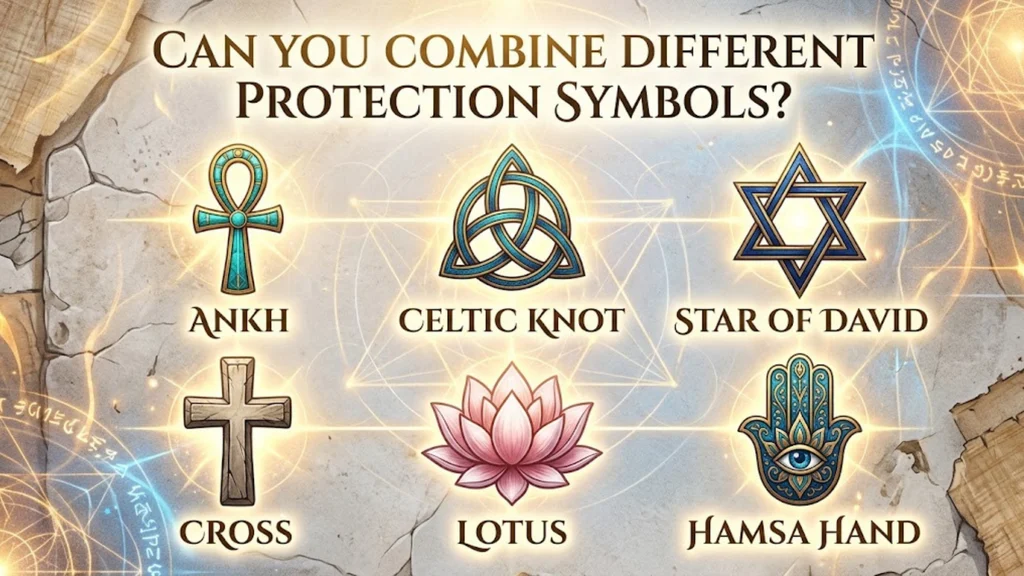
Yes, people sometimes combine symbols in jewelry, artwork, or personal spaces. However, combining them does not create a universally recognized protective effect.
For example, a piece of jewelry might feature a Tree of Life with a small geometric pattern. Someone may also display a Hamsa alongside other meaningful decorative objects.
If you want to combine symbols, consider these points:
- Understand each symbol individually. Learn its meaning before mixing it with other designs.
- Respect religious differences. Not every symbol has the same status or purpose across traditions.
- Avoid assuming compatibility. Some combinations may be meaningful to one person but inappropriate within another tradition.
- Keep your intention clear. Choose designs because their meanings matter to you, not because you expect more symbols to guarantee greater protection.
- Consider the visual design. A simple arrangement may communicate your intended meaning more clearly than a crowded collection.
There is no universal rule requiring people to use only one symbol. The important factors are cultural understanding, personal meaning, and respectful use.
Frequently Asked Questions About Protection Symbols
What Is the Most Powerful Protection Symbol?
There is no objectively established most powerful protection symbol. Different cultures and religious traditions attach different meanings to symbols such as the Eye of Horus, Hamsa, Nazar Boncuk, and Christian cross.
The best choice depends on the tradition you follow, the meaning you want to express, and your personal connection to the symbol. Claims about supernatural protection are matters of belief, not scientifically verified rankings.
Which Symbol Represents Protection From the Evil Eye?
The Hamsa hand and Nazar Boncuk are two well-known symbols traditionally associated with protection from the evil eye.
The Hamsa is a hand-shaped design used in different cultural and religious contexts. The Nazar Boncuk is a blue eye-shaped bead particularly associated with Turkish traditions.
Their meanings vary by community, and neither should be confused with the ancient Egyptian Eye of Horus.
What Is the Ancient Egyptian Symbol of Protection?
The Eye of Horus, also known as the Wedjat Eye, is one of the most recognizable ancient Egyptian protective symbols.
Ancient Egyptians used Wedjat amulets, which were associated with healing, restoration, and protection. Museum collections preserve examples dating back thousands of years.
The Metropolitan Museum of Art
+1
The Ankh is another famous Egyptian symbol, primarily associated with life and eternal life.
What Symbol Represents Spiritual Protection?
Several symbols are associated with spiritual protection, including the Hamsa, Eye of Horus, pentacle, and Christian cross. Their meanings depend on the traditions and beliefs in which they are used.
For Christians, the cross is a central symbol of faith. In modern Wiccan settings, the pentacle may represent spiritual balance and protection. These interpretations should not be treated as interchangeable.
Are Protection Symbols Religious?
Some protection symbols have strong religious connections, while others are primarily cultural, historical, decorative, or associated with modern spiritual practices.
The Christian cross and Om have important religious meanings. The Eye of Horus belongs to ancient Egyptian religious history, while the Nazar Boncuk is associated with cultural traditions surrounding the evil eye.
A symbol’s meaning depends on its context. It is best to learn about the specific tradition rather than label all protective symbols as belonging to one religion.
Can I Wear a Protection Symbol Without Believing in Its Power?
Yes. People wear symbolic jewelry for many reasons, including cultural identity, artistic appreciation, personal memories, and religious expression.
You can appreciate a symbol’s historical significance without believing that it has supernatural effects. However, if the symbol is sacred to a particular community, learning about its meaning can help you use it respectfully.
Do Protection Symbols Really Work?
Protection symbols can provide cultural meaning, personal reassurance, or a focus for religious practice. However, there is no reliable scientific evidence that wearing a symbol can independently prevent accidents, illness, misfortune, or supernatural harm.
A symbol may remind you to act with courage or stay connected to your values. For real-world safety, rely on appropriate precautions, professional care, and evidence-based practices.
Conclusion: Finding Meaning in Protection Symbols
Protection symbols connect people with stories, traditions, beliefs, and personal values. From the ancient Egyptian Eye of Horus to the Hamsa hand, Nazar Boncuk, Ankh, and Christian cross, each symbol has a distinct history and range of interpretations.
Some represent healing and renewal. Others express faith, strength, balance, or protection from the evil eye. Their significance depends on the cultural context and the people who use them.
When choosing a symbol, learn about its origins, understand its traditional meaning, and consider what it represents to you. You can wear it as jewelry, display it at home, or appreciate it as part of human history.
Ultimately, a symbol can be a meaningful reminder of your beliefs and intentions, even when its traditional protective powers are matters of faith rather than established fact.

Hi, I’m Asher Monroe, a writer who believes that meaningful words have the power to inspire change and bring people closer to their dreams. I have always been fascinated by the beauty of quotes and the way a simple message can provide motivation, hope, and comfort.
I enjoy creating content around inspirational quotes, life lessons, success stories, and positive thoughts that help readers find encouragement in their everyday lives. My goal is to share words that connect with people and remind them of their inner strength.
Through my writing, I explore the ideas of personal growth, confidence, and the importance of staying inspired through every chapter of life.
I am the author of Words That Move the Soul and The Path of Endless Inspiration, two books focused on the power of wisdom, positivity, and meaningful thoughts.
 Sienna Brooks
 Rowan Sinclair Rowan Sinclair