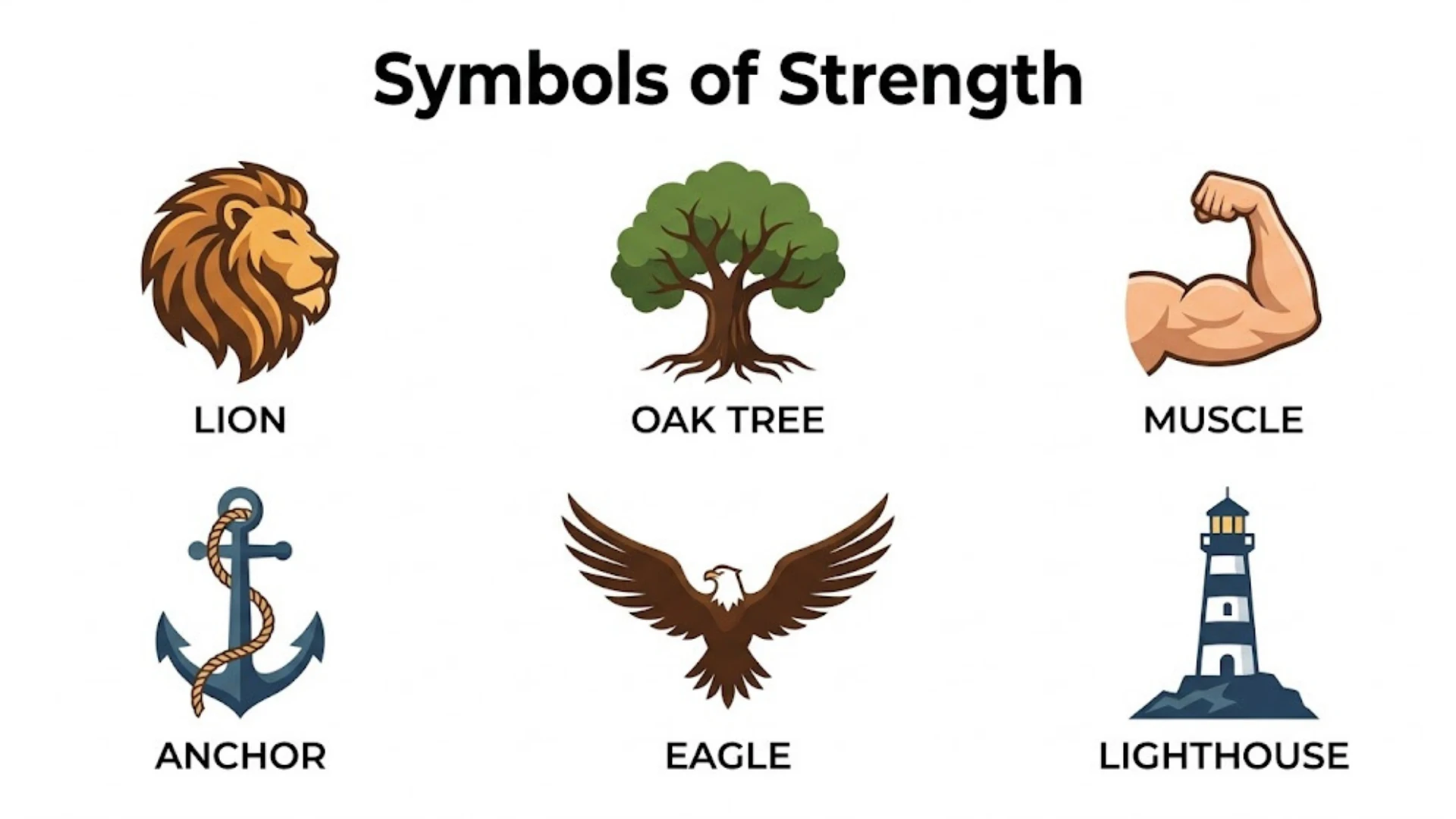
Strength means something different to everyone. For one person, it may mean having the courage to face a difficult challenge. For another, it may mean protecting loved ones, recovering after a painful experience, or staying true to personal values when life becomes uncertain.
Throughout history, people have used animals, plants, mythological heroes, and everyday objects to express these qualities. These images have become symbols of strength, representing physical power, courage, endurance, resilience, and personal growth.
Some symbols have well-established cultural or historical meanings. The lion appears in royal imagery and heraldry, the lotus holds deep religious significance in Hinduism and Buddhism, and Dwennimmen represents strength combined with humility in Akan Adinkra traditions. Other symbols, such as the phoenix and Kintsugi, have become popular ways to express recovery and transformation.
This guide explores more than 30 symbols of strength and their meanings, including their cultural backgrounds, common interpretations, and modern uses in tattoos, jewelry, and artwork.
What Do Symbols of Strength Represent?
Strength symbolism uses images, objects, animals, or stories to communicate qualities that people admire. These qualities may include courage, determination, protection, independence, endurance, and the ability to overcome adversity.
Strength isn’t limited to physical power. Someone can demonstrate strength by remaining calm during a crisis, adapting to an unexpected change, or asking for help when facing a difficult situation.
Here are the main types of strength represented by common symbols:
- Physical strength: Power, stamina, force, and the ability to perform demanding tasks.
- Mental strength: Focus, discipline, clear judgment, and determination.
- Emotional strength: The ability to acknowledge difficult feelings and respond constructively.
- Spiritual strength: Faith, purpose, inner peace, or commitment to spiritual development.
- Protective strength: The willingness to defend, support, and care for others.
- Moral strength: Integrity, humility, courage, and the ability to make difficult choices.
- Resilience: The ability to adapt to hardship and recover from setbacks.
- Perseverance: The determination to continue working toward a meaningful goal.
A single symbol can represent several qualities at once. For example, the oak tree often represents endurance and stability, while the phoenix is commonly interpreted as a symbol of renewal after hardship.
However, cultural symbols of strength don’t always have universal meanings. An image may carry a specific religious or historical meaning in one tradition and a more personal interpretation in another.
Understanding that distinction helps you appreciate a symbol’s original context without overlooking its modern meaning.
Symbols of Strength and Their Meanings at a Glance
If you want a quick answer, this table compares some of the most recognizable powerful symbols of strength.
| Symbol | Common symbolic meaning | Type of strength |
| Lion | Courage, leadership, nobility | Physical and personal |
| Bear | Power, protection, endurance | Physical and protective |
| Bull | Force, stamina, determination | Physical |
| Eagle | Freedom, authority, vision | Leadership and independence |
| Wolf | Loyalty, survival, cooperation | Social and emotional |
| Oak tree | Stability, endurance, longevity | Long-term resilience |
| Lotus flower | Purity, spiritual growth | Spiritual and emotional |
| Bamboo | Flexibility, integrity, adaptability | Mental and emotional |
| Mountain | Stability, achievement, perseverance | Mental and personal |
| Phoenix | Rebirth, hope, transformation | Recovery and resilience |
| Hercules | Heroic effort and extraordinary strength | Physical and moral |
| Dwennimmen | Strength balanced with humility | Character and self-control |
| Anchor | Hope, stability, steadfastness | Emotional and spiritual |
| Sword | Courage, defense, authority | Protective and martial |
| Shield | Protection and responsibility | Protective |
| Kintsugi | Repair, acceptance, transformation | Recovery and personal growth |
These are common interpretations, not universal definitions. A symbol’s meaning can change depending on the culture, historical period, artwork, or personal experience associated with it.
Animal Symbols of Strength and Their Meanings
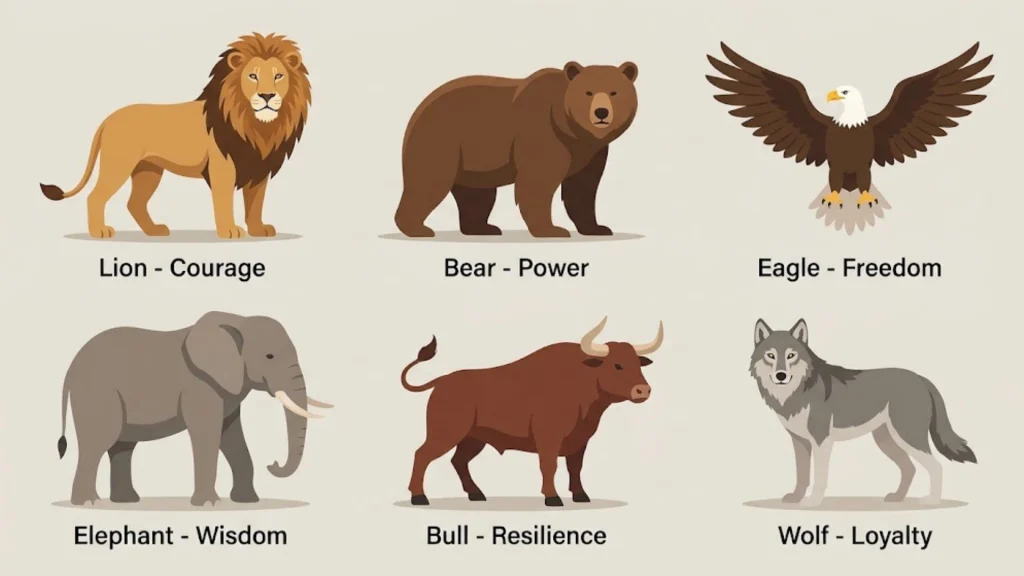
Animals have represented strength in mythology, folklore, religious art, and heraldry for centuries. Their physical characteristics and observed behaviors often influence the qualities people associate with them.
Lion Symbolism: Courage, Leadership, and Authority
The lion is one of the most recognizable animal symbols of strength. Its powerful build and commanding appearance have made it an enduring image of courage, leadership, and authority.
Lions appear in ancient Mediterranean art, royal imagery, monumental sculpture, and European heraldry. A lion on a coat of arms may communicate bravery, nobility, or authority, depending on the design and historical setting.
Lion symbolism commonly represents:
- Courage when facing danger
- Leadership and responsibility
- Confidence and authority
- Physical power and determination
- Protection of family or community
In modern designs, a lion tattoo may represent confidence, personal achievement, or the willingness to take responsibility for others.
The lion can also represent controlled power. A strong leader doesn’t need to use aggression to demonstrate authority. Sometimes, strength means making thoughtful decisions and protecting people who depend on you.
The lioness is frequently used in modern imagery as a symbol of female strength, determination, and protective care. These interpretations are popular today, although the exact meaning depends on the design and context.
Bear Symbolism: Power, Protection, and Endurance
The bear is associated with physical power, survival, and endurance. Bears also appear in stories and traditions involving protection, transformation, and relationships between people and nature.
Bear symbolism can communicate:
- Physical power and stamina
- Protection and parental care
- Independence and self-reliance
- Courage during difficult situations
- Adaptability and survival
A bear may represent protective strength rather than aggression. Someone might connect the animal with caring for family members or standing up for people who need support.
Bear symbolism varies across cultures. Some traditions portray bears as powerful spiritual beings, while other stories present them as dangerous animals. Researching a specific tradition provides a more accurate understanding than assuming bears have one universal meaning.
Bull Symbolism: Physical Power and Determination
The bull has represented physical force, vitality, fertility, and stamina in different historical traditions. Its strength also made it important in agricultural societies, where cattle supported farming and everyday life.
Bull imagery appears in ancient Mediterranean and Near Eastern art and mythology. Depending on the context, it could communicate prosperity, royal power, fertility, or dangerous force.
Bull symbolism commonly represents:
- Physical strength and stamina
- Determination and persistence
- Confidence and assertiveness
- Power and dominance
- Vitality and productivity
A bull can be a meaningful symbol for someone who values hard work and persistence. However, it can also suggest stubbornness or aggression. The surrounding design helps determine which qualities receive the most attention.
Eagle Symbolism: Freedom, Vision, and Authority
The eagle is a powerful bird of prey known for its keen eyesight and ability to soar at great heights. These qualities have helped make the eagle a symbol of freedom, vision, independence, and authority.
The bald eagle is the national emblem of the United States. Eagle imagery also appears in political symbols, military insignia, heraldry, and historical art.
Common eagle symbolism includes:
- Freedom and independence
- Vision and clear judgment
- Leadership and authority
- Courage and ambition
- Strength and determination
The eagle can represent the ability to see beyond immediate problems and maintain a wider perspective. Someone might choose an eagle design to express independence or a commitment to ambitious goals.
Its meaning isn’t identical across cultures. The species, artwork, historical setting, and cultural tradition all influence its interpretation.
Wolf Symbolism: Loyalty, Survival, and Resilience
Wolves are social animals that cooperate within family groups. Their adaptability, survival strategies, and relationships have influenced their portrayal in folklore and modern symbolism.
The wolf can represent both independence and connection with others. This combination highlights an important idea: strength doesn’t always require working alone.
Common wolf symbolism includes:
- Loyalty and cooperation
- Survival and adaptability
- Endurance and persistence
- Independence and self-reliance
- Protection of family or community
A wolf tattoo might represent loyalty to loved ones or the ability to survive difficult circumstances. In another context, the wolf may symbolize freedom or a desire to live independently.
Wolves also appear as dangerous figures in many folktales. Their varied portrayals show how animal symbols can communicate both admired qualities and cultural fears.
Ram’s Horns Symbolism: Determination and Resolve
Ram’s horns can represent physical force, persistence, and the willingness to face resistance. Rams use their horns when competing with other rams, making them recognizable images of strength.
Their most culturally specific connection in this guide is Dwennimmen, an Akan Adinkra symbol associated with strength and humility.
Outside that tradition, ram imagery may communicate determination or assertiveness. However, these general associations shouldn’t be confused with Dwennimmen’s specific cultural meaning.
Other Animals That Represent Strength
Several other animals can communicate different forms of strength.
- Elephant: Associated with power, wisdom, protection, or good fortune in selected cultural traditions.
- Horse: Often represents stamina, freedom, movement, and endurance.
- Tiger: Can symbolize courage, authority, and power in particular Asian traditions.
- Lioness: Commonly represents protective leadership and determination in modern imagery.
- Ram: Can represent persistence, assertiveness, and the ability to face resistance.
The best animal symbol depends on the quality you want to express. A lion may suit leadership, a bear may suggest protection, and a wolf may communicate loyalty and survival.
Nature Symbols of Strength and Resilience
Nature offers powerful examples of endurance and adaptation. Trees survive for decades or centuries, bamboo bends in strong winds, and mountains remain prominent through changing weather.
These features inspire symbols of strength and resilience because they help people visualize qualities that are otherwise difficult to describe.
Oak Tree Symbolism: Endurance and Stability
The oak tree is widely associated with strength, longevity, and stability. Its durable wood and long life have helped make it a lasting symbol in European traditions and modern decorative imagery.
Oak trees have carried religious, ceremonial, and political significance in some historical settings. Oak leaves and branches also appear in military awards, civic designs, and other emblems that communicate honor, achievement, or endurance.
Oak tree symbolism commonly includes:
- Stability and reliability
- Endurance through difficult conditions
- Longevity and resilience
- Strong foundations and personal values
- Protection and steadfastness
Oak roots offer another useful metaphor. A tree needs a strong foundation to remain upright as it grows. In the same way, people often rely on their values, relationships, and experience when facing challenges.
The oak is an excellent choice for someone who wants to represent lasting strength rather than a brief display of power.
Lotus Flower Symbolism: Resilience and Spiritual Growth
The sacred lotus has deep religious significance in Hinduism and Buddhism. Depending on the tradition, it can represent purity, divinity, and spiritual development. The Royal Botanic Gardens, Kew, explains that lotus flowers feature prominently in Asian religious art and are associated with purity and divinity in these traditions. Kew’s sacred lotus guide.
Lotus plants grow from muddy environments and produce flowers that rise above the water. This growth pattern has inspired modern interpretations of the lotus as a symbol of rising above hardship.
Lotus flower symbolism may represent:
- Spiritual growth and enlightenment
- Purity in relevant religious traditions
- Renewal and personal development
- Growth through challenging conditions
- The possibility of moving forward after difficulty
The lotus can be meaningful for someone who views growth as a gradual process. It serves as a reminder that development remains possible during difficult times.
However, the lotus isn’t simply a generic symbol of resilience. Its religious importance should be respected when using it in artwork, tattoos, or jewelry.
Bamboo Symbolism: Flexibility and Integrity
Bamboo is associated with flexibility, resilience, and integrity in selected East Asian artistic and cultural traditions. Its tall, upright form and ability to bend in the wind make it a useful image for strength that doesn’t depend on rigidity.
Bamboo offers an important lesson: being flexible doesn’t mean being weak. A person can adjust a plan, accept new information, or change direction while remaining committed to important values.
Bamboo symbolism commonly includes:
- Adaptability under pressure
- Integrity and upright character
- Patience and steady growth
- Mental resilience
- Strength without unnecessary aggression
Bamboo can represent the ability to respond to change without losing direction. It’s especially suitable for people who value patience, flexibility, and self-control.
Its meanings differ across East Asian traditions, so culturally specific designs should be researched within their own contexts.
Mountain Symbolism: Stability and Perseverance
Mountains often symbolize endurance because they remain prominent despite changing weather and seasons. Their steep paths also make them natural images of difficult goals and long journeys.
A mountain summit can represent achievement after sustained effort. The climb may be challenging, but reaching the top becomes a reminder of what persistence can accomplish.
Mountain symbolism commonly represents:
- Stability and strength
- Perseverance through obstacles
- Ambition and achievement
- Mental determination
- Perspective and personal growth
Mountain imagery is popular in tattoos, travel artwork, and motivational designs. Someone who has completed a demanding project or reached a meaningful life goal may use a mountain to represent that achievement.
Mountains also carry religious and spiritual significance in many traditions. Their meanings can involve sacred places, revelation, solitude, or closeness to the divine. These associations should be explained within their specific cultural contexts.
Other Flowers and Trees That Represent Strength
Different plants can communicate different qualities, although their meanings often depend on regional traditions and modern floral symbolism.
| Plant | Common association | Possible interpretation |
| Gladiolus | Strength and integrity in floral symbolism | Standing firm in your values |
| Sunflower | Optimism and vitality in modern interpretations | Maintaining hope |
| Cedar | Durability and longevity in particular traditions | Lasting strength |
| Olive tree | Peace, longevity, and renewal in selected traditions | Strength guided by peace |
| Lotus | Spiritual growth and purity in relevant traditions | Transformation and development |
| Oak | Stability and endurance | Building strong foundations |
These associations aren’t universal definitions. When selecting a flower or tree, consider its cultural history as well as the message you personally want to communicate.
Phoenix Symbolism: Rebirth, Hope, and Transformation
The phoenix is a legendary bird associated with renewal and rebirth. In the familiar modern version of the story, the bird dies or burns and then rises from its ashes.
The phoenix’s history is more complex than one universal legend. Ancient Mediterranean traditions contributed to its symbolic development, while later literature and popular culture helped spread the familiar image of rebirth through fire.
Today, phoenix symbolism commonly represents:
- Recovery after hardship
- Renewal and transformation
- Hope after loss
- Starting again after failure
- Personal growth through change
The phoenix is particularly meaningful for people who have experienced a major transition. It can symbolize rebuilding a life, developing a new identity, or moving forward after a difficult chapter.
However, the symbol shouldn’t suggest that every painful experience automatically makes someone stronger. Recovery can take time, and people may need support along the way.
A phoenix tattoo is often chosen to mark a personal turning point. Its image can acknowledge the past without allowing the past to define the future.
Ancient Symbols of Strength and Heroic Power
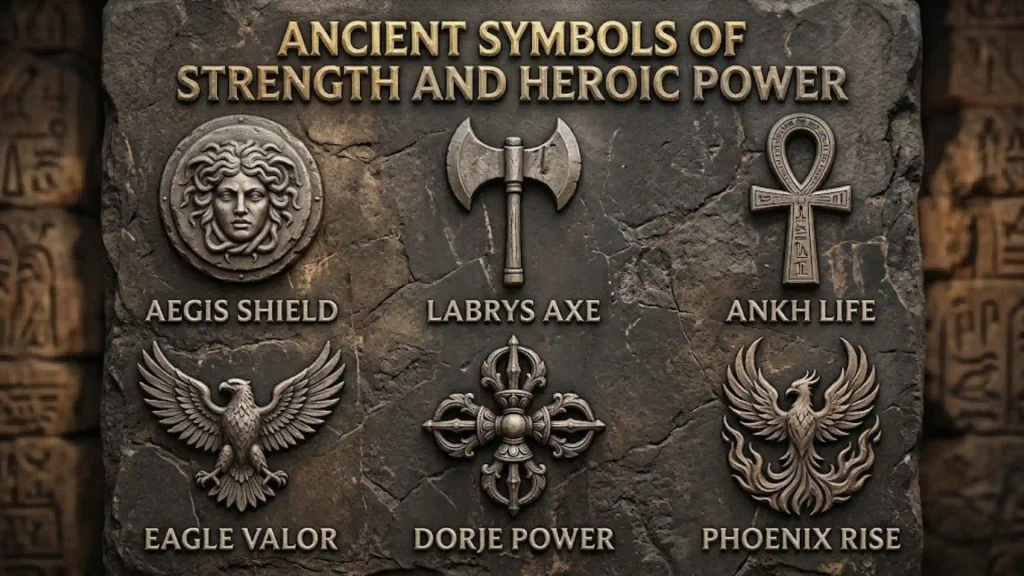
Ancient mythology contains stories about extraordinary heroes, dangerous creatures, and difficult challenges. These stories helped people explore courage, duty, power, and the limits of human ability.
Hercules and Heracles in Greek Mythology
Hercules is the Roman name for the Greek hero Heracles. Both names refer to the famous mythological figure known for extraordinary strength and the Twelve Labors.
In Greek mythology, Heracles faced a series of dangerous tasks that tested more than physical power. The stories also involve endurance, resourcefulness, determination, and the ability to confront seemingly impossible challenges.
Hercules symbolism commonly represents:
- Extraordinary physical strength
- Courage in the face of danger
- Persistence through demanding tasks
- Heroic effort and determination
- The struggle to overcome personal limitations
The Twelve Labors are important because they show strength in action. The hero must complete difficult tasks rather than simply possess impressive muscles.
Hercules and Heracles are mythological figures, not verified historical individuals. Their importance lies in the stories and values associated with them.
The Nemean Lion and Heroic Courage
The Nemean lion is a creature from Greek mythology and the first opponent Heracles had to overcome during his Twelve Labors. The story describes a dangerous beast that threatened the surrounding region.
The episode represents a specific kind of strength: using courage and resourcefulness to face a formidable challenge.
The Nemean lion can therefore symbolize:
- Facing fear directly
- Overcoming a powerful obstacle
- Resourcefulness under pressure
- Heroic courage and determination
This is different from general lion symbolism. The ordinary lion may represent leadership or nobility, while the Nemean lion belongs to a specific mythological story.
Greek and Roman Symbols of Strength
Greek and Roman traditions used heroes, gods, animals, and objects to express different kinds of power. These meanings often overlapped with ideas about wisdom, justice, authority, and duty.
Heracles and Hercules are clear examples of physical and heroic strength. Other mythological figures may represent strategic thinking, protection, or authority rather than raw force.
When studying Greek mythology symbols or Roman imagery, ask what kind of strength the story emphasizes. Some heroes succeed through physical force, while others rely on planning, intelligence, or self-control.
Ancient symbols also appeared in architecture, sculpture, coins, and civic imagery. Their use could communicate religious devotion, political authority, or community identity.
African Symbols of Strength and Their Meanings
African cultures contain many distinct languages, artistic traditions, religions, and symbol systems. There is no single set of symbols that represents the entire continent.
One well-documented example is Dwennimmen, an Akan Adinkra symbol associated with strength and humility.
Dwennimmen: Strength Balanced With Humility
Dwennimmen means “ram’s horns” and belongs to the Akan Adinkra tradition of Ghana. The Smithsonian’s National Museum of African Art identifies the design as a symbol of humility combined with strength. See the Smithsonian’s Dwennimmen collection record.
The design resembles a pair of ram’s horns. The ram provides an image of force and determination, while the symbol’s message emphasizes that strength should exist alongside humility.
Dwennimmen represents several connected qualities:
- Strength without arrogance
- Courage balanced with humility
- Self-control and restraint
- Power guided by wisdom
- Respect for others despite personal ability
This makes Dwennimmen different from symbols that focus mainly on dominance or victory. It suggests that a strong person doesn’t need to prove superiority at every opportunity.
A leader, for example, may have the authority to make decisions while still listening carefully to other people. A skilled athlete may demonstrate confidence while respecting opponents. These examples reflect the modern application of the symbol’s central idea.
Akan Adinkra Symbols and Cultural Meaning
Adinkra symbols form a visual vocabulary associated with Akan cultural traditions. They have been used in textiles and other forms of artistic expression to communicate ideas, values, and messages.
Historically, Adinkra cloth had particular ceremonial associations, including funerary use among the Asante. Today, Adinkra designs appear in a broader range of textiles, decorative objects, and artistic contexts.
Dwennimmen is one example of how a design can communicate a moral principle through a recognizable image. Other Adinkra symbols express different concepts, such as cooperation, security, or learning from the past.
When discussing African symbols of strength, identify the specific community and tradition involved. Dwennimmen is an Akan symbol, not a universal symbol shared by all African cultures.
Its meaning is especially useful when exploring strength and humility in symbolism. It shows that power and modesty can support each other rather than compete.
Japanese Symbols of Resilience
Japanese art and craft traditions include objects that can communicate patience, care, and transformation. Kintsugi is a particularly well-known example because it turns the repair of broken pottery into a visible part of the object’s appearance.
Kintsugi Symbolism: Strength Through Repair
Kintsugi is a Japanese technique for repairing broken ceramics using lacquer, often finished with powdered gold. Rather than hiding cracks, the repair makes them visible.
Japan House London describes Kintsugi as a centuries-old technique that uses Japanese lacquer, known as urushi, and metallic powder to restore ceramics. The exact origins are uncertain, but the practice is associated with Japan’s Muromachi period, which lasted from 1336 to 1573. Read Japan House London’s Kintsugi guide.
The repaired vessel remains useful, and its visible lines become part of its history. This has inspired modern interpretations of Kintsugi symbolism as a way of understanding recovery and personal transformation.
Kintsugi can represent:
- Acceptance of imperfections
- Recovery after damage or loss
- The value of experience
- Transformation rather than concealment
- Beauty in a repaired object
The metaphor is powerful because it doesn’t suggest that the break never happened. Instead, the repair becomes part of the object’s story.
For someone recovering from a difficult experience, Kintsugi-inspired artwork may serve as a reminder that healing doesn’t require pretending the past was painless.
Still, Kintsugi is first and foremost a skilled craft with a real material history. Its modern use as a metaphor for emotional healing is an interpretation, not the only meaning of the tradition.
Bamboo and Resilience in East Asian Traditions
Bamboo is another useful symbol of adaptability and integrity in East Asian art and literature. Its ability to bend without immediately snapping has inspired comparisons with people who respond to pressure without abandoning their values.
Bamboo imagery may communicate patience, flexibility, uprightness, and steady growth. These associations vary by cultural setting, so Japanese symbolism shouldn’t automatically be treated as identical to Chinese or other East Asian traditions.
Together, bamboo and Kintsugi offer two different ways to understand resilience. Bamboo represents adapting under pressure, while Kintsugi represents repair after something has broken.
Both can remind us that strength doesn’t always mean remaining unchanged.
Objects That Symbolize Strength, Courage, and Protection
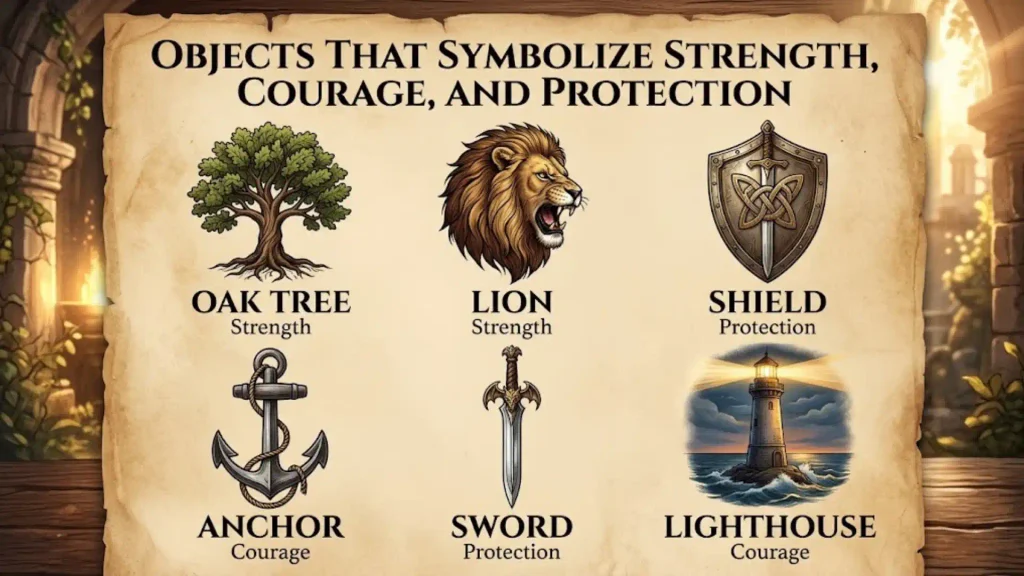
Objects can become symbols when their practical function or historical use connects them with a broader idea. Anchors, swords, and shields are particularly recognizable examples.
Anchor Symbolism: Stability, Hope, and Steadfastness
An anchor helps keep a vessel in position. Its practical purpose has made it a natural symbol of stability, security, and steadfastness.
Anchor symbolism also appears in Christian imagery, where the anchor has been associated with hope. Its precise meaning depends on the design and context.
Common interpretations include:
- Stability during uncertainty
- Hope during difficult times
- Loyalty and commitment
- Emotional steadiness
- Remaining grounded during change
An anchor necklace may serve as a reminder of family, faith, personal values, or a relationship that provides support.
The anchor is particularly suitable for someone who wants a symbol of strength without aggression. It represents the ability to remain grounded rather than the need to overpower others.
Sword Symbolism: Courage, Justice, and Authority
The sword has represented combat, defense, authority, and honor in different historical traditions. Its meaning depends heavily on how it appears in an artwork, emblem, story, or ceremonial object.
Sword symbolism may represent:
- Courage and readiness to act
- Defense and protection
- Authority or command
- Justice in specific symbolic contexts
- Conflict, danger, or the use of force
In heraldry and historical art, a sword may communicate the power or responsibility of a ruler, warrior, or institution. It can also represent the duty to defend a community.
However, sword symbolism isn’t always positive. A sword may suggest violence or domination when the context emphasizes conquest or aggression.
This distinction matters because symbols of courage and resolve can communicate different values depending on whether they emphasize protection, justice, or force.
Shield Symbolism: Protection and Responsibility
The shield represents defense. Historically, shields protected people during combat, and their designs often became recognizable markers of identity in heraldry.
Today, a shield may symbolize protection, safety, responsibility, and the willingness to defend others.
Unlike the sword, which can communicate both attack and defense, the shield focuses more directly on preventing harm.
A shield can therefore represent:
- Protecting loved ones
- Maintaining healthy boundaries
- Taking responsibility for others
- Defending important principles
- Offering security during uncertainty
This makes the shield a meaningful symbol of protective strength. It suggests that strength isn’t measured only by what someone can defeat, but also by what they can protect.
Symbols of Inner Strength: Mental, Emotional, and Spiritual Resilience
Some of the most meaningful symbols of inner strength represent patience, self-control, and recovery rather than physical force.
These symbols can act as personal reminders of the qualities people want to practice in everyday life.
Symbols of Mental Strength
Mental strength involves focus, persistence, sound judgment, and the ability to make decisions under pressure. It doesn’t mean never feeling fear or doubt.
Several symbols can represent these qualities:
- Mountain: Persistence toward a challenging goal.
- Bamboo: Flexibility and the ability to adapt.
- Oak tree: Stability and strong foundations.
- Anchor: Steadiness during uncertainty.
A mountain may remind someone to break a large goal into smaller steps. Bamboo can represent the willingness to change a plan when circumstances shift. An anchor may encourage someone to return to their core values before making a difficult decision.
These interpretations turn abstract ideas into memorable images.
Symbols of Emotional Strength
Emotional strength means acknowledging feelings, responding thoughtfully, and recovering at a pace that works for the individual. It doesn’t require hiding sadness, avoiding help, or acting as though nothing hurts.
The phoenix, lotus, and Kintsugi can all represent emotional resilience in modern interpretations.
The phoenix represents renewal after a difficult chapter. The lotus can symbolize growth through challenging conditions, while Kintsugi provides an image of repair that leaves the history of damage visible.
These symbols can be meaningful reminders, but they aren’t substitutes for practical support. Emotional recovery may involve rest, trusted relationships, professional help, or changes in difficult circumstances.
Symbols of Spiritual Strength
Symbols of spiritual strength often connect people with faith, purpose, values, or a sense of belonging.
The lotus has important meanings in Hindu and Buddhist traditions, including purity and spiritual development. The anchor has been used as a symbol of hope in Christian contexts.
Other spiritual symbols may represent endurance, wisdom, devotion, or the search for meaning. Their significance should be explained within the relevant tradition rather than assigned a universal definition.
For many people, spiritual strength means continuing to act according to their beliefs during uncertainty. For others, it means maintaining a sense of purpose, practicing compassion, or finding peace through reflection.
Symbols of Strength Without Violence
Strength doesn’t have to involve fighting, domination, or intimidation. Many symbols communicate the ability to remain steady, adapt, protect others, or recover after hardship.
Consider these examples:
- Bamboo: Flexibility and adaptability.
- Oak tree: Stability and endurance.
- Lotus: Spiritual growth and renewal.
- Kintsugi: Repair and acceptance.
- Dwennimmen: Strength balanced with humility.
- Anchor: Hope and steadfastness.
These are useful symbols of strength without violence because they focus on qualities that help people manage challenges without harming others.
Quiet strength can appear in many everyday situations. It may mean refusing to respond to an insult with cruelty, admitting a mistake, asking for help, or staying committed to a worthwhile goal.
Symbols of Female Strength
Symbols of female strength often communicate courage, independence, wisdom, protection, and renewal. Some have established historical or mythological backgrounds, while others have become popular through modern art and personal interpretation.
Lioness
The lioness is often used as a symbol of courage, determination, leadership, and protective care. In modern imagery, it may represent a woman’s commitment to her family, ambitions, or personal values.
Athena
Athena is a goddess in Greek mythology associated with wisdom, strategic skill, and warfare. She can represent strength guided by intelligence and judgment rather than physical force alone.
Lotus Flower
The lotus has established religious significance in Hinduism and Buddhism. In contemporary personal symbolism, it may also represent growth, renewal, or moving forward after a difficult experience.
Phoenix
The phoenix is a popular modern symbol of transformation and recovery. It may represent rebuilding after a setback or beginning a new chapter.
No symbol belongs exclusively to one gender. The most meaningful choice is the one that reflects the qualities and experiences a person wants to honor.
Strength Symbols in Tattoos, Art, and Jewelry
Strength symbols are popular in tattoos, pendants, bracelets, paintings, and other personal designs. They offer a way to express an important value or remember a meaningful life experience.
Best Symbols of Strength for Tattoos
The following comparison can help you choose a design that matches your intention.
| Tattoo symbol | Common interpretation | Best suited to |
| Lion | Courage and leadership | Confidence and responsibility |
| Phoenix | Rebirth and transformation | A new beginning after hardship |
| Oak tree | Stability and endurance | Long-term resilience |
| Lotus | Spiritual growth and renewal | Personal or spiritual development |
| Mountain | Perseverance and achievement | Working toward a major goal |
| Bamboo | Flexibility and integrity | Adaptability and self-control |
| Anchor | Hope and stability | Faith, commitment, or grounding |
| Dwennimmen | Strength and humility | Power guided by modesty |
| Kintsugi-inspired design | Repair and acceptance | Recovery and personal transformation |
| Shield | Protection and responsibility | Family, boundaries, or service |
A good tattoo should communicate the intended meaning without relying on an inaccurate description of its origins.
For culturally specific symbols, research the design and its community before using it. This is especially important when a symbol has religious, ceremonial, or historical significance.
Strength Symbols in Jewelry and Everyday Art
Jewelry can make a symbol part of everyday life. An anchor necklace may represent hope, while a lion pendant may communicate courage or leadership.
Other options include oak leaves, mountain outlines, lotus pendants, and phoenix designs. Each can carry a personal meaning beyond its popular interpretation.
A meaningful keepsake doesn’t need to be ancient or universally recognized. It may be an object connected to a personal achievement, a loved one, or a difficult period that you survived.
When combining multiple symbols in artwork, consider how their meanings work together. A mountain and an anchor, for example, might communicate ambition balanced with stability. A phoenix and an oak tree could represent renewal built on strong foundations.
How to Choose a Meaningful Symbol of Strength
The best symbol depends on what strength means in your life. Before choosing a tattoo, piece of jewelry, or artwork, identify the quality you want the image to represent.
Use these steps to narrow your options:
- Choose the quality: Decide whether you want to express courage, protection, stability, adaptability, recovery, or leadership.
- Match the image to the meaning: Consider a lion for courage, an oak tree for endurance, or Kintsugi-inspired artwork for recovery.
- Research the background: Check whether the design has a documented historical, cultural, or religious meaning.
- Consider your personal connection: A symbol linked to an important experience may feel more meaningful than a popular design.
- Think about the context: A tattoo, pendant, memorial object, and piece of wall art may communicate the same symbol differently.
- Avoid unsupported claims: Don’t assume a design is ancient or universal just because a website describes it that way.
Most importantly, remember that a symbol represents a value; it doesn’t create that quality by itself. A mountain tattoo can’t replace persistence, and an anchor pendant can’t guarantee emotional stability. Their value comes from the meaning you give them and the actions they remind you to take.
Frequently Asked Questions About Symbols of Strength
What are the most powerful symbols of strength?
The lion, bear, oak tree, phoenix, mountain, and Dwennimmen are popular examples. Each communicates a different kind of strength, from physical power and leadership to resilience, renewal, and humility. No single symbol is the most powerful across every culture.
What do symbols of strength represent?
They can represent physical power, courage, endurance, protection, mental determination, emotional resilience, spiritual growth, and the ability to recover after adversity. Their meanings depend on cultural history and personal interpretation.
What animal symbolizes strength and courage?
The lion is a widely recognized symbol of courage and leadership. The bear often represents power and protection, while the bull can represent physical force and determination. The most suitable choice depends on the quality you want to emphasize.
Which animal symbolizes inner strength?
The wolf can represent survival, loyalty, and adaptability. The bear may communicate self-reliance and protection, while the lioness is often used in modern imagery to represent determination and protective leadership.
What flower symbolizes strength and resilience?
The lotus is a popular choice, particularly because its growth from muddy environments has inspired modern interpretations of resilience. It also has important religious meanings in Hinduism and Buddhism, where its symbolism includes purity and spiritual development.
What tree symbolizes strength and endurance?
The oak tree is commonly associated with endurance, stability, and longevity. Its durable wood and long life have helped establish it as a symbol of lasting strength in several European traditions and modern designs.
What is a symbol of strength after hardship?
The phoenix and Kintsugi are two popular examples. The phoenix represents renewal and rebirth, while Kintsugi-inspired imagery represents repair, acceptance, and transformation after damage.
What is an ancient symbol of strength?
There isn’t one ancient symbol shared by all cultures. Historical examples include lions in ancient art and heraldry, as well as Heracles in Greek mythology. Their meanings differ according to the story, period, and culture.
What is an African symbol of strength?
Dwennimmen is an Akan Adinkra symbol from Ghana that represents strength combined with humility. It is associated with ram’s horns and communicates the idea that genuine strength should be balanced with modesty.
What does the oak tree symbolize?
The oak tree commonly represents stability, endurance, longevity, and strong foundations. Its exact meaning varies across traditions, and oak imagery has also appeared in civic, military, and decorative designs.
What does the phoenix symbolize in life?
The phoenix is commonly interpreted as a symbol of rebirth, renewal, hope, and transformation. In modern personal symbolism, it often represents beginning again after a difficult experience.
What does the lotus flower represent spiritually?
The lotus has important meanings in Hinduism and Buddhism, including purity and spiritual development. Its precise significance depends on the religious tradition and the context in which it appears.
What does bamboo symbolize in Asian cultures?
Bamboo is associated with flexibility, integrity, and resilience in selected East Asian traditions. Its ability to bend in the wind has also inspired modern interpretations of adapting to pressure without abandoning important values.
What does the anchor symbolize during difficult times?
The anchor commonly represents stability, hope, and steadfastness. In Christian symbolism, it has also been associated with hope. In personal jewelry, it may serve as a reminder of faith, commitment, or emotional grounding.
What does the sword symbolize in heraldry?
A sword may represent courage, defense, authority, honor, or justice, depending on the particular emblem and tradition. It can also represent conflict or force, so the surrounding design matters.
How does Kintsugi symbolize strength and recovery?
Kintsugi repairs broken pottery with lacquer and often highlights the cracks with powdered gold. Its modern metaphor emphasizes acceptance, repair, and transformation rather than hiding the object’s history.
What is the difference between strength, courage, and resilience?
Strength refers broadly to the capacity to withstand or manage challenges. Courage means facing fear or difficulty, while resilience describes the ability to adapt or recover after adversity. These qualities often work together.
What is the difference between physical strength and inner strength?
Physical strength concerns bodily power and the ability to perform physical tasks. Inner strength involves qualities such as determination, emotional resilience, self-control, sound judgment, and the willingness to act according to one’s values.
Which symbols represent strength without violence?
Bamboo, the oak tree, the lotus, Kintsugi-inspired designs, and Dwennimmen can communicate strength without focusing on aggression. Their common interpretations emphasize flexibility, endurance, recovery, and humility.
What symbol represents mental strength?
The mountain, bamboo, oak tree, and anchor can all represent aspects of mental strength. A mountain may suggest perseverance, bamboo can represent adaptability, the oak tree suggests stability, and the anchor can communicate steadiness.
What symbol represents female strength?
The lioness, Athena, lotus, and phoenix are popular choices in modern interpretations of female strength. They can represent courage, wisdom, personal growth, and renewal, although none is limited exclusively to women.
What is a symbol of strength in Christianity?
The anchor is associated with hope in Christian symbolism. Other symbols may communicate faith, protection, or spiritual endurance depending on the denomination, historical period, and specific religious context.
What are the best strength symbols for tattoos?
Popular choices include the lion, phoenix, oak tree, lotus, mountain, bamboo, anchor, and Dwennimmen. Choose a symbol that matches your intended meaning, and research culturally specific designs before using them.
How do cultures represent strength through animals?
Cultures use animal imagery in mythology, folklore, religious art, heraldry, and ceremonial designs. Lions may communicate courage or authority, while other animals can represent protection, endurance, loyalty, or spiritual qualities. These meanings vary between traditions.
Are all symbols of strength based on ancient traditions?
No. Some symbols have long histories, while others gained meaning through modern literature, art, jewelry, and personal experiences. Kintsugi, for example, is a historical Japanese craft that has also inspired modern interpretations of emotional recovery.
Conclusion: Finding a Symbol That Represents Your Strength
Symbols of strength and their meanings offer different ways to understand courage, endurance, protection, and personal growth. Animals such as lions, bears, bulls, eagles, and wolves represent different forms of power and resilience. Natural symbols, including the oak tree, lotus flower, bamboo, and mountain, communicate stability, adaptability, and perseverance.
Mythology adds another layer through figures such as Hercules and stories such as the Nemean lion. Cultural traditions provide more specific examples, including Dwennimmen’s message of strength balanced with humility. Meanwhile, the anchor, sword, shield, and Kintsugi-inspired designs communicate stability, defense, and recovery.
The most meaningful symbol is the one that reflects the quality you value most. You might choose a lion for courage, an oak tree for endurance, a lotus for spiritual growth, or a phoenix for renewal.
Ultimately, strength isn’t always about being the loudest, toughest, or most powerful person in the room. It can mean adapting when circumstances change, protecting someone who needs help, recovering after a setback, or staying humble when you succeed.
Choose a symbol that reminds you of the kind of strength you want to practice—and let its meaning grow through your actions.

Hi, I’m Sienna Brooks, and I believe that the right words can inspire, comfort, and empower people at every stage of life. For as long as I can remember, I’ve been drawn to meaningful quotes and the stories behind them. I love curating collections of inspirational, motivational, and heartfelt quotes that resonate with readers around the world.
Through my writing, I strive to help others find encouragement, whether they’re celebrating life’s happiest moments or navigating its biggest challenges. I believe that wisdom is timeless, and I’m passionate about sharing words that leave a lasting impact.
I am the author of Reflections in Words and The Journey of Inspiration, two books dedicated to exploring the beauty and power of timeless quotes.
 Asher Monroe
 Rowan Sinclair Rowan Sinclair