Male and female symbols are familiar signs that appear in science textbooks, biology diagrams, public restrooms, medical records, and discussions about gender. The male symbol (♂) features a circle with an arrow, while the female symbol (♀) features a circle with a cross beneath it. Both have historical connections to the planets Mars and Venus.
However, sex and gender symbols include much more than these two traditional signs. Today, people also use symbols, flags, and pictograms to represent transgender, intersex, nonbinary, genderqueer, gay, lesbian, bisexual, asexual, and other identities.
This guide explains the male and female symbols and their meanings, explores their history, and introduces commonly used LGBTQ+ symbols. It also explains an important distinction: some symbols have established scientific meanings, while others have meanings that depend on a particular community or context.
What Do the Male and Female Symbols Mean?
The male symbol (♂) and female symbol (♀) are traditional signs associated with males and females. Their meanings developed through astronomy, astrology, alchemy, botany, and biology before becoming widely recognized as sex-related symbols.
Male Symbol (♂): Meaning and Uses
The male symbol (♂) consists of a circle with an arrow extending diagonally toward the upper right. It is commonly called the male gender sign or the symbol for men.
The symbol has several uses:
- Biology: It can identify male organisms or male reproductive structures.
- Botany: It can indicate male flowers or male reproductive functions in plants.
- Genetics: It may appear in diagrams and records that describe sex-related information.
- Gender representation: It is commonly used to represent men or masculinity.
- Public signage: It may appear on restroom signs and other gender-related pictograms.
- Astronomy and astrology: It is the traditional planetary symbol for Mars.
The arrow is part of the symbol’s traditional design. Although people sometimes associate it with strength or masculinity, the symbol’s historical meaning is more closely connected to the planetary sign for Mars.
Female Symbol (♀): Meaning and Uses
The female symbol (♀) consists of a circle with a small cross extending downward. It is commonly called the female gender sign or the symbol for women.
You may encounter it in several settings:
- Biology: It can identify female organisms or reproductive structures.
- Botany: It can indicate female flowers or female reproductive functions.
- Genetics: It may be used in diagrams that record sex-related information.
- Gender representation: It commonly represents women or femininity.
- Public signage: It appears on some women’s restroom signs.
- Astronomy and astrology: It is the traditional planetary symbol for Venus.
The circle-and-cross design is sometimes described as resembling a hand mirror associated with the goddess Venus. This is a popular explanation of the design, but the symbol’s history also involves older astronomical and alchemical traditions.
Male vs. Female Symbols: Key Differences
| Feature | Male symbol | Female symbol |
| Character | ♂ | ♀ |
| Common name | Male sign | Female sign |
| Traditional shape | Circle with an upper-right arrow | Circle with a downward cross |
| Planetary association | Mars | Venus |
| Common biological use | Male sex or reproductive structures | Female sex or reproductive structures |
| Common social use | Men and masculinity | Women and femininity |
These traditional signs remain useful, but they do not describe every person’s gender identity. They should also not be treated as complete descriptions of a person’s biological characteristics.
Male and Female Symbols Chart
The following multimeter-free gender symbols chart provides a quick reference to traditional sex symbols, gender identity symbols, and sexuality-related signs.
| Symbol | Name | Common meaning or association |
| ♂ | Male symbol | Male sex or masculine identity in traditional contexts |
| ♀ | Female symbol | Female sex or feminine identity in traditional contexts |
| ⚧ | Transgender symbol | Transgender identity and gender diversity |
| ⚥ | Combined male-female symbol | Used in some biological and historical contexts; interpretation depends on context |
| ☿ | Mercury symbol | Planetary and alchemical symbol with historical associations in sex classification |
| ⚣ | Double Mars symbol | Associated with some gay men and male same-sex identity |
| ⚢ | Double Venus symbol | Associated with some lesbians and female same-sex identity |
| ♠ | Ace of spades | Sometimes used by asexual people |
| ∅ | Empty-set symbol | Sometimes used in designs associated with agender identity |
| ⚲ | Neutrois symbol | A symbol associated with neutrois identity in some references |
| 🚹 | Men’s restroom pictogram | Common sign for men’s restrooms |
| 🚺 | Women’s restroom pictogram | Common sign for women’s restrooms |
Important: Not every symbol has one universally accepted meaning. Some are widely recognized, while others are community-created, historical, or used only in particular settings. Symbols can also look different across fonts and devices.
History and Origin of Male and Female Symbols
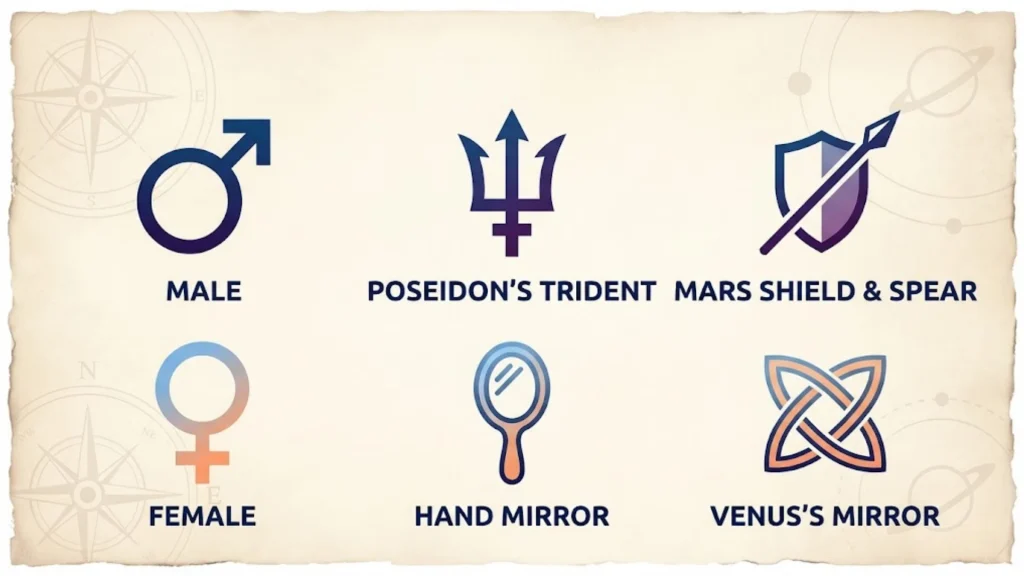
The origin of gender symbols is more complicated than a simple connection between two Roman gods and two modern signs. Their development involved planetary symbols, ancient beliefs, alchemy, botanical classification, and scientific notation.
Why Is Mars the Symbol for Males?
Mars is the traditional planetary symbol associated with the male sign (♂). In Roman mythology, Mars was the god of war. Ancient traditions also associated the planet Mars with masculine qualities.
The symbol later became associated with male classification in scientific writing. Its circle and arrow developed through historical conventions involving planetary and alchemical signs.
The association between Mars and masculinity reflects historical beliefs. It does not mean that all men have the personality traits traditionally linked to Mars.
Why Is Venus the Symbol for Females?
Venus, the Roman goddess associated with love and beauty, gives her name to the planet Venus. The traditional Venus sign (♀) became associated with female classification.
The symbol’s design is often compared to a hand mirror, an object associated with Venus in popular explanations. The symbol’s history, however, is tied to a broader tradition of planetary signs and their use in older systems of knowledge.
Together, the Mars and Venus symbols became recognizable shorthand for male and female categories.
Carl Linnaeus and the History of Sex Symbols
Carl Linnaeus was an influential Swedish botanist who helped develop a systematic approach to classifying living organisms. During the 18th century, he used planetary symbols as shorthand in botanical works.
Historical research explains that Linnaeus adopted symbols already used in earlier pharmaceutical and alchemical writing. In botanical classification, Mars and Venus signs could identify male and female flowers, while Mercury’s symbol could represent flowers with both male and female reproductive structures in particular contexts.
These symbols were convenient because they saved space in scientific descriptions. Their use later spread into zoology, human biology, and genetics.
According to a historical review published in the British Medical Journal, the signs traveled through astronomy, astrology, alchemy, pharmacy, and botany before becoming established in human biology. The review also explains that the familiar male and female symbols were used in a medical pedigree as early as 1845.
You can read the historical review in the British Medical Journal and the research on botanical usage through the International Association for Plant Taxonomy’s historical paper.
How Sex Symbols Evolved Over Time
The development of traditional sex symbols followed several stages:
- Astronomy and astrology: Planetary signs were used to identify celestial bodies.
- Alchemy and pharmacy: Related signs became part of systems used to describe materials and substances.
- Botany: Scientists used planetary symbols to classify reproductive structures in plants.
- Biology and genetics: The signs became shorthand for male and female categories in scientific diagrams.
- Public signage: Male and female signs became familiar pictograms on restroom doors and other signs.
- Modern identity representation: LGBTQ+ communities developed, adapted, or adopted additional symbols and flags.
The modern use of gender symbols is therefore broader than their original scientific applications.
Transgender and Intersex Symbols
Modern gender identity symbols include signs used to represent transgender people, intersex people, and other gender-diverse communities. Their meanings should be understood separately from the traditional biological uses of ♂ and ♀.
Transgender Symbol (⚧): Meaning and History
The transgender symbol (⚧) combines elements associated with traditional male and female signs, along with an additional arrow-like element in a widely used design.
It represents transgender identity and is sometimes used as a broader sign of gender diversity or inclusion. It appears in educational materials, community resources, and some public signage.
A transgender person has a gender identity that differs from the sex assigned to them at birth. Transgender people may identify as men, women, nonbinary people, or another gender.
The transgender symbol is not a label that every transgender person must use. Some people prefer the transgender pride flag, a personal symbol, or no symbol at all.
For background on the term transgender, see Planned Parenthood’s explanation of transgender and nonbinary identities.
Intersex Symbol (⚥): Meaning and Alternatives
The intersex symbol is sometimes represented by a combined male-female sign (⚥), but this is not the only symbol associated with intersex people.
Intersex refers to natural variations in sex characteristics, which may involve chromosomes, hormones, reproductive anatomy, gonads, or other physical traits. Intersex is not itself a gender identity or a sexual orientation.
Some intersex-led organizations prefer the intersex flag, which was created by Morgan Carpenter in 2013. It features a yellow background with an unbroken purple circle. The design represents wholeness and completeness without dividing people into conventional male and female categories.
The Intersex Day Project’s symbol guide explains the history and meaning of the intersex flag and other symbols used in intersex communities.
Transgender vs. Intersex: What’s the Difference?
| Term | Meaning | What it describes |
| Transgender | A gender identity that differs from the sex assigned at birth | Gender identity |
| Intersex | Natural variations in sex characteristics | Physical sex traits |
| Nonbinary | A gender identity outside an exclusively male-or-female classification | Gender identity |
| Sexual orientation | A person’s patterns of romantic, emotional, or sexual attraction | Attraction |
An intersex person may identify as a man, a woman, nonbinary, or another gender. An intersex person may also be transgender, but being intersex does not automatically mean someone is transgender.
Nonbinary and Genderqueer Symbols
The nonbinary symbol and genderqueer symbols are part of a broader range of ways people represent identities outside traditional gender categories. There is no single pictogram that every nonbinary or genderqueer person uses.
Nonbinary Symbol: Meaning and Representation
Nonbinary describes people whose gender identity does not fit exclusively into the categories of man or woman. A nonbinary person may experience their gender as a combination of genders, somewhere between them, outside them, or in another way.
Nonbinary people may use:
- The nonbinary pride flag.
- Gender-neutral pictograms.
- Personal symbols or designs.
- The transgender symbol, if it reflects how they identify.
- Written labels rather than a symbol.
The nonbinary pride flag, designed by Kye Rowan in 2014, uses yellow, white, purple, and black stripes. The colors represent different aspects of nonbinary identity and gender diversity.
Is There a Unicode Symbol for Nonbinary Identity?
There is no single Unicode character universally accepted as the symbol for all nonbinary people. The transgender sign (⚧) is a Unicode character, but it does not represent every nonbinary identity.
Unicode is a system that assigns codes to text characters so computers can store and display them. Community-created symbols may circulate online without having a dedicated Unicode character.
This distinction matters when designing websites, forms, or digital documents. If a symbol is unfamiliar or may not display correctly, include a clear text label.
Genderqueer Symbols and the Interlocking G and Q
Genderqueer is a term used by some people whose gender identity challenges conventional categories or expectations. Some people use it interchangeably with nonbinary, while others consider it a distinct identity.
The letters G and Q are sometimes combined in community-created designs to refer to genderqueer identity. Such designs are not universal symbols, so their meaning should be explained when they appear in educational or public materials.
The term genderqueer is about identity, not a person’s clothing, hairstyle, voice, or appearance.
Comet Symbol (☄) and Other Nonbinary Pictograms
The comet symbol (☄) appears in some online lists of alternative gender symbols. However, its meaning is not as widely standardized as that of ♂ or ♀.
When using a nonbinary pictogram or an alternative gender sign, verify the source and the community context before assigning it a specific meaning. An image circulating online may be an individual creation rather than an established community symbol.
Nonbinary vs. Genderfluid
Nonbinary and genderfluid are related terms, but they do not mean the same thing.
- Nonbinary is a broad term for gender identities outside an exclusively male-or-female classification.
- Genderfluid describes a gender identity that may change over time.
- A genderfluid person may also identify as nonbinary.
- Not every nonbinary person experiences changes in gender.
These terms describe different experiences, and individuals may choose the label that best fits them.
Androgyne and Neutrois Symbols
Androgyne Symbol (⚨): Meaning
Androgyne is a gender identity that some people describe as a blend of masculine and feminine genders, a position between them, or a distinct gender experience.
The symbol ⚨ is commonly listed as an androgyne symbol in some reference materials. However, its use is not universal, and other designs may also appear.
It is important to distinguish an androgyne gender identity from an androgynous appearance. A person can dress or look androgynously without identifying as androgyne.
Neutrois Symbol (⚲): Meaning
Neutrois is a gender identity often associated with neutrality, a neutral gender, or an absence of gender. People use the term in different ways, so the person’s own description matters.
The character ⚲ is sometimes identified as the neutrois symbol. Other designs may also be used, and the character may not display consistently across all fonts and platforms.
Neutrois and agender can overlap in meaning for some people, but they are not necessarily interchangeable. People choose different labels to describe their own experiences.
Androgyne vs. Neutrois
| Identity | Common description |
| Androgyne | A gender identity associated by some people with a blend or combination of masculine and feminine genders |
| Neutrois | A gender identity associated by some people with neutrality or an absence of gender |
| Androgynous | A description of appearance or expression that combines masculine and feminine characteristics |
The table gives general descriptions, not strict definitions that apply to everyone.
Gay, Lesbian, and Bisexual Symbols
Sexuality symbols often represent sexual orientation rather than gender identity. Some use traditional male or female signs, while others use flags, colors, or independent designs.
Gay Symbol (⚣): Double Mars Symbol
The double Mars symbol (⚣) consists of two interlocking male symbols. It is associated with some gay men and male same-sex identity.
However, not all gay men use this symbol. The rainbow flag is a more widely recognized symbol of the broader LGBTQ+ community, while other flags and symbols represent particular identities.
A symbol may be useful in a community context, but it should not be used to guess another person’s sexual orientation.
Lesbian Symbol (⚢): Double Venus Symbol
The double Venus symbol (⚢) consists of two interlocking female symbols. It is associated with some lesbians and female same-sex identity.
Other symbols associated with lesbian communities include the labrys and lesbian pride flag imagery. These have different histories and meanings, so they should not be treated as interchangeable designs.
The word lesbian describes a sexual orientation, not a particular appearance or gender expression.
Bisexual Symbol: Meaning and Representation
Bisexuality generally refers to the potential for attraction to more than one gender. It does not require equal attraction to every gender or attraction to multiple genders at the same time.
There is no single Unicode character universally recognized as the bisexual symbol. The bisexual pride flag is a widely used form of representation, featuring pink, purple, and blue stripes.
The colors are commonly explained as representing attraction to the same gender, attraction to different genders, and the overlap between these experiences.
Gay, Lesbian, and Bisexual Symbols Compared
| Identity | Common symbol or representation | Meaning |
| Gay men | Double Mars symbol (⚣) | Associated with some gay men |
| Lesbians | Double Venus symbol (⚢) | Associated with some lesbians |
| Bisexual people | Bisexual pride flag | Represents bisexual identity |
| LGBTQ+ community | Rainbow pride flag | Broad community visibility and pride |
These symbols represent different identities and communities. They are not all the same type of symbol, and each may have variations.
Agender, Asexual, Genderfluid, and Other Identity Symbols
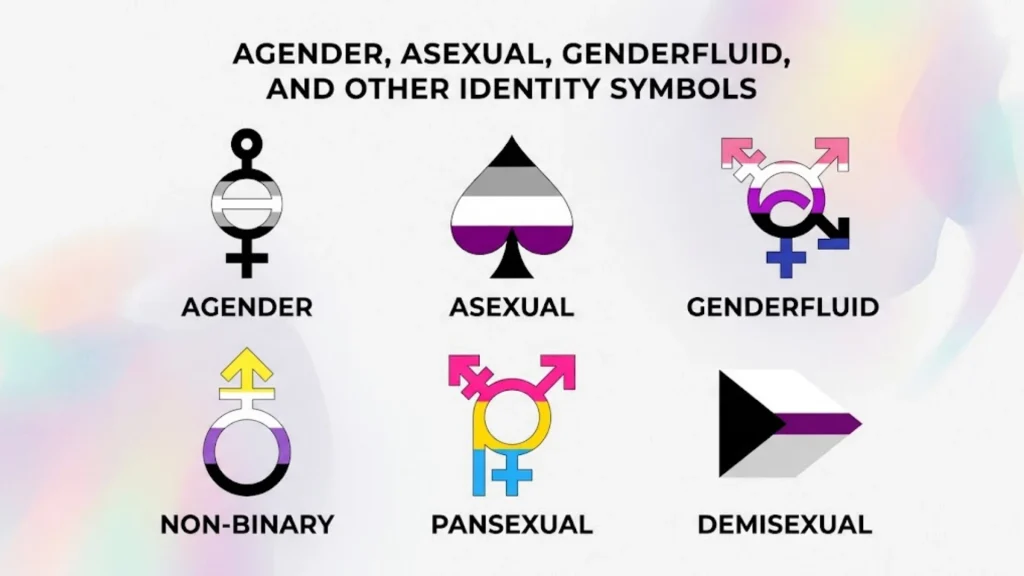
Agender Symbol (∅ or ⊖): Meaning
Agender is a gender identity associated with having no gender, experiencing gender as absent, or identifying outside conventional gender categories.
Some designs use an empty circle, a slashed circle, or other geometric forms to express agender identity. The symbols ∅ and ⊖ may appear in lists of alternative designs, but neither should be presented as the universal agender sign.
Agender people may also use the agender pride flag or simply describe their identity in words.
Asexual Symbol: Meaning and Common Designs
Asexuality generally describes experiencing little or no sexual attraction. Asexual people can still experience romantic attraction, emotional closeness, or a desire for relationships. Experiences vary from person to person.
Common symbols and representations include:
- Asexual pride flag: Black, gray, white, and purple stripes.
- Ace of spades (♠): Used by some asexual people.
- Other community designs: Hearts and geometric symbols may appear in particular contexts.
The ace of spades is not exclusive to asexuality and has other meanings in card games and wider culture. Its meaning depends on context.
Asexuality also differs from aromanticism. Asexuality concerns sexual attraction, while aromanticism concerns romantic attraction. A person may identify as one, both, or neither.
Genderfluid Symbol: Meaning
Genderfluid describes a gender identity that can change over time. A person’s experience may shift between genders, include several genders, or vary in other ways.
The genderfluid pride flag is a widely used form of representation. It contains pink, white, purple, black, and blue stripes, each associated with aspects of gender expression and identity.
There is no single Unicode character universally recognized as the genderfluid symbol. Online pictograms and alternative designs should be described according to the source that uses them.
Intergender Symbol: Meaning
Intergender is a term some people use for a gender identity experienced as between genders, combining aspects of genders, or otherwise related to gender beyond conventional categories.
The intergender symbol is not standardized across all communities. Some online lists show designs involving circles or lines, but these should not be assigned a universal meaning without a reliable source.
Intergender should not be confused with intersex. Intergender describes a gender identity; intersex refers to variations in sex characteristics.
Travesti Symbol: Meaning and Cultural Context
Travesti is a culturally specific gender identity used in parts of Latin America, particularly in some South American communities. Its meaning is shaped by regional history, language, and lived experience.
Although some people may use travesti within broader conversations about transgender identity, it is not simply a direct synonym for transgender. Individuals and communities may understand the terms differently.
There is no universally recognized travesti pictogram established across all contexts. If a particular symbol is attributed to travesti identity, verify its source and explain the cultural context rather than presenting it as a universal sign.
Alternative Male and Female Symbols
Male and Female Triangle Symbols (△ and ▽)
Triangles appear in various historical, scientific, and cultural systems, but their meanings depend on the specific convention.
The symbols △ and ▽ are sometimes listed online as male and female symbols. However, they are not universal replacements for ♂ and ♀. In mathematics, diagrams, and other systems, the same shapes can have entirely different meanings.
If a chart uses triangles to represent sex or gender, its legend should explain what each shape means.
Male and Female Symbols in Kinship Charts
Kinship symbols help researchers represent family relationships, ancestry, and family structures. In traditional pedigree diagrams, squares and circles have often represented male and female individuals, respectively.
These are different from the planetary male and female symbols.
In a family tree or genetic pedigree, the legend is essential because shapes, connecting lines, and shading can represent different relationships or information. Modern professional guidance also emphasizes accurately representing gender and sex-related information rather than relying on a person’s shape alone.
Hollow Square and Other Alternative Sex Symbols
A hollow square (□) can represent an unknown, unspecified, or missing value in some charts. It does not universally mean unknown sex.
Other diagrams may use circles, diamonds, labels, or annotations. The correct interpretation depends on the discipline and the chart’s conventions.
For educational material, it is best to include a clear legend rather than assume readers already know what each shape represents.
Combined Male and Female Symbols
Combined male and female designs may appear in historical biology, identity-related materials, and other contexts. Their meanings are not always the same.
For example, a combined sign may refer to reproductive structures in a botanical text, while a modified combination of male and female elements may represent transgender identity in a modern community setting.
The symbol should therefore be interpreted in context. A combined sign does not automatically mean transgender, intersex, nonbinary, or any other single identity.
Male and Female Bathroom Symbols
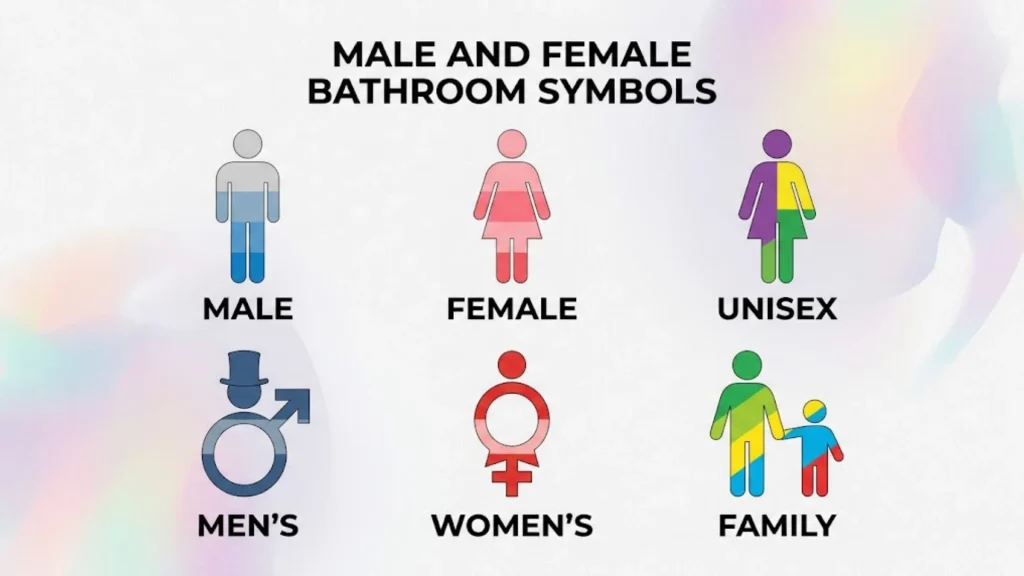
Male and Female Restroom Signs (🚹 and 🚺)
The male and female bathroom symbols are pictograms that help visitors identify public facilities. Common restroom signs use simplified human figures, labels, or a combination of both.
The 🚹 and 🚺 characters are Unicode restroom pictograms. Their exact appearance can vary across devices, operating systems, and fonts.
Restroom symbols are practical signs, not complete descriptions of gender identity. Buildings may use text labels, accessible signage, or additional pictograms to make facilities easier to identify.
Gender-Neutral Bathroom Symbols
Gender-neutral restrooms may use labels such as “All-Gender Restroom,” a neutral human figure, or a pictogram that does not indicate a single gender.
Signage varies by location and building. Clear written labels can help visitors understand which facilities are available, especially when a pictogram is unfamiliar.
History of Public Bathroom Gender Signs
Public buildings and transportation systems have used different restroom signs across countries and periods. Some rely on text, while others use human figures, silhouettes, or abstract pictograms.
There is no single design that explains the entire history of bathroom gender signage. Claims about particular countries, trains, or decades should be supported by specific historical evidence.
Sex Symbols vs. Gender Symbols vs. Sexuality Symbols
These terms overlap in everyday conversation, but they describe different concepts.
What Is the Difference Between Sex and Gender Symbols?
Biological sex concerns physical sex characteristics, including reproductive anatomy, hormones, chromosomes, and other traits. Gender identity refers to a person’s internal understanding of their gender. Gender expression describes how someone presents or expresses gender, such as through clothing, behavior, or appearance.
The male and female symbols have historical uses in biological classification, but people also use them in social and gender-related contexts.
A symbol alone cannot tell you all of a person’s sex characteristics, gender identity, or gender expression.
Gender Identity Symbols vs. Sexual Orientation Symbols
Gender identity and sexual orientation are separate concepts.
- Gender identity symbols may represent transgender, nonbinary, agender, genderfluid, or other gender identities.
- Sexuality symbols may represent gay, lesbian, bisexual, asexual, or other sexual orientations.
- Pride flags often communicate community identity and visibility rather than one universal meaning.
- Personal symbols may have specific meanings for an individual or group.
A person can be transgender and gay, nonbinary and bisexual, or intersex and asexual. These terms describe different aspects of identity and are not mutually exclusive.
How Symbols Support LGBTQ+ Visibility
Symbols can help communities communicate identity, history, and pride. They appear in educational materials, community events, online profiles, and public spaces.
Still, symbols should not be used to make assumptions about someone. People may choose different signs, use a pride flag, describe their identity in words, or prefer not to display any symbol.
Respecting the language people use for themselves is more reliable than trying to infer identity from appearance or symbols.
How to Find and Use Gender Symbols on Digital Devices
Unicode Gender Symbols
Unicode makes it possible to represent many symbols in digital text. Commonly used characters include:
| Symbol | Common name |
| ♂ | Male sign |
| ♀ | Female sign |
| ⚧ | Transgender sign |
| ⚥ | Male-female sign |
| ☿ | Mercury sign |
| ⚣ | Double Mars sign |
| ⚢ | Double Venus sign |
| ♠ | Spade suit |
| 🚹 | Men’s restroom |
| 🚺 | Women’s restroom |
Not every community-created symbol has its own Unicode character. Even when a character exists, its visual design can vary across devices and applications.
Copy and Paste Male and Female Symbols
You can copy these common characters for use in a document, article, presentation, or educational chart:
- Male symbol: ♂
- Female symbol: ♀
- Transgender symbol: ⚧
- Intersex-related combined sign: ⚥
- Mercury symbol: ☿
- Double Mars symbol: ⚣
- Double Venus symbol: ⚢
- Men’s restroom: 🚹
- Women’s restroom: 🚺
Always include a text label when readers may not recognize a symbol. This also helps people using assistive technology understand the content.
Using Symbols in Documents, Websites, and Charts
When publishing gender pictograms online or in print, follow these practical guidelines:
- Explain uncommon symbols the first time they appear.
- Use a legend for charts and diagrams.
- Do not assume every symbol has a universal meaning.
- Check how symbols display on mobile devices and desktop browsers.
- Provide descriptive text for screen readers where appropriate.
- Use current, reliable sources for historical and cultural claims.
- Respect the names and labels individuals use for their identities.
These steps make information clearer and reduce the risk of confusing biological, gender, and sexuality-related meanings.
Frequently Asked Questions About Male and Female Symbols
What do the male and female symbols mean?
The male symbol (♂) traditionally represents males, while the female symbol (♀) traditionally represents females. Both have historical associations with the planets Mars and Venus and are used in biology, botany, and other settings.
Where do the male and female symbols come from?
Their history runs through planetary symbolism, astrology, alchemy, pharmacy, and botany. Carl Linnaeus helped popularize their use in botanical classification during the 18th century, and the signs later spread into other scientific fields.
Why is Mars the symbol for males and Venus the symbol for females?
The male symbol is associated with Mars, the Roman god of war, while the female symbol is associated with Venus, the Roman goddess of love and beauty. These are historical associations, not scientific rules about masculinity or femininity.
What does the transgender symbol (⚧) mean?
The transgender symbol commonly represents transgender people and gender diversity. Its familiar design combines elements associated with the traditional male and female symbols, with an additional arrow-like element.
What is the intersex symbol, and what does it mean?
The combined sign ⚥ is sometimes used in intersex-related contexts, but it is not a universal intersex symbol. The intersex pride flag, with a yellow background and purple circle, is a widely used alternative created by intersex advocate Morgan Carpenter in 2013.
Is there a universal symbol for nonbinary identity?
No single character is universally used by all nonbinary people. The transgender symbol may be meaningful to some nonbinary people, while others use nonbinary pride imagery, personal designs, or written labels.
What are the symbols for different sexualities?
Some examples include the double Mars symbol (⚣), associated with some gay men, and the double Venus symbol (⚢), associated with some lesbians. Bisexual and asexual communities also use pride flags and other symbols. Usage varies between individuals and groups.
What is the difference between nonbinary and genderfluid?
Nonbinary is a broad term for gender identities outside an exclusively male-or-female classification. Genderfluid describes a gender identity that can change over time. A person can identify as both nonbinary and genderfluid.
Are male and female symbols the same as gender identity symbols?
Not exactly. The symbols ♂ and ♀ have traditional biological uses and are also used in social contexts. Modern gender identity symbols represent a wider range of experiences, and none of these signs alone describes every aspect of a person.
Can I use gender symbols in a school project or article?
Yes. Use symbols accurately, provide text labels, and explain unfamiliar designs. If you discuss a community-specific symbol, check a reliable source and avoid claiming that every member of the community uses it.
Conclusion: Understanding Male and Female Symbols and Their Meanings
The male symbol (♂) and female symbol (♀) have a long history connecting planetary signs with scientific classification. Their familiar shapes became widely used in botany, biology, genetics, and public signage.
Today, sex and gender symbols cover a broader range of identities and experiences. Transgender, intersex, nonbinary, genderqueer, androgyne, gay, lesbian, bisexual, agender, asexual, genderfluid, neutrois, intergender, and travesti communities may use different symbols, flags, and pictograms.
The most important point is that symbols depend on context. Some have established scientific meanings, while others reflect specific community traditions or personal identity. When interpreting or using them, check reliable sources, explain less familiar designs, and respect the terms people choose for themselves.

Hi, I’m Asher Monroe, a writer who believes that meaningful words have the power to inspire change and bring people closer to their dreams. I have always been fascinated by the beauty of quotes and the way a simple message can provide motivation, hope, and comfort.
I enjoy creating content around inspirational quotes, life lessons, success stories, and positive thoughts that help readers find encouragement in their everyday lives. My goal is to share words that connect with people and remind them of their inner strength.
Through my writing, I explore the ideas of personal growth, confidence, and the importance of staying inspired through every chapter of life.
I am the author of Words That Move the Soul and The Path of Endless Inspiration, two books focused on the power of wisdom, positivity, and meaningful thoughts.
 Sienna Brooks
 Rowan Sinclair Rowan Sinclair