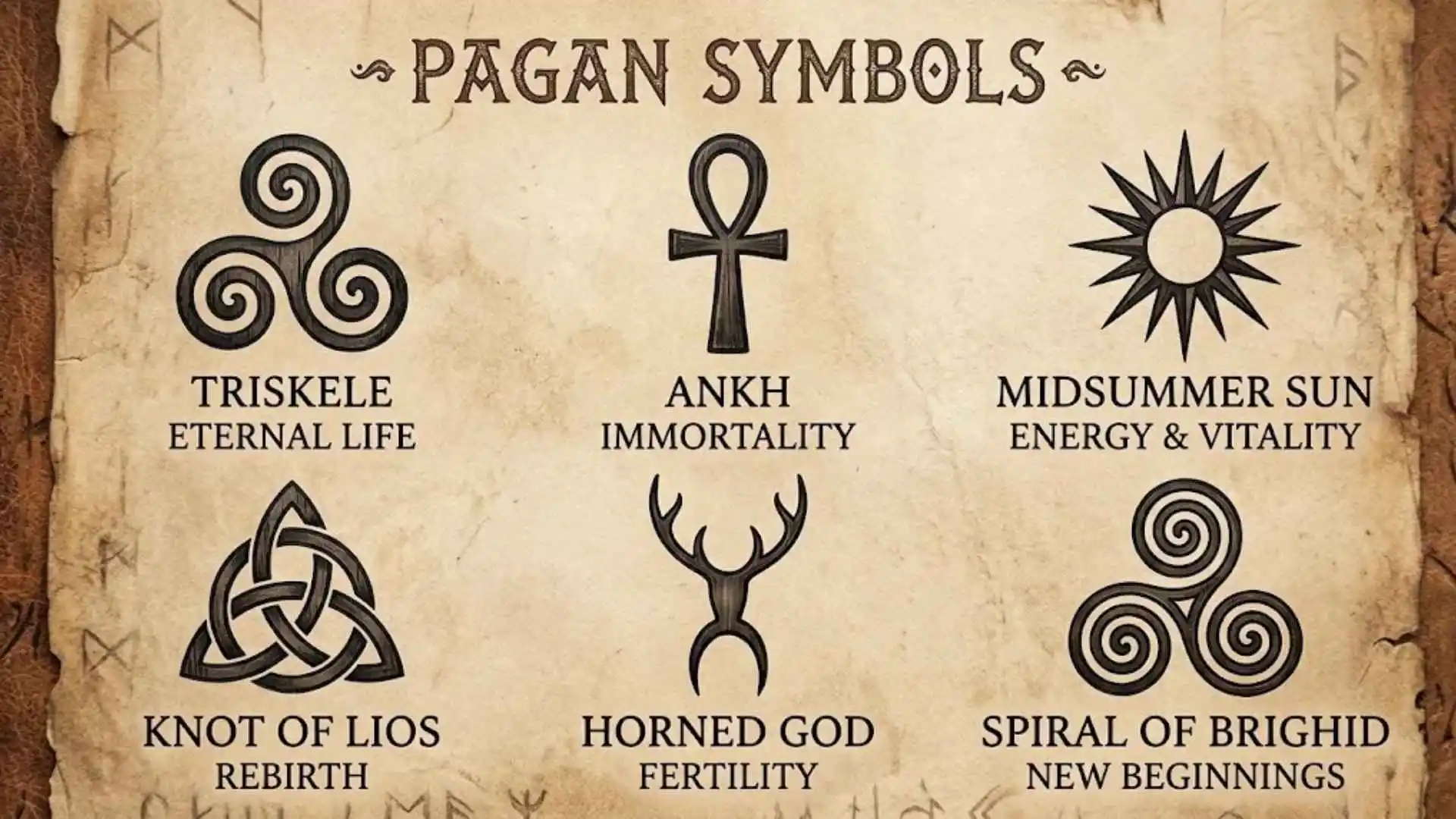
Pagan symbols have a long and varied history. They appear in ancient artwork, religious objects, mythology, seasonal celebrations, and modern spiritual practices. Some represent nature and the changing seasons, while others connect to particular gods, protective traditions, or ideas about life and renewal.
Today, people explore pagan symbols and meanings for many reasons. Some want to understand ancient religions, while others follow modern Pagan traditions such as Wicca, Druidry, or Heathenry. Others simply want to learn about the history behind a symbol before wearing it as jewelry or using it in artwork.
However, not every symbol commonly described as pagan originated in an ancient Pagan religion. Some have documented historical meanings, while others gained their present associations through modern spiritual movements.
This guide explores important ancient pagan symbols, Celtic and Norse imagery, Wiccan symbols, nature-based designs, and symbols associated with protection, strength, wisdom, and spiritual growth.
What Are Pagan Symbols?
Pagan symbols are images, objects, signs, and patterns associated with Pagan religions or spiritual practices. Depending on the tradition, they may represent deities, natural forces, seasonal cycles, fertility, protection, wisdom, or the relationship between humans and the natural world.
The word Pagan covers many different religious traditions. Historically, it became a broad label for various non-Christian religions, particularly those practiced in the ancient Mediterranean and Europe. Today, modern Paganism includes diverse religious movements inspired by ancient traditions, folklore, nature, and contemporary spiritual ideas.
There is no single symbol that represents every Pagan religion. The pentacle is widely recognized in modern Wicca, while Mjölnir is especially important to Norse-inspired Heathenry. Other symbols belong to particular historical cultures or religious communities.
What Does Paganism Mean?
Paganism does not describe one unified belief system. It includes different traditions with their own gods, rituals, ethical beliefs, and spiritual practices.
Some Pagans worship multiple deities. Others focus on one divine presence, nature, ancestors, or spiritual principles. Some modern practitioners understand gods as literal divine beings, while others interpret them symbolically.
Common Pagan traditions include:
- Wicca: A modern Pagan religion that often incorporates seasonal festivals, ritual practices, and reverence for a Goddess, a God, or both.
- Druidry: A modern spiritual movement influenced by ancient Celtic cultures, nature, poetry, and ideas about sacred landscapes.
- Heathenry: A family of modern religious traditions inspired by pre-Christian Germanic and Norse religions.
- Hellenic Paganism: Modern religious practice inspired by ancient Greek gods and religious customs.
- Kemetic Paganism: Modern religious practice inspired by ancient Egyptian religion.
These traditions may share some interests, but their beliefs and symbols are not interchangeable.
Why Do Pagans Use Symbols?
Symbols can express religious beliefs in a visual form. They may appear on pendants, altar objects, ritual tools, clothing, artwork, or sacred spaces.
For example, a Wiccan practitioner might use a pentacle to represent the elements and spiritual practice. A Heathen might wear Thor’s hammer to express devotion to Thor or a connection to Norse religious traditions.
Symbols can also represent personal values, including courage and bravery, resilience, wisdom, and spiritual strength. However, these meanings depend on the symbol’s history and the tradition using it.
Are Pagan Symbols the Same as Wiccan Symbols?
No. Wicca is one modern Pagan religion, not another name for all Paganism.
The pentacle and Triple Moon are strongly associated with modern Wiccan practice. Norse religious symbols, Greek deity attributes, and many other cultural symbols have different origins.
Wicca’s recognizable modern forms developed mainly in twentieth-century Britain. Although Wicca draws on older religious imagery and folklore, historians have not established an unbroken Wiccan institution surviving unchanged from ancient times. Source: HISTORY’s overview of Wicca.
Are All Ancient Symbols Pagan?
No. Some symbols originated in ancient polytheistic religions, but others developed in Christian, Jewish, Muslim, or other cultural settings. Some designs also served decorative purposes before acquiring religious meanings.
A symbol’s appearance alone does not prove its religious origin. Researchers consider archaeological objects, inscriptions, historical texts, and the context in which a design appeared.
Most Recognizable Pagan Symbols and Their Meanings
The following table provides a quick overview of well-known symbols connected with historical Pagan cultures and modern Pagan traditions.
| Symbol | Common meaning or association | Historical or spiritual context |
| Pentacle | Elements and spiritual practice | Modern Wicca and other esoteric traditions |
| Pentagram | Five-pointed star with varied historical meanings | Ancient and modern contexts |
| Triple Moon | Lunar phases and the Goddess in modern Wicca | Modern Paganism |
| Triskelion | Threefold design and movement | Ancient European art and modern interpretations |
| Triquetra | Interlaced three-part pattern | Early medieval art and modern spiritual use |
| Mjölnir | Thor, divine power, and protection | Norse religion and modern Heathenry |
| Yggdrasil | Cosmic tree connecting worlds | Norse mythology |
| Valknut | Mysterious three-part design | Viking Age archaeological contexts |
| Vegvísir | Guidance and protection in later Icelandic magic | Later Icelandic magical manuscripts |
| Ankh | Life and vitality | Ancient Egyptian religion |
| Eye of Horus | Protection and restoration | Ancient Egyptian religion |
| Djed pillar | Stability and associations with Osiris | Ancient Egyptian religion |
| Athena’s owl | Wisdom and knowledge | Ancient Greek religion |
| Zeus’s thunderbolt | Divine power and authority | Greek mythology |
| Oak tree | Strength and sacredness in particular traditions | European religious and cultural contexts |
These meanings are not universal. A design may have different interpretations across cultures or periods. The following sections explain the background of each major symbol.
Pagan Symbols of Protection and Spiritual Power
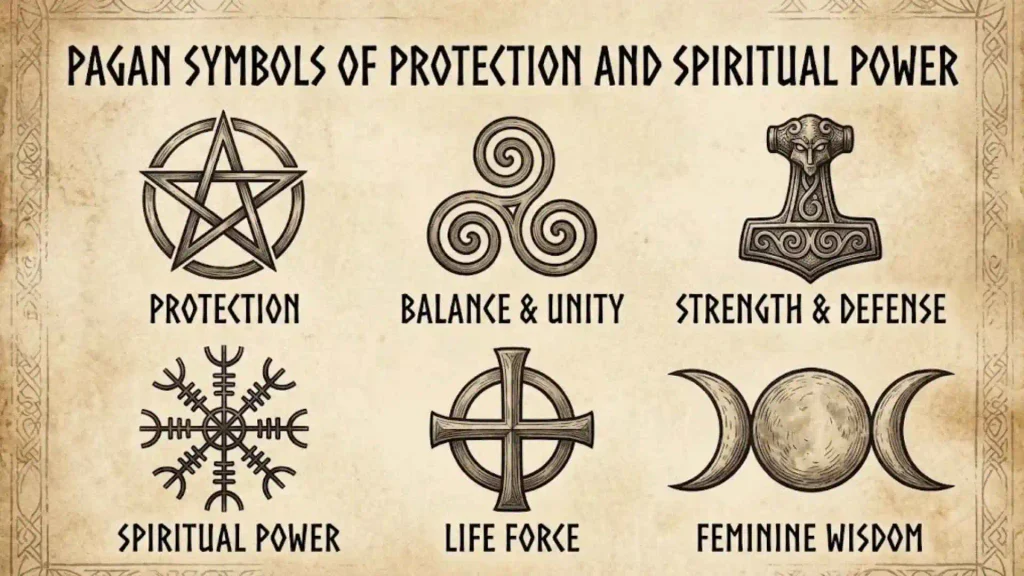
Protection is an important theme in many religious traditions. Historical communities used amulets, ritual objects, inscriptions, and sacred images for different purposes. Modern Pagan practitioners may also use symbols to express faith, establish personal intentions, or create a meaningful ritual space.
The Pentacle and Pentagram
The pentagram is a five-pointed star. A pentacle commonly refers to a pentagram enclosed within a circle, although terminology varies between traditions and historical sources.
<figure> <figcaption>The five-pointed star and the circle are among the most recognizable symbols in modern Pagan spirituality.</figcaption> </figure>
In modern Wicca, the five points of the pentacle are commonly associated with earth, air, fire, water, and spirit. The surrounding circle can represent unity, wholeness, or the boundary of a ritual space, depending on the practitioner’s tradition.
The five-pointed star has a much older history than modern Wicca. It appeared in several ancient societies and was used in different religious, mathematical, and symbolic contexts.
Its meaning also depends on orientation and setting. A pentagram does not automatically represent evil, and an upright pentagram is widely used by Wiccans and other modern Pagans.
For many practitioners, the pentacle represents spiritual balance, protection, and a connection between human life and the natural world.
Thor’s Hammer (Mjölnir)
Mjölnir, commonly called Thor’s hammer, is one of the best-known symbols associated with Norse mythology.
Thor is the Norse god of thunder, and his hammer is a powerful weapon in medieval Norse mythological accounts. It protects the gods and is associated with Thor’s strength and ability to confront dangerous forces.
Archaeologists have discovered hammer-shaped pendants from the Viking Age. These objects provide evidence that the hammer held religious or cultural significance for some people in Scandinavia.
Today, many Heathens wear Mjölnir pendants to express religious identity, devotion to Thor, or a connection to Norse heritage. The hammer is also associated with protection and strength in modern practice.
It is a useful example of a symbol of power whose modern significance builds on a historical religious tradition.
The Helm of Awe (Ægishjálmur)
The Helm of Awe is a popular symbol in modern Norse-inspired spirituality. Its familiar design usually consists of a central point surrounded by radiating arms or branches.
The name and concept appear in medieval Icelandic literature, including the Völsunga Saga. In that story tradition, the dragon Fáfnir possesses a helm of awe that inspires fear.
However, the texts do not establish that the familiar graphic design was a Viking Age symbol. The visual form commonly sold today belongs to later Icelandic magical manuscript traditions.
Modern users may associate it with courage, protection, confidence, and the ability to face adversity. These are contemporary interpretations, so they should not be presented as a single proven Viking Age meaning.
The Hamsa Hand
The Hamsa hand is a palm-shaped symbol with a distinctive arrangement of fingers. Some versions contain an eye in the center of the palm.
It has a long history across parts of the Middle East and North Africa and is used in Jewish and Muslim cultural and religious contexts. Depending on the community, it may represent protection, blessing, or good fortune.
Although the Hamsa sometimes appears in modern Pagan and eclectic spiritual settings, it is not exclusively pagan. Its established cultural and religious associations deserve recognition.
People interested in protective symbols should learn about the Hamsa’s living traditions rather than treating it as a generic magical decoration.
Celtic Pagan Symbols and Their Meanings
Celtic-associated symbols appear in archaeological finds, medieval manuscripts, metalwork, and modern spiritual traditions. However, the historical record does not support every popular claim about their original meanings.
Ancient Celtic-speaking peoples lived across different parts of Europe, and their religious practices varied. Modern Celtic Paganism and Druidry draw on surviving evidence, mythology, folklore, and contemporary interpretation.
The Triskelion (Triple Spiral)
The triskelion is a three-part design with arms or spirals extending from a central point. The word is associated with a three-legged or three-part form.
One famous example of prehistoric spiral artwork appears at Newgrange, a passage tomb in Ireland built around 3200 BCE. The monument contains elaborate carved designs, including spirals.
The presence of a spiral at Newgrange does not establish that it had the same meaning as every modern triskelion. Researchers cannot confidently assign one universal interpretation to all such designs.
Modern Pagan practitioners may connect the triskelion with movement, cycles, personal growth, or three interconnected aspects of life. It is often chosen as a symbol of transformation and resilience.
When describing the Triskelion symbol meaning, separate its documented archaeological presence from the spiritual meanings people give it today.
The Triquetra (Celtic Knot)
The triquetra is a three-cornered design formed by interlocking arcs. It appears in early medieval art and decorative traditions, including manuscripts and metalwork.
Today, some Pagans associate it with the relationship between land, sea, and sky, or with three aspects of the Goddess. Others use it to represent interconnectedness or the cycles of life.
However, the triquetra is not exclusively Celtic Pagan. It also appears in Christian art, where it has been associated with the Trinity.
The Celtic knot meaning therefore depends on its historical setting and modern use. Its three-part shape can inspire spiritual interpretations, but those interpretations should not be confused with a universally established ancient meaning.
The Celtic Spiral
Spiral designs appear in prehistoric European art, including monuments created long before the historical period usually associated with Celtic cultures.
Modern Celtic-inspired spiritual practices sometimes interpret spirals as symbols of growth, movement, renewal, or the cycles of existence.
These are meaningful contemporary interpretations, but the precise meaning of a particular prehistoric spiral may remain uncertain.
A careful article about ancient symbols should distinguish the age of an artwork from the age of the religious interpretation attached to it.
The Oak Tree and Sacred Groves
Oak trees have cultural and religious significance in several European traditions. Their size, long lives, and ability to withstand harsh conditions make them natural symbols of strength and endurance.
Ancient literary sources also associate oak trees with religious practices in some European communities. However, evidence about specific Celtic rituals is incomplete, and later accounts do not describe every community equally well.
In modern Pagan practice, an oak tree may represent stability, wisdom, resilience, or a connection to nature. These associations make oak imagery a common choice for people seeking a symbol of inner strength.
Cernunnos and the Horned God
Cernunnos is the name commonly associated with a horned figure depicted in ancient Celtic religious art. One well-known example appears on the Gundestrup Cauldron, a decorated silver vessel generally dated to the late second or early first century BCE.
The figure is shown with antlers and surrounded by animals. Researchers often discuss the image in connection with animals and the natural world, although the full identity and meaning of the figure remain debated.
Modern Wicca also includes the Horned God as a central divine figure in some traditions. This modern religious concept draws on older imagery but should not be treated as identical to every ancient horned deity.
Norse Pagan Symbols and Their Meanings
Norse mythology includes gods, giants, supernatural beings, sacred objects, and a complex view of the universe. Modern Heathen traditions draw on these sources, along with archaeology and historical research.
The evidence has limits. Many surviving written accounts were recorded after the Viking Age, while archaeological objects do not always explain their own meanings.
Yggdrasil, the World Tree
Yggdrasil is the cosmic tree described in Norse mythology. It connects different parts of the mythological universe and is associated with the gods, other beings, and the structure of existence.
The tree appears in medieval Old Norse sources, including the Poetic Edda and Prose Edda. These texts provide important evidence for Norse mythological ideas, although they were recorded in a Christian-era setting.
Modern practitioners may interpret Yggdrasil as a symbol of connection, wisdom, endurance, or the relationship between different forms of life.
The World Tree also appeals to people interested in nature-based spirituality because it offers an image of interconnected existence. However, it is specifically a Norse mythological concept, not a universal symbol shared by all Pagan religions.
Mjölnir, Thor’s Hammer
Thor’s hammer deserves attention in both historical and modern contexts. In Norse mythology, Mjölnir is associated with Thor’s power and protection.
Hammer-shaped pendants found at Viking Age sites provide stronger historical evidence for the symbol’s use than many designs commonly marketed as Viking symbols.
Today, the hammer can represent faith, heritage, strength, and protection among Heathen practitioners. Its meaning varies by wearer, so it is best understood through the individual’s religious or cultural context.
The Valknut
The Valknut is a design formed from three interlocking triangles. It appears on a small number of Viking Age objects and picture stones, sometimes near imagery interpreted as related to Odin, warriors, or death.
Despite its modern popularity, no surviving Viking Age text gives a clear explanation of the symbol’s meaning. Its connection to Odin and the dead is a scholarly interpretation based partly on the contexts in which it appears.
Some modern Heathens use the Valknut to express an interest in Norse religion or a connection to Odin. Others avoid making strong claims about its meaning because the historical evidence remains incomplete.
The important point is that the Valknut has genuine historical examples, but its precise significance is unresolved.
The Vegvísir
The Vegvísir is a compass-like design popular in modern Norse-inspired jewelry and tattoos. It is often described online as a Viking navigation symbol.
That description is misleading. The design is documented in later Icelandic magical manuscripts, not in known Viking Age artifacts or texts.
In modern use, the Vegvísir is commonly associated with guidance, protection, and finding one’s way through difficult circumstances. These contemporary meanings are understandable, but the symbol should not be described as a proven Viking Age compass.
Norse Runes and the Elder Futhark
Runes are characters used in historical Germanic writing systems. The Elder Futhark, an early runic alphabet, contains 24 characters and was used during the early centuries of the Common Era.
Runes appeared in names, memorial inscriptions, objects, and other written contexts. Historical sources also connect runes with magic, so their use was not limited to ordinary writing.
Modern Pagans may study runes for historical interest, religious practice, meditation, or divination. However, many popular one-word meanings assigned to individual runes are modern interpretations rather than direct translations of ancient beliefs.
For example, Uruz rune meaning is often presented today in terms of strength, endurance, or vitality. Readers should distinguish these contemporary associations from the rune’s historical linguistic and archaeological evidence.
Wiccan Symbols and Modern Pagan Spirituality
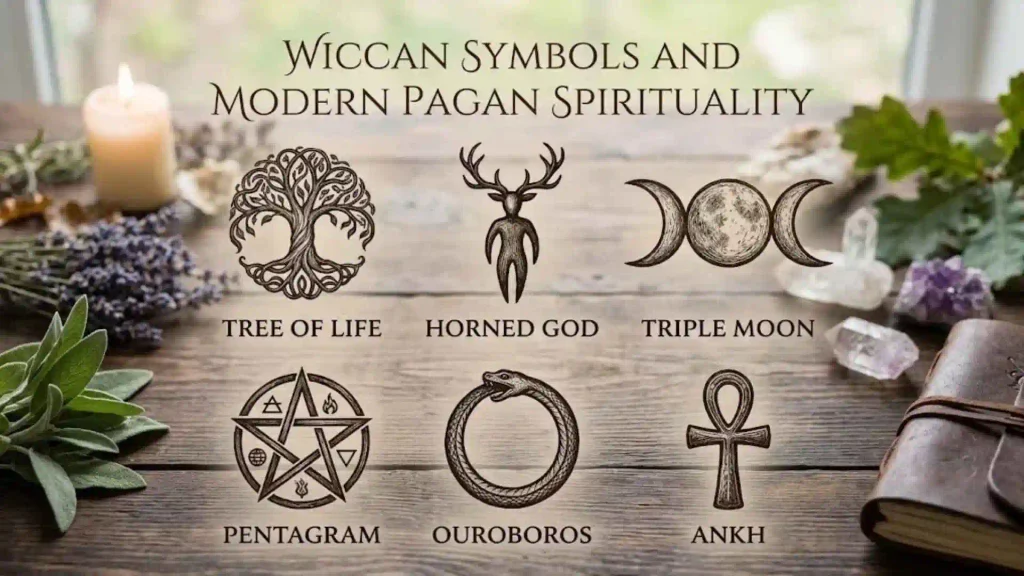
Wicca is a modern Pagan religion with varied traditions. Many Wiccans observe seasonal festivals, use ritual tools, and honor a Goddess, a God, or other understandings of divinity.
Wiccan symbols can help practitioners express their beliefs and organize ritual practice. Their meanings differ among traditions, so no single explanation applies to every Wiccan.
The Pentacle and the Five Elements
In many Wiccan traditions, the pentacle represents five elements: earth, air, fire, water, and spirit.
The elements provide a symbolic framework for thinking about the natural world and spiritual life. Earth may represent stability, air thought, fire transformation, and water emotion or renewal. Spirit can represent the unifying principle in some systems.
These correspondences vary. The pentacle is a religious symbol, not a scientific diagram of the physical world.
The Triple Moon Symbol
The Triple Moon usually depicts a waxing crescent, a full moon, and a waning crescent. It is closely associated with modern Wicca and some Goddess-centered spiritual traditions.
The three phases may represent the changing Moon. In some modern traditions, they also correspond to the Maiden, Mother, and Crone framework.
This interpretation is important in contemporary Pagan spirituality, but the familiar Triple Moon design should not automatically be labeled an ancient universal goddess symbol.
The Horned God
The Horned God is a divine figure in some Wiccan traditions. He is often associated with animals, wild nature, fertility, and seasonal cycles.
His imagery draws on a range of older sources, including ancient horned figures and European folklore. Modern Wiccan theology developed its own religious meaning for the figure.
Not all Pagans worship a Horned God, and not all Wiccans understand divinity in the same way.
The Goddess Symbol
Many Wiccan traditions honor a Goddess, sometimes alongside a God. Some practitioners use the Triple Moon or other lunar imagery to express this aspect of their spirituality.
The Goddess may be associated with nature, birth, death, renewal, or the phases of life. These associations vary across traditions.
It is important to avoid assuming that all Pagan religions worship one universal Goddess. Historical religions included many different deities, and modern Pagan beliefs remain diverse.
The Wheel of the Year
The Wheel of the Year is a modern Pagan calendar commonly associated with eight seasonal festivals in many Wiccan traditions:
- Samhain: Often observed in late October or early November, with themes involving ancestors and remembrance.
- Yule: Celebrated around the winter solstice in many modern traditions.
- Imbolc: Commonly observed in early February, with themes of returning light and renewal.
- Ostara: Associated in modern Pagan calendars with the spring equinox.
- Beltane: Often celebrated around May 1, with themes of fertility and the arrival of warmer weather.
- Litha: Associated with the summer solstice.
- Lammas or Lughnasadh: A harvest festival commonly observed around August 1.
- Mabon: Associated in modern Pagan calendars with the autumn equinox.
The names and customs have different histories. The familiar eight-festival calendar combines seasonal observances and modern religious developments rather than representing one unchanged ancient calendar.
Greek and Roman Pagan Symbols
Ancient Greek and Roman religions used images of gods, animals, weapons, plants, and celestial objects to express divine attributes. Many of these symbols remain recognizable because they appear in sculptures, coins, pottery, and written myths.
Zeus’s Thunderbolt
The thunderbolt is a major attribute of Zeus, the Greek god associated with the sky and divine authority.
In mythology, Zeus uses the thunderbolt as a weapon. It represents his power over the gods and his ability to enforce order or punish opponents.
Modern readers may interpret it as a symbol of strength, decisive action, or authority. Historically, its clearest connection is to Zeus and the ancient Greek religious and mythological tradition.
Athena’s Owl
The owl is closely associated with Athena, the Greek goddess of wisdom and strategic warfare. Owl imagery also appeared on coins produced by ancient Athens.
The owl became a recognizable emblem of the city and its connection to Athena. Its association with wisdom continues in modern art and education.
For readers interested in symbols of wisdom, Athena’s owl is a strong example of a symbol with a well-established cultural and mythological connection.
Poseidon’s Trident
Poseidon’s trident is a three-pronged spear associated with the Greek god of the sea. Mythological accounts also connect Poseidon with earthquakes and horses.
The trident represents his divine authority and connection to powerful natural forces. Its design is easy to recognize in ancient and modern depictions of the god.
Although modern interpretations may associate the trident with power or control, its main historical meaning comes from Poseidon’s mythology.
The Laurel Wreath of Apollo
The laurel wreath is associated with Apollo, a Greek god connected with music, prophecy, healing, and other aspects of divine life.
Laurel wreaths were also used as honors in ancient Greek culture, including athletic and poetic contexts. The plant became a symbol of achievement and distinction.
Its use demonstrates how a religious association can extend into public life and cultural traditions.
Hermes’s Caduceus
The caduceus is a staff with two intertwined serpents and, in many depictions, wings. It belongs to Hermes, the Greek messenger god.
It is often confused with the Rod of Asclepius, which features a single serpent and is associated with healing. The two symbols have different historical identities.
This distinction matters because a symbol’s familiar modern use may not match its original religious context.
Ancient Egyptian Symbols Sometimes Associated With Paganism
Ancient Egyptian religion included numerous gods, sacred animals, ritual objects, and symbols associated with life, death, kingship, and the afterlife.
Modern Pagan practitioners sometimes draw inspiration from Egyptian religious imagery. However, Egyptian symbols should first be understood within their own historical and religious setting.
The Ankh
The ankh is one of the best-known symbols from ancient Egypt. It resembles a cross with a loop at the top and is strongly associated with life.
Ancient Egyptian art often depicts gods holding an ankh or presenting it to a ruler. It can appear in scenes involving divine power, vitality, and the continuation of life.
Today, some people use the ankh as a symbol of spiritual vitality, eternal life, or an interest in ancient Egyptian religion.
Although it may appear in modern Pagan settings, it originated in ancient Egyptian culture and is not exclusive to Paganism.
The Eye of Horus
The Eye of Horus is an ancient Egyptian symbol associated with protection, healing, and restoration.
Its mythology connects it with Horus, a god associated with kingship and the sky. In stories about Horus and Seth, the eye becomes linked with injury and restoration.
Amulets bearing the Eye of Horus were used in ancient Egyptian contexts, including funerary settings. Its modern popularity reflects its strong visual identity and historical association with protection.
It is distinct from the Eye of Ra, which has separate associations in Egyptian mythology, although modern descriptions sometimes confuse the two.
The Djed Pillar
The Djed pillar is an ancient Egyptian symbol associated with stability and the god Osiris.
It appears in Egyptian art and ritual contexts, including objects connected with funerary beliefs. Its association with Osiris links it to ideas about death, restoration, and continued existence.
Modern readers may connect it with resilience and steadfastness, but its historical meaning should remain rooted in ancient Egyptian religion.
The Scarab Beetle
The scarab beetle was an important symbol in ancient Egyptian religion. Its association with Khepri connected the beetle with the rising Sun and renewal.
Scarab-shaped amulets were widely used in ancient Egypt. Some served as seals, while others had protective or funerary functions.
Today, the scarab is often described as a symbol of transformation, renewal, and regeneration. These interpretations draw on its ancient religious associations, although individual objects served different purposes.
The Sun Disk of Aten
Aten was represented as a solar disk whose rays extended toward the earth, often ending in hands. This imagery became especially prominent during the reign of Akhenaten in the fourteenth century BCE.
Akhenaten promoted the worship of Aten in a major religious shift during the Amarna period. The sun disk became a central feature of royal religious art.
The symbol is historically important because it reflects a specific period of Egyptian religious change, not simply a general Pagan symbol of sunlight.
Pagan Symbols of Nature, the Sun, and the Moon
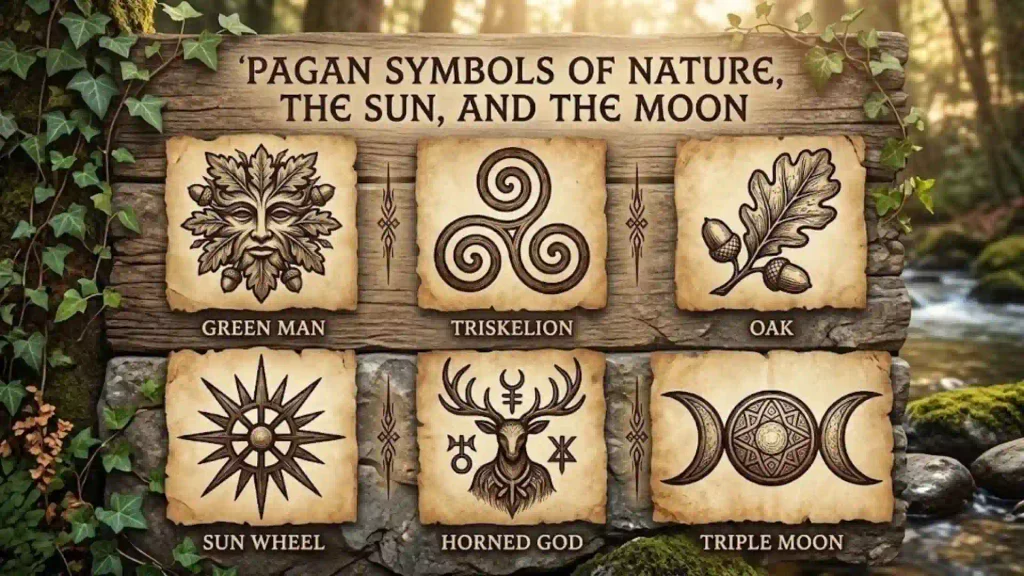
Nature plays an important role in many modern Pagan traditions, but different religions understand natural symbols in different ways. The Sun, Moon, trees, and animals may be connected to specific deities, seasonal events, or personal spiritual meanings.
The Sun Wheel and Solar Symbols
Circular designs with spokes or crosses appear in different historical cultures. Some are interpreted as solar symbols, but similar shapes can have different meanings depending on where and when they were used.
In modern Pagan spirituality, solar imagery may represent light, vitality, warmth, or seasonal change. In some traditions, the Sun is also associated with particular deities.
It is important not to treat every wheel-shaped design as a symbol of one ancient religion.
The Crescent Moon and Full Moon
The Moon’s changing appearance has inspired religious stories, calendars, and ritual practices for thousands of years.
In modern Wicca, lunar phases may be used to organize rituals or reflect on change. Some practitioners connect the full Moon with particular ceremonies, while others follow different schedules.
Lunar symbolism also appears in many religions outside Paganism. A crescent moon is not automatically evidence of Pagan origin.
Trees and the World Tree
Trees are important in many cultural and religious traditions. Their roots, trunks, and branches can provide natural images of connection, growth, and continuity.
Yggdrasil belongs specifically to Norse mythology. Other traditions have their own sacred trees or tree imagery, but they should not be treated as versions of the same symbol.
In modern Pagan settings, trees may represent nature, endurance, and the relationship between the physical and spiritual worlds.
Spirals and Seasonal Cycles
Spiral designs appear in prehistoric artwork and later decorative traditions. Modern spiritual interpretations often connect spirals with movement, growth, and the changing cycles of life.
Seasonal symbolism is also important in many modern Pagan calendars. Festivals may mark planting, harvest, solstices, or equinoxes.
These practices help practitioners connect spiritual observance with the natural world, although their origins and dates vary between traditions.
Animals in Pagan Symbolism
Animals can represent gods, supernatural beings, or qualities in specific religious traditions.
For example:
- Ravens appear in Norse mythology as companions of Odin.
- Owls are associated with Athena in Greek mythology.
- Snakes appear in many religious traditions, but their meanings vary.
- Bulls feature in several ancient Mediterranean and other cultural contexts.
- Lions appear in myths, royal imagery, and religious art across different societies.
These examples should not be combined into one universal system of animal symbolism. An animal may represent wisdom in one context and something entirely different in another.
Pagan Symbols of the Elements
Many modern Wiccan traditions use a system of five elements: earth, air, fire, water, and spirit. This framework helps practitioners organize ritual symbolism and reflect on different aspects of existence.
The system is not universal to all Pagan religions, and its meanings vary among practitioners.
Earth Symbol
Earth is often associated with the physical world, stability, growth, and material life in modern elemental systems.
Practitioners may use soil, stones, plants, or earth-colored objects in rituals. The earth element can also serve as a reminder of environmental responsibility and connection to place.
Air Symbol
Air may represent breath, thought, communication, or movement in some modern Pagan systems.
Feathers and incense sometimes appear in rituals associated with air, although specific correspondences differ. These objects are used symbolically rather than as proof of a universal ancient practice.
Fire Symbol
Fire is often associated with energy, change, warmth, and transformation.
Candles and ritual flames may represent focused attention or the transition from one state to another. Fire also has important roles in many religions outside Paganism, so its meaning depends on the ritual setting.
Water Symbol
Water can represent cleansing, renewal, emotion, or the natural cycles that sustain life.
Modern practitioners may use bowls of water or other water-related objects in ritual practice. The symbolism varies across traditions, and water also has many independent religious meanings.
Spirit or Aether
Some elemental systems include spirit as a fifth element. It may represent a unifying presence or a connection between the other four elements.
This framework is common in some modern Wiccan settings but is not shared by every Pagan tradition.
Pagan Symbols for Fertility, Rebirth, and Transformation
Life cycles and seasonal change appear in many religious traditions. Modern Pagans may use symbols of renewal to reflect on personal growth, natural cycles, or changes in their lives.
The Spiral and the Cycle of Life
A spiral can suggest movement and change in modern symbolic interpretation. Some people use it to reflect on personal development or the recurring patterns of nature.
However, spiral designs appear in many periods and cultures. Their presence alone does not prove a specific Pagan meaning.
The Phoenix and Rebirth
The phoenix is a mythical bird associated with renewal and the return of life. Ancient accounts of phoenix-like birds developed in Mediterranean and Egyptian-related literary traditions, and the imagery changed over time.
Today, the phoenix often represents rebirth, resilience, and the ability to recover after hardship. It can be a meaningful symbol of resilience, but it is not exclusively Pagan. The phoenix also became important in Christian symbolism.
Seeds, Eggs, and Spring Symbols
Seeds and eggs are natural images of potential and new life. Modern seasonal celebrations may use them to represent growth, fertility, or the return of spring.
However, the meaning of a particular object depends on its cultural context. A modern seasonal decoration should not automatically be described as an unchanged ancient religious symbol.
The Serpent and Renewal
Serpents appear in many religious stories and artistic traditions. Depending on the context, they may be associated with renewal, healing, danger, wisdom, protection, or divine power.
There is no universal meaning shared by every serpent image. Readers should identify the specific deity, myth, or cultural tradition before assigning a symbolic interpretation.
Pagan Symbols for Wisdom, Courage, and Strength
People often look for symbols that express personal values. Pagan-related traditions include many images associated with courage, endurance, power, and wisdom, but the strongest explanations connect each symbol to its specific history.
Athena’s Owl as a Symbol of Wisdom
Athena’s owl is a particularly clear example of a symbol of wisdom. The association comes from Athena’s role in Greek religion and mythology.
The owl also appeared on Athenian coins, linking the animal to the city’s identity. Modern uses of the owl often draw on this established association with knowledge and learning.
Thor’s Hammer as a Symbol of Strength
Mjölnir represents Thor’s power in Norse mythology. Its association with the god and its archaeological presence make it a well-supported example of a historical symbol linked to strength and protection.
Modern Heathens may wear it as an expression of faith, identity, or cultural interest.
The Oak Tree as a Symbol of Endurance
Oak trees can live for many decades or centuries, depending on the species and conditions. Their strength and longevity help explain why they have become powerful images of endurance.
Modern Pagan practitioners may use oak imagery to represent stability and connection to nature. Historical claims about specific oak rituals should still be checked against the available evidence.
The Raven in Norse Mythology
In Norse mythology, Odin has two ravens named Huginn and Muninn. Their names are commonly translated as Thought and Memory.
The ravens travel through the world and report what they observe. Their role connects them with knowledge and Odin’s search for information.
Modern interpretations may associate ravens with wisdom, awareness, or mystery. Their specific mythological role is Norse rather than universal.
The Triskelion and Personal Growth
The triskelion’s three-part design has inspired modern interpretations involving progress, movement, and interconnected stages of life.
These meanings can make it a personal emblem of growth or resilience. However, the historical meaning of a specific ancient triskelion cannot always be established.
Are Pagan Symbols Different From Satanic Symbols?
Paganism and Satanism are distinct religious or philosophical categories. Some symbols may appear in more than one modern spiritual setting, but shared imagery does not prove that the beliefs behind it are identical.
The pentagram is a good example. It has appeared in different historical contexts, and modern Wiccans commonly use the upright pentacle as a religious symbol.
A symbol’s meaning depends on its orientation, setting, history, and intended use. It is inaccurate to assume that every pentagram, pentacle, or other unfamiliar design represents Satanism.
Likewise, not every symbol used by a Pagan practitioner comes from an ancient Pagan religion. Some originate in modern movements, while others come from separate cultural or religious traditions.
The best way to understand a symbol is to ask three questions:
- Where did the design first appear?
- What evidence explains its historical use?
- How does the current religious or cultural community understand it?
These questions help separate fact from rumor.
How to Choose and Use a Pagan Symbol
If you want to wear a Pagan symbol, include it in artwork, or use it in personal spiritual practice, start by understanding its history.
Choose a Symbol Based on Its Historical Tradition
Begin with the meaning you want to explore. If you are interested in Norse mythology, research Mjölnir or Yggdrasil. If you are learning about Wicca, study the pentacle and Triple Moon.
Choosing a symbol because of its actual background helps you avoid misleading claims.
Understand Its Meaning Before Wearing It
A symbol may have religious, cultural, or political associations beyond its popular description.
For example, the Vegvísir is often marketed as a Viking compass, but its familiar design is documented in later Icelandic magical manuscripts. Knowing that history gives you a more accurate understanding of what you are wearing.
Use Symbols in Jewelry, Art, Altars, or Personal Practice
Many people express their beliefs through pendants, rings, artwork, or ritual objects. Others use symbols as reminders of personal values, such as courage, patience, or spiritual reflection.
There is no single way to use every Pagan symbol. Follow the practices of the tradition you are learning about and avoid presenting personal interpretations as universal religious facts.
Avoid Mixing Symbols Without Understanding Their Origins
Some modern spiritual communities combine symbols from different traditions. Such combinations may reflect personal beliefs, but they should not erase the symbols’ original contexts.
For instance, the Hamsa has established Jewish and Muslim associations. The ankh comes from ancient Egyptian religion, while Mjölnir belongs to Norse mythology.
Understanding these distinctions supports more respectful and informed use.
Respect Living Religious and Cultural Traditions
Many symbols remain important to people who practice their associated religions today. Read reliable historical sources and, where appropriate, resources produced by the communities themselves.
Avoid treating every cultural symbol as a generic decoration or assigning meanings that its history cannot support.
Frequently Asked Questions About Pagan Symbols
What Is the Most Recognizable Pagan Symbol?
The pentacle is one of the most recognizable symbols in modern Paganism, particularly Wicca. It commonly represents the five elements and spiritual practice. However, Paganism includes many traditions, so no single symbol represents everyone.
What Is the Difference Between a Pentagram and a Pentacle?
A pentagram is a five-pointed star. A pentacle commonly refers to a pentagram enclosed in a circle, although usage varies by tradition and historical context.
What Are the Main Celtic Pagan Symbols?
Commonly discussed examples include the triskelion, triquetra, spiral designs, and imagery associated with horned figures such as Cernunnos. Their historical meanings differ, and some popular interpretations come from modern Pagan practice.
What Are the Main Norse Pagan Symbols?
Important examples include Mjölnir, Yggdrasil, runes, and the Valknut. Mjölnir has strong archaeological support as a Viking Age pendant motif, while the Valknut’s exact meaning remains uncertain.
Is the Triple Moon an Ancient Pagan Symbol?
The familiar Triple Moon design is strongly associated with modern Wicca and Goddess-centered Pagan spirituality. Its current interpretation should not be presented as proof that the exact design served as a universal ancient Pagan symbol.
Is the Helm of Awe a Viking Symbol?
The name and concept appear in medieval Icelandic literature, but the familiar graphic form belongs to later Icelandic magical traditions. It is misleading to describe the modern design as a proven Viking Age emblem.
Are Pagan Symbols Used for Protection?
Some historical amulets and religious symbols were associated with protection. In modern Pagan practice, symbols such as the pentacle or Mjölnir may also express protective intentions, although meanings vary between traditions.
Can Anyone Wear Pagan Symbols?
Many people wear symbols to express religious beliefs, cultural interests, or personal values. Before choosing one, learn about its origins and any living religious or cultural associations.
Are All Pagan Symbols Ancient?
No. Some symbols have archaeological or textual evidence from ancient societies. Others gained their current meanings through medieval traditions or modern Pagan movements. A modern origin does not make a symbol meaningless, but it should be described accurately.
Conclusion: Understanding Pagan Symbols and Their Meanings
Pagan symbols offer a window into the beliefs, stories, and artistic traditions of many cultures. The pentacle is strongly associated with modern Wicca, Mjölnir belongs to Norse mythology, and the ankh comes from ancient Egyptian religion. Celtic-associated designs, Greek deity attributes, and nature imagery each have their own histories.
Some symbols are connected to strength, courage, protection, wisdom, and resilience. Others represent the natural world, divine beings, seasonal change, or the relationship between life and death.
The most important point is that Paganism is diverse. Symbols do not all share one origin or one fixed meaning. By learning about their historical evidence and modern use, you can appreciate their significance without confusing cultural traditions or repeating unsupported claims.
Whether you are researching ancient religions, exploring modern Pagan spirituality, or looking for a meaningful symbol, begin with the history and context behind the design. That approach will help you understand not only what a symbol may represent, but also why it matters to the people who use it.

Hello, I’m Rowan Sinclair, a passionate writer and lifelong admirer of the wisdom found in great quotes. I believe that words have the ability to inspire change, spark creativity, and connect people across cultures and generations.
I enjoy writing about motivational quotes, famous sayings, and lessons from history’s most influential thinkers. Every article I create is driven by my desire to help readers discover meaningful insights that they can apply to their own lives.
When I’m not writing, I spend my time reading biographies, exploring classic literature, and collecting memorable quotes that deserve to be shared with the world.
I am the author of Voices That Inspire and A Collection of Timeless Thoughts, two books that celebrate the enduring power of words and the stories behind them.
 Asher Monroe
 Sienna Brooks