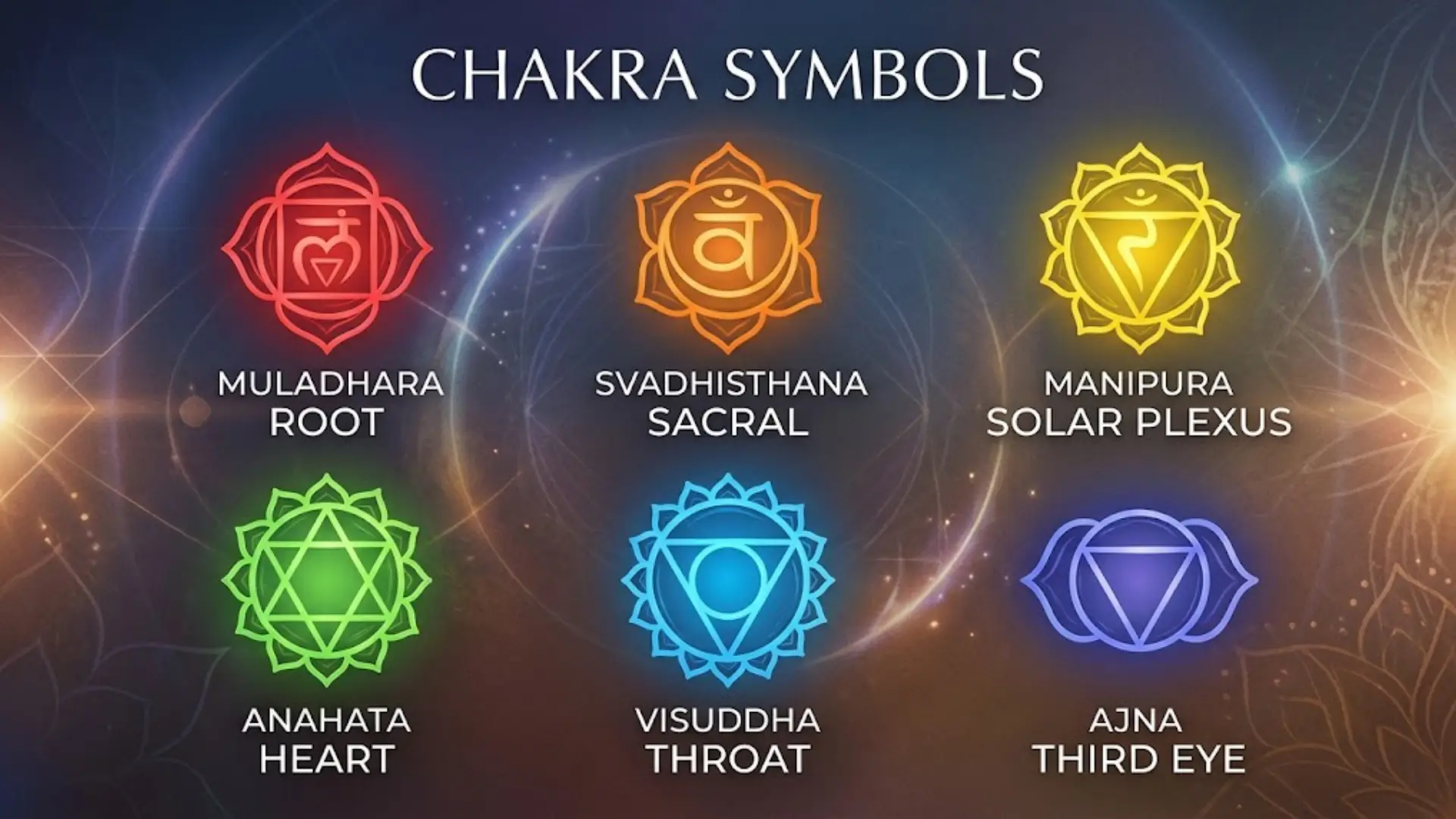
Chakra symbols and meanings help explain a spiritual system found in several Indian religious and contemplative traditions. These symbols often include lotus flowers, geometric shapes, colors, and Sanskrit syllables. Each feature has a particular role within the tradition that uses it.
The familiar 7 chakra symbols are commonly associated with grounding, creativity, personal power, love, communication, insight, and spiritual connection. You may have seen them arranged along the spine in a colorful chart, with one symbol representing each chakra.
But there is an important detail to understand: not every historical Hindu or Buddhist tradition uses the same seven-chakra system. The familiar rainbow color sequence is also common in modern spiritual teaching rather than universal across all older texts.
This guide explains the seven chakras and their meanings, the traditional features associated with each symbol, and the meditation and wellness practices people connect with them. It also explores their historical background so you can understand what these symbols mean without confusing spiritual beliefs with scientific facts.
What Are Chakras?
The Sanskrit word chakra (also written cakra) means “wheel” or “circle.” In some Hindu and Buddhist tantric traditions, chakras are subtle-body centers used in spiritual practices, meditation, and visualization. They are often pictured as wheels or lotus flowers along a central channel within the subtle body.
In modern spiritual writing, chakras are often described as energy centers in the body or spinning energy vortices. These phrases express how practitioners understand the system. They do not refer to physical organs or energy structures established by modern anatomy.
The Sanskrit Meaning of Chakra
The word chakra has several meanings depending on its context. It can refer to a wheel, circle, or disk. In Hindu and Buddhist traditions, the term also appears in other symbolic and religious settings.
Within particular tantric practices, chakra diagrams may include:
- Lotus petals or spokes.
- Geometric shapes and circles.
- Sanskrit syllables used in meditation.
- Colors associated with a particular tradition.
- Deities, elements, or other religious symbols.
- Connections to channels described within the subtle body.
These features work together as parts of a symbolic and contemplative system. Their meanings depend on the text, lineage, and practice in which they appear.
Chakras in Hinduism and Buddhism
Chakra concepts are associated with different forms of Hindu and Buddhist tantra and yoga. They developed within broader ancient Indian spiritual traditions, but the traditions do not all describe them in the same way.
For example, some Tibetan Buddhist tantric systems describe five principal chakras, while others use different numbers. Some Hindu tantric traditions describe six main chakras below the crown, with the thousand-petaled Sahasrara above them. Other systems use different arrangements.
The familiar seven-chakra model became especially influential in modern yoga and spiritual wellness. It is useful for understanding contemporary chakra charts, but it should not be treated as the only historical system. The Encyclopedia of Buddhism provides an overview of these variations in its entry on chakras in the subtle body.
Understanding the Seven-Chakra System
In the common modern model, seven chakras are arranged from the base of the spine to the top of the head. Each has a Sanskrit name and a group of symbolic associations.
People use this model to explore the mind-body-spirit connection, personal growth, meditation, and spiritual awareness. Each chakra is often connected with a particular area of life, such as stability, creativity, compassion, or insight.
These meanings are spiritual interpretations rather than medically verified descriptions of how the body works.
Seven Chakra Symbols and Meanings Chart
The following chakra symbols and meanings chart summarizes the seven chakras in the common modern system. The colors and interpretations shown here are widely used today, although historical sources and individual lineages may differ.
| Chakra | Sanskrit name | Common modern color | Common symbol features | Commonly associated meaning |
| Root Chakra | Muladhara | Red | Four-petaled lotus, square, inverted triangle | Grounding, stability, safety |
| Sacral Chakra | Svadhisthana | Orange | Six-petaled lotus, crescent moon | Creativity, pleasure, emotions |
| Solar Plexus Chakra | Manipura | Yellow | Ten-petaled lotus, triangle | Confidence, willpower, personal power |
| Heart Chakra | Anahata | Green | Twelve-petaled lotus, intersecting triangles | Love, compassion, harmony |
| Throat Chakra | Vishuddha | Blue | Sixteen-petaled lotus, circle, triangle | Communication and expression |
| Third Eye Chakra | Ajna | Indigo | Two-petaled lotus and central geometry | Insight, intuition, awareness |
| Crown Chakra | Sahasrara | Violet or white | Thousand-petaled lotus | Spiritual realization and connection |
This chart gives a quick overview of the seven chakra symbols, shapes, and colors commonly found in modern spiritual resources. The symbols should be understood within their specific traditions rather than as a universal code.
The Seven Chakra Symbols and Their Meanings
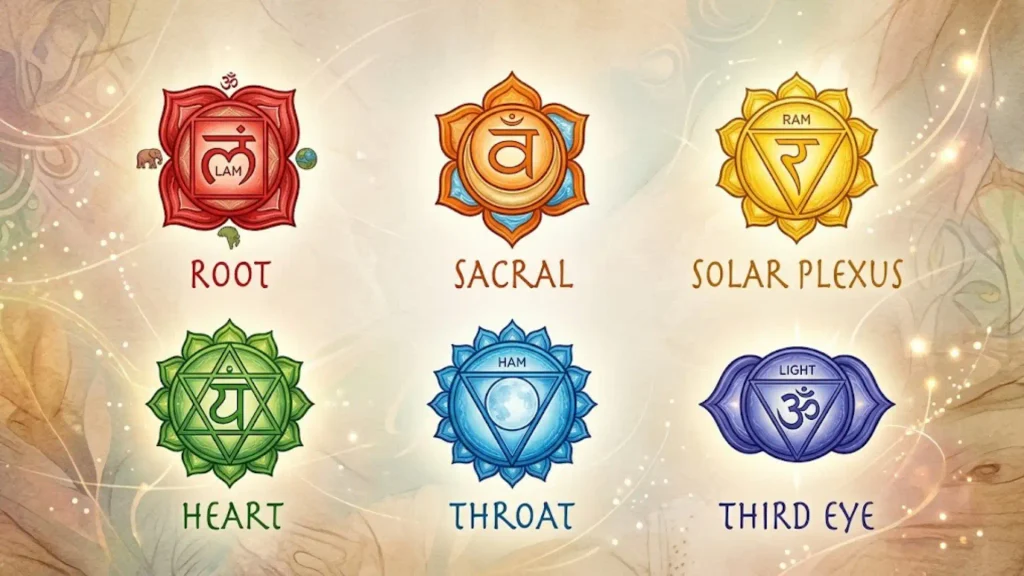
Each chakra in the familiar seven-chakra model has a Sanskrit name and a set of symbolic features. The sections below explain their common modern interpretations and the shapes often shown in chakra illustrations.
Root Chakra Symbol and Meaning (Muladhara)
The Root Chakra symbol and meaning are commonly associated with grounding, stability, and a sense of safety. Its Sanskrit name is Muladhara, and modern charts usually place it at the base of the spine.
The Root Chakra is often shown as a four-petaled lotus. Its traditional diagram may also include a square and an inverted triangle. These features belong to a particular symbolic arrangement, and their detailed meanings can depend on the source.
Root Chakra Symbol and Its Main Features
- Common color: Red.
- Sanskrit name: Muladhara.
- Lotus petals: Four.
- Geometric features: Square and inverted triangle in commonly reproduced diagrams.
- Associated element: Earth.
- Common themes: Grounding, stability, survival, and security.
The earth association connects this chakra with firmness and a stable foundation. In modern interpretations, it represents how a person relates to daily responsibilities, physical surroundings, and basic needs.
The meaning of the Root Chakra symbol is often explained through its square and lotus. The square can suggest stability and structure, while the lotus represents spiritual symbolism and unfolding awareness.
Root Chakra Practices
People who use this model may connect the Root Chakra with grounding exercises and routines that support a sense of steadiness.
Examples include:
- Practicing Mountain Pose (Tadasana).
- Trying Tree Pose (Vrikshasana) for balance.
- Walking mindfully in a safe outdoor setting.
- Keeping regular sleep and meal routines.
- Using grounding affirmations, such as “I can take one steady step at a time.”
Hematite and red jasper are sometimes associated with this chakra in modern crystal practices. Cedarwood, patchouli, and sandalwood oils also appear in some contemporary aromatherapy lists. These are spiritual or wellness associations, not proven treatments for a chakra blockage.
Sacral Chakra Symbol and Meaning (Svadhisthana)
The Sacral Chakra symbol and meaning are commonly connected with creativity, pleasure, emotional expression, and relationships. Its Sanskrit name is Svadhisthana, and modern illustrations generally place it in the lower abdomen or sacral region.
Its familiar symbol includes a six-petaled lotus and a crescent moon. The water element is commonly associated with this chakra, reflecting ideas of movement, change, and emotional flow.
Sacral Chakra Symbol and Its Main Features
- Common color: Orange.
- Sanskrit name: Svadhisthana.
- Lotus petals: Six.
- Geometric feature: Crescent moon in common representations.
- Associated element: Water.
- Common themes: Creativity, pleasure, desire, and emotions.
In modern interpretations, this chakra represents a person’s relationship with feelings, enjoyment, and creative expression. The water association can serve as a metaphor for adapting to change rather than resisting every new experience.
The meaning of the Sacral Chakra symbol is not identical across every tradition. When describing it, explain the common interpretation you are using rather than claiming it represents one universal historical belief.
Sacral Chakra Practices
People may explore this chakra through activities that encourage creativity and emotional awareness.
- Draw, paint, write, or make something by hand.
- Dance or listen to music mindfully.
- Keep a journal about emotions and relationships.
- Try gentle movement or a comfortable swimming session.
- Practice slow breathing while noticing your feelings without judging them.
Carnelian and moonstone are popular modern crystal associations. Ylang-ylang and jasmine oils also appear in some contemporary lists. These associations are symbolic; they have not been shown to activate a measurable chakra or cure emotional difficulties.
Solar Plexus Chakra Symbol and Meaning (Manipura)
The Solar Plexus Chakra symbol and meaning are commonly associated with confidence, willpower, decision-making, and personal responsibility. Its Sanskrit name is Manipura. Modern charts usually place it in the upper abdomen.
Its common symbol is a ten-petaled lotus containing a triangle. Yellow is the color most often used in modern seven-chakra illustrations, and fire is the commonly associated element.
Solar Plexus Chakra Symbol and Its Main Features
- Common color: Yellow.
- Sanskrit name: Manipura.
- Lotus petals: Ten.
- Geometric feature: Triangle.
- Associated element: Fire.
- Common themes: Confidence, willpower, self-discipline, and personal power.
Fire can symbolize change, energy, and transformation. In modern chakra interpretation, the Solar Plexus Chakra is often used as a starting point for reflecting on personal boundaries, goals, and the confidence to make decisions.
The meaning of the Solar Plexus Chakra symbol is often explained through its connection with fire and personal strength. It does not mean that a person must always feel confident. Doubt and uncertainty are normal parts of life.
Solar Plexus Chakra Practices
Try activities that help you build confidence through realistic action:
- Set one manageable goal and complete it.
- Practice core-strengthening exercises at a suitable level.
- Break a difficult task into smaller steps.
- Use an affirmation such as “I can make thoughtful decisions.”
- Reflect on a time when you handled a challenge well.
Citrine and tiger’s eye are popular crystal associations for this chakra. Peppermint and chamomile oils also appear in modern wellness lists. These items are not scientifically established methods of changing chakra energy.
Heart Chakra Symbol and Meaning (Anahata)
The Heart Chakra symbol and meaning are commonly linked to love, compassion, forgiveness, and harmony. Its Sanskrit name is Anahata, and modern charts generally place it at the center of the chest.
The familiar symbol contains a twelve-petaled lotus and two intersecting triangles, sometimes forming a six-pointed star. Green is its most common color in modern chakra charts, and air is its associated element.
Heart Chakra Symbol and Its Main Features
- Common color: Green.
- Sanskrit name: Anahata.
- Lotus petals: Twelve.
- Geometric feature: Two intersecting triangles.
- Associated element: Air.
- Common themes: Love, compassion, forgiveness, and connection.
The intersecting triangles are an important part of the commonly reproduced symbol. Some modern interpretations describe them as representing the meeting of contrasting forces or the connection between different aspects of life. The exact explanation should be tied to the tradition or source being discussed.
The meaning of the Heart Chakra symbol is often explored through the balance between giving and receiving care. This can include kindness toward others as well as healthy boundaries and self-respect.
Heart Chakra Practices
- Try a loving-kindness meditation.
- Write a message of gratitude to someone.
- Reflect on a disagreement and consider what forgiveness means to you.
- Practice listening without immediately preparing a reply.
- Use a gentle affirmation such as “I can offer compassion while respecting my boundaries.”
Rose quartz and green aventurine are common modern crystal associations. Rose and lavender oils also appear in contemporary chakra resources. These associations may be meaningful to practitioners, but they are not medical treatments for heart disease or emotional disorders.
Throat Chakra Symbol and Meaning (Vishuddha)
The Throat Chakra symbol and meaning are commonly associated with communication, truth, listening, and self-expression. Its Sanskrit name is Vishuddha, and modern illustrations place it in the throat region.
Its familiar diagram includes a sixteen-petaled lotus, a circle, and a triangle. Blue is the color most often used in modern charts, and the element of space or ether is commonly associated with it.
Throat Chakra Symbol and Its Main Features
- Common color: Blue.
- Sanskrit name: Vishuddha.
- Lotus petals: Sixteen.
- Geometric features: Circle and triangle in common representations.
- Associated element: Space or ether.
- Common themes: Communication, honesty, and expression.
In modern interpretations, this chakra encourages reflection on how people speak, listen, and communicate their needs. Clear communication involves more than talking. It also requires attention, patience, and respect for other people’s boundaries.
The meaning of the Throat Chakra symbol is therefore often explained through honest expression and thoughtful listening.
Throat Chakra Practices
- Read a passage aloud or practice singing.
- Try gentle chanting if it suits your beliefs.
- Write down what you want to communicate before a difficult conversation.
- Practice expressing an opinion respectfully.
- Listen carefully before responding.
Lapis lazuli and aquamarine are common modern crystal associations. Eucalyptus and chamomile oils also appear in some lists. Do not apply essential oils directly to the throat or ingest them unless a qualified professional has specifically advised a safe use.
Third Eye Chakra Symbol and Meaning (Ajna)
The Third Eye Chakra symbol and meaning are commonly connected with insight, intuition, imagination, and awareness. Its Sanskrit name is Ajna. Modern illustrations usually place it between the eyebrows.
The familiar symbol includes a two-petaled lotus and central geometric details. Indigo or deep blue is the color most often assigned to it in modern charts.
Third Eye Chakra Symbol and Its Main Features
- Common color: Indigo or deep blue.
- Sanskrit name: Ajna.
- Lotus petals: Two in common representations.
- Geometric features: Circle and triangle in some illustrations.
- Common themes: Insight, intuition, visualization, and awareness.
The meaning of the Third Eye Chakra symbol is often described through the idea of seeing beyond a first impression. In a practical sense, this can mean examining assumptions, noticing patterns, and taking time to think before making a judgment.
These are modern reflective interpretations. They do not establish that a physical third eye exists or that the chakra can predict the future.
Third Eye Chakra Practices
- Spend a few minutes in quiet meditation.
- Write down dreams and reflections in a journal.
- Visualize a peaceful place.
- Examine a decision from more than one point of view.
- Practice an affirmation such as “I can pause, reflect, and consider new perspectives.”
Amethyst and sodalite are common crystal associations. Frankincense, sandalwood, and sage also appear in modern spiritual or aromatherapy lists. These associations should not be presented as scientifically proven ways to increase intuition or change brain function.
Crown Chakra Symbol and Meaning (Sahasrara)
The Crown Chakra symbol and meaning are commonly associated with spiritual connection, contemplation, and enlightenment. Its Sanskrit name is Sahasrara, and modern diagrams place it at or above the top of the head.
The crown symbol is often shown as a thousand-petaled lotus. Modern charts commonly use violet or white, although color assignments differ among contemporary systems.
Crown Chakra Symbol and Its Main Features
- Common colors: Violet or white.
- Sanskrit name: Sahasrara.
- Symbol: Thousand-petaled lotus.
- Common themes: Spiritual realization, contemplation, and connection with a larger reality.
The lotus can symbolize spiritual unfolding, while the thousand petals suggest an expansive or complete state in some interpretations. The crown is treated differently across historical chakra systems, so it is important not to assume every tradition describes it in the same way.
In some influential systems, six main chakras are described below the crown, while Sahasrara represents a higher culmination rather than simply another chakra identical to the others.
Crown Chakra Practices
- Practice quiet meditation or prayer according to your beliefs.
- Read a spiritual or philosophical text and reflect on it.
- Spend time in nature without distractions.
- Consider how your values shape your daily choices.
- Use an affirmation such as “I remain open to learning and reflection.”
Clear quartz and selenite are popular modern crystal associations. Lotus and lavender oils also appear in contemporary lists. They are not established methods of reaching enlightenment or treating a health condition.
Why Do Chakra Symbols Have Different Numbers of Petals?
The chakra lotus symbols are among the most recognizable features of chakra diagrams. Each lotus may have a different number of petals, such as four, six, ten, twelve, sixteen, or two. The Crown Chakra is often shown with a thousand petals.
These numbers are not simply decorative. In particular tantric systems, petals can correspond to symbolic features such as Sanskrit letters, channels, or other elements of a meditation diagram. The details depend on the text and lineage.
| Chakra | Common lotus-petal count |
| Root Chakra | Four |
| Sacral Chakra | Six |
| Solar Plexus Chakra | Ten |
| Heart Chakra | Twelve |
| Throat Chakra | Sixteen |
| Third Eye Chakra | Two |
| Crown Chakra | Often described as a thousand |
This chart reflects the commonly presented modern system. It should not be used to claim that every Hindu or Buddhist tradition uses these exact petal counts.
What Does the Lotus Flower Symbolize?
The lotus flower appears in many Indian religious and artistic traditions. It can symbolize purity, spiritual growth, awakening, or unfolding awareness, depending on the context.
In chakra diagrams, the lotus provides a visual structure for the center being represented. Its petals may also carry specific symbolic associations in a particular system.
The phrase chakra lotus symbols and their meanings therefore covers more than the number of petals. It includes the way the lotus works with geometric shapes, syllables, colors, and other features.
Chakra Shapes and Their Meanings
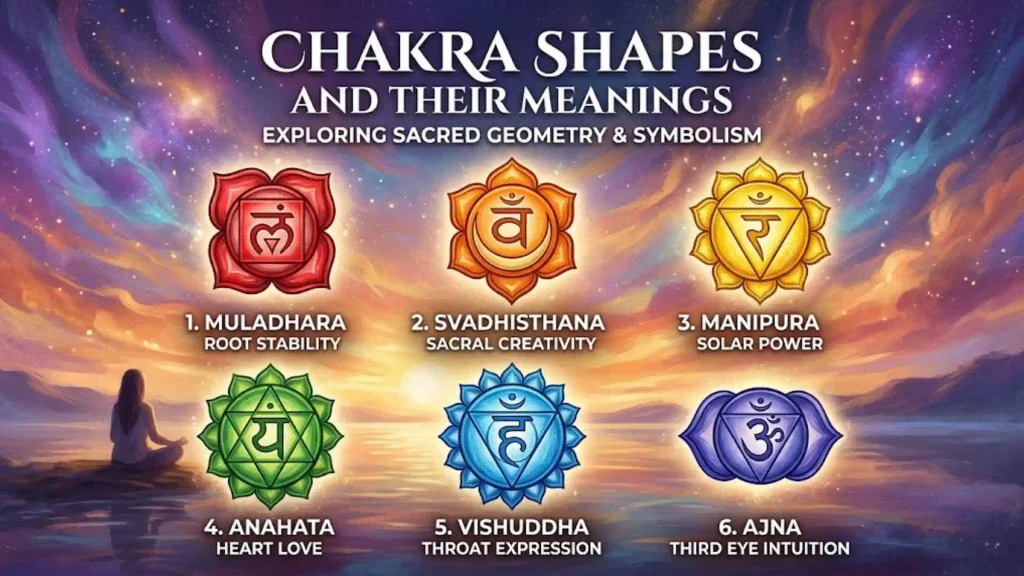
Geometric shapes are another important feature of many chakra diagrams. Their meanings depend on the tradition and the specific symbol in which they appear.
The Inverted Triangle
The meaning of the inverted triangle in chakra symbols varies by context. In commonly reproduced chakra diagrams, triangles may relate to elements, deities, or other symbolic relationships. Some modern interpretations connect the downward-pointing triangle with descent, receptivity, or the movement of energy.
Avoid assigning one meaning to every inverted triangle. A triangle in one chakra diagram may have a different role from a similar shape in another ritual or meditation image.
Squares, Circles, and Intersecting Triangles
Other shapes also have important roles:
- Square: Often associated with stability or the earth element in modern explanations of the Root Chakra.
- Circle: May appear as part of a chakra’s geometric design and can carry different symbolic meanings.
- Crescent moon: Commonly shown in the Sacral Chakra symbol and linked with water in modern presentations.
- Intersecting triangles: A feature of the commonly reproduced Heart Chakra symbol.
- Lotus flower: Provides the petal structure found in many chakra illustrations.
A useful article should explain these features in the context of the symbol being discussed rather than treating all chakra shapes and meanings as a universal code.
Chakra Colors and Their Meanings
The familiar modern chakra chart often follows a rainbow-like sequence from red at the Root Chakra to violet at the Crown Chakra. This is a widely used modern convention, not a universal feature of every historical chakra tradition.
| Common modern color | Chakra | Common modern association |
| Red | Root | Grounding and stability |
| Orange | Sacral | Creativity and emotional expression |
| Yellow | Solar Plexus | Confidence and personal power |
| Green | Heart | Compassion and connection |
| Blue | Throat | Communication and truth |
| Indigo | Third Eye | Insight and awareness |
| Violet or white | Crown | Spiritual connection and realization |
The chakra colors and meanings can help people remember the seven-chakra model. However, colors differ across historical texts, lineages, and modern teachings. Some traditional diagrams use colors tied to specific ritual or contemplative systems rather than the modern rainbow sequence.
When explaining how chakra colors relate to their meanings, distinguish the symbolism of a particular tradition from newer interpretations designed for modern yoga, meditation, or wellness settings.
What Are Blocked and Balanced Chakras?
In contemporary chakra practice, a blocked chakra is often described as a center whose symbolic qualities feel out of balance. A balanced chakra, by contrast, is said to reflect a healthier relationship with those qualities.
For example, modern Root Chakra interpretations may focus on safety and stability. Heart Chakra interpretations may focus on compassion and boundaries. Throat Chakra interpretations may focus on clear communication.
These descriptions can serve as prompts for reflection, but they are spiritual concepts rather than medical diagnoses. There is no established clinical test that can confirm a chakra is blocked.
Commonly Described Signs of Chakra Imbalance
Some modern spiritual resources associate chakra imbalance with patterns such as:
- Feeling uncertain about stability or safety.
- Struggling to express emotions.
- Finding it difficult to communicate clearly.
- Feeling disconnected from personal values.
- Having trouble setting healthy boundaries.
- Wanting more time for reflection or spiritual practice.
These examples are not diagnostic signs. The same experience can have many causes, and a chakra framework cannot establish the reason for a physical or mental health symptom.
If distress or physical symptoms persist, consider speaking with an appropriate healthcare professional rather than relying on chakra interpretations alone.
How to Balance All Seven Chakras
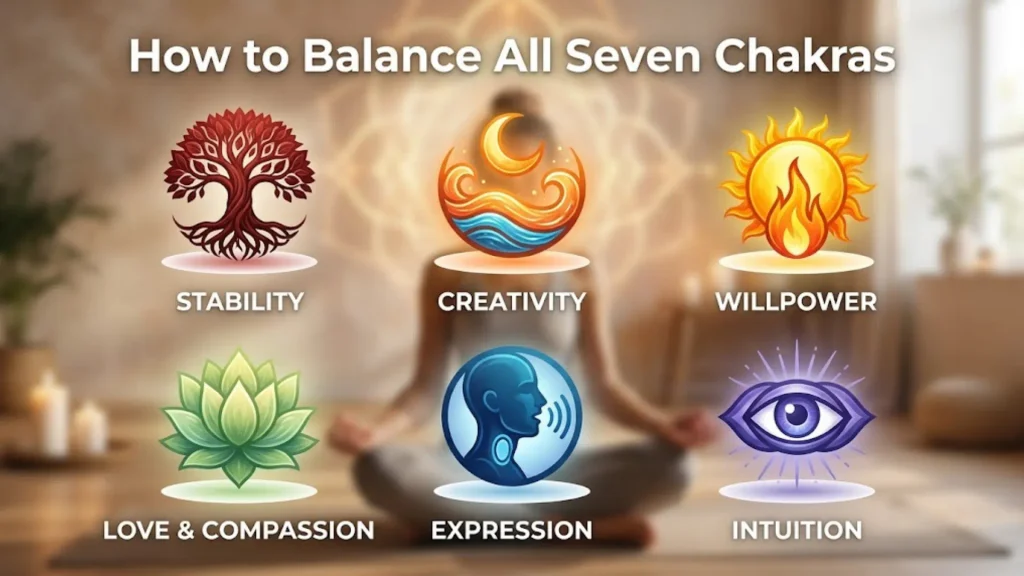
People who follow chakra practices may use meditation, yoga, breathwork, visualization, journaling, and affirmations to explore the qualities associated with each center. The purpose can be relaxation, spiritual reflection, or a stronger sense of personal intention.
There is no single method accepted by all traditions. Choose practices that are safe, comfortable, and meaningful to you.
Chakra Meditation for Beginners
A simple meditation can help you focus your attention without requiring you to accept any particular belief about energy.
- Find a comfortable seated position.
- Let your breathing settle into a natural rhythm.
- Bring your attention to one chakra’s commonly associated theme, such as stability or compassion.
- Notice your thoughts without judging them.
- Continue for a few minutes, then return to your regular activities.
You can use a visualization if it helps you focus. For example, some modern practitioners imagine a color associated with a chakra. Treat this as an optional meditation technique rather than a proven method of activating a physical energy center.
Yoga Poses for the Seven Chakras
Some modern yoga teachers associate specific poses with particular chakras. These pairings vary, and they are not universal rules of yoga.
| Chakra | Pose sometimes associated with it | Common practice goal |
| Root | Mountain Pose (Tadasana) or Tree Pose (Vrikshasana) | Balance and grounding |
| Sacral | Gentle hip-opening poses | Mobility and body awareness |
| Solar Plexus | Boat Pose or suitable core work | Strength and focus |
| Heart | Cobra Pose (Bhujangasana) or Fish Pose (Matsyasana) | Chest opening and posture |
| Throat | Gentle neck mobility and chanting | Awareness and expression |
| Third Eye | Seated meditation | Focus and reflection |
| Crown | Comfortable seated meditation | Contemplation and stillness |
Use suitable modifications and avoid movements that cause pain. Yoga poses are not guaranteed to balance chakras or treat medical conditions.
Breathwork, Affirmations, and Journaling
Other practices may include:
- Breathwork: Use gentle, comfortable breathing exercises. Stop if you feel dizzy or unwell.
- Affirmations: Choose realistic statements, such as “I can speak honestly and respectfully.”
- Journaling: Write about feelings, decisions, relationships, or personal values.
- Creative expression: Explore drawing, dance, music, or writing.
- Loving-kindness meditation: Reflect on compassion for yourself and others.
- Grounding activities: Take a mindful walk or spend time noticing your surroundings.
These techniques can support reflection or relaxation for some people. Their value does not depend on proving that a chakra energy system operates as a measurable physical mechanism.
Best Crystals for Each Chakra
Crystals and gemstones appear frequently in contemporary chakra wellness practices. The following associations are popular today, but they are not fixed rules across Hindu and Buddhist traditions, and they are not proven medical treatments.
| Chakra | Crystals often associated with it |
| Root | Hematite, red jasper |
| Sacral | Carnelian, moonstone |
| Solar Plexus | Citrine, tiger’s eye |
| Heart | Rose quartz, green aventurine |
| Throat | Lapis lazuli, aquamarine |
| Third Eye | Amethyst, sodalite |
| Crown | Clear quartz, selenite |
People may use these stones as meditation objects, reminders of personal intentions, or decorative items. If a crystal helps you focus, you can treat it as a personal symbol without assuming it has a medically verified effect.
Essential Oils for Chakra Balancing
Some modern wellness resources pair essential oils with chakra themes. These pairings vary between practitioners and brands, so they should be described as contemporary associations rather than traditional facts shared by every lineage.
| Chakra | Oils often associated with it |
| Root | Cedarwood, patchouli, sandalwood |
| Sacral | Ylang-ylang, jasmine |
| Solar Plexus | Peppermint, chamomile |
| Heart | Rose, lavender |
| Throat | Eucalyptus, chamomile |
| Third Eye | Frankincense, sandalwood, sage |
| Crown | Lotus, lavender |
Essential oils can irritate skin or trigger allergies. Follow product safety directions, avoid swallowing oils, and take extra care around children, pets, pregnancy, asthma, or other relevant health concerns. Aromatherapy should not replace medical care.
Chakras in Hinduism and Buddhism: Historical Context
The relationship between chakras and Hinduism is complex because Hindu traditions include many schools, texts, and practices. Chakra concepts also appear in Buddhist tantra, including traditions that developed in India and later spread to Tibet and other regions.
The number and arrangement of chakras have changed across texts and lineages. Some Buddhist tantric systems describe five principal centers; other systems describe six, seven, or more. Some Hindu tantric systems describe six principal chakras and a crown lotus above them.
This variation matters because modern diagrams often present one seven-chakra arrangement as if it were the single system used throughout ancient India. Historical sources do not support that simplification.
The Vedas are important texts in Hindu religious history, but it would be misleading to claim that the familiar modern seven-chakra diagram, complete with a fixed rainbow color sequence, appears uniformly across the Vedas. Chakra systems are more closely associated with particular tantric and yogic texts and practices, and their development spans different periods.
For further background, see the Encyclopedia of Buddhism entry on chakra systems in Buddhist tantra and the scholarly overview of cakras in yoga and meditation studies.
Understanding this history helps readers appreciate chakra symbols without treating every modern explanation as an ancient or universal belief.
Frequently Asked Questions About Chakra Symbols
What are chakras?
Chakras are subtle-body centers described in certain Hindu and Buddhist tantric traditions. They are used in spiritual practices, meditation, and visualization. Different traditions describe different numbers and arrangements of chakras.
What do the seven chakra symbols mean?
In the common modern system, the Root Chakra represents grounding, the Sacral Chakra creativity, the Solar Plexus personal power, the Heart compassion, the Throat communication, the Third Eye insight, and the Crown spiritual connection. These are common modern associations rather than universal definitions.
What are the colors of the seven chakras?
Modern chakra charts often use red, orange, yellow, green, blue, indigo, and violet or white, in order from Root to Crown. Historical systems may use different colors or symbolic arrangements.
Where are the seven chakras located?
The familiar modern chart places them at the base of the spine, lower abdomen, upper abdomen, chest, throat, between the eyebrows, and top of the head. These are locations within a subtle-body model, not seven physical organs identified by anatomy.
Why do chakra symbols have different numbers of petals?
In particular traditions, lotus petals can represent symbolic features such as channels, Sanskrit letters, or other elements of meditation diagrams. The details vary by text and lineage.
How do you balance the seven chakras?
People who practice chakra balancing may use meditation, yoga, breathing exercises, visualization, journaling, or affirmations. These practices can support personal reflection or relaxation, but there is no established medical test for chakra balance.
Which crystals are associated with each chakra?
Popular modern associations include red jasper for the Root Chakra, carnelian for the Sacral Chakra, citrine for the Solar Plexus, rose quartz for the Heart, lapis lazuli for the Throat, amethyst for the Third Eye, and clear quartz for the Crown. These are contemporary wellness associations, not proven treatments.
Which essential oils are used for chakra healing?
Modern lists may pair cedarwood with the Root Chakra, ylang-ylang with the Sacral Chakra, peppermint with the Solar Plexus, rose with the Heart, eucalyptus with the Throat, frankincense with the Third Eye, and lavender with the Crown. These pairings vary and are not established medical therapies.
What is the connection between chakras and Hinduism?
Chakra concepts appear in several Hindu tantric and yogic traditions. They also appear in Buddhist tantra, but different traditions use different numbers, symbols, and practices. The popular modern seven-chakra rainbow chart is not the only historical system.
What is holistic chakra healing?
Holistic chakra healing is a modern umbrella term for practices that combine chakra symbolism with meditation, yoga, breathwork, visualization, crystals, or other wellness activities. It may provide a framework for personal reflection, but it should not be presented as a proven cure for illness.
Conclusion: Understanding the Seven Chakra Symbols
The seven chakra symbols and their meanings offer a familiar way to explore spiritual ideas about grounding, creativity, confidence, compassion, communication, insight, and connection. Their lotus petals, geometric shapes, and colors make each symbol visually distinct.
The most important point is to understand the context behind the symbols. Chakra traditions are varied, and the popular seven-chakra rainbow chart represents one modern way of presenting a much broader history.
Whether you study chakra symbolism for spiritual reasons, cultural interest, or meditation, approach it with curiosity and care. Use the symbols as tools for learning and reflection, and distinguish traditional beliefs from modern interpretations and scientific evidence.

Hi, I’m Asher Monroe, a writer who believes that meaningful words have the power to inspire change and bring people closer to their dreams. I have always been fascinated by the beauty of quotes and the way a simple message can provide motivation, hope, and comfort.
I enjoy creating content around inspirational quotes, life lessons, success stories, and positive thoughts that help readers find encouragement in their everyday lives. My goal is to share words that connect with people and remind them of their inner strength.
Through my writing, I explore the ideas of personal growth, confidence, and the importance of staying inspired through every chapter of life.
I am the author of Words That Move the Soul and The Path of Endless Inspiration, two books focused on the power of wisdom, positivity, and meaningful thoughts.
 Sienna Brooks
 Rowan Sinclair Rowan Sinclair