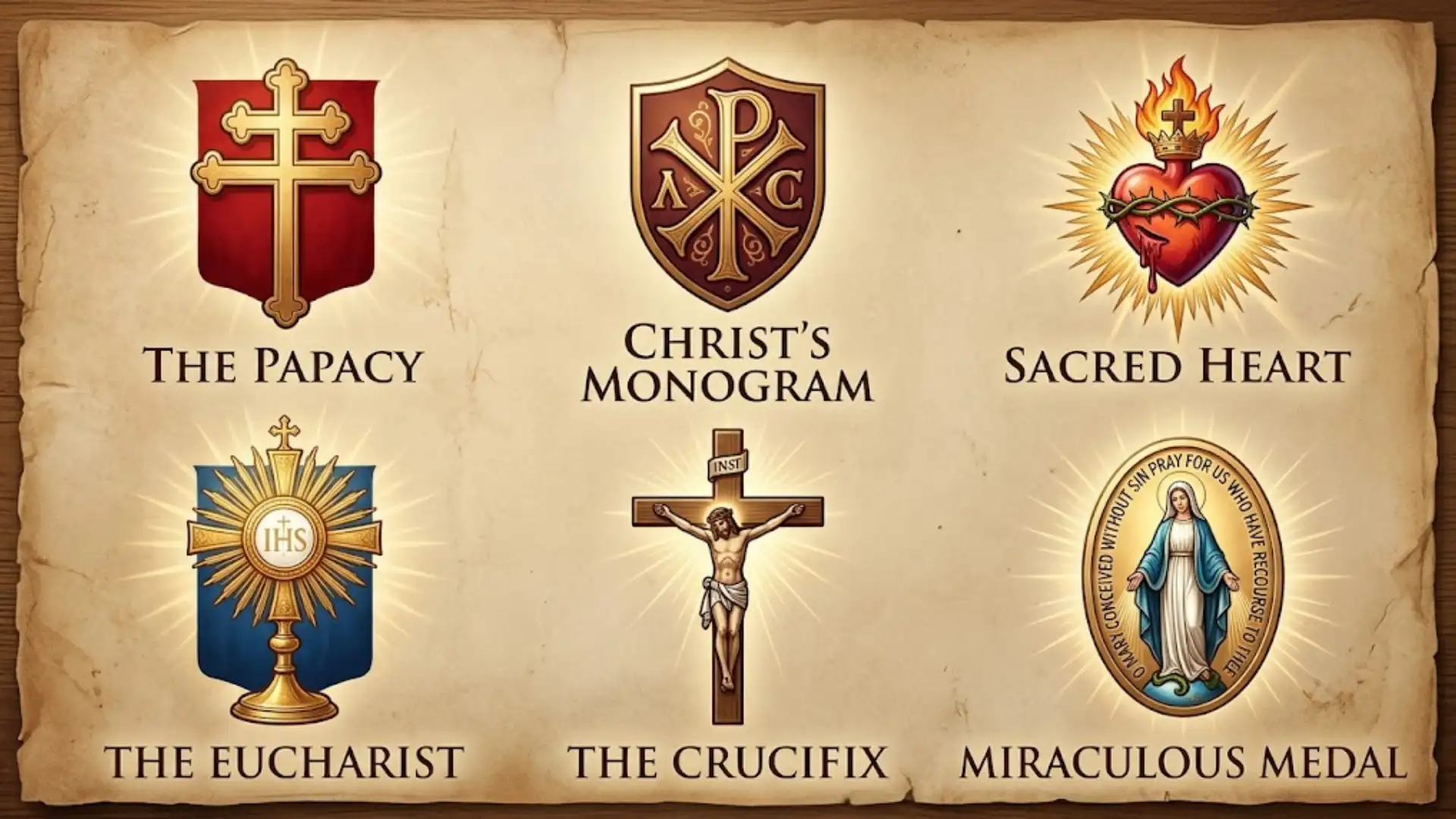
Sacred symbols of the Catholic Church help Catholics understand their faith through images, objects, colors, gestures, and signs. From the cross and Sacred Heart of Jesus to the dove, chalice, Paschal candle, and crossed keys, these symbols communicate important teachings about Jesus Christ, the Holy Spirit, the sacraments, salvation, and eternal life.
The meaning of a symbol often comes from the Bible, Catholic tradition, or its role in the liturgy. Some symbols appear in nearly every Catholic church, while others are associated with particular saints, religious devotions, or celebrations during the liturgical year.
This guide explains more than 50 Catholic symbols and meanings, including their biblical backgrounds, uses in Catholic worship, and significance in religious art. It also explains the difference between a cross and a crucifix, the purpose of the tabernacle and monstrance, and the meaning of symbols used during Holy Mass.
What Are Catholic Symbols?
Catholic symbols are signs, images, objects, and artistic designs that communicate aspects of the Catholic faith. They help people recognize biblical stories, remember important teachings, and understand the meaning of religious celebrations.
Catholic symbolism appears in many places, including:
- Churches, chapels, and sanctuaries
- Altars and other Catholic liturgical objects
- Stained-glass windows, paintings, and statues
- Vestments and religious garments
- Baptismal fonts and sacramental objects
- Homes, prayer spaces, and devotional items
- Religious books, crosses, medals, and rosaries
These Catholic religious symbols are not all used in the same way. A crucifix reminds believers of Christ’s Passion, while a chalice serves a practical role in the Eucharistic liturgy. A halo identifies holiness in religious artwork, while the sanctuary light indicates the presence of the reserved Blessed Sacrament.
The Catechism of the Catholic Church explains that sacred art and the arrangement of a church should direct attention toward Christ and the mysteries celebrated in the liturgy. Source: Catechism of the Catholic Church, sections on the celebration of the liturgy
Why Are Sacred Catholic Symbols Important?
Sacred Catholic symbols make religious teachings easier to recognize and remember. They also connect Scripture, worship, and everyday Christian life.
Their purposes include:
- Teaching the faith: Images can explain biblical stories and important beliefs.
- Supporting prayer: Crucifixes, statues, and devotional images help focus attention during prayer.
- Celebrating the sacraments: Water, oil, bread, wine, and candles have important roles in Catholic sacramental life.
- Remembering Jesus Christ: The cross, Sacred Heart, and Lamb of God direct attention to Christ’s life, death, and Resurrection.
- Honoring saints: Religious artwork often identifies saints through familiar symbols.
- Expressing hope: Images of light, the tree of life, and the Resurrection point toward Christian hope and eternal life.
A symbol’s meaning depends on its context. For example, a dove can represent the Holy Spirit in a depiction of Jesus’ baptism, while an olive branch can communicate peace in a biblical or artistic setting.
Catholic Symbols and Meanings Chart
The following table provides a quick guide to more than 50 Catholic symbols and their meanings. Some meanings are firmly established by Scripture or Catholic liturgical practice, while others are traditional associations found in Christian art.
| Catholic symbol | Meaning or significance |
| Cross | Christ’s sacrifice and Christian salvation |
| Crucifix | Jesus Christ’s Passion and death |
| Sacred Heart | Christ’s love and mercy |
| Alpha and Omega | Christ as the beginning and the end |
| Chi-Rho | Christ’s name |
| IHS | A traditional Christogram for Jesus |
| INRI | The inscription identifying Jesus as King of the Jews |
| Dove | The Holy Spirit, especially in depictions of Jesus’ baptism |
| Fire | The Holy Spirit, divine presence, or spiritual zeal, depending on context |
| Fish | Early Christian identity and Jesus Christ |
| Lamb of God | Christ’s sacrifice and victory over sin |
| Good Shepherd | Jesus’ care and guidance for his people |
| Crown of Thorns | Christ’s suffering and Passion |
| Halo | Holiness or heavenly glory |
| Chalice | The Eucharistic celebration |
| Bread and wheat | The Eucharist and biblical imagery of nourishment |
| Grapes and wine | The Eucharist and the Blood of Christ |
| Paschal candle | Christ’s Resurrection and the light of Christ |
| Altar | The table of the Lord and the sacramental memorial of Christ’s sacrifice |
| Ambo | The proclamation of the Word of God |
| Tabernacle | The place where the Blessed Sacrament is reserved |
| Monstrance | The consecrated host displayed for Eucharistic adoration |
| Sanctuary light | A sign of the reserved Blessed Sacrament |
| Holy water | Baptismal remembrance and blessing |
| Ashes | Repentance, mortality, and conversion |
| White baptismal garment | New life in Christ |
| Chrism oil | The gift of the Holy Spirit and sacramental anointing |
| Oil of the Sick | Anointing of the sick |
| Oil of the Catechumens | Preparation for baptism |
| Crossed keys | St. Peter and the authority associated with the papacy |
| Crosier | A bishop’s pastoral care |
| Miter | A liturgical sign of episcopal ministry |
| Lily | Purity in certain Christian and Marian artworks |
| Fleur-de-lis | A stylized lily, sometimes used in Marian imagery |
| Olive branch | Peace in biblical and Christian imagery |
| Palm branch | Christ’s entry into Jerusalem or Christian martyrdom |
| Peacock | Immortality or Resurrection in some Christian art |
| Pelican | Christ’s self-giving love in traditional Christian symbolism |
| Tree of Life | Life, restoration, and the hope of eternal life |
| Circle | Eternity or completeness in some artistic contexts |
| Triangle | The Trinity in some Christian artwork |
| Shamrock | A traditional illustration used to teach about the Trinity |
| Triquetra | A three-part interlaced design sometimes used in Christian imagery |
| Shell | Baptism or St. James in particular contexts |
| Ship | The Church or the Christian journey in some artwork |
| Serpent | Temptation in some biblical scenes; other meanings in different passages |
| Eagle of St. John | The Gospel of John |
| Winged lion of St. Mark | The Gospel of Mark |
| Winged ox of St. Luke | The Gospel of Luke |
| Winged man of St. Matthew | The Gospel of Matthew |
| Cross of St. Andrew | The traditional form of St. Andrew’s cross |
| Eye of God | Divine knowledge or providence in some Christian art |
| Candle | Christ’s light, prayer, reverence, or celebration |
| Incense | Prayer, reverence, and worship |
| The Word of God | God’s revelation; Jesus as the Word made flesh |
| The Pope | The papal office and visible service to Church unity |
These meanings provide a starting point for understanding Catholic iconography. A symbol’s exact significance can change according to the biblical passage, liturgical celebration, saint, or devotional tradition in which it appears.
Catholic Symbols of Jesus Christ
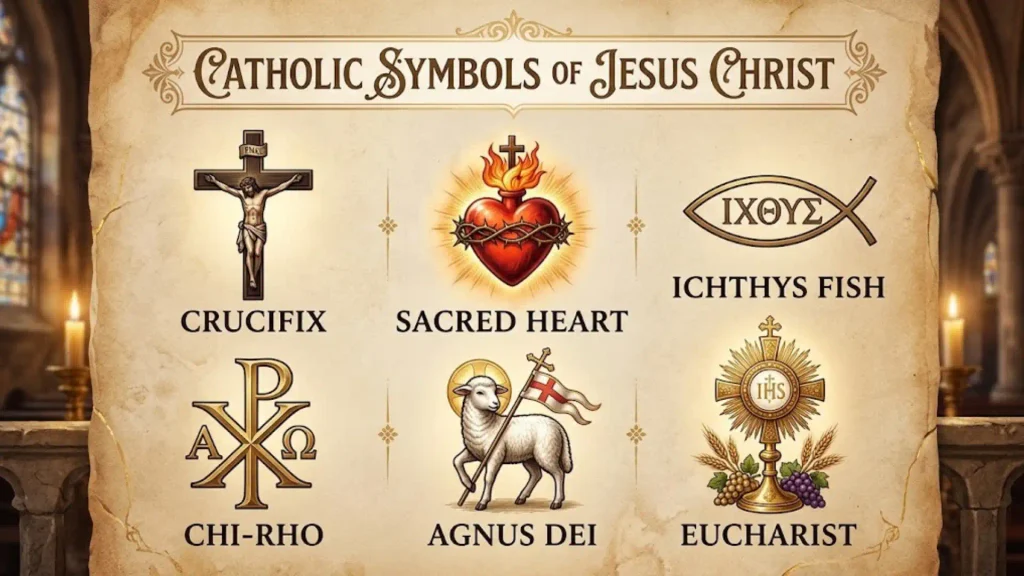
Many of the most recognizable Catholic symbols of Jesus Christ focus on his identity, divine love, suffering, death, and Resurrection. These symbols appear in crucifixes, church paintings, altars, devotional images, and the celebration of the Eucharist.
The Cross
The cross is the central symbol of Christianity. It recalls the Crucifixion of Jesus Christ and the belief that his sacrifice brings redemption and salvation.
For Catholics, the cross is not simply a reminder of suffering. It also points toward God’s love, forgiveness, and the hope of the Resurrection. That is why crosses appear in churches, homes, cemeteries, prayer books, and Catholic schools.
The cross is especially prominent during the liturgy. The General Instruction of the Roman Missal directs that a cross with the figure of Christ crucified should be visible to the congregation during Mass. Source: USCCB, General Instruction of the Roman Missal
The Crucifix
A crucifix is a cross that includes a representation of Jesus’ body. It focuses attention on Christ’s Passion and death.
Catholic churches commonly display a crucifix near or above the altar. Catholics may also keep one in their homes or carry one as a devotional item.
What is the difference between a cross and a crucifix?
- A cross may be shown without Jesus’ body.
- A crucifix specifically depicts Jesus crucified on the cross.
Both are Christian symbols, but the crucifix makes Christ’s suffering and sacrifice especially visible.
The Sacred Heart of Jesus
The Sacred Heart of Jesus is a devotional image of Christ’s heart, often shown with flames, a cross, or a crown of thorns. Some images also show a wound, recalling the piercing of Jesus’ side during the Crucifixion.
The symbol represents Christ’s divine love, mercy, and self-giving sacrifice. It reminds Catholics that Jesus’ love is not distant or abstract; it is expressed through his life, suffering, and care for humanity.
The devotion has a long history in Catholic life. The USCCB explains that the pierced heart of Christ has been understood in Christian tradition as a source of life, holiness, and sacramental grace. Source: USCCB, Novena to the Sacred Heart of Jesus
Alpha and Omega
Alpha and Omega are the first and last letters of the Greek alphabet. In the Book of Revelation, God declares himself the beginning and the end. The phrase is also associated with Christ in the book’s concluding passages.
The symbol communicates God’s eternity and the belief that all history exists within God’s power and purpose.
Catholic artists may place Alpha and Omega on a Paschal candle, a cross, a church wall, or other religious objects. On the Paschal candle, these letters help express the connection between the risen Christ and the whole of time.
The Chi-Rho
The Chi-Rho combines the Greek letters Chi and Rho, the first two letters of the Greek word Christos, meaning Christ.
It became an important Christian emblem in late antiquity and is often associated with early Christian art and Roman Emperor Constantine. It can appear on church furnishings, vestments, banners, and crosses.
The Chi-Rho identifies Christ rather than representing a separate deity or sacrament. It is one of the best-known examples of a Christogram, a symbol formed from letters associated with Jesus’ name or title.
IHS
IHS is a traditional Christogram associated with the name of Jesus. It comes from the Greek spelling of Jesus’ name, represented through Latin letters in the form used by Western Christian tradition.
The letters appear on altars, chalices, vestments, devotional objects, and church decorations. In some contexts, a cross or other design is added above the letters.
The symbol reminds viewers of Jesus’ name and identity. It is not necessary to interpret IHS as an English acronym to understand its religious significance.
INRI
INRI stands for the Latin phrase Iesus Nazarenus Rex Iudaeorum, which means “Jesus of Nazareth, King of the Jews.”
According to the Gospel accounts, this title was placed above Jesus during his Crucifixion. Catholic crucifixes often show the letters INRI on a small plaque above Jesus’ head.
The inscription connects the crucifix to the biblical account of the Passion. It also recalls the title under which Jesus was presented to those who witnessed his death.
The Lamb of God
The Lamb of God is an important biblical image of Jesus Christ. In John 1:29, John the Baptist identifies Jesus as the Lamb of God who takes away the sin of the world.
The lamb connects Jesus with sacrifice, innocence, and redemption. It also recalls the Passover lamb in the Old Testament and the victorious Lamb described in Revelation 5:6–14.
In Catholic art, the lamb may appear holding a cross or standing near a banner of victory. These details connect Christ’s sacrifice with the Christian belief in his Resurrection.
The Good Shepherd
The Good Shepherd represents Jesus as the one who knows, guides, protects, and cares for his people. The image comes especially from John 10, where Jesus describes himself as the good shepherd who lays down his life for the sheep.
Christian art may show Jesus carrying a lamb, standing among sheep, or guiding a flock. The image communicates both tenderness and sacrifice: Christ cares for his followers and gives himself for them.
It is one of the most accessible examples of Catholic religious imagery because it expresses a major Christian teaching through an everyday scene.
The Crown of Thorns
The Crown of Thorns recalls the soldiers who mocked Jesus before his Crucifixion. The Gospel accounts describe them placing a crown of thorns on his head as part of their mockery.
In Catholic religious art, the crown represents suffering, humiliation, and Christ’s Passion. It can also remind believers of the contrast between earthly power and Christ’s self-giving love.
When shown with the Sacred Heart, the crown often emphasizes the connection between Christ’s suffering and his love for humanity.
Catholic Symbols of the Holy Spirit
The Holy Spirit is the third person of the Trinity. Catholic art uses several symbols to communicate the Spirit’s presence and work, drawing especially from biblical accounts
The dove is one of the most recognizable Catholic symbols of the Holy Spirit. In Matthew 3:16 and Mark 1:10, the Spirit descends upon Jesus at his baptism in a form described as resembling a dove.
Artists often show a white dove with rays of light surrounding it. This image may appear above a baptismal font, in a church window, or in artwork depicting Pentecost.
The dove can also symbolize peace in some Christian imagery. Its exact meaning depends on the scene: above Jesus at his baptism, it points especially to the Holy Spirit.
Fire and Flames
Fire is another biblical symbol associated with the Holy Spirit. In Acts 2, the Holy Spirit comes upon the disciples at Pentecost, with tongues described as being like fire.
In Catholic artwork, flames can represent the Spirit’s presence, spiritual renewal, and the courage to proclaim the Gospel. Fire can also have other biblical meanings, so its significance depends on the passage or image.
Holy Oil and Sacred Chrism
Holy oil has a practical and symbolic role in Catholic sacramental life. The Church uses three principal oils:
- Oil of the Catechumens: Used in certain baptismal rites as a sign of strengthening those preparing for baptism.
- Sacred Chrism: A mixture of olive oil and perfume, consecrated by a bishop and used in baptism, confirmation, ordination, and the dedication of churches and altars.
- Oil of the Sick: Used in the Sacrament of the Anointing of the Sick.
These oils are not interchangeable. Their different uses reflect distinct aspects of Catholic sacramental practice. The USCCB describes their preparation and use in its guidance on the reception of holy oils. Source: USCCB, Order for the Reception of the Holy Oils
Catholic Symbols of the Holy Trinity
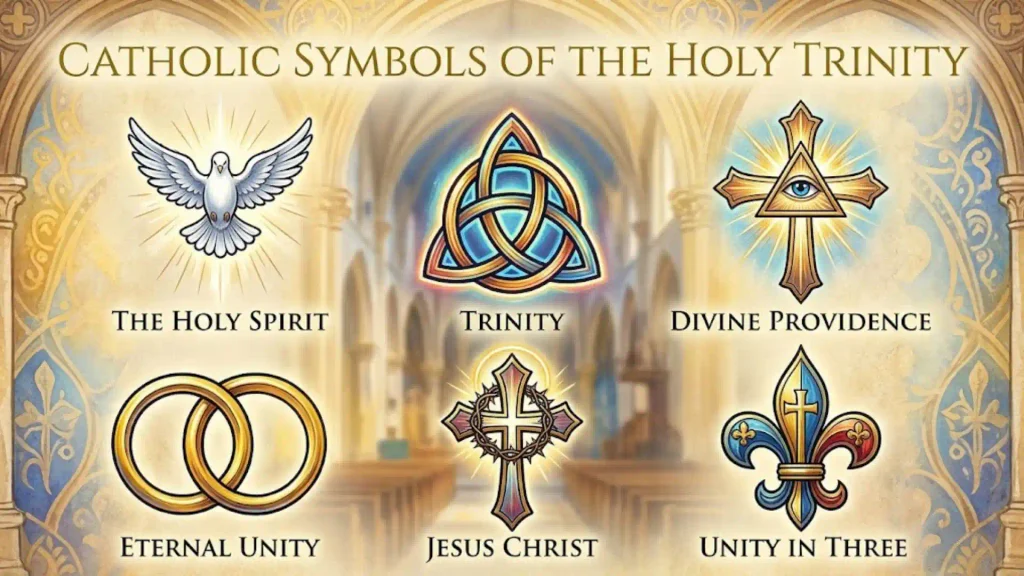
The Holy Trinity is the Catholic belief in one God in three persons: the Father, the Son, and the Holy Spirit. Some symbols help communicate this teaching, though no image can fully explain the mystery of God.
The Triangle
A triangle is sometimes used in Christian art to represent the Trinity. Its three sides form one shape, making it a visual aid for thinking about three persons in one God.
This is an illustration, not a complete explanation of Catholic doctrine. The Father, Son, and Holy Spirit are not three parts of God; each is fully God, and together they are the one God.
The Shamrock and Three-Leafed Clover
The shamrock, a small three-leafed plant, is traditionally associated with St. Patrick and his teaching about the Trinity.
The three leaves offer a simple illustration of the Father, Son, and Holy Spirit. The plant itself is not a sacramental object, and the analogy should not be taken literally. Its value lies in helping people remember the Christian teaching of the Trinity.
The Triquetra
The triquetra is a three-part interlaced design found in various historical and modern contexts. Some Christian artists use it to represent the Trinity and unity.
However, it is not exclusively Catholic, and its meaning is not always religious. If it appears in a church or religious image, its surrounding design and context help establish how it should be interpreted.
Catholic Symbols of Mary
Catholic art often uses flowers, hearts, stars, and other visual elements to express devotion to the Virgin Mary. These symbols reflect biblical themes, traditional titles, and particular forms of Marian devotion.
The Lily
The lily is commonly associated with purity in Christian art. It frequently appears in depictions of the Virgin Mary and St. Joseph.
The flower can represent purity and innocence, but it is not exclusively a Marian symbol. Its meaning depends on the person or biblical story shown in the artwork.
The Fleur-de-lis
The fleur-de-lis is a stylized lily used in heraldry and religious art. In some Christian images, it is associated with Mary and purity.
Because the design has also appeared in royal emblems, flags, and secular art, it should not automatically be labeled a Catholic symbol in every setting.
The Immaculate Heart of Mary
The Immaculate Heart of Mary is a devotional image of Mary’s heart, often surrounded by flowers or pierced by a sword. It expresses Mary’s love for God, her maternal care, and her sorrow as she shares in the suffering of Jesus.
This devotion is distinct from the Sacred Heart of Jesus, although the two images are sometimes displayed together. Each focuses on a different person and aspect of Catholic devotion.
The Star of the Sea
The title Stella Maris, or Star of the Sea, is associated with the Virgin Mary. It presents Mary as a source of guidance and hope for Christians on their journey of faith.
Images may show a star near Mary or include maritime imagery. The title has a long place in Catholic prayer and devotional tradition.
The Rosary
The rosary is a Catholic prayer devotion that helps people meditate on events in the lives of Jesus and Mary. Its beads help keep track of prayers, and it usually includes a crucifix.
The rosary is not a charm or a symbol that works automatically. Its purpose is to support prayer and reflection on the Gospel.
Catholic Symbols of Saints and the Four Gospels
Catholic sacred art often includes recognizable symbols that help viewers identify saints and biblical figures. These symbols may refer to a saint’s life, martyrdom, writings, or a particular biblical story.
The Four Creatures in Revelation
Revelation 4:6–8 describes four living creatures: one like a lion, one like an ox or calf, one with a human face, and one like an eagle. Since the early centuries of Christianity, these creatures have traditionally been associated with the four Gospel writers.
The traditional pairings are:
| Gospel writer | Symbol | Traditional association |
| St. Matthew | Winged man or angel | Christ’s human ancestry and humanity |
| St. Mark | Winged lion | Courage and the proclamation of Christ |
| St. Luke | Winged ox | Sacrifice and priestly imagery |
| St. John | Eagle | Spiritual insight and the elevated themes of his Gospel |
These associations are part of established Christian iconography. The USCCB’s notes on Revelation explain that the four creatures have been used as symbols of the evangelists since the second century. Source: USCCB Bible, Revelation 4
The Halo
A halo is a circle or glow around the head of a figure in Christian art. It identifies holiness or heavenly glory and appears in images of Jesus, Mary, angels, and saints.
Artists may use different styles to distinguish figures. For example, images of Christ sometimes include a cross within the halo. However, the style varies across periods and artistic traditions.
A halo is an artistic sign, not a physical feature that Catholic teaching says all holy people possess.
The Palm Branch
The palm branch has more than one important association in Christianity. In the Gospel accounts of Jesus’ entry into Jerusalem, people greet him with palm branches. In Christian art, a palm branch can also identify a martyr who remained faithful even unto death.
The palm therefore can communicate victory, faithful witness, and Christ’s triumph. Its exact meaning depends on whether the artwork depicts Palm Sunday, a saint, or another biblical scene.
The Cross of St. Andrew
The Cross of St. Andrew is traditionally shown as an X-shaped cross. Christian tradition associates this shape with the martyrdom of St. Andrew, one of Jesus’ apostles.
It is also known as a saltire. Because the same shape appears in flags and heraldry, its presence alone does not prove a religious meaning. In Catholic artwork, the association with St. Andrew is clearer when the saint or his story appears in the image.
Catholic Symbols of the Eucharist
The Eucharist is central to Catholic worship. During Mass, Catholics believe that the bread and wine become the Body and Blood of Christ through consecration. The Church calls the consecrated Eucharist the Blessed Sacrament and teaches the Real Presence of Christ.
Many Catholic symbols of the Eucharist connect the Last Supper, Christ’s sacrifice, and the promise of eternal life.
Bread and Wheat
Bread is central to the account of the Last Supper, when Jesus took bread, gave thanks, broke it, and gave it to his disciples.
Wheat may appear in Catholic art because it is used to make bread. Together, bread and wheat can point toward nourishment, the Eucharist, and the gift of Christ’s life.
Grapes and Wine
Grapes and wine are associated with the Eucharistic celebration. At the Last Supper, Jesus gave his disciples wine and connected it with his blood.
In Christian art, grapevines can also symbolize spiritual fruitfulness and the relationship between Christ and his followers. Their meaning depends on the scene and the accompanying text.
The Chalice
A chalice is the sacred cup used for the wine during the Eucharistic liturgy. It is a practical liturgical vessel as well as a sign connected to the Last Supper and the Blood of Christ.
Chalices may be made from precious metals and decorated with crosses or other religious imagery. Their use is governed by liturgical practice, rather than being merely decorative.
The Monstrance
A monstrance is a vessel used to display the consecrated host for Eucharistic adoration. It often has a central opening surrounded by rays or other decorative elements.
The monstrance helps focus attention on the Blessed Sacrament during prayer and adoration. It is not the object Catholics worship in itself; Catholic adoration is directed to Christ believed to be truly present in the Eucharist.
The Tabernacle
The tabernacle is the secure, honored place where the Blessed Sacrament is reserved outside the immediate celebration of Mass. It allows the Eucharist to be kept for Communion to the sick and for prayer and adoration.
The Catechism teaches that the tabernacle should occupy a worthy place that supports reverence and adoration before Christ’s Real Presence. Source: Catechism of the Catholic Church, section 1183
The Sanctuary Light
The sanctuary light, often a candle or lamp near the tabernacle, indicates and honors the presence of the reserved Blessed Sacrament.
This is more specific than the general symbolism of a candle. When the light is placed near the tabernacle, it tells worshippers that the Eucharist is reserved there.
The Lamb of God and Eucharistic Imagery
The Lamb of God is often shown in church art holding a banner or standing near a cross. The image connects Christ’s sacrifice with his victory over sin and death.
During Mass, the phrase “Lamb of God” is also used in the liturgy before Communion. This makes the symbol a clear link between biblical imagery and Catholic worship.
Catholic Symbols Used During Mass
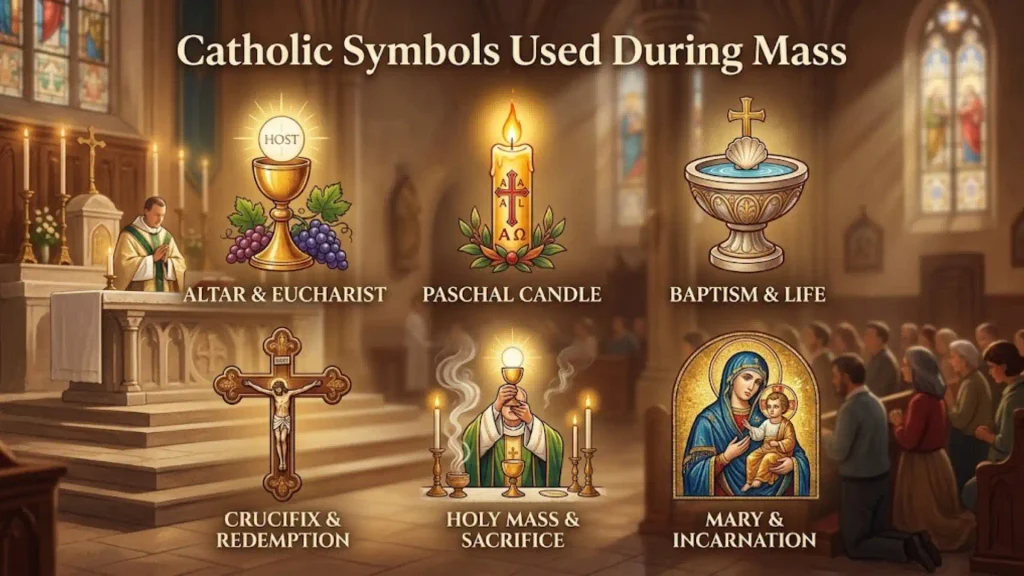
The Holy Mass includes physical signs, gestures, objects, and words. These elements are not random decorations. Their use helps communicate the meaning of the Eucharist and the Liturgy of the Word.
The Altar
The altar is the central place for the Eucharistic celebration. It represents the table of the Lord and is connected to the sacrifice of the Cross, made present sacramentally in the liturgy.
The Catechism describes the altar as both the Lord’s Cross and the table to which the People of God are invited. Source: Catechism of the Catholic Church, section 1182
The altar is not the same as a general table or shelf used for decorations. It has a distinct role in Catholic worship.
The Ambo
The ambo is the designated place from which Scripture is proclaimed during the Liturgy of the Word. Readings, the responsorial psalm, and the Easter Proclamation are proclaimed from it according to the liturgical norms.
Its purpose differs from that of the altar: the ambo is associated with the proclamation of God’s Word, while the altar is the focal point of the Eucharistic liturgy.
Candles and the Paschal Candle
Candles are used in Catholic worship as signs of Christ’s light, reverence, and celebration.
The Paschal candle has a particularly important role at Easter. It is blessed and lit during the Easter Vigil, when the congregation gathers in darkness to celebrate Christ’s Resurrection.
The candle represents Christ as the light of the world. Its symbols often include a cross, the Greek letters Alpha and Omega, and the current year.
The USCCB explains that the Paschal candle should be a genuine candle and that it represents Christ’s light rising in glory. It is also used during the Easter season, at baptisms, and at funerals. Source: USCCB, Questions on the Sacred Paschal Triduum
Holy Water
Holy water is water blessed for use in Catholic worship and devotional practices. It is associated with baptism, blessing, and remembrance of the promises made in baptism.
Catholics may dip their fingers into holy water at the entrance of a church and make the Sign of the Cross. The gesture recalls baptism and expresses faith in the Father, Son, and Holy Spirit.
Holy water is a sacramental sign. It is not believed to operate as magic or to replace repentance, prayer, or the sacraments.
Ashes
Ashes are used especially on Ash Wednesday, the beginning of Lent in the Roman Rite. They remind Catholics of human mortality, repentance, and the call to turn back to God.
The use of ashes has biblical roots in practices of mourning and repentance. During the Ash Wednesday liturgy, the minister places ashes on the forehead or head while speaking words that call the faithful to conversion or remembrance of mortality.
White Garments
A white garment is traditionally given to the newly baptized as a sign of new life in Christ. White communicates purity and the washing away of sin, while also pointing toward the responsibility to live according to the faith.
The USCCB explains that the white garment symbolizes being washed clean of sin and being called to walk in newness of life. Source: USCCB, Christian Initiation of Adults
Catholic Liturgical Objects and Their Meanings
Catholic churches contain many objects used in worship. Some are sacramental objects, while others serve as liturgical furnishings or signs of the responsibilities of ordained ministers.
The Miter
A miter is a ceremonial head covering worn by bishops and certain other prelates during liturgical celebrations. It is associated with episcopal ministry and the bishop’s role in teaching, sanctifying, and shepherding the faithful.
Its design and use are governed by liturgical custom. The miter should not be confused with a symbol that independently represents the Bible or the two Testaments; that explanation is sometimes repeated in popular symbol lists but is not its primary official function.
The Crosier
A crosier is a staff carried by a bishop during certain liturgical ceremonies. Its curved shape resembles a shepherd’s crook and symbolizes pastoral care.
The image of a shepherd connects to biblical descriptions of leaders who care for God’s people. The crosier therefore represents the bishop’s responsibility to guide and serve the local Church.
The Crossed Keys
The crossed keys are associated with St. Peter and the authority Jesus describes in Matthew 16:19: “I will give you the keys to the kingdom of heaven.”
The symbol is particularly associated with the papacy and the Vatican. It appears in papal and Vatican imagery, often with other emblems.
The crossed keys do not mean that the Pope personally controls who enters Heaven. They represent a theological understanding of the authority entrusted to Peter and his successors within the Church.
The Pope and Papal Symbols
The Pope is the Bishop of Rome and the visible sign of unity for the Catholic Church. Papal coats of arms and insignia identify the office or an individual pontificate.
The crossed keys are among the best-known papal symbols. Other elements may appear in an individual Pope’s coat of arms, but these can change from one pontificate to another.
Incense
Incense is burned during some Catholic liturgies as a sign of reverence, honor, and prayer. Biblical imagery connects incense with prayer rising before God.
During Mass, incense may be used to honor the altar, the Gospel book, the Eucharistic gifts, the priest, and the congregation, according to the rite being celebrated. Its use is symbolic and liturgical, not a claim that the smoke itself grants forgiveness.
The Ship
The ship is a traditional image in Christian art for the Church or the journey of faith through difficulty. The image draws on biblical stories of boats, storms, and Jesus’ presence with his disciples.
It may appear in church decoration, stained glass, or religious writing. However, not every ship image has a religious meaning; the context determines its significance.
Catholic Symbols of Eternal Life, Peace, Purity, and Forgiveness
Many Catholic spiritual symbols draw on biblical images of nature, sacrifice, light, and new life. These symbols can communicate hope, God’s mercy, and the promise of salvation.
The Olive Branch
The olive branch is associated with peace and reconciliation in Christian imagery. In Genesis 8:1–12, Noah sends out a dove, which returns with a freshly plucked olive leaf. The episode becomes a sign that the floodwaters are receding and the earth is becoming habitable again.
In Christian art, the olive branch may represent peace, hope, or reconciliation. Its meaning depends on the biblical story or artwork in which it appears.
The Peacock
The peacock appears in some historical Christian art as a symbol of immortality or eternal life. This association developed through older beliefs and artistic traditions about the bird.
A peacock in a Christian mosaic or painting may therefore point toward the hope of life beyond death. However, the bird does not have one fixed meaning in every work of art.
The Pelican
The pelican is a traditional Christian symbol associated with Christ’s self-giving love. In older Christian bestiaries, people believed that a pelican could wound its own breast to feed its young. Christian writers used this story as an image of Christ giving himself for humanity.
The image often appears in Eucharistic art and church decoration. Its significance comes from the traditional story and its connection to Christ’s sacrifice, rather than from a literal claim about pelican behavior.
The Tree of Life
The Tree of Life appears in Genesis 2 and Revelation 22. In Genesis, it stands in the Garden of Eden. In Revelation, the tree appears in the vision of restored creation and the life of God’s people.
In Catholic art, the Tree of Life can represent God’s gift of life, restoration, and the hope of eternal life in Heaven. Its meaning is especially clear when an artwork refers directly to these biblical passages.
The Serpent
The snake or serpent has several meanings in the Bible. In Genesis 3, the serpent tempts Adam and Eve. In that context, it is associated with temptation and disobedience.
However, the serpent does not always carry a negative meaning in Scripture. Other passages use serpent imagery differently, so the meaning must be read in context rather than assumed from the animal alone.
The Circle
A circle has no beginning or end, so Christian artists sometimes use it to suggest eternity, completeness, or God’s everlasting nature.
However, a circle can also serve a practical or decorative purpose. Its religious meaning depends on its placement and relationship to other elements in the image.
The Eye of God
The Eye of God, sometimes called the Eye of Providence, appears in some Christian and church artwork as an image of divine knowledge or providence. It may be shown within a triangle or surrounded by rays of light.
The design is not exclusively Catholic. Its historical meanings vary, so it should not be presented as an official Catholic symbol with only one interpretation.
Catholic Symbols in the Bible
Many Catholic symbols in the Bible come from stories and images that later became common in Christian art. Understanding the original passage helps readers interpret the symbol more accurately.
| Biblical passage | Symbol or image | Main context |
| Genesis 2 | Tree of Life | Life in the Garden of Eden |
| Genesis 8:1–12 | Dove and olive leaf | The floodwaters recede; the earth becomes habitable |
| Matthew 3:16 | Dove-like descent of the Spirit | Jesus’ baptism |
| Luke 22:42 | Jesus’ prayer in Gethsemane | Obedience to the Father’s will before the Passion |
| John 1:14 | The Word made flesh | The Incarnation of Jesus Christ |
| John 1:35–36 | Lamb of God | John the Baptist identifies Jesus |
| Revelation 1:8 | Alpha and Omega | God as the beginning and the end |
| Revelation 5:6–14 | The Lamb | Christ’s sacrifice and victory |
| Revelation 21:6 | Beginning and end | God’s fulfillment of his promises |
| Revelation 22:13 | Alpha and Omega | The beginning and the end |
These passages are useful starting points when researching biblical symbolism. They also help separate the meaning of a symbol in Scripture from meanings that developed later in Christian art.
Catholic Symbols Found in Churches and Religious Art
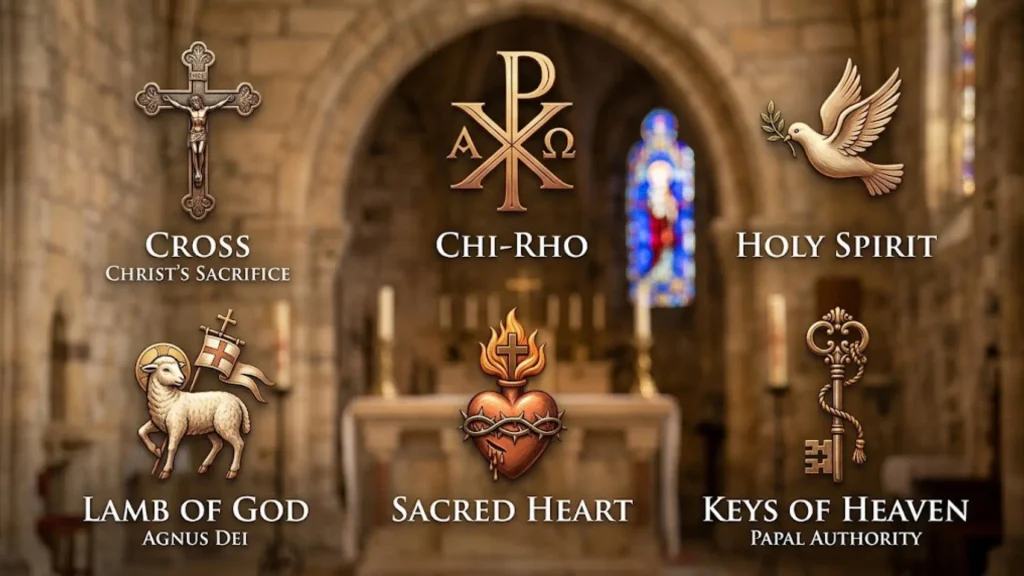
Catholic religious art includes paintings, statues, mosaics, stained-glass windows, carvings, and decorative elements that communicate biblical stories and Catholic beliefs.
A church might display a crucifix above the altar, a dove near the baptismal font, or images of the four evangelists around the sanctuary. These designs help worshippers recognize key teachings and connect the physical space with the liturgy.
When interpreting Catholic church decorations, consider three questions:
- What does the image show? Identify the person, object, animal, or biblical scene.
- Where is it placed? A symbol near the tabernacle may have a different purpose from a similar design in a stained-glass window.
- What is its source? Scripture, Catholic liturgical practice, and a particular saint’s story can explain why the image appears there.
Catholic church architecture also gives important places distinct roles. The altar serves the Eucharistic liturgy, the ambo is used for the proclamation of Scripture, and the baptismal font is associated with Christian initiation.
These furnishings are more than interior decoration. Their placement and use help organize Catholic worship and communicate the meaning of the rites celebrated there.
Frequently Asked Questions About Catholic Symbols
What are the most common Catholic symbols?
The most recognizable Catholic symbols include the cross, crucifix, Sacred Heart, dove, Chi-Rho, IHS, chalice, Paschal candle, tabernacle, and crossed keys. Each has a particular meaning connected to Scripture, Catholic teaching, devotion, or liturgical practice.
What is the most important symbol in Catholicism?
The cross is the central symbol of Christianity because it recalls Jesus Christ’s sacrifice and the salvation Catholics believe comes through him. The crucifix, which shows Jesus’ body on the cross, is especially common in Catholic churches and devotional life.
What does the Sacred Heart symbolize?
The Sacred Heart of Jesus represents Christ’s love and mercy. Images often include a flame, crown of thorns, or wound to connect the heart with Jesus’ Passion and self-giving love.
What does the fish symbol mean in Christianity?
The fish is an ancient Christian symbol associated with Jesus and Christian identity. It is also connected with biblical stories about fishing and the calling of the apostles. The Greek word for fish, ichthys, became associated with a Christian confession of faith.
What do the crossed keys represent?
The crossed keys are traditionally associated with St. Peter and the authority described in Matthew 16:19. They are especially recognizable in papal and Vatican imagery.
What do Alpha and Omega mean in the Catholic Church?
Alpha and Omega are the first and last letters of the Greek alphabet. They symbolize God as the beginning and the end and are associated with passages in Revelation. The letters often appear on Paschal candles and other Christian objects.
What does the Chi-Rho symbolize?
The Chi-Rho combines the Greek letters Chi and Rho from the word Christos, meaning Christ. It is an ancient Christian monogram used to identify Jesus Christ in religious art and decoration.
What does IHS stand for?
IHS is a traditional Christogram associated with the name of Jesus. It comes from the Greek spelling of Jesus’ name as represented in Western Christian tradition and appears on church furnishings, vestments, and devotional objects.
What does INRI mean on a crucifix?
INRI stands for Iesus Nazarenus Rex Iudaeorum, meaning “Jesus of Nazareth, King of the Jews.” It refers to the inscription associated with Jesus’ Crucifixion.
What does the dove symbolize in Catholicism?
The dove most commonly represents the Holy Spirit, especially in artwork depicting Jesus’ baptism. In other Christian contexts, it can also represent peace.
What does the lamb symbolize in Catholic art?
The Lamb of God represents Jesus Christ, particularly his sacrifice and victory over sin. The image connects the Gospel of John with the lamb imagery found in Revelation.
What do the three leaves of a shamrock represent?
The shamrock is traditionally used to illustrate the Trinity: the Father, the Son, and the Holy Spirit. The three leaves are an aid to understanding the teaching, not a literal description of God.
What does the triangle symbolize in Catholicism?
A triangle sometimes represents the Trinity in Christian artwork. Its three sides provide a visual illustration, but the triangle itself does not fully explain the Catholic belief in one God in three persons.
What does the Paschal candle represent?
The Paschal candle represents the light of the risen Christ. It is blessed and lit during the Easter Vigil and also has an important role in baptismal and funeral liturgies.
What is the purpose of a monstrance?
A monstrance displays the consecrated host for Eucharistic adoration. Its purpose is to support prayer and reverence toward Christ believed to be truly present in the Blessed Sacrament.
What is the meaning of the sanctuary light?
The sanctuary light near a tabernacle indicates and honors the presence of the reserved Blessed Sacrament. It is a specific sign associated with the Eucharist.
Why do Catholics use holy water?
Catholics use holy water as a reminder of baptism and as a sign associated with blessings. Making the Sign of the Cross with holy water recalls baptism and the Christian faith in the Trinity.
Why is incense used during Mass?
Incense is used as a sign of reverence, honor, and prayer. Depending on the liturgy, it may be used to honor the altar, Gospel book, Eucharistic gifts, ministers, and congregation.
What do white garments symbolize after baptism?
White garments symbolize being washed clean of sin and beginning a new life in Christ. They also remind the baptized of their call to live according to the Christian faith.
What do the four creatures in Revelation represent?
The lion, ox, winged man, and eagle are traditionally associated with the four Gospel writers: Mark, Luke, Matthew, and John, respectively. These associations became common in Christian art during the early centuries of the Church.
Why do Catholic churches display religious symbols?
Catholic churches use religious symbols to teach the faith, support prayer, identify biblical stories, and express the meaning of the sacraments. Their placement can also help worshippers understand the roles of the altar, ambo, tabernacle, and other sacred furnishings.
Conclusion: Understanding Sacred Symbols of the Catholic Church
The sacred symbols of the Catholic Church communicate the faith through recognizable images, objects, and signs. The cross and Sacred Heart focus attention on Jesus Christ and his sacrifice. The dove points to the Holy Spirit, while the triangle and shamrock can help explain the Trinity. The chalice, tabernacle, monstrance, and sanctuary light have specific connections to the Eucharist and Catholic worship.
Other symbols, including the four Gospel creatures, lilies, palm branches, olive branches, and Tree of Life, connect Scripture with centuries of Christian art and devotion.
The best way to understand Catholic symbols and meanings is to look at their biblical background, traditional use, and place within the liturgy. A symbol is most meaningful when it is understood in the context of the faith it expresses.

Hi, I’m Sienna Brooks, and I believe that the right words can inspire, comfort, and empower people at every stage of life. For as long as I can remember, I’ve been drawn to meaningful quotes and the stories behind them. I love curating collections of inspirational, motivational, and heartfelt quotes that resonate with readers around the world.
Through my writing, I strive to help others find encouragement, whether they’re celebrating life’s happiest moments or navigating its biggest challenges. I believe that wisdom is timeless, and I’m passionate about sharing words that leave a lasting impact.
I am the author of Reflections in Words and The Journey of Inspiration, two books dedicated to exploring the beauty and power of timeless quotes.
 Asher Monroe
 Rowan Sinclair Rowan Sinclair