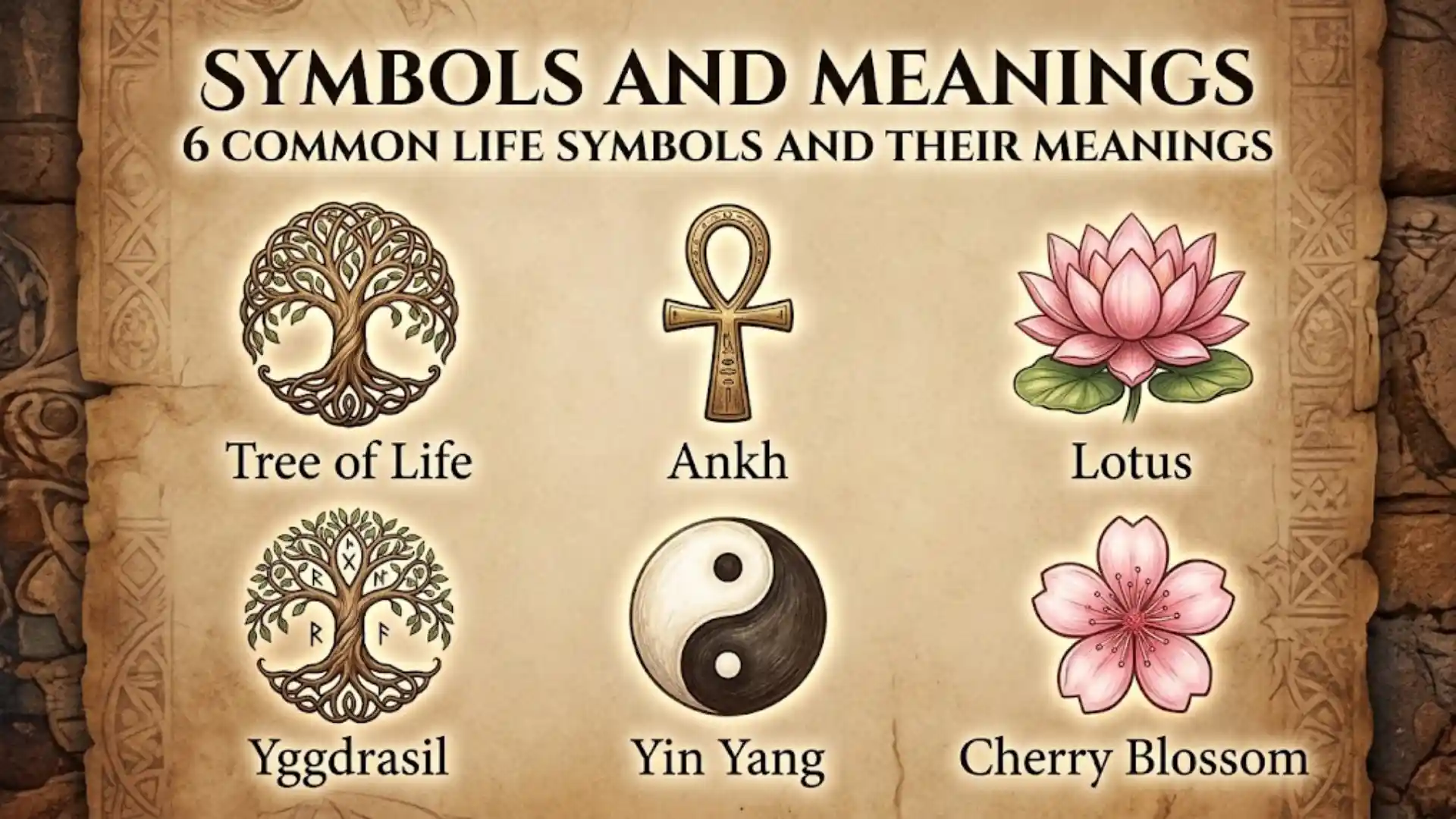
Symbols are everywhere in everyday communication. You see them in text messages, emails, books, websites, mathematical equations, weather reports, and product labels. A simple character such as @, #, or % can communicate an idea quickly without using a full sentence.
However, the meaning of a symbol often depends on its context. The # symbol can identify a number, introduce a social media hashtag, or serve a special purpose in computer programming. Similarly, $ represents a dollar currency, but the country and surrounding text help identify which currency someone means.
This guide covers symbols in English, their names, meanings, and practical uses. You’ll find a full list of symbols, explanations of common punctuation marks, mathematical signs, currency symbols, legal marks, and special characters. You’ll also learn how to use symbols effectively in formal writing, academic work, technical documents, and everyday messages.
What Are Symbols in English?
A symbol is a character, sign, mark, or visual representation that communicates a particular meaning. In English, symbols help readers understand information, express ideas, show relationships, and organize written communication.
Some symbols represent mathematical operations. Others indicate punctuation, currency, temperature, ownership, or digital communication.
For example:
- The plus sign (+) represents addition or a positive value.
- The question mark (?) shows that a sentence asks a question.
- The at symbol (@) appears in email addresses and social media handles.
- The copyright symbol (©) identifies a copyright notice.
- The infinity symbol (∞) represents something without an end or limit in mathematical contexts.
These English symbols make communication more efficient when readers understand their intended meanings.
Why Are Symbols Important in English Writing?
Symbols help writers communicate information clearly and concisely. They can also make complicated ideas easier to understand.
Consider these examples:
| Without a symbol | With a symbol |
| The temperature is 25 degrees Celsius. | The temperature is 25°C. |
| The price is 20 dollars. | The price is $20. |
| The result is greater than zero. | The result is > 0. |
| Send the message to this email address. | Use the address containing @. |
| The total equals five. | The total = 5. |
Symbols can be especially helpful in technical writing, scientific explanations, tables, charts, and mathematical expressions.
However, not every symbol belongs in every situation. Formal writing usually requires standard punctuation and clear wording, while informal messages often allow more creative uses.
What Is the Difference Between a Symbol, a Sign, and a Punctuation Mark?
These terms overlap, but they don’t always mean the same thing.
- Symbol: A character or visual mark that represents an idea, object, operation, or concept.
- Sign: A mark or indicator that communicates information, instructions, or a warning.
- Punctuation mark: A character that organizes sentences and clarifies meaning in writing.
For example, + is a mathematical symbol, a road sign can communicate a warning, and ? is a punctuation mark.
In everyday English, people sometimes use the words sign and symbol interchangeably. Their precise meanings depend on the subject and context.
Full List of Symbols in English and Their Meanings
The following table provides a quick reference to common English symbols, their names, and their everyday uses.
| Symbol | Symbol name | Meaning and common use |
| + | Plus sign | Addition, positive values, or adding something |
| − | Minus sign | Subtraction or negative values |
| × | Multiplication sign | Multiplication |
| * | Asterisk | Footnotes, wildcard characters, or multiplication in some computer systems |
| ÷ | Division sign | Division |
| = | Equals sign | Shows that two values are equal |
| % | Percent sign | Represents a proportion out of 100 |
| # | Number sign or hashtag | Identifies numbers or topics on social media |
| @ | At symbol | Appears in email addresses and online handles |
| & | Ampersand | Means “and” in certain names and expressions |
| / | Slash | Separates items, indicates alternatives, or appears in dates |
| \ | Backslash | Used in file paths and programming |
| ! | Exclamation mark | Expresses strong emotion or emphasis |
| ? | Question mark | Marks a direct question |
| … | Ellipsis | Shows an omission, pause, or unfinished thought |
| : | Colon | Introduces a list, explanation, or quotation |
| ; | Semicolon | Connects closely related independent clauses |
| ( ) | Parentheses | Add extra information or clarification |
| [ ] | Brackets | Enclose editorial notes or additional information |
| { } | Braces | Group information in mathematics and programming |
| ‘ | Apostrophe | Shows possession or omitted letters |
| “ | Quotation marks | Enclose direct speech or quoted material |
| ° | Degree symbol | Indicates angles or temperature when combined with a scale |
| °C | Degrees Celsius | Expresses temperature on the Celsius scale |
| °F | Degrees Fahrenheit | Expresses temperature on the Fahrenheit scale |
| © | Copyright symbol | Identifies a copyright notice |
| ® | Registered trademark symbol | Indicates a registered trademark |
| ™ | Trademark symbol | Identifies a claimed trademark |
| $ | Dollar sign | Represents dollar-denominated currencies |
| £ | Pound sign | Represents pound-denominated currencies, including pound sterling |
| € | Euro sign | Represents the euro |
| ¥ | Yen or yuan symbol | Represents Japanese yen or Chinese yuan, depending on context |
| ¢ | Cent sign | Represents one-hundredth of a dollar in relevant contexts |
| ∞ | Infinity symbol | Represents an unbounded quantity or concept |
| → | Right arrow | Shows direction, movement, or a relationship |
| ← | Left arrow | Shows movement or direction to the left |
| ↑ | Up arrow | Indicates upward movement or an increase |
| ↓ | Down arrow | Indicates downward movement or a decrease |
| Σ | Capital sigma | Represents summation in mathematics |
| σ | Lowercase sigma | Has several uses, including standard deviation in statistics |
| θ | Theta | Commonly represents an angle in mathematics |
| √ | Square root symbol | Represents a square root |
| ≈ | Approximately equal to | Indicates an approximate value |
| ≠ | Not equal to | Shows that two values are different |
| ≤ | Less than or equal to | Indicates a value is smaller than or equal to another |
| ≥ | Greater than or equal to | Indicates a value is larger than or equal to another |
This list includes several types of signs and symbols in English, from punctuation and mathematical notation to digital characters.
One important distinction: × is the standard multiplication sign in conventional mathematical notation. The asterisk (*) is also used for multiplication in calculators, spreadsheets, and programming environments.
Similarly, °C and °F are common written forms for Celsius and Fahrenheit temperatures. They combine the degree sign with a letter identifying the temperature scale.
Common Punctuation Symbols and Their Uses
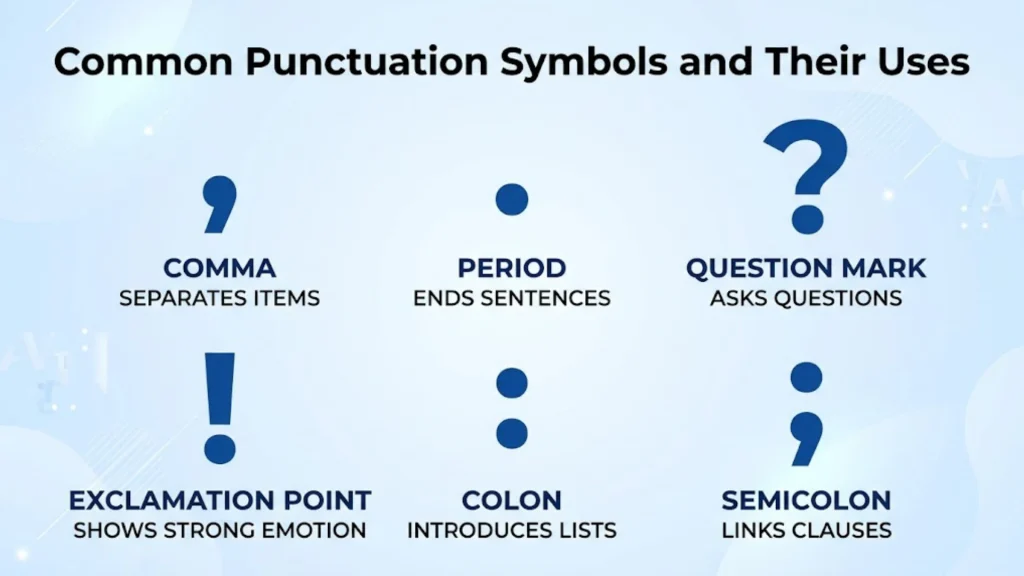
Punctuation symbols help readers understand sentence structure, pauses, emphasis, and relationships between ideas. Correct punctuation can change the meaning of a sentence, so it’s important to know when and how to use each mark.
Exclamation Mark (!)
The exclamation mark expresses excitement, surprise, anger, urgency, or strong emphasis.
Examples:
- What a beautiful day!
- Watch out!
- Congratulations on your new job!
Use exclamation marks sparingly in professional and academic writing. Too many can make your message seem overly emotional or less formal.
Question Mark (?)
The question mark appears at the end of a direct question.
Examples:
- What does this symbol mean?
- How do you use symbols in English?
- Where can I find the full list?
Don’t usually add a question mark after an indirect question.
- Direct question: Where is the library?
- Indirect question: She asked where the library was.
Asterisk (*)
The asterisk has several uses in written communication. It can point to a footnote, indicate omitted information, or act as a wildcard in digital systems.
Examples:
- Please read the terms carefully.*
- Your password must include an asterisk.
- Search for color* in a system that supports wildcard searches.
The asterisk can also represent multiplication in programming and plain-text calculations. In polished mathematical writing, use the multiplication sign (×) when appropriate.
Ampersand (&)
The ampersand means “and.” It’s common in business names, brand names, titles, and compact labels.
Examples:
- Research & Development
- Johnson & Johnson
- Food & Drink
Although the ampersand saves space, spell out “and” in ordinary sentences unless a style guide or official name calls for &.
At Symbol (@)
The at symbol appears in email addresses, social media handles, and some digital systems.
Examples:
- name@example.com
- @username
- price @ $10 each
In an email address, @ separates the local part from the domain. In social media, it often identifies a particular account.
Slash (/)
The slash symbol can separate alternatives, show a ratio, or appear in dates and abbreviations.
Examples:
- and/or
- 60 miles/hour
- 10/21/2026
Dates written with slashes can be confusing across countries. In the United States, 10/21/2026 means October 21, 2026. Other date formats may follow different conventions.
For clarity, spell out dates in international or formal communication when confusion is possible.
Ellipsis (…)
An ellipsis consists of three dots. It can show omitted text, a pause, hesitation, or an unfinished thought.
Examples:
- I thought we had agreed to meet…
- The report states that “the results … were significant.”
- Well… I’m not sure.
Use ellipses carefully. In formal writing, an ellipsis may indicate omitted material from a quotation. In casual messages, it can suggest hesitation or an implied meaning.
Mathematical Symbols and Their Meanings
Mathematical symbols represent operations, comparisons, quantities, and relationships. They make equations easier to read and reduce the need for lengthy explanations.
The same character can sometimes have different meanings in different fields. The Unicode Standard, for example, explains that mathematical characters can have different functions depending on their context.
Unicode 16.0.0
| Symbol | Name | Example | Meaning |
| + | Plus sign | 4 + 3 = 7 | Addition |
| − | Minus sign | 9 − 5 = 4 | Subtraction |
| × | Multiplication sign | 6 × 2 = 12 | Multiplication |
| ÷ | Division sign | 12 ÷ 3 = 4 | Division |
| = | Equals sign | 5 + 2 = 7 | Equality |
| ≠ | Not equal to | 4 ≠ 9 | Different values |
| > | Greater than | 8 > 3 | First value is larger |
| < | Less than | 2 < 6 | First value is smaller |
| ≥ | Greater than or equal to | x ≥ 10 | At least 10 |
| ≤ | Less than or equal to | x ≤ 20 | No more than 20 |
| ≈ | Approximately equal to | π ≈ 3.14 | Approximate equality |
| ∞ | Infinity | ∞ | An unbounded quantity or concept |
| √ | Square root | √25 = 5 | Number that squares to 25 |
| Σ | Capital sigma | Σx | Summation in common mathematical notation |
| θ | Theta | θ = 45° | Often represents an angle |
Plus and Minus Signs (+ and −)
The plus sign usually indicates addition or a positive value. The minus sign indicates subtraction or a negative value.
Examples:
- 12 + 8 = 20
- 12 − 8 = 4
- −6 + 10 = 4
- +7 represents positive seven.
Don’t confuse a mathematical minus sign (−) with a hyphen (-). They may look similar, but they serve different purposes in standard typography.
Percent Sign (%)
The percent sign represents a value out of 100.
For example:
- 25% means 25 out of 100.
- 50% means one-half.
- 100% means the whole amount.
If a product costs $80 and receives a 25% discount, the discount equals $20. The final price is $60.
Percentages appear in financial reports, surveys, statistics, school grades, and everyday shopping.
Infinity Symbol (∞)
The infinity symbol represents something without a finite limit. It appears in mathematics, physics, and informal expressions.
For example, mathematicians use infinity when discussing unbounded quantities or limits. In everyday writing, someone might say, “Thanks a million times—almost infinity!”
Remember that infinity isn’t an ordinary number that you can treat exactly like 5 or 10 in every calculation. Its mathematical use depends on the concept being discussed.
Sigma (Σ and σ)
The Greek letter sigma has different meanings depending on whether it’s uppercase or lowercase.
- Σ commonly represents a sum or summation.
- σ can represent standard deviation in statistics and other quantities in mathematics and science.
For example, statistical reports often use lowercase sigma to discuss the spread or variability of data. Always check the field and formula before interpreting a Greek-letter symbol.
Theta (θ)
The Greek letter theta commonly represents an angle in geometry and trigonometry. It can also represent other variables in statistics, physics, and engineering.
Example:
θ = 45°
This expression indicates that theta has a value of 45 degrees. The exact meaning depends on the equation or subject.
Common Keyboard Symbols and Special Characters
Special characters in English include symbols that aren’t ordinary letters or digits. They appear on keyboards, in documents, web addresses, file names, and computer code.
Some common examples include:
| Character | Name | Common use | |—|—|—| | @ | At symbol | Email addresses | | # | Number sign | Numbers and hashtags | | & | Ampersand | Names and shortened labels | | * | Asterisk | Footnotes and wildcard searches | | _ | Underscore | Usernames and file names | | – | Hyphen-minus | Hyphenated terms and plain-text typing | | \ | Backslash | File paths and programming | | | | Vertical bar | Separators and technical notation | | ~ | Tilde | Approximation or specialized technical uses | | ^ | Caret | Editing, exponent notation in some systems | | + | Plus sign | Addition and positive values | | = | Equals sign | Equality and assignments in some programming languages |
What Is the Difference Between a Hyphen, En Dash, and Em Dash?
These three marks look similar but have different roles.
- Hyphen (-): Joins words, as in well-known author.
- En dash (–): Often represents a range, as in pages 10–20.
- Em dash (—): Creates a strong break in a sentence—like this one.
Keyboard shortcuts and software settings vary. Many writing tools can automatically convert two hyphens into an em dash.
For clean English writing, use the correct dash when possible, especially in published articles and professional documents.
Currency Symbols and Their Names
Currency symbols identify money units and help readers understand prices, financial statements, and international transactions.
| Symbol | Currency | Common association |
| $ | Dollar | United States, Australia, Canada, and other countries |
| £ | Pound sterling | United Kingdom |
| € | Euro | Countries that use the euro |
| ¥ | Yen | Japan |
| ¥ | Yuan or renminbi | China |
| ¢ | Cent | One-hundredth of a dollar in relevant contexts |
Dollar Sign ($)
The dollar sign appears in the United States and several other countries that use dollar-denominated currencies.
Examples:
- $15 means 15 dollars.
- $2.50 means two dollars and fifty cents.
The symbol alone doesn’t always identify the country. If you’re comparing prices internationally, include a currency code such as USD, CAD, or AUD.
Pound Sign (£)
The pound sign represents pound-denominated currencies, including the British pound sterling.
Example: £50
In British English, the currency name is usually written as pound sterling when precision is needed.
Euro Sign (€)
The euro sign represents the euro, used by many European Union countries.
Examples:
- €10
- €125.50
The euro is not used by every country in Europe. Therefore, don’t assume that a European price automatically uses this currency.
Yen and Yuan Symbol (¥)
The ¥ symbol can represent Japanese yen or Chinese yuan. The surrounding context helps identify the intended currency.
For example, an online store selling Japanese products may use ¥ for yen, while a Chinese financial document may use it for yuan. Currency codes such as JPY and CNY remove much of this ambiguity.
How to Use Currency Symbols Correctly
Follow these practical rules:
- Place the currency symbol in the format commonly used by the relevant country or publication.
- Use a currency code when readers might confuse two currencies.
- Keep the format consistent throughout a table or article.
- Include the currency name when an international audience needs clarification.
Currency symbols make prices shorter, but accuracy matters more than saving a few characters.
Symbols Used in Texting, Emails, and Social Media
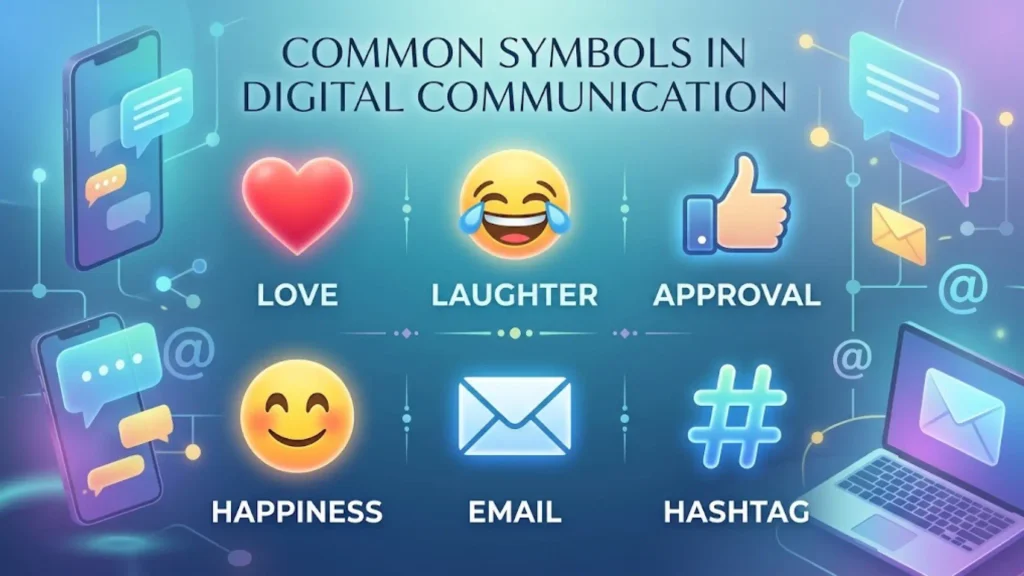
Digital communication has made symbols a regular part of everyday writing. People use them to shorten messages, identify accounts, add emotion, and organize online conversations.
Hashtag (#)
A hashtag uses the number sign before a word or phrase, usually without spaces.
Examples:
- #TravelTips
- #WednesdayWisdom
- #LearnEnglish
On many social platforms, hashtags help group posts around a topic. The same character can also function as a number sign in other contexts.
For example, #5 may mean “number five,” while #TravelTips is a social media hashtag.
Plus Sign (+) in Digital Communication
The plus sign can mean “add,” “include,” or “and more.” It also appears in labels such as LGBTQ+, where it signals the inclusion of additional identities beyond those explicitly listed.
The intended meaning depends on the subject. Don’t assume that every plus sign has a mathematical function.
Asterisk for Emphasis or Censorship
People sometimes use asterisks to correct a typo or hide letters in a word.
Examples:
- I meant Tuesday* can signal a correction in a chat.
- That was a d*** good movie. uses asterisks to censor part of a word.
These conventions are informal and may vary by platform. In professional messages, clear wording is usually better than relying on a symbol that readers might interpret differently.
Symbols in Email Communication
Email uses several symbols to manage recipients and messages.
- @ separates the username from the domain in an email address.
- . separates parts of a domain name.
- & can appear in a company or organization name.
- # may appear in a ticket number or reference code.
For example, support@example.com uses @ to separate the mailbox name from the domain.
Avoid adding decorative symbols to business emails unless they serve a clear purpose. Simple formatting makes important information easier to scan.
Copyright and Trademark Symbols Explained
Legal and commercial symbols identify copyright notices and trademark claims. Three common marks are ©, ™, and ®.
| Symbol | Name | General purpose |
| © | Copyright symbol | Identifies a copyright notice |
| ™ | Trademark symbol | Signals a claim to a trademark, commonly for goods |
| ® | Registered trademark symbol | Indicates a registered trademark where its use is authorized |
Copyright Symbol (©)
The copyright symbol commonly appears with a year and the name of a rights holder.
Example:
© 2026 Example Publishing
It signals a copyright notice. However, the symbol alone doesn’t tell you the complete legal status of a work, and copyright rules vary by jurisdiction.
Trademark Symbol (™)
The trademark symbol identifies a name, phrase, logo, or other mark that someone claims as a trademark.
For example:
BrightPath™
In the United States, businesses can use ™ to indicate a trademark claim without first obtaining federal trademark registration.
Registered Trademark Symbol (®)
The registered trademark symbol indicates that a trademark has been registered. In the United States, the USPTO says it should be used only with goods or services covered by the applicable federal registration.
USPTO
+1
Don’t use ® just because a brand looks established. Verify registration and applicable rules before using it.
Temperature and Scientific Symbols
Temperature and measurement symbols help present technical information accurately. You’ll often see them in weather forecasts, science lessons, cooking instructions, laboratory reports, and engineering documents.
Degree Symbol (°)
The degree symbol appears in temperature measurements and angle measurements.
Examples:
- 30° may represent a 30-degree angle.
- 25°C represents a temperature of 25 degrees Celsius.
- 77°F represents a temperature of 77 degrees Fahrenheit.
The degree symbol alone doesn’t identify a temperature scale. Include C or F when writing temperatures that need to be understood precisely.
Celsius and Fahrenheit Symbols
| Written form | Meaning | Example |
| °C | Degrees Celsius | 20°C |
| °F | Degrees Fahrenheit | 68°F |
| ° | Degree | 90° in an angle measurement |
Celsius is widely used in scientific work and in many countries’ everyday temperature reporting. Fahrenheit remains common in everyday weather reporting in the United States.
The following temperatures are equivalent:
- 0°C = 32°F
- 100°C = 212°F
- 20°C = 68°F
These examples show why including the scale matters. A number without its temperature unit may be misleading.
Scientific Symbols in Reports
Scientific writing uses many other characters to represent measurements, variables, and relationships. Their meanings depend on the discipline and the notation being used.
For example:
- ± indicates plus or minus.
- ≈ indicates an approximate value.
- μ can represent a Greek letter used for various scientific quantities.
- Σ can indicate a sum.
- θ can represent an angle.
Don’t assign a universal meaning to every scientific character. Check the report’s legend, definitions, or accompanying equation.
Arrows and Symbols That Represent Ideas
Arrows and visual marks communicate relationships without lengthy descriptions. They’re common in flowcharts, diagrams, instructions, presentations, and data visualization.
| Symbol | Common interpretation | Example |
| → | Direction, result, or next step | Input → Process → Output |
| ← | Movement to the left or a previous step | ← Back |
| ↑ | Increase or upward movement | Sales ↑ |
| ↓ | Decrease or downward movement | Costs ↓ |
| ↔ | Two-way relationship | Buyer ↔ Seller |
| ✓ | Completion or approval | Task ✓ |
| ✗ | Incorrect or rejected item | Answer ✗ |
| ★ | Rating or favorite | ★★★★★ |
| ♥ | Love or affection | A heart symbol in a message |
| ∞ | Infinity or an unbounded idea | The concept of endless time |
These interpretations are common, but not universal. A symbol can mean something different in a particular organization, culture, or technical system.
How Arrows Improve Written Communication
Arrows are especially useful when explaining a process or sequence.
For example:
Choose a file → Upload it → Review the result
This format communicates the order of actions quickly. It works well in a short guide, slide, or diagram.
For a long academic paper, however, explain the relationship in words when the arrow could confuse readers.
How to Use Symbols Effectively in English Writing

Good symbol usage in English depends on clarity, consistency, audience, and context. A symbol should make the message easier to understand—not force readers to guess.
Use these guidelines when writing articles, reports, emails, and other documents.
Choose Symbols That Fit Your Audience
A technical reader may understand ≤, Σ, and ± immediately. A beginner may need a short explanation.
For example:
- Technical: The value must be ≤ 10.
- Plain English: The value must be 10 or less.
Both versions can be correct. Choose the one that best serves your reader.
Follow the Right Writing Style
Academic, professional, and technical writing often follows specific style guides. Those guides may determine how to format percentages, measurements, currency, punctuation, and mathematical expressions.
In informal communication, you may have more freedom to use hashtags, abbreviations, and decorative symbols.
When a style guide applies, follow it consistently instead of mixing conventions.
Avoid Overusing Symbols
Too many symbols can make a paragraph difficult to read.
For example:
Buy now!!! Save 50% & get more!!!
A clearer version might be:
Buy now and save 50%.
The second version communicates the offer without excessive punctuation.
Explain Unfamiliar Symbols
If a symbol is central to your document, define it when it first appears.
For example:
Let θ represent the angle between the two lines.
After defining theta, you can use it throughout the equation or explanation.
This practice is particularly helpful in academic writing, technical manuals, and educational content.
Keep Formatting Consistent
Use the same notation for the same concept throughout a document.
If you write temperatures as 25°C in one section, avoid switching randomly to 25 degrees Celsius in a table unless the change improves readability.
Consistency helps readers recognize patterns and compare information accurately.
How Context Changes Symbol Meanings
A symbol doesn’t always have one fixed meaning. Its interpretation can change according to the subject, audience, platform, and surrounding words.
This is why symbol interpretation requires more than recognizing a character.
| Symbol | Possible meaning | Context |
| # | Number sign | Numbered lists or references |
| # | Hashtag | Social media |
| + | Addition | Mathematics |
| + | Inclusion | Labels such as LGBTQ+ |
| * | Footnote marker | Books and reports |
| * | Multiplication operator | Some computing environments |
| @ | Part of an email address | Email communication |
| @ | Account identifier | Social media |
| ¥ | Japanese yen | Japanese prices |
| ¥ | Chinese yuan | Chinese prices |
| Σ | Summation | Mathematics |
| σ | Standard deviation | Many statistical contexts |
The Unicode Standard distinguishes characters by their encoded form while noting that their meanings and uses can depend on context.
Unicode 16.0.0
+1
Cultural Differences in Symbol Meanings
Some symbols have different meanings across cultures or communities. Colors, hand gestures, religious signs, and visual icons can carry cultural associations that don’t translate directly.
For example, a symbol used as a positive sign in one setting might be unfamiliar or inappropriate in another. A business communicating internationally should consider its audience before using culturally meaningful imagery.
When discussing a cultural symbol, explain the relevant tradition or community rather than assuming one interpretation applies everywhere.
Why Context Matters in Technical Writing
Technical documents often use compact notation to represent complicated ideas. That shorthand is helpful only when readers know what it means.
For example, σ may represent standard deviation in a statistics report, but a different quantity in another scientific field.
A good technical document defines important variables, explains units, and includes a legend for unfamiliar notation.
Common Mistakes When Using Symbols
Even familiar symbols can create confusion when writers use them incorrectly. Avoid these common mistakes to improve clarity, accuracy, and professional communication.
- Confusing the multiplication sign with an asterisk: Use × in conventional mathematical writing when multiplication is intended.
- Using a degree sign without a temperature scale: Write 25°C or 77°F when you mean a temperature.
- Assuming every dollar sign means US dollars: Specify the currency code when international readers might be confused.
- Using ® without verifying registration: In the United States, use it only when the relevant trademark registration permits it.
- Overusing exclamation marks: Excessive punctuation can make professional writing look less polished.
- Adding spaces randomly: Follow the relevant style conventions for punctuation, measurements, equations, and currency.
- Assuming symbols mean the same thing everywhere: Check the surrounding text and the subject.
- Using unexplained technical notation: Define unfamiliar symbols before relying on them.
- Mixing informal and formal conventions: A chat message and an academic paper usually need different levels of formality.
A useful rule is to ask yourself one question before inserting a symbol: Will this character make my meaning clearer to the intended reader?
If the answer is no, ordinary words may be the better choice.
FAQs About Symbols and Meanings
What Are the Most Common Symbols in English?
Common symbols include the plus sign (+), minus sign (−), percent sign (%), at symbol (@), ampersand (&), number sign (#), asterisk (*), question mark (?), and exclamation mark (!).
Their meanings depend on how they’re used. Some support grammar and punctuation, while others represent mathematical operations or digital functions.
What Do Symbols Mean in English?
Symbols are characters or visual marks that represent ideas, operations, relationships, or information. For example, = represents equality in mathematics, @ appears in email addresses, and © identifies a copyright notice.
The intended meaning often depends on the context.
How Do You Use Symbols in English Writing?
Choose symbols that suit your audience and purpose. Use punctuation marks according to standard grammar, mathematical signs in equations, and currency or measurement symbols when they improve accuracy.
Explain unfamiliar characters and follow any style guide that applies to your document.
What Are Mathematical Symbols?
Mathematical symbols represent operations, quantities, and relationships. Common examples include + for addition, − for subtraction, × for multiplication, ÷ for division, and = for equality.
Other symbols, such as ∞, Σ, and θ, have specialized mathematical uses.
What Is the Difference Between ©, ™, and ®?
The © symbol identifies a copyright notice. The ™ symbol indicates a trademark claim, while ® indicates a registered trademark where its use is permitted.
These symbols serve different purposes and shouldn’t be treated as interchangeable.
How Are Symbols Used in Texting and Social Media?
People use symbols to shorten messages, identify accounts, group posts, and express feelings. For example, @ can identify a social media account, while #TravelTips can group posts under a topic.
Some symbols also serve informal purposes, such as indicating a correction or censoring part of a word.
Why Does the Same Symbol Have Different Meanings?
A symbol’s meaning depends on the subject, audience, and surrounding information. The # symbol, for instance, can mean “number” in one setting and introduce a hashtag in another.
Reading the surrounding text helps you identify the intended meaning.
Where Can I Find a Complete List of Symbols?
You can use the tables in this guide as a practical reference for common English, punctuation, mathematical, currency, and technical symbols. For an extensive character reference, the official Unicode character charts organize characters into categories, including punctuation, mathematical operators, arrows, and currency symbols.
Unicode
Final Thoughts on Symbols in English
Symbols make written communication faster, more compact, and easier to organize. From punctuation marks and mathematical signs to currency characters and digital symbols, each has a useful role when readers understand its meaning.
The key is to choose the right character for the situation. Consider your audience, follow the relevant writing conventions, and explain unfamiliar symbols when necessary.
Use this list of symbols in English as a reference when you need to identify a character, understand its meaning, or decide how to use it. With consistent and thoughtful symbol usage, you can make your writing clearer, more accurate, and easier to read.

Hello, I’m Rowan Sinclair, a passionate writer and lifelong admirer of the wisdom found in great quotes. I believe that words have the ability to inspire change, spark creativity, and connect people across cultures and generations.
I enjoy writing about motivational quotes, famous sayings, and lessons from history’s most influential thinkers. Every article I create is driven by my desire to help readers discover meaningful insights that they can apply to their own lives.
When I’m not writing, I spend my time reading biographies, exploring classic literature, and collecting memorable quotes that deserve to be shared with the world.
I am the author of Voices That Inspire and A Collection of Timeless Thoughts, two books that celebrate the enduring power of words and the stories behind them.
 Asher Monroe
 Sienna Brooks