Hopi symbols carry the stories, beliefs, and spiritual wisdom of the Hopi people, one of the oldest Indigenous cultures of North America. These powerful designs connect humans with nature, ancestors, harmony, and the sacred cycles of life.
From ancient rock art to modern artwork, Hopi symbols reveal a deep understanding of balance, creation, and existence. Exploring these symbols opens a window into a world where every shape, line, and pattern holds meaning.
(Quick Answer) Hopi Symbols
Hopi symbols are sacred designs created by the Hopi people of northeastern Arizona to represent spiritual beliefs, natural forces, ancestors, ceremonies, and the connection between humans and the universe. These symbols appear in pottery, textiles, rock art, kachina figures, and traditional ceremonies, carrying messages of harmony, protection, and balance.
Quick Facts About Hopi Symbols
| Aspect | Information |
| Origin | Created by the Hopi people, an Indigenous Pueblo culture of Arizona |
| Historical Significance | Used for thousands of years in ceremonies, pottery, architecture, and storytelling |
| Main Meaning | Connection, harmony, nature, ancestors, and spiritual balance |
| Spiritual Meaning | Represents the relationship between humans, the Earth, and the Creator |
| Cultural Importance | Preserves Hopi traditions, history, and religious teachings |
| Modern Usage | Found in Native artwork, jewelry, designs, museums, and cultural education |
What Are Hopi Symbols?
Hopi symbols are meaningful visual representations created by the Hopi people to communicate spiritual ideas, cultural stories, and observations about the natural world. The Hopi are a Pueblo Native American tribe who have lived in the region now known as northeastern Arizona for centuries.
The word “Hopi” comes from the Hopi phrase “Hopitu,” which means “peaceful person” or “one who behaves in a peaceful manner.” Their culture places strong importance on humility, cooperation, respect for nature, and living in harmony with all beings.
Unlike simple decorative patterns, Hopi symbols often contain layers of meaning. A spiral may represent growth and movement, while a circle may represent unity, cycles, and the connection between all living things.
Many Hopi symbols appear on:
- Pottery
- Basket designs
- Textiles
- Rock carvings
- Sand paintings
- Kachina figures
- Ceremonial objects
- Jewelry
For the Hopi people, symbols are not only artwork. They are a visual language connected to religion, history, agriculture, astronomy, and community identity.
Historical Background of Hopi Symbols
The Hopi people belong to the Ancestral Pueblo cultural tradition, which includes ancient civilizations such as the Ancestral Puebloans who lived throughout the American Southwest.
Archaeological evidence shows that symbolic designs have existed in the Southwest for thousands of years. Ancient pottery, petroglyphs, and ceremonial objects demonstrate that Indigenous communities used symbols to record important beliefs and experiences.
Hopi symbolism developed through generations of oral traditions, ceremonies, and relationships with the land. Many symbols are connected to:
- The emergence story of the Hopi people
- The importance of rain and agriculture
- The spiritual role of animals
- The movement of the sun and stars
- The teachings of ancestors
The Hopi worldview sees humans as part of nature rather than separate from it. This belief strongly influences their symbolic art.
Ancient Hopi Symbols and Their Meanings
Ancient Hopi symbols can be explored through pottery, rock art, architecture, archaeological remains, and other material connected with the long history of the Hopi people and the wider Pueblo world.
Geometric patterns and natural imagery appear throughout the ancient Southwest. Designs associated with water, animals, plants, agriculture, and movement can provide clues about how earlier communities interacted with their environment.
However, it is important to avoid assigning a definite meaning to every ancient design. Some interpretations are supported by cultural or archaeological evidence, while others remain uncertain. Ancient Pueblo imagery should also not automatically be labeled as specifically Hopi unless there is evidence connecting it to Hopi history or tradition.
Deep Symbolic Meaning of Hopi Symbols
Spiritual Level
Hopi symbols often express the sacred relationship between humans, nature, and spiritual forces.
The Hopi believe that life exists through balance. Humans must respect the Earth, maintain harmony, and follow spiritual teachings passed down by ancestors.
Many symbols represent:
Connection With the Creator
Hopi traditions include beliefs about spiritual beings who guide humanity. Symbols often represent communication between the physical world and the spiritual world.
Harmony and Balance
Balance is one of the strongest themes in Hopi symbolism. Many designs reflect the idea that everything in nature is connected.
The movement of seasons, rainfall, plants, animals, and human life are viewed as parts of one sacred system.
Transformation and Renewal
Symbols connected with water, rain, and cycles represent renewal. They reflect the belief that life continually changes and returns in new forms.
Psychological Level
From a psychological perspective, symbols influence human emotions because they communicate ideas beyond ordinary language.
Swiss psychologist Carl Jung studied how symbols appear across cultures as expressions of the collective unconscious.
Hopi symbols connect with universal human experiences such as:
- The search for meaning
- The desire for connection
- The need for protection
- Respect for nature
- The journey of personal growth
A spiral, for example, can psychologically represent movement, development, and the journey inward.
A circle may create feelings of safety because humans naturally associate circles with completeness and unity.
Cultural Level
For Hopi communities, symbols preserve identity and cultural memory.
They communicate teachings about:
- Responsibility toward the Earth
- Community cooperation
- Respect for ancestors
- Spiritual discipline
- Agricultural traditions
Each symbol carries knowledge that connects modern generations with their ancestors.
Types and Variations of Hopi Symbols
Traditional Hopi Symbols and Their Meanings
Traditional Hopi symbols are connected with the Hopi people’s relationship with their homeland, agriculture, nature, community, and spiritual traditions. Rather than functioning as a simple collection of universal icons, Hopi imagery often gains meaning from the cultural setting in which it is created or used.
Corn, rain, animals, plants, geometric patterns, and celestial elements can all appear in Hopi artistic and cultural traditions. Their meanings may differ according to the object, artist, community, and context. Some ceremonial knowledge is also traditionally taught within the Hopi community and should not be treated as ordinary decorative symbolism.
For this reason, traditional Hopi symbols are best understood as part of a living cultural tradition rather than as isolated designs with one fixed definition.
Hopi Spiral Symbol
Visual Description
A curved line that moves inward or outward in a circular motion.
Meaning
The spiral represents movement, growth, evolution, and the journey of life.
Symbolism
It can represent:
- Life cycles
- Creation
- Personal transformation
- The movement of energy
Cultural Connection
Spirals appear in many Indigenous cultures of the Southwest, including ancient Pueblo traditions.
Where It Appears
- Pottery
- Rock art
- Jewelry
- Contemporary Native artwork
Hopi Sun Symbol
Visual Description
A circular design representing the sun with rays extending outward.
Meaning
The sun symbolizes life, energy, warmth, and spiritual guidance.
Symbolism
The sun is connected to:
- Growth
- Agriculture
- Time cycles
- Creation
Cultural Connection
The sun plays an important role in Hopi ceremonies and agricultural traditions.
Where It Appears
- Ceremonial art
- Pottery
- Textiles
Hopi Rain Symbol
Visual Description
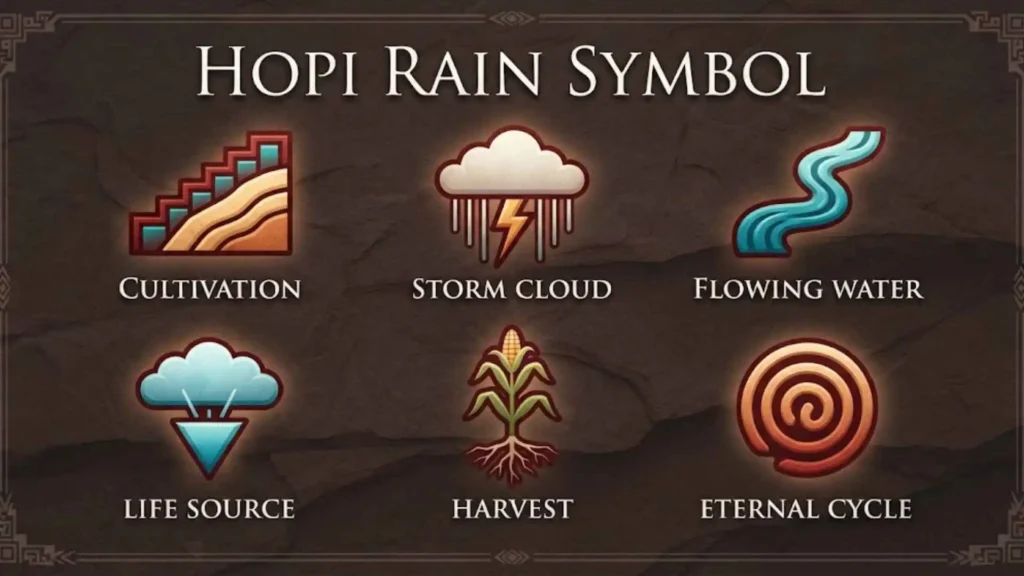
Often shown through lines, clouds, zigzags, or water-related patterns.
Meaning
Rain represents life, fertility, and blessings.
Symbolism
For desert communities, water represents survival and spiritual renewal.
Cultural Connection
Rain ceremonies are central to Hopi traditions because agriculture depends on rainfall.
Where It Appears
- Pottery
- Sand paintings
- Ritual objects
Hopi Corn Symbol
Visual Description
A design representing corn plants, seeds, or agricultural patterns.
Meaning
Corn symbolizes life, nourishment, and the relationship between humans and the Earth.
Symbolism
It represents:
- Family
- Survival
- Fertility
- Gratitude
Cultural Connection
Corn is one of the most sacred plants in Hopi culture.
Where It Appears
- Ceremonies
- Artwork
- Traditional teachings
Hopi Symbol of Life and Its Meaning
There is no single universal Hopi symbol that represents the entire concept of life. Instead, the idea of life can be understood through interconnected themes such as corn, water, agriculture, family, nature, and the land.
Corn has a particularly important place in Hopi life because it provides nourishment and is deeply connected with agriculture and cultural traditions. Rain and water are also essential symbols of life in the dry environment of the American Southwest because they support crops, animals, and communities.
This broader understanding shows that Hopi ideas about life are not necessarily represented by one isolated symbol. They are expressed through relationships between people, nature, community, and the environment.
Hopi Kachina Symbols
Visual Description
Representations connected to spiritual beings known as Kachinas.
Meaning
Kachinas are believed to represent spiritual forces that help maintain balance in the world.
Symbolism
They represent:
- Guidance
- Protection
- Nature spirits
- Community teachings
Where They Appear
- Dolls
- Ceremonial performances
- Artwork
Hopi Symbols in Images: Designs and Meanings
Hopi symbols can be seen in different forms of artwork, including pottery, textiles, jewelry, architecture, rock art, and other cultural objects. Images can make it easier to recognize recurring geometric and natural patterns, but the appearance of a design alone does not always reveal its complete meaning.
When examining Hopi symbol images, consider the source of the artwork, the artist, the object on which the design appears, and its historical or cultural context. A pattern found on a modern commercial product may not have the same significance as a design created within a traditional Hopi setting.
Using reliable cultural sources alongside images can help prevent modern interpretations from being mistaken for traditional Hopi meanings.
Hopi Symbols Across Different Cultures
Ancient Egypt
Ancient Egyptians also used symbols to express relationships between humans, nature, and the divine.
Similar themes include:
| Hopi Symbolism | Egyptian Symbolism |
| Sun as life energy | Ra, the sun god |
| Cycles of nature | Cycles of death and rebirth |
| Sacred animals | Animal-based deities |
Both cultures viewed nature as filled with spiritual meaning.
Ancient Greece
Greek culture used symbols such as:
- Spirals
- Circles
- Animals
- Plants
The Greek meander pattern, for example, represented infinity and eternal movement.
This connects with Hopi ideas of cycles and continuity.
Roman Culture
Romans adopted many symbolic traditions involving:
- Protection
- Agriculture
- Divine forces
Like the Hopi, Romans connected farming with spiritual beliefs.
Eastern Traditions
Eastern cultures, including Hindu and Buddhist traditions, use symbols representing:
- Balance
- Enlightenment
- Cycles of existence
The circle appears frequently as a symbol of completeness.
Indigenous Traditions
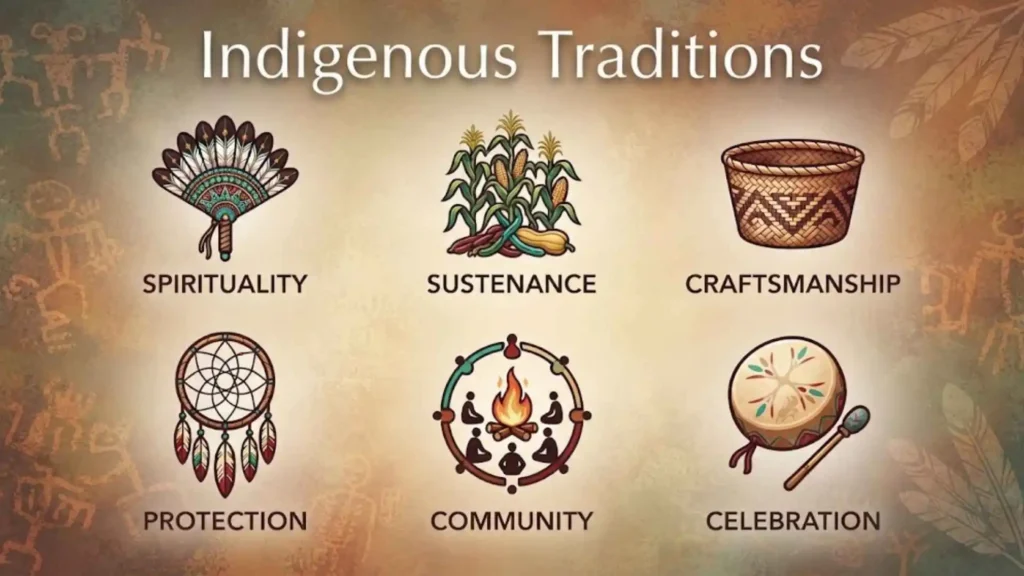
Many Indigenous cultures worldwide share symbolic themes:
- Respect for nature
- Animal relationships
- Ancestor connection
- Spiritual balance
However, each culture has its own unique meanings and traditions.
Similar Symbols and Their Meanings
| Symbol | Similar Meaning | Difference |
| Spiral | Growth and cycles | Hopi meanings often connect with nature and life journeys |
| Circle | Unity and completeness | Hopi circles often reflect harmony and cosmic balance |
| Sun Symbol | Life and energy | Hopi traditions connect it strongly with agriculture and ceremonies |
| Animal Symbols | Spiritual connection | Meanings vary by specific animal and culture |
A common misunderstanding is assuming all Native American symbols have identical meanings. Indigenous cultures are diverse, and symbols must be understood within their own traditions.
Hopi Symbols in Mythology and Folklore
Hopi mythology contains powerful stories about creation, emergence, and humanity’s relationship with the world.
According to Hopi traditions, humans moved through different worlds before reaching the present world. These stories emphasize lessons about responsibility, humility, and respecting natural laws.
Many symbols connect with these teachings:
- Spirals represent journeys between stages of existence.
- Rain symbols represent blessings and survival.
- Animals represent spiritual teachers.
- Corn represents the gift of life.
These stories continue through oral traditions, ceremonies, and community teachings.
Hopi Symbols in Art, Literature, Movies, and Pop Culture
Hopi symbols have influenced many forms of creative expression.
Pottery and Traditional Art
Hopi pottery often uses geometric patterns and natural imagery. These designs preserve cultural stories while displaying artistic skill.
Hopi Symbols in Jewelry: Meanings and Designs
Modern jewelry may include Hopi-inspired patterns representing:
- Identity
- Heritage
- Spiritual connection
Authentic Hopi artists create pieces based on cultural knowledge rather than simple decoration.
Hopi artistic traditions can also be represented through jewelry, particularly in silverwork and other forms of Native American craftsmanship. Individual Hopi artists may develop distinctive designs using geometric forms, natural imagery, stones, and other materials.
The meaning of a design can depend on the artist and the cultural context rather than following one universal symbol chart. Buyers should also distinguish between authentic work created by Hopi artists and products described only as “Hopi-inspired.”
When researching or purchasing Hopi jewelry, information about the artist, maker, origin, and cultural background can provide a better understanding of what the design represents.
Literature
Books about Indigenous cultures often explore Hopi symbols as examples of spiritual relationships with nature.
Movies and Media
Native symbolism appears in films and documentaries exploring Indigenous history, spirituality, and environmental connections.
Tattoos
Some people choose Hopi-inspired tattoos because they admire meanings connected with:
- Balance
- Strength
- Nature
- Personal growth
However, cultural respect is important because many symbols have sacred meanings.
Spiritual and Dream Meaning of Hopi Symbols
Dream interpretations vary among individuals and cultures, but Hopi-inspired symbolism may represent several ideas.
Seeing Spirals in Dreams
Possible meanings:
- Personal growth
- Life changes
- Inner exploration
Seeing Water or Rain Symbols
Possible meanings:
- Renewal
- Emotional healing
- New opportunities
Seeing Corn Symbols
Possible meanings:
- Nourishment
- Family connection
- Gratitude
Spiritual interpretations should always be approached with respect because Hopi traditions are living cultural practices.
Healing Hopi Symbols and Their Meanings
The phrase “healing Hopi symbols” is commonly used online to describe designs that people associate with protection, renewal, balance, or spiritual wellness. However, these modern interpretations should not automatically be presented as traditional Hopi teachings.
Hopi culture has longstanding relationships with nature, spirituality, agriculture, community, and ceremonial traditions. These broader traditions can involve ideas of balance and well-being, but that does not mean every spiral, animal, plant, or geometric pattern is a traditional healing symbol.
When discussing healing-related Hopi imagery, it is more accurate to distinguish documented cultural traditions from modern spiritual interpretations and commercial uses of Native-inspired designs.
Positive and Negative Meanings of Hopi Symbols
| Positive Meaning | Negative Meaning |
| Harmony | Loss of balance |
| Growth | Resistance to change |
| Connection | Separation from nature |
| Protection | Ignoring spiritual responsibilities |
| Renewal | Destruction or imbalance |
A symbol itself is not automatically positive or negative. Meaning depends on context, intention, and cultural understanding.
Why Humans Are Attracted to Hopi Symbols
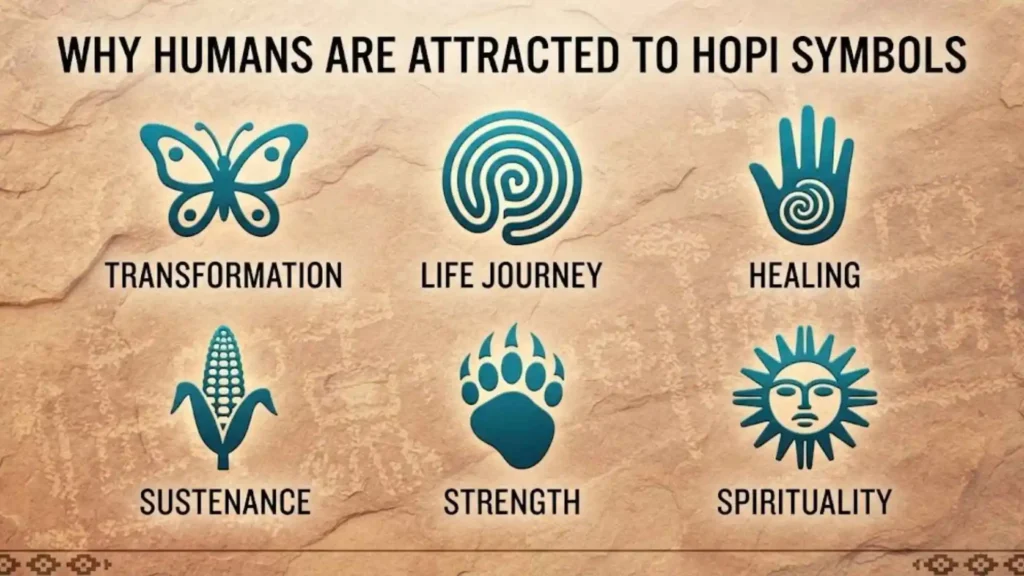
Humans have always used symbols to understand mysteries that words cannot fully explain.
Hopi symbols attract people because they represent deep human desires:
- Finding purpose
- Feeling connected
- Understanding nature
- Remembering ancestors
- Seeking balance
Symbols create emotional connections because they allow people to see their own experiences reflected in simple shapes.
A spiral can remind someone of personal growth. A circle can represent belonging. A sun can symbolize hope.
Modern Uses of Hopi Symbols
Tattoos
People often choose Hopi-inspired designs to express:
- Spiritual beliefs
- Respect for nature
- Personal transformation
Hopi Hand Symbol: Meaning and Cultural Significance
The term “Hopi hand symbol” is sometimes used online for hand-shaped designs that are described as Hopi or Native American. However, a hand image found on a website, tattoo page, or merchandise store should not automatically be considered an authentic traditional Hopi symbol.
The meaning of a hand design depends on its actual cultural source and context. Some modern designs may simply be inspired by Native American art without having a specific historical connection to Hopi traditions.
If you are researching a particular Hopi hand symbol, check where the design originated, who created it, and whether a reliable Hopi cultural source documents its meaning. This approach helps separate authentic cultural symbolism from modern interpretations or commercial artwork.
Jewelry
Symbolic jewelry allows people to carry cultural meanings close to them.
Fashion and Design
Patterns inspired by Indigenous artwork appear in:
- Clothing
- Home decoration
- Graphic design
Authentic cultural appreciation requires understanding and respecting the original meaning.
Contemporary Spirituality
Many people use symbolic designs for meditation, reflection, and personal inspiration.
Interesting Facts About Hopi Symbols
- The Hopi people are among the oldest continuously living cultures in North America.
- Corn is one of the most important sacred symbols in Hopi traditions.
- Hopi ceremonies are closely connected with seasons, agriculture, and natural cycles.
- Many Hopi symbols are passed through generations using oral teachings.
- Kachina traditions include hundreds of spiritual figures with different meanings.
- Hopi artwork often combines geometric patterns with natural elements.
- Symbols are not separated from daily life because spirituality is deeply connected with everyday actions.
- Hopi villages are located on mesas in northeastern Arizona, creating a unique relationship with the desert environment.
Frequently Asked Questions
What do Hopi symbols represent?
Hopi symbols represent spiritual beliefs, nature, ancestors, balance, agriculture, and the connection between humans and the universe.
What is the most important Hopi symbol?
There is no single most important Hopi symbol. Symbols such as corn, rain, sun, and spirals hold important meanings within different traditions.
Are Hopi symbols religious?
Many Hopi symbols are connected to spiritual and ceremonial beliefs, but they also represent history, identity, and cultural teachings.
Can anyone use Hopi symbols?
People can appreciate Hopi symbols, but they should learn their meanings and respect that some designs are sacred cultural expressions.
What does the Hopi spiral symbol mean?
The spiral often represents movement, growth, life cycles, and transformation.
Conclusion
Hopi symbols are more than beautiful designs. They are visual teachings that preserve thousands of years of wisdom, spirituality, and connection with the natural world. Each symbol carries stories about balance, respect, renewal, and human responsibility. By understanding Hopi symbols, we gain a deeper appreciation for Indigenous knowledge and the timeless human search for meaning.

Hi, I’m Asher Monroe, a writer who believes that meaningful words have the power to inspire change and bring people closer to their dreams. I have always been fascinated by the beauty of quotes and the way a simple message can provide motivation, hope, and comfort.
I enjoy creating content around inspirational quotes, life lessons, success stories, and positive thoughts that help readers find encouragement in their everyday lives. My goal is to share words that connect with people and remind them of their inner strength.
Through my writing, I explore the ideas of personal growth, confidence, and the importance of staying inspired through every chapter of life.
I am the author of Words That Move the Soul and The Path of Endless Inspiration, two books focused on the power of wisdom, positivity, and meaningful thoughts.
 Sienna Brooks
 Rowan Sinclair Rowan Sinclair