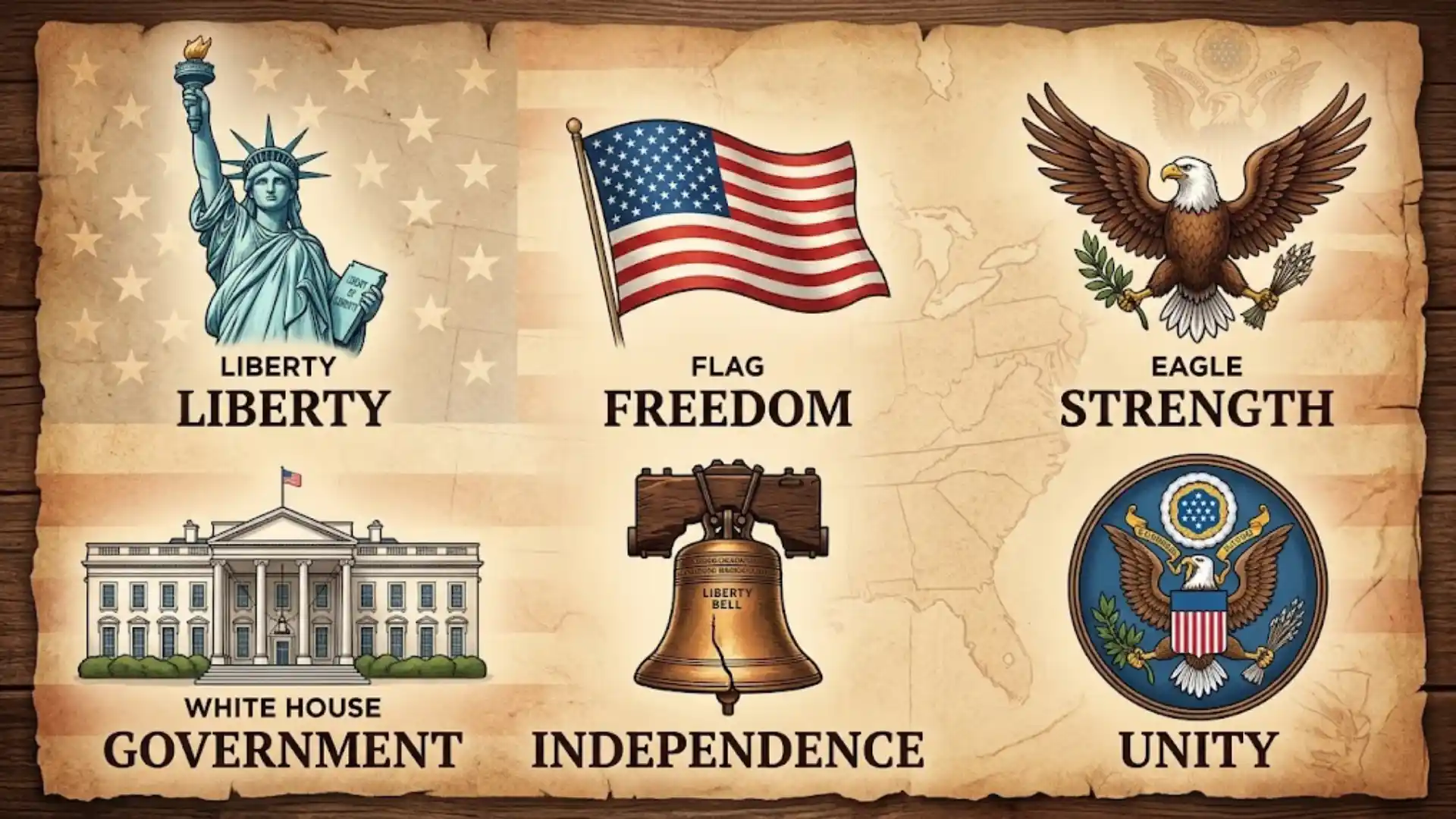
American symbols tell the story of the nation’s history, government, culture, and ideals. Some, such as the American flag and bald eagle, represent the United States on an official level. Others, including Uncle Sam, apple pie, Smokey Bear, and Rosie the Riveter, became recognizable through folklore, advertising, and historical events.
Understanding American symbols and meanings helps explain how people express patriotism, remember important moments, and represent ideas such as freedom, independence, peace, and national identity.
This guide explores a detailed list of American symbols, including official national emblems, historical landmarks, cultural icons, and unofficial symbols of the United States. It also explains the stories behind each symbol and why these images remain important in American life.
What Are American Symbols?
American symbols are objects, images, people, landmarks, colors, and cultural traditions that represent the United States. They can communicate national identity, historical events, political ideals, or everyday aspects of American culture.
Some symbols have formal government recognition. Others became popular through stories, public campaigns, artwork, or traditional celebrations.
For example, the American flag represents the nation, while Uncle Sam personifies the federal government. The Liberty Bell recalls the country’s struggle for independence, and apple pie represents a familiar part of American food culture.
American symbols generally fall into several categories:
- National symbols: The American flag, bald eagle, and Great Seal of the United States.
- Historical symbols: The Liberty Bell, Independence Hall, and the Declaration of Independence.
- Patriotic symbols: The national anthem, flag, and monuments associated with American history.
- Cultural symbols: Apple pie, Paul Bunyan, and other familiar traditions or folklore figures.
- Social and historical icons: Rosie the Riveter, who represents women’s industrial work during World War II.
- Public awareness symbols: Smokey Bear, the well-known character associated with wildfire prevention.
Not every famous American icon is an official national symbol. Understanding this distinction helps explain the different ways these images represent the country.
List of American Symbols and Their Meanings
The following table provides a quick overview of famous symbols of America, their meanings, and their historical or cultural significance.
| American symbol | Meaning or significance |
| American flag | National identity and the United States |
| Bald eagle | National identity, strength, and freedom |
| Great Seal of the United States | Federal authority and national representation |
| Stars and stripes | The 50 states and the original 13 colonies |
| Statue of Liberty | Liberty, welcome, and hope |
| Liberty Bell | American liberty and independence |
| Uncle Sam | Personification of the US government |
| Columbia | Historical personification of America |
| Apple pie | American food traditions and cultural identity |
| Smokey Bear | Wildfire prevention and public education |
| Paul Bunyan | North American logging folklore |
| Rosie the Riveter | Women’s industrial work during World War II |
| White House | The US presidency and executive branch |
| US Capitol | Congress and the legislative branch |
| Washington Monument | George Washington and national history |
| Star-Spangled Banner | National anthem and patriotic identity |
| American bison | National mammal and American wildlife |
| Olive branch | Peace and the desire for peace |
| Thirteen arrows on the Great Seal | Readiness for defense |
| Liberty torch | Freedom and enlightenment, especially through the Statue of Liberty |
Some entries are official national symbols, while others are historical landmarks or cultural icons. Their significance comes from different sources, including laws, historical events, public traditions, and popular culture.
Official National Symbols of the United States
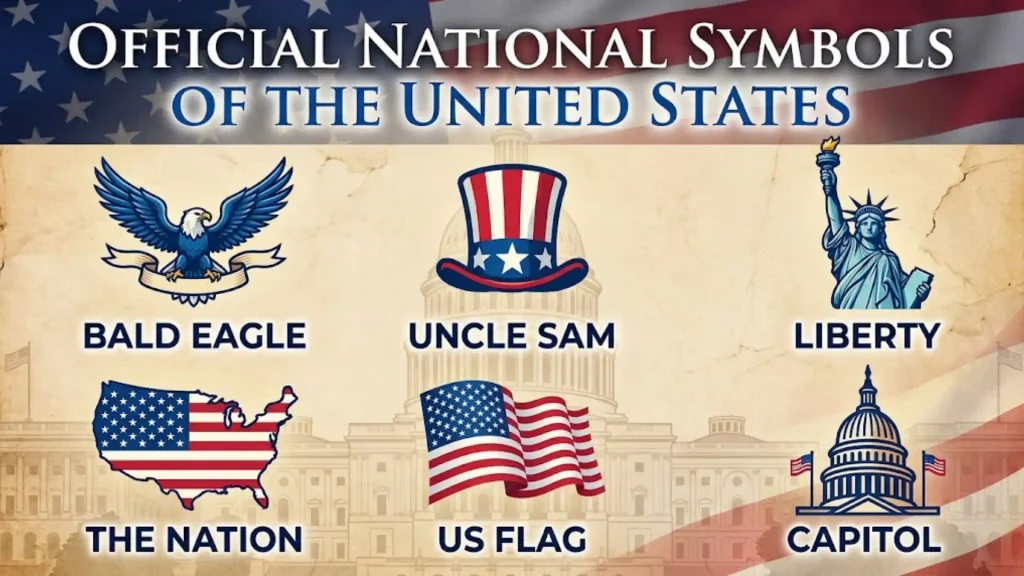
Official national symbols represent the country or its government through established traditions, formal designations, and government use. The American flag, national bird, national mammal, and Great Seal are important examples.
The American Flag: Stars and Stripes
The American flag is one of the most recognizable United States symbols. Its red and white stripes and white stars on a blue field represent the country’s history and national identity.
The flag has changed as the United States expanded. Its design developed from a flag representing the original states into the familiar 50-star flag used today.
The flag’s principal elements include:
- Fifty stars: Represent the 50 states of the United States.
- Thirteen stripes: Represent the original 13 colonies.
- Red, white, and blue: Colors associated with the flag and American patriotism.
The phrase Stars and Stripes is a common name for the American flag. It appears during civic ceremonies, national holidays, sporting events, and military observances.
The flag is also a powerful symbol of national identity. People may display it to express patriotism, honor military service, remember historical events, or celebrate American traditions.
What Do the Red, White, and Blue Colors Mean?
The red, white, and blue meaning of the American flag is often explained through traditional associations with character and civic values.
These interpretations are widely repeated, but it is useful to distinguish the traditional explanation of the colors from the symbolism formally described for the Great Seal.
Meaning of Red in the American Flag
Red is traditionally associated with hardiness and valor. These qualities suggest strength, courage, and the willingness to defend the country.
Some popular explanations also connect red with the blood shed by American Patriots during the struggle for independence. This is a common patriotic interpretation rather than a separate formal description of the flag’s design.
Meaning of White in the American Flag
White is traditionally associated with purity and innocence. In patriotic explanations, it represents ideals of honesty, integrity, and moral purpose.
These associations contribute to the familiar interpretation of the flag’s three colors as symbols of national values.
Meaning of Blue in the American Flag
Blue is traditionally associated with vigilance, perseverance, and justice.
These qualities reflect the importance of remaining alert, protecting civic institutions, and pursuing fairness. Blue also forms the background behind the flag’s stars.
What Do the 50 Stars and 13 Stripes Represent?
The 50 stars represent the 50 US states. The 13 stripes represent the original 13 colonies that declared independence from Great Britain.
The original colonies became the foundation of the United States. As the nation expanded, the flag’s star pattern changed to reflect the addition of new states.
The number of stripes, however, remains 13. This preserves the connection between the modern flag and the country’s founding history.
The Bald Eagle: America’s National Bird
The bald eagle is the national bird of the United States and one of its most famous wildlife symbols. Its white head, dark brown body, and large wings make it easy to recognize.
The bald eagle became a national emblem because it represented qualities Americans associated with strength, independence, and freedom. It also appears on the Great Seal of the United States.
The eagle’s symbolism extends beyond wildlife. Government seals, official documents, currency, and other national imagery use eagle designs to communicate authority and national identity.
What Does the Bald Eagle Symbolize in America?
The bald eagle meaning is commonly connected to freedom, strength, courage, and independence. Its ability to soar high above the landscape has also contributed to its association with power and a broad national perspective.
However, the eagle does not have one universally accepted meaning for every American. Its symbolism has developed through historical traditions, government imagery, and popular culture.
The bald eagle also represents an important conservation story. Its population suffered serious declines due to factors including habitat loss, hunting, and pesticide exposure. Legal protections and conservation efforts helped the population recover significantly.
The eagle’s return is therefore associated not only with national identity but also with wildlife protection and environmental recovery.
Is the Bald Eagle America’s National Animal?
The bald eagle is the national bird of the United States. The American bison, by contrast, is the country’s national mammal.
People sometimes describe the bald eagle as America’s national animal in casual conversation. For accuracy, an article should distinguish the eagle’s official designation from the bison’s designation.
The Great Seal of the United States
The Great Seal of the United States is an official emblem used to authenticate certain government documents and represent the federal government.
It features a bald eagle holding an olive branch in one talon and a bundle of arrows in the other. A shield covers the eagle’s chest, while a group of stars appears above its head.
The design contains several important elements:
- Bald eagle: Represents the United States.
- Olive branch: Traditionally symbolizes peace.
- Arrows: Represent readiness for defense.
- Shield: Uses the flag’s red, white, and blue colors.
- Stars: Represent the states in the union at the time the seal’s design was established.
- E Pluribus Unum: A Latin motto commonly translated as “Out of many, one.”
The Great Seal appears in official government contexts and is different from the American flag, although both represent the nation.
What Do the Arrows and Olive Branch Mean?
The olive branch and arrows create a deliberate contrast between peace and defense.
The olive branch represents the desire for peace. The arrows suggest that the country is prepared to defend itself when necessary.
Together, these features express the idea that peace is desirable while national defense remains important.
The arrows are often discussed in connection with the original 13 colonies, but their main symbolic function in the eagle’s design is readiness for defense. Avoid assuming that every element of the seal has a single, simple meaning.
The American Bison: National Mammal
The American bison is the national mammal of the United States. This large animal has played an important role in North American ecosystems, Indigenous cultures, and the history of the American West.
Bison once moved across vast grasslands in enormous herds. Their populations later declined dramatically because of widespread hunting and other pressures.
Conservation programs helped protect remaining populations and restore bison to some landscapes.
As an American symbol, the bison represents native wildlife, the Great Plains, and the importance of conservation. It also reminds readers that American heritage includes natural history alongside political history.
The Star-Spangled Banner: America’s National Anthem
The Star-Spangled Banner is the national anthem of the United States. Its lyrics were written by Francis Scott Key after he witnessed the British bombardment of Fort McHenry during the War of 1812.
Key’s words reflected his observation of the American flag still flying after the attack. The poem later became associated with the music now used for the national anthem.
The anthem represents patriotism, national identity, and the country’s historical struggles. It is commonly performed at official ceremonies, sporting events, and other public gatherings.
Although the flag and anthem serve different purposes, both are among the most recognizable American patriotic symbols.
American Symbols of Freedom and Independence
Many American freedom symbols are connected to the American Revolution, the Declaration of Independence, and the nation’s continuing debates about liberty and equality.
These symbols preserve memories of important events and express ideals that have influenced American political life.
The Statue of Liberty
The Statue of Liberty stands on Liberty Island in New York Harbor. France presented the monument to the United States as a gift celebrating friendship between the two countries and shared republican ideals.
The statue depicts a robed female figure holding a torch in one hand and a tablet in the other.
Its most recognizable features include:
- Torch: Commonly associated with enlightenment and the guiding light of liberty.
- Tablet: Bears the date July 4, 1776, linking the monument to American independence.
- Crown: Includes seven rays often interpreted as representing the seven seas and seven continents.
- Overall figure: Represents liberty and has become associated with immigration and welcome.
The Statue of Liberty became particularly meaningful to immigrants arriving in the United States. Its image came to represent the possibility of a new life, although the real experiences of immigrants varied widely.
Today, the statue is one of the most iconic symbols of America and a major historical landmark.
The Liberty Bell
The Liberty Bell is a historic bell in Philadelphia, Pennsylvania. It is closely associated with American independence and later movements for freedom and equality.
The Pennsylvania Provincial Assembly commissioned the bell in 1752. It was intended for the Pennsylvania State House, now known as Independence Hall.
The bell became famous for its inscription, which refers to liberty. Its crack and later public history helped transform it into a powerful national symbol.
What Does the Liberty Bell Symbolize?
The Liberty Bell meaning is closely connected to freedom, independence, and the struggle for equal rights.
During the nineteenth century, abolitionists adopted the bell as a symbol of their campaign against slavery. This gave the bell a significance that extended beyond the Revolutionary era.
The Liberty Bell is now displayed at the Liberty Bell Center in Independence National Historical Park in Philadelphia.
Its history shows how a physical object can acquire new meaning as different generations connect it with their own struggles for freedom.
Independence Hall
Independence Hall is a historic building in Philadelphia where the Declaration of Independence was adopted in 1776 and the US Constitution was debated and signed in 1787.
The building represents the country’s founding political institutions and the creation of a new system of government.
It is also closely connected to the Liberty Bell, which was commissioned for the building’s original use as the Pennsylvania State House.
Together, Independence Hall and the Liberty Bell help visitors understand the historical setting of the American Revolution and the formation of the United States.
The Declaration of Independence
The Declaration of Independence announced that the American colonies considered themselves free and independent states in 1776.
The document expresses influential ideas about equality, rights, and government by consent. It has become a major symbol of American independence and political ideals.
However, the rights described in the Declaration were not extended equally to everyone at the time. Enslaved people, women, and many other groups faced serious legal and social restrictions.
Understanding this historical gap helps explain why the Declaration has inspired both patriotic celebration and movements demanding that the country live up to its stated ideals.
Uncle Sam: The Personification of the US Government
Uncle Sam is a familiar personification of the United States government. He is usually shown as an older man with white hair, a pointed beard, a top hat, and red, white, and blue clothing.
His image became especially famous through political cartoons and recruitment posters.
What Is the Origin of Uncle Sam?
The traditional account connects Uncle Sam to Samuel Wilson, a meat supplier from Troy, New York, who supplied provisions to American soldiers during the War of 1812.
According to the popular story, barrels marked with the initials “U.S.” were associated with Wilson’s supplies. The initials were jokingly interpreted as “Uncle Sam,” helping the expression become associated with the federal government.
The story is widely repeated, and Congress formally recognized Samuel Wilson’s connection to the Uncle Sam tradition in 1961. The broader development of the character took place over time, so the modern image should not be attributed to one event alone.
What Does Uncle Sam Represent?
Uncle Sam represents the US government, particularly in political communication and public campaigns.
During wartime, posters used his image to encourage enlistment and support for national efforts. One famous recruitment poster depicts Uncle Sam pointing toward the viewer with the words “I Want You.”
Unlike the American flag, which represents the country as a whole, Uncle Sam specifically personifies the government and its calls for public participation.
Columbia: A Historical Symbol of America
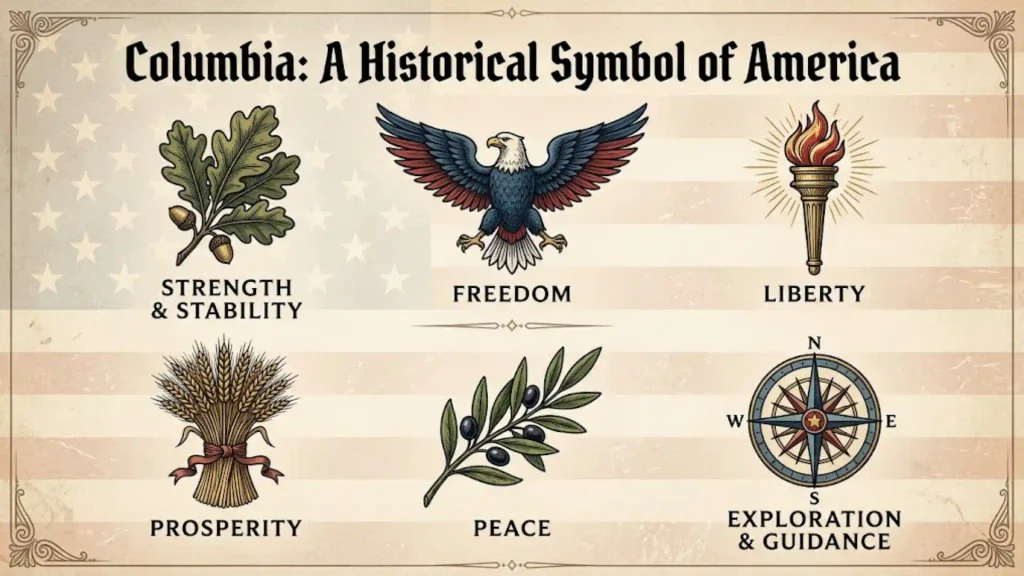
Columbia is a female personification of the United States that appeared in American artwork, poetry, political imagery, and public monuments.
The name developed from European naming traditions associated with Christopher Columbus. During earlier periods of American history, Columbia was used as a poetic name for the country.
Artists often depicted Columbia as a woman wearing classical clothing, sometimes with a liberty cap, shield, or other patriotic features.
What Does Columbia Represent?
Columbia represents the United States as a nation. In historical imagery, she was often associated with liberty, national pride, and republican ideals.
Her prominence declined as Uncle Sam and other national figures became more common in popular culture.
The name survives in places and institutions, including the District of Columbia and Columbia University. However, these uses do not all carry the same symbolic meaning.
Columbia is best understood as a historical national personification rather than a current official national emblem.
American Cultural Symbols and Everyday Traditions
Not all American cultural symbols come from government or major historical events. Food, familiar buildings, and traditional stories also contribute to national identity.
These icons often represent everyday experiences, shared memories, and cultural traditions.
Apple Pie: An Unofficial American Symbol
Apple pie is one of the best-known examples of an unofficial American symbol. The dessert is closely associated with family meals, holidays, comfort food, and traditional American home cooking.
The phrase “as American as apple pie” helped connect the dessert with ideas of national identity.
However, apple pie did not originate exclusively in the United States. Recipes for apple pies existed in Europe before the American colonies were established. British, Dutch, and other European culinary traditions influenced early American food.
Over time, American cooks adapted recipes using locally available apples, spices, pastry techniques, and regional ingredients.
Apple pie became a familiar feature of American celebrations, including Thanksgiving and other family gatherings. It is often served with vanilla ice cream or whipped cream.
Its cultural importance comes from its association with home, hospitality, and tradition rather than official recognition.
The White House
The White House is the official residence and workplace of the president of the United States. Located in Washington, DC, it serves as a central setting for presidential administration and diplomatic events.
As a symbol, the White House represents the presidency and the executive branch of the federal government.
Its public image appears in news coverage, official announcements, political discussions, and historical photographs.
The White House is therefore an important American government symbol, although it is a building rather than an official national emblem like the flag.
The US Capitol
The US Capitol is the meeting place of the United States Congress. It stands on Capitol Hill in Washington, DC, and houses the Senate and House of Representatives.
The building represents the legislative branch and the country’s system of representative government.
Its dome and surrounding architecture are widely recognizable in photographs, news coverage, and civic imagery.
The Capitol’s meaning is closely connected to lawmaking, political debate, and the constitutional structure of the federal government.
The Washington Monument
The Washington Monument honors George Washington, the first president of the United States and a major figure in the American Revolution.
The tall obelisk stands on the National Mall in Washington, DC. Its simple, monumental design makes it one of the city’s most recognizable landmarks.
The monument represents Washington’s place in American history and the country’s efforts to commemorate its founding generation.
Smokey Bear: A Symbol of Wildfire Prevention
Smokey Bear, commonly called Smokey the Bear in everyday speech, is a well-known American public service character associated with wildfire prevention.
The campaign began during the 1940s and encouraged people to take responsibility for preventing human-caused wildfires.
Smokey’s familiar appearance includes a ranger hat, jeans, and a belt. The character is often shown reminding people to be careful with campfires, matches, cigarettes, and other potential sources of fire.
What Does Smokey Bear Represent?
The Smokey Bear meaning centers on wildfire prevention, public education, and the protection of forests and wildlife.
The campaign has involved the US Forest Service, the Ad Council, and the National Association of State Foresters. Advertising and public service messages helped make Smokey a recognizable American icon.
A real bear cub rescued after a wildfire in New Mexico in 1950 later became associated with the campaign. The cub lived at the National Zoo in Washington, DC, and helped draw attention to Smokey’s message.
Smokey Bear is an example of an advertising character that gained lasting cultural importance through public education.
How Does Smokey Bear Help Prevent Wildfires?
The campaign encourages people to reduce preventable fire risks by following safe practices.
Its message includes taking care with campfires, properly extinguishing fires, following local fire restrictions, and avoiding careless behavior that could ignite dry vegetation.
The character represents a public awareness campaign rather than an official national symbol. His importance comes from the connection between recognizable imagery and a practical conservation message.
Paul Bunyan: A Symbol of American Folklore
Paul Bunyan is a giant lumberjack from North American folklore. Stories about him describe extraordinary strength, enormous size, and exaggerated adventures in forests and logging camps.
His legend developed through logging traditions and oral storytelling. Over time, printed stories, advertisements, statues, and entertainment productions helped popularize the character.
Who Is Paul Bunyan in American Folklore?
Paul Bunyan is a folk hero associated with North American loggers. Stories often portray him performing impossible feats, such as clearing huge forests or shaping the landscape through his adventures.
His companion, Babe the Blue Ox, appears in many versions of the legend.
Paul Bunyan stories use humor and exaggeration to celebrate hard work, physical strength, and the difficult conditions associated with historical logging.
What Does Paul Bunyan Symbolize?
Paul Bunyan represents American folklore, logging traditions, and the larger-than-life heroes of regional storytelling.
His legend also illustrates how commercial works and popular entertainment can turn local stories into recognizable cultural icons.
Paul Bunyan is not an official national symbol. He belongs to the broader tradition of American legends and folk heroes.
Rosie the Riveter: A Symbol of Women During World War II
Rosie the Riveter is one of the most recognizable American cultural icons associated with women working during World War II.
As millions of men entered military service, women took jobs in factories, shipyards, aircraft production, and other industries that supported the war effort.
Rosie became a symbol of these workers and the changing role of women in American industrial life.
Who Is Rosie the Riveter?
Rosie the Riveter is a cultural character representing women who contributed to wartime production.
The character became associated with recruitment and publicity efforts encouraging women to enter industrial jobs. Different images and campaigns contributed to the wider Rosie identity.
One of the best-known images is the “We Can Do It!” poster, which depicts a woman in work clothes with a red-and-white polka-dot headscarf and a raised arm.
Although people often associate the poster directly with Rosie, the image had its own original historical context. Its later popularity helped link it more closely to the broader Rosie the Riveter story.
What Does Rosie the Riveter Symbolize?
Rosie the Riveter symbolizes women’s contributions to the wartime economy, women’s industrial labor, and the changing expectations placed on women during World War II.
Her meaning expanded in later decades. Feminist movements and public discussions of workplace equality adopted Rosie as a symbol of women’s empowerment and capability.
However, the historical experience of women workers was not identical for everyone. Race, class, working conditions, and unequal opportunities shaped women’s experiences in the wartime workforce.
Rosie remains a powerful reminder of women’s contributions to American history and the continuing discussion of gender and work.
The Rosie the Riveter Song
A song titled “Rosie the Riveter” was released in 1942, with lyrics by Redd Evans and music by John Jacob Loeb.
The song helped popularize the image of a woman contributing to wartime production. Its lyrics reflected the period’s public messaging about women working in support of the war effort.
The song and later visual imagery contributed to Rosie’s lasting place in American cultural history.
Other American Symbols of Patriotism
Several familiar symbols express American patriotism without necessarily having a formal designation as national emblems.
The National Colors: Red, White, and Blue
Red, white, and blue appear in patriotic decorations, clothing, flags, and public displays. People commonly use these colors during Independence Day celebrations, civic events, and national sporting competitions.
Their widespread use makes them a visual shorthand for the United States.
The Olive Branch
The olive branch appears in the Great Seal held by the bald eagle. It traditionally represents peace and the desire for peaceful relations.
Because the eagle also holds arrows, the design presents peace alongside readiness for defense.
The Liberty Torch
The torch held by the Statue of Liberty is a recognizable image of freedom and enlightenment. Its light is commonly interpreted as a guide toward liberty and hope.
The torch is particularly important as part of the statue’s design, rather than as a separate official national symbol.
The American Flag During National Holidays
The American flag appears during Independence Day, Memorial Day, Veterans Day, and many other civic events.
Its role can vary with the occasion. Independence Day celebrations emphasize the country’s founding, while Memorial Day and Veterans Day focus on different aspects of military service and remembrance.
The flag provides a familiar visual connection between these observances and American national identity.
Official vs. Unofficial American Symbols
A useful way to understand American national symbols is to distinguish formal national emblems from widely recognized cultural icons.
| Symbol | Category | Why it matters |
| American flag | Official national symbol | Represents the United States |
| Great Seal of the United States | Official government emblem | Authenticates certain federal documents and represents government authority |
| Bald eagle | National bird | Recognized national wildlife emblem |
| American bison | National mammal | Represents native wildlife and conservation |
| Star-Spangled Banner | National anthem | Expresses national identity through music |
| Liberty Bell | Historical symbol | Represents liberty and the struggle for freedom |
| Uncle Sam | National personification | Represents the US government |
| Columbia | Historical personification | Represents the United States in older artwork |
| Apple pie | Cultural symbol | Represents food traditions and home cooking |
| Smokey Bear | Public awareness icon | Promotes wildfire prevention |
| Paul Bunyan | Folklore figure | Represents logging stories and folk traditions |
| Rosie the Riveter | Cultural and historical icon | Represents women in wartime industrial work |
These categories can overlap. A symbol may be connected to a government program or a historical event without becoming an official national emblem.
This distinction also explains why the phrase unofficial symbols of the United States includes such different examples. Apple pie represents cultural tradition, Smokey Bear represents public education, and Paul Bunyan belongs to folklore.
Why Are American Symbols Important?
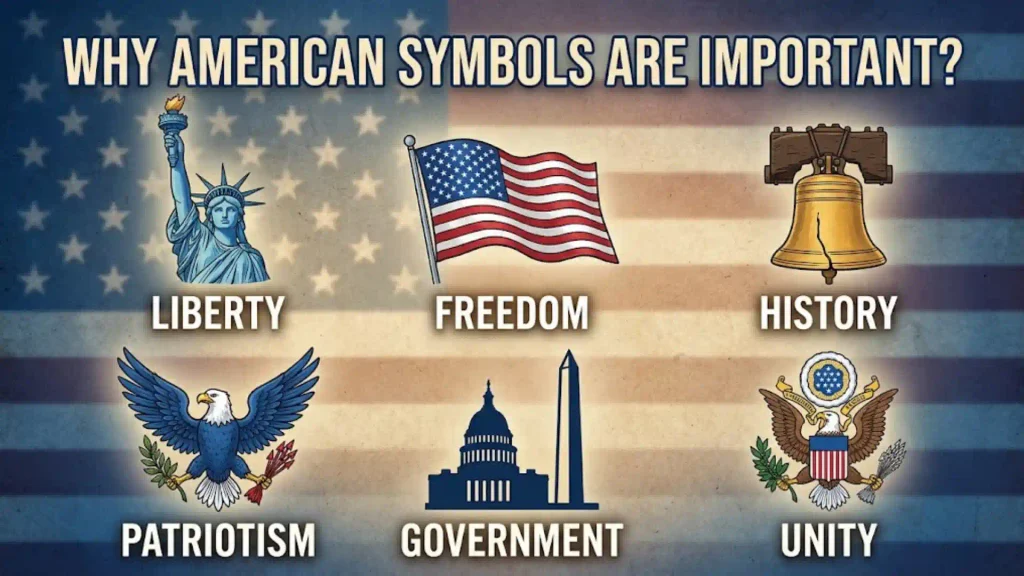
American symbols help people connect with the nation’s history, culture, institutions, and public ideals. Their significance can be historical, political, cultural, or personal.
They Represent National Identity
The American flag, bald eagle, and national anthem are recognizable symbols of the United States. They appear at official ceremonies and public events, helping people identify the country in a wide range of settings.
They Preserve Historical Memory
Landmarks such as Independence Hall and the Liberty Bell connect modern visitors with the American Revolution and the founding of the country.
These sites also help explain how later generations interpreted the ideas of independence and liberty.
They Express Civic Ideals
Symbols such as the Statue of Liberty and the Declaration of Independence are associated with liberty, equality, and political rights.
Their meaning is not limited to celebration. They also provide a way to discuss whether American institutions have lived up to the ideals expressed in founding documents.
They Reflect Cultural Traditions
Apple pie and Paul Bunyan show that national identity also develops through food, storytelling, entertainment, and regional traditions.
These symbols may not have formal recognition, but they remain familiar parts of American cultural imagery.
They Recognize Social Contributions
Rosie the Riveter represents women whose work supported the wartime economy. Her later association with feminism shows how a historical figure can take on new meaning as social attitudes change.
They Support Public Awareness
Smokey Bear demonstrates how an easily recognized character can deliver a practical message. In this case, the message concerns preventing human-caused wildfires and protecting forests.
Frequently Asked Questions About American Symbols
What are the most famous American symbols?
Some of the most famous American symbols include the American flag, bald eagle, Statue of Liberty, Great Seal of the United States, Liberty Bell, Uncle Sam, and the national anthem. Apple pie, Smokey Bear, Paul Bunyan, and Rosie the Riveter are also widely recognized cultural icons.
What are the national symbols of America and their meanings?
The American flag represents the nation, while the bald eagle is its national bird. The American bison is the national mammal, and the Great Seal represents federal authority. The Star-Spangled Banner serves as the national anthem. Each symbol has a different official or historical role.
What symbols represent the United States of America?
The flag, bald eagle, Great Seal, Statue of Liberty, and national anthem are among the best-known symbols representing the United States. Historical landmarks and cultural icons also contribute to the country’s identity.
What do the red, white, and blue colors of the American flag mean?
Traditional explanations associate red with hardiness and valor, white with purity and innocence, and blue with vigilance, perseverance, and justice. These are widely repeated traditional interpretations of the flag’s colors.
What do the 50 stars on the American flag represent?
The 50 stars represent the 50 states of the United States. The flag’s star count increased as new states joined the union.
What do the 13 stripes on the American flag represent?
The 13 stripes represent the original 13 colonies that declared independence from Great Britain. The stripes preserve a visual connection to the country’s founding period.
What does the bald eagle symbolize in America?
The bald eagle is commonly associated with strength, freedom, independence, and national identity. It is the national bird of the United States and appears on the Great Seal.
What do the arrows and olive branch on the Great Seal mean?
The olive branch traditionally represents peace, while the arrows symbolize readiness for defense. Together, they express the relationship between the desire for peace and the need to protect the nation.
Why is apple pie considered an American symbol?
Apple pie became associated with American home cooking, family gatherings, and cultural traditions. Although its roots extend to European cooking, the dessert became a familiar part of American food culture.
Who is Uncle Sam, and what does he represent?
Uncle Sam is a personification of the US government. His familiar image became popular through political cartoons, public campaigns, and military recruitment posters.
What is the origin of Uncle Sam?
The traditional story links Uncle Sam to Samuel Wilson, a meat supplier who provided food for American soldiers during the War of 1812. The expression later became a popular way to personify the federal government.
What does Smokey Bear represent?
Smokey Bear represents wildfire prevention and public education about fire safety. His campaign encourages people to avoid careless actions that can cause human-caused wildfires.
Who is Paul Bunyan in American folklore?
Paul Bunyan is a giant lumberjack and folk hero in North American logging stories. His exaggerated adventures and his companion, Babe the Blue Ox, became familiar parts of American folklore.
What does the Liberty Bell symbolize?
The Liberty Bell symbolizes American liberty and independence. Abolitionists later used it as a symbol in the movement against slavery, expanding its historical significance.
Where is the Liberty Bell located?
The Liberty Bell is located at the Liberty Bell Center in Independence National Historical Park in Philadelphia, Pennsylvania.
Who is Columbia in American history?
Columbia is a female personification of the United States that appeared in older artwork, poetry, and political imagery. She was once a common symbolic figure representing the nation.
What does Columbia represent in the United States?
Columbia represents the United States as a nation. Historically, artists used her image to communicate national identity, liberty, and republican ideals.
Who is Rosie the Riveter?
Rosie the Riveter is a cultural figure representing women who worked in factories, shipyards, and other industries during World War II. Her image later became associated with women’s empowerment.
What does Rosie the Riveter symbolize?
Rosie symbolizes women’s industrial work during World War II, their contributions to the wartime economy, and broader discussions about women’s capabilities and workplace equality.
Which American symbols represent freedom and independence?
The Statue of Liberty, Liberty Bell, American flag, and Declaration of Independence are among the symbols most closely associated with freedom and independence. Each represents a different aspect of American history or civic ideals.
What are some unofficial symbols of American culture?
Apple pie, Uncle Sam, Smokey Bear, Paul Bunyan, Columbia, and Rosie the Riveter are familiar cultural or historical icons. They represent different parts of American life, from food and folklore to public campaigns and social history.
Which symbols represent American women during World War II?
Rosie the Riveter is the best-known cultural symbol of American women who entered industrial jobs during World War II. Her image represents the contribution of women workers to the wartime home front.
Conclusion
The symbols of America represent far more than flags and patriotic decorations. They reflect the nation’s government, founding history, cultural traditions, wildlife, public campaigns, and changing social ideals.
The American flag and bald eagle are among the best-known national symbols. The Great Seal represents federal authority, while the Liberty Bell and Statue of Liberty connect American identity with liberty and independence. Uncle Sam, Columbia, apple pie, Smokey Bear, Paul Bunyan, and Rosie the Riveter demonstrate how cultural figures and traditions also shape the country’s public image.
Understanding these American symbols and meanings helps explain why certain images remain recognizable across generations. It also makes it easier to distinguish officially recognized national symbols from the cultural icons that have become part of American heritage.

Hi, I’m Asher Monroe, a writer who believes that meaningful words have the power to inspire change and bring people closer to their dreams. I have always been fascinated by the beauty of quotes and the way a simple message can provide motivation, hope, and comfort.
I enjoy creating content around inspirational quotes, life lessons, success stories, and positive thoughts that help readers find encouragement in their everyday lives. My goal is to share words that connect with people and remind them of their inner strength.
Through my writing, I explore the ideas of personal growth, confidence, and the importance of staying inspired through every chapter of life.
I am the author of Words That Move the Soul and The Path of Endless Inspiration, two books focused on the power of wisdom, positivity, and meaningful thoughts.
 Sienna Brooks
 Rowan Sinclair Rowan Sinclair