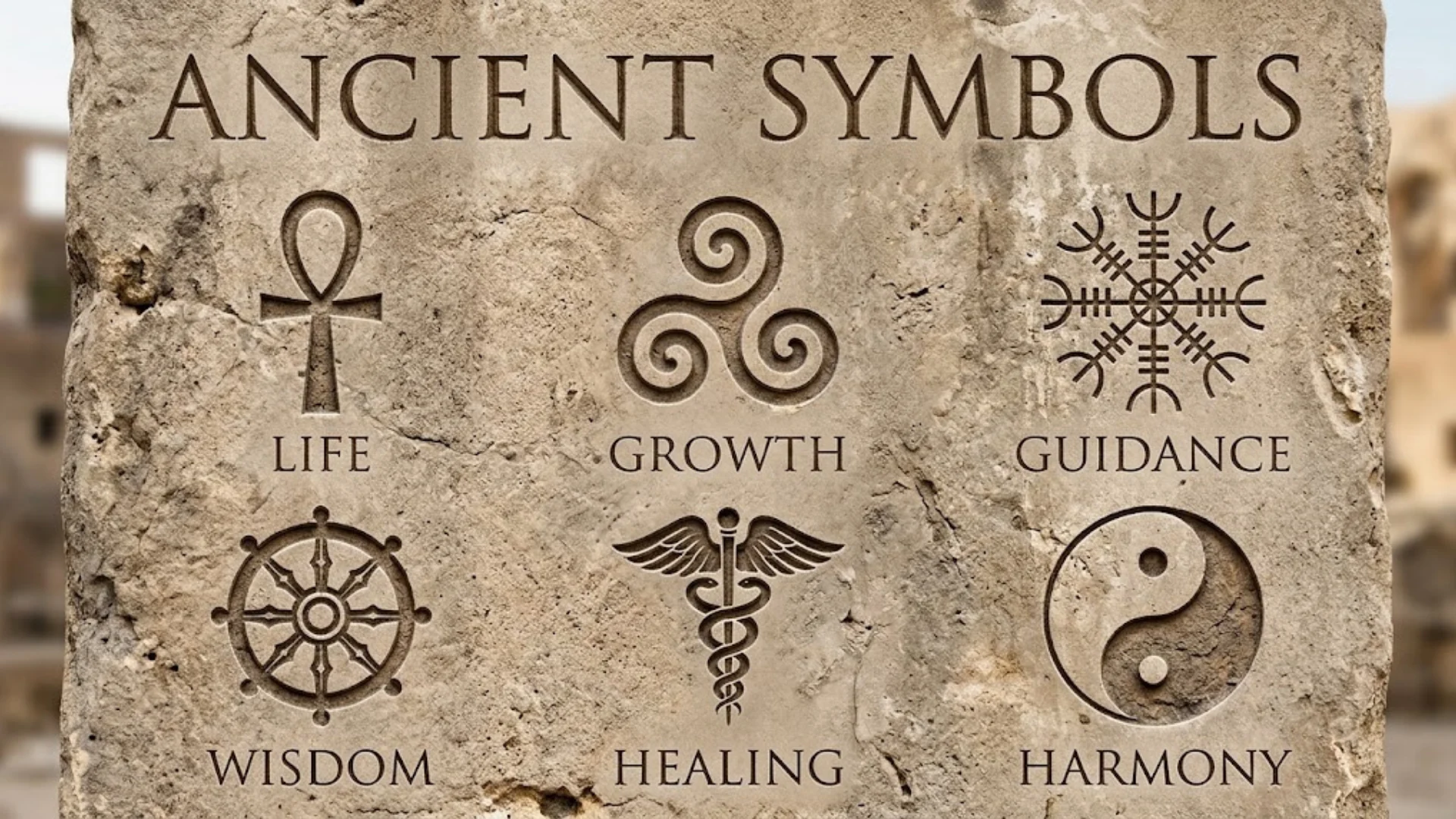
Ancient symbols of royalty tell us how kings, queens, pharaohs, and emperors showed their power and identity. From Egyptian ankhs to European crowns and Chinese imperial dragons, these symbols helped rulers communicate authority, religious beliefs, family heritage, and political status.
Some symbols appeared on crowns, ceremonial staffs, royal clothing, coins, and official documents. Others decorated temples, palaces, tombs, and monuments. Their meanings often changed as civilizations developed and different rulers adopted older traditions.
Understanding ancient symbols of royalty also means recognizing their historical differences. The ankh belongs to ancient Egyptian culture, while the Tudor Rose developed much later in English history. Similarly, the Japanese chrysanthemum has a specific imperial association, whereas the lotus carries broader religious and cultural meanings across Asia.
This guide explores the most important royal symbols and meanings, including their origins, historical uses, and connections with kingship, nobility, divine authority, and imperial power.
What Are Ancient Symbols of Royalty?
Ancient symbols of royalty are visual signs, objects, and emblems associated with rulers, royal families, dynasties, and imperial governments. They helped identify a monarch, communicate political authority, and express religious or cultural beliefs.
These symbols took many forms. A crown could represent sovereignty, a royal seal could authenticate a decree, and an Egyptian cartouche could enclose a pharaoh’s name.
Rulers also used animals, flowers, religious images, and architectural designs to communicate specific ideas. However, the meaning of a symbol depended on its historical and cultural setting.
Why Did Kings and Queens Use Royal Symbols?
Kings and queens ruled societies where many people never met their monarch personally. Symbols helped make royal authority visible in public life.
Common purposes included:
- Royal authority: Showing that a ruler had the right to govern.
- Royal lineage: Connecting a monarch with a dynasty or noble family.
- Divine authority: Expressing a ruler’s relationship with gods or religious traditions.
- Political identity: Distinguishing one kingdom, dynasty, or ruling house from another.
- Protection: Representing divine guardianship or protection from harm.
- Ceremonial status: Marking coronations, royal weddings, religious rituals, and state occasions.
- Official authentication: Identifying documents issued under royal authority.
For example, ancient Egyptian pharaohs wore distinctive headdresses and displayed the uraeus cobra on their foreheads. Medieval European rulers used heraldic shields, crowns, and seals. These traditions served similar political purposes but developed in different cultures.
Ancient Royal Symbols vs. Medieval and Modern Royal Emblems
Not every royal emblem is ancient. Some symbols originated thousands of years ago, while others developed during the Middle Ages or later.
| Historical period | Examples | Main purpose |
| Ancient Egypt | Ankh, uraeus, cartouche, scarab | Kingship, life, protection, religious authority |
| Ancient Rome | Laurel wreath, imperial eagle | Victory, honor, military and imperial identity |
| Medieval Europe | Heraldic lion, fleur-de-lis, royal seals | Dynastic identity, authority, territorial claims |
| Tudor England | Tudor Rose | Dynastic identity and political union |
| Imperial China | Dragon and phoenix imagery | Imperial status and court symbolism |
| Imperial Japan | Chrysanthemum crest | Imperial family identity |
| Modern monarchies | Royal cyphers and warrants | Official identity, recognition, and endorsement |
This distinction matters because historical accuracy makes an article about symbols of monarchy more useful than a list that treats every emblem as an ancient object.
Famous Royal Symbols and Their Meanings
Several symbols appear repeatedly in royal history. Some represent a ruler’s authority, while others identify a dynasty or express religious beliefs.
| Symbol | Main meaning or association | Historical context |
| Crown | Sovereignty and royal status | Monarchies across different periods |
| Scepter | Authority and the right to govern | Royal ceremonies |
| Royal orb | Sovereignty and, in Christian monarchies, the Christian world | European royal regalia |
| Royal seal | Official identity and authentication | Royal administrations |
| Royal coat of arms | Family identity and lineage | European heraldry |
| Lion | Courage and strength | Heraldic traditions |
| Tudor Rose | Tudor dynasty and dynastic union | England |
| Fleur-de-lis | French royal heraldry | Medieval and early modern France |
| Laurel wreath | Victory and honor | Ancient Rome |
| Ankh | Life | Ancient Egypt |
| Eye of Horus | Healing and protection | Ancient Egypt |
| Uraeus cobra | Kingship and protection | Ancient Egypt |
| Dragon | Imperial authority | Chinese imperial traditions |
| Chrysanthemum | Japanese imperial identity | Japan |
These meanings are useful starting points, but no symbol has exactly the same meaning in every society.
Crowns and Royal Regalia
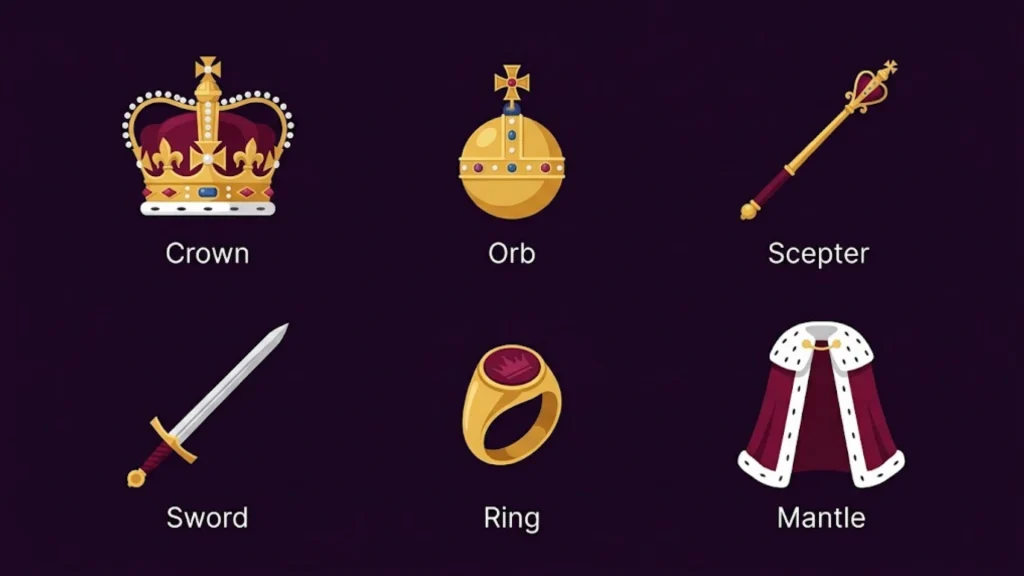
Royal regalia refers to ceremonial objects associated with a monarch’s position and duties. Depending on the tradition, these objects may include crowns, scepters, orbs, swords, rings, and other ceremonial items.
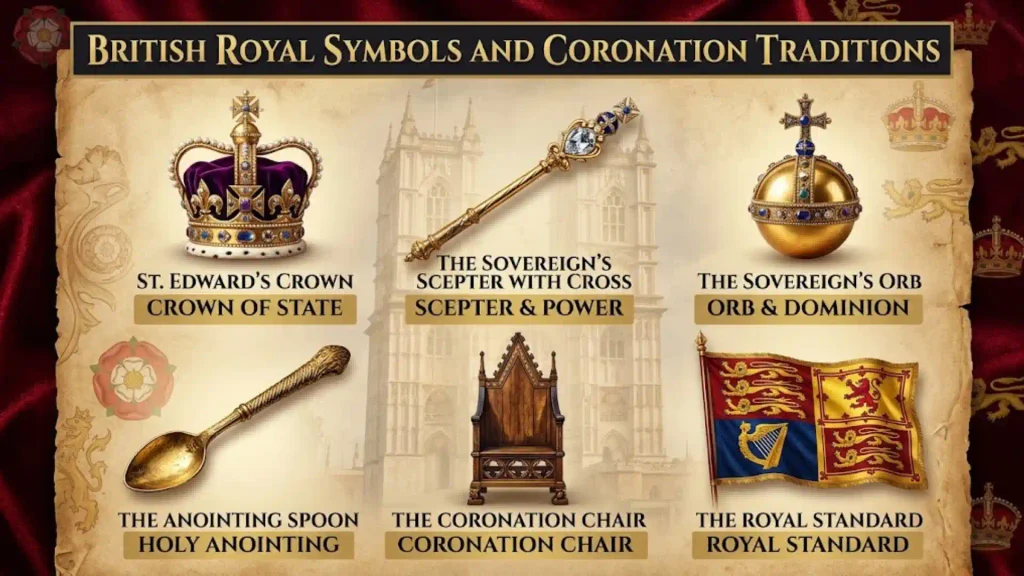
The British coronation regalia offers a well-documented example. The Royal Family explains that these objects represent the status, responsibilities, and service associated with the monarchy. (The Royal Family: Coronation Guide)
Crown Symbolism: Sovereignty and Royal Status
The crown is one of the best-known symbols of royalty. It represents sovereignty, royal dignity, and the position of a monarch.
Crowns differ in design according to their historical period and cultural setting. Some feature arches and crosses, while others use distinctive shapes, precious metals, and gemstones.
A crown can also appear in paintings, official documents, flags, and coats of arms. In those contexts, it may represent the monarchy without depicting a particular ruler.
The British St Edward’s Crown illustrates the ceremonial importance of royal headwear. The current crown was made for the coronation of Charles II in 1661, following the destruction of much of the earlier English coronation regalia. It is used during the crowning portion of a British coronation. (Royal Collection Trust: The Crown Jewels)
Scepter Symbolism and Royal Authority
A royal scepter is a ceremonial staff that represents a ruler’s authority.
In European coronation traditions, scepters may communicate different responsibilities. The British Sovereign’s Sceptre with Cross represents temporal power, while the Sceptre with Dove represents the monarch’s spiritual role and is associated with equity and mercy.
These objects show that royal authority was sometimes understood as a responsibility to govern wisely, not simply as a sign of personal power. (The Royal Family: Coronation Guide)
Royal Orb and Globus Cruciger
The royal orb is a globe-shaped ceremonial object. In Christian European monarchies, the Globus Cruciger consists of a globe topped with a cross.
The globe represents the world, while the cross expresses the Christian religious framework within which the monarch’s authority was traditionally understood.
During a British coronation, the Sovereign’s Orb is placed in the monarch’s right hand before being returned to the altar. The object dates to the coronation of Charles II in 1661 and weighs approximately 1.32 kilograms. (The Coronation Roll: The Orb)
The orb is therefore a particularly clear example of symbols of divine authority within Christian royal traditions. It should not be treated as a universal symbol shared by every ancient civilization.
Royal Regalia and Coronation Ceremonies
Coronation ceremonies formally recognize a ruler’s accession and responsibilities. The objects used in these ceremonies often carry meanings that developed over centuries.
Depending on the monarchy, regalia may include:
- Crowns and ceremonial headwear.
- Scepters and other royal ceremonial staffs.
- Orbs representing the world or sovereignty.
- Swords associated with justice and the defense of the realm.
- Rings representing royal dignity or faith.
- Ceremonial garments and objects used during anointing.
The meaning of each object depends on the specific tradition. Royal regalia should be studied through its documented ceremonial use rather than through appearance alone.
Royal Seals, Coats of Arms, and Cyphers
Not all royal emblems are physical objects worn by a monarch. Some are marks used on documents, buildings, and official possessions.
Royal Seals and Their Meanings
Royal seals were used to authenticate documents issued under royal authority. A seal could feature a ruler’s image, title, coat of arms, or other identifying details.
When attached to a charter, decree, or official document, a seal helped communicate that the document came from an authorized source.
Royal seals also provide historians with evidence about rulers, titles, artistic styles, and political relationships. Their designs changed over time, so they should be interpreted in their historical context.
Royal Coat of Arms and Heraldic Symbols
A Royal Coat of Arms is a formal heraldic design associated with a monarch or royal house. It may include a shield, animals, crowns, supporters, and other decorative elements.
Heraldry became especially important in medieval Europe. Coats of arms helped distinguish individuals, noble families, military participants, and political authorities.
Common heraldic elements include:
- Lions: Frequently associated with courage and strength.
- Eagles: Used in several European and imperial traditions.
- Crowns: Indicating royal or noble status in a specific context.
- Crosses: Expressing Christian identity or religious affiliation.
- Fleurs-de-lis: Strongly associated with French royal heraldry.
- Colors and patterns: Helping distinguish one heraldic identity from another.
The exact meaning of a coat of arms depends on its documented history. A design may reflect family inheritance, political alliances, territorial claims, or honors granted to its owner.
Royal Cyphers and Monarchical Identity
A royal cypher is a monarch’s personal monogram, usually combining initials with a crown or other official design.
Royal cyphers can appear on government buildings, official stationery, uniforms, and royal possessions. They help identify the reigning monarch associated with an official object or institution.
Queen Elizabeth II used the cypher “EIIR,” combining her name and regnal number. King Charles III uses his own royal cypher.
These are examples of modern royal insignia, not ancient symbols of kingship.
What Is a Royal Warrant?
A royal warrant is a formal recognition granted to qualifying businesses or suppliers connected with a royal household.
It indicates an official relationship and can allow a business to display a designated royal warrant emblem under the applicable rules.
A royal warrant differs from a royal seal or coat of arms. A seal authenticates a document, a coat of arms identifies a heraldic entity, and a warrant recognizes a qualifying supplier.
Royal warrants belong to a later administrative tradition, so they should not be presented as ancient royal insignia.
Ancient Egyptian Symbols of Royalty and Their Meanings
Ancient Egypt developed a rich visual language connecting kingship, religion, protection, and life after death. Pharaohs appeared in statues, temple reliefs, tomb paintings, and inscriptions wearing recognizable royal objects and symbols.
The British Museum’s educational resource on Egyptian symbols identifies the ankh, nemes headdress, scarab, uraeus, cartouche, and lotus as important elements of Egyptian imagery. (British Museum: Ancient Egypt—Symbols of the Pharaoh)
The Ankh: Symbol of Life
The Ankh is a cross-shaped hieroglyph with a loop at the top. Its basic meaning is “life.”
In ancient Egyptian art, gods often hold an ankh, and depictions sometimes show a god presenting it to a pharaoh. The symbol therefore connected royal imagery with life, divine favor, and religious beliefs about existence beyond death.
The ankh remains one of the most recognizable ancient symbols of power and life, although it was not exclusively a royal emblem. It also appeared in broader religious and funerary contexts.
Eye of Horus: Healing and Protection
The Eye of Horus is associated with Horus, a major Egyptian deity connected with the sky and kingship.
Egyptian mythology tells of Horus’s eye being injured and restored. This story contributed to the eye’s associations with healing, restoration, and protection.
People used Eye of Horus designs on amulets, and the symbol also appeared in religious contexts. It was not simply a decorative mark of royalty; its protective role extended beyond kings and queens.
Eye of Ra: Solar Power and Divine Protection
The Eye of Ra is connected with Ra, the ancient Egyptian sun god. It represents a powerful aspect of the deity and appears in myths involving protection, punishment, and the force of the sun.
The Eye of Ra and the Eye of Horus are related through Egyptian religious imagery, but they are not interchangeable in every context.
| Feature | Eye of Horus | Eye of Ra |
| Main association | Horus | Ra |
| Common themes | Healing, restoration, protection | Solar power, protection, destructive force |
| Religious context | Myth of Horus’s injured and restored eye | Myths involving the power of the sun god |
| Typical use | Protective amulets and religious imagery | Solar and divine imagery |
Both symbols belong to ancient Egyptian mythology, but their stories and associations differ.
The Uraeus Cobra: A Symbol of Egyptian Kingship
The uraeus is a rearing cobra with a raised hood. Egyptian rulers wore this emblem on the forehead of royal headdresses.
The uraeus was associated with Wadjet, a protective goddess, and represented protection and kingship. Its placement on the pharaoh’s forehead made the connection between the symbol and royal authority especially visible.
Unlike a general animal motif, the uraeus had a specific place in Egyptian royal iconography.
The Scarab Beetle: Rebirth and Renewal
The Scarab Beetle held religious significance in ancient Egypt. Egyptians observed how dung beetles rolled balls across the ground and associated this behavior with the sun’s movement across the sky.
Scarab imagery became connected with renewal, regeneration, and rebirth. Scarab amulets also appeared in funerary contexts, where beliefs about life after death were important.
The scarab was not exclusively a royal symbol. Its use in amulets and burial objects shows how religious ideas reached beyond the royal court.
The Royal Cartouche: The Pharaoh’s Name
A cartouche is an oval enclosure around a royal name in Egyptian hieroglyphic inscriptions.
It helped identify a pharaoh and visually distinguish the ruler’s name within written records. Cartouches appear on monuments, temples, and objects associated with Egyptian rulers.
This makes the cartouche a particularly direct example of a symbol used for royal identity.
The Nemes Headdress: A Sign of the Pharaoh
The nemes headdress was a striped and pleated cloth worn by Egyptian pharaohs. Its recognizable shape appears in royal statues and other images of rulers.
The headdress helped distinguish a pharaoh from ordinary people in formal representations. It was a royal garment rather than a standalone religious sign, although it often appeared alongside other symbols of kingship.
The Sphinx: Royal Guardianship and Power
The Egyptian Sphinx commonly combines a lion’s body with a human head. The Great Sphinx of Giza is one of the most famous examples of this form.
The lion’s body conveys strength, while the human head gives the figure a human identity. Egyptian sphinxes frequently appeared in royal and monumental settings, where they could communicate power and guardianship.
The meaning of a particular sphinx depends on its date, location, and design. Egyptian sphinx traditions also differ from Greek sphinx mythology.
The Lotus Flower: Rebirth and Renewal
The Lotus Flower was an important image in ancient Egyptian art and religious symbolism.
The blue lotus opens during the day and closes at night. This daily cycle helped connect the flower with the sun and the renewal of life.
The lotus was also associated with Upper Egypt, while papyrus was associated with Lower Egypt. These plants could appear together in artistic and political imagery representing the two regions.
European Royal Symbols and Their Historical Meanings
European royal traditions developed through different periods, from ancient Rome to medieval kingdoms and modern monarchies. Many familiar historical symbols of royalty emerged through heraldry, dynastic conflicts, and coronation customs.
The Tudor Rose: Unity and Dynastic Identity
The Tudor Rose combines a red rose associated with Lancaster and a white rose associated with York.
The emblem became linked with the Tudor dynasty, which began when Henry VII took the English throne in 1485. His marriage to Elizabeth of York helped connect the rival dynastic lines following the Wars of the Roses.
The Tudor Rose is therefore associated with dynastic union and the political settlement that followed a long period of conflict.
The Red Rose and White Rose: Lancaster vs. York
The Red Rose became associated with the House of Lancaster, while the White Rose became associated with the House of York.
These rival houses played central roles in the Wars of the Roses, a series of dynastic conflicts in England during the fifteenth century.
The familiar floral contrast helps people remember the competing houses, but the roses’ later symbolic importance should not be mistaken for proof that every historical supporter used a rose badge in the same way.
The Tudor Rose combined the two traditions into a new royal emblem.
The Fleur-de-Lis: French Royal Heraldry
The Fleur-de-Lis is a stylized flower-shaped emblem strongly associated with French royal heraldry.
French monarchs used the motif in royal insignia, ceremonial objects, and heraldic designs. Its meaning varied by period and context, but it became one of the most recognizable symbols connected with the French monarchy.
Although the fleur-de-lis is often associated with purity and religious ideas, its historical use as a royal emblem is more specific than any single universal interpretation.
The Lion: Courage, Strength, and Royal Authority
The Lion is one of the most familiar animals in European heraldry. Its image can communicate courage, strength, and royal or noble identity.
Lions appeared on shields, banners, seals, and coats of arms. Their positions and colors helped distinguish heraldic designs.
However, not every lion symbolizes a king. A lion may belong to a noble family, city, institution, or other heraldic entity. Its meaning depends on the particular design and its documented history.
Griffins: Strength and Guardianship
Griffins are mythical creatures with features of both lions and eagles. They appear in ancient art and later decorative and heraldic traditions.
The combination of a lion’s body and an eagle’s head and wings gave the griffin associations with strength and vigilance. In heraldic settings, griffins could serve as powerful decorative figures or supporters.
Their use in royal or noble imagery does not mean that griffins were exclusive symbols of monarchy.
Unicorns: Purity and Royal Heraldry
Unicorns appear in European legends and medieval art. They became associated with purity, grace, and other virtues in different traditions.
The unicorn also appears as a supporter in the Royal Arms of the United Kingdom, alongside the lion. In that setting, it forms part of a specific heraldic composition rather than acting as a universal sign of royalty.
Laurel Wreaths: Victory in Ancient Rome
The Laurel Wreath was associated with victory and honor in ancient Greek and Roman traditions. Roman art often depicted emperors wearing laurel wreaths.
Laurel became a recognizable sign of achievement and public distinction. Its use in imperial imagery connected rulers with the ideals of victory and prestige.
Unlike a medieval crown, a laurel wreath did not necessarily indicate a hereditary monarch. It could also honor military leaders, victors, and celebrated individuals.
The Holy Cross: Religion and Christian Kingship
The Holy Cross is primarily a Christian religious symbol associated with the crucifixion and resurrection of Jesus Christ.
It also appears in Christian royal traditions. Crosses can be found on crowns, ceremonial objects, flags, and coats of arms, reflecting the relationship between religious institutions and some European monarchies.
The cross may therefore serve religious and political purposes at the same time. It is not, however, exclusively a royal symbol.
British Royal Symbols and Coronation Traditions
British royal traditions provide several clear examples of how objects, places, and ceremonies reinforce monarchy.
Westminster Abbey and Royal Coronations
Westminster Abbey has a central place in British coronation history. The abbey has hosted coronations for centuries, making it an important setting for ceremonies that recognize the monarch’s role.
The building is a religious site, a historic monument, and a place associated with the continuity of the British monarchy.
Its significance comes from its documented ceremonial use rather than from being a symbol in the same sense as a crown or royal seal.
The Coronation Chair and Stone of Scone
The Coronation Chair is associated with British coronation ceremonies. It was created in the early fourteenth century for Edward I and became connected with the Stone of Scone.
The Stone of Scone, also known as the Stone of Destiny, has a long history associated with Scottish kingship. Edward I took the stone to England in 1296, and it was placed beneath the coronation chair.
The chair and stone illustrate how royal ceremonies can preserve political memories and connections between kingdoms.
The Royal Harp and Irish Symbols
The harp is a long-established symbol of Irish culture and national identity. It appears in Irish heraldry and official emblems, including the coat of arms associated with the Irish state.
The instrument also has historical links with music and courtly patronage. However, the harp should not be described as exclusively a symbol of Irish royalty. Its cultural and national importance extends beyond monarchy.
Celtic Knots and Royal Ornament
Celtic Knots are interlaced patterns found in Celtic art, including manuscripts, metalwork, and decorative objects.
Their continuous lines are often interpreted today as symbols of eternity or interconnectedness. Those interpretations can be useful, but not every knot had one fixed meaning in its original setting.
Celtic knotwork was part of a wider artistic tradition, not a symbol used only by kings and queens.
Chinese Imperial Symbols and Their Meanings
Chinese imperial art used animals, precious materials, and decorative motifs to express rank, authority, and cultural ideals. The Chinese dragon, phoenix, and jade are especially important examples.
The Chinese Dragon: Imperial Power and Authority
The Chinese Dragon is strongly associated with imperial power. In Chinese imperial traditions, the five-clawed dragon was an important emblem of the emperor.
Dragons appeared on robes, ceramics, architectural decoration, and other objects connected with imperial life. Their significance included authority and auspicious power.
A surviving example in the Metropolitan Museum of Art pairs a five-clawed dragon, identified as a symbol of the emperor, with a phoenix associated with the empress. The object dates to the late sixteenth or early seventeenth century. (The Metropolitan Museum of Art: Dish with Dragon and Phoenix)
The Phoenix: Harmony and Empress Symbolism
The Chinese Phoenix, often called fenghuang, is associated with virtue, harmony, and auspicious circumstances.
In some imperial contexts, phoenix imagery was linked with the empress and paired with the emperor’s dragon. The pairing communicated complementary roles and the harmony of the imperial household.
The phoenix should not be confused with every mythical bird called a phoenix in other cultures. Different traditions developed their own stories and meanings.
Jade: Virtue, Integrity, and Status
Jade has a long history in Chinese art and material culture. Craftspeople shaped it into ornaments, ritual objects, and decorative pieces.
In Chinese traditions, jade became associated with qualities such as virtue, refinement, and integrity. Its beauty, durability, and value also made it suitable for objects connected with elite status.
Jade was not exclusively a royal material. Its historical use extended to different social and ritual settings, although certain objects were closely associated with powerful or wealthy people.
Yin and Yang: Balance and Complementary Forces
Yin and yang describe complementary forces within Chinese philosophy and cosmology. The concept helps explain relationships between qualities such as darkness and light, rest and activity, or coolness and warmth.
Although the concept influenced Chinese political and cosmological thought, it is not specifically a royal emblem. Its broader philosophical role makes it different from an imperial dragon or a formal court insignia.
Japanese Imperial Symbols and Their Meanings
Japan’s imperial traditions include distinctive emblems associated with the imperial family and official honors.
The Chrysanthemum: Japan’s Imperial Crest
The Chrysanthemum, known in Japanese as kiku, is closely associated with the Japanese imperial family.
The imperial chrysanthemum crest features sixteen petals. It appears in contexts connected with imperial identity, and chrysanthemum designs are also used in official honors.
Japan’s Supreme Order of the Chrysanthemum is the country’s highest order of decoration. Its design incorporates chrysanthemum flowers and leaves. (Japan Patent Office: Imperial Chrysanthemum Crest)
The chrysanthemum’s broader associations with longevity and autumn culture should be distinguished from its specific role as an imperial emblem.
Kiku no Sekku and the Chrysanthemum Festival
Kiku no Sekku refers to the traditional Chrysanthemum Festival, associated with the ninth day of the ninth lunar month. It is also connected with the broader tradition of the Double Ninth Festival.
The festival reflects the cultural importance of chrysanthemums, but it is not itself a royal insignia. It belongs to a wider tradition of seasonal observances and court culture.
Imperial Crests and Royal Identity
Imperial crests help identify the Japanese imperial household and distinguish its official emblems from ordinary decorative patterns.
As with European heraldry, a crest’s meaning depends on the particular design, historical period, and institution using it. Not every chrysanthemum image represents the imperial family.
Thai Royal Symbols and the Lotus Flower
Thailand’s royal traditions include formal insignia, ceremonial objects, and emblems connected with the monarchy. Religious and cultural symbols also play important roles in Thai public life.
The Lotus Flower in Thai Religious and Cultural Traditions
The Lotus Flower is important in Thai Buddhist culture. It appears in religious offerings, temple art, and ceremonies.
The flower is commonly associated with purity and spiritual development in Buddhist traditions. These meanings are religious and cultural, rather than exclusively royal.
Although lotus imagery may appear in Thai ceremonial and official settings, the specific meaning of an emblem should be established through its documented use.
Thai Royal Insignia and Ceremonial Emblems
Thai royal insignia includes formal objects and emblems associated with the monarchy. These should be studied individually instead of assuming that every sacred flower or decorative motif represents the Thai Royal Family.
This distinction helps separate the wider culture of Thailand from symbols reserved for particular royal institutions or ceremonies.
Ancient Roman Symbols of Imperial Authority
Ancient Rome developed symbols that communicated victory, military status, and political authority. Some later European monarchies adopted similar classical imagery.
The Laurel Wreath and Imperial Victory
The Laurel Wreath was one of Rome’s most recognizable signs of victory and distinction. Emperors appeared in art wearing laurel wreaths, connecting their images with public honor and triumph.
The wreath also belonged to wider classical traditions of celebrating achievement. It was not limited to rulers, and its use could vary according to the occasion.
Roman Eagles and Imperial Insignia
The eagle was an important symbol in Roman military and state traditions. Roman legions carried eagle standards, making the bird a powerful sign of military identity and loyalty.
Eagles also appeared in later imperial symbolism across Europe. However, a Roman military standard should not be confused with a later royal coat of arms simply because both use an eagle.
Crowns and Symbols in Roman Rule
Roman leaders used different forms of headwear and ceremonial honors. These included laurel wreaths and other forms of public distinction.
Their functions differed from the hereditary crowns used in many medieval monarchies. Understanding this distinction prevents the modern image of a crown from being projected onto every ancient ruler.
Castle Towers and Architecture as Symbols of Royal Power
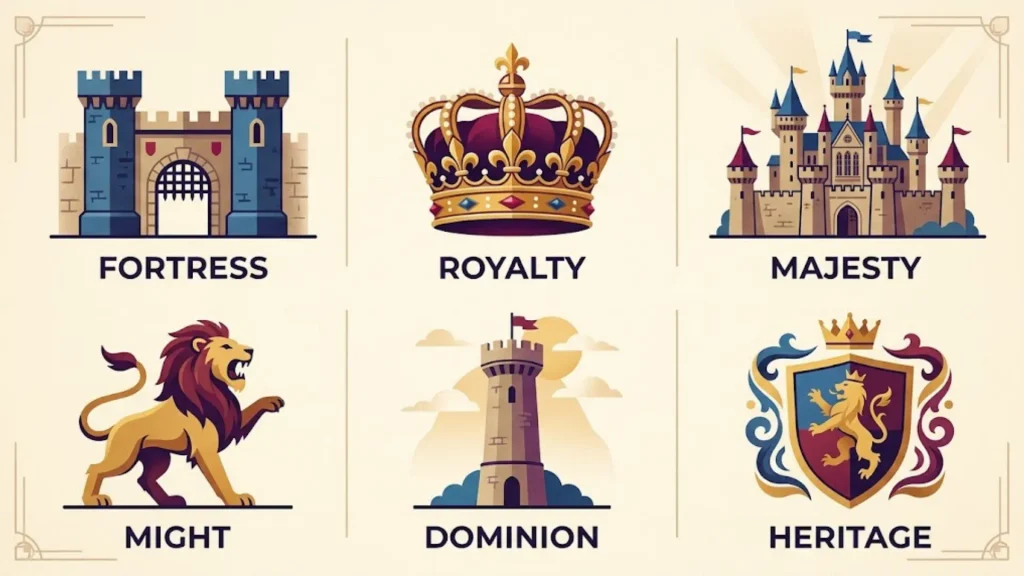
Architecture could communicate royal status just as clearly as a ceremonial object. Castles, fortified gates, palace walls, and towers had practical purposes, but they could also project a ruler’s control over a territory.
Castle Towers: Defense and Territorial Control
A Castle Tower provided a defensive position, a place for observation, or a strong point within a fortification.
Towers could also make a stronghold visible from a distance. Their size and placement communicated the resources available to the people who controlled the site.
A tower in a coat of arms may represent a castle or fortress, but its meaning depends on the specific heraldic design. A real defensive tower and a symbolic tower are related ideas, not identical objects.
Royal Castles and Strongholds
Royal castles served as residences, administrative centers, and military strongholds. Some housed royal courts, stored supplies, and supported government operations.
Their walls, gates, and towers helped protect people and property. At the same time, impressive fortifications displayed wealth and authority.
Castles were not always royal. Nobles, military orders, and local rulers also built and controlled fortified sites.
Human Heads, Sculptures, and Royal Authority
Images of rulers appeared on coins, statues, monuments, and ceremonial objects. These portraits helped identify leaders and communicate status.
A Human Head may represent a ruler, deity, ancestor, or other individual. Its meaning depends on the image’s inscription, setting, and historical context.
Masks and sculptures also served religious and ritual purposes in many societies. It would be inaccurate to assign all human-head imagery a single meaning such as leadership or royal authority.
Morning Sun and Renewal
The Morning Sun can symbolize renewal in particular artistic and religious traditions. In ancient Egypt, solar imagery was especially important because the sun was connected with gods, creation, and the cycle of life.
However, the idea that a morning sun always represents the beginning of a new reign is not a universal historical rule. Such an interpretation should be tied to a specific coronation, monument, or cultural tradition.
Royal Symbols of Divine Authority and Protection
Many rulers connected their authority with religion. In some societies, kings were understood as divine figures; in others, rulers claimed that their position had religious approval.
These traditions were different, but they often used symbols to communicate the relationship between political power and sacred beliefs.
Divine Right to Rule and Sacred Kingship
The concept of divine authority appears in different forms across history. Ancient Egyptian pharaohs were closely connected with the gods in royal ideology. Some European monarchs later claimed that their right to rule came from God.
These ideas were not identical. Their meanings depended on the civilization, religious system, and political period.
Royal symbols helped express these relationships through sacred objects, religious images, ceremonial clothing, and coronation rituals.
Symbols of Divine Protection
Examples include the Egyptian uraeus and Eye of Horus, as well as crosses and other religious emblems used in royal ceremonies.
Their functions differed:
- The uraeus was associated with Egyptian kingship and protection.
- The Eye of Horus appeared in protective amulets and religious imagery.
- The Holy Cross represented Christianity and appeared in some Christian coronation traditions.
- Royal regalia could express religious duties as well as political status.
These examples show why religious symbolism and royal authority sometimes overlap without being the same thing.
Symbols of Immortality, Rebirth, and Longevity
Some symbols express ideas about life, renewal, or continued existence.
- Ankh: Life in ancient Egyptian writing and religious imagery.
- Scarab Beetle: Rebirth and regeneration in Egyptian religious traditions.
- Lotus Flower: Renewal and creation in ancient Egyptian imagery, with other meanings in Asian traditions.
- Chrysanthemum: An important Japanese imperial emblem, with broader cultural associations.
These symbols belong to different traditions. Their shared themes do not mean that they originated from one common royal system.
What Do Royal Symbols Represent?
The most useful way to understand royal symbols and their meanings is to connect each symbol with its historical use.
| Theme | Examples | What the examples communicate |
| Sovereignty | Crown, royal orb | The status and responsibilities of a monarch |
| Right to govern | Scepter, royal regalia | Authority within a particular monarchy |
| Dynastic identity | Tudor Rose, coat of arms | A royal house or family lineage |
| Courage and strength | Lion, griffin | Qualities associated with heraldic imagery |
| Religious faith | Holy Cross | Christian belief and religious identity |
| Protection | Eye of Horus, uraeus | Protection within ancient Egyptian traditions |
| Life and renewal | Ankh, scarab, lotus | Life, regeneration, and religious ideas |
| Imperial identity | Chinese dragon | Imperial status in Chinese traditions |
| Imperial family identity | Chrysanthemum crest | The Japanese imperial household |
| Victory and honor | Laurel wreath | Achievement and distinction in classical traditions |
These associations provide a practical reference, but the historical context remains essential. A symbol may have different meanings in religious art, official heraldry, and popular culture.
Frequently Asked Questions About Ancient Royal Symbols
What Are the Ancient Symbols of Royalty and Their Meanings?
Important examples include the Egyptian ankh, uraeus, and royal cartouche; Roman laurel wreaths; and later royal crowns and heraldic emblems. Their meanings include life, protection, sovereignty, victory, and dynastic identity.
Not all these examples come from the same period. Crowns and heraldic designs developed differently across cultures and centuries.
What Are the Most Famous Symbols of Royalty?
The crown is probably the most widely recognized symbol of royalty. Other notable examples include the scepter, royal orb, royal coat of arms, lion, Tudor Rose, fleur-de-lis, and Chinese imperial dragon.
Ancient Egyptian symbols such as the ankh and Eye of Horus are also widely recognized, although their meanings extend beyond royalty.
What Symbols Represent Kings and Queens?
Crowns, scepters, orbs, royal seals, and coats of arms can represent kings and queens. Their use varies by monarchy.
Chinese imperial imagery also associated the dragon with the emperor and the phoenix with the empress in certain historical contexts.
What Does the Crown Symbolize in Royalty?
The crown commonly represents sovereignty, royal status, and the responsibilities of monarchy. During a coronation, it marks the formal crowning of a ruler.
Its exact meaning depends on the tradition in which it appears.
What Is the Meaning of the Tudor Rose?
The Tudor Rose combines the red rose associated with Lancaster and the white rose associated with York. It became an emblem of the Tudor dynasty after Henry VII took the English throne in 1485.
It is commonly associated with the union of the rival dynastic lines.
What Do the Red and White Roses Represent in English History?
The red rose is associated with the House of Lancaster, while the white rose is associated with the House of York. Their rivalry is connected with the Wars of the Roses in fifteenth-century England.
The Tudor Rose later combined both colors in a single dynastic emblem.
Is the Holy Cross a Symbol of Royalty or Religion?
The Holy Cross is primarily a Christian religious symbol associated with the crucifixion and resurrection of Jesus Christ. Some Christian monarchies incorporated crosses into their crowns, regalia, and heraldic designs.
It can therefore appear in royal symbolism without being exclusively royal.
Why Is Westminster Abbey Important to British Royalty?
Westminster Abbey has hosted British coronations for centuries. Its religious and historical role makes it a central location in the traditions of the British monarchy.
The abbey is a historic site rather than a royal emblem in the same sense as a crown or scepter.
What Do Griffins and Unicorns Symbolize in Royal Heraldry?
Griffins are mythical creatures combining a lion and an eagle. They are often associated with strength and vigilance in artistic and heraldic traditions.
Unicorns have been linked with purity and grace in European traditions. A unicorn also appears as a supporter in the Royal Arms of the United Kingdom.
What Does the Morning Sun Symbolize in a Coronation?
Solar imagery can represent renewal, creation, or divine power in particular traditions. Ancient Egyptian religious and royal imagery provides a strong example of solar symbolism.
There is no universal rule that the morning sun symbolizes a new reign in every coronation tradition.
What Do Royal Seals and Coats of Arms Represent?
Royal seals authenticate official documents and identify the authority behind them. Coats of arms communicate heraldic identity and may reflect lineage, titles, honors, and political connections.
Although both can include royal imagery, they serve different purposes.
What Does a Royal Scepter Symbolize?
A royal scepter represents authority and the right to govern. In British coronation traditions, different scepters carry distinct meanings related to temporal power, equity, mercy, and spiritual responsibility.
What Is the Meaning of a Royal Warrant?
A royal warrant is a formal recognition granted to qualifying suppliers connected with a royal household. It is an official endorsement, not an ancient royal symbol or a ceremonial object.
What Does a Castle Tower Symbolize in Royal History?
A castle tower can represent defense, territorial control, and the strength of a fortified site. In heraldry, its meaning depends on the specific coat of arms or emblem.
What Does the Royal Orb or Globus Cruciger Represent?
In Christian European monarchies, the Globus Cruciger is a globe topped with a cross. It represents sovereignty within a Christian religious framework.
The British Sovereign’s Orb is one example used during coronation ceremonies.
What Is a Royal Cypher and What Does It Mean?
A royal cypher is a monarch’s monogram, usually combining initials with a crown or other design. It identifies the monarch associated with official buildings, documents, and possessions.
Queen Elizabeth II’s “EIIR” cypher is a well-known example.
Why Is the Harp a Symbol of Irish Royalty?
The harp has historical links with Irish music, courtly patronage, and cultural identity. It later became an important Irish national and heraldic emblem.
It is more accurate to describe it as an Irish cultural and national symbol than as an emblem exclusively belonging to royalty.
What Does the Lion Symbolize in Royal Heraldry?
The lion commonly represents courage and strength in heraldic traditions. It appears in the coats of arms of various royal houses, noble families, and other institutions.
Its meaning depends on the specific design and historical context.
What Do Celtic Knots Represent in Royalty?
Celtic knots are interlaced designs found in Celtic art and decorative traditions. They are often interpreted today as representing continuity or interconnectedness.
However, they were not exclusively royal symbols, and their original meanings cannot always be established with certainty.
What Does the Fleur-de-Lis Symbolize?
The fleur-de-lis is a stylized floral emblem strongly associated with French royal heraldry. It appeared in royal insignia and other heraldic designs.
Its associations with purity and religious ideas vary according to the tradition and historical period.
What Did Laurel Wreaths Represent in Ancient Rome?
Laurel wreaths represented victory, honor, and distinction in classical traditions. Roman emperors appeared wearing them in art, but wreaths could also honor other celebrated individuals.
What Is the Meaning of the Eye of Horus?
The Eye of Horus is an ancient Egyptian symbol associated with healing, restoration, and protection. It appeared on amulets and in religious contexts.
Its meaning comes from Egyptian mythology surrounding Horus’s injured and restored eye.
What Is the Difference Between the Eye of Horus and the Eye of Ra?
The Eye of Horus is associated with Horus and themes of restoration and protection. The Eye of Ra is connected with the sun god Ra and themes of solar power, protection, and destructive force.
They are related but distinct elements of Egyptian mythology.
What Does the Sphinx Symbolize in Ancient Egyptian Mythology?
The Egyptian sphinx often combines a human head with a lion’s body. It appears in monumental and royal contexts and is associated with power and guardianship.
The meaning of a specific sphinx depends on its historical setting.
What Does the Ankh Symbolize in Ancient Egypt?
The ankh is the hieroglyphic symbol for life. It frequently appears in Egyptian religious and royal imagery, where gods may hold it or present it to a pharaoh.
What Does the Scarab Beetle Represent in Egyptian Culture?
The scarab became associated with rebirth and renewal because Egyptians connected the beetle’s behavior with the sun’s daily movement. Scarab amulets also played a role in funerary practices.
What Does the Lotus Flower Symbolize in Royal Traditions?
In ancient Egypt, the lotus was associated with renewal and creation. In Buddhist traditions across Asia, it is commonly associated with purity and spiritual development.
Its meaning depends on the culture and context in which it appears.
Why Is the Chrysanthemum Important to the Japanese Imperial Family?
The chrysanthemum crest is closely associated with the Japanese imperial family. The imperial crest features sixteen petals and appears in official and ceremonial contexts.
The flower also has broader cultural associations that extend beyond the imperial household.
What Do Dragons, Phoenixes, and Jade Symbolize in Chinese Royalty?
In Chinese imperial traditions, the dragon was associated with the emperor, while the phoenix was often associated with the empress. Jade was valued in Chinese culture and became associated with qualities such as virtue and refinement.
These associations developed within broader artistic, philosophical, and cultural traditions.
Which Ancient Symbols Represent Divine Authority and Protection?
Examples include the Egyptian uraeus, Eye of Horus, and religious objects used in royal ceremonies. The Globus Cruciger represents sovereignty within Christian European royal traditions.
These symbols belong to different cultures and should not be treated as interchangeable.
Which Royal Symbols Represent Power, Purity, Victory, and Longevity?
The crown and scepter represent royal authority in many monarchies. The laurel wreath is associated with victory, while unicorn imagery has been linked with purity in some European traditions. Chrysanthemums have broader associations with longevity in Japanese culture and a specific connection with the imperial family.
These meanings depend on their historical and cultural settings.
Conclusion: How Ancient Royal Symbols Shaped History
Ancient symbols of royalty helped rulers communicate authority, lineage, religious beliefs, and cultural identity. Crowns and scepters represented royal status, while seals and coats of arms identified rulers and their families.
Ancient Egyptian symbols such as the ankh, Eye of Horus, and uraeus connected kingship with life, protection, and religious traditions. Roman laurel wreaths represented victory and honor. Later European emblems, including the Tudor Rose and fleur-de-lis, reflected dynastic history and royal identity.
Chinese dragon imagery and the Japanese chrysanthemum crest show how imperial symbols developed within distinct Asian traditions.
The most important lesson is that royal symbols and their meanings depend on their origins and uses. Some symbols were created for rulers, while others had broader religious, cultural, or artistic roles.
Understanding these differences reveals how symbols helped shape the public image of kings, queens, pharaohs, and emperors across history.

Hi, I’m Sienna Brooks, and I believe that the right words can inspire, comfort, and empower people at every stage of life. For as long as I can remember, I’ve been drawn to meaningful quotes and the stories behind them. I love curating collections of inspirational, motivational, and heartfelt quotes that resonate with readers around the world.
Through my writing, I strive to help others find encouragement, whether they’re celebrating life’s happiest moments or navigating its biggest challenges. I believe that wisdom is timeless, and I’m passionate about sharing words that leave a lasting impact.
I am the author of Reflections in Words and The Journey of Inspiration, two books dedicated to exploring the beauty and power of timeless quotes.
 Asher Monroe
 Rowan Sinclair Rowan Sinclair