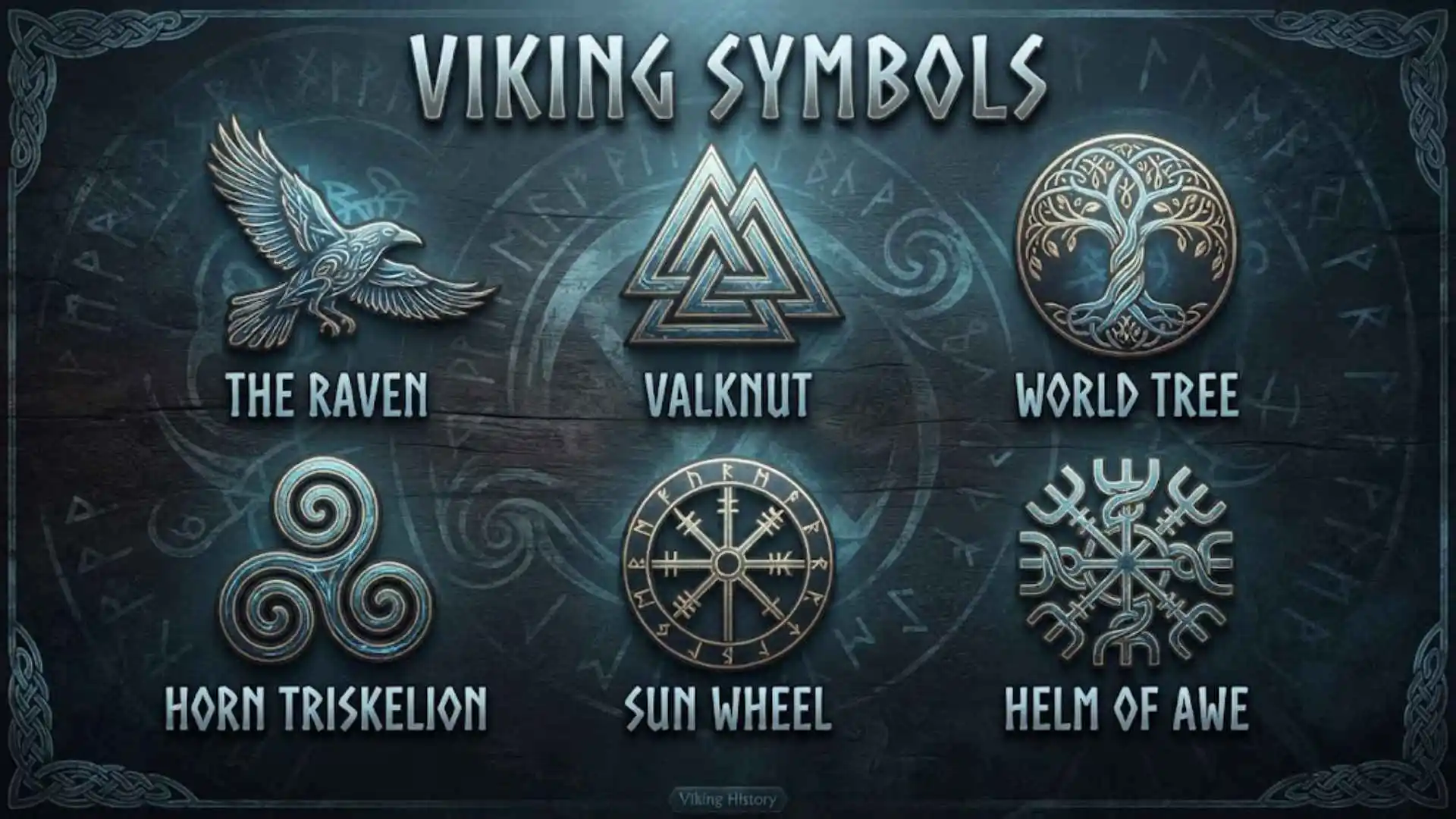
Viking symbols continue to attract attention because they connect mythology, religion, warfare, nature, family, and the mysteries of the Norse world. From Thor’s hammer and the Valknut to runes and ancient animal imagery, these designs can carry different meanings depending on their historical context.
This guide explores Viking symbols and meanings in a practical way, including symbols associated with protection, love, strength, warriors, Danish history, tattoos, and Norse mythology. It also separates symbols with strong Viking Age evidence from designs that became popular much later.
If you are looking for a tattoo idea, a meaningful symbol to copy, or simply want to understand which Norse symbols were actually used in the past, the sections below provide useful context without treating modern interpretations as historical facts.
Viking Symbols And Meanings
There was no single official set of “Viking symbols.” The Viking Age lasted roughly from the late eighth century to the mid-11th century, and Scandinavian people used imagery from religion, art, writing, mythology, and everyday life. The meaning of a design often depended on where and how it appeared.
Some of the best-attested examples include Mjölnir (Thor’s hammer), Valknut-like designs, runes, ships, ravens, serpents, wolves, and imagery connected with Norse gods. Archaeological finds and rune stones provide much stronger evidence for some symbols than later books or modern tattoo traditions.
Here are several important examples:
| Symbol | Common association | Historical note |
| Mjölnir / Thor’s hammer | Thor, protection, power | Viking Age amulets are well documented |
| Valknut | Odin, death, the afterlife | The modern name and exact meaning are uncertain |
| Runes | Writing, names, messages, memorials | Widely used in Viking Age Scandinavia |
| Ship | Travel, voyages, death and the afterlife | Ships appear frequently in Viking imagery |
| Raven | Odin, thought and memory | Ravens are strongly connected with Odin |
| Wolf | Strength, danger, mythology | Wolves occur in Norse myth and Viking imagery |
| Serpent | Myth, danger, cosmic forces | Serpent imagery appears in Norse art |
| Cross | Christianity | Christian symbols became increasingly common during the Viking Age |
The safest approach is to treat these meanings as contextual associations rather than universal definitions.
Viking Symbols Tattoos
Viking-inspired tattoos are popular because many Norse designs have bold shapes that work well in blackwork, linework, geometric art, and larger compositions. However, a modern tattoo should not automatically be described as an authentic Viking symbol simply because it looks Nordic.
For a historically grounded tattoo, Mjölnir, runic inscriptions, Viking Age animal ornament, ships, and documented archaeological motifs are useful starting points. Thor’s hammer pendants have been found across Scandinavia and are among the clearest examples of a Norse symbol surviving in archaeological material.
Popular Viking Tattoo Ideas
- Mjölnir (ᛏ-style surrounding runes are not part of the hammer itself) — associated with Thor.
- Valknut — commonly connected with Odin and death, although its exact original meaning is debated.
- Runes — useful for names or words when the Old Norse wording and runic spelling are carefully researched.
- Raven imagery — associated with Odin through Huginn and Muninn.
- Viking ship — a strong visual reference to travel, exploration, and maritime culture.
- Serpent or dragon ornament — inspired by Viking Age artistic traditions.
A tattoo artist should also distinguish historical runes from modern decorative “Viking fonts.” A design can look convincing while containing a spelling that would not have existed in the Viking Age.
Danish Viking Symbols
Danish Viking symbolism is especially important because Denmark was one of the central regions of Viking Age Scandinavia. The National Museum of Denmark places the Viking Age broadly between about 800 and 1050 AD and notes the importance of sea travel, political power, trade, warfare, and the transition from the old Nordic religion to Christianity.
The Jelling stones are among the most important Danish examples. They contain runic inscriptions and imagery connected with King Harald Bluetooth and the Christianization of Denmark. Around 970, Harald raised the larger Jelling Stone in memory of his parents, Gorm and Thyra.
Important Danish Viking-related motifs include:
- Runes — used on memorial stones and other objects.
- Thor’s hammer — evidence of pre-Christian Norse religious practice.
- Ships — central to Danish Viking travel and warfare.
- Animal ornament — common in Viking Age decorative art.
- Christian crosses — increasingly visible during the conversion period.
- Jelling-style imagery — especially important in Danish Viking art and history.
Top 10 Viking Symbols And Meanings
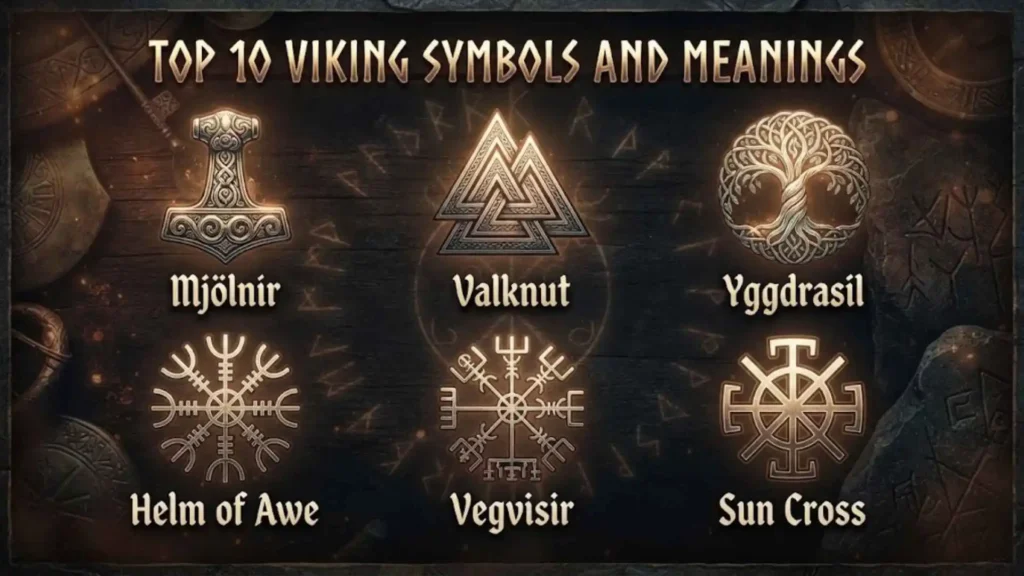
The phrase “top 10” should be understood as a practical list rather than an ancient ranking. Vikings did not leave behind a list naming their ten most important symbols.
Here are ten widely discussed Norse or Viking-associated symbols:
- Mjölnir — Thor’s hammer: Connected with Thor and his protective and thunder-related powers.
- Valknut — three interlocked shapes: Frequently associated with Odin and death, although its original name and meaning remain uncertain.
- Yggdrasil — the World Tree: Represents the cosmic tree described in Norse mythology.
- Huginn and Muninn — Odin’s ravens: Associated with thought and memory.
- Gungnir — Odin’s spear: The mythical spear belonging to Odin.
- Viking ship: Associated with travel, warfare, exploration, burial, and the journey between worlds.
- Runes: The writing system used by Scandinavian peoples, especially Younger Futhark during the Viking Age.
- Serpents: Important creatures in Norse mythology and Viking artistic decoration.
- Wolves: Connected with powerful mythological figures such as Fenrir and with Odin.
- Christian cross: Increasingly important in Scandinavia during the later Viking Age.
The archaeological record is especially useful for distinguishing documented Viking Age objects from symbols that became popular through modern Norse-inspired culture.
Top 10 Viking Symbols And Meanings
This repeated heading covers a slightly different need: readers often want a quick reference rather than a long explanation.
| # | Symbol or motif | Common modern meaning |
| 1 | Mjölnir | Protection and strength |
| 2 | Valknut | Odin, death, fate |
| 3 | Yggdrasil | Life, cosmos, connection |
| 4 | Ravens | Thought and memory |
| 5 | Gungnir | Authority and power |
| 6 | Ship | Journey and exploration |
| 7 | Runes | Writing and identity |
| 8 | Serpent | Mythological power |
| 9 | Wolf | Strength and danger |
| 10 | Cross | Christianity and conversion |
These meanings are convenient modern summaries, not fixed translations of symbols. For example, the Valknut’s exact significance is still debated, while Thor’s hammer has much stronger archaeological evidence as a Viking Age religious amulet.
Berserker Viking Symbols
Berserkers are remembered in Old Norse literature as warriors associated with extraordinary battle fury. Modern art often connects them with wolves, bears, weapons, shields, and animal skins.
There is no single historically verified “berserker symbol.” A wolf or bear image may evoke the idea of berserkers, but that does not mean Vikings used a specific wolf or bear emblem as a standardized berserker badge.
The National Museum of Denmark notes that depictions of warriors with unusual headgear appear in earlier Scandinavian imagery and that later sources describe berserkers as warriors associated with battle fury. It also emphasizes that the familiar horned Viking helmet is not supported by ordinary Viking Age helmet finds.
For a berserker-inspired design, historically grounded elements can include:
- A warrior with a shield and weapon
- Wolf or bear imagery
- Viking Age animal ornament
- Runes used correctly as an inscription
- A historically documented weapon motif
Old Norse Viking Symbols
“Old Norse symbols” is a broad term. Old Norse was the language spoken in Scandinavia during the Viking Age and later medieval periods, while Younger Futhark was the main Scandinavian runic writing system during much of the Viking Age.
Runes were not simply a collection of magical icons. They were also practical letters used for names, messages, memorials, ownership marks, and other purposes. Danish rune stones, for example, preserve the names and stories of people from the Viking period.
Important Old Norse-Related Symbols
- ᚠ — Fehu in the older rune tradition; the exact historical system matters when assigning meanings.
- ᚢ — Uruz in Elder Futhark terminology.
- ᚦ — Thurisaz in Elder Futhark.
- ᚬ / ᚭ and other later forms — examples of the changing Scandinavian runic tradition.
A major caution is that Elder Futhark and Younger Futhark are not interchangeable. Using an Elder Futhark chart to represent a Viking Age Scandinavian inscription can produce historically inaccurate results.
Meaning Tattoo Viking Symbols
A tattoo based on a Viking symbol should begin with the historical object or motif, not with a modern list of meanings.
For example, a Mjölnir tattoo can reasonably evoke Thor, protection, strength, thunder, and Norse religion because archaeological examples connect hammer-shaped amulets with Thor. A Valknut tattoo is commonly associated with Odin and death, but the original name and exact meaning of the design are uncertain.
If you want a meaningful tattoo, consider the following:
- Decide whether historical accuracy or modern symbolism matters more.
- Research the exact symbol rather than relying only on a social-media graphic.
- Check the original shape carefully.
- If using runes, verify the language and historical runic alphabet.
- Avoid claiming a disputed interpretation as established fact.
Strength Warrior Viking Symbols Tattoos
Strength and warrior themes fit naturally with Viking-inspired tattoos, but there was no single Viking symbol that literally meant “strength.”
Instead, different motifs can communicate different ideas:
- Mjölnir — Thor, power, protection, and religious identity.
- Sword — warfare, status, and martial culture.
- Axe — an important Viking Age weapon.
- Shield — defense and combat.
- Spear — strongly associated with Odin through the mythological spear Gungnir.
- Wolf — danger, power, and mythological associations.
- Raven — Odin and the warrior’s relationship with death and memory.
Viking weapons were not purely decorative. Archaeological evidence shows that swords, axes, spears, shields, bows, and other equipment were important parts of Viking Age warfare and daily life.
Viking Symbols And Their Meanings
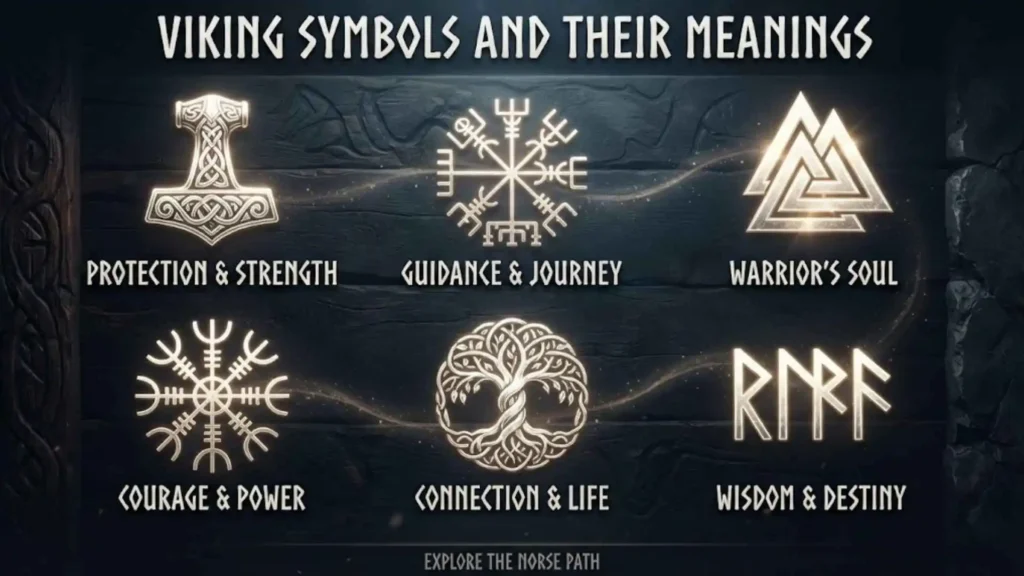
Viking symbolism becomes easier to understand when symbols are grouped by theme.
Religion And Gods
Mjölnir points toward Thor. Ravens point toward Odin, while mythological creatures such as wolves and serpents appear in stories and visual traditions connected with the Norse gods.
Death And The Afterlife
The Valknut is frequently associated with death and Odin, partly because it appears in contexts connected with burial and imagery that may involve Odin. However, scholars have not established one universally accepted meaning for the motif.
Travel And Exploration
The ship is one of the most recognizable Viking Age motifs. Ships were practical vehicles for trade, migration, warfare, and exploration, and ship imagery also appears in funerary and mythological contexts.
Writing And Identity
Runes could preserve names, memories, messages, and memorial statements. Rune stones therefore offer an unusually direct connection with individual Viking Age people.
Nordic Viking Symbols
“Nordic” is broader than “Viking.” It can include symbols and traditions from Scandinavia and the wider Nordic cultural world across different periods.
Common Nordic-inspired imagery includes:
- Mjölnir
- Valknut
- Runes
- Ravens
- Wolves
- Serpents
- Ships
- Yggdrasil
- Interlaced animal ornament
- Christian crosses from the later Viking and medieval transition
Some designs found in modern Nordic artwork are genuinely old, while others are modern reconstructions or later magical symbols. That distinction matters when an article or tattoo claims historical authenticity.
Warrior Viking Symbols And Meanings
Viking warriors used practical equipment such as swords, axes, spears, bows, helmets, shields, and mail. Some objects also carried decoration, and weapons could have symbolic significance because of their association with status, combat, religion, or personal identity.
Common Warrior Motifs
Sword: A prestigious weapon that could indicate wealth and status.
Axe: A practical tool and weapon that was widely used in Viking Age society.
Spear: A common weapon with an especially strong mythological connection to Odin through Gungnir.
Shield: A defensive object central to Viking combat.
Raven: Associated with Odin and the battlefield.
Wolf: A powerful mythological animal connected with figures such as Fenrir.
A warrior tattoo can combine these elements without claiming that the complete modern composition was itself an ancient Viking symbol.
Christian Viking Symbols
Christianity and Norse religion existed alongside each other during the Scandinavian conversion period. This means Viking Age symbolism cannot always be divided into a simple pagan-versus-Christian system.
The cross became increasingly visible as Christianity spread through Scandinavia. Archaeological objects sometimes show Christian and older Norse imagery together. One Swedish pendant, for example, contains both a cross and a valknut-like motif.
Rune stones also show this transition. Some later Viking Age monuments include Christian prayers while retaining older runic traditions and artistic styles.
This mixture is one reason the phrase “Christian Viking” can make historical sense when discussing the later Viking Age.
Norse Viking Symbols
Norse symbols are often connected with mythology, religion, nature, warfare, and ideas about life and death.
Some of the most recognizable include:
- Mjölnir — Thor’s hammer.
- Valknut — a three-part interlaced motif associated by many scholars with Odin and death, though its exact interpretation remains uncertain.
- Yggdrasil — the cosmic tree from Norse mythology.
- Huginn and Muninn — Odin’s ravens, associated with thought and memory.
- Gungnir — Odin’s mythological spear.
- Ships — important in both practical and symbolic contexts.
- Runes — the written characters used by Scandinavian communities.
Norse mythology is known mainly through sources that were written down after the Viking Age, including the Poetic and Prose Eddas. The National Museum of Denmark cautions that these Christian-era written sources do not always provide a direct picture of how Viking Age people understood their gods.
Viking Symbols And Artifacts Guide
The best way to understand a Viking symbol is to examine the physical objects on which it appears.
Thor’s Hammer
Thor’s hammer pendants are among the clearest examples. Archaeologists have found examples made from materials including silver and iron, and some were associated with graves or settlements.
Rune Stones
Rune stones were often memorial monuments. In Denmark, hundreds of Viking Age rune stones are known, with many dating from the late 10th and early 11th centuries.
Picture Stones
Gotland’s picture stones provide important examples of Viking Age imagery. Some show ships, warriors, animals, mythological scenes, and Valknut-like motifs. Their exact scenes can sometimes remain difficult to interpret.
Weapons
Swords, axes, spears, shields, and other weapons provide evidence about Viking warfare and craftsmanship. Some swords featured elaborate decoration, including precious-metal work on their handles.
Völva Staffs
Archaeological finds also reveal religious practices beyond warfare. The Klinta staff, for example, is associated with the völva, a female practitioner connected with seiðr, a form of pre-Christian Norse ritual practice.
Danish Viking Symbols
Danish Viking symbolism deserves special attention because Denmark played a major role in the Viking Age. The country’s archaeological record includes rune stones, weapons, jewelry, religious objects, fortifications, ships, and decorated artifacts.
The Jelling stones are especially significant. The larger stone raised by Harald Bluetooth contains a runic inscription and imagery associated with the transition toward Christianity. It is an important historical example rather than simply a decorative symbol.
For a Danish Viking-inspired design, consider using documented rune forms, Jelling-related motifs, Viking Age animal ornament, ships, or Thor’s hammer imagery rather than modern symbols that are sometimes incorrectly labeled “Danish Viking.”
Viking Symbols And Meanings Tattoos
When choosing a tattoo, the difference between a historical symbol and a modern interpretation is worth checking.
| Tattoo motif | Common association | Historical confidence |
| Mjölnir | Thor, protection | Strong archaeological evidence |
| Valknut | Odin, death | Ancient motif, exact meaning uncertain |
| Runes | Writing, identity | Strong archaeological evidence |
| Ship | Travel, sea, burial | Strong visual evidence |
| Raven | Odin, thought, memory | Strong mythological association |
| Wolf | Power, danger, mythology | Strong mythological association |
| Vegvisir | Guidance | Later Icelandic symbol, not a Viking Age symbol |
| Helm of Awe | Protection | Later Icelandic magical tradition, not securely Viking Age |
The final two examples are especially important. The Vegvisir and Ægishjálmur (Helm of Awe) are frequently marketed as Viking symbols, but they belong to later Icelandic magical traditions rather than being securely documented as Viking Age symbols.
Viking Symbols Meaning
A symbol’s meaning should always be considered alongside its evidence.
For example, Mjölnir has a strong connection to Thor because archaeological hammer pendants explicitly refer to his weapon. The Swedish History Museum describes these objects as Viking Age amulets and notes their association with Thor.
The Valknut is different. The motif is genuinely found in Viking Age contexts, but the name “Valknut” is modern and its original meaning is uncertain. It appears alongside imagery that may relate to Odin, death, or the afterlife, which explains many of its modern associations.
This distinction helps prevent modern interpretations from being presented as proven historical definitions.
Tattoo Viking Symbols
A Viking tattoo can be simple or highly detailed. For a small design, Mjölnir, a single raven, a rune, or a compact knotwork motif can work well. Larger tattoos can combine ships, animals, weapons, and Viking Age ornament.
If you use runes, avoid translating an English phrase word-for-word into a random online rune chart. Viking Age inscriptions used particular languages and runic systems, and spelling can vary by period and region.
For a historically informed design, keep the original symbol recognizable and use a modern artistic style around it rather than altering the historical motif until its identity becomes unclear.
Protection Viking Symbols
Protection is one of the most common modern reasons people search for Viking symbols.
Mjölnir has one of the strongest historical connections to protection. The National Museum of Denmark explains that Thor was understood as a protector of Midgard, while the Swedish History Museum notes the hammer’s associations with protection and religious practice.
Other symbols can have protective associations, but the evidence is less straightforward:
- Mjölnir — Thor and protective power.
- Valknut — associated with Odin and death-related imagery; not a proven general-purpose protection symbol.
- Ravens — Odin and knowledge rather than a universal protection emblem.
- Wolf imagery — power and mythological danger rather than a standardized protective sign.
- Runic inscriptions — some inscriptions invoke or refer to supernatural forces, but runes were also ordinary writing.
Protection should therefore be treated as an interpretation unless an artifact or historical source provides stronger evidence.
Warrior Viking Symbols Tattoos
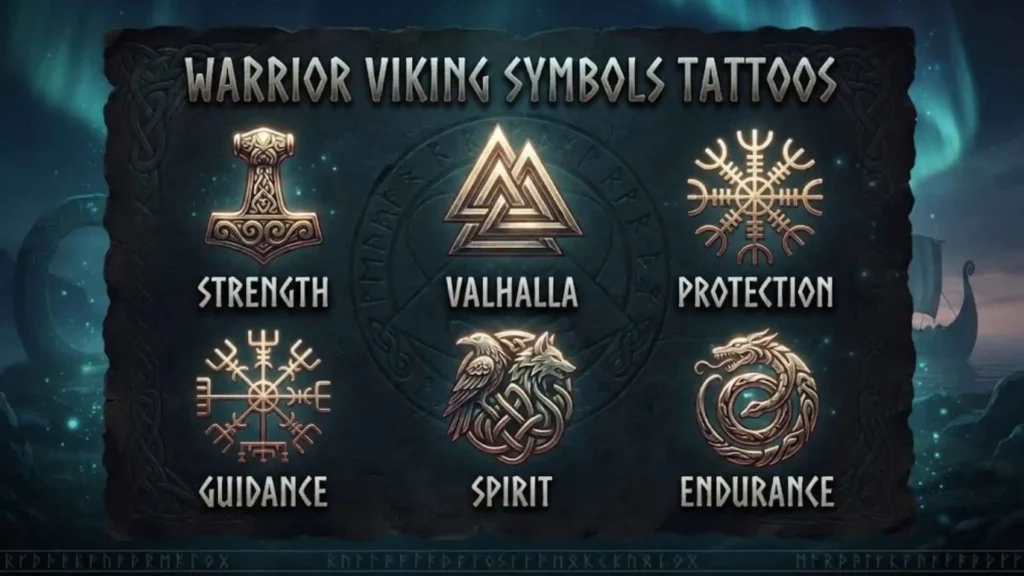
Warrior-themed tattoos often combine several elements into one dramatic design. A historically inspired composition might use a shield, spear, sword, axe, raven, ship, or documented Viking Age ornament.
A useful approach is to give each element its own purpose. For example:
- Shield for defense.
- Spear for the warrior tradition and Odin’s Gungnir.
- Sword for elite martial equipment.
- Axe for a common Viking Age weapon.
- Raven for Odin.
- Ship for travel and warfare.
- Runes for a name or carefully researched inscription.
Viking weapons were found in graves and other archaeological contexts, giving historians substantial physical evidence for their use. Swords were relatively expensive and could feature elaborate decoration, while axes and spears were more broadly accessible.
Real Viking Symbols
Real Viking symbols are best identified through archaeological finds, rune stones, contemporary or near-contemporary imagery, and carefully interpreted historical sources.
Mjölnir pendants are among the strongest examples. Hundreds of Thor’s hammer finds and related objects have been documented across Scandinavia and beyond, demonstrating that hammer imagery was used during the Viking Age.
Runes are also unquestionably real Viking Age evidence. Rune stones contain personal names, memorial messages, descriptions of achievements, and sometimes Christian prayers.
Valknut-like motifs are real archaeological designs too, appearing on objects and picture stones. What remains uncertain is the exact meaning and original name of the motif.
By contrast, symbols such as the Vegvisir should not be presented as Viking Age symbols. They belong to later Icelandic magical traditions. The same caution applies to many internet graphics labeled “ancient Viking protection symbols.” A symbol can be Norse-inspired without being a Viking Age artifact.
Frequently Asked Questions
What Is The Most Famous Viking Symbol?
Mjölnir, or Thor’s hammer, is one of the most recognizable Viking-associated symbols. Archaeological hammer pendants provide direct evidence that hammer imagery connected with Thor was used during the Viking Age.
What Does The Valknut Mean?
The Valknut is commonly associated with Odin, death, warriors, and the afterlife. However, its exact original meaning is uncertain, and the name “Valknut” itself is a modern term rather than a securely documented Viking Age name.
Were Viking Runes Symbols Or Letters?
Runes were primarily a writing system, although individual inscriptions could have religious, memorial, magical, or decorative purposes. Viking Age Scandinavians used runes for practical communication as well as monuments and personal inscriptions.
Is The Vegvisir A Real Viking Symbol?
The Vegvisir is a real Icelandic magical symbol, but it should not be described as a Viking Age symbol. It belongs to a much later tradition and is therefore different from archaeological symbols documented from the Viking period.
Which Viking Symbol Is Associated With Protection?
Mjölnir is the clearest choice when historical evidence is the priority. Thor was associated with protection, and Viking Age hammer-shaped amulets have been found in Scandinavia and other areas connected with the Viking world.
Conclusion
Viking symbols bring together mythology, religion, writing, warfare, travel, art, and ideas about life and death. Mjölnir, runes, Valknut-like motifs, ships, ravens, weapons, and animal imagery all provide different windows into Scandinavian history.
For tattoos and modern designs, the most useful distinction is between symbols that are supported by Viking Age evidence and later symbols that have been given a Viking identity online. Mjölnir and runic inscriptions have strong archaeological foundations, while the exact meaning of some motifs remains open to interpretation.
If historical accuracy matters to you, research the original artifact, period, and runic system before choosing a design. A symbol becomes much more meaningful when its history is understood rather than replaced by a modern definition.

Hello, I’m Rowan Sinclair, a passionate writer and lifelong admirer of the wisdom found in great quotes. I believe that words have the ability to inspire change, spark creativity, and connect people across cultures and generations.
I enjoy writing about motivational quotes, famous sayings, and lessons from history’s most influential thinkers. Every article I create is driven by my desire to help readers discover meaningful insights that they can apply to their own lives.
When I’m not writing, I spend my time reading biographies, exploring classic literature, and collecting memorable quotes that deserve to be shared with the world.
I am the author of Voices That Inspire and A Collection of Timeless Thoughts, two books that celebrate the enduring power of words and the stories behind them.
 Sienna Brooks