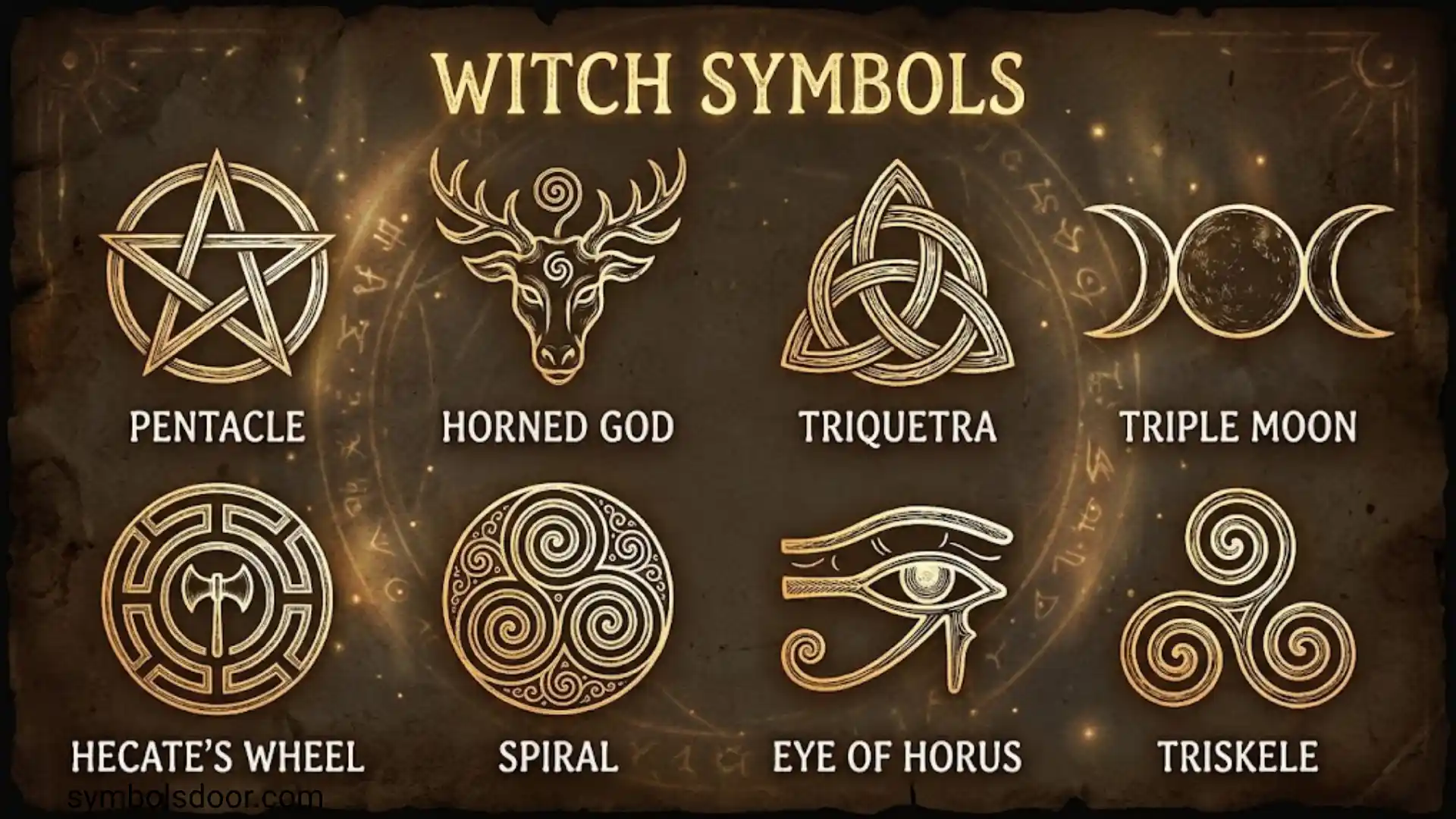
Witch symbols have fascinated people for centuries. You can find them in ancient artwork, modern spiritual practices, jewelry, tattoos, books, and ritual spaces. Some represent protection and balance, while others connect with the Moon, nature, life, and spiritual transformation.
However, not every symbol associated with witchcraft began as a witchcraft symbol. The Ankh, for example, comes from ancient Egyptian religion. The triquetra appears in Celtic art and Christian imagery. The pentacle has become especially important in modern Wiccan and Pagan traditions.
Understanding these differences helps you explore witch symbols and meanings without confusing historical facts with modern interpretations.
This guide explains eight widely recognized symbols, their origins, spiritual associations, and uses in modern practice. It also explores Pagan symbols, Wiccan symbols, protection imagery, and the differences between witchcraft, Wicca, and Paganism.
What Are Witchcraft Symbols?
Witchcraft symbols are images, shapes, and designs that carry spiritual, cultural, or magical meaning within particular traditions. Practitioners may use them during rituals, meditation, spellwork, or personal spiritual activities.
Some symbols represent natural forces, such as the elements and Moon phases. Others express ideas like protection, unity, renewal, and the connection between different parts of life.
You may encounter these symbols in several settings:
- Spiritual altars: Practitioners display symbols to represent elements, deities, or spiritual intentions.
- Ritual practices: Symbols can help establish the purpose or focus of a ceremony.
- Spellwork: Some traditions use drawn or physical symbols as part of magical practices.
- Jewelry and clothing: People may wear symbols to express their beliefs or spiritual identity.
- Meditation: A symbol can provide a visual focus for reflection.
- Sacred art: Symbols appear in religious objects, paintings, manuscripts, and decorative designs.
The meaning of a symbol depends on its origin and the tradition using it. A design may have one meaning in an ancient religion and a different interpretation in modern Pagan spirituality.
Are Witchcraft Symbols Ancient?
Some symbols associated with modern witchcraft have ancient histories. Others became popular through modern religious and spiritual movements.
For example, the Ankh was used in ancient Egypt as a hieroglyph representing life. The pentagram also appeared in ancient cultures long before modern Wicca developed.
Wicca, however, emerged as a recognizable modern Pagan religion in twentieth-century Britain. Its practitioners adopted and developed symbolic practices using older imagery and newer interpretations.
This distinction matters. An ancient symbol appearing in modern witchcraft does not prove that ancient witches used it in exactly the same way.
8 Common Witch Symbols and Their Meanings
The following eight symbols are commonly associated with witchcraft, Wicca, Pagan spirituality, and modern occult imagery. Their meanings are not always universal, so the historical background and modern interpretations are explained separately.
Pentacle and Pentagram: Symbols of Balance and Protection
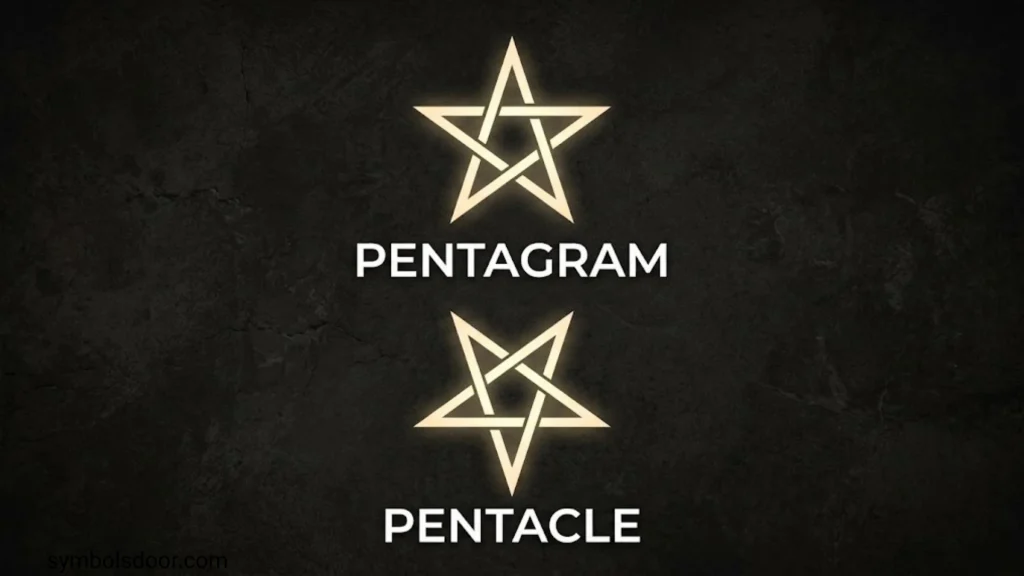
The pentacle is one of the most recognizable Wiccan symbols. It usually features a five-pointed star enclosed within a circle.
The five-pointed star itself is called a pentagram. When a circle surrounds it, the design is commonly called a pentacle in modern Pagan and Wiccan settings.
<figure> <img src=”https://upload.wikimedia.org/wikipedia/commons/thumb/8/8e/Pentacle.svg/512px-Pentacle.svg.png” alt=”Five-pointed pentacle symbol inside a circle”> </figure>
Pentacle Meaning and Spiritual Significance
In many Wiccan and Pagan traditions, the five points represent the five elements:
- Earth: Stability, grounding, and the physical world.
- Air: Thought, communication, and knowledge.
- Fire: Energy, action, and transformation.
- Water: Emotion, intuition, and renewal.
- Spirit: The spiritual force connecting the other four elements.
The circle surrounding the star can represent unity, wholeness, and the relationship between the elements.
Together, these features give the pentacle spiritual meaning connected with harmony and spiritual balance. Some practitioners also use it as a protection symbol during rituals or as a personal reminder of their beliefs.
Upright Pentacle vs. Inverted Pentacle
The direction of the star changes how some traditions interpret it.
An upright pentacle has one point facing upward. In many Wiccan settings, this arrangement represents spirit above the four physical elements.
An inverted pentagram has two points facing upward. Some modern Satanic traditions use this arrangement, including imagery associated with the Church of Satan. However, an inverted star does not automatically identify someone’s religion or beliefs.
| Design | Common interpretation |
| Upright pentagram | Spirit guiding or balancing the four elements in some Wiccan interpretations |
| Pentacle | Five-pointed star inside a circle; often associated with unity and protection |
| Inverted pentagram | Used in some modern occult and Satanic imagery; meanings vary by group |
Is a Pentacle a Satanic Symbol?
No. A pentacle is not automatically a Satanic symbol.
Wiccans and other Pagan practitioners commonly use the upright pentacle as a religious or spiritual symbol. Some Satanic groups use an inverted pentagram, but the symbol’s meaning depends on its specific design and context.
The pentagram has appeared in different cultures and belief systems throughout history. It is therefore inaccurate to assign one meaning to every version.
Remember: A pentagram is the five-pointed star. A pentacle commonly refers to that star enclosed within a circle, especially in modern Pagan use.
Triple Moon Symbol: The Three Phases of the Goddess
The Triple Moon symbol features three lunar shapes arranged side by side. A waxing crescent appears on the left, a full moon in the center, and a waning crescent on the right.
It is strongly associated with the Triple Goddess in modern Wiccan and Goddess-centered traditions.
<figure> <img src=”https://upload.wikimedia.org/wikipedia/commons/thumb/3/3b/Triple_Goddess_symbol.svg/512px-Triple_Goddess_symbol.svg.png” alt=”Triple Moon symbol showing waxing crescent, full moon, and waning crescent”> </figure>
Triple Moon Meaning
The three lunar shapes represent different stages of the Moon’s monthly cycle:
- Waxing crescent: The Moon grows brighter after the new moon.
- Full moon: The Moon appears fully illuminated.
- Waning crescent: The illuminated portion becomes smaller before the next new moon.
In modern Wiccan symbolism, these phases are often connected with three aspects of the Goddess.
Maiden, Mother, and Crone
The Triple Moon is frequently interpreted through the Maiden Mother Crone framework.
| Goddess aspect | Symbolic associations |
| Maiden | Youth, beginnings, curiosity, and potential |
| Mother | Creation, nurturing, fertility, and care |
| Crone | Wisdom, experience, reflection, and endings |
The Maiden represents the beginning of a journey. The Mother represents growth and creation. The Crone represents accumulated wisdom and the knowledge that comes with experience.
Together, these three figures symbolize the changing stages of life.
Triple Moon Spiritual Meaning
The Triple Moon spiritual meaning centers on change, renewal, and the natural cycles of existence.
Its common associations include:
- Lunar transformation: The Moon continually changes its visible shape.
- Cycles of change: Life includes beginnings, growth, decline, and renewal.
- Feminine spirituality: The symbol is important in some Goddess-centered traditions.
- Goddess worship: It represents the Triple Goddess in many modern Wiccan interpretations.
- Personal growth: Its three phases can remind people that every stage of life has value.
The Triple Moon is especially popular in modern witchcraft jewelry, altar decorations, and spiritual artwork.
One historical distinction is important: the Maiden, Mother, and Crone interpretation should not be presented as a universal belief shared by all ancient cultures. It is a particular framework used in modern Goddess spirituality and Wiccan traditions.
Triquetra: The Celtic Symbol of Threefold Connection
The triquetra is a design made from three interlocking arcs. Its name comes from Latin and means something like three-cornered.
It is also known as a Celtic knot or Trinity knot in some contexts.
<figure> <img src=”https://upload.wikimedia.org/wikipedia/commons/thumb/1/1f/Triquetra.svg/512px-Triquetra.svg.png” alt=”Triquetra symbol formed from three interlocking arcs”> </figure>
Triquetra Meaning and Historical Background
The triquetra appears in Celtic art and decorative designs. It is particularly familiar from early medieval insular art and illuminated manuscripts.
However, its use is not limited to Celtic or Pagan traditions. Christian artists also adopted the design to represent the Holy Trinity: the Father, the Son, and the Holy Spirit.
This makes the triquetra an interesting example of a symbol used by different religious communities.
Triquetra Spiritual Meaning
Modern Pagan and witchcraft interpretations often focus on the number three.
Depending on the tradition, the three connected sections may represent:
- Life, death, and rebirth
- Mind, body, and spirit
- Past, present, and future
- Earth, sea, and sky
- Three connected stages of personal development
These interpretations emphasize interconnectedness, unity, and the relationship between different parts of existence.
The interwoven design can also suggest continuity. Its lines move through one another without appearing to have a clear beginning or ending.
Is the Triquetra a Witchcraft Symbol?
The triquetra is used in some modern Pagan and witchcraft settings, but it is not exclusively a witchcraft symbol.
Its historical associations include Celtic art and Christian imagery. Its modern spiritual meaning depends on the person or tradition using it.
For this reason, describing every triquetra as an ancient witchcraft symbol would be misleading.
Witch’s Knot: A Symbol Associated With Protection
The Witch’s Knot is a name used for certain interwoven knot designs associated with folk magic and modern witchcraft.
It is often discussed as a protection knot or warding design. Its meaning can vary because the term does not always refer to one single standardized symbol.
<figure> <img src=”https://upload.wikimedia.org/wikipedia/commons/thumb/4/4a/Celtic_knotwork.svg/512px-Celtic_knotwork.svg.png” alt=”Interwoven decorative knotwork”> </figure>
Witch’s Knot Meaning
The central idea behind many knot-based magical practices is that tying, looping, or binding something can represent holding an intention.
In some modern interpretations, the Witch’s Knot is associated with:
- Spiritual protection: A symbolic reminder of personal boundaries.
- Warding: Representing a barrier against unwanted influences.
- Binding magic: Symbolically restraining something a practitioner wishes to limit.
- Magical intention: Giving a physical form to a personal goal or focus.
- Interconnectedness: Representing the relationship between different forces or parts of life.
Some practitioners display knot designs in their homes, on personal objects, or on spiritual altars.
What Is Knot Magic?
Knot magic refers to folk and magical practices that use knots, cords, or threads as part of symbolic actions.
A practitioner might tie a knot while focusing on a particular intention. The knot can represent holding that intention or bringing attention to a desired outcome.
This is a form of symbolic or spiritual practice. It is not scientific evidence that a knot can physically prevent harm or control outside events.
Is Every Celtic Knot a Witch’s Knot?
No. Celtic knotwork includes many designs with different artistic and cultural backgrounds.
A decorative interwoven pattern should not automatically be identified as a Witch’s Knot. The name is used in modern spiritual contexts, but historical claims about one universal ancient Witch’s Knot need careful evidence.
Wheel of the Year: A Symbol of Seasonal Cycles
The Wheel of the Year represents the annual cycle of seasonal changes in many modern Pagan and Wiccan traditions.
It is commonly shown as a circle divided into eight sections. Each section represents a seasonal festival, often called a Sabbat.
<figure> <img src=”https://upload.wikimedia.org/wikipedia/commons/thumb/2/2a/Wheel_of_the_Year.svg/512px-Wheel_of_the_Year.svg.png” alt=”Wheel of the Year showing eight seasonal Pagan festivals”> </figure>
Wheel of the Year Meaning
The Wheel of the Year connects spiritual practice with the natural world. It follows the changing seasons and the movement of the year through winter, spring, summer, and autumn.
Its eight festivals are:
| Festival | Approximate time in the Northern Hemisphere | Common themes |
| Yule | Winter solstice, around December 21 | Winter, renewal, returning light |
| Imbolc | Around February 1–2 | Early spring, hope, preparation |
| Ostara | Spring equinox, around March 20 | Balance, growth, new beginnings |
| Beltane | Around May 1 | Fertility, vitality, summer’s approach |
| Litha | Summer solstice, around June 20–21 | Sunlight, abundance, summer |
| Lammas or Lughnasadh | Around August 1 | First harvest, gratitude, food |
| Mabon | Autumn equinox, around September 22–23 | Balance, harvest, reflection |
| Samhain | Around October 31–November 1 | Ancestors, remembrance, seasonal transition |
Exact astronomical dates can vary slightly from year to year. The dates of some festivals also vary between traditions and regions.
The Four Seasonal Festivals and Four Cross-Quarter Days
The Wheel combines two groups of seasonal observances.
The solar festivals mark the solstices and equinoxes:
- Winter solstice
- Spring equinox
- Summer solstice
- Autumn equinox
The other four festivals are traditionally associated with the points between those solar events:
- Imbolc
- Beltane
- Lammas or Lughnasadh
- Samhain
Together, they form the familiar eight-part Pagan calendar.
Is the Wheel of the Year an Ancient Pagan Symbol?
The seasonal festivals have different historical backgrounds, and some names come from older European seasonal traditions.
However, the familiar eight-festival system became established through modern Pagan and Wiccan movements during the twentieth century. It should not be described as one unchanged calendar followed by every ancient Pagan community.
The modern Wheel of the Year is important because it gives practitioners a way to observe seasonal changes, celebrate the natural world, and reflect on the annual cycle.
Elemental Symbols: Earth, Air, Fire, and Water
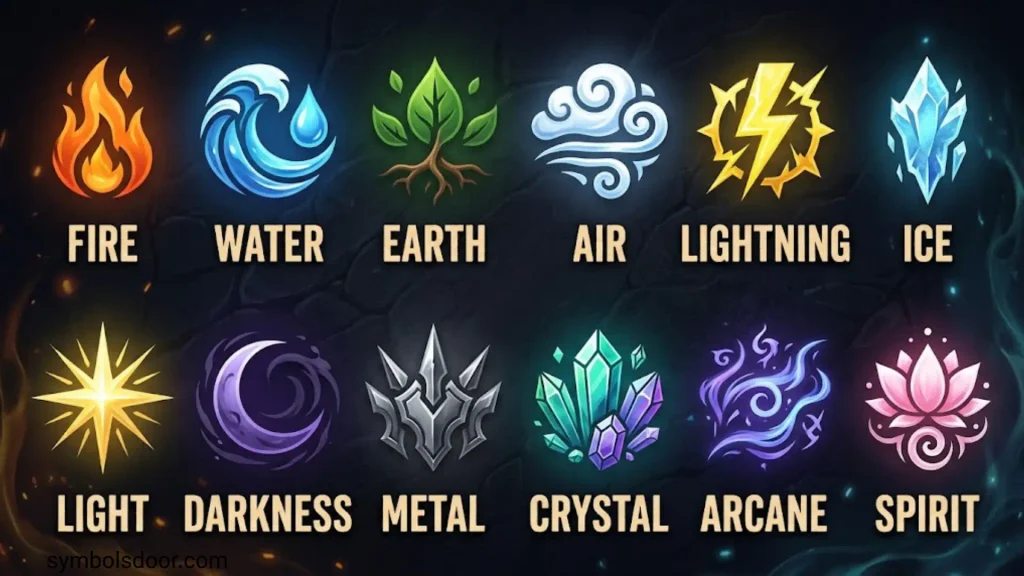
Elemental symbols represent the four classical elements used in several Western esoteric, ceremonial, and Wiccan traditions.
These are not the same as the chemical elements in modern science. They are symbolic categories used to describe qualities of the natural and spiritual world.
The four elements are Earth, Air, Fire, and Water. Some traditions also include Spirit as a fifth element.
Four Elemental Symbols and Their Meanings
The symbols commonly use triangles, sometimes with a horizontal line.
<figure> <img src=”https://upload.wikimedia.org/wikipedia/commons/thumb/5/5a/Alchemical_symbols_for_the_four_elements.svg/512px-Alchemical_symbols_for_the_four_elements.svg.png” alt=”Classical elemental symbols for Earth, Air, Fire, and Water”> </figure>
| Element | Common symbol | Common associations |
| Earth | Downward-pointing triangle with a horizontal line | Stability, grounding, nature |
| Air | Upward-pointing triangle with a horizontal line | Thought, communication, intellect |
| Fire | Upward-pointing triangle | Energy, action, transformation |
| Water | Downward-pointing triangle | Emotion, intuition, flow |
| Spirit | Varies by tradition | Unity, consciousness, spiritual connection |
Earth Symbol
The Earth symbol is usually represented by a downward-pointing triangle crossed by a horizontal line.
It is associated with stability, physical life, growth, and the natural world. In some spiritual practices, Earth represents the practical foundation needed to support other activities.
Air Symbol
The Air symbol is an upward-pointing triangle with a horizontal line.
Its common associations include communication, learning, thought, and movement. Practitioners may connect it with breathing, ideas, and the exchange of information.
Fire Symbol
The Fire symbol is an upward-pointing triangle without a horizontal line.
Fire represents energy, action, passion, and change. It can also symbolize purification and transformation in some ritual settings.
Water Symbol
The Water symbol is a downward-pointing triangle.
It is often associated with emotions, intuition, cleansing, and renewal. Water also has an important place in many spiritual ceremonies and symbolic purification practices.
How Are Elemental Symbols Used in Witchcraft?
Some practitioners use elemental symbols on an altar or during ritual work. They may arrange objects to represent the four elements or use the symbols as visual reminders of their qualities.
For example:
- A bowl of soil or a stone may represent Earth.
- Incense or a feather may represent Air.
- A candle may represent Fire.
- A bowl of water may represent Water.
These associations vary. There is no single altar arrangement or elemental system followed by every witch or Pagan practitioner.
Spiral Symbol: Growth, Change, and Transformation
The spiral symbol is a curved line that winds inward or outward around a central point.
Spiral designs appear in ancient artwork, decorative objects, and archaeological sites across different parts of the world. They also occur in nature, including shells, plant growth patterns, and certain weather formations.
<figure> <img src=”https://upload.wikimedia.org/wikipedia/commons/thumb/2/2b/Spiral.svg/512px-Spiral.svg.png” alt=”Simple spiral symbol”> </figure>
Spiral Meaning and Spiritual Associations
In modern Pagan spirituality, the spiral is sometimes interpreted as a symbol of growth, transformation, and the continuing movement of life.
Its common spiritual associations include:
- Growth: Moving outward can suggest expansion and development.
- Transformation: The changing path can represent personal change.
- Life cycles: The spiral can symbolize repeating stages of existence.
- Spiritual development: Its movement may represent an inward journey of reflection.
- Continuity: The curved line can suggest movement without a simple endpoint.
Ancient Spiral Symbolism
Spiral designs have a long history in different cultures. Their presence in ancient art does not establish one universal meaning.
Some may have had decorative, religious, or cultural purposes. Others may have represented ideas that researchers cannot confidently identify today.
In modern witchcraft, a spiral may be used as a visual focus for meditation, reflection, or personal spiritual intention.
The spiral spiritual meaning therefore depends on the tradition and the person interpreting it. It is better to avoid claiming that every ancient spiral represents the same Pagan or witchcraft belief.
Ankh: The Ancient Egyptian Symbol of Life
The Ankh is an ancient Egyptian symbol shaped like a cross with a loop at the top. It is one of the best-known symbols from ancient Egyptian religion and art.
Its hieroglyphic form represents the Egyptian word for life.
<figure> <img src=”https://upload.wikimedia.org/wikipedia/commons/thumb/0/0a/Ankh.svg/512px-Ankh.svg.png” alt=”Ankh, the ancient Egyptian symbol of life”> </figure>
Ankh Meaning in Ancient Egypt
The Ankh was closely connected with life and vitality. Egyptian gods are frequently shown holding it in temple reliefs and other religious artwork.
The symbol also appears in amulets and funerary objects. It could represent life beyond death and the continuation of existence in the afterlife.
The U.S. National Park Service’s explanation of the Ankh describes its association with eternal life in ancient Egyptian culture.
The Global Egyptian Museum also explains that the sign means life and appears regularly in Egyptian art.
Ankh Spiritual Meaning
The Ankh’s established ancient meaning is life. Modern spiritual interpretations may also connect it with:
- Eternal life and spiritual continuity.
- Renewal and vitality.
- The relationship between physical life and the afterlife.
- Ancient Egyptian religious beliefs.
- Personal spiritual identity.
Some modern Pagan practitioners incorporate the Ankh into their spiritual practices. However, it is important to recognize its Egyptian origins rather than describe it as a symbol invented by witchcraft.
Is the Ankh a Witchcraft Symbol?
The Ankh is not originally a witchcraft symbol. It is an ancient Egyptian symbol with a documented role in Egyptian writing, religious art, and funerary traditions.
Its later adoption by some modern spiritual practitioners gives it additional contemporary meanings. Those modern uses do not change its original cultural history.
Other Symbols Associated With Modern Witchcraft and Pagan Practice
The eight symbols above are not the only designs you may encounter in modern witchcraft. Other symbols have become connected with Pagan spirituality, Goddess traditions, and protective practices.
Their cultural backgrounds are important, especially when a symbol belongs to a living religious tradition.
Eye of Horus
The Eye of Horus is an ancient Egyptian symbol associated with the god Horus.
It appears in Egyptian religious art and amulets. Its associations include protection, healing, and well-being.
Some modern spiritual practitioners use it as a protective image. However, its historical background belongs to ancient Egyptian religion, not specifically to witchcraft.
Hamsa Hand
The Hamsa Hand is a palm-shaped symbol used in several cultural and religious traditions.
It is commonly associated with protection against the evil eye. It has important connections with Jewish and Muslim cultural traditions, among others.
Some people use it in modern spiritual settings, but it should not be described as exclusively Pagan or Wiccan.
Horned God Symbol
The Horned God is an important religious figure in many Wiccan traditions. He is often associated with nature, animals, wilderness, and seasonal cycles.
Representations of the Horned God vary. Some images show a human figure with antlers or horns.
This modern Wiccan deity should not be confused with every historical horned figure found in ancient cultures. Similar visual features do not necessarily indicate the same religious identity or meaning.
What Do Witchcraft Symbols Represent?
Although individual meanings differ, many symbols of witchcraft are connected with recurring themes. These themes often relate to nature, spiritual identity, protection, and the stages of life.
| Theme | Symbols commonly associated with it | Common interpretation |
| Protection | Pentacle, Witch’s Knot | Warding, boundaries, and spiritual protection |
| Feminine spirituality | Triple Moon | Goddess symbolism and stages of life |
| Balance and unity | Pentacle, triquetra | Connection and harmony |
| Nature | Wheel of the Year, elemental symbols | Natural forces and seasonal changes |
| Transformation | Spiral, Triple Moon | Growth, change, and renewal |
| Life and continuity | Ankh | Life, vitality, and eternal life |
| Threefold connection | Triquetra, Triple Moon | Three connected aspects or stages |
Protection and Warding
Protection is a common theme in modern witchcraft symbolism.
Some practitioners use the pentacle or knot designs as spiritual protection symbols. These may represent personal boundaries, safety, or the intention to keep unwanted influences away.
The symbols are meaningful within particular belief systems. Their use should not be presented as a scientifically proven way to prevent physical harm.
Feminine Energy and Goddess Symbolism
The Triple Moon is strongly associated with Goddess-centered spirituality.
Its connection with the Maiden, Mother, and Crone provides a framework for thinking about different stages of life. It also reflects the changing appearance of the Moon.
Not all Wiccan or Pagan traditions interpret the Goddess in the same way. Some worship a Goddess and God, while others follow different religious or spiritual approaches.
Unity and Spiritual Balance
The pentacle and triquetra can both express unity, although their interpretations differ.
The pentacle often connects the five elements within a circle. The triquetra can represent three interconnected parts of a whole.
These designs provide visual ways to express ideas that can be difficult to describe in words.
Natural Cycles and Transformation
The Wheel of the Year and Triple Moon both reflect cycles.
The Wheel follows the changing seasons. The Triple Moon reflects the lunar cycle and, in some modern traditions, the stages of life.
The spiral is another symbol often used to represent growth and transformation.
Are Witch Symbols the Same as Pagan and Wiccan Symbols?
No. Witchcraft, Paganism, and Wicca are related terms, but they do not mean the same thing.
Understanding the difference helps explain why some symbols appear in more than one spiritual tradition.
What Is Witchcraft?
Witchcraft refers to a broad range of practices and beliefs. Depending on the practitioner and cultural setting, it may involve folk magic, ritual work, herbal traditions, divination, or other spiritual activities.
Not everyone who practices witchcraft follows a religion. Some people approach it as a spiritual practice, while others connect it with a particular religious tradition.
What Is Paganism?
Paganism is a broad term covering many religious and spiritual traditions. Modern Paganism includes diverse paths, such as Wicca, Druidry, and other nature-based or polytheistic movements.
Pagan traditions do not all share the same gods, rituals, symbols, or beliefs.
What Is Wicca?
Wicca is a modern Pagan religion that developed in twentieth-century Britain. Many Wiccan traditions include ritual practices, seasonal festivals, and reverence for a Goddess and God.
Wiccan practitioners often use the pentacle, elemental symbols, and other ritual imagery.
However, Wicca is not identical to all witchcraft. Some Wiccans practice witchcraft, but not every witch is Wiccan.
| Term | Meaning | Relationship to symbols |
| Witchcraft | A broad range of magical or spiritual practices | May use symbols from different traditions |
| Paganism | A broad group of religious and spiritual paths | Includes many different symbolic systems |
| Wicca | A modern Pagan religion | Uses symbols such as the pentacle and elemental signs |
| Modern Paganism | Contemporary Pagan religious movements | May draw on historical, cultural, and newly developed imagery |
Difference Between Wiccan and Pagan Symbols
Some symbols are strongly associated with Wicca, while others are shared across wider Pagan or cultural traditions.
For example, the pentacle is widely recognized in Wiccan practice. The Ankh, on the other hand, originated in ancient Egyptian religion. The triquetra has Celtic and Christian associations, as well as modern Pagan interpretations.
There is no single symbol collection used by every Pagan practitioner.
How Are Modern Witchcraft Symbols Used Today?
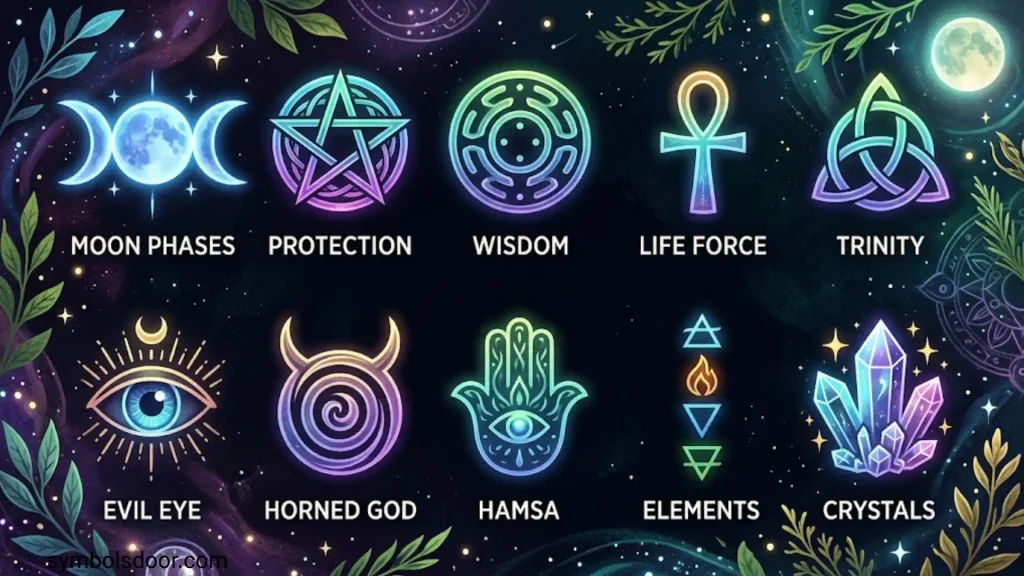
Modern witches and Pagan practitioners use symbols in different ways. Their choices depend on personal beliefs, religious traditions, and the purpose of a practice.
Spiritual Altars and Decorations
A spiritual altar may contain objects that represent particular elements, deities, or intentions.
For example, a practitioner might display a pentacle, a candle, a bowl of water, or a seasonal decoration. These objects help establish the meaning and focus of the space.
An altar does not have to follow one universal arrangement.
Rituals and Spellwork
Some practitioners include symbols in ritual activities or spellwork.
A symbol may represent the purpose of a ritual, such as protection, reflection, or personal change. It can also serve as a visual reminder of the practitioner’s intention.
Different traditions have different rules and methods. There is no single ritual system followed by all witches.
Jewelry and Tattoos
Pentacles, Triple Moon designs, triquetras, and Ankhs are common choices for jewelry and tattoos.
People may choose them to express their spiritual beliefs, cultural interests, or personal values.
Before adopting a symbol, it is worth learning its cultural and religious background. This is especially important when the design belongs to a tradition outside your own.
Meditation and Personal Reflection
Symbols can also serve as visual tools during meditation.
A person might focus on a spiral while reflecting on personal growth or use the Moon’s phases as a reminder of changing circumstances.
In these situations, the symbol’s personal meaning may be just as important as its wider spiritual associations.
How to Identify Witchcraft Symbols Correctly
Not every unusual design is an occult symbol or a sign of witchcraft. Some shapes are decorative, religious, or cultural.
Use these points when identifying a symbol:
- Study its shape: Look at the number of points, lines, circles, and other features.
- Check its orientation: An upright pentagram and an inverted pentagram can carry different associations.
- Consider its setting: A symbol on a Wiccan altar may have a different context from the same design in a medieval church.
- Research its history: Look for museum collections, historical records, and reliable academic sources.
- Separate old and new meanings: A modern spiritual interpretation does not necessarily reflect the symbol’s earliest known use.
- Avoid assumptions: A pentagram, knot, or crescent alone does not prove that someone practices witchcraft.
The historical background matters because symbols move between cultures and religions. Their meanings can change as people adopt them for new purposes.
Frequently Asked Questions About Witch Symbols
What Are the Most Common Witch Symbols?
Some commonly recognized symbols associated with witchcraft and modern Pagan practice include the pentacle, Triple Moon, triquetra, Witch’s Knot, Wheel of the Year, elemental symbols, spiral, and Ankh.
Their meanings include protection, unity, natural cycles, transformation, and life. However, not all originated in witchcraft.
What Do Witchcraft Symbols Mean?
Witchcraft symbols can represent spiritual protection, balance, nature, Goddess traditions, transformation, and personal beliefs.
Their meanings depend on the historical background and the tradition using them. A symbol may also have several interpretations across different cultures.
What Is the Most Powerful Protection Symbol in Witchcraft?
The pentacle is one of the best-known protection symbols in modern Wiccan and Pagan practice. Some practitioners also use the Witch’s Knot as a warding design.
However, there is no universally accepted ranking of magical power. Different traditions and individuals assign different meanings to their symbols.
Is the Pentacle a Satanic Symbol?
No. The pentacle is widely used in Wiccan and Pagan traditions and is often associated with the five elements and spiritual balance.
An inverted pentagram appears in some modern Satanic imagery, but that does not make every pentacle or pentagram Satanic.
What Is the Difference Between a Pentacle and a Pentagram?
A pentagram is a five-pointed star. A pentacle commonly refers to a pentagram enclosed within a circle, especially in modern Wiccan and Pagan contexts.
The terms sometimes overlap in everyday use, so context matters.
What Does the Triple Moon Symbol Represent?
The Triple Moon usually shows a waxing crescent, full moon, and waning crescent.
In modern Wiccan and Goddess-centered traditions, it is often associated with the Maiden, Mother, and Crone. It can also represent lunar cycles, transformation, and the changing stages of life.
What Does the Celtic Triquetra Represent?
The triquetra is a three-part interwoven design found in Celtic art and Christian imagery.
Modern Pagan interpretations may connect it with life, death, and rebirth or other threefold relationships. Its meaning is not fixed across every culture or religious tradition.
What Does a Witch’s Knot Symbolize?
A Witch’s Knot is commonly associated with protection, warding, and knot magic in modern spiritual contexts.
Some practitioners interpret its interwoven design as a representation of binding or holding an intention. The term can refer to different knot designs, so its exact meaning depends on the context.
What Is the Wheel of the Year?
The Wheel of the Year is a modern Pagan seasonal calendar with eight festivals.
These festivals are Yule, Imbolc, Ostara, Beltane, Litha, Lammas or Lughnasadh, Mabon, and Samhain. They mark seasonal transitions and important points in the annual cycle.
What Are the Four Elements in Witchcraft?
The four classical elements are Earth, Air, Fire, and Water.
Some Wiccan and other esoteric traditions also include Spirit as a fifth element. Each element has symbolic associations, such as Earth with stability and Water with emotion.
What Does the Spiral Symbol Represent?
In modern spiritual interpretations, a spiral can represent growth, change, transformation, and repeating life cycles.
Spiral designs also appear in ancient art across different cultures. Their original meanings are not necessarily connected with witchcraft.
What Does the Ankh Symbol Mean?
The Ankh is an ancient Egyptian hieroglyph representing life.
It appears in Egyptian religious art, amulets, and funerary objects. It is also associated with vitality and eternal life in ancient Egyptian beliefs.
Are Witchcraft Symbols Always Religious?
No. Some symbols have specific religious meanings, while others are used in personal spiritual practices, cultural art, jewelry, or decoration.
A symbol’s purpose depends on the person using it and the context in which it appears.
Can Anyone Use Witchcraft Symbols?
People encounter and use symbols for different reasons, including cultural interest, personal expression, and spiritual practice.
However, it is respectful to learn about a symbol’s history and religious background before adopting it. This is particularly important when a symbol belongs to a living cultural or religious tradition.
Conclusion
Witch symbols carry a wide range of meanings. The pentacle is associated with the five elements and protection in many modern Wiccan traditions. The Triple Moon represents lunar cycles and the Triple Goddess in some Goddess-centered practices. The triquetra expresses threefold connections, while the Witch’s Knot is linked with protection and knot magic.
Other symbols connect witchcraft with the natural world. The Wheel of the Year follows seasonal changes, elemental symbols represent Earth, Air, Fire, and Water, and the spiral can suggest growth and transformation. The Ankh has a different historical background: it is an ancient Egyptian symbol of life.
The most important point is that witchcraft symbolism does not have one universal meaning. Symbols can change across cultures, religions, and generations. Understanding their origins helps you appreciate their significance without confusing modern spiritual interpretations with historical facts.
Hi, I’m Asher Monroe, a writer who believes that meaningful words have the power to inspire change and bring people closer to their dreams. I have always been fascinated by the beauty of quotes and the way a simple message can provide motivation, hope, and comfort.
I enjoy creating content around inspirational quotes, life lessons, success stories, and positive thoughts that help readers find encouragement in their everyday lives. My goal is to share words that connect with people and remind them of their inner strength.
Through my writing, I explore the ideas of personal growth, confidence, and the importance of staying inspired through every chapter of life.
I am the author of Words That Move the Soul and The Path of Endless Inspiration, two books focused on the power of wisdom, positivity, and meaningful thoughts.
 Sienna Brooks
 Rowan Sinclair Rowan Sinclair


