
GHS symbols help you recognize dangerous chemicals before you handle, store, or transport them. You will find these chemical hazard symbols on bottles, drums, containers, workplace labels, and other chemical products. Each pictogram communicates a specific type of danger, such as fire, poisoning, corrosion, or environmental damage.
The symbols belong to the Globally Harmonized System of Classification and Labelling of Chemicals (GHS). The United Nations developed this system to make chemical hazard information easier to understand across different countries and industries.
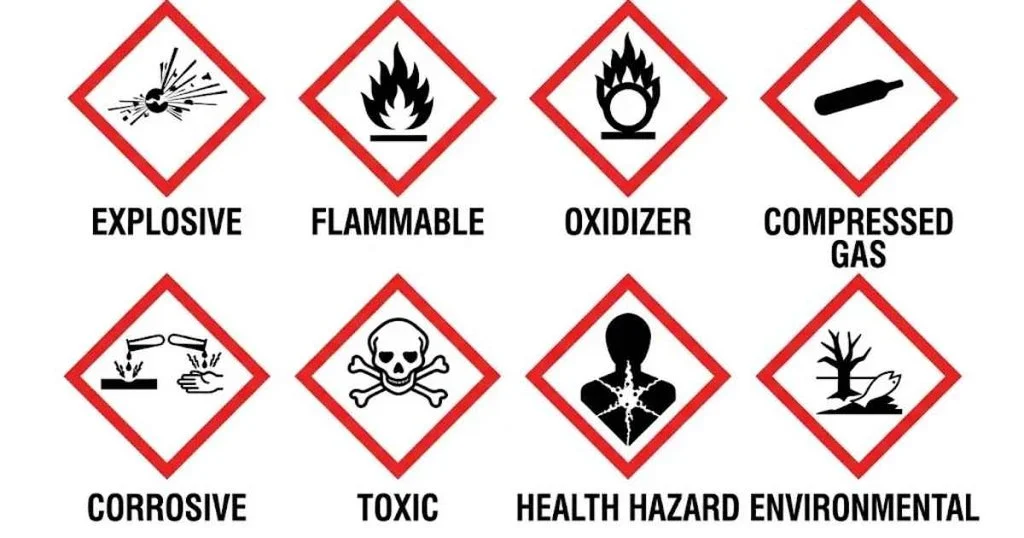
There are nine official GHS hazard pictograms. Each one uses a black symbol inside a red diamond-shaped border with a white background. Together, they communicate physical, health, and environmental hazards.
However, recognizing a pictogram is only the first step. You also need to understand the signal words, hazard statements, and precautionary instructions printed on the chemical label.
This guide explains all nine GHS symbols, their meanings, the hazards they identify, and how to read chemical warning labels correctly. It also covers dangerous-goods transport labels, hazard classifications, and other workplace safety systems.
What Are GHS Symbols?
GHS symbols, also called GHS pictograms or hazard pictograms, are standardized images used on chemical labels to communicate specific hazards.
They help workers, consumers, emergency responders, and chemical handlers identify dangerous properties without relying entirely on lengthy written warnings.
For example, a flame symbol alerts you to a fire hazard. A skull and crossbones warns about serious acute toxicity. A gas cylinder indicates that a product contains gas under pressure.
Each GHS pictogram has three main visual elements:
- Red diamond border: A square turned onto one corner.
- White background: Provides contrast for the warning image.
- Black hazard symbol: Shows the type of danger associated with the chemical.
The pictogram assigned to a product depends on its chemical classification. A product may display one pictogram or several, depending on the hazards identified during classification.
What Are the Three Main Groups of GHS Hazards?
The GHS organizes chemical hazards into three broad groups.
| Hazard group | What it covers | Examples |
| Physical hazards | Dangerous physical or chemical properties | Explosives, flammable liquids, oxidizers, gases under pressure |
| Health hazards | Harmful effects on the human body | Poisoning, skin corrosion, cancer risks, respiratory sensitization |
| Environmental hazards | Harmful effects on the environment | Acute and chronic aquatic toxicity |
A single chemical can belong to more than one hazard group. For example, a chemical may be flammable and harmful if inhaled. Its label must communicate the applicable hazards.
What Is the Globally Harmonized System (GHS)?
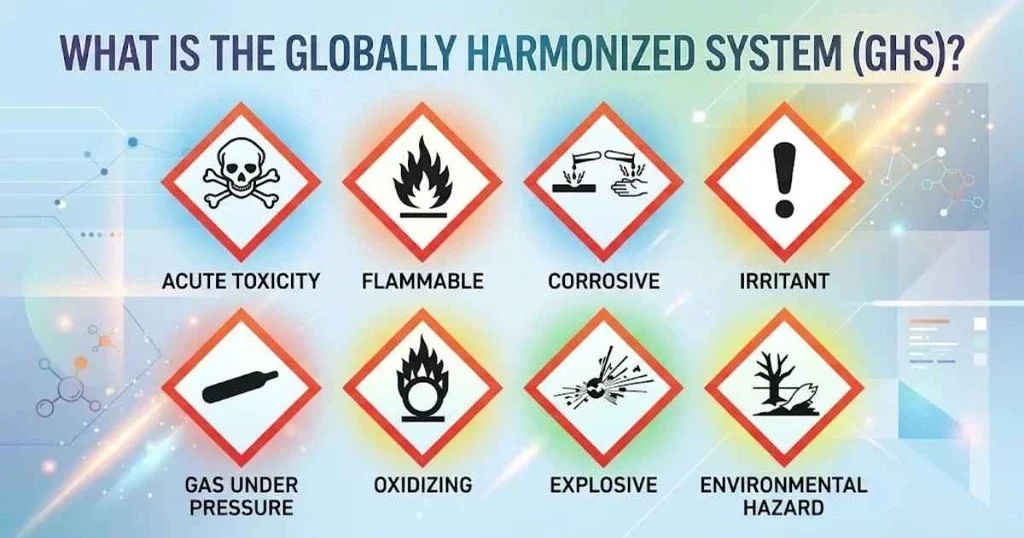
The Globally Harmonized System of Classification and Labelling of Chemicals is an international framework developed through the United Nations.
Its purpose is to create a consistent approach to identifying chemical hazards and communicating safety information.
Before widespread GHS adoption, countries used different chemical classification and labeling systems. A product could carry different warning labels depending on where it was sold or used. This created confusion for international businesses and workers handling imported chemicals.
GHS helps reduce those differences by providing common classification criteria and hazard communication elements.
The system covers:
- Chemical classification: Identifying the physical, health, and environmental hazards of substances and mixtures.
- Hazard pictograms: Using standardized images to communicate dangers.
- Signal words: Showing the relative severity of a classified hazard.
- Hazard statements: Describing the nature of the hazard.
- Precautionary statements: Explaining how to prevent or respond to exposure.
- Safety Data Sheets (SDS): Providing detailed information about chemical properties, hazards, handling, storage, and emergency measures.
The United Nations published the eleventh revised edition, GHS Rev. 11, in 2025. Countries and regions adopt GHS through their own laws, so local requirements may not match every detail of the latest UN edition.
You can consult the for the framework and its revisions.
All 9 GHS Hazard Pictograms and Their Meanings
The nine official GHS pictograms help users identify different types of chemical hazards.
Here is a quick reference chart:
| GHS code | Symbol name | Main hazard |
| GHS01 | Exploding bomb | Explosives and certain reactive substances |
| GHS02 | Flame | Flammable and certain self-reactive substances |
| GHS03 | Flame over circle | Oxidizing substances |
| GHS04 | Gas cylinder | Gases under pressure |
| GHS05 | Corrosion | Skin corrosion, serious eye damage, and metal corrosion |
| GHS06 | Skull and crossbones | Severe acute toxicity |
| GHS07 | Exclamation mark | Irritation, harmful toxicity, and certain other effects |
| GHS08 | Health hazard silhouette | Serious or long-term health hazards |
| GHS09 | Dead tree and fish | Aquatic environmental hazards |
The following sections explain each GHS hazard pictogram in detail.
GHS01: Exploding Bomb Symbol
<text><escape>GHS01 — Exploding Bomb</escape></text>
The exploding bomb symbol warns about explosive materials and certain substances that can react violently under specific conditions.
These materials may release large amounts of energy, heat, and pressure. Depending on their classification, they can cause explosions, fires, or dangerous projections.
GHS01 is associated with hazards involving:
- Unstable explosives.
- Certain explosive substances and mixtures.
- Certain self-reactive substances.
- Certain organic peroxides.
The actual hazard can vary. Some explosives present a mass explosion hazard, while others may produce dangerous fragments or intense fires.
The GHS classification identifies the nature of the explosive hazard. It does not replace the more detailed transport classification used for dangerous goods.
Examples of materials associated with explosive hazards include:
- TNT.
- Nitroglycerin.
- Certain unstable explosive compounds.
These examples should not be treated as automatic label assignments. The exact classification depends on the material, its form, and the applicable testing criteria.
What should you do when you see GHS01?
- Do not handle the product without proper authorization and training.
- Follow the manufacturer’s storage and handling instructions.
- Keep the material away from incompatible conditions identified on its label and safety data sheet.
- Follow workplace emergency procedures.
The exploding bomb is one of the most serious chemical warning symbols because it identifies materials capable of producing violent physical reactions.
GHS02: Flame Symbol
<text><escape>GHS02 — Flame</escape></text>
The flame symbol identifies chemicals that can catch fire easily or create fire hazards under certain conditions.
Some substances ignite when exposed to heat, sparks, or open flames. Others can ignite spontaneously or release flammable gases when they contact water.
GHS02 applies to several hazard classes, including:
- Flammable gases.
- Flammable aerosols.
- Flammable liquids.
- Flammable solids.
- Pyrophoric liquids and solids.
- Self-reactive substances and mixtures.
- Self-heating substances and mixtures.
- Certain substances that emit flammable gases when they contact water.
- Certain organic peroxides.
A chemical does not need to behave like gasoline to receive this pictogram. Different substances have different ignition temperatures, flash points, and combustion properties.
Common examples include:
- Acetone.
- Methanol.
- Certain solvent-based products.
- Some flammable aerosol products.
The exact classification depends on the product’s properties and formulation.
What Is a Flash Point?
The flash point is the lowest temperature at which a liquid produces enough vapor to form an ignitable mixture with air under specified test conditions.
A lower flash point generally indicates that a liquid can produce ignitable vapor at a lower temperature.
This is an important factor when classifying flammable liquids.
What Are Pyrophoric Substances?
Pyrophoric substances can ignite spontaneously when exposed to air under specified conditions.
They do not necessarily need an external flame or spark to start burning.
Other substances are classified as self-heating because they can gradually generate heat through chemical reactions and may eventually ignite.
What should you do when you see GHS02?
- Keep the product away from ignition sources as directed by its label.
- Follow the recommended storage conditions.
- Use appropriate ventilation and handling controls.
- Keep containers closed when required.
- Follow the safety data sheet for fire prevention and emergency instructions.
The flame pictogram is especially important in laboratories, factories, workshops, and workplaces that use chemical solvents.
GHS03: Flame Over Circle Symbol
<text><escape>GHS03 — Flame Over Circle</escape></text>
The flame over circle symbol identifies oxidizing substances.
Oxidizers can cause or intensify fires by supporting combustion or increasing the intensity of a fire involving other materials.
This is different from the flame pictogram. A flammable chemical can burn, while an oxidizer may make another material burn more intensely.
GHS03 covers three main categories:
- Oxidizing gases.
- Oxidizing liquids.
- Oxidizing solids.
Common examples of oxidizing substances include certain forms and concentrations of hydrogen peroxide and potassium permanganate.
Their classification depends on their chemical properties and test results.
Why Are Oxidizing Chemicals Dangerous?
Oxidizing agents can react with combustible materials and increase fire hazards.
Some reactions also release significant heat. This is why oxidizers need suitable storage arrangements and separation from incompatible substances.
For example, storing an oxidizer beside an incompatible combustible material can create a dangerous situation if the substances come into contact.
What should you do when you see GHS03?
- Follow the storage instructions on the label.
- Keep the substance away from incompatible materials.
- Use appropriate protective equipment.
- Follow workplace procedures for spills and chemical reactions.
- Consult the safety data sheet before handling the product.
Remember that oxidizers are not necessarily flammable themselves. Their danger comes from their ability to support or intensify combustion.
GHS04: Gas Cylinder Symbol
<text><escape>GHS04 — Gas Cylinder</escape></text>
The gas cylinder symbol identifies gases stored under pressure.
These products may be supplied in cylinders, cartridges, tanks, or other pressure containers.
The main GHS gas categories include:
- Compressed gases: Gases stored under pressure that remain gaseous at their storage temperature.
- Liquefied gases: Gases stored as liquids under pressure.
- Refrigerated liquefied gases: Gases kept in liquid form at very low temperatures.
- Dissolved gases: Gases dissolved in a solvent under pressure.
Examples include compressed carbon dioxide, liquid nitrogen, liquid helium, and other industrial or laboratory gases.
Not every gas is toxic or flammable. The gas cylinder pictogram communicates a pressure-related hazard, although a product may carry additional pictograms for other dangers.
What Hazards Do Gases Under Pressure Present?
Pressure-related rupture: A container can become dangerous if exposed to unsuitable conditions, including excessive heat.
Cold injuries: Refrigerated liquefied gases can cause severe cold burns or frostbite through contact.
Asphyxiation: Some gases can displace oxygen in an enclosed area. A person may experience oxygen deficiency without noticing a warning smell.
What should you do when you see GHS04?
- Protect containers from heat and physical damage.
- Follow approved storage and handling procedures.
- Keep cylinders secured as required by workplace rules.
- Use suitable equipment and connections.
- Follow the safety data sheet for ventilation and emergency guidance.
The gas cylinder symbol is common in hospitals, laboratories, manufacturing facilities, and industrial workplaces.
GHS05: Corrosion Symbol
<text><escape>GHS05 — Corrosion</escape></text>
The corrosion symbol shows liquid from test tubes damaging a hand and a metal surface.
It identifies chemicals that can cause serious skin burns, serious eye damage, or corrosion of metals.
This pictogram covers three important hazard areas:
- Skin corrosion.
- Serious eye damage.
- Corrosive effects on metals.
Common examples may include certain strong acids and strong bases.
Products containing sodium hydroxide, nitric acid, or other corrosive chemicals may require this pictogram depending on their concentration and classification.
Skin Irritation vs. Skin Corrosion
These terms describe different levels of damage.
Skin irritation refers to reversible skin damage. Symptoms may include redness, itching, or inflammation.
Skin corrosion refers to irreversible damage to the skin. It can involve severe burns and tissue destruction.
This distinction matters because the exclamation mark and corrosion pictograms communicate different levels or types of hazards.
What Is Serious Eye Damage?
Serious eye damage refers to eye injury that is not fully reversible.
A corrosive chemical splash can cause permanent damage if it reaches the eyes.
What should you do when you see GHS05?
- Avoid direct contact with the product.
- Follow the label’s protective equipment instructions.
- Use suitable eye and face protection where required.
- Follow the safety data sheet for storage and handling.
- Know the workplace emergency procedures before using the chemical.
Never assume that a clear liquid is safe. Many corrosive substances have no obvious visual warning.
GHS06: Skull and Crossbones Symbol
<text><escape>GHS06 — Skull and Crossbones</escape></text>
The skull and crossbones is one of the most recognizable chemical danger symbols.
It warns about severe acute toxicity. A substance with this classification can cause serious poisoning or death after a single exposure, depending on the amount and route of exposure.
GHS06 applies to acute toxicity involving three main routes:
- Oral toxicity: Exposure through swallowing.
- Dermal toxicity: Exposure through skin contact.
- Inhalation toxicity: Exposure through breathing in a substance.
The pictogram is used for the more severe acute toxicity categories. Less severe harmful acute toxicity may use the exclamation mark instead.
What Is Acute Toxicity?
Acute toxicity refers to harmful effects that occur after a single exposure or multiple exposures within a short period.
The seriousness depends on the chemical, the amount, and how it enters the body.
For example, some substances are especially dangerous when inhaled. Others present a greater danger if swallowed or absorbed through the skin.
Hydrogen cyanide is an example of a highly toxic chemical. It can interfere with the body’s ability to use oxygen and can cause life-threatening poisoning.
What should you do when you see GHS06?
- Do not handle the product without proper training and authorization.
- Avoid inhalation, swallowing, and skin contact.
- Follow the safety data sheet’s exposure-control instructions.
- Use the required protective equipment.
- Follow emergency procedures immediately if exposure occurs.
A chemical does not need a strong smell, bright color, or visible warning to be highly toxic. Always rely on its official classification and safety information.
GHS07: Exclamation Mark Symbol
<text><escape>GHS07 — Exclamation Mark</escape></text>
The exclamation mark symbol identifies several health hazards, including irritation and harmful acute toxicity.
It often appears on products that can cause unpleasant or harmful effects but do not fall into the more severe categories represented by other pictograms.
GHS07 may indicate:
- Skin irritation.
- Eye irritation.
- Skin sensitization.
- Harmful acute toxicity.
- Respiratory tract irritation.
- Drowsiness or dizziness.
Some products may cause an allergic skin reaction after contact. Others may irritate the eyes or respiratory system.
Certain chemicals can also produce narcotic effects, such as dizziness or drowsiness.
Is the Exclamation Mark a Low-Risk Warning?
No. It does not mean that a chemical is harmless.
It communicates specific hazards that still require attention. Repeated exposure or poor handling can create serious problems, depending on the substance.
For example, a product that causes skin sensitization may trigger an allergic reaction after repeated or later exposure.
What should you do when you see GHS07?
- Read the hazard statements carefully.
- Avoid unnecessary skin and eye contact.
- Follow ventilation instructions.
- Wear the protective equipment specified for the product.
- Follow the recommended hygiene and handling procedures.
The exclamation mark is common on certain cleaners, solvents, detergents, and industrial products.
GHS08: Serious Health Hazard Symbol
<text><escape>GHS08 — Serious Health Hazard</escape></text>
The serious health hazard symbol shows a human silhouette with a star-shaped mark on the chest.
It identifies certain serious health hazards that may cause long-term damage or severe effects on the body.
Unlike the skull and crossbones, which focuses on severe acute toxicity, GHS08 covers several important chronic and systemic health hazards.
These include:
- Carcinogenicity.
- Germ cell mutagenicity.
- Reproductive toxicity.
- Respiratory sensitization.
- Specific target organ toxicity.
- Aspiration hazard.
Carcinogenicity
Carcinogenicity refers to the ability of a substance to cause cancer.
A chemical may be classified as a carcinogen when scientific evidence meets the relevant classification criteria.
The label may identify a substance as known or suspected to cause cancer, depending on its classification.
Germ Cell Mutagenicity
Germ cell mutagenicity concerns genetic changes that may affect reproductive cells.
These changes can potentially be passed to future generations.
Reproductive Toxicity
Reproductive toxicity refers to harmful effects on reproductive functions or the development of offspring.
It can include effects on fertility or the unborn child.
Respiratory Sensitization
Respiratory sensitization occurs when exposure can lead to an allergic reaction in the respiratory system.
In some cases, later exposure may trigger asthma-like symptoms or breathing difficulties.
Specific Target Organ Toxicity
This classification identifies chemicals that can damage particular organs or body systems.
The effects may occur after a single exposure or repeated exposure.
For example, a chemical may cause damage to the liver, kidneys, nervous system, or respiratory system.
Aspiration Hazard
An aspiration hazard occurs when a substance enters the respiratory system through the mouth or nose, usually during swallowing or vomiting.
Certain liquids can cause serious lung damage if they enter the airways.
What should you do when you see GHS08?
- Read the full hazard statements.
- Follow exposure-control requirements.
- Avoid repeated or unnecessary exposure.
- Use suitable protective equipment.
- Follow workplace procedures for handling, storage, and disposal.
- Consult the safety data sheet for specific health information.
The serious health hazard pictogram does not mean that every chemical carrying it causes cancer. It represents several different serious health hazard classes.
GHS09: Environmental Hazard Symbol
<text><escape>GHS09 — Environmental Hazard</escape></text>
The environmental hazard symbol shows a dead tree and a dead fish.
It warns that a substance or mixture can harm aquatic organisms or cause lasting damage to the aquatic environment.
The pictogram mainly relates to:
- Acute aquatic toxicity.
- Chronic aquatic toxicity.
- Harmful effects on aquatic organisms.
- Long-lasting aquatic environmental damage.
What Is Acute Aquatic Toxicity?
Acute aquatic toxicity refers to harmful effects on aquatic organisms following short-term exposure.
Depending on the chemical, exposure can affect fish, algae, and aquatic invertebrates.
What Is Chronic Aquatic Toxicity?
Chronic aquatic toxicity concerns harmful effects associated with longer-term exposure.
Some chemicals can remain in the environment and continue affecting aquatic life over time.
Why Is Environmental Hazard Labeling Important?
Chemical releases can affect rivers, lakes, groundwater, and other ecosystems.
Some substances may harm aquatic organisms even when they are present in relatively small amounts.
Environmental contamination can also affect food chains and habitats.
What should you do when you see GHS09?
- Prevent uncontrolled chemical releases.
- Follow the product’s spill-control instructions.
- Use the recommended storage arrangements.
- Dispose of chemical waste according to local rules.
- Never pour hazardous chemicals into drains unless the applicable instructions specifically permit it.
The environmental pictogram is especially relevant to laboratories, agricultural operations, manufacturing facilities, and chemical waste management.
Physical, Health, and Environmental Hazard Groups
The nine GHS symbols are easier to understand when you organize them by the type of danger they communicate.
Physical Hazard Pictograms
Physical hazards involve dangerous properties that can cause fires, explosions, pressure-related accidents, or other physical damage.
The main pictograms include:
- GHS01: Exploding bomb.
- GHS02: Flame.
- GHS03: Flame over circle.
- GHS04: Gas cylinder.
- GHS05: Corrosion, when it identifies corrosive effects on metals.
Examples of physical hazards include flammability, explosive instability, oxidation, pressure, and chemical reactions that release heat.
A substance may present more than one physical hazard. For example, a chemical could be both flammable and reactive under certain conditions.
Health Hazard Pictograms
Health hazards involve harmful effects on the human body.
The main pictograms include:
- GHS05: Skin corrosion and serious eye damage.
- GHS06: Severe acute toxicity.
- GHS07: Irritation and harmful acute toxicity.
- GHS08: Serious or chronic health hazards.
These symbols help communicate risks such as poisoning, burns, allergic reactions, organ damage, and cancer-related hazards.
Environmental Hazard Pictograms
The main environmental pictogram is:
- GHS09: Dead tree and fish.
It identifies certain substances that can harm aquatic organisms or create long-lasting damage to aquatic environments.
Not every environmental concern is covered by this pictogram. For example, environmental impacts such as climate-related effects may be addressed through additional or different classification provisions, depending on the applicable GHS revision and local rules.
How GHS Chemical Hazard Classification Works
A chemical receives its hazard classification based on its properties and the available scientific evidence.
The classification process helps determine which pictograms, signal words, hazard statements, and precautionary statements belong on its label.
The GHS includes different hazard classes for physical, health, and environmental hazards.
Each class may have its own categories or subcategories.
What Are GHS Hazard Categories?
Hazard categories describe the level or type of danger within a particular hazard class.
For example, acute toxicity uses categories to distinguish different levels of toxic effects.
Other hazard classes use different category structures. Some include categories 1, 2, 3, or 4. Others use subcategories such as 1A and 1B.
A lower category number often represents a more severe hazard, but you should never apply that rule without checking the specific hazard class.
The meaning of a category depends on the classification system used for that hazard.
What Are Types A Through G?
Certain self-reactive substances and organic peroxides use types A through G.
These types reflect their hazard characteristics and behavior under the applicable classification criteria.
They are not general categories that apply to every chemical hazard.
Hazard vs. Risk: What Is the Difference?
These terms are related, but they do not mean the same thing.
| Term | Meaning | Example |
| Hazard | A property that can cause harm | A liquid is corrosive |
| Risk | The likelihood and seriousness of harm under actual conditions | A worker may suffer burns if the liquid splashes onto exposed skin |
A corrosive chemical remains hazardous even when stored safely.
However, proper containers, training, protective equipment, and handling procedures can reduce the risk of exposure.
This distinction is important in workplace risk assessment and chemical safety planning.
What Information Appears on a GHS Chemical Label?
A GHS label contains more than hazard pictograms. It combines several elements to explain the product’s identity, hazards, and safe handling requirements.
The exact legal requirements depend on the jurisdiction and applicable regulation.
Product Identifier
The product identifier tells you which chemical or mixture is inside the container.
It may include:
- Chemical name.
- Product name.
- Mixture name.
- Identification number.
- Other information needed to match the product with its safety data sheet.
Always check that the product identifier matches the chemical you intend to use.
Supplier Identification
The label may include information about the manufacturer, importer, or supplier.
This information can include:
- Company name.
- Address.
- Telephone number.
Supplier details help users identify the responsible business and find additional safety information.
Signal Words: Danger and Warning
GHS uses two main signal words:
Danger indicates a more severe hazard category.
Warning indicates a less severe hazard category when a signal word is required.
A label may use only one signal word, even when a product has several classified hazards.
Some hazard categories do not require a signal word.
Do not assume that a product labeled Warning is harmless. It still has a hazard that requires appropriate precautions.
Hazard Statements
Hazard statements describe the nature of a chemical’s danger.
They explain what harm the substance may cause.
For example, a statement may communicate that a product:
- Is highly flammable.
- Causes serious eye damage.
- Is harmful if swallowed.
- May cause cancer.
- May be fatal if inhaled.
- Is toxic to aquatic life.
The wording is standardized within the relevant regulatory system and classification.
Precautionary Statements
Precautionary statements explain how to reduce exposure and respond safely.
They generally cover four main areas:
| Group | Purpose | Example of information |
| Prevention | Reduce the chance of exposure or an accident | Wear protective equipment |
| Response | Explain what to do after exposure or a spill | Follow first-aid or emergency instructions |
| Storage | Explain suitable storage conditions | Keep the product in an appropriate container |
| Disposal | Explain how to dispose of the product safely | Follow local hazardous-waste requirements |
Some GHS materials also identify general precautionary statements as a separate group.
These instructions are essential because a pictogram alone cannot tell you every step needed to handle a chemical safely.
Supplemental Label Information
Some labels contain additional information required by local regulations or relevant product rules.
This may include special warnings, usage restrictions, or other details.
For example, the European Union’s CLP Regulation includes supplemental labeling provisions for certain products and hazards.
GHS Hazard Categories and Dangerous Goods Transport Classes
One common source of confusion is the difference between GHS hazard categories and dangerous-goods transport classes.
They are related, but they serve different purposes.
GHS classification communicates chemical hazards during supply and use.
Transport classification identifies dangerous goods for transportation by road, rail, sea, or air under the applicable rules.
The United Nations Recommendations on the Transport of Dangerous Goods provide the basis for many international transport requirements.
Dangerous Goods Classes and Divisions
The main dangerous-goods transport classes include:
| Transport class or division | Description |
| Class 1 | Explosives |
| Division 2.1 | Flammable gases |
| Division 2.2 | Non-flammable, non-toxic gases |
| Division 2.3 | Toxic gases |
| Class 3 | Flammable liquids |
| Division 4.1 | Flammable solids and certain related substances |
| Division 4.2 | Substances liable to spontaneous combustion |
| Division 4.3 | Substances that emit flammable gases when in contact with water |
| Division 5.1 | Oxidizing substances |
| Division 5.2 | Organic peroxides |
| Division 6.1 | Toxic substances |
| Division 6.2 | Infectious substances |
| Class 7 | Radioactive materials |
| Class 8 | Corrosive substances |
| Class 9 | Miscellaneous dangerous goods |
Class 1 explosives are divided into Divisions 1.1 through 1.6, according to the type and extent of their hazards.
These transport classifications should not be confused with GHS categories.
For example, Flammable Liquids Category 2 under GHS and Class 3 under transport rules belong to different classification systems. Their labels and criteria serve different regulatory purposes.
GHS Symbols vs. Dangerous Goods Transport Pictograms
GHS pictograms and transport labels can look similar because both use visual warnings. However, they are not interchangeable.
| Feature | GHS pictograms | Transport pictograms |
| Main purpose | Communicate chemical hazards | Identify dangerous goods during transportation |
| Typical appearance | Black symbol on white background inside a red diamond | Class-specific diamond labels |
| Classification | GHS hazard classes and categories | UN dangerous goods classes and divisions |
| Common use | Chemical containers and workplace labels | Packages, freight, vehicles, and transport documents |
| Examples | Flame, corrosion, skull and crossbones | Class 3 flammable liquid, Class 8 corrosive |
What Are Dangerous Goods Labels?
Dangerous-goods labels identify the transport hazards of a product.
They often display:
- A class or division number.
- A specific hazard symbol.
- A particular label color or design.
- Additional markings where required.
For example, a Class 3 transport label identifies flammable liquids.
A Class 8 label identifies corrosive substances.
Transport requirements depend on the mode of transport and the regulations that apply.
In the United States, the Department of Transportation (DOT) regulates hazardous materials transportation under its hazardous materials regulations in Title 49 of the Code of Federal Regulations.
Other Chemical Hazard Labeling Systems
GHS is not the only system used to communicate chemical hazards.
You may also encounter NFPA 704, HMIS, and Hazchem in workplaces and industrial settings.
These systems serve different purposes and should not be confused with GHS pictograms.
NFPA 704: The Fire Diamond
NFPA 704 is a hazard identification system developed by the National Fire Protection Association.
It uses a diamond divided into four colored sections.
| Color | What it communicates |
| Blue | Health hazard |
| Red | Flammability |
| Yellow | Instability or reactivity |
| White | Special hazards |
The blue, red, and yellow sections use numerical ratings from 0 to 4.
In this system, 0 represents a minimal hazard rating, while 4 represents the most severe rating within the system.
The white section can contain special hazard symbols or abbreviations.
NFPA 704 is particularly useful for emergency responders who need to identify important hazards at facilities and storage locations.
Its numbers are not GHS hazard categories.
HMIS Color Bar
HMIS, or the Hazardous Materials Identification System, is a workplace hazard communication system.
It commonly uses color-coded sections to communicate:
- Health hazards.
- Flammability.
- Physical hazards.
- Personal protective equipment information, depending on the version.
HMIS ratings and GHS classifications are not interchangeable.
A number on an HMIS label should not be interpreted as a GHS category.
Hazchem System
The Hazchem system is used in certain countries to communicate emergency action information for hazardous materials, especially during incidents involving transportation or storage.
It can help emergency responders identify appropriate response considerations.
Hazchem is not another name for GHS. It has its own format and purpose.
How to Read a GHS Label Correctly
A GHS label provides several pieces of information. Reading them together gives you a clearer understanding of the chemical’s hazards.
Follow these steps:
Check the product identifier. Confirm that the label matches the chemical or mixture you intend to use.
Identify every pictogram. Look for all hazard symbols rather than focusing on only the most noticeable one.
Read the signal word. Check whether the label uses Danger or Warning.
Read the hazard statements. These explain the specific dangers associated with the product.
Follow the precautionary statements. Pay attention to prevention, response, storage, and disposal instructions.
Check supplier information. Identify the manufacturer, importer, or supplier if you need more information.
Consult the Safety Data Sheet. The SDS provides detailed information that may not fit on the container label.
What Is a Safety Data Sheet?
A Safety Data Sheet (SDS) is a document that provides detailed information about a chemical or mixture.
Under the standard 16-section format, an SDS covers:
- Identification.
- Hazard identification.
- Composition and information on ingredients.
- First-aid measures.
- Firefighting measures.
- Accidental release measures.
- Handling and storage.
- Exposure controls and personal protection.
- Physical and chemical properties.
- Stability and reactivity.
- Toxicological information.
- Ecological information.
- Disposal considerations.
- Transport information.
- Regulatory information.
- Other information.
The SDS is especially useful when you need details about exposure limits, protective equipment, chemical compatibility, or emergency response.
Chemical Safety: How to Prevent Exposure and Accidents
Understanding GHS symbols is an important part of chemical safety, but recognizing hazards does not prevent accidents by itself.
You must also follow appropriate workplace procedures and use the correct controls.
Read Labels Before Handling Chemicals
Never assume that a familiar-looking product is safe.
Check the label before opening or using it. If the label is damaged or missing, follow workplace procedures to identify the product before handling it.
Use Appropriate Protective Equipment
Personal protective equipment (PPE) depends on the chemical and the task.
It may include:
- Chemical-resistant gloves.
- Safety goggles.
- Face shields.
- Protective clothing.
- Respiratory protection where required.
The correct equipment should be selected using the product’s safety information and a workplace risk assessment.
Follow Safe Storage Procedures
Different chemicals have different storage requirements.
Some products need protection from heat. Others must be kept away from incompatible materials.
Always follow the manufacturer’s instructions and workplace chemical storage procedures.
Prevent Chemical Exposure
Use suitable engineering and administrative controls to reduce exposure.
Examples include:
- Appropriate ventilation.
- Closed chemical handling systems.
- Proper containers.
- Spill-prevention measures.
- Workplace training.
- Clear chemical labeling.
PPE should support these controls rather than replace them.
Dispose of Chemical Waste Correctly
Do not pour chemical waste into drains or ordinary trash unless the applicable instructions specifically allow it.
Follow local waste management rules and the product’s disposal guidance.
Correct disposal helps prevent water pollution, environmental contamination, and accidental exposure.
GHS Regulations and International Chemical Safety Standards
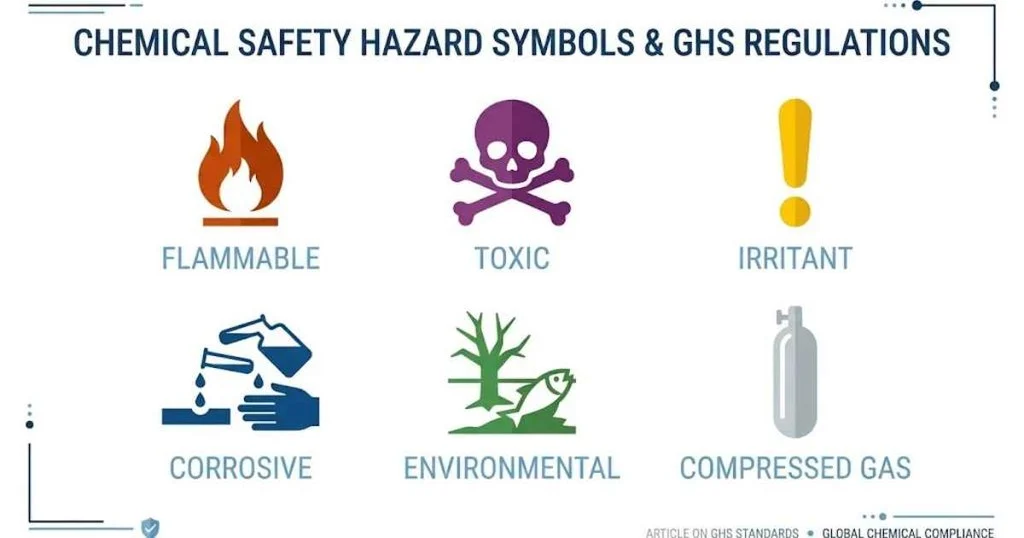
The GHS provides an international framework, but individual countries and regions implement it through their own regulations.
This means chemical labeling requirements can differ depending on where a product is manufactured, sold, or used.
United Nations and the GHS
The United Nations maintains the GHS framework through the UN Sub-Committee of Experts on the Globally Harmonized System.
The system is revised periodically to improve classification criteria and hazard communication.
The latest published edition is GHS Rev. 11 (2025).
United States: OSHA Hazard Communication Standard
In the United States, the Occupational Safety and Health Administration (OSHA) implements workplace chemical hazard communication through the Hazard Communication Standard.
The standard covers classification, labels, safety data sheets, and employee information and training.
One important distinction: the international GHS contains nine pictograms, but OSHA’s Hazard Communication Standard requires eight standard pictograms. The environmental pictogram is not required under OSHA’s standard because environmental hazards are outside its jurisdiction.
This is an important detail when comparing international GHS labels with US workplace labels.
European Union: CLP Regulation
The European Union implements GHS-based chemical classification and labeling through the CLP Regulation (EC) No. 1272/2008.
CLP stands for Classification, Labelling and Packaging.
It sets requirements for:
- Chemical classification.
- Hazard pictograms.
- Signal words.
- Hazard statements.
- Precautionary statements.
- Chemical packaging and labeling.
The European Chemicals Agency provides official guidance on
United States: Department of Transportation
The Department of Transportation (DOT) regulates the transportation of hazardous materials in the United States.
Its regulations cover dangerous-goods classification, packaging, marking, labeling, and shipping documentation.
These transportation rules are separate from OSHA’s workplace hazard communication requirements.
UN Recommendations on the Transport of Dangerous Goods
The UN Recommendations on the Transport of Dangerous Goods provide a common foundation for international dangerous-goods transportation rules.
They help support consistent transport classification and hazard communication across different modes of transport.
However, each country or transport authority may adopt additional requirements.
Frequently Asked Questions About GHS Symbols
What are the nine GHS hazard pictograms?
The nine GHS pictograms are:
- GHS01 — Exploding bomb.
- GHS02 — Flame.
- GHS03 — Flame over circle.
- GHS04 — Gas cylinder.
- GHS05 — Corrosion.
- GHS06 — Skull and crossbones.
- GHS07 — Exclamation mark.
- GHS08 — Serious health hazard.
- GHS09 — Environmental hazard.
Each pictogram communicates a different type of chemical hazard.
What is the difference between GHS06 and GHS07?
GHS06 identifies severe acute toxicity that can be fatal or toxic through swallowing, skin contact, or inhalation.
GHS07 identifies certain less severe acute toxicity hazards, irritation, skin sensitization, respiratory tract irritation, and narcotic effects.
Both indicate health hazards, but they apply to different classifications.
What does the GHS flame symbol mean?
GHS02 identifies flammable and certain reactive substances.
It can apply to flammable gases, aerosols, liquids, solids, pyrophoric materials, self-heating substances, and certain organic peroxides.
What does the GHS flame-over-circle symbol mean?
GHS03 identifies oxidizing gases, liquids, and solids.
Oxidizers can cause or intensify fires by supporting combustion or increasing the intensity of a fire involving other materials.
What does the corrosion pictogram indicate?
GHS05 warns about skin corrosion, serious eye damage, and corrosive effects on metals.
The product may cause severe burns or permanent eye damage, depending on its classification and exposure.
What does the serious health hazard symbol mean?
GHS08 identifies serious health hazards such as carcinogenicity, reproductive toxicity, germ cell mutagenicity, respiratory sensitization, aspiration hazards, and specific target organ toxicity.
It does not mean that every chemical carrying the symbol causes cancer.
What is the difference between Danger and Warning on a GHS label?
Both are GHS signal words.
Danger indicates a more severe hazard category, while Warning indicates a less severe category when a signal word is required.
A product may have several hazard classifications but uses the applicable signal word according to the labeling rules.
Are GHS symbols the same in every country?
The GHS provides a common international framework, but countries adopt it through their own regulations.
Some jurisdictions may use different revisions or have additional requirements.
For example, the United States’ OSHA workplace standard does not require the environmental pictogram, although the international GHS includes it.
Are GHS pictograms and transport symbols the same?
No. GHS pictograms communicate chemical hazards during supply and workplace use.
Transport labels identify dangerous goods during shipping and handling under transportation regulations.
They may look similar, but their classification systems and purposes differ.
Do all hazardous chemicals need all nine GHS symbols?
No. A chemical label displays the pictograms required by its hazard classification and the applicable regulations.
A product may need one pictogram, several pictograms, or none if it does not meet the relevant classification criteria.
Where can I find detailed information about a chemical’s hazards?
Start with the product label and its Safety Data Sheet (SDS).
The label provides a quick overview, while the SDS contains detailed information about chemical properties, exposure controls, first aid, storage, and disposal.
Conclusion
GHS symbols make chemical hazards easier to recognize and understand. The nine pictograms cover a wide range of dangers, including explosions, fires, oxidation, pressure, corrosion, poisoning, long-term health effects, and environmental damage.
Each symbol has a specific purpose. The flame warns about fire-related hazards, the skull and crossbones identifies severe acute toxicity, and the health hazard silhouette communicates serious health risks.
However, pictograms are only one part of chemical hazard communication. You should also read the signal words, hazard statements, precautionary statements, and supplier information on the label.
Remember that GHS categories and dangerous-goods transport classes are different systems. Other workplace systems, such as NFPA 704 and HMIS, also use their own ratings and symbols.
The safest approach is simple: identify the chemical, read its complete label, consult its Safety Data Sheet, and follow the required handling procedures. Understanding these warning symbols helps protect workers, consumers, and the environment from preventable chemical accidents.

Hi, I’m Sienna Brooks, and I believe that the right words can inspire, comfort, and empower people at every stage of life. For as long as I can remember, I’ve been drawn to meaningful quotes and the stories behind them. I love curating collections of inspirational, motivational, and heartfelt quotes that resonate with readers around the world.
Through my writing, I strive to help others find encouragement, whether they’re celebrating life’s happiest moments or navigating its biggest challenges. I believe that wisdom is timeless, and I’m passionate about sharing words that leave a lasting impact.
I am the author of Reflections in Words and The Journey of Inspiration, two books dedicated to exploring the beauty and power of timeless quotes.
 Asher Monroe
 Rowan Sinclair Rowan Sinclair