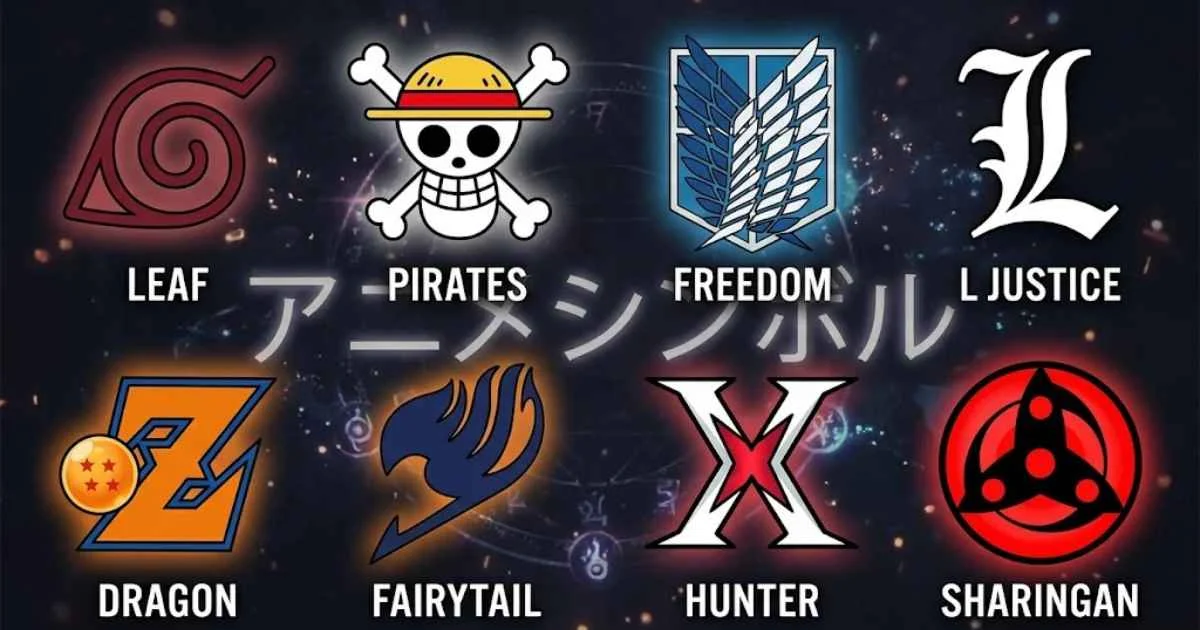
Anime is full of beautiful images that carry meanings beyond what appears on screen. A red flower may hint at death. A butterfly might represent personal growth. A bird flying across an open sky can suggest freedom, while a bird trapped inside a cage may reflect a character’s emotional struggles.
These details are not always random decorations. Many anime creators use visual symbolism to communicate emotions, explore cultural ideas, and develop their stories. Sometimes a single image can express feelings that an entire conversation cannot.
Understanding anime symbols helps you notice these deeper layers. You may recognize how flowers connect to life and death, why certain animals appear during important scenes, or how colors reflect a character’s changing emotions.
Japanese culture also plays an important role in this visual language. Concepts such as mono no aware, Buddhist ideas about impermanence, traditional flower meanings, and Japanese folklore influence many anime scenes.
However, symbols do not always have one fixed meaning. Their interpretation depends on the story, the character, the setting, and the creator’s intentions.
This guide explores common symbols in anime, their cultural backgrounds, and the meanings they often communicate.
What Do Symbols Mean in Anime?
Anime symbolism is the use of images, objects, colors, animals, flowers, and visual patterns to communicate ideas beyond their literal appearance.
Instead of explaining everything through dialogue, anime creators often use symbolic imagery to help viewers understand a character’s emotions or a story’s central themes.
For example, imagine a character standing beneath falling cherry blossoms after losing someone important. The flowers may represent beauty, but their short blooming period also reflects the temporary nature of life.
Similarly, a butterfly appearing during a character’s transformation may suggest personal growth, freedom, or a new beginning.
Symbols can serve several purposes:
- Express emotions: Show sadness, hope, fear, love, or loneliness without lengthy dialogue.
- Develop characters: Represent a character’s personality, personal struggles, or transformation.
- Connect stories to culture: Introduce Japanese traditions, religious ideas, and folklore.
- Create visual foreshadowing: Hint at future events before they happen.
- Strengthen themes: Reinforce ideas about life, death, freedom, identity, and human existence.
A symbol can also change meaning as a story progresses. A bird might initially represent freedom, but later become a reminder of a character’s inability to escape.
That changing meaning makes visual storytelling especially powerful.
Common Symbols in Anime and What They Mean
Many anime series use familiar symbols to communicate universal emotions and themes. Flowers, animals, colors, and everyday objects can all carry deeper meanings.
The following table provides a quick introduction to some common symbols in Japanese anime.
| Anime symbol | Common symbolic meaning |
| Red spider lily | Death, farewell, remembrance, and the boundary between life and death |
| Cherry blossoms | Impermanence, youth, beauty, and life’s fleeting moments |
| Blue spider lily | A fictional flower connected to Muzan’s search for a cure in Demon Slayer |
| White flowers | Innocence, remembrance, mourning, or purity, depending on context |
| Butterflies | Transformation, renewal, freedom, and personal growth |
| Birds | Freedom, hope, the human spirit, and escape |
| Caged birds | Imprisonment, oppression, and restricted choices |
| Crows | Intelligence, mystery, death-related imagery, or guidance |
| Wisteria | Beauty and protection in the fictional world of Demon Slayer |
| Lotus flowers | Spiritual growth, purity, and Buddhist symbolism |
| Red color | Passion, danger, violence, love, or intense emotions |
| Blue color | Calmness, sadness, distance, or emotional depth |
| White color | Innocence, purity, mourning, or spiritual significance |
| Mirrors | Identity, self-reflection, and hidden truths |
| Water | Change, cleansing, emotional depth, and renewal |
These meanings are starting points, not universal rules. A red flower in one anime may represent death, while another story may use it to express romantic love.
The surrounding scene provides the most important clues.
Flower Symbolism in Anime
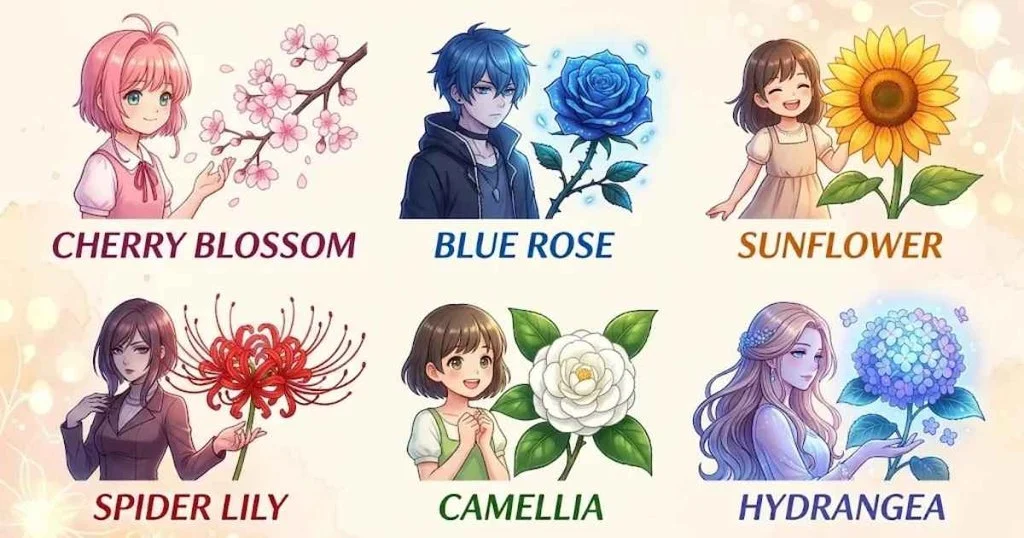
Flowers are among the most recognizable forms of symbolic imagery in Japanese animation. Their colors, shapes, blooming seasons, and short lifespans make them useful for expressing complicated emotions.
Japanese culture has a long tradition of appreciating flowers through poetry, art, seasonal customs, and flower-arranging practices. The language of flowers, known as hanakotoba, also assigns meanings to different blooms.
Anime creators draw on these traditions while developing their own fictional meanings.
Red Spider Lily: Death, Farewell, and Remembrance
<image_placeholder>
The red spider lily, scientifically known as Lycoris radiata, is one of the most recognizable flowers in anime symbolism.
Its Japanese name is higanbana, commonly translated as “equinox flower.” The flower blooms around the autumn equinox, which coincides with the Buddhist Higan period when families traditionally visit ancestral graves.
Because of this association, the red spider lily often appears in stories involving death, separation, grief, and remembrance.
Its bright red petals also create a striking contrast against dark or quiet backgrounds. This visual contrast makes it especially effective in emotional scenes.
The flower can communicate several ideas:
- Death and farewell: Its association with graveyards makes it a natural choice for scenes about loss.
- Remembrance: It can suggest memories of people who have passed away.
- Separation: Its appearance may accompany characters who are leaving someone behind.
- The afterlife: Its connection with Higan can evoke spiritual boundaries and the world beyond ordinary life.
- Impermanence: Its seasonal blooming can remind viewers that life and beauty do not last forever.
The flower’s cultural background is particularly important. Higan is associated with the Buddhist idea of reaching the “other shore,” and families observe the seasonal periods by honoring their ancestors. Red spider lilies have become closely connected with autumn grave visits in Japan. (Nippon.com)
This explains why the flower often carries a mysterious or sorrowful atmosphere in anime.
Why are spider lilies associated with death?
Their association comes partly from their appearance around graveyards and their seasonal connection with the Higan period. The plant also contains toxic compounds, and its bulbs have historically been used to discourage animals from disturbing graves and crops.
The flower’s reputation is not based on one simple legend. It developed through a combination of seasonal customs, practical uses, and cultural associations. (The Japan Times)
Blue Spider Lily: The Search for Immortality in Demon Slayer
The blue spider lily has a special meaning in Demon Slayer: Kimetsu no Yaiba.
Unlike the real red spider lily, the blue spider lily is a fictional flower created for the story. It is connected to the medicine that Muzan Kibutsuji received while struggling with a serious illness as a human.
Muzan’s transformation into a demon did not solve his problems completely. He remained vulnerable to sunlight, which became one of his greatest weaknesses.
He therefore searches for the blue spider lily, hoping to overcome that limitation and achieve a form of immortality.
The flower represents several important themes:
- Immortality: Muzan wants to escape the limits of ordinary human life.
- Obsession: His search shows how far he is willing to go for power and survival.
- Fear of death: His actions reveal his inability to accept mortality.
- Unattainable desire: The flower becomes a symbol of something he desperately wants but cannot easily obtain.
- Consequences of ambition: His pursuit of eternal life leads to suffering and destruction.
The contrast between the red spider lily and the blue spider lily is especially interesting.
The real red flower carries cultural associations with death and remembrance. The fictional blue flower represents Muzan’s attempt to escape death.
This contrast supports one of the series’ central conflicts: the difference between accepting mortality and trying to control life forever.
White Spider Lily: Purity, Loss, and Spiritual Meaning
White flowers often appear in anime scenes involving funerals, memories, peaceful settings, and emotional farewells.
The white spider lily can be interpreted through similar themes, although its exact meaning depends on the story.
White often creates a sense of quietness and simplicity. In a scene about death, it may suggest remembrance, mourning, or spiritual peace. In a scene about a new beginning, it may suggest innocence or renewal.
It is important not to treat white as a universal symbol of happiness or purity. White can also carry associations with mourning in Japanese cultural contexts.
When you interpret a white flower, consider the scene around it:
- Is someone remembering a person who died?
- Does the flower appear during a funeral or farewell?
- Is the character experiencing emotional relief?
- Does the scene suggest a fresh beginning?
These details help reveal the intended symbolic meaning.
Cherry Blossoms: Beauty and the Fragility of Life
<image_placeholder>
Cherry blossoms, known as sakura in Japanese, are among the most recognizable symbols in Japanese culture.
They bloom beautifully but remain on the trees for only a short period. Their petals eventually fall, creating a powerful image of temporary beauty.
In anime, cherry blossoms often represent:
- Youth and childhood memories
- New beginnings and school life
- Romantic feelings
- Friendship and emotional connections
- The fragility of life
- Change and separation
- Memories that remain after people move on
Their connection with mono no aware makes them especially meaningful.
A character watching cherry blossoms fall may be experiencing happiness, sadness, or both. The scene can remind viewers that wonderful moments are valuable partly because they do not last forever.
Cherry blossoms frequently appear during graduation scenes, school entrances, first meetings, and emotional endings.
For example, an anime may show two friends meeting beneath a cherry tree at the beginning of their journey. Later, the same location may appear when they separate. The flowers connect those moments and highlight how much time has passed.
Wisteria: Beauty and Protection
Wisteria is another important flower in anime, especially in Demon Slayer.
In the series, wisteria has a special protective role. Its scent and properties are used to keep demons away, and it appears around places associated with safety.
This is a story-specific symbolic use, not evidence that traditional Japanese culture universally considers wisteria a demon-repelling plant.
Within the anime, wisteria can represent:
- Protection from danger
- Safety and shelter
- Hope during difficult times
- Beauty existing alongside fear
- The contrast between nature and supernatural threats
Its hanging clusters also create a distinctive visual effect. The flowers can make a setting look peaceful even when the surrounding story involves violence.
Lotus Flowers: Spiritual Growth and Enlightenment
The lotus flower has deep religious and cultural significance across several Asian traditions, including Buddhism.
It grows in muddy water yet produces a clean, beautiful flower. This contrast makes it a powerful image of spiritual development.
In Buddhist symbolism, the lotus is associated with purity, awakening, and the possibility of rising above suffering.
Anime may use lotus imagery to suggest:
- Spiritual growth
- Inner strength
- Purity despite difficult circumstances
- Rebirth and renewal
- Wisdom and enlightenment
- Freedom from destructive attachments
The lotus also appears in religious artwork and references connected with Buddhist teachings.
Its symbolism should not be confused with a specific passage or teaching from the Lotus Sutra every time it appears. A flower may simply use familiar Buddhist imagery without directly referring to that scripture.
Other Flowers and Their Symbolic Meanings
Different flowers can add emotional depth to anime scenes. Their meanings may come from traditional flower language, seasonal associations, or the story itself.
| Flower | Common symbolic associations |
| Camellia | Love, beauty, devotion, and sometimes farewell |
| Chrysanthemum | Autumn, longevity, and remembrance; also associated with Japan’s imperial emblem |
| Plum blossom | Resilience, hope, and the arrival of spring |
| Rose | Love, passion, romance, and beauty |
| Morning glory | Temporary beauty and fleeting feelings |
| Hydrangea | Changing emotions, gratitude, and apology in some flower-language traditions |
| Sunflower | Warmth, hope, admiration, and positivity |
A flower’s meaning can change according to its color and placement. A red rose may suggest passion, while a white rose may suggest innocence or remembrance.
Animal Symbolism in Anime
Animals are another major part of visual storytelling. Their natural behavior, appearance, and cultural associations make them useful for representing human emotions and personality traits.
An anime character may be compared to an animal because of their intelligence, courage, loyalty, or ability to survive.
Animals can also appear in the background as visual metaphors. A bird flying away, for example, may express a desire to escape even when the character says nothing.
Butterflies: Transformation, Freedom, and Rebirth
<image_placeholder>
Butterflies are common symbols of transformation in anime.
Their life cycle provides a natural metaphor for personal development. A caterpillar becomes a chrysalis before emerging as a butterfly. This process can represent a character moving beyond an earlier version of themselves.
Butterflies may symbolize:
- Transformation and personal growth
- Freedom and independence
- Rebirth and renewal
- Beauty and fragility
- The soul or spiritual change in certain cultural traditions
- A character leaving behind painful experiences
Their appearance can also create a connection between beauty and danger.
In Demon Slayer, butterfly imagery is strongly associated with Shinobu Kocho and the Butterfly Mansion. Shinobu’s butterfly-inspired appearance connects to her personality, her fighting style, and the wider imagery surrounding her character.
However, the butterfly’s meaning is not limited to Shinobu. Across anime, butterflies can represent emotional change, a delicate form of hope, or the movement from one stage of life to another.
Birds: Freedom, Hope, and the Human Spirit
Birds often represent the desire to move beyond limitations.
They can fly across mountains, cities, and oceans. This ability makes them natural symbols of freedom and independence.
In anime, birds may communicate:
- Hope during difficult times
- Escape from oppression
- Personal independence
- The desire to explore the world
- Emotional release
- The human spirit seeking a new direction
A bird flying toward the horizon can suggest that a character is beginning a new journey. A bird sitting outside a prison window may reflect a person’s longing for freedom.
The meaning depends on the scene. A bird can also symbolize loneliness if it appears separated from its flock.
Caged Birds: Imprisonment and Oppression
A caged bird is one of the clearest visual metaphors in anime.
The bird may have wings, but the cage prevents it from flying. This contrast can represent a character who has potential but lacks the freedom to make personal choices.
A bird cage may symbolize:
- Oppression and control
- Restricted independence
- Family or social expectations
- Emotional imprisonment
- Fear of taking risks
- The struggle for freedom
The cage does not always represent a physical prison.
A character may live in a beautiful home but feel trapped by family pressure. Another may have wealth and status but lack control over their future.
In these situations, the bird cage becomes a visual representation of an invisible restriction.
Crows: Intelligence, Mystery, and Guidance
<image_placeholder>
Crows have a complex place in Japanese symbolism.
They are sometimes associated with death, darkness, and bad omens. However, Japanese mythology also includes a significant crow figure known as Yatagarasu.
Yatagarasu is a mythical crow that guided the legendary Emperor Jimmu on his journey. It is associated with guidance and divine assistance, particularly through its connection with the sun goddess Amaterasu.
The Japan Tourism Agency describes Yatagarasu as a guide sent to help Jimmu travel from Kumano toward present-day Nara.
This means crows do not have one fixed meaning in Japanese culture.
They may suggest:
- Guidance and direction
- Intelligence and observation
- Mystery and darkness
- Death and misfortune
- Spiritual messages
- Survival and adaptability
Their meaning depends on the story’s cultural references and visual context.
What Do Crows Represent in Haikyuu?
In Haikyuu!!, crows are directly connected to Karasuno High School’s volleyball team.
The word karasu means “crow” in Japanese. The team’s identity and imagery reflect this connection.
Karasuno is also associated with the nickname “Flightless Crows.” This nickname reflects the team’s difficult period and its struggle to regain its former reputation.
The crow becomes a fitting image for the team’s journey.
It can represent:
- Team identity and unity
- Perseverance after failure
- The desire to rise again
- Strength through cooperation
- The struggle to regain lost confidence
The imagery becomes more meaningful as the players improve. They are not simply trying to win matches. They are also trying to prove that they can rise again.
Seagulls: Survival, Hope, and the Open World
Seagulls often appear in anime scenes near beaches, ports, and coastal towns.
Their presence can create a feeling of openness. A character standing beside the ocean while seagulls fly overhead may appear ready to leave the past behind.
Possible meanings include:
- Freedom and independence
- Hope for a better future
- Perseverance
- Travel and exploration
- Loneliness or separation
- Connection with nature
However, seagulls do not have one established symbolic meaning across Japanese culture. Their interpretation is usually specific to the story or scene.
A seagull flying over the sea might suggest freedom in one anime, while a group of birds calling near an empty harbor might create a feeling of loneliness in another.
Caterpillars: Change Before Transformation
Caterpillars are less common than butterflies, but they offer an interesting symbolic contrast.
A butterfly represents the completed transformation. A caterpillar represents the stage before that change.
In anime, caterpillars can suggest:
- A character’s early development
- Hidden potential
- Personal struggles
- An unfinished journey
- Growth that requires patience
- The uncertainty of change
This symbolism is useful when a character has not yet discovered their strengths.
The caterpillar reminds viewers that transformation takes time. A person does not become stronger in a single moment.
Other Animals and Their Meanings
| Animal | Common symbolic meaning |
| Fox | Intelligence, mystery, trickery, and supernatural folklore |
| Snake | Danger, transformation, temptation, or renewal |
| Cat | Independence, curiosity, mystery, and good fortune in some contexts |
| Crane | Longevity, hope, peace, and good fortune |
| Dragon | Power, protection, wisdom, and supernatural strength |
| Koi fish | Perseverance, determination, and overcoming obstacles |
| Wolf | Loyalty, survival, independence, and instinct |
| Deer | Nature, gentleness, spirituality, and sensitivity |
These associations are not fixed meanings for every anime. A fox may be a friendly companion in one series and a dangerous supernatural creature in another.
Color Symbolism in Anime
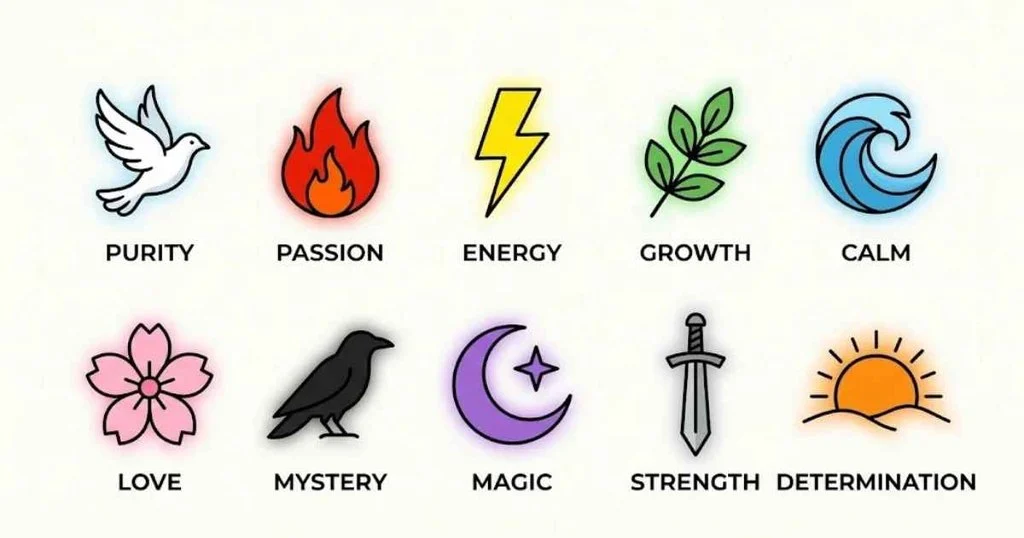
Color is one of the simplest ways anime creators communicate mood and emotion.
A scene can feel peaceful because of its soft blue lighting. A sudden shift to red may create tension or suggest danger. White backgrounds can make a moment feel pure, empty, or emotionally distant.
These visual choices help establish the atmosphere before viewers fully understand what is happening.
Red: Love, Passion, Danger, and Death
Red is an emotionally powerful color.
It can represent love, passion, anger, blood, violence, or danger. Its meaning depends on how the anime uses it.
For example:
- Red flowers may suggest love, loss, or remembrance.
- Red lighting may create a threatening atmosphere.
- Red clothing may highlight confidence or intensity.
- Blood-red imagery may emphasize violence and mortality.
Red spider lilies are particularly important because their color combines visual beauty with associations of death and farewell.
The idea that red symbolizes death in every Japanese story would be too broad. Red has many meanings, and the surrounding scene determines its role.
Blue: Calmness, Sadness, and Emotional Depth
Blue often creates a peaceful or reflective atmosphere.
It may appear during scenes involving water, night skies, emotional distance, or loneliness.
Common interpretations include:
- Calmness and peace
- Sadness and grief
- Loyalty and trust
- Isolation
- Emotional control
- Reflection and introspection
In some anime, blue lighting creates a sense of emotional distance between characters. In others, it suggests a peaceful moment after conflict.
The claim that blue symbolizes life is not a universal Japanese color rule. The fictional blue spider lily in Demon Slayer, for example, has a specific story role rather than representing a general cultural meaning of blue.
White: Innocence, Purity, and Mourning
White is often associated with simplicity, purity, and innocence.
However, its meaning can also connect with mourning and death in Japanese cultural contexts.
In anime, white may appear in:
- Funeral scenes
- Spiritual or religious imagery
- Memories of childhood
- Scenes of emotional peace
- Moments of isolation
- Representations of innocence
A white flower beside a grave may suggest remembrance. A character wearing white during a peaceful scene may appear innocent or emotionally renewed.
Japanese and Western interpretations can overlap, but they are not always identical. Cultural context matters.
Black: Mystery, Grief, and Hidden Emotions
Black often creates a dramatic atmosphere.
It may represent:
- Death and mourning
- Mystery and secrecy
- Fear and danger
- Emotional darkness
- Power and authority
- Hidden intentions
Anime frequently uses dark backgrounds to show a character’s isolation or internal conflict.
However, black clothing does not automatically mean that a character is evil. It may simply reflect their personality, social position, or visual design.
Purple: Mystery, Nobility, and Spiritual Power
Purple often creates a sense of mystery and elegance.
Depending on the story, it may represent:
- Royalty and status
- Spiritual energy
- Mystery and secrecy
- Power and ambition
- Unusual or supernatural abilities
Its use in character designs can help distinguish someone who has an unusual personality or a complicated background.
Pink and Yellow: Emotion, Warmth, and Hope
Pink often appears in scenes involving affection, romance, innocence, and tenderness.
Yellow and gold can create feelings of warmth, happiness, optimism, or achievement.
| Color | Common anime interpretations |
| Red | Passion, danger, love, violence, and intense emotions |
| Blue | Calmness, sadness, trust, and reflection |
| White | Innocence, purity, mourning, and spiritual meaning |
| Black | Mystery, grief, secrecy, and darkness |
| Purple | Power, elegance, mystery, and spirituality |
| Pink | Romance, tenderness, and affection |
| Yellow | Happiness, energy, hope, and warmth |
| Gold | Success, prestige, and achievement |
Japanese Cultural and Religious Symbols in Anime
Understanding Japanese symbolism makes it easier to recognize references that may not be immediately obvious to international viewers.
Anime often includes traditional beliefs, seasonal customs, religious imagery, and philosophical ideas. These details can add meaning to a story without requiring a direct explanation.
Mono no Aware: The Beauty of Impermanence
Mono no aware is a Japanese aesthetic concept that describes an emotional awareness of the temporary nature of things.
It involves recognizing that life, beauty, relationships, and experiences change over time.
The feeling can be both joyful and sad. You appreciate something because it is beautiful, but you also understand that it will not last forever.
Cherry blossoms provide a familiar example.
Their flowers create a beautiful display, but they fall after a short blooming period. Their temporary nature makes the experience more meaningful.
In anime, mono no aware may appear through:
- Falling flower petals
- Childhood memories
- Characters separating after years together
- Changing seasons
- A final meeting between friends
- A character remembering someone who has died
A scene does not need to mention the phrase directly to express the concept.
A quiet shot of an empty classroom after graduation can communicate the same feeling. The room remains, but the people who once filled it have moved on.
Buddhist Symbolism: Life, Death, and Rebirth
Buddhism influences many aspects of Japanese art and culture, including visual imagery found in anime.
Some recurring Buddhist concepts include:
- Impermanence: All things change and eventually pass away.
- Suffering: Human life includes pain, loss, and dissatisfaction.
- Rebirth: Existence is connected with cycles of birth and death in Buddhist traditions.
- Enlightenment: Spiritual awakening involves understanding reality more deeply.
- Non-attachment: Freedom from unhealthy attachment can help overcome suffering.
Anime may explore these ideas through lotus flowers, temples, monks, funeral imagery, and characters who struggle with loss or attachment.
However, not every story involving reincarnation or an afterlife is directly based on Buddhist teachings. Some anime combine Buddhist imagery with Shinto traditions, folklore, fantasy, and original fictional ideas.
Higan: Remembering the Dead
Higan is a Buddhist observance in Japan that takes place around the spring and autumn equinoxes.
During these periods, many families visit ancestral graves, clean them, and offer prayers or flowers.
The autumn Higan period is closely connected with the blooming of red spider lilies.
This relationship helps explain why higanbana frequently appears in anime scenes involving death, memory, and farewell.
The flower is not simply a frightening decoration. It also connects the story to seasonal change and remembrance of ancestors.
Shinto Symbols and Nature
Shinto is a traditional Japanese religion with a strong focus on kami, sacred places, and relationships with the natural world.
Anime may include Shinto imagery through:
- Torii gates
- Shrine buildings
- Sacred ropes known as shimenawa
- Ritual purification
- Offerings and festivals
- Sacred trees and natural locations
A torii gate often marks the entrance to a Shinto shrine or a boundary associated with sacred space.
When an anime character walks through a torii gate, the scene may establish a connection with a shrine or a spiritual setting.
The gate does not automatically mean that the character is entering another world. Its meaning depends on the story.
Japanese Folklore and Yokai
Japanese folklore includes many supernatural beings known as yokai.
They appear in different forms, including strange animals, spirits, monsters, and mysterious creatures.
Anime often adapts these traditional figures or creates new ones inspired by folklore.
Common examples include:
- Kitsune, supernatural foxes
- Tengu, mountain-associated supernatural beings
- Kappa, water-dwelling creatures
- Oni, powerful ogre-like beings
- Tanuki, creatures associated with transformation and trickery
These figures can represent fear, temptation, protection, mischief, or the unknown.
Their meanings differ across regional traditions and individual stories.
How Anime Uses Symbols in Famous Series
Some anime series use symbolism so effectively that their visual details become closely connected with the story’s identity.
Looking at individual examples helps explain how symbols work in practice.
Demon Slayer: Flowers, Sunlight, and Immortality
Demon Slayer: Kimetsu no Yaiba uses flowers and natural imagery to support its themes of mortality, family, and survival.
The most important examples include:
Red spider lilies: These flowers connect with death, remembrance, and the atmosphere of the boundary between life and death.
Blue spider lily: This fictional flower represents Muzan’s search for a way to overcome his weakness to sunlight and achieve greater control over his existence.
Wisteria: Within the series, wisteria provides protection against demons. It creates a contrast between the beauty of nature and the danger of the demon world.
Butterflies: Their association with Shinobu Kocho and the Butterfly Mansion connects them with transformation, delicacy, and the characters’ work to protect and heal others.
Sunlight: Sunlight is central to the conflict between humans and demons. It represents a natural force that demons cannot easily overcome.
These symbols help communicate the difference between human vulnerability and Muzan’s obsession with escaping death.
Tokyo Ghoul: Masks, Identity, and Humanity
Tokyo Ghoul explores the conflict between human identity and monstrous existence.
Masks play an important role in this world. Characters use them to hide their identities, protect themselves, or express their ghoul identities.
Masks can symbolize:
- Hidden identities
- Social exclusion
- Fear of judgment
- The difference between appearance and reality
- The struggle to belong
- A divided sense of self
Kaneki’s journey also explores the tension between two identities.
He struggles to understand where he belongs as his human life and ghoul existence become increasingly difficult to separate.
This makes masks and physical transformation especially meaningful. They reflect the characters’ changing relationships with themselves and society.
Your Lie in April: Music, Color, and Emotional Change
Your Lie in April uses music and visual imagery to express emotions that its characters struggle to communicate.
The story follows Kosei Arima, a talented pianist whose relationship with music changes after experiencing personal loss.
Color plays an important role in the anime’s atmosphere.
Bright scenes, soft lighting, and musical performances can suggest emotional awakening. In contrast, muted or darker visuals may reflect grief, isolation, and painful memories.
The central symbolism connects with:
- Healing after loss
- Rediscovering passion
- Emotional freedom
- Love and friendship
- The temporary nature of relationships
- The power of music to express hidden feelings
Music becomes more than a performance. It provides a way for characters to communicate their inner thoughts.
A Silent Voice: Water, Distance, and Reconnection
A Silent Voice explores bullying, guilt, disability, loneliness, and forgiveness.
Its visual storytelling frequently reflects the emotional distance between characters.
The story uses framing, movement, and environmental details to show how characters experience the world around them.
Some recurring visual ideas include:
- Water: Can create a reflective atmosphere and accompany moments of emotional change.
- Distance: Physical separation can reflect loneliness and difficulty communicating.
- Faces and expressions: Small changes reveal emotions that characters struggle to express.
- Silence: The absence of conversation becomes part of the emotional experience.
- Reconnection: Changes in how characters interact suggest progress and healing.
The film’s visual choices support its central message: understanding another person requires more than simply hearing their words.
Attack on Titan: Freedom, Birds, and Oppression
Attack on Titan repeatedly explores freedom, confinement, violence, and the limits placed on human life.
Walls are among the most important visual symbols in the story.
They provide protection, but they also restrict movement and knowledge. This creates a contradiction between safety and imprisonment.
The walls can represent:
- Oppression
- Fear of the outside world
- Restricted knowledge
- Social control
- The desire for independence
Bird imagery also connects naturally with the series’ central theme of freedom.
Birds can move beyond the walls and travel through the open sky. This creates a powerful contrast with characters whose lives are restricted by physical and political boundaries.
The story’s use of freedom is complicated, though. It asks whether freedom is possible without consequences and whether one person’s independence can come at another person’s expense.
Vinland Saga: Violence, Growth, and the Search for Peace
Vinland Saga uses character development to explore the consequences of revenge and violence.
Thorfinn’s journey is especially important.
At first, revenge controls much of his life. His identity becomes closely connected with violence and the desire to defeat Askeladd.
As the story develops, his understanding of strength changes.
His journey can be interpreted through themes such as:
- Personal transformation
- The rejection of violence
- Emotional healing
- Freedom from hatred
- The search for purpose
- Building a peaceful future
The changing landscape also supports the story’s themes. Travel, open spaces, and new settlements can represent possibilities beyond the violence of the past.
The title’s connection to Vinland also supports the idea of searching for a better place and a different way of living.
Haikyuu: Crows, Teamwork, and Perseverance
Haikyuu!! uses the crow identity of Karasuno High School as an important part of its team symbolism.
The team’s name connects with the Japanese word for crow, and its identity reflects the idea of a group trying to rise again.
The crow imagery supports several themes:
- Teamwork and cooperation
- Perseverance after failure
- Confidence and ambition
- Growth through practice
- Loyalty to teammates
- The determination to compete
The players do not succeed through individual talent alone. They learn to trust one another and combine their strengths.
This makes the crow a fitting symbol for a team that wants to fly again.
Other Common Visual Symbols in Anime
Flowers, animals, and colors are only part of anime’s symbolic language. Everyday objects and natural settings can also carry important meanings.
The Moon: Change, Mystery, and Reflection
The moon often appears in scenes involving solitude, romance, mystery, and emotional reflection.
Its changing phases can suggest the passage of time or changes in a character’s life.
A full moon may create a sense of completion or emotional intensity. A crescent moon can make a scene feel quiet, mysterious, or incomplete.
The moon may also connect with supernatural themes, depending on the story.
Water: Cleansing, Change, and Emotional Depth
Water is a flexible symbol because it can appear in many different forms.
A river may represent the passage of time. Rain may accompany sadness or emotional release. The ocean may suggest freedom, uncertainty, or the vastness of life.
Common interpretations include:
- Emotional change
- Cleansing and renewal
- Memories
- The passage of time
- Uncertainty
- Personal transformation
A character washing their hands after a difficult experience may suggest an attempt to leave the past behind.
However, water can also represent danger or overwhelming emotions. Its meaning depends on the scene.
Mirrors and Reflections: Identity and Self-Discovery
Mirrors often appear when characters question who they are.
A reflection can represent the difference between a person’s public appearance and private thoughts.
Anime may use mirrors to explore:
- Identity and self-awareness
- Hidden emotions
- Personal conflict
- Fear of change
- Self-acceptance
- The difference between reality and illusion
A character looking into a mirror may be trying to understand how much they have changed.
Masks: Hidden Feelings and Social Identity
Masks can hide a person’s face, but they can also represent the role someone plays in society.
A character may appear confident in public while feeling frightened or insecure privately.
Masks can therefore symbolize:
- Secrecy
- Protection
- False appearances
- Social expectations
- Hidden identities
- Emotional defense
This symbolism is particularly useful in stories involving supernatural creatures, secret organizations, or characters who struggle with belonging.
Torii Gates: Sacred Boundaries and Spiritual Places
Torii gates are recognizable features of Shinto shrines.
They commonly mark the entrance to a sacred area and help establish a visual distinction between ordinary surroundings and a shrine’s sacred space.
In anime, a torii gate may suggest:
- A connection with Shinto traditions
- A spiritual setting
- A place associated with local legends
- A transition into an unfamiliar environment
- A meeting between ordinary and supernatural worlds
Some anime use torii gates in fantasy scenes, but their traditional function should still be understood.
The Red String of Fate: Connection and Destiny
The red string of fate is a popular East Asian cultural motif associated with destined relationships.
It is often shown as an invisible or visible thread connecting people who are meant to meet.
In anime, it may represent:
- Romantic destiny
- A meaningful relationship
- A connection across distance
- Fate and coincidence
- A bond that survives separation
The motif is often used in romance and fantasy stories.
It should not be confused with a universal Japanese belief that every relationship is predetermined. Anime frequently adapts the idea for dramatic storytelling.
How Anime Symbols Develop Characters and Themes
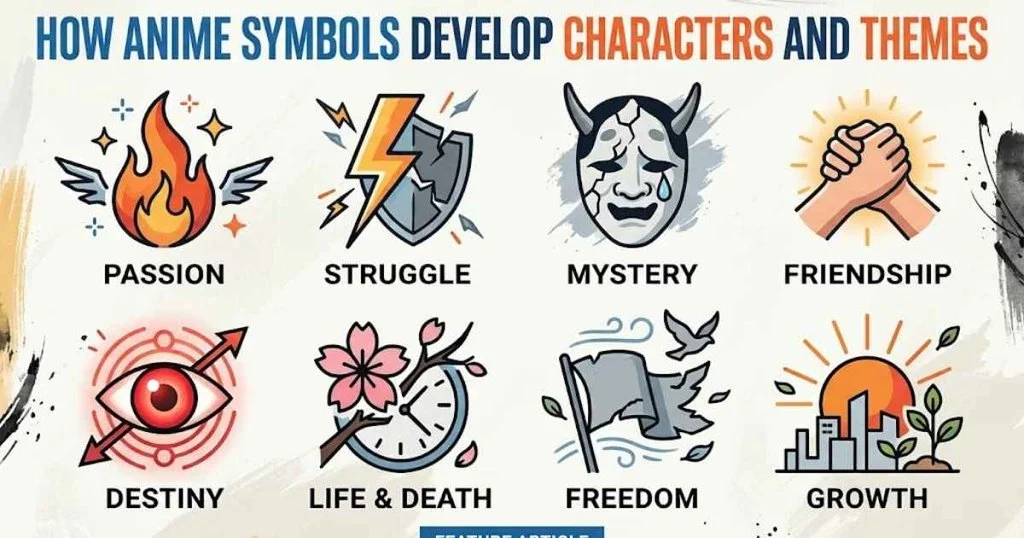
Symbols become most powerful when they connect with a character’s personal journey.
A butterfly, for example, may initially appear as a simple decorative detail. Later, it may become connected with a character’s transformation or emotional recovery.
This repeated use helps viewers recognize changes without requiring the story to explain everything directly.
Symbols Reveal Inner Thoughts
Characters do not always express their feelings through dialogue.
A character may say they are fine while sitting alone beneath a dark sky. The setting can communicate loneliness more clearly than their words.
Likewise, a person watching a bird fly away may reveal a desire for freedom.
These visual details help viewers understand the gap between what a character says and what they actually feel.
Symbols Show Character Transformation
A symbol can follow a character through different stages of life.
For example, a butterfly may appear when a character is struggling, then return after they have changed.
The repeated image creates a connection between the character’s earlier and later experiences.
This technique is known as a visual motif. A motif is an image, object, sound, or idea that appears repeatedly and gains meaning through repetition.
Symbols Connect Personal Stories With Larger Themes
A character’s experience may reflect a larger idea about human existence.
A cherry blossom can connect one person’s sadness with the universal experience of losing something beautiful.
A cage can represent one character’s personal restrictions while also suggesting wider social oppression.
A bird flying beyond a wall can connect a character’s private dream with a larger quest for freedom.
This is how narrative symbolism helps anime communicate ideas beyond individual characters.
How to Interpret Hidden Meanings in Anime
You do not need specialist knowledge to recognize symbolism. A few simple steps can help you understand the meaning behind an image.
Look at the Scene’s Context
Start by asking what is happening when the symbol appears.
A white flower during a funeral may suggest remembrance. The same flower during a character’s recovery may suggest peace or renewal.
Context is more useful than memorizing a list of meanings.
Notice Repeated Images
If the same object or animal appears several times, it may be an important visual motif.
Pay attention to when it appears and whether its meaning changes.
For example, a bird may first appear in a cage and later appear flying freely. This contrast may reflect a character’s emotional development.
Consider the Character’s Journey
Think about what the character wants, fears, and struggles with.
A symbol often connects directly with these personal experiences.
A character obsessed with immortality may be surrounded by images related to death. Someone searching for independence may repeatedly appear beside open skies or flying birds.
Understand the Cultural Background
Some symbols have meanings rooted in Japanese traditions.
Knowing the background of higanbana, cherry blossoms, Buddhist imagery, or Shinto shrine objects can make certain scenes easier to understand.
However, cultural meanings should not be treated as automatic explanations. Anime creators can adapt, change, or completely reinvent traditional symbols.
Avoid Assuming Every Detail Has a Hidden Message
Not every flower, bird, or color represents a secret idea.
Sometimes a flower is simply part of the background. A blue scene may be a lighting choice rather than a statement about life or sadness.
Good interpretation requires balance. Look for repeated patterns, meaningful placement, and connections with the story instead of forcing symbolism into every detail.
Frequently Asked Questions About Anime Symbols
What are the four common symbols in anime and what do they mean?
Four common symbols include flowers, butterflies, birds, and colors.
Flowers often communicate beauty, impermanence, love, or death. Butterflies can represent transformation and rebirth. Birds frequently suggest freedom and hope. Colors help establish emotions, moods, and character traits.
Their exact meanings depend on the anime and its cultural context.
What does the spider lily symbolize in anime?
The red spider lily commonly symbolizes death, farewell, remembrance, and separation.
Its Japanese name, higanbana, connects it with the autumn Higan period and visits to ancestral graves.
The fictional blue spider lily in Demon Slayer has a different story-specific meaning. It represents Muzan’s search for a way to overcome his vulnerability to sunlight.
Why are spider lilies associated with death?
Red spider lilies bloom around the autumn equinox, when many Japanese families visit ancestral graves during the Higan period.
They are also commonly found near graveyards and paths. Their association with death developed through seasonal customs, practical uses, and cultural traditions.
What do cherry blossoms represent in anime?
Cherry blossoms often represent youth, beauty, new beginnings, and the temporary nature of life.
Their short blooming period connects them with the Japanese aesthetic concept of mono no aware, which describes the emotional awareness of impermanence.
What do butterflies symbolize in anime?
Butterflies commonly symbolize transformation, freedom, rebirth, and personal growth.
Their life cycle makes them a natural metaphor for characters who overcome difficulties and enter a new stage of life.
What do birds symbolize in anime?
Birds often represent freedom, hope, independence, and the human spirit.
A flying bird may suggest escape or new possibilities. A caged bird can represent oppression, emotional restrictions, or a character’s desire to make their own choices.
What do crows represent in Japanese culture?
Crows have both positive and negative associations in Japanese culture.
They can be connected with death and misfortune, but the mythical Yatagarasu is associated with divine guidance. This three-legged crow guided the legendary Emperor Jimmu on his journey.
What do crows represent in Haikyuu?
Crows represent the identity of Karasuno High School’s volleyball team.
The imagery connects with the team’s name and its reputation as the “Flightless Crows.” It also supports themes of teamwork, perseverance, ambition, and rising again after failure.
What does mono no aware mean in anime?
Mono no aware describes an emotional awareness of the temporary nature of life and beauty.
In anime, it may appear through falling cherry blossoms, changing seasons, childhood memories, farewells, and characters who must accept that important moments cannot last forever.
Does blue symbolize life in Japanese culture?
No. Blue does not have one universal meaning of life in Japanese culture.
It can represent calmness, sadness, distance, trust, or other ideas depending on the context. The blue spider lily in Demon Slayer is a fictional story element, not proof of a traditional color meaning.
Do all anime symbols have traditional Japanese meanings?
No. Some symbols come from Japanese culture, Buddhism, Shinto, or folklore. Others are created specifically for an anime’s fictional world.
A creator may also adapt a familiar symbol to communicate a new idea. Always consider the story’s context before deciding what an image means.
Conclusion: Why Anime Symbols Make Stories More Meaningful
Anime symbols help transform ordinary images into powerful storytelling tools.
A red spider lily can connect a scene with death and remembrance. Cherry blossoms can remind viewers that beauty and youth are temporary. Butterflies can represent transformation, while birds may express freedom or hope.
Japanese cultural ideas also add depth to these images. Concepts such as mono no aware, Buddhist impermanence, Higan, and Shinto traditions help explain why certain flowers, animals, and objects appear so often in anime.
However, the most important rule is to consider context. A symbol can have different meanings in different stories, and fictional symbolism does not always follow traditional cultural interpretations.
The next time you watch anime, pay attention to the flowers, colors, animals, and objects in the background. You may discover that a small visual detail reveals something important about a character’s emotions, struggles, or future.

Hello, I’m Rowan Sinclair, a passionate writer and lifelong admirer of the wisdom found in great quotes. I believe that words have the ability to inspire change, spark creativity, and connect people across cultures and generations.
I enjoy writing about motivational quotes, famous sayings, and lessons from history’s most influential thinkers. Every article I create is driven by my desire to help readers discover meaningful insights that they can apply to their own lives.
When I’m not writing, I spend my time reading biographies, exploring classic literature, and collecting memorable quotes that deserve to be shared with the world.
I am the author of Voices That Inspire and A Collection of Timeless Thoughts, two books that celebrate the enduring power of words and the stories behind them.
 Asher Monroe
 Sienna Brooks