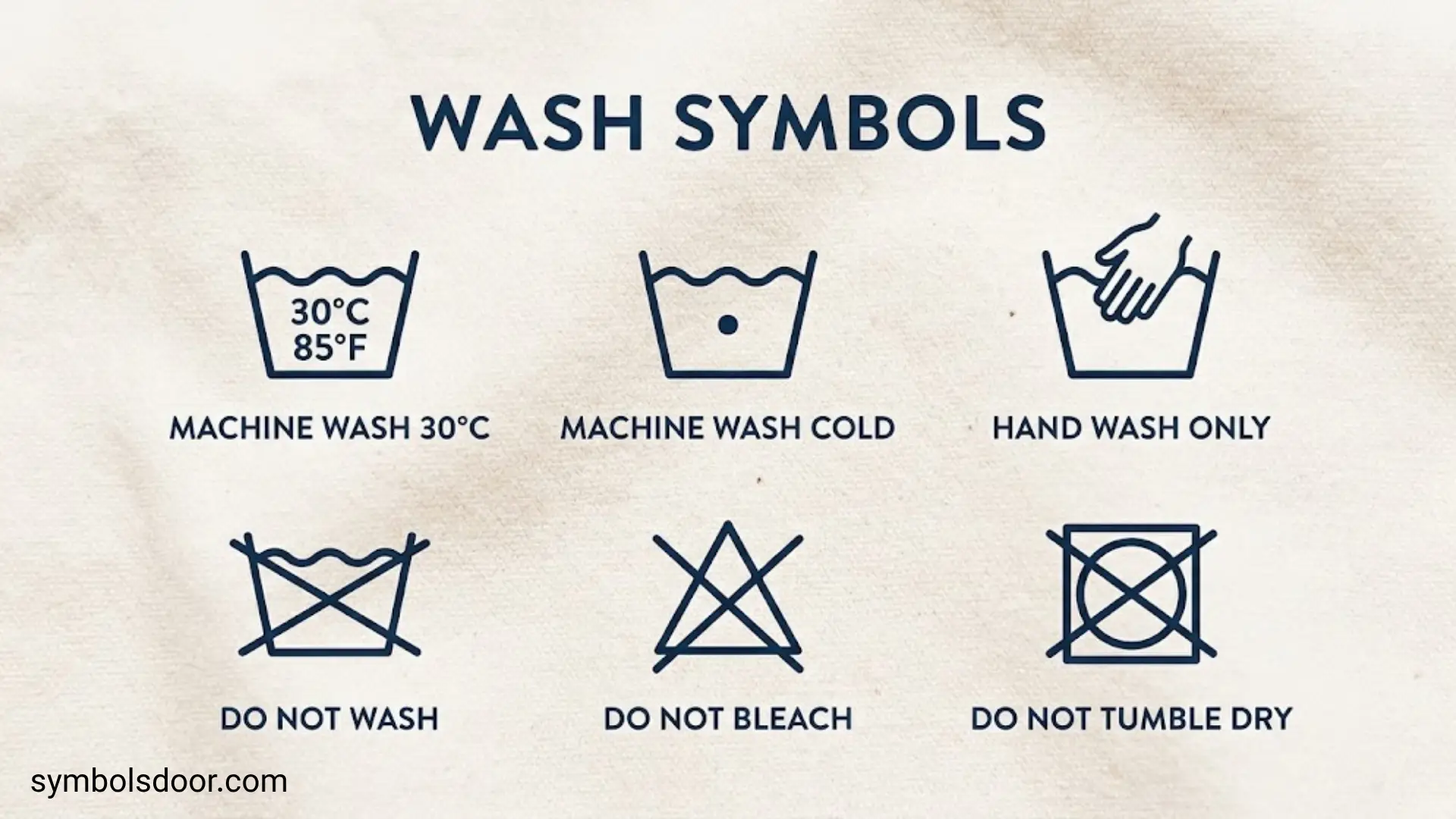
Have you ever looked at a clothing label and wondered what all those little symbols mean? You’re not alone. Washing symbols can look confusing at first, especially when a single label contains buckets, triangles, circles, dots, and crossed-out pictures.
However, these small symbols provide important instructions for caring for your clothes. They tell you whether a garment can go into the washing machine, which water temperature to use, whether bleach is safe, and how to dry or iron the fabric. Some labels also explain when you need professional dry cleaning.
Understanding washing symbols helps you avoid common laundry mistakes. The right instructions can prevent shrinking, fading, stretching, and unnecessary fabric damage. They also help you choose suitable washing machine settings and drying methods.
Most clothing care labels use five main categories: washing, bleaching, drying, ironing, and professional textile care. Each category has its own recognizable symbol and additional markings that explain the correct treatment.
This complete laundry symbols guide explains what each symbol means, how to read clothing labels, and how to care for different fabrics. Whether you’re washing cotton shirts, delicate silk garments, or wool sweaters, you’ll know what your clothes need.
What Are Washing Symbols?
Washing symbols, also called laundry symbols or clothing care symbols, are small graphic instructions printed on clothing labels. They explain how to clean, dry, and maintain textile products without causing avoidable damage.
Clothing manufacturers use these symbols to communicate specific care requirements. Instead of printing long instructions in several languages, they use familiar pictures that consumers can recognize.
For example, a washing tub with a temperature number tells you the maximum water temperature for that garment. A crossed-out triangle means you shouldn’t use bleach. Similarly, a square containing a circle indicates that tumble drying is permitted under the specified conditions.
The international care-labeling system is covered by ISO 3758:2023, which establishes symbols for domestic washing, bleaching, drying, ironing, and professional textile care.
These symbols describe the most severe treatments that should not cause irreversible damage when followed correctly.
You can find them on labels attached to:
- T-shirts, shirts, trousers, and jeans.
- Dresses, skirts, and other everyday clothing.
- Wool sweaters and silk garments.
- Jackets, coats, and outerwear.
- Towels, bedsheets, and other household textiles.
Why do washing symbols matter?
Different fabrics respond differently to water, heat, friction, and cleaning chemicals. Cotton can often tolerate higher washing temperatures than delicate silk. Wool may shrink when exposed to unsuitable heat and agitation. Some synthetic materials can lose their shape under excessive dryer temperatures.
Following the correct washing instructions helps you:
- Prevent clothes from shrinking or stretching.
- Protect fabric colors from fading.
- Avoid damage caused by excessive heat.
- Choose suitable washing machine programs.
- Prevent damage from unsuitable bleaching agents.
- Maintain the appearance and shape of garments.
- Reduce unnecessary professional cleaning costs.
In short, clothing care labels help you clean garments while preserving their quality.
How to Read Laundry Symbols on Clothing Labels
Before starting a laundry load, check the care label inside your garment. You’ll usually find it along a side seam, near the neckline, or inside the waistband.
Most international care labels arrange their symbols in a consistent sequence:
| Symbol Category | Basic Shape | What It Explains |
| Washing | Washing tub | Washing method and water temperature |
| Bleaching | Triangle | Whether bleaching is permitted |
| Drying | Square | Tumble drying and natural drying methods |
| Ironing | Iron | Safe ironing temperature |
| Professional textile care | Circle | Dry cleaning and professional wet cleaning |
The sequence follows the five main treatments established by ISO 3758.
Once you recognize these shapes, reading laundry label symbols becomes much easier.
Understanding Dots, Lines, Numbers, and Crosses
Additional markings change the meaning of a basic symbol.
- Numbers: Show the maximum washing temperature in degrees Celsius on international washing symbols.
- Dots: Indicate temperature or heat levels in relevant symbol systems.
- One line: Usually indicates a milder treatment with reduced mechanical action or intensity.
- Two lines: Indicate a very mild treatment.
- Cross: Prohibits the treatment represented by that symbol.
- Diagonal lines: Provide additional instructions, such as using only non-chlorine bleach or drying in the shade.
For example, a washing tub marked 40°C means you shouldn’t exceed that temperature. If the same tub has one underline, you should select a gentler washing program.
Important: Don’t assume that every laundry symbol uses the same temperature system. International labels commonly use numbers inside washing tubs, while other systems may use dots.
Washing Symbols and Their Meanings
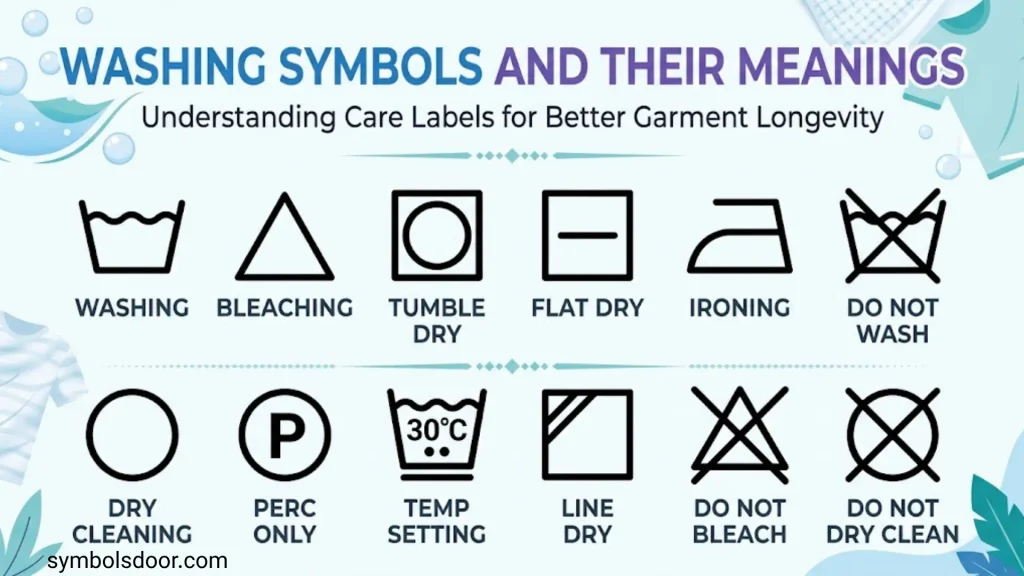
The washing tub is one of the most recognizable washing label symbols. It looks like a small bucket filled with water and provides instructions for cleaning garments.
It tells you whether domestic washing is allowed and whether you should use a particular temperature or washing cycle.
The symbol applies to both hand washing and machine washing. Additional markings explain which method and treatment intensity are appropriate.
Machine Wash Symbol
A plain washing tub without a hand inside or a cross generally indicates that domestic washing is permitted.
This is commonly called the machine wash symbol, although the tub itself doesn’t always mean you must use a washing machine. You need to check its additional markings to determine the correct method.
When machine washing is permitted:
- Separate clothes according to color and fabric type.
- Choose a suitable washing machine program.
- Follow the maximum temperature shown.
- Use an appropriate laundry detergent.
- Avoid overcrowding the washing machine.
- Follow any instructions about reduced spinning or agitation.
For example, a cotton shirt with a 40°C washing symbol can generally go through a normal or otherwise suitable wash cycle at that maximum temperature.
However, a delicate garment with two underlines requires much gentler treatment.
Hand Wash Symbol
The hand wash symbol shows a hand inside a washing tub.
It means you should wash the garment by hand rather than treating it like ordinary machine-washable clothing.
This instruction commonly appears on delicate fabrics, certain wool garments, and other materials that need gentle handling.
Follow these steps when hand washing:
- Fill a clean basin with water at the recommended temperature.
- Dissolve a suitable mild detergent in the water.
- Place the garment in the solution.
- Gently move the garment through the water.
- Rinse carefully without twisting or pulling.
- Press out excess water gently.
- Dry according to the garment’s drying instructions.
Avoid aggressive rubbing because it can damage fibers and change the garment’s shape.
Some modern washing machines include a hand wash program. However, don’t automatically assume that this setting is suitable for every hand-wash-only garment. Check the manufacturer’s instructions and the garment’s care label.
Washing Tub With Numbers: Water Temperature Symbols
Numbers inside a washing tub indicate the maximum permitted washing temperature in degrees Celsius under the international system.
These numbers matter because excessive heat can shrink fabrics, damage fibers, and affect clothing colors.
Here are some common washing temperatures:
| Washing Symbol | Maximum Temperature | General Meaning |
| Tub marked 30 | 30°C | Cool or low-temperature wash |
| Tub marked 40 | 40°C | Moderate-temperature wash |
| Tub marked 50 | 50°C | Higher-temperature wash |
| Tub marked 60 | 60°C | Hotter wash for suitable fabrics |
| Tub marked 70 | 70°C | High-temperature wash |
| Tub marked 95 | 95°C | Very hot wash for suitable textiles |
These temperatures are maximum limits, not instructions that you must always wash at the stated temperature.
For example, if a label says 40°C, you can generally wash the garment at a lower temperature when appropriate. You shouldn’t exceed 40°C.
Cold water, warm water, and hot water also affect cleaning results differently.
- Cold water: Useful for many colored garments and lightly soiled clothes. It can help reduce color bleeding and energy use.
- Warm water: Suitable for some everyday laundry when the care label permits it.
- Hot water: Appropriate for certain durable textiles and cleaning situations, provided the garment allows it.
Modern detergents can clean many everyday garments effectively at lower temperatures. However, always consider the fabric, detergent instructions, and level of soiling.
One-Dot and Two-Dot Washing Symbols
Some care-label systems use dots instead of numbers to communicate washing temperatures.
However, dot meanings depend on the applicable labeling system. Don’t apply dryer or ironing dot meanings to washing symbols automatically.
When a label uses a dot-based washing system, check its accompanying instructions or the relevant regional chart before choosing a temperature.
For international ISO-style washing tubs, numbers are the primary temperature indicators.
Lines Under the Washing Symbol
Lines underneath the washing tub explain how gently you should wash a garment.
They indicate reduced mechanical action rather than a different maximum water temperature.
| Washing Symbol | Meaning | Recommended Treatment |
| Tub without underline | Normal washing | Suitable normal washing program |
| Tub with one underline | Mild washing | Reduced agitation and gentler spinning |
| Tub with two underlines | Very mild washing | Extra-gentle treatment |
One line under the washing symbol means you should choose a mild cycle. This setting is often suitable for easy-care garments and mechanically sensitive fabrics.
Two lines under the washing symbol indicate a very mild cycle. Wool garments and particularly delicate textiles may require this treatment.
These markings are important because heat isn’t the only thing that can damage clothing. Excessive movement, friction, and spinning can also affect fabric structure.
Synthetic, Gentle, and Wool Washing Cycles
Your washing machine may offer several programs that correspond to different garment-care requirements.
- Synthetic cycle: Designed for many synthetic and blended fabrics. It generally uses more controlled washing action than a regular cotton program.
- Gentle wash cycle: Uses reduced mechanical action to protect delicate materials.
- Wool wash cycle: Provides specialized treatment for suitable machine-washable wool garments.
- Hand wash program: Offers particularly gentle machine treatment for certain hand-washable textiles.
The names and exact settings vary between washing machine manufacturers. Always select a program that matches the garment’s care label.
Do Not Wash and Do Not Wring Symbols
A washing tub crossed out means do not wash. The garment shouldn’t undergo domestic washing.
Some textiles cannot tolerate water-based cleaning or require professional treatment. Others may be unsuitable for ordinary household washing because of their construction or size.
The do not wring symbol gives a separate instruction. It means you shouldn’t twist the garment to remove excess water.
Wringing can stretch delicate fibers, distort seams, and change the shape of clothing.
Instead, gently press out water or place the garment between clean towels when its care instructions permit this method.
Bleaching Symbols and Their Meanings
Bleaching symbols appear as triangles on clothing labels. They tell you whether you can use bleaching agents during laundry.
Bleach can help remove certain stains and improve whiteness. However, unsuitable bleaching products can weaken fibers, discolor fabrics, and damage garment finishes.
The three important bleaching symbols are the empty triangle, the triangle with diagonal lines, and the crossed-out triangle.
Empty Triangle Symbol
An empty triangle means bleaching is permitted when necessary.
Under the international care-labeling system, this symbol allows chlorine and oxygen-based bleaching agents.
However, it doesn’t mean you should automatically add bleach to every wash. Consider the fabric, garment color, product instructions, and stain-removal requirements.
For example, a white cotton garment may tolerate an appropriate bleaching product. A colored garment might still require extra caution.
Triangle With Diagonal Lines
A triangle containing two diagonal lines means only non-chlorine bleach is permitted.
This instruction allows suitable oxygen-based bleaching agents while prohibiting chlorine bleach.
Common oxygen-based products contain ingredients such as sodium percarbonate or hydrogen peroxide.
These products are often used for stain removal and color-safe laundry treatment. Nevertheless, always check the product label to make sure it’s suitable for your garment.
Crossed-Out Triangle Symbol
A triangle with a cross means do not bleach.
You shouldn’t use chlorine bleach or oxygen-based bleaching products on garments carrying this symbol.
Bleaching agents can cause unwanted discoloration or weaken sensitive textile fibers.
If you need to remove a stain, use a suitable detergent or a fabric-safe stain remover instead. Test any cleaning product according to its instructions.
Chlorine and Non-Chlorine Bleach: What’s the Difference?
Both products help remove stains, but they use different chemical processes.
| Bleach Type | Common Ingredient | General Use |
| Chlorine bleach | Sodium hypochlorite | Whitening and disinfection |
| Oxygen bleach | Sodium percarbonate or hydrogen peroxide | Stain removal and whitening |
The care label determines which type is permitted.
Never use chlorine bleach on clothing marked for non-chlorine bleaching only. Also, never mix chlorine bleach with ammonia, acids, or other incompatible cleaning products because dangerous gases can form.
Drying Symbols and Their Meanings
Drying symbols appear as squares on clothing care labels. They explain whether you can use a tumble dryer or should dry garments naturally.
Choosing the wrong drying method can cause shrinkage, stretching, fading, and other fabric damage.
The square is the main drying symbol. A circle inside it represents tumble drying, while different lines inside a square describe natural drying methods.
Tumble Dry Symbol
A square containing a circle means tumble drying is permitted.
The circle represents the dryer drum. Additional dots inside the circle indicate the permitted heat level.
Before using your clothes dryer, check the number of dots and any lines underneath the symbol.
For example, a tumble-dry symbol with one dot indicates a lower heat setting than a symbol with two dots.
Tumble Dry Low, Medium, and High
Dots inside the tumble dryer symbol indicate heat intensity.
In the common three-dot system:
| Dryer Symbol | Meaning | Recommended Setting |
| One dot | Low heat | Low-temperature drying |
| Two dots | Medium heat | Medium-temperature drying |
| Three dots | High heat | High-temperature drying |
Some systems and appliances use different temperature ranges. Always follow the applicable care-label instructions.
Low heat is particularly useful for garments that are sensitive to excessive temperatures. Higher settings should only be used when the clothing label permits them.
Do Not Tumble Dry Symbol
A square with a circle crossed out means do not tumble dry.
This symbol tells you to avoid using a tumble dryer for that garment.
High heat and continuous drum movement can damage delicate fibers, cause shrinkage, or distort clothing.
Instead, choose a suitable natural drying method, such as hanging the garment or drying it flat.
Wool sweaters, delicate silk garments, and some synthetic clothing may require special drying treatment.
Lines Under the Tumble Dryer Symbol
Bars underneath a tumble-drying symbol indicate a gentler drying process.
They generally communicate reduced treatment intensity.
- One bar: Mild drying process.
- Two bars: Very mild drying process.
These instructions may relate to reduced heat, shorter treatment duration, or gentler mechanical action.
Don’t confuse these bars with dots. Dots indicate heat levels, while bars indicate the severity of the drying process.
Natural Drying Symbols
Natural drying symbols appear inside a square without a circle.
They explain how to dry clothes without using a tumble dryer.
The main methods include line drying, drip drying, flat drying, and shade drying.
Line Dry Symbol
A square containing one vertical line means hang to dry or line dry.
You can hang the garment on a washing line or suitable hanger, depending on its construction and care instructions.
This method works well for many durable garments, including cotton shirts and other colorfast textiles.
However, heavy wet garments may stretch when hung. Use a suitable support when necessary.
Drip Dry Symbol
A square with vertical lines indicates drip drying when the symbol includes the appropriate additional markings.
Drip drying means allowing excess water to drain naturally without aggressively spinning or wringing the garment.
This method can help protect delicate clothing from mechanical stress.
It may be suitable for certain silk garments and other sensitive textiles.
Flat Dry Symbol
A square containing a horizontal line means dry flat.
Place the garment on a clean, flat surface and allow it to dry naturally.
This method is particularly useful for wool sweaters and knitted clothing that could stretch under their own weight.
Reshape the garment while damp if its care instructions recommend doing so.
Dry in the Shade Symbol
An additional diagonal line in the corner of a natural drying symbol indicates shade drying.
This instruction means you should keep the garment away from direct sunlight while it dries.
Direct sunlight can cause some fabrics and dyes to fade. Shade drying helps protect garments that are sensitive to light.
How to Prevent Clothes From Shrinking During Drying
Shrinkage often happens when garments experience unsuitable heat, moisture, or mechanical action.
Use these practical precautions:
- Check the maximum drying temperature.
- Avoid tumble drying garments marked do not tumble dry.
- Use low heat when the label permits it.
- Dry wool and knitted garments flat when instructed.
- Avoid hanging heavy wet garments if they may stretch.
- Remove clothes promptly when the drying cycle finishes.
- Follow specific instructions for delicate fabrics.
The right drying method helps prevent fabric damage and keeps clothing in its intended shape.
Ironing Symbols and Their Meanings
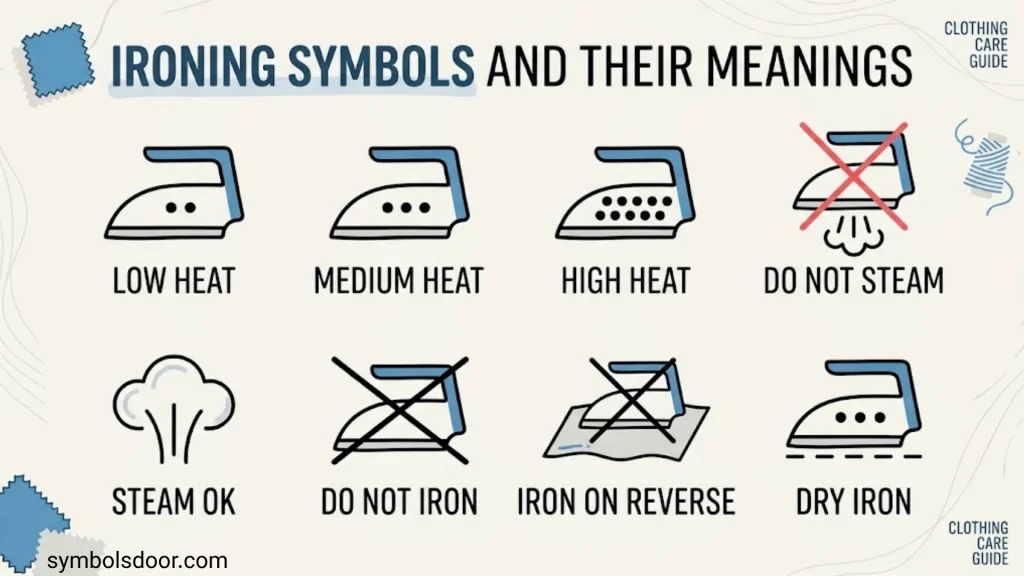
Ironing symbols appear as small irons on clothing care labels. They tell you whether ironing is permitted and which temperature setting you should use.
Different fabrics tolerate different levels of heat. Synthetic materials can melt or become shiny under excessive temperatures, while suitable cotton and linen garments can generally tolerate higher heat.
The dots inside the iron symbol communicate the maximum permitted temperature.
One-Dot Iron Symbol
An iron with one dot means low-temperature ironing.
The maximum soleplate temperature is 110°C under the international system.
This setting is commonly associated with delicate fabrics and certain synthetic materials.
When ironing delicate clothing:
- Use the lowest suitable heat setting.
- Avoid pressing one area for too long.
- Follow any instructions about steam.
- Consider using a clean pressing cloth when appropriate.
Silk and some synthetic garments may require this treatment, depending on their construction.
Two-Dot Iron Symbol
An iron with two dots means medium-temperature ironing.
The maximum soleplate temperature is 150°C.
This setting may be suitable for certain wool garments and blended fabrics when their care labels permit it.
Always test an inconspicuous area if the garment’s instructions and fabric construction allow it.
Three-Dot Iron Symbol
An iron with three dots means high-temperature ironing.
The maximum soleplate temperature is 200°C.
This setting is generally associated with durable fabrics such as cotton and linen.
However, don’t assume every cotton or linen garment can tolerate high heat. Fabric finishes, dyes, blends, and garment construction can change the recommended treatment.
Do Not Iron Symbol
An iron crossed out means do not iron.
Applying direct heat can cause permanent damage to certain fabrics, coatings, and decorative finishes.
If the garment needs wrinkle removal, consider an approved alternative. Depending on the care label, this might include careful hanging or professional treatment.
Do Not Steam Symbol
An iron with crossed-out steam lines means do not use steam.
The instruction restricts steam treatment even if ordinary ironing is permitted.
Some garments may tolerate controlled dry ironing but not steam.
Check the complete symbol before filling your iron’s water tank or selecting a steam setting.
Ironing Different Fabrics
Different materials need different ironing approaches.
| Fabric | General Ironing Guidance |
| Cotton | Often tolerates higher heat when permitted |
| Linen | Usually needs careful moisture and heat control |
| Wool | Use suitable moderate heat and follow label instructions |
| Silk | Requires gentle, low-temperature treatment |
| Synthetic fabrics | Often require low heat |
The care label always takes priority over general fabric recommendations.
Dry Cleaning Symbols and Their Meanings
Dry-cleaning symbols appear as circles on clothing labels. They provide instructions for professional textile cleaning.
Despite its name, dry cleaning doesn’t necessarily mean the process uses no liquid. Professional dry cleaning uses suitable solvents rather than an ordinary water-based washing bath.
Professional cleaners use specialized equipment and controlled processes to clean garments while managing moisture, mechanical action, and solvent exposure.
Some garments require this treatment because their fabrics, linings, decorations, or construction cannot tolerate ordinary domestic washing.
Dry Clean Symbol
A plain circle generally indicates professional dry cleaning.
However, additional markings and letters provide more specific instructions.
If the garment has a dry-clean-only instruction, don’t assume that a delicate home washing program is an acceptable substitute.
Take the garment to a professional cleaner who can assess its construction and cleaning requirements.
Letters Inside Dry Cleaning Symbols
Letters inside circles provide information about the permitted professional cleaning process.
Two commonly encountered letters are P and F.
| Letter | General Meaning |
| P | Professional cleaning using specified solvents permitted under the relevant standard |
| F | Professional cleaning using specified hydrocarbon solvents |
| W | Professional wet cleaning |
These letters aren’t washing-machine settings. They guide professional cleaners in selecting an appropriate process.
The exact permitted solvents and treatment conditions depend on the applicable care-label standard.
Dry Cleaning Symbols With Lines
A line underneath a professional cleaning symbol indicates a milder cleaning process.
Two lines indicate a very mild process.
These restrictions can involve mechanical action, drying temperature, and other treatment conditions.
For delicate garments, these additional markings are important. They help professional cleaners avoid unnecessary stress during cleaning.
Do Not Dry Clean Symbol
A circle crossed out means do not dry clean.
The garment shouldn’t undergo the professional dry-cleaning process represented by that symbol.
Follow the other care instructions to determine whether domestic washing or another cleaning method is allowed.
Remember that a do-not-dry-clean symbol doesn’t automatically mean a garment is machine washable.
Complete Laundry Symbols Chart
A quick-reference chart makes it easier to identify common laundry care symbols without reading every explanation again.
The following table summarizes the major symbol shapes and their meanings.
| Symbol Description | Symbol Name | Meaning |
| Washing tub | Machine/domestic wash | Domestic washing permitted |
| Tub with hand | Hand wash | Wash by hand |
| Crossed-out tub | Do not wash | Avoid domestic washing |
| Tub with temperature number | Maximum wash temperature | Do not exceed the stated temperature |
| Tub with one underline | Mild wash | Use reduced mechanical action |
| Tub with two underlines | Very mild wash | Use a very gentle cycle |
| Empty triangle | Bleaching allowed | Any permitted bleach type |
| Triangle with diagonal lines | Non-chlorine bleach | Only oxygen-based bleach |
| Crossed-out triangle | Do not bleach | Avoid bleaching agents |
| Square with circle | Tumble dry | Tumble drying permitted |
| Dryer with one dot | Low heat | Use low dryer heat |
| Dryer with two dots | Medium heat | Use medium dryer heat |
| Dryer with three dots | High heat | Use high dryer heat |
| Crossed-out dryer | Do not tumble dry | Avoid tumble drying |
| Square with vertical line | Line dry | Hang to dry |
| Square with horizontal line | Dry flat | Place garment horizontally |
| Square with diagonal corner line | Dry in shade | Avoid direct sunlight |
| Iron with one dot | Low-temperature ironing | Maximum 110°C |
| Iron with two dots | Medium-temperature ironing | Maximum 150°C |
| Iron with three dots | High-temperature ironing | Maximum 200°C |
| Crossed-out iron | Do not iron | Avoid ironing |
| Iron with crossed-out steam | Do not steam | Avoid steam ironing |
| Circle | Professional dry cleaning | Professional cleaning permitted |
| Circle with P | P cleaning | Specified professional solvent cleaning |
| Circle with F | F cleaning | Specified hydrocarbon-solvent cleaning |
| Crossed-out circle | Do not dry clean | Avoid dry cleaning |
Note: This is a simplified reference for common international care symbols. Some regional labeling systems use different markings. Always interpret the complete symbol and follow the applicable care-label standard.
Washing Symbols for Different Fabrics
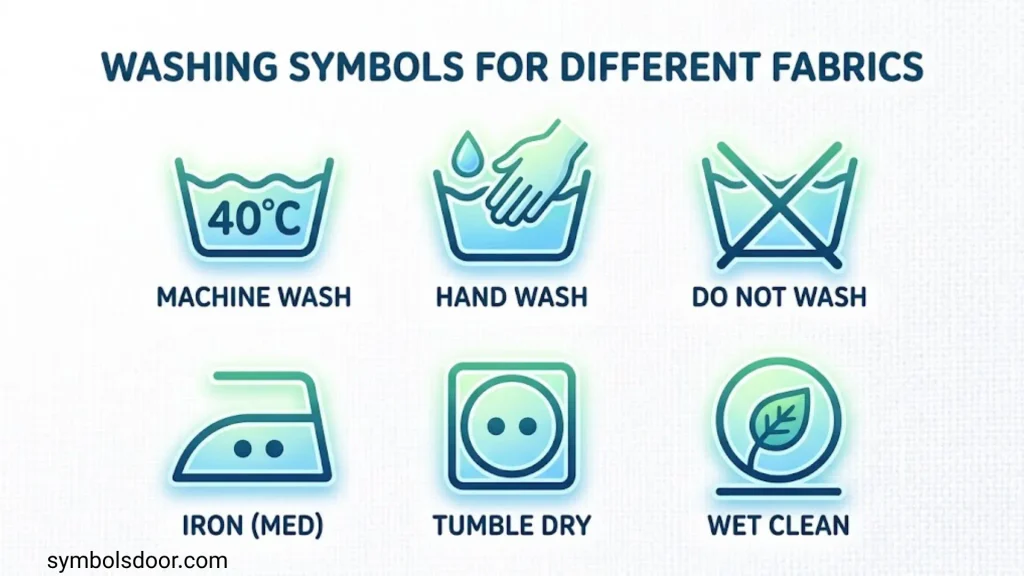
Not every fabric responds to laundry treatments in the same way. Cotton, wool, silk, linen, and synthetic materials have different fiber structures and care requirements.
Understanding the material helps you interpret its washing instructions more effectively.
However, a fabric’s general characteristics shouldn’t replace its actual care label. Blends, dyes, coatings, and garment construction can change the recommended treatment.
Cotton
Cotton is a natural fiber commonly used in T-shirts, shirts, underwear, towels, and bedsheets.
Many cotton garments can tolerate machine washing. However, the correct temperature depends on the garment’s dye, construction, and finishing.
Follow these precautions:
- Check the maximum washing temperature.
- Separate dark and light-colored clothing.
- Use a suitable detergent.
- Avoid excessive dryer heat.
- Iron according to the garment’s temperature instructions.
Cotton can shrink under unsuitable washing and drying conditions, particularly when exposed to excessive heat.
Linen
Linen comes from flax fibers and is popular for summer clothing, shirts, trousers, and household textiles.
Its natural texture makes it comfortable and breathable. However, linen wrinkles easily and needs suitable washing and drying treatment.
For linen garments:
- Follow the specified washing temperature.
- Avoid unnecessarily aggressive washing cycles.
- Use suitable drying methods.
- Iron at the permitted temperature.
- Avoid excessive heat if the garment contains delicate finishes.
Some linen garments benefit from ironing while slightly damp, provided their care labels permit it.
Wool
Wool is a natural animal fiber used in sweaters, coats, scarves, and other clothing.
It can shrink or become distorted under unsuitable heat and mechanical action.
Many wool garments require hand washing or a specialized wool wash cycle.
Use these precautions:
- Choose cold or lukewarm water when permitted.
- Use detergent suitable for wool.
- Avoid aggressive rubbing.
- Don’t wring the garment.
- Dry flat when instructed.
- Avoid high dryer temperatures.
Some wool garments require professional dry cleaning rather than domestic washing.
Silk
Silk is a delicate natural protein fiber known for its smooth texture and appearance.
It can be sensitive to friction, unsuitable detergents, heat, and certain cleaning products.
Before washing silk:
- Check whether hand washing is permitted.
- Use an appropriate gentle detergent.
- Avoid twisting or wringing.
- Follow the recommended drying method.
- Use low-temperature ironing only when permitted.
Some silk garments require professional cleaning. Never assume every silk item can be washed at home.
Synthetic Fabrics
Synthetic fabrics include polyester, nylon, acrylic, and other manufactured fibers.
They’re commonly used in sportswear, jackets, everyday clothing, and blended textiles.
Many synthetic garments require moderate washing temperatures and controlled drying conditions.
Keep these points in mind:
- Use the recommended washing temperature.
- Choose a suitable synthetic or gentle cycle.
- Avoid excessive dryer heat.
- Follow ironing restrictions.
- Use a detergent suitable for the garment.
Synthetic fibers can be sensitive to high temperatures. Excessive heat may distort their shape or damage their surface.
UK Washing Symbols vs. US Laundry Symbols
Many UK washing symbols follow the international textile care-labeling system established by ISO 3758.
The United States also uses familiar washing, bleaching, drying, ironing, and dry-cleaning symbols. However, US labels may follow different conventions and symbol standards.
One important difference involves temperature notation.
| Feature | International and UK Labels | Common US Symbol Systems |
| Washing temperature | Often shown as numbers in Celsius | May use dots or written temperature instructions |
| Washing cycle | Underlines indicate reduced mechanical action | Bars may identify permanent-press or gentle cycles |
| Bleaching | Triangle symbols | Triangle symbols |
| Tumble drying | Square containing a circle | Square containing a circle |
| Ironing | Dots indicate maximum temperature | Dots indicate maximum temperature |
| Professional cleaning | Circle with additional markings | Circle with additional markings |
The United States has historically used ASTM care-symbol conventions alongside written care instructions. The Federal Trade Commission’s Care Labeling Rule also governs care instructions for covered textile wearing apparel and certain piece goods.
For UK consumers, the current international reference is ISO 3758:2023, adopted in the British standards system as BS EN ISO 3758:2023.
The key difference is not that every country has completely different laundry symbols. Many basic shapes are shared internationally, but their details and temperature conventions can vary.
When reading an unfamiliar label, check its actual markings instead of assuming that every dot or number has the same meaning.
Common Laundry Symbol Mistakes to Avoid
Even familiar washing symbols can be misunderstood. A small mistake may lead to shrinking, fading, or damage that you can’t reverse.
Here are some common errors worth avoiding.
Confusing Washing Symbols With Washing Machine Symbols
Clothing care symbols and appliance control-panel symbols serve different purposes.
Clothing labels explain how to treat garments. Washing machine symbols identify available programs, functions, and settings.
For example, a wool symbol on a washing machine may identify its wool program. The same general category on a clothing label communicates the garment’s care requirements.
Always match the machine program to the garment label.
Ignoring Maximum Washing Temperature
A 30°C washing instruction doesn’t mean you can use 40°C or 60°C.
The number represents the maximum permitted temperature. Exceeding it may cause shrinkage, color loss, or other damage.
Ignoring Underlines
Some people notice the temperature but overlook the lines underneath the washing tub.
That’s a mistake.
One underline requires a milder cycle, while two underlines indicate very mild treatment. Using an aggressive program can damage sensitive garments even when the water temperature is correct.
Confusing Bleach Symbols
An empty triangle and a crossed-out triangle have opposite meanings.
An empty triangle permits bleaching. A crossed-out triangle prohibits it.
A triangle with two diagonal lines permits oxygen-based, non-chlorine bleach only.
Using the Wrong Dryer Setting
A garment marked tumble dry low shouldn’t automatically go into a high-heat dryer program.
Check the dots and any underlines before choosing the setting.
Ironing Without Checking the Temperature
High heat can scorch, melt, or distort certain fabrics.
Always check the iron symbol before selecting a temperature.
If steam is prohibited, don’t use the steam function even when ironing itself is allowed.
Misunderstanding Professional Cleaning Instructions
A circle with P or F doesn’t refer to an ordinary home washing program.
These letters communicate professional cleaning requirements. If you’re unsure, ask a qualified dry cleaner to interpret the complete label.
Frequently Asked Questions About Washing Symbols
What Do Washing Symbols Mean on Clothing Labels?
Washing symbols explain how to clean and maintain garments safely. They cover washing, bleaching, drying, ironing, and professional textile cleaning.
Numbers, dots, lines, and crosses provide additional instructions about temperature, treatment intensity, and prohibited methods.
What Is the Symbol for Machine Washing?
A washing tub generally indicates that domestic washing is permitted.
The temperature number and any underlines explain which washing conditions you should use.
What Does the Bucket Symbol Mean on Clothes?
The bucket or washing tub symbol represents domestic washing.
It tells you whether a garment can be washed and provides additional information about temperature and washing intensity.
What Does a Hand Inside a Washing Tub Mean?
A hand inside a washing tub means hand wash.
You should gently wash the garment by hand using the recommended water temperature and a suitable detergent.
What Does a Crossed-Out Washing Symbol Mean?
A crossed-out washing tub means do not wash.
The garment shouldn’t undergo domestic washing. Check the remaining care instructions to determine whether professional cleaning is required.
What Do Dots Mean on Laundry Symbols?
Dots indicate temperature or heat levels in the relevant symbol system.
For example, dots inside an iron communicate maximum ironing temperature. Dots inside a tumble dryer symbol indicate dryer heat intensity.
What Do Lines Under Washing Symbols Mean?
One underline indicates a mild washing process with reduced mechanical action.
Two underlines indicate a very mild process suitable for particularly sensitive textiles.
What Does a Triangle Mean on Washing Labels?
A triangle provides bleaching instructions.
An empty triangle permits bleaching, a triangle with two diagonal lines allows non-chlorine bleach only, and a crossed-out triangle means do not bleach.
What Does a Square With a Circle Mean?
A square containing a circle is the tumble-dry symbol.
It means tumble drying is permitted under the conditions indicated by additional dots or lines.
What Does the Crossed-Out Tumble Dryer Symbol Mean?
It means do not tumble dry.
You should use an appropriate natural drying method instead, such as line drying or flat drying.
What Do Ironing Dots Mean?
Ironing dots indicate the maximum permitted soleplate temperature.
- One dot: 110°C.
- Two dots: 150°C.
- Three dots: 200°C.
These are the maximum temperatures under the international care-labeling system.
What Does the Circle Mean on Clothing Labels?
A circle indicates professional textile care.
Additional letters and markings explain the permitted dry-cleaning or professional wet-cleaning process.
What Do P and F Mean in Dry-Cleaning Symbols?
P and F identify different permitted professional cleaning processes.
P indicates specified professional solvent cleaning, while F indicates specified hydrocarbon-solvent cleaning.
How Do I Know If Clothes Are Machine Washable?
Check the washing tub symbol on the care label.
If domestic washing is permitted, follow the temperature and cycle instructions. A hand inside the tub indicates hand washing, while a crossed-out tub means do not wash.
How Do I Know What Temperature to Wash My Clothes At?
Look for a number inside the washing tub.
The number indicates the maximum washing temperature in degrees Celsius under the international system.
For example, a tub marked 40 means you shouldn’t wash the garment above 40°C.
Can I Wash Clothes If the Care Label Is Missing?
You can sometimes wash garments without labels, but you should proceed carefully.
Consider the fabric composition, garment construction, colors, and any available manufacturer information.
If you’re unsure, choose a conservative cleaning method. For expensive or delicate garments, professional advice is safer than guessing.
Final Thoughts on Understanding Washing Symbols
Understanding washing symbols makes laundry easier and helps you protect your clothes from avoidable damage. Those small pictures on clothing labels provide valuable instructions about water temperature, washing cycles, bleaching, drying, ironing, and professional cleaning.
Start by learning the five main categories: the washing tub, triangle, square, iron, and circle. Then pay attention to additional markings such as dots, numbers, underlines, and crosses.
Remember these important points:
- Check the care label before washing any garment.
- Never exceed the stated maximum washing temperature.
- Follow underlines when choosing washing and drying cycles.
- Use only permitted bleaching agents.
- Check dryer heat settings before tumble drying.
- Follow ironing restrictions to avoid damaging fibers.
- Take garments requiring professional treatment to a qualified cleaner.
Whether you’re caring for cotton shirts, delicate silk, wool sweaters, or synthetic clothing, the right instructions make a difference.
Keep a laundry symbols chart nearby for quick reference. Once you understand these common clothing care symbols, you’ll find it much easier to choose the right laundry method and keep your favorite garments looking their best.

Hi, I’m Asher Monroe, a writer who believes that meaningful words have the power to inspire change and bring people closer to their dreams. I have always been fascinated by the beauty of quotes and the way a simple message can provide motivation, hope, and comfort.
I enjoy creating content around inspirational quotes, life lessons, success stories, and positive thoughts that help readers find encouragement in their everyday lives. My goal is to share words that connect with people and remind them of their inner strength.
Through my writing, I explore the ideas of personal growth, confidence, and the importance of staying inspired through every chapter of life.
I am the author of Words That Move the Soul and The Path of Endless Inspiration, two books focused on the power of wisdom, positivity, and meaningful thoughts.
 Sienna Brooks
 Rowan Sinclair Rowan Sinclair