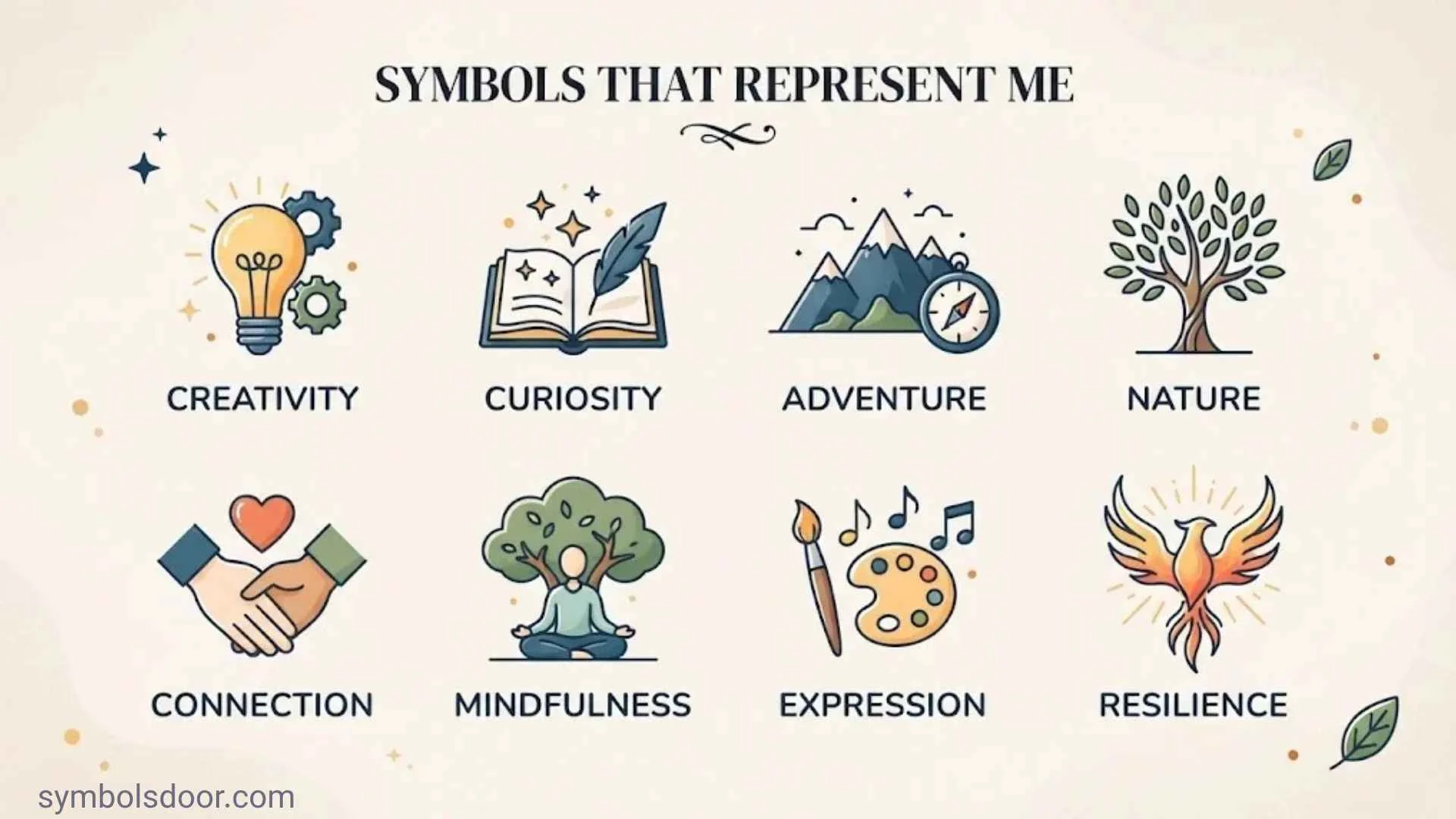
Have you ever wondered what symbol best represents you? Maybe you see yourself as a strong lion, a peaceful dove, a creative butterfly, or a determined mountain climber. The right symbol can express something about your personality, values, beliefs, and life experiences without using a single word.
Symbols that represent you can come from many places. A favorite color might reflect your mood or personal taste. An animal may remind you of a quality you admire. A flower might represent growth, while a spiritual symbol could connect with your beliefs or cultural background.
However, symbols do not have one fixed meaning everywhere. A particular color, animal, or image may represent different ideas across cultures and historical periods. Your personal interpretation matters, too.
In this guide, you’ll explore personal symbols, their meanings, and how they connect with different personality traits. You’ll discover symbols associated with strength, courage, kindness, loyalty, creativity, and independence. You’ll also explore colors, animals, plants, religious traditions, zodiac signs, and emojis.
At the end, a simple symbol quiz will help you find a symbol that feels like a natural match for your personality.
What Does It Mean to Have a Symbol That Represents You?
A personal symbol is an image, object, animal, color, or design that expresses something meaningful about who you are. It can represent your character, personal values, interests, cultural background, beliefs, or goals.
For example, someone who values freedom might connect with a flying bird. A person who has overcome difficult experiences might choose a mountain as a reminder of perseverance. Someone who cares deeply about family and friendship might prefer a heart.
This is called symbolic representation. Instead of explaining an idea in a long sentence, you use an image or object to communicate its meaning.
Symbols appear throughout everyday life. Flags represent nations, religious images express beliefs, and logos help people recognize organizations. Personal symbols work in a similar way, but their meaning comes from your own experiences and interpretation.
Personal Symbols and Individual Identity
Your identity includes the qualities, experiences, relationships, and beliefs that make you an individual. A personal symbol can represent one part of that identity.
Consider these examples:
- Lion: You admire courage, confidence, and leadership.
- Butterfly: You value change, personal growth, and new beginnings.
- Dove: You care about peace, kindness, and harmony.
- Oak tree: You appreciate stability, patience, and strength.
- Compass: You value direction, purpose, and independence.
- Star: You connect with hope, ambition, or inspiration.
A symbol does not need to describe every part of your personality. It can represent one important quality or a meaningful chapter in your life.
Personal Symbols vs. Cultural and Religious Symbols
These categories sometimes overlap, but they are not exactly the same.
| Type of symbol | What it represents | Example |
| Personal symbol | Individual values or characteristics | A mountain representing perseverance |
| Cultural symbol | Shared traditions and heritage | A Chinese dragon |
| Religious symbol | A faith, teaching, or religious community | The Christian cross |
| National symbol | A country and its identity | The American bald eagle |
| State symbol | An officially recognized state emblem | California’s grizzly bear |
| Historical symbol | An event, period, or historical idea | The ancient Egyptian ankh |
You can choose a symbol that reflects your identity while still respecting its original meaning and cultural importance.
How to Find a Symbol That Represents Your Personality
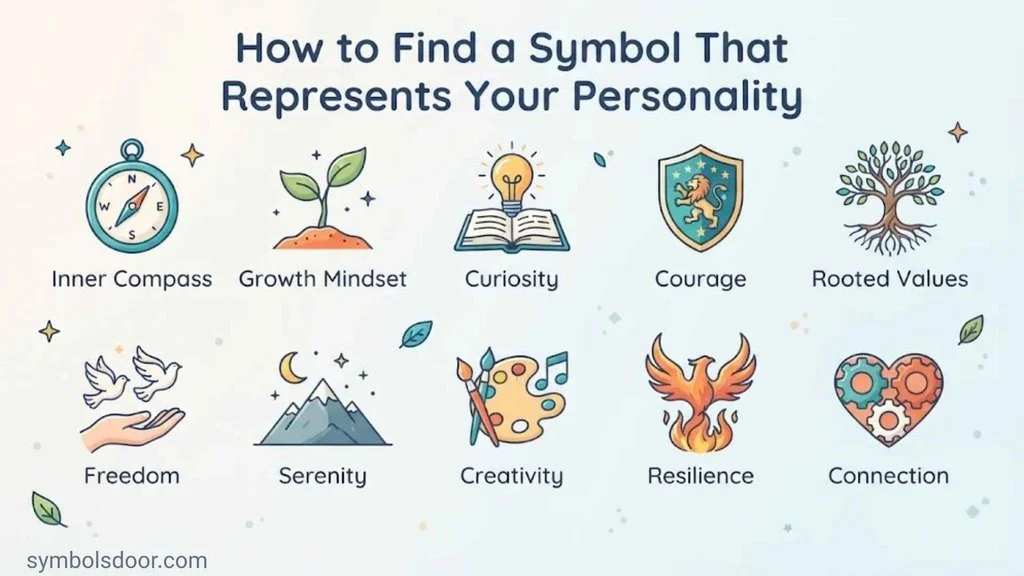
Finding a personal symbol does not require a complicated personality test. Start by thinking about what matters most to you. Then explore images and meanings that connect with those qualities.
Identify Your Strongest Personality Traits
Think about how you usually behave, what motivates you, and how you respond to challenges.
For example:
- Strength: You remain determined when situations become difficult.
- Confidence: You trust your abilities and decisions.
- Courage: You face challenges even when you feel afraid.
- Kindness: You care about other people and their feelings.
- Loyalty: You value trust and long-term relationships.
- Creativity: You enjoy producing new ideas or expressing yourself.
- Leadership: You like guiding, supporting, or organizing others.
- Independence: You appreciate freedom and making your own decisions.
Choose two or three qualities that genuinely describe you. You do not need to select every positive characteristic.
Think About Your Personal Values
Your values can reveal more about your identity than your favorite color or animal.
Ask yourself:
- Do I value honesty more than popularity?
- Is family especially important to me?
- Do I prefer independence or teamwork?
- Does faith guide my decisions?
- Do I care deeply about learning and knowledge?
- Do I want to help others?
- Is personal growth one of my main goals?
A person who values knowledge might choose an owl or an open book. Someone who values family may connect with a tree because its branches can represent different generations.
Consider Your Interests and Life Experiences
Your personal symbol can also reflect the things you enjoy and the experiences that shaped you.
Think about:
- Your favorite hobbies and activities.
- Important friendships and relationships.
- Personal achievements and competitions.
- Challenges you have overcome.
- Adventures you remember.
- Goals you want to reach.
- Skills you are proud of.
- Experiences that changed how you see the world.
For instance, a compass might represent someone who has moved to a new place and learned to find their own direction. A phoenix might represent a person who rebuilt their life after a difficult period.
Choose a Symbol That Feels Meaningful
Once you identify your main qualities, look for symbols that express them.
Do not choose something simply because it looks attractive. Learn about its traditional meaning, consider its cultural background, and decide whether it connects with your own story.
Your personal symbol can have a traditional meaning and a private meaning at the same time.
What Symbol Represents Different Personality Traits?
Different symbols are commonly associated with different human qualities. These associations come from mythology, literature, religion, folklore, and everyday visual communication.
The following table gives you a useful starting point.
| Personality trait | Symbol | Common symbolic meaning |
| Strength | Mountain | Stability and endurance |
| Courage | Lion | Bravery and leadership |
| Wisdom | Owl | Knowledge and observation |
| Kindness | Heart | Love and compassion |
| Loyalty | Dog | Faithfulness and companionship |
| Freedom | Flying bird | Independence and possibility |
| Peace | Dove | Harmony and reconciliation |
| Hope | Rising sun | Renewal and optimism |
| Creativity | Butterfly | Transformation and expression |
| Growth | Tree | Development and resilience |
| Determination | Arrow | Direction and persistence |
| Balance | Yin-yang | Complementary forces |
Symbols That Represent Strength and Courage
If you consider yourself strong and determined, you might connect with symbols associated with endurance, bravery, or overcoming obstacles.
- Lion: A familiar symbol of courage, authority, and leadership.
- Eagle: Often represents strength, vision, and freedom.
- Mountain: Represents endurance, stability, and difficult achievements.
- Oak tree: Commonly associated with strength, longevity, and resilience.
- Phoenix: Represents renewal and the ability to rise after hardship.
A mountain can be especially meaningful if you have faced difficult situations. Reaching its summit becomes a reminder that progress often requires patience and effort.
Symbols That Represent Kindness and Loyalty
People who value relationships and compassion may prefer symbols connected with care and trust.
- Heart: Love, affection, and emotional connection.
- Dove: Peace, gentleness, and harmony.
- Dog: Loyalty, friendship, and companionship.
- Rose: Love, appreciation, and beauty.
- Two linked circles: Connection, partnership, and lasting relationships.
A dog may represent loyalty because dogs have long been associated with companionship and relationships with humans. A heart, meanwhile, offers a simple visual way to express affection.
Symbols That Represent Wisdom and Intelligence
If learning, knowledge, and thoughtful decisions matter to you, consider these symbols:
- Owl: Wisdom, observation, and knowledge.
- Open book: Learning, education, and curiosity.
- Lamp: Understanding, discovery, and enlightenment.
- Eye: Awareness, perception, and observation.
- Tree of knowledge: Learning, growth, and understanding.
The owl is especially recognizable as a symbol of wisdom in many modern educational and literary contexts. Its association with Athena, the ancient Greek goddess of wisdom, helped strengthen that connection.
Symbols That Represent Freedom and Independence
Some people value personal space, exploration, and the ability to make their own choices.
Symbols that may reflect these qualities include:
- Flying bird: Freedom and independence.
- Butterfly: Change and personal transformation.
- Ocean: Openness, movement, and possibility.
- Sailboat: Exploration and adventure.
- Open road: New opportunities and personal direction.
A compass can also represent independence. It suggests that you can choose your own direction while staying connected to your goals.
Colors and Their Meanings: Which Color Represents Your Personality?
Colors are among the most common forms of symbolic imagery. They appear in clothing, art, flags, logos, celebrations, and religious traditions.
However, color symbolism is not universal. The same color can communicate different ideas depending on the culture, situation, and individual experience. Color preferences also cannot reliably determine someone’s personality.
Still, familiar color associations can help you choose a personal symbol.
Red – Passion, Energy, and Courage
Red is often associated with strong emotions and physical energy. It can represent love, passion, danger, excitement, or courage.
You might connect with red if you admire:
- Confidence and boldness.
- Passion and determination.
- Strong emotions.
- Action and ambition.
- Courage during difficult situations.
Red can be a good personal color if you want your symbol to communicate energy and intensity.
Orange – Creativity, Enthusiasm, and Adventure
Orange combines the warmth of red with the brightness associated with yellow. It often appears in designs connected with enthusiasm, celebration, and creativity.
Common associations include:
- Adventure and exploration.
- Social energy.
- Warmth and friendliness.
- Creativity and expression.
- Enthusiasm for new experiences.
Yellow – Happiness, Optimism, and Curiosity
Yellow is commonly connected with sunshine, light, and cheerful experiences.
It may appeal to people who value:
- Optimism.
- Curiosity.
- Happiness.
- Learning and discovery.
- Positive communication.
Yellow can also attract attention, which is why designers often use it for signs and visual warnings.
Green – Growth, Nature, and Balance
Green is strongly connected with plants and the natural world. It often represents renewal, health, fertility, and environmental awareness.
You might choose green if you value:
- Personal growth.
- Patience and stability.
- Nature and the environment.
- Balance and harmony.
- Fresh beginnings.
Blue – Trust, Peace, and Loyalty
Blue often communicates calmness, reliability, and stability. It is also closely associated with the sky and water.
Common symbolic associations include:
- Trust and honesty.
- Peace and calmness.
- Loyalty and dependability.
- Wisdom and reflection.
- Stability and confidence.
Purple Creativity, Mystery, and Spirituality
Purple has historical associations with royalty and luxury. In some traditions, it also connects with spirituality, imagination, and reflection.
It may represent:
- Artistic creativity.
- Individuality.
- Mystery.
- Spiritual exploration.
- Imagination and originality.
Quick Color Symbolism Guide
| Color | Common associations | Possible personal connection |
| Red | Passion, energy, courage | Bold and determined |
| Orange | Warmth, creativity, enthusiasm | Adventurous and expressive |
| Yellow | Optimism, happiness, curiosity | Cheerful and curious |
| Green | Growth, nature, balance | Grounded and patient |
| Blue | Trust, calmness, loyalty | Thoughtful and dependable |
| Purple | Mystery, imagination, spirituality | Creative and reflective |
Tip: Choose a color because it feels meaningful to you, not because someone claims it reveals your personality.
Animal Symbols That Represent Different Personalities
Animals have played important roles in myths, stories, national emblems, religious traditions, and cultural artwork. Their symbolic meanings often come from their behavior, appearance, habitat, or role in traditional stories.
Here are some familiar animal symbols and the qualities people commonly associate with them.
Lion – Strength, Courage, and Leadership
The lion is widely recognized as a symbol of power and authority. Its presence in coats of arms, royal imagery, and traditional stories has helped establish its association with leadership.
A lion may represent you if you admire:
- Courage.
- Confidence.
- Responsibility.
- Leadership.
- Determination.
Wolf Loyalty, Cooperation, and Independence
Wolves live in social groups and communicate through complex behaviors. In folklore and modern storytelling, they can represent loyalty, teamwork, independence, and survival.
A wolf may appeal to someone who values strong friendships but also needs personal freedom.
Eagle Freedom, Vision, and Ambition
Eagles are powerful birds of prey known for their keen eyesight and ability to fly at great heights. Their appearance has made them popular symbols of strength, freedom, and authority.
The bald eagle, for example, is the national bird of the United States and appears on the Great Seal.
Owl Wisdom, Knowledge, and Observation
Owls are often linked with wisdom because of their historical connection with Athena in Greek mythology. Their quiet movement and nocturnal habits have also contributed to associations with mystery and observation.
An owl may represent someone who enjoys learning, studying, and thinking carefully.
Butterfly Transformation, Hope, and Personal Growth
A butterfly’s life cycle makes it a natural symbol of transformation. It begins as a caterpillar, enters a chrysalis, and eventually emerges as an adult butterfly.
This change makes the butterfly a popular symbol of:
- Personal development.
- New beginnings.
- Freedom.
- Beauty.
- Transformation after difficult experiences.
Dolphin Playfulness, Intelligence, and Social Connection
Dolphins are highly social marine mammals known for their communication and complex behavior. They often represent friendliness, intelligence, cooperation, and curiosity in popular symbolism.
Bear Protection, Strength, and Resilience
Bears appear in many cultural stories and traditional images. Depending on the culture, they may represent protection, courage, power, or connection with nature.
A bear can be a fitting personal symbol if you value strength and protecting the people close to you.
Fox Cleverness, Adaptability, and Resourcefulness
Foxes often represent intelligence and quick thinking in folklore. Their ability to adapt to different environments makes them familiar symbols of resourcefulness.
Dog Loyalty, Friendship, and Trust
Dogs have a long history of companionship with humans. As personal symbols, they commonly express loyalty, affection, protection, and friendship.
Horse Freedom, Energy, and Determination
Horses have played important roles in transportation, farming, warfare, and sport. They frequently symbolize freedom, movement, endurance, and power.
What Dog Breed Matches Your Personality?
Dog breeds have different histories, physical characteristics, and working purposes. However, a breed does not determine a person’s personality. You can use these examples as lighthearted symbolic associations.
| Dog breed | Recognizable characteristics | Possible symbolic association |
| Siberian Husky | Athletic, energetic working dog | Adventure and independence |
| Pug | Small companion breed | Affection and companionship |
| Basset Hound | Scent hound with a strong sense of smell | Patience and determination |
| German Shepherd | Working and herding breed | Alertness and responsibility |
| Golden Retriever | Sporting and retrieving breed | Cooperation and friendliness |
| Collie | Herding breed | Intelligence and attentiveness |
State Animal Symbols: California Grizzly Bear and Texas Longhorn
Some animal symbols represent an entire state rather than an individual’s personality.
The California grizzly bear became California’s official state animal in 1953. Although the California grizzly is extinct, its image remains on the California state flag and Great Seal. It has become an enduring emblem of the state’s history and identity. The California State Capitol Museum explains the bear’s place in the state’s official symbolism.
The Texas longhorn is strongly associated with Texas ranching history and Western culture. The Texas longhorn is also the state’s official large mammal. Its recognizable horns and connection with cattle ranching make it an important regional emblem.
These examples show how animals can represent shared history, geography, and cultural identity—not just individual characteristics.
Plant, Flower, and Nature Symbols That Represent You
Plants and flowers often symbolize growth, beauty, survival, renewal, and emotional connection. Their meanings can come from their appearance, growing conditions, traditional uses, or place in cultural stories.
Rose Love, Beauty, and Passion
The rose is one of the most recognizable flowers in symbolic communication. Its meaning changes with its color and context.
- Red roses commonly represent romantic love and passion.
- White roses can represent purity, remembrance, or peace.
- Yellow roses are often associated with friendship and warmth.
- Pink roses can communicate admiration and appreciation.
A rose may suit someone who values love, relationships, and emotional expression.
Lotus Flower Renewal, Spirituality, and Growth
The lotus has deep significance in several Asian religious and philosophical traditions, including Hinduism and Buddhism.
Because it grows in muddy water and produces a flower above the surface, it is often used to represent spiritual development, purity, and awakening.
The lotus may be meaningful to someone who connects with inner growth and overcoming challenges.
Sunflower – Happiness, Warmth, and Optimism
Sunflowers are known for their bright appearance and association with sunlight. They are often used in modern symbolism to represent happiness, positivity, warmth, and hope.
Cactus Resilience, Protection, and Adaptability
A cactus can survive in dry environments where many plants struggle. Its ability to store water and withstand harsh conditions makes it a useful symbol of resilience and survival.
You might choose a cactus if you value independence and the ability to keep going during difficult times.
Bamboo is an important symbol in several East Asian cultural traditions. Its ability to bend without easily breaking makes it a common representation of flexibility, endurance, and resilience.
Bamboo – Flexibility, Strength, and Perseverance
A bamboo shoot can represent fresh growth and new beginnings.
Vine – Connection, Growth, and Persistence
Vines grow by spreading and attaching themselves to surrounding structures. In symbolic imagery, they can represent connection, continuity, persistence, and relationships.
Oak Tree – Stability, Strength, and Longevity
The oak tree is frequently associated with endurance because of its strong wood and long life. It can represent family roots, stability, wisdom, and protection.
Fruit Symbols and Their Common Associations
Fruits also appear in religious art, mythology, folklore, and everyday expressions.
| Fruit | Common symbolic associations |
| Apple | Knowledge, temptation, and abundance in different traditions |
| Peach | Longevity and good fortune in Chinese symbolism |
| Orange | Prosperity, celebration, and abundance in some cultures |
| Pineapple | Hospitality and welcome |
| Cherry | Beauty and the temporary nature of life |
| Watermelon | Summer, refreshment, and celebration |
These meanings depend on context. For example, the apple has different roles in religious stories, mythology, and modern popular culture.
How to Choose a Flower or Plant That Represents You
Consider the qualities you want your symbol to communicate.
- Choose a cactus if you admire resilience.
- Choose a lotus if personal growth and spirituality matter to you.
- Choose a sunflower if you value optimism.
- Choose an oak tree if stability and family are important.
- Choose bamboo if you believe strength includes flexibility.
You can also select a plant because it reminds you of a person, place, or important experience.
Religious and Spiritual Symbols and What They Represent
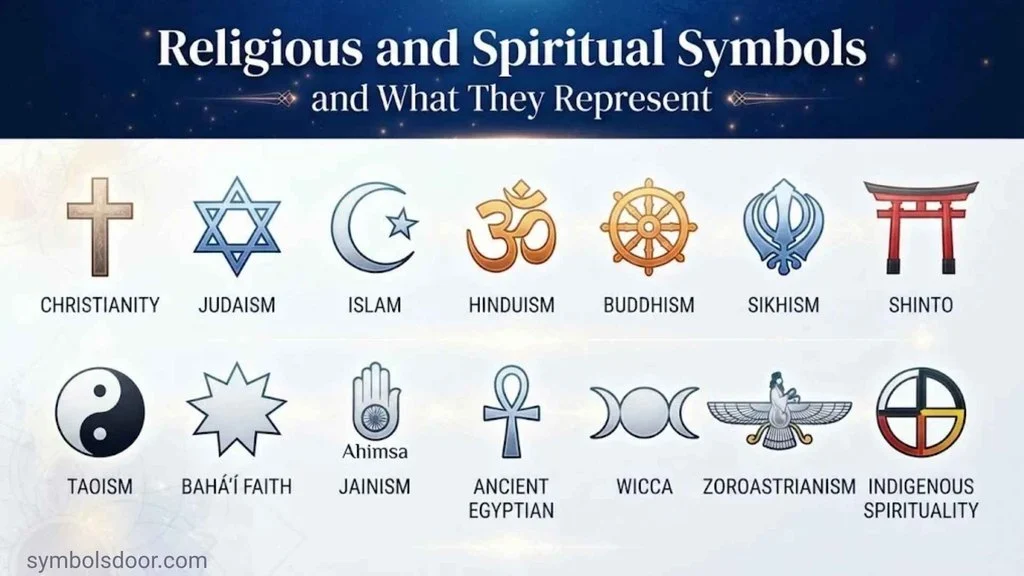
Religious symbols can express faith, history, teachings, and belonging. They often carry meanings that are deeply important to the communities that use them.
If you choose a religious symbol as a personal representation, learn about its original meaning and treat it with respect.
Christianity – The Cross
The cross is the central symbol of Christianity. It represents the crucifixion of Jesus Christ and is associated with sacrifice, redemption, salvation, and faith.
For many Christians, the cross is a reminder of God’s love and the message of Jesus.
Judaism – The Star of David
The Star of David, also called the six-pointed star, is one of the best-known symbols of Jewish identity.
It consists of two overlapping triangles that form a six-pointed star. It is widely used in Jewish communities, synagogues, cultural institutions, and on the flag of Israel.
Its historical development is complex, and it should not be reduced to a single universal symbolic meaning.
Islam – Crescent Moon and Star
The crescent moon and star are widely associated with Islamic history and with several Muslim-majority countries.
However, the crescent and star are not universal religious requirements or foundational symbols of Islamic belief. The symbol’s association with Islam developed through historical and political use, including its appearance in Ottoman imagery.
The Qur’an and Islamic religious traditions do not establish the crescent and star as a required emblem of the faith.
Hinduism – Om
The Om symbol represents a sacred sound and spiritual concept in Hindu traditions. It is associated with meditation, prayer, and the understanding of ultimate reality.
Om is also used in some Buddhist and Jain traditions, although its role and interpretation differ across belief systems.
Buddhism – Dharma Wheel and Lotus
Two important Buddhist symbols are the Dharma Wheel and the lotus flower.
- Dharma Wheel: Represents the Buddha’s teachings and the path of Buddhist practice. Its eight spokes are commonly connected with the Noble Eightfold Path.
- Lotus: Represents purity, spiritual development, and awakening.
These symbols are meaningful parts of Buddhist religious iconography.
Ancient Egyptian Symbolism – Eye of Horus
The Eye of Horus is an ancient Egyptian symbol associated with protection, healing, and restoration.
In Egyptian mythology, Horus lost an eye during a conflict with Seth. The eye was restored, and its image became connected with protection and healing.
The symbol appeared in ancient Egyptian objects, jewelry, and protective imagery. explains its historical associations with restoration and protection.
How Spiritual Symbols Relate to Personal Identity
Spiritual symbols can become meaningful parts of a person’s identity because they connect individual beliefs with a wider tradition.
Before choosing one, consider:
- Whether you belong to the tradition associated with the symbol.
- What the symbol means to its community.
- Whether its use is appropriate in your intended context.
- Whether you understand its historical and religious background.
A personal symbol should express your identity without misrepresenting another community’s beliefs.
Cultural and Historical Symbols That Can Reflect Your Identity
Cultural symbols connect people with shared traditions, stories, artistic practices, and historical experiences. They can represent a community, a place, or a particular period.
Egyptian Symbols and Their Meanings
Ancient Egyptian art includes many recognizable symbols.
| Egyptian symbol | Common historical meaning |
| Ankh | Life |
| Eye of Horus | Protection, healing, and restoration |
| Scarab | Renewal and transformation |
| Djed pillar | Stability and endurance |
| Was scepter | Power and authority |
The ankh is especially recognizable. It has a cross-like shape with a loop at the top and frequently appears in ancient Egyptian artwork.
The scarab beetle was associated with the god Khepri and ideas of renewal and the sun’s movement.
Chinese Cultural Symbols
Chinese cultural symbolism includes animals, colors, plants, and traditional designs.
The Chinese dragon, known in Chinese as long or loong in modern English transliteration, is a powerful cultural symbol.
Unlike many European dragon traditions, Chinese dragons have often been associated with auspicious power, water, rain, imperial authority, and good fortune.
The Smithsonian’s National Museum of Asian Art explains that dragons in Chinese art were connected with water, weather, masculine power, and imperial majesty. Its collection resource on Chinese dragons offers useful historical context.
Other familiar Chinese symbols include:
- Yin-yang: Complementary forces and balance.
- Bamboo: Integrity, resilience, and flexibility.
- Peach: Longevity and good fortune.
- Red: Celebration, happiness, and good fortune in many traditional contexts.
Celtic Symbols and Their Cultural Associations
Celtic art includes distinctive knotwork and geometric patterns.
Some widely recognized designs include:
- Triquetra: A three-part knot associated with different interpretations in Celtic-inspired art and Christian contexts.
- Celtic knotwork: Interlacing patterns often used to suggest continuity and connection.
- Triskele: A three-part spiral design associated with movement and threefold patterns.
Not every modern interpretation of these designs has a clearly established ancient origin. If you use one, distinguish historical evidence from modern spiritual interpretations.
Why Cultural Symbols Matter
Cultural symbols can preserve ideas and traditions across generations.
They appear in:
- Traditional clothing and jewelry.
- Architecture and monuments.
- Religious ceremonies.
- National and regional artwork.
- Literature and storytelling.
- Family traditions and celebrations.
Understanding a symbol’s history makes your choice more meaningful and helps you avoid using it in a way that misrepresents its original purpose.
State and National Symbols That Represent Identity
National and state symbols represent communities rather than individual personality types. They can reflect a country’s history, natural environment, political ideals, or shared heritage.
United States National Symbols
Some familiar American symbols include:
- American flag: Represents the United States and its national identity.
- Bald eagle: The national bird and a widely recognized emblem of the country.
- Statue of Liberty: Commonly represents freedom and welcome.
- Great Seal of the United States: Used to authenticate official documents and represent the federal government.
These symbols have different histories and official roles. Their meanings should be understood in their historical and civic contexts.
California State Symbols
California has a wide range of official symbols, including animals, plants, colors, and a state song.
| California symbol | Official designation or association |
| California grizzly bear | State animal |
| California golden poppy | State flower |
| Coast redwood and giant sequoia | State trees |
| Blue and gold | State colors |
| “I Love You, California” | State song |
| Eureka | State motto |
The California grizzly bear became the official state animal in 1953, even though the animal had already become extinct in the state. The bear remains a prominent feature of the state flag.
The California golden poppy became the state flower in 1903. provides details about these and many other official emblems.
Texas State Symbols
Texas also uses official symbols to represent its natural resources and regional heritage.
Examples include:
- Texas longhorn: Official state large mammal.
- Bluebonnet: State flower.
- Pecan tree: State tree.
- Texas state flag: A major emblem of the state’s identity.
The longhorn is especially connected with ranching history and the image of the American West.
Why States and Countries Choose Symbols
Governments often choose official emblems because they represent important features of a region.
These may include:
- Native animals and plants.
- Important historical events.
- Local industries and traditions.
- Natural landscapes.
- Shared cultural values.
- Political history and national identity.
State symbols can also help people feel connected to their home region.
Zodiac Signs and Astrology Symbols That May Reflect Your Personality
The zodiac is a system of twelve signs associated with the path of the Sun through the sky in astrology. Each sign has a traditional symbol and a set of personality descriptions.
Astrological interpretations are part of a cultural and spiritual tradition. They are not scientifically established personality assessments, so use them as a source of reflection rather than proof of someone’s character.
Aries – The Ram
Aries is represented by the ram. In astrology, it is commonly associated with initiative, courage, energy, and action.
Taurus – The Bull
Taurus is represented by the bull. Traditional descriptions connect it with stability, patience, determination, and persistence.
Gemini – The Twins
Gemini is represented by twins. It is commonly associated with communication, curiosity, adaptability, and social interaction.
Cancer – The Crab
Cancer is represented by the crab. Its traditional associations include emotional connection, nurturing, protection, and sensitivity.
Leo – The Lion
Leo is represented by the lion. It is associated with confidence, leadership, creativity, and self-expression.
Virgo – The Maiden
Virgo is represented by the maiden. Traditional descriptions connect it with practicality, attention to detail, organization, and service.
Libra – The Scales
Libra is represented by scales, which are associated with balance, fairness, relationships, and justice.
Scorpio – The Scorpion
Scorpio is represented by the scorpion. It is traditionally associated with intensity, determination, transformation, and emotional depth.
Sagittarius – The Archer
Sagittarius is represented by the archer. Its common associations include exploration, adventure, freedom, and learning.
Capricorn – The Sea-Goat
Capricorn is represented by the sea-goat. Traditional descriptions connect it with discipline, ambition, patience, and responsibility.
Aquarius – The Water-Bearer
Aquarius is represented by the water-bearer. It is often associated with originality, independence, innovation, and humanitarian interests.
Pisces – The Fish
Pisces is represented by two fish. Its traditional associations include imagination, empathy, intuition, and emotional sensitivity.
Zodiac Symbols at a Glance
| Zodiac sign | Symbol | Common astrological associations |
| Aries | Ram | Initiative and courage |
| Taurus | Bull | Stability and determination |
| Gemini | Twins | Curiosity and communication |
| Cancer | Crab | Nurturing and sensitivity |
| Leo | Lion | Confidence and leadership |
| Virgo | Maiden | Practicality and attention to detail |
| Libra | Scales | Balance and fairness |
| Scorpio | Scorpion | Intensity and transformation |
| Sagittarius | Archer | Freedom and adventure |
| Capricorn | Sea-Goat | Discipline and ambition |
| Aquarius | Water-Bearer | Originality and independence |
| Pisces | Fish | Imagination and empathy |
Your zodiac symbol can be one part of your personal identity if astrology is meaningful to you. However, you do not need to choose it as your personal symbol. Your values and experiences may matter more.
Music, Hobbies, and Lifestyle Symbols That Represent You
Your interests can also help you discover a symbol that feels personal. Music, hobbies, sports, and creative activities often become important parts of individual identity.
Music Genres and Their Symbolic Associations
Different music genres have their own histories, communities, styles, and cultural influences.
| Music genre | Possible cultural or personal associations |
| Metal | Intensity, individuality, and powerful expression |
| Hip-hop | Storytelling, rhythm, identity, and cultural expression |
| Country | Storytelling, rural life, and personal relationships |
| Pop | Popular culture and shared experiences |
| Folk | Heritage, community, and traditional storytelling |
| Rock | Individuality, energy, and creative expression |
These are broad associations, not personality rules. Listening to metal does not automatically make someone rebellious, just as enjoying country music does not determine someone’s lifestyle.
Symbols Connected to Hobbies and Interests
You can turn an interest into a personal symbol by choosing an object connected with that activity.
- Board game piece: Strategy, planning, and problem-solving.
- Sports equipment: Teamwork, competition, and determination.
- Book: Learning, knowledge, and imagination.
- Pen: Writing, communication, and creativity.
- Theater masks: Acting, performance, and emotional expression.
- Musical instrument: Creativity and artistic skill.
- Medical emblem: Healthcare, service, and responsibility.
For example, a writer might choose a fountain pen to represent creativity and communication. An athlete might prefer a trophy or running shoe to represent discipline and achievement.
Symbols That Represent Your Goals and Life Experiences
Some symbols are meaningful because they represent a journey rather than a personality trait.
| Symbol | Possible meaning |
| Mountain | Overcoming challenges |
| Compass | Purpose and direction |
| Road | Life journey and new experiences |
| Bridge | Connection and transition |
| Open door | Opportunity and change |
| Gold medal | Achievement and dedication |
| Anchor | Stability and security |
| Star | Hope and ambition |
A compass may represent someone who is still discovering their purpose. An open door might represent starting a new career, moving to another city, or beginning a different chapter of life.
Symbols That Represent Your Emotions, Fears, and Motivations
Your emotional experiences can influence which symbols feel meaningful to you. Some people choose images that represent what they have overcome. Others choose symbols that remind them of what they want to achieve.
Symbols That Represent Hope and Optimism
These symbols are commonly associated with renewal and positive change:
- Rising sun: A new beginning.
- Rainbow: Hope and promise.
- Star: Inspiration and direction.
- Phoenix: Renewal after hardship.
Symbols That Represent Fear and Uncertainty
Some images can represent difficult emotions or uncertain experiences.
- Storm cloud: Emotional difficulty or uncertainty.
- Maze: Confusion and difficult decisions.
- Broken bridge: Separation or a lost connection.
- Dark forest: The unknown or fear of change.
These are artistic associations, not universal meanings. A storm, for example, can represent danger in one artwork and cleansing or renewal in another.
Symbols That Represent Change and Personal Growth
If you have experienced major changes, these symbols may connect with your story:
- Butterfly: Transformation.
- Phoenix: Starting again after hardship.
- Open door: New opportunities.
- New leaf: Fresh beginnings.
- Growing tree: Long-term development.
Symbols That Represent Love and Friendship
- Heart: Love and affection.
- Two linked rings: Partnership and commitment.
- Interlocking circles: Connection and unity.
- Dove: Peace and harmony.
- Two hands: Support and cooperation.
Symbols That Represent Determination and Motivation
- Mountain: Persistence.
- Arrow: Direction and progress.
- Anchor: Stability during difficult times.
- Compass: Purpose and focus.
- Flame: Passion and motivation.
You can use one of these symbols as a reminder of a personal goal or a quality you want to develop.
Emojis That Represent Different Personalities
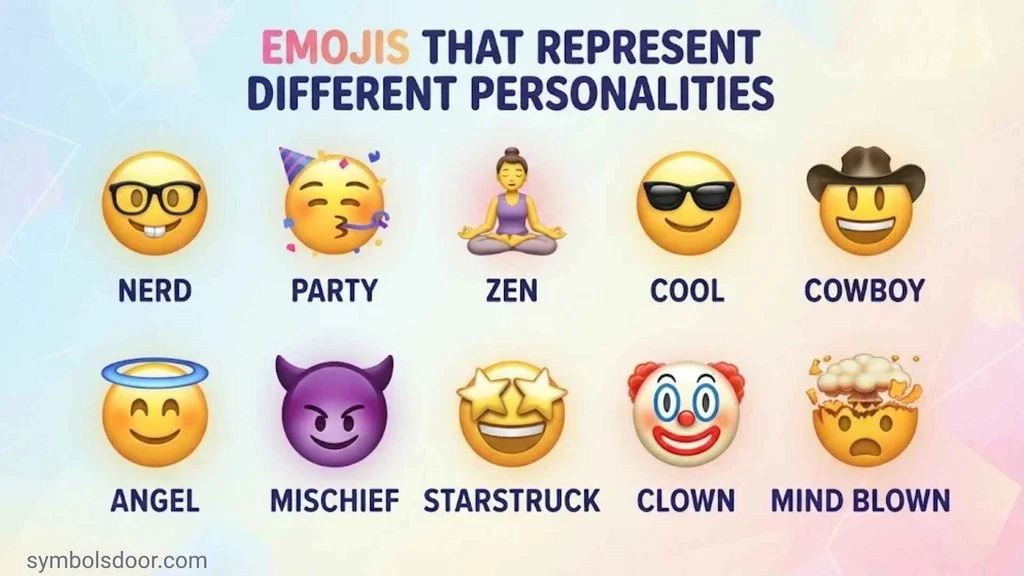
Emojis are modern digital symbols that help people express emotions, reactions, and ideas in messages and social media.
Their meanings depend on context, and people sometimes use the same emoji in different ways. Still, certain emojis have familiar associations.
💪 Strength Emoji
The flexed biceps emoji commonly represents strength, effort, confidence, and determination.
You might use it to celebrate a personal achievement or remind yourself to keep working toward a difficult goal.
💐 Flower Bouquet Emoji
The flower bouquet emoji often communicates appreciation, affection, celebration, and kindness.
It can represent someone who values relationships, thoughtful gestures, and positive connections.
🌊 Ocean Wave Emoji
The ocean wave emoji can represent the sea, travel, nature, movement, or emotional depth.
It may suit someone who feels connected to the ocean or enjoys adventure and exploration.
🥇 Gold Medal Emoji
The gold medal emoji represents achievement, victory, success, and excellence.
It can reflect a competitive spirit or a commitment to reaching personal goals.
🤗 Hugging Face Emoji
The hugging face emoji commonly expresses warmth, affection, support, and friendliness.
It may appeal to someone who values kindness and emotional connection.
⛵ Sailboat Emoji
The sailboat emoji can represent travel, freedom, exploration, and adventure.
It may be meaningful to someone who enjoys discovering new places or following an independent path.
How to Choose an Emoji That Represents You
Choose an emoji based on the message you want to communicate.
For example:
- Use 💪 if determination is important to you.
- Choose 💐 if kindness and appreciation describe you.
- Pick 🌊 if you connect with the ocean and nature.
- Use 🥇 if achievement motivates you.
- Choose 🤗 if friendship and warmth matter to you.
- Pick ⛵ if freedom and adventure inspire you.
An emoji can be a simple digital version of your personal symbol.
What Symbol Best Represents Me? Take a Simple Personality Symbol Quiz
Now that you have explored different symbols, try this short quiz. Choose the answer that feels closest to your personality or personal values.
This is a self-reflection activity, not a scientific personality test.
Question 1: Which Personality Trait Describes You Best?
- A. Strong and determined.
- B. Kind and caring.
- C. Creative and imaginative.
- D. Independent and adventurous.
- E. Wise and thoughtful.
Question 2: What Matters Most to You?
- A. Achievement and success.
- B. Relationships and friendship.
- C. Self-expression and creativity.
- D. Freedom and independence.
- E. Knowledge and understanding.
Question 3: Which Natural Setting Do You Prefer?
- A. Mountains.
- B. Flower gardens.
- C. Forests.
- D. The ocean.
- E. An open sky.
Question 4: Which Color Feels Most Like You?
- A. Red.
- B. Green.
- C. Purple.
- D. Blue.
- E. Yellow.
Question 5: Which Animal Do You Connect With Most?
- A. Lion.
- B. Dog.
- C. Butterfly.
- D. Eagle.
- E. Owl.
Quiz Results: Discover Your Personal Symbol
Count the letter you selected most often.
| Your most common answer | Personal symbol | What it represents |
| Mostly A | Lion | Courage, strength, and leadership |
| Mostly B | Heart | Kindness, love, and connection |
| Mostly C | Butterfly | Creativity, transformation, and growth |
| Mostly D | Eagle | Freedom, independence, and ambition |
| Mostly E | Owl | Wisdom, knowledge, and curiosity |
What if you have a tie? Combine the meanings. For example, a lion and an owl could represent someone who values both courage and wisdom.
Your result is only a starting point. If another symbol feels more meaningful, you can choose that one instead.
How to Create Your Own Personal Symbol
You do not have to select an existing symbol. You can create a personal design that combines several ideas from your life.
A custom symbol can be useful for artwork, a journal, a personal logo, a digital profile, or a meaningful gift.
Choose Three Words That Describe You
Start with three qualities you want your symbol to express.
For example:
- Courage.
- Creativity.
- Growth.
Or:
- Kindness.
- Loyalty.
- Family.
These words will give your design a clear purpose.
Select a Symbol Connected to Your Strongest Value
Choose an image that represents your most important quality.
For example:
- Mountain for resilience.
- Heart for kindness.
- Eagle for freedom.
- Tree for growth.
- Compass for direction.
You can use one main image or combine two or three simple shapes.
Pick Colors That Reflect Your Personal Meaning
Choose colors based on the message you want your design to communicate.
For instance, green might represent growth, while blue could express calmness. Purple might add a sense of creativity or mystery.
Remember that color meanings vary across cultures, so your personal interpretation can guide your choice.
Combine Simple Shapes and Images
You do not need complicated artwork to create a recognizable symbol.
Consider these combinations:
- A mountain with a rising sun for strength and hope.
- A tree with deep roots for family and stability.
- A compass inside a circle for purpose and direction.
- A butterfly with a flower for growth and creativity.
- A heart surrounded by stars for love and inspiration.
Make Sure Your Design Is Original and Respectful
Before using a design, check whether it closely resembles an existing religious, cultural, national, or organizational emblem.
You can take inspiration from general shapes and natural objects without copying a sacred or protected symbol.
Use Your Personal Symbol in Meaningful Ways
Once you have created it, you can use your design in places that matter to you:
- A personal journal or notebook.
- Digital artwork and profile images.
- A vision board.
- A personal website or portfolio.
- A handmade gift.
- A private reminder of your values.
Your symbol can also change as your life changes. A design that represents independence today may eventually become a symbol of family, stability, or personal growth.
Why Symbols Are Important in Everyday Life
Symbols help people communicate ideas quickly. They can express complex beliefs, identify communities, preserve history, and make information easier to recognize.
You encounter them more often than you might realize.
Symbols Make Communication Easier
A heart can communicate affection without a written explanation. A red traffic light tells drivers to stop. A medical cross can help people recognize healthcare facilities.
These examples show how visual communication can make information easier to understand.
Symbols Help Express Personal Identity
People often use clothing, jewelry, tattoos, colors, and artwork to express their interests and values.
A person might wear a particular pendant because it represents family heritage. Another might use a mountain image because it reminds them of a difficult achievement.
Symbols Preserve Cultural Heritage
Flags, traditional patterns, religious artwork, and historical monuments help communities preserve their shared stories.
They can connect younger generations with the customs and experiences of earlier generations.
Symbols Communicate Beliefs and Values
Religious symbols can express faith and spiritual teachings. National symbols can represent political history and shared identity. Personal symbols can communicate individual values.
However, their meanings depend on the people and traditions connected with them.
Symbols Influence Art, Literature, and Popular Culture
Writers and artists often use symbols to communicate ideas beyond their literal appearance.
A storm might represent conflict. A journey might represent personal development. A locked door might suggest an obstacle or an opportunity that has not yet been discovered.
This is why symbolism remains important in art, storytelling, design, and everyday communication.
Frequently Asked Questions About Symbols That Represent Me
What symbol best represents me?
The best symbol is one that reflects your personality, values, interests, or life experiences. A lion may represent courage, a dove may represent peace, and a butterfly may represent transformation. Choose the image that feels most meaningful to you.
How do I find a symbol that represents my personality?
Start by identifying three important personality traits. Then explore symbols associated with those qualities. Consider animals, colors, plants, objects, and traditional designs before choosing one that feels appropriate.
What is a personal symbol?
A personal symbol is an image, object, color, or design that represents something meaningful about an individual. It may express personal values, beliefs, interests, relationships, or experiences.
Which symbol represents strength and courage?
The lion, eagle, mountain, oak tree, and phoenix are commonly associated with strength and courage. The lion often represents bravery and leadership, while the mountain suggests endurance and stability.
What symbol represents kindness and loyalty?
The heart is a familiar symbol of love and kindness. A dog often represents loyalty and companionship, while a dove can represent peace and gentleness.
What animal represents intelligence and wisdom?
The owl is widely recognized as a symbol of wisdom and knowledge. Its association with Athena in Greek mythology helped establish this connection in Western traditions.
What flower represents personal growth?
The lotus is commonly associated with spiritual growth and awakening in Hindu and Buddhist traditions. The butterfly is another popular symbol of transformation, although it is an insect rather than a flower.
Can a color represent my personality?
A color can express your personal taste, emotions, or cultural associations, but it cannot reliably determine your personality. Choose a color based on the qualities and experiences you want it to represent.
Can my zodiac sign be my personal symbol?
Yes. If astrology is meaningful to you, you can use your zodiac sign as a personal symbol. Each of the twelve signs has a traditional image and symbolic associations. However, astrology is not a scientifically validated way to determine personality.
Are personal symbols different from religious symbols?
Yes. Personal symbols express an individual’s identity or experiences, while religious symbols have meanings connected with particular faiths and traditions. A symbol can serve both purposes, but its religious and cultural background should be respected.
Can I create my own symbol?
Absolutely. Start with a few personal values, select images that represent them, and combine simple shapes or colors into an original design. You can create a symbol that reflects your personality, goals, and experiences.
Can my personal symbol change over time?
Yes. Your interests, beliefs, relationships, and goals may change as you grow. A symbol that once represented independence might later represent family or stability. Your personal symbol does not have to remain the same forever.
Final Thoughts on Finding a Symbol That Represents You
Finding a symbol that represents you is a personal journey. You might connect with a lion because you admire courage, a butterfly because you value transformation, or an oak tree because stability matters to you.
You can also choose a color, flower, zodiac sign, spiritual symbol, or everyday object. What matters most is the meaning you attach to it.
Explore different symbols and their meanings, consider your personal values, and learn about the cultural background of any traditional design you choose. You do not need to fit into one category or let a quiz decide who you are.
Your personality is more complex than a single image. Still, the right symbol can serve as a meaningful reminder of your strengths, beliefs, experiences, and the person you want to become.

Hi, I’m Asher Monroe, a writer who believes that meaningful words have the power to inspire change and bring people closer to their dreams. I have always been fascinated by the beauty of quotes and the way a simple message can provide motivation, hope, and comfort.
I enjoy creating content around inspirational quotes, life lessons, success stories, and positive thoughts that help readers find encouragement in their everyday lives. My goal is to share words that connect with people and remind them of their inner strength.
Through my writing, I explore the ideas of personal growth, confidence, and the importance of staying inspired through every chapter of life.
I am the author of Words That Move the Soul and The Path of Endless Inspiration, two books focused on the power of wisdom, positivity, and meaningful thoughts.
 Sienna Brooks
 Rowan Sinclair Rowan Sinclair