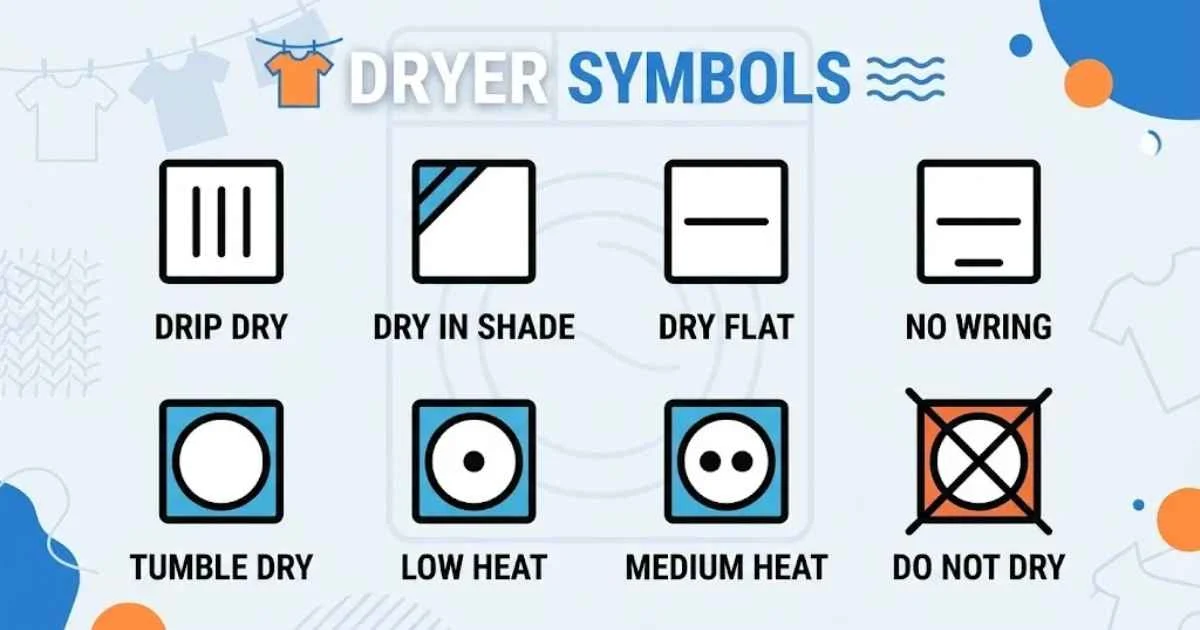
Dryer symbols tell you how to dry your clothes without damaging the fabric. A small circle inside a square, a single dot, or a crossed-out symbol can change how you should handle an entire load of laundry. Understanding these markings helps you avoid shrinking sweaters, damaging elastic, fading colors, and ruining delicate garments.
However, not every drying symbol means the same thing. Some labels allow tumble drying, while others recommend low heat, flat drying, or keeping clothes away from direct sunlight. A few symbols also warn you against using a dryer altogether.
This guide explains dryer symbols and their meanings, including tumble-drying instructions, natural drying methods, heat settings, and common clothing care labels. You’ll also learn how to identify the correct drying method for different fabrics and avoid mistakes that shorten the life of your clothes.
Whether you’re reading a clothing label for the first time or trying to understand unfamiliar laundry symbols, this guide will help you make the right choice.
What Are Dryer Symbols on Clothing Labels?
Dryer symbols are small pictograms printed on clothing care labels. They explain how you should dry a garment after washing it. Manufacturers use these symbols to help consumers choose suitable drying methods and avoid unnecessary fabric damage.
Most international textile care labels follow a recognizable system. Each symbol communicates a particular instruction through basic shapes, lines, dots, and crosses.
The square is the main shape used for drying instructions. When you see a circle inside the square, it generally indicates tumble drying. Additional markings explain the recommended temperature or drying method.
For example:
- A square containing a circle means tumble drying is permitted.
- One dot inside the circle indicates low heat.
- Two dots indicate medium heat.
- Three dots indicate high heat.
- A cross over the tumble-drying symbol means you should not tumble dry the garment.
- Horizontal or vertical lines inside a square indicate different natural drying methods.
These markings matter because fabrics react differently to heat, moisture, and movement. Cotton may shrink under excessive heat, while elastic fibers can lose their stretch when exposed to unsuitable temperatures.
Why Are Dryer Symbols Important?
Clothing manufacturers choose materials and construction methods based on how garments should be cleaned and maintained. Drying instructions help protect those materials after washing.
Ignoring a care label can lead to several problems:
- Shrinkage: Excessive heat can make certain fabrics smaller.
- Fabric damage: Delicate fibers may weaken or become distorted.
- Loss of elasticity: Heat can damage elastic components in clothing.
- Color fading: Direct sunlight and repeated exposure can affect some dyes.
- Wrinkles: Incorrect drying methods can leave garments heavily creased.
- Shape distortion: Hanging heavy, wet knitwear can stretch it.
Think of clothing care labels as a small instruction manual attached to your clothes. Following them can help your favorite garments last longer.
Dryer Symbols Chart: Quick Reference Guide
If you want to understand a clothing label quickly, start with the shape of the drying symbol. The following chart covers common international laundry drying instructions.
| Dryer symbol description | Meaning | Recommended action |
| Square with a circle | Tumble dry | Use a tumble dryer |
| Square with a circle and one dot | Tumble dry low | Select low heat |
| Square with a circle and two dots | Tumble dry medium | Select medium heat |
| Square with a circle and three dots | Tumble dry high | Select high heat |
| Square with a crossed-out circle | Do not tumble dry | Avoid machine drying |
| Square with one horizontal line | Dry flat | Place the garment flat |
| Square with vertical lines | Line dry | Hang the garment |
| Square with a curved line | Line dry | Hang the garment over a line |
| Square with vertical lines and diagonal corner lines | Drip dry in the shade | Hang without wringing in a shaded area |
| Square with horizontal and diagonal lines | Dry flat in the shade | Lay flat away from direct sunlight |
| Square with diagonal corner lines | Dry in the shade | Keep away from direct sunlight |
Note: This is a descriptive reference, not a substitute for checking the exact pictogram. Line arrangements and regional labeling conventions matter. The sections below explain the symbols in more detail.
Tumble Dryer Symbols and Their Meanings
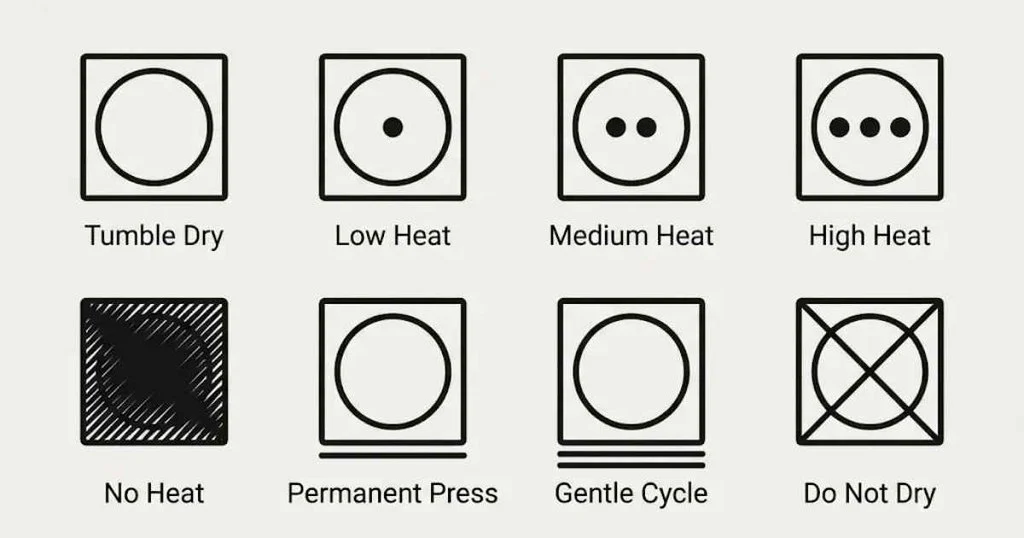
Tumble dryer symbols are among the most recognizable clothing care symbols. They tell you whether a garment can go into a machine dryer and, when applicable, which heat level to use.
The basic symbol combines a square and a circle. The square represents the drying process, while the circle identifies tumble drying.
Tumble Dry Symbol: Square With a Circle
The basic tumble-dry symbol consists of a circle inside a square. It means you can dry the garment in a tumble dryer.
However, this symbol doesn’t automatically mean that every temperature is safe. Check for additional dots inside the circle before selecting a dryer setting.
For example, a garment might tolerate tumble drying but require a lower temperature. Another garment may allow a warmer cycle.
What you should do:
- Check whether the symbol contains any dots.
- Follow the indicated heat level.
- Avoid overcrowding the dryer.
- Remove clothes promptly when the cycle finishes.
- Check other care instructions before washing and drying.
Tumble Dry Low Heat Symbol
The low-heat tumble-dry symbol features one dot inside a circle surrounded by a square.
It tells you to use a low-temperature drying cycle. This instruction is common for garments that need more protection from heat.
Low heat can help reduce the risk of shrinkage and damage to heat-sensitive fibers. However, it doesn’t make every delicate garment suitable for machine drying. Always check the complete care label.
Common examples include:
- Certain synthetic fabrics.
- Some lightweight clothing.
- Garments containing elastic fibers.
- Selected delicate household textiles.
Choose your dryer’s low-heat or delicate setting when the garment permits tumble drying at a low temperature.
Tumble Dry Medium Heat Symbol
The medium-heat symbol contains two dots inside the tumble-drying circle.
It means you can use a moderate dryer temperature. This setting provides more heat than low-temperature drying but less than high-heat drying.
Some everyday garments can tolerate medium heat, depending on their fiber content and construction.
For example, certain cotton blends and synthetic fabrics may carry this instruction. However, don’t assume that all garments made from these materials can handle medium heat.
Follow these precautions:
- Select the medium-heat cycle.
- Avoid extending the drying time unnecessarily.
- Separate delicate items from heavier laundry.
- Remove garments when they reach the desired dryness.
Tumble Dry High Heat Symbol
The high-heat tumble-dry symbol contains three dots inside the circle.
It indicates that the garment can tolerate high-temperature tumble drying under the conditions intended by its care label.
Some sturdy cotton garments and household textiles may carry this instruction. However, high heat isn’t automatically suitable for every cotton item.
Excessive heat can cause shrinkage, weaken certain fibers, and damage decorative elements. Even when a garment permits high heat, avoid unnecessary exposure.
Practical tip: Use high heat only when the care label allows it. Don’t choose this setting simply because you want your laundry to dry faster.
Tumble Dry No Heat or Air Fluff
Air fluff is an appliance setting rather than a universal clothing care-label symbol.
It tumbles clothing using moving air without applying the dryer’s normal heating cycle. This makes it useful for refreshing suitable garments, loosening wrinkles, and fluffing certain textiles.
You can use air fluff for items that benefit from tumbling without additional heat, provided their care instructions permit machine movement.
Remember that air fluff and natural air drying aren’t identical. Air fluff uses the dryer’s drum, while natural air drying takes place outside the appliance.
Permanent Press and Delicate Dryer Settings
Permanent press and delicate are common dryer cycle names. They describe appliance functions rather than separate international care-label pictograms.
Permanent press generally uses controlled heat and a cooling period to help reduce wrinkles. It’s often useful for suitable synthetic fabrics and everyday clothing.
Delicate generally uses gentler drying conditions and lower heat. It’s designed for garments that need more careful treatment.
The exact temperature, drum movement, and cycle duration depend on your dryer model. Always match the cycle to the garment’s care instructions.
Do Not Tumble Dry Symbol: What Does It Mean?
The do not tumble dry symbol features a circle inside a square with a diagonal cross over it. This marking tells you that you shouldn’t place the garment in a tumble dryer.
Some fabrics cannot handle the combination of heat and continuous movement inside a dryer. Even a short drying cycle may cause unwanted changes.
Common reasons manufacturers prohibit tumble drying include:
- Heat sensitivity: Certain fibers can weaken or change shape when heated.
- Shrinkage risk: Some materials become smaller after exposure to high temperatures.
- Elastic damage: Stretch fibers may lose their recovery and flexibility.
- Delicate construction: Embellishments, coatings, and decorative details may become damaged.
- Shape retention: Certain garments need careful handling to maintain their original structure.
What Should You Do Instead of Tumble Drying?
When a garment carries this symbol, choose a suitable natural drying method.
Depending on the other care instructions, you can:
- Hang the garment on a clothesline.
- Place it flat on a clean drying rack.
- Allow excess water to drain before arranging it.
- Keep it away from direct sunlight when the label requires shade.
- Reshape the garment gently while it’s still damp.
Important: A do-not-tumble-dry instruction doesn’t mean you cannot dry the garment. It means you must avoid the tumble-drying process.
Natural Drying Symbols and Their Meanings
Not every garment belongs in a machine dryer. Some clothing needs natural drying to maintain its shape, texture, and overall appearance.
International laundry care labels use different lines inside a square to communicate natural drying instructions. The position and number of lines determine how you should arrange the garment.
Line Dry Symbol
The line dry symbol features one vertical line inside a square. It tells you to hang the garment on a clothesline or suitable hanger and allow it to dry naturally.
This method works well for many everyday garments that can support their own weight while wet.
How to line dry clothes properly:
- Shake garments gently to remove wrinkles.
- Hang them evenly on a clothesline or drying rack.
- Use suitable clips or hangers.
- Leave enough space for air circulation.
- Avoid stretching the fabric while it’s wet.
For heavy garments, check whether the label permits hanging. Some materials can stretch under their own weight.
Drip Dry Symbol
The drip-dry symbol contains two vertical lines inside a square. It means you should hang the garment without removing much of its remaining water through spinning or wringing.
This method allows water to drain naturally as the garment hangs.
Drip drying can help delicate clothing retain its shape. It’s particularly useful for certain garments that shouldn’t undergo aggressive mechanical handling.
Follow these steps:
- Remove the garment carefully from the washing machine.
- Avoid twisting or squeezing it.
- Hang it over a suitable drying rack.
- Place a towel underneath if water may drip onto the floor.
- Allow sufficient time for natural drying.
The ISO 3758 care-label standard specifies that drip-drying instructions require the washing machine’s spin cycle to be canceled.
Textiles+1
Dry Flat Symbol
The dry flat symbol features one horizontal line inside a square. It means you should place the garment on a flat surface rather than hanging it.
This instruction is especially important for knitted clothing. Wet knitwear can become heavier and stretch when you hang it from a hanger or clothesline.
Sweaters, wool garments, and certain delicate fabrics often benefit from flat drying.
How to dry clothes flat:
- Place a clean, dry towel on a flat surface.
- Lay the garment over the towel.
- Reshape the shoulders, sleeves, and body.
- Remove excessive folds and wrinkles.
- Turn the garment occasionally if necessary.
Avoid placing wet clothing directly on a surface that traps moisture. Good airflow helps the garment dry more evenly.
Drip Flat Dry Symbol
The drip-flat symbol features two horizontal lines inside a square.
It tells you to dry the garment flat while allowing excess water to drain naturally. Unlike ordinary flat drying, this method doesn’t call for aggressive water removal.
It’s useful for garments that need both gentle handling and support during drying.
For example, certain delicate knitted items may benefit from this approach because hanging them could distort their shape.
Dry in the Shade Symbol
The shade-drying symbol includes a diagonal line in the corner of the square. It indicates that you should dry the garment away from direct sunlight.
Sunlight can affect certain dyes and heat-sensitive materials. Some colored fabrics may fade when exposed to strong sunlight for extended periods.
Shade drying helps reduce this risk.
You can use:
- A covered outdoor drying area.
- A shaded balcony.
- An indoor drying rack near good airflow.
- A ventilated laundry room.
Remember that shade drying doesn’t mean drying clothes in a damp or poorly ventilated room. Moisture needs somewhere to escape.
Line Dry in the Shade Symbol
This symbol combines one vertical line with a diagonal shade marking.
It means you should hang the garment naturally while keeping it away from direct sunlight.
This instruction can be useful for colored garments and fabrics that need protection from excessive sun exposure.
Hang the item in a shaded, well-ventilated location. Avoid placing it under strong direct sunlight, even if the weather feels pleasant.
Drip Dry in the Shade Symbol
This marking combines two vertical lines with a diagonal shade line.
It tells you to hang the garment without wringing or spinning it aggressively and allow it to drip dry in the shade.
This method provides gentle water removal while protecting the garment from direct sunlight.
Dry Flat in the Shade Symbol
The dry-flat-in-the-shade symbol combines a horizontal line with a diagonal corner marking.
It means you should lay the garment flat and keep it away from direct sunlight.
This method is particularly useful for wool garments, delicate knitwear, and clothing that can stretch when wet.
Drip Flat Dry in the Shade Symbol
This symbol combines two horizontal lines with a diagonal shade marking.
It means you should lay the garment flat without aggressive water extraction and keep it away from direct sunlight.
Arrange the garment carefully on a clean drying surface. Allow excess water to drain naturally while maintaining its original shape.
How to Read Dryer Symbols on Clothing Labels
Reading laundry care labels becomes much easier once you understand the basic shapes.
Most clothing labels contain several groups of symbols. Each group addresses a different stage of garment care.
Here’s how to identify the drying instructions.
Find the Clothing Care Label
Start by checking the inside of your garment. Manufacturers commonly place care labels in locations such as:
- Inside the side seam of shirts and dresses.
- Along the waistband of pants.
- Inside the neckline of tops.
- Along the inner seam of jackets.
- Inside the lining of certain garments.
Some labels include written instructions alongside international care pictograms.
Identify the Square
Look for the square-shaped symbol.
This represents the drying process. If the square contains a circle, you’re looking at a tumble-drying instruction.
If it contains horizontal or vertical lines, it generally describes natural drying.
Check for Dots Inside the Circle
Dots indicate the permitted tumble-drying temperature level.
For current ISO 3758 and GINETEX labeling, the common tumble-drying scale has two permitted heat levels:
| Symbol marking | Meaning | Maximum exhaust temperature |
| Circle inside square, no dots | Normal tumble drying | 80°C |
| Circle inside square, one dot | Low-temperature tumble drying | 60°C |
| Cross over circle inside square | Do not tumble dry | Not permitted |
An important distinction: The current international system does not use a three-dot high-heat tumble-drying category. Some appliance displays use different graphics or temperature levels, so don’t confuse dryer control icons with clothing care-label symbols.
Textiles+1
Look for Lines and Diagonal Markings
When the square contains lines instead of a circle, check their direction and number.
- One vertical line: Line drying.
- Two vertical lines: Drip line drying.
- One horizontal line: Flat drying.
- Two horizontal lines: Drip flat drying.
- Diagonal corner marking: Perform the indicated natural drying method in the shade.
Check for a Cross
A diagonal cross over a symbol means the corresponding treatment isn’t permitted.
For example, a crossed-out tumble-drying symbol tells you to avoid using a tumble dryer.
Never ignore this marking just because a garment looks sturdy.
Dryer Symbols vs. Washing Machine Symbols
Dryer symbols and washing machine symbols appear together on many clothing labels. However, they communicate different instructions.
Confusing them can lead to poor laundry decisions.
The washing symbol tells you how to clean the garment. The drying symbol explains how to remove moisture afterward.
Here’s how to distinguish the main care-label categories.
| Care symbol shape | Represents | What it tells you |
| Washtub | Washing | Washing temperature and process |
| Square | Drying | Tumble or natural drying method |
| Triangle | Bleaching | Whether bleaching is permitted |
| Iron | Ironing | Suitable ironing temperature |
| Circle | Professional textile care | Dry cleaning or professional wet cleaning |
GINETEX+1
For example, a shirt may carry a washing symbol that permits machine washing at a certain temperature. However, its drying symbol might prohibit tumble drying.
That means you can wash the shirt in your washing machine but must dry it naturally.
Remember: Permission to machine wash doesn’t automatically mean permission to machine dry.
What Do Dryer Symbols Mean for Different Fabrics?
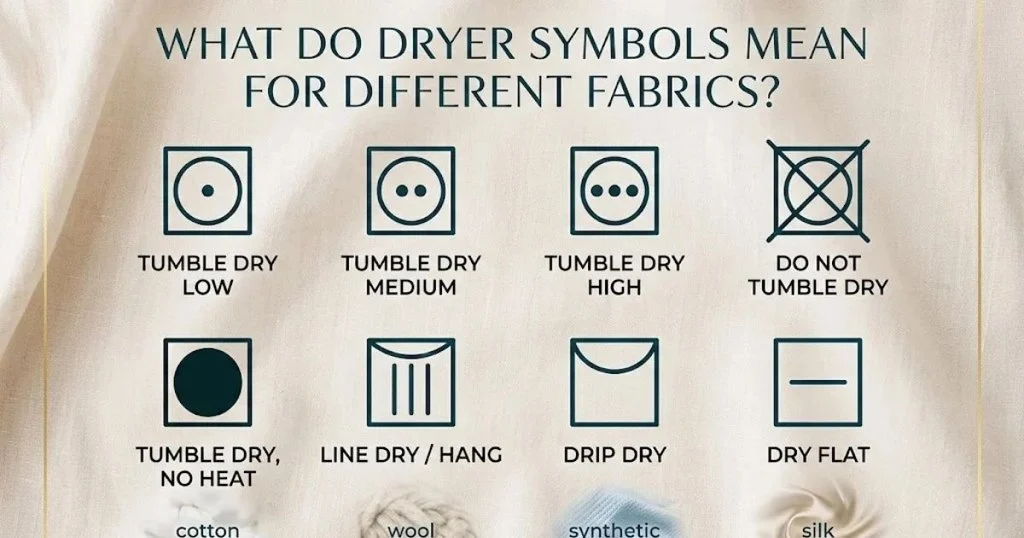
Different materials respond differently to heat, moisture, and mechanical movement. Understanding fabric behavior helps you interpret drying instructions more carefully.
However, the care label always takes priority over general fabric advice.
Cotton
Cotton is a common natural fiber used in T-shirts, towels, shirts, bedding, and everyday clothing.
Many cotton garments can tolerate tumble drying. However, excessive heat can cause shrinkage, especially when the fabric hasn’t been treated to control dimensional changes.
Drying recommendations:
- Follow the garment’s specific tumble-drying symbol.
- Use low or normal heat when permitted.
- Avoid unnecessarily long drying cycles.
- Remove clothing promptly to reduce wrinkles.
Don’t assume every cotton garment can handle high temperatures.
Polyester
Polyester is a synthetic fiber used in sportswear, jackets, shirts, and many household textiles.
It generally dries relatively quickly and often needs less heat than heavier natural fabrics.
Excessive heat can damage polyester fibers or affect the shape of the garment.
Better drying practices:
- Check whether the garment permits tumble drying.
- Choose the specified low-temperature setting when required.
- Avoid excessive heat.
- Remove garments when dry.
Wool
Wool requires special attention because heat, moisture, and agitation can cause felting and shrinkage.
Many wool garments should not go into a conventional tumble dryer. Some specifically designed machine-washable wool products have different instructions.
Recommended approach:
- Check the care label before drying.
- Use flat drying when instructed.
- Reshape the garment while damp.
- Avoid hanging heavy, wet sweaters.
- Keep wool away from excessive heat.
A wool sweater that loses its shape can be difficult to restore.
Silk
Silk is a delicate natural protein fiber known for its smooth texture and appearance.
Some silk garments can tolerate careful washing, but their drying requirements vary considerably.
Direct sunlight and unsuitable heat can affect silk’s appearance and strength.
Follow these precautions:
- Read the care label carefully.
- Avoid tumble drying when prohibited.
- Use the specified natural drying method.
- Keep garments away from direct sunlight when instructed.
- Handle wet silk gently.
Linen
Linen comes from flax fibers and is commonly used in summer clothing, shirts, trousers, and bedding.
It can tolerate different drying methods depending on its construction and finishing.
However, excessive heat may contribute to shrinkage and wrinkles.
Allow suitable linen garments to dry naturally when recommended. If the label permits tumble drying, select the specified temperature.
Denim
Denim is a sturdy cotton-based fabric used for jeans, jackets, and other clothing.
Although denim feels durable, high dryer temperatures can cause shrinkage and affect the garment’s fit.
For better results:
- Check the care label.
- Turn jeans inside out when appropriate.
- Use the permitted temperature.
- Avoid unnecessary high-heat drying.
- Remove jeans when they reach the desired dryness.
Spandex and Elastane
Spandex, also known as elastane, provides stretch in leggings, sportswear, underwear, and fitted clothing.
These fibers can lose their elasticity when exposed to excessive heat.
Many garments containing elastane recommend low heat or natural drying.
Avoid assuming that a garment is dryer-safe simply because its main fabric is cotton or polyester. Even a small percentage of elastic fiber can affect its care requirements.
Cashmere and Knitted Fabrics
Cashmere is a fine natural fiber used in sweaters, scarves, and other premium clothing.
Its delicate structure requires careful handling, especially when wet.
Many cashmere garments recommend flat drying. Hanging them can stretch the fabric and distort their original shape.
Place the garment on a clean towel or suitable drying rack. Reshape it gently and allow it to dry naturally.
Common Dryer Settings and What They Do
Clothing care symbols tell you what a garment can tolerate. Your dryer’s control panel tells you which drying cycle you can select.
These are two different things. A dryer might offer several cycles, but you should choose one that matches the garment’s care instructions.
Normal or Regular Dry
The normal or regular cycle is designed for everyday laundry that can tolerate the selected temperature and tumbling action.
Depending on the appliance, this cycle may use higher heat than delicate settings.
It’s commonly used for suitable:
- Cotton towels.
- Everyday cotton clothing.
- Durable household fabrics.
- Certain cotton-blend garments.
Check the care label before using this cycle. A garment that prohibits tumble drying shouldn’t go into a regular dryer simply because it’s made from a sturdy material.
Delicate Dry
The delicate cycle uses gentler drying conditions than many standard cycles. It generally reduces heat or adjusts the drying action to protect suitable sensitive garments.
You may use it for certain lightweight clothing, synthetic fabrics, and delicate textiles when their labels permit tumble drying.
However, selecting the delicate cycle doesn’t override a do-not-tumble-dry instruction.
Permanent Press
Permanent press is designed to help reduce wrinkles in suitable fabrics.
Many permanent press cycles use moderate heat followed by a cooling period. This helps reduce creasing as the clothes finish drying.
It’s commonly used for:
- Polyester shirts.
- Certain cotton blends.
- Everyday synthetic clothing.
- Suitable wrinkle-resistant garments.
Always check the manufacturer’s instructions because permanent press temperatures differ between dryer models.
Heavy Duty
The heavy-duty cycle is intended for suitable thick or bulky items that need more drying time.
Depending on the appliance, it may use stronger tumbling action or higher heat.
Common examples include:
- Heavy cotton towels.
- Durable work clothes.
- Certain sturdy bedding items.
- Thick cotton garments.
Don’t automatically use heavy duty for every bulky item. Some comforters, jackets, and specialty fabrics require specific drying instructions.
Air Fluff
Air fluff uses moving air without the dryer’s normal heating element.
It can help refresh suitable clothing, loosen wrinkles, and fluff certain fabrics.
It’s also useful when you want tumbling action without additional heat.
However, remember that air fluff still involves mechanical movement. Garments that prohibit tumble drying may not be suitable for this cycle either.
Timed Dry
Timed dry allows you to choose how long the dryer operates.
Unlike automatic moisture-sensing cycles, this setting follows the duration you select.
For example, you might use timed drying for a small load that needs a short finishing period.
Avoid choosing an unnecessarily long duration. Excessive drying can waste energy and expose fabrics to more heat and mechanical movement than necessary.
Sensor Dry
Sensor dry uses moisture sensors to estimate how much moisture remains in the laundry.
The dryer adjusts its operation based on the moisture level it detects. This can help prevent unnecessary drying when garments have already reached the selected dryness level.
Sensor dry is useful for everyday laundry, although results depend on the appliance and load.
For best results:
- Avoid overcrowding the drum.
- Separate items with very different drying times.
- Clean the lint filter regularly.
- Choose a suitable dryness level.
- Follow each garment’s care instructions.
Common Mistakes People Make When Reading Dryer Symbols
Even experienced people make mistakes when interpreting laundry labels. A small misunderstanding can damage an otherwise perfectly good garment.
Here are some common problems worth avoiding.
Confusing Tumble Drying With Natural Drying
A square containing a circle represents tumble drying. A square containing lines represents natural drying.
These symbols aren’t interchangeable.
If your garment displays a flat-drying instruction, placing it inside a tumble dryer isn’t the correct approach.
Ignoring the Crossed-Out Tumble Dryer Symbol
A crossed-out symbol means the treatment isn’t permitted.
Some people ignore this instruction because they believe a short drying cycle won’t cause damage. Unfortunately, even brief exposure can affect sensitive materials.
Follow the manufacturer’s recommended alternative instead.
Misunderstanding the Dots
Dots communicate the permitted tumble-drying temperature level.
In the current international system, one dot means low temperature, while two dots indicate normal temperature.
Don’t assume that three dots represent the standard international high-heat category. Different appliance controls may use their own symbols.
Hanging Clothes That Should Dry Flat
Wet knitted clothing can stretch under its own weight.
Hanging a sweater that requires flat drying may leave it longer, wider, or unevenly shaped.
Use a flat drying rack and reshape the garment while it’s damp.
Ignoring Shade-Drying Instructions
Direct sunlight can affect certain dyes and delicate materials.
If your care label includes a shade-drying marking, avoid leaving the garment under strong sunlight.
A shaded location with good airflow is a better choice.
Mixing Different Fabrics in One Load
Cotton towels and lightweight synthetic shirts don’t necessarily need the same drying time.
If you combine them, one group may become completely dry while another remains damp.
Separate garments according to their care instructions, fabric weight, and drying requirements.
Assuming All Cotton Clothing Is Dryer-Safe
Cotton is a durable natural fiber, but that doesn’t make every cotton garment suitable for tumble drying.
Construction, finishing, dyes, and fabric blends can change its drying requirements.
Always check the label rather than relying on the material name alone.
What Should You Do If Dryer Symbols Are Missing or Unclear?
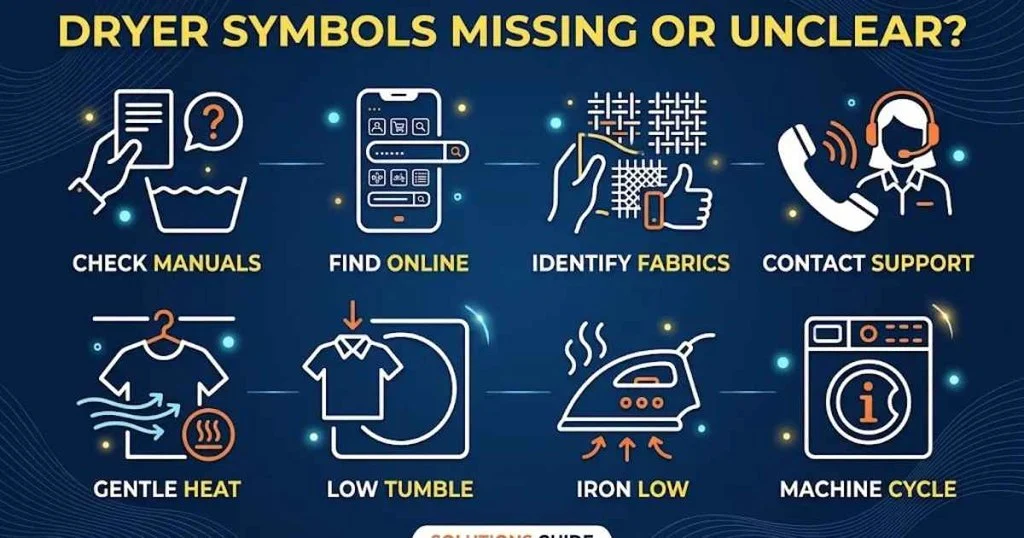
Sometimes clothing labels become faded, damaged, or difficult to read. Older garments may also have missing care instructions.
In these situations, avoid guessing.
A cautious approach can help prevent accidental damage.
Check the Manufacturer’s Website
Start by searching for the garment’s product name, model number, or identification code.
Some manufacturers publish detailed washing and drying instructions online.
If you purchased the garment recently, its original product page may still contain the complete care information.
Check the Fabric Composition
Look at the material information printed on the remaining label.
A garment containing wool, silk, elastane, or other sensitive fibers may need more careful treatment than ordinary durable cotton.
However, fabric composition alone doesn’t establish the correct drying method.
A cotton-polyester blend, for example, can have different care requirements depending on its construction.
Choose a Cautious Drying Method
When you cannot identify the correct drying instructions, natural drying is often a sensible starting point.
For example:
- Lay delicate knitwear flat.
- Hang suitable sturdy garments.
- Avoid direct sunlight for sensitive colors.
- Keep clothes away from excessive heat.
- Allow enough airflow around wet fabrics.
Natural drying isn’t automatically safe for every garment, either. Some materials need professional care or specific handling.
Avoid Using a Dryer as a Test
Putting an unknown garment through a short dryer cycle isn’t a reliable way to discover whether it’s dryer-safe.
Heat damage can happen before you notice any visible changes.
When the correct instructions remain uncertain, check with the manufacturer or choose an appropriate professional cleaning service.
Frequently Asked Questions About Dryer Symbols
Here are answers to common questions about dryer symbols on clothing labels and their meanings.
What Is the Symbol for Tumble Dry?
The tumble-dry symbol is a circle inside a square. It indicates that a garment can be dried in a tumble dryer.
Additional dots inside the circle indicate the permitted temperature level.
What Does a Circle Inside a Square Mean on Clothes?
A circle inside a square represents tumble drying.
The square identifies the drying process, while the circle indicates that the garment can be dried in a rotating machine drum.
Check for additional markings to determine the correct heat level.
What Does One Dot Mean on a Dryer Symbol?
One dot inside the tumble-drying symbol indicates low-temperature drying.
Under the current ISO 3758 international system, the maximum exhaust temperature for this treatment is 60°C.
Choose a suitable low-heat setting on your dryer.
What Do Two Dots Mean on a Dryer Symbol?
Two dots indicate normal-temperature tumble drying.
The current international standard specifies a maximum exhaust temperature of 80°C for this treatment.
Follow the garment’s remaining care instructions before selecting the cycle.
What Do Three Dots Mean on a Dryer Symbol?
Three dots aren’t part of the current ISO 3758 tumble-drying symbol scale.
The international system uses one dot for low temperature and two dots for normal temperature.
Some appliance displays may use different graphics, so distinguish dryer controls from clothing care labels.
What Is the Symbol for Do Not Tumble Dry?
The do-not-tumble-dry symbol features a circle inside a square with a diagonal cross over it.
It means you shouldn’t put the garment in a tumble dryer.
Choose an appropriate natural drying method instead.
What Does the Square With a Horizontal Line Mean?
A square containing one horizontal line means dry flat.
Place the garment on a suitable flat surface rather than hanging it.
This method helps prevent certain wet fabrics from stretching under their own weight.
What Does the Square With Vertical Lines Mean?
A square containing one vertical line means line dry.
Hang the garment on a clothesline or suitable drying rack and allow it to dry naturally.
Two vertical lines indicate drip line drying.
What Does the Triangle Mean on Clothing Labels?
The triangle represents bleaching instructions rather than drying instructions.
It tells you whether bleaching products are permitted.
A crossed-out triangle means you shouldn’t bleach the garment. Other markings may restrict the type of bleach you can use.
Can You Tumble Dry Clothes With a Low-Heat Symbol?
Yes. A low-heat tumble-drying symbol means you can use a tumble dryer at a reduced temperature.
Choose a suitable low-heat or delicate cycle. Avoid selecting a hotter setting simply to finish the load faster.
What Does Air Dry Mean on a Clothing Label?
Air drying generally means allowing clothing to dry naturally rather than using heated tumble drying.
The exact method depends on the symbol. Some garments need line drying, while others require flat drying or drip drying.
Are Dryer Symbols the Same in the US and UK?
Many countries use the international textile care-label system based on ISO 3758. However, labeling conventions and older regional symbols can differ.
The United States also has its own clothing care-label requirements. Therefore, you may encounter written instructions alongside pictograms.
What Happens If You Ignore Dryer Symbols?
Ignoring drying instructions can cause several problems, including:
- Shrinkage.
- Fabric distortion.
- Loss of elasticity.
- Color fading.
- Damaged decorations.
- Excessive wrinkles.
- Reduced garment lifespan.
Following the label helps you choose a suitable drying method and protect your clothing.
Conclusion: Understand Dryer Symbols Before Drying Your Clothes
Understanding dryer symbols and their meanings makes everyday laundry easier and helps protect your favorite clothing. These small markings provide important instructions about heat, tumble drying, and natural drying methods.
The most important thing is to recognize the basic shapes. A square containing a circle indicates tumble drying, while lines inside a square describe natural drying methods. Dots indicate the permitted tumble-drying temperature, and a crossed-out symbol prohibits the treatment.
Before putting clothes into your dryer, remember these simple rules:
- Check the care label before selecting a drying cycle.
- Use low heat when the garment requires it.
- Never ignore a do-not-tumble-dry symbol.
- Lay garments flat when the label recommends flat drying.
- Keep sensitive fabrics away from direct sunlight when instructed.
- Separate clothing with different drying requirements.
A few seconds spent reading a clothing label can save you from shrinking a sweater, damaging a favorite shirt, or ruining an expensive garment.

Hi, I’m Asher Monroe, a writer who believes that meaningful words have the power to inspire change and bring people closer to their dreams. I have always been fascinated by the beauty of quotes and the way a simple message can provide motivation, hope, and comfort.
I enjoy creating content around inspirational quotes, life lessons, success stories, and positive thoughts that help readers find encouragement in their everyday lives. My goal is to share words that connect with people and remind them of their inner strength.
Through my writing, I explore the ideas of personal growth, confidence, and the importance of staying inspired through every chapter of life.
I am the author of Words That Move the Soul and The Path of Endless Inspiration, two books focused on the power of wisdom, positivity, and meaningful thoughts.
 Sienna Brooks
 Rowan Sinclair Rowan Sinclair