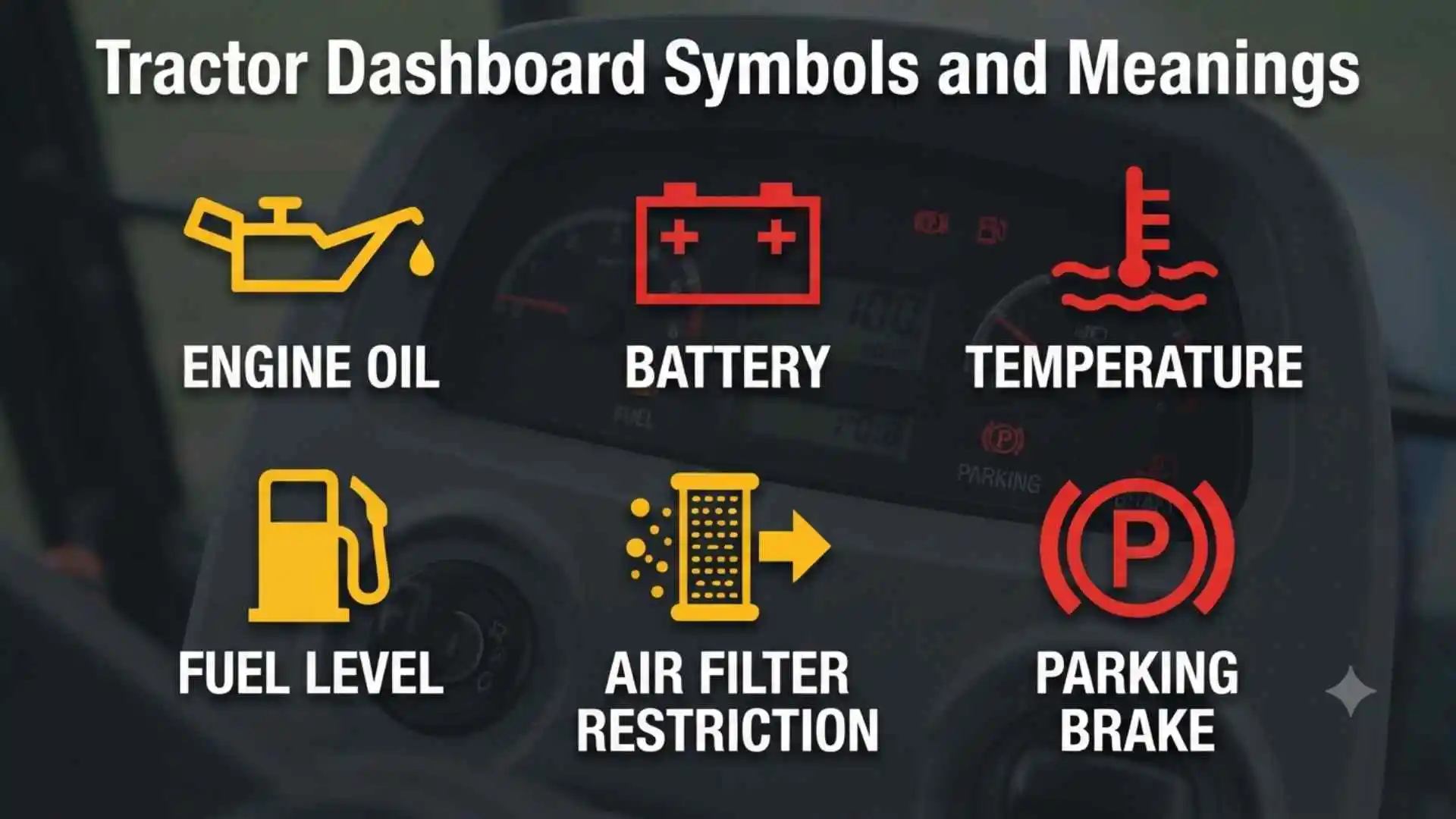
Tractor dashboard symbols and meanings can make the difference between finishing a job safely and facing an expensive breakdown. A small glowing icon may warn you about low oil pressure, overheating, a blocked air filter, or an active tractor function. These symbols form a visual language designed to protect the engine, equipment, operator, and everyone working nearby. Learning that language gives you greater confidence every time you turn the key.
(Quick Answer) Tractor Dashboard Symbols
Tractor dashboard symbols are warning lights, status indicators, and operating icons that communicate the condition of the engine, transmission, hydraulic system, brakes, PTO, emissions equipment, lighting, and other tractor functions. Red usually signals immediate danger, amber indicates caution, green confirms an active function, and blue commonly identifies high-beam headlights.
Quick Facts About Tractor Dashboard Symbols and Meanings
| Aspect | Information |
| Origin | Developed from mechanical gauges, vehicle warning lamps, safety signs, and standardized machinery pictograms |
| Historical Significance | Helped operators monitor increasingly powerful and complex farm machinery without stopping work |
| Main Meaning | Communicate warnings, operating conditions, system status, and maintenance needs |
| Spiritual Meaning | No formal spiritual meaning, although operators may view them as symbols of awareness, responsibility, and respect for machinery |
| Cultural Importance | Part of modern agricultural safety culture and equipment training |
| Modern Usage | Used on tractors, combines, loaders, harvesters, telehandlers, and other agricultural machines |
| Most Urgent Color | Red |
| Common Caution Color | Amber or yellow |
| Common Status Colors | Green and blue |
| Best Reference | The operator’s manual for the exact tractor model |
What Are Tractor Dashboard Symbols?
Tractor dashboard symbols are visual signs displayed on an instrument panel, digital screen, or warning-light cluster. Each icon represents a condition or function within the machine.
Some symbols are warnings. Others simply confirm that a system is operating. For example, a red oil-can symbol may signal dangerously low engine oil pressure, while a green arrow usually means a turn signal is active.
Modern tractors may display information about:
- Engine temperature
- Engine oil pressure
- Battery charging
- Fuel level
- Diesel exhaust fluid
- Hydraulic pressure
- Transmission temperature
- Parking brake status
- Four-wheel drive
- Differential lock
- Power take-off
- Diesel particulate filter cleaning
- Glow plugs
- Lighting
- Implement position
- Diagnostic fault codes
The exact design, color, and meaning can vary by manufacturer, model, year, market, and equipment package. Therefore, a general guide helps you recognize likely meanings, but the tractor’s official operator’s manual remains the final authority.
John Deere manuals, for example, distinguish between informational, caution, and serious stop warnings. A flashing red STOP light indicates a serious fault that requires the engine to be shut down immediately, while a yellow caution light directs the operator to review the associated fault message.
How Tractor Dashboard Symbols Evolved
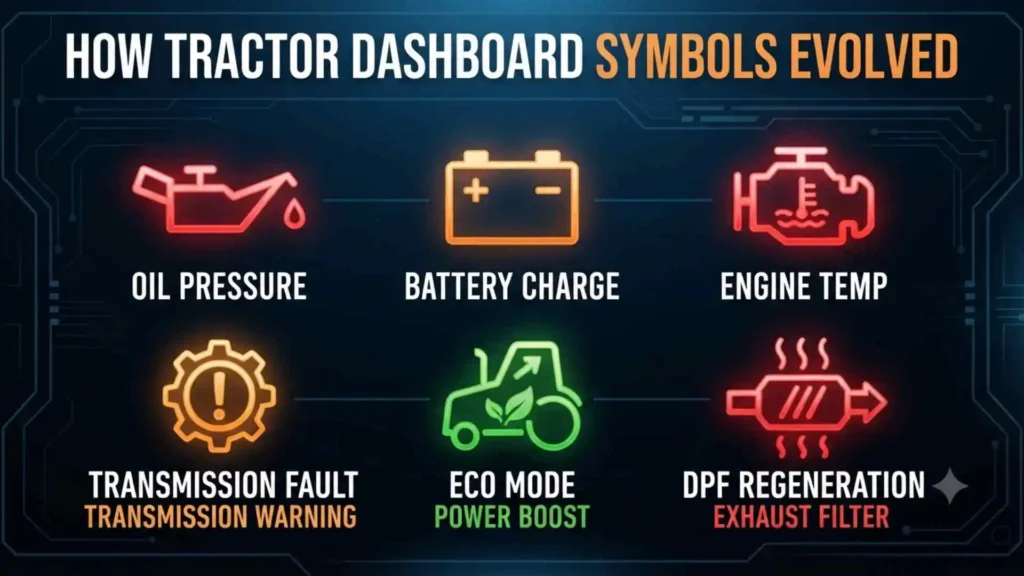
Early tractors had very simple instrument panels. Operators often relied on sound, smell, vibration, steam, and visible leaks to judge the machine’s condition.
Mechanical gauges later provided information about oil pressure, coolant temperature, engine speed, and fuel level. These gauges required the operator to look closely and understand the normal operating range.
As tractors gained hydraulic systems, electrical controls, power-shift transmissions, turbochargers, emissions equipment, and electronic control units, dashboards became more complex. Manufacturers introduced illuminated pictograms that could communicate quickly across language barriers.
Today, premium tractors may combine traditional warning lights with:
- Digital display messages
- Audible alarms
- Diagnostic trouble codes
- Touchscreen alerts
- Remote telematics
- Dealer-connected monitoring
- Automatic engine protection
Some modern systems can show the operator’s in-cab display remotely, allowing farm managers or technicians to help troubleshoot a problem from another location.
Understanding Tractor Warning-Light Colors
Color is often the fastest way to judge how urgently you should respond.
| Color | General Meaning | Typical Response |
| Red | Serious danger, critical malfunction, or unsafe condition | Stop safely and shut down if instructed |
| Amber or yellow | Caution, developing fault, or maintenance concern | Reduce load, investigate, and consult the manual |
| Green | Normal active function | Continue operating while remaining aware |
| Blue | High-beam lighting or informational function | No repair normally required |
| White | General status or selected feature | Monitor the displayed function |
| Flashing symbol | Increased urgency or changing condition | Respond promptly and check accompanying message |
Colors are helpful, but they are not perfectly universal. A red parking-brake symbol, for instance, may simply show that the brake is applied while the tractor is stationary. The same light becomes urgent if you attempt to drive with the brake engaged.
John Deere Tractor Dashboard Symbols and Meanings
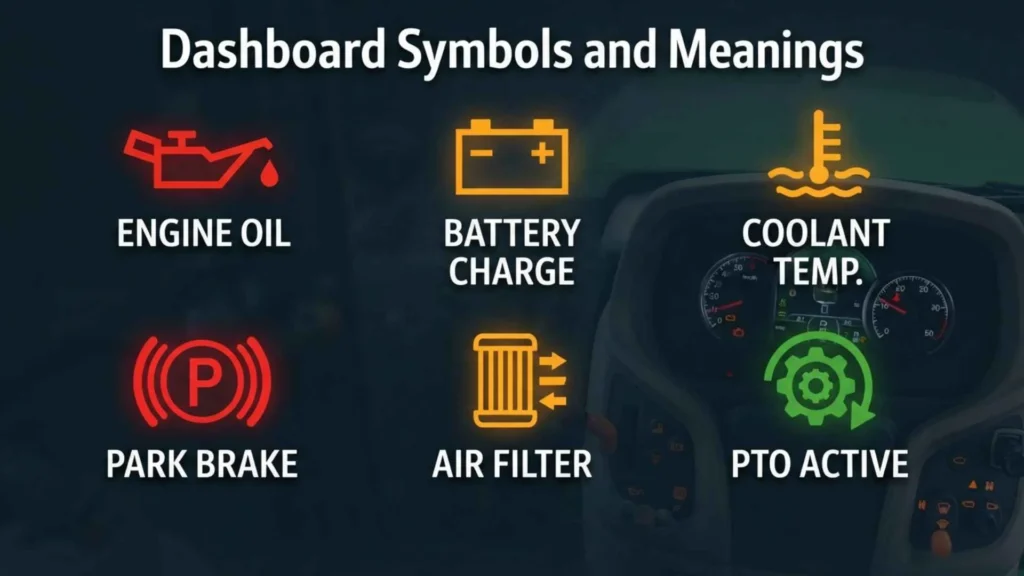
John Deere tractors ke dashboard par warning, indicator aur information lights operator ko tractor ki condition samajhne mein help karti hain. Exact symbols model aur production year ke mutabiq change ho sakte hain, lekin common indicators mein engine warning, oil pressure, coolant temperature, battery/charging system, fuel level, glow plug aur parking brake lights shamil hoti hain.
Common John Deere dashboard symbols include:
- Engine warning light: Engine ya electronic control system mein fault ki taraf ishara kar sakti hai.
- Oil pressure warning: Engine oil pressure low hone par attention demand karti hai. Tractor ko safely stop karke issue check karna chahiye.
- Coolant temperature light: Engine temperature zyada hone ki warning deti hai.
- Battery/charging symbol: Charging system ya alternator se related problem indicate kar sakta hai.
- Fuel symbol: Fuel level low hone par driver ko refill karne ka signal deta hai.
- Glow plug indicator: Diesel engine ko start karne se pehle preheating process ko indicate karta hai.
- PTO indicator: Power take-off engaged hone ki information de sakta hai.
- Parking brake symbol: Parking brake apply hone ki indication hoti hai.
- Hydraulic warning: Hydraulic system se related pressure ya performance issue ki taraf attention dilata hai.
John Deere tractor mein red warning light ko aam tor par serious condition samjha jata hai. Amber indicators aksar caution ya service-related information dete hain, jabke green ya blue indicators normal operating functions ko show kar sakte hain.
New Holland Tractor Dashboard Symbols and Meanings
New Holland tractors mein dashboard symbols operator ko engine, transmission, hydraulic system aur safety functions ke baare mein real-time information dete hain. Different New Holland series mein icons aur displays different ho sakte hain.
Common symbols mein engine fault, oil pressure, coolant temperature, battery charging, fuel level, PTO, parking brake, hydraulic system aur transmission warnings shamil ho sakte hain.
Agar engine oil pressure ya coolant temperature ki serious warning appear ho, to tractor ko safe location par stop karna aur operator’s manual ke instructions follow karna important hai. Sirf warning light ko reset kar dena problem ka solution nahi hota.
Tractor Dashboard Symbols and Meanings PDF
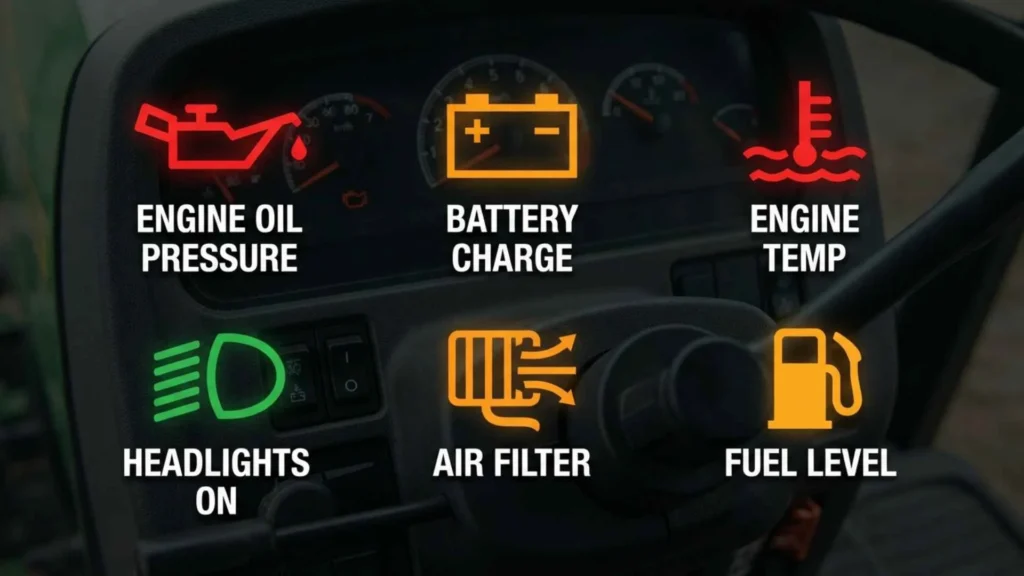
Tractor dashboard symbols ka PDF reference field mein quick identification ke liye useful ho sakta hai, especially jab operator ko kisi unfamiliar icon ka meaning samajhna ho. Lekin ek universal PDF har tractor ke liye accurate nahi hota.
Different manufacturers aur models mein same-looking symbols ka function ya warning level different ho sakta hai. Is wajah se tractor ke specific model ka official operator’s manual sabse reliable reference hota hai.
Agar aap PDF guide bana rahe hain, to usmein manufacturer, tractor model, model year aur symbol description ko clearly mention karna useful hai. Is se readers universal symbols aur model-specific warnings ke darmiyan difference samajh sakte hain.
Kubota Warning Tractor Dashboard Symbols
Kubota tractors par warning symbols operator ko potentially important mechanical ya operational conditions ke baare mein alert karte hain. Common warnings mein engine oil pressure, coolant temperature, battery charging, engine malfunction, fuel aur hydraulic-related indicators shamil ho sakte hain.
Kubota warning symbols ko samajhte waqt:
- Red warning: Serious problem ya immediate attention ki requirement indicate kar sakti hai.
- Amber warning: Caution, malfunction ya service requirement show kar sakti hai.
- Green indicator: Usually an active operating function ko indicate karta hai.
- Blue indicator: Kuch models mein specific operating or information function ko represent kar sakta hai.
Exact meaning tractor model ke dashboard aur owner’s manual par depend karta hai.
Warning Tractor Dashboard Symbols
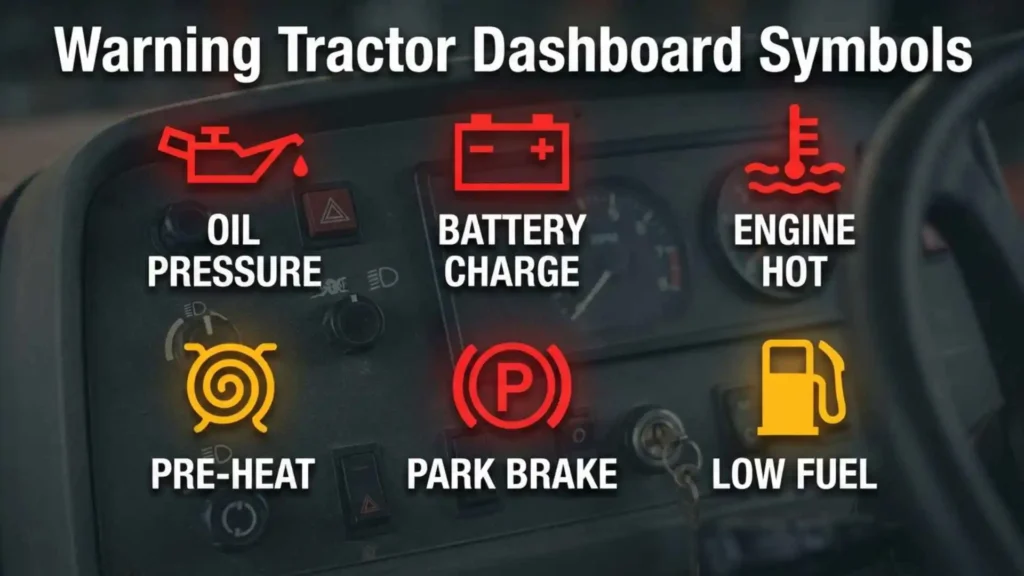
Warning tractor dashboard symbols operator ko aisi conditions ke baare mein alert karte hain jo tractor ki performance, safety ya mechanical condition ko affect kar sakti hain. Common warning icons mein oil pressure, engine temperature, battery, brakes, transmission, hydraulics aur engine malfunction indicators shamil hain.
Agar koi warning light suddenly appear ho, to tractor ki current operating condition ko check karein. Red warning light, unusual engine noise, overheating, loss of oil pressure ya other serious symptoms ke saath ho to operation continue karna unsafe ho sakta hai.
Kubota Tractor Dashboard Symbols and Meanings
Kubota dashboard symbols tractor ke different systems ki status information provide karte hain. Model ke mutabiq dashboard mein digital display ke saath multiple indicator lamps bhi ho sakti hain.
Common Kubota symbols ke examples:
- Engine oil pressure: Low engine oil pressure ki warning.
- Coolant temperature: Engine overheating ya excessive temperature ki indication.
- Battery: Charging system ki condition se related indicator.
- Fuel: Fuel level ya low-fuel condition ki information.
- PTO: PTO engagement ya operating status.
- Glow plug: Diesel engine preheating ka indication.
- Parking brake: Parking brake engaged hone ka signal.
- Engine malfunction: Engine ya electronic control system mein fault ki indication.
- Hydraulic/transmission warning: Relevant system mein abnormal condition ko indicate kar sakti hai.
Kisi symbol ko sirf uski shape dekh kar diagnose nahi karna chahiye. Kubota ke specific model manual mein symbol ki exact definition aur recommended action check karna best approach hai.
Dash Warning Light Tractor Dashboard Symbols
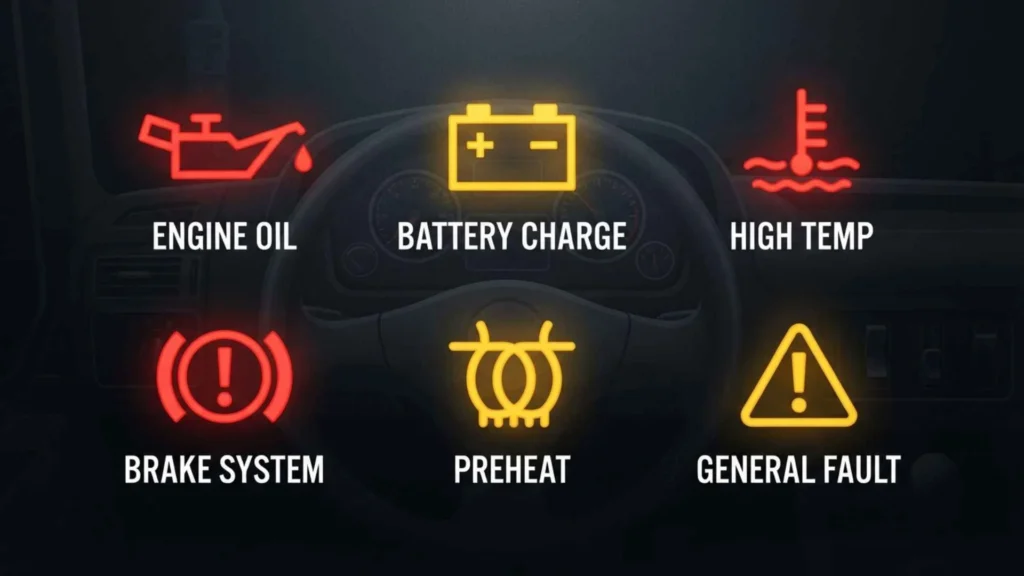
Dash warning lights tractor ke important systems ki condition monitor karne ka quick way provide karti hain. Har light ka color aur icon operator ko batata hai ke condition normal hai, caution required hai ya immediate attention ki zarurat hai.
Generally:
- Red: Serious warning ya stop-and-check condition.
- Amber/Yellow: Caution, fault ya service-related condition.
- Green: Function active ya operating status.
- Blue: Certain information or active function, depending on model.
Colors ko universal rule nahi samajhna chahiye. Manufacturer ki documentation ko final authority maana jana chahiye.
Indicator Light John Deere Tractor Dashboard Symbols
John Deere tractor indicator lights different functions ke active hone ya system status ko show kar sakti hain. PTO, parking brake, turn signals, high beam, four-wheel drive aur other operating functions ke liye indicators model ke according available ho sakte hain.
Indicator light ka purpose warning dena zaroori nahi hota. Kuch lights simply operator ko batati hain ke koi function currently selected ya active hai. Is liye indicator light aur warning light mein difference samajhna important hai.
Case IH Tractor Dashboard Symbols and Meanings
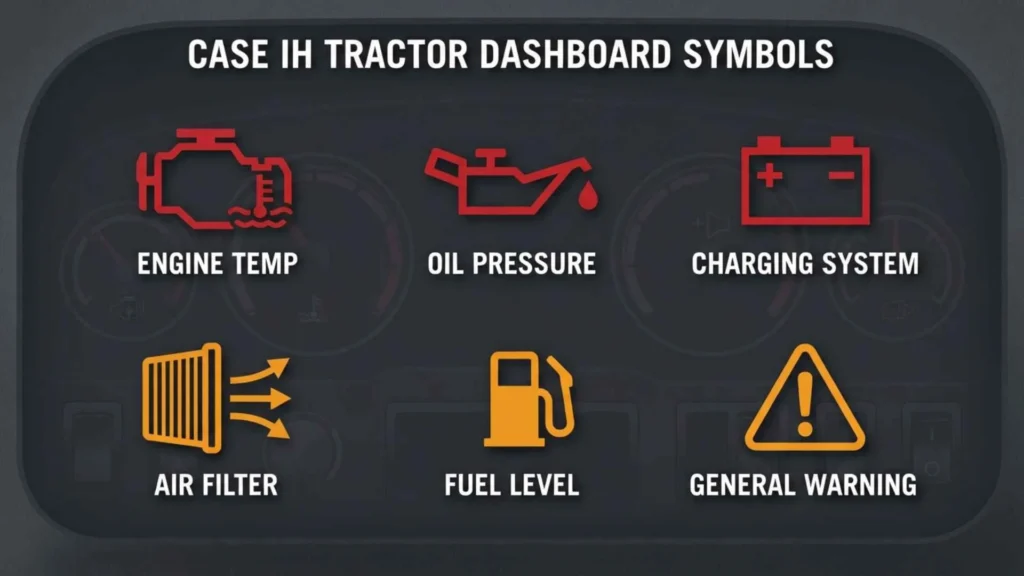
Case IH tractors mein dashboard symbols engine, transmission, hydraulics, PTO, electrical system aur safety functions ko monitor karne mein help karte hain. Different Case IH models mein display layout aur symbols vary kar sakte hain.
Common symbols mein:
- Engine malfunction or service indicator
- Low engine oil pressure
- High coolant temperature
- Battery or charging system
- PTO status
- Parking brake
- Hydraulic system warning
- Transmission warning
- Fuel level
- Four-wheel-drive status
- Differential lock status
Agar dashboard par serious warning appear ho, to operator ko tractor ko safe condition mein rakh kar manual mein recommended troubleshooting steps check karne chahiye.
Massey Ferguson Warning Tractor Dashboard Symbols
Massey Ferguson tractors mein warning lights aur symbols operator ko engine aur tractor systems ki condition ke baare mein information dete hain. Oil pressure, coolant temperature, battery, transmission, hydraulic system aur engine management se related warnings commonly mil sakti hain.
Massey Ferguson dashboard par red warning ko ignore karna avoid karein. Agar warning ke saath overheating, abnormal sound, smoke ya performance loss bhi ho, to tractor ko operate karne ke bajaye fault ka cause identify karna safer hota hai.
Ford Tractor Dashboard Symbols and Meanings
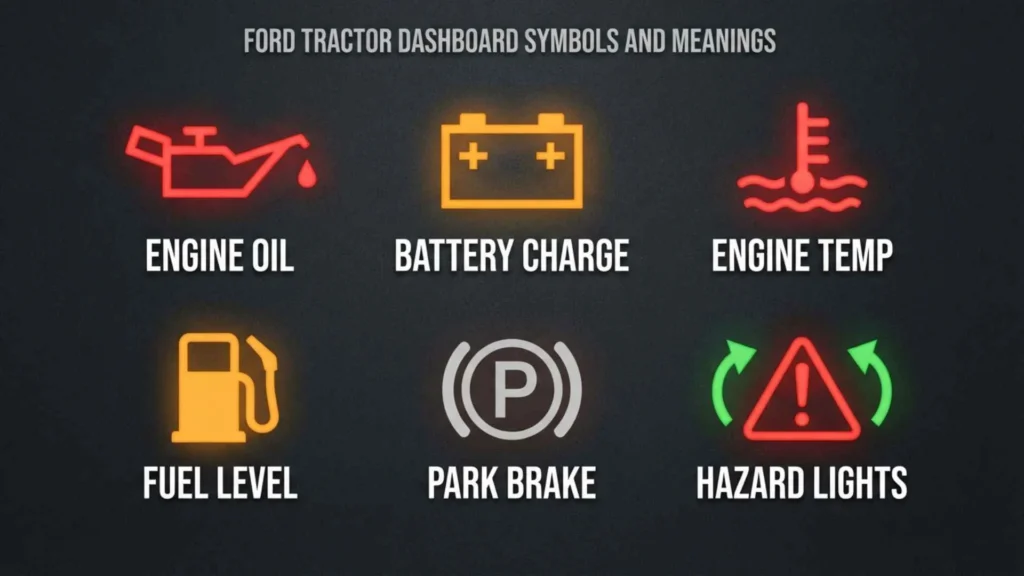
Older Ford tractors mein dashboard indicators modern digital displays ke muqable mein simple ho sakte hain. Common symbols aur warning lamps engine oil pressure, charging system, coolant temperature, fuel, glow plugs, brakes aur PTO jaise functions se related ho sakte hain.
Ford tractor ke older models mein symbol design modern tractors se noticeably different ho sakta hai. Is liye model-specific service or operator manual ko reference banana particularly important hai.
Mahindra Tractor Dashboard Symbols and Meanings
Mahindra tractor dashboard symbols operator ko engine, electrical, hydraulic aur operating functions ki information dete hain. Common indicators mein oil pressure, coolant temperature, battery charging, fuel, PTO, parking brake aur engine-related warnings shamil ho sakti hain.
Mahindra tractor operate karte waqt unfamiliar warning light ko ignore karne ke bajaye uska meaning model manual mein verify karna chahiye. Dashboard icon ka appearance similar hone ke bawajood different models mein function vary kar sakta hai.
Kioti Tractor Dashboard Symbols
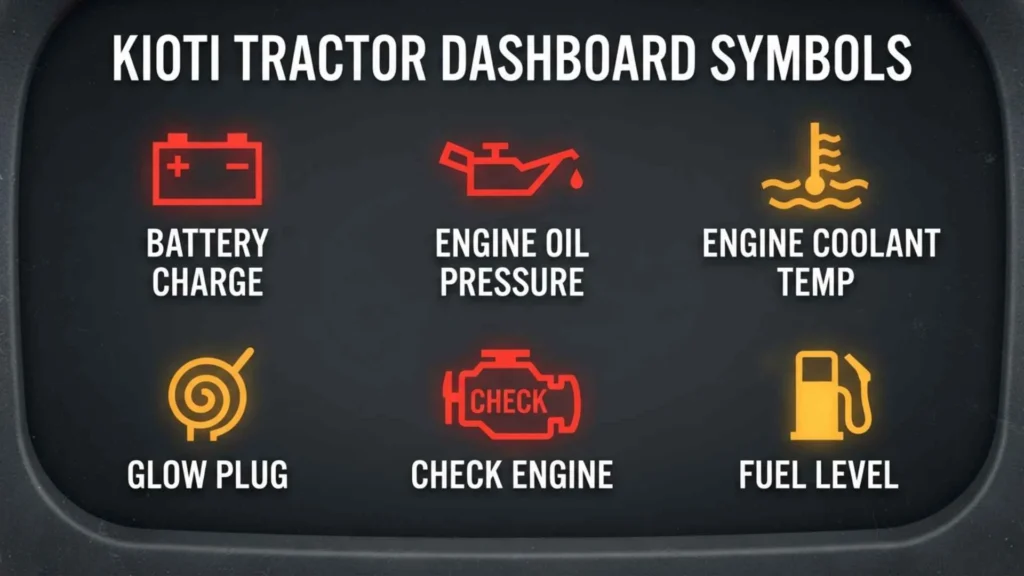
Kioti tractors par dashboard symbols engine status, safety systems aur operating functions ko monitor karne mein help karte hain. Common indicators mein glow plug, engine oil pressure, coolant temperature, battery charging, PTO, parking brake aur fuel-related symbols shamil ho sakte hain.
Kioti ke compact tractor models mein dashboard layout model ke hisaab se change ho sakta hai. Agar koi warning light unusual time par illuminate ho ya continuously remain kare, to operator’s manual mein us specific indicator ko identify karna chahiye.
Universal Tractor Dashboard Symbols
Kuch tractor dashboard symbols industry mein commonly used concepts ko represent karte hain. Inmein oil pressure, engine temperature, battery charging, fuel, parking brake, PTO aur turn indicators jaise symbols shamil hain.
Lekin universal tractor dashboard symbols ka matlab har tractor mein 100% identical nahi hota. Manufacturer-specific icons, colors aur warning levels different ho sakte hain.
A useful general guide is:
| Symbol/Indicator | General Meaning |
| Oil can | Engine oil pressure or lubrication |
| Thermometer | Engine coolant temperature |
| Battery | Electrical charging system |
| Fuel pump | Fuel level or fuel system |
| Engine outline | Engine malfunction or service |
| PTO symbol | Power take-off status |
| Parking brake | Parking brake engaged |
| Glow plug | Diesel engine preheating |
| Hydraulic symbol | Hydraulic system status |
| Turn arrow | Turn signal |
| Headlamp | Lighting/high-beam function |
Ye table general identification ke liye hai. Exact warning meaning tractor ke model-specific manual se confirm karna chahiye.
Mahindra Tractor Dashboard Symbols
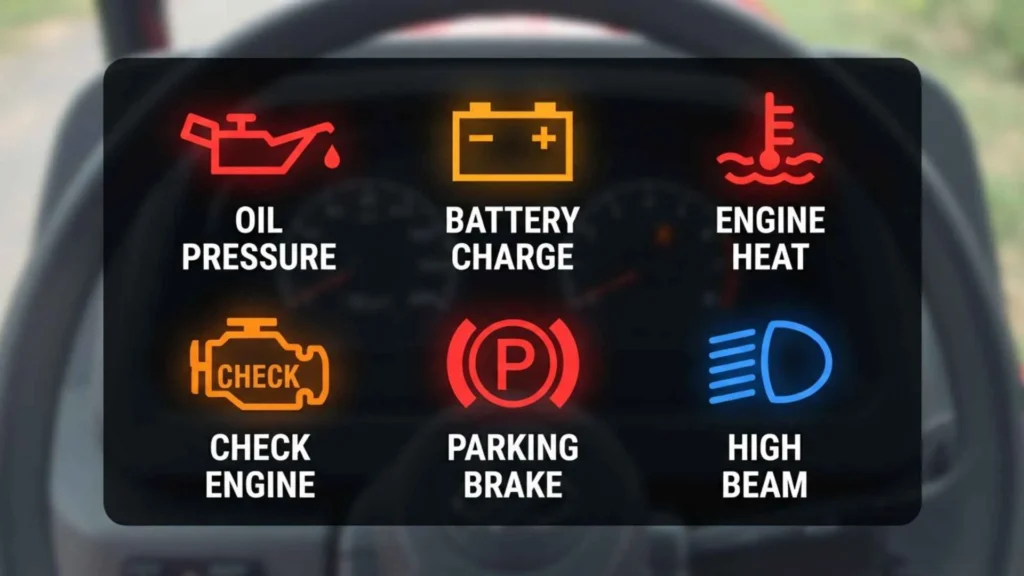
Mahindra tractors ke dashboard par different indicators tractor ki current operating condition aur system status ko communicate karte hain. Engine warning, oil pressure, battery, temperature, PTO, parking brake aur fuel indicators commonly important categories hain.
Kisi Mahindra dashboard symbol ko identify karte waqt tractor model aur model year ko consider karna zaroori hai. Newer tractors mein digital displays aur electronic fault messages additional information provide kar sakte hain.
Case Tractor Dashboard Symbols
Case tractor dashboard symbols tractor ke engine, electrical, hydraulic, transmission aur safety systems ki status information provide karte hain. Older Case tractors aur newer Case IH models ke dashboard symbols mein significant differences ho sakte hain.
Common indicators ko samajhne ke liye operator ko symbol ke saath light ka color, behavior aur accompanying message bhi observe karna chahiye. Flashing warning aur continuously illuminated warning ka significance bhi model ke mutabiq different ho sakta hai.
2018 John Deere Tractor Dash Symbols and Meanings
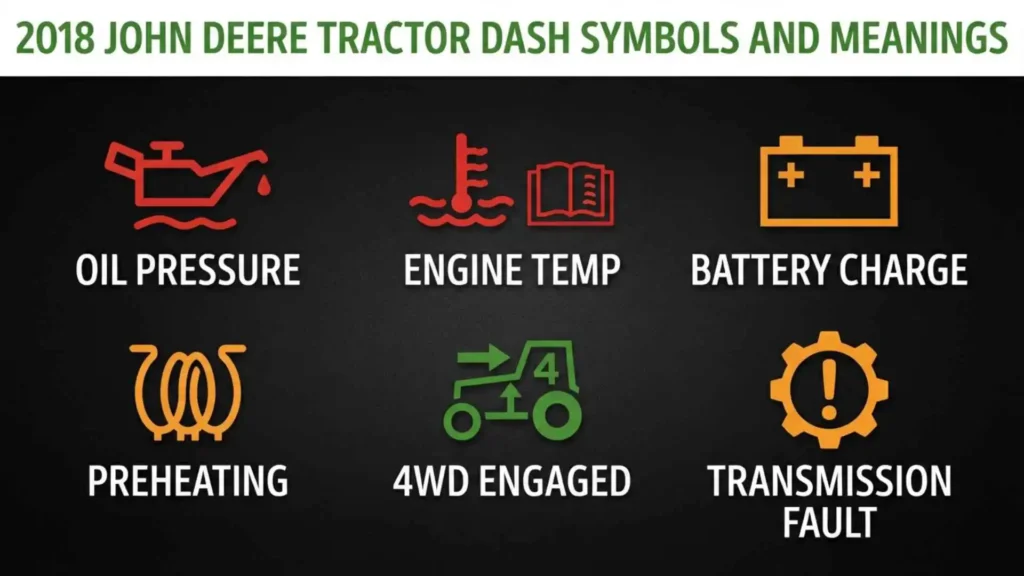
2018 John Deere tractors mein dashboard symbols tractor series aur exact model ke according different ho sakte hain. Is liye sirf “2018 John Deere” kehne se har dashboard icon ka ek single universal meaning establish nahi hota.
2018-era John Deere tractor dashboards par commonly encountered categories mein engine warning, oil pressure, coolant temperature, battery charging, fuel, PTO, parking brake, glow plug, hydraulic aur transmission indicators shamil ho sakti hain.
Agar aap 2018 John Deere tractor ka exact dashboard symbol identify karna chahte hain, to model number ke saath symbol ko check karna sabse accurate method hai. For example, ek 2018 utility tractor aur ek 2018 row-crop tractor ka dashboard layout aur available indicators different ho sakte hain.
Red Tractor Dashboard Symbols and Meanings
Red symbols deserve immediate attention. Continuing to operate after a critical red warning can cause engine damage, fire, loss of control, or personal injury.
Engine Oil Pressure Warning
Visual description: An oil can, often with a drop of oil coming from its spout.
Meaning: Engine oil pressure is below the safe operating level.
What to do: Stop the tractor safely and shut off the engine. Check the oil level after allowing the engine to settle. Look for visible leaks, a damaged filter, or other obvious problems.
Do not assume that adding oil will solve the issue. The oil level may be correct while the pump, pressure sensor, pickup tube, filter, or internal engine components have failed.
John Deere guidance states that if the engine oil pressure light comes on while the engine is running, the operator should stop the engine and investigate the condition.
Engine Coolant Temperature Warning
Visual description: A thermometer rising from wavy liquid lines.
Meaning: Engine coolant temperature is dangerously high.
Possible causes:
- Low coolant
- Blocked radiator screen
- Dirty radiator fins
- Broken fan belt
- Failed cooling fan
- Heavy engine load
- Faulty thermostat
- Coolant leak
- Damaged water pump
What to do: Reduce the load and move to a safe location. If the warning remains on or the temperature continues rising, shut down according to the operator’s manual.
Never open a hot radiator cap. Pressurized coolant can cause severe burns.
Red STOP Warning
Visual description: The word STOP, an exclamation mark, or a red master-warning lamp.
Meaning: A serious malfunction has occurred.
This light may appear with another symbol, such as engine oil pressure, transmission pressure, coolant temperature, or hydraulic failure. A message or diagnostic code may also appear on the display.
What to do: Stop the tractor in a safe location and shut off the engine immediately unless doing so would create a greater danger.
Brake-System Warning
Visual description: An exclamation mark or the letter P inside a circle, sometimes surrounded by curved brackets.
Meaning: Depending on the model, the parking brake is engaged, brake fluid is low, brake pressure is insufficient, or a brake-system fault has occurred.
A parking-brake light is normal when the brake is intentionally applied. It becomes a concern if it stays on after release or appears while the tractor is moving.
Transmission Oil Pressure Warning
Visual description: A gear, transmission case, oil drop, or exclamation mark associated with a drivetrain symbol.
Meaning: Transmission or hydraulic oil pressure may be too low.
Low pressure can affect lubrication, steering, braking, clutch operation, or power-shift functions. Stop work and consult the manual. Some tractors share fluid between the transmission and hydraulic system, which makes this warning especially important.
Hydraulic Oil Temperature Warning
Visual description: A thermometer beside an oil drop, hydraulic cylinder, or gear.
Meaning: Hydraulic or transmission oil is too hot.
Possible causes:
- Low oil level
- Wrong oil type
- Restricted filter
- Constant operation over a relief valve
- Heavy implement load
- Blocked oil cooler
- Internal pump or valve problem
Allowing hot oil to circulate can damage seals, pumps, clutches, and valves.
Steering-System Warning
Visual description: A steering wheel with an exclamation mark.
Meaning: Power steering pressure or electronic steering assistance may be reduced.
Treat this warning seriously. Steering may become heavy or unpredictable, particularly at low engine speed.
Amber and Yellow Tractor Dashboard Symbols
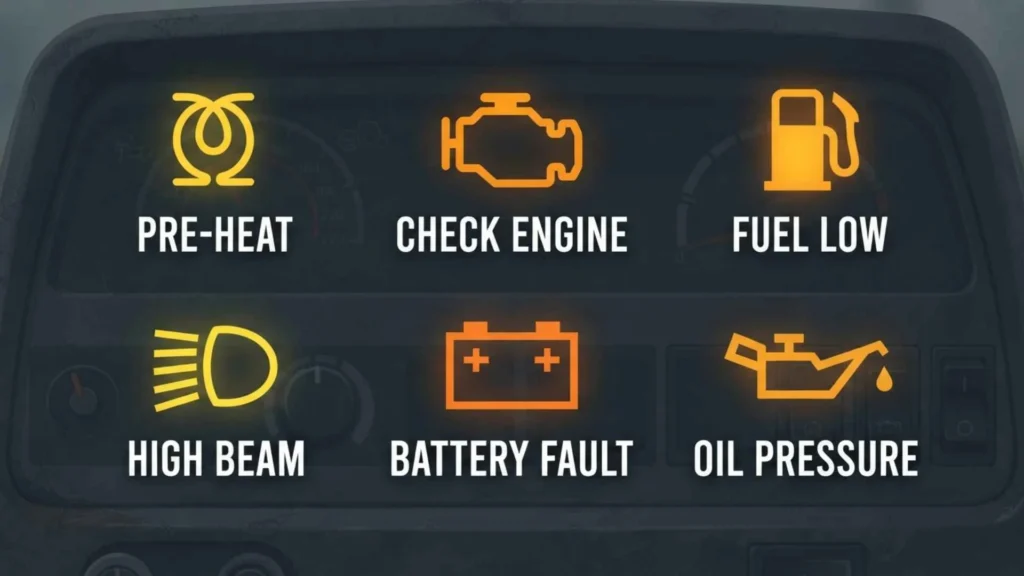
Amber lights usually indicate caution rather than immediate catastrophic failure. However, ignoring them may allow a minor problem to become a major repair.
Check Engine Warning
Visual description: An engine-shaped outline or engine symbol with an exclamation mark.
Meaning: The engine control unit has detected a fault.
The tractor may continue operating normally, enter a reduced-power mode, or display a diagnostic code. Check the message center and operator’s manual.
Possible causes include:
- Sensor failure
- Fuel-system problem
- Air-intake restriction
- Emissions-system fault
- Electrical connection problem
- Abnormal engine temperature or pressure
Air Filter Restriction Warning
Visual description: A filter element with airflow lines, dots, or arrows.
Meaning: The engine air cleaner is restricted.
A blocked air filter reduces airflow, lowers power, increases fuel consumption, and may increase exhaust smoke. Inspect the air-cleaner system according to the manufacturer’s instructions.
Do not repeatedly strike or aggressively blow out a filter unless the manual permits that cleaning method. Incorrect cleaning can damage the filter media and allow dust into the engine.
Fuel Filter or Water-in-Fuel Warning
Visual description: A fuel filter, droplet, or container with a water line.
Meaning: Water has collected in the fuel separator, or the fuel filter is restricted.
Water in diesel fuel can cause corrosion, poor combustion, injector damage, and starting problems. Drain the separator using the procedure in the operator’s manual.
Low Fuel Warning
Visual description: A fuel pump.
Meaning: The fuel level is low.
Although this is not normally a mechanical fault, allowing a diesel tractor to run out of fuel may introduce air into the fuel system. Some engines then require bleeding or priming before they will restart.
Battery or Alternator Warning
Visual description: A battery with positive and negative signs.
Meaning: The charging system is not maintaining normal battery voltage.
The light should normally appear when the key is switched on before the engine starts. It should go out after the engine begins running.
If it remains illuminated, possible causes include:
- Loose or broken drive belt
- Failing alternator
- Damaged wiring
- Poor battery connection
- Faulty regulator
- Weak battery
A manufacturer’s manual may instruct the operator to increase engine speed briefly and stop the engine if the charging light remains on.
Diesel Exhaust Fluid Warning
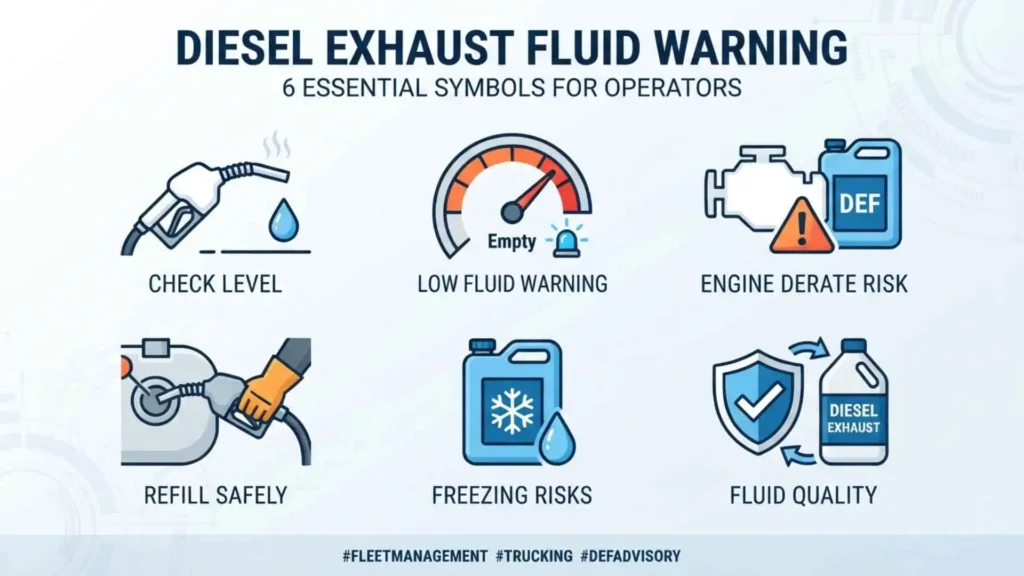
Visual description: A fluid container, exhaust symbol, or letters such as DEF or AdBlue.
Meaning: The diesel exhaust fluid level is low, the fluid quality is poor, or the selective catalytic reduction system has detected a fault.
Modern diesel tractors may reduce engine power if an emissions warning is ignored. Refill only with the correct fluid and avoid contaminating the DEF tank with diesel fuel, water, oil, or dirt.
Diesel Particulate Filter Warning
Visual description: An exhaust filter containing dots, smoke lines, or heat waves.
Meaning: Soot has accumulated in the diesel particulate filter, or a filter-cleaning cycle is required.
The tractor may request:
- Passive regeneration
- Automatic active regeneration
- Parked regeneration
- Dealer service
Follow the exact instructions for your tractor. Interrupting repeated regeneration cycles can increase soot loading.
High Exhaust Temperature Indicator
Visual description: Exhaust pipe with heat waves.
Meaning: Exhaust temperatures are elevated, often because diesel particulate filter cleaning is underway.
This does not always indicate a fault. However, dry grass, straw, fuel, oil, or other combustible materials must be kept away from the exhaust area.
John Deere identifies this light as an indicator that an active exhaust-filter cleaning process is taking place.
Hydraulic Filter Restriction Warning
Visual description: An oil filter, gear, or hydraulic line with an alert mark.
Meaning: The hydraulic or transmission filter may be restricted.
Cold oil can sometimes trigger a temporary warning immediately after startup. If the light remains on after the tractor warms, inspect the system and replace the filter if required.
General Caution or Master Warning
Visual description: An exclamation mark inside a triangle.
Meaning: One or more noncritical faults require attention.
Look for another icon, written message, or diagnostic code. The triangle alone usually does not identify the failed system.
Green, Blue, and White Tractor Indicator Symbols
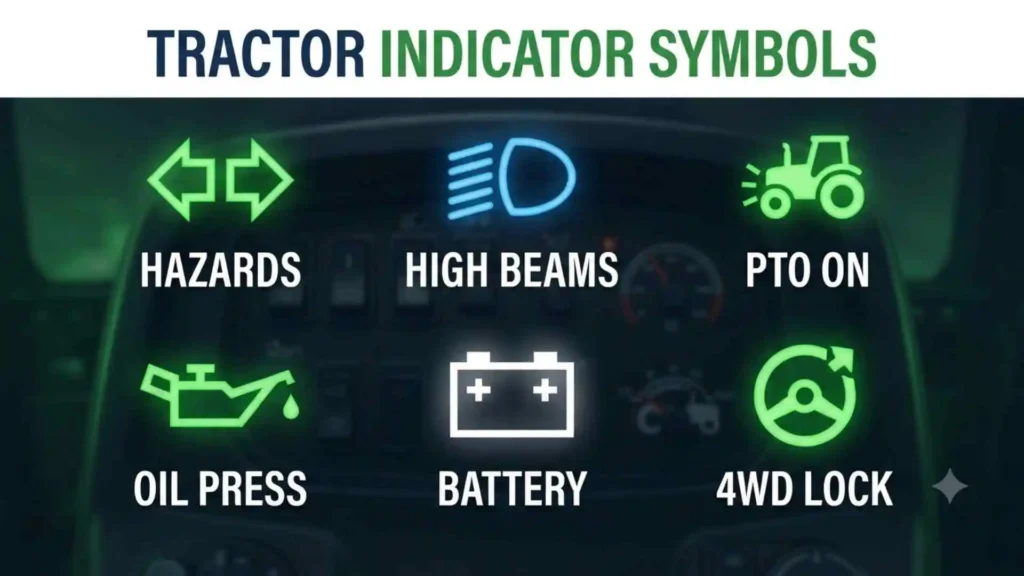
These lights normally confirm that a function has been selected or activated.
Power Take-Off Indicator
Visual description: A rotating shaft, circle with projecting tabs, or the letters PTO.
Meaning: The front, rear, or mid-mounted power take-off is engaged.
The PTO transfers engine power to an implement such as a mower, baler, tiller, auger, spreader, or generator.
Before leaving the seat, clearing a blockage, connecting equipment, or approaching a driven implement, disengage the PTO, lower the implement, apply the parking brake, stop the engine, and remove the key.
John Deere instrument panels commonly use separate indicators for front, rear, and economy PTO modes.
Four-Wheel Drive or MFWD Indicator
Visual description: Front and rear axles joined by a driveline.
Meaning: Mechanical front-wheel drive or four-wheel drive is engaged.
Four-wheel drive improves traction in mud, loose soil, snow, hills, and loader work. Avoid unnecessary use on dry, firm surfaces when the manual advises against it, especially during tight turns.
Differential Lock Indicator
Visual description: An axle with a lock or crossed wheel symbol.
Meaning: The differential lock is engaged.
This function forces both drive wheels on an axle to turn together, improving traction when one wheel slips.
Disengage it before sharp turns. Turning with the differential locked can make steering difficult and place stress on the drivetrain.
High-Beam Indicator
Visual description: A blue headlamp with straight horizontal light rays.
Meaning: High-beam headlights are active.
Low-Beam or Work-Light Indicator
Visual description: A lamp with angled rays.
Meaning: Headlights, rear work lights, roof lights, or implement lights are switched on.
Turn-Signal Indicators
Visual description: Green left or right arrows.
Meaning: A turn signal is operating.
Both arrows may flash when the hazard lights are active. Some tractors also include separate trailer turn-signal indicators.
Cruise Control Indicator
Visual description: A speedometer with an arrow.
Meaning: Cruise control, constant-speed control, or field-speed memory is active.
Auto-Steering or Guidance Indicator
Visual description: A steering wheel, tractor between guidance lines, or satellite symbol.
Meaning: Automatic guidance is available, engaged, or temporarily disabled.
Colors can change according to system status. For example, white may indicate readiness, green may mean active steering, and amber may indicate that conditions for engagement have not been met.
Implement or Three-Point Hitch Indicator
Visual description: Tractor hitch arms, an implement, or upward and downward arrows.
Meaning: Shows hitch position, movement, draft-control status, transport lock, or implement automation.
Modern digital panels may display the three-point hitch position as a percentage.
Common Tractor Dashboard Symbols and Meanings Chart
| Symbol or Appearance | Typical Meaning | Recommended Action |
| Red oil can | Low engine oil pressure | Stop engine immediately |
| Thermometer in liquid | High coolant temperature | Reduce load and stop if warning remains |
| Battery | Charging-system problem | Check belt, battery, alternator, and wiring |
| Fuel pump | Low fuel | Refuel soon |
| Engine outline | Engine-control fault | Read message or fault code |
| Filter with airflow | Restricted engine air filter | Inspect or service air cleaner |
| Filter with droplet | Water in fuel | Drain separator |
| Gear with thermometer | Hot transmission oil | Stop heavy work and investigate |
| Gear or oil drop with warning | Low transmission or hydraulic pressure | Stop and check system |
| Exhaust filter with dots | DPF soot loading or regeneration request | Follow regeneration instructions |
| Exhaust with heat waves | High exhaust temperature | Keep away from combustible materials |
| Fluid container or DEF | Low DEF or SCR fault | Refill or diagnose emissions system |
| Circle with P | Parking brake applied | Release before moving |
| Axles connected by shaft | Four-wheel drive engaged | Status indicator |
| Axle with lock | Differential lock engaged | Disengage before tight turns |
| PTO symbol | PTO engaged | Keep people clear of rotating equipment |
| Coil | Glow plugs heating | Wait before starting |
| Blue headlamp | High beams on | Status indicator |
| Green arrows | Turn signal or hazards | Status indicator |
| Triangle with exclamation mark | General caution | Check display and manual |
| Red STOP | Serious system fault | Stop safely and shut down |
Glow Plug and Cold-Start Symbol
Visual description: A coiled wire or spring.
Meaning: The diesel-engine glow plugs or intake heater are warming the combustion chambers.
When the engine is cold, switch the key to the preheat position and wait until the light goes out before cranking, unless the manual gives different instructions.
Starting too early may cause:
- Hard starting
- White smoke
- Rough running
- Extra battery strain
The symbol may also illuminate during starting because some systems continue heating after the engine begins to crank.
Transmission and Gear Symbols
Modern tractors may use several icons to describe transmission operation.
Neutral Indicator
A letter N or neutral symbol means the transmission, shuttle lever, or reverser is in neutral.
Forward and Reverse Indicators
Letters F and R, directional arrows, or a tractor silhouette may show the selected travel direction.
Power-Shift Range
Numbers, letters, or gear graphics identify the selected transmission range and power-shift step.
Creeper Gear
A turtle, snail, or low-speed icon means an extremely low travel range is selected.
Automatic Transmission Mode
The letter A, gear with an A, or AUTO symbol means the tractor is automatically choosing gears or engine speed according to load.
Transmission Fault
A gear containing an exclamation mark indicates a transmission-control problem. The tractor may enter a limited operating mode to protect the drivetrain.
Hydraulic and Three-Point Hitch Symbols
Hydraulic symbols can be confusing because they may represent pressure, flow, temperature, remotes, or implement position.
Hydraulic Oil Level
An oil drop beside a reservoir may indicate low hydraulic fluid.
Hydraulic Pressure
A pump, oil line, or pressure gauge may warn of low or abnormal hydraulic pressure.
Hydraulic Temperature
A thermometer beside an oil drop indicates excessive hydraulic-fluid temperature.
Remote Hydraulic Valve
A cylinder with arrows may show that a selective control valve is extending, retracting, floating, or locked.
Three-Point Hitch Raise and Lower
Arrows beside hitch arms show the direction of hitch movement.
Draft Control
A plow or implement symbol may represent automatic draft control, which adjusts hitch height according to soil resistance.
Because hydraulic layouts differ greatly, always compare an unfamiliar icon with the manual for the installed hydraulic package.
PTO Symbols and Safety Meanings
The PTO indicator has both a technical and psychological importance. Technically, it tells you that rotational power is available at the shaft. Psychologically, it should create immediate awareness of entanglement danger.
A rotating PTO can catch clothing, hair, ropes, or loose material in an instant. Never step over a rotating shaft, even when it is protected by a guard.
Common PTO indicators include:
- Rear PTO engaged
- Front PTO engaged
- Mid PTO engaged
- 540 rpm mode
- 540 economy mode
- 1,000 rpm mode
- Automatic PTO mode
- PTO fault
- PTO overspeed
Match the tractor’s PTO speed to the implement. Operating a 540-rpm implement at 1,000 rpm can cause severe equipment failure.
Emissions and Regeneration Symbols
Emissions icons are among the most misunderstood modern tractor dashboard symbols.
Passive Regeneration
The exhaust system cleans itself during normal high-temperature operation. The operator may not notice any change.
Active Regeneration
The engine-management system raises exhaust temperature to burn soot from the diesel particulate filter.
Parked Regeneration Required
The tractor must remain stationary while a controlled cleaning cycle takes place. Follow instructions regarding parking brake position, PTO status, engine speed, and nearby combustible material.
Regeneration Inhibited
A crossed-out filter or exhaust symbol means automatic regeneration has been disabled. This setting may be useful temporarily in a fire-sensitive area, but it should not remain disabled indefinitely.
DPF Service Required
A flashing filter, stop warning, or fault code may indicate that soot loading has become too high for normal regeneration. Dealer equipment may be required.
Diagnostic Codes and Electronic Alerts
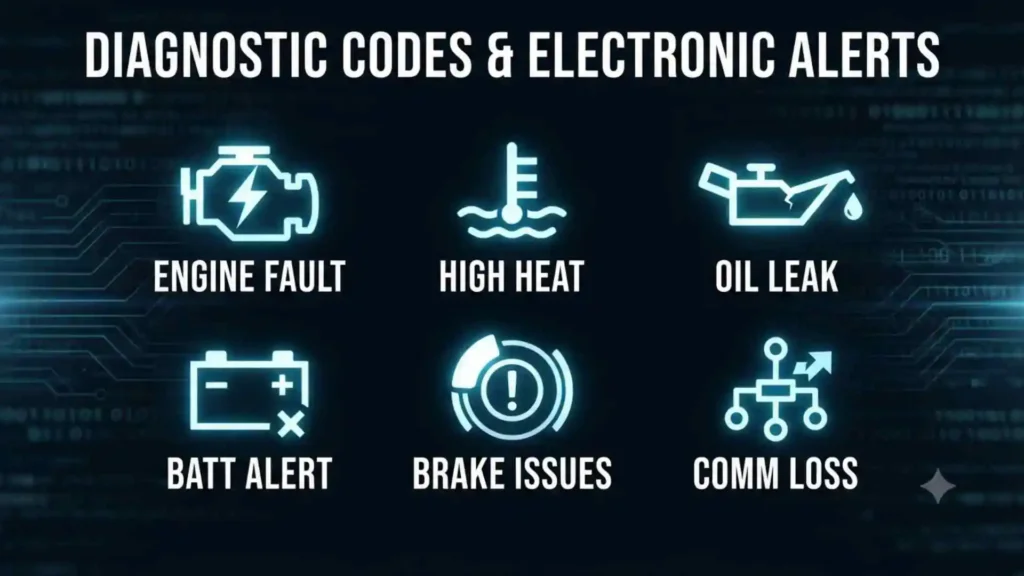
Many newer tractors show diagnostic trouble codes instead of relying only on dashboard icons.
A code may identify:
- The affected control module
- The failed circuit
- Sensor voltage
- Pressure outside the normal range
- Communication failure
- Emissions-system condition
- Transmission fault
- Hydraulic-controller problem
Write down the complete code before switching off the display. Include every letter, number, dash, and decimal point.
Do not replace parts based only on a generic internet code list. The same code format may have different meanings across brands, models, software versions, and control modules.
What to Do When a Tractor Warning Light Comes On
1. Stay Calm
Do not make a sudden turn or stop in an unsafe location. Maintain control of the tractor and move away from traffic, slopes, power lines, livestock, or workers.
2. Notice the Color
A red warning generally requires faster action than an amber warning.
3. Check for Other Symptoms
Pay attention to:
- Smoke
- Steam
- Burning smell
- Loss of power
- Unusual vibration
- Knocking sounds
- Heavy steering
- Slow hydraulic response
- Fluid leaks
4. Reduce the Load
Disengage the PTO, lower the implement safely, and reduce engine load when appropriate.
5. Read the Display
Look for a written message, gauge reading, or diagnostic code.
6. Stop the Tractor Safely
Park on stable ground, place the transmission in neutral or park, apply the parking brake, lower attachments, and shut down if the warning requires it.
7. Consult the Operator’s Manual
Use the manual for the exact model and serial-number range. Manufacturers provide model-specific manuals because instruments and procedures can change between production years. John Deere and Case IH, for example, direct equipment owners to their official manual resources for model-specific operating and safety information.
8. Contact a Qualified Technician
Seek professional help when the warning involves:
- Engine oil pressure
- Brake pressure
- Steering
- Transmission pressure
- Repeated overheating
- Electrical smoke
- Emissions derating
- Unknown diagnostic codes
- A warning that returns after basic checks
When Should You Stop the Tractor Immediately?
Stop the tractor as soon as it is safe when you see or experience:
- Red STOP warning
- Low engine oil pressure
- Severe engine overheating
- Loss of steering assistance
- Brake-system failure
- Low transmission pressure
- Major hydraulic leak
- Fuel or oil spraying onto hot components
- Electrical smoke or burning insulation
- Loud mechanical knocking
- Rapid loss of coolant
- Uncontrolled engine speed
Do not continue merely because the tractor still moves. Many serious failures provide a short warning period before permanent damage occurs.
Common Mistakes When Reading Tractor Dashboard Lights
Assuming Every Light Means a Breakdown
Green, blue, and white lights often confirm normal operation. A PTO, four-wheel-drive, or high-beam indicator is not usually a fault.
Ignoring an Amber Light for Too Long
Amber does not mean harmless. It often means that the machine is still operating but needs attention before the condition becomes critical.
Restarting to Make the Warning Disappear
Turning the key off may temporarily clear a display, but it does not repair the fault.
Using a Symbol Chart for the Wrong Brand
A similar-looking icon can represent different systems. Always verify it against the correct manual.
Covering a Warning Light
Some operators place tape over an irritating lamp. This hides a safety message and may allow expensive damage to continue unnoticed.
Replacing a Sensor Without Testing
A warning may come from a faulty sensor, but it may also reveal a real pressure, temperature, electrical, or mechanical problem.
Opening a Hot Cooling System
Removing a radiator cap from a hot engine can release boiling coolant and steam.
Deep Symbolic Meaning of Tractor Dashboard Symbols
Tractor dashboard lights are practical engineering signs, not religious or mystical symbols. Still, they carry deeper human meaning because they turn invisible mechanical conditions into visible messages.
Symbolic Meaning on a Personal Level
A warning light represents awareness. It reminds the operator that strength and productivity depend on attention.
A tractor may appear powerful, yet its operation relies on thin oil films, clean air, controlled heat, electrical current, and precise pressure. The dashboard makes these hidden systems understandable.
Psychological Meaning
Humans react quickly to color and simple shapes. Red attracts attention because people associate it with danger, heat, blood, and stopping. Amber suggests caution. Green communicates permission, safety, or active operation.
This visual hierarchy reduces the mental effort needed to interpret a problem while operating heavy equipment.
Jungian Interpretation
From a Jungian perspective, machinery can represent human power, labor, progress, and control over the environment. A warning symbol interrupts that sense of control. It acts like a message from the hidden interior of the machine, similar to how discomfort or emotion can signal a hidden problem within a person.
This is an interpretation rather than an official meaning, but it explains why experienced operators often treat a warning light as the machine “speaking.”
Cultural Meaning
In farming communities, dashboard knowledge represents competence and responsibility. An operator who understands the panel protects the equipment, the harvest, coworkers, and the family business.
Tractor Dashboard Symbols Across Different Cultures
Dashboard icons are modern industrial symbols, but the need to communicate danger visually is ancient.
Ancient Egypt
Egyptians used pictorial writing to communicate names, actions, objects, and sacred concepts. Tractor icons are not connected to hieroglyphs, but both systems show how a picture can carry meaning without a full sentence.
Ancient Greece
Greek thinkers studied mechanics, motion, heat, and pressure long before the modern engine. Greek letters are still used in science and engineering, although tractor dashboards mainly rely on universal pictograms.
Roman Culture
Roman roads, military organization, and engineering depended on clear signals and standardized systems. Modern machinery warnings follow a similar principle: rapid communication supports coordinated and safe work.
Eastern Traditions
Chinese and Japanese writing systems show how visual forms can hold complex meaning. Modern equipment sold internationally often uses pictograms because they can be understood more easily than text alone.
Indigenous Traditions
Indigenous peoples around the world have used marks, carvings, patterns, and visual signs to communicate identity, direction, memory, and environmental knowledge. Tractor dashboard icons serve a different technical purpose, but they also rely on shared visual understanding.
Modern Agricultural Culture
Today, a tractor icon may be recognized by farmers in many countries even when they speak different languages. International pictograms help manufacturers create equipment for global markets while reducing dependence on written labels.
Similar Symbols and Their Meanings
| Symbol Type | Purpose | Similarity to Dashboard Icons | Main Difference |
| Road signs | Control traffic and warn drivers | Use simple shapes and colors | Apply to public roads rather than machine systems |
| Safety labels | Warn about crushing, cutting, heat, and entanglement | Communicate hazards visually | Usually attached near the physical hazard |
| Vehicle warning lights | Monitor cars and trucks | Share many engine and brake icons | Agricultural machines include PTO and hydraulic functions |
| Industrial control symbols | Monitor factories and heavy equipment | Show system status and faults | Often appear on fixed machinery |
| Smartphone icons | Communicate battery, signal, and settings | Use small visual shortcuts | Usually relate to digital functions rather than mechanical safety |
Tractor Dashboard Symbols in Mythology and Folklore
Tractor dashboard symbols do not appear in ancient mythology because tractors are modern machines. However, the ideas behind them have mythic parallels.
Fire warnings echo humanity’s ancient fear and respect for destructive heat. Oil-pressure and hydraulic symbols relate to flow, a theme often used in stories to represent life, energy, and continuity. The charging symbol reflects stored power, while the STOP light resembles the guardian figure that blocks a dangerous path.
These comparisons are metaphorical. They should not replace the technical meaning printed in the operator’s manual.
Tractor Dashboard Symbols in Art, Literature, Movies, and Pop Culture
Tractors often represent labor, rural identity, independence, family tradition, and the changing relationship between people and technology.
In films and television, a glowing warning light may build tension before a machine fails. In agricultural advertising, illuminated screens represent modern precision and control. In farm photography, the dashboard can create the feeling of seeing the field through the operator’s eyes.
Tractor symbols also appear in:
- Training posters
- Workshop signs
- Equipment-themed clothing
- Simulator games
- Agricultural education materials
- Farm-safety campaigns
- Mobile equipment-monitoring applications
Unlike decorative symbols, dashboard icons must remain clear. Their value comes from fast recognition rather than artistic complexity.
Spiritual and Dream Meaning of Tractor Dashboard Symbols
There is no recognized spiritual doctrine attached to tractor warning lights. Dream interpretations are personal and should not be treated as predictions.
Still, dreaming about a warning light may reflect:
- A concern you have been ignoring
- Fear of losing control
- Pressure to remain productive
- A need for maintenance or rest
- Anxiety about work or finances
- A desire to understand a hidden problem
A red warning light in a dream may symbolize urgency. A fuel light may suggest depleted energy. An overheating symbol may reflect stress or emotional exhaustion.
These meanings are psychological possibilities, not fixed truths.
Positive and Negative Meanings of Tractor Dashboard Symbols
| Positive Meaning | Negative Meaning |
| Awareness | Mechanical failure |
| Prevention | Urgency |
| Communication | Fear of breakdown |
| Control | Loss of control |
| Responsible maintenance | Expensive repair |
| Operator knowledge | Confusion |
| Safety | Danger |
| Protection of equipment | Interrupted work |
| Early diagnosis | Ignored warning |
| Efficient operation | Reduced productivity |
The same light can carry both meanings. An oil-pressure warning signals danger, but it also gives the operator a chance to stop before the engine is destroyed.
Why Humans Are Attracted to Tractor Dashboard Symbols
People naturally look for patterns. A familiar icon reduces uncertainty and helps the brain make a quick decision.
Dashboard symbols also satisfy a desire for control. Farming involves weather, soil, animals, markets, and mechanical systems that are never completely predictable. A clear instrument panel gives the operator measurable information in an uncertain environment.
Experienced operators often build emotional familiarity with a tractor’s normal sounds and displays. They know where each needle should sit and which lights should appear during startup. This knowledge creates trust, much like learning the habits of a dependable working partner.
Modern Uses of Tractor Dashboard Symbols
Modern tractor icons are used far beyond traditional warning-light clusters.
Digital Instrument Panels
LCD and touchscreen displays combine symbols with written instructions, gauge readings, maps, and fault codes.
Precision Agriculture
Guidance icons show steering engagement, field boundaries, application coverage, satellite connection, and implement control.
Remote Telematics
Farm managers may receive alerts about fuel use, machine location, fault codes, maintenance intervals, and engine condition.
Training and Simulation
Agricultural colleges, dealerships, and equipment simulators use dashboard symbols to teach safe operation.
Mobile Applications
Some manufacturers connect tractors to mobile or web platforms where users can review machine alerts and performance information.
Workshop Diagnosis
Technicians use symbols and electronic fault codes as starting points for pressure tests, electrical testing, software diagnostics, and mechanical inspection.
Interesting Facts About Tractor Dashboard Symbols
- Many dashboard lights appear briefly when the key is turned on because the tractor is testing the bulbs, display, or electronic circuits.
- A warning light that never appears during startup may have a failed bulb or display problem.
- A battery symbol usually indicates a charging-system fault, not necessarily a bad battery.
- The oil-pressure light measures pressure, not simply the amount of oil in the engine.
- The same fluid may serve both the transmission and hydraulic system on some tractors.
- An air-filter warning is often triggered by intake restriction rather than a timer.
- A high-exhaust-temperature light may indicate normal diesel particulate filter cleaning rather than engine overheating.
- Four-wheel-drive and differential-lock lights are status indicators, but their use affects steering, traction, and tire wear.
- Some tractors use audible alarms with red warnings so the operator notices the problem even when looking away from the panel.
- Two tractors from the same brand may use different symbols if they were built in different years or markets.
Frequently Asked Questions
What is the most serious warning light on a tractor?
A flashing red STOP light, low engine oil-pressure warning, severe overheating warning, brake failure, or steering warning is usually among the most serious. Stop safely and follow the operator’s manual immediately.
What does the exclamation mark mean on a tractor dashboard?
An exclamation mark normally indicates a general warning or system fault. Its exact meaning depends on the surrounding shape, color, accompanying symbol, and display message.
Can I keep driving with an amber tractor warning light?
Sometimes, but not automatically. Amber means caution. Reduce the load, read the display, and check the manual. Stop if performance changes, the light flashes, or a red warning appears.
What does the oil-can symbol mean on a tractor?
The oil-can symbol usually means low engine oil pressure. Shut off the engine as soon as it is safe. Check the oil level and investigate the cause before continuing.
What does the coil symbol mean on a diesel tractor?
The coil represents the glow-plug or intake-heater system. Wait for the light to go out before starting a cold engine unless the manufacturer provides different instructions.
Why is my tractor’s DPF light on?
The diesel particulate filter may be collecting soot or requesting a regeneration cycle. Follow the model-specific instructions. Repeatedly ignoring or interrupting regeneration may lead to reduced power or required service.
Conclusion
Tractor dashboard symbols and meanings form a practical language that helps operators detect trouble before it becomes dangerous or expensive.
Red lights demand urgent attention, amber lights call for investigation, and green or blue icons usually confirm active functions. Yet no universal chart can replace the operator’s manual for a specific model. Listen when the dashboard speaks, because a small light today may prevent a major failure tomorrow.

Hi, I’m Asher Monroe, a writer who believes that meaningful words have the power to inspire change and bring people closer to their dreams. I have always been fascinated by the beauty of quotes and the way a simple message can provide motivation, hope, and comfort.
I enjoy creating content around inspirational quotes, life lessons, success stories, and positive thoughts that help readers find encouragement in their everyday lives. My goal is to share words that connect with people and remind them of their inner strength.
Through my writing, I explore the ideas of personal growth, confidence, and the importance of staying inspired through every chapter of life.
I am the author of Words That Move the Soul and The Path of Endless Inspiration, two books focused on the power of wisdom, positivity, and meaningful thoughts.
 Sienna Brooks
 Rowan Sinclair Rowan Sinclair