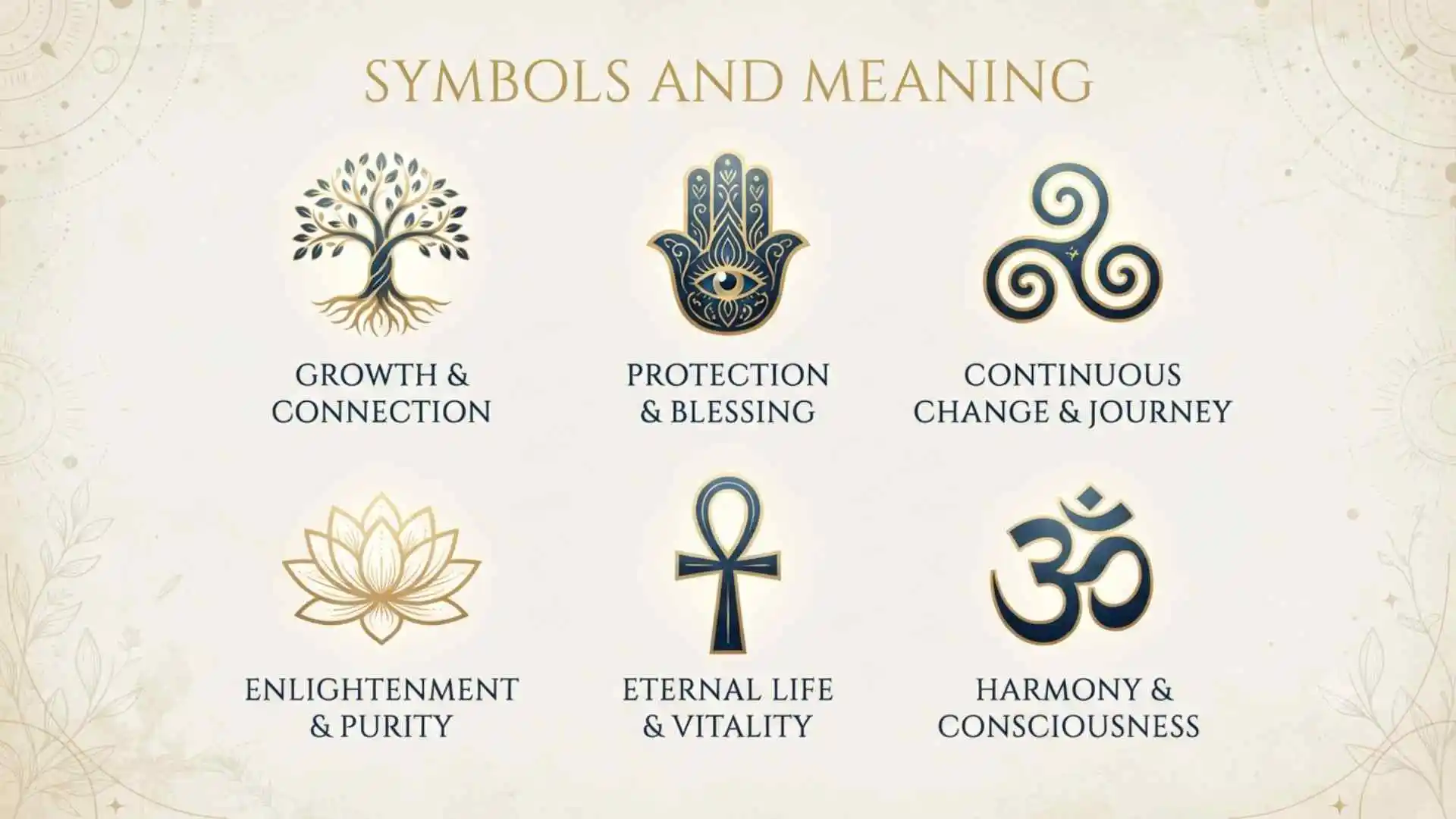
Symbols and meaning shape how people understand love, danger, faith, identity, death, and hope. A simple image such as a heart, circle, tree, or flame can carry centuries of human experience within it.
Across civilizations, people have used symbols to communicate ideas that ordinary words could not fully express. By exploring their history, psychology, and spiritual depth, we begin to understand not only ancient cultures but also ourselves.
(Quick Answer) symbols and meaning
Symbols are images, objects, gestures, sounds, or signs that represent ideas beyond their literal form. Their meanings may come from religion, mythology, history, psychology, or shared cultural experience. A symbol can express complex themes such as life, protection, rebirth, wisdom, unity, love, power, or death through one recognizable form.
Quick Facts About Symbols and Meaning
| Aspect | Information |
| Origin | Symbols appeared in prehistoric art, ritual objects, body markings, tools, and early writing systems |
| Historical Significance | They preserved beliefs, laws, identities, myths, and sacred knowledge across generations |
| Main Meaning | A visible or recognizable form that represents a deeper idea |
| Spiritual Meaning | Connection with the divine, the soul, transformation, protection, or enlightenment |
| Cultural Importance | Symbols unite communities and communicate shared values, traditions, and identities |
| Modern Usage | Logos, emojis, tattoos, road signs, religious icons, fashion, art, branding, and social media |
What Are Symbols and Meaning?
A symbol is something that stands for more than itself. It may be a picture, shape, color, animal, object, gesture, word, or sound. Its visible form is usually simple, but the idea behind it may be complex.
A red rose, for example, is a flower in the physical world. Symbolically, it may represent romantic love, passion, beauty, sacrifice, secrecy, or grief. Its meaning changes according to culture, color, setting, and personal experience.
Symbols differ from ordinary signs. A sign usually provides direct information. A stop sign tells a driver to stop. A symbol often invites interpretation. A flame may represent destruction, divine presence, knowledge, purification, anger, or renewed life.
The Origin of Symbolic Communication
Symbolic thinking is one of the foundations of human culture. Long before formal writing existed, people carved animals, handprints, geometric patterns, and hunting scenes onto cave walls.
These images probably served more than a decorative purpose. They may have supported ritual, storytelling, group identity, memory, or spiritual belief.
As communities developed, their symbols became more organized. Ancient Egyptians used hieroglyphs that could represent sounds, words, objects, and sacred ideas. The word “hieroglyph” itself comes from Greek terms associated with sacred carving.
In ancient Egypt, the ankh represented life or the act of living. It often appeared in temple scenes where gods offered life to kings. The Metropolitan Museum of Art describes the ankh as a sign read as “life” or “to live.”
How Symbols Evolved
Over time, symbols became central to:
- Religious rituals
- Royal authority
- Family identity
- Trade and ownership
- Writing systems
- Military communication
- Mythological storytelling
- Political movements
- Art and architecture
Modern life remains filled with symbolic communication. National flags represent shared identity. Corporate logos express brand values. Emojis carry emotion through small digital images. Wedding rings represent commitment, while black clothing may suggest mourning, formality, rebellion, or elegance.
Symbols have changed in form, but their basic purpose remains the same. They help people turn invisible ideas into something visible.
Deep Symbolic Meaning of Symbols
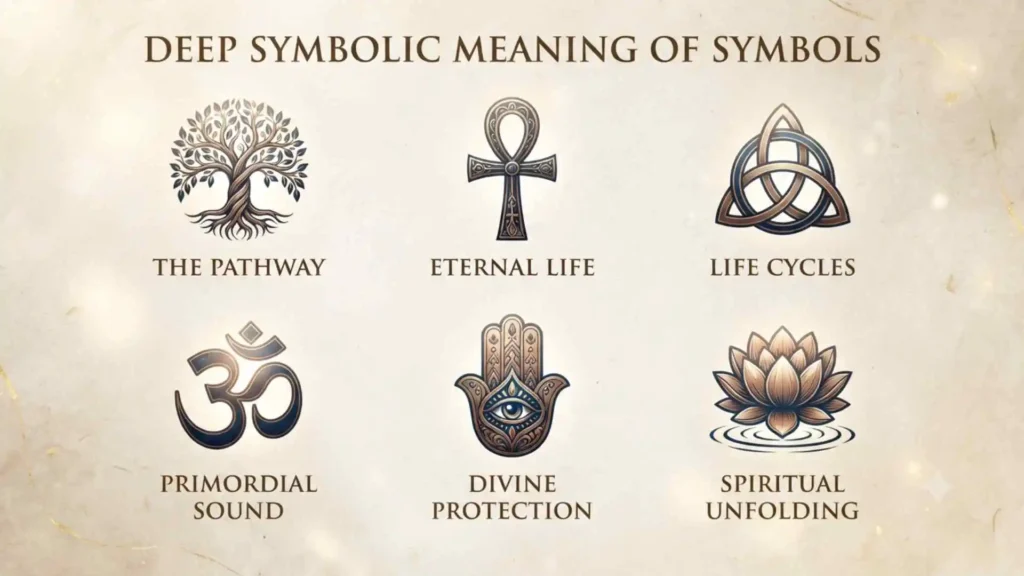
The meaning of a symbol can operate on several levels at once. One image may carry spiritual, psychological, cultural, and personal significance.
Spiritual Level
Spiritual symbols help people express experiences that are difficult to describe through ordinary language. They often represent the soul, divine power, moral truth, protection, transformation, or the mystery of existence.
A circle may symbolize eternity because it has no clear beginning or end. A ladder may suggest spiritual ascent. Water may represent purification, creation, emotional depth, or rebirth.
The exact meaning depends on the belief system in which the image appears.
Inner Transformation
Many spiritual traditions use symbolic journeys to describe inner growth. Darkness may represent confusion or spiritual separation. Light may represent knowledge, divine truth, or awakening.
A seed buried in soil appears to disappear before it grows. For this reason, seeds often symbolize hidden potential, faith, patience, and transformation.
The butterfly carries a similar message. Its change from caterpillar to chrysalis and finally to winged form makes it a natural symbol of renewal, freedom, and spiritual development.
Soul and Consciousness
Symbols can act as bridges between conscious thought and deeper emotional experience. During prayer, meditation, dreams, or ritual, a person may connect with an image that seems to express an inner truth.
A door may represent opportunity or transition. A mountain may represent struggle, spiritual discipline, or closeness to heaven. A mirror may suggest self-knowledge, truth, vanity, or illusion.
These images become powerful because people recognize their meaning both intellectually and emotionally.
Psychological Level
Psychologically, symbols organize feelings and experiences into recognizable patterns.
A child may fear darkness before understanding why. An adult may feel comforted by a childhood home, an old photograph, or a family object. These things carry emotional associations far beyond their physical appearance.
Jungian Symbolism
Swiss psychiatrist Carl Jung believed that symbols found in dreams, religion, art, and mythology could reveal patterns within the human psyche. His approach to analytic psychology gave special importance to primordial images and symbols.
Jung called recurring symbolic patterns archetypes. Common examples include:
- The hero
- The mother
- The wise elder
- The shadow
- The trickster
- Death and rebirth
- The journey
- The child
These patterns appear in myths from cultures that developed far apart. Although their details differ, they often reflect similar human fears, desires, conflicts, and stages of growth.
Emotional Attraction
People are often drawn to symbols that reflect their current emotional needs.
Someone seeking strength may choose a lion. A person recovering from hardship may connect with a phoenix. Someone who values peace may wear a dove or olive branch.
The symbol becomes a personal reminder. It gives visible form to an inner goal, memory, promise, or identity.
Cultural Level
Culture teaches people how to interpret symbols.
White is associated with weddings and purity in many Western settings. In some Asian traditions, however, white is strongly connected with mourning and funerals.
The owl may represent wisdom in traditions influenced by ancient Greece, partly because of its connection with Athena. In other contexts, it may be viewed as a messenger, guardian, warning, or sign of death.
This does not mean one meaning is correct and another is wrong. Symbolic meaning grows from shared stories, customs, environments, and historical experiences.
UNESCO describes culture as including the spiritual, material, intellectual, and emotional features of a society, including its values, traditions, arts, and beliefs. Symbols help make those shared features visible.
Types and Variations of Symbols
Symbols may be divided into several broad groups. Many symbols belong to more than one category.
Natural Symbols
Natural symbols come from animals, plants, landscapes, weather, and the elements.
| Symbol | Visual Description | Common Meaning | Cultural Connection | Where It Appears |
| Sun | Bright circle with rays | Life, power, truth, divine energy | Solar deities and royal authority | Religion, flags, art, architecture |
| Moon | Crescent or full circle | Cycles, intuition, mystery, time | Lunar calendars and goddesses | Mythology, dreams, jewelry |
| Tree | Trunk, branches, and roots | Life, growth, ancestry, connection | World tree traditions | Religion, family crests, literature |
| Water | Waves, rivers, or drops | Life, cleansing, emotion, change | Baptism and purification rites | Dreams, poetry, rituals |
| Fire | Flame or burning light | Passion, destruction, knowledge, renewal | Sacred fires and creation myths | Temples, art, ceremonies |
| Mountain | High peak | Strength, challenge, sacred ascent | Homes of gods and spirits | Myth, pilgrimage, dreams |
Animal Symbols
Animals often represent qualities people admire, fear, or wish to understand.
Lion
Visual description: A powerful big cat, often shown standing proudly or wearing a crown.
Meaning: Courage, leadership, royalty, strength, and protection.
Cultural connection: Lions guarded temples and thrones in many ancient societies. They also became symbols of kingship in European heraldry.
Where it appears: Myths, flags, coats of arms, religious art, tattoos, and company logos.
Snake
Visual description: A long, curved reptile, sometimes shown biting its tail.
Meaning: Healing, danger, wisdom, temptation, transformation, or immortality.
Symbolism: Because snakes shed their skin, they became symbols of renewal. Their venom also made them signs of danger and death.
Where it appears: Medicine, mythology, religion, dreams, jewelry, and occult traditions.
Eagle
Visual description: A large bird with wide wings and sharp vision.
Meaning: Freedom, authority, courage, victory, and spiritual vision.
Cultural connection: Eagles appeared in Roman military standards and continue to represent state power in several countries.
Where it appears: National emblems, military insignia, mythology, tattoos, and sports logos.
Butterfly
Visual description: A winged insect with colorful, symmetrical patterns.
Meaning: Transformation, beauty, freedom, the soul, and temporary life.
Cultural connection: Its life cycle naturally connects it with death and rebirth.
Where it appears: Art, memorials, tattoos, dreams, fashion, and spiritual imagery.
Geometric Symbols
Geometric shapes are among humanity’s oldest symbolic forms.
Circle
The circle represents unity, wholeness, eternity, cycles, and protection. It appears in halos, wedding rings, mandalas, sun disks, and sacred architecture.
Triangle
A triangle may represent stability, divine groups, body-mind-spirit unity, fire, aspiration, or hierarchy. Its direction changes its interpretation. An upward triangle often suggests fire or ascent, while a downward triangle may represent water or descent.
Square
The square represents order, structure, stability, earth, and the material world. Buildings, maps, and city plans often use square forms because they suggest control and reliability.
Spiral
The spiral symbolizes movement, growth, unfolding consciousness, life cycles, and return. It appears in ancient carvings, shells, storms, galaxies, and sacred designs.
Religious and Sacred Symbols
Sacred symbols express faith, doctrine, community identity, and spiritual teaching.
Examples include:
- The Christian cross
- The Islamic crescent in cultural and historical contexts
- The Jewish Star of David
- The Hindu Om
- The Buddhist Dharma wheel
- The Sikh Khanda
- The Taoist yin-yang
- The ancient Egyptian ankh
These symbols should be interpreted within their own traditions. Removing a sacred image from its religious context can produce misleading or disrespectful explanations.
Social and Political Symbols
Flags, raised fists, ribbons, badges, colors, and hand gestures can represent political causes, social movements, protest, unity, or resistance.
Their meanings may change quickly. A symbol that once represented one movement may later be adopted, rejected, or reinterpreted by another group.
Personal Symbols
A personal symbol gains meaning through individual experience.
A seashell may remind someone of a lost parent. A particular song may represent a friendship. A number may feel meaningful because of a birthday, achievement, or major turning point.
Personal symbols do not need universal recognition. Their power comes from memory and emotional connection.
Symbols and Meaning Across Different Cultures
Ancient Egypt
Ancient Egyptian culture used a highly developed visual language in temples, tombs, jewelry, clothing, and writing.
The ankh represented life. The scarab beetle became associated with renewal and the rising sun. The Eye of Horus represented protection, healing, and restored order.
Plants also carried symbolic meaning. Papyrus was connected with Lower Egypt and could express freshness, flourishing, and health. The lotus became a powerful symbol of regeneration because it opened with the morning sun and closed at night.
Egyptian symbols were not merely decoration. They were believed to participate in the reality they represented. An image of protection could protect. A written name could preserve identity. A tomb scene could help sustain life in the next world.
Ancient Greece
Greek symbols often developed through mythology.
The owl represented Athena and became associated with wisdom, strategy, and watchfulness. The laurel wreath represented victory and honor. The thunderbolt showed the authority of Zeus.
The labyrinth came from the myth of Theseus and the Minotaur. It now symbolizes confusion, challenge, spiritual searching, or a difficult journey toward the center of the self.
Greek mythology continues to shape modern language and symbolism. The phrase “Achilles’ heel” still represents a hidden weakness. A “Trojan horse” represents danger concealed within an attractive or trusted form.
Roman Culture
The Romans adopted many Greek symbols while giving them new political and military meanings.
The eagle represented Jupiter, victory, and imperial power. Roman legions carried eagle standards as signs of honor and unity.
The fasces, a bundle of rods surrounding an axe, represented authority and collective strength. Its later political use changed how many people interpret it today.
Laurel wreaths crowned victorious generals, poets, and emperors. Their symbolism survives in phrases such as “resting on one’s laurels.”
Eastern Traditions
Eastern traditions include many cultures and should never be treated as one single system. Still, several widely recognized symbols developed across South, East, and Southeast Asia.
Yin-Yang
The yin-yang symbol represents complementary forces. Light and darkness, activity and rest, firmness and softness exist in relationship rather than complete separation.
It does not simply mean good versus evil. Its deeper message is balance, interdependence, and continuous change.
Lotus
In Hindu and Buddhist traditions, the lotus often represents purity, spiritual awakening, and liberation. It grows from muddy water yet rises above the surface in beauty.
This makes it a powerful image of inner development. Difficult conditions do not prevent spiritual growth.
Dharma Wheel
The Buddhist Dharma wheel represents the teachings of the Buddha and the path toward freedom from suffering. Its spokes may symbolize ethical and spiritual principles, including the Noble Eightfold Path.
Dragon
In many Chinese traditions, the dragon represents power, good fortune, rain, authority, and cosmic energy. This differs sharply from many European legends, where dragons often represent chaos, greed, or danger.
Indigenous Traditions
Indigenous traditions are diverse, living belief systems rather than a single symbolic category.
Animals, plants, directions, landscapes, ancestors, and natural forces often carry deep meaning. However, interpretations belong to specific communities and cannot always be generalized.
A feather may represent honor, prayer, responsibility, achievement, or spiritual connection in certain traditions. Its meaning depends on the nation, ceremony, bird species, and person receiving it.
Sacred symbols should not be copied only for fashion. Respectful understanding requires attention to community ownership, living traditions, and historical context.
UNESCO notes that cultural heritage includes living expressions passed between generations, including rituals, oral traditions, knowledge of nature, and traditional craftsmanship.
Modern Interpretations
Modern culture constantly creates and transforms symbols.
The heart icon now means love, approval, health, or digital engagement. A hashtag can organize a movement. A rainbow may represent hope, diversity, peace, natural wonder, or LGBTQ+ pride depending on context.
Emojis function as a fast visual language. Yet even they can be misunderstood. A folded-hands emoji may mean prayer, thanks, respect, greeting, or celebration.
Modern symbols travel quickly across cultures. As they spread, their meanings may expand, weaken, or become controversial.
Similar Symbols and Their Meanings
| Symbols | Similarity | Main Difference | Common Misconception |
| Sun and fire | Both suggest energy, warmth, and life | The sun often suggests cosmic order, while fire suggests active change | Both do not always mean positivity |
| Circle and spiral | Both relate to cycles and continuity | A circle suggests completion, while a spiral suggests movement or growth | A spiral is not simply an unfinished circle |
| Dove and olive branch | Both symbolize peace | The dove is a living messenger, while the branch represents reconciliation | Their peace meaning is not universal in every context |
| Snake and dragon | Both may represent power and transformation | Dragons often combine several animal qualities and cosmic forces | Both are not always evil |
| Tree and mountain | Both connect earth and sky | A tree emphasizes life and growth, while a mountain emphasizes height and endurance | Neither has one fixed religious meaning |
| Moon and water | Both relate to emotion, cycles, and intuition | The moon is celestial, while water is fluid and earthly | Their feminine associations are culturally shaped, not universal |
Symbols and Meaning in Mythology and Folklore
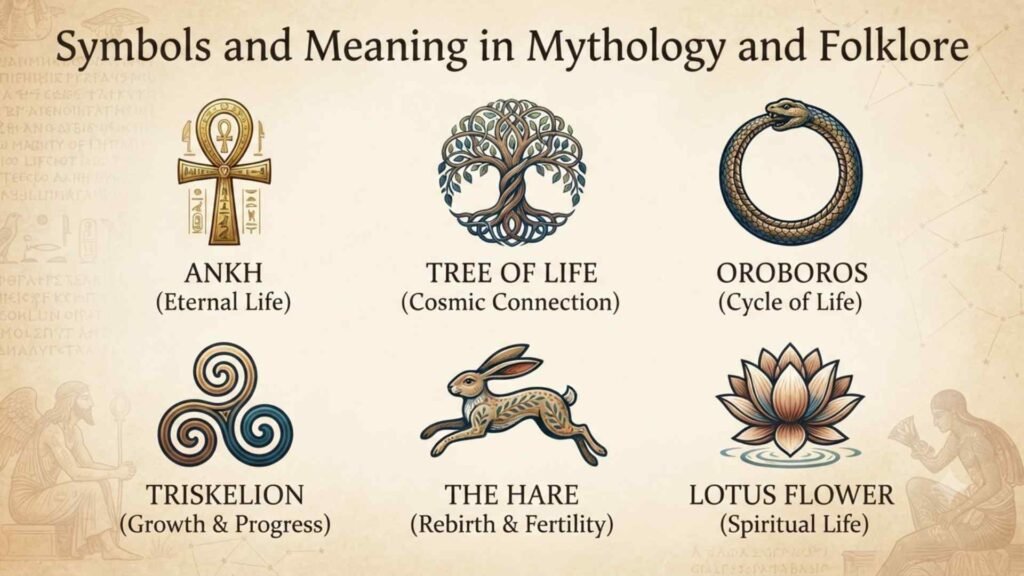
Myths use symbols to turn difficult ideas into memorable stories.
The phoenix dies in flame and rises again. It represents renewal after loss. The hero enters a dark forest, cave, or underworld and returns changed. This journey represents confrontation with fear and the discovery of inner strength.
The World Tree
Many traditions describe a great tree that connects different levels of existence.
Its roots reach into the underworld. Its trunk stands in the human world. Its branches rise toward the heavens.
The tree represents connection, ancestry, cosmic order, and the cycle of life. Related ideas appear in Norse, Central Asian, Mesoamerican, and other cultural traditions, though each version has its own meaning.
The Trickster
The trickster appears as a clever god, animal, spirit, or rule-breaker. Tricksters create confusion, but they also reveal hypocrisy and force change.
Figures such as Loki, Hermes, Anansi, and Coyote are different characters from distinct traditions. They should not be treated as identical. Still, each shows how disorder can expose hidden truth.
The Hero’s Journey
Myths often follow a pattern in which a character leaves home, faces trials, receives help, confronts danger, and returns transformed.
The road, bridge, cave, monster, treasure, and homecoming all carry symbolic meaning. They represent stages of psychological and moral growth.
These patterns remain common in novels, films, games, and television because they reflect familiar human experiences.
Symbols and Meaning in Art, Literature, Movies, and Pop Culture
Paintings
Artists use color, posture, objects, animals, and light to create symbolic messages.
A skull in a still-life painting may remind viewers that life is temporary. A wilting flower may suggest fading beauty. A candle may represent divine presence, knowledge, human life, or approaching death.
The meaning depends on the artistic period and the work’s cultural setting.
Literature and Poetry
Writers use symbols to add depth without explaining every idea directly.
A storm may mirror emotional conflict. Spring may symbolize renewal. A locked room may represent secrecy, trauma, repression, or isolation.
In poetry, symbols often remain open to several interpretations. This ambiguity invites the reader to take part in creating meaning.
Movies and Television
Film directors use repeated colors, costumes, objects, camera angles, and locations as visual symbols.
A broken mirror can suggest a divided identity. A red door may signal danger, passion, or transition. A bird escaping a cage may represent freedom.
Repeated symbols help connect scenes and reveal themes without direct dialogue.
Tattoos
Tattoos turn symbols into permanent personal statements.
Popular symbolic tattoos include:
- Lions for courage
- Butterflies for change
- Anchors for stability
- Compasses for direction
- Trees for growth
- Moons for cycles
- Semicolons for continuation and survival
- Phoenixes for rebirth
Before choosing a tattoo, it is wise to research its cultural, religious, and historical meanings. A design may carry meanings the wearer did not intend.
Fashion and Modern Design
Fashion uses symbols to communicate identity, status, rebellion, belonging, or mood.
Colors, patterns, logos, jewelry, and traditional clothing can carry powerful cultural messages. Some designs honor heritage. Others may raise concerns about cultural appropriation when sacred or community-owned symbols are used without respect.
Spiritual and Dream Meaning of Symbols
Dreams often communicate through images rather than direct statements.
However, dream symbols do not have one guaranteed meaning. Personal feelings, life events, culture, and the dream’s full setting matter more than a generic symbol dictionary.
Common Dream Symbols
Water
Calm water may suggest emotional peace. Flooding may represent overwhelming feelings. Deep water may point toward mystery, fear, or the unconscious.
House
A house may symbolize the dreamer’s sense of self. Different rooms may represent memories, hidden emotions, relationships, or parts of life.
Door
A door may represent opportunity, transition, secrecy, or hesitation. An open door suggests access, while a locked door may reflect limitation or unreadiness.
Snake
A snake may suggest fear, healing, temptation, transformation, instinct, or hidden danger. The dreamer’s emotional response is essential.
Flying
Flying can symbolize freedom, ambition, confidence, escape, or loss of control.
Meditation and Spiritual Encounters
During meditation, people may notice colors, shapes, animals, or landscapes in the imagination. These images can become tools for reflection, but they should not automatically be treated as supernatural messages.
A balanced interpretation asks:
- What emotion did the symbol create?
- What does it mean in my culture?
- What personal memory does it awaken?
- Is it connected with a current decision or fear?
- Does the interpretation encourage wisdom and healthy action?
Positive and Negative Meanings of Symbols
| Symbol | Positive Meaning | Negative or Cautionary Meaning |
| Fire | Warmth, passion, purification, knowledge | Destruction, anger, punishment |
| Snake | Healing, renewal, wisdom | Betrayal, danger, temptation |
| Crown | Leadership, achievement, dignity | Pride, domination, entitlement |
| Moon | Intuition, cycles, reflection | Illusion, uncertainty, instability |
| Sword | Justice, courage, protection | Violence, conflict, division |
| Mirror | Truth, awareness, self-knowledge | Vanity, deception, fractured identity |
| Raven | Intelligence, mystery, transformation | Death, warning, misfortune |
| Rose | Love, beauty, devotion | Pain, secrecy, loss |
| Ocean | Life, freedom, emotional depth | Chaos, danger, helplessness |
| Darkness | Rest, mystery, hidden potential | Fear, ignorance, despair |
The same symbol can hold light and shadow because human experience contains both.
Fire cooks food and destroys homes. Water sustains life and causes floods. A crown can represent responsible leadership or cruel power.
Context determines whether a symbol feels hopeful, dangerous, sacred, or tragic.
Why Humans Are Attracted to Symbols
People are attracted to symbols because the mind naturally searches for patterns and meaning.
A symbol compresses a large idea into a small form. A wedding ring can represent years of trust, sacrifice, memory, and commitment. A national flag can awaken pride, grief, unity, or conflict in seconds.
Pattern Recognition
The human brain quickly recognizes familiar shapes and associations. This helps people understand warnings, identify groups, remember stories, and make decisions.
Symbols work because they reduce complex information into memorable patterns.
Emotional Connection
Symbols can awaken emotions faster than explanations.
A childhood toy may create comfort. A military medal may evoke sacrifice. A religious object may inspire devotion. A family photograph may bring love and grief at the same time.
Collective Memory
Communities preserve memory through monuments, rituals, songs, clothing, and emblems.
These symbols connect the present with the past. They tell people who they are, where they came from, and what their group values.
UNESCO’s World Heritage emblem, for example, represents the relationship between cultural and natural heritage and the universal values protected by the World Heritage Convention.
Personal Meaning
People also reshape symbols according to their own experiences.
A storm may represent fear to one person and freedom to another. A rose may remind one person of romance and another of a funeral.
Symbolic meaning is strongest when shared cultural knowledge meets personal memory.
Modern Uses of Symbols
Tattoos
Tattoos allow people to carry identity, memory, belief, or personal values on the body.
A meaningful tattoo may mark recovery, family connection, grief, faith, cultural heritage, or a life-changing event.
Jewelry
Rings, pendants, bracelets, and charms often hold symbolic value.
Common examples include crosses, stars, trees, birthstones, protective eyes, initials, lockets, moons, and infinity signs.
Fashion
Clothing symbols communicate group membership, taste, protest, wealth, humor, or cultural identity.
Even the absence of decoration can send a message of simplicity, discipline, or resistance to consumer culture.
Branding
Companies use symbols because images are easier to recognize than long explanations.
A successful logo may suggest speed, trust, nature, innovation, luxury, strength, or friendliness through shape and color alone.
Social Media
Likes, hearts, check marks, hashtags, reaction icons, and emojis form a constantly changing symbolic language.
Their meanings may differ by age group, platform, or online community. A symbol that seems friendly in one setting may appear sarcastic or dismissive in another.
Contemporary Spirituality
Mandalas, crystals, moons, chakras, sacred geometry, and animal images often appear in modern spiritual practices.
Some come from established traditions with precise meanings. Others are modern combinations. Responsible use requires research and respect for the cultures from which they come.
Home Decor
People use symbols in homes to create emotional atmosphere.
Trees may suggest growth. Mountains may suggest strength. Family names may express belonging. Religious symbols may turn a room into a place of prayer or reflection.
Personal Expression
Symbols help people express ideas they cannot easily say aloud.
A ribbon may show support for a cause. A bracelet may honor someone who died. A profile image may signal identity, mood, community, or belief.
Interesting Facts About Symbols and Meaning
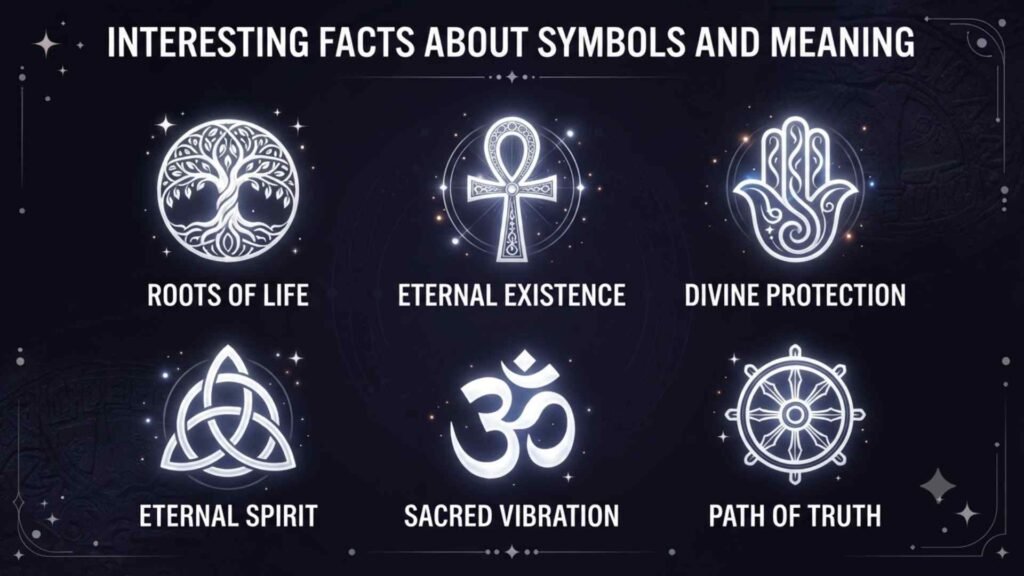
- Symbols can change meaning over time. A symbol may begin as religious, become political, and later turn into a fashion design.
- The same symbol can mean opposite things. A snake may represent both healing and danger.
- Color meanings are culturally shaped. White can represent purity, peace, mourning, emptiness, or surrender depending on context.
- Ancient games contained symbolic ideas. The Egyptian game senet became connected with the soul’s journey through the afterlife.
- Symbols can receive legal protection. International emblems may identify cultural property protected during armed conflict.
- A symbol can work without words. Road signs and safety icons communicate across language barriers.
- Brands depend on symbolic memory. A familiar shape or color can help people identify a company before reading its name.
- Dream symbols are highly personal. Universal interpretations can be useful starting points, but emotional context is more important.
- Sacred symbols may be active parts of ritual. In many traditions, a consecrated object is not treated as decoration but as something carrying religious importance.
- Digital culture creates new symbols quickly. Emojis, memes, gestures, and hashtags can gain global meaning within days.
Frequently Asked Questions
What is the simple meaning of a symbol?
A symbol is an image, object, sound, gesture, or sign that represents a deeper idea. For example, a heart commonly represents love, while a crown may represent authority.
Why are symbols important in human culture?
Symbols preserve beliefs, memories, values, and identities. They help communities communicate complex ideas and pass traditions from one generation to another.
Can one symbol have several meanings?
Yes. Meaning changes according to culture, religion, history, setting, and personal experience. A snake may symbolize healing, danger, wisdom, or rebirth.
What are the most common universal symbols?
Common symbols found across many cultures include the sun, moon, tree, water, fire, circle, mountain, bird, snake, and mother figure. Their exact meanings still vary.
What is the difference between a sign and a symbol?
A sign usually gives direct information, such as a traffic signal. A symbol represents a broader idea and often requires cultural or emotional interpretation.
How can I understand the meaning of an unfamiliar symbol?
Study its historical period, culture, religion, visual setting, and original use. Avoid relying on appearance alone, especially when the symbol is sacred or culturally specific.
Conclusion
Symbols and meaning reveal how human beings turn invisible ideas into visible forms. They preserve stories of love, fear, faith, power, death, renewal, and belonging across generations.
Their meanings are never created by shape alone but by history, culture, emotion, and personal experience. When we learn to read symbols carefully, we discover a hidden language that connects ancient temples, modern screens, and the deepest parts of the human mind.
Hi, I’m Sienna Brooks, and I believe that the right words can inspire, comfort, and empower people at every stage of life. For as long as I can remember, I’ve been drawn to meaningful quotes and the stories behind them. I love curating collections of inspirational, motivational, and heartfelt quotes that resonate with readers around the world.
Through my writing, I strive to help others find encouragement, whether they’re celebrating life’s happiest moments or navigating its biggest challenges. I believe that wisdom is timeless, and I’m passionate about sharing words that leave a lasting impact.
I am the author of Reflections in Words and The Journey of Inspiration, two books dedicated to exploring the beauty and power of timeless quotes.
 Rowan Sinclair Rowan Sinclair