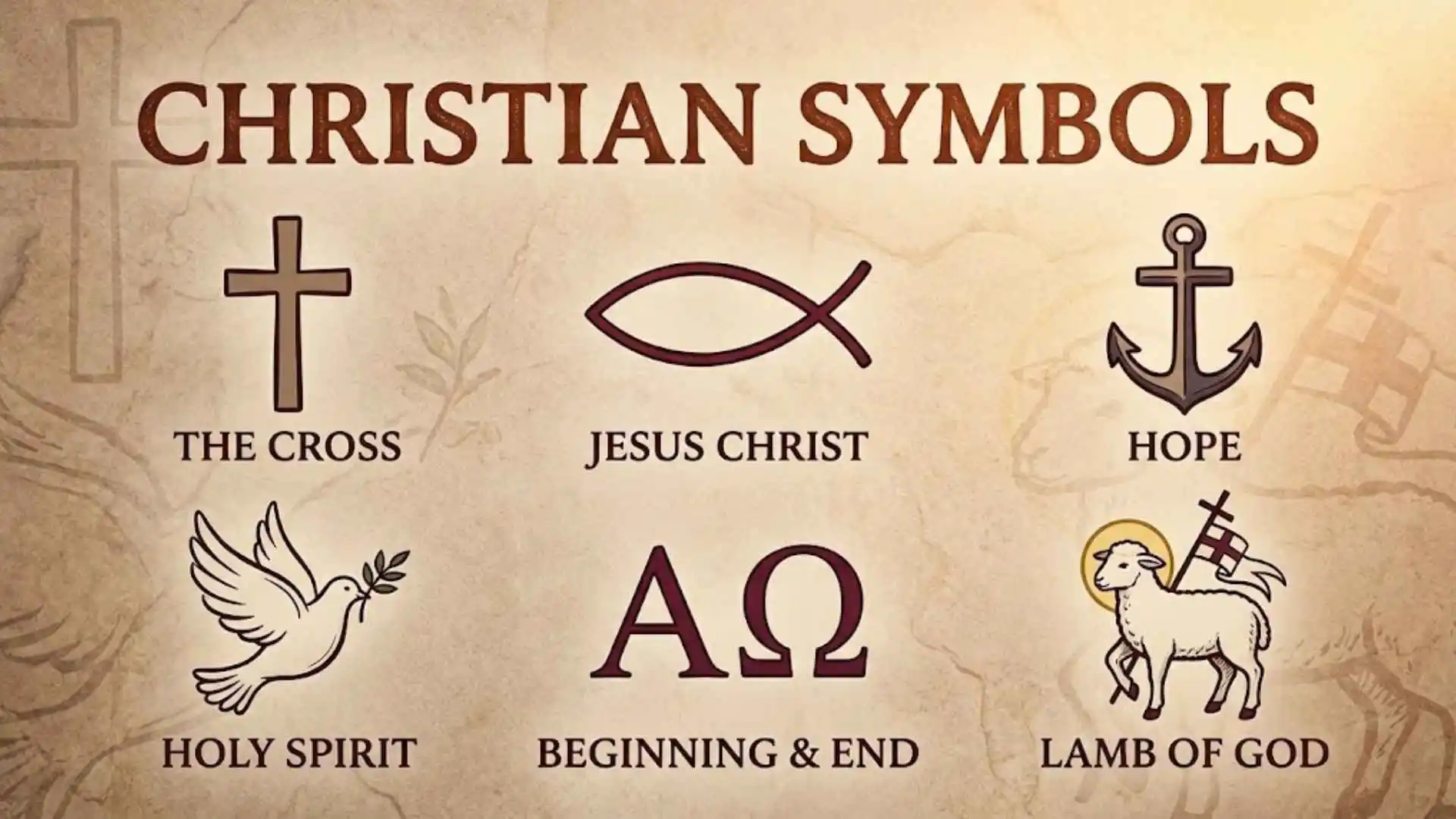
Christian symbols help believers express faith, remember biblical teachings, and recognize important parts of Christian history. From the cross and the fish to the dove and the Chi-Rho, each symbol can communicate a spiritual message through a simple shape or image. Some are used in churches and religious ceremonies, while others appear in jewelry, artwork, tattoos, and everyday decorations.
This guide explores Christian symbols and meanings, including early Christian symbols, ancient designs, Orthodox traditions, Celtic Christian art, and symbols associated with faith, protection, and marriage. You will also find Christian symbols in text that you can copy and paste into messages, social media posts, profiles, and personal notes.
If you are researching the meaning of a familiar religious image or looking for a symbol to represent your beliefs, this article explains the most recognizable designs, their historical backgrounds, and how their meanings can differ between Christian traditions.
Christian symbols and meanings
Christian symbols communicate religious ideas through recognizable images, shapes, and objects. Many are connected to the life of Jesus Christ, biblical stories, the Holy Spirit, salvation, and eternal life.
Here are some widely recognized Christian symbols and their meanings.
| Symbol | Name | Common Meaning |
| ✝ | Latin Cross | The crucifixion of Jesus, sacrifice, and salvation |
| ☧ | Chi-Rho | Jesus Christ and His central place in Christianity |
| ΙΧΘΥΣ | Ichthys (Fish) | Jesus Christ, faith, and Christian identity |
| 🕊 | Dove | The Holy Spirit, peace, and purity |
| Α Ω | Alpha and Omega | God as the beginning and the end |
| ☦ | Orthodox Cross | The cross as understood in Eastern Orthodox tradition |
| ♱ | Cross variant | A decorative cross form used in some religious designs |
| ☩ | Cross of Lorraine-style form | A double-barred cross associated with different historical traditions |
The meanings of these symbols depend on their historical and religious context. For example, a cross may represent personal faith, remembrance, sacrifice, or the Christian community. A dove can symbolize peace in general, but in Christian art it is also associated with the Holy Spirit.
The Bible itself uses many images, including light, vines, shepherds, seeds, and lambs. Although not all these images have a single standardized graphic symbol, they remain important in Christian teaching and artwork.
Christian symbols images and meanings
Christian symbols are often easier to recognize when they are shown visually. Churches, stained-glass windows, paintings, manuscripts, and religious jewelry use images to communicate ideas that might otherwise require lengthy explanations.
The Cross (✝)
The central symbol of Christianity represents Jesus’ crucifixion and the Christian belief in redemption and resurrection. It appears on church buildings, necklaces, graves, and religious artwork.
The Fish (Ichthys)
This symbol is associated with Jesus Christ and early Christian identity. It is frequently used on car decals, jewelry, and Christian websites.
The Dove
The dove is associated with the Holy Spirit, particularly in depictions of Jesus’ baptism. It can also represent peace and spiritual renewal.
The Chi-Rho (☧)
Formed from the Greek letters Chi and Rho, the first two letters of Christos in Greek, this monogram identifies Christ and appears in early Christian art.
Other familiar images include the lamb, which is associated with Jesus as the Lamb of God; the anchor, which can represent hope; and the shepherd, which reflects biblical descriptions of Christ caring for His followers.
What are the 3 main symbols of Christianity
The three symbols most commonly recognized across Christian communities are the cross, the fish, and the dove. Their importance comes from their connections to Jesus, Christian identity, and the Holy Spirit.
- The Cross (✝): Represents the crucifixion of Jesus, His sacrifice, and the hope of salvation. It is the most widely recognized symbol of Christianity.
- The Fish (Ichthys): Represents Jesus Christ and Christian identity. Its Greek name, ichthys, became associated with a phrase describing Jesus Christ as the Son of God and Savior.
- The Dove (🕊): Represents the Holy Spirit, especially in connection with Jesus’ baptism. It is also used to communicate peace and spiritual purity.
There is no universal official list limiting Christianity to three symbols. Different denominations and historical periods give prominence to other images, including the Chi-Rho, the Bible, the lamb, and the empty tomb.
Christian symbols px
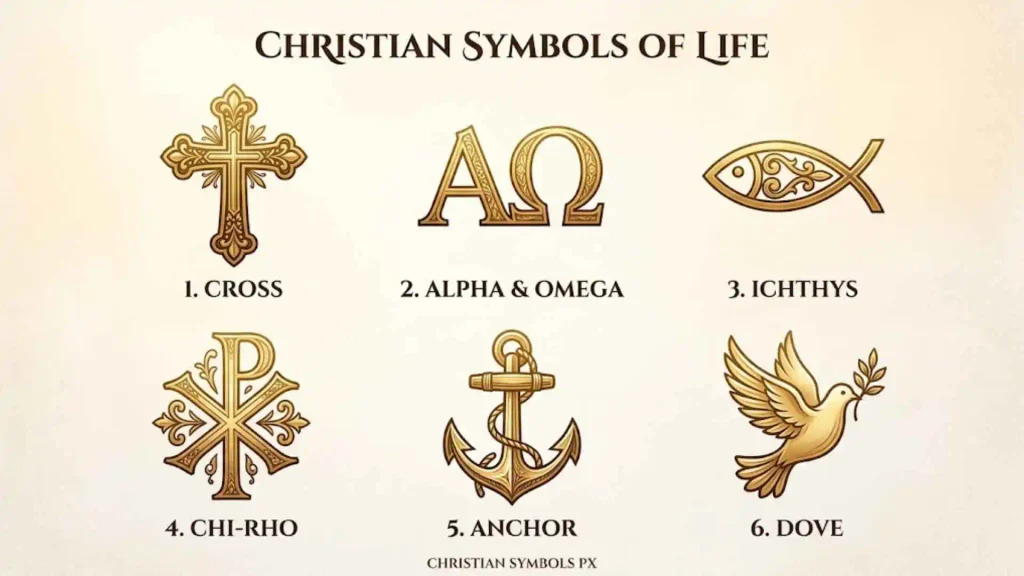
The word “px” generally refers to pixels, a measurement used for digital images. People searching for Christian symbols with “px” may be looking for small graphics, icons, or images that fit a website, profile, design, or digital project.
For digital designs, the best symbol format depends on how it will be used.
- Unicode text: Characters such as ✝ and ☦ can be typed or pasted into supported applications.
- PNG images: Useful when you need a transparent background or a fixed-size graphic.
- SVG graphics: Suitable for scalable designs because vector artwork can remain sharp at different sizes.
- Icon fonts: Useful in some website interfaces, provided the font is licensed and supported.
If you need a Christian symbol for a small profile icon, test it at the intended size before publishing. Fine details in an Orthodox cross or an intricate religious emblem may become difficult to distinguish when reduced to a few pixels.
Unicode text symbols are not the same as image files. A character may change its appearance according to the font, device, or application displaying it.
Christian symbols text
Christian symbols in text are useful for writing religious messages, decorating profiles, creating invitations, and sharing Bible-related content. Some are standard Unicode characters, while others are combinations of letters or words.
| Symbol or Text | Name | Suggested Use |
| ✝ | Latin Cross | Faith-related posts and messages |
| ☦ | Orthodox Cross | Eastern Orthodox content |
| ☧ | Chi-Rho | Christian history and religious designs |
| ♱ | Cross variant | Decorative text |
| ☩ | Cross variant | Religious-themed designs |
| 🕊️ | Dove emoji | Peace and spiritual messages |
| ✝️ | Cross emoji | Christian posts and profiles |
| Α Ω | Alpha and Omega | Messages about God’s eternal nature |
| INRI | Latin inscription | Christian artwork and crucifix imagery |
| ΙΧΘΥΣ | Greek word for fish | Christian history and symbolism |
For example, a profile description could say, “Faith, hope, and love ✝” or “Walking in faith 🕊️.”
Keep in mind that the Latin Cross, Orthodox Cross, and decorative cross characters are not interchangeable in every context. If you are representing a particular church or denomination, select a design that matches its tradition.
Christian symbols copy and paste
You can copy the Christian symbols below and paste them into social media profiles, text messages, website content, digital invitations, and personal notes.
✝
Latin Cross
✝
Copy
✞
Shadowed White Latin Cross
✞
Copy
✟
Outlined Latin Cross
✟
Copy
☦
Orthodox Cross
☦
Copy
☧
Chi-Rho
☧
Copy
♱
Cross Variant
♱
Copy
☩
Cross Variant
☩
Copy
🕊️
Dove Emoji
🕊️
Copy
✝️
Cross Emoji
✝️
Copy
Α Ω
Alpha and Omega
Α Ω
Copy
ΙΧΘΥΣ
Ichthys in Greek Letters
ΙΧΘΥΣ
Copy
INRI
Inscription on Traditional Crucifixes
INRI
Copy
How to use these symbols: Select a symbol or use its Copy button, then paste it into your preferred application. On some devices, emoji may appear in color, while text characters may use a plain font style.
If a character displays as a square or question mark, the selected font or application may not support it. Try another font or use a properly licensed image instead. For formal church materials, confirm that the symbol reflects the intended Christian tradition.
Orthodox christian symbols
Eastern Orthodox Christianity uses a rich collection of symbols in icons, churches, liturgical objects, and religious art. These symbols often communicate teachings about Jesus Christ, the Virgin Mary, saints, the resurrection, and the spiritual life.
8
Common Orthodox Christian symbols include:
- Orthodox Cross (☦): Often depicted with three horizontal bars. In a widely used Russian Orthodox form, the lower bar is slanted. Details and interpretations can vary.
- Christ Pantocrator: An icon of Christ as ruler and judge of all, often shown blessing with one hand and holding the Gospels with the other.
- Theotokos: A title meaning “God-bearer,” used for Mary. Orthodox icons frequently depict her with the child Jesus.
- The IC XC monogram: A traditional abbreviation of the Greek name of Jesus Christ, commonly seen in Orthodox icons.
- The Cross and Resurrection imagery: Emphasizes Christ’s victory over death and the hope of resurrection.
Orthodox icons are more than decorative pictures. They have a role in prayer, worship, and teaching. Their colors, gestures, inscriptions, and arrangements often follow established artistic conventions.
Old christian symbols
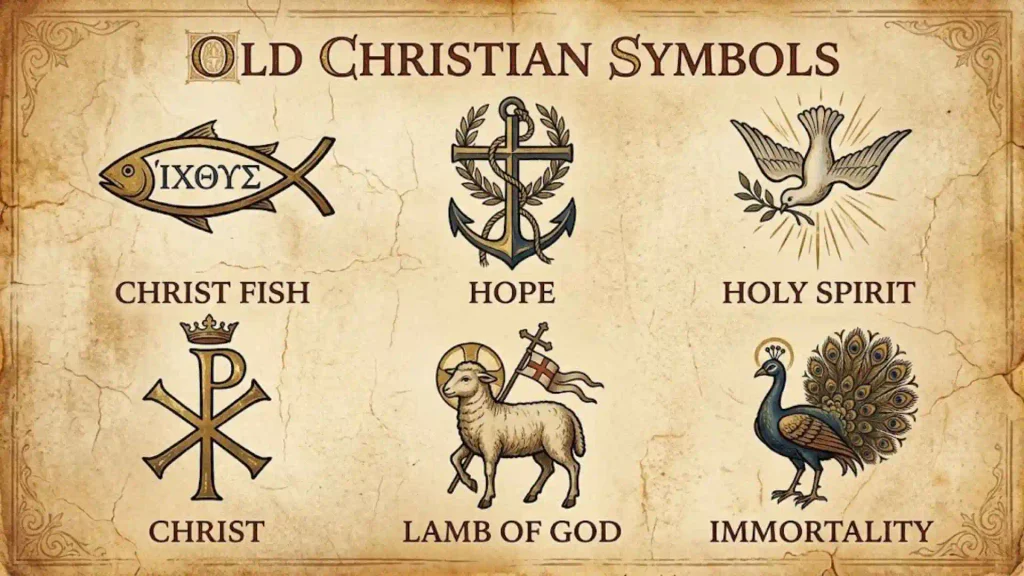
Old Christian symbols developed during the early centuries of Christianity, when believers used images and abbreviated inscriptions to express their faith. Some appeared in catacombs, tombs, engraved objects, and early church decorations.
Several historical symbols remain familiar today:
- The Good Shepherd: A shepherd carrying or caring for a sheep, representing care, guidance, and Christ’s relationship with believers.
- The Anchor: Associated with hope and steadfast faith. Hebrews 6:19 uses the image of an anchor for the soul.
- The Dove: Used in Christian art to communicate peace and, in particular contexts, the Holy Spirit.
- The Chi-Rho (☧): A monogram formed from Greek letters associated with Christ.
- The Fish: A symbol connected with Jesus and Christian identity.
- The Alpha and Omega: The first and last letters of the Greek alphabet, associated with God’s eternal nature.
Not every image found in an ancient burial place was exclusively Christian. Historical context, inscriptions, and archaeological evidence help researchers determine how an image was understood.
Christian symbols fish
The Christian fish, known as the Ichthys, is one of the most recognizable symbols of Christian faith. Its simple outline consists of two curved lines that meet to form a fish.
The Greek word ichthys means “fish.” Christians also connected its letters with the phrase Iēsous Christos, Theou Huios, Sōtēr, meaning “Jesus Christ, Son of God, Savior.”
The fish became a recognizable Christian symbol in the ancient world. Today, it appears on car stickers, necklaces, church materials, stationery, and online profiles.
What does the fish symbol mean?
The Ichthys is commonly associated with:
- Faith in Jesus Christ.
- Christian identity and fellowship.
- Biblical stories involving fish and fishing.
- The calling of disciples who were fishermen.
- The feeding of the multitudes with loaves and fish.
The fish is sometimes described as a secret sign used by early Christians. However, the historical evidence does not justify treating every fish image as proof of a hidden Christian meeting or a single uniform secret code.
For modern use, the fish works well in simple text and graphic designs. The familiar curved fish outline is usually an illustration rather than a dedicated Unicode character, so an image may be more reliable when you need the exact traditional shape.
Christian symbols and meaning
Christian symbols can have more than one related meaning. Their interpretation often depends on the Bible, a church’s teachings, historical tradition, and the setting in which the symbol appears.
| Symbol | Main Meaning | Additional Association |
| Cross | Jesus’ crucifixion | Salvation and resurrection |
| Crown | Kingship | Christ’s authority or the crown of life |
| Lamb | Jesus as the Lamb of God | Innocence and sacrifice |
| Anchor | Hope | Steadfastness in faith |
| Vine | Spiritual connection | Christ and His followers |
| Light or lamp | Guidance and truth | God’s presence |
| Alpha and Omega | Beginning and end | Eternity |
| Bread and cup | The Eucharist or Communion | Remembrance of Jesus |
These associations are useful when studying religious artwork or selecting a symbol for a personal project. They should not be treated as rigid definitions for every image. For example, a crown might represent Christ’s kingship in one artwork and martyrdom or victory in another.
Anti christian symbols
Anti-Christian symbols are signs or images used to criticize Christianity, reject Christian authority, or express opposition to Christian beliefs. Their meanings vary depending on the individual, historical period, and context.
Examples may include:
- An inverted cross: Sometimes used in anti-Christian imagery, but it is also associated with Saint Peter, who according to Christian tradition was crucified upside down. It is therefore not automatically anti-Christian.
- Mocking or altered crosses: A cross may be modified in a political, artistic, or satirical work to criticize a church or religious institution.
- Anti-religious slogans and artwork: Words or images may express atheism, secularism, criticism of organized religion, or hostility toward Christianity.
It is useful to distinguish criticism of religious institutions from hatred toward Christians as people. A symbol’s meaning cannot always be determined from its appearance alone. Consider the source, intended message, historical background, and surrounding imagery before interpreting it.
Christian symbols of faith
Symbols of faith help Christians express trust in God, commitment to Jesus, and hope in biblical promises. They appear in worship, personal jewelry, church decorations, gifts, and digital communication.
Some meaningful choices include:
- Cross (✝): A reminder of Jesus’ sacrifice and the hope of salvation.
- Ichthys fish: An expression of Christian identity.
- Anchor: A reminder of hope and spiritual steadfastness.
- Bible: Represents Scripture, teaching, and spiritual guidance, although it is an object rather than a single standardized symbol.
- Alpha and Omega (Α Ω): Represents God’s eternal nature.
- Dove: Represents the Holy Spirit and, in suitable contexts, peace.
When choosing a symbol of faith, think about the message you want to express. A cross may be suitable for a general Christian design, while the Orthodox cross may be more appropriate for someone wishing to reflect a particular church tradition.
Celtic christian symbols
Celtic Christian symbols combine Christian beliefs with artistic traditions that developed in Celtic-speaking regions, including Ireland and parts of Britain. Interlacing patterns, spirals, and intricate knotwork are prominent in many examples of Celtic art.
7
Popular examples include:
- Celtic Cross: A cross with a ring around the intersection in its familiar traditional form. It is strongly associated with Celtic Christian heritage and later Irish and Scottish religious art.
- Interlaced Knotwork: Continuous woven patterns used in manuscripts and stone carvings. Modern interpretations often associate them with eternity or interconnectedness, although meanings vary.
- Spiral Motifs: Ancient designs that also appear in some Christian-era Celtic artwork. Their significance depends on the particular object and historical setting.
- High Crosses: Large stone crosses decorated with biblical scenes, figures, and ornamental patterns.
The Celtic cross is especially popular in jewelry, memorials, tattoos, and decorative art. However, not every knot or spiral is exclusively Christian; many motifs have broader histories in Celtic art.
All christian symbols
There is no single official list of all Christian symbols because Christianity includes many denominations, languages, and artistic traditions. However, the following collection covers many of the most recognizable symbols and their common associations.
| Symbol | Name | Meaning |
| ✝ | Latin Cross | Sacrifice and salvation |
| ☦ | Orthodox Cross | Eastern Orthodox Christian tradition |
| ☧ | Chi-Rho | Christ |
| ΙΧΘΥΣ | Ichthys | Christian identity |
| 🕊️ | Dove | Holy Spirit and peace |
| Α Ω | Alpha and Omega | Eternity |
| ♱ | Cross Variant | Decorative religious design |
| ☩ | Cross Variant | Historical and decorative uses |
| ⚓ | Anchor | Hope and steadfast faith |
| 🐑 | Lamb | Christ and sacrifice |
| 👑 | Crown | Kingship and victory |
| 📖 | Book | Scripture and teaching |
| 🌿 | Branch or greenery | Life and renewal in suitable contexts |
| 🕯️ | Candle | Prayer, remembrance, or spiritual light |
| INRI | Crucifixion inscription | Jesus of Nazareth, King of the Jews |
| IC XC | Christogram | Abbreviated Greek name of Jesus Christ |
| ☧ | Chi-Rho monogram | Early Christian symbolism |
Some entries are text characters, while others are emoji, letter combinations, or illustrations. Emoji such as the lamb, crown, and candle are not exclusively Christian symbols; their meaning comes from how they are used.
If you need a specific design for a church, historical study, or personal project, identify its denomination and background before selecting a symbol.
Early christian symbols and their meanings
Early Christians used symbols to communicate religious ideas in an era when Christian art and worship were developing across different parts of the Roman world. Symbols appeared in burial places, inscriptions, personal objects, and later church decorations.
The following examples are particularly important in the history of Christian art.
- The Good Shepherd: Represents care for believers and is connected with biblical descriptions of Jesus as a shepherd.
- The Fish: Associated with Jesus Christ and Christian identity.
- The Anchor: Communicates hope and firmness in faith.
- The Dove: Represents peace and, in Christian contexts, the Holy Spirit.
- The Chi-Rho: Uses the Greek letters Chi and Rho to identify Christ.
- The Orant Figure: Shows a person standing with arms raised in prayer. It appears in early Christian art, although the pose itself was not exclusively Christian.
- Alpha and Omega: Uses the first and last Greek letters to express God’s eternal nature.
- The Lamb: Represents Christ through the biblical image of the Lamb of God.
These images were not necessarily used in the same way everywhere. Their meanings developed over time, and some were adapted from visual traditions that existed before Christianity.
Christian symbols images
Christian symbol images come in many styles, from simple black-and-white outlines to colorful stained-glass designs and detailed historical illustrations.
When choosing an image, consider what you need it for:
- Websites and blogs: Use clear, appropriately sized images with descriptive alternative text.
- Social media: Simple cross and fish designs are easy to recognize in small profile pictures.
- Presentations: High-contrast symbols are more readable on slides.
- Church invitations: Traditional crosses, doves, and relevant denominational symbols can suit religious events.
- Educational materials: Include a caption explaining the symbol’s name, historical background, and meaning.
Check image licensing before using a graphic commercially. A religious symbol itself may be ancient, but a modern illustration, photograph, or digital artwork can still be protected by copyright.
Christian symbols of protection
Many Christians use religious symbols as reminders of God’s care, spiritual strength, and trust during difficult times. Some also wear them as devotional objects or family keepsakes.
Common choices include:
- The Cross: Represents Christ’s sacrifice and the believer’s hope in God.
- The Saint Benedict Medal: A devotional medal associated with prayers for spiritual protection and resistance to evil in Catholic tradition.
- The Archangel Michael: Often depicted defeating evil and associated with courage and spiritual defense.
- The Psalm 91 imagery: Religious artwork inspired by a biblical passage about refuge and protection.
- The Chi-Rho: A sign of Christ used in Christian art and historical religious objects.
Interpretations vary between denominations. In Christian teaching, a symbol or medal is generally understood within a wider context of prayer and faith rather than as an object that automatically guarantees safety or prevents harm.
For a meaningful gift, you might choose a cross necklace, a Saint Benedict medal, or an image of Saint Michael according to the recipient’s religious tradition.
Christian symbols of marriage
Christian marriage symbols express love, commitment, unity, and the spiritual significance of marriage. They commonly appear in wedding ceremonies, invitations, church decorations, and anniversary gifts.
- Wedding Rings: Circular rings represent an enduring commitment in many wedding traditions. Their Christian meaning comes from the vows and ceremony in which they are exchanged.
- The Cross (✝): Represents faith in Christ and can express the couple’s desire to place their marriage within their Christian beliefs.
- Two Interlocking Rings: Commonly symbolize the union of two people.
- Doves: Often represent peace, love, and the hope for a harmonious marriage.
- The Unity Candle: In some Christian wedding ceremonies, two flames are used to represent the joining of two lives.
- The Bible: May represent shared faith, spiritual guidance, and a commitment to Christian teaching.
Wedding practices differ among Catholic, Orthodox, Protestant, and other Christian communities. For a church ceremony, check which customs and images are appropriate for that particular tradition.
Earliest christian symbols
The earliest Christian symbols developed during the first centuries of the Christian movement. Many were simple enough to be carved, painted, or engraved on everyday objects and burial monuments.
The fish, shepherd, anchor, and prayerful human figure are among the images associated with early Christian art. The Chi-Rho became another significant sign of Christ, especially in later ancient Christian settings.
Researchers study these symbols alongside inscriptions, the locations where objects were found, and other archaeological evidence. A fish or anchor alone does not prove that an object belonged to a Christian, since these images also existed in wider Mediterranean culture.
The distinction between an early Christian symbol and a later traditional symbol is useful. Some symbols were used in the first centuries, while others became prominent through later medieval art, denominational traditions, or modern devotional practices.
Different christian symbols
Different Christian symbols reflect the many ways believers have expressed their faith throughout history. Some are shared across denominations, while others are strongly associated with particular churches.
- Cross: Widely used across Christianity.
- Crucifix: A cross bearing a depiction of Jesus’ body, especially prominent in Catholic and some other Christian traditions.
- Orthodox Cross: Associated with Eastern Orthodox churches and their distinctive cross traditions.
- Chi-Rho: A Christogram rooted in early Christian history.
- Celtic Cross: Associated with Celtic Christian heritage and later religious art.
- Marian symbols: Images such as the lily or specific depictions of Mary, especially prominent in Catholic and Orthodox contexts.
- The Lamb of God: An image of Jesus associated with sacrifice and redemption.
- The Bible: A central Christian sacred text, often represented in art as a book.
These symbols should not be treated as identical. For instance, a crucifix specifically includes the figure of Jesus, whereas a plain cross does not. The choice between them may reflect personal preference or denominational tradition.
Religious christian symbols
Religious Christian symbols are used in worship, prayer, teaching, sacred architecture, and celebrations throughout the Christian calendar.
Some are visual representations of biblical events, while others are objects or abbreviations with established religious significance.
The cross is central to Christian worship and remembrance. The dove often represents the Holy Spirit, and the lamb can refer to Jesus as the Lamb of God. The bread and cup are associated with Communion or the Eucharist, although their exact interpretation differs between Christian traditions.
Other images are tied to particular celebrations. Nativity scenes represent the birth of Jesus, while palm branches are associated with Palm Sunday in many churches. Candles may be used during prayer services, vigils, and Christmas celebrations.
A symbol’s religious meaning depends on the setting in which it appears. The same candle can be a general decorative object or part of a specific worship practice. Understanding the tradition behind an image helps explain why Christians use it and what it communicates.
Ancient christian symbols
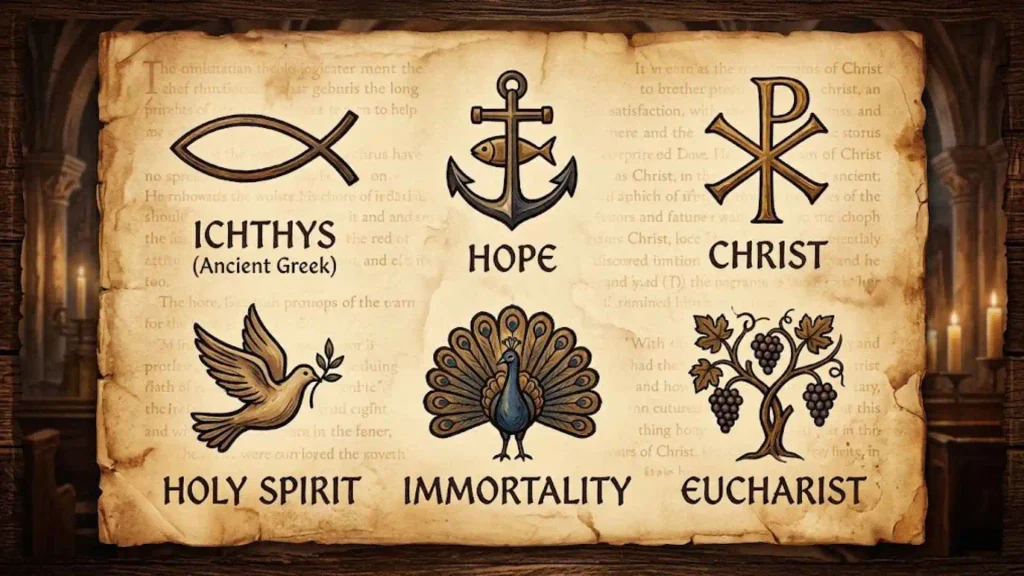
Ancient Christian symbols provide a window into the beliefs, worship, and visual culture of early Christian communities. Many continue to appear in contemporary churches, religious jewelry, and Christian art.
8
Three especially notable examples are the Good Shepherd, the Chi-Rho, and the anchor. The Good Shepherd illustrates care and guidance; the Chi-Rho identifies Christ; and the anchor evokes hope and spiritual steadfastness.
Alpha and Omega also became an important Christian image through its biblical association with God’s eternal nature. In ancient and medieval art, these letters could appear alongside a cross or a representation of Christ.
Ancient symbols are valuable for historical study because they reveal how Christian communities communicated ideas visually. However, a modern interpretation should not automatically be applied to every ancient object. Archaeological context and reliable historical evidence matter when determining an image’s original meaning.
Christian symbols tattoos
Christian symbol tattoos are chosen for personal faith, remembrance, devotion, or a connection to family and religious heritage. Some people prefer a small, simple character, while others choose a detailed illustration.
6
Popular designs include:
- Cross Tattoo: A straightforward expression of Christian faith.
- Ichthys Tattoo: A simple fish outline associated with Jesus and Christian identity.
- Celtic Cross Tattoo: Combines the cross with traditional interlacing designs.
- Chi-Rho Tattoo: A historically rooted monogram representing Christ.
- Bible Verse With a Cross: Combines a religious symbol with a personally meaningful passage.
- Dove Tattoo: Represents the Holy Spirit or peace, depending on the intended meaning.
Before choosing a design, consider its size, placement, and level of detail. A complex Celtic cross may require more space than a small Latin cross. If you want to reflect a particular denomination, research its traditional imagery first.
It is also worth remembering that tattoos are personal choices, and Christian communities differ in their views about them. Choose a design for its meaning to you rather than assuming that every Christian interprets it in the same way.
Early christian symbols
Early Christian symbols helped believers express their identity and communicate ideas about Christ, hope, prayer, and salvation. Although this topic overlaps with the history of ancient Christian art, it also highlights how symbols were used in the lives of early communities.
The fish and Chi-Rho identified Christ; the anchor represented hope; and the Good Shepherd conveyed care and guidance. The orant figure, shown praying with raised arms, represented a posture of prayer rather than a uniquely Christian gesture.
These images gradually became part of a wider Christian artistic language. As churches developed, religious symbols appeared in mosaics, manuscripts, sarcophagi, and church architecture.
Studying early Christian symbols is useful for understanding how the faith was expressed before many familiar medieval and modern religious images became widespread. It also helps distinguish symbols with strong historical evidence from meanings added by later traditions.
Frequently Asked Questions
What is the most important symbol in Christianity?
The cross is generally considered the most important and widely recognized symbol of Christianity. It represents the crucifixion of Jesus Christ and the Christian belief in salvation and resurrection.
What does the Christian fish symbol mean?
The Christian fish, or Ichthys, represents Jesus Christ and Christian identity. Its Greek name is also associated with the phrase “Jesus Christ, Son of God, Savior.”
What is the difference between a cross and a crucifix?
A cross is a cross-shaped symbol without a figure necessarily attached. A crucifix specifically depicts Jesus on the cross and is particularly prominent in Catholic religious practice.
Which Christian symbols can I copy and paste?
You can copy symbols such as ✝, ☦, ☧, ♱, ☩, and 🕊️. Their appearance may vary by device and font, and some detailed designs are better represented by images.
Which Christian symbol represents protection?
The cross, Saint Benedict medal, and images of Saint Michael are associated with spiritual protection in different Christian traditions. Their significance comes from religious belief and devotion rather than a guarantee of physical safety.
Conclusion
Christian symbols express important ideas about Jesus Christ, salvation, hope, peace, and spiritual life. The cross, fish, dove, Chi-Rho, and anchor each have distinctive histories and associations that help explain their importance in Christian tradition.
These symbols also serve different purposes today. People use them in church artwork, jewelry, wedding ceremonies, tattoos, educational materials, and online profiles. Text characters such as ✝ and ☦ are convenient for copying and pasting, while detailed Celtic crosses and Orthodox designs often work better as images.
When choosing a Christian symbol, consider its historical meaning and the tradition it represents. Understanding the difference between similar designs helps you select a symbol that communicates your intended message respectfully and accurately.

Hi, I’m Asher Monroe, a writer who believes that meaningful words have the power to inspire change and bring people closer to their dreams. I have always been fascinated by the beauty of quotes and the way a simple message can provide motivation, hope, and comfort.
I enjoy creating content around inspirational quotes, life lessons, success stories, and positive thoughts that help readers find encouragement in their everyday lives. My goal is to share words that connect with people and remind them of their inner strength.
Through my writing, I explore the ideas of personal growth, confidence, and the importance of staying inspired through every chapter of life.
I am the author of Words That Move the Soul and The Path of Endless Inspiration, two books focused on the power of wisdom, positivity, and meaningful thoughts.
 Sienna Brooks
 Rowan Sinclair Rowan Sinclair