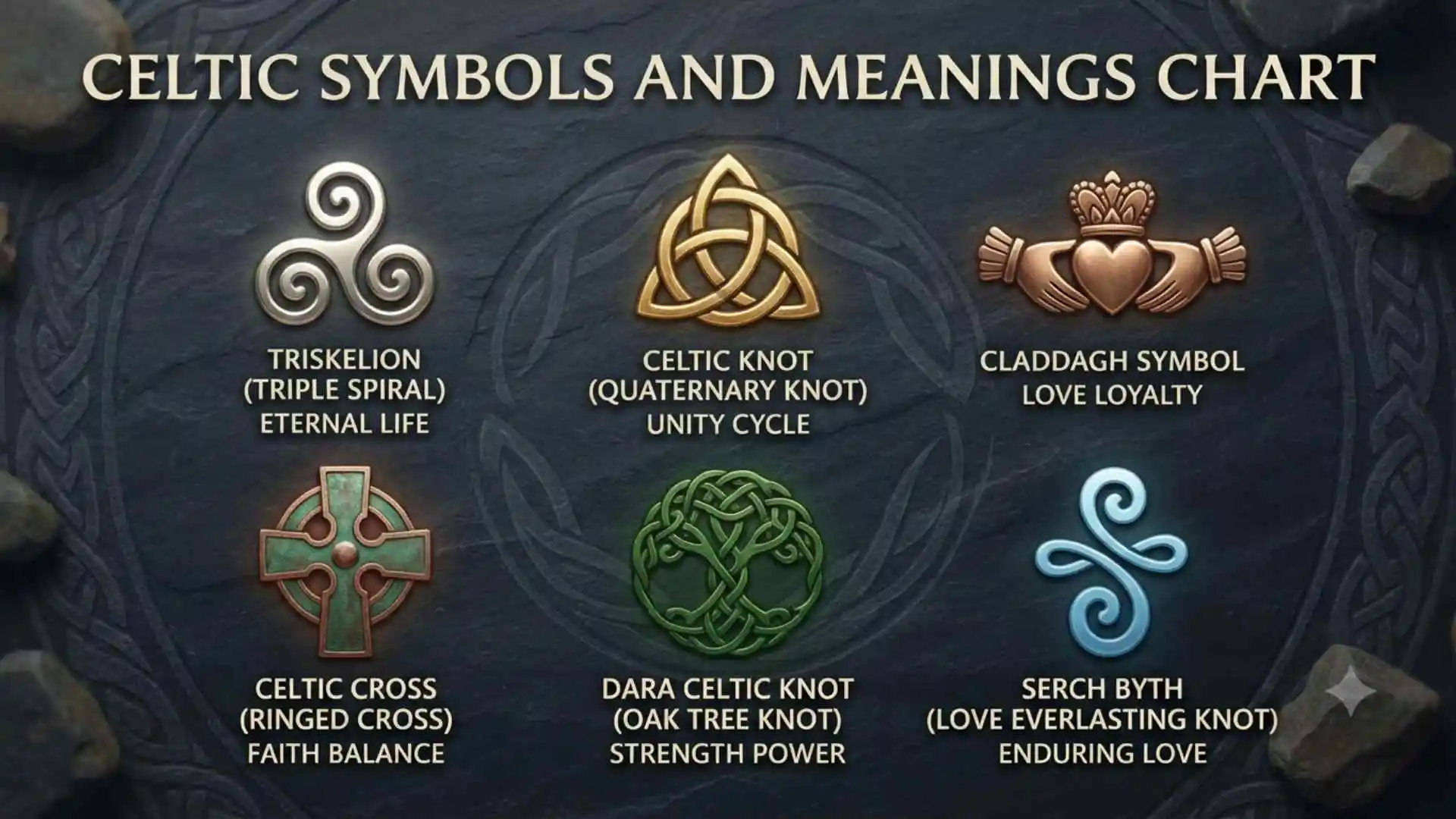
Celtic symbols and meanings chart guides open a doorway into a world of spirals, sacred trees, protective knots, animals, and ancient stone carvings.
These designs can feel deeply personal because they speak about life, death, love, courage, nature, and belonging.
Yet their true history is often more complex than the simple meanings shared online.
By exploring archaeology, mythology, medieval art, and modern interpretation, we can appreciate Celtic symbols without turning uncertain ideas into historical facts.
(Quick Answer) celtic symbols and meanings chart
Celtic symbols are visual motifs connected with the ancient and medieval peoples of Ireland, Britain, and continental Europe. They include spirals, interlaced patterns, crosses, animals, plants, and geometric forms. Some meanings are supported by archaeology or written tradition, while others are modern spiritual interpretations inspired by Celtic culture.
Celtic Symbols and Meanings Chart
| Celtic Symbol | Visual Description | Common Meaning | Historical Context | Modern Use |
| Triskele or Triple Spiral | Three curved spirals joined at the center | Movement, growth, cycles, threefold unity | Appears in prehistoric European art and later Celtic-style traditions | Tattoos, jewelry, spiritual art |
| Triquetra | Three interlocking pointed loops | Unity, eternity, three connected forces | Common in early medieval Insular decoration | Love symbols, Christian art, family jewelry |
| Celtic Knot | One continuous interwoven line | Eternity, connection, continuity | Widely used in medieval manuscripts and stone carving | Rings, tattoos, logos, home decor |
| Celtic Cross | Cross with a circular ring | Faith, eternity, divine order | Strongly associated with early medieval Christianity in Ireland and Britain | Memorials, churches, pendants |
| Tree of Life | Tree with spreading branches and roots | Balance, ancestry, growth, connection | Trees held importance in Celtic stories and sacred landscapes | Wall art, jewelry, family symbols |
| Shield Knot | Four-cornered interlaced knot | Protection, strength, security | Mostly a modern name applied to knot patterns | Protective tattoos and charms |
| Dara Knot | Knot inspired by oak roots | Inner strength, wisdom, endurance | Modern design linked with the Irish word doire, meaning oak grove | Motivational jewelry and tattoos |
| Spiral | Single curved line circling inward or outward | Growth, change, journey, energy | Found throughout prehistoric and Iron Age Europe | Meditation, art, body designs |
| Awen | Three rays or lines, often inside circles | Inspiration, harmony, poetic insight | Developed within modern Druid traditions | Druidry, poetry, spiritual identity |
| Brigid’s Cross | Woven cross made from rushes or straw | Protection, blessing, spring, Saint Brigid | Irish folk custom associated with February 1 | Home blessings and seasonal crafts |
| Shamrock | Three-leaf clover | Ireland, faith, hope, national identity | Connected in later tradition with Saint Patrick | Irish branding, celebrations, jewelry |
| Harp | Curved stringed musical instrument | Ireland, music, sovereignty, cultural pride | Important in Irish courtly and political history | National emblems, coins, government seals |
| Claddagh | Heart held by two hands beneath a crown | Love, friendship, loyalty | Developed in Irish ring-making tradition | Engagement rings, gifts, tattoos |
| Salmon | Fish often shown in flowing water | Wisdom, knowledge, inspiration | Central to the Irish story of the Salmon of Knowledge | Literary art and educational symbolism |
| Stag | Antlered deer | Nobility, wilderness, leadership, transformation | Appears in Celtic-related mythology and Iron Age imagery | Tattoos, crests, fantasy designs |
| Boar | Strong wild pig | Courage, battle strength, ferocity | Seen on Iron Age objects and in heroic stories | Warrior symbols and heraldry |
| Raven | Black bird with a strong beak | Prophecy, battle, mystery, transformation | Associated with figures such as the Morrígan in Irish literature | Gothic art, tattoos, spiritual symbolism |
| Celtic Horse | Horse decorated with curves or knots | Freedom, power, travel, fertility | Horses held economic and religious importance in Celtic societies | Jewelry, equestrian art, tattoos |
| Serpent | Curved or coiled snake | Renewal, healing, hidden knowledge | Appears in European art and later Celtic-style imagery | Transformation and healing symbols |
| Green Man | Face surrounded by leaves | Nature, rebirth, seasonal renewal | Primarily a medieval architectural motif, not exclusively Celtic | Garden decor, pagan and ecological art |
| Ogham | Lines and notches arranged along a stem line | Language, ancestry, names, identity | Early medieval alphabet used mainly in Ireland and western Britain | Name tattoos, inscriptions, jewelry |
| Fivefold Symbol | Four circles around a central circle | Balance, five provinces, center and wholeness | Mostly based on modern symbolic interpretation | Meditation diagrams and spiritual art |
| Serch Bythol | Two joined triquetra-like forms | Everlasting love and partnership | Commonly promoted as a modern Celtic love design | Wedding jewelry and couple tattoos |
| Sailor’s Knot | Two interwoven rope-like strands | Loyalty, separation, safe return | Modern romantic interpretation of knotwork | Couple jewelry and nautical tattoos |
| Quaternary Knot | Knot divided into four repeating sections | Four seasons, elements, directions, or stages of life | Four-part patterns occur in medieval art, but meanings vary | Family emblems and spiritual designs |
Quick Facts About Celtic Symbols and Meanings
| Aspect | Information |
| Origin | Prehistoric Europe, Iron Age Celtic cultures, and early medieval Ireland and Britain |
| Historical Significance | Used in metalwork, manuscripts, stone monuments, jewelry, weapons, religious objects, and architecture |
| Main Meaning | Identity, continuity, nature, power, spirituality, kinship, and sacred order |
| Spiritual Meaning | Cycles of life, connection between worlds, transformation, protection, and inner balance |
| Cultural Importance | Celtic-inspired imagery supports Irish, Scottish, Welsh, Breton, Cornish, and Manx heritage |
| Modern Usage | Tattoos, jewelry, fashion, branding, memorials, weddings, spiritual practice, and home decor |
| Important Caution | Many fixed meanings found online are modern interpretations rather than proven ancient definitions |
What Are Celtic Symbols?
Celtic symbols are decorative forms, images, letters, animals, and sacred objects associated with cultures commonly described as Celtic. The term covers a long period and a wide geographic area, so there was never one universal Celtic symbol system.
The ancient Celtic-speaking world included communities across parts of continental Europe and the British Isles. Archaeologists often connect later Iron Age Celtic art with the La Tène artistic tradition, which developed from about 450 BC across large areas of western and central Europe. La Tène designs frequently used flowing curves, plant forms, spirals, hidden faces, and abstract animal shapes.
Centuries later, Christian artists in Ireland, Scotland, and northern Britain created illuminated manuscripts, stone crosses, metalwork, and carved slabs filled with interlace, spirals, animals, vines, and biblical scenes. This early medieval style is often called Insular art.
As a result, what people now call “Celtic symbols” may come from several different sources:
- Prehistoric European carvings
- Iron Age Celtic-style metalwork
- Roman-period art
- Early Irish and Welsh literature
- Pictish carved stones
- Medieval Christian manuscripts
- Irish and Scottish folk traditions
- Nineteenth-century Celtic revival art
- Modern Pagan, Druid, tattoo, and jewelry culture
Understanding these layers matters. A symbol can be culturally meaningful today even when its popular definition cannot be traced to an ancient written source.
The Historical Development of Celtic Symbolism
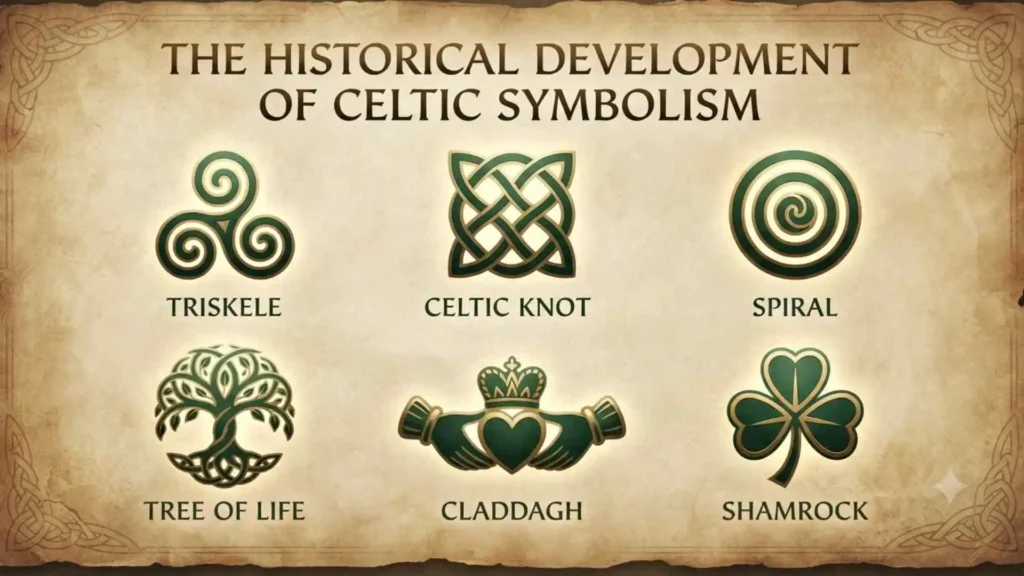
Prehistoric Foundations
Spirals, circles, cup marks, and geometric carvings existed in Europe long before the historically recognized Celtic cultures appeared.
For example, the famous triple spiral at Newgrange in Ireland belongs to a Neolithic passage tomb built more than a thousand years before the Iron Age Celtic period. It is often described as a Celtic symbol today because it became part of modern Irish visual identity. Historically, however, its creators lived much earlier.
This does not make the symbol less meaningful. Instead, it shows how later cultures can inherit, reinterpret, and protect ancient landscapes.
Iron Age Celtic Art
Iron Age artists created powerful objects from bronze, gold, iron, coral, glass, and enamel. Torcs, shields, mirrors, helmets, sword fittings, and vessels carried flowing designs that rarely remained still.
A curve might become a leaf, then a bird, then a hidden face. This visual movement gave Celtic-style art a dreamlike quality.
The British Museum describes La Tène as the material culture of much of northern and western Europe during the later Iron Age. Surviving objects include decorated torcs and mirrors with spirals, concentric circles, plant-like curves, and complex abstract forms.
Early Medieval Christian Art
After Christianity spread through Ireland and Britain, artists did not simply abandon local visual traditions. They blended geometric interlace, animals, spirals, vines, crosses, and Christian stories.
This fusion appears in:
- Illuminated Gospel books
- High crosses
- Reliquaries
- Brooches
- Church sculpture
- Pictish cross-slabs
- Grave markers
Pictish monuments sometimes place older regional symbols beside Christian crosses, showing a period of cultural and religious change. Historic Environment Scotland notes that several cross-slabs combine Christian imagery with traditional Pictish symbols.
The Celtic Revival
During the eighteenth and nineteenth centuries, writers, artists, political thinkers, and craftspeople renewed interest in Irish, Scottish, Welsh, and Breton heritage.
Knotwork, crosses, harps, shamrocks, legendary heroes, and medieval manuscript designs became symbols of identity and cultural survival.
Many modern Celtic designs were standardized during this revival. Some were faithful copies of medieval art. Others were creative combinations shaped by nationalism, Romanticism, Christianity, folklore, and personal spirituality.
Celtic Iconography
Celtic iconography refers to the visual language of symbols, motifs, animals, plants, geometric forms, inscriptions, and decorative patterns associated with Celtic cultures and later Celtic-inspired art.
Important examples include spirals, knotwork, interlace, Celtic crosses, animal figures, sacred-tree imagery, Ogham inscriptions, and manuscript decoration.
Archaeological objects, carved stones, metalwork, illuminated manuscripts, and other surviving artworks provide evidence for studying Celtic visual traditions. These sources show that Celtic art developed over long periods and across different regions.
Celtic iconography should therefore not be treated as one fixed symbolic system. A motif found in Iron Age continental Europe may have a different historical context from a similar-looking design found in a medieval Irish manuscript.
Deep Symbolic Meaning of Celtic Symbols
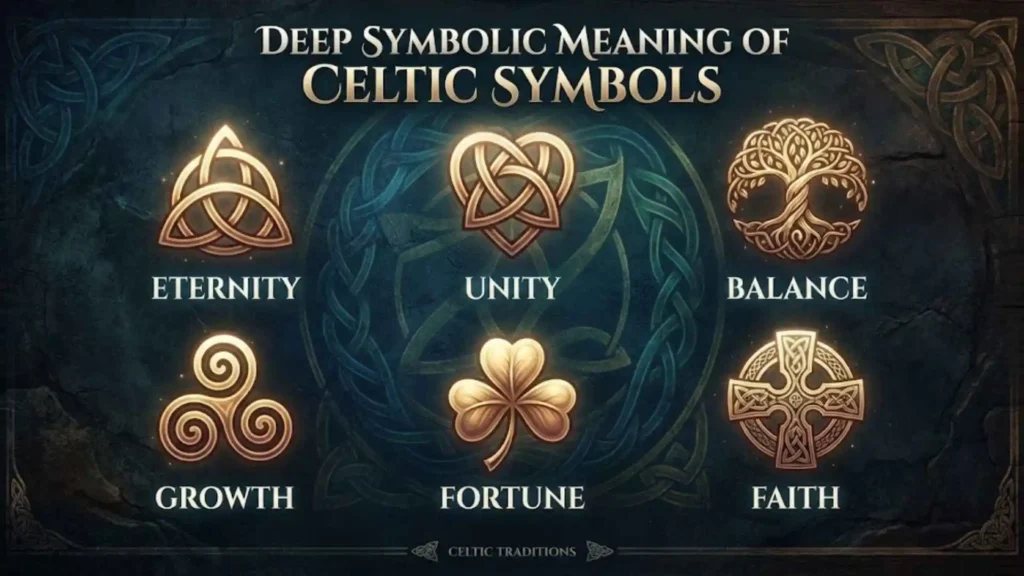
Spiritual Level
Celtic-inspired designs often express a world in which nothing exists alone.
An interwoven knot connects every line. A tree reaches into the earth and sky. A spiral moves inward and outward. A triple design joins separate forces within one form.
For modern spiritual users, these images may represent:
- The relationship between body, mind, and spirit
- Birth, life, and death
- Earth, sea, and sky
- Past, present, and future
- Creation, preservation, and transformation
- The visible world and the unseen world
- Personal growth through repeated cycles
These interpretations are meaningful, but they should usually be described as modern spiritual readings unless an early source clearly supports them.
Inner Transformation
The spiral is especially powerful as an image of transformation. It can suggest a journey toward the inner self, followed by a return to ordinary life with greater wisdom.
A person may move through grief, confusion, or change and feel as if life is circling rather than moving in a straight line. The spiral offers a comforting idea: returning to a familiar place does not mean you have made no progress. You may be meeting the same experience from a deeper level.
Soul and Consciousness
Interlaced patterns can symbolize the way memory, relationships, culture, and identity shape the self.
No strand remains separate for long. Each passes above and below another, much like the way joy and pain, independence and belonging, or past and present influence one another.
Psychological Level
Human Emotions
Celtic knots attract people because they create order without becoming lifeless. They are controlled, yet always moving.
Psychologically, this balance can feel reassuring. The design suggests that life may be complicated without being meaningless.
People often choose Celtic imagery during emotionally important moments, such as:
- Marriage
- Bereavement
- Recovery
- Parenthood
- Migration
- Military service
- Reconnection with ancestry
- Personal reinvention
Archetypes and Jungian Symbolism
Swiss psychiatrist Carl Jung wrote about recurring symbolic patterns that appear across myths, dreams, religions, and art. He called many of these patterns archetypal.
Celtic symbols can be viewed through this psychological lens:
- The tree may represent the Self, growth, and integration.
- The circle may represent wholeness.
- The serpent may represent renewal or hidden fear.
- The warrior may represent courage and conflict.
- The wise animal may represent instinctive knowledge.
- The journey into the Otherworld may reflect psychological transformation.
This does not prove that ancient Celtic people interpreted the images in Jungian terms. It simply provides a modern method for exploring why the symbols still affect us.
Emotional Attraction
Humans naturally search for patterns. Repetition, symmetry, rhythm, and balance can make a design feel complete.
Celtic interlace rewards attention because the eye follows one line, loses it, finds it again, and discovers how it fits into the whole. That small visual journey creates curiosity and emotional satisfaction.
Cultural Level
Celtic symbols now carry strong associations with Ireland, Scotland, Wales, Cornwall, Brittany, and the Isle of Man.
For families with Celtic heritage, a knot, harp, cross, thistle, dragon, or ogham inscription may represent:
- Ancestral pride
- Language preservation
- Connection to homeland
- Cultural endurance
- Family memory
- Resistance to cultural loss
- A link between generations
However, Celtic cultures are not identical. Irish, Scottish Gaelic, Welsh, Breton, Cornish, and Manx traditions developed through different histories, languages, beliefs, and political experiences.
Respectful use begins by identifying which culture, period, or story a symbol actually comes from.
Types and Variations of Celtic Symbols
Triskele or Triple Spiral
Visual Description
The triskele usually contains three curved arms, legs, or spirals rotating around one center.
Meaning
Its most common modern meanings include movement, personal progress, transformation, life cycles, and the power of three.
Symbolism
Because each arm appears to move, the triskele feels active rather than fixed. It can represent life as an ongoing process.
Cultural Connection
Triple-armed motifs occur in many ancient cultures. Spiral forms also appeared in prehistoric Ireland and later European art. Therefore, the triskele should not be treated as exclusively Celtic.
Where It Appears
- Prehistoric stone carving
- Iron Age decoration
- Heraldry
- Modern Irish art
- Tattoos
- Pagan and spiritual designs
Celtic Circle Meaning
The circle is an important shape in Celtic and Celtic-inspired artwork, but it does not have one fixed meaning that applies to every Celtic culture and historical period.
In modern interpretations, the circle is often associated with wholeness, unity, continuity, cycles, and eternity because it has no obvious beginning or end. Circular forms can be found in Celtic crosses, spirals, knotwork, carved stones, and modern Celtic designs.
The meaning of a circle depends on how it is used. A circle surrounding a Celtic Cross may have a different historical context from a circular knot, spiral, or modern tattoo design.
For this reason, the simple statement that “the Celtic circle always means eternity” should be treated as a modern interpretation rather than a universal ancient rule.
Triquetra or Trinity Knot
Visual Description
The triquetra has three pointed loops formed from one continuous or interwoven line. Some versions include a circle.
Meaning
Today, it commonly represents unity, eternity, love, family, or three connected forces.
Christian Meaning
In Christian settings, the three points may represent the Father, Son, and Holy Spirit.
Modern Spiritual Meaning
Modern users may connect it with:
- Maiden, mother, and elder
- Earth, sea, and sky
- Mind, body, and spirit
- Life, death, and rebirth
Historical Caution
Interlaced triquetra forms became common in early medieval Insular ornament from around the seventh century. Their exact meaning could change according to the object and religious context.
Celtic Knotwork
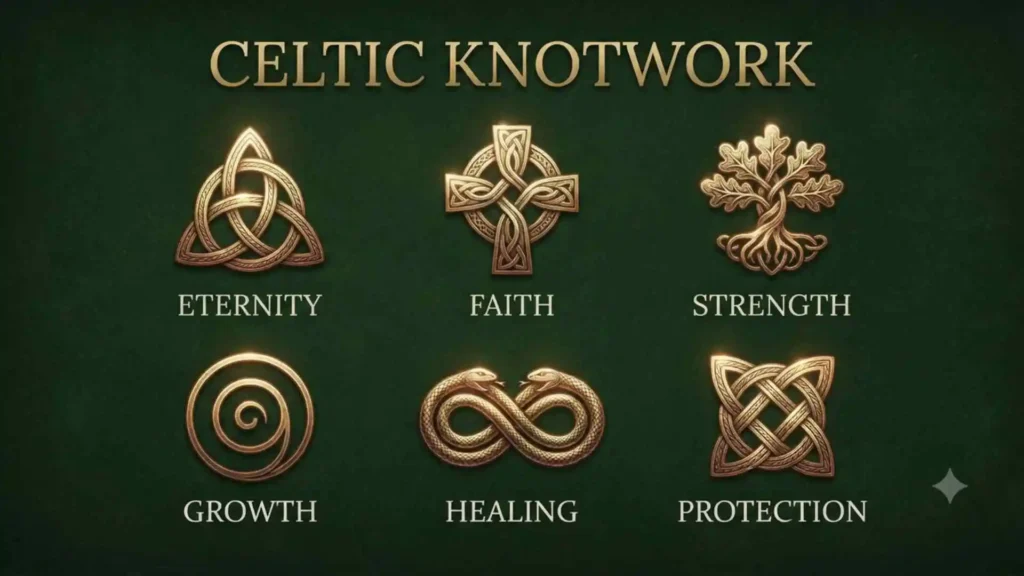
Visual Description
Celtic knotwork uses lines that weave over and under one another, often with no obvious beginning or end.
Meaning
Common modern meanings include eternity, loyalty, connection, destiny, and the continuity of life.
Historical Context
Interlace appears in early medieval manuscripts, metalwork, sculpture, and church decoration. It was not limited to Celtic-speaking regions. Related patterns appeared in Roman, Germanic, Anglo-Saxon, Scandinavian, Mediterranean, and Islamic art.
Where It Appears
- Illuminated manuscripts
- Stone crosses
- Pictish sculpture
- Church furniture
- Wedding rings
- Tattoos
- Graphic design
Celtic Patterns and Meanings
Celtic patterns are recognized for their repeated lines, interlacing forms, spirals, geometric shapes, and decorative complexity. They appear in different forms of art, including manuscripts, carved stones, metalwork, and modern jewelry and tattoos.
Celtic knotwork is commonly interpreted today as representing continuity, connection, and interconnectedness. Spirals are often associated with movement and cycles, while repeated interlacing patterns can suggest relationships and continuity.
However, not every Celtic pattern had a specific hidden meaning. Many patterns also served an important decorative purpose. The modern idea that every knot contains a precise symbolic message is therefore stronger than the available historical evidence supports.
Celtic Designs and Meanings
Celtic designs can have different meanings depending on the symbol, period, culture, and modern context in which they are used.
A Celtic knot is commonly used today to represent connection, continuity, or eternity. A triskele is often interpreted as a symbol of movement, cycles, and ongoing change. The Tree of Life is frequently associated with growth, connection, and family.
Animal designs add another layer of symbolism. The stag may represent strength and the natural world, the boar can suggest courage or ferocity, and the raven can have associations with warfare and supernatural themes in Irish mythology.
When several Celtic motifs are combined into one modern design, the final meaning is usually a contemporary interpretation rather than a historically documented Celtic formula.
Celtic Shapes
Celtic art and Celtic-inspired designs use many different shapes, including circles, spirals, triangles, crosses, interlaced lines, animals, leaves, branches, and geometric forms.
Spirals create a strong visual sense of movement and repetition. Circles create enclosed and continuous forms. Interlaced lines form the complex structures seen in Celtic knotwork. Crosses became especially prominent in medieval Celtic Christian art.
Animal shapes are also important in Celtic-inspired artwork. Stags, boars, birds, horses, and serpents appear in different Celtic artistic and mythological contexts.
These shapes should not automatically be interpreted as secret symbols. Some were used primarily for decoration, while others acquired cultural or religious associations through particular historical contexts.
Celtic Cross
Visual Description
The Celtic cross usually has a Christian cross with a circular ring around the intersection.
Meaning
It symbolizes Christian faith, salvation, eternity, divine light, and spiritual unity.
Cultural Connection
Ringed crosses became a major feature of early medieval monuments in Ireland and Britain. Many were covered with biblical scenes, bosses, spirals, interlace, animals, and plant forms.
Common Misconception
The circle is sometimes described as a surviving pagan sun symbol. This interpretation is possible in certain modern spiritual readings, but it is not a universally proven explanation for every ringed cross.
The ring may also have served artistic, structural, theological, or symbolic purposes.
Tree of Life
Visual Description
A Celtic Tree of Life design usually shows branches rising upward and roots spreading below, often forming a circle.
Meaning
It represents growth, ancestry, wisdom, balance, protection, and connection between worlds.
Cultural Connection
Trees appear throughout Irish and Welsh storytelling. Certain trees marked boundaries, meeting places, royal sites, or sacred landscapes.
Modern Meaning
Today, the Tree of Life often symbolizes family. Roots stand for ancestors, the trunk represents the present generation, and branches represent descendants or future possibilities.
Dara Knot
Visual Description
The Dara knot is usually a modern interlaced design resembling tangled roots.
Meaning
It represents strength, endurance, stability, and wisdom.
Cultural Connection
The name is connected with doire, an Irish word associated with an oak grove. Oak trees carried strong cultural and literary associations with durability, status, and the natural world.
Historical Caution
There is no single ancient Dara knot design with a fixed archaeological meaning. Most examples sold today are modern creations inspired by Celtic knotwork and oak symbolism.
Shield Knot
Visual Description
A shield knot often has four corners, four loops, or a square-like interlaced form.
Meaning
It is commonly interpreted as protection, courage, boundaries, and defense from harm.
Where It Appears
The term is widely used in modern jewelry and tattoo design. Four-part interlace patterns are historically real, but their identification as a specific magical “shield knot” is usually modern.
Brigid’s Cross
Visual Description
Brigid’s Cross is woven from rushes or straw, usually with a square center and four extending arms.
Meaning
It represents blessing, protection, spring, healing, hospitality, and renewal.
Cultural Connection
The cross is traditionally made around February 1 for Saint Brigid’s Day, also connected with the seasonal festival of Imbolc.
The National Museum of Ireland documents Brigid’s crosses and other woven straw traditions as important forms of Irish folk art and religious devotion.
Where It Appears
- Above doors
- Inside homes
- Schools
- Churches
- Seasonal festivals
- Irish cultural displays
Awen
Visual Description
The Awen symbol usually has three vertical or spreading rays, sometimes surrounded by one or more circles.
Meaning
It represents inspiration, poetic vision, creative flow, truth, and harmony.
Cultural Connection
The Welsh word awen refers to poetic or creative inspiration. However, the familiar three-ray emblem is mainly connected with modern Druid revival traditions rather than securely documented ancient Celtic usage.
Ogham
Visual Description
Ogham letters are formed from straight strokes or notches placed beside or across a central line.
Meaning
Ogham represents language, names, ancestry, memory, territory, and identity.
Historical Context
Ogham was used mainly in early medieval Ireland and parts of western Britain. Surviving inscriptions often record personal names, family relationships, or territorial associations.
Modern Use
People now use ogham for:
- Names
- Family mottos
- Memorials
- Tattoos
- Wedding jewelry
- Irish-language art
Before choosing an ogham tattoo, the spelling and letter direction should be checked carefully.
Celtic Sigils
The term Celtic sigil is widely used in modern spiritual practices, tattoos, jewelry, and online Celtic-inspired artwork. It usually refers to a personalized symbolic design based on Celtic motifs such as knots, spirals, Ogham, animals, or geometric patterns.
It is important, however, to distinguish modern Celtic sigils from historically documented Celtic symbols. Ogham was an early medieval writing system, while Celtic knotwork and animal imagery belong to different artistic and cultural traditions.
Many designs described online as “ancient Celtic sigils” are actually modern creations. Their meanings may be meaningful to contemporary users without being historically documented beliefs of ancient Celtic communities.
If a Celtic sigil is being used for a tattoo or personal emblem, its modern intended meaning should be clearly separated from claims about ancient history.
Claddagh
Visual Description
The Claddagh shows a heart held by two hands and topped with a crown.
Meaning
- Heart: love
- Hands: friendship
- Crown: loyalty
Cultural Connection
The Claddagh is Irish, but it is not an ancient Iron Age Celtic symbol. It belongs to the later European tradition of rings expressing faith, friendship, and romantic commitment.
Modern Use
It appears in friendship gifts, wedding rings, family heirlooms, tattoos, and Irish heritage jewelry.
Shamrock
Visual Description
The shamrock is a small three-leaf clover.
Meaning
It represents Ireland, luck, faith, national identity, and the Christian Trinity.
Cultural Connection
Later tradition says Saint Patrick used a three-leaf plant to explain the Trinity. The story is culturally influential, although its earliest historical details are difficult to verify.
Common Misconception
A shamrock normally has three leaves. A four-leaf clover is a different symbol associated with rare good luck.
Irish Harp
Visual Description
The Irish harp is a triangular stringed instrument with a curved pillar.
Meaning
It represents music, sovereignty, cultural memory, artistic skill, and Ireland itself.
Historical Significance
Harpers once served courts and noble households. Over time, the harp became one of Ireland’s strongest political and cultural emblems.
Unlike many modern “Celtic” symbols, the harp has a clear and continuous place in Irish historical identity.
Salmon of Knowledge
Visual Description
The salmon may be shown swimming through waves, surrounded by hazel leaves, or combined with spirals.
Meaning
It represents wisdom, inspiration, memory, and knowledge gained through experience.
Mythological Connection
In Irish tradition, the young Fionn mac Cumhaill gained extraordinary wisdom after tasting the Salmon of Knowledge while preparing it for the poet Finegas.
The story reminds us that wisdom may arrive unexpectedly, but it also carries responsibility.
Celtic Stag
Visual Description
The stag appears as a deer with large branching antlers.
Meaning
It represents wilderness, nobility, maturity, leadership, instinct, and renewal.
Symbolism
Antlers fall and grow again, making the stag a natural image of seasonal rebirth.
Where It Appears
- Mythic stories
- Iron Age art
- Hunting scenes
- Heraldry
- Fantasy fiction
- Tattoos
Boar
Visual Description
The boar is shown with a strong body, raised bristles, and curved tusks.
Meaning
It represents courage, aggression, protection, abundance, and warrior strength.
Cultural Connection
Boars appear in ancient European art and in Irish and Welsh heroic literature. Hunting a supernatural boar often tests a hero’s courage, loyalty, and self-control.
Raven and Crow
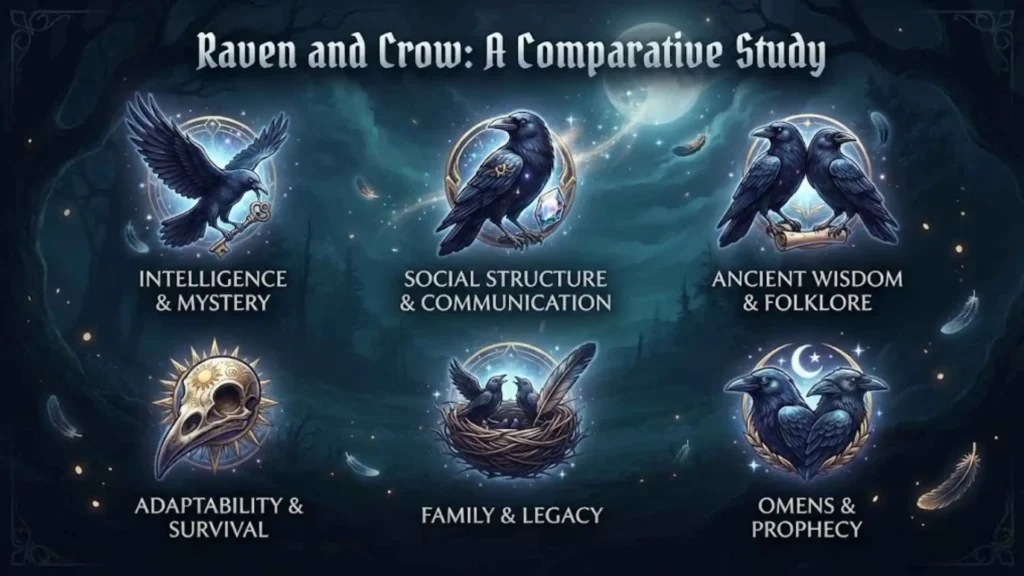
Visual Description
The raven is a large dark bird, often shown with spread wings.
Meaning
It may represent prophecy, death, battle, intelligence, protection, or transformation.
Mythological Connection
The Morrígan, a powerful figure in medieval Irish literature, is associated with warfare, sovereignty, fate, and birds of the battlefield.
Light and Shadow
The raven is not simply evil. It can be a warning, guide, witness, guardian, or messenger between ordinary and supernatural experience.
Celtic Horse
Visual Description
Celtic horse designs often use curved bodies, flowing manes, spirals, or knotwork.
Meaning
The horse symbolizes freedom, movement, power, status, fertility, and the journey between worlds.
Historical Importance
Horses were essential for transport, warfare, agriculture, prestige, and ceremony. Their value made them natural symbols of authority and divine power.
Serpent
Visual Description
The serpent may appear coiled, curved, interlaced, or paired with a rod-like shape.
Meaning
Modern interpretations include healing, rebirth, danger, hidden knowledge, and transformation.
Historical Context
Snake imagery occurs throughout ancient Europe, but its meaning varies widely. Pictish stones sometimes contain serpent-like symbols combined with rods, though their precise meaning remains debated. Historic Environment Scotland states directly that the meanings of several Pictish carvings remain unknown.
Celtic Symbols Across Different Cultures
Celtic symbols belong to particular European traditions, but many of their shapes have parallels elsewhere. Similarity does not always prove direct cultural contact. Human beings often create circles, spirals, trees, animals, and woven patterns independently.
Ancient Egypt
Egyptian art used symbols such as the ankh, scarab, lotus, Eye of Horus, and djed pillar.
Similarities
Like Celtic-inspired designs, Egyptian symbols often expressed:
- Renewal
- Protection
- Divine order
- Life after death
- Royal authority
Differences
Egyptian symbols often had meanings supported by extensive inscriptions, temple texts, and funerary traditions. Many Celtic designs survive without written explanations from their original makers.
The Egyptian ankh is sometimes compared with the Celtic cross, but their histories and religious functions are different.
Ancient Greece
Greek art used spirals, meanders, laurel wreaths, owls, serpents, and triple-formed figures.
Similarities
Greek and Celtic-style art both used repeating borders, animals, plant forms, and circular motion.
Differences
Greek art often emphasized the human body, mythological scenes, and architectural order. Celtic-style art tended to favor transformation, abstraction, flowing curves, and hidden forms.
The word triskelion comes from Greek roots and refers to a three-legged or three-armed form. This shows that the name itself is not originally an Irish-language term.
Roman Culture
Roman art spread across much of Europe and interacted with local traditions.
Similarities
Roman mosaics, jewelry, military objects, and architecture used knots, vines, spirals, circles, animals, and geometric borders.
Cultural Exchange
In Roman Britain and Gaul, local artists combined regional styles with Roman materials and religious imagery. Therefore, some designs described as Celtic may reflect centuries of exchange rather than a completely isolated tradition.
Eastern Traditions
Asian traditions include mandalas, endless knots, yin-yang designs, lotus flowers, sacred trees, and rotating symbols.
Similarities
The Buddhist endless knot and Celtic interlace both suggest continuity and connection to modern viewers.
Differences
The Buddhist endless knot has meanings shaped by Buddhist philosophy, including interdependence, wisdom, and compassion. Celtic knotwork developed in a different cultural and religious environment.
Visual resemblance should not erase those differences.
Indigenous Traditions
Indigenous cultures across the world use circles, animals, spirals, trees, woven forms, and directions as meaningful images.
Similarities
Many traditions express:
- Kinship with the land
- Ancestral memory
- Seasonal cycles
- Community identity
- Relationships with animals
Respectful Comparison
It is inaccurate to group all Indigenous traditions together or label their symbols “Celtic-like.” Each design belongs to a specific people, place, language, and history.
Comparison should encourage respect rather than blending unrelated cultures into one imagined spiritual system.
Modern Western Culture
Today, Celtic symbols have become global.
They appear in:
- Fantasy novels
- Video games
- Sports logos
- Wedding rings
- Memorial tattoos
- Pagan spirituality
- Christian jewelry
- Music festivals
- Heritage tourism
- Film and television
Modern interpretation often places greater emphasis on personal identity than historical ritual.
Similar Symbols and Their Meanings
| Symbol | Often Confused With | Similarity | Key Difference |
| Triskele | Triskelion with three human legs | Both use threefold rotation | One may use spirals, while the other may show legs |
| Triquetra | Valknut | Both have triangular forms | The valknut belongs to Norse visual tradition |
| Celtic Knot | Buddhist Endless Knot | Both use continuous interlace | They developed within different religious cultures |
| Celtic Cross | Solar Cross | Both may combine circle and cross | Their dates, structures, and religious contexts differ |
| Tree of Life | Norse Yggdrasil | Both connect worlds through a sacred tree | Yggdrasil has a specific role in Norse mythology |
| Ogham | Norse Runes | Both are early writing systems | They use different alphabets, languages, and structures |
| Awen | Ancient sun rays | Both feature radiating lines | The modern Awen emblem belongs mainly to Druid revival tradition |
| Green Man | Celtic forest deity | Both connect with vegetation | The Green Man is mainly a medieval art-historical label |
| Shamrock | Four-leaf clover | Both are clover-like plants | Shamrock has three leaves and strong Irish associations |
| Claddagh | Ancient Celtic love knot | Both symbolize relationships | The Claddagh is a later Irish ring design |
Common Misconceptions About Celtic Symbols
Every Celtic Knot Had a Secret Meaning
Medieval artists may have chosen some forms for theological, symbolic, practical, or decorative reasons. However, no surviving master chart translates every knot into one fixed meaning.
Names such as “motherhood knot,” “sailor’s knot,” and “shield knot” often describe modern designs or modern interpretations.
All Celtic Symbols Are Pagan
Some are prehistoric. Some are Iron Age. Many famous examples come from Christian manuscripts and monuments.
Celtic cultural identity and Christianity have influenced one another for more than a thousand years.
The Celts Were One Nation
The ancient peoples described as Celtic did not form one united country or empire. They lived across different regions and belonged to many communities.
Modern Celtic nations also have distinct languages and histories.
Every Spiral Means Life, Death, and Rebirth
That is a popular and meaningful interpretation, but it is not a translation preserved beside every ancient spiral.
Archaeologists often know when and where a design was made without knowing exactly what its maker believed it meant.
Pictish Symbols Have Been Fully Decoded
They have not. Pictish stones include crescents, rods, mirrors, combs, animals, double discs, and fantastic creatures. Scholars continue to debate whether they represented names, families, offices, territories, beliefs, or other forms of identity.
Celtic Symbols in Mythology and Folklore
The Otherworld
Irish and Welsh stories often describe a realm beyond ordinary human experience. It may be reached through a mound, mist, cave, island, lake, feast, dream, or sudden encounter.
Symbols such as circles, spirals, doorways, birds, horses, and sacred trees fit naturally with stories about crossing boundaries.
The Otherworld is not always a land of the dead. It may be a place of beauty, danger, timelessness, wisdom, or supernatural power.
The Sacred Tree
Trees connect several symbolic levels at once:
- Roots enter the hidden earth.
- The trunk stands in the human world.
- Branches reach toward the sky.
- Leaves die and return.
- Fruit carries future life.
This structure makes the tree a natural symbol of connection, ancestry, and renewal.
The Heroic Hunt
Boars, stags, hounds, and magical animals often lead heroes beyond safe boundaries.
The hunt may begin as a physical chase but become a test of pride, loyalty, destiny, or spiritual readiness.
In psychological terms, the animal draws the hero toward a part of life that cannot be controlled by ordinary rules.
The Morrígan and the Raven
The Morrígan appears in medieval Irish tradition as a complex supernatural figure connected with conflict, sovereignty, prophecy, and fate.
Her bird associations helped shape the modern popularity of the raven as a Celtic symbol of battle and transformation.
However, reducing her to a simple “war goddess” can hide the complexity of the surviving stories.
Fionn and the Salmon of Knowledge
The Salmon of Knowledge ate hazelnuts that fell into a sacred pool. The fish absorbed their wisdom.
When Fionn burned his thumb while cooking the salmon, he placed it in his mouth and received the knowledge intended for another.
The story links wisdom with nature, accident, discipline, and destiny. It also suggests that knowledge changes the person who receives it.
Cernunnos and the Antlered Figure
A famous ancient image shows an antlered male figure often called Cernunnos. He appears on objects from the wider Celtic-speaking world, sometimes surrounded by animals.
Modern users connect him with wilderness, fertility, prosperity, animals, and seasonal power. Yet the surviving evidence does not provide one complete theology or universal myth about him.
Celtic Symbols in Art, Literature, Movies, and Pop Culture
Illuminated Manuscripts
Early medieval Gospel books contain some of the most admired interlace and spiral decoration in European art.
Their patterns do more than fill empty space. They slow the reader’s eye, surround sacred words, and transform the page into a place of contemplation.
Animals may twist into letters. Lines may become bodies. Borders may feel alive.
Stone Carving
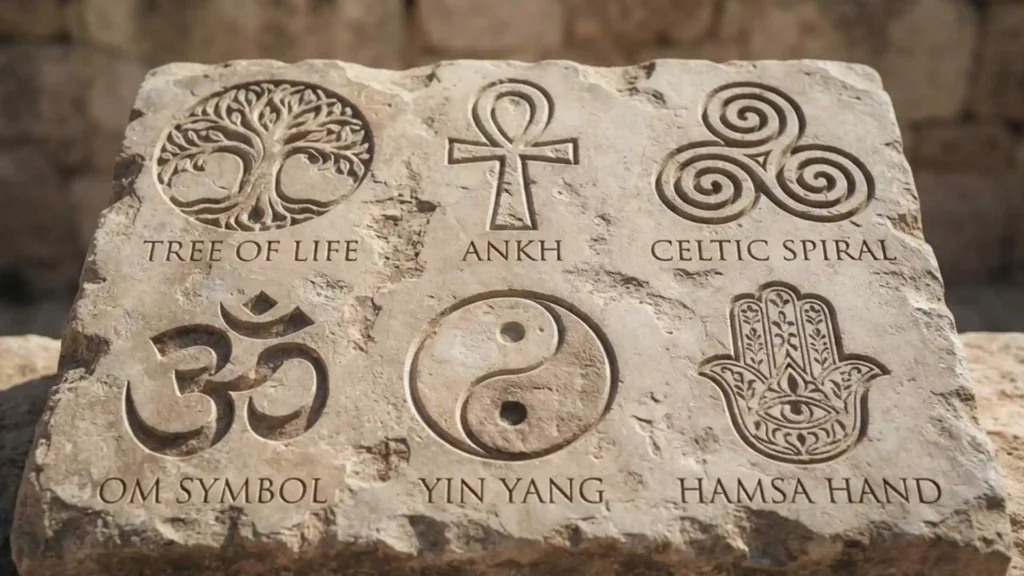
Celtic and Pictish monuments combine:
- Crosses
- Human figures
- Hunting scenes
- Animals
- Interlace
- Vines
- Geometric symbols
- Ogham inscriptions
Rodney’s Stone in Scotland, for example, includes a cross, Pictish symbols, and ogham inscriptions. Other monuments display crescents, rods, double discs, boats, animals, and fantastic creatures.
Poetry and Literature
Celtic imagery often appears in literature to represent:
- Lost heritage
- Wild landscapes
- Ancient memory
- Spiritual longing
- Exile
- National identity
- The boundary between reality and myth
Modern fantasy literature frequently uses knots, standing stones, sacred groves, ravens, stags, and triple symbols to create a sense of old magic.
Movies and Television
Celtic-inspired symbols appear in historical dramas, fantasy series, animation, and supernatural television.
They often signal:
- Ancient power
- Family destiny
- Magical bloodlines
- Secret societies
- Warrior identity
- Nature-based spirituality
These uses are usually creative rather than historically exact.
Tattoos
Celtic tattoos may mark love, family, military service, grief, religious faith, survival, or ancestry.
A person may combine:
- A knot with children’s initials
- A cross with a memorial date
- A tree with family names
- A triskele with a recovery story
- Ogham with an Irish word
- A raven with a personal transformation
The strongest tattoo designs connect a historically informed symbol with a clear personal intention.
Fashion and Modern Design
Celtic patterns remain popular because they are detailed enough to feel ancient but flexible enough for modern design.
They appear on:
- Rings
- Pendants
- Clothing
- Book covers
- Wedding invitations
- Sportswear
- Logos
- Ceramics
- Furniture
- Digital illustrations
Spiritual and Dream Meaning of Celtic Symbols
Dream interpretation is personal. A symbol may reflect memory, emotion, cultural background, or a recent experience rather than a universal message.
Still, certain themes appear often.
Dreaming of a Celtic Knot
A knot may represent:
- A lasting relationship
- A complicated emotional problem
- Loyalty
- Repeating life patterns
- A promise that feels binding
- The need to see how separate issues connect
A loose or opening knot may suggest release. A tightening knot may suggest pressure or commitment.
Dreaming of a Triple Spiral
A triple spiral may suggest movement through three stages of life.
It can appear during:
- Personal transition
- Recovery
- A career change
- Pregnancy or parenthood
- Spiritual questioning
- The ending of one identity and creation of another
Its message may be positive when the motion feels smooth, but cautionary when the spiral feels dizzying or uncontrollable.
Dreaming of a Celtic Cross
A Celtic cross may symbolize faith, grief, protection, moral choice, or connection with ancestors.
Its meaning depends greatly on the dreamer’s religious and cultural relationship with the cross.
Dreaming of a Sacred Tree
A healthy tree may suggest stability, family support, and growth.
A damaged tree may reflect loss, exhaustion, family conflict, or fear of losing one’s roots.
New leaves may symbolize hope after a difficult period.
Dreaming of a Raven
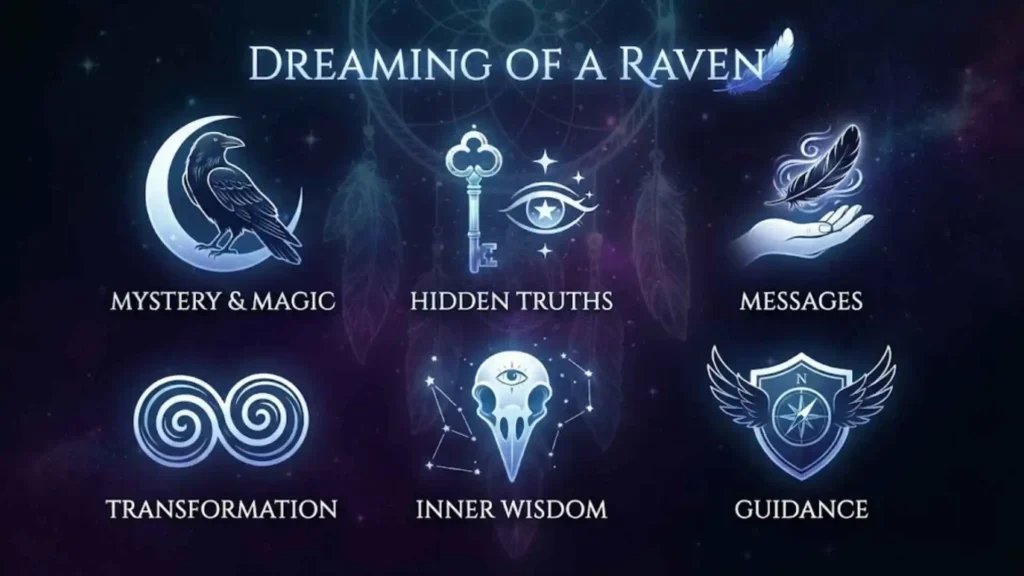
A raven may represent warning, intelligence, difficult truth, grief, or transformation.
Rather than assuming it predicts death, consider what the bird does. A speaking raven, circling raven, trapped raven, and peaceful raven create very different psychological messages.
Dreaming of Ogham
Unknown writing in a dream may reflect a message that has not yet become conscious.
Ogham may symbolize ancestry, forgotten knowledge, the desire to understand one’s identity, or the feeling that the past is trying to speak.
Positive and Negative Meanings of Celtic Symbols
| Symbol | Positive Meaning | Negative or Shadow Meaning |
| Celtic Knot | Loyalty, eternity, connection | Feeling trapped, repeated conflict |
| Triskele | Progress, growth, transformation | Restlessness, lack of direction |
| Tree of Life | Balance, ancestry, renewal | Family burden, fear of change |
| Raven | Wisdom, prophecy, intelligence | Fear, conflict, unsettling truth |
| Boar | Courage, protection, strength | Aggression, recklessness |
| Stag | Leadership, instinct, nobility | Pride, isolation |
| Serpent | Healing, rebirth, knowledge | Deception, hidden danger |
| Celtic Cross | Faith, hope, salvation | Grief, religious conflict |
| Ogham | Memory, language, identity | Miscommunication, lost heritage |
| Shield Knot | Safety, boundaries, resilience | Defensiveness, emotional walls |
| Awen | Creativity, harmony, inspiration | Creative pressure, spiritual pride |
| Claddagh | Love, loyalty, friendship | Possessiveness, broken trust |
A symbol does not carry one emotional message in every situation. Context changes meaning.
A knot on a wedding ring may represent commitment. The same knot in a stressful dream may represent emotional entanglement. A raven may be frightening in one story and protective in another.
The shadow meaning does not cancel the positive meaning. Instead, it reveals the tension inside the symbol.
Why Humans Are Attracted to Celtic Symbols
We Look for Continuity
Human life contains many endings. Relationships change, people die, children grow, homes are left behind, and identities shift.
An endless knot gives visual form to the hope that something continues.
It may be love, memory, ancestry, faith, influence, or the bond between generations.
We Respond to Pattern
The brain naturally enjoys repetition, rhythm, and symmetry.
Celtic knotwork creates a balance between predictability and surprise. We understand the basic rule of the weave, yet the path remains complex enough to hold attention.
We Want to Belong
Symbols give people a visible language of identity.
A small pendant can say:
- My family came from Ireland.
- I value loyalty.
- I remember someone who died.
- I am rebuilding my life.
- Nature is sacred to me.
- My faith connects past and present.
We Carry Cultural Memory
A person does not need to know every historical detail to feel moved by an ancient cross, carved stone, ruined monastery, or illuminated page.
Places and objects can create emotional continuity. They make history feel less like a list of dates and more like a conversation across generations.
We Give Old Symbols New Meaning
Symbols survive because people continue to use them.
Modern meanings are not automatically false. They become misleading only when presented as proven ancient facts without evidence.
A new family meaning attached to an old knot can still be sincere, beautiful, and culturally respectful.
Modern Uses of Celtic Symbols
Tattoos
Before choosing a tattoo:
- Identify the symbol’s actual origin.
- Separate historical evidence from modern interpretation.
- Check spelling carefully, especially in Irish, Welsh, Scottish Gaelic, or ogham.
- Avoid combining unrelated traditions without understanding them.
- Choose a design that remains clear as the tattoo ages.
Jewelry
Celtic jewelry often marks weddings, anniversaries, births, graduations, and memorials.
Popular choices include:
- Trinity knot rings
- Claddagh rings
- Celtic cross pendants
- Tree of Life necklaces
- Ogham bracelets
- Knotwork wedding bands
- Triskele earrings
Fashion
Celtic-inspired patterns appear on scarves, jackets, formal wear, sports clothing, and festival outfits.
Designers may use knotwork to express heritage, luxury, strength, or handcrafted tradition.
Branding
Businesses use Celtic imagery to suggest:
- Irish or Scottish origin
- Traditional craftsmanship
- Natural ingredients
- Heritage
- Trust
- Strength
- Storytelling
- Community
Brands should avoid presenting invented meanings as historical facts.
Social Media
Celtic symbols are shared as profile images, memorial graphics, family crests, spiritual quotes, and tattoo inspiration.
Because simplified claims spread quickly, social media is also a major source of inaccurate history. A polished chart may look authoritative even when its meanings were invented recently.
Contemporary Spirituality
Modern Pagans, Druids, Christians, meditators, and nature-centered spiritual communities may all use Celtic-inspired designs.
The same triquetra can represent the Christian Trinity for one person and earth, sea, and sky for another.
Respect begins by asking what the symbol means in that person’s tradition rather than assuming.
Home Decor
Celtic crosses, woven Brigid’s crosses, knotwork panels, Tree of Life plaques, and carved animals appear in homes and gardens.
They may serve as:
- Heritage displays
- Spiritual reminders
- Family symbols
- Protective decorations
- Seasonal crafts
- Memorial objects
Personal Expression
A symbol becomes most powerful when a person understands both its history and personal meaning.
Someone may choose a Dara-inspired knot not because it is an exact ancient emblem, but because the oak-root design represents resilience after hardship.
That personal interpretation is valid when described honestly.
Interesting Facts About Celtic Symbols
- Many famous Celtic symbols are not exclusively Celtic. Spirals, knots, sacred trees, and triple forms appear in cultures across the world.
- The triple spiral at Newgrange predates the Iron Age Celts. Its modern association with Celtic Ireland reflects cultural inheritance rather than original authorship.
- There was no single ancient Celtic symbols dictionary. Meanings varied by time, region, object, and community.
- Knotwork became especially prominent in early medieval art. It appears in Christian manuscripts, carved crosses, metalwork, and stone monuments.
- Pictish symbols remain partly undeciphered. Their exact meanings continue to be debated by historians and archaeologists.
- The Claddagh is Irish but not ancient Celtic. It belongs to a later ring tradition centered on love, loyalty, and friendship.
- The familiar Awen emblem is modern. The idea of poetic inspiration is old, but the three-ray design is linked mainly with Druid revival movements.
- Ogham is a real historical alphabet. It is not simply a magical code, although modern spiritual users may give it mystical meanings.
- Christianity helped preserve and develop Celtic-inspired art. Monasteries and churches produced many of the designs now treated as classic Celtic imagery.
- A museum description may identify a design without explaining its meaning. Archaeologists can often date and classify an object even when its symbolic message remains unknown.
How to Choose the Right Celtic Symbol
Start by asking what you want the symbol to express.
For Love
Choose:
- Claddagh
- Triquetra
- Interwoven knot
- Two-strand knot design
For Family
Choose:
- Tree of Life
- Knot with initials
- Ogham family name
- Four-part knot for family members
For Strength
Choose:
- Dara-inspired knot
- Boar
- Stag
- Shield-style knot
- Torc-inspired design
For Transformation
Choose:
- Triskele
- Spiral
- Serpent
- Raven
- Seasonal tree
For Faith
Choose:
- Celtic cross
- Triquetra
- Brigid’s Cross
- Illuminated manuscript-style knotwork
For Irish Heritage
Choose:
- Irish harp
- Shamrock
- Ogham
- Claddagh
- Brigid’s Cross
- Historically Irish cross designs
For Scottish Heritage
Consider:
- Designs based on specific Scottish carved stones
- Pictish animals or geometric forms
- Thistle imagery
- Scottish Gaelic inscriptions
- Regional cross and knotwork traditions
Because Pictish symbols are not fully decoded, it is better to describe them by their known form rather than claim a fixed meaning.
Frequently Asked Questions
What Is the Most Powerful Celtic Symbol?
There is no single most powerful Celtic symbol. The Celtic cross may be strongest for Christian faith, the triskele for transformation, the Tree of Life for ancestry, and the Dara knot for modern ideas of inner strength. Power depends on cultural context and personal meaning.
What Celtic Symbol Means Strength?
The Dara knot is widely used today as a symbol of strength because it resembles the deep roots of an oak tree. Boars, stags, torcs, and shield-style knots can also represent courage, status, endurance, or protection.
What Celtic Symbol Means Eternal Love?
The triquetra, Claddagh, and endless knot are commonly used to symbolize eternal love. The Claddagh specifically combines love, friendship, and loyalty, while interlaced knots suggest a bond without a visible ending.
Are Celtic Knots Pagan or Christian?
They can be associated with both, but many surviving examples come from early medieval Christian art. Modern Pagan traditions also use knotwork. The meaning depends on the design, date, object, and community using it.
What Is the Difference Between a Triskele and a Triquetra?
A triskele has three rotating arms or spirals moving from a central point. A triquetra has three pointed, interlocking loops. Both use threefold structure, but they have different shapes and historical uses.
Are the Meanings in a Celtic Symbols and Meanings Chart Historically Proven?
Some meanings are supported by literature, religious tradition, folk practice, inscriptions, or clear cultural use. Others are modern interpretations. A trustworthy chart should clearly separate documented history from contemporary symbolism.
Conclusion
Celtic symbols are powerful because they connect beauty, history, identity, nature, and human emotion.
Some meanings come from archaeology and written tradition, while others grew through medieval Christianity, folklore, cultural revival, and modern spiritual practice.
Understanding those layers does not weaken the symbols. It gives them greater depth and honesty.
The most meaningful symbol is one chosen with knowledge, respect, and a personal story worth carrying forward
Hello, I’m Rowan Sinclair, a passionate writer and lifelong admirer of the wisdom found in great quotes. I believe that words have the ability to inspire change, spark creativity, and connect people across cultures and generations.
I enjoy writing about motivational quotes, famous sayings, and lessons from history’s most influential thinkers. Every article I create is driven by my desire to help readers discover meaningful insights that they can apply to their own lives.
When I’m not writing, I spend my time reading biographies, exploring classic literature, and collecting memorable quotes that deserve to be shared with the world.
I am the author of Voices That Inspire and A Collection of Timeless Thoughts, two books that celebrate the enduring power of words and the stories behind them.
 Sienna Brooks