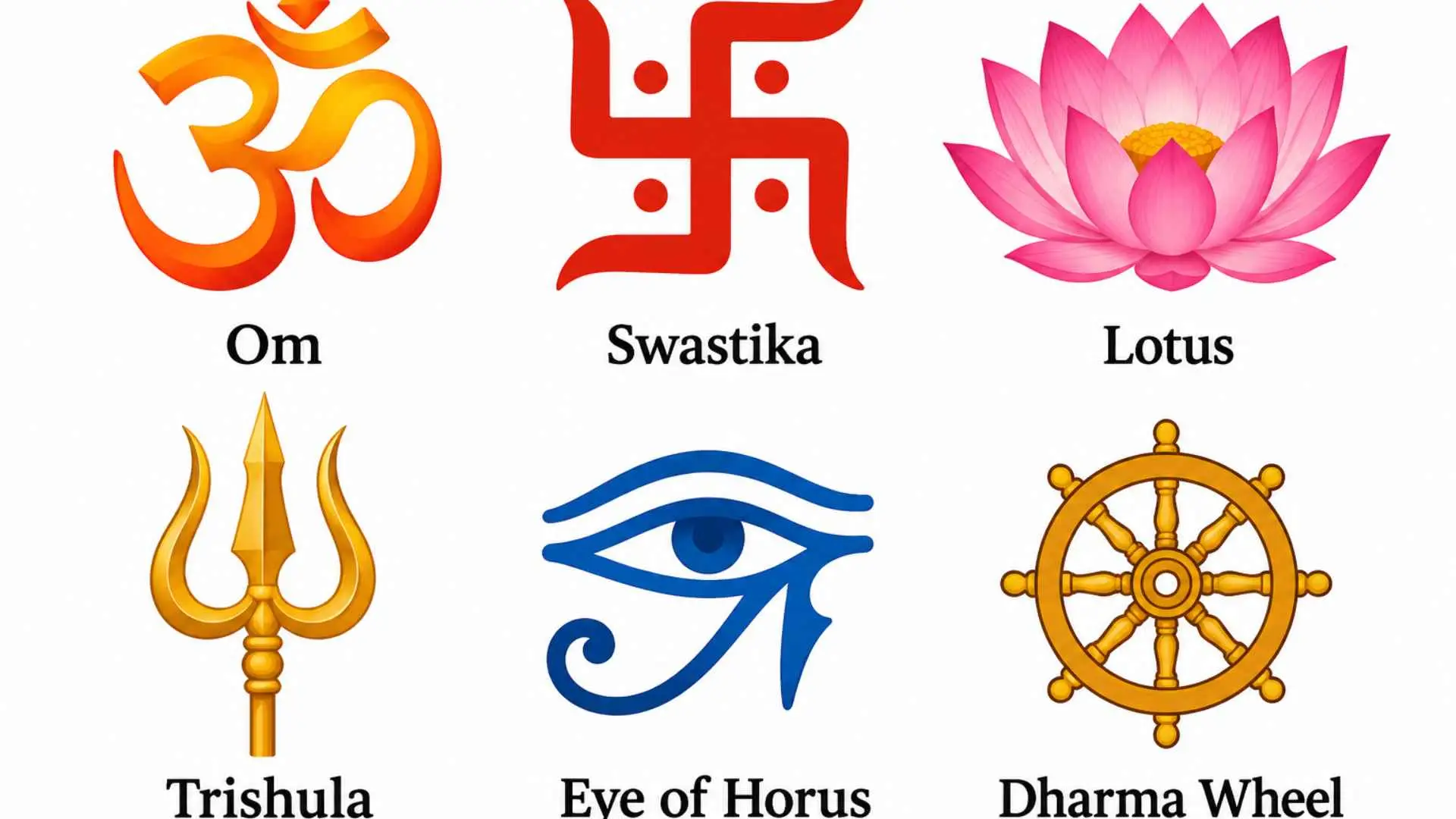
Hindu symbols carry deep spiritual meanings connected to faith, wisdom, creation, protection, and the balance of life. From the sacred sound Om (ॐ) to the trident of Lord Shiva (🔱), these symbols appear in temples, religious ceremonies, traditional artwork, jewelry, and everyday devotional practices.
Understanding Hindu symbols and their meanings can help you appreciate the stories and beliefs behind them. Some represent Hindu deities, others express spiritual ideas such as karma and dharma, and many are used as reminders of peace, positive energy, and personal growth.
In this guide, you will discover important Hindu symbols, ancient Indian designs, Shatkona, Shiva symbols, and symbols associated with protection. You will also find Hindu symbols in text that you can copy and paste into messages, social media profiles, artwork, and tattoo inspiration.
Hindu Symbols and Meanings
Hinduism has a rich collection of sacred symbols developed through religious texts, philosophical traditions, temple art, and centuries of worship. Their meanings can vary across regions, communities, and Hindu traditions, so a symbol may have several connected interpretations.
Here are some widely recognized Hindu symbols and their common meanings.
| Symbol | Name | Common Meaning |
| ॐ | Om | Sacred sound, ultimate reality, and spiritual awareness |
| 卐 | Traditional Hindu Swastika | Auspiciousness, well-being, and good fortune |
| 🔱 | Trishula | The trident associated with Lord Shiva |
| 🪷 | Lotus | Purity, spiritual growth, and beauty |
| श्री | Shri | Respect, auspiciousness, and prosperity |
| कलश | Kalasha | Abundance, welcome, and ritual purity |
| त्रिपुण्ड्र | Tripundra | Three horizontal sacred ash lines associated with Shiva |
| तिलक | Tilak | Devotion, blessing, or religious identity |
| स्वस्तिक | Swastika | An auspicious sign in Hindu religious and cultural settings |
| 🐚 | Shankha | Sacred conch associated with Vishnu and ritual worship |
The lotus is often shown in Hindu art beneath deities, suggesting spiritual beauty and the ability to rise above difficult conditions. The Trishula is connected with Shiva and can carry different philosophical interpretations. The Kalasha, a ceremonial pot, is commonly used in worship and auspicious occasions.
The traditional Hindu swastika deserves particular context. It has a long history as an auspicious symbol in Hinduism and other Asian religions. Its meaning is distinct from the Nazi emblem, which appropriated a similar form and made it a symbol of hatred and genocide.
Hindu Symbols Text
Hindu symbols in text are useful for religious messages, social media captions, personal notes, devotional writing, and creative designs. Some characters belong to the Devanagari script, while others are Unicode symbols or emoji.
| Symbol | Name | Common Use |
| ॐ | Om | Meditation and devotional messages |
| 卐 | Swastika | Traditional auspicious designs |
| श्री | Shri | Respect and prosperity |
| शुभ | Shubh | Auspiciousness |
| लाभ | Labh | Benefit or prosperity |
| नमः | Namah | Reverence or salutation |
| हर हर महादेव | Har Har Mahadev | Devotional expression associated with Shiva |
| जय श्री राम | Jai Shri Ram | Devotional expression honoring Rama |
| राधे राधे | Radhe Radhe | Devotional greeting associated with Radha and Krishna |
| 🪷 | Lotus Emoji | Spiritual and decorative posts |
| 🔱 | Trident Emoji | Shiva-related designs |
| 🐚 | Shell Emoji | Conch-related decoration |
Some text entries are words or phrases rather than individual symbols. Their meaning comes from Sanskrit, Hindi, and devotional usage.
For example, you might write “ॐ शान्तिः” in a meditation-themed design or use “जय श्री राम” in a devotional message. If you publish text in Devanagari, choose a font that supports the script so that vowel marks and joined characters display correctly.
Hindu Symbols Shatkona
The Shatkona is a six-pointed geometric symbol formed by combining two interlocking triangles. It appears in Hindu yantras, sacred diagrams, and some traditions of religious art.
The two triangles are often interpreted as complementary principles. Depending on the tradition and context, they may represent the relationship between Shiva and Shakti, consciousness and energy, or the union of complementary forces.
The Shatkona is sometimes compared with the hexagram found in other religious and cultural traditions. Although the basic geometric shape can look similar, its religious meaning depends on the surrounding design and the tradition using it.
Where Is the Shatkona Used?
- Yantras: Sacred geometric diagrams used in certain Hindu spiritual practices.
- Religious Art: Decorative patterns in paintings and devotional designs.
- Meditation Materials: Images used to support contemplation or represent philosophical ideas.
- Jewelry: Pendants and other accessories inspired by sacred geometry.
The Shatkona is not the same as every six-pointed star. A plain geometric hexagram may have no religious significance, while a Shatkona placed within a specific yantra can carry a more specialized meaning.
Hindu Symbols of Protection
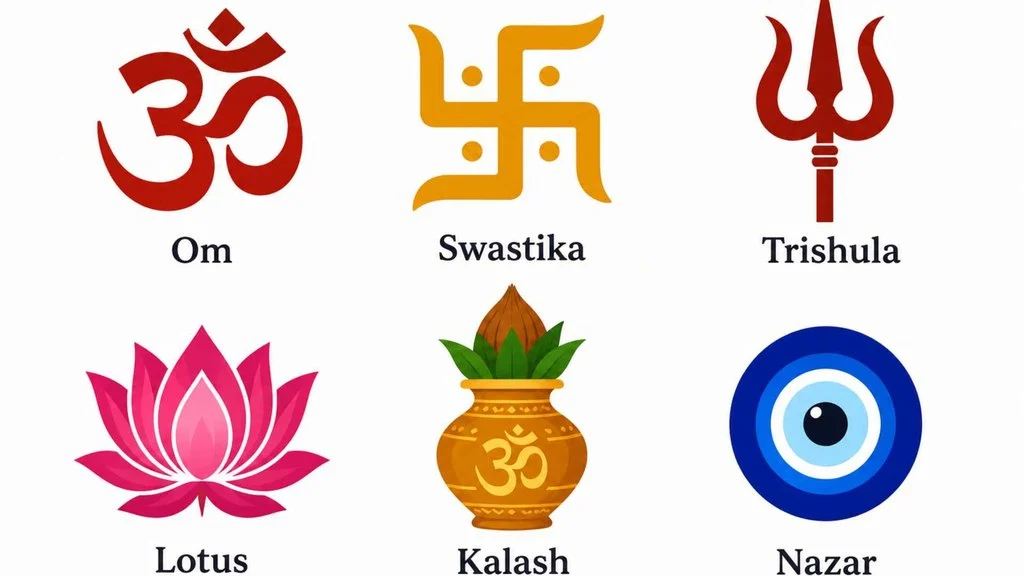
Many Hindu symbols are associated with divine protection, courage, spiritual strength, and the removal of obstacles. They are used in temple worship, household rituals, jewelry, and religious decorations.
Common examples include:
- Trishula (🔱): Shiva’s trident, associated with divine power and the destruction of ignorance.
- Om (ॐ): A sacred symbol used in prayer and meditation, representing spiritual reality.
- Hanuman’s Image: Associated with devotion, courage, strength, and overcoming difficulties.
- Narasimha Imagery: Connected with Vishnu’s protective form in Hindu tradition.
- Nazar-Related Motifs: Blue-eye motifs appear in several cultures, but they should not automatically be described as uniquely Hindu symbols.
- Traditional Swastika (卐): Used in Hindu settings as an auspicious sign of well-being and blessing.
- Sacred Threads: In some Hindu communities, threads tied during rituals represent blessings, religious commitments, or protection.
The meaning of a protective symbol depends on the practice in which it is used. Some people wear a pendant as an expression of devotion, while others place auspicious signs near a doorway or on ceremonial objects.
These practices express religious and cultural beliefs; they should not be presented as scientifically proven methods of preventing harm.
Hindu Symbols Copy and Paste
Use these Hindu symbols and sacred text characters in your messages, social media bios, captions, invitations, and devotional designs. Select the character you need and copy it into your preferred application.
ॐ
Om
ॐ
Copy
卐
Traditional Hindu Swastika
卐
Copy
🔱
Trident
🔱
Copy
🪷
Lotus
🪷
Copy
श्री
Shri
श्री
Copy
शुभ
Shubh
शुभ
Copy
लाभ
Labh
लाभ
Copy
☸
Dharma Wheel Character
☸
Copy
🐚
Conch Emoji
🐚
Copy
🙏
Folded Hands Emoji
🙏
Copy
☯
Yin-Yang Character
☯
Copy
त्रिशूल
Trishula in Devanagari
त्रिशूल
Copy
A quick compatibility tip: Symbols such as ॐ and श्री use text characters, while 🔱 and 🪷 are emoji. Their appearance can differ between devices and applications. The Dharma Wheel character ☸ is a general religious symbol and is not exclusively Hindu. Likewise, ☯ is associated primarily with Chinese philosophical traditions rather than being a specifically Hindu symbol.
For traditional Hindu artwork, use an image when the exact shape, color, proportions, or ritual arrangement matters.
Hindu Symbols Om
Om, written as ॐ, is one of the most important sacred symbols in Hinduism. It is associated with prayer, meditation, spiritual knowledge, and the understanding of ultimate reality.
Om is commonly pronounced as a sacred syllable during meditation and religious ceremonies. It is often represented as Aum, with its sound described through the components A, U, and M. Interpretations of these sounds differ among Hindu philosophical traditions.
The Mandukya Upanishad gives particular attention to Om and connects it with states of consciousness and ultimate reality. In everyday religious practice, the symbol may appear at the beginning of prayers, on temple walls, in homes, and on devotional objects.
How Is Om Used?
- Meditation: Repeated or contemplated as part of a spiritual practice.
- Prayer: Used at the beginning or end of certain chants.
- Home Worship: Displayed on a prayer shelf or in a sacred space.
- Decorative Art: Included in paintings, pendants, and religious designs.
- Digital Text: Added to captions, greetings, and devotional profiles.
Om is more than a decorative character. For many Hindus, it has profound religious significance, so using it respectfully is especially important in contexts unrelated to worship.
Ancient Hindu Symbols
Ancient Hindu symbols developed through a long history of religious practice, philosophical thought, sacred literature, and artistic traditions. Some symbols have roots in early Indian archaeological cultures, while others became prominent through later Vedic, Puranic, and temple traditions.
10
Some notable examples include:
- Lotus: Associated with purity, beauty, spiritual growth, and several Hindu deities.
- Swastika: An auspicious sign used in Hindu rituals, architecture, and ceremonial decoration.
- Shankha: The sacred conch, associated especially with Vishnu and religious ceremonies.
- Trishula: Shiva’s trident, a prominent symbol of divine power.
- Kalasha: A ceremonial vessel used in auspicious rituals.
- Dharma Chakra: A wheel motif associated with Indian religious traditions. Its specific meaning depends on context and it is especially prominent in Buddhism.
- Sacred Tree Motifs: Trees such as the banyan and peepal hold religious and cultural significance in different Hindu traditions.
The historical age of each symbol should be assessed individually. An ancient-looking design is not automatically evidence of a particular date, and modern decorative interpretations may differ from the meanings of historical objects.
Shiva Hindu Symbols
Lord Shiva is one of the principal deities in Hinduism and is associated with transformation, meditation, asceticism, and the cosmic cycle of creation and dissolution. His symbols appear in temples, devotional art, and religious ceremonies.
7
| Symbol | Name | Meaning or Association |
| 🔱 | Trishula | Shiva’s trident; divine power and transformation |
| ॐ | Om | Sacred sound used in spiritual practice |
| Ḍamaru | Damaru Drum | Rhythm, sound, and cosmic activity |
| Lingam | Shiva Lingam | Sacred representation of Shiva |
| Tripundra | Three Horizontal Ash Lines | Shaiva religious identity and spiritual discipline |
| Crescent Moon | Chandra | A traditional feature of Shiva’s iconography |
| Ganga | River Ganges in Shiva’s Hair | Shiva’s association with the sacred river |
| Nandi | Sacred Bull | Shiva’s mount and devoted companion |
The Trishula is often interpreted in different philosophical ways, including as a representation of threefold principles. There is no single interpretation shared by every Hindu tradition.
The Shiva Lingam is an especially significant object of worship. It should not be reduced to a decorative shape, because its meanings are rooted in religious theology and established ritual practice.
Hindu Symbols of Protection
Protection-related symbolism is an important part of Hindu devotional life. In addition to divine images, certain marks, objects, and sacred words are used during ceremonies to express blessings, devotion, and the wish for well-being.
The tilak, for example, may be applied to the forehead during worship or as a sign of religious identity. Its shape and color vary by community. Some Vaishnava traditions use vertical markings, while many Shaiva traditions use three horizontal ash lines known as the Tripundra.
Protective practices may also include sacred threads, Hanuman imagery, and prayers to particular deities. Families may display auspicious symbols at entrances during festivals or other important occasions.
These traditions are diverse, and a symbol that has a specific ritual role in one community may have a different meaning elsewhere. The most useful approach is to understand the symbol within the relevant family, temple, or religious tradition rather than assigning a universal meaning to every design.
Hindu Symbols Om
The written form ॐ is widely recognized as the Om symbol, but its meaning goes beyond the shape of the character. It represents a sacred sound that is central to many Hindu spiritual practices.
In Sanskrit religious literature, Om is associated with the relationship between ordinary experience and ultimate reality. Some interpretations connect it with waking, dreaming, deep sleep, and a state of consciousness beyond these experiences. The Mandukya Upanishad is a key source for this philosophical discussion.
Om is also used in mantras. For example, Om Namah Shivaya is a widely known mantra associated with Shiva. The phrase is commonly understood as an expression of reverence to Shiva, although interpretations can include deeper philosophical meanings.
When using Om in digital content, preserve the character ॐ if you want the traditional written form. A generic spiral or decorative logo may resemble it visually but does not necessarily carry the same religious meaning.
Simple Hindu Symbols
Simple Hindu symbols are easy to recognize and can be useful in learning materials, small illustrations, digital designs, and personal devotional projects.
Here are a few accessible examples:
- ॐ — Om: A sacred syllable associated with spiritual reality.
- 卐 — Traditional Swastika: An auspicious sign in Hindu religious contexts.
- 🔱 — Trishula: The trident associated with Shiva.
- 🪷 — Lotus: A flower commonly connected with purity and spiritual growth.
- श्री — Shri: An honorific associated with respect and auspiciousness.
- 🐚 — Conch Emoji: A modern text representation of a shell; traditional conch imagery has specific Hindu religious associations.
- 🙏 — Folded Hands Emoji: Often used to express prayer, gratitude, or respect, although the emoji itself is not uniquely Hindu.
Simple symbols work well at small sizes, but a text character is not always an accurate substitute for a traditional drawing. If you are creating a religious poster or teaching resource, check the form against reliable examples from the relevant tradition.
Important Hindu Symbols
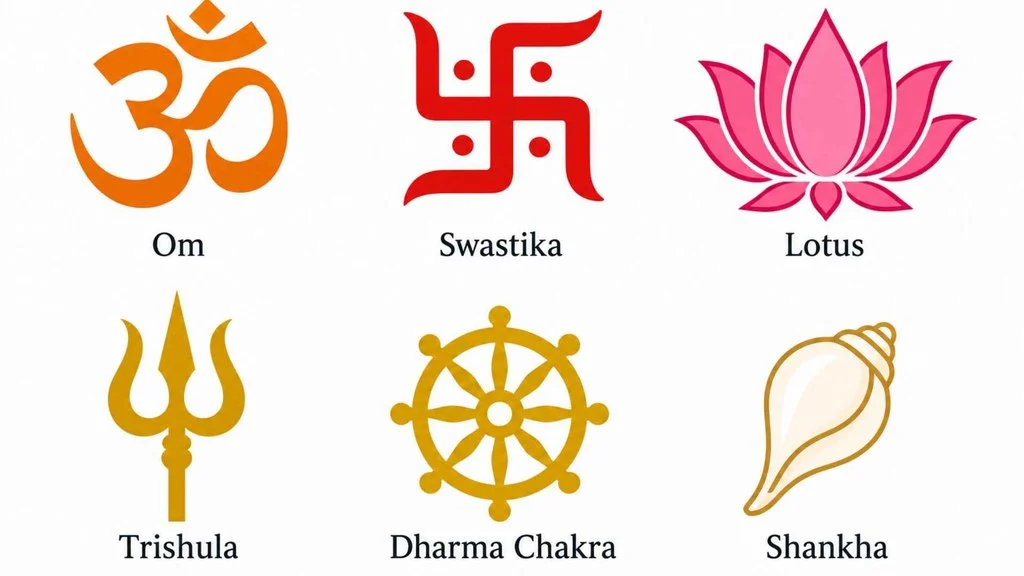
Some Hindu symbols are especially important because they connect directly to major deities, sacred texts, ritual practices, and philosophical teachings.
The following symbols are among the most widely recognized:
Om (ॐ): Represents a sacred sound and is associated with spiritual knowledge and ultimate reality.
Swastika (卐): A traditional sign of auspiciousness used in Hindu ceremonies, festival decorations, and religious art.
Trishula (🔱): Shiva’s trident, associated with divine power and transformation.
Lotus (🪷): Represents purity, beauty, and spiritual growth, and is associated with deities such as Lakshmi and Brahma in Hindu art.
Shankha (Conch): Associated with Vishnu and used in certain religious rituals.
Kalasha: A ceremonial vessel representing auspiciousness and abundance in many Hindu rites.
Tilak: A forehead marking that can express devotion, blessing, or religious affiliation.
Shri (श्री): An honorific associated with respect, auspiciousness, and prosperity.
These symbols appear in many settings, but their importance is not identical for all Hindus. Regional customs, family traditions, and religious affiliations influence which symbols receive the most attention.
Sacred Hindu Symbols
Sacred Hindu symbols are used in worship, meditation, ceremonies, and the representation of spiritual ideas. Many are connected to specific deities or religious texts, while others express broader concepts such as dharma, prosperity, and spiritual awakening.
Examples of Sacred Symbols
- Om (ॐ): Used in mantras, prayer, and meditation.
- Shri Yantra: A sacred geometric diagram associated with the Goddess and, in many traditions, Sri Vidya worship.
- Shankha: A conch used in certain forms of ritual worship.
- Kalasha: A ceremonial pot used in auspicious rites and celebrations.
- Tripundra: Three horizontal lines of sacred ash associated with Shaiva traditions.
- Tilak: A mark applied to the forehead in several Hindu traditions, with forms that vary by community.
- Sacred Lotus: A motif associated with deities and spiritual qualities.
Sacred diagrams such as the Shri Yantra should be distinguished from ordinary geometric decoration. In their religious settings, their structure and use can carry specific ritual and philosophical significance.
Indian Hindu Symbols
Hindu symbols form an important part of India’s religious and cultural heritage. They can be seen in temples, homes, festival decorations, classical dance, sculpture, traditional textiles, and ceremonial objects.
Some are widely shared across Hindu communities, while others are closely associated with particular regions or traditions.
| Symbol | Cultural or Religious Connection |
| ॐ | Prayer, meditation, and sacred sound |
| 卐 | Auspiciousness in Hindu ceremonies |
| 🪷 | Lotus imagery in religious art |
| 🔱 | Shiva worship |
| श्री | Respect and auspicious beginnings |
| Kalasha | Rituals, weddings, and festivals |
| Tilak | Religious identity and blessings |
| Rangoli Patterns | Decorative designs made for auspicious occasions |
| Diya | Oil lamp used in worship and festivals |
Rangoli and diya designs are especially visible during festivals such as Diwali, although regional names and customs differ. A diya can represent light, worship, or the victory of light over darkness, depending on the occasion.
Indian Hindu symbolism is not limited to one visual style. Temple carvings in South India, Himalayan traditions, Bengali festival art, and Rajasthani decorative patterns may use different forms while expressing related religious ideas.
Karma Hindu Symbols
Karma is a central concept in several Indian religious and philosophical traditions, including Hinduism. It broadly concerns action and its consequences, with interpretations shaped by particular schools of thought.
There is no single universally recognized symbol that exclusively represents karma in Hinduism. Instead, several images may be used in modern artwork to communicate ideas about action, responsibility, spiritual development, and the consequences of choices.
Common visual associations include:
- Dharma Chakra: A wheel that can represent dharma and spiritual teaching. It is especially prominent in Buddhism, so it should not automatically be labeled a uniquely Hindu karma symbol.
- Lotus: Often used in modern designs to express spiritual growth and the possibility of rising above difficult circumstances.
- Om (ॐ): Represents a sacred sound and spiritual reality rather than karma specifically.
- Balance or Wheel Motifs: Sometimes used in contemporary artwork to express cause and effect, although such designs do not have one universal traditional meaning.
The relationship between karma and dharma is important. Dharma can refer to duty, right conduct, or a broader moral and cosmic order, depending on context. Karma concerns actions and their consequences. These concepts are related but not interchangeable.
If you want a tattoo or pendant representing karma, a lotus or a carefully chosen wheel motif may communicate your intended idea, but it is best to explain that this is a personal or contemporary interpretation rather than an exclusive ancient symbol.
Common Hindu Symbols
Common Hindu symbols appear in everyday worship, household traditions, temples, and religious celebrations. Many people recognize these symbols even if they are unfamiliar with their deeper philosophical meanings.
The most familiar examples include Om, the traditional swastika, the lotus, the Trishula, the conch, and the tilak. These designs appear on prayer items, religious calendars, festive decorations, and devotional gifts.
Other common forms include the diya, a small oil lamp; the Kalasha, a ceremonial vessel; and the sacred thread used in particular Hindu rituals. The meaning of each object depends on how it is used.
For instance, the traditional swastika may be drawn at an entrance or on a ceremonial object to express auspiciousness. A tilak may indicate devotion to a particular deity or tradition. The same mark should not be assumed to carry exactly the same meaning in every region.
When learning about common Hindu symbols, it helps to separate widely shared practices from customs that belong to a specific community. This makes their meanings easier to understand without treating Hinduism as a single uniform tradition.
Hindu Symbols Om Meaning
The meaning of Om (ॐ) is closely connected to Hindu ideas about sacred sound, consciousness, and ultimate reality. It is frequently recited during prayer and meditation and appears in many religious texts and ceremonies.
In the Mandukya Upanishad, Om receives a detailed philosophical explanation. The syllable is discussed through the sounds A, U, and M, together with the silence associated with its completion. Interpretations connect these elements with different states of consciousness and a reality that goes beyond ordinary experience.
Om is also used as an opening syllable in many mantras. Its presence can establish a devotional or meditative setting, but its role differs among practices.
For a simple digital design, the character ॐ is the clearest text form to use. For a traditional artwork, select a script and visual style appropriate to the intended religious context. Avoid treating every decorative symbol that resembles Om as an authentic representation of the sacred character.
Hindu Symbols Text
Hindu symbols and religious words can make text more meaningful when used in devotional messages, festival greetings, or personal profiles. Devanagari characters are particularly useful when you want to include traditional Sanskrit or Hindi writing.
Here are additional text examples and their meanings.
| Text | Meaning or Use |
| ॐ नमः शिवाय | A mantra expressing reverence to Shiva |
| हरे कृष्ण | A devotional expression associated with Krishna |
| श्री गणेशाय नमः | A traditional invocation of Ganesha |
| शुभ दीपावली | A greeting meaning “Auspicious Diwali” |
| सत्यमेव जयते | “Truth alone triumphs” |
| शान्तिः | Peace |
| धर्म | Dharma, duty, or religious order, depending on context |
| कर्म | Karma, action and its consequences |
| शक्ति | Shakti, power or divine energy |
| भक्ति | Bhakti, devotion |
These are meaningful words and phrases rather than all being standalone symbols. Use the appropriate spelling and diacritical marks when writing Sanskrit or Hindi, especially for educational or religious content.
For social media, a phrase such as “ॐ नमः शिवाय” can express devotion, while “शुभ दीपावली” is suitable for a Diwali greeting. If your audience uses different scripts, consider adding a translation so the message remains clear.
Hindu Symbols and Their Meanings
Hindu symbols and their meanings are closely linked to mythology, sacred literature, philosophy, and devotional practices. A symbol can refer to a deity, a spiritual principle, or a religious action.
Here are some additional examples that help explain the range of Hindu symbolism.
- Nandi: The sacred bull associated with Shiva. Nandi is often depicted facing a Shiva shrine and is connected with devotion and service.
- Garuda: A divine bird associated with Vishnu. It appears in religious art and stories about Vishnu’s power.
- Sudarshana Chakra: Vishnu’s discus, associated with divine authority and the protection of dharma.
- Veena: A musical instrument associated with Saraswati, the goddess of learning, music, and the arts.
- Lotus Seat: A common feature in images of Hindu deities, suggesting sacredness and spiritual beauty.
- Third Eye of Shiva: Associated with spiritual insight and Shiva’s power to destroy ignorance and transform the universe.
- Sacred Fire: Used in many Hindu rituals and associated with offerings, purification, and divine presence.
Not every object has one fixed meaning. For example, the veena is a real musical instrument as well as an important attribute of Saraswati in religious imagery. Its interpretation depends on whether it appears in worship, sculpture, a painting, or a general musical context.
Hindu Symbols and Meaning
Understanding the meaning of a Hindu symbol often requires knowing the deity, story, or ritual connected to it. The shape alone may not tell the whole story.
Consider these distinctions:
| Symbol or Object | What It Commonly Represents |
| Trishula | Shiva and divine power |
| Damaru | Shiva’s drum and sacred rhythm |
| Shankha | Vishnu, ritual worship, and auspiciousness |
| Sudarshana Chakra | Vishnu and divine protection of dharma |
| Veena | Saraswati and knowledge through music |
| Lotus | Purity and spiritual growth |
| Tilak | Devotion, blessing, or religious affiliation |
| Diya | Light, worship, and auspicious celebration |
These examples show why it is helpful to identify the object before interpreting it. A wheel held by Vishnu, for example, is generally understood as the Sudarshana Chakra, while a wheel used in a different religious tradition may have another meaning.
If you are researching an unfamiliar symbol, look for its traditional name, the deity or figure shown with it, and the context in which it appears. These details are more reliable than assigning a meaning based only on its shape.
Hindu Symbols and Meanings
Hindu symbolism also includes ideas expressed through colors, gestures, patterns, and arrangements. Not every sacred symbol is a single character that can be copied into text.
For example, a deity’s hand gesture may represent blessing, reassurance, or teaching. The Abhaya Mudra, commonly shown with the palm raised outward, is associated with fearlessness and reassurance. The Varada Mudra, often depicted with the hand extended downward, is associated with generosity or granting blessings.
Colors may also carry associations in particular settings. Saffron is often linked with renunciation and spiritual life, while red is prominent in many auspicious ceremonies and wedding traditions. However, color meanings are not universal rules and can vary by region and ritual.
Sacred geometry is another part of Hindu symbolism. Yantras use carefully arranged geometric forms in specific spiritual traditions. Their designs should be interpreted in context rather than treated as interchangeable decorative patterns.
Understanding these visual details makes it easier to appreciate Hindu paintings, temple sculptures, and religious ceremonies. It also helps you choose artwork that represents the intended concept accurately.
Hindu Symbols Tattoos
Hindu symbol tattoos are often chosen to represent personal devotion, spiritual growth, cultural heritage, or a connection to a particular deity. Some people prefer a simple character, while others choose a more detailed religious design.
8
Popular tattoo ideas include:
- Om Tattoo: Represents a sacred sound and spiritual awareness.
- Trishula Tattoo: Associated with Shiva, transformation, and divine strength.
- Lotus Tattoo: Often chosen to express purity, growth, and resilience.
- Shri Yantra Tattoo: A detailed geometric design connected with specific Hindu spiritual practices.
- Shiva Lingam Tattoo: A religiously significant representation of Shiva that should be approached with an understanding of its role in worship.
- Sudarshana Chakra Tattoo: Associated with Vishnu and the protection of dharma.
- Devanagari Mantra Tattoo: Uses a sacred phrase such as Om Namah Shivaya.
Before choosing a tattoo, verify the spelling of any Sanskrit phrase and check the design against reliable traditional examples. Fine details can blur in small tattoos, so a simpler design may be more readable over time.
Consider placement carefully, particularly for sacred names and symbols. Views about tattooing religious imagery differ among individuals and Hindu communities, so personal and cultural context matters.
Positive Energy Hindu Symbols Tattoos
Many people look for Hindu-inspired tattoos that represent positive energy, inner strength, harmony, or spiritual development. These meanings are often personal interpretations shaped by Hindu beliefs, individual experiences, and modern tattoo culture.
8
Here are some designs people choose for these purposes.
- Om (ॐ): Selected as a reminder of meditation, spiritual awareness, and connection with the sacred.
- Lotus: Often represents growth, purity, and the ability to rise above difficult circumstances.
- Surya Imagery: The sun deity Surya is associated with light, vitality, and cosmic order in Hindu traditions.
- Shri Yantra: Used in particular spiritual traditions and sometimes chosen for its associations with meditation and sacred geometry.
- Traditional Swastika (卐): Represents auspiciousness and well-being in Hindu contexts. Its historical and religious background should be understood, especially when using it in international settings.
- Trishula (🔱): Represents Shiva and may be chosen to express strength, devotion, or transformation.
A tattoo does not have a universal power to attract energy or guarantee good fortune. These designs are better understood as religious symbols or personal reminders of qualities the wearer values.
If you choose a sacred design, research its traditional use and make sure the artist understands the details. This is particularly helpful for Sanskrit lettering, yantras, and symbols whose orientation or arrangement matters.
All Hindu Symbols
There is no single definitive catalogue of all Hindu symbols. Hinduism includes many traditions, deities, regional practices, and forms of worship, so its visual language is extensive.
The following list brings together additional important symbols and objects that may help with research or design selection.
| Symbol or Name | Association |
| Ganesha | Wisdom and the removal of obstacles |
| Lakshmi | Prosperity and abundance |
| Saraswati | Knowledge, music, and learning |
| Vishnu’s Chakra | Divine authority and protection of dharma |
| Garuda | Vishnu’s divine mount |
| Nandi | Shiva’s sacred bull |
| Damaru | Shiva’s drum |
| Abhaya Mudra | Fearlessness and reassurance |
| Varada Mudra | Giving and blessings |
| Diya | Light and worship |
| Kalasha | Auspiciousness and ritual use |
| Tripundra | Shaiva identity |
| Vaishnava Tilak | Devotional marking used in Vaishnava traditions |
| Shri Yantra | Sacred geometry in specific Hindu traditions |
| Sacred Tulsi Plant | Devotional significance in many Vaishnava households |
Some entries are symbols, some are sacred objects, and others are gestures, plants, or images associated with particular deities. They belong in a broad guide to Hindu symbolism, but they should not all be treated as identical kinds of symbols.
When researching a symbol, consider its name, religious context, and traditional use. This helps distinguish established meanings from modern decorative interpretations and makes your choice more informed.
Frequently Asked Questions
What is the most sacred symbol in Hinduism?
Om (ॐ) is widely regarded as one of the most sacred symbols in Hinduism. It is associated with sacred sound, meditation, spiritual knowledge, and ultimate reality.
Which Hindu symbol represents protection?
The Trishula, images of Hanuman, and certain sacred markings are associated with divine strength or protection in different Hindu traditions. Their significance depends on religious context and personal belief.
What does the Hindu lotus symbol mean?
The lotus commonly represents purity, spiritual growth, and beauty. Its ability to rise above muddy water makes it a meaningful image in Hindu religious art.
What is the difference between Om and the Swastika?
Om (ॐ) represents a sacred sound and spiritual reality, while the traditional Hindu swastika (卐) is an auspicious sign associated with well-being and good fortune. They have different forms and meanings.
Which Hindu symbols are suitable for tattoos?
Om, the lotus, the Trishula, and certain deity-related designs are popular choices. Before getting a tattoo, verify the design and any Sanskrit text, and consider its religious significance and placement.
Conclusion
Hindu symbols express a wide range of ideas, including devotion, wisdom, auspiciousness, protection, and spiritual growth. Symbols such as Om, the lotus, the Trishula, and the traditional swastika each have distinctive histories and meanings rooted in Hindu religious and cultural traditions.
These symbols appear in temple art, household worship, festival decorations, jewelry, tattoos, and digital text. Copy-and-paste characters are convenient for everyday messages, while detailed yantras and traditional deity symbols are often better represented through carefully chosen images.
The best way to choose a Hindu symbol is to understand what it represents and how it is used. Learning its background helps you appreciate its significance and use it respectfully, whether for personal devotion, research, or a creative project.

Hi, I’m Sienna Brooks, and I believe that the right words can inspire, comfort, and empower people at every stage of life. For as long as I can remember, I’ve been drawn to meaningful quotes and the stories behind them. I love curating collections of inspirational, motivational, and heartfelt quotes that resonate with readers around the world.
Through my writing, I strive to help others find encouragement, whether they’re celebrating life’s happiest moments or navigating its biggest challenges. I believe that wisdom is timeless, and I’m passionate about sharing words that leave a lasting impact.
I am the author of Reflections in Words and The Journey of Inspiration, two books dedicated to exploring the beauty and power of timeless quotes.
 Rowan Sinclair Rowan Sinclair