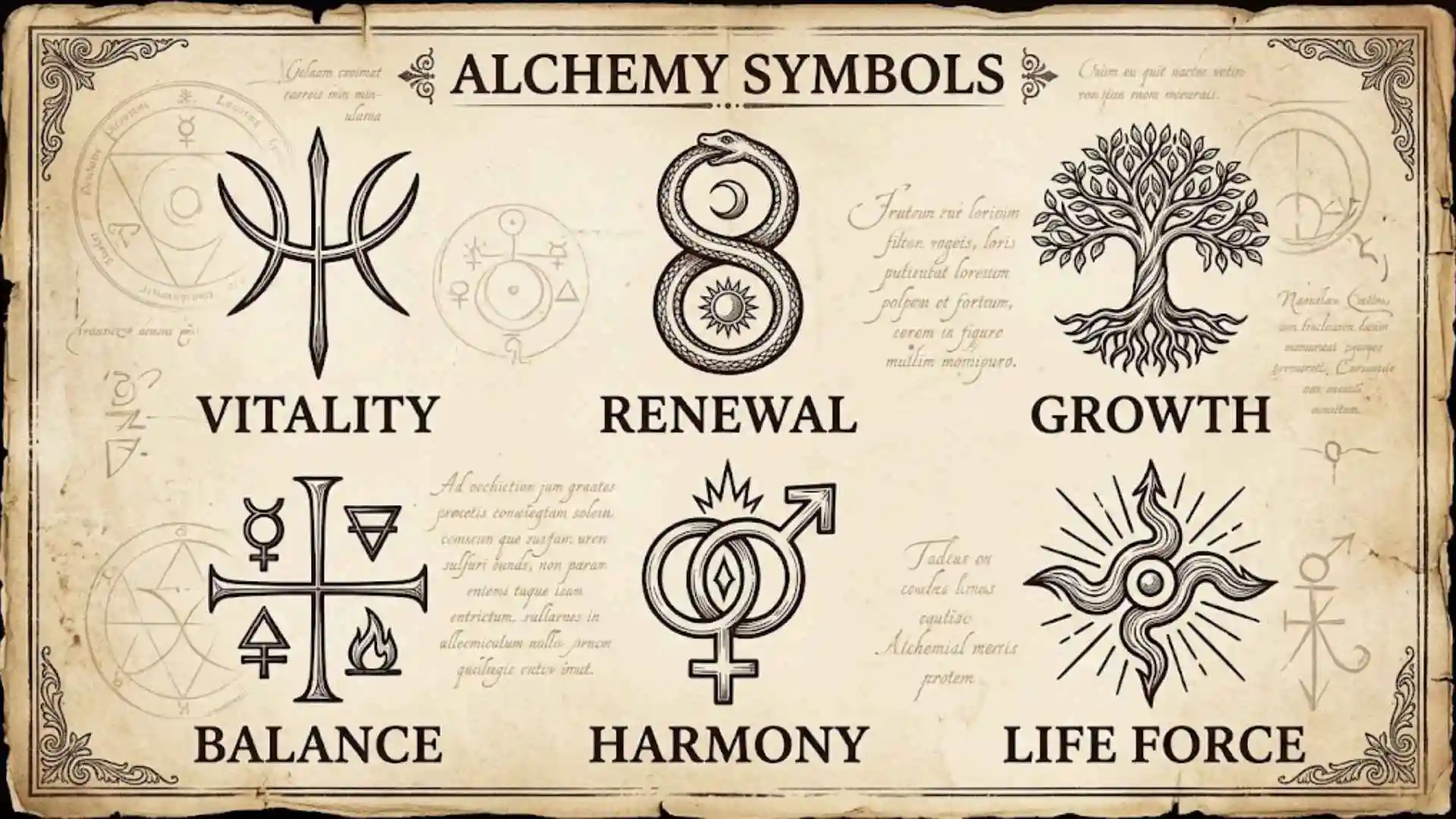
Alchemy symbols offer a fascinating look into ancient science, philosophy, spirituality, and the search for transformation. Early alchemists used special signs to represent metals, elements, planets, laboratory processes, and substances. Over time, these symbols also became associated with personal growth, spiritual change, and the idea of turning something ordinary into something valuable.
From the symbols of gold, silver, mercury, and sulfur to sacred geometry and the seven stages of spiritual alchemy, each group has its own history and interpretation. Some signs come from historical manuscripts, while others are modern designs inspired by alchemical philosophy. Understanding this difference helps you explore their meanings without confusing historical evidence with later spiritual interpretations.
In this guide, you will discover an alchemy symbols list, ancient and Hermetic symbols, elemental signs, transmutation symbols, and spiritual interpretations. You will also find text symbols you can copy and paste for notes, creative projects, tattoos, and social media profiles.
Alchemy Symbols and Meanings
Alchemy symbols were used by practitioners to record substances, describe experiments, and communicate ideas about nature. Alchemy developed across several traditions, including Greco-Egyptian, Arabic, European, Indian, and Chinese contexts. Their symbols did not all share the same meanings or history.
The following table introduces some well-known symbols associated with Western alchemy.
| Symbol | Name | Common Association |
| 🜂 | Fire | Heat, combustion, transformation |
| 🜄 | Water | Liquid, dissolution, fluidity |
| 🜁 | Air | Gases, breath, movement |
| 🜃 | Earth | Solid matter, stability |
| 🜔 | Salt | Salt as an alchemical principle |
| ☿ | Mercury | Mercury, the planet Mercury, or a broader alchemical principle |
| 🜍 | Sulfur | Sulfur and its role in alchemical theory |
| 🜚 | Gold | Gold in historical alchemical notation |
| 🜛 | Silver | Silver in historical alchemical notation |
| 🜖 | Sublimation | A sign associated with a specific alchemical operation |
These are historical or traditional alchemical characters, not a universal code in which every symbol always means the same thing. Interpretations can vary by manuscript, period, and author.
For example, gold could represent a material sought by alchemists and, in later spiritual interpretations, perfection or enlightenment. The spiritual meaning should not be confused with the historical use of a symbol to identify a substance.
Alchemy Symbols List
An alchemy symbols list usually includes signs for metals, elements, substances, and processes. Some have familiar astronomical origins, while others belong to specialized alchemical notation.
| Symbol | Name | Typical Use or Meaning |
| ☉ | Sun | Sun; often associated with gold |
| ☽ | Moon | Moon; often associated with silver |
| ☿ | Mercury | Mercury and its planetary association |
| ♀ | Venus | Venus; often associated with copper |
| ♂ | Mars | Mars; often associated with iron |
| ♃ | Jupiter | Jupiter; often associated with tin |
| ♄ | Saturn | Saturn; often associated with lead |
| 🜂 | Fire | Fire element |
| 🜄 | Water | Water element |
| 🜁 | Air | Air element |
| 🜃 | Earth | Earth element |
| 🜍 | Sulfur | Sulfur |
| 🜔 | Salt | Salt |
| 🜚 | Gold | Gold |
| 🜛 | Silver | Silver |
The planetary symbols are also used in astronomy and astrology, so their meaning depends on context. In alchemical writing, a planetary sign may identify a metal, while in astronomy it may refer to a celestial body.
Alchemical notation also includes symbols for distillation, calcination, dissolution, sublimation, and other operations. A historical manuscript may use a unique sign or abbreviation that cannot be interpreted accurately without its surrounding text.
Spiritual Alchemy Symbols
Spiritual alchemy is a philosophical interpretation of alchemy that treats transformation as a metaphor for inner development. In this approach, changing a substance becomes a way to describe changes in character, awareness, or understanding.
Common symbols used in modern spiritual interpretations include:
- The Sun (☉): Often represents clarity, vitality, consciousness, or illumination.
- The Moon (☽): Can represent intuition, reflection, or the hidden side of experience.
- The Ouroboros (🐍): A serpent or dragon consuming its own tail, traditionally associated with cycles, renewal, and unity.
- The Philosopher’s Stone: A legendary goal of alchemy associated with transmutation and, in some interpretations, perfection.
- The Phoenix: A mythical bird associated with death, renewal, and rebirth.
- The Circle: Can suggest unity, completeness, or an unbroken cycle.
These interpretations are not universal historical definitions. The circle, for instance, has many meanings in different cultures, and the phoenix is a mythological image rather than a single standardized alchemical character.
Spiritual alchemy symbols are often used in journals, meditation artwork, personal emblems, and designs that represent growth or a new stage of life.
Spiritual Alchemy Symbols and Meanings
Spiritual alchemy connects the language of transformation with ideas about personal growth. Its symbols are commonly interpreted as stages of reflection, change, and renewal, although meanings differ across modern spiritual traditions.
| Symbol | Spiritual Interpretation |
| ☉ Sun | Awareness, clarity, and illumination |
| ☽ Moon | Intuition, reflection, and inner life |
| 🜂 Fire | Change, energy, and purification |
| 🜄 Water | Emotions, adaptability, and cleansing |
| 🜃 Earth | Stability, grounding, and patience |
| 🜁 Air | Thought, communication, and movement |
| Ouroboros | Cycles, continuity, and renewal |
| Phoenix | Rebirth after difficulty |
These associations can help when choosing symbols for a personal journal, artwork, or meditation space. However, they are interpretive rather than a fixed dictionary of ancient meanings.
A fire symbol, for example, may refer to literal heat in a historical recipe and to personal transformation in a contemporary spiritual design. Always consider the source before assigning a meaning.
Alchemy Symbols Text
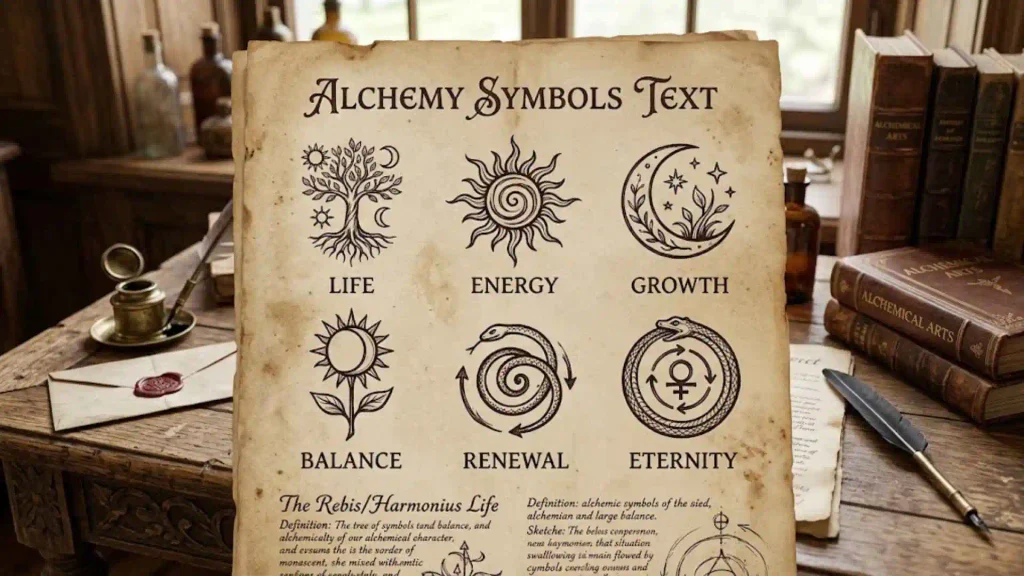
Alchemy symbols in text can be useful for digital notes, educational writing, creative projects, and decorative designs. Several alchemical characters are included in Unicode, the international standard used to encode text across digital systems.
Here are some characters commonly associated with alchemy:
- 🜂 — Alchemical symbol for fire
- 🜄 — Alchemical symbol for water
- 🜁 — Alchemical symbol for air
- 🜃 — Alchemical symbol for earth
- 🜍 — Alchemical symbol associated with sulfur
- 🜔 — Alchemical symbol associated with salt
- ☿ — Mercury
- ☉ — Sun
- ☽ — Moon
- ♀ — Venus
- ♂ — Mars
- ♃ — Jupiter
- ♄ — Saturn
The four elemental characters and specialized alchemical signs belong to the Unicode Alchemical Symbols block, while planetary characters such as ☿ and ☉ are encoded in other Unicode blocks.
If a character does not display properly, the font or application may lack support for it. In that case, use a suitable font or an image of the symbol. Avoid substituting a similar-looking character when accuracy matters.
Hermetic Alchemy Symbols
Hermetic alchemy is connected with a broad philosophical tradition that blends ideas about nature, spiritual understanding, and the relationship between different levels of reality. Its history overlaps with ancient Hermetic writings and later European alchemical traditions.
Important symbols associated with Hermetic alchemy include:
- Mercury (☿): A metal and planetary symbol; in some Hermetic interpretations, it also represents a mediating or changeable principle.
- Sulfur (🜍): A material used in alchemy that became associated with active or combustible qualities in certain theories.
- Salt (🜔): A substance connected with preservation and material stability in some later alchemical systems.
- The Sun (☉): Associated with gold and sometimes with perfection or illumination.
- The Moon (☽): Associated with silver and lunar symbolism.
- The Ouroboros: A circular serpent image used in alchemical and related traditions to express continuity or cyclical change.
The meanings of these symbols depend on the text and period. Modern explanations sometimes present them as a single, universal spiritual system, but historical Hermetic and alchemical traditions were diverse.
Alchemy Symbols Meaning
The meaning of an alchemy symbol depends on whether it appears in a practical recipe, a philosophical text, an illustration, or a modern spiritual design.
For example, ☿ can identify mercury as a substance, refer to the planet Mercury, or carry a broader philosophical association. Similarly, ☉ is the Sun sign and was also used in alchemical contexts associated with gold.
Three useful distinctions can help you interpret alchemical symbols:
- Material meanings: A sign identifies a metal, mineral, element, or other substance.
- Process meanings: A sign describes an operation such as heating, dissolving, distilling, or sublimating.
- Philosophical meanings: An author uses an image to discuss transformation, nature, or spiritual ideas.
A symbol may work on more than one level in the same text. Read it alongside the surrounding instructions and illustrations rather than assuming its meaning from appearance alone.
Alchemy Symbols for Elements
The four classical elements—fire, water, air, and earth—are important in many Western philosophical and alchemical traditions. Their alchemical characters are particularly useful for identifying elemental themes in modern artwork and some historical references.
🜂
Fire
Associated with heat, burning, energy, and transformation.
🜄
Water
Associated with liquid, dissolution, and fluidity.
🜁
Air
Associated with air, movement, and the gaseous state.
🜃
Earth
Associated with solid matter, grounding, and stability.
In some traditional diagrams, fire and air are represented by upward-pointing triangles, while water and earth use downward-pointing triangles. The triangle alone is a geometric form, so its meaning depends on the diagram or tradition in which it appears.
These classical elements are philosophical categories, not the same thing as modern chemical elements on the periodic table.
Sacred Geometry Alchemy Symbols
Sacred geometry refers to shapes and geometric arrangements given symbolic or spiritual significance. Geometry appears in alchemical illustrations, philosophical diagrams, religious art, and many other traditions.
Common geometric forms used in alchemy-inspired designs include:
- Circle: Can represent unity, wholeness, or a repeating cycle.
- Triangle: In elemental diagrams, its orientation helps distinguish fire, air, water, and earth.
- Square: May suggest structure, stability, or material order in modern interpretations.
- Circle Within a Circle: Can be used to express unity or a relationship between parts and a whole.
- Interlocking Geometric Forms: Often used in contemporary artwork to suggest balance, connection, or transformation.
These meanings are not universal. A geometric figure may have a precise technical role in a historical diagram or a more flexible symbolic role in modern art. Sacred geometry designs should not automatically be described as ancient alchemical symbols without evidence from a historical source.
All Alchemy Symbols
No single list contains every alchemical symbol used across all periods and cultures. Different authors created variations, and some manuscripts included local abbreviations or signs that were not widely shared.
The major categories include:
| Category | Examples | Purpose |
| Planets and metals | ☉, ☽, ☿, ♀, ♂, ♃, ♄ | Identify celestial bodies and associated metals |
| Classical elements | 🜂, 🜄, 🜁, 🜃 | Identify fire, water, air, and earth |
| Alchemical substances | 🜍, 🜔 | Represent sulfur and salt |
| Operations | Specialized process signs | Describe laboratory procedures |
| Philosophical imagery | Ouroboros, phoenix, geometric figures | Communicate ideas through images and allegory |
The best way to use an alchemical reference is to identify the symbol first, then check its meaning in the particular historical or artistic context. This avoids mixing signs from unrelated traditions.
Transmutation Alchemy Symbols
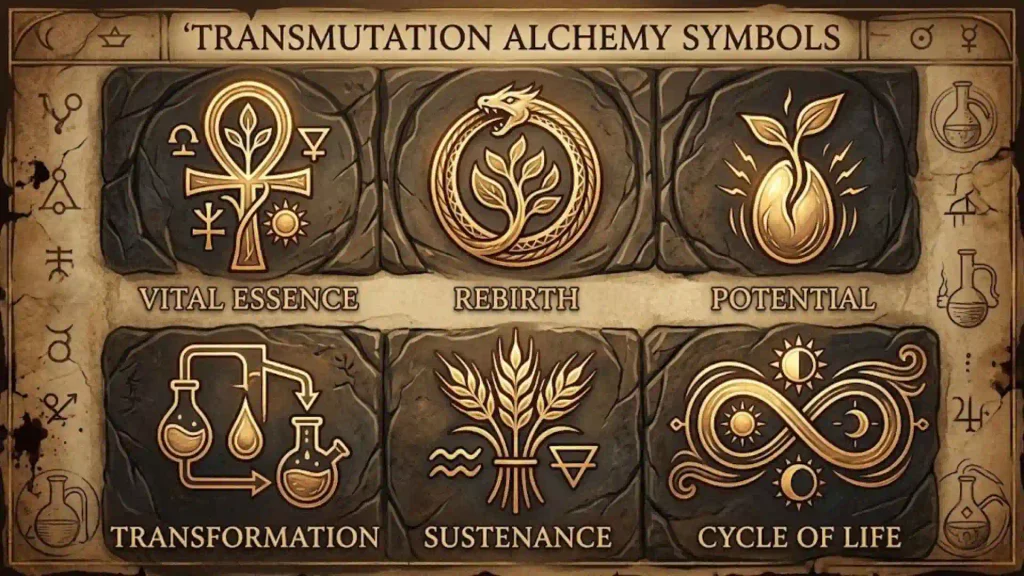
Transmutation is the process of changing one substance into another. In historical alchemy, it often referred to attempts to transform base metals into noble metals such as gold. Alchemical writing also used transmutation as a philosophical image of change.
Several symbols are connected with this idea:
- ☉ Sun: Associated with gold in traditional planetary-metal correspondences.
- ☿ Mercury: Represents mercury and has an important role in many alchemical theories.
- 🜂 Fire: Connected with heating and other processes that change materials.
- The Ouroboros: Represents cyclical change or continuity in some alchemical imagery.
- The Philosopher’s Stone: A legendary substance associated with the goal of transmutation, although it is generally represented through illustrations or written descriptions rather than one universally standardized character.
These symbols do not all mean transmutation by themselves. Their relationship to transformation depends on the work in which they appear.
Ancient Spiritual Alchemy Symbols
Ancient alchemical traditions developed in different regions and periods, and spiritual interpretations were not identical across them. Western alchemy, Chinese alchemy, and Indian alchemical traditions each have distinctive histories and terminology.
Symbols used in modern discussions of spiritual alchemy often include the Sun, Moon, serpent, phoenix, and circle. They can represent cycles, renewal, knowledge, and the relationship between material and spiritual life.
The Ouroboros is especially recognizable: it depicts a serpent or dragon eating its own tail. Related images appeared in ancient and later alchemical contexts, where they could communicate ideas about unity, cycles, and the relationship between beginnings and endings.
The phoenix is another popular image of renewal. In contemporary spiritual artwork, it often represents starting again after a difficult period. That interpretation is useful as a modern metaphor, but it should not be treated as the fixed meaning of every historical alchemical illustration.
Alchemy Symbols Manuscript
Alchemical manuscripts are among the most valuable sources for studying how these symbols were actually used. They contain handwritten recipes, diagrams, illustrations, and abbreviations that sometimes differ from modern reference charts.
When examining an alchemical manuscript, look for three types of evidence:
- The surrounding text: Instructions can reveal whether a sign identifies an ingredient, a tool, or an operation.
- The date and location: Symbols and terminology changed across centuries and regions.
- The diagram: A sign drawn beside a vessel or heating apparatus may have a practical meaning rather than a spiritual one.
Some historical manuscripts are digitized by libraries and museums. Reproductions can help you study the original notation, but a modern transcription or scholarly commentary is often needed to interpret difficult handwriting.
Be cautious with online images labelled “ancient alchemy symbols.” Without a reliable source, it may be impossible to establish their date, origin, or original meaning.
Alchemy Symbols Tattoo
Alchemy symbols are popular tattoo choices because their simple shapes can represent transformation, balance, mystery, and personal development. A symbol can also appeal to someone interested in the history of science or medieval art.
Popular design ideas include:
- Fire (🜂): For transformation, energy, or change.
- Water (🜄): For adaptability or emotional depth.
- Mercury (☿): For historical alchemical interest and associations with change.
- The Ouroboros: For cycles, continuity, and renewal.
- The Sun (☉): For light, vitality, or its historical connection with gold.
- The Four Elements: A collection representing different aspects of nature.
Before getting a tattoo, verify the exact character and its intended meaning. A symbol can look different in different fonts, and a Unicode character may not match the historical illustration you have in mind.
For a lasting design, ask the tattoo artist to work from a clear reference image. If historical accuracy matters to you, use a documented manuscript or a reputable historical source rather than relying solely on modern social media graphics.
Transmutation Spiritual Alchemy Symbols
Transmutation in spiritual alchemy is often used as a metaphor for inner change. Instead of turning one metal into another, the focus is on changing habits, understanding, or one’s approach to life.
Common symbols used to express this idea include:
| Symbol | Modern Spiritual Interpretation |
| 🜂 Fire | Releasing old patterns and embracing change |
| ☉ Sun | Clarity and awareness |
| ☽ Moon | Reflection and intuition |
| Ouroboros | Repeated cycles of growth |
| Phoenix | Renewal after a setback |
| Circle | Wholeness or continuity |
These interpretations can be useful for personal artwork, meditation journals, or symbolic jewelry. They are not a universal historical system, and the same image can communicate a different message in another context.
For example, a phoenix may represent a fresh start in a modern tattoo, while a historical alchemical illustration might use other imagery to describe a specific material process. Understanding the difference keeps the symbolism meaningful and accurate.
Alchemy Symbols Copy Paste
If you want alchemy symbols for social media, notes, messages, or creative writing, the following characters can be copied directly where supported.
🜂
Fire
🜂
Copy
🜄
Water
🜄
Copy
🜁
Air
🜁
Copy
🜃
Earth
🜃
Copy
🜍
Sulfur
🜍
Copy
🜔
Salt
🜔
Copy
☉
Sun
☉
Copy
☽
Moon
☽
Copy
☿
Mercury
☿
Copy
♀
Venus
♀
Copy
♂
Mars
♂
Copy
♃
Jupiter
♃
Copy
♄
Saturn
♄
Copy
To use a symbol, select its Copy button and paste it into the application you want. You can combine characters with ordinary text to create a simple design, such as ☉ ☽ ☿ for a planetary-themed heading.
Display can vary between fonts, operating systems, and applications. If a symbol appears as an empty box, try another font or use an image. Also remember that the planetary characters are not exclusive to alchemy; they have other established uses.
Protection Transmutation Alchemy Symbols
Some modern spiritual communities associate alchemical-inspired designs with protection, balance, and personal transformation. These interpretations are best understood as symbolic beliefs rather than proven protective effects.
Common design choices include:
- Circle: Often used to suggest wholeness, boundaries, or completeness.
- Earth (🜃): Can represent grounding and stability.
- Fire (🜂): May symbolize strength or the ability to move through change.
- Ouroboros: Can represent continuity and the cycle of renewal.
- The Philosopher’s Stone: In modern spiritual interpretations, may represent the search for wisdom or personal completion.
There is no single historical alchemical sign universally recognized as a guarantee of protection or transmutation. A symbol may hold personal meaning, but it should not be presented as an object that can reliably prevent harm or change physical reality.
If you choose one for a pendant, tattoo, or personal emblem, decide whether you are drawn to its documented history, modern spiritual meaning, or visual design.
Medieval Alchemy Symbols
Medieval European alchemy used a combination of planetary signs, metal symbols, elemental marks, and specialized abbreviations. These appeared in manuscripts, laboratory notes, and illustrations describing experiments.
Some important examples are:
- ☉ — Sun: Used in planetary symbolism and associated with gold.
- ☽ — Moon: Associated with silver.
- ☿ — Mercury: Used for the metal mercury and its planetary counterpart.
- ♀ — Venus: Associated with copper in traditional correspondences.
- ♂ — Mars: Associated with iron.
- ♃ — Jupiter: Associated with tin.
- ♄ — Saturn: Associated with lead.
These correspondences helped organize alchemical knowledge, but they were not simply a modern chemical notation system. Medieval writers also used written instructions, drawings, and symbols whose meanings depended on the particular manuscript.
Medieval alchemy was not exclusively European. Knowledge and techniques travelled between cultures, and Arabic-language scholarship played an important role in the development of alchemical literature in Europe. The symbols found in one tradition should not automatically be attributed to all others.
7 Stages of Alchemy Symbols
The seven stages of alchemy are widely discussed in modern spiritual and psychological interpretations. They are often presented as a journey from breaking down old patterns to developing a clearer sense of self. Different authors use different stage names and symbolic associations.
| Stage | Common Name | Symbolic Interpretation |
| 1 | Calcination | Breaking down old assumptions |
| 2 | Dissolution | Examining emotions and inner life |
| 3 | Separation | Distinguishing what matters from what does not |
| 4 | Conjunction | Bringing different parts together |
| 5 | Fermentation | New ideas or perspectives emerging |
| 6 | Distillation | Refining understanding |
| 7 | Coagulation | Integrating change into everyday life |
These stages are based on alchemical operations that later writers interpreted metaphorically. They should not be treated as a universal ancient spiritual program followed by every alchemist.
In historical practice, calcination involved heating a substance, dissolution involved dissolving material, and distillation involved separating components through vaporization and condensation. The spiritual meanings developed through interpretation and analogy.
This framework is useful for reflective writing or symbolic artwork, provided you distinguish the modern personal-growth model from documented historical laboratory practice.
Alchemy Symbols List
An alchemy symbols list can also be organized by the purpose each sign serves. This makes it easier to identify a character before researching its meaning.
| Symbol | Category | Common Association |
| 🜂 | Element | Fire |
| 🜄 | Element | Water |
| 🜁 | Element | Air |
| 🜃 | Element | Earth |
| 🜍 | Substance | Sulfur |
| 🜔 | Substance | Salt |
| ☉ | Planetary sign | Sun and gold |
| ☽ | Planetary sign | Moon and silver |
| ☿ | Planetary sign | Mercury |
| ♀ | Planetary sign | Venus and copper |
| ♂ | Planetary sign | Mars and iron |
| ♃ | Planetary sign | Jupiter and tin |
| ♄ | Planetary sign | Saturn and lead |
The planetary-metal associations are traditional correspondences in Western alchemy, not modern chemical classifications. The chemical elements and metals themselves are real substances, but the philosophical associations attached to them belong to historical systems of thought.
When using a reference list, check the symbol’s name, source, and context. A short chart is a helpful starting point, but it cannot capture every variation found in centuries of alchemical writing.
Spiritual Alchemy Symbols
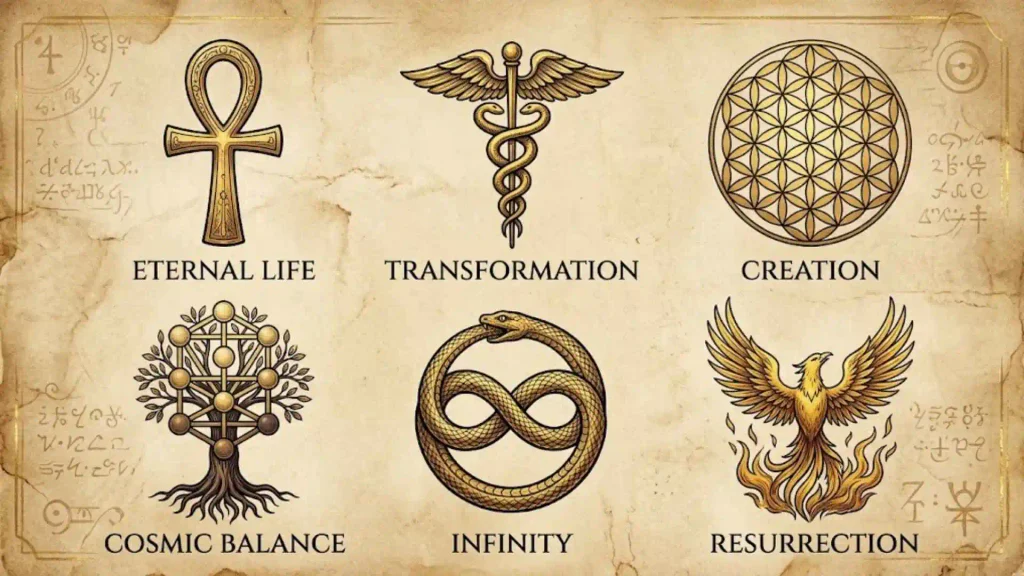
Spiritual alchemy symbols are used in contemporary interpretations of transformation, reflection, and self-development. The focus is often on how a person responds to challenges, learns from experience, and develops a new outlook.
The Sun and Moon are frequently paired to express contrasting or complementary qualities. Fire and water can represent different kinds of change, while the Ouroboros can express the repeating cycles of life. A circle may be used to suggest wholeness.
These associations work well in modern artwork, personal journals, and symbolic designs. However, they are not a single fixed system: different authors and communities may give the same symbol different meanings.
If you are choosing a symbol for a personal project, consider the idea you want to express and whether you prefer a historically documented sign or a contemporary spiritual interpretation. That distinction helps keep the design both meaningful and honest.
Alchemy Symbols and Meanings
Alchemy symbols can communicate practical, philosophical, and spiritual ideas, sometimes at the same time. Their interpretation becomes clearer when you look at the type of source in which they appear.
For example, ☿ commonly represents mercury in alchemical notation and is also the astronomical or astrological symbol for Mercury. In a laboratory recipe, it may identify a material. In a philosophical text, it may carry a wider association.
The four elemental symbols are similarly context-dependent. 🜂, 🜄, 🜁, and 🜃 represent fire, water, air, and earth in alchemical notation. A modern designer might use them to represent energy, adaptability, thought, and stability, but those additional interpretations should be identified as modern or symbolic rather than universal historical meanings.
A good reference should provide the character, its name, the context in which it was used, and any uncertainty about its interpretation. This approach is more reliable than assigning one definitive meaning to every alchemical sign.
Spiritual Alchemy Symbols and Meanings
The meanings of spiritual alchemy symbols often depend on the framework used to interpret them. In modern spiritual writing, alchemy is sometimes described as a metaphor for turning confusion into understanding or difficulty into personal growth.
The following examples show how some familiar signs are used in that setting:
- Fire (🜂): Represents a period of change or letting go.
- Water (🜄): Represents adaptability and emotional reflection.
- Air (🜁): Represents thought, learning, and communication.
- Earth (🜃): Represents stability and practical action.
- Sun (☉): Represents clarity and awareness.
- Moon (☽): Represents reflection and intuition.
These meanings are useful for creative expression, but they should not be mistaken for a universal ancient code. Historical alchemists wrote in different periods and traditions, and modern interpretations often draw together ideas that were not originally part of one system.
When explaining a spiritual symbol, distinguish its historical use from the meaning you personally attach to it. That makes the explanation clearer for readers who are interested in both symbolism and history.
Ancient Alchemy Symbols
Ancient alchemy developed over many centuries, with early traditions flourishing in the Hellenistic world and later knowledge developing across Arabic-language scholarship, Europe, and other regions. Symbols were used to identify substances, record operations, and illustrate philosophical ideas.
The Sun, Moon, and planetary signs became important in Western alchemical traditions because of their associations with metals. The Ouroboros also has a long history in ancient and later symbolic traditions and was adopted in some alchemical contexts to communicate cyclical or unified processes.
The signs now used for fire, water, air, and earth are useful references for Western alchemy, but the appearance of a similar shape in another culture does not prove that it had the same meaning there.
When studying ancient alchemy, reliable historical sources are especially valuable. Manuscripts, museum collections, and scholarly studies can help establish where a sign appeared and how it was understood. This avoids confusing a modern decorative design with an authenticated historical symbol.
Frequently Asked Questions
What are the most common alchemy symbols?
Some of the most recognizable alchemy symbols include ☉ for the Sun, ☽ for the Moon, ☿ for Mercury, and 🜂, 🜄, 🜁, and 🜃 for the four classical elements.
What does the Ouroboros mean in alchemy?
The Ouroboros depicts a serpent or dragon eating its own tail. It is associated with cycles, continuity, and unity in several historical and symbolic traditions.
What is the difference between alchemy and spiritual alchemy?
Historical alchemy involved the study and transformation of materials, while spiritual alchemy interprets transformation as a metaphor for personal or philosophical development. The two can overlap in some texts.
Can I copy and paste alchemy symbols?
Yes. Many alchemical characters are available in Unicode and can be copied into compatible applications. Their appearance depends on font and software support.
What do the seven stages of alchemy represent?
In a popular modern interpretation, the seven stages describe a journey from breaking down old patterns to integrating new understanding. This is a metaphorical framework, not a universal historical doctrine.
Conclusion
Alchemy symbols preserve a fascinating connection between early scientific experiments, philosophical ideas, and the history of spiritual thought. Signs for metals, planets, elements, and laboratory operations helped alchemists record their work, while later interpretations explored the symbolic meaning of transformation.
Today, these symbols are used in historical research, educational material, artwork, jewelry, tattoos, and digital designs. Characters such as ☿, ☉, 🜂, and 🜄 make it easy to incorporate alchemical imagery into text, while more detailed illustrations can communicate the appearance of historical symbols more accurately.
The best way to understand an alchemy symbol is to consider its original context before assigning a meaning. By separating documented historical uses from modern spiritual interpretations, you can explore this rich symbolic tradition with greater accuracy and make informed choices for your own creative projects.

Hello, I’m Rowan Sinclair, a passionate writer and lifelong admirer of the wisdom found in great quotes. I believe that words have the ability to inspire change, spark creativity, and connect people across cultures and generations.
I enjoy writing about motivational quotes, famous sayings, and lessons from history’s most influential thinkers. Every article I create is driven by my desire to help readers discover meaningful insights that they can apply to their own lives.
When I’m not writing, I spend my time reading biographies, exploring classic literature, and collecting memorable quotes that deserve to be shared with the world.
I am the author of Voices That Inspire and A Collection of Timeless Thoughts, two books that celebrate the enduring power of words and the stories behind them.
 Sienna Brooks