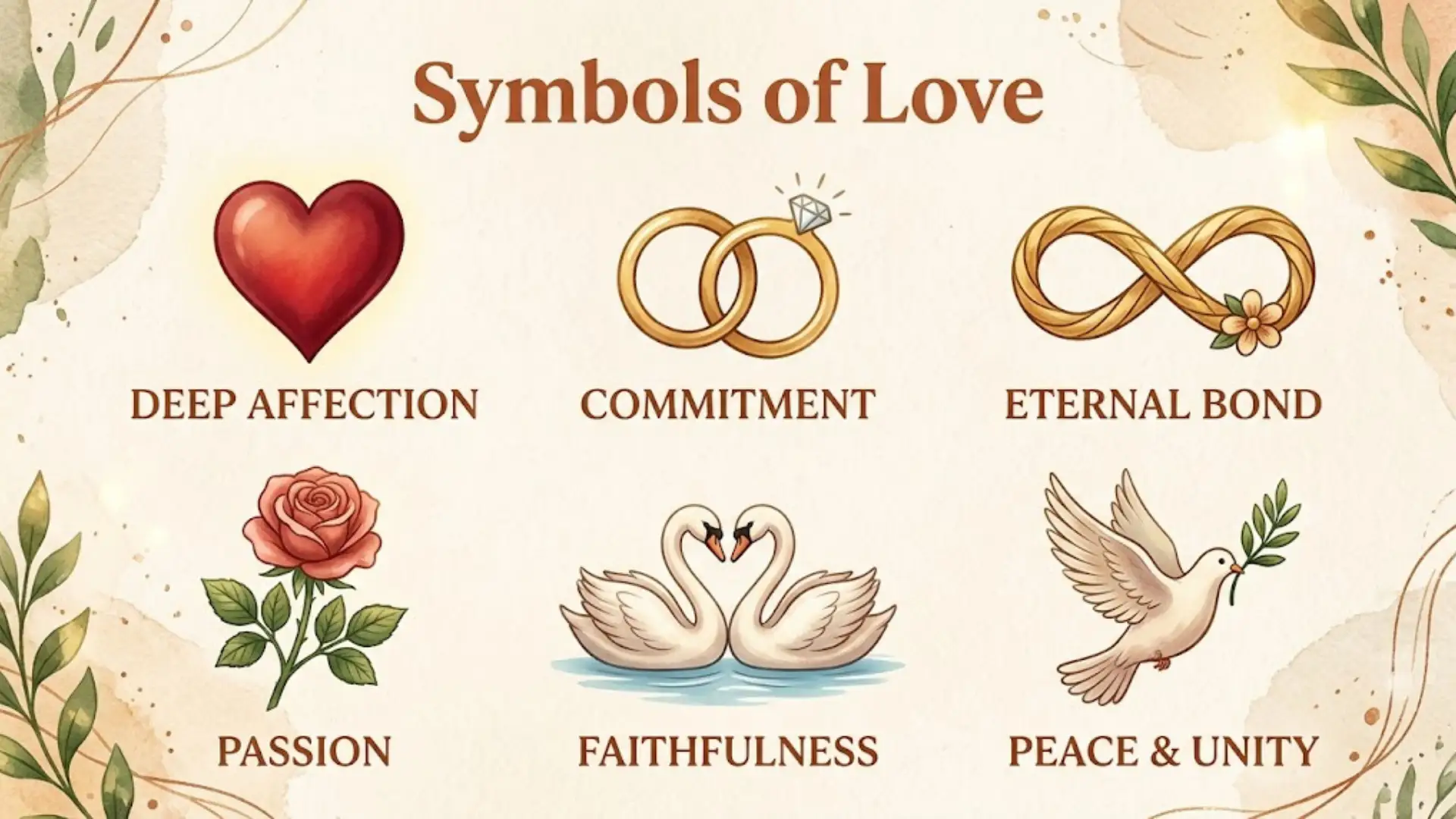
Love can be difficult to explain with words alone. A red rose, a heart-shaped pendant, or a simple ring can communicate affection, desire, loyalty, or commitment without a long speech. Across history, people have used objects, flowers, animals, and mythological figures to express emotions and celebrate relationships.
Understanding romantic symbols of love also reveals how different societies have understood romance. Some symbols come from ancient mythology, while others developed through religious traditions, poetry, jewelry, and modern popular culture. The heart, Cupid, and red rose are familiar examples, but symbols such as the Claddagh ring, Celtic love knot, and infinity sign carry their own meanings.
This guide explores symbols of love and their meanings, including their historical origins, cultural associations, and psychological significance. You’ll also discover how symbols represent passion, friendship, emotional intimacy, and lasting commitment—and why a symbol can express love without proving that a relationship is healthy.
What Are Symbols of Love?
Symbols of love are images, objects, plants, animals, gestures, or designs that people associate with affection and relationships. Their meanings develop through cultural traditions, stories, personal experiences, and repeated use.
For example, a red rose often represents romantic passion, while a wedding ring commonly represents commitment. A heart emoji might express romantic affection in one message and friendly support in another.
These romantic emblems help people communicate feelings that may be difficult to describe directly. They also preserve memories and mark important moments, such as engagements, weddings, anniversaries, and Valentine’s Day.
However, not every symbol represents the same kind of love.
- Romantic love: Hearts, red roses, Cupid, and love-themed jewelry.
- Passion and desire: Cupid’s arrow, Eros, and selected red floral imagery.
- Friendship and affection: Doves, thoughtful gifts, and personal keepsakes.
- Commitment: Wedding rings, Claddagh rings, and infinity designs.
- Spiritual love: Religious heart imagery, music, and symbols associated with compassion or devotion.
The meaning of a symbol depends on its context. A gift becomes more meaningful when the people exchanging it understand what it represents.
What Are the Most Common Symbols of Love?
The most recognizable symbols of romantic love include the heart, rose, Cupid, swans, rings, and infinity sign. Other symbols carry meanings connected to friendship, loyalty, beauty, fertility, or emotional closeness.
| Love symbol | Common meaning | Historical or cultural association |
| Heart | Love, affection, compassion | European art and modern popular culture |
| Red rose | Passion, romance, desire | Poetry, courtship, and floral traditions |
| Cupid | Attraction and desire | Roman mythology and Valentine’s Day |
| Eros | Love and desire | Ancient Greek mythology |
| Swans | Partnership and beauty | Folklore, poetry, and romantic art |
| Doves | Peace, tenderness, and harmony | Religious art and wedding imagery |
| Claddagh ring | Love, friendship, and loyalty | Irish cultural tradition |
| Celtic love knot | Connection and continuity | Celtic-inspired designs and modern jewelry |
| Infinity symbol | Enduring affection | Modern romantic jewelry and gifts |
| Diamond ring | Commitment and lasting value | Engagement and wedding customs |
| Harp | Music, emotion, and cultural identity | Celtic traditions and biblical stories |
| Cupid’s arrow | Sudden attraction | Classical mythology |
| Flowers | Affection, admiration, and care | Floral gifting traditions |
| Wedding ring | Marriage and commitment | Marriage customs across many societies |
| Red thread | A destined connection in some traditions | East Asian folklore and modern interpretations |
These meanings are common associations, not universal rules. The same object can communicate different feelings depending on the people, culture, and situation involved.
Romantic Symbols of Love and Their Meanings
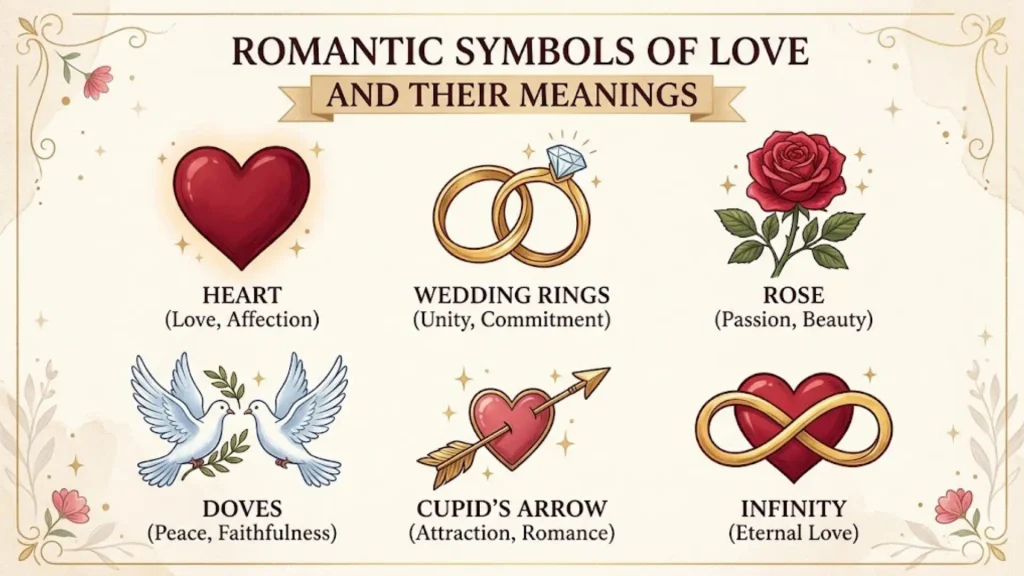
The Heart Symbol
The heart symbol meaning is closely connected to affection, compassion, romance, and emotional connection. Today, the familiar heart shape appears on greeting cards, jewelry, clothing, social media, and digital messages.
Yet the modern love heart does not closely resemble the anatomical human heart. Researchers have proposed several explanations for its development, including stylized botanical forms and interpretations of ancient anatomical descriptions.
The recognizable heart shape appeared in European visual culture during the Middle Ages and became increasingly associated with love in later centuries. By the 16th century, it had become an established symbol in European culture. Its precise origin remains uncertain. A historical overview from HISTORY discusses several competing explanations, while a 2024 article in the Journal of Visual Communication in Medicine reviews the symbol’s development.
The heart also has meanings beyond romance. In different traditions, it can represent courage, life, compassion, moral character, or spiritual devotion.
Why the heart represents love: People have long connected the physical heart with life and powerful emotions. Art, language, and repeated cultural use strengthened that association over time.
The Red Rose
The red rose is one of the best-known love and affection symbols. It commonly represents romantic passion, admiration, beauty, and desire.
Roses have appeared in poetry, art, mythology, and courtship traditions for centuries. Their color and presentation often influence their modern interpretation.
- Red roses: Passion and romantic love.
- Pink roses: Admiration, appreciation, and tenderness.
- White roses: Purity, remembrance, or new beginnings in some traditions.
- Yellow roses: Friendship, warmth, and happiness in many contemporary gifting contexts.
These meanings are not fixed across all cultures. A flower’s significance may depend on local customs, the occasion, and the relationship between the giver and receiver.
Red roses remain popular because they offer a recognizable way to communicate romantic feelings. Still, a person’s favorite flower may carry more personal meaning than any traditional color code.
Cupid
Cupid symbolism comes from Roman mythology. Cupid is a god associated with love and desire, commonly portrayed as a winged figure carrying a bow and arrows.
In popular imagery, Cupid’s arrow can make someone fall in love or experience sudden attraction. This story explains familiar expressions such as being “struck by Cupid’s arrow.”
Cupid’s appearance changed over time. Classical art depicted him in different youthful forms, while later European art increasingly popularized the chubby, winged infant familiar from Valentine’s Day cards.
Today, Cupid represents romantic attraction, flirtation, desire, and courtship. His image appears on cards, decorations, chocolates, and advertisements during Valentine’s Day.
Cupid is a mythological figure, however, rather than a scientific explanation for attraction. Real relationships develop through a combination of emotional, social, personal, and biological influences.
Eros, the Greek God of Love
Eros is a figure from ancient Greek mythology associated with love and desire. His role varies across Greek traditions. Some accounts portray Eros as a primordial force connected with creation, while later artistic traditions often depict him as a youthful winged god.
The relationship between Eros and Cupid reflects the cultural exchange between Greek and Roman mythology. Roman writers and artists adapted many Greek deities, connecting Cupid with the Greek figure Eros.
Although they are often treated as direct equivalents, their stories and portrayals developed within different cultural settings.
| Feature | Eros | Cupid |
| Mythological tradition | Greek | Roman |
| Main associations | Love, desire, and attraction | Love, desire, and attraction |
| Common modern image | Winged youthful figure | Winged infant with bow and arrows |
| Cultural influence | Greek myths, art, and literature | Roman mythology and later Valentine’s imagery |
Eros can represent the power of desire and attraction in ancient Greek thought. Cupid’s modern image focuses more narrowly on romantic attraction and courtship.
Swans
Swans commonly symbolize beauty, grace, partnership, and devotion. Their elegant appearance and courtship displays have inspired artists, poets, and storytellers.
Paired swans appear in romantic illustrations, wedding decorations, and poetry. Their long necks can form a heart-like shape when the birds face each other, which has helped reinforce their romantic association in popular imagery.
However, swans do not always mate for life, and their partnerships can change. Their symbolic meaning should not be confused with a biological rule.
As symbols of romantic love, swans express the human ideal of partnership, closeness, and shared life. Their meaning comes from cultural interpretation as much as from observing the animals themselves.
Doves
Doves are widely associated with peace, tenderness, gentleness, and harmony. They also appear in religious art, wedding ceremonies, and romantic imagery.
A single dove may represent peace or spiritual themes, while a pair of doves can suggest partnership and affection. Their use in wedding imagery connects them with the hope for a peaceful and loving marriage.
Doves can therefore represent both romantic and non-romantic relationships. Their symbolism is especially useful when a person wants to communicate gentle affection rather than intense passion.
The Claddagh Ring
The Claddagh ring meaning comes from a traditional Irish design featuring two hands holding a crowned heart. Each part carries a familiar symbolic association:
- Hands: Friendship.
- Heart: Love.
- Crown: Loyalty.
The ring originated in the Claddagh area near Galway, Ireland. It is now worn as jewelry, a sign of Irish heritage, and a token of affection or commitment.
The ring is sometimes used as an engagement or wedding ring. Traditional interpretations also connect its orientation with relationship status, although individual customs vary.
According to Ireland.com, the ring’s familiar design combines love, loyalty, and friendship. The history behind its creation includes different stories, so not every detail of its origin is certain.
The Claddagh ring is a particularly meaningful romantic emblem because it combines three ideas: affection, trust, and loyalty. It suggests that a strong relationship needs more than attraction alone.
The Celtic Love Knot
The Celtic love knot meaning is commonly associated with connection, continuity, and enduring affection. Its interlaced lines create a design in which separate strands appear to weave together.
Modern jewelry often uses Celtic-inspired knotwork to represent two lives connected by a shared bond. People choose these designs for engagement gifts, wedding jewelry, and anniversary presents.
It is important to distinguish historical Celtic art from modern interpretations. Interlaced patterns appear in early medieval art, but not every design sold today as a “Celtic love knot” has one established ancient meaning.
The symbolism remains appealing because the continuous pattern offers a visual metaphor for relationships. Two people can maintain their individuality while building a life together.
The Infinity Symbol
The infinity symbol resembles a sideways figure eight. In mathematics, it represents the concept of infinity. In modern romantic culture, it often represents lasting affection, loyalty, and commitment.
The infinity symbol meaning in love is straightforward: the relationship is intended to endure beyond a limited period. Infinity necklaces, rings, and tattoos use the design to express a lasting bond.
The symbol’s romantic meaning is a modern interpretation rather than a single ancient tradition. Its popularity comes from its simple shape and the powerful idea of something without an end.
Some people combine the infinity sign with a heart or names to create a more personal design. These combinations can represent affection that the people involved hope to sustain over time.
Diamonds and Diamond Rings
Diamonds commonly symbolize durability, value, and commitment. Their use in engagement rings has made them strongly associated with marriage and long-term relationships.
A diamond’s hardness helps explain its symbolic association with endurance. However, the popularity of diamond engagement rings also reflects social customs, jewelry traditions, advertising, and changing expectations around marriage.
A diamond ring does not automatically prove devotion, just as a different gemstone does not indicate weaker love. The meaning of a ring depends on the people exchanging it and the promises they attach to it.
Flowers as Symbols of Love
Flowers communicate affection through their color, scent, shape, and cultural associations. They are used for romantic dates, weddings, anniversaries, apologies, and expressions of appreciation.
Different flowers can carry different meanings:
- Tulips: Often associated with love, care, and fresh beginnings.
- Carnations: Can express affection, admiration, or remembrance.
- Lilies: Frequently associated with purity, renewal, or solemn occasions.
- Forget-me-nots: Commonly represent remembrance and lasting connection.
- Red roses: Strongly associated with passion and romance in modern Western gifting traditions.
Floral symbolism varies by region and occasion. If you’re choosing flowers for someone, consider their preferences rather than relying only on traditional meanings.
The Apple
The apple has represented beauty, desire, knowledge, temptation, and fertility in different cultural stories. Its meaning depends heavily on the particular myth or tradition.
In Greek mythology, apples appear in stories involving gods, beauty, and conflict. The golden apples associated with the Garden of the Hesperides, for example, have different narrative meanings from the apple in the story of the Judgment of Paris.
An apple can therefore appear in a discussion of ancient symbols of love, but it is not a universal symbol of romance. Its association with love depends on the story, image, or cultural setting.
The Winged Cherub
Winged child figures have become familiar romantic images in European art and modern Valentine’s Day decorations. They often suggest innocence, sweetness, affection, or divine influence.
Classical Cupid imagery influenced many later depictions of winged infants. Renaissance and subsequent artists blended classical mythological themes with Christian artistic traditions.
However, Cupid and biblical cherubim are not the same figure. Cupid belongs to classical mythology, while cherubim have their own roles in Jewish and Christian religious traditions. Their appearances may overlap in later art, but their origins differ.
Cupid’s Bow and Arrow
Cupid’s bow and arrow represent sudden attraction, desire, and the feeling of unexpectedly falling in love. The arrow gives romantic attraction a vivid visual form: a person seems to be struck by a force they cannot easily control.
The image appears on Valentine’s Day cards, gifts, cartoons, and romantic decorations. It is often used playfully to describe a new crush or intense attraction.
This symbol focuses on the beginning of romance rather than the work required to maintain a relationship. Attraction may start quickly, but trust and commitment usually develop through time and shared experience.
The Wedding Ring
A wedding ring commonly represents marriage, fidelity, and commitment. Its circular shape is often interpreted as a symbol of continuity because it has no obvious beginning or end.
Ring customs vary across cultures. People may wear wedding rings on different hands or fingers, and some traditions use other jewelry or ceremonies to mark marriage.
The ring’s meaning comes from the promise it represents. Its value is not limited to the metal or gemstone; it also reflects the commitment the couple chooses to associate with it.
The Red Thread
The red-thread motif appears in East Asian folklore and is associated in some traditions with connections between people whose lives are destined to meet. Modern interpretations often connect it with soulmates and romantic relationships.
The idea has become popular in jewelry, tattoos, fiction, and social media. A red thread can represent the belief that an important connection may persist despite distance or obstacles.
This is a cultural and folkloric motif, not evidence that every relationship is predetermined. Its value lies in the meaning people choose to give it.
The Butterfly
Butterflies often represent transformation, beauty, renewal, and personal growth. In romantic contexts, they can symbolize the excitement of attraction or the changes people experience during a relationship.
The expression “butterflies in the stomach” describes a familiar physical feeling of nervous excitement. It helps explain why butterflies have become a modern image of a new crush or romantic anticipation.
Butterfly symbolism varies across cultures, so it should not be treated as one fixed meaning.
The Pearl
Pearls can symbolize beauty, rarity, elegance, and something treasured. They appear in wedding jewelry, anniversary gifts, and romantic keepsakes.
A pearl’s gradual formation inside a mollusk offers a useful metaphor for something valuable that develops over time. This makes pearls suitable for representing patience, growth, or a relationship that people value deeply.
Still, their meaning depends on cultural and personal context rather than a universal romantic code.
The Heart and Arrow
A heart pierced by an arrow combines two familiar images: affection and sudden attraction. It is closely connected to Cupid and the classical tradition of arrows representing desire.
The design may suggest vulnerability, emotional intensity, or the unexpected nature of falling in love. It is especially common in Valentine’s Day imagery.
The Heart and Infinity Symbol
The heart-and-infinity design combines romantic affection with the idea of something lasting. People often use it in necklaces, bracelets, tattoos, and anniversary gifts.
It is a modern symbolic combination, not an ancient universal emblem. Its meaning is clear because it brings together two familiar ideas: love and continuity.
The Harp
The harp carries associations with music, emotion, cultural identity, and spirituality. Its role varies across historical and religious settings, making it a useful example of how one object can hold several symbolic meanings.
In Celtic traditions, the harp has strong associations with Irish cultural heritage and traditional music. In the Bible, David plays a stringed instrument for King Saul, whose distress is eased by the music in the narrative.
The harp does not always represent romantic love. Instead, harp symbolism often concerns music’s ability to express feelings, comfort people, preserve cultural memory, or create a sense of connection.
Music can also become a personal romantic symbol. A particular song may remind two people of their first meeting, a shared journey, or a meaningful moment. In that case, the emotional significance comes from their experience rather than from a universal rule about the instrument.
The Red Heart Emoji
The red heart emoji is a modern digital symbol of affection, support, and appreciation. Its meaning depends on the sender, receiver, and conversation.
A person might use it to express romantic love, thank a friend, support a family member, or respond warmly to a message. The same emoji can communicate different things in different relationships.
Digital heart icons show how old symbolic ideas adapt to new forms of communication. The design is familiar, but its exact meaning still depends on context.
Ancient Symbols of Love and Their Historical Origins
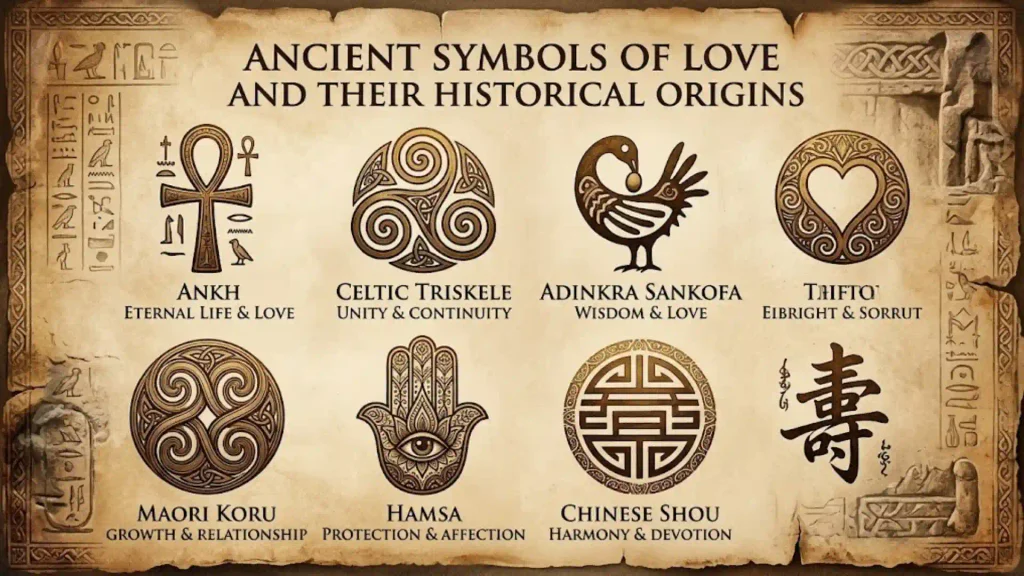
Ancient symbols of love developed through mythology, art, religious beliefs, fertility practices, and social customs. Some symbols have well-documented historical uses, while others are connected to modern theories that remain uncertain.
The Heart in Ancient and Medieval Culture
The heart has long been associated with life and emotion, although different civilizations understood its role in different ways. Ancient beliefs about the heart did not always match modern scientific knowledge.
The familiar heart-shaped icon developed gradually. Possible predecessors appeared in earlier visual traditions, and the symbol became increasingly associated with romantic love in medieval and Renaissance Europe. Its later use in religious art, playing cards, jewelry, and Valentine’s Day imagery helped make it widely recognizable.
The Art & History Museum’s Heart Museum documents the heart’s symbolism in Western culture through hundreds of objects dating from the 16th to the early 20th century.
Venus, Fertility, and Silphium
Venus was the Roman goddess associated with love and beauty. Her image appeared in Roman art and other cultural expressions, helping connect her with romance and attraction.
The silphium plant, which grew in the region around ancient Cyrene in present-day Libya, was highly valued in the Greek and Roman world. Its fruit appeared on ancient coins in a shape that resembles a modern heart.
This resemblance has inspired the theory that silphium helped influence the heart symbol’s romantic meaning. However, the connection is not proven. Historical sources also disagree about the plant’s exact identity and medicinal uses.
Silphium is sometimes described online as a reliable ancient contraceptive or aphrodisiac. The evidence is more complicated, and historians continue to debate these claims. The Royal Botanic Gardens, Kew discusses the plant’s history and the theory linking its seed shape to the modern love heart.
Love Symbols in Classical Mythology
Greek and Roman mythology shaped many historical symbols of love. Eros, Cupid, and Venus represented different aspects of love, desire, and beauty in their respective traditions.
Their images later appeared in European art, poetry, and romantic decorations. Over time, mythological symbols moved beyond their original religious contexts and became familiar expressions of courtship and affection.
This transformation shows how symbolic meanings evolve. A figure once understood within a religious or mythological tradition can later become a decorative image used to celebrate romance.
Love Symbols Across Cultures
Love symbols across cultures reflect shared human experiences as well as distinct histories and customs. People everywhere form emotional bonds, but they do not necessarily express them through the same objects or images.
Celtic Symbols of Love
The Claddagh ring is strongly associated with Irish heritage, friendship, love, and loyalty. Celtic-inspired knotwork is often used in modern jewelry to represent continuity and connection. The harp is another important cultural symbol associated with Irish musical traditions.
These examples show how romantic symbols can also express cultural identity. A ring or design may be meaningful because of its relationship symbolism, its cultural history, or both.
Greek and Roman Symbols of Love
Eros, Cupid, and Venus are among the most recognizable figures in classical love symbolism. Their stories helped shape later ideas about desire, attraction, and romantic beauty.
Classical imagery continues to appear in modern art, literature, Valentine’s Day cards, and popular culture. However, modern interpretations do not always preserve every detail of the original myths.
Symbols of Love in Christian Traditions
The heart has an important place in Christian art, including images associated with devotion, compassion, and the Sacred Heart of Jesus. These meanings are connected to religious faith rather than romantic attraction alone.
Cupid’s image also appears in later European art influenced by classical mythology. Although Cupid and cherubim may look similar in some artwork, they belong to different traditions.
Symbols of Love in South Asian Traditions
South Asian expressions of affection can include flowers, garlands, jewelry, poetry, gifts, and marriage customs. Their meanings depend on regional traditions, religion, language, and family practices.
Flowers may play a role in weddings and ceremonies, while jewelry can carry emotional and family significance. Poetry, music, and stories also express love and longing.
South Asia includes many different cultures, so no single symbol represents love for every community. A careful discussion should identify the specific tradition rather than treating the entire region as culturally uniform.
Are There Universal Symbols of Love?
The heart is one of the most widely recognized modern symbols of love, especially in digital communication and popular culture. Red roses and Cupid imagery are also familiar in many places.
However, widespread recognition does not prove that a symbol has one universal meaning. Global media, advertising, education, and international celebrations have helped spread these images.
A symbol can be common across countries while still carrying different meanings for individual people. It is more accurate to call these symbols widely recognized than universally understood.
The Psychology of Romantic Symbols
The psychology of romantic symbols explores how images, objects, memories, and cultural associations influence emotions. A gift may remind someone of a meaningful experience, while a song can bring back feelings connected with a relationship.
Several factors help explain why symbols can feel powerful:
- Memory: An object may remind someone of an important moment.
- Learning: Repeated exposure can connect an image with a particular emotion.
- Culture: Stories, customs, and media teach people how to interpret symbols.
- Personal meaning: A symbol may represent a relationship or experience unique to one person.
- Shared rituals: Exchanging rings, flowers, or gifts can make a symbol more meaningful to the people involved.
These explanations do not mean every symbol has a hidden meaning. Emotional responses depend on the person, the situation, and the associations they have learned.
Freud’s Theory of the Unconscious Mind
Sigmund Freud was an Austrian neurologist who founded psychoanalysis. His theories emphasized the role of unconscious mental processes in feelings, dreams, and behavior.
Freud described conscious awareness, preconscious material that could become conscious, and unconscious processes that were not directly available to awareness. The familiar iceberg model is a simplified illustration often used to explain this framework.
Freud believed that dreams and symbolic images could reveal hidden wishes or conflicts. From a Freudian perspective, a romantic symbol might carry meanings connected to desire, memory, or unresolved feelings.
However, Freud’s specific interpretations should not be treated as proven explanations for every dream or emotional response. Modern psychology uses a broader range of theories and evidence to study memory, motivation, emotion, and relationships.
How Does the Unconscious Mind Influence Romantic Symbolism?
People do not always think deliberately about why an object makes them feel something. A necklace, photograph, or familiar song may trigger memories and emotions almost immediately.
For example, a song played during a first date may later remind someone of that relationship. The song becomes a romantic symbol because of the person’s experience, not because the melody has a universal romantic meaning.
Dreams can also draw on memories, concerns, and emotional experiences. However, there is no reliable rule that a particular dream symbol has one fixed meaning for everyone.
Carl Jung’s Collective Unconscious Theory
Carl Jung was a Swiss psychiatrist who developed analytical psychology. He proposed that people share a collective unconscious containing inherited psychological patterns, which he called archetypes.
In Jung’s framework, recurring images and themes in myths, stories, dreams, and religious traditions may reflect these archetypes. Some interpretations connect images of union, pairs, circles, or transformation with human relationships.
Jung’s ideas influenced literature, art, and discussions of symbolism. However, the collective unconscious remains a theoretical concept rather than a scientifically established storehouse of shared ancestral memories.
What Are Jungian Archetypes in Romantic Symbolism?
Jungian archetypes are recurring patterns or figures in Jung’s psychological theory. They are used to interpret themes that appear across stories, myths, and personal experiences.
A heart might be interpreted as an image of emotional connection. Two interlocking forms might suggest union, while a circle could represent wholeness or continuity. These are possible interpretations, not fixed meanings supported by one universal code.
Cultural learning offers another explanation for recurring symbols. People encounter similar images through books, films, art, and shared customs, which can create familiar associations without requiring an inherited archetype.
Why Do Romantic Symbols Trigger Emotional Responses?
A romantic symbol can evoke emotion because it connects with memory, expectation, personal experience, or cultural meaning.
For instance, a ring given during a proposal may become linked with a major life event. A heart emoji may feel reassuring when it comes from someone important. A red rose may communicate affection because both people recognize its conventional meaning.
Symbols can therefore influence how people express and understand feelings. But their emotional power varies. One person may treasure a handwritten letter, while another may find a shared song more meaningful.
Modern Psychology and the Meaning of Love Symbols
Modern approaches to psychology study how emotions, memory, attachment, social learning, and cognition shape human behavior. These approaches help explain why symbols can become emotionally important without assuming that every image has a hidden or universal meaning.
Freud’s psychoanalysis and Jung’s analytical psychology remain influential in the history of ideas, but their claims have different levels of scientific support. Neither should be used as a complete explanation for romantic attraction or relationship behavior.
The key distinction is between a symbol’s emotional significance and its ability to prove something about a relationship. A gift may express affection, but it cannot by itself establish trust, compatibility, or commitment.
Symbols of Passion, Friendship, and Commitment
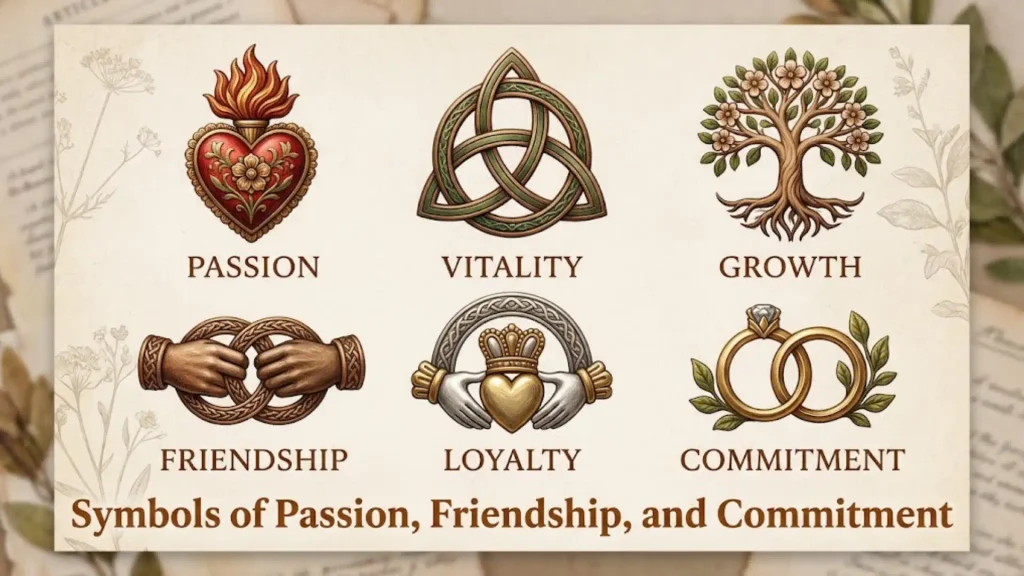
Different symbols of romantic love communicate different relationship qualities. Some focus on the excitement of attraction, while others emphasize loyalty, friendship, or a long-term bond.
Symbols of Passionate Love and Desire
Cupid, Eros, red roses, and Cupid’s arrow often represent passion and attraction. They are especially suitable for expressing a new crush, romantic interest, or intense feelings.
These symbols tend to focus on the emotional energy of romance. They do not necessarily communicate the stability or commitment associated with a long-term relationship.
Symbols of Friendship and Affection
Doves, flowers, personal gifts, and meaningful keepsakes can represent friendship, warmth, and care. Their meanings often depend on the relationship and the occasion.
A flower given to a friend may express gratitude rather than romance. The same gift can carry different meanings because the people involved understand the context.
Symbols of Commitment and Long-Term Relationships
Wedding rings, Claddagh rings, infinity designs, and interlaced knots commonly represent lasting bonds. Their meanings are tied to promises, shared experiences, and cultural customs.
Yet symbols are only one part of a relationship. Consistent care, honest communication, mutual respect, and reliability are more useful signs of commitment than jewelry alone.
Symbols of True Love: What Do They Really Mean?
People often associate true love with loyalty, sacrifice, affection, and a willingness to support one another. Romantic symbols can help communicate these ideas, but they cannot confirm them on their own.
Healthy relationships depend on actions over time. Partners show care by listening, respecting boundaries, sharing responsibilities, and working through disagreements constructively.
Jealousy and possessiveness are not reliable evidence of love. A meaningful symbol should express affection rather than excuse controlling behavior.
How to Choose a Symbol That Represents Your Relationship
The best symbol is one that matches the meaning you want to communicate. You do not have to choose the most popular image if another object better reflects your relationship.
Consider these options:
- For romantic affection: A heart, red rose, or personal gift.
- For commitment: A wedding ring, Claddagh ring, or infinity design.
- For cultural identity: A meaningful traditional object or design from your heritage.
- For a shared memory: A photograph, song, place, or keepsake connected with an important moment.
- For friendship and care: Flowers, a handwritten note, or a thoughtful object.
- For personal growth: A butterfly or another symbol that reflects change and renewal.
Before choosing a gift, think about the recipient’s preferences and beliefs. Some people love traditional romantic gestures, while others prefer simple, personal expressions of affection.
A symbol becomes meaningful when both people understand what it represents. If you’re unsure, explain why you chose it instead of expecting the other person to interpret it correctly.
Frequently Asked Questions About Symbols of Love
What are the most common symbols of love?
The heart, red rose, Cupid, swans, doves, rings, and infinity sign are among the most familiar symbols of love. Their common meanings include affection, attraction, loyalty, partnership, and commitment.
What do romantic symbols represent?
Romantic symbols and their meanings vary, but they often represent passion, emotional closeness, desire, loyalty, or lasting commitment. The intended meaning depends on culture and personal experience.
What is the meaning behind the heart symbol?
The heart commonly represents love, compassion, affection, and emotional connection. Its familiar shape developed through historical artistic traditions, although its exact origin remains uncertain.
Why is the heart a symbol of romantic love?
The heart became associated with romance through a combination of historical beliefs about emotion, medieval and Renaissance art, literature, and later popular culture. The familiar icon does not closely resemble the anatomical heart.
What is the origin of the modern heart symbol?
The modern heart symbol developed gradually, with possible predecessors appearing before its widespread use in European art. Theories connect it with stylized botanical forms and historical anatomical ideas, but no single origin has been proven.
What does Cupid symbolize in love?
Cupid represents romantic desire, attraction, and the sudden experience of falling in love. His bow and arrows are common images in Valentine’s Day decorations.
What is the difference between Cupid and Eros?
Eros belongs to Greek mythology, while Cupid belongs to Roman mythology. They share many associations with love and desire, but their stories and artistic portrayals developed in different cultural settings.
Why is Cupid associated with Valentine’s Day?
Cupid became a familiar Valentine’s Day figure through the use of classical mythology in later European romantic art, greeting cards, and commercial imagery.
What does the harp symbolize in romantic love?
The harp can represent music, emotional expression, longing, and spiritual connection. Its meaning varies by context, and it is not exclusively a symbol of romantic love.
What does the harp represent in Celtic culture?
The harp is an important symbol of Irish cultural identity and traditional music. Its associations include artistry, heritage, storytelling, and musical expression.
How are music and love connected?
Music can evoke memories, strengthen shared experiences, and help people express emotions. A particular song may become a personal symbol of a relationship.
What do swans and doves symbolize in love?
Swans often represent beauty, partnership, and devotion. Doves commonly represent peace, tenderness, and harmony, while a pair of doves can suggest affection or unity.
What is the meaning of the Claddagh ring?
The Claddagh ring traditionally represents friendship through its hands, love through its heart, and loyalty through its crown. It originated in the Claddagh area near Galway, Ireland.
What does the Celtic love knot symbolize?
Celtic-inspired love knots commonly represent connection, continuity, and enduring affection. Specific meanings depend on the design and whether the interpretation comes from a historical tradition or a modern use.
What does the infinity symbol mean in relationships?
The infinity symbol commonly represents lasting affection, loyalty, or commitment. Its romantic meaning is a modern interpretation of the mathematical symbol for infinity.
How do romantic symbols differ across cultures?
Cultural traditions, religion, history, and personal experience shape the meanings of romantic symbols. A symbol that is common in one region may be unfamiliar or carry a different meaning elsewhere.
Why have love symbols remained popular throughout history?
Love symbols make complex feelings easier to express. Art, stories, ceremonies, jewelry, gifts, and digital communication help preserve and adapt their meanings across generations.
How do symbols become associated with love?
Symbols gain meaning through repeated use, cultural traditions, stories, shared experiences, and personal memories. Their meanings can change as societies reinterpret them.
What is the psychological meaning of romantic symbols?
Romantic symbols can evoke emotions through memory, learned associations, cultural familiarity, and personal experience. Their psychological significance varies from one person to another.
How does the unconscious mind influence romantic symbolism?
A familiar image or object can trigger memories and feelings without deliberate thought. This everyday process is broader than any single theory of the unconscious mind.
What is Freud’s theory of the unconscious mind?
Freud argued that unconscious mental processes influence feelings and behavior. His theory distinguishes conscious, preconscious, and unconscious processes, although many specific psychoanalytic claims remain debated.
What is Jung’s collective unconscious theory?
Jung proposed that people share inherited psychological patterns, which he called the collective unconscious. This is an influential theoretical concept, not a scientifically established storehouse of universal memories.
What are Jungian archetypes in romantic symbolism?
Jungian archetypes are recurring patterns or figures in Jung’s theory. They can be used to interpret symbols in myths, dreams, and stories, but they do not provide one proven meaning for every romantic image.
How does the collective unconscious explain universal love symbols?
Jung’s theory offers one interpretation of recurring symbolic patterns. Cultural learning, shared experiences, and the spread of popular imagery also help explain why certain love symbols appear in many places.
Why do romantic symbols trigger emotional responses?
Symbols can connect with memories, expectations, personal experiences, and cultural associations. Their effects differ depending on the person and situation.
How are love symbols connected to dreams and desire?
Dreams may reflect memories, emotions, and personal concerns. Their meanings vary, so a heart, rose, or other image should not be assigned one fixed interpretation for everyone.
What role do symbols play in human relationships?
Symbols help people express affection, celebrate milestones, preserve memories, and communicate shared intentions. They can support a relationship, but they cannot replace honest communication and caring behavior.
Why should romantic symbols not be confused with love itself?
A symbol can express love, but it cannot prove that a relationship is healthy or committed. Trust, respect, communication, reliability, and care matter more than any object or image.
Conclusion
Romantic symbols of love tell stories about how people understand affection, attraction, friendship, and commitment. The heart and red rose express familiar ideas about romance, while Cupid and Eros connect love with classical mythology. The Claddagh ring, Celtic-inspired knotwork, and infinity symbol offer other ways to communicate loyalty and lasting connection.
These love symbols and meanings have changed through art, history, cultural exchange, and personal experience. Some are rooted in well-established traditions, while others reflect modern interpretations or theories that remain uncertain.
No single image can represent every kind of love. The most meaningful symbol is the one that reflects the relationship and carries a significance the people involved understand.
A rose, ring, song, or simple handwritten note can be a powerful expression of affection. What matters most, however, is the care, honesty, respect, and commitment behind it.

Hi, I’m Sienna Brooks, and I believe that the right words can inspire, comfort, and empower people at every stage of life. For as long as I can remember, I’ve been drawn to meaningful quotes and the stories behind them. I love curating collections of inspirational, motivational, and heartfelt quotes that resonate with readers around the world.
Through my writing, I strive to help others find encouragement, whether they’re celebrating life’s happiest moments or navigating its biggest challenges. I believe that wisdom is timeless, and I’m passionate about sharing words that leave a lasting impact.
I am the author of Reflections in Words and The Journey of Inspiration, two books dedicated to exploring the beauty and power of timeless quotes.
 Asher Monroe
 Rowan Sinclair Rowan Sinclair