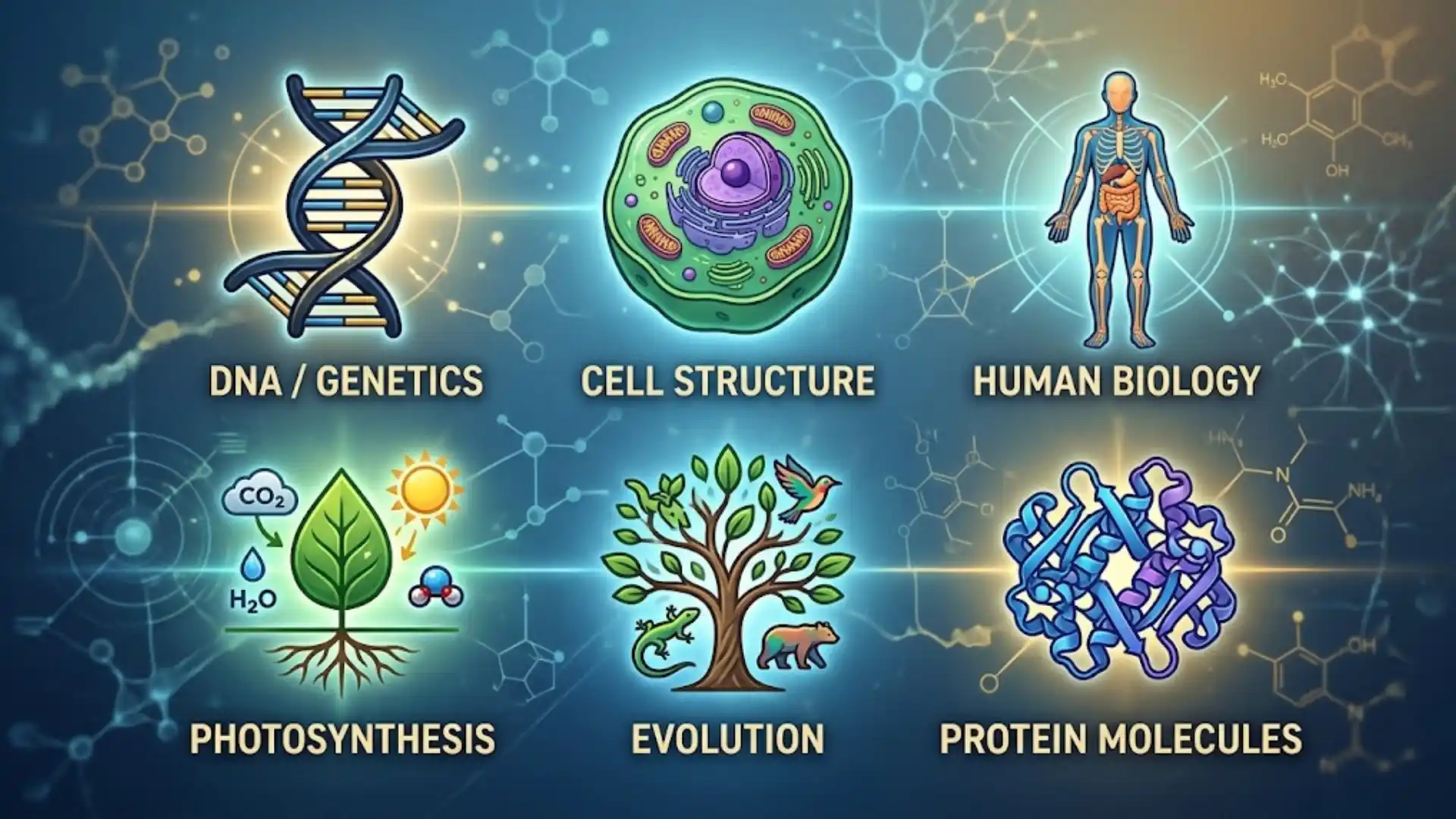
Science symbols make complex ideas easier to understand, calculate, and communicate. From the plus sign in a simple equation to chemical symbols on the periodic table, these signs help scientists describe the natural world with precision.
This guide covers science symbols and meanings across mathematics, chemistry, physics, biology, and laboratory safety. You’ll learn what common symbols represent, how to read scientific notation, how to recognize Greek letters, and how to use symbols correctly in diagrams and school assignments.
You’ll also find practical tables of scientific symbols, their names, common uses, and measurement units. Remember that a symbol’s meaning can change with its context, so always read the surrounding equation, labels, and units.
What Are Science Symbols?
Science symbols are letters, signs, numbers, and graphical marks that represent scientific ideas, measurements, materials, or processes. They allow people to share information without writing long explanations every time.
For example, scientists use the symbol (m) to represent mass in many equations. They use (\mathrm{Na}) to identify sodium and (\lambda) to represent wavelength in many wave-related formulas.
These symbols used in science make information easier to record, compare, calculate, and communicate. A chemist can write H₂O instead of spelling out the composition of a water molecule. A physicist can use (F = ma) to express the relationship between force, mass, and acceleration.
Scientific notation also includes special signs, such as subscripts, superscripts, arrows, and Greek letters. Each can carry important information.
Why Are Scientific Symbols Important?
Scientific symbols and their uses extend across almost every scientific subject. They help researchers:
- Record measurements in a consistent format.
- Represent complicated ideas in a compact form.
- Write equations and chemical reactions.
- Label structures in biological and laboratory diagrams.
- Identify hazardous substances and laboratory risks.
- Compare results across experiments and research studies.
- Share scientific information across languages.
Symbols also reduce confusion when people use them correctly. However, a symbol may have different meanings in different fields.
For example, (V) commonly represents volume in some equations, but it can also represent electric potential difference. The surrounding formula tells you which meaning applies.
Common Science Symbols and Their Meanings
The following table introduces some of the most widely used scientific signs and symbols.
| Symbol | Name | Common meaning |
| (+) | Plus sign | Addition or positive value |
| (−) | Minus sign | Subtraction or negative value |
| (=) | Equal sign | Two expressions have equal values |
| (\ne) | Not equal sign | Two expressions have different values |
| (\approx) | Approximately equal | A value is close to another value |
| (\pm) | Plus-minus sign | Two possible signs or a stated tolerance |
| (\Delta) | Delta | Change in a quantity |
| (\pi) | Pi | Mathematical constant, approximately 3.14159 |
| (\infty) | Infinity | An unbounded quantity or concept |
| (\sqrt{x}) | Square root | A number that produces (x) when squared |
| (\sum) | Summation | Addition of a sequence of values |
| (\int) | Integral | Integration in calculus |
| (\alpha) | Alpha | Greek letter used as a variable or label |
| (\lambda) | Lambda | Often represents wavelength |
| (c) | Speed of light symbol | Speed of light in a vacuum |
| (\mathrm{H}) | Hydrogen | Chemical element symbol |
| (\mathrm{O}) | Oxygen | Chemical element symbol |
| (\mathrm{Na}) | Sodium | Chemical element symbol |
| (\mathrm{H_2O}) | Water formula | Two hydrogen atoms and one oxygen atom per molecule |
| (\mathrm{kg}) | Kilogram | SI unit of mass |
These common science symbols are useful starting points, but you should always check the subject and context.
For instance, (\Delta T) commonly represents a change in temperature. If the initial temperature is 20°C and the final temperature is 35°C, the change is:
[
\Delta T = 35 – 20 = 15^\circ\mathrm{C}
]
The delta symbol does not represent a specific temperature. It indicates the difference between two values.
Different Types of Science Symbols

There are several different types of science symbols, and each category serves a particular purpose.
Greek Symbols in Science
Scientists use Greek letters to represent variables, constants, particles, angles, and other quantities. Examples include alpha ((\alpha)), beta ((\beta)), delta ((\Delta)), and lambda ((\lambda)).
Mathematical Symbols
Mathematical symbols represent operations, comparisons, relationships, and logical ideas. Common examples include (+), (−), (=), (\le), (\sum), and (\int).
Chemical Symbols
Chemical symbols identify individual elements. For example, C represents carbon, O represents oxygen, and Fe represents iron.
Chemical formulas combine these symbols to show the composition of substances. For example, CO₂ represents carbon dioxide.
Physics Symbols and Units
Physics uses symbols to represent quantities such as mass, time, force, energy, and temperature. Units such as kilograms, seconds, and joules express the measurements of those quantities.
Biology Symbols
Biology uses symbols, labels, and diagrams to explain cell structures, genetic relationships, biological processes, and organism classification.
Laboratory Symbols
Laboratory symbols include chemical hazard pictograms, equipment labels, and other signs that help people recognize risks and follow safe procedures.
Scientific Diagram Symbols
Scientific diagrams use arrows, lines, labels, shapes, and legends to show structures, relationships, sequences, and experimental results.
Understanding these categories makes it easier to recognize scientific symbols and their uses in textbooks, laboratories, and research papers.
Greek Alphabet Letters and Symbols Used in Science
The Greek alphabet contains 24 letters. Scientists frequently use Greek letters because the Latin alphabet alone does not provide enough convenient symbols for every variable and concept.
Greek letters appear in mathematics, physics, chemistry, engineering, statistics, and other disciplines. Their meanings depend on the subject and the equation in which they appear.
Greek Alphabet Letters and Symbols
| Greek letter name | Uppercase | Lowercase | Common scientific use |
| Alpha | Α | (\alpha) | Coefficients, angles, alpha particles |
| Beta | Β | (\beta) | Beta particles, coefficients |
| Gamma | Γ | (\gamma) | Gamma radiation, coefficients |
| Delta | Δ | (\delta) | Change or variation |
| Epsilon | Ε | (\epsilon) | Small quantities and other variables |
| Zeta | Ζ | (\zeta) | Mathematical variables |
| Eta | Η | (\eta) | Efficiency or viscosity in some contexts |
| Theta | Θ | (\theta) | Angles |
| Iota | Ι | (\iota) | Specialized mathematical notation |
| Kappa | Κ | (\kappa) | Coefficients and physical properties |
| Lambda | Λ | (\lambda) | Wavelength |
| Mu | Μ | (\mu) | Micro-prefix and other quantities |
| Nu | Ν | (\nu) | Frequency in some fields |
| Xi | Ξ | (\xi) | Mathematical and physical variables |
| Omicron | Ο | (\omicron) | Rarely used as a scientific variable |
| Pi | Π | (\pi) | Mathematical constant |
| Rho | Ρ | (\rho) | Density in many physics contexts |
| Sigma | Σ | (\sigma) | Summation, stress, or standard deviation |
| Tau | Τ | (\tau) | Time constants and other quantities |
| Upsilon | Υ | (\upsilon) | Specialized notation |
| Phi | Φ | (\phi) | Angles, flux, and other variables |
| Chi | Χ | (\chi) | Chi-squared statistics and other variables |
| Psi | Ψ | (\psi) | Wavefunctions in quantum mechanics |
| Omega | Ω | (\omega) | Ohm unit symbol in uppercase; angular frequency often uses lowercase |
Greek letters are not assigned one universal scientific meaning. For example, (\rho) often represents density, but a researcher may define it differently in a particular model.
Uppercase and lowercase forms can also have different meanings. The uppercase sigma, (\Sigma), commonly represents summation, while lowercase sigma, (\sigma), can represent standard deviation or stress.
What Are Greek Symbols Used for in Science?
Greek letters help scientists distinguish between multiple quantities in the same equation. They are particularly useful when familiar Latin letters already represent other variables.
For example, the wavelength of a wave is commonly represented by (\lambda). The frequency may be represented by (f), and the speed of a wave by (v).
The relationship is:
[
v = f\lambda
]
For electromagnetic waves traveling through a vacuum, the corresponding relationship is:
[
c = f\lambda
]
Here, (c) represents the speed of light in a vacuum.
Greek letters also appear in quantum mechanics, statistics, and chemistry. The symbol (\psi), for example, commonly represents a wavefunction in quantum mechanics.
Delta, Tau, and Other Common Greek Symbol Meanings
The Greek letter delta is especially useful in scientific equations. Uppercase delta, (\Delta), often means a change or difference between two values.
Examples include:
- (\Delta T): change in temperature.
- (\Delta t): time interval.
- (\Delta x): change in position.
- (\Delta v): change in velocity.
The lowercase Greek letter tau, (\tau), often represents a time constant in physics and engineering. In other fields, it may represent a different quantity.
Greek symbols sometimes appear in discussions of life, death, radiation, and particles, but their meanings depend on the relevant scientific convention. Avoid assuming that a Greek letter has the same meaning in every discipline.
Math Symbols and Meanings in Science
Mathematical symbols help scientists describe quantities, perform calculations, and express relationships. They are essential for interpreting formulas, analyzing measurements, and presenting results.
Basic Mathematical Operation Symbols
| Symbol | Name | Meaning | Example |
| (+) | Plus | Addition | (4+3=7) |
| (−) | Minus | Subtraction | (9-5=4) |
| (\times) | Multiplication | Multiplication | (3\times4=12) |
| (\div) | Division | Division | (12\div3=4) |
| (/) | Slash | Division or ratio | (10/2=5) |
| (=) | Equal to | Equality | (2+3=5) |
| (\ne) | Not equal to | Inequality | (4\ne7) |
Scientists use these basic math symbols to calculate measurements and describe relationships between quantities.
For example, if an object travels 100 meters in 20 seconds at a constant speed, its speed is:
[
v = \frac{d}{t} = \frac{100\ \mathrm{m}}{20\ \mathrm{s}} = 5\ \mathrm{m/s}
]
The slash represents division, while the letters represent the physical quantities involved.
Equality and Inequality Symbols
Comparison symbols show whether one value equals, exceeds, or falls below another value.
| Symbol | Name | Meaning |
| (=) | Equal to | Both values are equal |
| (\ne) | Not equal to | Values are different |
| (<) | Less than | Left value is smaller |
| (>) | Greater than | Left value is larger |
| (\le) | Less than or equal to | Left value is smaller or equal |
| (\ge) | Greater than or equal to | Left value is larger or equal |
| (\approx) | Approximately equal to | Values are close |
| (\propto) | Proportional to | One quantity varies proportionally with another under the stated relationship |
| (\pm) | Plus-minus | Indicates two signs or a stated uncertainty range |
For example, (T \ge 300\ \mathrm{K}) means the temperature is at least 300 kelvin.
The approximately equal symbol is useful when a value has been rounded. For example, (\pi \approx 3.14159).
Common Advanced Mathematical Symbols
| Symbol | Name | Meaning |
| (\infty) | Infinity | An unbounded concept |
| (\sqrt{x}) | Square root | A value that squares to (x) |
| (\sum) | Summation | Adds a series of values |
| (\int) | Integral | Represents integration |
| (\partial) | Partial derivative symbol | Derivative with respect to one variable |
| (\therefore) | Therefore | Introduces a conclusion |
| (\because) | Because | Introduces a reason |
| (\parallel) | Parallel | Lines or directions that remain parallel |
| (\cong) | Congruent | Geometric figures with the same shape and size |
| (!) | Factorial | Product of positive integers up to a given number |
| (\land) | Logical AND | Both conditions are true |
| (\lor) | Logical OR | At least one condition is true |
The factorial symbol illustrates why context matters. In mathematics, (5!) means:
[
5! = 5\times4\times3\times2\times1 = 120
]
It does not function as an exclamation mark in ordinary writing.
Calculus Symbols and Their Uses
Calculus studies change and accumulation. Its symbols help describe motion, growth, areas, and many other scientific processes.
A derivative represents a rate of change. For example:
[
v = \frac{dx}{dt}
]
In this equation, velocity is the rate at which position (x) changes with time (t).
An integral can represent accumulated quantities. For example:
[
x = \int v(t),dt
]
Under the appropriate conditions, integrating velocity over time gives a change in position. A definite integral also includes limits that specify the interval being considered.
The partial derivative symbol, (\partial), is useful when a function depends on several variables. Scientists use it to examine how changing one variable affects a result while treating the others as fixed.
Variables, Constants, and Mathematical Relationships
A variable represents a quantity that may change or take different values. A constant remains fixed within the stated equation or situation.
Consider:
[
d = vt
]
Here, (d) represents distance traveled, (v) represents constant speed, and (t) represents elapsed time. If speed remains at 5 meters per second for 10 seconds, the distance traveled is 50 meters.
Symbols also express geometric relationships. For example, parallel lines may be marked with matching arrow symbols, while congruent sides of a shape may use matching tick marks.
These conventions make diagrams easier to interpret without lengthy descriptions.
Chemical Symbols and Their Meanings
Chemical symbols are standardized one- or two-letter abbreviations for chemical elements. They form the foundation of chemical formulas, equations, and periodic table notation.
What Are Chemical Symbols?
Each recognized element has its own official symbol. The first letter is capitalized, and the second letter, when present, is lowercase.
Examples include:
- H for hydrogen.
- C for carbon.
- O for oxygen.
- Na for sodium.
- Fe for iron.
- Ag for silver.
- Au for gold.
Some element symbols come from Latin names. For example, Na comes from natrium, the Latin name associated with sodium, while Fe comes from ferrum, the Latin name for iron.
Capitalization matters because changing a letter’s case can change the meaning. Co is cobalt, while CO is the chemical formula for carbon monoxide.
Chemical Symbols in the Periodic Table
The periodic table of elements organizes the 118 currently recognized chemical elements according to their atomic numbers and recurring chemical properties.
An element’s atomic number tells you how many protons its atoms contain. The periodic table contains 18 groups, which are the vertical columns, and periods, which are the horizontal rows.
Elements are often grouped broadly as metals, nonmetals, and metalloids. Their position helps scientists understand patterns in properties and chemical behavior.
Valence-shell electrons are important because they influence how atoms interact and form chemical bonds. However, bonding behavior depends on more than the number of valence electrons alone.
Common Chemical Element Symbols
| Element | Symbol | Atomic number |
| Hydrogen | H | 1 |
| Helium | He | 2 |
| Carbon | C | 6 |
| Nitrogen | N | 7 |
| Oxygen | O | 8 |
| Sodium | Na | 11 |
| Magnesium | Mg | 12 |
| Aluminum | Al | 13 |
| Silicon | Si | 14 |
| Phosphorus | P | 15 |
| Sulfur | S | 16 |
| Chlorine | Cl | 17 |
| Calcium | Ca | 20 |
| Iron | Fe | 26 |
| Copper | Cu | 29 |
| Silver | Ag | 47 |
| Gold | Au | 79 |
One-letter symbols are useful because they are compact. Two-letter symbols make it possible to give different elements distinct identifiers.
Chemical Symbols vs. Chemical Formulas
A chemical symbol identifies an element, while a chemical formula represents the composition of a substance.
For example:
- Na identifies sodium.
- Cl identifies chlorine.
- NaCl represents sodium chloride.
- H₂O represents water.
- CO₂ represents carbon dioxide.
Subscripts indicate the number of atoms represented in a formula. In H₂O, the subscript 2 means that each water molecule contains two hydrogen atoms. The oxygen symbol has no subscript, so it represents one oxygen atom per molecule.
A coefficient placed before a formula indicates how many molecules or formula units are involved. For example, (2\mathrm{H_2O}) represents two water molecules, containing four hydrogen atoms and two oxygen atoms in total.
Chemical Equations and Reaction Symbols
Chemical equations show how reactants change into products.
For example:
[
2\mathrm{H_2}+\mathrm{O_2}\rightarrow2\mathrm{H_2O}
]
The plus sign separates reactants, and the arrow indicates the direction of the reaction as written. The coefficients balance the number of hydrogen and oxygen atoms on both sides.
Common state symbols include:
- (s): solid.
- (l): liquid.
- (g): gas.
- (aq): dissolved in water, or aqueous.
A reversible reaction may use (\rightleftharpoons). Conditions such as temperature, pressure, or a catalyst may appear above or below the reaction arrow.
Physics Symbols and SI Units
Physics symbols describe measurable quantities, physical constants, and mathematical relationships. To understand them, you need to distinguish a quantity’s symbol from its unit symbol.
For example, (m) often represents mass, while kg is the symbol for kilogram, the SI unit of mass.
Common Physics Symbols and Their Meanings
| Physical quantity | Common symbol | SI unit | Unit symbol |
| Mass | (m) | Kilogram | kg |
| Distance | (d) | Meter | m |
| Position or radius | (x), (r) | Meter | m |
| Time | (t) | Second | s |
| Volume | (V) | Cubic meter | m³ |
| Area | (A) | Square meter | m² |
| Density | (\rho) | Kilogram per cubic meter | kg/m³ |
| Frequency | (f) | Hertz | Hz |
| Temperature | (T) | Kelvin | K |
| Wavelength | (\lambda) | Meter | m |
| Speed | (v) | Meter per second | m/s |
| Acceleration | (a) | Meter per second squared | m/s² |
| Force | (F) | Newton | N |
| Energy | (E) | Joule | J |
| Power | (P) | Watt | W |
| Electric current | (I) | Ampere | A |
| Electric charge | (Q) | Coulomb | C |
| Angular displacement | (\theta) | Radian | rad |
These are common conventions, not universal rules for every equation. For example, (Q) may represent electric charge in one context and heat transferred in another. Read the equation’s definitions before interpreting a symbol.
What Are SI Units?
The International System of Units (SI) provides a standard system for expressing measurements. It allows scientists and engineers to compare results consistently.
The seven SI base units are:
| Base quantity | SI unit | Symbol |
| Length | Meter | m |
| Mass | Kilogram | kg |
| Time | Second | s |
| Electric current | Ampere | A |
| Thermodynamic temperature | Kelvin | K |
| Amount of substance | Mole | mol |
| Luminous intensity | Candela | cd |
The SI system also includes derived units. These are formed by combining base units mathematically. For example, speed is measured in meters per second, while density is measured in kilograms per cubic meter. The newton measures force, and the joule measures energy. Source: BIPM’s SI base units and NIST’s SI units guide.
Correct unit notation matters. Unit symbols do not take a plural ending: write 5 kg, not 5 kgs. A space normally separates a numerical value from its unit symbol: 20 m, 35 s, or 300 K.
Scalar and Vector Quantities
A scalar quantity has magnitude but no direction. A vector quantity has both magnitude and direction.
Scalar quantity examples include:
- Mass.
- Time.
- Temperature.
- Energy.
- Distance traveled.
Vector quantity examples include:
- Displacement.
- Velocity.
- Acceleration.
- Force.
For example, a car’s speed might be 60 km/h. Its velocity could be 60 km/h east. The second description includes direction, so it represents a vector.
Scientists may show vectors with arrows above letters, bold letters, or arrows drawn in a diagram. The exact notation depends on the textbook or scientific field.
Symbols for Mass, Distance, Volume, and Time
These four quantities appear frequently in introductory science.
Mass is often represented by (m), distance by (d), volume by (V), and time by (t). Their standard SI units are kilogram, meter, cubic meter, and second, respectively.
For a rectangular object, volume can be calculated using:
[
V = lwh
]
Here, (l) is length, (w) is width, and (h) is height. Each measurement must use compatible units.
If all three dimensions are measured in meters, the resulting volume is in cubic meters.
Frequency, Wavelength, and the Speed of Light
Frequency describes how many cycles occur per second. Its SI unit is the hertz (Hz). Wavelength is the distance between corresponding points on successive waves, such as one crest and the next.
The symbol (f) commonly represents frequency, while (\lambda) represents wavelength. For a wave traveling at speed (v):
[
v=f\lambda
]
For electromagnetic radiation traveling through a vacuum, the speed is represented by (c):
[
c=f\lambda
]
The speed of light in a vacuum is exactly 299,792,458 meters per second under the SI definition. This relationship shows that, for electromagnetic waves in a vacuum, higher frequency corresponds to shorter wavelength.
Density, Heat Flux, and Angular Displacement
Density describes mass per unit volume. It is commonly represented by the Greek letter rho:
[
\rho=\frac{m}{V}
]
If an object has a mass of 2 kg and a volume of 0.5 m³, its average density is 4 kg/m³.
Heat flux describes the rate of heat transfer through a unit area. Depending on the field, it may be represented by (q”) or another defined symbol. It is commonly expressed in watts per square meter (W/m²).
Angular displacement is often represented by (\theta) and can be measured in radians. One full revolution is (2\pi) radians, equivalent to 360 degrees.
Biology Symbols and Their Meanings

Biology symbols help scientists describe living organisms, cellular structures, inheritance, and biological processes. Some are standardized conventions, while others are labels selected to make a particular diagram easier to understand.
What Are Biology Symbols Used For?
Biological notation is useful for:
- Identifying cell structures.
- Explaining how organs and tissues work.
- Recording genetic crosses and inheritance.
- Naming organisms scientifically.
- Labeling structures in illustrations.
- Recording and comparing observations.
Biologists also use symbols in charts, tables, family-tree diagrams, and scientific classification systems.
Cell Symbols and Biological Diagrams
A cell diagram often identifies structures through labels and arrows rather than a universal collection of icons.
Common cell structures include:
| Structure | Main role |
| Cell membrane | Controls movement of substances into and out of the cell |
| Nucleus | Contains most of a eukaryotic cell’s genetic material |
| Cytoplasm | Material inside the cell membrane, excluding the nucleus in common textbook usage |
| Mitochondria | Carry out many processes involved in cellular energy conversion |
| Ribosomes | Build proteins |
| Chloroplasts | Carry out photosynthesis in plants and some other organisms |
Plant cell diagrams commonly show a cell wall, chloroplasts, and a large central vacuole. Animal cell diagrams do not show chloroplasts or a cell wall.
Labels should point clearly to the intended structure. A diagram’s legend explains any colors, line styles, or other markings that might not be obvious.
Biology Notation and Scientific Names
Scientific names allow researchers to identify organisms consistently across languages. The system of binomial nomenclature uses two names: the genus and the specific epithet.
For example, the scientific name of modern humans is Homo sapiens. The genus begins with a capital letter, while the specific epithet begins with a lowercase letter. Both words are normally italicized in printed text.
Genetics also uses symbols and letters to represent alleles. In a simplified example, a textbook might use (A) and (a) to represent two alleles of a gene. The actual inheritance pattern depends on the gene and biological system being studied.
Pedigree charts use standardized shapes and connecting lines to represent family relationships and patterns of inherited traits. In common human pedigree notation, squares often represent males and circles often represent females, though modern contexts may require more inclusive conventions.
Morphology and Physiology Symbols
Morphology examines the form and structure of organisms. Physiology studies how biological systems function.
A botanical illustration may label a plant’s roots, stem, leaves, and flowers. An anatomical diagram may label organs or internal structures. These illustrations use labels, arrows, keys, and scale bars to make the information clear.
Symbols in biological diagrams should support the evidence rather than replace it. Readers should be able to distinguish observed structures from simplified representations.
Laboratory Symbols and Safety Signs
Laboratory symbols help people identify hazards, equipment, and important procedures. Correct interpretation is essential because laboratory chemicals, instruments, and experiments can present serious risks.
Laboratory Safety Symbols and Their Meanings
Many chemical containers use hazard pictograms associated with the Globally Harmonized System of Classification and Labelling of Chemicals (GHS). In the United States, OSHA’s Hazard Communication Standard specifies chemical hazard pictograms for applicable workplace labels. The pictograms use a black symbol against a white background with a red diamond-shaped border. Source: OSHA’s Hazard Communication pictogram guide.
| Hazard symbol | What it communicates |
| Flame | Flammable substances and certain other fire-related hazards |
| Corrosion | Skin burns, serious eye damage, or corrosive effects on metals |
| Skull and crossbones | Certain forms of acute toxicity |
| Exploding bomb | Explosives and certain unstable reactive substances |
| Flame over circle | Oxidizing substances |
| Gas cylinder | Gases under pressure |
| Health hazard silhouette | Certain serious health hazards, such as carcinogenicity or respiratory sensitization |
| Exclamation mark | Certain irritants, harmful substances, or other specified hazards |
| Environmental hazard | Hazards to aquatic life; use and requirements vary by system |
A pictogram communicates a classified hazard, but it does not tell you every detail about safe handling. Read the product label and safety data sheet before using a chemical.
Not every laboratory warning sign follows the same system. Radiation, biological hazards, electrical risks, and general safety instructions may use other recognized signs.
Common Laboratory Equipment and Its Uses
Laboratory equipment is often identified by its name, shape, label, or diagram symbol.
| Equipment | Main use |
| Microscope | Magnifies small objects and structures |
| Test tube | Holds, mixes, or heats suitable samples |
| Watch glass | Holds small samples or supports evaporation |
| Beaker | Holds and mixes liquids; provides approximate volume readings |
| Graduated cylinder | Measures liquid volume more accurately than a typical beaker |
| Pipette | Transfers measured quantities of liquid |
| Burette | Delivers measured liquid volumes, commonly during titration |
| Balance | Measures mass |
| Thermometer | Measures temperature |
Equipment choice depends on the experiment. A beaker’s markings are generally not suitable when a highly precise liquid measurement is required. A graduated cylinder, pipette, or volumetric flask may be more appropriate.
Laboratory Warning Signs and Safe Chemical Handling
Laboratory safety requires more than recognizing symbols. Follow the experiment’s written procedure, use appropriate personal protective equipment, and make sure you understand the hazards before starting.
Important precautions include:
- Read the chemical label and safety data sheet.
- Wear the protective equipment required for the procedure.
- Keep containers labeled and properly closed.
- Use suitable ventilation when required.
- Never mix chemicals unless the procedure specifically permits it.
- Dispose of chemical waste according to laboratory rules.
- Report spills, exposures, and damaged equipment promptly.
A warning pictogram indicates a hazard, not permission to handle the substance casually. When the risk is unclear, stop and ask a trained supervisor.
Symbols in Scientific Diagrams and Visual Representation
Scientific diagrams use visual conventions to explain structures, processes, relationships, and observations. Their symbols help readers understand information that would be difficult to communicate through text alone.
Common Symbols Used in Scientific Diagrams
- Arrows: Show direction, movement, sequence, or a relationship.
- Labels: Identify parts, structures, or important features.
- Lines: Connect related items or indicate boundaries.
- Legends: Explain colors, shapes, and line patterns.
- Graph axes: Identify the quantities displayed on a graph.
- Data markers: Represent measured or plotted observations.
- Flowchart shapes: Represent steps, decisions, or inputs and outputs.
The meaning of an arrow depends on the diagram. In a food web, arrows commonly indicate the direction of energy transfer. In a chemical equation, the reaction arrow indicates the direction of the reaction as written.
How to Read Scientific Diagrams
Start by reading the title and checking what the diagram intends to explain. Then look at the labels, units, scale, and legend.
Follow arrows carefully. In a process diagram, they may show the order of steps. In a biological diagram, they may point toward a structure. In a graph, arrows on axes may indicate the direction of increasing values.
Also distinguish between a diagram that illustrates a general concept and one that presents measured data. An illustration may simplify the shape or size of an object, while an experimental graph should represent the recorded measurements accurately.
Scientific Diagrams for Education and Presentations
Students and researchers use several visual formats to organize scientific information:
- Process maps for experimental procedures.
- Concept maps for connections between ideas.
- Flowcharts for decision-making and sequences.
- Labeled illustrations for biological structures.
- Graphs for comparing measurements.
- Chemical reaction diagrams for showing transformations.
A good scientific diagram includes only the information needed to explain the concept. Use consistent labels, readable text, clear arrows, and a legend whenever the symbols may be unfamiliar.
How to Type Mathematical and Scientific Symbols
You can insert mathematical symbols into school assignments, research papers, reports, and presentations using a word processor or equation editor.
How to Type Math Symbols
Most word processors provide a symbol menu or an equation editor. These tools allow you to insert characters such as (\sum), (\int), (\sqrt{}), and (\le).
For basic symbols, you can copy and paste characters from a reliable reference. However, make sure the font and application display them correctly.
For complex equations, an equation editor is usually more reliable than typing every symbol as ordinary text. It helps align fractions, roots, subscripts, superscripts, and multi-line expressions.
How to Type Greek Alphabet Letters and Symbols
To enter Greek letters:
- Open your software’s symbol menu.
- Search for the required Greek letter.
- Select the correct uppercase or lowercase form.
- Insert it into the equation or document.
- Check that the letter displays correctly.
Do not confuse visually similar characters. For example, the Greek letter (\nu) and the Latin letter (v) look similar in some fonts but are different characters.
How to Write Chemical and Physics Notation
Chemical formulas require correct capitalization and subscripts. Write H₂O for water, not H2O when proper subscript formatting is available in formal typesetting.
For physics, distinguish the variable from its unit. For example, write a mass as (m=5\ \mathrm{kg}). Here, (m) is the quantity symbol and kg is the unit symbol.
Use superscripts for powers, such as m² for square meters and m³ for cubic meters. Check every formula before submitting a report because incorrect symbols can change its meaning.
How to Create a Science Diagram Online

A science diagram maker can help you create clear visuals for lessons, assignments, research, and presentations. The right tool depends on whether you need a process map, a laboratory setup, a biological illustration, or a mathematical diagram.
Steps to Create a Scientific Diagram
Choose the right diagram type. Decide whether a flowchart, labeled illustration, graph, or process map best explains your topic.
Select appropriate symbols. Use shapes, arrows, and labels that fit the scientific purpose. Do not use decorative icons when a precise scientific convention is needed.
Add labels and units. Name the important parts and include units for numerical measurements. A graph should identify both axes.
Include a legend when needed. Explain any colors, line types, or symbols that readers may not recognize.
Check scientific accuracy. Verify the relationships, labels, formulas, and direction of the arrows. Ask someone familiar with the subject to review complicated diagrams.
Export the diagram. Choose a format that suits your work. Vector formats are useful for scalable graphics, while PNG and similar image formats can be convenient for slides and online articles. PDF may be suitable for sharing a finished document.
Science Diagram Makers and Symbol Libraries
Tools such as EdrawMax and other diagramming applications offer shapes, templates, and symbol libraries for creating flowcharts, process maps, and educational diagrams. Some tools also support mathematical notation or importing custom graphics.
Before choosing a tool, check whether it supports the symbols you need, allows labels and units, and exports diagrams at a suitable quality. If you plan to use a diagram in a scientific report, make sure the finished image remains readable when printed.
A diagram maker can improve presentation, but it cannot verify scientific accuracy automatically. You remain responsible for checking the information and symbols.
Frequently Asked Questions About Science Symbols
What are science symbols?
Science symbols are letters, signs, and graphical marks that represent scientific quantities, elements, processes, or concepts. Examples include (m) for mass in many equations, O for oxygen, and (\Delta) for a change in a quantity.
What are scientific symbols and their meanings?
Scientific symbols communicate information in a compact format. Their meanings depend on the field and context. For example, (\lambda) often represents wavelength, Na represents sodium, and kg represents kilogram.
What are the different types of science symbols?
Major categories include Greek letters, mathematical symbols, chemical element symbols, physics quantities and units, biology notation, laboratory safety signs, and scientific diagram symbols.
What are the most commonly used science symbols?
Common examples include (+), (−), (=), (\ne), (\approx), (\Delta), (\pi), (\sqrt{}), and (\sum). Chemical symbols such as H, O, and C also appear frequently in science education.
What do science symbols represent?
They may represent quantities, units, elements, mathematical operations, relationships, biological structures, or hazards. The surrounding text, formula, and diagram help determine the intended meaning.
Why are symbols important in science?
Symbols help scientists write equations, record measurements, explain processes, and share information efficiently. Standardized notation also makes it easier for people in different places to understand scientific results.
What are Greek symbols used for in science?
Greek letters often represent variables, constants, angles, particles, and statistical quantities. For example, (\lambda) commonly represents wavelength, while (\sigma) may represent standard deviation or stress.
What are the most common math symbols and meanings?
The plus sign means addition, the minus sign means subtraction, the equality sign indicates equal values, and the square-root symbol represents a square-root operation. Other symbols describe comparisons, summations, and calculus operations.
What is the difference between chemical symbols and formulas?
A chemical symbol identifies an element, such as Na for sodium. A chemical formula shows the elements and their proportions in a substance, such as NaCl for sodium chloride.
What are the most common physics symbols and units?
Common examples include (m) for mass, (t) for time, (v) for speed or velocity, (F) for force, and (E) for energy. Their units include kg, s, m/s, N, and J, respectively.
What are scalar and vector quantities in physics?
A scalar has magnitude but no direction, such as mass or temperature. A vector has both magnitude and direction, such as force, velocity, or displacement.
What are laboratory symbols and their meanings?
Laboratory symbols identify chemical hazards, equipment, and safety instructions. Common chemical hazard pictograms warn about flammability, corrosion, acute toxicity, oxidizing substances, gases under pressure, and other classified risks.
How do you type mathematical symbols?
Use a word processor’s symbol menu or equation editor. You can also copy supported Unicode characters, but check their appearance and meaning before using them in a scientific document.
How can you create a science diagram online?
Choose a diagramming tool, select an appropriate template, add scientific shapes and labels, include a legend when needed, and check the content for accuracy. Export the finished diagram in a format suitable for your assignment or presentation.
Conclusion: Understanding Science Symbols and Their Uses
Science symbols help turn complex ideas into information that people can read, calculate, compare, and share. They appear in mathematical equations, chemical formulas, physics measurements, biological diagrams, and laboratory safety instructions.
Learning the meaning of common symbols is a useful first step. You should also understand the difference between a quantity and its unit, recognize the importance of capitalization, and check how a symbol is used in context.
Whether you are studying Greek letters, reading the periodic table, measuring physical quantities, or creating a scientific diagram, accurate notation makes your work clearer and more reliable.

Hello, I’m Rowan Sinclair, a passionate writer and lifelong admirer of the wisdom found in great quotes. I believe that words have the ability to inspire change, spark creativity, and connect people across cultures and generations.
I enjoy writing about motivational quotes, famous sayings, and lessons from history’s most influential thinkers. Every article I create is driven by my desire to help readers discover meaningful insights that they can apply to their own lives.
When I’m not writing, I spend my time reading biographies, exploring classic literature, and collecting memorable quotes that deserve to be shared with the world.
I am the author of Voices That Inspire and A Collection of Timeless Thoughts, two books that celebrate the enduring power of words and the stories behind them.
 Asher Monroe
 Sienna Brooks