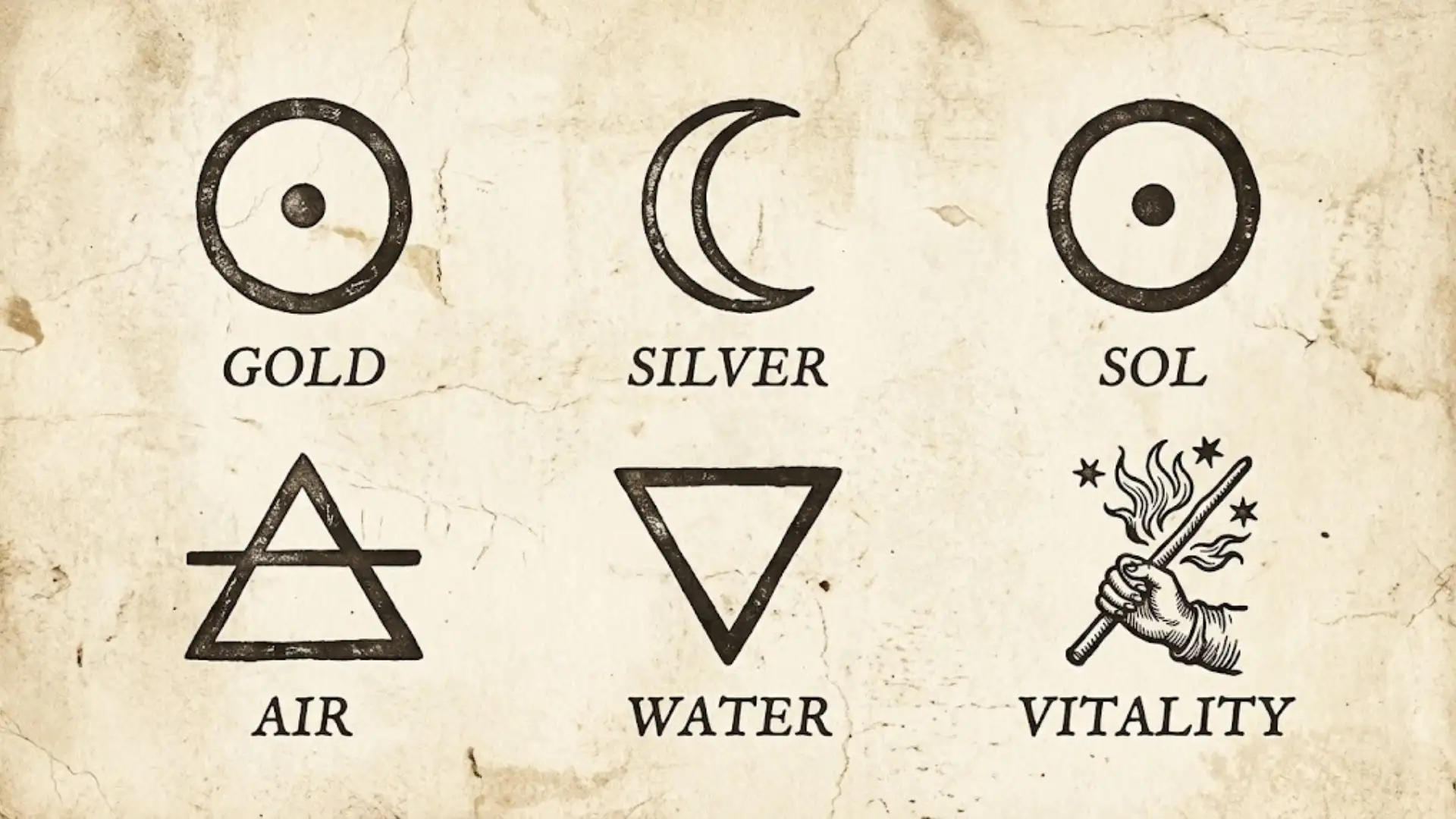
Alchemical symbols are ancient signs that helped people describe metals, minerals, elements, chemical processes, and ideas about the natural world. Some look like simple triangles or circles, while others resemble planetary signs, crosses, crescents, and unusual geometric shapes. Each sign could communicate information that would otherwise require a lengthy written description.
The study of alchemical symbols and meanings opens a window into the history of science, philosophy, medicine, and art. Alchemists used symbols to identify substances, record experiments, and express theories about how matter changed. Their work also included the search for the Philosopher’s Stone, a legendary substance believed to enable the transformation of ordinary metals into gold.
Today, these symbols appear in historical manuscripts, museums, tattoos, jewelry, books, and digital designs. However, their meanings aren’t always straightforward. A symbol might represent a metal in one context and a planet or philosophical concept in another.
This guide explores the most important alchemy symbols, their traditional meanings, their historical background, and how to interpret them accurately.
What Are Alchemical Symbols?
Alchemical symbols are signs used in historical alchemy to represent elements, metals, minerals, chemical preparations, equipment, and laboratory operations. They formed a specialized visual language that helped practitioners record information in handwritten manuscripts and printed books.
Before modern chemical notation became standardized, alchemists relied on a mixture of symbols, abbreviations, coded expressions, diagrams, and written instructions. A single sign could identify a material or communicate its relationship to a planet, element, or stage of an experiment.
For example, the Sun sign, ☉, traditionally represented gold, while the Moon sign, ☽, represented silver. Other familiar signs included ☿ for mercury, ♂ for iron, and ♀ for copper.
Historical alchemy wasn’t simply an attempt to make gold through magic. Practitioners investigated metals, minerals, dyes, acids, distillation, and other practical processes. Their explanations of matter often differ from modern science, but their experiments contributed to the development of chemistry. The Science History Institute’s history of alchemy explores this relationship between practical experimentation and historical theories.
The Purpose of Alchemical Symbols
Alchemists used symbols for several practical and philosophical reasons:
- Identifying substances: Symbols could represent gold, silver, sulfur, mercury, salts, and other materials.
- Recording experiments: A written recipe could use signs to identify ingredients or describe an operation.
- Representing natural elements: Fire, water, air, and earth appeared in traditional systems for explaining matter.
- Connecting metals with planets: Seven classical metals were associated with seven celestial bodies.
- Expressing philosophical ideas: Some texts used images and symbols to explore transformation, purification, balance, and perfection.
- Protecting specialized knowledge: Certain authors used obscure language and complicated imagery to limit understanding among uninitiated readers.
Not every alchemist used the same notation. Historical signs could vary by region, author, manuscript, and period. Therefore, the surrounding text matters as much as the shape of a symbol.
Alchemical Symbols vs. Modern Chemical Symbols
Modern chemistry uses standardized element symbols, such as Au for gold, Ag for silver, and Hg for mercury. Historical alchemical notation worked differently.
| Substance | Traditional alchemical or planetary sign | Modern chemical symbol |
| Gold | ☉ | Au |
| Silver | ☽ | Ag |
| Mercury | ☿ | Hg |
| Copper | ♀ | Cu |
| Iron | ♂ | Fe |
| Tin | ♃ | Sn |
| Lead | ♄ | Pb |
The signs in the middle column belong to historical systems that connected metals with planets. Modern chemical symbols identify elements according to a standardized scientific system.
Alchemical Symbols and Their Meanings Chart
The following chart provides a quick introduction to frequently discussed alchemical symbols and meanings. Some signs are widely recognized traditional planetary or elemental symbols. Others are specialized characters included in the Unicode Alchemical Symbols block.
| Symbol | Name | Traditional meaning or use |
| 🜀 | Quintessence | Fifth essence in certain historical systems |
| 🜁 | Air | Classical element of air |
| 🜂 | Fire | Classical element of fire |
| 🜃 | Earth | Classical element of earth |
| 🜄 | Water | Classical element of water |
| ☉ | Sun / gold | Gold and the Sun |
| ☽ | Moon / silver | Silver and the Moon |
| ☿ | Mercury | Mercury and the planet Mercury |
| ♀ | Venus / copper | Copper and Venus |
| ♂ | Mars / iron | Iron and Mars |
| ♃ | Jupiter / tin | Tin and Jupiter |
| ♄ | Saturn / lead | Lead and Saturn |
| 🜍 | Sulfur | A specific alchemical sulfur character |
| 🜔 | Salt | A specific alchemical salt character |
| 🜖 | Vitriol | Historical symbol for vitriol |
| 🜚 | Gold | Unicode character named Alchemical Symbol for Gold |
| 🜛 | Silver | Unicode character named Alchemical Symbol for Silver |
| 🝞 | Sublimation | Alchemical process character |
| 🝠 | Distill | Alchemical process character |
| 🝥 | Crucible | Alchemical apparatus character |
The Unicode Standard lists these specialized signs in its Notice that the chart distinguishes specific alchemical characters from familiar planetary signs. Their appearances and historical uses aren’t always interchangeable.
The Four Classical Alchemical Element Symbols
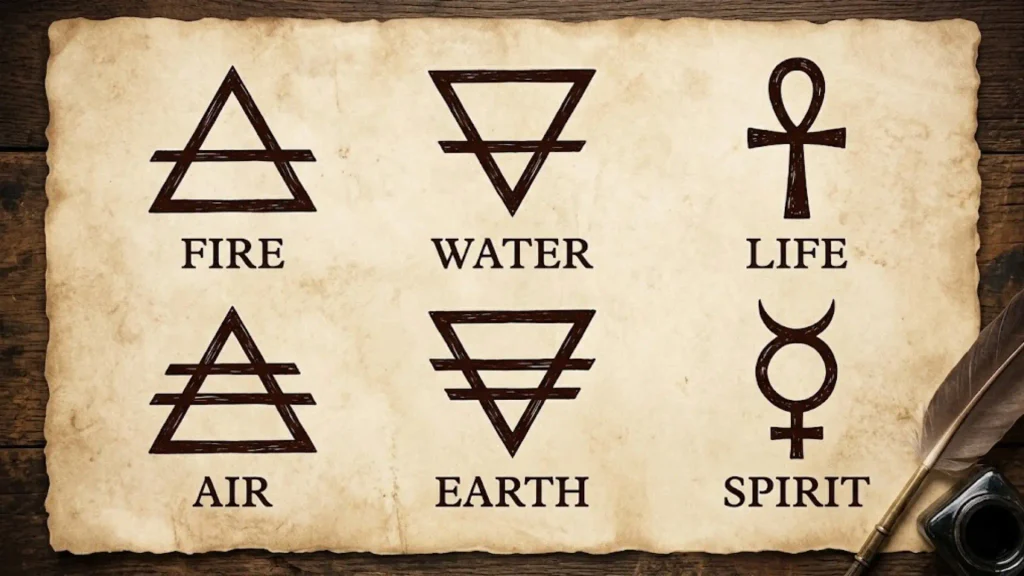
The four classical elements—fire, air, water, and earth—played an important role in historical ideas about nature and matter. Alchemical writers inherited these concepts from older philosophical traditions and adapted them to their own theories.
The familiar geometric versions use triangles. Fire and air point upward, while water and earth point downward. A horizontal line distinguishes air from fire and earth from water.
Fire Alchemy Symbol (🜂)
Fire traditionally represented heat, burning, energy, and transformation. In laboratory work, heat was essential for operations such as calcination, distillation, and the preparation of certain materials.
The familiar elemental sign for fire is an upward-pointing triangle: △. The specialized Unicode character 🜂 is named Alchemical Symbol for Fire.
Fire could also carry philosophical meaning. It suggested the power to change a substance through heat or to separate one material from another. However, its precise interpretation depended on the text and process being described.
Common associations:
- Heat and combustion
- Transformation through heating
- Energy and activity
- Purification through certain thermal operations
These associations describe traditional symbolism, not a universal spiritual meaning shared by every alchemist.
Air Alchemy Symbol (🜁)
Air traditionally represented the element associated with an upward-pointing triangle crossed by a horizontal line: △̶. Its specialized Unicode character is 🜁.
Air was one of the four classical elements used to explain the natural world. In philosophical discussions, it could be associated with qualities such as lightness and movement.
It’s important to distinguish the classical element of air from actual gases studied in modern chemistry. Historical elemental theory wasn’t the same as today’s scientific classification of matter.
Water Alchemy Symbol (🜄)
Water is traditionally represented by a downward-pointing triangle: ▽. The Unicode character 🜄 is named Alchemical Symbol for Water.
Water had obvious practical importance in alchemical work. Liquid preparations, washing, dissolving, and distillation frequently appeared in historical recipes. Nevertheless, the elemental symbol for water doesn’t automatically mean that every liquid ingredient in an old manuscript was ordinary water.
Common associations include:
- Liquids and fluidity
- Dissolution and washing
- Change through mixing
- The classical element of water
The exact meaning still depends on how the author used the sign.
Earth Alchemy Symbol (🜃)
Earth traditionally uses a downward-pointing triangle crossed by a horizontal line: ▽̶. The specialized Unicode character is 🜃.
The element represented solidity, material substance, and the grounded qualities assigned to earth in classical philosophy. It belonged to a broader framework that used four elements to explain the properties and behavior of natural materials.
In an alchemical text, earth symbolism may relate to a philosophical element rather than literal soil or a specific mineral.
The Fifth Element or Quintessence (🜀)
Some historical traditions discussed a fifth essence, commonly called quintessence. The Unicode character 🜀 is named Alchemical Symbol for Quintessence.
Quintessence wasn’t simply another name for one of the four classical elements. It was associated in certain traditions with a refined or essential substance beyond the ordinary four-element framework.
Its meaning varied across historical and philosophical contexts. Some writers connected the idea with celestial substance, while others explored it in discussions of medicine, refinement, or the essential nature of materials.
The Seven Planetary Metal Alchemy Symbols
One of the best-known systems of alchemy symbols connects seven metals with seven classical celestial bodies. The associations linked material substances to the Sun, Moon, and five planets known in traditional astronomy.
These correspondences helped organize alchemical theories about metals and the natural world. They weren’t based on the modern scientific understanding of planetary influence.
| Metal | Traditional sign | Celestial association | Modern chemical symbol |
| Gold | ☉ | Sun | Au |
| Silver | ☽ | Moon | Ag |
| Mercury | ☿ | Mercury | Hg |
| Copper | ♀ | Venus | Cu |
| Iron | ♂ | Mars | Fe |
| Tin | ♃ | Jupiter | Sn |
| Lead | ♄ | Saturn | Pb |
The Science History Institute’s article on Arabic alchemy explains that alchemical writers used planetary names to refer to metals. The system became an important part of later European alchemical notation as well.
Gold Symbol (☉)
The Sun sign, ☉, traditionally represented gold. Gold’s resistance to tarnishing, bright color, rarity, and economic value made it especially significant to alchemists.
Gold often represented perfection in theories of metallic transformation. Some practitioners believed that less perfect metals could be transformed into more noble metals under the right conditions.
The Sun sign also appears in astronomy, so context determines whether it represents the celestial body, the metal, or a related idea.
Silver Symbol (☽)
Silver was traditionally associated with the Moon and represented by a crescent sign, ☽. Its bright appearance and changing surface reflections helped strengthen the traditional lunar connection.
In alchemical recipes, the Moon could refer to silver rather than the astronomical object. The symbol also appears in modern astronomical and astrological contexts.
Mercury Symbol (☿)
Mercury has a particularly important place in alchemy because it was both a material substance and a concept in historical theories of matter.
The sign ☿ represented mercury, also called quicksilver. Alchemists investigated its unusual liquid-metal behavior and its interactions with other substances.
In some theories, Mercury also referred to an abstract principle associated with volatility or the behavior of matter. That philosophical use shouldn’t be confused with the physical element mercury or with the planet itself.
Copper Symbol (♀)
Copper was traditionally connected with Venus and represented by ♀. The association linked a familiar metal with the planet and its namesake in classical mythology.
Copper’s color, workability, and long history of use in tools, vessels, and decorative objects made it an important material in historical metalworking and alchemy.
Iron Symbol (♂)
Iron was associated with Mars and represented by ♂. The relationship reflects traditional connections between Mars, warfare, weapons, and the strength of iron.
In historical notation, the sign can identify iron or refer to Mars. Modern uses of ♂ also include the male sign, which is a separate context for interpreting the character.
Tin Symbol (♃)
Tin was traditionally associated with Jupiter and represented by ♃. It was one of the seven classical planetary metals.
Historical alchemists studied tin and other metals through practical experiments and theories about their composition. The symbol helped identify the metal in a system that connected earthly substances with celestial bodies.
Lead Symbol (♄)
Lead was associated with Saturn and represented by ♄. Its weight, softness, and practical uses made it a familiar metal in historical craft and laboratory work.
In some alchemical interpretations, lead represented an imperfect or less refined metal in contrast with gold. This reflects historical theories of metallic development, not a modern chemical process by which lead naturally turns into gold.
The Three Alchemical Principles: Sulfur, Mercury, and Salt
Some alchemical traditions used a framework known as the tria prima, or three principles: sulfur, mercury, and salt. This system is especially associated with Paracelsian alchemy and later interpretations of matter.
These principles weren’t simply identical to the modern chemical substances with the same names. They could represent broader qualities or theoretical components used to explain material behavior.
Sulfur Symbol (🜍)
The Unicode character 🜍 is named Alchemical Symbol for Sulfur. Historical sulfur was also known as brimstone.
Actual sulfur played an important role in alchemical experiments because it reacted with metals and other substances. Historical writers also used sulfur as a theoretical principle associated with qualities such as combustibility.
The material and philosophical meanings must be separated carefully. A recipe referring to physical sulfur doesn’t necessarily use the word in an abstract sense.
Mercury as an Alchemical Principle
Mercury could refer to quicksilver, the metal, or a theoretical principle. In some traditions, the principle of mercury helped explain qualities such as volatility and the capacity of substances to change.
The distinction matters because alchemists often used familiar material names to express ideas about the behavior and composition of matter.
For example, the historical principle of Mercury wasn’t simply a claim that all substances contained the modern chemical element Hg.
Salt Symbol (🜔)
The Unicode character 🜔 is named Alchemical Symbol for Salt. Salt also appeared as a material in numerous historical preparations.
In certain philosophical systems, the principle of salt was associated with solidity, stability, or the body’s material aspect. Its meaning varied by author and tradition.
Salt also had practical roles in historical chemistry. Recipes could use different salts for preparation, purification, or reactions. Always check the recipe’s date and terminology before assuming it refers to modern table salt.
How the Three Principles Work Together
The three principles offered one way to explain the behavior of materials. Rather than describing every substance as a simple mixture of modern chemical elements, alchemists often used theories involving qualities, principles, proportions, and degrees of purity.
These ideas helped guide experiments, although they don’t match modern atomic theory.
The three principles also differ from the four classical elements and seven planetary metals. They are related parts of the broader history of alchemy, not interchangeable categories.
Other Important Alchemical Symbols and Substances
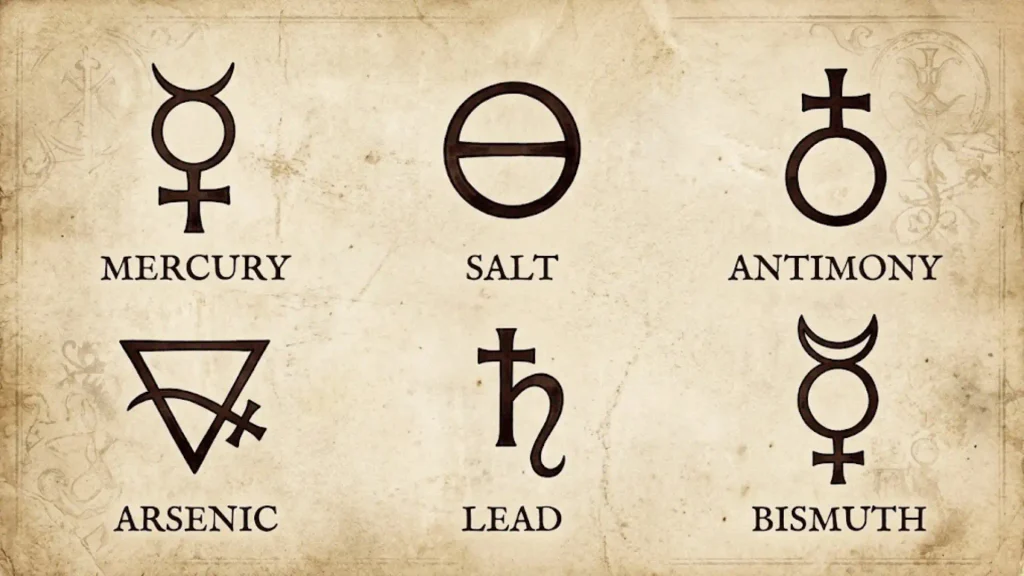
Alchemical texts contain many signs beyond the best-known elements and planetary metals. Some identify particular compounds or preparations, while others represent equipment or processes.
The Unicode chart includes characters for substances such as aquafortis, aqua regia, cinnabar, vitriol, rock salt, arsenic, borax, and quicklime. The historical meaning of each character should be checked against its source.
Philosopher’s Stone
The Philosopher’s Stone was a legendary substance associated with one of alchemy’s most famous goals: transforming base metals into gold. Some traditions also linked it to the preparation of medicines or an elixir intended to preserve health.
The Stone didn’t have one universally standardized symbol. Historical manuscripts sometimes represented it through allegorical illustrations, geometric forms, kings, animals, or other imagery that required interpretation alongside the accompanying text.
Today, the Philosopher’s Stone often symbolizes transformation, knowledge, or the achievement of a difficult goal. These modern interpretations can be meaningful, but they shouldn’t replace historical explanations.
Ouroboros Symbol
The Ouroboros depicts a serpent or dragon consuming its own tail. It appears in several historical symbolic traditions and became associated with alchemical imagery.
Depending on its context, the Ouroboros can suggest a cycle, a process that returns to its beginning, or the unity of a whole. Its circular shape makes it a natural image for continuity and recurrence.
However, it isn’t a chemical notation for a particular substance. Its significance comes from the text or image in which it appears.
Vitriol Symbol (🜖)
The Unicode character 🜖 is named Alchemical Symbol for Vitriol. Historically, vitriol referred to certain sulfate salts and could appear in the names of different materials or preparations.
For example, oil of vitriol was a historical name for sulfuric acid. The word’s meaning depended on the period and the substance being discussed.
A symbol labeled vitriol in a historical chart should therefore be interpreted in context rather than automatically assigned to one modern chemical compound.
Cinnabar and Other Laboratory Materials
Cinnabar, an ore of mercury, had a place in historical alchemy and metalworking. The Unicode character 🜓 is named Alchemical Symbol for Cinnabar.
Historical charts also contain signs for aquafortis, aqua regia, aqua vitae, nitre, rock salt, borax, and other substances. These names may refer to preparations whose composition or purity differed from modern products.
Some historical ingredients are hazardous. Mercury compounds, arsenic compounds, and strong acids can cause serious harm, so old alchemical recipes should be studied as historical documents rather than followed as practical instructions.
Alchemical Apparatus Symbols
Alchemical writers also represented laboratory equipment. The Unicode character 🝥 is named Alchemical Symbol for Crucible, while 🝪 is named Alchemical Symbol for Alembic.
A crucible is a heat-resistant vessel used for heating materials. An alembic is a type of distillation apparatus used to separate or collect vapors and liquids.
Equipment signs matter because they help researchers understand what an alchemist intended to do. A symbol for an apparatus is different from one representing a substance or theoretical principle.
Alchemical Symbols for Processes and Transformations
Alchemical manuscripts described many operations that changed, separated, purified, or prepared materials. Some operations have dedicated characters in Unicode’s alchemical block, although historical notation wasn’t completely uniform.
Calcination
Calcination involves heating a material, often in the presence of air, to produce a change such as decomposition or oxidation. Alchemists used heating operations in work with minerals and metals.
In philosophical interpretations, calcination could also appear as an image of breaking down or removing impurities. That symbolic reading depends on the source and shouldn’t be assumed for every recipe.
Dissolution
Dissolution involves a substance entering a liquid or becoming dispersed within it. Alchemical recipes used liquids and solvents to prepare materials for later operations.
Unicode includes 🝡, named Alchemical Symbol for Dissolve. The existence of a named character doesn’t mean every historical author used precisely the same sign or assigned it one universal interpretation.
Separation
Separation refers to distinguishing components of a mixture or material. Historical alchemists used techniques such as filtration, settling, and distillation to separate substances.
In some philosophical writing, separation also described distinguishing different aspects of a material before combining or refining them. The practical and symbolic meanings must be read in context.
Conjunction
Conjunction means joining or combining materials. In certain alchemical texts, it referred to a stage in a sequence of operations or to a union represented through allegorical imagery.
Some historical works used elaborate illustrations to communicate conjunction. The same image could combine practical, philosophical, and religious themes.
Distillation
Distillation uses heating and condensation to separate or collect substances based on differences in volatility. It was an important technique in historical alchemy and contributed to the development of laboratory chemistry.
The Unicode character 🝠 is named Alchemical Symbol for Distill. Other historical signs may refer to particular apparatuses or related operations.
Coagulation and Other Operations
Coagulation describes a process in which material becomes thicker, clumps together, or forms a more solid mass, depending on the substance and historical usage.
Other alchemical operations included sublimation, precipitation, purification, and putrefaction. Unicode provides dedicated characters for several processes, including 🝞 for sublimation and 🝟 for precipitate.
These characters are useful for modern reference, but historians should verify how a sign was used in a particular manuscript rather than assuming that modern Unicode labels explain every historical occurrence.
What Do Alchemical Symbols Mean Spiritually?
Many modern readers interpret alchemical symbols through ideas about inner growth, personal change, balance, and renewal. These interpretations are common in contemporary spiritual writing and popular culture.
Historical alchemy sometimes combined practical experimentation with philosophical, religious, or mystical ideas. Yet the details varied widely. Not every historical symbol was intended as a message about personal development.
Transformation and Personal Change
Alchemical transformation is often used today as a metaphor for changing habits, developing knowledge, or moving through a difficult period.
The metaphor draws on the historical goal of changing materials into something considered more valuable or refined. However, the modern psychological interpretation should be identified as a later reading unless a particular historical text supports it.
Balance and the Union of Opposites
Some alchemical texts explore opposing qualities or the joining of different materials. Later readers have interpreted these themes as symbols of balance, integration, or the union of opposites.
The meaning depends on the source. A historical illustration showing two figures together, for example, might refer to a particular operation or philosophical theory rather than a universal spiritual rule.
Death, Renewal, and Rebirth
Images of decay, dissolution, and renewed formation appear in some alchemical works. Modern interpretations often connect them with endings and new beginnings.
Such readings can help explain why alchemy remains attractive in art and popular culture. Still, it’s important to distinguish an interpretation from a meaning explicitly documented by a historical author.
Historical Meanings vs. Modern Spiritual Interpretations
When researching alchemical symbols and their meanings, ask three questions:
- Does a historical manuscript explain the symbol?
- Is the interpretation supported by a museum, scholarly, or historical reference?
- Is the meaning a modern spiritual interpretation rather than a documented historical use?
These questions help keep the article informative without presenting every popular interpretation as an established fact.
The History of Alchemical Symbols
Alchemical symbols developed across multiple cultures and historical periods. There wasn’t one inventor or one universal system that remained unchanged over time.
Early Alchemical Traditions
Alchemy developed in the ancient Mediterranean world, including Greco-Egyptian settings during the early centuries of the Common Era. Its practitioners drew on traditions involving metallurgy, medicine, craft knowledge, and Greek philosophy.
Early alchemical writing combined practical observations with theories about how substances could change. Some texts used symbolic language, allegories, and coded recipes.
Alchemy in the Medieval Islamic World
Arabic-language scholars preserved, translated, and developed important strands of alchemical knowledge. Their work contributed to the transmission of ancient learning and included practical advances in laboratory techniques.
Historical Arabic alchemy involved both theoretical discussions and hands-on work with substances. The discusses its intellectual background and its influence on later traditions.
European Medieval and Renaissance Alchemy
Alchemy became influential in medieval and early modern Europe. Practitioners used manuscripts, printed books, diagrams, and specialized signs to record their work.
The provides a historical example of a table identifying signs used in printed and manuscript works.
The table also illustrates an important point: although some notation became common, symbol forms and uses could still vary.
Alchemical Symbols in the Rise of Chemistry
Alchemical notation gradually gave way to more standardized systems as chemistry developed. However, the transition wasn’t a simple moment when one field disappeared and another began.
Many alchemists conducted practical experiments with acids, metals, distillation, and other processes. Some of these activities contributed to later chemical knowledge, even when their theories of matter differed from modern scientific explanations.
Alchemy had ceased to be regarded as a mainstream scientific program by the middle of the eighteenth century, but its symbols continued to influence historical writing, art, and popular culture.
How to Read and Identify Alchemical Symbols
A symbol’s appearance alone rarely provides enough information to identify its exact meaning. If you’re examining an old manuscript, a tattoo design, or a symbol chart, use a careful method.
Identify the Symbol’s Shape
Compare the shape with a reputable reference chart. Pay attention to small differences, such as a line through a triangle, a cross beneath a circle, or a mark beside a crescent.
Two symbols can look similar while representing different substances or operations. A modern symbol chart is a useful starting point, but it doesn’t replace historical research.
Check the Surrounding Text
Look at the words, ingredients, and instructions near the symbol. If the text discusses heating a metal, the sign may refer to an ingredient or an operation. If it discusses planets, it may use the same character in an astronomical sense.
The offers a useful example of how symbols appeared in chemical authors’ manuscripts and printed books.
Consider the Date and Tradition
A symbol’s meaning may change between manuscripts or periods. The same sign may be interpreted differently by an author working in a different theoretical tradition.
When possible, record the source’s date, language, author, and surrounding passage. Those details help prevent incorrect identifications.
Unicode can confirm a character’s encoded name, but that name alone doesn’t establish how every historical alchemist used it.
Alchemical Symbols Copy and Paste
If you want alchemical symbols to copy and paste, start with these commonly referenced characters.
| Symbol | Name |
| 🜀 | Quintessence |
| 🜁 | Air |
| 🜂 | Fire |
| 🜃 | Earth |
| 🜄 | Water |
| 🜍 | Sulfur |
| 🜔 | Salt |
| 🜖 | Vitriol |
| 🜚 | Gold |
| 🜛 | Silver |
| 🝞 | Sublimation |
| 🝟 | Precipitate |
| 🝠 | Distill |
| 🝡 | Dissolve |
| 🝥 | Crucible |
| 🝪 | Alembic |
For traditional planetary metal signs, you can also copy these characters:
☉ ☽ ☿ ♀ ♂ ♃ ♄
These are useful for notes, study materials, illustrations, and digital designs. Check the meaning before using a sign in a historical or educational project.
Why Some Alchemical Symbols May Not Display
Some alchemical characters belong to a specialized Unicode block. A device or font may not support every character, so you might see an empty box or a substitute glyph instead.
If a character doesn’t appear correctly:
- Try a different font or application.
- Check whether the platform supports the relevant Unicode character.
- Use an image of the symbol when exact visual reproduction is important.
- Verify the character against the official Unicode chart.
Remember that the glyph displayed on your screen may differ slightly from the way the symbol appears in an old manuscript.
Alchemical Symbols in Tattoos, Jewelry, and Modern Design
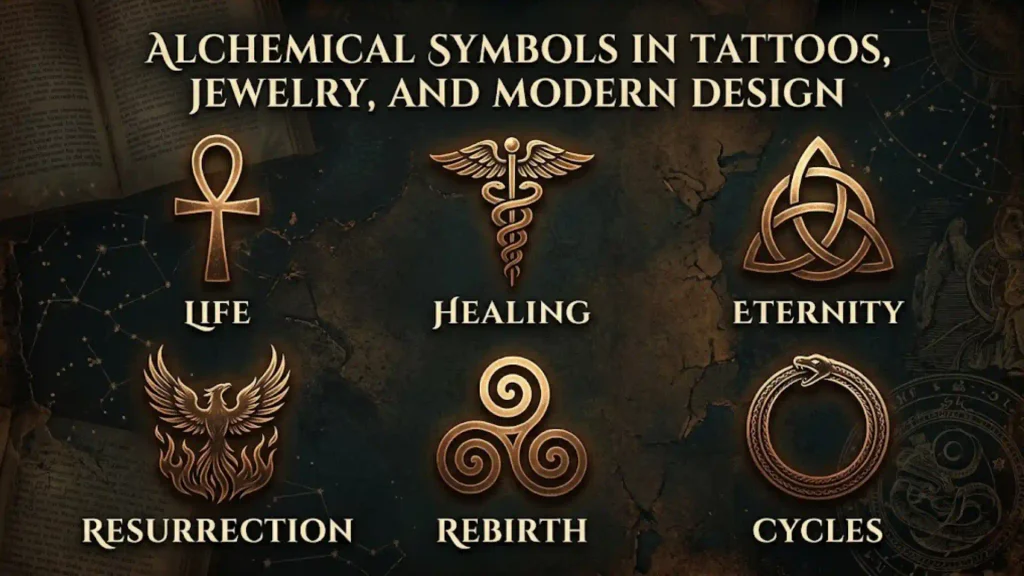
Alchemical signs have become popular in contemporary artwork because their geometric forms are distinctive and their historical associations can suggest transformation, mystery, or scientific curiosity.
Alchemical Symbol Tattoos and Their Meanings
People may choose alchemical tattoos to represent an interest in history, chemistry, philosophy, or personal transformation. Others prefer the clean shapes of elemental signs or the familiar planetary metal symbols.
Before getting a tattoo, verify the exact character and its intended use. A sign associated with gold, for example, isn’t the same as a sign for the Sun in every context, even when the two share a traditional association.
Also consider whether the meaning you want is historical or personal. Both can matter, but it’s helpful to understand the difference.
Alchemical Symbols in Jewelry
Alchemical symbols appear in pendants, rings, bracelets, and other decorative items. Elemental triangles and planetary signs are especially suitable for small designs because their shapes remain recognizable at different sizes.
If a piece of jewelry claims to feature an authentic historical symbol, ask for a reference showing the sign and explaining its source.
Alchemical Symbols in Art and Graphic Design
Artists use alchemical signs in book covers, illustrations, fantasy artwork, posters, and logos. The symbols can create a historical or mysterious atmosphere without requiring a long explanation.
For an accurate historical design, use a reference image from a manuscript or a trusted collection. For a fictional or personal design, you can adapt the shapes creatively, provided you don’t present the result as an exact historical reproduction.
Alchemical Symbols vs. Astrology and Modern Chemistry
Alchemical symbols overlap with astronomy and astrology, but the systems serve different purposes.
Alchemical Symbols vs. Astrological Symbols
The planetary signs ☉, ☽, ☿, ♀, ♂, ♃, and ♄ appear in several contexts. In alchemy, they traditionally connect celestial bodies with metals. In astrology, planetary symbols represent celestial bodies used in astrological interpretation.
The sign alone may not tell you which system an author intended. Check the surrounding text and the document’s purpose.
Alchemical Symbols vs. Modern Chemical Symbols
Modern chemical symbols are standardized abbreviations for elements. For example, Au identifies gold, Ag identifies silver, and Fe identifies iron.
Historical alchemical symbols served a broader and less uniform range of purposes. They could represent a metal, a preparation, a process, an apparatus, or an abstract principle.
The difference reflects a change in how scientists and practitioners recorded information about matter.
Are Alchemical Symbols Still Used Today?
Yes. People use them in historical research, teaching, art, jewelry, tattoos, and digital writing. Scholars also examine them to understand how earlier practitioners described materials and conducted experiments.
Their modern use doesn’t mean the original alchemical theories have been confirmed by contemporary science. The symbols remain valuable as historical evidence and as a part of cultural and artistic traditions.
Frequently Asked Questions About Alchemical Symbols
What are the most common alchemical symbols?
Commonly discussed signs include the four classical element symbols, the seven planetary metal signs, and the symbols for sulfur and salt. The exact set depends on the historical tradition or reference chart.
What do the four alchemical element symbols mean?
Fire, air, water, and earth formed a classical framework for explaining nature and matter. Their signs are commonly shown as triangles, with upward or downward points and horizontal lines distinguishing the elements.
What are the seven planetary metal symbols?
The traditional set connects gold with the Sun, silver with the Moon, mercury with Mercury, copper with Venus, iron with Mars, tin with Jupiter, and lead with Saturn.
What does the alchemical symbol for mercury mean?
The sign ☿ traditionally represents mercury, also called quicksilver, and is associated with the planet Mercury. In some alchemical theories, Mercury also refers to an abstract principle, so context matters.
What is the difference between sulfur, mercury, and salt in alchemy?
They are known as the three principles, or tria prima, in certain alchemical traditions. The terms could refer to physical substances or broader theoretical principles, depending on the author.
What does the Philosopher’s Stone symbolize?
Historically, the Philosopher’s Stone was associated with metallic transmutation and, in some traditions, medicinal goals. Today, it is also used as a metaphor for transformation, knowledge, or the pursuit of perfection.
Are alchemical symbols the same as astrology symbols?
No, although the systems share some planetary signs. Alchemy used these signs in connection with metals and substances, while astrology uses them to represent celestial bodies in astrological interpretation.
Can I copy and paste alchemical symbols?
Yes. Many specialized alchemical characters are encoded in Unicode. However, display depends on font and platform support, so some symbols may not appear correctly on every device.
Why do alchemical symbols have different meanings?
Alchemical notation developed across different periods, regions, authors, and traditions. A sign’s meaning could depend on the substance, process, or philosophical framework described in the text.
Are alchemical symbols used in modern chemistry?
Modern chemistry primarily uses standardized chemical symbols and notation. Alchemical signs remain useful in historical research, education, design, and cultural references, but they aren’t a replacement for modern chemical symbols.
Conclusion
Alchemical symbols provide a fascinating record of how people once understood metals, elements, substances, and the processes that changed them. The four classical elements, seven planetary metals, three alchemical principles, and symbols for laboratory operations all reveal different aspects of this history.
Their meanings aren’t always fixed. A planetary sign might represent a metal, a celestial body, or a concept in a particular text. Specialized Unicode characters can help modern readers copy and identify alchemical signs, but historical manuscripts remain essential for understanding their original use.
Whether you’re researching ancient traditions, studying the history of chemistry, or choosing a symbol for a design, start with a reliable reference and consider the context. That approach will help you distinguish historical evidence from modern interpretations while exploring the rich world of alchemy.

Hi, I’m Sienna Brooks, and I believe that the right words can inspire, comfort, and empower people at every stage of life. For as long as I can remember, I’ve been drawn to meaningful quotes and the stories behind them. I love curating collections of inspirational, motivational, and heartfelt quotes that resonate with readers around the world.
Through my writing, I strive to help others find encouragement, whether they’re celebrating life’s happiest moments or navigating its biggest challenges. I believe that wisdom is timeless, and I’m passionate about sharing words that leave a lasting impact.
I am the author of Reflections in Words and The Journey of Inspiration, two books dedicated to exploring the beauty and power of timeless quotes.
 Asher Monroe
 Rowan Sinclair Rowan Sinclair