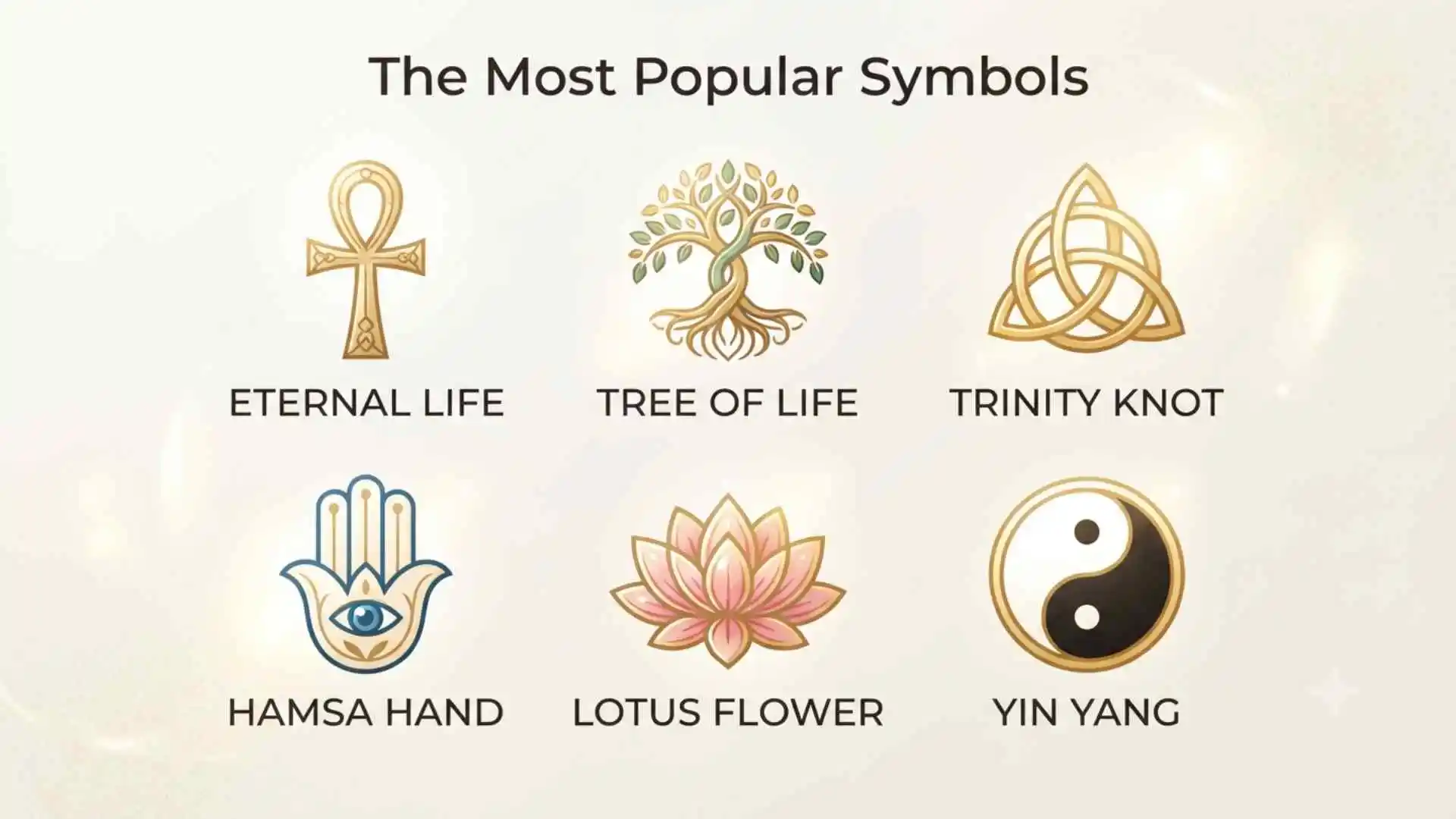
Symbols that mean family speak to one of the deepest human needs: the desire to belong, protect, remember, and stay connected. Across history, people have used trees, circles, animals, knots, crests, and sacred patterns to represent parents, children, ancestors, and future generations.
These images appear in ancient art, spiritual traditions, jewelry, tattoos, and family heirlooms. By exploring them, we discover how different cultures express the same timeless truth: family gives life a sense of identity, continuity, and home.
Symbols That Mean Family (Quick Answer)
Symbols that mean family are visual signs representing love, loyalty, ancestry, protection, unity, and connection across generations. Common examples include the family tree, Tree of Life, Celtic knot, triquetra, circle, heart, elephant herd, wolf pack, family crest, and linked rings. Their exact meaning depends on culture, history, and personal interpretation.
Quick Facts About Symbols That Mean Family
| Aspect | Information |
| Origin | Family symbols developed independently in ancient cultures through nature, religion, ancestry, and social traditions |
| Historical Significance | They identified clans, preserved family history, honored ancestors, and strengthened community bonds |
| Main Meaning | Love, belonging, unity, protection, ancestry, loyalty, and continuity |
| Spiritual Meaning | Connection between ancestors, living relatives, future generations, and the sacred source of life |
| Cultural Importance | Family symbols help communities preserve identity, values, stories, and collective memory |
| Modern Usage | Tattoos, jewelry, family crests, logos, wall art, memorials, gifts, clothing, and social media |
What Are Symbols That Mean Family?
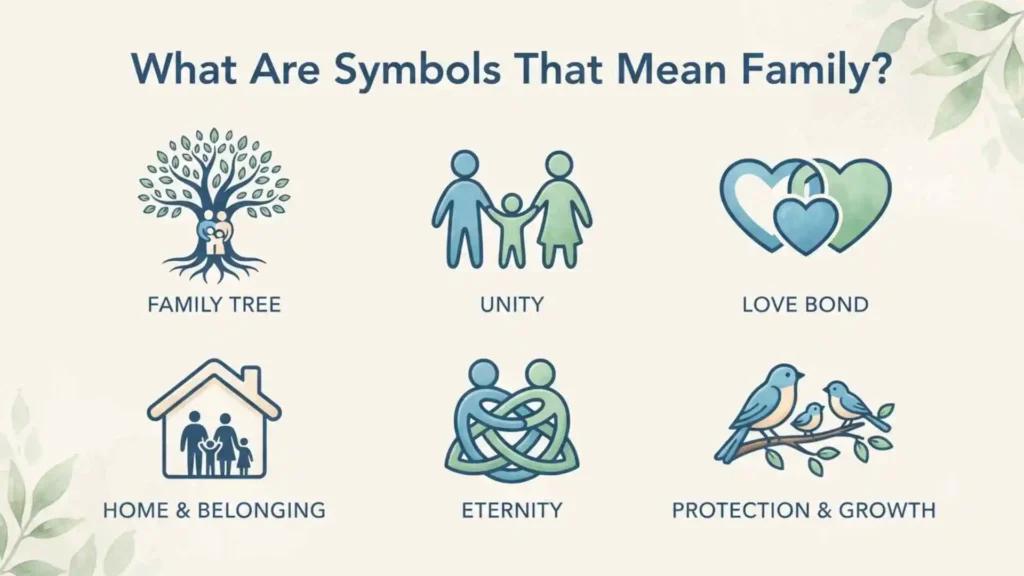
Symbols that mean family are images, patterns, animals, plants, or objects used to express the bonds between relatives and loved ones.
Some focus on blood relationships. Others represent chosen family, close friendships, adoption, spiritual communities, or people who provide emotional safety and support.
A family symbol may communicate several ideas at once:
- Shared roots
- Parental love
- Protection
- Loyalty
- Ancestral heritage
- Growth
- Sacrifice
- Strength during hardship
- Connection across distance
- Continuity between generations
Long before written records became common, people used symbols to preserve family identity. A carved animal, woven pattern, household emblem, or sacred tree could communicate ancestry and community membership.
Over time, these signs evolved into heraldic crests, clan emblems, religious images, wedding symbols, family tattoos, and personalized jewelry.
Today, people often combine several traditional symbols to create a design that reflects their own family story.
The Historical Importance of Family Symbols
Family has shaped nearly every known society. Ancient people depended on relatives for food, shelter, defense, education, and survival.
Because family bonds were so important, cultures developed visible signs of kinship.
In ancient Rome, elite households displayed ancestral images and honored family lineages. European heraldry later used shields, animals, plants, colors, and mottos to identify noble families.
In many African societies, symbols, textiles, oral traditions, and carved objects preserved community wisdom and ancestral memory. Adinkra symbols, which originated among Akan peoples in present-day Ghana and Côte d’Ivoire, communicate ideas such as unity, cooperation, heritage, and learning from the past. The Smithsonian notes that Adinkra symbols pass on traditional wisdom, while Sankofa encourages people to return to the past and recover what is valuable.
In Māori culture, genealogy, known as whakapapa, connects people with ancestors, community, land, and the natural world. Visual forms such as the koru can express creation, renewal, and the continuation of life.
Although the designs differ, the purpose is often similar. Family symbols help people answer three basic questions:
Who came before me?
Where do I belong?
What will I pass forward?
Deep Symbolic Meaning of Symbols That Mean Family
Spiritual Meaning
On a spiritual level, family symbols often represent an invisible connection between generations.
The roots of a tree may symbolize ancestors. The trunk can represent the living family. Branches and leaves may stand for children and future descendants.
This structure suggests that no life exists in isolation. Every person grows from relationships, history, memory, and sacrifice.
Circular symbols also carry spiritual meaning because they have no clear beginning or end. They can represent eternal love, reincarnation, continuity, and the belief that family bonds survive physical separation or death.
For some people, family is also a spiritual assignment. It is the place where patience, forgiveness, responsibility, compassion, and unconditional love are learned.
Psychological Meaning
Psychologically, symbols that mean family can create feelings of safety and emotional stability.
Humans naturally form attachment bonds. From infancy, people depend on caregivers for survival and emotional regulation. As a result, images of shelter, circles, trees, hands, nests, and protective animals can activate feelings of warmth and security.
Carl Jung described archetypes as recurring images and patterns that appear across myths, dreams, religions, and human imagination. The protective parent, nurturing mother, wise ancestor, vulnerable child, and united tribe are powerful family-related archetypes.
A family symbol can also help a person make sense of loss. A tattoo, necklace, photograph, or heirloom may act as a continuing bond with someone who has died.
It does not replace the person. Instead, it gives memory a visible form.
Cultural Meaning
At the cultural level, family symbols protect shared identity.
They may preserve:
- Surnames
- Clan history
- Migration stories
- Religious beliefs
- Traditional occupations
- Regional identity
- Family achievements
- Moral values
- Memories of struggle and survival
A family crest, textile pattern, ancestral object, or inherited piece of jewelry often becomes important because of the story attached to it.
The emotional power comes not only from how the symbol looks, but also from what the family remembers when they see it.
Most Powerful Symbols That Mean Family
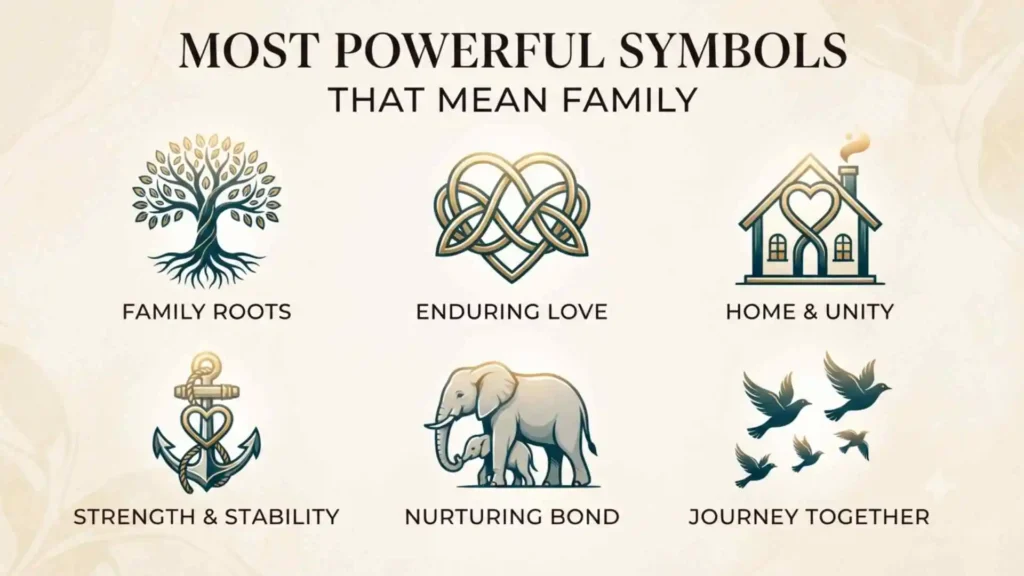
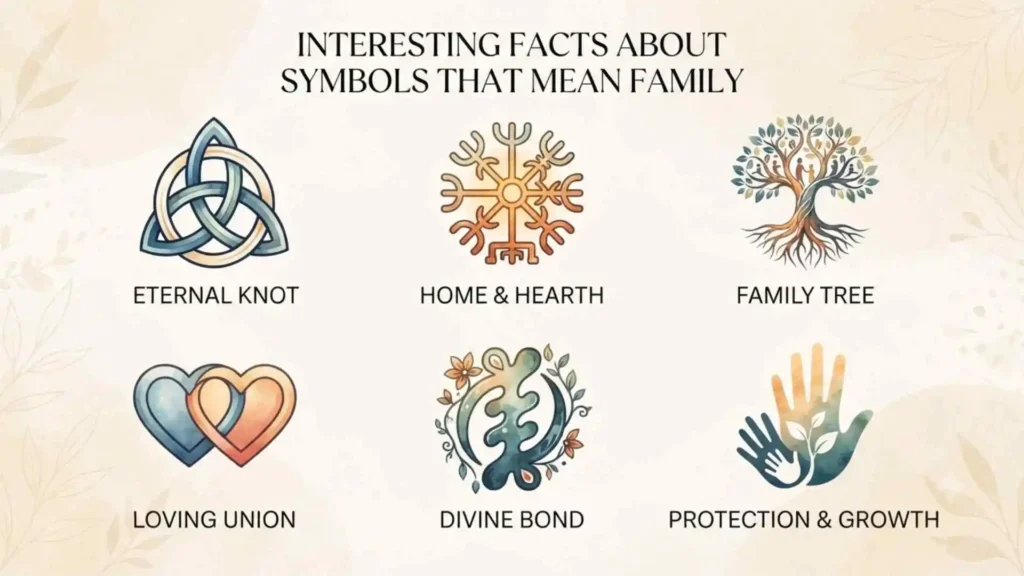
1. The Family Tree
Visual Description
A family tree usually shows a strong trunk, spreading branches, leaves, roots, or names connected through lines.
Meaning
It represents ancestry, relationships, growth, and future generations.
Symbolism
- Roots symbolize ancestors
- The trunk represents shared identity
- Branches represent family lines
- Leaves represent individual relatives
- Fruit may symbolize children, achievements, or legacy
Cultural Connection
Genealogical trees became widely used in medieval and early modern Europe, but tree imagery has represented life and descent in many cultures.
Where It Appears
Family charts, tattoos, memorial art, genealogy books, wedding gifts, jewelry, and home decor.
2. The Tree of Life
Visual Description
The Tree of Life is usually shown as a large tree with visible roots and branches, sometimes enclosed within a circle.
Meaning
It represents interconnected life, spiritual growth, ancestry, balance, and continuity.
Symbolism
Its roots reach into the earth while its branches rise toward the sky. This creates a bridge between the physical and spiritual worlds.
As a family symbol, it suggests that every generation is part of one living system.
Cultural Connection
Sacred trees appear in Mesopotamian, Egyptian, Norse, Celtic, Buddhist, Hindu, Jewish, Christian, and Indigenous traditions. The exact meanings are not identical, so the Tree of Life should be understood within its cultural context.
The Metropolitan Museum of Art notes that trees held sacred importance in early Indian religious landscapes before and during the rise of Buddhist art.
Where It Appears
Religious art, mythology, paintings, pendants, tattoos, logos, gardens, and family memorials.
3. The Circle
Visual Description
A continuous line forming a closed, round shape.
Meaning
The circle represents unity, equality, wholeness, protection, and eternal connection.
Symbolism
Because a circle has no beginning or end, it is often used to express everlasting love.
When people stand in a circle, every person becomes part of the whole. No one stands above or below another.
Cultural Connection
Circles appear in sacred art, wedding rings, ceremonial gatherings, mandalas, medicine wheels, halos, and community rituals.
Where It Appears
Wedding jewelry, family logos, tattoos, spiritual art, gatherings, and decorative designs.
4. Linked Rings
Visual Description
Two or more rings joined together.
Meaning
Linked rings symbolize relationships that remain distinct but inseparable.
Symbolism
Each ring can represent one person, while the connection represents commitment, cooperation, and mutual support.
Cultural Connection
Rings have long been used in marriage ceremonies and agreements because their circular form suggests permanence.
Where It Appears
Wedding jewelry, necklaces, bracelets, tattoos, anniversary gifts, and family emblems.
5. The Celtic Knot
Visual Description
An interwoven line that forms an unbroken pattern.
Meaning
Celtic knot designs are commonly interpreted as symbols of eternity, connection, loyalty, and interdependence.
Symbolism
The endless line can represent a family bond with no clear beginning or end.
Cultural Connection
Interlace patterns appear in Celtic metalwork, stone carving, and illuminated manuscripts. Not every knot had one fixed historical meaning. Many modern family interpretations developed later.
Where It Appears
Tattoos, rings, crosses, pendants, wedding invitations, and family artwork.
6. The Triquetra
Visual Description
The triquetra consists of three connected loops, often forming a triangular shape.
Meaning
Modern interpretations often connect it with family groups of three, such as:
- Mother, father, and child
- Parent, child, and grandparent
- Past, present, and future
- Birth, life, and death
Symbolism
Its three parts remain connected within one continuous form.
Cultural Connection
The triquetra appears in ancient decorative art and later Christian imagery, where it was sometimes associated with the Trinity. Its use as a family symbol is largely a modern personal interpretation.
Where It Appears
Celtic-inspired jewelry, tattoos, religious art, fantasy designs, and family gifts.
7. The Heart
Visual Description
The familiar heart shape has two rounded upper curves and a pointed base.
Meaning
It represents love, affection, compassion, emotional closeness, and devotion.
Symbolism
As a family symbol, the heart expresses emotional connection rather than ancestry alone.
Several small hearts may represent parents and children. Interlocking hearts may represent a family that stays united.
Cultural Connection
The heart became a major symbol of romantic and spiritual love in medieval and early modern European art. It now represents many forms of love.
Where It Appears
Greeting cards, lockets, tattoos, clothing, memorials, social media, and family illustrations.
8. Holding Hands
Visual Description
Two or more hands joined together, sometimes arranged in a circle.
Meaning
Holding hands represents support, trust, cooperation, protection, and presence.
Symbolism
Hands show that love is active. Family is not only a feeling. It also involves helping, guiding, protecting, and staying close during difficulty.
Cultural Connection
Joined hands appear in marriage imagery, community logos, charity designs, religious art, and political movements.
Where It Appears
Family tattoos, school logos, nonprofit branding, children’s drawings, and memorial art.
9. The House or Home
Visual Description
A simple roof, doorway, cottage, or building shape.
Meaning
The home symbolizes safety, belonging, shelter, memory, and shared life.
Symbolism
A house represents more than a physical structure. It can symbolize the emotional space where people are accepted and protected.
Cultural Connection
Household shrines, ancestral homes, hearth traditions, and domestic rituals have carried family meaning for centuries.
Where It Appears
Family logos, ornaments, housewarming gifts, tattoos, signs, and real estate branding.
10. The Nest
Visual Description
A woven nest holding eggs or young birds.
Meaning
The nest symbolizes parenting, protection, nurturing, preparation, and children growing toward independence.
Symbolism
Parents build a safe environment, care for the young, and eventually allow them to leave.
An empty nest may represent both pride and sadness when children grow up.
Cultural Connection
Bird nests have long appeared in poetry, folklore, and domestic imagery.
Where It Appears
Motherhood jewelry, paintings, nursery art, tattoos, poetry, and home decor.
11. The Elephant Herd
Visual Description
Several elephants walking close together, often with trunks or tails touching.
Meaning
Elephants symbolize strong family bonds, wisdom, memory, protection, and care for the young.
Symbolism
Elephant family groups are commonly led by experienced females. Herd members cooperate to protect calves and support one another.
Cultural Connection
Elephants hold sacred and royal significance in many South Asian and Southeast Asian traditions. Modern family art often focuses on their social behavior.
Where It Appears
Family figurines, tattoos, nursery art, jewelry, and home decoration.
12. The Wolf Pack
Visual Description
A group of wolves standing, traveling, or howling together.
Meaning
The wolf pack represents loyalty, cooperation, guardianship, endurance, and shared responsibility.
Symbolism
Wolves survive through coordinated family groups. Adults protect, feed, teach, and guide younger members.
Cultural Connection
Wolf symbolism differs greatly across cultures. Wolves may represent family loyalty in one tradition and danger or wildness in another.
Where It Appears
Tattoos, fantasy art, sports logos, jewelry, films, and family crests.
13. The Lion Pride
Visual Description
A male lion, lionesses, and cubs grouped together.
Meaning
The lion pride symbolizes courage, protection, leadership, parental strength, and family loyalty.
Symbolism
A lion family design often represents parents protecting children.
Cultural Connection
Lions have appeared in Egyptian, Mesopotamian, Greek, Roman, African, Asian, Christian, and heraldic imagery.
Where It Appears
Coats of arms, tattoos, statues, jewelry, royal emblems, and home art.
14. The Turtle
Visual Description
A turtle with a hard shell, sometimes shown with smaller turtles.
Meaning
The turtle may represent family protection, longevity, patience, home, and ancestral continuity.
Symbolism
Because the turtle carries its shell, it can suggest that home and belonging travel with us.
Cultural Connection
Turtle meanings vary among specific Indigenous nations and other world cultures. It is important not to treat all Indigenous traditions as one belief system.
Where It Appears
Carvings, jewelry, tattoos, coastal art, spiritual objects, and family gifts.
15. The Koru
Visual Description
The koru is a spiral based on the shape of an unfurling fern frond.
Meaning
It represents creation, new life, growth, renewal, and a return to one’s origin.
Symbolism
Its inward coil suggests a connection to the starting point, while its unfolding form represents development and change.
Te Ara, the Encyclopedia of New Zealand, explains that the koru represents perpetual movement and the way life changes while remaining connected to its origin.
Cultural Connection
The koru belongs to Māori visual culture. It should be used with respect and awareness rather than treated as a generic decorative spiral.
Where It Appears
Māori carving, painting, flags, jewelry, logos, clothing, and contemporary art.
16. Sankofa
Visual Description
Sankofa may appear as a bird turning its head backward or as a heart-like Adinkra symbol.
Meaning
Sankofa expresses the idea of returning to the past to recover wisdom that should not be forgotten.
Symbolism
As a family sign, it represents genealogy, ancestral learning, cultural memory, and the responsibility to carry valuable knowledge forward.
Cultural Connection
Sankofa comes from Akan tradition in West Africa. It has also become meaningful in African diaspora communities, including family reunions and heritage education.
Where It Appears
Adinkra cloth, carvings, jewelry, paintings, family reunion logos, educational materials, and tattoos.
17. Bese Saka
Visual Description
Bese Saka is an Adinkra symbol connected with a sack of kola nuts.
Meaning
It represents abundance, unity, trade, cooperation, and collective strength.
Symbolism
Its family meaning comes from the idea that prosperity grows when people work together and share resources.
The Smithsonian describes Bese Saka as a symbol of abundance and unity, emphasizing the strength gained through community.
Cultural Connection
It comes from Akan visual tradition.
Where It Appears
Textiles, artwork, carvings, educational designs, jewelry, and cultural displays.
18. The Family Crest
Visual Description
A shield or emblem containing animals, plants, colors, helmets, crowns, or mottos.
Meaning
A family crest may represent lineage, reputation, regional identity, values, or historical achievement.
Symbolism
Each element can communicate a different quality, such as bravery, faith, generosity, loyalty, or strength.
Cultural Connection
European heraldry followed formal systems. Strictly speaking, a coat of arms was usually granted to a particular person and inherited under specific rules, rather than automatically belonging to everyone with the same surname.
Where It Appears
Shields, seals, rings, flags, architecture, genealogy documents, and decorative products.
19. Braided Cord or Rope
Visual Description
Several strands woven into one strong cord.
Meaning
Braided rope symbolizes unity, cooperation, resilience, and strength through connection.
Symbolism
A single strand may break easily, while several woven strands can withstand greater pressure.
Cultural Connection
Braiding appears in textiles, hair traditions, marriage ceremonies, crafts, and spiritual rituals around the world.
Where It Appears
Bracelets, wedding ceremonies, tattoos, decorative knots, and family keepsakes.
20. The Infinity Symbol
Visual Description
A sideways figure eight.
Meaning
The infinity symbol represents endless love, lasting commitment, and connection beyond time.
Symbolism
Names, initials, hearts, feathers, or birth dates are often added to personalize it.
Cultural Connection
The mathematical infinity sign became widely recognized after the seventeenth century. Its family meaning is modern rather than ancient.
Where It Appears
Necklaces, rings, bracelets, tattoos, memorial art, and personalized gifts.
Symbols That Mean Family Across Different Cultures
Ancient Egypt
Ancient Egyptian family symbolism often appeared through household religion, divine families, and beliefs about life after death.
The divine family of Osiris, Isis, and Horus represented kingship, motherhood, protection, inheritance, and restoration.
Isis became a powerful image of devoted motherhood because she protected and raised Horus after the death of Osiris.
The ankh represented life and could support family-related themes of continuation and immortality. However, it was not exclusively a family symbol.
Family tombs also preserved names, images, offerings, and relationships so the deceased could remain part of an eternal social order.
Ancient Greece
Greek mythology contains many family stories involving love, inheritance, rivalry, sacrifice, and loyalty.
Hestia, goddess of the hearth, represented the sacred center of home life. The household fire symbolized continuity, nourishment, and shared identity.
The olive tree could represent peace, prosperity, endurance, and connection to place. Family lines also played an important role in Greek identity, politics, and mythology.
At the same time, Greek myths warned that family relationships could carry conflict as well as love. The stories of the House of Atreus and the family of Oedipus explore inherited trauma and destructive cycles.
Roman Culture
Roman society placed great importance on household identity and ancestry.
The household included living relatives, ancestors, dependents, and domestic religious traditions. Lares were protective deities associated with the home, while household shrines created a sacred center for daily family life.
Elite Roman families preserved ancestral memory through names, portraits, funerary traditions, and public reputation.
The hearth, doorway, dining table, and household altar all carried symbolic family meaning.
Eastern Traditions
Eastern traditions contain many symbols connected with ancestry, harmony, longevity, and family prosperity.
In Chinese culture, ancestor remembrance has historically reinforced respect between generations. Family halls, genealogical records, tablets, names, and ritual offerings preserve continuity.
Bamboo may symbolize resilience and upright character. Pine represents endurance and survival because it stays green through winter. The Metropolitan Museum of Art notes that pine trees became emblems of survival and moral character in Chinese painting.
In Japan, the ie system historically emphasized the continuity of the household. Family crests called kamon identified households through stylized plants, animals, and geometric patterns.
Akan and West African Traditions
Akan Adinkra symbols communicate moral lessons, social values, and traditional wisdom.
Sankofa connects families to ancestral knowledge. Bese Saka represents abundance and unity. Funtunfunefu Denkyemfunefu, showing joined crocodiles with separate heads, is commonly associated with unity despite differences.
These symbols show that family does not require identical personalities. People may disagree and still depend on the same shared source of life.
Māori Traditions
Māori identity is deeply connected with whakapapa, which links people to ancestors, communities, land, and the natural world.
The koru expresses renewal and life unfolding from an origin. Carved meeting houses can embody ancestors and tribal identity, creating a physical place where history and living community meet.
Because Māori designs carry cultural and genealogical meaning, respectful use requires more than copying an attractive shape.
Indigenous Traditions
There is no single Indigenous symbol for family.
Indigenous nations across the Americas, Australia, the Pacific, Arctic regions, and other lands have distinct languages, histories, artistic systems, and spiritual traditions.
Common themes may include kinship, land, ancestors, animals, seasons, and responsibility to future generations. However, meanings must be traced to a specific people rather than presented as universal.
Respectful interpretation names the culture, learns the context, and avoids turning sacred imagery into decoration.
Modern Interpretations
Modern family symbols are often personal combinations rather than inherited cultural forms.
A person may choose:
- A tree with relatives’ birthstones
- An infinity sign containing children’s names
- A line of elephants representing parents and children
- Linked circles for siblings
- A house containing a heart
- Coordinates of an ancestral home
- A constellation representing family members
- Fingerprints forming a heart
- Flowers representing birth months
- A custom crest based on shared values
Modern symbolism gives people freedom to represent blended families, adoptive families, same-sex parents, chosen families, stepfamilies, and relatives separated by distance.
Similar Family Symbols and Their Meanings
| Symbol | Main Family Meaning | Key Difference |
| Family Tree | Genealogy and ancestry | Focuses on named relationships and descent |
| Tree of Life | Spiritual connection and continuity | Broader meaning that includes all life |
| Celtic Knot | Eternal bond | Focuses on uninterrupted connection |
| Triquetra | Three connected parts | Often chosen for a three-person family |
| Circle | Unity and wholeness | Simple, universal geometric form |
| Heart | Love and affection | Focuses mainly on emotion |
| House | Safety and belonging | Represents shared space and home |
| Nest | Parenting and nurturing | Emphasizes care for children |
| Elephant Herd | Protection and memory | Draws meaning from animal behavior |
| Family Crest | Heritage and identity | Often linked with heraldic tradition |
| Sankofa | Learning from ancestors | Focuses on recovering wisdom from the past |
| Koru | Renewal and origin | Expresses new life connected to its source |
| Infinity Sign | Endless love | Primarily a modern personal symbol |
| Braided Rope | Strength through unity | Shows separate strands becoming stronger together |
Common Misconceptions About Family Symbols
Every Celtic Knot Has a Fixed Ancient Meaning
Many modern sellers assign exact meanings to knot designs, but historical evidence does not always support those claims.
Interlace can certainly represent continuity and connection today. Still, people should separate modern interpretation from proven ancient usage.
Everyone With the Same Surname Has the Same Crest
Traditional heraldry does not usually work that way.
Coats of arms were connected to particular individuals and inherited according to legal or cultural rules. A commercial “surname crest” may not represent every person sharing that name.
All Indigenous Cultures Share the Same Symbols
Indigenous traditions are highly diverse.
A turtle, wolf, eagle, spiral, or feather can have different meanings in different nations. Some designs may also be sacred or restricted.
A Symbol Has Only One Meaning
Symbols are shaped by context.
A wolf can represent family loyalty, danger, independence, wilderness, or spiritual guidance. A tree can symbolize ancestry, knowledge, grief, renewal, or immortality.
The surrounding culture and personal story determine the most appropriate meaning.
Symbols That Mean Family in Mythology and Folklore
Mythology often presents family as both a source of strength and a source of conflict.
Isis, Osiris, and Horus
In Egyptian mythology, Isis restores and protects her family after Osiris is killed. She raises Horus, who later confronts Seth.
The story connects family with grief, restoration, motherhood, inheritance, and rightful order.
Demeter and Persephone
The Greek myth of Demeter and Persephone explores a mother’s grief when separated from her daughter.
Their reunion became connected with the return of growth and seasonal renewal. The story remains powerful because it links family separation with the emotional rhythm of loss and return.
Romulus and Remus
Roman tradition tells of twin brothers raised by a she-wolf.
The image of the nursing wolf became associated with Rome’s origins. Yet the brothers’ later conflict also shows the darker side of family rivalry.
Yggdrasil
In Norse mythology, Yggdrasil is the great world tree connecting different realms.
Although it is not specifically a family tree, it can symbolize the interconnected structure of existence. Modern readers often relate its roots and branches to generations and shared ancestry.
Ancestral Folklore
Many folk traditions describe ancestors watching over descendants, appearing in dreams, or returning during seasonal festivals.
These stories help communities manage grief and maintain a sense of connection with those who died.
Symbols That Mean Family in Art, Literature, Movies, and Pop Culture
Paintings
Family portraits have historically communicated status, lineage, inheritance, affection, and social identity.
Objects within the scene may add symbolic meaning. A home can suggest stability. Fruit can suggest fertility. A dog may represent loyalty. Joined hands can show affection or agreement.
Literature
Family symbols appear throughout literature.
A house may hold generations of memory. A tree may represent an ancestral line. A meal may symbolize reconciliation. An heirloom can carry hidden history.
In many novels, the family home becomes almost like a character. It stores joy, conflict, secrets, and identity.
Poetry
Poets often use roots, blood, names, rivers, kitchens, photographs, hands, and inherited objects to describe family.
These images work because they make an abstract bond feel physical.
Movies and Television
Film often uses family symbols to communicate emotion quickly.
Common examples include:
- An empty chair representing loss
- A shared meal representing reunion
- A broken photograph representing conflict
- A restored home representing healing
- A family necklace representing inheritance
- A tree representing several generations
- A doorway representing return
Popular stories frequently expand the meaning of family beyond biology. Teams, friends, communities, and unlikely companions become chosen families through loyalty and shared sacrifice.
Tattoos
Family tattoos may include names, dates, birth flowers, trees, fingerprints, animals, knots, coordinates, or handwritten messages.
Their power comes from personal meaning rather than public recognition.
Fashion and Modern Design
Family symbols appear on clothing, charm bracelets, pendants, watches, rings, and embroidered textiles.
A simple design can quietly communicate love and identity without revealing private details.
Spiritual and Dream Meaning of Symbols That Mean Family
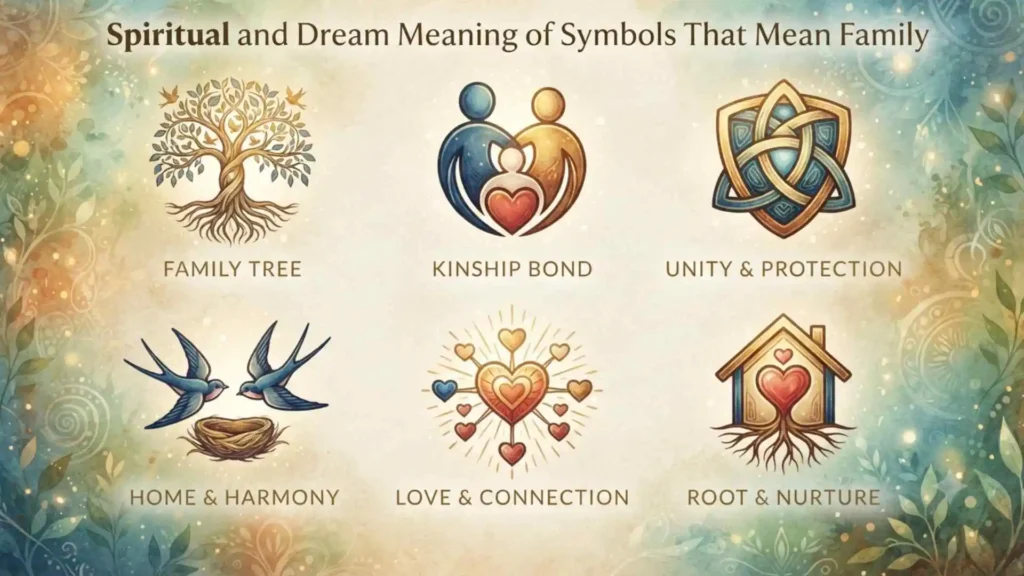
Dreams involving family symbols often reflect emotional relationships rather than literal predictions.
Dreaming of a Family Tree
A family tree may suggest that you are thinking about ancestry, identity, inheritance, or your place within a larger story.
Healthy leaves may symbolize connection and growth. Broken branches may reflect separation, grief, or family conflict.
Dreaming of a House
A house often represents the self, personal history, or emotional life.
A warm family home may reflect security. A damaged house may suggest unresolved tension. Returning to a childhood home may point to memories that still shape present behavior.
Dreaming of a Circle
A circle may represent wholeness, reunion, protection, or a need to feel included.
A broken circle may reflect exclusion or emotional distance.
Dreaming of a Nest
A nest may relate to parenting, caregiving, pregnancy, childhood, or preparation for change.
An empty nest may reflect independence, transition, loneliness, or pride.
Dreaming of Ancestors
Dreams of deceased relatives may arise during grief, major decisions, anniversaries, or periods of personal change.
Spiritually, some people interpret them as visits or guidance. Psychologically, they may express memory, attachment, unfinished feelings, or the internal voice of family wisdom.
Dream interpretation is personal. The emotions within the dream usually matter more than any universal symbol guide.
Positive and Negative Meanings of Symbols That Mean Family
| Positive Meaning | Negative or Shadow Meaning |
| Love | Emotional dependence |
| Unity | Pressure to conform |
| Protection | Overcontrol |
| Loyalty | Unhealthy obligation |
| Tradition | Resistance to change |
| Ancestry | Inherited conflict |
| Belonging | Exclusion of outsiders |
| Support | Loss of independence |
| Memory | Difficulty releasing the past |
| Sacrifice | Neglect of personal needs |
| Continuity | Repetition of harmful patterns |
| Identity | Feeling trapped by expectations |
A family symbol can contain both light and shadow.
For example, roots can represent stability, but they can also suggest feeling stuck. A circle may represent inclusion, but a tightly closed circle can exclude others.
Healthy family symbolism celebrates connection without erasing individuality.
Why Humans Are Attracted to Symbols That Mean Family
Family Supports Survival
For most of human history, survival depended on cooperation.
Relatives shared food, protected children, taught skills, cared for the sick, and defended the group. Family symbols therefore became connected with physical and emotional safety.
People Search for Belonging
Humans want to know where they fit.
A family name, recipe, photograph, song, crest, or heirloom can create a bridge between personal identity and a larger story.
The Mind Understands Images Quickly
Symbols communicate complex emotions faster than long explanations.
One tree can suggest ancestry, growth, death, rebirth, and legacy at the same time.
Shared Symbols Strengthen Groups
When relatives wear matching jewelry, display a crest, or gather around a family object, the symbol reinforces group identity.
It quietly says, “We belong to one another.”
Symbols Preserve Cultural Memory
A symbol can carry stories long after the original storyteller has died.
Children may not remember every historical detail, but they may remember the pendant, textile, photograph, house, or tree associated with their ancestors.
Personal Meaning Creates Emotional Power
A simple object may mean little to outsiders and everything to one family.
A spoon can represent a grandmother’s kitchen. A train may recall a migration story. A flower can represent a child who died. A star may represent someone living far away.
The deepest family symbols are often private.
Modern Uses of Symbols That Mean Family
Family Tattoos
Popular family tattoo ideas include:
- Trees with names or initials
- Birth flowers
- Linked circles
- Roman numerals
- Coordinates
- Fingerprints
- Handwriting samples
- Elephant families
- Lion prides
- Wolf packs
- Heartbeat lines
- Infinity symbols
- Family mottos
Before using imagery from a living culture, research its meaning and whether the design is appropriate for outsiders.
Jewelry
Family jewelry often includes:
- Birthstones
- Engraved names
- Lockets
- Tree pendants
- Interlocking rings
- Initial charms
- Family crest rings
- Memorial necklaces
- Mother-and-child designs
Jewelry works well because it keeps a symbol physically close.
Fashion
Family emblems appear on reunion shirts, jackets, scarves, hats, and embroidered clothing.
These items can create unity during celebrations, weddings, funerals, and reunions.
Branding
Family-owned businesses often use trees, houses, hands, shields, or linked shapes in their logos.
These designs communicate trust, heritage, care, stability, and long-term commitment.
Social Media
Digital family symbols include matching profile images, family hashtags, heart emojis, home icons, tree graphics, and memorial posts.
Although modern, these practices serve an ancient purpose: publicly declaring belonging.
Contemporary Spirituality
People may create ancestor altars, meditation spaces, memory boxes, or family intention boards.
Objects such as candles, photographs, flowers, stones, and inherited items help make remembrance tangible.
Home Decor
Common family decor includes:
- Personalized family trees
- Framed crests
- Photo walls
- Name signs
- Ancestral maps
- Recipe prints
- Memorial candles
- Growth charts
- Quilts
- Family motto displays
The best decor tells a real story rather than using a symbol without context.
How to Choose the Right Family Symbol
Start by asking what part of family you want to express.
Choose a family tree for ancestry and genealogy.
Choose a nest for parenting and nurturing.
Choose linked rings for partnership and commitment.
Choose a heart for love.
Choose a house for belonging and safety.
Choose an elephant herd for protection and memory.
Choose Sankofa when connecting with Akan heritage and ancestral learning.
Choose a koru when it has a respectful cultural or personal connection to Māori meaning.
Choose a braided cord when unity through cooperation matters most.
A custom symbol may combine several elements. For example, a tree inside a circle can represent ancestry held together by eternal love.
The strongest design is not always the most complex. It is the one whose story your family can explain honestly.
Interesting Facts About Symbols That Mean Family
- Family trees are not always shaped like trees. Genealogical records may also appear as circles, fans, tables, or branching diagrams.
- A coat of arms is not automatically shared by everyone with one surname. Historical heraldry usually followed specific inheritance rules.
- The koru is based on a real stage of fern growth. Its coiled shape opens as the young frond develops, making it a natural image of new life and continuity.
- Sankofa appears in more than one visual form. It may be represented as a backward-looking bird or a heart-like Adinkra design.
- Family reunion logos can preserve ancestral history. The Smithsonian records the use of Sankofa in an African American family reunion emblem to encourage reflection on the past.
- A tree can represent both one family and all existence. That is why family trees and Trees of Life look similar but do not always carry the same meaning.
- Animal family symbols are based partly on observed behavior. Elephants, wolves, lions, penguins, and swans are often chosen because people associate their behavior with care or partnership.
- The heart was not always the universal image of love. Its modern emotional meaning developed gradually through art, religion, literature, and popular culture.
- Family symbols can represent chosen relationships. Many people use them for friends, mentors, foster families, adoptive relatives, and supportive communities.
- Ordinary objects can become stronger symbols than famous icons. A recipe card, key, tool, photograph, or piece of fabric may hold generations of personal meaning.
Frequently Asked Questions
What is the most common symbol for family?
The family tree is one of the most widely recognized family symbols. It represents ancestry, roots, relationships, growth, and future generations.
What symbol represents family love?
The heart is the clearest symbol of family love. Interlocking hearts, a heart inside a house, or several small hearts can represent different relatives.
What animal symbolizes family?
Elephants, wolves, lions, swans, penguins, and turtles are often associated with family. Elephants commonly represent protection, memory, and strong social bonds.
What Celtic symbol means family?
Celtic knots and the triquetra are often used as modern family symbols because their interwoven lines suggest eternal connection. However, many exact family meanings are modern interpretations rather than documented ancient definitions.
What symbol represents family and strength?
A braided rope, oak tree, elephant herd, lion pride, or shield can represent family strength. Each suggests protection, cooperation, endurance, or resilience.
What symbol represents ancestors?
The family tree, roots, Sankofa, ancestral portraits, and genealogy symbols can represent ancestors. Their meaning often centers on memory, heritage, and learning from previous generations.
Conclusion
Symbols that mean family remind us that belonging is both inherited and created through love, loyalty, memory, and care. A tree may connect us to our roots, while a circle shows that no person stands alone. Across cultures, these symbols preserve stories that words cannot always hold. The most meaningful family symbol is the one that honors the past, supports the present, and carries hope into the future.
Hi, I’m Sienna Brooks, and I believe that the right words can inspire, comfort, and empower people at every stage of life. For as long as I can remember, I’ve been drawn to meaningful quotes and the stories behind them. I love curating collections of inspirational, motivational, and heartfelt quotes that resonate with readers around the world.
Through my writing, I strive to help others find encouragement, whether they’re celebrating life’s happiest moments or navigating its biggest challenges. I believe that wisdom is timeless, and I’m passionate about sharing words that leave a lasting impact.
I am the author of Reflections in Words and The Journey of Inspiration, two books dedicated to exploring the beauty and power of timeless quotes.
 Asher Monroe