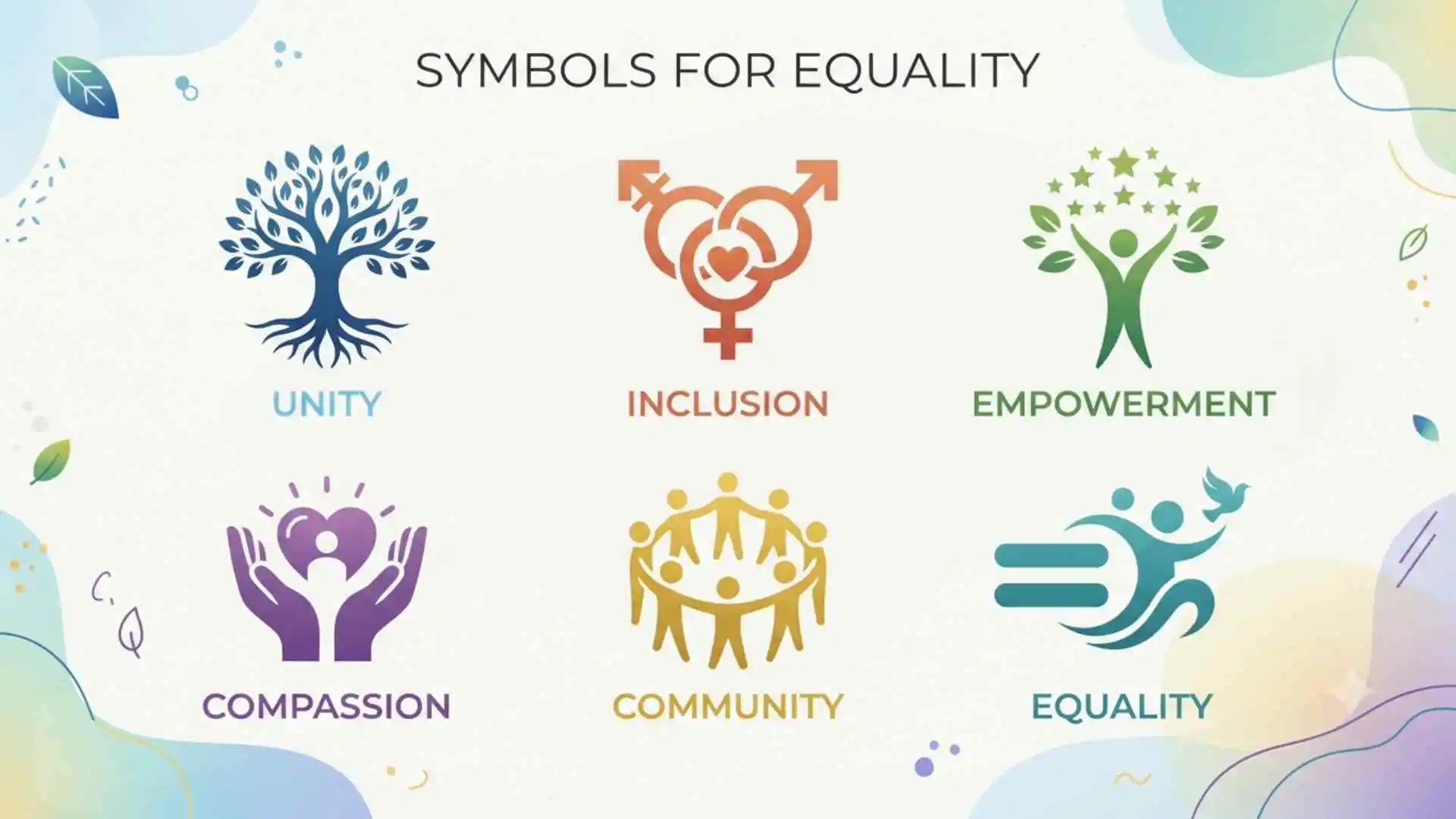
Symbols for equality carry a simple but powerful promise: every person deserves dignity, fairness, and respect.
Across history, people have used signs, colors, gestures, and images to challenge discrimination and bring divided communities together.
Some equality symbols grew from mathematics, while others emerged from religion, protest movements, law, art, and shared human experience.
By exploring their deeper meanings, we can better understand how visual signs shape identity, inspire courage, and turn an abstract ideal into something people can see and feel.
(Quick Answer) symbols for equality
Symbols for equality are visual signs that represent equal rights, fair treatment, human dignity, inclusion, and justice. Common examples include the equals sign, balanced scales, interlocking circles, joined hands, the raised fist, rainbow imagery, and equal-sign equality logos. Their meanings can change depending on culture, history, and social context.
Symbols for Equality and Justice
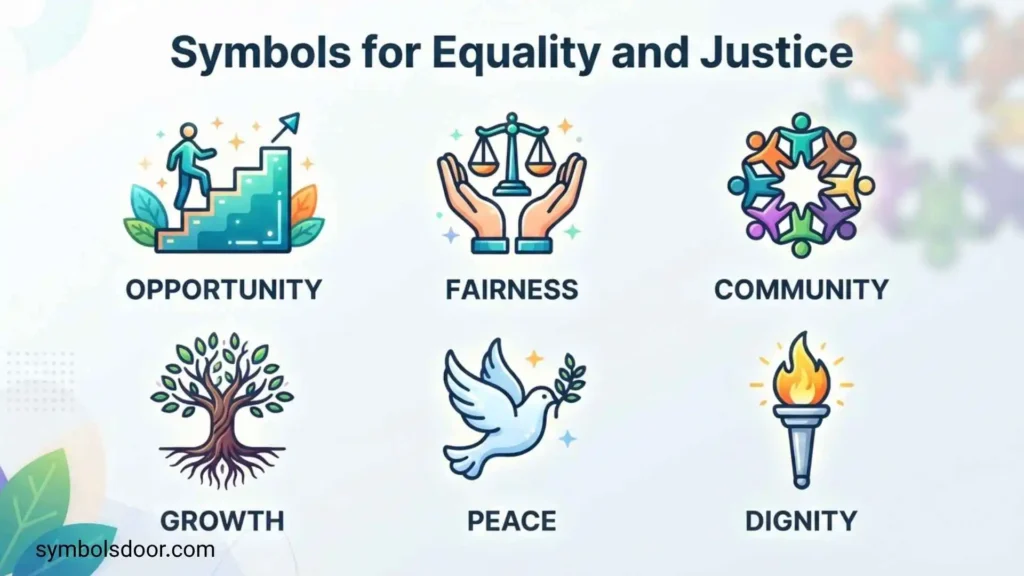
Symbols for equality and justice represent the idea that every person deserves fair treatment, equal opportunities, dignity, and protection under the law. Common examples include the scales of justice, the equal sign (=), joined hands, balanced geometric designs, and circles representing unity. The scales of justice are especially associated with fairness because they symbolize weighing evidence and treating people impartially.
The equal sign is another simple but powerful symbol. It communicates that people should have equal rights and value regardless of their background, identity, or social position. In modern movements, raised fists, interlocking figures, and diverse groups standing together may also represent the struggle for equality and justice.
Peace Symbols for Equality
Peace symbols for equality combine the ideas of harmony, nonviolence, and equal treatment. The peace sign, dove, olive branch, and rainbow are widely used to communicate peaceful cooperation and acceptance. These symbols can represent the belief that equality is strongest when communities resolve differences without discrimination or violence.
The dove and olive branch have long been associated with peace. When used alongside equality messages, they can suggest peaceful coexistence between people with different cultures, beliefs, and backgrounds. The rainbow can also represent diversity and inclusion, particularly when used in social and human-rights contexts.
Race Symbols for Equality
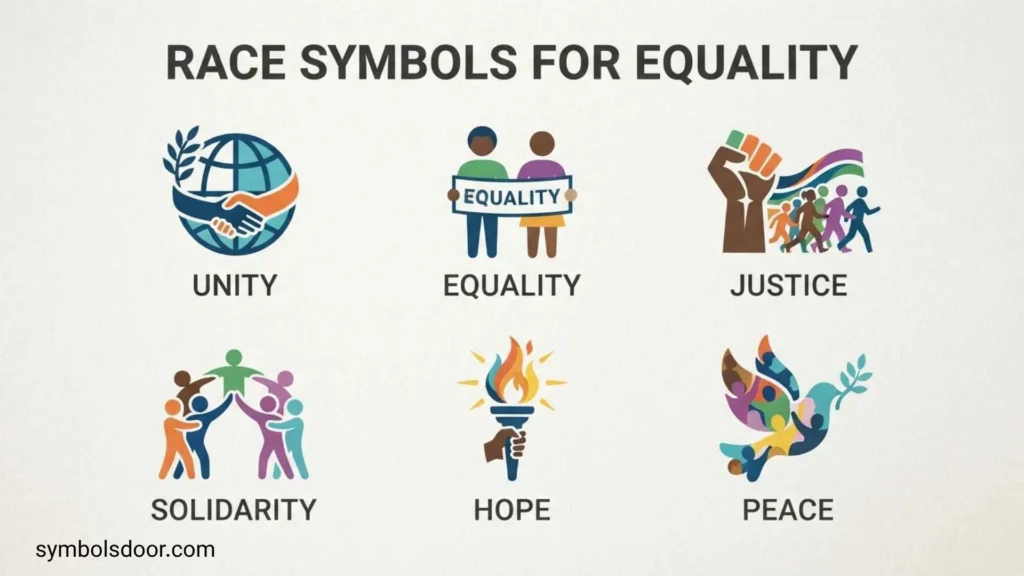
There is no single universal symbol for racial equality, but several symbols are commonly used to represent opposition to racism and support for equal treatment. Diverse hands, people of different skin tones standing together, interlocking figures, and circles made from different colors are frequently used to communicate racial unity.
The raised fist can symbolize resistance, solidarity, and the pursuit of equal rights. Multicolored designs may also represent the idea that differences in appearance or ancestry should not determine a person’s rights, dignity, or opportunities.
When using race-related symbols, context matters. A symbol may have different meanings depending on the movement, culture, country, or historical period in which it appears.
Peaceful Symbols for Equality and Justice
Peaceful symbols for equality and justice often focus on unity rather than conflict. The dove, olive branch, peace sign, equal sign, clasped hands, and diverse groups of people are examples that can communicate these ideas.
The equal sign emphasizes fairness and equal status, while joined hands suggest cooperation. A circle containing different people or colors can represent inclusion and the idea that everyone belongs. Together, these images can communicate a simple message: justice should be pursued peacefully, and equality should apply to everyone.
Human Rights Symbols and Meanings
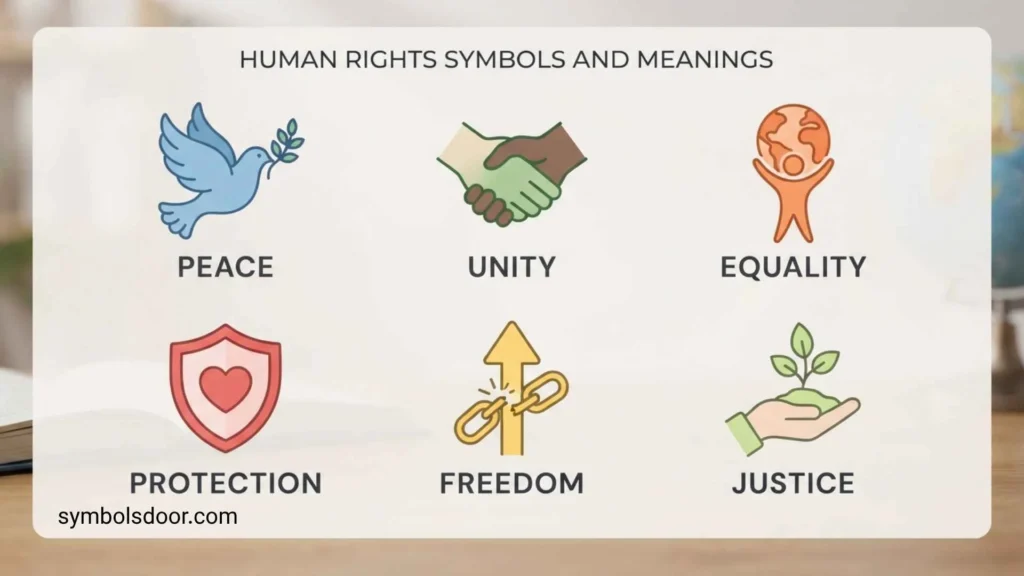
Human rights symbols represent basic freedoms, dignity, equality, and protection for all people. Some widely recognized examples include the dove, scales of justice, raised fist, broken chains, torch, open hand, and human figures standing together.
The open hand can represent freedom, peace, and a rejection of violence. Broken chains often symbolize liberation from oppression or unjust restrictions. The scales of justice represent fairness and impartial judgment, while a group of diverse people can symbolize equal human dignity.
A symbol’s meaning can change with its context. For example, a raised fist may represent solidarity in one movement and resistance or political struggle in another. Understanding the surrounding message is therefore important when interpreting human rights imagery.
Symbols of Equality and Fairness
Symbols of equality and fairness communicate the principle that people should receive equal rights, opportunities, and consideration. The equal sign, scales of justice, balanced scales, level playing fields, circles, and joined hands are common examples.
Balanced scales are particularly meaningful because balance is closely connected with fairness. The equal sign provides a direct visual representation of equal value or treatment. Joined hands add the idea of cooperation, while circles can suggest inclusion and shared belonging.
These symbols appear in education, law, social campaigns, organizations, posters, and public awareness materials.
What Symbolizes Equality?
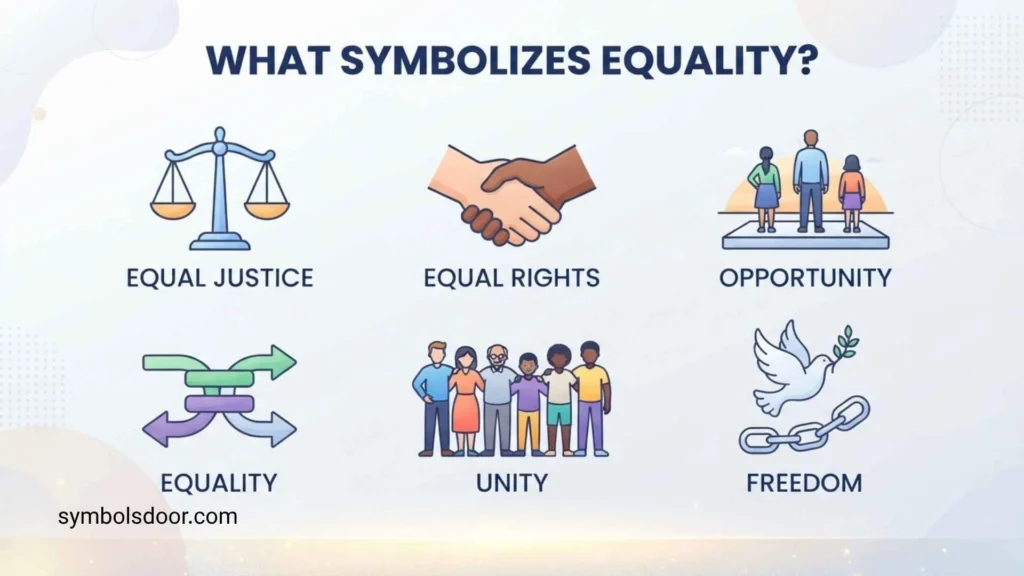
The equal sign (=) is one of the clearest symbols of equality because it directly represents two things being equal. Other symbols include balanced scales, identical shapes, joined hands, circles, and groups of diverse people standing together.
Equality can also be represented through visual balance. For example, two figures of different appearances standing at the same level can communicate that their differences do not change their fundamental rights or worth. A circle containing people from different backgrounds can similarly symbolize inclusion and equal membership.
Things That Represent Equality
Many objects and images can represent equality depending on their context. Common examples include:
- The equal sign (=)
- Balanced scales
- Joined hands
- Diverse groups of people
- Identical circles or shapes
- A level playing field
- Interlocking circles
- A rainbow representing diversity
- A circle representing inclusion
- People standing side by side
The central idea behind these representations is that differences should not prevent people from receiving equal rights, respect, opportunities, or protection.
Symbols That Represent Equality
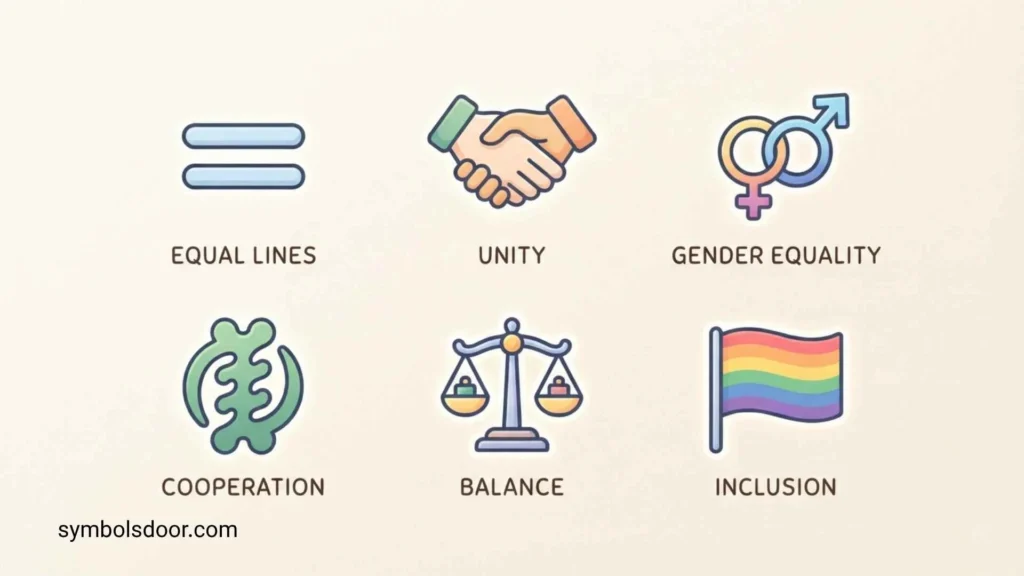
Several symbols are commonly associated with equality in different settings. The equal sign is the most direct mathematical representation, while balanced scales symbolize fairness and impartial treatment. Joined hands can represent cooperation among people who may have different backgrounds.
Other visual symbols include interlocking circles, diverse human figures, and balanced geometric designs. In social and cultural contexts, the rainbow may symbolize diversity and inclusion. The exact meaning depends on how the symbol is used and the message surrounding it.
Symbols for Equality and Justice
Equality and justice are closely related but are not exactly the same idea. Equality focuses on equal rights and opportunities, while justice also concerns fairness and the correction of unfair treatment. Symbols that combine these concepts often include scales of justice, the equal sign, balanced designs, joined hands, and diverse groups of people.
The scales emphasize impartiality, while the equal sign communicates equal status. A group of people standing together can add the ideas of solidarity, dignity, and inclusion.
Natural Rights Symbols
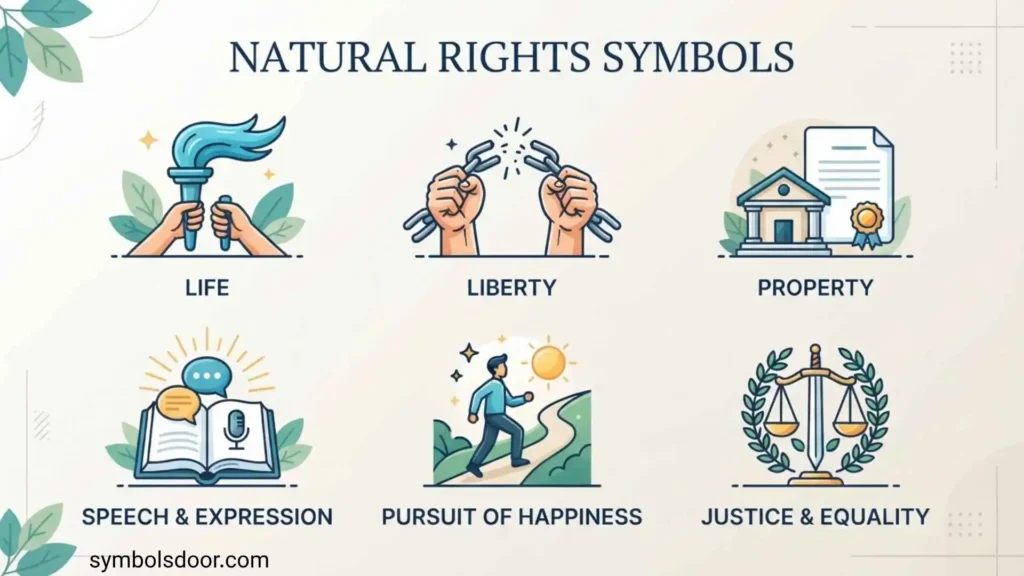
Natural rights are rights understood as belonging to people simply because they are human. Ideas commonly associated with natural rights include freedom, life, liberty, dignity, and equality. Symbols used to represent these concepts include broken chains, an open hand, a torch, a dove, and a raised fist.
Broken chains can symbolize freedom from oppression. An open hand can represent liberty or peaceful action, while a torch is often associated with enlightenment, freedom, and the spread of knowledge. Because natural rights are philosophical and political concepts, there is no single universally accepted symbol for all natural rights.
Things That Symbolize Equality
Equality can be symbolized through simple visual ideas such as balance, sameness, unity, and inclusion. The equal sign, balanced scales, level lines, joined hands, and people standing side by side are among the clearest examples.
A particularly effective equality symbol often shows different people receiving the same level of respect or standing on equal ground. This visual approach communicates that diversity and equality can exist together. Equality does not require everyone to be identical. Instead, it emphasizes equal human worth, rights, and opportunities.
Symbol for Discrimination
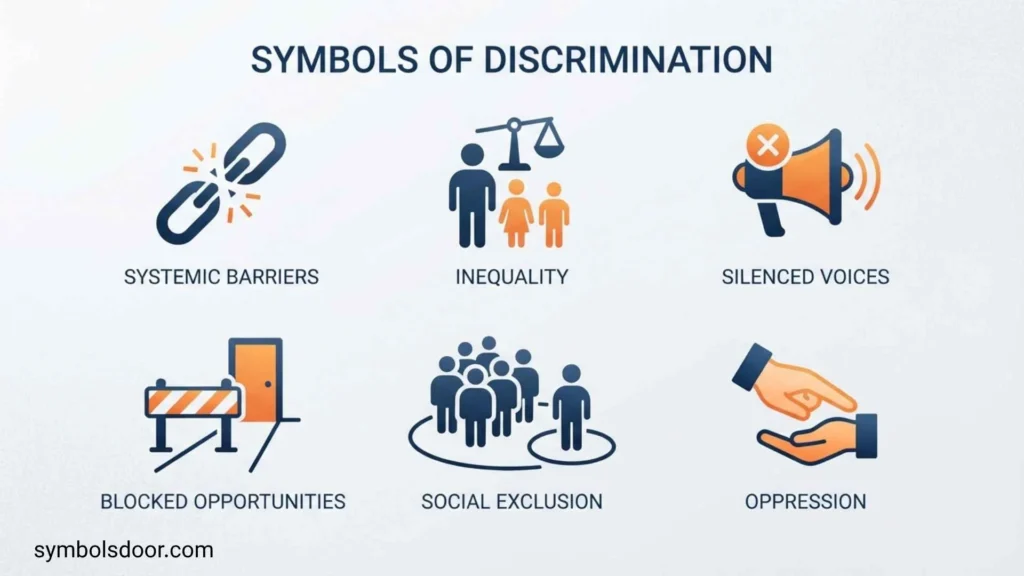
There is no single universal symbol for discrimination. Instead, discrimination is often represented through images showing exclusion, separation, unequal treatment, barriers, or rejection. A person separated from a group, a divided circle, unequal scales, or a barrier between people can communicate these ideas.
The unequal sign (≠) may also be used in educational or symbolic contexts to represent inequality, although it is not specifically a universal symbol for discrimination. Broken lines, barriers, crossed-out discriminatory labels, and contrasting groups may likewise be used in awareness campaigns.
Quick Facts About Symbols for Equality
| Aspect | Information |
| Origin | Equality symbolism comes from mathematics, ancient law, religion, philosophy, political movements, and modern civil rights campaigns. |
| Historical Significance | These symbols have supported movements against slavery, segregation, sexism, religious persecution, colonial rule, and other forms of discrimination. |
| Main Meaning | Equal value, equal rights, fair opportunity, inclusion, dignity, and justice. |
| Spiritual Meaning | The shared worth of every soul and the belief that all life is connected. |
| Cultural Importance | Equality symbols help communities express solidarity, resistance, unity, and hope. |
| Modern Usage | They appear in protests, tattoos, jewelry, flags, logos, social media posts, classrooms, public art, and human rights campaigns. |
What Are Symbols for Equality?
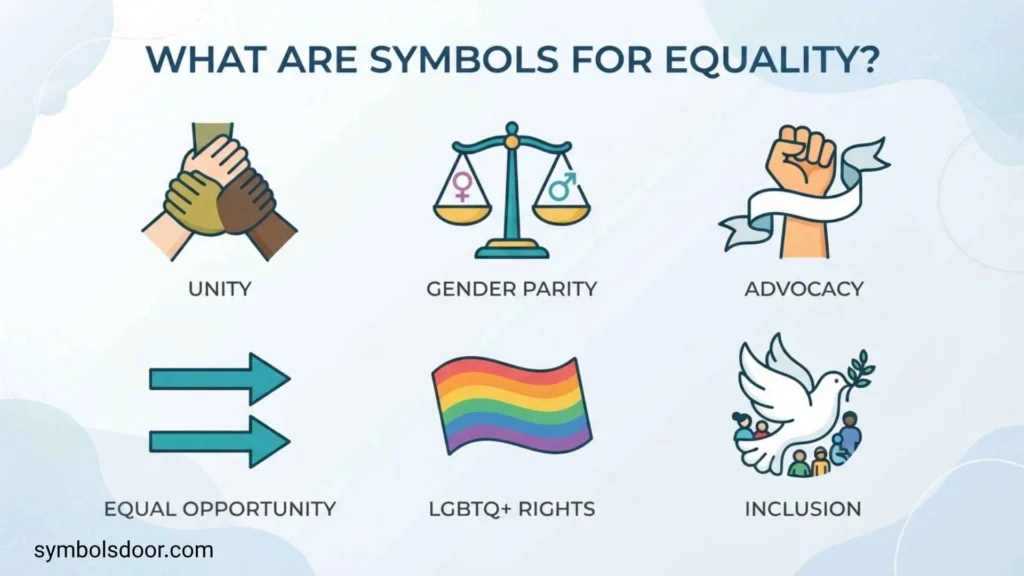
Symbols for equality are images, signs, objects, colors, or gestures that communicate the idea that people should be treated with equal dignity and fairness.
They do not always mean that every person is identical. Instead, they often represent the belief that differences in race, sex, gender, religion, ability, wealth, nationality, or social position should not reduce anyone’s human worth.
The simplest example is the mathematical equals sign: =. In mathematics, it shows that two expressions have the same value. Outside mathematics, it has become a powerful visual metaphor for equal rights.
However, equality is also represented through balanced scales, linked hands, circles, parallel lines, raised fists, bridges, rainbows, and symmetrical designs. Each symbol highlights a different side of equality.
Some emphasize fairness. Others represent unity, resistance, diversity, or shared humanity.
Historical Background
The idea of equality has deep roots, but human societies have not always applied it equally.
Ancient legal systems often created different rules for different social classes. Philosophers in Ancient Greece and Rome debated justice and citizenship, yet many people, including women, enslaved individuals, and foreigners, were excluded from full political life.
Religious teachings later helped spread the idea that human beings share a spiritual origin or moral value. Still, these beliefs were often practiced unevenly.
During the Enlightenment, writers and political thinkers placed greater focus on natural rights, liberty, and equality before the law. These ideas influenced revolutions, constitutions, abolitionist movements, labor campaigns, women’s rights activism, anti-colonial struggles, and modern human rights law.
As these movements grew, symbols became essential. A clear image could communicate a message even when people spoke different languages.
How Equality Symbols Evolved
Early symbols of equality often focused on divine order, law, balance, and harmony.
Later symbols became more political. Chains were broken to represent freedom from slavery. Raised fists expressed organized resistance. Joined hands represented cooperation across social boundaries.
In the modern age, equality symbols have become highly shareable. A simple sign can appear on a poster, profile picture, T-shirt, mural, bracelet, or digital campaign.
Their power comes from repetition. When thousands of people display the same image, it creates a visible community built around a shared belief.
Deep Symbolic Meaning of Symbols for Equality
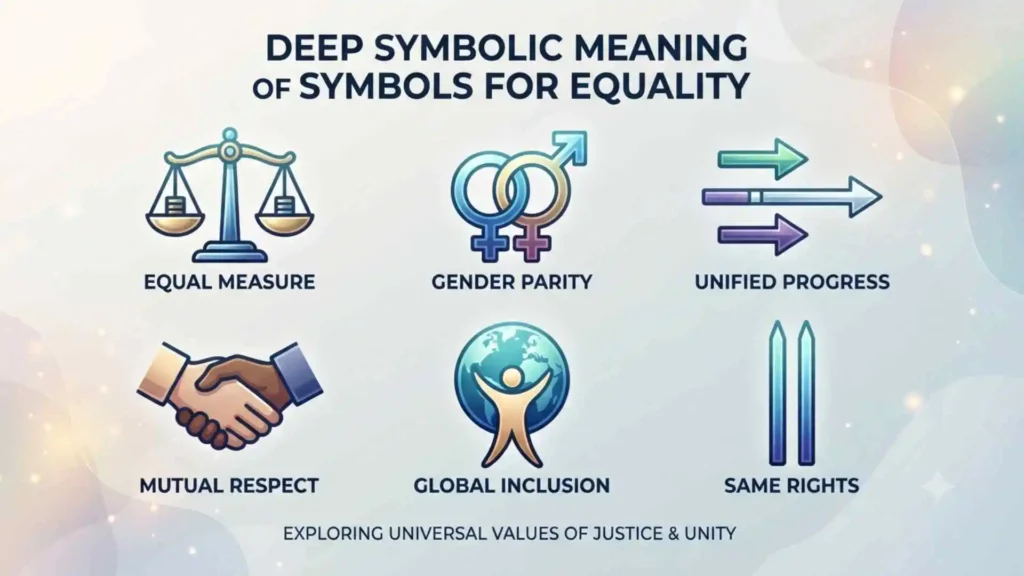
Spiritual Level
Spiritually, equality symbols often represent the belief that every soul has equal value.
Many traditions teach that social labels are temporary, while the deepest part of the person is sacred. Wealth, appearance, nationality, and status may shape earthly life, but they do not determine spiritual worth.
The circle is especially meaningful in this context. Because it has no beginning or end, it can represent unity, eternity, and the equal place of all beings within creation.
Joined hands may symbolize compassion in action. They suggest that spiritual equality is not merely an idea. It requires people to recognize suffering, offer support, and protect one another’s dignity.
Light is another common spiritual image. One candle can light another without losing its own flame. In equality symbolism, this can represent the idea that giving another person rights, knowledge, or opportunity does not reduce our own humanity.
Psychological Level
Psychologically, equality symbols speak to a basic human desire to belong.
People naturally form groups, but group identity can create exclusion. Symbols can either strengthen separation or challenge it. Equality symbols invite people to expand the boundaries of who counts as “one of us.”
Carl Jung’s ideas about archetypes can help explain why certain forms feel powerful. The circle may suggest wholeness. Balanced scales may suggest moral order. A bridge may represent connection between divided parts. A raised fist may embody the warrior archetype, showing courage against oppression.
Symmetry also affects how people perceive equality. Two matching sides feel stable and fair. This visual balance can make symbols of justice emotionally satisfying.
At the same time, equality symbols may awaken difficult feelings. They can remind viewers of injustice, guilt, fear, or social conflict. Their emotional power comes from the tension between the world as it is and the world as it should be.
Cultural Level
Culturally, equality symbols turn values into visible identity.
A person wearing an equality pin may be saying, “I support equal rights.” A group carrying the same sign at a march may be saying, “We stand together.”
These signs also preserve collective memory. They remind later generations that rights were often won through sacrifice, protest, legal struggle, and courage.
However, symbols do not have fixed meanings forever. A sign may be inspiring in one community and controversial in another. Its meaning depends on who uses it, why they use it, and what history surrounds it.
Types and Variations of Symbols for Equality
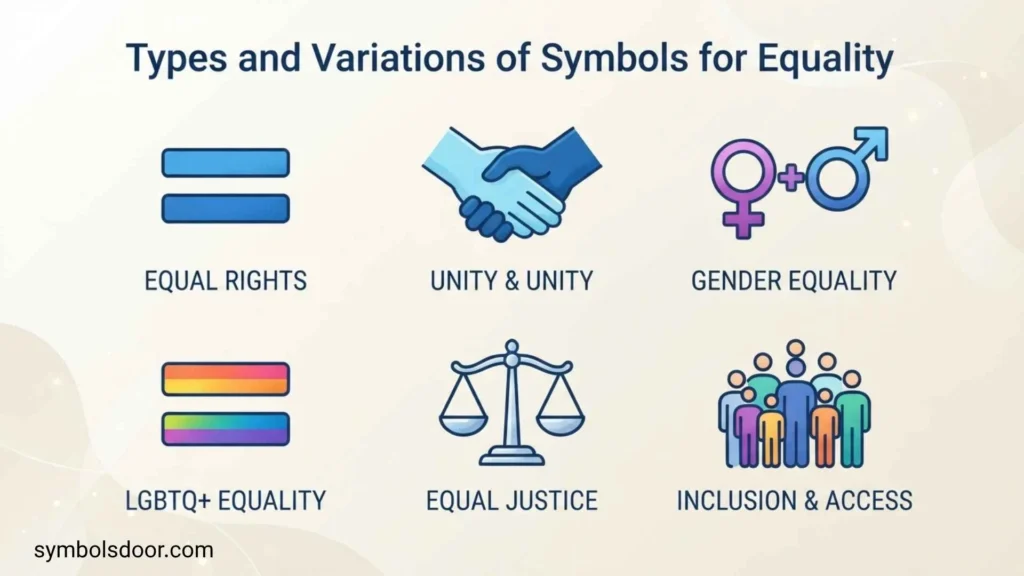
The Equals Sign
Visual description: Two short horizontal parallel lines.
Meaning: Equal value, equal status, or equal treatment.
Symbolism: The equals sign suggests that two sides deserve the same recognition.
Cultural connection: It began as a mathematical sign and later became widely used in equality campaigns.
Where it appears: Protest posters, human rights logos, tattoos, clothing, social media graphics, school materials, and political art.
The equals sign is powerful because it is simple. Almost anyone can recognize it, even without written explanation.
Balanced Scales
Visual description: Two pans hanging at equal height from a central beam.
Meaning: Fairness, justice, impartial judgment, and equality before the law.
Symbolism: Each side should receive equal consideration.
Cultural connection: Scales are associated with ancient legal, religious, and mythological traditions.
Where it appears: Courts, government buildings, law offices, paintings, statues, seals, and justice organizations.
Balanced scales do not always mean identical outcomes. They can also represent careful judgment based on evidence and circumstances.
Interlocking Circles
Visual description: Two or more overlapping circles.
Meaning: Unity, shared identity, partnership, inclusion, and equal relationships.
Symbolism: Different people can remain distinct while sharing common space.
Cultural connection: Circles appear in marriage symbols, community emblems, spiritual art, and social movements.
Where it appears: Jewelry, tattoos, logos, artwork, wedding designs, and diversity campaigns.
Joined Hands
Visual description: Two or more hands holding, clasping, or reaching toward one another.
Meaning: Cooperation, solidarity, trust, mutual support, and racial or cultural harmony.
Symbolism: Equality requires people to connect rather than dominate.
Cultural connection: Hand imagery appears in religious art, political posters, charity campaigns, labor movements, and peace activism.
Where it appears: Murals, nonprofit logos, classroom posters, community programs, and public demonstrations.
The Raised Fist
Visual description: A closed hand lifted upward.
Meaning: Resistance, strength, unity, defiance, and collective power.
Symbolism: People who have been ignored can organize and demand recognition.
Cultural connection: The raised fist has appeared in labor movements, anti-fascist campaigns, racial justice activism, feminist movements, and liberation struggles.
Where it appears: Posters, flags, murals, clothing, protest art, music, and political graphics.
The meaning of the raised fist depends strongly on context. It can represent liberation, but different groups may use it for different causes.
The Rainbow
Visual description: A curved band or sequence of multiple colors.
Meaning: Diversity, hope, inclusion, peace, and acceptance.
Symbolism: Different colors can exist together without losing their individuality.
Cultural connection: Rainbows appear in ancient myths, religious stories, peace campaigns, LGBTQ+ pride movements, and children’s art.
Where it appears: Flags, jewelry, tattoos, clothing, public art, social media, and festival designs.
Broken Chains
Visual description: A chain with one or more links snapped apart.
Meaning: Freedom from slavery, oppression, control, or unjust social systems.
Symbolism: Equality becomes possible when structures of domination are broken.
Cultural connection: Broken chains have long been connected with abolition, emancipation, revolution, and political liberation.
Where it appears: Monuments, coins, seals, protest art, tattoos, and historical illustrations.
Parallel Lines
Visual description: Two lines moving in the same direction at an equal distance.
Meaning: Equal status, shared purpose, and side-by-side progress.
Symbolism: No line stands above the other.
Cultural connection: Parallel designs often appear in modern equality logos and minimalist tattoos.
Where it appears: Graphic design, branding, political campaigns, jewelry, and contemporary art.
The Bridge
Visual description: A structure connecting two separate sides.
Meaning: Reconciliation, communication, access, and social connection.
Symbolism: Equality can require building paths across cultural, racial, religious, or economic divides.
Cultural connection: Bridges are common metaphors in poetry, speeches, peacebuilding, and social psychology.
Where it appears: Murals, organizational logos, literature, films, and public memorials.
The Circle of People
Visual description: Human figures standing or holding hands in a circular form.
Meaning: Community, belonging, shared responsibility, and equal participation.
Symbolism: Every person has a place, and no one occupies the highest position.
Cultural connection: Circular gatherings are important in many community, council, ceremonial, and Indigenous traditions.
Where it appears: Educational materials, nonprofit branding, community events, team logos, and social justice art.
The Peace Sign
Visual description: A circle containing a central vertical line with two diagonal lines extending downward.
Meaning: Peace, nonviolence, disarmament, and peaceful coexistence.
Symbolism: Equality is difficult to achieve where violence and fear control society.
Cultural connection: The modern peace symbol was designed for the British nuclear disarmament movement and later became a global sign of peace activism.
Where it appears: Posters, jewelry, graffiti, fashion, tattoos, and music culture.
The Gender Equality Symbol
Visual description: Male and female gender signs combined, balanced, or placed beside an equals sign.
Meaning: Equal rights, opportunities, respect, and freedom regardless of sex or gender.
Symbolism: Social roles should not determine human value or limit potential.
Cultural connection: It appears in women’s rights, workplace equality, education, health, and anti-discrimination campaigns.
Where it appears: Advocacy materials, reports, public campaigns, logos, classroom resources, and social media.
Symbols for Equality Across Different Cultures
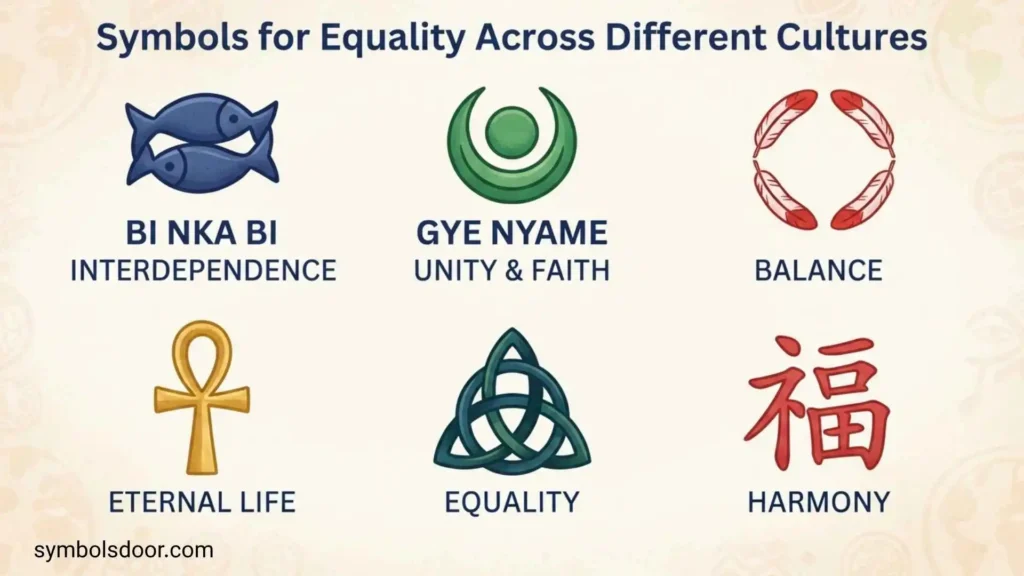
Ancient Egypt
Ancient Egyptian culture did not express equality in the modern democratic sense, but it developed powerful symbols of justice and moral balance.
The concept of Ma’at represented truth, order, justice, harmony, and proper balance. Ma’at was often shown as a goddess wearing an ostrich feather.
In funerary tradition, the heart of the deceased was weighed against the feather of Ma’at. This image suggested that every person was morally accountable.
The weighing scene later influenced how people imagined justice, judgment, and balanced scales.
Ancient Greece
Ancient Greek thinkers explored equality through ideas about law, citizenship, virtue, and political participation.
The goddess Themis represented divine order and lawful custom. Dike represented justice and fair judgment.
Greek democracy introduced forms of political equality among eligible male citizens, although women, enslaved people, and foreigners were excluded.
Modern equality symbolism often draws from Greek images of balance, reason, civic duty, and justice while also recognizing the limits of ancient society.
Roman Culture
Roman law played a major role in shaping later Western legal traditions.
The Romans valued concepts such as civic order, legal procedure, and public duty. Yet Roman society remained highly unequal, with major differences between citizens, noncitizens, enslaved people, men, women, and social classes.
The figure of Lady Justice developed partly through Roman imagery connected with Justitia, the personification of justice.
Her scales symbolize balance. Her sword represents authority. Her blindfold, added more widely in later art, represents impartiality.
Eastern Traditions
Many Eastern traditions approach equality through harmony, compassion, spiritual unity, and balanced relationships.
In Buddhism, all beings are understood to experience suffering and to possess the potential for awakening. This creates a spiritual foundation for compassion that reaches beyond class or social identity.
In Hindu philosophy, the idea that the divine essence exists within living beings can support the belief in shared spiritual worth, even though historical societies did not always practice social equality.
In Chinese philosophy, yin and yang represent complementary balance rather than identical sameness. The symbol teaches that different forces can hold equal importance within a greater whole.
Indigenous Traditions
Indigenous cultures are diverse, so no single symbol or belief represents them all.
However, many Indigenous traditions emphasize kinship, reciprocity, community responsibility, and balance with the natural world.
The circle often holds deep importance. It may represent cycles of life, the unity of creation, shared decision-making, or the equal place of community members.
Circular council gatherings can also reduce visible hierarchy. Instead of placing one person above others, participants face one another.
These traditions remind modern readers that equality is not only about personal rights. It may also involve responsibility to family, community, ancestors, land, and future generations.
Modern Interpretations
Modern equality imagery often combines older symbols with direct political messages.
The equals sign may be paired with hearts, rainbow colors, raised fists, gender signs, disability symbols, or human figures with different skin tones.
Digital communication has also changed how symbols spread. A graphic can move across the world in minutes, allowing local struggles to gain international attention.
At the same time, fast sharing can remove context. A symbol may be copied without understanding the history or community behind it.
Similar Symbols and Their Meanings
| Symbol | Main Meaning | Connection to Equality | Important Difference |
| Equals sign | Equal value | Directly represents equal status or rights | Does not explain how equality should be achieved |
| Scales of justice | Fairness and law | Represents equal consideration | May symbolize fairness rather than identical treatment |
| Raised fist | Resistance and solidarity | Represents collective struggle for rights | More connected with protest and power |
| Rainbow | Diversity and inclusion | Celebrates different identities | Focuses more on diversity and acceptance |
| Joined hands | Cooperation | Shows unity across differences | Emphasizes relationship and support |
| Broken chains | Liberation | Represents freedom from oppression | Focuses on escaping control |
| Circle | Unity and wholeness | Suggests equal belonging | Often spiritual or communal rather than legal |
| Peace sign | Nonviolence | Supports coexistence and human dignity | Focuses mainly on peace |
| Bridge | Connection | Links divided groups | Represents reconciliation more than equal status |
| Open door | Access and opportunity | Suggests inclusion and equal entry | Focuses on removing barriers |
Equality Versus Equity Symbols
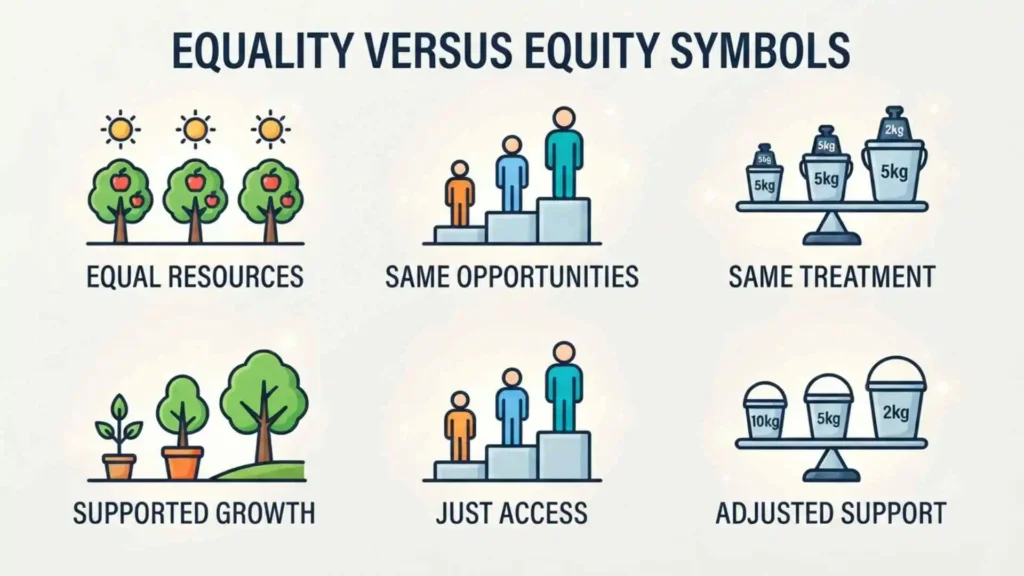
Equality and equity are related, but they are not identical.
Equality means giving people the same rights, status, or resources. Equity recognizes that people may face different barriers and may need different forms of support to reach a fair result.
For example, giving every student the same book is equality. Providing accessible formats for students with different needs is equity.
Balanced scales may represent equality when both sides receive the same weight. They may represent equity when different conditions are considered to create a fair balance.
Equality Versus Unity
Unity means people stand together. Equality means they have equal dignity, rights, or opportunity.
A society can appear united while still containing unfair power structures. Therefore, joined hands and circles become stronger equality symbols when they are connected with real fairness and shared decision-making.
Equality Versus Justice
Equality focuses on equal worth and treatment. Justice focuses on correcting wrongs and creating fair systems.
Justice may require more than treating everyone the same. It can involve repairing harm, removing barriers, or changing laws that produce unequal outcomes.
Symbols for Equality in Mythology and Folklore
Ancient stories rarely present modern equality in direct language. However, myths often explore justice, moral balance, oppression, and the consequences of abusing power.
The Scales of Ma’at
In Egyptian funerary belief, the heart was weighed against the feather of Ma’at. A balanced heart suggested truth and moral integrity.
This story shaped the lasting connection between scales, judgment, and justice.
Themis and Dike
In Greek mythology, Themis represented divine law, order, and proper custom. Dike represented human justice and fair judgment.
Their stories helped turn justice into a human-like figure who could be painted, sculpted, and remembered.
Justitia
Roman culture developed Justitia as a personification of justice.
Later European artists often showed Lady Justice carrying scales and a sword. The blindfold eventually became a sign that justice should not be influenced by wealth, power, appearance, or social status.
The Rainbow as a Sacred Bridge
In different mythologies, the rainbow appears as a bridge between worlds.
Norse mythology describes Bifröst as a burning rainbow bridge connecting the world of humans with the realm of the gods.
Other traditions associate rainbows with divine promises, transformation, or messages from the spiritual world.
Because a rainbow joins separate colors within one form, it later became a natural symbol of peace, diversity, and inclusion.
The Broken Chain in Liberation Stories
Chains appear in myths, legends, religious stories, and folklore as symbols of captivity.
Breaking chains represents release from unjust authority, fear, punishment, or spiritual bondage.
This image later became central to abolitionist and emancipation symbolism because it communicated freedom immediately.
Symbols for Equality in Art, Literature, Movies, and Pop Culture
Paintings and Sculpture
Artists have long personified justice as a woman holding scales.
Public monuments may show broken chains, open gates, lifted torches, joined hands, or figures standing side by side. These images turn political ideals into physical experiences.
Symmetry is also common in equality-themed art. Equal visual weight suggests order and fairness.
Literature
Writers often use tables, circles, bridges, doors, chains, and mirrors to explore equality.
A round table can symbolize shared voice because no seat naturally stands at the head. A locked door may represent exclusion. An open door can suggest opportunity.
Broken chains represent liberation, while mirrors can ask readers to recognize themselves in people who appear different.
Poetry
Poetry often presents equality through repeated images of blood, breath, earth, light, and shared mortality.
These images remind readers that social divisions may be powerful, but they are not more fundamental than human life itself.
The idea that everyone stands under the same sky is a common poetic expression of shared existence.
Movies and Television
Films and television often use visual contrast to show inequality.
Characters may be separated by fences, walls, uniforms, seating areas, neighborhoods, or levels within a building. When these barriers are crossed or removed, the image can signal movement toward equality.
Groups standing shoulder to shoulder often represent solidarity. A single person stepping out from a crowd may symbolize moral courage.
Tattoos
Equality tattoos may feature:
- An equals sign
- Balanced scales
- Interlocking circles
- Rainbow lines
- Joined hands
- A raised fist
- Broken chains
- A circle of human figures
- Gender symbols combined with an equals sign
- Words such as “equal,” “human,” “justice,” or “together”
For many people, these tattoos are personal promises. They may honor a civil rights struggle, express identity, remember discrimination, or show support for loved ones.
Fashion and Modern Design
Equality symbols appear on shirts, bracelets, pins, hats, necklaces, bags, and shoes.
Minimalist designs are especially popular because they are easy to recognize. Two lines, linked circles, or a small equal sign can carry a large social message.
Brands also use equality imagery, although audiences may question whether the company’s policies match its public symbols.
Spiritual and Dream Meaning of Symbols for Equality
Dream interpretation is personal and should not be treated as a fixed prediction. Still, equality-related symbols may reflect emotional concerns about fairness, belonging, identity, or power.
Dreaming of an Equals Sign
An equals sign may suggest that you are comparing two people, choices, or parts of your life.
It can also reflect a desire to be respected as an equal in a relationship, workplace, family, or community.
Dreaming of Balanced Scales
Balanced scales may indicate inner peace, careful decision-making, or a wish for justice.
Uneven scales may suggest guilt, unfair treatment, conflict, or fear that an important situation is not being judged honestly.
Dreaming of Joined Hands
Joined hands may symbolize trust, reconciliation, emotional support, or a need for deeper connection.
If one person refuses the hand, the dream may reflect rejection, broken trust, or unequal effort in a relationship.
Dreaming of Broken Chains
Broken chains often suggest freedom, recovery, courage, or release from a controlling situation.
They may also represent a major change in identity. You may be leaving behind an old role, belief, fear, or expectation.
Dreaming of a Circle
A circle may symbolize wholeness, spiritual unity, safety, or belonging.
Standing outside the circle may reflect feelings of exclusion. Entering it may symbolize acceptance or a new sense of community.
Meditation and Spiritual Encounters
During meditation, equality symbols may be used to focus on compassion and shared humanity.
A person might visualize light moving equally through all living beings. Another may imagine a circle where every person has a place.
Such practices can encourage empathy, but spiritual symbolism should support real action. Respect, listening, fair treatment, and protection of rights give the symbol its true meaning.
Positive and Negative Meanings of Symbols for Equality
| Positive Meaning | Negative or Cautionary Meaning |
| Equal dignity | Equality used as an empty slogan |
| Fair opportunity | Ignoring real differences in need |
| Unity across differences | Pressure to erase individuality |
| Justice before the law | Legal symbolism without fair enforcement |
| Inclusion | Performative support without action |
| Freedom from oppression | Conflict during social change |
| Shared responsibility | Loss of personal accountability |
| Peaceful cooperation | Avoiding necessary disagreement |
| Collective strength | Group pressure or rigid ideology |
| Hope for progress | Disappointment when change is slow |
A symbol can carry both light and shadow.
The equals sign may represent justice, but it can also oversimplify complex situations. Giving everyone exactly the same support may not be fair when some people face greater barriers.
The raised fist can inspire courage, but it may also be viewed as confrontational. A rainbow can express hope and inclusion, yet it may be used commercially without meaningful support for the communities it represents.
The lesson is simple: symbols gain moral value through action.
Why Humans Are Attracted to Symbols for Equality
We Understand Images Quickly
The human brain processes visual patterns rapidly.
Two balanced sides feel fair. Joined circles feel connected. Broken chains feel liberating. These impressions can arise before we consciously explain them.
We Want to Belong
Equality symbols reassure people that they deserve a place within the group.
For someone who has experienced exclusion, seeing a familiar sign in a school, workplace, business, or public space can provide emotional comfort.
We Remember Stories Through Symbols
A symbol can carry generations of history.
A raised fist may recall workers, activists, students, and communities who risked punishment to demand rights. Broken chains may recall the long fight against slavery.
The image becomes a container for memory.
We Seek Moral Order
People often feel disturbed when effort, dignity, or punishment appears unfair.
Balanced scales answer this emotional need by presenting a world in which decisions are measured carefully.
Even when reality is unjust, the symbol reminds people that another standard is possible.
We Use Symbols to Express Identity
A person may display an equality symbol to communicate personal values without speaking.
It can say, “You are safe with me,” “I oppose discrimination,” or “This cause is part of who I am.”
We Are Drawn to Hope
Equality is never only about present conditions. It is also about possibility.
Symbols make a future ideal visible. They help people imagine fairer laws, kinder communities, and relationships based on mutual respect.
Modern Uses of Symbols for Equality
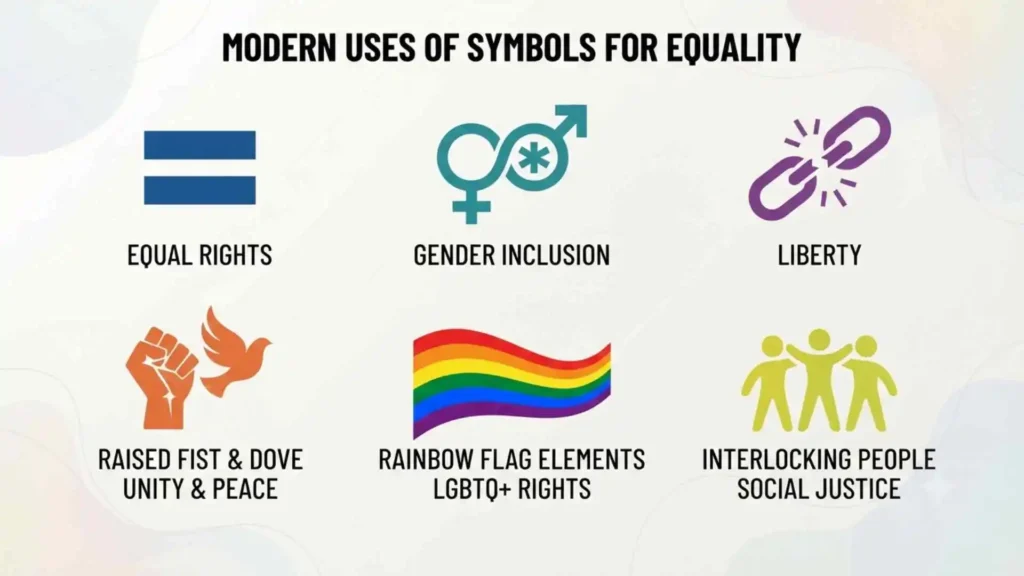
Tattoos
Equality tattoos turn public values into permanent personal commitments.
People may choose them after surviving discrimination, joining an advocacy movement, supporting a family member, or experiencing a change in worldview.
Jewelry
Necklaces, rings, bracelets, and earrings featuring equal signs, circles, rainbows, or joined hands allow people to carry equality symbolism quietly.
Jewelry can also serve as a conversation starter.
Fashion
Clothing with equality messages can make social beliefs visible in everyday spaces.
However, ethical buyers may look beyond the printed symbol and consider how the product was made, who produced it, and whether workers were treated fairly.
Branding
Organizations often use equality imagery to communicate fairness, diversity, accessibility, or social responsibility.
Strong branding should be supported by fair hiring, accessible services, respectful policies, equal pay, and transparent leadership.
Social Media
Equality symbols are widely used in profile pictures, hashtags, campaign graphics, digital stickers, and educational posts.
They help people respond quickly to social events, but online support is most meaningful when paired with learning, voting, donating, organizing, or changing harmful behavior.
Contemporary Spirituality
Modern spiritual communities may use circles, mandalas, shared light, open hands, and rainbow imagery to express universal connection.
These symbols often communicate the belief that spiritual growth includes compassion for people beyond one’s own group.
Home Decor
Equality signs appear in wall art, posters, sculptures, flags, and decorative objects.
In homes, schools, clinics, and workplaces, such imagery may signal welcome and inclusion.
Personal Expression
Some people combine equality symbols with names, dates, flowers, cultural patterns, or meaningful words.
This creates a personal symbol that connects a universal value with an individual life story.
Interesting Facts About Symbols for Equality
- The equals sign is nearly five centuries old. Welsh mathematician Robert Recorde introduced the familiar parallel-line sign in the sixteenth century because he believed nothing could be more equal than two parallel lines.
- The blindfold on Lady Justice was not always present. Early justice figures often had uncovered eyes. The blindfold later became associated with impartial judgment.
- Scales represented morality before becoming a modern courtroom image. Ancient Egyptian judgment scenes connected weighing with truth and ethical accountability.
- The rainbow has many meanings. It can represent a divine promise, a bridge between worlds, peace, diversity, inclusion, or LGBTQ+ pride depending on context.
- A raised fist is not tied to one movement. It has appeared in labor, civil rights, anti-colonial, feminist, racial justice, and other political struggles.
- Circles reduce visual hierarchy. In a circular arrangement, no single person automatically occupies the highest or most important position.
- Broken chains became a major abolitionist image. The symbol communicated emancipation even to people who could not read political texts.
- Equality and equity are often confused. Equality gives the same treatment, while equity considers different barriers and needs.
- Minimal symbols spread easily. Simple forms such as two lines or linked circles work well on small screens, buttons, pins, and profile images.
- A symbol can lose trust when actions contradict it. People often judge organizations not by the equality signs they display, but by how they treat employees, customers, and communities.
Frequently Asked Questions
What is the main symbol for equality?
The equals sign is the most direct symbol for equality. Its two parallel lines represent equal value and are widely used in social justice, human rights, and inclusion campaigns.
What symbol represents equality and justice?
Balanced scales represent equality and justice. They suggest that each side should receive fair consideration and that decisions should be made without improper bias.
What symbol represents equal rights?
The equals sign, joined hands, raised fist, balanced scales, and equality logos using parallel lines can all represent equal rights. The best choice depends on the cause and cultural context.
What flower symbolizes equality?
No single flower universally represents equality. However, sunflowers, lotuses, roses in mixed colors, and bouquets of different flowers are sometimes used to express shared dignity, inclusion, hope, and unity in diversity.
What color represents equality?
Blue is often linked with justice, trust, and human rights. Purple has strong connections with women’s equality movements. Rainbow colors represent diversity and LGBTQ+ equality. Meaning depends on history and context.
What is the difference between a symbol of equality and a symbol of equity?
A symbol of equality usually represents equal rights or equal treatment. A symbol of equity emphasizes fairness based on different needs, barriers, or starting points. Equality gives the same support, while equity provides the support required for fair access.
Conclusion
Symbols for equality transform a powerful human ideal into something visible, memorable, and shareable.
From parallel lines and balanced scales to broken chains and joined hands, each image tells a story about dignity, justice, courage, and belonging.
Yet symbols alone cannot create equality. Their deepest meaning appears when people turn them into fair laws, compassionate choices, and respectful everyday actions.
In the end, the strongest symbol of equality is a human being choosing to recognize the full worth of another.
Hi, I’m Sienna Brooks, and I believe that the right words can inspire, comfort, and empower people at every stage of life. For as long as I can remember, I’ve been drawn to meaningful quotes and the stories behind them. I love curating collections of inspirational, motivational, and heartfelt quotes that resonate with readers around the world.
Through my writing, I strive to help others find encouragement, whether they’re celebrating life’s happiest moments or navigating its biggest challenges. I believe that wisdom is timeless, and I’m passionate about sharing words that leave a lasting impact.
I am the author of Reflections in Words and The Journey of Inspiration, two books dedicated to exploring the beauty and power of timeless quotes.
 Rowan Sinclair Rowan Sinclair