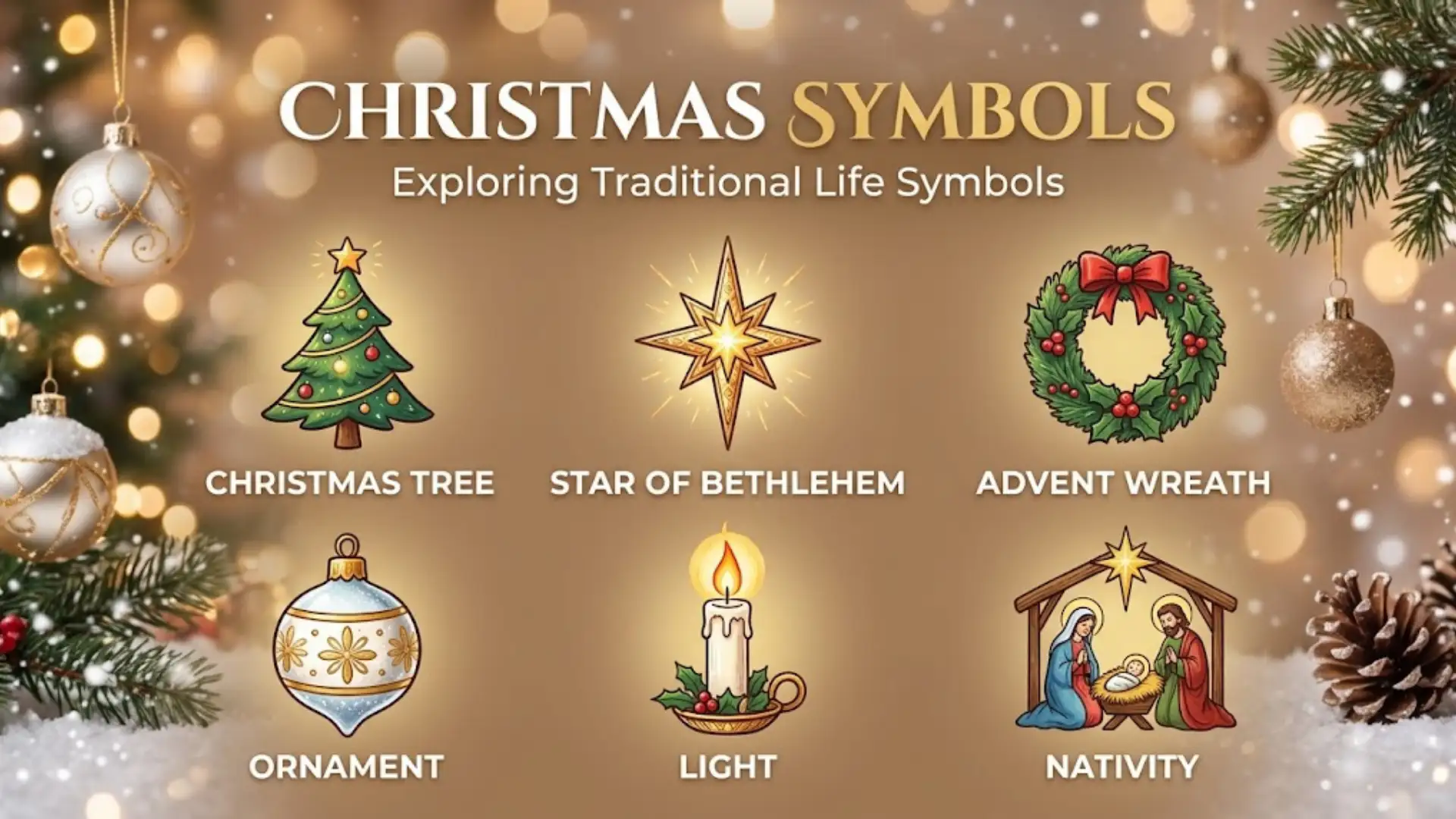
Christmas symbols help people express the joy, hope, and spiritual meaning of the holiday season. From the Star of Bethlehem to evergreen trees, holly leaves, and Christmas lights, these familiar decorations carry meanings shaped by Christian teachings, historical customs, and popular traditions.
Many Christmas symbols and meanings connect to the birth of Jesus Christ, God’s love, salvation, and the promise of eternal life. Others developed through cultural traditions and later received Christian interpretations. Understanding the difference helps us appreciate both the history and the religious significance of Christmas decorations.
In this guide, you’ll discover ten traditional Christmas symbols, explore their Christian meanings, and learn how they relate to biblical teachings. You’ll also find the stories behind Christmas stockings, candy canes, poinsettias, wreaths, and other familiar holiday decorations.
What Are Christmas Symbols and What Do They Mean?
Christmas symbols are objects, decorations, images, and signs associated with Christmas celebrations. They can represent religious beliefs, historical events, cultural traditions, and values such as love, kindness, generosity, and peace.
For Christians, many symbols serve as reminders of Jesus Christ and the events surrounding his birth. A star can represent the Star of Bethlehem, while lights can remind believers of Jesus as the Light of the World.
Other symbols have meanings that developed through tradition rather than direct biblical instruction. The modern Christmas tree, candy cane, and Christmas stocking are examples of objects that people may interpret through a Christian perspective.
The Meaning of Christmas Symbols in Christian Tradition
Christian Christmas symbolism often focuses on several central themes.
- Hope: The birth of Jesus represents hope in Christian belief.
- Light: Jesus is described as the Light of the World in John 8:12.
- Love: John 3:16 connects God’s love for the world with the gift of his Son.
- Salvation: Christians understand Jesus as the Savior who came to bring redemption.
- Eternal life: Christian teachings connect faith in Christ with everlasting life.
- Generosity: Christmas gifts can remind people to share with others and care for those in need.
- Peace and goodwill: Luke 2:14 records the angels’ praise associated with Jesus’ birth.
These themes help explain why religious Christmas decorations remain meaningful to many families. They can turn ordinary objects into reminders of faith, gratitude, and spiritual reflection.
Biblical Christmas Symbols vs. Traditional Christmas Decorations
Not every familiar Christmas decoration appears in the Bible. Some symbols connect directly to biblical accounts, while others became part of Christmas customs centuries later.
For example, Matthew 2:1–12 describes the Wise Men following a star and bringing gifts to Jesus. Luke 2:8–14 describes angels announcing Jesus’ birth to shepherds.
However, the Bible doesn’t prescribe modern electric Christmas lights, decorated Christmas trees, candy canes, or stockings. Their religious meanings come from later traditions, symbolic interpretations, or popular stories.
Understanding this distinction allows readers to appreciate Christmas symbolism without confusing historical customs with Scripture.
Ten Symbols of Christmas and Their Meanings
The following table summarizes ten popular Christmas symbols and their common Christian interpretations.
| Christmas symbol | Common meaning | Christian connection |
| Christmas star | Guidance and hope | The Wise Men’s journey to Jesus |
| Christmas lights | Faith and spiritual guidance | Jesus as the Light of the World |
| Christmas tree | New life and everlasting life | Traditional evergreen symbolism |
| Poinsettia | Celebration, faith, and sacrifice | Later Christian interpretations |
| Holly | Sacrifice and redemption | Traditional crown-of-thorns symbolism |
| Christmas wreath | Eternity and enduring life | Circular shape and evergreen branches |
| Christmas bells | Joy and good news | Celebration of Jesus’ birth |
| Candy cane | Guidance and care | Popular interpretation of the shepherd’s staff |
| Christmas stockings | Generosity and kindness | Saint Nicholas traditions |
| Christmas gifts | Love and giving | The Wise Men’s gifts and God’s gift of Jesus |
Candles are another important Christmas symbol. They are discussed alongside Christmas lights below because both share the theme of light, although candles also have their own traditions and uses.
The Christmas Star: Guidance and Hope
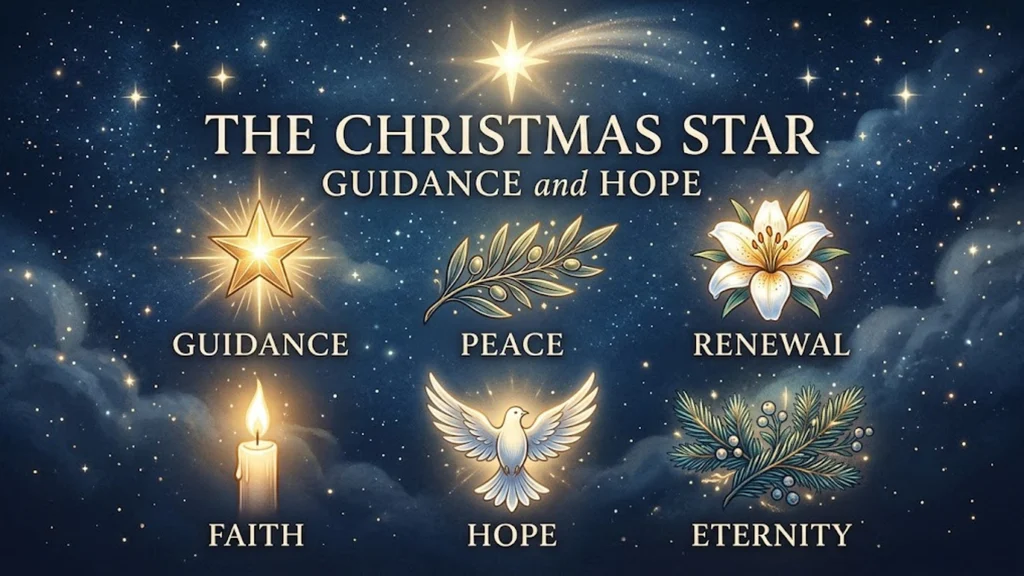
The Christmas star, commonly called the Star of Bethlehem, is one of the most recognizable Christian Christmas symbols. It represents the star described in Matthew’s Gospel, which the Wise Men followed while searching for the child Jesus.
In Matthew 2:1–12, the Wise Men travel to Jerusalem after seeing a star associated with the birth of the King of the Jews. They eventually find Jesus, worship him, and present gifts of gold, frankincense, and myrrh.
What Does the Christmas Star Represent?
For many Christians, the Christmas star symbolizes:
- Divine guidance: The star leads the Wise Men toward Jesus.
- Hope: Its association with Christ’s birth reflects the hope Christians find in the Savior.
- Faith: The Wise Men’s journey represents their willingness to seek and worship Jesus.
- Spiritual light: The star provides a visual reminder of guidance in times of uncertainty.
Many families place a star at the top of their Christmas tree. This decoration serves as a reminder of the Nativity story and the journey of the Wise Men.
The star also appears in Christmas cards, church displays, ornaments, and Nativity scenes.
Biblical reference: Matthew 2:2 describes the Wise Men asking about the star associated with the birth of the King of the Jews.
It’s important to distinguish the biblical account from artistic traditions. The Bible describes the star and the Wise Men’s journey, but it doesn’t prescribe a particular design for a Christmas tree topper.
Christmas Lights: Jesus as the Light of the World
Christmas lights brighten homes, streets, churches, and public spaces during the holiday season. For Christians, they can represent Jesus Christ as the Light of the World, a title used in John 8:12.
Light is a powerful image in Christian teaching. It can represent truth, hope, spiritual guidance, and the presence of God.
How Do Christmas Lights Represent Jesus Christ?
The Christian meaning of Christmas lights comes from their connection to spiritual light.
- Hope in darkness: Light can symbolize hope during difficult times.
- Spiritual guidance: Jesus’ teachings help Christians understand how to live.
- Faith: Lights can remind believers to keep their faith central during Christmas.
- Sharing goodness: Just as lights brighten a room, acts of kindness can improve other people’s lives.
Electric Christmas lights are a later tradition, not a decoration prescribed in the Bible. Nevertheless, many Christians use them as a visual reminder of biblical teachings about light.
The symbolism becomes more meaningful when families connect their decorations with practical actions, such as helping neighbors, donating to charities, or spending time with people who feel isolated.
Biblical reference: John 8:12 records Jesus saying that he is the Light of the World and that those who follow him will have the light of life.
Christmas Candles: Spiritual Light, Warmth, and Remembrance
Christmas candles are traditional decorations used in homes and churches. Their gentle light creates a peaceful atmosphere and can remind Christians of faith, hope, and the spiritual significance of Jesus’ birth.
Candles are especially important in some Advent and Christmas services. Advent is the season of preparation leading up to Christmas in many Christian traditions.
What Is the Meaning of Christmas Candles?
Christmas candles commonly symbolize:
- Spiritual light: A reminder of Jesus as the Light of the World.
- Hope: Light can represent hope during darkness and uncertainty.
- Peace: A candle’s gentle glow can encourage quiet reflection.
- Remembrance: Lighting a candle can provide a moment to reflect on Jesus’ birth and Christian teachings.
Some churches use Advent wreaths with candles as part of their worship traditions. The number, colors, and interpretations of those candles vary among denominations.
Candles can also represent welcome, prayer, or remembrance in different Christian communities. These uses should not be treated as a single universal practice.
For practical safety, never leave a burning candle unattended. Keep it away from curtains, paper decorations, children, and pets.
The Christmas Tree: Hope, New Life, and Everlasting Life
The Christmas tree is one of the most familiar traditional Christmas symbols. Families decorate evergreen trees with lights, ornaments, ribbons, and stars to celebrate the holiday.
Evergreen trees retain much of their green foliage throughout winter. This quality has made them a natural symbol of endurance and continuing life in various cultural traditions.
What Does a Christmas Tree Symbolize?
In Christian interpretations, the evergreen tree can represent:
- New life: Green foliage can remind believers of renewal and hope.
- Everlasting life: Evergreen branches provide a symbol of enduring life.
- Faith: Decorations can remind families of their religious beliefs.
- Jesus Christ: Some Christians view the tree as a reminder of God’s gift of the Savior.
The tree’s modern Christian meanings developed through tradition. The Bible does not directly identify a decorated Christmas tree as a symbol of Jesus.
The Spiritual Meaning of Evergreen Trees
Evergreen branches also appear in wreaths, garlands, and other seasonal decorations. Their lasting greenery makes them suitable reminders of life and hope during winter.
For Christian families, decorating a tree can become an opportunity to discuss the meaning of Christmas ornaments. A star might recall the Wise Men, while lights might recall Jesus as the Light of the World.
Gold balls and other ornaments may represent celebration, beauty, or personal family traditions. Their meanings are not fixed biblical teachings, so families can explain them according to their own customs.
Poinsettias: Christmas Celebration, Faith, and Hope
Poinsettias are popular Christmas flowers recognized by their bright red or white leaf-like structures called bracts. Their association with the holiday is particularly strong in North America.
The plant originated in Mexico, where it grows naturally as a shrub. It became associated with Christmas through Mexican traditions and later gained widespread popularity as a seasonal decoration.
What Does the Poinsettia Flower Represent in Christianity?
Poinsettias don’t have one universal Christian meaning. However, some Christian interpretations connect their shape and colors with the Nativity and Jesus’ sacrifice.
Red poinsettia meaning at Christmas
Red poinsettias are often associated with celebration, love, and, in some Christian interpretations, Christ’s blood and sacrifice. Their red color can prompt reflection on the broader Christian story of Jesus’ life and redemption.
White poinsettia spiritual meaning
White poinsettias are commonly associated with purity, peace, and hope. These meanings reflect broader religious and cultural associations with white rather than a specific biblical description of the flower.
The Poinsettia Legend
A popular Mexican Christmas legend tells of a poor child who wanted to offer a gift to Jesus but had nothing valuable to give. The child gathered humble plants, which miraculously transformed into beautiful red flowers.
The story is a legend, not a verified historical account. Its message emphasizes that a sincere gift can be meaningful even when it costs very little.
For many families, poinsettias represent the spirit of Christmas: giving with love, appreciating simple blessings, and remembering the religious meaning of the holiday.
Holly: Red Berries, the Crown of Thorns, and Sacrifice
Holly is a traditional Christmas decoration featuring glossy green leaves and bright red berries. People use it in wreaths, garlands, centerpieces, and seasonal arrangements.
In Christian tradition, holly has developed a symbolic connection to the suffering and sacrifice of Jesus Christ.
Why Are Holly Leaves Associated With the Crown of Thorns?
The traditional Christian interpretation connects the plant’s prickly leaves with the crown of thorns placed on Jesus before his crucifixion. Matthew 27:29 describes the soldiers placing a crown of thorns on Jesus’ head.
Red holly berries are sometimes interpreted as representing Christ’s blood. Together, the leaves and berries can remind believers of Jesus’ sacrifice and the Christian message of redemption.
These associations are traditional symbolic interpretations. The Bible does not identify holly as the plant used for the crown of thorns.
Holly as a Christian Symbol
Holly’s green leaves can also evoke life and endurance, while its red berries add a vivid seasonal color. When displayed during Christmas, the plant can help Christians connect the celebration of Jesus’ birth with the wider story of his life and sacrifice.
This symbolism is one reason holly remains popular in Christian Christmas decorations.
The Christmas Wreath: Eternity and Everlasting Life
A Christmas wreath is a circular decoration commonly made from pine branches, evergreen foliage, holly, ribbons, and ornaments. Families hang wreaths on doors, windows, and walls during the holiday season.
Its circular shape has encouraged associations with eternity because a circle has no visible beginning or end.
What Does a Christmas Wreath Symbolize?
Common interpretations include:
- Eternity: The unbroken circle can represent enduring life.
- Hope: Evergreen branches can represent life during winter.
- Welcome: A wreath on a door can express hospitality and celebration.
- Faith: Christian families may use wreaths as reminders of spiritual beliefs.
These meanings come from tradition and interpretation rather than a direct biblical instruction to hang wreaths at Christmas.
Christmas Wreaths and Advent Wreaths
A decorative Christmas wreath is not necessarily the same as an Advent wreath.
An Advent wreath is used in many Christian traditions during the weeks leading up to Christmas. It typically includes candles and evergreen branches, although designs and practices vary.
The candles may mark the weeks of Advent and support prayer, worship, and reflection. The wreath’s circular shape is commonly connected with God’s enduring love and eternity.
Both types of wreaths can have spiritual meaning, but their purposes and customs differ.
Christmas Bells: Joy, Celebration, and Good News
Christmas bells appear in ornaments, cards, songs, church decorations, and seasonal displays. Their sound is associated with celebration, gatherings, and announcements.
In Christian Christmas traditions, bells can represent the joy of celebrating Jesus’ birth and sharing the message of peace and goodwill.
What Do Christmas Bells Represent?
Christmas bells commonly symbolize:
- Joy: Their ringing accompanies celebrations.
- Good news: Bells can announce an important event or gathering.
- Peace and goodwill: Their association with Christmas songs connects them to the holiday’s message.
- Community: Church bells can call people together for worship.
Luke 2:14 records the angels praising God and proclaiming peace in connection with Jesus’ birth. However, the passage does not describe Christmas bells ringing during the Nativity.
The connection between bells and the announcement of Christ’s birth is symbolic, not a literal detail of the biblical account.
Christmas bells remain a popular reminder to celebrate with gratitude, share kindness, and welcome others into the holiday season.
The Candy Cane: The Shepherd’s Staff and Christian Meaning
The candy cane is a curved peppermint candy commonly associated with Christmas. Its familiar shape has inspired a popular Christian interpretation connecting it with a shepherd’s staff.
The story is meaningful to many believers, although the claim that the candy cane was deliberately invented to communicate a specific set of Christian teachings is not established historical fact.
What Is the Christian Meaning of the Candy Cane?
In a popular interpretation, the candy cane’s shape represents a shepherd’s staff. This connects it with the shepherds in Luke 2 and with Jesus as the Good Shepherd in John 10:11.
Other interpretations assign meanings to its colors:
- White: Purity or innocence.
- Red: Christ’s sacrifice and blood.
- Curved shape: A shepherd’s crook or the letter J, representing Jesus.
These meanings are later religious interpretations, not biblical descriptions of candy canes.
Jesus as the Good Shepherd
John 10:11 records Jesus describing himself as the Good Shepherd who lays down his life for the sheep. John 10:14 also emphasizes his relationship with those who follow him.
For Christians, this imagery communicates care, protection, guidance, and sacrifice.
The candy cane can therefore serve as a simple teaching aid for children. Parents can explain the Good Shepherd theme while also making clear that the candy’s religious interpretation is a tradition rather than a confirmed account of its origin.
Christmas Stockings: Generosity, Kindness, and Saint Nicholas
Christmas stockings are often hung near fireplaces, on walls, or beside Christmas trees. Families fill them with small gifts, sweets, and other surprises for Christmas morning.
The tradition is commonly associated with Saint Nicholas, a Christian bishop remembered for generosity and charitable acts.
How Did Christmas Stockings Become a Tradition?
Stories about Saint Nicholas helped shape later Christmas gift-giving traditions. One popular legend tells of a poor family whose daughters needed financial help. According to the story, Saint Nicholas secretly provided gold, sometimes described as falling into stockings or shoes placed near a fire.
Different versions of the legend vary, and the familiar stocking story should not be treated as a fully verified historical account.
Over time, the practice of hanging stockings became part of Christmas customs in several countries.
The Spiritual Meaning of Christmas Stockings
For Christians, stockings can serve as reminders of generosity and care for others.
Their meaning extends beyond the gifts placed inside them. They can encourage families to think about people who have fewer resources and to share what they have.
Examples of Christmas kindness include:
- Donating food or warm clothing.
- Preparing gifts for children in need.
- Visiting older neighbors or relatives.
- Supporting community charities.
- Helping someone who feels alone during the holiday season.
These acts connect the festive tradition with the Christian values of service, kindness, and selflessness.
Christmas Gifts: Love, Generosity, and God’s Greatest Gift
Exchanging Christmas gifts is one of the most familiar holiday traditions. For many Christians, giving presents provides an opportunity to express love, gratitude, and generosity.
The tradition is often connected to the Wise Men, who brought gifts to Jesus after finding him in Bethlehem.
What Gifts Did the Wise Men Bring to Jesus?
Matthew 2:11 records three gifts:
- Gold
- Frankincense
- Myrrh
Each gift has acquired traditional Christian interpretations.
Gold was a valuable gift associated with wealth and kingship. Christians often interpret it as acknowledging Jesus’ kingship.
Frankincense was an aromatic resin used in incense and religious settings. Its association with worship has led Christians to connect it with Jesus’ divine significance.
Myrrh was an aromatic resin used in perfumes and burial preparations. Christians have often interpreted it as foreshadowing Jesus’ suffering and death.
These are traditional interpretations of the gifts. Matthew names the gifts but does not explicitly explain each one’s symbolic meaning.
Jesus Christ as the True Gift of Christmas
Many Christians see Jesus himself as God’s greatest gift to humanity. John 3:16 expresses God’s love for the world through the gift of his Son.
This belief gives Christmas gift-giving a deeper meaning. Presents can represent affection, generosity, and the desire to make others feel valued.
However, the Christian meaning of Christmas does not depend on how many gifts a person receives or gives. Simple acts of service, time spent with loved ones, and help offered to someone in need can express the spirit of Christmas just as meaningfully.
Other Christian Christmas Symbols and Their Spiritual Meanings
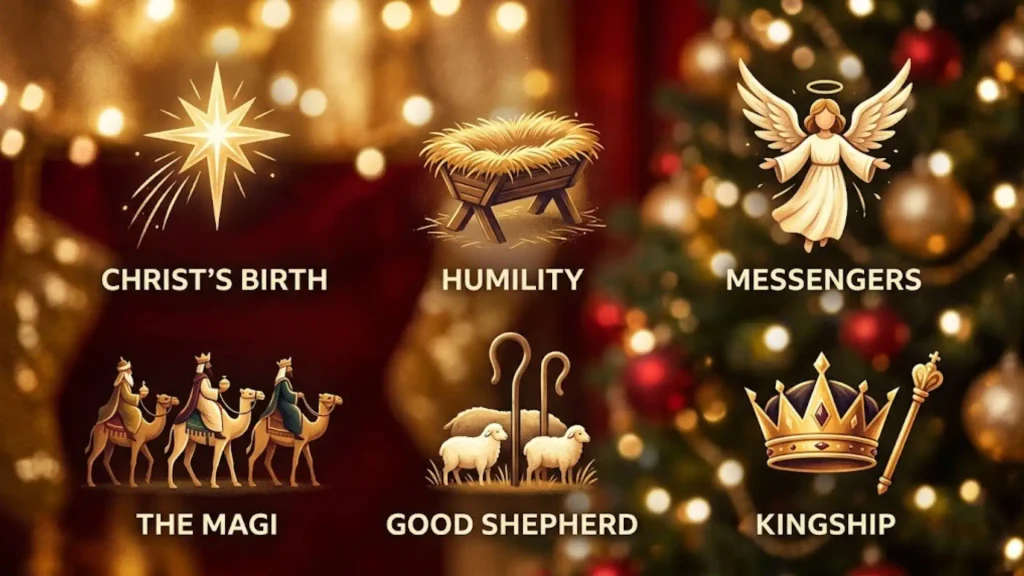
The ten symbols above cover many familiar decorations, but other figures and objects also play important roles in Christian Christmas celebrations.
Angels: Messengers of Good News
Angels appear in the biblical accounts surrounding Jesus’ birth. In Luke 2:8–14, an angel announces the birth of the Savior to shepherds, and a multitude of heavenly beings praises God.
Angels in Christmas decorations commonly represent:
- Messages from God.
- Praise and worship.
- Hope and reassurance.
- The announcement of Jesus’ birth.
Decorative angels are artistic representations of these biblical figures. Their clothing, wings, and appearance in artwork reflect artistic traditions rather than detailed descriptions in the Nativity accounts.
Shepherds: Guidance, Care, and Humility
The shepherds in Luke 2:8–20 hear the angel’s announcement and visit the child Jesus. Their presence is central to many Nativity scenes.
Shepherds can represent humility, attentiveness, and the willingness to respond to God’s message.
Their story also connects with Jesus’ later description of himself as the Good Shepherd in John 10:11. This image emphasizes care, guidance, and a willingness to sacrifice for others.
The Nativity Scene: Remembering the Birth of Jesus
A Nativity scene depicts the birth of Jesus, often including Mary, Joseph, the infant Jesus, a manger, shepherds, angels, and animals.
Some displays also include the Wise Men. However, Matthew does not specify that the Wise Men arrived on the night Jesus was born. Their inclusion in Christmas displays reflects the way Christian art and traditions combine different parts of the Gospel accounts.
For many families, setting up a Nativity scene helps keep Jesus at the center of Christmas celebrations.
Gold Christmas Ornaments and Balls
Gold-colored Christmas ornaments are common on trees, wreaths, and garlands. Their color can suggest royalty, beauty, celebration, and precious gifts.
Some Christians connect gold ornaments with the gold presented to Jesus by the Wise Men. Others choose them for their traditional festive appearance.
There is no universal biblical meaning assigned to gold Christmas balls. Their significance depends on personal beliefs, family customs, and the way the decorations are used.
Christmas Symbols in the Bible
The Bible provides the foundation for many Christian interpretations of Christmas symbols. The most relevant passages describe Jesus’ birth, the angelic announcement, the Wise Men’s visit, and Jesus’ identity as the Savior.
Important Bible Verses About Christmas Symbols
| Bible reference | Main theme | Connection to Christmas |
| Matthew 2:1–12 | Star and Wise Men | The Wise Men’s journey and gifts |
| Matthew 2:11 | Gold, frankincense, and myrrh | Gifts presented to Jesus |
| Matthew 27:29 | Crown of thorns | Traditional Christian interpretation of holly |
| Luke 2:8–14 | Angels and shepherds | Announcement of Jesus’ birth |
| John 3:16 | God’s love | Jesus as God’s gift to the world |
| John 8:12 | Light of the World | Christian meaning of Christmas lights |
| John 10:11 | Good Shepherd | Popular interpretation of the candy cane |
| John 10:14 | The Good Shepherd | Jesus’ care for those who follow him |
These references support the biblical themes behind many Christmas interpretations. They do not mean that every decoration listed above appears in Scripture.
Are All Christmas Symbols Mentioned in the Bible?
No. Some Christmas symbols connect directly to biblical events, while others developed through later cultural and religious traditions.
The star, Wise Men, shepherds, angels, and gifts appear in the Nativity accounts. Modern electric lights, decorated Christmas trees, candy canes, and stockings are later customs.
Christians differ in how they approach these traditions. Some emphasize only symbols closely connected to Scripture, while others embrace a broader range of seasonal customs as reminders of Christian values.
The important distinction is to identify the source of each meaning accurately rather than presenting every popular story as a biblical fact.
The History Behind Christmas Symbols and Traditions
Christmas traditions developed over many centuries and across different regions. Evergreen decorations, Christmas trees, wreaths, lights, and gift-giving did not all originate at the same time or for the same reason.
How Christmas Decorations Developed
Evergreen plants have been used in seasonal customs in various cultures. Over time, evergreen branches became familiar Christmas decorations, and the decorated Christmas tree became especially popular in parts of Europe before spreading more widely.
Candles were used on Christmas trees before electric lights became common, although open flames presented obvious fire risks. Electric Christmas lights later allowed people to decorate trees and buildings with less reliance on exposed flames.
Wreaths and garlands also became common seasonal decorations. Their modern meanings reflect a mixture of older decorative customs and later Christian interpretations.
Saint Nicholas and Christmas Gift-Giving
Saint Nicholas was a Christian bishop associated with Myra, in what is now Türkiye. Later traditions celebrated his generosity and his concern for people in need.
Stories about his charitable acts helped shape the development of Christmas gift-giving customs. Over time, different cultures developed their own gift-bringing figures and traditions.
The familiar story of Saint Nicholas secretly leaving gold is part of this tradition, but its details vary across versions. It is best understood as a popular legend rather than a completely documented historical event.
How Christmas Traditions Differ Around the World
Christmas celebrations vary among countries, Christian denominations, and families. Some communities emphasize church services and Nativity displays, while others place greater emphasis on family meals, music, and gift-giving.
Mexico, for example, has its own rich Christmas traditions and a strong association between poinsettias and the holiday season.
These differences show that Christmas symbolism is not completely uniform. A decoration may have a specific religious meaning in one community and a broader seasonal meaning in another.
How Christmas Symbols Teach Christian Values
Christmas symbols can be more than decorations. When people understand their meanings, these objects can encourage reflection on the values that Christians associate with Jesus Christ.
Faith and Hope
The Star of Bethlehem can remind believers of guidance and hope. Christmas lights can represent spiritual light, while evergreen trees may evoke new life and enduring hope.
These interpretations can encourage people to reflect on their faith and remain hopeful during difficult times.
Generosity and Selfless Service
Christmas gifts and stockings can remind people to share with others. The Saint Nicholas tradition reinforces the value of giving without expecting recognition.
Families can put these ideas into practice by donating food, supporting local charities, or helping neighbors who need assistance.
Peace, Kindness, and Goodwill
The Christmas story includes the angels’ proclamation of peace in Luke 2:14. Many Christians connect this message with kindness, forgiveness, and goodwill toward others.
Small actions can reflect these values:
- Reaching out to someone who feels lonely.
- Making peace after an argument.
- Helping a family facing financial difficulties.
- Giving time to community service.
- Treating others with patience and respect.
These actions help connect Christmas traditions with everyday Christian teachings.
Remembering Jesus as the True Meaning of Christmas
For Christians, the birth of Jesus is at the heart of Christmas. Decorations can help families remember the Nativity story, but the spiritual meaning of the holiday goes beyond ornaments, lights, and presents.
Prayer, worship, reading the Bible, caring for others, and reflecting on God’s love can help keep Jesus central to the celebration.
Christmas symbols are most meaningful when they point beyond themselves to the beliefs and values they represent.
How to Choose Meaningful Christian Christmas Decorations
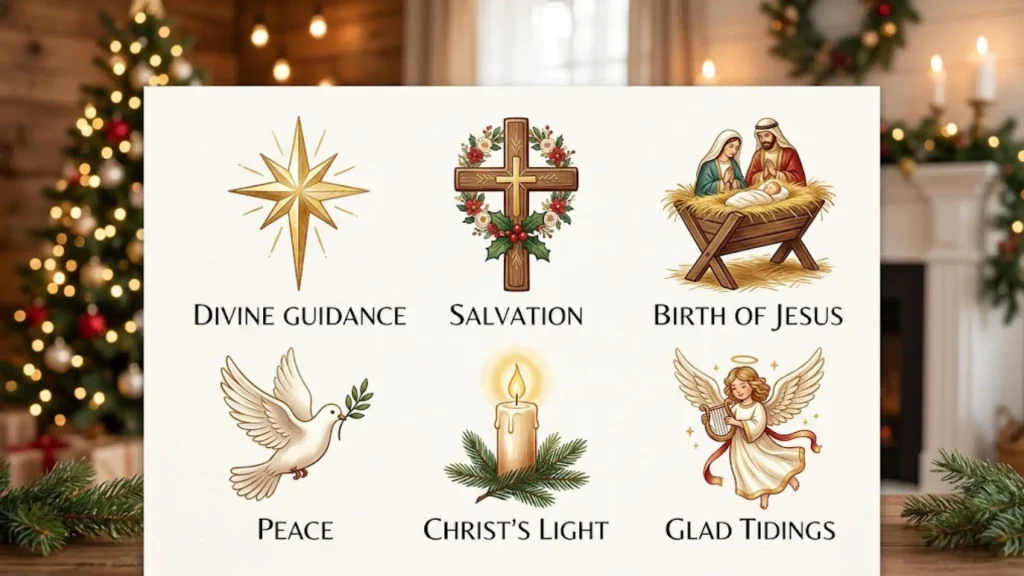
Families can make Christmas decorations more meaningful by choosing objects that connect with their faith and values.
Decorations for a Christ-Centered Christmas
Consider these options:
- A Nativity scene: Helps tell the story of Jesus’ birth.
- A star ornament: Recalls the Wise Men’s journey.
- Christmas lights: Remind the family of Jesus as the Light of the World.
- An Advent wreath: Supports seasonal worship and reflection in traditions that use one.
- Bible-verse ornaments: Provide opportunities to discuss Scripture.
- A Christmas wreath: Can represent enduring life, hope, and welcome.
- A gift-giving tradition: Encourages generosity and service to people in need.
Not every decoration needs a religious meaning. Families can enjoy festive colors and seasonal ornaments while choosing a few meaningful symbols to emphasize their beliefs.
Simple Ways to Teach Children Christmas Symbolism
Parents and teachers can help children understand Christmas symbols through short, practical activities.
- Explain one symbol at a time.
- Read the related Bible passage together.
- Ask children what value the symbol reminds them of.
- Encourage them to show kindness or generosity in a practical way.
- Explain which stories come from Scripture and which come from later legends.
For example, when placing a star on a tree, a parent can read Matthew 2:1–12 and discuss the Wise Men’s journey. When hanging stockings, the family can talk about generosity and ways to help others.
These simple activities help children understand that Christmas symbols can communicate meaningful ideas rather than serving only as decorations.
Frequently Asked Questions About Christmas Symbols
What Are the Ten Symbols of Christmas and Their Meanings?
Ten popular Christmas symbols are the Christmas star, Christmas lights, Christmas tree, poinsettia, holly, wreath, bells, candy cane, stockings, and gifts. They are commonly associated with guidance, hope, new life, sacrifice, eternity, joy, generosity, and love.
Their interpretations vary, and some meanings come from later traditions rather than direct biblical references.
What Is the Christian Meaning Behind Christmas Symbols?
Christian Christmas symbols often remind believers of Jesus Christ, his birth, God’s love, salvation, and the hope of everlasting life. Lights can represent Jesus as the Light of the World, while the Star of Bethlehem recalls the Wise Men’s journey.
Other symbols, such as stockings and candy canes, have Christian meanings assigned through later customs and popular interpretations.
Why Is the Star an Important Symbol of Christmas?
The Star of Bethlehem is important because Matthew 2:1–12 describes the Wise Men following a star while searching for Jesus. Christians commonly interpret the star as a symbol of guidance, hope, and the birth of the Savior.
How Do Christmas Lights Represent Jesus Christ?
Christmas lights can remind Christians of Jesus’ description of himself as the Light of the World in John 8:12. They can symbolize spiritual guidance, truth, and hope.
Electric Christmas lights are a later tradition, but many Christians use them to reflect on these biblical themes.
Why Does the Evergreen Tree Symbolize Everlasting Life?
Evergreen trees retain much of their green foliage throughout winter. This quality has encouraged associations with enduring life and hope.
Christians may interpret the evergreen Christmas tree as a reminder of new life and everlasting life. This is a traditional interpretation, not a meaning directly prescribed in the Bible.
What Does the Poinsettia Flower Represent in Christianity?
Poinsettias are popular Christmas flowers associated with celebration and seasonal beauty. Some Christian interpretations connect red poinsettias with Christ’s sacrifice and white poinsettias with purity and peace.
These associations come from tradition and symbolism rather than direct biblical teaching.
Why Are Holly Leaves Associated With the Crown of Thorns?
The prickly leaves of holly are traditionally associated with the crown of thorns placed on Jesus in Matthew 27:29. Red holly berries are sometimes interpreted as representing Christ’s blood.
This is a later Christian interpretation; the Bible does not identify holly as the plant used for the crown.
What Does a Christmas Wreath Symbolize in Christian Tradition?
A Christmas wreath’s circular shape is commonly associated with eternity because it has no visible beginning or end. Evergreen branches can also represent enduring life and hope.
An Advent wreath has a more specific role in Christian seasonal worship and often includes candles.
What Is the Religious Meaning of the Candy Cane?
A popular Christian interpretation connects the candy cane’s curved shape with a shepherd’s staff and Jesus as the Good Shepherd. Its red and white colors are sometimes associated with sacrifice and purity.
These meanings are traditional interpretations rather than verified facts about the candy cane’s original invention.
How Did Christmas Stockings Become a Tradition?
Christmas stockings are associated with later gift-giving customs and the popular legend of Saint Nicholas secretly leaving gold for a family in need. Different versions of the story exist, and the exact historical development of the stocking tradition is more complex than a single legend suggests.
Why Do Christians Exchange Gifts at Christmas?
Many Christians connect gift-giving with the Wise Men’s gifts to Jesus and the belief that God gave his Son out of love for the world. John 3:16 is an important biblical reference for this understanding.
Gift-giving can also express generosity, gratitude, and care for family members, friends, and people in need.
What Were the Gifts Presented to Jesus by the Wise Men?
Matthew 2:11 identifies three gifts: gold, frankincense, and myrrh. Christian traditions commonly associate gold with kingship, frankincense with worship, and myrrh with suffering and death.
The Gospel names the gifts but does not explicitly explain each one’s symbolic meaning.
How Can Christmas Traditions Encourage Kindness and Service?
Families can use Christmas traditions to support people in need, visit isolated relatives, donate food, volunteer, and give thoughtful gifts. These actions reflect Christian values of generosity, love, and service.
They also help connect the celebration of Jesus’ birth with practical care for others.
Conclusion: The True Meaning of Christmas Symbols
Christmas symbols bring together religious teachings, historical customs, and family traditions. The Star of Bethlehem recalls the Wise Men’s journey, lights can represent Jesus as the Light of the World, and evergreen trees can symbolize enduring life and hope.
Other decorations carry meanings shaped by later Christian interpretations. Holly can remind believers of Christ’s sacrifice, wreaths can represent eternity, and gifts can express love and generosity.
Understanding these differences helps us appreciate the meaning of Christmas symbols without confusing biblical accounts with popular legends.
For Christians, the deeper purpose of Christmas is to remember the birth of Jesus Christ and reflect on God’s love, salvation, hope, and peace. Decorations become especially meaningful when they inspire kindness, generosity, faith, and service throughout the holiday season.

Hi, I’m Sienna Brooks, and I believe that the right words can inspire, comfort, and empower people at every stage of life. For as long as I can remember, I’ve been drawn to meaningful quotes and the stories behind them. I love curating collections of inspirational, motivational, and heartfelt quotes that resonate with readers around the world.
Through my writing, I strive to help others find encouragement, whether they’re celebrating life’s happiest moments or navigating its biggest challenges. I believe that wisdom is timeless, and I’m passionate about sharing words that leave a lasting impact.
I am the author of Reflections in Words and The Journey of Inspiration, two books dedicated to exploring the beauty and power of timeless quotes.
 Asher Monroe
 Rowan Sinclair Rowan Sinclair