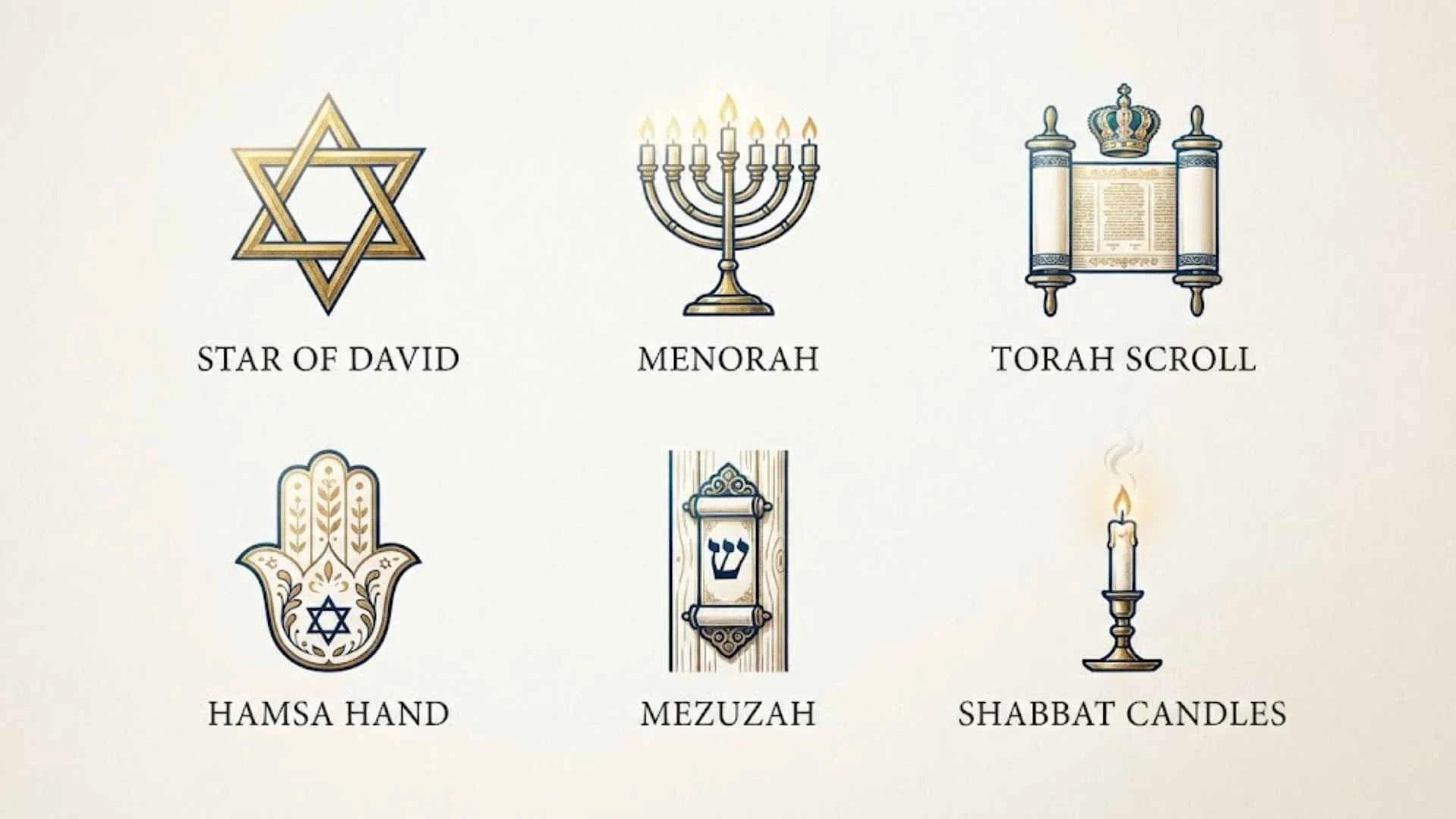
Jewish symbols carry religious, cultural, historical, and personal meanings that have developed across centuries. Some are widely recognized, such as the Star of David, while others are connected with Hebrew words, biblical traditions, Jewish communities, holidays, and ancient history.
This guide explores common Jewish symbols, their names, meanings, images, and uses. It also covers Chai, the hand symbol, protection symbols, food markings, jewelry, ancient symbols, Ashkenazi traditions, and Messianic Jewish symbolism.
If you are looking for Jewish symbols to understand, identify, copy, use in a design, or research for a project, the sections below provide a practical reference while keeping the cultural context of each symbol clear.
What Are Jewish Symbols
Jewish symbols are visual signs, letters, objects, or designs associated with Judaism and Jewish cultural life. Some have religious origins, while others developed through Jewish communities, Hebrew language traditions, historical events, or later cultural practices.
Common examples include:
- ✡ — Star of David
- חי — Chai
- 🕎 — Menorah-related visual representation
- חמסה — Hamsa or hand symbol
- ש — Shin, a Hebrew letter used in several Jewish contexts
- Torah scroll — Symbol of Jewish scripture and learning
- Shofar — Ram’s horn associated with Jewish worship and Rosh Hashanah
Not every symbol is exclusively Jewish. Some designs have also appeared in other Middle Eastern or Mediterranean cultures, so context matters when identifying them.
What Are Some Jewish Symbols
Some of the most recognizable Jewish symbols include the Star of David, menorah, Chai, shofar, Torah scroll, mezuzah, and hamsa.
| Symbol or object | Common association |
| ✡ Star of David | Jewish identity and Judaism |
| Chai חי | Life |
| Menorah | Jewish worship, Temple tradition, and light |
| Torah scroll | Jewish scripture and learning |
| Mezuzah | Jewish home and religious practice |
| Shofar | Worship, remembrance, and Rosh Hashanah |
| Hamsa | Protection in some Jewish cultural contexts |
| Dreidel | Hanukkah |
| Tallit | Jewish prayer |
| Tefillin | Jewish prayer and observance |
These symbols do not all have the same status. Some are religious objects, some are visual emblems, and others are cultural symbols.
Common Jewish Symbols
The Star of David is probably the most familiar Jewish symbol today. The menorah is another major symbol with a much older connection to Jewish religious tradition.
Other commonly recognized symbols include:
- ✡ Star of David — Jewish identity
- מנורה Menorah — seven-branched lamp associated with the Temple
- חי Chai — life
- שופר Shofar — ram’s horn used in religious practice
- מזוזה Mezuzah — object placed on a Jewish doorpost
- תורה Torah — Jewish scripture and teaching
- חמסה Hamsa — hand-shaped symbol used in some Jewish communities and broader regional traditions
The meaning of an item can change depending on whether it is being used in worship, cultural expression, decoration, jewelry, or historical representation.
Important Jewish Symbols
Several symbols have particular importance in Jewish religious and cultural life.
Star Of David
The Star of David, or Magen David, is a six-pointed geometric figure formed from two overlapping triangles. It became an important Jewish identity symbol, particularly in modern Jewish history.
Menorah
The traditional seven-branched menorah is an ancient Jewish symbol connected with the Temple in Jerusalem. It should be distinguished from the nine-branched Hanukkah lamp, commonly called a hanukkiah.
Torah
The Torah scroll represents Jewish scripture, learning, religious teaching, and communal worship. A Torah scroll is a sacred object rather than simply a decorative symbol.
Chai
חי is formed from the Hebrew letters ח and י and spells a word associated with life. It is widely used in Jewish jewelry and decorative art.
Jewish Symbols And Their Meanings
Here is a practical reference to several important Jewish symbols:
| Jewish symbol | Name | Common meaning or association |
| ✡ | Star of David / Magen David | Jewish identity |
| חי | Chai | Life |
| 🕎 | Menorah | Temple tradition, worship, and light |
| מזוזה | Mezuzah | Jewish home and religious observance |
| שופר | Shofar | Worship, remembrance, repentance, and Rosh Hashanah |
| תורה | Torah | Scripture, teaching, and Jewish learning |
| חמסה | Hamsa | Protection in some Jewish traditions |
| תפילין | Tefillin | Prayer and religious observance |
| טלית | Tallit | Prayer and Jewish religious practice |
| סביבון | Dreidel | Hanukkah |
These meanings are broad descriptions. A symbol’s significance can be more specific depending on its religious, historical, or cultural setting.
Jewish Symbols And Names
Knowing the Hebrew or traditional name of a symbol can make research much easier.
| Symbol name | Hebrew name | Description |
| Star of David | מגן דוד | Six-pointed star |
| Chai | חי | Hebrew word meaning life |
| Menorah | מנורה | Seven-branched lamp |
| Mezuzah | מזוזה | Scroll-containing object attached to a doorpost |
| Shofar | שופר | Ram’s horn |
| Torah | תורה | Jewish teaching or scripture |
| Tallit | טלית | Prayer shawl |
| Tefillin | תפילין | Prayer boxes and straps |
| Dreidel | סביבון | Four-sided spinning top |
Hebrew words may be transliterated into English in more than one way. For example, Chai may appear as Chay, while Hanukkah also has several English spellings.
Jewish Symbols Meaning
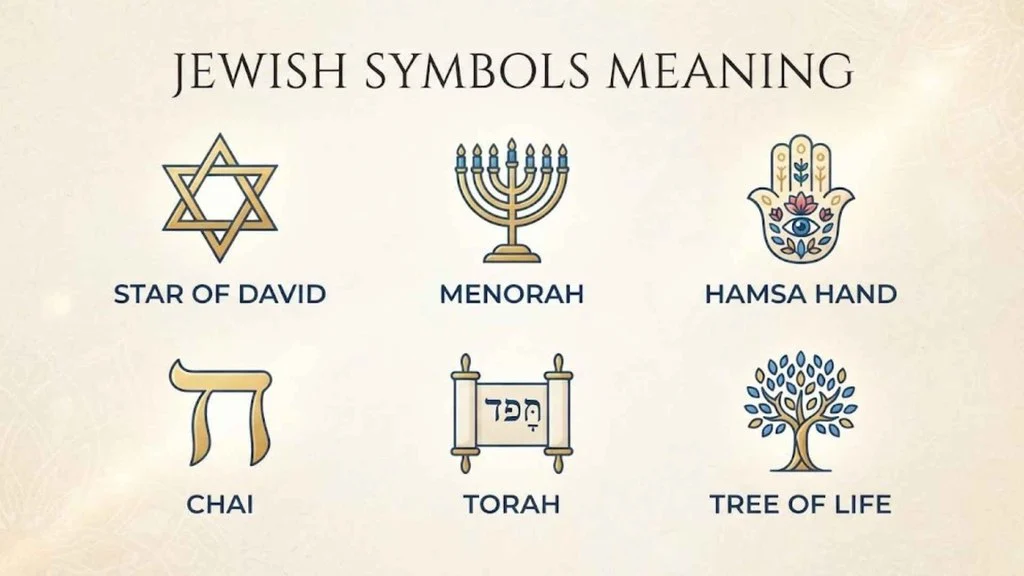
Jewish symbols can communicate identity, faith, remembrance, life, religious practice, community, or historical connection.
The Magen David, for example, is strongly associated with Jewish identity. Chai focuses on the idea of life. The menorah connects to ancient Jewish religious history and the Temple.
Some symbols are also associated with particular practices. Tefillin are connected with prayer and commandments, while a mezuzah is associated with the Jewish home.
Because Jewish traditions developed across different communities and historical periods, there is no single meaning that applies equally to every Jewish symbol.
Jewish Symbols Chai
The Chai symbol is written in Hebrew as:
חי
It combines the Hebrew letters:
- ח — Chet
- י — Yud
Together, they form the Hebrew word chai, meaning life.
Chai is especially common in Jewish jewelry, artwork, necklaces, pendants, and decorative objects. The expression L’Chaim, meaning roughly to life, is also familiar in Jewish cultural contexts.
Chai is a good example of a Jewish symbol that is simultaneously a word, a cultural expression, and a popular decorative design.
Jewish Symbols Hand
The hand-shaped symbol commonly called the Hamsa appears in Jewish communities as well as in other cultures of the Middle East and North Africa.
It is often represented as an open hand, sometimes with an eye in the center. In some Jewish cultural contexts, it has been associated with protection and warding off the evil eye.
The Hamsa should not be confused with a symbol that is exclusively Jewish. Its history crosses cultural and religious boundaries, and different communities have attached different meanings to it.
For that reason, descriptions such as protection symbol are more accurate than claiming one universal religious interpretation.
Jewish Symbols Of Protection
Several objects and symbols are associated with protection in Jewish history and culture, although their roles are not identical.
The mezuzah is placed on Jewish doorposts and has an important religious role. The Hamsa has been used as a protective symbol in some Jewish communities. Certain Hebrew inscriptions, amulets, and biblical passages have also appeared historically in protective contexts.
Protection-related Jewish symbolism may therefore include:
- Hamsa — protection in some cultural traditions
- Mezuzah — religious practice associated with the Jewish home
- Biblical inscriptions — historically used in various contexts
- Amulets — found in some periods and communities
These examples should not be treated as interchangeable. Their historical and religious functions are different.
Jewish Symbols Jewelry
Jewish symbols are widely used in jewelry, including necklaces, pendants, bracelets, rings, earrings, and charms.
Popular choices include:
- Star of David pendants
- Chai necklaces
- Hamsa jewelry
- Menorah pendants
- Hebrew name jewelry
- Mezuzah-inspired pendants
Jewelry can express religious belief, cultural identity, family heritage, remembrance, or personal connection. Some pieces are highly religious, while others are primarily cultural or decorative.
When buying or designing Jewish-symbol jewelry, checking the Hebrew lettering is particularly important because a small spelling error can change a word or make it meaningless.
Jewish Symbols Necklace
Jewish symbol necklaces commonly feature the Star of David, Chai, Hamsa, or Hebrew lettering.
A Star of David necklace is often worn as an expression of Jewish identity. A Chai necklace can represent life and is also frequently given as a meaningful gift.
A Hamsa necklace may be chosen because of its association with protection, although the Hamsa has a broader cultural history beyond Judaism.
The choice of symbol usually depends on what the wearer wants the necklace to communicate.
Jewish Symbols On Food
Jewish food products may carry certification marks known as kosher symbols or hechsherim. These marks indicate that a certifying organization has determined that a product meets particular kosher requirements.
Examples include certification symbols associated with organizations such as:
- OU — Orthodox Union
- OK — a kosher certification organization
- Star-K — kosher certification organization
- Kof-K — kosher certification organization
A kosher symbol is different from a general Jewish religious symbol. It is primarily a certification mark connected with kosher supervision.
The exact requirements and certification practices can vary between organizations, so the presence of a kosher mark should be understood according to the certifier that issued it.
Jewish Symbols Images
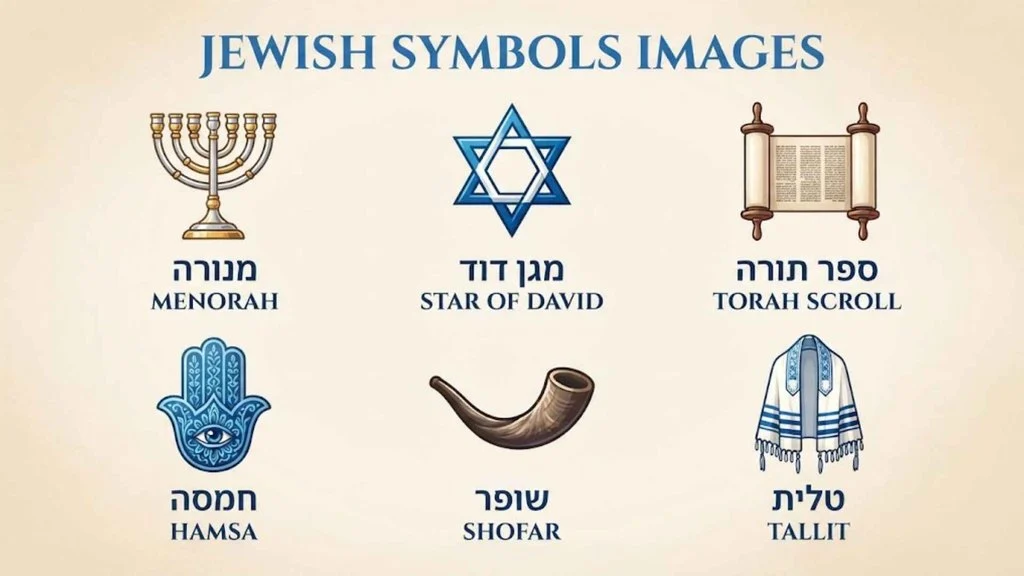
Images are often the easiest way to distinguish Jewish symbols because many are graphic designs rather than ordinary text characters.
For visual reference, common examples include:
✡ — Star of David
חי — Chai
🕎 — Menorah-related emoji representation
חמסה — Hamsa
שופר — Shofar
When searching for images, pay attention to the difference between the traditional seven-branched menorah and the nine-branched Hanukkah lamp. They are related to Jewish tradition but represent different objects and practices.
Jewish Symbols Images
Jewish symbol images are useful for identifying designs that cannot be accurately represented through normal keyboard characters.
For example, the Star of David can be typed or displayed as a Unicode character in many environments, but a traditional Hamsa or menorah design is generally better represented by an image.
For design work, use clear source images and avoid changing a sacred or culturally significant symbol so extensively that its original form becomes difficult to recognize.
Pictures Of Jewish Symbols And Meanings
Pictures can help connect a visual design with its traditional name and meaning.
| Picture-style representation | Symbol | Meaning or association |
| ✡ | Star of David | Jewish identity |
| חי | Chai | Life |
| 🕎 | Menorah | Jewish religious history and light |
| 🖐 | Hamsa-style hand | Protection in some traditions |
| 📜 | Torah scroll concept | Jewish scripture and learning |
| 📯 | Shofar concept | Jewish worship and holidays |
Emoji representations are only approximations for some objects. A generic emoji should not automatically be treated as an exact traditional Jewish symbol.
Pictures Of Jewish Symbols And Meanings
A well-organized picture guide should place the visual symbol next to its name and explanation. This is especially helpful for symbols such as the Star of David, menorah, Chai, Hamsa, mezuzah, shofar, and Torah.
For educational use, it is helpful to separate:
- Religious objects
- Identity symbols
- Hebrew-letter symbols
- Holiday symbols
- Protective or folk-cultural symbols
- Historical symbols
This prevents different types of Jewish symbolism from being treated as though they all serve the same purpose.
Jewish Symbols Copy And Paste
Some Jewish-related characters can be copied directly as Unicode text, while many traditional symbols cannot.
Easy Copy Examples
✡ — Star of David
חי — Chai
ח — Hebrew letter Chet
י — Hebrew letter Yud
ש — Hebrew letter Shin
א — Hebrew letter Alef
מ — Hebrew letter Mem
The Star of David has a Unicode character, U+2721, named STAR OF DAVID.
The Hebrew word חי is made from ordinary Hebrew Unicode letters rather than being one single Chai character.
For other Jewish symbols, an image or emoji may be more appropriate than a text character. Unicode does not contain a dedicated character for every cultural or religious design.
Ashkenazi Jewish Symbols
Ashkenazi Jews developed a rich cultural tradition in Central and Eastern Europe. Their history includes distinctive customs, languages, religious practices, manuscripts, art, and community traditions.
Some symbols used by Ashkenazi Jews are shared with Jewish communities worldwide. The Star of David, menorah, Torah, mezuzah, and Chai are not limited to Ashkenazi Judaism.
Other cultural symbols may be connected to specific regional traditions rather than Judaism as a whole. For this reason, it is useful to distinguish between a symbol that is specifically Ashkenazi and a symbol that is broadly Jewish but has also been used by Ashkenazi communities.
Messianic Jewish Symbols
Messianic Judaism is a movement whose communities generally combine Jewish cultural or religious forms with belief in Jesus as the Messiah. Its symbolism can therefore overlap with both Jewish and Christian imagery.
Some Messianic Jewish groups use symbols such as:
- Star of David
- Menorah
- Hebrew lettering
- Messianic Jewish emblems
- Cross-related imagery
- Fish-related Christian imagery
These combinations are not representative of Judaism as a whole. The term Messianic Jewish symbols should therefore be understood as referring to symbolism used by Messianic Jewish communities rather than as a standard category within mainstream Jewish religious practice.
Ancient Jewish Symbols
Ancient Jewish symbolism includes designs and objects from biblical, Second Temple, Roman, and later periods.
The menorah is particularly important in ancient Jewish history. Archaeological and historical evidence also shows Jewish use of symbols and motifs such as the shofar, lulav, etrog, Torah-related imagery, and various inscriptions.
The Star of David, although deeply associated with Jewish identity today, should be treated carefully when discussing antiquity. Its modern prominence developed much later than some other Jewish symbols.
Ancient Jewish symbols can therefore tell us about different periods of Jewish history rather than representing one unchanged symbolic system.
What Are The Five Symbols Of Judaism
There is no universally authoritative list of exactly five symbols that represents all of Judaism. However, five widely recognized examples are:
- Star of David — ✡ — Jewish identity.
- Menorah — 🕎 — ancient Jewish religious tradition and Temple history.
- Chai — חי — life.
- Torah scroll — Jewish scripture and learning.
- Shofar — religious practice, remembrance, and major Jewish occasions.
These five examples cover several different types of symbolism. The Star of David is primarily an identity emblem, while the Torah and shofar are connected with religious practice and the menorah has deep historical significance.
Jewish Symbols Jewelry
Jewish jewelry often combines symbolism with personal identity and family tradition. The most recognizable designs include the Star of David, Chai, Hamsa, menorah, and Hebrew names.
A piece of jewelry can have a straightforward religious meaning, a cultural meaning, or simply serve as a connection to Jewish heritage.
For Hebrew jewelry, accuracy matters. Hebrew letters should be checked individually, especially when a piece contains a person’s name, biblical phrase, or Hebrew word.
Jewish Symbols Necklace
A Jewish symbols necklace can be designed around one central symbol or combine several elements.
Common examples include:
- ✡ Star of David necklace — Jewish identity
- חי Chai necklace — life
- Hamsa necklace — protection in some traditions
- Menorah necklace — Jewish religious and historical connection
- Hebrew name necklace — personal or family identity
The meaning comes from both the symbol and the context in which the person wears it.
Jewish Symbols And Names
Jewish symbols have names in Hebrew, English, and sometimes Yiddish or other languages. Transliteration can create spelling differences.
For example:
- Magen David — Star of David
- Chai — life
- Menorah — lamp
- Shofar — ram’s horn
- Mezuzah — doorpost object containing a scroll
- Tallit — prayer shawl
- Tefillin — ritual objects worn during weekday morning prayer
When searching for a symbol online, using both its English and Hebrew name can produce more accurate historical and visual results.
Jewish Symbols And Meanings
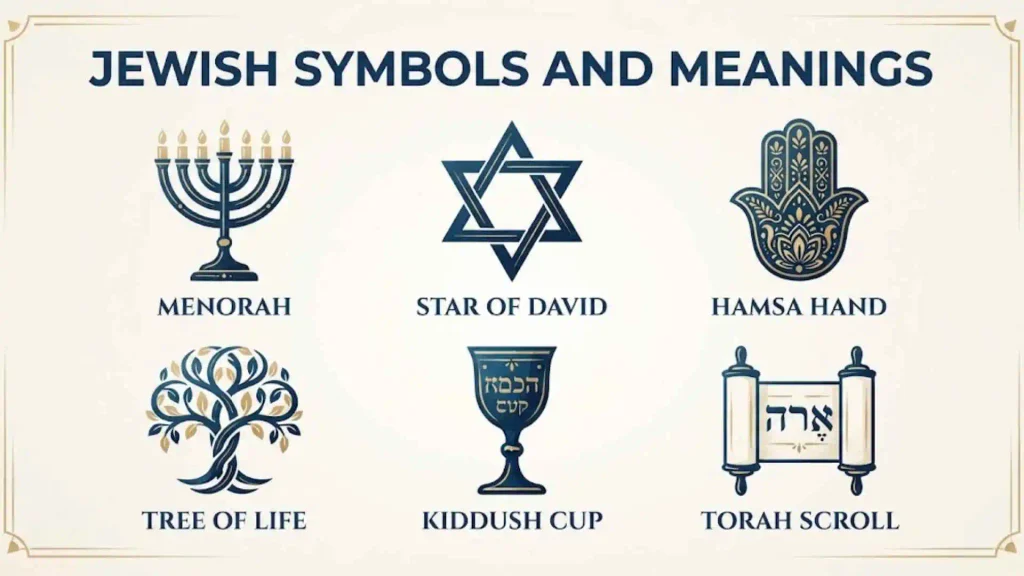
Jewish symbols cover a wide range of religious and cultural ideas. Some focus on identity, some on religious practice, and others on history or community.
A simple reference is:
- ✡ Star of David — Jewish identity
- חי Chai — life
- Menorah — Temple tradition and Jewish religious history
- Mezuzah — Jewish home and observance
- Shofar — religious practice and Jewish holidays
- Torah — scripture and learning
- Hamsa — protection in some Jewish cultural traditions
- Dreidel — Hanukkah
This variety is one reason there is no single list that can completely describe Jewish symbolism.
FAQ
What Is The Most Recognizable Jewish Symbol?
The Star of David, also called Magen David, is one of the most widely recognized symbols associated with Jewish identity.
What Does The Jewish Chai Symbol Mean?
Chai, written חי, is the Hebrew word associated with life. It is commonly used in Jewish jewelry, art, gifts, and cultural expressions.
Is The Hamsa A Jewish Symbol?
The Hamsa is used in some Jewish communities and has associations with protection, but it is not exclusively Jewish. It has a broader history across Middle Eastern and North African cultures.
Is The Menorah The Same As A Hanukkah Menorah?
No. The traditional menorah has seven branches and is associated with the ancient Temple. The Hanukkah lamp, commonly called a hanukkiah, has nine places for lights.
Can Jewish Symbols Be Copied And Pasted?
Some can. The Star of David, ✡, is a Unicode character, while Chai can be copied as the two Hebrew letters חי. Many other Jewish symbols are better represented with images because they do not have dedicated Unicode characters.
Conclusion
Jewish symbols bring together religion, history, language, community, and cultural identity. The Star of David, Chai, menorah, Torah, shofar, mezuzah, and other symbols each have their own history and should be understood according to their particular context.
For digital projects, copy-and-paste use, jewelry, educational materials, and artwork, identifying the exact symbol and its meaning is more useful than relying on appearance alone. Hebrew lettering also deserves careful checking because small differences can change the meaning.
Jewish symbolism has developed across many communities and historical periods, so there is room for considerable variety. A good reference should therefore explain both what a symbol looks like and where its meaning comes from.

Hi, I’m Sienna Brooks, and I believe that the right words can inspire, comfort, and empower people at every stage of life. For as long as I can remember, I’ve been drawn to meaningful quotes and the stories behind them. I love curating collections of inspirational, motivational, and heartfelt quotes that resonate with readers around the world.
Through my writing, I strive to help others find encouragement, whether they’re celebrating life’s happiest moments or navigating its biggest challenges. I believe that wisdom is timeless, and I’m passionate about sharing words that leave a lasting impact.
I am the author of Reflections in Words and The Journey of Inspiration, two books dedicated to exploring the beauty and power of timeless quotes.
 Rowan Sinclair Rowan Sinclair