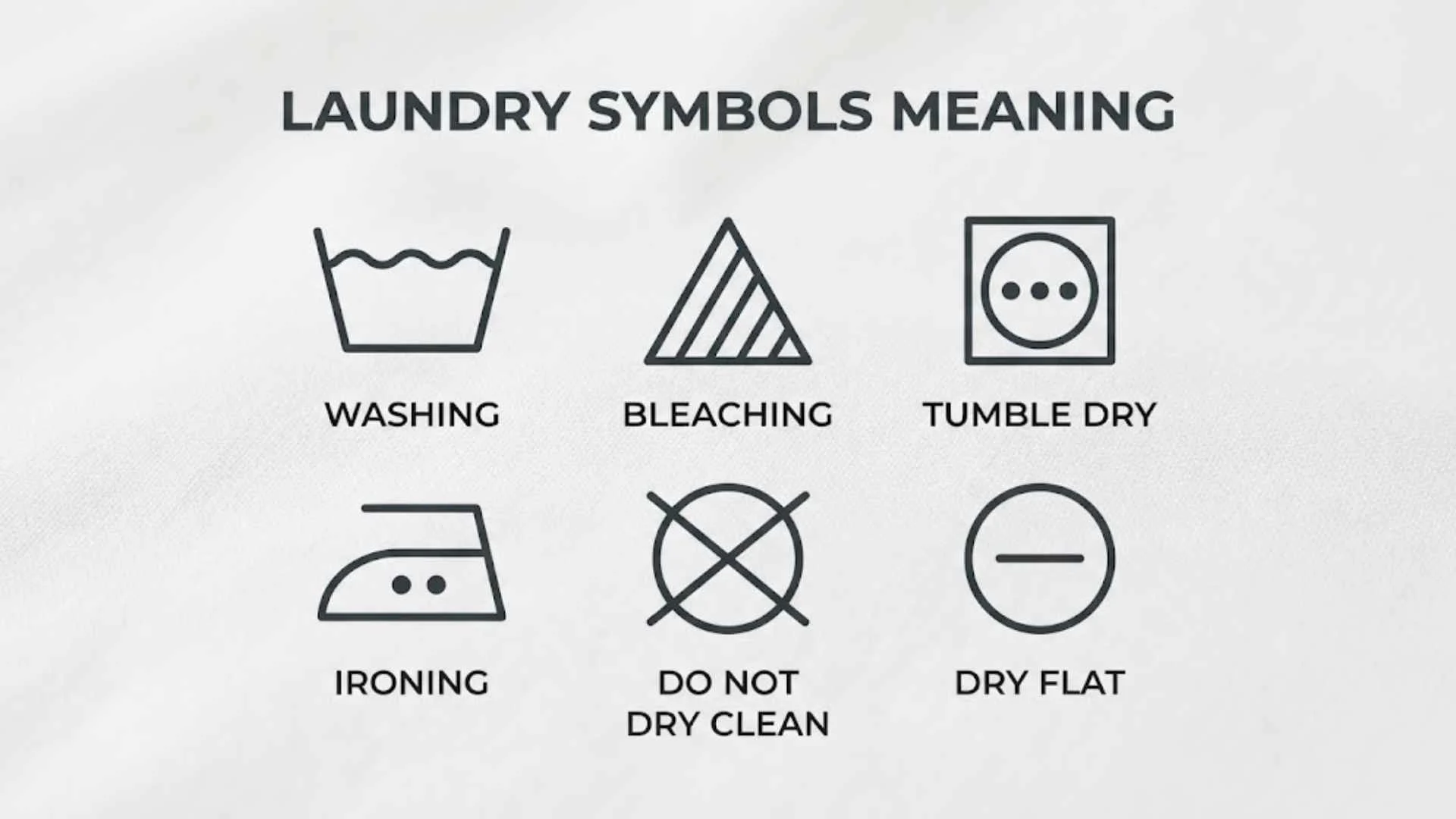
Laundry symbols can look confusing at first, but most of them follow a simple visual system. A tub usually relates to washing, a square to drying, an iron to ironing, and a circle to professional cleaning. Once you know these basic shapes, clothing care labels become much easier to understand.
This guide explains laundry symbols meaning in a practical way, including washing, drying, dry-cleaning, ironing, and clothing-care symbols. It also covers common international symbols along with European, Japanese, Korean, Chinese, UK, and brand-specific examples.
You will also find laundry symbols charts, printable information, PDF guidance, and explanations of symbols such as P in a circle and a square with a vertical line. Keep this guide handy when you need to check the correct way to wash, dry, or care for a garment.
List of laundry symbols
Laundry symbols are small pictograms found on clothing care labels. They tell you how a garment should be washed, dried, ironed, professionally cleaned, or treated with bleach.
The main laundry symbol categories are:
| Symbol shape | General meaning |
| 🛁 Tub | Washing |
| □ Square | Drying |
| ○ Circle | Professional cleaning |
| ♨ Iron shape | Ironing |
| △ Triangle | Bleaching |
The symbols may contain additional marks that change their instructions. For example, a cross through a symbol usually means that the treatment is not allowed.
Common examples include:
- Tub with 30°C — Wash at or below 30°C.
- Tub with 40°C — Wash at or below 40°C.
- Tub with a hand — Hand wash.
- Crossed-out tub — Do not wash.
- Square with a circle — Tumble dry.
- Crossed-out square with circle — Do not tumble dry.
- Iron with dots — Iron according to the indicated temperature level.
- Crossed-out iron — Do not iron.
- Triangle — Bleaching may be permitted.
- Crossed-out triangle — Do not bleach.
- Circle with P — Professional dry cleaning using the process represented by P.
- Crossed-out circle — Do not professionally dry clean.
Laundry symbols chart
A laundry symbols chart makes care labels much easier to scan.
| Symbol | Meaning |
| Tub | Machine or normal washing instructions |
| Tub + 30 | Wash at maximum 30°C |
| Tub + 40 | Wash at maximum 40°C |
| Tub + hand | Hand wash |
| Crossed-out tub | Do not wash |
| Tub with one line underneath | Reduced or mild washing process |
| Tub with two lines underneath | Very mild washing process |
| Square | Natural drying instructions |
| Square + circle | Tumble drying |
| Square + one horizontal line | Dry flat |
| Square + three vertical lines | Drip dry |
| Square + one vertical line | Line dry |
| Iron + dots | Ironing temperature |
| Crossed-out iron | Do not iron |
| Triangle | Bleaching instructions |
| Crossed-out triangle | Do not bleach |
| Circle | Professional cleaning |
| Circle + P | Professional cleaning process marked P |
| Circle + F | Professional cleaning process marked F |
| Crossed-out circle | Do not professionally dry clean |
The exact details can vary according to the number of dots, lines, and other marks. Always read the complete symbol rather than identifying it only by its basic shape.
Laundry symbols pdf
A PDF version of a laundry symbols guide can be useful if you frequently check clothing labels. You can save a care-symbol chart to your phone or print one for your laundry area.
A useful PDF should include:
- Washing symbols
- Temperature symbols
- Hand-washing symbols
- Bleaching symbols
- Drying symbols
- Tumble-drying symbols
- Ironing symbols
- Dry-cleaning symbols
- Symbols that indicate treatments are prohibited
When creating or downloading a PDF reference, make sure the symbols are large enough to identify easily. A chart that includes both the symbol and its meaning is more useful than a page containing symbols alone.
Laundry symbols meaning P in circle
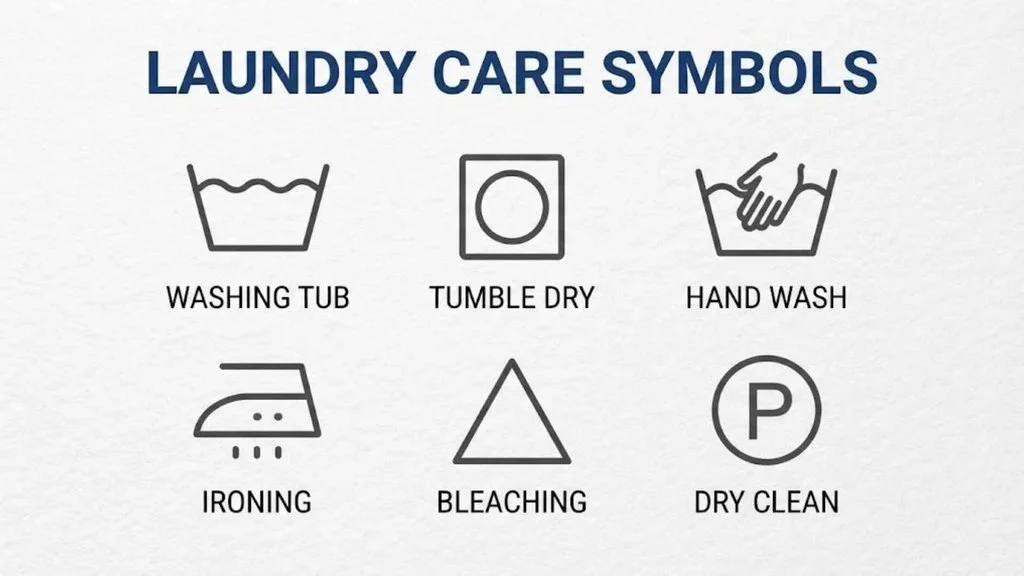
A P inside a circle is a professional dry-cleaning symbol.
○ P — Professional dry cleaning using the process represented by P
The letter is not a washing temperature. It identifies a professional cleaning process under the care-label system. A garment carrying this symbol should be taken to a professional cleaner rather than treated as an ordinary washing instruction.
A crossed-out circle has a different meaning:
⊘ — Do not professionally dry clean
The letter inside a circle should always be considered together with the circle itself and any additional markings.
Drying symbols for laundry
Drying symbols normally use a square as their basic shape. Different marks inside or around the square explain how the garment should be dried.
Common drying symbols include:
- □ — Natural drying category.
- □ with one vertical line — Line dry.
- □ with two vertical lines — Drip dry.
- □ with three vertical lines — Drip drying under the applicable care system.
- □ with one horizontal line — Dry flat.
- □ with a circle — Tumble dry.
- Crossed-out square with circle — Do not tumble dry.
Some drying symbols also use dots inside the tumble-drying circle. More dots generally indicate a higher permitted drying temperature.
Why drying symbols matter
A garment can sometimes be washed correctly but damaged during drying. Heat may shrink certain fabrics, affect elastic materials, distort knitted clothing, or damage delicate construction.
Checking the square symbol before putting clothing into a dryer can therefore prevent avoidable damage.
Drying symbols meaning
Drying symbols explain whether a garment should be tumble dried or naturally dried and, where applicable, what type of natural drying is recommended.
Tumble drying
□ with ○ means tumble drying is permitted.
Dots inside the circle indicate the permitted heat level:
- One dot — Lower temperature.
- Two dots — Higher temperature.
A crossed-out version means tumble drying is not permitted.
Natural drying
A square containing lines describes natural drying:
- Vertical line — Line drying.
- Two vertical lines — Drip drying.
- Horizontal line — Dry flat.
These instructions are particularly useful for garments that can lose their shape when hung or exposed to mechanical drying.
International laundry symbols PDF
International laundry symbols are designed to make garment-care instructions understandable across language barriers. The pictorial system is widely used on clothing labels around the world.
A practical international laundry symbols PDF should group symbols into five major areas:
- Washing
- Bleaching
- Drying
- Ironing
- Professional textile care
Temperature numbers and dots provide additional instructions, while lines beneath washing symbols can indicate gentler processes.
When using an international chart, remember that the care label attached to the garment is the final instruction for that specific item. A general chart explains the symbols, but it cannot replace the manufacturer’s complete care instructions.
European laundry symbols
European clothing labels commonly use the same basic international care-symbol system. The symbols are designed to communicate care instructions without depending on a particular language.
European laundry labels may show:
- A wash tub for washing
- A triangle for bleaching
- A square for drying
- An iron for ironing
- A circle for professional cleaning
European garments can also contain temperature numbers such as 30, 40, 60, or 95 inside the washing symbol, depending on the permitted washing temperature.
The symbols should be interpreted as a complete system. A 40°C wash symbol with a line underneath is different from a plain 40°C wash symbol because the additional line changes the process requirement.
Japanese laundry symbols meaning
Japanese clothing labels use care symbols that may look familiar to users of international laundry charts, but Japan also has its own labeling conventions and standards.
Japanese laundry symbols can indicate:
- Washing temperature
- Hand washing
- Bleaching restrictions
- Tumble drying
- Natural drying
- Ironing
- Professional cleaning
Japanese care labels may use Japanese text alongside pictograms, especially when additional instructions are needed.
For someone reading a Japanese garment label, the pictograms are often the easiest starting point. Match the symbol to an international care-symbol chart, then check any accompanying Japanese instructions for additional details.
Korean laundry symbols meaning
Korean clothing labels commonly use pictorial care instructions together with Korean text. The symbols describe washing, drying, ironing, bleaching, and professional-care requirements.
Common examples include:
- A wash tub for washing instructions
- A hand inside the tub for hand washing
- A crossed-out triangle for no bleaching
- A square with a circle for tumble drying
- An iron with dots for ironing temperature
- A circle for professional cleaning
If a Korean care label contains both symbols and written instructions, use both. The written information may provide fabric-specific warnings that are not represented by the basic symbol alone.
Clothes laundry symbols meaning
Clothes laundry symbols tell you how to care for a particular garment without requiring a long written explanation.
For example:
Tub 30°C
Wash at a maximum of 30°C.
Tub with hand
Hand wash.
Crossed-out tub
Do not wash.
Triangle crossed out
Do not bleach.
Square with circle and one dot
Tumble dry at a lower temperature.
Iron with two dots
Iron at the temperature level represented by two dots.
Circle with P
Professional cleaning using the process represented by P.
Reading all the symbols together gives you a complete care routine for the garment.
Laundry symbols meaning guide
A simple way to read laundry symbols is to identify the shape first and the additional marks second.
Step 1: Identify the main shape
Look for the basic symbol:
- Tub = washing
- Triangle = bleaching
- Square = drying
- Iron = ironing
- Circle = professional cleaning
Step 2: Check the numbers or dots
Numbers inside a wash tub indicate temperature limits. Dots on an iron or tumble-drying symbol indicate temperature levels.
Step 3: Look for lines
Lines underneath a washing symbol generally indicate a gentler process. Lines inside a natural-drying square describe the drying method.
Step 4: Check for a cross
A cross through a symbol normally means the corresponding treatment is prohibited.
Step 5: Follow the complete label
Never interpret one mark while ignoring the others. A garment may be washable but unsuitable for tumble drying, or suitable for low-temperature ironing but unsuitable for bleaching.
Laundry symbols meaning p in circle
The P in a circle is one of the symbols people most often search for because the letter can be mistaken for a temperature or washing instruction.
○ P = Professional dry cleaning process marked P
The symbol belongs to professional textile-care instructions rather than ordinary household washing.
For comparison:
- ○ P — Professional cleaning process represented by P.
- ○ F — Professional cleaning process represented by F.
- Crossed-out ○ — Do not professionally dry clean.
If you are unsure about a garment carrying a professional-cleaning symbol, show the label to a professional cleaner rather than guessing which household cleaning method is safe.
Laundry symbols meaning Japan
When searching for laundry symbols meaning Japan, it helps to distinguish between the pictograms and the language printed beside them.
Japanese garments can include care instructions relating to washing, bleaching, drying, ironing, and professional cleaning. The pictograms provide a visual reference, while Japanese text may add specific instructions.
Some Japanese labels also contain additional information about fabric composition, care precautions, or handling. Therefore, translating only one symbol may not give you the complete care instruction.
Laundry symbols meaning UK
UK clothing labels generally use the internationally recognized care-symbol system. The same basic categories apply:
- Washing
- Bleaching
- Drying
- Ironing
- Professional textile care
A UK label might show 30°C, 40°C, or another temperature in the wash tub. It may also use dots and lines to provide additional instructions.
The phrase dry clean only can appear alongside a professional-cleaning symbol, while do not dry clean corresponds to a crossed-out professional-cleaning symbol.
Printable laundry symbols meaning
A printable laundry symbols guide can be useful beside a washing machine, inside a laundry cupboard, or in a household reference folder.
For a practical printable chart, include:
| Category | Useful symbols to include |
| Washing | 30°C, 40°C, hand wash, no wash |
| Bleaching | Bleach allowed, non-chlorine bleach, no bleach |
| Drying | Tumble dry, low heat, higher heat, no tumble dry |
| Natural drying | Line dry, drip dry, dry flat |
| Ironing | Low, medium, high temperature, no ironing |
| Professional care | P, F, no professional cleaning |
A clean black-and-white layout is often easiest to print and read.
Washing laundry symbols meaning
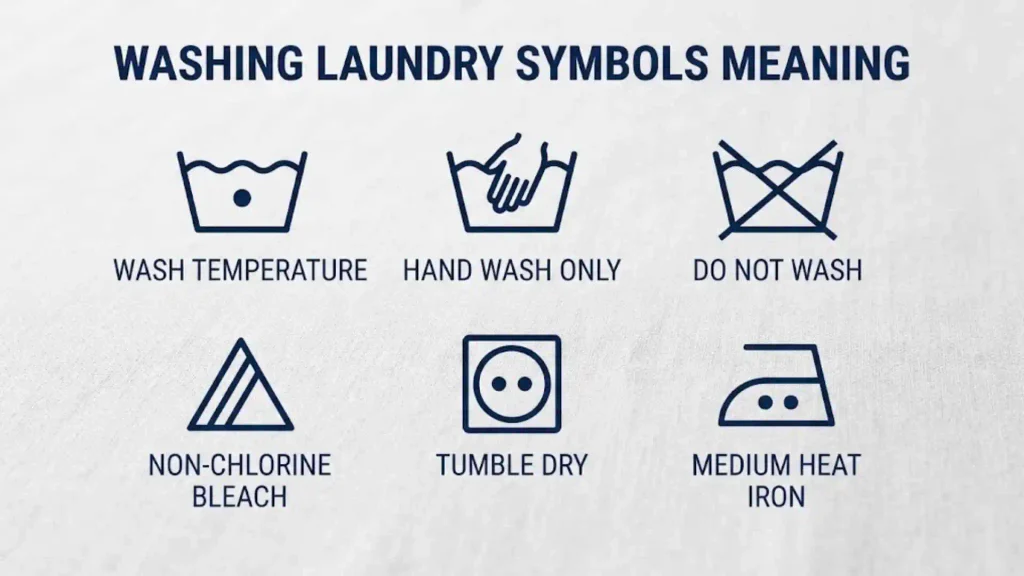
Washing symbols use the tub shape. They tell you whether the garment can be washed and, when specified, the temperature and washing intensity.
Common examples include:
- Tub with 30°C — Wash at a maximum of 30°C.
- Tub with 40°C — Wash at a maximum of 40°C.
- Tub with hand — Hand wash.
- Tub with one line underneath — Use a reduced or mild process.
- Tub with two lines underneath — Use a very mild process.
- Crossed-out tub — Do not wash.
The temperature shown on the label is a maximum rather than a requirement to use exactly that temperature.
For example, a 40°C symbol generally means the garment may be washed at up to 40°C, while a lower temperature may also be suitable if the cleaning result is adequate.
Common laundry symbols meaning
The most common symbols can be remembered by their shapes.
| Symbol | Meaning |
| 🛁 | Washing |
| 🛁 30°C | Maximum wash temperature of 30°C |
| 🛁 + hand | Hand wash |
| △ | Bleaching information |
| □ | Natural drying information |
| □ + ○ | Tumble drying |
| ♨ | Ironing |
| ○ | Professional cleaning |
| ⊘ | Treatment shown is not permitted |
Because care symbols are pictograms rather than ordinary text characters, the exact graphical appearance can differ depending on how they are displayed. The meaning comes from the complete care-label symbol.
Printable printable laundry symbols meaning
A printable laundry-symbol reference should focus on quick recognition rather than long explanations.
For example, you can organize a print-friendly reference like this:
Washing
- Tub 30°C — Maximum 30°C
- Tub 40°C — Maximum 40°C
- Hand in tub — Hand wash
- Crossed tub — Do not wash
Drying
- Square + circle — Tumble dry
- Square + circle + one dot — Lower tumble-drying temperature
- Square + circle + two dots — Higher tumble-drying temperature
- Square + horizontal line — Dry flat
- Square + vertical line — Line dry
Ironing
- One dot — Lower temperature
- Two dots — Medium temperature
- Three dots — Higher temperature
- Crossed iron — Do not iron
This format is easy to save, print, or turn into a household laundry reference sheet.
Clevercare.info laundry symbols meaning
Clevercare.info is associated with textile-care guidance that focuses on helping consumers understand garment care and make informed care choices.
When using Clevercare information, readers may encounter guidance related to:
- Washing temperature
- Drying
- Ironing
- Professional cleaning
- More careful garment care
- Reducing unnecessary washing and drying
The key idea is to combine the care label with practical garment-care habits. Following the recommended temperature and drying method can help avoid unnecessary wear.
If a care label and a general online chart appear to differ, the instructions on the garment itself should take priority for that particular item.
Laundry symbols meaning printable
A printable laundry symbols meaning sheet works best when symbols and explanations are placed next to each other.
Here is a compact reference:
| Symbol | Quick meaning |
| Tub | Wash |
| Tub + hand | Hand wash |
| Crossed tub | Do not wash |
| Triangle | Bleach information |
| Crossed triangle | Do not bleach |
| Square | Natural drying |
| Square + circle | Tumble dry |
| Crossed square + circle | Do not tumble dry |
| Iron | Iron |
| Crossed iron | Do not iron |
| Circle | Professional cleaning |
| Crossed circle | Do not professionally clean |
For printing, use a readable font and leave enough space between symbols so similar pictograms are not confused.
Laundry symbols meaning
Laundry symbols provide a visual language for garment care. Instead of writing a separate sentence for every instruction, clothing manufacturers can use a standardized set of pictograms.
The most useful way to understand them is by category:
Washing: Look for the tub.
Bleaching: Look for the triangle.
Drying: Look for the square.
Ironing: Look for the iron.
Professional cleaning: Look for the circle.
Additional marks then provide more specific instructions. Dots generally relate to temperature, lines can indicate process intensity or natural drying methods, and crosses indicate that a treatment is not permitted.
This system makes labels easier to understand across different languages and countries.
Laundry symbols meaning chart
The following chart brings the most useful symbols together in one place.
| Care area | Symbol example | Meaning |
| Washing | Tub 30°C | Wash at maximum 30°C |
| Washing | Tub 40°C | Wash at maximum 40°C |
| Washing | Tub + hand | Hand wash |
| Washing | Crossed tub | Do not wash |
| Bleaching | Triangle | Bleaching information |
| Bleaching | Crossed triangle | Do not bleach |
| Drying | Square + circle | Tumble dry |
| Drying | Square + circle + dot | Tumble dry at lower temperature |
| Drying | Square + horizontal line | Dry flat |
| Drying | Square + vertical line | Line dry |
| Ironing | Iron + one dot | Lower ironing temperature |
| Ironing | Iron + two dots | Medium ironing temperature |
| Ironing | Iron + three dots | Higher ironing temperature |
| Ironing | Crossed iron | Do not iron |
| Cleaning | Circle + P | Professional cleaning process marked P |
| Cleaning | Circle + F | Professional cleaning process marked F |
| Cleaning | Crossed circle | Do not professionally dry clean |
All laundry symbols meaning
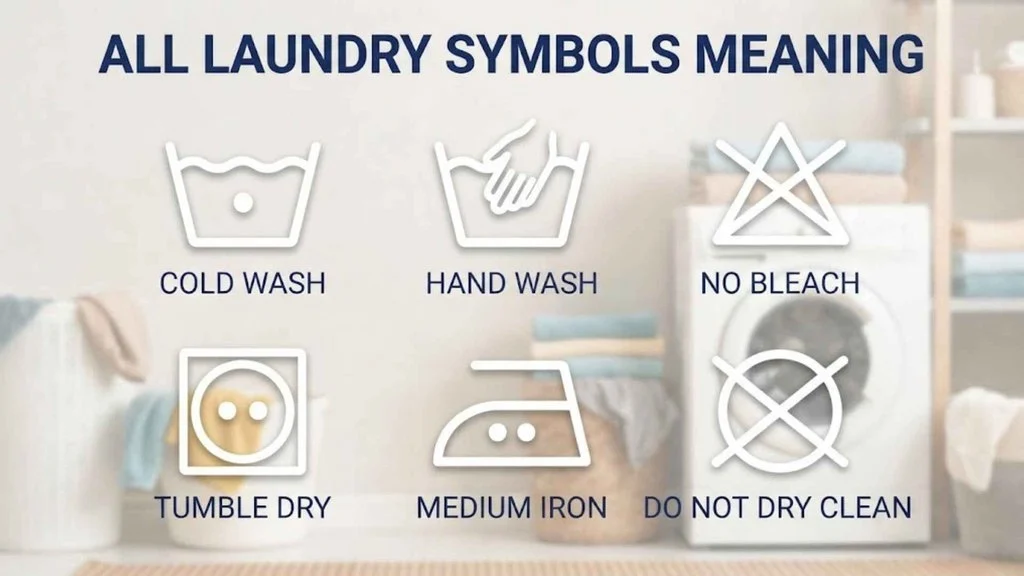
There is no single short list that explains every possible variation without showing the full care-symbol system, because many symbols are created by combining shapes, dots, numbers, lines, and crosses.
A useful complete overview includes five groups.
Washing symbols
- Tub
- Tub with temperature
- Tub with hand
- Tub with one line
- Tub with two lines
- Crossed-out tub
Bleaching symbols
- Triangle
- Triangle with specific bleaching indication where applicable
- Crossed-out triangle
Drying symbols
- Square
- Square with vertical lines
- Square with horizontal line
- Square with circle
- Square with circle and dots
- Crossed-out tumble-drying symbol
Ironing symbols
- Iron with one dot
- Iron with two dots
- Iron with three dots
- Crossed-out iron
Professional-care symbols
- Circle
- Circle with P
- Circle with F
- Other professional-care markings
- Crossed-out circle
The safest approach is to identify the symbol category first and then interpret every additional mark.
Ikea laundry symbols meaning
IKEA clothing, textile, bedding, and household fabric products can include standard care symbols on their labels. The exact instructions depend on the individual product and its materials.
Common IKEA textile-care symbols may cover:
- Machine washing
- Temperature limits
- Gentle washing
- Bleaching
- Tumble drying
- Natural drying
- Ironing
- Professional cleaning
For an IKEA product, check the physical care label or the care instructions supplied with that particular item. Product materials can differ, so the care instruction for one IKEA textile should not automatically be applied to another.
Clothing laundry symbols meaning
Clothing laundry symbols are designed to help protect garments from unsuitable washing, drying, bleaching, ironing, or professional-cleaning processes.
A simple example is a shirt labeled with:
30°C wash → low-temperature tumble dry → low-temperature iron → do not bleach
This means the garment has several separate care requirements. Washing it at the correct temperature does not automatically mean every drying or ironing method is safe.
Before laundering a new garment, check the entire label from left to right. Treat every symbol as one part of the complete care instruction.
Frequently Asked Questions
What does P in a circle mean on a laundry label?
P in a circle indicates a professional cleaning process represented by the letter P. It is a dry-cleaning care symbol, not a washing-temperature symbol.
What does a square with a circle mean in laundry symbols?
A square containing a circle indicates tumble drying. Dots inside the circle provide information about the permitted drying temperature.
What does one line under a washing symbol mean?
One line underneath a washing symbol generally indicates a reduced or gentler washing process compared with the standard process represented by the same wash temperature.
What does a crossed-out laundry symbol mean?
A cross through a care symbol generally means the treatment shown by that symbol should not be used. For example, a crossed-out iron means do not iron.
Are laundry symbols the same in every country?
The basic international care-symbol system is designed to work across languages and countries, but individual countries and manufacturers can have additional labeling requirements or written instructions. Always check the complete label.
Conclusion
Laundry symbols turn detailed garment-care instructions into a small set of easy-to-recognize pictograms. Once you remember the main shapes—tub for washing, triangle for bleaching, square for drying, iron for ironing, and circle for professional cleaning—the labels become much easier to read.
Details such as temperature numbers, dots, lines, and crosses provide the extra information needed to care for different fabrics correctly. Symbols such as P in a circle, hand washing, dry-flat instructions, and tumble-drying restrictions are especially useful when a garment needs more careful treatment.
Keep a laundry symbols chart or printable reference near your washing machine if you often forget what the symbols mean. When there is any doubt, give priority to the complete care label on the garment because it is specific to that particular textile and its construction.

Hi, I’m Asher Monroe, a writer who believes that meaningful words have the power to inspire change and bring people closer to their dreams. I have always been fascinated by the beauty of quotes and the way a simple message can provide motivation, hope, and comfort.
I enjoy creating content around inspirational quotes, life lessons, success stories, and positive thoughts that help readers find encouragement in their everyday lives. My goal is to share words that connect with people and remind them of their inner strength.
Through my writing, I explore the ideas of personal growth, confidence, and the importance of staying inspired through every chapter of life.
I am the author of Words That Move the Soul and The Path of Endless Inspiration, two books focused on the power of wisdom, positivity, and meaningful thoughts.
 Sienna Brooks
 Rowan Sinclair Rowan Sinclair