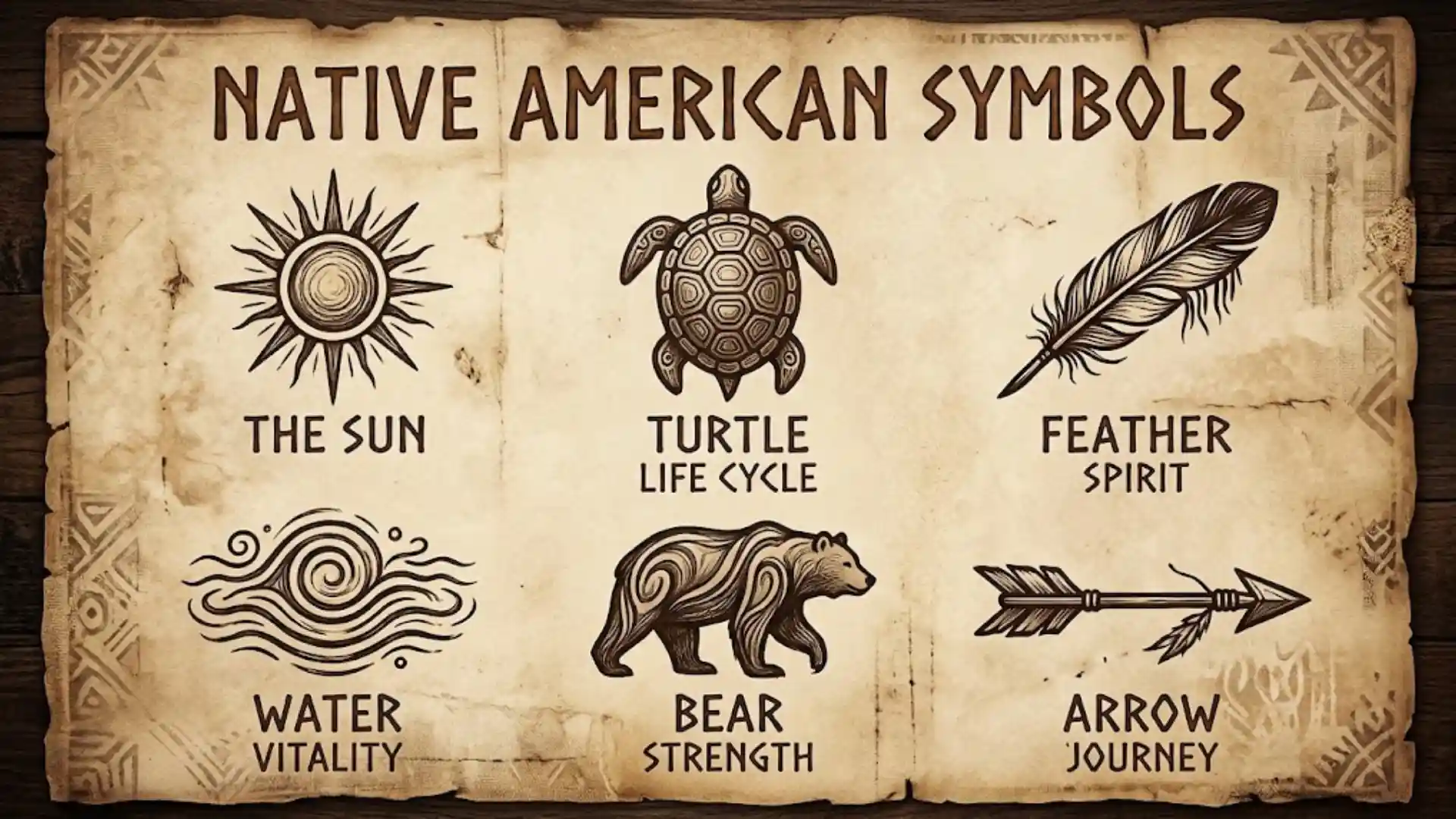
Native American symbols and meanings reflect the diverse histories, spiritual beliefs, languages, and cultural traditions of Indigenous peoples across North America. These symbols appear in petroglyphs, pictographs, beadwork, pottery, weaving, ceremonial objects, carvings, and other forms of traditional artwork. Some represent animals or natural forces. Others connect to family, community, sacred stories, ceremonies, or relationships between people and the land.
However, there is one important fact to understand: Native American symbols do not have one universal meaning. The same shape or animal may carry different meanings among the Hopi, Navajo (Diné), Lakota, Cherokee, Haida, Zuni, and other Indigenous nations. Some symbols have publicly shared explanations, while others belong to specific ceremonies or traditions and should not be interpreted without guidance from the communities that maintain them.
This guide explores well-known Native American spiritual symbols, animal symbols, nature symbols, arrow designs, rock markings, and Indigenous writing systems. It also explains how to research their meanings respectfully and avoid confusing traditions from different nations.
What Are Native American Symbols?
Native American symbols are visual signs, designs, images, and patterns created or used by Indigenous peoples. Depending on the nation and context, they can communicate ideas, preserve cultural knowledge, represent relationships, or serve practical, artistic, and ceremonial purposes.
These symbols are not simply decorative pictures. A design may connect to a family, a community, a place, a story, a spiritual practice, or an important event. Its meaning may depend on its location, colors, surrounding images, creator, and intended audience.
Indigenous nations have distinct languages, histories, and traditions. For this reason, the phrase Indigenous symbols and meanings covers many different cultural systems rather than one shared dictionary.
Why Are Native American Symbols Important?
Symbols can preserve knowledge across generations, especially when communities pass stories and teachings through oral traditions, ceremonies, and artistic practices.
They may communicate:
- Spiritual beliefs: Relationships between people, the natural world, and spiritual beings.
- Cultural identity: Connections to a particular nation, family, clan, or community.
- Nature and survival: Knowledge of animals, plants, water sources, seasons, and landscapes.
- Family and community: Relationships, responsibilities, shared histories, and belonging.
- Ceremonial practices: Designs associated with specific gatherings, objects, or traditions.
- Historical events: Memories of travel, migration, encounters, and important experiences.
- Communication: Information expressed through images, markings, and established visual conventions.
Not every symbol has a spiritual meaning. Some markings may record a practical event, identify a place, or communicate information. Researchers often need archaeological evidence and knowledge from Indigenous communities to understand what a particular image means. The National Park Service explains that many rock markings remain difficult to interpret without their cultural and historical context. Source: National Park Service
Native American Symbols and Meanings Chart
The following table introduces several widely discussed symbols and cultural forms. Treat the descriptions as starting points for research, not as universal definitions.
| Symbol or design | Commonly discussed association | Important context |
| Medicine Wheel / Sacred Hoop | Relationships, directions, cycles, and balance | Interpretations and color arrangements vary among Indigenous nations. |
| Kokopelli | A flute-playing figure associated with traditions of the Southwest | Its meaning depends on the specific cultural and artistic context. |
| Man in the Maze | A journey through life and its choices | Particularly associated with O’odham cultural art; details vary by interpretation. |
| Thunderbird | A powerful supernatural bird in several Indigenous traditions | Stories and significance differ among nations. |
| Kachina / Katsina figures | Spiritual beings and ceremonial traditions among some Pueblo peoples | Terms, roles, and practices are community-specific. |
| Eagle and eagle feathers | Important relationships with spirituality, honor, or ceremony in various traditions | Meanings and protocols vary; feathers may have specific cultural or legal significance. |
| Turtle | A significant animal in many Indigenous stories and traditions | Turtle stories are not identical across nations. |
| Arrow designs | Possible references to hunting, movement, conflict, direction, or other ideas | There is no single standardized meaning for every arrow pattern. |
| Petroglyphs | Images carved or pecked into rock | Their meanings depend on the people, location, and historical context. |
| Pictographs | Images painted onto rock | They may communicate cultural, practical, historical, or spiritual information. |
This chart cannot replace a source from the nation associated with a particular design. A symbol’s appearance alone is not enough to establish its meaning.
Native American Spiritual Symbols and Their Meanings
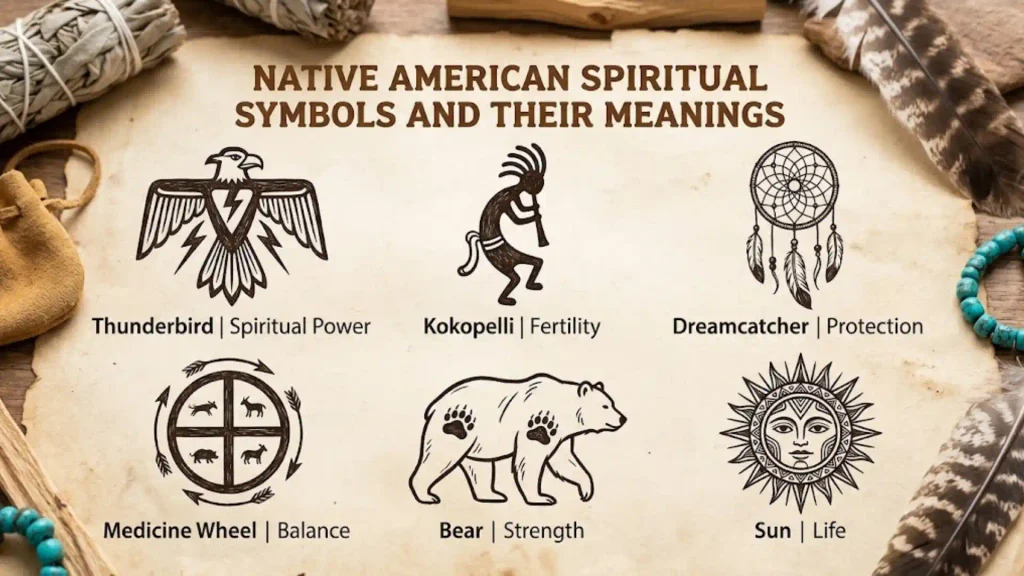
Native American spiritual symbols can represent relationships among people, ancestors, animals, the land, and spiritual forces. Some are connected to public cultural teachings, while others are used in ceremonies or shared only within a community.
The symbols below are discussed in museums, cultural resources, and educational materials. Their explanations should be connected to the relevant Indigenous tradition rather than applied to every Native American nation.
Medicine Wheel and Sacred Hoop
The Medicine Wheel, sometimes called the Sacred Hoop, is an important symbol in several Indigenous traditions. It can be represented as a circle divided into sections, sometimes with lines pointing toward the four directions.
Depending on the community, the wheel may relate to the Earth, the directions, cycles, relationships, teachings, or ceremonial practices. Some versions use four colors, but the colors and their arrangement are not the same in every tradition.
The National Park Service notes that Medicine Wheel color arrangements and interpretations vary among tribes. Some physical medicine wheels are built from stones on the landscape, while other versions appear on objects or in artwork. Source: National Park Service
Common topics associated with Medicine Wheel teachings include:
- Balance: Considering different parts of life and their relationships.
- Four Directions: Understanding directions within a particular cultural framework.
- Cycles of life: Reflecting on change, growth, and renewal.
- Community and relationships: Recognizing connections among people, the natural world, and responsibilities.
These are broad themes, not a fixed definition for every Medicine Wheel. Avoid assigning the same color, direction, animal, or life stage to every version.
Kokopelli
Kokopelli is a recognizable flute-playing figure found in some art associated with the American Southwest. The figure appears in different forms, and its stories vary by cultural context.
Kokopelli is often discussed in relation to music, fertility, conception, childbirth, and agricultural abundance. Some popular explanations also connect the figure with travel, joy, or change. However, these descriptions should not be treated as a single, universal interpretation.
The figure has appeared in regional art for many centuries. When researching Kokopelli meaning, look for sources that explain the specific tradition, image, and community being discussed rather than relying only on generalized symbol lists.
Kachina Dolls and Katsina Figures
Kachina dolls are often associated with Hopi art, although the word kachina is frequently used in English for figures connected to broader Pueblo cultural traditions. The Hopi term katsina refers to spiritual beings within Hopi beliefs, and carved figures can represent those beings.
These figures are not simply generic good-luck charms or decorations. In relevant communities, katsinam are connected to relationships, ceremonial life, teaching, and cultural knowledge. The meanings of individual figures depend on the specific being, tradition, and context.
When researching a Kachina Doll, distinguish a carved figure made for educational or artistic purposes from ceremonial practices and objects. Do not assume that all Pueblo communities use the same names, figures, or traditions.
Man in the Maze
The Man in the Maze, also called the O’odham maze design, is especially associated with the Tohono O’odham and related O’odham traditions.
The design shows a human figure in relation to a winding maze. One interpretation describes the maze as a journey through life, with turns representing choices and experiences. The center can be connected with a person’s goals or the end of life’s journey, depending on the explanation.
An educational resource from We R Native shares a Tohono O’odham explanation of the figure known as I’itoi or Se:he and describes the maze as representing life’s twists and turns. Source: We R Native
The design appears on O’odham basketry and other cultural objects. It is a useful example of why identifying the nation matters: a design with a well-established connection to one people should not automatically be described as a universal Native American symbol.
Thunderbird
The Thunderbird appears in stories and visual traditions among several Indigenous nations. It is often portrayed as a powerful bird associated with thunder, storms, or supernatural power, but its role differs across cultures.
A Thunderbird design may appear on carved objects, artwork, textiles, or other forms of cultural expression. The meaning of a particular image depends on its source and community.
Do not assume that every large bird design represents a Thunderbird. Nor should stories from one nation be presented as the beliefs of all Indigenous peoples.
Cosmic Cross and Cross in the Circle
The terms Cosmic Cross and Cross in the Circle appear in some modern discussions of Indigenous and ancient symbols. A circle divided by crossing lines can suggest directions, divisions, or relationships, but the shape alone does not establish a specific tribal meaning.
If a design is described as a Native American sacred symbol, research its documented name, origin, and use. Do not label every circle-and-cross design as a Medicine Wheel, because that may confuse distinct traditions and objects.
Other Spiritual and Mythical Figures
Searches for Native American mythical symbols may also return names such as Komokwa, Sisiutl, Sea Serpent, Bukwus, Tsonoqua, Tsonokwa, Dzunuk’wa, Mouse Woman, Kugaan Jaad, Knife Wing, Yei, Yei Bi Chei, Rainbow Man, Shaman Eye, and Wild Man or Woman of the Woods.
These names do not belong to one shared mythology. Some are associated with specific Northwest Coast nations; others relate to distinct traditions in the Southwest or elsewhere. Spellings can also vary because names are written in English from Indigenous languages.
For example, Sisiutl is associated with Northwest Coast Indigenous traditions, including Kwakwaka’wakw cultural contexts. Yei and Yei Bi Chei are terms associated with Diné (Navajo) traditions. They should not be grouped together as interchangeable figures.
For every named figure, a reliable explanation should identify:
- The specific Indigenous nation or community.
- The original or locally preferred name, when available.
- The story, object, or ceremony in which the figure appears.
- Whether the information is publicly shared.
- The limits of what outsiders can accurately interpret.
Native American Animal Symbols and Meanings
Animals appear in Indigenous stories, artwork, and cultural practices across North America. They may be connected to teachings, family histories, particular places, hunting, survival, or spiritual relationships.
However, there is no single Native American animal symbols and meanings chart that applies to every nation. The same animal can have different roles in different stories. Some meanings are well documented, while others may be modern interpretations or commercial descriptions.
The following sections explain common research topics without claiming that every animal has one fixed meaning.
Eagle and Eagle Feathers
The eagle is an important animal in many Indigenous traditions. Depending on the nation and context, eagles and their feathers may be connected to spirituality, honor, responsibility, or ceremony.
Eagle feathers are not simply decorative objects in many communities. They can have cultural significance, and their use may be governed by community protocols and applicable laws.
When researching Native American eagle symbols, check which nation’s traditions are being discussed. Avoid assuming that the eagle always means leadership, freedom, strength, or wisdom in every context.
Bear and Bear Tracks
The bear appears in many Indigenous stories and cultural traditions. It may be connected with particular teachings, family or clan identities, healing traditions, or relationships with the natural world.
Searches for Native American bear symbols and bear tracks often produce simplified meanings such as courage, protection, or strength. Those associations may be appropriate in some contexts, but they are not a universal dictionary definition.
A bear track carved into an object or painted on a surface should be interpreted using evidence about the object’s creator, location, and tradition.
Wolf
The wolf features in stories among several Indigenous nations. Its role varies: in one tradition it may be a relative, helper, teacher, or powerful character, while another community may tell very different stories.
Modern websites often assign the wolf a single meaning, such as loyalty or family. Those associations should not automatically be presented as traditional beliefs shared by all Native American peoples.
Raven
Raven has important roles in some Northwest Coast traditions. In certain stories, Raven is associated with creation, transformation, cleverness, or the bringing of important things into the world. Details vary among nations and stories.
A Raven design on a Northwest Coast object may also be connected to a particular artist, family, or cultural history. It is best to identify the specific nation and source rather than assigning a generic meaning.
Turtle
The turtle appears in important stories across multiple Indigenous traditions. Some communities connect turtles with creation narratives, land, or the structure of the world. Other traditions tell different stories.
The term Turtle Island is used by some Indigenous peoples to refer to North America or the world in particular creation traditions, but it is not a term used in precisely the same way by every nation.
For this reason, Native American turtle symbols should be discussed through specific stories and community sources rather than a universal claim that the turtle always represents longevity or wisdom.
Buffalo or Bison
The buffalo, more precisely called the American bison in zoological contexts, has deep historical, practical, and cultural significance for many Plains peoples.
Bison provided food, materials, and other resources, and their importance is reflected in cultural knowledge, community histories, and traditional practices. Some designs may relate to bison or buffalo, but the meaning of a particular image still depends on its origin and context.
A general claim that the buffalo always represents abundance, prosperity, or strength may overlook more specific relationships and histories.
Other Native American Animal Symbols
The following animals and designs also appear in searches for Native American animal symbols and meanings. Their meanings should be verified within the relevant nation’s traditions.
| Animal or motif | What to research |
| Coyote | Trickster stories, creation narratives, and teachings in specific traditions |
| Owl | Different stories, beliefs, and roles across Indigenous nations |
| Hummingbird | Regional stories, artistic designs, and relationships with the natural world |
| Butterfly | Local stories, artwork, and community-specific interpretations |
| Frog | Water, seasonal changes, stories, and designs in particular traditions |
| Dragonfly | Regional imagery and the cultural context of the artwork |
| Snake or Winged Snake | Specific mythological beings and their roles in a particular tradition |
| Spider or Spider Web | Stories, weaving traditions, and named cultural figures |
| Deer and Deer Tracks | Hunting, landscapes, stories, and particular visual motifs |
| Beaver | Stories, resource knowledge, and regional cultural practices |
| Salmon | Especially relevant to some Pacific Northwest peoples and their relationships with salmon |
| Orca or Killer Whale | Northwest Coast stories, family histories, and specific artistic traditions |
| Loon, Sea Otter, Sculpin, and Dogfish | Regional animal imagery and the cultural source of the design |
| Shark Woman | The specific story or cultural context in which the figure appears |
| Badger Tracks and Eagle Feather | The source, purpose, and tradition connected to the motif |
A list like this can help readers find the right topic, but it should not be used to manufacture meanings when credible sources do not support them.
Native American Nature Symbols and Their Meanings
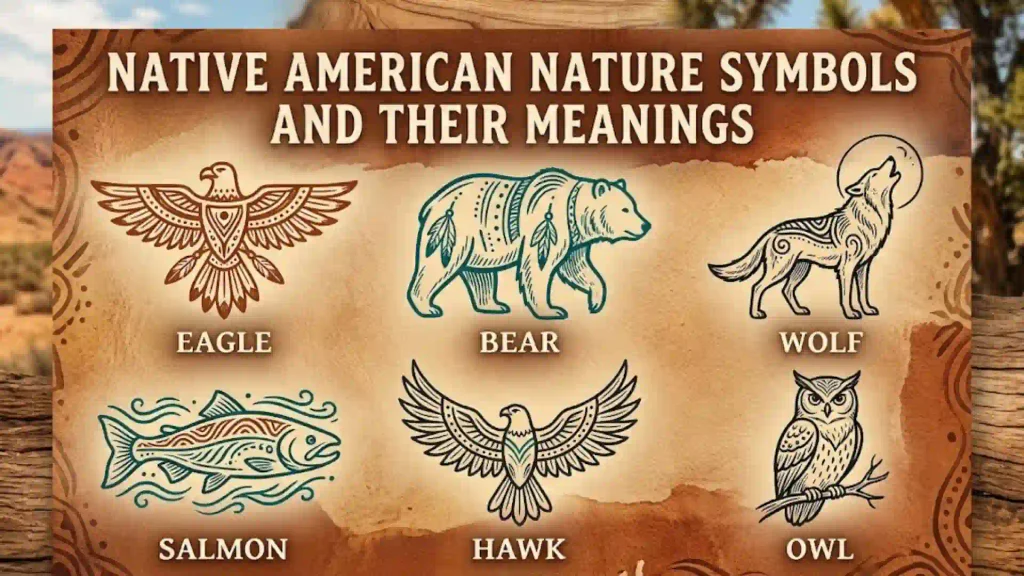
The natural world is central to many Indigenous knowledge systems. Plants, animals, rivers, mountains, stars, and seasonal changes can hold practical, historical, and spiritual significance.
Still, a Native American nature symbol should be understood within the cultural context where it appears. The sun, moon, water, and stars do not have one identical meaning across all Indigenous nations.
Sun Symbol
The sun is important in many Indigenous stories, calendars, ceremonies, and artistic traditions. It can be connected to daylight, warmth, seasonal cycles, or particular spiritual teachings.
Some designs represent the sun as a circle, sometimes with rays or other geometric details. But a circular image with rays is not enough by itself to identify a specific nation or meaning.
For accurate research, look for the name of the object, the community that made it, and any documented explanation from the artist or cultural source.
Moon and Morning Star
The moon and Morning Star appear in some Indigenous stories, artworks, and systems of observing the sky. Celestial observations could help communities understand seasons, time, and changes in the natural world.
The Morning Star symbol can have a particular meaning in a specific nation’s visual tradition. For example, the National Park Service describes the Morning Star in Blackfeet lodge painting, where celestial imagery formed part of a larger design connected with the night sky. Source: National Park Service
This example illustrates why it is better to identify a cultural source than to assume all star symbols mean hope, guidance, or new beginnings.
Rain Cloud and Water Symbols
Rain clouds, water symbols, waves, and rivers can relate to environmental knowledge, survival, seasonal changes, or spiritual traditions.
In dry regions, rainfall and water sources are especially important to life. Some Southwestern visual traditions include cloud or rain-related motifs, but the details and meanings differ among communities.
A design described online as a Native American rain symbol may have a more specific name and context. Before assigning a meaning, check whether the source identifies the community, the object, and the tradition.
Corn, Cactus Flower, and Plant Symbols
Plants such as corn have important roles in the food systems, stories, and ceremonial lives of several Indigenous peoples. Corn is especially significant in many Pueblo traditions, although the details differ from one community to another.
The cactus flower and other regional plants may appear in pottery, basketry, textiles, and other artwork. Their importance can reflect local environments, practical knowledge, or community-specific stories.
Avoid assuming that every plant motif represents fertility, abundance, or renewal. Those may be modern interpretations or may apply only to a particular context.
Fire, Air, Earth, and the Cycles of Nature
Searches for Native American earth symbols, fire symbols, air symbols, seasons, sunrise, sunset, and stars often produce generalized lists of meanings.
These topics are worth exploring, but the natural elements should not be presented as a standardized four-part belief system shared by every Indigenous nation.
Some traditions use particular directions, elements, colors, animals, or seasonal teachings together. Others organize knowledge differently. The most accurate approach is to explain the specific system and its cultural source.
Native American Arrow Symbols and Meanings
Arrow designs appear in a variety of Indigenous artworks and objects. They may relate to hunting, movement, direction, conflict, or other ideas, depending on the object and its cultural context.
There is no universal code that assigns one fixed meaning to every arrow shape.
Single Arrow and Arrowhead
A single arrow or arrowhead can appear in artwork, artifacts, and designs. An actual arrowhead is also a tool-related object, so it should not automatically be interpreted as a spiritual symbol.
If an arrow appears as part of a documented design, research the object and the community that created it. Do not assume that every arrowhead symbolizes protection or warrior strength.
Crossed Arrows
Crossed arrows are often assigned meanings such as friendship, alliance, or peace on popular symbol websites. However, such claims need a reliable source tied to the design’s cultural origin.
A crossed-arrow design may have different meanings depending on the object, time period, or community. If a source does not identify the tradition, describe the meaning as unverified rather than stating it as fact.
Broken Arrow
A broken arrow is sometimes described in modern lists as a symbol of peace or the end of conflict. That meaning should not be attributed to all Native American traditions without evidence.
If the phrase appears in a historical account, artwork description, or particular cultural story, use that context to explain it. A modern interpretation is not automatically a traditional one.
Four or Five Arrows
Searches for four arrows, a bundle of five arrows, and arrows pointing in different directions may return claims about unity, protection, strength, or the four directions.
These interpretations should be checked individually. A particular bundle or directional design may have a documented meaning in one tradition, but the number of arrows alone does not prove it.
Four Directions in Native American Traditions
The Four Directions are important in some Indigenous teachings and ceremonies. They may be represented by directions on a compass, colors, animals, seasons, or other elements. The combinations differ among nations and traditions.
In some contexts, the directions are part of a Medicine Wheel or Sacred Hoop. However, it is inaccurate to assume that every Indigenous community uses the same colors or assigns the same animal to each direction.
A useful way to research the Four Directions is to ask:
- Which nation or community teaches this particular system?
- What directions and colors are used in that tradition?
- Are animals or seasons connected to the directions?
- Is the explanation intended for public education, or is it part of a restricted practice?
These questions help prevent a general guide from mixing unrelated traditions into one invented system.
Native American Art, Petroglyphs, and Pictographs
Indigenous visual traditions include rock markings, pottery, basketry, beadwork, textiles, carvings, paintings, and many other art forms. Their designs can express cultural identity, record events, convey knowledge, or serve practical and ceremonial purposes.
What Are Petroglyphs?
Petroglyphs are images made by carving, pecking, or otherwise marking a rock surface. The process can expose lighter rock beneath a darker surface coating, creating a visible image.
Petroglyphs may show animals, people, abstract shapes, spirals, lines, or other motifs. They can be found at sites across North America, and some remain connected to living cultural traditions.
The National Park Service notes that petroglyphs may have been used to communicate stories, mark routes, record events, or convey other information. Their precise meanings often depend on location and cultural knowledge. Source: National Park Service
What Are Pictographs?
Pictographs are images painted onto rock surfaces rather than carved into them. Their pigments could be made from natural materials, depending on the place and period.
Pictographs can depict recognizable figures or abstract designs. Some may relate to stories, ceremonial practices, important events, or observations of the landscape.
The terms are not interchangeable:
| Term | How it is made |
| Petroglyph | Carved, pecked, chipped, or ground into a rock surface |
| Pictograph | Painted onto a rock surface |
| Inscription | Writing, lettering, numbers, or other marks added to a surface |
Not every image can be confidently interpreted today. Descendant communities may preserve knowledge about a site, while other meanings remain uncertain. The National Park Service advises visitors to treat these places with respect, as they may be culturally significant or sacred. Source: National Park Service
Spirals, Circles, and Other Rock Markings
Spirals, circles, lines, and other geometric designs appear in rock markings across different regions. Their visual similarity does not mean they share one meaning.
At Chaco Canyon, for example, a Hopi interpretation described by the National Park Service connects a spiral with migration. Other spiral designs may have different meanings or may remain uncertain. Source: National Park Service
A spiral might relate to a story, a place, a journey, a celestial event, or another idea. Researchers should consider the location, surrounding images, archaeological evidence, and knowledge from descendant communities before suggesting an interpretation.
Totem Poles and Northwest Coast Art
Totem poles are monumental carved works associated with particular Indigenous nations of the Northwest Coast. They can communicate family histories, inherited rights, stories, names, or other important relationships.
They are not a universal symbol system shared by all Native American peoples. Nor are they simply generic decorations featuring animal symbols.
The figures on a pole should be interpreted in relation to the nation, family, artist, and purpose of that work. The same animal may have a specific significance within a family’s history that cannot be understood from the image alone.
Other important forms of traditional artwork include:
- Basketry: Functional and artistic weaving traditions with region-specific materials and patterns.
- Pottery: Vessels and designs reflecting local materials, techniques, and cultural practices.
- Beadwork: Designs that can carry personal, family, community, or artistic significance.
- Textiles and weaving: Patterns shaped by regional techniques and cultural knowledge.
- Carving: Works made from wood, stone, and other materials.
- Ceremonial objects: Items whose meanings may be specific to a community or practice.
Native American Symbols in Writing and Language
Not every Indigenous symbol is a religious or spiritual symbol. Indigenous peoples also developed writing systems and used visual markings for communication, recordkeeping, and artistic expression.
It is important to distinguish a writing system from a picture or motif. A writing system follows conventions for representing language. A symbol in a piece of artwork may communicate an idea without functioning as written language.
Cherokee Syllabary
The Cherokee syllabary was developed by Sequoyah in the early nineteenth century. It uses distinct characters to represent syllables in the Cherokee language.
Although people sometimes refer to the characters as the Cherokee alphabet, syllabary is the more precise term. Most characters represent syllables rather than single sounds in the same way letters do in the English alphabet.
The syllabary is a major example of Indigenous innovation in writing. It should not be confused with a collection of decorative symbols or a universal Native American alphabet.
Cree Syllabics and Other Indigenous Writing Systems
Cree syllabics are used to write Cree and are part of a broader family of Indigenous writing practices in Canada. Other Indigenous languages have their own writing conventions, orthographies, or adaptations of the Latin alphabet.
These systems are not all interchangeable. A character used for one language may not represent the same sound or meaning in another.
When researching the Native American alphabet, it is better to identify the specific language and writing system. The term “Native American alphabet” can misleadingly suggest that all Indigenous languages share one set of characters.
Petroglyphs Versus Writing Systems
Petroglyphs and pictographs can communicate information, but they are not automatically writing systems. A rock marking may depict an animal, represent a particular event, mark a location, or serve another purpose without functioning like a sentence.
To determine whether an image is part of a writing system, researchers need evidence of how the community used it. Visual similarity to a letter or familiar symbol is not enough.
How Native American Symbols Differ Between Tribes
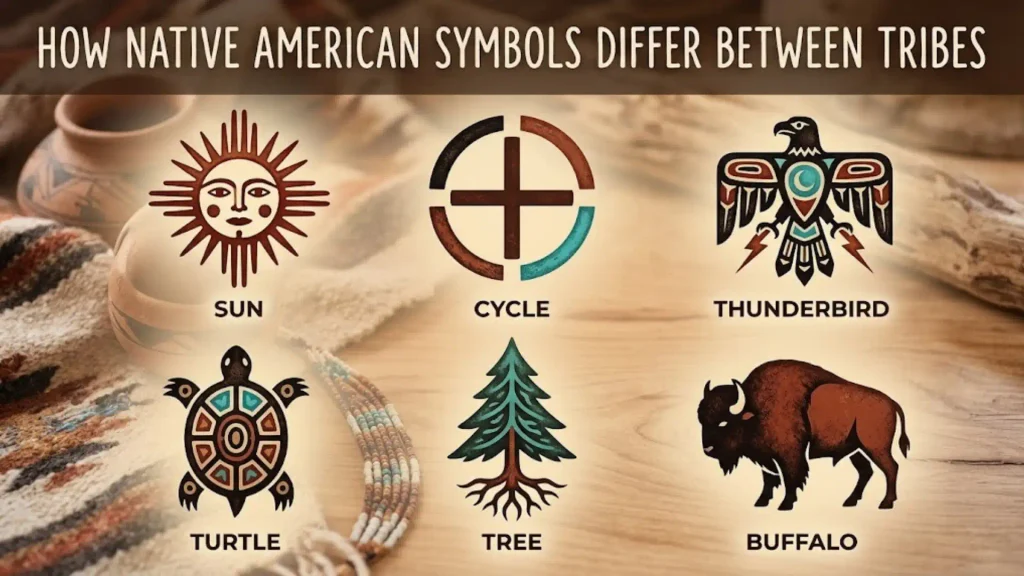
One of the most important parts of researching Native American symbols and meanings is understanding cultural diversity. Indigenous peoples across North America have their own languages, governments, histories, artistic practices, and spiritual traditions.
A symbol associated with one nation may have a different meaning in another. Some designs are shared among related communities, while others are specific to a family, place, or ceremonial tradition.
Plains Nations
Plains nations include peoples such as the Lakota, Dakota, Nakota, Blackfeet, and others. Their histories include distinct artistic practices, relationships with the land, and traditions connected to animals, community life, and ceremonies.
For example, painted lodges and other historical artworks may include animals, celestial bodies, and designs connected to particular families or cultural practices. The meaning of an image depends on the specific nation and its history.
Pueblo Peoples of the Southwest
Pueblo communities include the Hopi, Zuni, and other distinct nations in the Southwest. Their traditions include pottery, weaving, ceremonial practices, and artwork connected to their histories and environments.
Katsina traditions are especially important in Hopi cultural life, while other Pueblo communities have their own distinct practices and terminology. It is inaccurate to describe all Pueblo beliefs as identical.
Northwest Coast Nations
Northwest Coast Indigenous nations include the Haida and Kwakwaka’wakw, among others. Their visual traditions include carving, weaving, painted designs, and monumental works such as totem poles.
Animals and supernatural figures can have specific connections to family histories, inherited rights, and cultural stories. These designs should be interpreted through the relevant community rather than a generic list of animal meanings.
Eastern Woodlands and Other Regions
Indigenous nations in the Eastern Woodlands and other regions have their own artistic traditions, languages, and histories. The Cherokee, Ojibwe, Haudenosaunee (Iroquois Confederacy), and many other nations should not be treated as one cultural group.
Terms such as First Nations, Inuit, and Maya also refer to distinct peoples and cultural contexts. They are not interchangeable with one another or with the broad phrase “Native American.”
The most reliable way to understand a symbol is to identify the people who created or use it and consult sources that represent their knowledge.
Native American Symbols for Tattoos and Modern Designs
Many people search for Native American symbols for tattoos, including designs associated online with strength, healing, protection, wisdom, peace, family, or spiritual guidance.
Before choosing a design, it is important to learn whether it belongs to a specific Indigenous tradition and whether its use is appropriate outside that context.
Consider these guidelines:
- Research the origin: Identify the nation or community associated with the design.
- Verify the meaning: Use sources from Indigenous communities, cultural institutions, or knowledgeable artists.
- Avoid sacred or restricted imagery: Some designs or ceremonial objects are not intended for unrestricted public use.
- Do not combine unrelated symbols casually: A Medicine Wheel, a Northwest Coast figure, and a Southwestern design do not automatically form one traditional system.
- Ask the artist about the source: If a tattoo artist advertises a design as an authentic Indigenous symbol, ask what documentation supports that claim.
- Consider contemporary Indigenous artists: Their work can offer a more informed way to learn about living traditions and cultural identity.
A design may look attractive without having the meaning a website assigns to it. If the source cannot explain its origin, avoid presenting it as an authentic traditional symbol.
How to Research Native American Symbols Accurately
Online symbol lists often give a short meaning to every animal, shape, or color. These lists can be useful for discovering terms, but they can also mix different cultures or repeat unsupported claims.
Use the following process when researching a symbol for an article, educational project, or personal interest.
- Identify the exact symbol. Record its name, spelling variations, appearance, and the object or artwork where it appears.
- Find the cultural origin. Determine which Indigenous nation, community, artist, or region is connected to it.
- Look for a primary or authoritative source. Prefer tribal cultural offices, Indigenous-led educational resources, museums with documented collections, and the National Park Service.
- Check more than one source. Compare the explanations and note where meanings differ or remain uncertain.
- Separate traditional knowledge from modern interpretation. If a meaning comes from a contemporary tattoo website rather than a cultural source, label it accordingly.
- Respect cultural boundaries. Do not assume every sacred story or ceremonial meaning is intended for public sharing.
For further reading, start with these reliable resources:
- National Park Service: Petroglyphs and Pictographs — explains rock markings, their contexts, and their preservation.
- National Park Service: The Medicine Wheel — discusses the Medicine Wheel and differences in tribal practices.
- We R Native: Man in the Maze — shares a Tohono O’odham explanation of the maze design.
- Smithsonian National Museum of the American Indian — provides educational material and collection records for Indigenous objects and cultures.
Frequently Asked Questions About Native American Symbols
What are the most common Native American symbols?
Frequently discussed examples include the Medicine Wheel, Kokopelli, Thunderbird, eagle imagery, Man in the Maze, arrow designs, and animal figures. However, what counts as “common” depends on the region, cultural tradition, and type of artwork being discussed.
What is the meaning of the Native American Medicine Wheel?
The Medicine Wheel or Sacred Hoop has important meanings in several Indigenous traditions. It may relate to the Earth, directions, cycles, relationships, or ceremonial practices. The colors and interpretations vary among nations, so there is no single definition that covers every Medicine Wheel.
Which Native American symbols represent protection or strength?
Some Indigenous designs and stories may relate to protection, strength, or spiritual power, but those meanings depend on the tradition. Avoid claiming that a particular animal or arrow design universally represents protection without a reliable cultural source.
What is the difference between a petroglyph and a pictograph?
A petroglyph is carved or pecked into rock, while a pictograph is painted onto a rock surface. Both may communicate information or have cultural significance, but their meanings depend on the people who created them and the context in which they appear.
Do all Native American tribes use the same symbols?
No. Indigenous nations have distinct histories, languages, artistic traditions, and spiritual practices. Some symbols or themes may appear across different communities, but their meanings and uses can vary significantly.
Are Native American symbols appropriate for tattoos?
Some designs are part of publicly shared artistic traditions, while others may be sacred, restricted, or closely connected to particular communities. Research the design’s origin and seek guidance from appropriate cultural sources before using it as a tattoo.
What is the Native American symbol for life?
There is no single symbol for life used by every Indigenous nation. Some symbols, including particular Medicine Wheel designs, may be connected to cycles or relationships within specific traditions. The meaning should be verified in its cultural context.
Is there a universal Native American alphabet?
No. Indigenous languages have different writing systems and conventions. The Cherokee syllabary and Cree syllabics are examples of distinct systems, not parts of one universal Native American alphabet.
Conclusion
Native American symbols and meanings offer an important way to explore Indigenous histories, artistic traditions, languages, relationships with nature, and spiritual knowledge. Medicine Wheels, animal figures, Kokopelli, the Man in the Maze, petroglyphs, pictographs, and traditional carvings all provide opportunities to learn about particular communities and their cultural heritage.
The key is to look beyond a symbol’s appearance. Identify its origin, consult reliable sources, and recognize that meanings may differ among Indigenous nations. Some designs have publicly documented explanations, while others belong to living traditions that deserve careful treatment.
A respectful guide does more than list symbols and assign simple meanings. It helps readers understand who uses a symbol, what context gives it meaning, and why that cultural knowledge matters.

Hi, I’m Sienna Brooks, and I believe that the right words can inspire, comfort, and empower people at every stage of life. For as long as I can remember, I’ve been drawn to meaningful quotes and the stories behind them. I love curating collections of inspirational, motivational, and heartfelt quotes that resonate with readers around the world.
Through my writing, I strive to help others find encouragement, whether they’re celebrating life’s happiest moments or navigating its biggest challenges. I believe that wisdom is timeless, and I’m passionate about sharing words that leave a lasting impact.
I am the author of Reflections in Words and The Journey of Inspiration, two books dedicated to exploring the beauty and power of timeless quotes.
 Asher Monroe
 Rowan Sinclair Rowan Sinclair