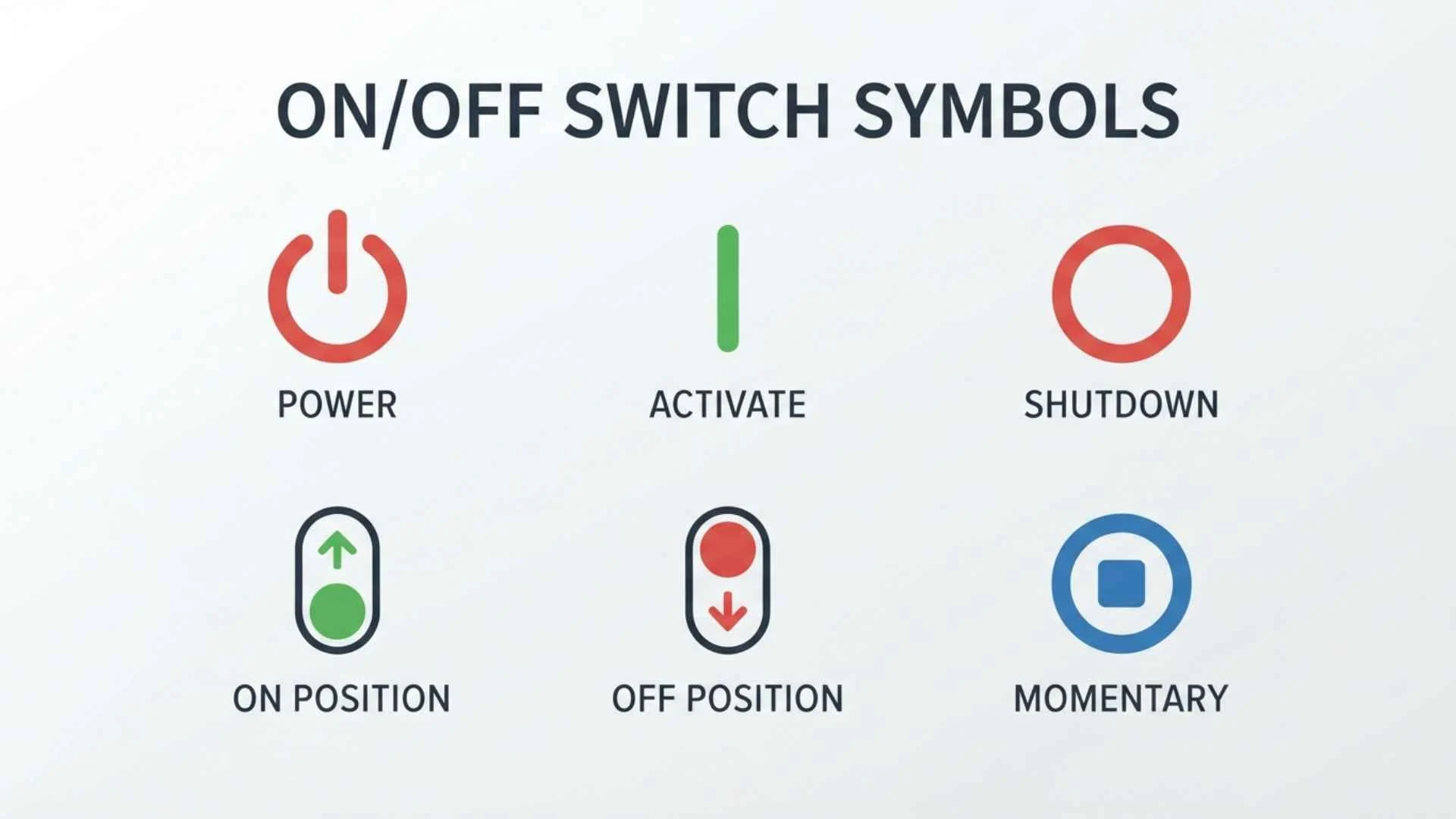
If you have ever looked at a switch and wondered whether the line or circle means ON, you are not alone. Many electrical and electronic devices use symbols instead of the words “ON” and “OFF.”
The most common on/off switch symbols are I and O. In general, I means ON and O means OFF. The familiar ⏻ power symbol indicates a power control, but it does not always mean that a device is completely disconnected from electricity.
These symbols can be found on rocker switches, power strips, computers, monitors, appliances, power supplies, and many other devices.
Quick Answer: What Do On/Off Switch Symbols Mean?
The simplest way to remember the most common switch markings is:
| Symbol | Meaning | Common use |
| I | ON | Physical power switches |
| O | OFF | Physical power switches |
| I/O | ON/OFF | Rocker switches |
| ⏻ | Power control | Computers and electronics |
| ⏽ | ON | Electronic controls |
| ⭘ | OFF | Some interfaces and controls |
Remember: I = ON and O = OFF.
The I represents the on state, while O represents the off state. A ⏻ symbol is a power-control marking and may be used to turn a device on, turn it off, or control a standby state depending on the equipment.
What Does I Mean on a Switch?
The I symbol, which looks like a vertical line, generally means ON.
It is commonly printed on physical electrical switches and represents the active or powered state.
You may see the I symbol on:
- Power strips
- Extension cords
- Computer power supplies
- Household appliances
- Audio equipment
- Industrial equipment
- Electronic devices
- Rocker switches
When a rocker switch has I on one side, pressing that side generally places the switch in its ON position.
Why Does I Mean ON?
The convention is closely related to the binary concept of 1 and 0.
In a simple two-state system:
- 1 = ON
- 0 = OFF
The vertical line or I is therefore associated with the active state, while the circle or O is associated with the inactive state.
What Does O Mean on a Switch?
The O symbol, which looks like a circle, generally means OFF.
It is commonly found beside an I on two-position electrical switches.
For example:
I | O
means:
I = ON
O = OFF
The O is associated with zero, representing the inactive state in a simple binary system.
Does the Circle Mean ON or OFF?
On a standard two-position power switch, the circle means OFF.
If you are looking at a switch marked with a line and a circle, the easiest rule to remember is:
Line (I) = ON
Circle (O) = OFF
The physical orientation of the switch can vary, so do not assume that “up” or “down” is always ON. Look at the actual marking on the switch.
What Does I/O Mean on a Switch?
When I/O appears on a power switch, it generally means ON/OFF.
In this context:
- I = ON
- O = OFF
The letters are not referring to “input/output.” On a power switch, they identify the two operating states.
This marking is especially common on rocker switches found on electrical equipment, appliances, power supplies, and other devices.
Which Side of an I/O Rocker Switch Is ON?
The side marked I is generally the ON position.
The side marked O is generally the OFF position.
However, the switch may be installed horizontally, vertically, or in another orientation. Therefore, the symbol is more reliable than the physical direction of the rocker.
For example, if the switch is installed upside down, the I side can still represent ON even though it is physically pointing downward.
What Does the ⏻ Power Symbol Mean?
The ⏻ symbol is the familiar power symbol found on many electronic devices.
It generally identifies a power control rather than simply labeling a permanent ON or OFF position.
You may find it on:
- Computers
- Laptops
- Monitors
- Televisions
- Speakers
- Game consoles
- Printers
- Chargers
- Smart devices
- Other consumer electronics
Pressing a button marked with the power symbol may turn a device on, shut it down, wake it from sleep, or place it into standby.
Why Does the Power Symbol Look Like a Circle With a Line?
The modern power symbol visually combines the ideas associated with O and I.
The circular portion resembles O, while the vertical line resembles I.
Together, they provide a recognizable symbol for a device’s power control.
This design is particularly useful for products sold internationally because a recognizable symbol can be understood without translating the words “power,” “on,” or “off.”
Is the ⏻ Symbol the Same as OFF?
Not necessarily.
This is an important distinction.
The ⏻ symbol generally means power control, while O generally identifies the OFF state on a two-position switch.
For example, a computer may have a button marked ⏻. Pressing it might start the computer or initiate a normal shutdown. It does not necessarily function like a mechanical switch that completely disconnects the computer from its power source.
Therefore:
⏻ = power control
O = OFF
These should not automatically be treated as identical symbols.
Power Symbol vs On/Off Switch Symbols
Although these symbols are related, they serve slightly different purposes.
I and O Symbols
I and O are commonly used to identify two distinct states of a physical switch.
I = ON
O = OFF
They are particularly common on rocker switches and equipment with a simple two-position power control.
⏻ Power Symbol
The ⏻ symbol identifies a power button or power-control function.
Its exact behavior depends on the device.
A short press might turn a device on, while another action could place it into standby or initiate shutdown.
Standby and Power States
Electronic equipment can have more than two practical states.
A device may be:
- Fully operating
- Sleeping
- In standby
- Powered down but still connected
- Completely disconnected from its power source
Because of this, a power button does not always mean that no electricity is reaching the device.
On/Off Switch Symbols on Rocker Switches
Rocker switches are one of the most common places to find I and O.
A typical switch may be marked:
I — O
When the I side is pressed, the switch is generally ON.
When the O side is pressed, the switch is generally OFF.
How to Identify the ON Position
Look for the I symbol.
The side of the rocker carrying the I marking is generally the ON side.
Do not rely only on whether the rocker is tilted upward or downward because manufacturers can install switches in different orientations.
On/Off Switch Symbols on Power Strips
Many power strips and extension boards use a simple switch marked with I and O.
The meaning is straightforward:
- I → Power ON
- O → Power OFF
Some power strips also have an indicator light. The light can provide an additional visual indication that the power strip is active, although indicator-light behavior varies by design.
On/Off Switch Symbols on Computers
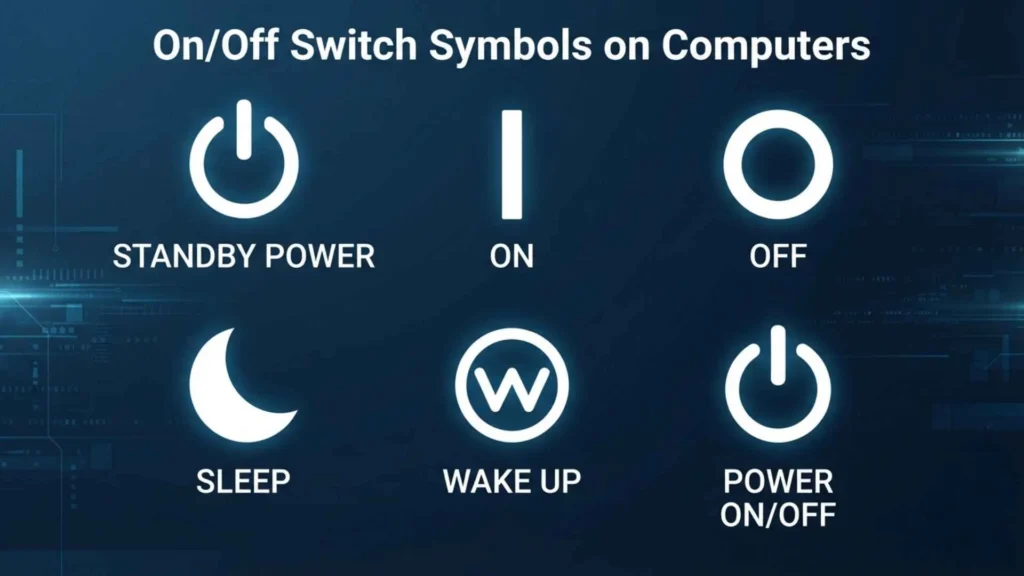
Computers commonly use the ⏻ power symbol.
You can find it on:
- Desktop computers
- Laptops
- Monitors
- Docking stations
- External displays
- Computer accessories
On a computer, the power button usually interacts with the operating system’s power functions.
For this reason, pressing or holding the button may have different effects depending on the computer’s settings.
A normal shutdown is generally preferable to forcibly cutting power unless the equipment instructions specifically call for another procedure.
On/Off Switch Symbols on Household Appliances
Many household appliances use power symbols or I/O markings.
Examples include:
- Fans
- Coffee makers
- Microwaves
- Blenders
- Air purifiers
- Heaters
- Kitchen appliances
- Audio equipment
A simple mechanical appliance may use I/O, while a more sophisticated electronic appliance may use a power button symbol.
Other symbols may identify individual operating modes rather than the overall power state.
On/Off Symbols in Electrical and Circuit Diagrams
Physical switch markings and electrical schematic symbols are related but are not the same thing.
A physical switch may have markings such as:
I, O, I/O, or ⏻
An electrical schematic, however, uses graphical symbols to show how a switch and other components are connected within a circuit.
A schematic can show whether a switch contact is open or closed and how it interacts with other electrical components.
Physical Markings vs Schematic Symbols
The distinction is useful when searching for electrical switch symbols.
If you want to know what a button or rocker switch marking means, you are usually looking for I, O, or ⏻.
If you are reading an electrical drawing, you may instead need to understand standardized circuit switch symbols.
Why Are On/Off Symbols Used Instead of Words?
Symbols make controls easier to understand across languages and markets.
A manufacturer selling the same product in different countries does not need to print separate translations of “ON” and “OFF” when a standardized symbol can communicate the intended state.
This is particularly useful for:
- International electronics
- Electrical equipment
- Appliances
- Industrial machinery
- Computer hardware
- Power supplies
Symbols also take up less space than written labels.
Are On/Off Switch Symbols Universal?
The most common symbols are widely recognized, but their exact function can depend on the equipment and applicable technical standards.
For ordinary two-position switches, I = ON and O = OFF are highly common conventions.
However, a power button marked ⏻ can have different behavior depending on the device.
When working with mains electricity, industrial equipment, or safety-critical machinery, always follow the manufacturer’s instructions rather than relying solely on the symbol.
Common On/Off Switch Symbol Examples
Here are the most useful examples to remember:
I = ON
O = OFF
I/O = ON/OFF
⏻ = POWER CONTROL
The first two are especially important when dealing with physical rocker switches.
Common Mistakes When Reading Switch Symbols
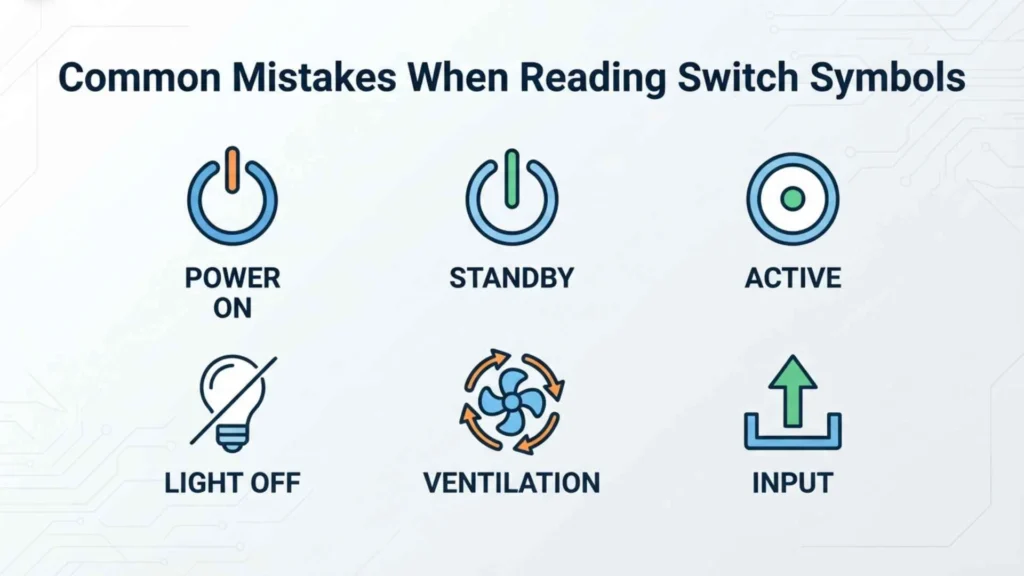
Understanding a few common mistakes can make these markings easier to interpret.
Assuming Up Always Means ON
A switch being physically “up” does not necessarily mean it is ON.
The switch may have been installed in a different orientation.
Check the marking instead.
Assuming ⏻ Always Means Completely OFF
The power symbol identifies a power control. On electronic equipment, the button may initiate standby or software-controlled shutdown rather than physically disconnecting the device.
Confusing O With Input/Output
On an I/O power switch, the O means OFF. It is not normally referring to output.
Confusing Physical Switch Symbols With Circuit Symbols
The symbols printed on a product and the symbols used in an electrical schematic can serve different purposes.
Knowing which type of symbol you are looking at helps you interpret it correctly.
Safety When Using Electrical Switches
Understanding switch symbols is useful, but symbols should not be treated as a substitute for safety instructions.
Before working on electrical equipment:
- Follow the manufacturer’s instructions.
- Disconnect power when the procedure requires it.
- Do not open electrical equipment unless you are qualified to do so.
- Treat mains-voltage equipment as potentially hazardous.
- Follow applicable electrical safety procedures.
For industrial machinery or specialized electrical equipment, use the equipment documentation and relevant safety procedures.
Frequently Asked Questions
Does the line mean ON or OFF?
The line or I symbol generally means ON.
Does the circle mean ON or OFF?
The circle or O symbol generally means OFF on a two-position power switch.
Is I ON and O OFF?
Yes. On many physical power switches, I means ON and O means OFF.
What does I/O mean on a power switch?
I/O generally means ON/OFF. The I position is ON and the O position is OFF.
What does the ⏻ symbol mean?
The ⏻ symbol identifies a power control. Depending on the device, it may turn the equipment on, initiate shutdown, or control a standby state.
Which side of a rocker switch is ON?
The side marked with I is generally ON. The physical direction of the rocker does not necessarily determine its state.
What is the difference between I/O and the power symbol?
I/O normally identifies two switch positions: ON and OFF. The ⏻ symbol generally identifies a power-control button or function whose behavior depends on the device.
Does the power button completely disconnect electricity?
Not always. Many electronic devices enter standby or another low-power state instead of being completely disconnected from the electrical supply.
Why does I mean ON?
The I marking is associated with the active state, commonly corresponding to 1, while O is associated with 0 and the inactive state.
Why are symbols used instead of ON and OFF?
Symbols can communicate the function of a control across different languages and require less space than written words.
Are the line and circle symbols used on electrical switches?
Yes. I and O are commonly used on physical power switches, especially two-position switches such as rocker switches.
What should I do if a switch symbol is unclear?
Check the device’s manual, labeling, or manufacturer’s instructions. If the equipment involves hazardous voltage or machinery, do not rely on guessing the symbol’s meaning.
Conclusion
The most important on/off switch symbols are easy to remember once you know what they represent.
I = ON
O = OFF
I/O = ON/OFF
⏻ = POWER CONTROL
The line means ON and the circle means OFF on a typical two-position power switch. The familiar ⏻ power symbol is slightly different because it identifies a power-control function and may operate differently depending on the device.
These symbols appear on everything from rocker switches and power strips to computers, monitors, appliances, and electronic equipment. Understanding the difference between I, O, I/O, and ⏻ makes it easier to identify switch positions and understand what a power control is designed to do.

Hi, I’m Asher Monroe, a writer who believes that meaningful words have the power to inspire change and bring people closer to their dreams. I have always been fascinated by the beauty of quotes and the way a simple message can provide motivation, hope, and comfort.
I enjoy creating content around inspirational quotes, life lessons, success stories, and positive thoughts that help readers find encouragement in their everyday lives. My goal is to share words that connect with people and remind them of their inner strength.
Through my writing, I explore the ideas of personal growth, confidence, and the importance of staying inspired through every chapter of life.
I am the author of Words That Move the Soul and The Path of Endless Inspiration, two books focused on the power of wisdom, positivity, and meaningful thoughts.