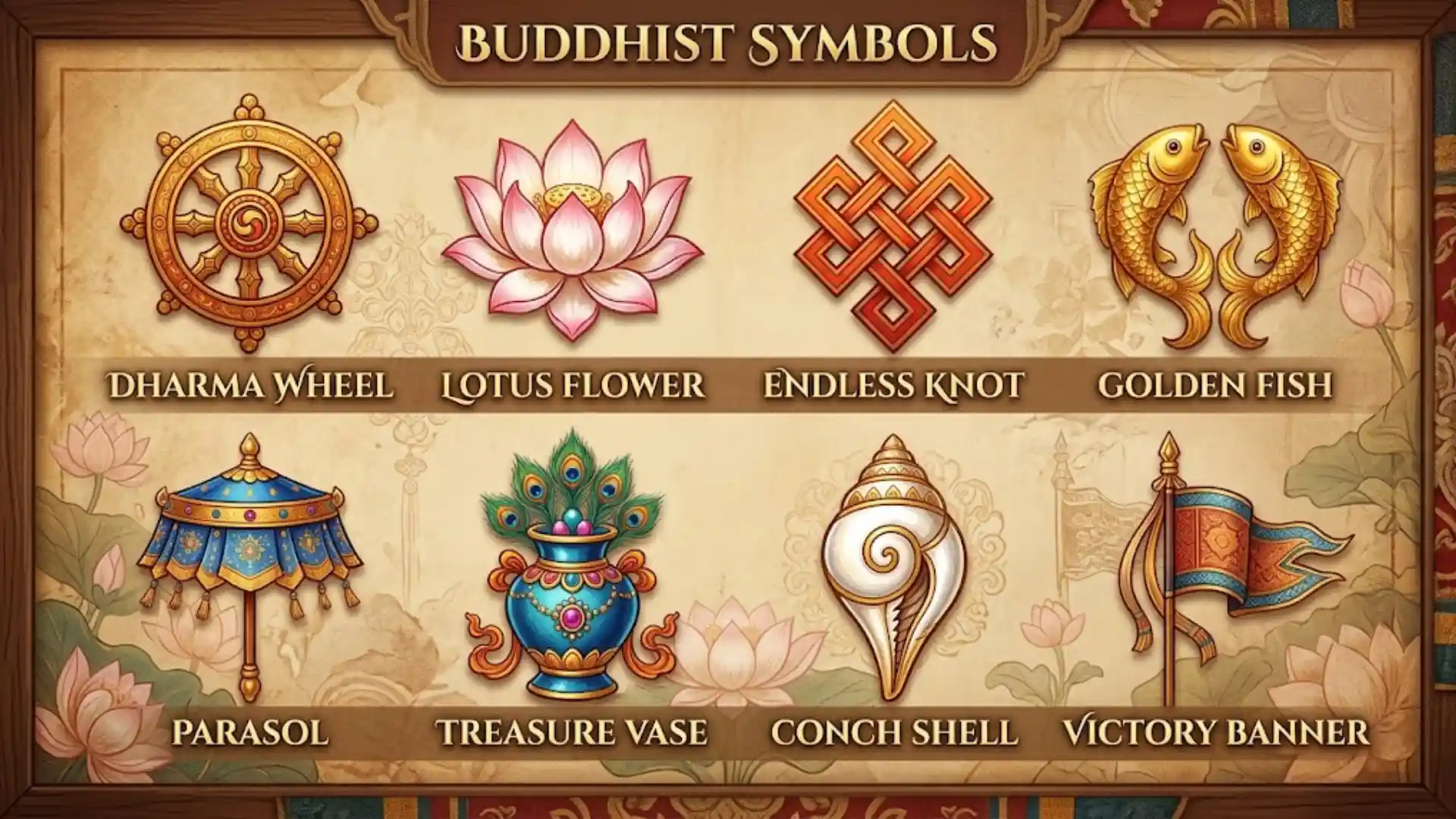
Buddhist symbols turn deep spiritual teachings into images you can recognize and understand. A wheel can represent the Buddha’s teachings, a lotus can express purity, and an endless knot can illustrate how everything is connected.
These symbols appear in Buddhist temples, monasteries, paintings, sculptures, rituals, and meditation spaces. Some are especially important in Tibetan Buddhism, while others have a much wider history across Buddhist traditions.
The Eight Auspicious Symbols, known as the Ashtamangala, form one of the best-known groups. Each has a distinct meaning connected to wisdom, compassion, spiritual protection, and the path toward enlightenment.
This guide explains the eight symbols in detail, explores other important Buddhist icons, and connects their meanings to the Buddha’s teachings. It also looks at how people use Buddhist symbols in meditation, religious art, and modern home decor.
What Are Buddhist Symbols?
Buddhist symbols are images, objects, signs, and artistic designs that communicate the Buddha’s teachings and important ideas in Buddhism. They help people understand spiritual concepts such as enlightenment, compassion, wisdom, impermanence, karma, and liberation.
Some symbols represent specific events in the Buddha’s life. Others communicate philosophical teachings or support religious practices.
For example, the Dharma Wheel represents the Buddha’s teachings, while the Bodhi Tree recalls his enlightenment. The lotus flower represents purity and spiritual awakening. Together, these images help explain ideas that can otherwise seem abstract.
Buddhist symbolism developed across many centuries and regions. As Buddhism spread from India into Central Asia, China, Tibet, Southeast Asia, Korea, and Japan, local artistic styles and religious practices shaped how people represented its teachings.
Why Are Symbols Important in Buddhism?
Symbols make Buddhist teachings easier to recognize, remember, and contemplate. They also provide visual reminders of the qualities practitioners seek to develop.
Their importance includes:
- Teaching: Symbols communicate important ideas from the Dharma.
- Meditation: Images can help practitioners focus their attention and reflect on spiritual qualities.
- Devotion: Religious objects provide a focus for prayer, offerings, and reverence.
- Remembrance: Images recall the Buddha, his enlightenment, and important events in his life.
- Protection: Some symbols represent the protective qualities of Buddhist teachings.
- Art and architecture: Symbols communicate religious ideas through temples, stupas, paintings, and sculptures.
A symbol does not automatically produce enlightenment or guarantee good fortune. Its value comes from the teachings and practices it represents.
Buddhist Symbols Across Different Traditions
Buddhism includes several major traditions. They share important teachings but do not use every symbol in exactly the same way.
| Buddhist tradition | Common symbolic features |
| Theravada Buddhism | Bodhi Tree, Buddha’s footprints, stupas, Dharma Wheel, and Buddha images |
| Mahayana Buddhism | Buddhas, Bodhisattvas, lotus imagery, mandalas, and compassion symbols |
| Vajrayana Buddhism | Eight Auspicious Symbols, ritual objects, mandalas, prayer wheels, and thangkas |
| Tibetan Buddhism | Prayer flags, prayer wheels, endless knot, conch shell, and other Ashtamangala symbols |
The Eight Auspicious Symbols are particularly prominent in Tibetan and Himalayan Buddhist art. However, they also appear in other Buddhist regions, including Nepal and parts of East Asia.
The Eight Auspicious Symbols of Buddhism and Their Meanings
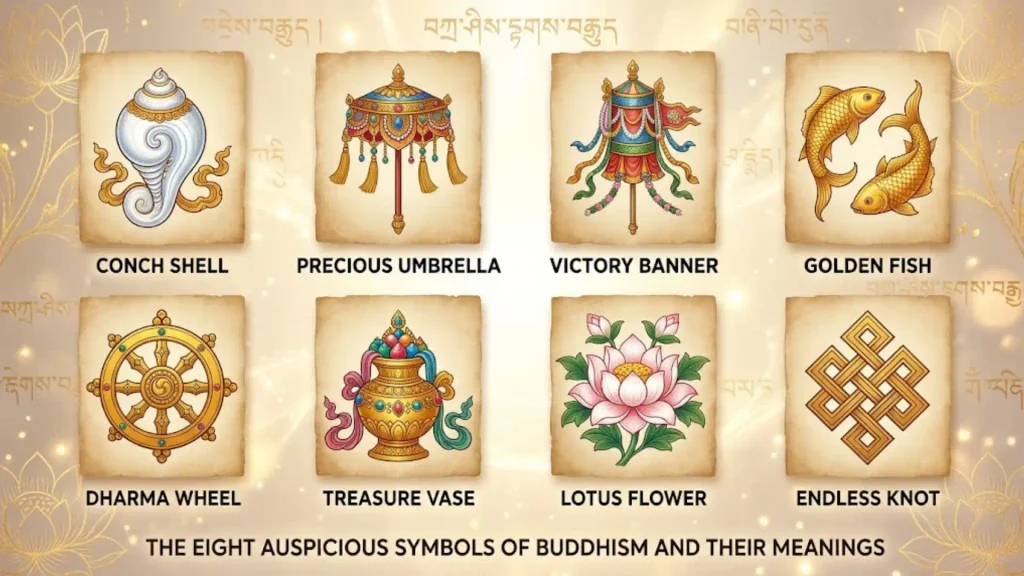
The Eight Auspicious Symbols, called Ashtamangala in Sanskrit, are a traditional collection of sacred emblems. They represent qualities associated with the Buddha’s teachings and the spiritual path.
The eight symbols are:
- Dharma Wheel
- White Conch Shell
- Pair of Golden Fish
- Lotus Flower
- Precious Parasol
- Treasure Vase
- Victory Banner
- Endless Knot
Their order can differ between artistic and religious presentations. Their individual interpretations can also vary across Buddhist traditions.
The symbols often appear together in Tibetan Buddhist paintings, temple decorations, ceremonial objects, and shrine rooms.
Dharma Wheel (Dharmachakra)
The Dharma Wheel, also called the Dharmachakra, is one of the most important Buddhist symbols. It represents the Buddha’s teachings and the path leading toward the end of suffering.
The Sanskrit word Dharma refers to the Buddha’s teaching in this context. Chakra means wheel. Together, the name describes the Wheel of Dharma.
The wheel commonly has eight spokes. These represent the Noble Eightfold Path, the practical guide to Buddhist ethical conduct, mental discipline, and wisdom.
The eight spokes represent:
- Right View: Understanding reality and the Four Noble Truths.
- Right Intention: Developing intentions based on kindness, renunciation, and harmlessness.
- Right Speech: Avoiding lies, harmful words, and divisive speech.
- Right Action: Acting ethically and avoiding harmful behavior.
- Right Livelihood: Earning a living without causing unnecessary harm.
- Right Effort: Developing beneficial mental qualities and reducing unwholesome ones.
- Right Mindfulness: Maintaining clear awareness of the body, feelings, mind, and experiences.
- Right Concentration: Developing focused and stable mental attention.
The eight spokes work together. They are not eight separate steps that someone completes once and then forgets. They support one another throughout Buddhist practice.
The First Sermon at Deer Park in Sarnath
The Dharma Wheel also connects to an important event in the Buddha’s life.
After attaining enlightenment, Buddha Shakyamuni delivered his first sermon at Deer Park, traditionally identified with Sarnath in present-day India. He taught the Four Noble Truths and introduced the path that became known as the Noble Eightfold Path.
Buddhist tradition describes this event as Turning the Wheel of Dharma.
The wheel’s movement represents the spreading of the Buddha’s teachings. It reminds practitioners that understanding Dharma requires more than hearing words. They must put the teachings into practice.
What does the Dharma Wheel represent?
The Dharma Wheel represents the Buddha’s teachings, the Noble Eightfold Path, wisdom, ethical conduct, and spiritual liberation. It is one of the clearest visual representations of Buddhism itself.
White Conch Shell (Shankha)
The white conch shell, known in Sanskrit as Shankha, represents the far-reaching sound of the Dharma.
Its sound carries across a wide area. In Buddhist symbolism, this represents how the Buddha’s teachings spread in every direction and reach people who need spiritual guidance.
The traditional auspicious emblem is often a white conch with a rightward spiral. Its distinctive shape and sound make it a recognizable part of Tibetan Buddhist art.
The conch communicates several ideas:
- Awakening from ignorance: Its sound symbolizes a call to wake up from spiritual confusion.
- Proclaiming the Dharma: It represents the spread of the Buddha’s wisdom.
- Spiritual awakening: Its sound reminds people to become aware of the teachings.
- Fearlessness: It can represent the confidence and strength of the Dharma.
The conch also appears in Buddhist ceremonies and religious decorations. Its meaning should not be reduced to warding off evil spirits or negative energy. Its central Buddhist association is the powerful and far-reaching sound of the teachings.
Pair of Golden Fish
The two golden fish symbolize freedom, fearlessness, happiness, and spiritual liberation.
They are often shown swimming together in water. Their movement suggests that they can travel freely without fear of drowning in the ocean of Samsara.
In Buddhist philosophy, Samsara refers to the cycle of birth, death, and rebirth shaped by ignorance, craving, and karma.
The golden fish represent the possibility of moving beyond the suffering associated with this cycle.
Their meanings commonly include:
- Freedom from spiritual restriction.
- Fearlessness in the face of suffering.
- Happiness and good fortune.
- Liberation from the ocean of Samsara.
- Spiritual abundance and positive qualities.
The pair may also suggest harmony and balance. However, their central Buddhist meaning is freedom and fearlessness.
Their golden color adds to their auspicious appearance. In Buddhist art, gold is often used to communicate sacred value, spiritual richness, and the qualities of enlightenment.
Why are there two golden fish in Buddhist symbols?
The pair represents freedom and fearlessness. Their ability to move freely through water provides an image of beings who are no longer trapped by the suffering of Samsara.
Lotus Flower (Padma)
The lotus flower, called Padma in Sanskrit, is one of the most recognizable Buddhist spiritual symbols.
A lotus grows in muddy water but rises above the surface to produce a beautiful flower. This natural process provides a powerful image of spiritual development.
People live with suffering, confusion, and attachment. Yet Buddhist teachings explain that wisdom and awakening are possible even within difficult conditions.
The lotus therefore represents:
- Spiritual purity.
- Enlightenment and awakening.
- Compassion and wisdom.
- The potential of Buddha-nature.
- Rising above ignorance and attachment.
- Transformation through spiritual practice.
The lotus is also closely connected to Buddhas and Bodhisattvas. Many Buddhist figures appear seated on a lotus throne, which represents their awakened qualities.
Lotus Bud, Opening Flower, and Full Bloom
The stages of a lotus flower can be used as a visual reminder of spiritual development.
- Lotus bud: May suggest potential and the beginning of spiritual practice.
- Opening lotus: Can represent growing awareness and the development of wisdom.
- Full bloom: Often represents complete awakening or enlightenment.
These are useful symbolic interpretations, not a fixed system followed by every Buddhist tradition.
Lotus Colors in Buddhist Art
Different lotus colors appear in Buddhist paintings and sculptures. Their meanings depend on the tradition and artistic context.
| Lotus color | Common symbolic association |
| White | Purity and spiritual clarity |
| Pink | The Buddha and the highest form of enlightenment |
| Red | Compassion and love |
| Blue | Wisdom and knowledge |
The lotus is especially meaningful because it connects ordinary worldly existence with the possibility of spiritual awakening.
Precious Parasol (Chattra)
The Precious Parasol, also called Chattra, represents protection, dignity, and the shelter provided by the Dharma.
A traditional parasol protects someone from the heat of the sun. In Buddhist symbolism, it represents protection from suffering, ignorance, and harmful mental influences.
It can be understood as the cooling shade of Dharma.
Its symbolic meanings include:
- Protection from suffering.
- Freedom from harmful influences.
- Shelter from mental afflictions.
- Wisdom and compassion.
- Spiritual dignity and authority.
In Tibetan Buddhist art, the parasol often has a decorative dome and a layered structure. Some interpretations connect the dome with wisdom and the surrounding fabric with compassion.
The parasol also has historical associations with royalty and high status in South Asian cultures. Buddhism adapted this familiar emblem to communicate spiritual protection and the value of the teachings.
It appears in temple decorations, ritual displays, and representations of the Eight Auspicious Symbols.
What does the Buddhist parasol symbolize?
The parasol symbolizes the protective qualities of the Dharma. It represents shelter from suffering and the mental afflictions that prevent spiritual development.
Treasure Vase
The Treasure Vase represents abundance, prosperity, longevity, and the inexhaustible qualities of the Dharma.
It is often shown as a decorated vessel with a rounded body and a narrow neck. Traditional descriptions sometimes connect it with a source of endless treasures or blessings.
However, its meaning goes beyond material wealth.
The treasure vase can represent:
- Spiritual abundance.
- Inexhaustible Dharma wealth.
- Longevity and well-being.
- Fulfillment of positive wishes.
- Health and prosperity.
- The richness of enlightened qualities.
In Buddhist symbolism, true wealth includes wisdom, compassion, generosity, and freedom from suffering.
Some traditional explanations also connect the vase with nectar of immortality and the deathless nature associated with liberation. These ideas should be understood within Buddhist spiritual teachings, not as promises of physical immortality.
Treasure vases may appear in Buddhist rituals, sacred sites, temple decorations, and ceremonial displays.
What is the meaning of the Buddhist treasure vase?
The treasure vase represents inexhaustible abundance and auspicious blessings. It can symbolize both material well-being and the deeper spiritual wealth gained through Buddhist practice.
Victory Banner (Dhvaja)
The Victory Banner, known as Dhvaja, represents triumph over obstacles that prevent spiritual awakening.
In Buddhist teachings, the greatest obstacles are not simply external problems. They include harmful mental states such as ignorance, attachment, aversion, and pride.
The victory banner symbolizes the ability to overcome these inner difficulties through wisdom, compassion, and disciplined practice.
Its common meanings include:
- Victory over ignorance.
- Triumph over attachment and aversion.
- Overcoming the Three Poisons.
- Spiritual progress.
- Determination and perseverance.
- Victory over Mara and the obstacles to enlightenment.
Victory Over Mara
Mara represents forces that obstruct awakening in Buddhist stories. In accounts of the Buddha’s enlightenment, Mara attempts to distract and discourage him.
The Buddha remains focused and overcomes these challenges. This story gives the victory banner a strong connection to spiritual determination.
The banner is also displayed in Tibetan Buddhist temples and monasteries. It reminds practitioners that enlightenment requires overcoming harmful mental habits rather than simply seeking external success.
Endless Knot (Eternal Knot)
The Endless Knot, also called the Eternal Knot, is a complex design made from interwoven lines with no obvious beginning or end.
It represents interconnectedness, interdependence, and the relationship between cause and effect.
In Buddhist philosophy, actions have consequences. Experiences arise through conditions and relationships rather than existing completely independently.
This makes the endless knot a natural symbol for karma and the interconnected nature of existence.
Its meanings commonly include:
- Interconnectedness and interdependence.
- The relationship between cause and effect.
- Karma and its consequences.
- The union of wisdom and compassion.
- The relationship between Samsara and Nirvana.
- The continuity of Buddhist teachings.
The knot is sometimes interpreted as a union of opposites or as a reminder that wisdom and compassion must work together.
It can also represent the idea that no event exists in complete isolation. Our actions affect others, and conditions influence the results we experience.
What does the endless knot symbolize in Tibetan Buddhism?
The endless knot represents interconnectedness and the relationship between causes and conditions. It is also associated with the union of wisdom and compassion.
Other Significant Buddhist Symbols and Their Meanings
The Eight Auspicious Symbols are not the only important images in Buddhism. Other symbols recall the Buddha’s life, represent important teachings, or support religious practices.
Some have roots in early Buddhist art, while others became especially prominent in particular regional traditions.
Bodhi Tree
The Bodhi Tree is one of the most important symbols in Buddhism because it is connected to Buddha Shakyamuni’s enlightenment.
According to Buddhist tradition, Siddhartha Gautama attained enlightenment while meditating beneath a tree at Bodh Gaya in present-day Bihar, India.
The tree is commonly identified as a sacred fig, Ficus religiosa. It is also known as the peepal tree.
The Bodhi Tree represents:
- Enlightenment and spiritual awakening.
- Wisdom and insight.
- Meditation and contemplation.
- Freedom from ignorance.
- The possibility of liberation.
The original tree associated with the Buddha’s enlightenment is no longer standing in its original historical form. However, the site at Bodh Gaya remains one of the most important Buddhist pilgrimage destinations.
A descendant of the sacred Bodhi Tree tradition is also preserved at Anuradhapura in Sri Lanka. The Sri Maha Bodhi is traditionally associated with a cutting brought from the original tree by Sanghamitta, according to Sri Lankan Buddhist history.
Buddha’s Footprints (Buddhapada)
Buddha’s Footprints, known as Buddhapada, are images of the Buddha’s feet.
They are important in early Buddhist art. During the early centuries of Buddhist artistic history, the Buddha was often represented through symbols rather than through a human figure.
His footprints, an empty throne, a stupa, and the Dharma Wheel could all indicate his presence.
The footprints may contain special markings, including a wheel symbol on the soles. These markings connect the image with the Buddha’s teachings and spiritual qualities.
They communicate:
- The historical presence of the Buddha.
- Reverence for his teachings.
- The path he walked.
- The memory of his spiritual journey.
- The lasting influence of his enlightenment.
Buddha’s footprints are not simply decorative images. They remind practitioners of the teacher who showed the path toward liberation.
Om Mani Padme Hum: The Six-Syllable Mantra
Om Mani Padme Hum is one of the best-known mantras in Tibetan Buddhism.
It is associated with Avalokiteshvara, the Bodhisattva of compassion. The mantra is widely recited by Tibetan Buddhist practitioners and appears on prayer wheels, prayer flags, stones, and religious objects.
The mantra has six syllables:
- Om
- Ma
- Ni
- Pad
- Me
- Hum
It is often associated with the development of compassion and wisdom.
A familiar translation is “Hail to the Jewel in the Lotus,” although the mantra’s meaning is deeper than a simple word-for-word translation.
Its syllables are interpreted in different ways across Tibetan Buddhist teachings. Some explanations connect them with the purification of negative mental states and the development of positive qualities.
The mantra reminds practitioners to develop compassion for all sentient beings. Its importance comes from its role in spiritual practice, not simply from the appearance of its written form.
Prayer Wheel
A Buddhist Prayer Wheel is a cylindrical religious object containing printed or written mantras. Tibetan Buddhist practitioners traditionally rotate it as part of devotional practice.
The mantra most commonly associated with prayer wheels is Om Mani Padme Hum.
Prayer wheels can be small handheld objects or large structures installed at monasteries and temples. Some contain many printed copies of a mantra inside the cylinder.
In Tibetan Buddhist tradition, rotating a prayer wheel is understood as a devotional act connected to mantra recitation and the generation of positive merit.
Common features include:
- A cylindrical drum.
- Sacred mantras written on the outside or placed inside.
- A handle or central support.
- A weighted chain on some handheld wheels.
- Decorative Buddhist symbols.
Prayer wheels are generally turned clockwise in Tibetan Buddhist practice.
They provide a physical way to engage with prayer and spiritual reflection. Their use should not be treated as a mechanical shortcut to enlightenment. Buddhist practice also emphasizes intention, understanding, compassion, and ethical conduct.
Prayer Flags
Tibetan Buddhist Prayer Flags are colorful pieces of cloth printed with mantras, prayers, and sacred images.
People traditionally hang them outdoors, including near monasteries, mountain passes, bridges, and sacred places.
Wind moves through the flags, symbolically carrying their prayers and positive aspirations outward.
The five traditional colors are commonly connected with elements:
| Color | Common elemental association |
| Blue | Space |
| White | Air or wind |
| Red | Fire |
| Green | Water |
| Yellow | Earth |
The arrangement and interpretation can vary, but the colors are widely recognized in Tibetan Buddhist practice.
Prayer flags may include the Wind Horse, Buddhist mantras, protective imagery, and prayers for the well-being of all beings.
Their purpose is not simply decoration. They express spiritual aspirations, compassion, and the wish for peace and well-being.
Thangka Paintings
A Thangka is a traditional Tibetan Buddhist religious painting, usually created on cloth.
Thangkas often depict Buddhas, Bodhisattvas, mandalas, teachers, and important figures from Buddhist teachings.
They serve several purposes:
- Supporting meditation and contemplation.
- Communicating religious teachings.
- Providing a focus for devotion.
- Preserving Buddhist artistic traditions.
- Representing complex spiritual ideas visually.
A thangka is often created according to established artistic guidelines. The proportions, gestures, colors, and symbolic objects of its figures can have specific religious meanings.
Some thangkas are used during religious ceremonies. Others are displayed in monasteries, temples, or home shrines.
Buddha Statue and Buddha Sculpture
Buddha statues are among the most recognizable Buddhist icons.
They represent the Buddha and remind practitioners of his teachings, enlightenment, and qualities. Their poses and hand gestures often communicate specific events or spiritual ideas.
A Buddha statue may show him seated in meditation, standing, walking, or reclining.
The meaning depends on the posture, hand position, and surrounding symbols.
Common Buddha Mudras
A mudra is a symbolic hand gesture used in Buddhist art and religious practice.
| Mudra | Meaning |
| Dhyana Mudra | Meditation and concentration |
| Bhumisparsha Mudra | Calling the Earth to witness enlightenment |
| Abhaya Mudra | Fearlessness and reassurance |
| Dharmachakra Mudra | Teaching and turning the Wheel of Dharma |
| Varada Mudra | Generosity, compassion, and giving |
The Bhumisparsha Mudra commonly shows the Buddha seated with one hand reaching toward the ground. It recalls the traditional account of his enlightenment and his overcoming of Mara.
The Dhyana Mudra shows the hands resting in the lap, often with palms facing upward. It represents meditation and mental concentration.
Lotus Throne
The Lotus Throne is a seat shaped like an open lotus flower. Buddhas and Bodhisattvas are often shown seated or standing on one.
The lotus represents purity and awakening. The throne therefore suggests that enlightened beings have risen above ignorance and attachment.
It also connects the lotus flower with the idea of Buddha-nature, the potential for awakening.
Buddhist Symbols of Enlightenment, Wisdom, and Compassion
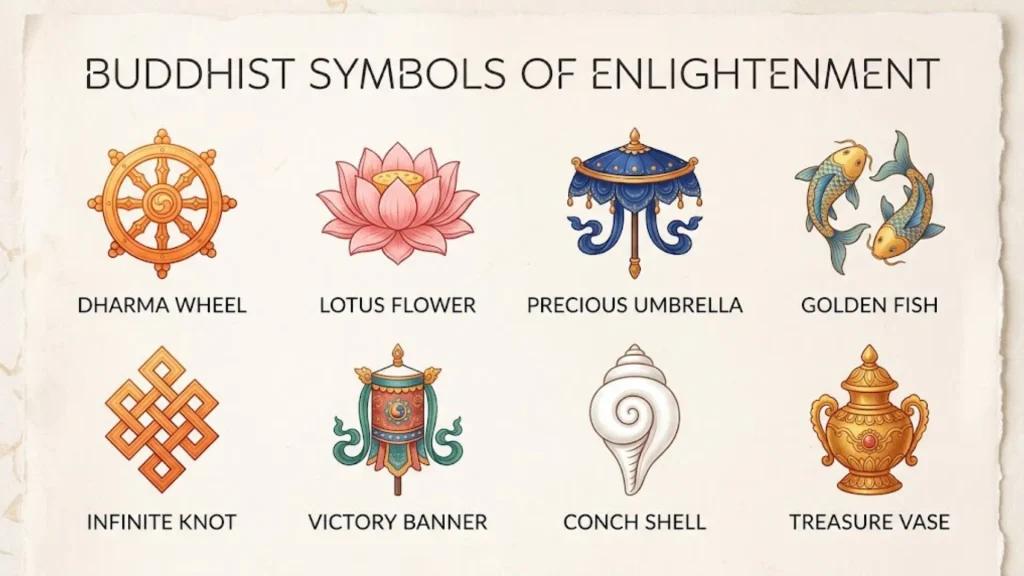
Buddhist symbols often communicate several spiritual qualities at once. Some are closely associated with enlightenment, while others emphasize compassion, wisdom, or the protection offered by Dharma.
Buddhist Symbols for Enlightenment
Enlightenment is the awakening that brings an end to ignorance and the causes of suffering.
Several symbols represent this goal:
- Dharma Wheel: The teachings and path leading toward awakening.
- Bodhi Tree: The place associated with the Buddha’s enlightenment.
- Lotus Flower: Purity and the possibility of spiritual awakening.
- Buddha’s Footprints: The presence and path of the awakened teacher.
- Bhumisparsha Mudra: The Buddha’s enlightenment and victory over Mara.
These symbols help practitioners remember that enlightenment requires wisdom, ethical conduct, and mental development.
Buddhist Symbols of Wisdom
Wisdom is central to Buddhist philosophy. It involves seeing reality clearly rather than allowing ignorance and mistaken understanding to control the mind.
The Dharma Wheel represents the teachings that develop this understanding.
Buddha images can also express wisdom through specific features and gestures. In Mahayana and Vajrayana traditions, Manjushri is especially associated with wisdom. He is often shown holding a sword that cuts through ignorance and confusion.
The endless knot can also communicate the importance of understanding relationships, causes, and conditions.
Buddhist Symbols of Compassion
Compassion means recognizing the suffering of others and developing the wish to help them.
The mantra Om Mani Padme Hum is strongly associated with Avalokiteshvara, the Bodhisattva of compassion.
The lotus also appears in representations of compassionate Bodhisattvas. It expresses purity and the possibility of awakening within ordinary worldly life.
The Bodhisattva ideal is especially important in Mahayana Buddhism. A Bodhisattva seeks enlightenment while maintaining a commitment to the welfare and liberation of all sentient beings.
Buddhist Symbols of Peace and Serenity
Some Buddhist symbols are commonly used to create an atmosphere of calm and spiritual reflection.
These include:
- Lotus flower artwork.
- Meditation Buddha statues.
- Prayer flags.
- Dhyana Mudra images.
- Dharma Wheel decorations.
Their visual presence can remind people to slow down, practice mindfulness, and reflect on the Buddha’s teachings.
However, peace in Buddhism is not only an external atmosphere. It also involves understanding the mind and reducing the causes of suffering.
Buddhist Symbols and the Core Teachings of Buddhism
To understand Buddhist symbolism deeply, it helps to understand the teachings behind the images.
Buddhist symbols are not separate from Buddhist philosophy. They often provide visual explanations of Dharma, karma, the Noble Eightfold Path, and liberation.
Buddhist Symbols and the Dharma
Dharma has several meanings in Buddhist traditions. It can refer to the Buddha’s teachings, the principles of reality, and the path of practice.
The Dharma Wheel is its most recognizable visual representation.
The wheel reminds practitioners that the Buddha’s teachings offer a path for understanding suffering and developing the wisdom needed to overcome it.
Following Dharma involves more than accepting a belief. It requires applying the teachings through ethical conduct, mindfulness, meditation, and understanding.
The Noble Eightfold Path and the Dharma Wheel
The Noble Eightfold Path is a central Buddhist teaching. It provides a practical framework for developing wisdom, ethical behavior, and mental discipline.
Its eight parts are traditionally grouped into three areas:
| Group | Path factors |
| Wisdom | Right View and Right Intention |
| Ethical conduct | Right Speech, Right Action, and Right Livelihood |
| Mental discipline | Right Effort, Right Mindfulness, and Right Concentration |
These categories show how Buddhist practice combines understanding, behavior, and mental development.
The Dharma Wheel’s eight spokes provide a visual connection to this path. They remind practitioners that spiritual progress involves all aspects of life.
Buddhist Symbols of Karma and Rebirth
Karma refers to intentional actions and their consequences. In Buddhist teachings, actions of body, speech, and mind influence future experiences.
Karma is closely connected to Samsara, the cycle of birth, death, and rebirth.
The endless knot can represent the relationship between causes and conditions. The Wheel of Life, another important Buddhist image, illustrates the cycle of existence and the forces that keep beings within it.
These symbols help communicate that actions matter. They also remind practitioners that freedom from suffering requires understanding the causes that sustain it.
Samsara and Nirvana
Samsara describes the cycle of repeated birth, death, and rebirth. It is shaped by ignorance, craving, aversion, and karma.
Nirvana refers to liberation from the causes of suffering and the cycle of Samsara.
| Samsara | Nirvana |
| Cycle of birth, death, and rebirth | Liberation from the causes of that cycle |
| Shaped by ignorance and craving | Associated with the ending of ignorance and craving |
| Involves suffering and dissatisfaction | Represents freedom from suffering |
| Driven by karmic conditions | Beyond the ordinary cycle of conditioned existence |
Different Buddhist traditions explain these concepts through their own philosophical frameworks. They should not be reduced to the simple idea that Samsara is a bad place and Nirvana is a physical paradise.
The Buddhist path focuses on understanding suffering, its causes, and the possibility of liberation.
Symbols of Impermanence and Spiritual Liberation
Impermanence is a central Buddhist teaching. Everything that arises through causes and conditions changes over time.
This includes physical objects, feelings, relationships, and mental experiences.
Buddhist art and meditation practices encourage people to reflect on change rather than cling to things as permanent.
The lotus, Dharma Wheel, and other sacred images can serve as reminders of spiritual development. Their deeper meaning comes from the teachings they represent.
Buddhist Symbols Used in Meditation and Spiritual Practice
Buddhist symbols are not limited to temples or museums. Practitioners use them in daily religious life, meditation, and devotional activities.
Their role depends on the symbol and the tradition.
Lotus Flower as a Meditation Symbol
The lotus is a useful image for reflecting on purity, transformation, and awakening.
A practitioner may contemplate how the flower rises from muddy water without being defined by its surroundings.
This can serve as a reminder that difficult experiences do not have to prevent spiritual growth.
Dharma Wheel in Buddhist Meditation
The Dharma Wheel can provide a visual reminder of the Noble Eightfold Path.
A practitioner may reflect on one path factor at a time, such as Right Speech or Right Mindfulness.
This helps connect meditation with daily ethical choices rather than treating spiritual practice as something separate from ordinary life.
Om Mani Padme Hum in Meditation
Practitioners recite Om Mani Padme Hum as a devotional and meditative practice.
The mantra is associated with Avalokiteshvara and the development of compassion.
People may repeat it aloud, silently, or while using prayer beads. In Tibetan Buddhist traditions, mantra recitation can be part of a broader practice involving visualization, devotion, and meditation.
Prayer Wheels and Prayer Flags
Prayer wheels and prayer flags are especially familiar in Tibetan Buddhist practice.
Prayer wheels provide a physical method for engaging with sacred mantras. Prayer flags display prayers and auspicious imagery in outdoor spaces.
Both are connected to devotional activity and positive aspirations for the welfare of beings.
Buddha Mudras and Meditation
Buddha statues often show hand gestures that communicate particular teachings.
The Dhyana Mudra is especially associated with meditation. The hands rest in the lap, creating an image of calm attention and concentration.
The Abhaya Mudra represents fearlessness, while the Dharmachakra Mudra recalls the Buddha’s teaching activity.
These gestures help practitioners recognize different aspects of the Buddha’s life and teachings.
Buddhist Symbols in Temples, Art, and Architecture
Buddhist art uses symbols to communicate religious ideas through buildings, sculptures, paintings, and ceremonial objects.
The designs vary by region. A Tibetan monastery may feature different artistic details from a Theravada temple in Thailand or a Buddhist temple in Japan.
Buddhist Symbols in Temples and Monasteries
Buddhist temples and monasteries often display symbols such as:
- Dharma Wheels.
- Lotus flowers.
- Golden fish.
- Conch shells.
- Endless knots.
- Buddha statues.
- Bodhisattva figures.
- Prayer wheels and prayer flags.
The symbols may appear on walls, pillars, ceilings, gates, altars, and ritual objects.
Some are decorative, while others have specific religious functions.
Buddhist Symbols in Stupas
A stupa is a Buddhist structure associated with sacred relics, remembrance, and religious devotion.
Stupas developed as important monuments in Buddhist communities. They became places for pilgrimage, offerings, and circumambulation.
Their architectural features can carry symbolic meanings connected to the Buddha’s teachings and the path toward awakening.
Early Buddhist art also used stupas to represent the Buddha’s presence. Along with footprints, wheels, and empty thrones, they were among the important visual forms used before human images of the Buddha became common.
Buddhist Symbols in Thangka Paintings
Thangka paintings often combine several symbols within one composition.
A painting may show a Buddha seated on a lotus throne, holding a symbolic object, and surrounded by other sacred figures.
Mandalas can also appear in thangkas. They provide structured visual representations used in certain Buddhist meditation and ritual practices.
The meaning of each image depends on the specific figure, colors, gestures, and religious context.
Buddhist Symbols in Traditional Sculpture
Traditional Buddhist sculpture includes Buddha images, Bodhisattvas, protective deities, and sacred animals.
Sculptors use posture, facial expression, hand gestures, and symbolic objects to communicate spiritual ideas.
A Buddha sculpture may represent meditation, teaching, enlightenment, or another important aspect of the Buddha’s life.
These works are not simply portraits. They are religious images created according to established artistic and symbolic traditions.
Buddhist Symbols for Protection, Good Luck, and Prosperity
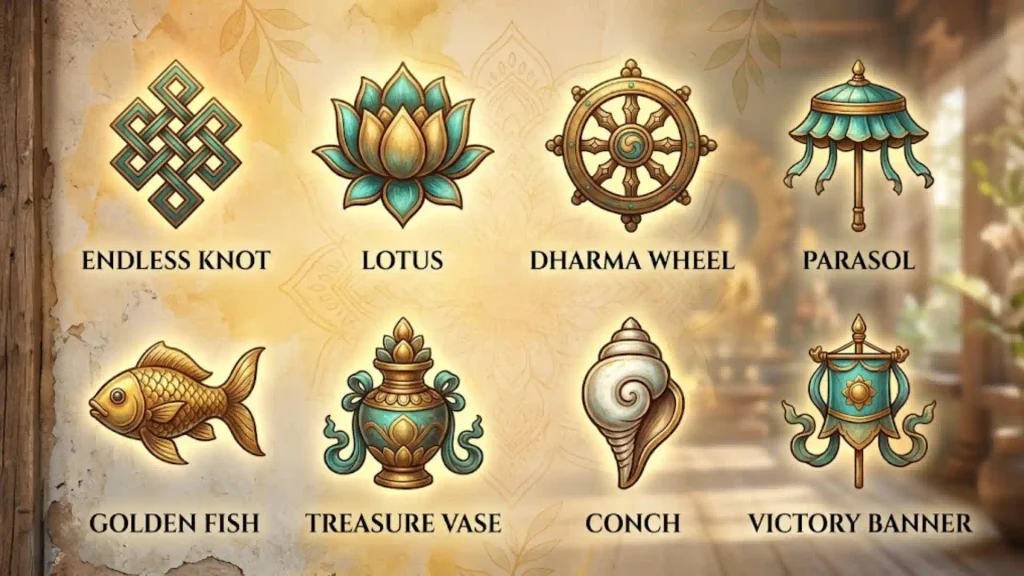
Many Buddhist symbols are described as auspicious. This means they are associated with positive qualities, blessings, or favorable conditions.
However, it is important to understand what these associations mean. Buddhist teachings do not reduce spiritual development to owning a particular object.
Buddhist Symbols for Spiritual Protection
The Precious Parasol is the clearest of the Eight Auspicious Symbols associated with protection.
It represents the shelter provided by Dharma from suffering and harmful mental influences.
The Victory Banner represents overcoming obstacles such as ignorance, attachment, and aversion.
Other protective imagery appears in Tibetan Buddhist traditions, including certain ritual objects and sacred figures.
These symbols express traditional religious beliefs. They should not be presented as guaranteed protection from illness, danger, or negative energy.
Buddhist Symbols for Good Luck and Prosperity
The Treasure Vase is associated with abundance, prosperity, longevity, and spiritual wealth.
The Golden Fish represent freedom, happiness, and fearlessness. The Eight Auspicious Symbols as a group are also displayed in settings where people wish to express auspiciousness and well-being.
Their meanings are broader than material success. They connect good fortune with spiritual qualities and positive conditions.
Buddhist Symbols of Inner Peace
The lotus, meditation Buddha, and Dharma Wheel are often used to represent peace and serenity.
Their meanings encourage mindfulness, wisdom, and reflection.
A symbol can remind someone to practice patience or compassion. However, Buddhist teachings place greater emphasis on developing these qualities than on simply displaying their images.
Buddhist Symbols in Modern Practice and Home Decor
Buddhist symbols remain visible in modern life. People use them in religious spaces, meditation rooms, jewelry, art, and home decorations.
Some uses are devotional. Others are decorative or connected to personal interest in Buddhist philosophy.
Understanding the original meaning helps people use these symbols more respectfully.
Buddhist Symbols Commonly Used in Homes
Common examples include:
- Buddha statues.
- Lotus flower paintings.
- Dharma Wheel wall art.
- Endless Knot decorations.
- Prayer flags.
- Prayer wheels.
- Thangka paintings.
- Buddhist altar objects.
In Buddhist homes, some of these objects may form part of a small shrine or home altar.
A shrine can provide a dedicated space for meditation, offerings, prayer, and reflection. Its arrangement depends on the family’s tradition and practice.
Choosing Buddhist Symbols for Home Decor
If you want to include Buddhist symbols in your home, learn about their meanings before choosing them.
A few practical considerations can help:
- Understand the symbol: Know whether it represents enlightenment, compassion, protection, or another teaching.
- Respect sacred images: Buddha statues are religious objects in many Buddhist communities, not just decorative figures.
- Choose a suitable location: A dedicated, clean, and respectful space is appropriate for devotional images.
- Consider the tradition: Tibetan, Theravada, and Mahayana communities may use different symbols and practices.
- Avoid misleading claims: A decorative symbol does not guarantee wealth, health, or spiritual protection.
A mindful approach makes home decor more meaningful and respectful.
Buddhist Symbols in Jewelry and Amulets
Buddhist jewelry often includes the lotus, Dharma Wheel, endless knot, and Om Mani Padme Hum.
Some people wear these designs as reminders of compassion, wisdom, or their spiritual interests.
In Tibetan Buddhist traditions, certain amulets and ritual objects have religious significance. Their use may involve specific teachings, blessings, or community practices.
It is helpful to distinguish traditional devotional objects from mass-produced accessories.
Buddhist Symbols in Tattoos
Buddhist symbols also appear in modern tattoo designs.
Common choices include:
- Lotus flowers.
- Dharma Wheels.
- Endless knots.
- Om Mani Padme Hum.
- Buddha imagery.
Before choosing a Buddhist tattoo, consider the symbol’s religious meaning and how it is viewed within the tradition.
Buddha images and sacred mantras are deeply meaningful to many Buddhist communities. Placing them on the body may be considered disrespectful in some cultural settings, particularly where the image is displayed in an inappropriate position.
Learning about the symbol first is a better approach than choosing it only because it looks attractive.
How Buddhist Symbols Are Used Today
Modern uses of Buddhist symbols include:
- Meditation and mindfulness spaces.
- Buddhist temples and monasteries.
- Religious festivals and ceremonies.
- Thangka paintings and traditional art.
- Jewelry and devotional objects.
- Prayer flags and prayer wheels.
- Home shrines and altar decorations.
- Cultural exhibitions and museum collections.
Their continued use shows how Buddhist symbolism connects historical traditions with modern spiritual life.
Eight Auspicious Symbols vs. Eight Auspicious Offerings
The Eight Auspicious Symbols and Eight Auspicious Offerings are related terms, but they do not refer to the same thing.
The Ashtamangala is a group of eight symbolic emblems. The Eight Auspicious Offerings refer to a different group of ritual offerings presented in certain Buddhist traditions.
The eight offerings commonly include water for drinking, water for washing, flowers, incense, light, perfume, food, and music. Their exact presentation can vary by ritual tradition.
This distinction matters when researching Buddhist symbols. The terms should not be used interchangeably.
Frequently Asked Questions About Buddhist Symbols
What are the eight auspicious symbols in Buddhism?
The eight auspicious symbols are the Dharma Wheel, white conch shell, pair of golden fish, lotus flower, precious parasol, treasure vase, victory banner, and endless knot. Together, they are known as the Ashtamangala.
What do the eight Buddhist symbols represent?
They represent different qualities associated with Buddhist teachings, including wisdom, compassion, purity, freedom, spiritual protection, abundance, victory over ignorance, and interconnectedness.
Which is the most important symbol in Buddhism?
The Dharma Wheel is often considered one of the most important Buddhist symbols because it represents the Buddha’s teachings and the Noble Eightfold Path. However, Buddhism does not have one universally designated symbol that every tradition ranks above all others.
What does the Dharma Wheel represent in Buddhism?
The Dharma Wheel represents the Buddha’s teachings and the path toward liberation from suffering. Its eight spokes are traditionally connected to the eight factors of the Noble Eightfold Path.
What do the eight spokes of the Dharma Wheel mean?
The eight spokes represent Right View, Right Intention, Right Speech, Right Action, Right Livelihood, Right Effort, Right Mindfulness, and Right Concentration.
What does the conch shell symbolize in Buddhism?
The white conch shell represents the far-reaching sound of the Dharma. It symbolizes the spread of the Buddha’s teachings and the awakening of beings from ignorance.
Why are there two golden fish in Buddhist symbols?
The two golden fish represent freedom, fearlessness, happiness, and liberation from the ocean of Samsara. Their ability to move freely through water provides an image of spiritual freedom.
What does the lotus flower represent in Buddhist teachings?
The lotus flower represents purity, spiritual awakening, and enlightenment. It grows in muddy water but rises above the surface, providing an image of overcoming ignorance and suffering.
What does the Buddhist parasol symbolize?
The parasol symbolizes spiritual protection and the shelter of Dharma. It represents protection from suffering and harmful mental influences.
What is the meaning of the Buddhist treasure vase?
The treasure vase represents spiritual abundance, longevity, prosperity, and inexhaustible blessings. Its meaning includes spiritual wealth rather than only material riches.
What does the victory banner represent in Buddhism?
The victory banner represents triumph over ignorance, attachment, aversion, and other obstacles to enlightenment. It also symbolizes determination and spiritual progress.
What does the endless knot symbolize in Tibetan Buddhism?
The endless knot represents interconnectedness, interdependence, karma, and the relationship between causes and conditions. It is also associated with the union of wisdom and compassion.
What is the meaning of the Bodhi Tree?
The Bodhi Tree represents the Buddha’s enlightenment. It recalls the sacred fig tree beneath which Siddhartha Gautama attained awakening at Bodh Gaya.
What does Om Mani Padme Hum mean?
Om Mani Padme Hum is a six-syllable mantra associated with Avalokiteshvara, the Bodhisattva of compassion. It is widely recited in Tibetan Buddhism as a devotional practice connected to compassion and wisdom.
What Buddhist symbols represent wisdom and compassion?
The Dharma Wheel represents the Buddha’s teachings and wisdom. The endless knot is associated with the union of wisdom and compassion. Om Mani Padme Hum is especially connected with compassion through Avalokiteshvara.
What is the difference between Samsara and Nirvana?
Samsara is the cycle of birth, death, and rebirth shaped by ignorance and craving. Nirvana is liberation from the causes of suffering and the cycle of Samsara.
How are Buddhist symbols used in meditation?
Practitioners may contemplate the lotus, focus on Buddha images, recite Om Mani Padme Hum, or reflect on the Dharma Wheel and Noble Eightfold Path. These practices support mindfulness, devotion, and spiritual reflection.
Where are Buddhist symbols commonly displayed?
Buddhist symbols appear in temples, monasteries, stupas, home shrines, thangka paintings, prayer wheels, prayer flags, sculptures, and religious objects. Their use varies by Buddhist tradition and region.
What are the best Buddhist symbols for home decor?
Popular choices include the lotus flower, Dharma Wheel, endless knot, Buddha images, and prayer flags. Choose symbols based on their meanings and display sacred images respectfully.
Conclusion: Understanding the Meaning of Buddhist Symbols
Buddhist symbols communicate teachings that can be difficult to explain through words alone. The Dharma Wheel represents the Buddha’s path, the lotus expresses purity and awakening, and the endless knot illustrates interconnectedness.
The Eight Auspicious Symbols are especially important in Tibetan Buddhist art and religious practice. Each offers a different reminder of the qualities associated with spiritual development.
Other symbols, including the Bodhi Tree, Buddha’s footprints, prayer wheels, and Om Mani Padme Hum, connect practitioners with the Buddha’s life and teachings.
Understanding these symbols means looking beyond their designs. Their deeper value comes from the ideas they represent: wisdom, compassion, ethical conduct, mindfulness, and liberation from suffering.
Whether you encounter Buddhist symbols in a temple, a painting, a meditation space, or modern home decor, knowing their meanings helps you appreciate their religious and cultural significance.

Hi, I’m Asher Monroe, a writer who believes that meaningful words have the power to inspire change and bring people closer to their dreams. I have always been fascinated by the beauty of quotes and the way a simple message can provide motivation, hope, and comfort.
I enjoy creating content around inspirational quotes, life lessons, success stories, and positive thoughts that help readers find encouragement in their everyday lives. My goal is to share words that connect with people and remind them of their inner strength.
Through my writing, I explore the ideas of personal growth, confidence, and the importance of staying inspired through every chapter of life.
I am the author of Words That Move the Soul and The Path of Endless Inspiration, two books focused on the power of wisdom, positivity, and meaningful thoughts.
 Sienna Brooks
 Rowan Sinclair Rowan Sinclair