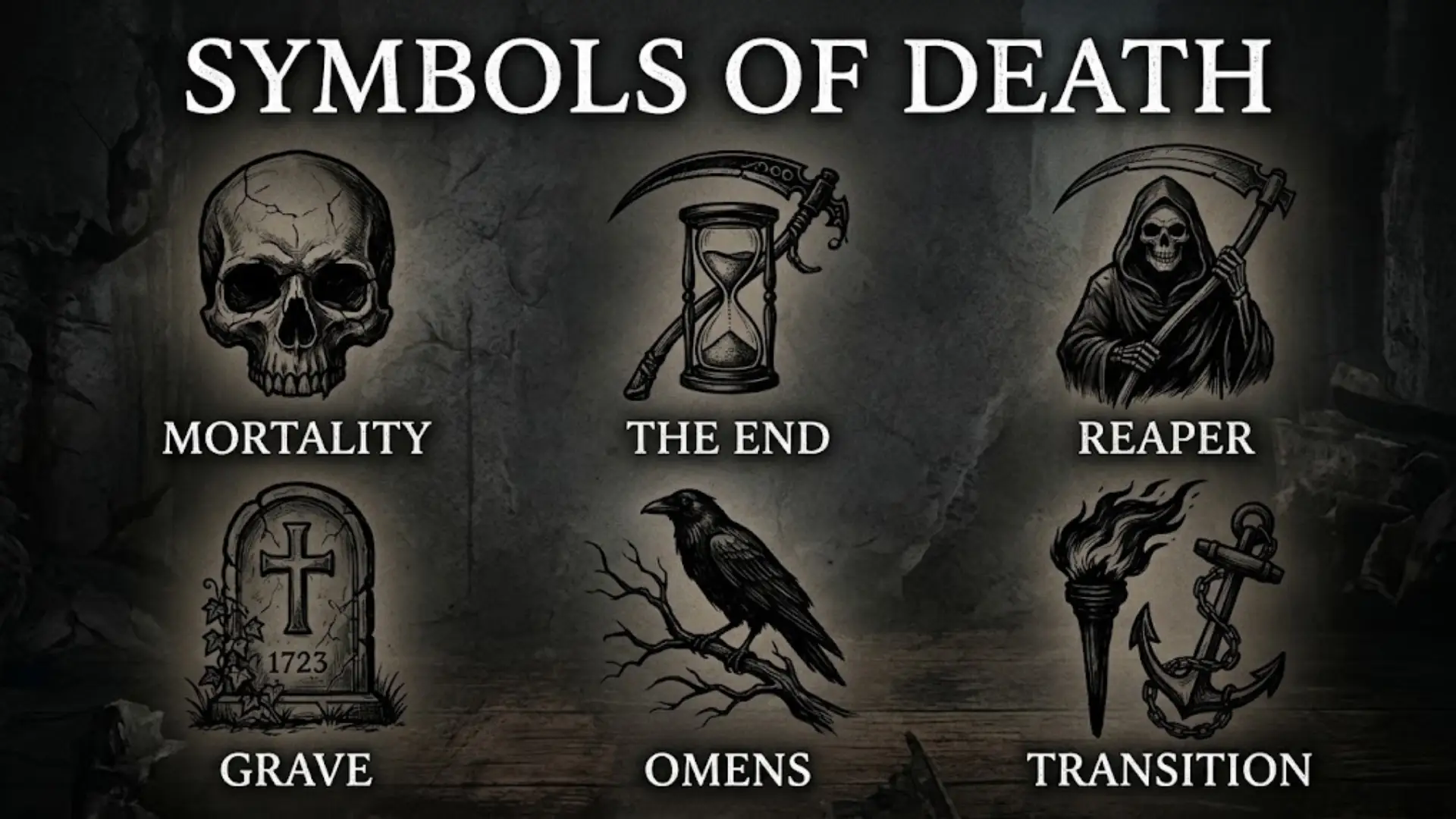
Death is one of the few experiences shared by every human culture. Yet people have never represented it in just one way. Across history, artists, religions, and communities have used symbols to express mortality, grief, remembrance, the afterlife, and rebirth.
Some images represent death directly. A skull, coffin, or Grim Reaper immediately brings mortality to mind. Others carry more complex meanings. A butterfly may suggest the soul or transformation, while a phoenix represents renewal after destruction.
Understanding symbols of death means looking beyond their appearance. Their meanings often depend on the culture, religion, historical period, and context in which people use them.
This guide explores common death symbols, animal symbolism, funeral flowers, mourning colors, ancient traditions, religious imagery, and symbols of death and rebirth. It also explains which meanings have historical roots and which are modern interpretations.
What Are the Symbols of Death?
Symbols of death are images, objects, colors, animals, flowers, or figures that communicate ideas connected to the end of life. They can represent physical death, the passage of time, mourning, the soul, or beliefs about what happens after death.
For example, a skull represents physical mortality, while a tombstone marks someone’s final resting place. An extinguished candle can suggest the end of life, and a white lily may express sympathy or spiritual hope.
Not every symbol has the same meaning everywhere. A color associated with mourning in one country may represent celebration or purity in another.
Death symbolism generally falls into four main categories:
- Death and mortality: Symbols that remind people that life is temporary, such as skulls, skeletons, and hourglasses.
- Mourning and remembrance: Objects and flowers used to honor people who have died, such as funeral wreaths, candles, and poppies.
- The afterlife and spiritual beliefs: Religious or cultural images connected to the soul, judgment, heaven, or the underworld.
- Death and rebirth: Symbols that express transformation, renewal, resurrection, or the continuing cycle of life.
These categories sometimes overlap. A skull, for instance, can represent mortality, remembrance, and spiritual reflection at the same time.
Common Symbols of Death and Their Meanings
Many familiar images have become widely recognized symbols of death. Some appear in funerals and memorials, while others come from mythology, religious art, or historical traditions.
Here are some of the most recognizable symbols that represent death.
Skull
The skull is one of the most recognizable symbols of death and human mortality. It represents the physical remains of the human body after life has ended.
Artists have used skulls for centuries to remind viewers that wealth, beauty, power, and social position cannot protect anyone from death.
In European art, skulls frequently appear in memento mori and vanitas paintings. These works encourage people to reflect on the temporary nature of earthly life.
Skulls also carry different meanings in different cultures. In Mexico, decorated skulls and sugar skulls are important parts of Día de los Muertos traditions. They honor deceased loved ones rather than simply presenting death as something frightening.
Skull and Crossbones
The skull and crossbones combines a human skull with two crossed bones. It commonly represents death, danger, poison, and serious physical risk.
Historically, variations of this image appeared in European funerary art and on some grave markers. It later became a familiar warning symbol.
Today, you may see the skull and crossbones on labels for highly toxic substances. It also appears in pirate imagery, where it became associated with danger and intimidation.
Its meaning depends on context. On a chemical label, it warns of poisoning. In a historical painting, it may remind viewers of mortality.
Grim Reaper
The Grim Reaper is a personification of death, usually shown as a skeleton wearing a dark hooded robe and carrying a scythe.
This figure became especially familiar in European art and folklore. Its popularity grew during and after periods of widespread disease, war, and social hardship.
The Grim Reaper represents death as an unavoidable force. It is often portrayed as a figure who comes to collect human souls when their lives end.
The image combines several recognizable symbols:
- A skeleton represents the dead human body.
- A dark robe suggests mystery and the unknown.
- A scythe represents cutting down life.
- A hood hides the figure’s identity and makes it appear mysterious.
The Grim Reaper is a cultural personification, not a religious figure accepted by every faith.
Scythe
A scythe is a farming tool with a long curved blade used to cut grass and crops. In death imagery, it represents the cutting short of human life.
Its association with death connects to the Grim Reaper, who traditionally carries the tool.
The scythe also has a symbolic connection to harvesting. Just as a farmer cuts mature crops, death is sometimes portrayed as gathering people at the end of their lives.
Skeleton
A skeleton represents the structure of the human body after death. It is closely related to skull symbolism but usually communicates a broader idea of physical mortality.
Skeletons appear frequently in medieval European art, especially in the Dance of Death tradition. Artists used them to show that death eventually reaches everyone, regardless of wealth, age, or social position.
Skeleton imagery also appears in Mexican Día de los Muertos decorations. In that setting, colorful skeletons can represent remembrance, cultural identity, and the relationship between life and death.
Corpse
A corpse is a dead human or animal body. Unlike a symbolic object such as an hourglass, it is a direct physical representation of death.
In paintings, literature, and historical records, a dead body can represent loss, violence, mortality, or the consequences of conflict.
Its meaning depends heavily on how an artist presents it. A corpse in a battlefield painting may communicate the human cost of war, while a body in a religious painting may connect to sacrifice or resurrection.
Mummy
A mummy is a preserved human or animal body. Mummification is strongly associated with ancient Egyptian burial practices, although other societies also practiced forms of body preservation.
In ancient Egypt, mummification was connected to beliefs about the afterlife and the continued existence of the deceased. Egyptians prepared bodies and placed them in tombs with objects that could support the dead in the next world.
Mummies therefore represent more than physical death. They also reflect preservation, spiritual preparation, and beliefs about eternal life.
Coffin
A coffin is a container used to hold a deceased person’s body for burial or funeral ceremonies.
It is a direct symbol of death, farewell, and the final stage of physical life. In literature and visual art, a coffin may represent grief, loss, fear, or the mystery of death.
Coffins also have different designs across cultures and historical periods. Their materials, decorations, and shapes often reflect religious beliefs and local funeral customs.
Tombstone and Gravesite
A tombstone marks a person’s burial place. It often includes the person’s name, birth and death dates, religious symbols, and a short memorial message.
A tombstone represents remembrance, final rest, and the connection between the living and the dead.
Common gravestone designs include:
- Crosses, often connected to Christian faith.
- Angels, sometimes representing spiritual protection or guidance.
- Doves, often associated with peace.
- Lambs, sometimes used on children’s graves in Christian contexts.
- Broken columns, which can represent a life cut short.
- Weeping willows, which often express grief and mourning.
- Hourglasses, which remind viewers that time is limited.
The meaning of a grave symbol should always be considered in its religious and historical context.
Hourglass
An hourglass measures time as sand moves from one chamber to another. In death symbolism, it represents the passage of time and the limited length of human life.
An hourglass often appears in memento mori artwork alongside skulls, candles, and other reminders of mortality.
An overturned hourglass can suggest that a person’s time has run out. A running hourglass can remind viewers that every moment brings them closer to the end of life.
Clock
A clock represents time, aging, and the steady movement toward life’s end.
In artwork, a stopped clock may suggest that time has ended for someone who has died. A clock with moving hands can represent the passage of life and the inevitability of mortality.
Clocks are not universal funeral symbols, but they can communicate the same ideas as hourglasses.
Candle and Extinguished Candle
A burning candle can represent life, hope, prayer, remembrance, and spiritual guidance. People often light candles during memorial services to honor someone who has died.
An extinguished candle carries a more direct connection to death. Its flame going out can symbolize the end of a person’s life.
The image is especially effective because a candle’s flame is temporary. It burns for a limited time before disappearing, much like human life.
Dagger
A dagger is a short, pointed weapon. In some paintings and stories, it represents violence, murder, betrayal, or sudden death.
However, a dagger is not a universal symbol of death. Its meaning depends on the scene in which it appears.
For example, a dagger in a historical battle painting may represent violence, while one in a symbolic artwork may suggest danger or treachery.
Heart
A heart usually represents love, emotion, compassion, and life. It is not a direct or universal symbol of death.
However, a broken or wounded heart can represent grief, emotional pain, and the loss of someone loved.
In memorial art, a heart may express the continuing love people feel for someone who has died.
Memento Mori
Memento mori is a Latin phrase commonly translated as “remember that you must die.”
It refers to an artistic and philosophical tradition that encourages people to remember their mortality. Rather than treating death only as something frightening, memento mori imagery asks viewers to think carefully about how they use their time.
Common memento mori objects include:
- Skulls and bones.
- Hourglasses and clocks.
- Extinguished candles.
- Wilting flowers.
- Decaying fruit.
- Empty shells.
- Bubbles that represent life’s fragility.
These objects often appear in still-life paintings called vanitas. Such paintings remind viewers that material possessions, physical beauty, and worldly achievements do not last forever.
Animal Death Symbols and Their Meanings
Animals appear in death symbolism across mythology, folklore, religion, and popular culture. Some are connected to the dead because they feed on remains. Others are associated with night, transformation, spiritual messages, or the afterlife.
However, animal meanings are not universal. The same creature may represent wisdom in one tradition and an omen of death in another.
| Animal | Common symbolic associations |
| Raven | Death, prophecy, memory, and mystery |
| Crow | Omens, intelligence, and the supernatural |
| Vulture | Death, decay, and the natural cycle |
| Butterfly | Transformation, the soul, and renewal |
| Owl | Wisdom, night, and death omens in some traditions |
| Bat | Darkness, night, and the underworld |
| Snake | Renewal, danger, healing, and transformation |
| Black cat | Superstition, witchcraft, and bad luck in some folklore |
| Jackal | Funerary traditions and ancient Egyptian mythology |
| Wolf | Wilderness, danger, and death in selected stories |
| Xoloitzcuintli | Guidance for the deceased in some Mexica beliefs |
| Death’s-head hawk moth | Mortality, fear, and supernatural folklore |
Ravens
Ravens are large, intelligent birds that have appeared in mythology and folklore for centuries. Their dark feathers, scavenging behavior, and presence around battlefields helped connect them with death in some European traditions.
In Norse mythology, Odin had two ravens named Huginn and Muninn. Their names are commonly translated as “Thought” and “Memory.” They traveled through the world and brought information to Odin.
These ravens are not simply death symbols. They are also connected to knowledge, observation, and memory.
Crows
Crows are often associated with death, mystery, and bad omens in European folklore. Their dark appearance and habit of feeding on dead animals contributed to these associations.
However, crows are also highly intelligent birds. In different stories, they can represent cleverness, communication, adaptation, or spiritual messages.
Their symbolism depends on the culture and story being discussed.
Vultures and Scavenger Birds
Vultures feed on dead animals, making them closely connected to decomposition and the natural process of death.
Their role is important in the environment. By consuming animal remains, they help remove carcasses and limit the spread of some diseases.
In some ancient Egyptian imagery, vultures also represented protection and motherhood. This shows why it is inaccurate to treat every vulture image as a negative symbol.
Butterflies
Butterflies are widely used as symbols of transformation because they change from caterpillars into winged adults.
In some spiritual beliefs, butterflies represent the soul, freedom, or the journey from physical life to another state of existence.
Some people interpret seeing a butterfly after a loved one’s death as a comforting reminder of that person. This is a personal or spiritual interpretation, not a scientifically established message from the deceased.
In parts of Mexican tradition, monarch butterflies also appear in beliefs connected to the return of departed souls around Día de los Muertos.
Owls
Owls are associated with wisdom in many cultures. Yet some traditions also connect them with darkness, death, and supernatural warnings.
Their nighttime activity and unusual calls helped create these associations.
In ancient Greek mythology, the owl was linked to Athena, the goddess of wisdom. This positive association contrasts with traditions in which an owl’s call is considered an omen.
Bats
Bats are nocturnal animals, and their association with darkness has made them common in gothic stories and supernatural imagery.
They may represent mystery, fear, the unknown, or the underworld in popular culture.
However, bats are not inherently symbols of death. Many species play valuable ecological roles, including pollination and insect control.
Spiders
Spiders sometimes appear in dark or gothic imagery because of their association with abandoned places, webs, and decay.
A spiderweb can also suggest time, entrapment, fate, and the fragile connections between life and death.
These meanings are mostly symbolic or artistic rather than universal cultural beliefs.
Serpents and Snakes
Snakes have complex meanings in mythology and religion. Their ability to shed their skin makes them natural symbols of renewal and transformation.
In some traditions, snakes represent danger, death, or the underworld. In others, they symbolize healing, fertility, wisdom, or immortality.
A snake can therefore represent both the end of one stage and the beginning of another.
Black Cats
Black cats became associated with witchcraft, bad luck, and supernatural beliefs in parts of European folklore.
During periods of intense fear about witchcraft, people sometimes viewed black cats as companions of witches or signs of evil.
These beliefs were not universal. In other cultures, cats have been respected or considered lucky.
A black cat is therefore better described as a symbol of superstition in certain traditions, not a universal symbol of death.
Jackals and Dogs
Jackals are especially important in ancient Egyptian death symbolism because of their connection to Anubis.
The jackal-headed god Anubis protected burial grounds, oversaw embalming, and played a role in the judgment of the dead.
Dogs also appear in mythology as guardians or guides associated with the underworld. Their role varies between traditions.
Xoloitzcuintli
The Xoloitzcuintli, commonly called the Mexican hairless dog, has a special place in some Mexica and broader Mesoamerican traditions.
Certain beliefs describe dogs as guides who helped deceased people travel through the difficult journey after death. The Xoloitzcuintli became associated with this spiritual journey.
This connection should be understood within its specific cultural history. It does not mean every Mexican tradition gives the dog exactly the same role.
Wolves
Wolves can represent danger, wilderness, violence, and death in some European stories. They sometimes appear as threats to travelers or as creatures connected to the boundary between civilization and the wild.
In other traditions, wolves represent loyalty, protection, family, or strength. Their meaning changes according to the story.
Death’s-Head Hawk Moth
The death’s-head hawk moth is known for the skull-like marking on its thorax. This unusual pattern helped connect it with death and bad omens in European folklore.
The moth became especially recognizable through its use in gothic imagery and popular culture.
Its name and appearance make it a striking example of an animal whose physical features helped shape its symbolic meaning.
Flowers Symbolizing Death, Mourning, and Remembrance
Flowers are common in funerals, memorial services, and gravesite decorations. Their colors, shapes, scents, and life cycles allow people to express feelings that may be difficult to put into words.
Some flowers represent grief and remembrance. Others suggest hope, purity, or the continuing cycle of life.
Chrysanthemums
Chrysanthemums are associated with funerals and mourning in several countries, including France and other parts of Europe.
In some places, people traditionally place chrysanthemums on graves during remembrance occasions. Their connection with autumn and memorial customs has strengthened their association with death.
However, chrysanthemums do not have one meaning everywhere. In Japan, for example, the flower also has important imperial and positive associations.
Red Poppies
The red poppy is one of the best-known flowers of remembrance, especially in countries connected to the First World War.
Red poppies grew across parts of the battlefields in Flanders after the ground had been disturbed by fighting. Canadian physician and soldier John McCrae wrote the poem In Flanders Fields in 1915, using the flowers as a powerful image of remembrance.
The poppy later became an emblem honoring people who died in war. It is particularly associated with Remembrance Day and related ceremonies.
The flower is not simply a general symbol of death. Its strongest modern meaning is remembrance of fallen service members and hope for peace.
Marigolds
Marigolds are central to many Día de los Muertos traditions in Mexico.
Known as cempasúchil, these bright orange and yellow flowers are used to decorate altars called ofrendas. Families may place petals along paths to symbolically guide deceased loved ones toward their homes.
Their color, scent, and use in family offerings connect them with remembrance and the relationship between the living and the dead.
Día de los Muertos is not simply a festival about death. It is a time for remembering and honoring loved ones through family traditions, food, photographs, flowers, and offerings.
Carnations
Carnations are common in funeral arrangements and memorial displays. They can express affection, admiration, remembrance, and sympathy.
Their meaning often depends on color:
- White carnations may express pure love and remembrance.
- Red carnations can represent deep affection.
- Pink carnations may communicate gratitude or lasting love.
People also use carnations in wreaths and bouquets because they are available in many colors and can remain attractive for an extended period after cutting.
White Lilies
White lilies are common in Western funeral arrangements, particularly in Christian settings.
They are often connected with purity, peace, innocence, and the hope of resurrection. Their pale petals and elegant appearance make them a familiar choice for expressing sympathy.
However, funeral flower customs vary. A white lily does not carry exactly the same meaning in every country or religion.
Funeral Wreaths and Flowers of Condolence
A funeral wreath is a circular arrangement of flowers, leaves, and other natural materials. Its circular shape can represent continuity, eternity, and the enduring memory of a loved one.
People may send funeral flowers to express:
- Sympathy for a grieving family.
- Respect for the deceased.
- Love and affection.
- Remembrance and gratitude.
- Condolences during a difficult time.
Flower arrangements often reflect local customs, religious beliefs, and the family’s preferences. It is always helpful to consider those traditions before choosing funeral flowers.
| Flower | Common association | Typical context |
| Chrysanthemum | Mourning and remembrance | Graves and memorials in some countries |
| Red poppy | Remembrance of war dead | Remembrance ceremonies |
| Marigold | Honoring deceased loved ones | Día de los Muertos |
| White lily | Purity and spiritual hope | Western Christian funerals |
| Carnation | Love, respect, and sympathy | Funeral bouquets and wreaths |
Colors That Represent Death, Mourning, and Grief
Colors are powerful forms of death symbolism. They can communicate sadness, respect, remembrance, spiritual beliefs, or transformation without using words.
However, funeral colors differ greatly between cultures. Black is a familiar mourning color in many Western societies, while white is used for mourning in several Asian traditions.
Black: Death and Mourning
Black is one of the most recognizable colors associated with death in Western cultures.
It often represents grief, sadness, solemnity, and respect for the deceased. Black clothing has traditionally been worn at funerals and during periods of mourning.
Queen Victoria’s public mourning after the death of Prince Albert in 1861 helped reinforce Victorian mourning customs. Black clothing became especially associated with formal expressions of grief during that period.
Black also appears in gothic art and literature, where it may represent darkness, fear, mystery, or the unknown.
White: Mourning, Purity, and the Afterlife
White has different meanings across cultures.
In several Asian traditions, including some Chinese and Hindu funeral customs, white is associated with mourning and death. In many Christian settings, it may instead suggest purity, peace, resurrection, or hope.
These meanings can overlap. A white flower may be chosen to express both grief and spiritual comfort.
Red: Blood, Sacrifice, and Remembrance
Red can represent blood, sacrifice, courage, passion, and life.
In some artwork, red suggests violence or the physical reality of death. In other settings, it represents strength, celebration, or protection.
The red poppy is a particularly clear example of how a color can develop a specific remembrance meaning through history.
Purple, Lavender, Mauve, and Lilac
Purple has long been associated with royalty, spirituality, and solemnity in different traditions.
In some Christian settings, it is used during periods of reflection and mourning. In Victorian mourning customs, shades such as mauve and lavender could be worn during later stages of mourning, sometimes called half-mourning.
These historical customs varied according to social class, period, and individual practice.
Gray
Gray is often associated with sadness, loss, age, and emotional heaviness.
Its muted appearance makes it suitable for visual expressions of grief and reflection. In art, gray skies and landscapes can communicate loneliness or the atmosphere of mourning.
Quick Guide to Mourning Colors
| Color | Common symbolic meanings |
| Black | Death, grief, mourning, solemnity |
| White | Mourning, purity, peace, spiritual hope |
| Red | Blood, sacrifice, courage, remembrance |
| Purple | Spirituality, dignity, solemnity |
| Lavender | Reflection, remembrance, half-mourning in some historical customs |
| Mauve and lilac | Later mourning stages in some Victorian customs |
| Gray | Sorrow, loss, sadness, reflection |
No color has one universal meaning. Always consider the cultural setting before interpreting funeral clothing, flowers, or decorations.
Ancient Death Symbols and Historical Traditions
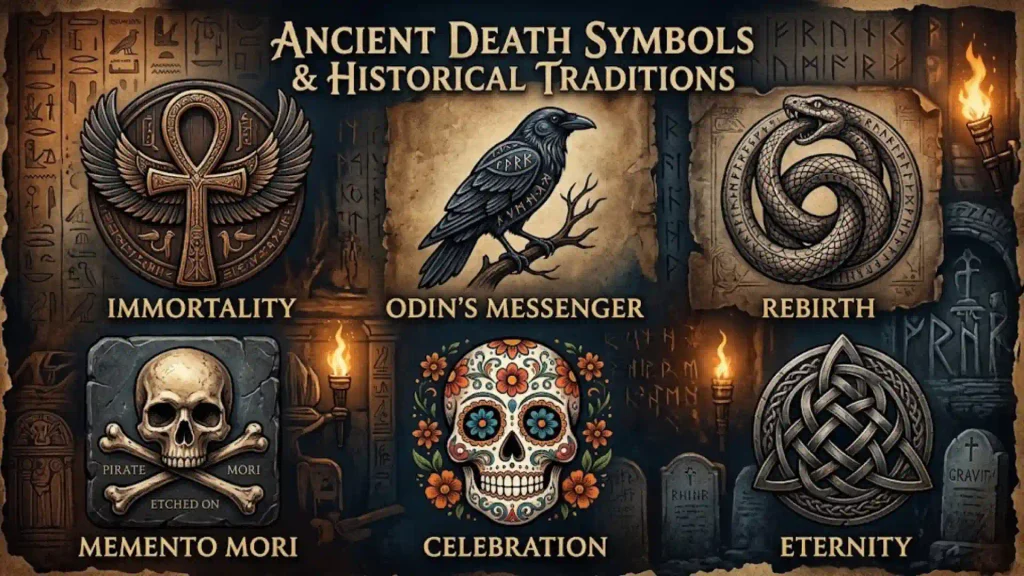
Ancient societies developed detailed ways to represent death, burial, and the afterlife. Their symbols often reflected beliefs about the soul, divine judgment, protection, and the journey beyond physical life.
Anubis: Ancient Egyptian God of the Dead
Anubis is one of the most recognizable figures in ancient Egyptian funerary art. He is usually shown with a human body and the head of a jackal.
He was connected to embalming, burial, protection of tombs, and the judgment of the dead.
Anubis also supervised the weighing of the heart ceremony. In this scene, the deceased person’s heart was weighed against the feather of Ma’at, which represented truth and order.
If the heart passed the test, the deceased could continue toward the afterlife. If it failed, a terrifying creature known as Ammut could devour it.
This imagery shows that ancient Egyptian death symbolism was closely connected to morality and the hope of life after death.
For further historical detail, see the University of Michigan’s exhibition on Anubis and the Metropolitan Museum of Art’s Egyptian funerary collection.
Ma’at and the Feather of Truth
Ma’at represented truth, balance, justice, and cosmic order in ancient Egyptian belief.
Her feather played an important role in the judgment of the dead. The deceased person’s heart was weighed against it to determine whether they had lived according to the principles of truth and order.
The feather is therefore connected to divine judgment, moral responsibility, and the afterlife, rather than death alone.
Greek Theta (Θ)
The Greek letter theta has been associated with death in some historical contexts. Certain ancient Greek inscriptions and traditions used the letter in ways connected to death or mortality.
However, theta is not a universal Greek symbol of death. Its interpretation depends on the specific inscription, period, and historical evidence.
It is important not to treat every appearance of the letter as a death reference.
Japanese Shi (死)
The Japanese character 死 means death.
It is pronounced shi in one common reading. The number four can also be pronounced shi in Japanese, creating an association between the number and death.
Because of this sound connection, some people avoid the number four in particular settings. For example, certain buildings and products may avoid number combinations considered unlucky.
These customs vary, and not every Japanese person follows them.
Banshee in Irish Folklore
A banshee is a supernatural female figure in Irish folklore. Her wailing cry is traditionally associated with the coming death of someone in a family.
The banshee is not usually described as causing death. Instead, she serves as a warning or messenger connected to an approaching loss.
The figure reflects the importance of oral storytelling, family history, and supernatural beliefs in Irish culture.
Yama: Lord of Death
Yama appears in Hindu and Buddhist traditions as a figure associated with death and the judgment or destiny of beings.
In Hindu traditions, Yama is commonly described as the god of death and ruler of the departed. In Buddhist imagery, Yama may appear holding or surrounding the Wheel of Life, reminding viewers of impermanence and the cycle of existence.
His role and interpretation differ across religious traditions.
Religious Death Symbols and the Afterlife
Religious symbols often communicate ideas about death beyond the physical body. They can represent sacrifice, resurrection, judgment, spiritual guidance, or hope for eternal life.
Christian Cross
The Christian cross is closely connected with the death of Jesus Christ by crucifixion.
For Christians, it represents sacrifice, redemption, faith, and the hope of resurrection. It is also one of the most common symbols found on Christian graves and memorials.
Although the cross is connected to death, its meaning is not limited to mourning. It also expresses the Christian belief in victory over death and the promise of eternal life.
Star of David
The Star of David is a major symbol of Jewish identity and tradition. It consists of two overlapping triangles that form a six-pointed star.
It sometimes appears on Jewish gravestones and memorials. In those settings, it can identify religious or cultural heritage.
However, the Star of David is not specifically a symbol of death. Its primary meaning is connected to Jewish identity.
Crescent Moon and Star
The crescent moon and star is widely recognized as an emblem associated with several Muslim communities and countries. It has historical and cultural associations, but it is not a universal symbol of Islam.
It should not be described as a general Islamic symbol of death or the afterlife. Islamic funeral traditions are more strongly shaped by religious teachings and practices, including prayers, burial, and remembrance.
Angels
Angels appear frequently in religious art, cemeteries, and memorial sculptures.
They may represent divine protection, spiritual guidance, hope, or the connection between heaven and earth. A praying angel can express mourning, while an angel with wings spread may suggest protection or the soul’s journey.
The exact meaning depends on the angel’s pose, surrounding imagery, and religious tradition.
Lamb
The lamb is an important symbol in Christian art. It can represent innocence, sacrifice, purity, and Jesus Christ, who is often called the Lamb of God.
On gravestones, a lamb may symbolize innocence and is sometimes used on children’s graves.
It is not simply a general symbol of death. Its meaning comes mainly from Christian religious imagery.
Buddha and Death
Buddhist teachings often emphasize impermanence, the idea that all conditioned things change and eventually pass away.
Death is understood within the broader cycle of birth, aging, death, and rebirth known as samsara.
Buddhist art uses symbols such as the Wheel of Life to explain this cycle. The goal is not simply to escape physical death but to overcome ignorance and suffering through spiritual understanding.
Symbols of Death and Rebirth
Some symbols represent the end of life, while others express the possibility of renewal or transformation. They remind people that death and change are often understood as parts of a larger cycle.
Phoenix
The phoenix is a mythical bird associated with fire, death, and rebirth.
According to familiar versions of the legend, the phoenix dies in flames and rises again from its ashes. This makes it a powerful symbol of renewal after destruction.
People use the phoenix to represent:
- Starting again after a difficult experience.
- Recovery after loss.
- Personal transformation.
- Hope after hardship.
- Immortality and renewal.
The phoenix is one of the clearest examples of a symbol connecting death with rebirth.
Ankh
The ankh is an ancient Egyptian symbol shaped like a cross with a loop at the top.
It represents life and is often interpreted as a sign of eternal life. Ancient Egyptian gods and rulers appear holding ankhs in temple reliefs and other artworks.
The ankh is important to death-related symbolism because ancient Egyptian beliefs connected life on earth with continued existence after death.
However, the ankh is primarily a symbol of life, not a direct symbol of physical death.
Tree of Life
The Tree of Life appears in several religious, cultural, and philosophical traditions.
It often represents creation, growth, family connections, wisdom, and the relationship between different forms of existence.
Its roots, trunk, and branches can suggest the connection between the past, present, and future. In some interpretations, it also represents the cycle of life, death, and renewal.
The Tree of Life does not have one universal meaning. Its symbolism changes between traditions.
Yin-Yang
The yin-yang symbol comes from Chinese philosophy and represents complementary forces that exist in relationship with one another.
Yin and yang are not simply good and evil. They describe qualities such as dark and light, passive and active, and other opposing but interconnected aspects of existence.
People sometimes connect the symbol with life and death because it expresses change, balance, and the relationship between opposites.
However, yin-yang is not specifically a death symbol. It represents a much broader philosophical idea.
Green Man
The Green Man is a face formed from or surrounded by leaves, vines, and foliage. It appears in European decorative art, including some medieval churches and buildings.
The figure is often associated with nature, vegetation, growth, and the return of life.
Some modern interpretations connect the Green Man with seasonal cycles and rebirth. However, scholars do not agree on one universal ancient meaning.
It is more accurate to describe it as a symbol associated with nature and renewal than as a confirmed ancient death symbol.
Triple Spiral and Triskele
The triple spiral is an ancient decorative motif found in prehistoric and later Celtic-associated art.
The triskele is a three-part spiral design. Its repeated movement can suggest motion, cycles, or connected forms.
Modern interpretations sometimes connect the three parts with life, death, and rebirth. Other readings include land, sea, and sky or past, present, and future.
These meanings should be treated as interpretations rather than one proven original definition.
Buddhist Wheel of Life
The Buddhist Wheel of Life, known as the Bhavachakra, is a complex diagram that explains samsara, the cycle of birth, death, and rebirth.
It commonly appears in Tibetan Buddhist art. The wheel illustrates how ignorance, attachment, and aversion contribute to suffering and continued existence within samsara.
Its sections represent different realms of existence, while the outer ring shows the links that contribute to the cycle of rebirth.
The Wheel of Life is not simply a picture of death. It explains why beings remain caught in repeated cycles of existence and how spiritual understanding can lead toward liberation.
Endless Knot
The Endless Knot is an important symbol in Tibetan Buddhism and other Buddhist traditions.
Its interwoven lines have no obvious beginning or end. They can represent interdependence, the relationship between cause and effect, and the interconnected nature of existence.
The symbol is sometimes connected with the ongoing cycle of life and rebirth. However, its meaning is broader than death alone.
Death Symbols in Art and Literature
Artists and writers have used death imagery to explore mortality, fear, war, love, religion, and the meaning of life.
Some symbols became especially influential because they appeared repeatedly in paintings, books, prints, and films.
La Danse Macabre: The Dance of Death
La Danse Macabre, also called the Dance of Death, is a medieval European artistic tradition.
It commonly shows skeletons dancing with people from different social classes, including kings, religious leaders, merchants, and ordinary workers.
The central message is that death comes to everyone. Wealth, authority, and social position cannot make a person immortal.
The tradition became especially prominent in late-medieval Europe. One early major example was a mural at the Cemetery of the Holy Innocents in Paris, associated with the year 1425.
The Dance of Death later appeared in printed books, woodcuts, paintings, and other forms of art. It remains one of the most recognizable historical expressions of human mortality.
The Three Living and the Three Dead
The Three Living and the Three Dead is a medieval European literary and artistic theme.
It tells of three living men who encounter three dead bodies. The dead remind the living that wealth, beauty, and worldly success cannot prevent death.
The story is often used as a moral lesson. It encourages people to remember their mortality and consider how they live.
The theme is closely connected to memento mori because both remind viewers that earthly life is temporary.
Death Playing Chess
Death playing chess is a visual and literary motif in which a living person plays a game against Death.
The image suggests that human beings cannot control the final outcome of life. Chess becomes a metaphor for the struggle between human choices and mortality.
The motif became widely recognizable through Ingmar Bergman’s 1957 film The Seventh Seal, in which a knight plays chess with Death.
The film helped make this image familiar to modern audiences. However, it should be understood as an artistic representation, not an ancient universal symbol.
La Catrina
La Catrina is a famous Mexican skeletal figure associated with Día de los Muertos.
The artist José Guadalupe Posada popularized the image through his satirical illustrations. The original figure, often called La Calavera Garbancera, criticized people who rejected their Mexican identity while trying to imitate European upper-class fashion.
The elegant skeleton later became strongly associated with Día de los Muertos.
La Catrina represents more than death. She can also communicate social criticism, cultural identity, humor, and the idea that death comes to people regardless of wealth or status.
Death Imagery in Literature
Writers use death symbols to communicate ideas that go beyond the physical end of life.
Some well-known examples include:
- The Masque of the Red Death: Edgar Allan Poe uses disease, time, and death imagery to explore the limits of wealth and human power.
- In Flanders Fields: John McCrae’s poem helped establish the red poppy as a symbol of remembrance for war dead.
- The Seventh Seal: The chess game with Death explores faith, uncertainty, and mortality.
- Memento mori artwork: Paintings featuring skulls, candles, and hourglasses remind viewers that life is temporary.
These examples show how symbols of death can carry historical, emotional, and philosophical meanings.
Death Symbols in Different Cultures and Mythologies
Death-related beliefs differ across the world. Some traditions focus on the journey of the soul, while others emphasize remembrance, reincarnation, spiritual judgment, or the relationship between ancestors and living family members.
Ancient Egyptian Culture
Ancient Egyptian beliefs included detailed ideas about the afterlife. People prepared bodies for burial, placed objects in tombs, and used religious texts and images to support the deceased.
Important symbols and figures included:
- Anubis: Connected with embalming, tomb protection, and judgment.
- Ma’at’s feather: Represented truth and balance during the weighing of the heart.
- The scarab: Associated with transformation, renewal, and the rising sun.
- The ankh: Represented life and eternal existence.
- Sarcophagi: Protected the deceased and often carried religious imagery.
These symbols reflect the importance of preparation for the afterlife in ancient Egyptian society.
Greek and Roman Mythology
Greek mythology includes several figures and ideas connected to death.
Hades ruled the underworld, while Charon transported souls across the river associated with the world of the dead. Thanatos personified death, and the Fates represented the course of human life.
In Roman mythology, Pluto was associated with the underworld. Roman funerary traditions also used tombs, inscriptions, and memorial objects to honor the dead.
These traditions influenced later European art and literature.
Norse Mythology
Norse mythology includes several beliefs about death and the afterlife.
Odin was associated with slain warriors who were taken to Valhalla. The Valkyries selected certain warriors who died in battle.
Odin’s ravens, Huginn and Muninn, traveled through the world and brought him information. Their connection with memory and thought is more direct than any universal association with death.
Norse traditions also include Hel, a figure associated with a realm of the dead.
Celtic and Irish Traditions
Celtic and Irish folklore includes stories about supernatural beings, death omens, and the boundary between the living and the dead.
The banshee is one of the best-known examples. Her wail traditionally warns that a death is approaching within a family.
Samhain, a Gaelic seasonal festival, is also associated in later folklore and modern interpretations with the boundary between the living and the dead. Its historical practices and meanings changed over time, so it should not be reduced to a single simple belief.
Japanese Culture
Japanese death symbolism includes religious, cultural, and linguistic elements.
The character 死 means death, and the pronunciation shi is also associated with the number four. This sound connection helps explain why some people avoid certain number combinations.
Buddhist traditions have also influenced Japanese funeral customs and beliefs about impermanence, the soul, and remembrance.
Mexican Culture and Día de los Muertos
Día de los Muertos is a Mexican tradition focused on remembering and honoring deceased loved ones.
Families may create ofrendas, or offerings, with photographs, candles, food, water, and marigolds. They may also decorate with skulls, skeletons, and papel picado.
The holiday is celebrated on November 1 and 2, although local practices and events vary.
Important symbols include:
- Marigolds: Their color and scent are traditionally associated with welcoming the spirits of the deceased.
- Sugar skulls: Decorated skulls that honor the dead and reflect the connection between life and death.
- La Catrina: A skeletal figure associated with Mexican identity and social commentary.
- Candles: Used to illuminate and decorate the ofrenda.
- Photographs: Help families remember the people they are honoring.
- Food and water: Offerings that reflect hospitality and care for deceased loved ones.
Día de los Muertos is not simply a celebration of death. It is a family-centered tradition of memory, connection, and respect.
Hinduism and Buddhism
Hindu and Buddhist traditions include beliefs about karma, rebirth, and the cycle of existence.
In Hindu traditions, Yama is associated with death and the departed. The concepts of karma and reincarnation help explain how actions relate to future existence.
In Buddhism, samsara describes the cycle of birth, death, and rebirth. The Wheel of Life illustrates this cycle and the role of ignorance, attachment, and karma.
Although these traditions share some concepts, their teachings about the self, rebirth, and liberation are not identical.
Jewish and Islamic Traditions
Jewish and Islamic funeral customs are shaped by religious teachings, community practices, and respect for the deceased.
In Jewish tradition, the Star of David may appear on gravestones as a marker of Jewish identity. It is not specifically a death symbol.
Islamic funeral traditions emphasize prayer, burial, and respect for the body. There is no single universal Islamic image that represents death in the way the Grim Reaper does in popular Western imagery.
It is more accurate to understand these traditions through their beliefs and practices rather than assigning them symbols they do not universally use.
Tombstone Symbols and Their Meanings
Gravestones often include decorative images that communicate religious beliefs, personal qualities, or hopes for the deceased.
The following table explains several common examples.
| Tombstone symbol | Common meaning |
| Cross | Christian faith, sacrifice, and resurrection |
| Angel | Spiritual protection, guidance, and hope |
| Dove | Peace, purity, and the soul |
| Lamb | Innocence and Christian symbolism |
| Broken column | A life cut short |
| Weeping willow | Grief, mourning, and sorrow |
| Laurel wreath | Honor, achievement, and remembrance |
| Ivy | Attachment, loyalty, and continuing life |
| Hourglass | Passage of time and mortality |
| Extinguished candle | The end of life |
| Open book | A life story, faith, or knowledge |
| Rose | Love, beauty, and remembrance |
These interpretations are common associations, not fixed rules. A symbol may have a personal meaning known only to the deceased’s family.
How to Understand Death Symbols Correctly
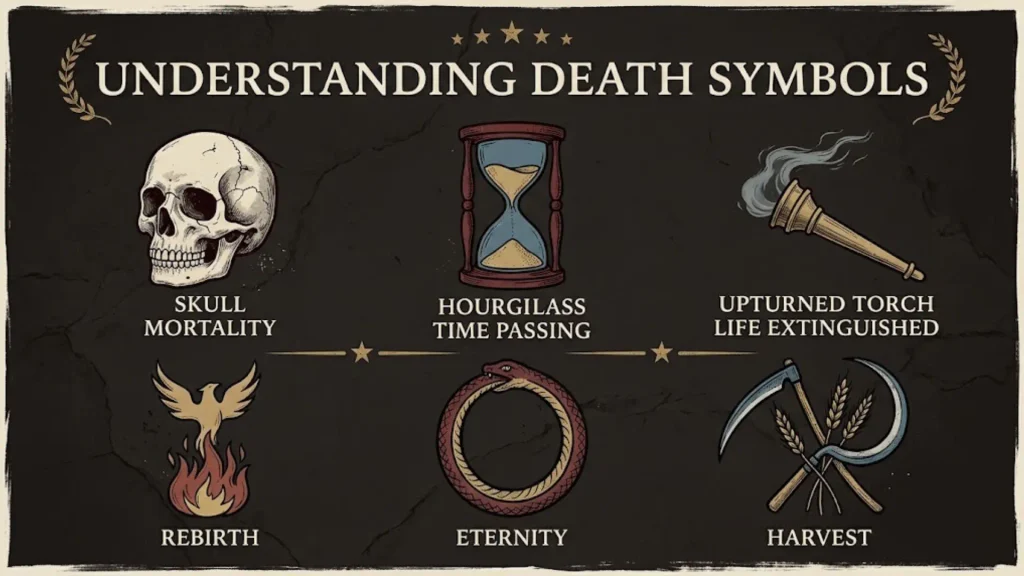
A symbol’s meaning can change depending on where and how it appears. Before interpreting a death-related image, consider a few important points.
Look at the cultural context. A white flower may represent mourning in one tradition and purity in another.
Separate direct symbols from related symbols. A coffin represents burial, while a butterfly may represent transformation or the soul in certain beliefs.
Check the historical background. The red poppy became a remembrance symbol through First World War history. It did not begin as a universal funeral flower.
Avoid assuming every animal is an omen. Owls, ravens, bats, and black cats have different meanings across cultures.
Distinguish religious beliefs from popular interpretations. Ankh, yin-yang, and the Buddhist Wheel of Life have specific meanings that should not be reduced to simple death symbols.
The most accurate interpretation considers the symbol’s history, purpose, and cultural setting.
Frequently Asked Questions About Symbols of Death
What are the most common symbols of death?
Common symbols of death include the skull, skeleton, Grim Reaper, scythe, coffin, tombstone, hourglass, and extinguished candle. These images are widely used to represent mortality, the end of life, and the passage of time.
What animal symbolizes death?
Ravens, crows, vultures, owls, and jackals are associated with death in certain cultures and traditions. Their meanings vary. For example, ravens can represent death or prophecy in some European folklore, while Anubis’s jackal imagery is connected with ancient Egyptian funerary beliefs.
What flower symbolizes death?
Chrysanthemums, marigolds, and white lilies are associated with funerals or remembrance in particular cultural settings. Red poppies are especially connected with remembering people who died in war.
No flower has one universal meaning, so local funeral customs matter.
What color represents death?
Black is a common mourning color in many Western cultures. White is used for mourning in several Asian traditions and can also represent purity or spiritual hope in other settings. Purple, gray, and red may carry additional meanings depending on the culture.
What is the symbol of death and rebirth?
The phoenix is one of the clearest symbols of death and rebirth. Its legendary cycle of dying in flames and rising from ashes represents renewal after destruction.
The Wheel of Life also relates to repeated cycles of birth, death, and rebirth in Buddhist teaching.
What does a skull symbolize?
A skull commonly represents death, mortality, and the temporary nature of human life. In memento mori artwork, it reminds viewers that physical beauty, wealth, and power do not last forever.
In Mexican Día de los Muertos traditions, decorated skulls can honor deceased loved ones and celebrate cultural remembrance.
What does the Grim Reaper symbolize?
The Grim Reaper represents death as an unavoidable force. Its skeleton body, dark robe, and scythe communicate the end of human life.
It is a personification of death found in European folklore and popular culture, rather than a universal religious figure.
What does memento mori mean?
Memento mori is a Latin phrase meaning “remember that you must die.” It describes an artistic and philosophical tradition that encourages people to remember their mortality and value the time they have.
Skulls, hourglasses, extinguished candles, and wilting flowers are common memento mori images.
Does the ankh symbolize death?
No. The ankh primarily symbolizes life and eternal life in ancient Egyptian culture. It is connected to death-related beliefs because ancient Egyptians believed in continued existence after physical death.
What does the butterfly symbolize after someone dies?
Some spiritual beliefs interpret butterflies as symbols of the soul, transformation, or a loved one’s continued presence. Others simply see them as reminders of change and renewal.
These interpretations are matters of personal or cultural belief rather than scientific evidence.
Is the crescent moon and star a symbol of death in Islam?
No. The crescent moon and star is associated with some Muslim communities and countries, but it is not a universal Islamic symbol of death. Islamic funeral practices are based on religious teachings and customs rather than one universal death emblem.
What is the difference between death symbols and mourning symbols?
Death symbols generally represent mortality, physical death, or the afterlife. Mourning symbols communicate grief, sympathy, remembrance, and respect for someone who has died.
Some images, such as skulls, candles, and funeral flowers, can belong to both categories depending on their use.
Conclusion: The Meaning Behind Symbols of Death
Symbols of death reveal how people understand mortality, grief, memory, and the unknown. A skull can remind us that life is temporary, while a red poppy can honor people who died in war. A marigold may welcome memories of loved ones, and a phoenix can represent the strength to begin again.
Some symbols have clear historical meanings. Others carry different interpretations across cultures and religions. That is why context matters when exploring symbols of death and rebirth.
Whether you are studying ancient mythology, religious traditions, funeral customs, or death imagery in art and literature, these symbols offer a deeper look at how people remember the dead and make sense of life’s final chapter.
Hi, I’m Sienna Brooks, and I believe that the right words can inspire, comfort, and empower people at every stage of life. For as long as I can remember, I’ve been drawn to meaningful quotes and the stories behind them. I love curating collections of inspirational, motivational, and heartfelt quotes that resonate with readers around the world.
Through my writing, I strive to help others find encouragement, whether they’re celebrating life’s happiest moments or navigating its biggest challenges. I believe that wisdom is timeless, and I’m passionate about sharing words that leave a lasting impact.
I am the author of Reflections in Words and The Journey of Inspiration, two books dedicated to exploring the beauty and power of timeless quotes.
 Asher Monroe
 Rowan Sinclair Rowan Sinclair