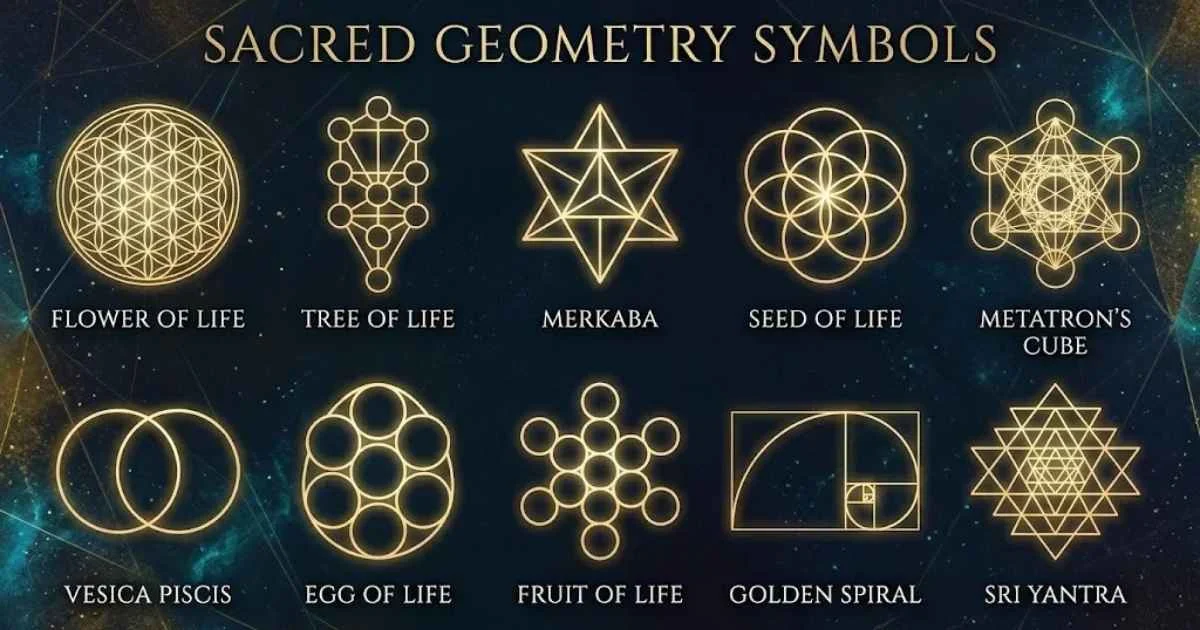
Sacred geometry symbols bring mathematics, art, nature, and spirituality together through fascinating shapes and patterns. From the Flower of Life and Metatron’s Cube to the Platonic solids and Golden Spiral, these designs have inspired artists, architects, philosophers, and spiritual traditions for centuries.
At their foundation, sacred geometry explores the mathematical relationships behind shapes, proportions, symmetry, and repeating patterns. Some of its ideas come from established mathematics and historical art. Others belong to religious traditions or modern spiritual interpretations.
You can find geometric designs in ancient architecture, religious artwork, Islamic mosaics, mandalas, and contemporary decorative pieces. Their appeal often comes from their balance, repetition, and visual harmony.
But what do these symbols actually mean? How do you construct them? And which claims about sacred geometry have a mathematical or historical basis?
This guide explores the most important sacred geometry symbols and meanings, explains their mathematical foundations, and shows how different cultures have used geometric patterns in art, architecture, and spiritual practice.
What Is Sacred Geometry?
Sacred geometry is the study and interpretation of geometric shapes, proportions, and patterns that people associate with spiritual ideas, religious symbolism, or the structure of the natural world.
It connects basic mathematical elements, such as circles, triangles, squares, and polygons, with broader ideas about balance, creation, unity, and order.
The word sacred refers to the spiritual or symbolic importance that different traditions attach to certain shapes. Geometry itself is a branch of mathematics that studies points, lines, angles, surfaces, and three-dimensional forms.
For example, a circle can represent wholeness or eternity in a symbolic context. Mathematically, however, it is a two-dimensional shape whose points are equally distant from a central point.
Both interpretations can exist together, but they are not the same kind of explanation.
The Main Principles of Sacred Geometry
Several mathematical ideas appear repeatedly in sacred geometry artwork and designs.
- Symmetry: A balanced arrangement in which parts of a shape correspond to one another.
- Proportion: The relationship between the sizes of different parts of a design.
- Repetition: Reusing a shape or motif to create a larger pattern.
- Intersection: The points or areas where geometric forms overlap.
- Radial symmetry: An arrangement in which elements extend around a central point.
- Tessellation: Covering a surface with shapes that fit together without gaps or overlaps.
- Fractals: Patterns that repeat similar structures at different scales.
- Geometric progression: A sequence in which values change according to a consistent mathematical ratio.
These principles help explain why sacred geometry patterns often look organized and harmonious.
Sacred Geometry and Mathematics: What Is the Difference?
Sacred geometry combines mathematical structures with interpretations that people give them.
The mathematical side includes measurable properties. You can calculate a circle’s radius, determine the angles of a polygon, or prove that a regular tetrahedron has four triangular faces.
The spiritual side explores what those shapes might represent. A person may interpret a circle as unity, a triangle as balance, or an interlocking geometric pattern as the relationship between different parts of existence.
The distinction matters because a mathematical fact does not automatically prove a spiritual claim.
For example, the Golden Ratio is a real mathematical constant. However, claims that it controls every natural pattern or appears intentionally in every ancient monument require separate evidence.
History and Origins of Sacred Geometry
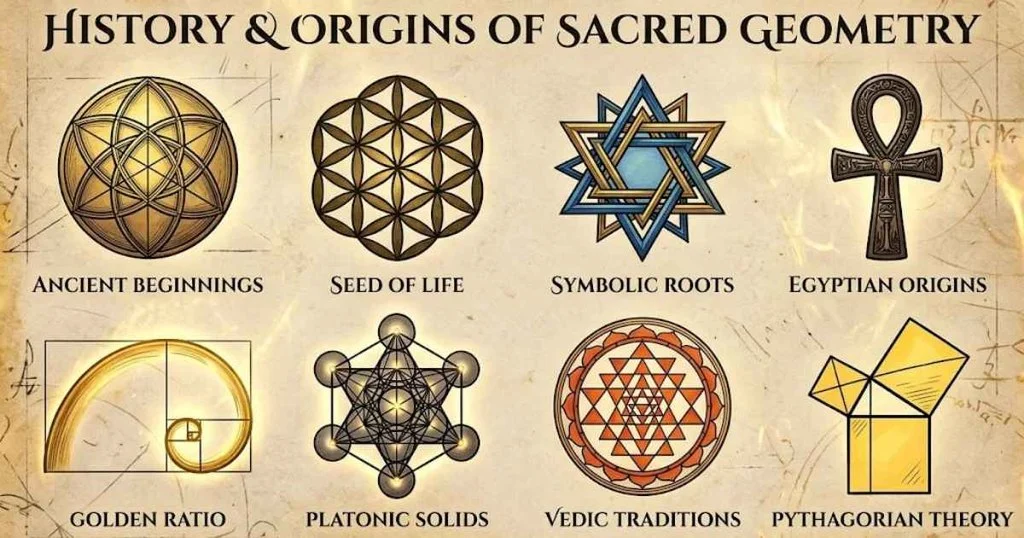
Geometric patterns appeared in human art and architecture long before the modern expression sacred geometry became popular.
Ancient communities used circles, triangles, squares, and symmetrical arrangements in pottery, textiles, buildings, monuments, and religious objects. These designs served practical, decorative, mathematical, and symbolic purposes.
Different civilizations developed their own geometric traditions. Their designs sometimes shared similar mathematical principles without necessarily having the same meaning.
Sacred Geometry in Ancient Civilizations
Ancient Greek thinkers made important contributions to the mathematical study of geometry.
Pythagoras and his followers explored numerical relationships, proportions, and mathematical harmony. Later, Plato discussed regular three-dimensional forms and their relationship to the structure of the cosmos in his work Timaeus.
Euclid’s Elements, written around 300 BCE, organized a large body of geometric knowledge into definitions, propositions, and mathematical proofs. Its treatment of regular polyhedra remains important to the history of geometry.
Ancient Egyptian architecture also demonstrates sophisticated measurement and geometric planning. Builders used practical surveying, alignment, and proportion to construct monumental structures.
However, modern claims that every pyramid or ancient monument deliberately encodes the Golden Ratio or a complete sacred geometry system should be treated carefully. A mathematical relationship discovered in a building does not, by itself, establish the builders’ intentions.
Sacred Geometry in Hindu and Buddhist Traditions
Geometric patterns play an important role in several Hindu and Buddhist traditions.
A mandala is a symbolic diagram that often uses circles, squares, and repeated geometric arrangements. Depending on the tradition, it may represent a sacred space, a spiritual universe, or a framework for meditation.
In Hindu traditions, the Sri Yantra is a well-known geometric diagram made from nine interlocking triangles arranged around a central point. Its complex structure creates smaller triangles and surrounding geometric elements.
Buddhist mandalas can also contain detailed geometric arrangements. Some are used in meditation and ritual practices, where their shapes and sections have specific meanings within a particular tradition.
Sacred Geometry in Islamic Art and Architecture
Islamic art is especially famous for its sophisticated geometric patterns.
Artists and craftspeople developed intricate designs using circles, squares, stars, polygons, and repeating units. These patterns appear on mosque walls, ceilings, tiles, manuscripts, ceramics, textiles, and architectural surfaces.
The Metropolitan Museum of Art explains that Islamic geometric decoration developed through the adaptation and elaboration of earlier artistic traditions, including Greek, Roman, Byzantine, and Sasanian influences. Mathematical knowledge also contributed to the precision of these designs. <sup>Source: The Metropolitan Museum of Art</sup>
Common features include:
- Repeating star patterns.
- Interlocking polygons.
- Radial symmetry.
- Repeated circles and geometric grids.
- Complex arrangements of straight and curved lines.
- Patterns that appear to continue beyond the decorated surface.
The designs often create a sense of balance and visual continuity.
Islamic geometric art is not simply a collection of sacred symbols. It is also a highly developed artistic tradition with its own construction methods, regional styles, and mathematical sophistication.
Sacred Geometry in Christianity and Jewish Mysticism
Geometric forms also appear in Christian and Jewish religious traditions.
Christian artwork uses circles, crosses, interlocking shapes, and almond-shaped frames called mandorlas. The fish-shaped Ichthys became an important Christian symbol.
In Jewish mysticism, the Tree of Life is associated with the Kabbalistic arrangement of ten Sephirot, which represent different aspects of divine manifestation within that tradition.
These examples show that geometric shapes can carry different meanings depending on their religious and cultural settings.
Important Sacred Geometry Symbols and Their Meanings
Sacred geometry includes many recognizable symbols. Some are based on straightforward mathematical constructions, while others have religious, cultural, or modern spiritual associations.
Here are the most commonly discussed sacred geometry symbols and their meanings.
Vesica Piscis: The Symbol of Overlapping Circles
<PRIVATE_PERSON>
The Vesica Piscis is a lens-shaped figure created by the intersection of two circles with the same radius.
To construct it, draw two equal circles so that the center of each circle lies on the circumference of the other. The overlapping area forms the Vesica Piscis.
Its distinctive shape resembles an almond or pointed oval.
Vesica Piscis Meaning
In modern sacred geometry interpretations, the Vesica Piscis often represents:
- Unity and connection.
- Creation and new beginnings.
- The meeting of two complementary forces.
- Balance between different aspects of existence.
- The relationship between two separate forms.
In Christian art, related almond-shaped designs appear as mandorlas, which frame sacred figures.
The Vesica Piscis is also mathematically interesting because its proportions can be calculated using basic circle geometry.
Seed of Life: The Seven-Circle Sacred Geometry Symbol
The Seed of Life is a circular geometric pattern made from seven equal-sized circles.
It contains one central circle surrounded by six circles. Each outer circle overlaps the central circle and creates a symmetrical flower-like arrangement.
The design has sixfold rotational symmetry.
Seed of Life Meaning
Modern spiritual interpretations often associate the Seed of Life with:
- Creation and new beginnings.
- Growth and development.
- Unity and interconnectedness.
- The stages of life.
- The foundations of the Flower of Life.
Some interpretations connect its seven circles with the seven days of creation described in Genesis. This is a symbolic association rather than proof that the pattern originated as a biblical diagram.
The Seed of Life is also popular in sacred geometry art, jewelry, meditation artwork, and decorative designs.
Egg of Life: A Symbol of Creation and Development
The Egg of Life is a geometric arrangement commonly described in contemporary sacred geometry teachings as eight spheres arranged in a cubic pattern.
It is often presented as a three-dimensional development of the Seed of Life.
The name comes from its association with early development, growth, and the formation of life.
Egg of Life Meaning
Its common symbolic interpretations include:
- Potential and transformation.
- The beginning of life.
- Development and growth.
- The relationship between structure and creation.
- The organization of three-dimensional space.
Some modern teachings connect the Egg of Life with embryonic development and musical relationships. These are symbolic interpretations, not established scientific descriptions of how embryos or sound work.
The distinction is important: a geometric model can inspire an idea without being a biological or acoustic explanation.
Flower of Life: One of the Most Recognizable Sacred Geometry Symbols
<PRIVATE_PERSON>
The Flower of Life is one of the best-known sacred geometry patterns.
It consists of multiple equally sized, overlapping circles arranged in a symmetrical design. The repeated circles create a flower-like appearance.
A common central arrangement contains 19 complete circles. Larger versions may include additional circles and outer boundaries.
The pattern is popular in spiritual artwork, jewelry, tattoos, wall decorations, and meditation spaces.
Flower of Life Meaning
The Flower of Life is commonly associated with:
- Unity and interconnectedness.
- The natural world.
- Creation and growth.
- Balance and harmony.
- The relationship between individual parts and a larger whole.
Some modern interpretations describe it as a blueprint of creation or a visual representation of universal patterns. Those descriptions belong to spiritual symbolism rather than established scientific theory.
Flower of Life Geometry
The mathematical structure is easier to understand when you examine its repeated circles.
Each circle has the same radius. Their centers follow a regular arrangement, producing overlapping intersections and a repeating pattern.
The design demonstrates:
- Circular repetition.
- Sixfold symmetry.
- Equal-radius construction.
- Intersections between neighboring circles.
- Radial organization.
The common 19-circle arrangement should not be confused with every larger version of the Flower of Life. Different diagrams use different numbers of surrounding circles.
Fruit of Life: The Thirteen-Circle Pattern
The Fruit of Life is a geometric arrangement commonly shown as 13 circles selected from the larger Flower of Life pattern.
The circles are arranged symmetrically, often with one central circle and surrounding groups.
In contemporary sacred geometry, the Fruit of Life is frequently presented as a foundation for constructing Metatron’s Cube.
Fruit of Life Meaning
Its common symbolic associations include:
- Creation and manifestation.
- The organization of the universe.
- Interconnectedness.
- Mathematical order.
- The relationship between simple and complex structures.
The 13-circle arrangement has a clear geometric form. Its spiritual interpretations vary among modern sacred geometry communities.
Fruit of Life and Metatron’s Cube
In a common construction, the centers of the 13 circles are marked and connected with straight lines.
Connecting every center to every other center creates a network of 78 possible pairwise connections.
This is because the number of unique connections between 13 points is:
[
\frac{13(13-1)}{2}=78
]
The resulting line pattern is commonly associated with Metatron’s Cube.
Metatron’s Cube: The Sacred Geometry Symbol of Structure
<PRIVATE_PERSON>
Metatron’s Cube is a geometric figure formed by connecting the centers of 13 circles in a common Fruit of Life arrangement.
The resulting diagram contains a complex network of straight lines and geometric intersections.
It is one of the most recognizable symbols in modern sacred geometry.
Metatron’s Cube Meaning
Modern spiritual interpretations commonly associate the symbol with:
- Balance and harmony.
- Creation and structure.
- Unity and interconnectedness.
- Protection.
- The relationship between different geometric forms.
Some teachings connect Metatron’s Cube with the five Platonic solids. These solids can be represented through particular geometric constructions within the diagram, depending on the method used.
It is important to distinguish the mathematical construction from claims about supernatural energy or protection. Those claims are not established by the geometry itself.
Metatron’s Cube and the Platonic Solids
The five Platonic solids are:
- Tetrahedron.
- Cube.
- Octahedron.
- Dodecahedron.
- Icosahedron.
Each is a regular convex polyhedron. Its faces are identical regular polygons, and the same arrangement of faces meets at every vertex.
These solids have precise mathematical properties that make them important in geometry.
Tree of Life: The Kabbalistic Sacred Geometry Symbol
<PRIVATE_PERSON>
The Tree of Life, also called Etz Chaim, is a central diagram in Kabbalistic Jewish mysticism.
It commonly contains ten interconnected circles known as Sephirot and 22 connecting paths.
The Sephirot represent different attributes or aspects of divine manifestation within Kabbalistic thought.
Tree of Life Meaning
The Tree of Life is often used to explore:
- Divine attributes.
- Spiritual development.
- The relationship between the divine and the created world.
- Different levels of understanding.
- The structure of existence within Kabbalistic teachings.
The ten Sephirot are commonly named:
- Keter — Crown.
- Chokhmah — Wisdom.
- Binah — Understanding.
- Chesed — Loving-kindness.
- Gevurah — Strength or judgment.
- Tiferet — Beauty or harmony.
- Netzach — Endurance or victory.
- Hod — Splendor.
- Yesod — Foundation.
- Malkhut — Kingdom.
Different Kabbalistic sources explain these concepts in nuanced ways.
Tree of Life vs. Yggdrasil
The Kabbalistic Tree of Life is not the same as Yggdrasil, the World Tree from Norse mythology.
Yggdrasil is a mythological tree connecting different realms in the Norse cosmos. It is not the ten-Sephirot diagram used in Kabbalah.
Both use the image of a tree to express relationships and structure, but they come from different traditions.
Grid of Life: A Repeating Geometric Structure
The Grid of Life is a term used in contemporary sacred geometry for arrangements of repeated geometric units.
One version is associated with a 64-tetrahedron grid, which uses tetrahedral forms arranged in a three-dimensional structure.
The name can refer to different diagrams, so it is important to identify the exact construction being discussed.
Grid of Life Meaning
Modern interpretations often connect the Grid of Life with:
- Order and organization.
- Interconnected systems.
- Three-dimensional structure.
- Balance and symmetry.
- The relationship between individual units and a larger whole.
The 64-tetrahedron grid is a contemporary sacred geometry concept. It should not be presented as a universally recognized ancient symbol or a proven blueprint of the physical universe.
Torus: The Ring-Shaped Geometric Form
A torus is a three-dimensional surface shaped like a doughnut.
You can imagine creating one by rotating a circle around an axis in the same plane as the circle, without allowing the circle to cross that axis.
The resulting surface has a central opening.
Torus Meaning in Sacred Geometry
In contemporary spiritual interpretations, the torus is often associated with:
- Cycles and continuity.
- Flow and movement.
- Renewal.
- Balance.
- Circular patterns of interaction.
The torus also has practical mathematical and scientific applications. It appears in topology, geometry, fluid dynamics, and models of certain physical systems.
However, the existence of a torus in mathematics or science does not establish every spiritual claim made about its energy or universal significance.
Merkaba: The Star Tetrahedron Symbol
<PRIVATE_PERSON>
The Merkaba is commonly shown in modern sacred geometry as a three-dimensional star tetrahedron.
This figure consists of two interlocking tetrahedra, often illustrated as one pointing upward and the other downward.
The overlapping arrangement creates a distinctive three-dimensional star shape.
Merkaba Meaning
Modern esoteric interpretations commonly associate the Merkaba with:
- Spiritual transformation.
- Balance between opposing forces.
- Protection.
- Meditation.
- The relationship between physical and spiritual existence.
The word is also connected to the Hebrew term Merkavah, meaning chariot, which has a distinct place in Jewish mystical traditions.
Merkaba and Merkavah should not be treated as interchangeable terms. The modern geometric symbol and the historical Jewish mystical tradition have related terminology but different contexts.
Monad: The Symbol of Unity
The Monad is a term used in philosophy, mathematics, and different spiritual traditions to describe a fundamental unit or principle.
In some sacred geometry artwork, the Monad is represented by a circle or a central point surrounded by a circle.
The central point can represent origin, while the surrounding circle defines a complete boundary.
Monad Meaning
Its common symbolic interpretations include:
- Unity.
- Oneness.
- The beginning of creation.
- Wholeness.
- A single source from which other forms emerge.
The Monad has different meanings across philosophical and religious traditions. It does not have one universal geometric design.
Reuleaux Triangle: A Constant-Width Geometric Shape
A Reuleaux Triangle is a curved triangular shape formed from three circular arcs.
To construct it, begin with an equilateral triangle. Use each vertex as the center of an arc that connects the other two vertices.
The resulting shape has a constant width. This means the distance between two parallel supporting lines remains the same as the shape rotates.
Reuleaux Triangle Meaning and Uses
In modern sacred geometry discussions, the Reuleaux Triangle may be associated with balance, motion, and geometric harmony.
Its more established importance is mathematical and practical.
For example, constant-width shapes have applications in mechanical design and engineering. The Reuleaux Triangle can also roll through certain square-shaped spaces in ways that ordinary circles cannot.
It is a mathematical shape first, rather than a universally recognized ancient spiritual symbol.
Mandorla: The Almond-Shaped Sacred Design
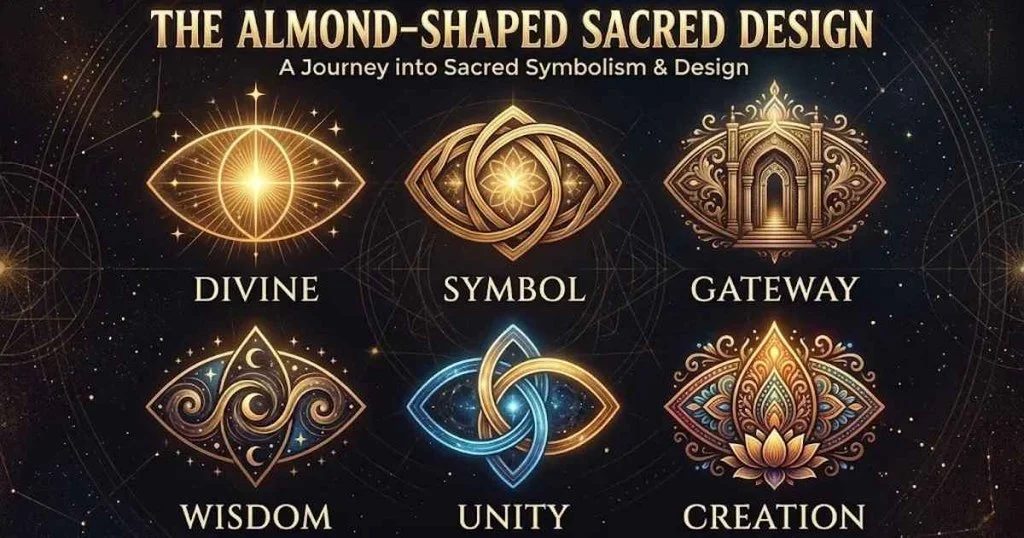
A Mandorla is an almond-shaped frame commonly used in Christian religious art.
It often surrounds a sacred figure, such as Christ or the Virgin Mary.
The shape resembles the lens formed by the intersection of two circles, making it visually related to the Vesica Piscis.
Mandorla Meaning
In Christian artwork, the Mandorla can communicate:
- Divine glory.
- Holiness.
- Spiritual presence.
- The meeting of heaven and earth.
- A sacred or transcendent space.
Its exact meaning depends on the artwork, period, and religious context.
Ichthys: The Christian Fish Symbol
The Ichthys is an ancient Christian fish symbol.
It is often drawn using two curved lines that meet at pointed ends, creating a fish-like outline. Similar arcs can be used to construct a shape related to the Vesica Piscis.
The Ichthys became a recognizable expression of Christian identity and faith.
Ichthys Meaning
The fish symbol is associated with:
- Christianity.
- Faith in Jesus Christ.
- Christian identity.
- Spiritual belonging.
The symbol is sometimes connected to the Greek word ichthys, meaning fish, and an early Christian phrase formed from the Greek letters of the word.
Its historical religious meaning should not be reduced to its geometric construction.
Triquetra: The Three-Cornered Knot
<PRIVATE_PERSON>
The Triquetra is a three-loop knot symbol formed by three interconnected arcs.
It appears in Celtic art, Christian artwork, and other cultural settings.
Its continuous lines create a balanced three-part design.
Triquetra Meaning
Depending on its context, the Triquetra can represent:
- Threefold unity.
- Eternity.
- Interconnection.
- Spiritual relationships.
- The Christian Trinity.
Some modern interpretations connect it with the three aspects of nature or different stages of life. These meanings are not universal.
The Triquetra is primarily a knotwork and symbolic motif rather than a standard geometric construction like a Platonic solid.
Yggdrasil: The Norse World Tree
Yggdrasil is the great World Tree in Norse mythology.
It connects different parts of the Norse cosmos and appears in stories involving gods, humans, and other beings.
The tree is often described as an ash tree, with roots and branches extending through different realms.
Yggdrasil Meaning
Yggdrasil is associated with:
- The structure of the cosmos.
- Life and renewal.
- Interconnected worlds.
- Fate and destiny.
- The relationship between different forms of existence.
Although it is sometimes included in modern sacred geometry collections, Yggdrasil is a mythological symbol, not a standard geometric diagram.
The Five Platonic Solids in Sacred Geometry
The Platonic solids are five regular convex polyhedra. They are among the most important three-dimensional forms in classical geometry.
Each solid has identical regular polygon faces. The same number and arrangement of faces meet at every vertex.
Plato discussed these forms in Timaeus, connecting four of them with classical elements and associating the fifth with the cosmos.
Platonic Solids and Their Meanings
| Platonic Solid | Faces | Edges | Vertices | Traditional Element |
| Tetrahedron | 4 | 6 | 4 | Fire |
| Cube (Hexahedron) | 6 | 12 | 8 | Earth |
| Octahedron | 8 | 12 | 6 | Air |
| Dodecahedron | 12 | 30 | 20 | Cosmos or universe |
| Icosahedron | 20 | 30 | 12 | Water |
The elemental associations come from Plato’s philosophical account, not modern physics.
Tetrahedron: The Fire Element
The tetrahedron has four triangular faces, six edges, and four vertices.
It is the simplest Platonic solid.
In Plato’s Timaeus, the tetrahedron is associated with fire. Modern sacred geometry interpretations often connect it with energy, transformation, and action.
Cube: The Earth Element
The cube, also called the hexahedron, has six square faces, 12 edges, and eight vertices.
Its equal sides and stable structure make it a familiar example of geometric balance.
In the classical Platonic system, the cube represents earth.
Octahedron: The Air Element
The octahedron has eight triangular faces, 12 edges, and six vertices.
It can be visualized as two square pyramids joined at their bases.
Plato associated it with air.
Icosahedron: The Water Element
The icosahedron has 20 triangular faces, 30 edges, and 12 vertices.
Its many faces give it a more rounded appearance than the tetrahedron or cube.
In the classical elemental system, it represents water.
Dodecahedron: The Cosmos or Aether
The dodecahedron has 12 pentagonal faces, 30 edges, and 20 vertices.
Plato associated it with the cosmos or the structure of the universe.
Some later interpretations connect it with aether, but that wording should be distinguished from Plato’s original discussion.
Why Are There Only Five Platonic Solids?
A regular convex polyhedron must satisfy strict geometric conditions.
Its faces must be identical regular polygons, and the same arrangement must meet at every vertex.
Only five forms satisfy these requirements in three-dimensional Euclidean geometry.
This is a mathematical result, not simply a spiritual tradition.
Golden Ratio and Sacred Geometry
The Golden Ratio is one of the most discussed mathematical ideas in sacred geometry.
It is represented by the Greek letter phi:
[
\phi=\frac{1+\sqrt{5}}{2}
]
Its approximate value is:
[
\phi\approx1.6180339887
]
The Golden Ratio appears when a line is divided into two parts so that the ratio of the entire line to the longer part equals the ratio of the longer part to the shorter part.
If the longer part is (a) and the shorter part is (b), then:
[
\frac{a+b}{a}=\frac{a}{b}=\phi
]
Golden Ratio Meaning
In modern sacred geometry interpretations, the Golden Ratio is associated with:
- Proportion and balance.
- Natural growth.
- Visual harmony.
- Mathematical order.
- Relationships between different sizes.
Its mathematical properties are well established. However, claims that it governs every beautiful object, natural structure, or ancient building are exaggerated.
Fibonacci Sequence and the Golden Ratio
The Fibonacci Sequence is a number sequence in which each number is the sum of the two preceding numbers.
It begins:
[
0,\ 1,\ 1,\ 2,\ 3,\ 5,\ 8,\ 13,\ 21,\ 34,\ 55,\ 89
]
As the sequence continues, the ratio between neighboring terms approaches the Golden Ratio.
For example:
[
\frac{34}{21}\approx1.619
]
[
\frac{55}{34}\approx1.618
]
The relationship becomes increasingly close as the numbers grow.
Golden Spiral and Fibonacci Spiral
A Golden Spiral is a logarithmic spiral whose radius increases by a factor related to the Golden Ratio for every quarter-turn.
A Fibonacci Spiral is a practical drawing approximation made by placing quarter-circle arcs inside adjoining squares whose side lengths follow Fibonacci numbers.
These two spirals can look similar, but they are not mathematically identical.
The distinction matters when discussing sacred geometry diagrams and mathematical accuracy.
Fibonacci Patterns in Nature
Fibonacci-related arrangements appear in some natural structures.
Examples include:
- Spiral arrangements in certain flower heads.
- The arrangement of leaves around some plant stems.
- The number of visible spiral families in some pinecones.
- Certain patterns in artichokes and pineapples.
However, not every flower, shell, leaf, or spiral follows the Fibonacci Sequence or Golden Ratio.
Natural growth is influenced by many biological and environmental factors. The Fibonacci relationship is an interesting pattern, not a universal rule.
Sacred Geometry in Four Dimensions: The 120-Cell and Other Polytopes
Sacred geometry discussions sometimes move beyond ordinary three-dimensional forms into four-dimensional geometry.
Mathematicians study higher-dimensional objects called polytopes. A polytope is a geometric structure that generalizes polygons and polyhedra into additional dimensions.
There are six regular convex polytopes in four-dimensional Euclidean space.
They are:
| Four-Dimensional Polytope | Common Name |
| 5-cell | 4-simplex |
| 8-cell | Tesseract or 4D hypercube |
| 16-cell | 4D cross-polytope |
| 24-cell | 24-cell |
| 120-cell | 120-cell |
| 600-cell | 600-cell |
What Is a 120-Cell?
The 120-cell is a regular four-dimensional polytope made of 120 dodecahedral cells.
It is the four-dimensional counterpart of a highly symmetrical geometric structure.
You cannot directly see a complete four-dimensional object in ordinary three-dimensional space. Instead, mathematicians study its projections, cross-sections, and mathematical descriptions.
What Is a Tesseract?
A tesseract is the four-dimensional equivalent of a cube.
A square is a two-dimensional shape. A cube extends that idea into three dimensions. A tesseract extends it into four dimensions.
Drawings of tesseracts often show one cube inside another, with corresponding vertices connected by lines.
These visualizations are projections. They do not show the complete four-dimensional object in the same way that a flat drawing of a cube does not reproduce every feature of a physical cube.
Sacred Geometry and Higher Dimensions
Some modern spiritual teachings connect four-dimensional geometry with consciousness, energy, or spiritual evolution.
Those interpretations are philosophical or symbolic. The mathematical existence of four-dimensional polytopes does not establish claims about hidden dimensions of human consciousness.
Sacred Geometry in Nature
Nature contains many patterns that remind people of sacred geometry.
From the symmetry of flowers to the structure of crystals, geometric arrangements appear throughout the natural world.
Scientists study these patterns through mathematics, biology, chemistry, and physics.
Common Geometric Patterns in Nature
Spiral patterns: Some plants arrange seeds, leaves, or scales in spiral patterns that can relate to Fibonacci numbers.
Radial symmetry: Many flowers and sea creatures display structures arranged around a central point.
Hexagonal patterns: Honeycomb cells use hexagonal geometry, which allows bees to create repeating cells with little wasted space.
Spherical forms: Bubbles and many droplets tend toward spherical shapes because surface tension influences their form.
Branching structures: Trees, river networks, and blood vessels display branching patterns shaped by growth and physical constraints.
Fractal-like structures: Ferns, coastlines, and branching plants can show similar patterns at different scales.
These examples reveal how mathematical relationships can help explain natural forms.
They do not mean that every natural structure was designed according to one universal sacred geometry diagram.
Sacred Geometry in Architecture and Art
Geometric principles have influenced architecture and decorative art across many cultures.
Builders and artists use symmetry, proportion, repetition, and spatial organization to create structures that look balanced and visually connected.
Sacred Geometry in Ancient Architecture
Ancient builders used geometry for measurement, planning, and construction.
Architectural designs often relied on:
- Symmetrical layouts.
- Repeated columns and structural elements.
- Proportional relationships.
- Circular and rectangular plans.
- Carefully measured angles.
- Geometric ornamentation.
The pyramids of Egypt, Greek temples, and religious structures from different civilizations demonstrate the importance of geometry in architecture.
However, it is important to separate documented construction methods from modern theories about hidden geometric codes.
Sacred Geometry in Islamic Architecture
Islamic architecture provides some of the clearest examples of sophisticated repeating geometric ornament.
You can see these patterns in mosques, madrasas, palaces, and other buildings.
Common elements include eight-pointed stars, ten-pointed stars, interlocking polygons, and repeating geometric grids.
The Metropolitan Museum of Art identifies circles, interlaced circles, squares, star patterns, and multisided polygons as important repeat units in Islamic geometric decoration. <sup>Source: The Metropolitan Museum of Art</sup>
The patterns can be extended across large surfaces through careful repetition and symmetry.
Sacred Geometry in Modern Art and Design
Contemporary artists use geometric patterns in many forms.
Examples include:
- Sacred geometry wall art.
- Geometric paintings.
- Digital mandalas.
- Decorative tiles.
- Jewelry and pendants.
- Tattoo designs.
- Architecture-inspired illustrations.
- Crystal-inspired artwork.
- SVG and PNG geometric graphics.
These designs can combine traditional motifs with modern colors, materials, and digital tools.
How to Draw Sacred Geometry Symbols
You do not need advanced mathematical knowledge to create many sacred geometry patterns.
A compass, straightedge, pencil, and paper are enough for several classic constructions.
The compass creates circles, while the straightedge helps you draw accurate lines between important points.
How to Draw the Vesica Piscis
- Draw a circle using a fixed radius.
- Mark a point on its circumference.
- Place the compass point on that mark.
- Draw a second circle using the same radius.
- Observe the lens-shaped overlapping region.
- Draw the two intersection points to identify the Vesica Piscis boundary.
The two circles should have equal radii for the standard construction.
How to Draw the Seed of Life
- Draw one circle.
- Keep the compass at the same radius.
- Mark six equally spaced points around the circumference.
- Place the compass point at each marked position.
- Draw six additional circles using the original radius.
- Check that the outer circles overlap the central circle evenly.
You should now have the familiar seven-circle Seed of Life pattern.
How to Draw the Flower of Life
- Begin with the central circle of the Seed of Life.
- Use the same radius for every circle.
- Continue adding circles around the existing arrangement.
- Maintain equal spacing between circle centers.
- Extend the pattern into the common 19-circle arrangement.
- Add an outer boundary if your chosen design includes one.
The exact number of circles depends on the version you want to create.
How to Draw Metatron’s Cube
- Draw or print a standard Fruit of Life arrangement.
- Identify the centers of its 13 circles.
- Mark each center clearly.
- Use a straightedge to connect the centers.
- Continue until every center has a line connecting it to each other center.
- Check the resulting network for missing connections.
The complete set of pairwise connections contains 78 unique lines.
Different illustrations may use simplified line arrangements, so compare your result with the specific diagram you are trying to reproduce.
Tools for Sacred Geometry Construction
| Tool | Purpose |
| Compass | Drawing equal circles and arcs |
| Straightedge | Connecting points and creating lines |
| Protractor | Measuring and checking angles |
| Ruler | Measuring distances |
| Graph paper | Maintaining alignment |
| Digital drawing software | Creating precise geometric artwork |
| SVG editor | Producing scalable vector designs |
A compass and straightedge are especially useful because they allow you to construct many traditional geometric patterns with consistent measurements.
Sacred Geometry, Meditation, and Spiritual Practice

Many people use sacred geometry symbols in meditation and personal spiritual practices.
The designs provide visual structures that can help people focus their attention.
A person may look at a mandala, trace a geometric pattern, or concentrate on a central point while meditating.
Sacred Geometry Symbols for Meditation
Some commonly used designs include:
- Flower of Life: Often associated with unity and interconnectedness.
- Seed of Life: Commonly linked with creation and new beginnings.
- Sri Yantra: Used in certain Hindu spiritual practices.
- Metatron’s Cube: Associated in modern interpretations with balance and structure.
- Vesica Piscis: Often connected with unity and the meeting of complementary forms.
- Mandala: Used in different religious and contemplative traditions.
The meaning and practice depend on the tradition. A design used in a specific religious ritual may have a different significance from a similar-looking decorative image.
Can Sacred Geometry Heal or Change Energy?
Some spiritual communities claim that sacred geometry can improve energy, promote healing, or create protective fields.
These claims are not established scientific facts.
A geometric image may help someone relax, focus, or reflect. Meditation itself can support attention and emotional well-being for many people.
However, there is no reliable scientific basis for treating a Flower of Life image, Metatron’s Cube, or another geometric diagram as a medical treatment or a source of supernatural protection.
You can appreciate the symbolic and personal value of these designs without accepting unsupported health or physics claims.
Sacred Geometry in Everyday Life
Sacred geometry is not limited to religious buildings or spiritual artwork.
Geometric principles appear in everyday objects, graphic design, furniture, architecture, and digital media.
Sacred Geometry in Home Decoration
People often use geometric designs to create visually balanced spaces.
Popular choices include:
- Flower of Life wall art.
- Mandala prints.
- Geometric wall panels.
- Circular mirrors.
- Star-pattern tiles.
- Symmetrical artwork.
- Decorative wooden patterns.
You can use these designs as visual decoration without assigning them a spiritual meaning.
Sacred Geometry in Jewelry and Crystals
Geometric symbols also appear in necklaces, bracelets, rings, pendants, and crystal decorations.
Common designs include the Seed of Life, Flower of Life, Metatron’s Cube, and star tetrahedron.
Some sellers attach spiritual properties to these objects. Such descriptions should be understood as beliefs or marketing claims, not proven effects of the jewelry or crystals.
Sacred Geometry in Digital Artwork
Digital artists use geometric software to create precise sacred geometry designs.
Common file formats include:
- SVG: A scalable vector format that preserves clean lines at different sizes.
- PNG: A raster format that supports transparent backgrounds.
- JPEG: A common image format for photographs and finished artwork.
- PDF: A useful format for sharing printable geometric diagrams.
Digital tools also make it easier to adjust circle sizes, line thickness, colors, and spacing.
Sacred Geometry Symbols Compared
The following table provides a quick reference to the main symbols discussed in this guide.
| Symbol | Basic Structure | Common Interpretation |
| Vesica Piscis | Two overlapping equal circles | Unity and connection |
| Seed of Life | Seven equal circles | Creation and beginnings |
| Egg of Life | Eight-sphere arrangement | Development and potential |
| Flower of Life | Repeated overlapping circles | Interconnectedness |
| Fruit of Life | Thirteen-circle arrangement | Creation and structure |
| Metatron’s Cube | Connected circle centers | Geometric order |
| Tree of Life | Ten Sephirot and connecting paths | Divine attributes |
| Grid of Life | Repeating tetrahedral arrangement | Structure and organization |
| Torus | Doughnut-shaped surface | Cycles and continuity |
| Merkaba | Two interlocking tetrahedra | Transformation and balance |
| Monad | Point or circle representing unity | Oneness |
| Reuleaux Triangle | Three curved sides | Constant width |
| Mandorla | Almond-shaped frame | Divine presence |
| Ichthys | Fish-shaped outline | Christian faith |
| Triquetra | Three interconnected loops | Threefold unity |
| Yggdrasil | Mythological World Tree | Cosmic connection |
Remember that these meanings are not universal. A symbol can carry different interpretations across religious, cultural, historical, and modern spiritual contexts.
Frequently Asked Questions About Sacred Geometry Symbols
What Are the Most Powerful Sacred Geometry Symbols?
There is no objective scientific ranking of sacred geometry symbols by power.
However, the Flower of Life, Seed of Life, Metatron’s Cube, Vesica Piscis, Sri Yantra, and Platonic solids are among the most widely discussed designs.
Their importance depends on the mathematical, cultural, or spiritual context in which people use them.
What Does the Flower of Life Symbol Mean?
The Flower of Life is commonly associated with unity, creation, interconnectedness, and the relationship between different parts of existence.
Its design uses repeated, equal-sized circles arranged in a symmetrical pattern.
Modern spiritual interpretations sometimes describe it as a blueprint of creation, but this is a symbolic belief rather than a scientific conclusion.
What Is the Difference Between the Seed of Life and the Flower of Life?
The Seed of Life contains seven equal circles: one central circle and six surrounding circles.
The Flower of Life extends this repeated-circle arrangement into a larger pattern. A common version contains 19 complete circles.
Both designs use equal-radius circles and sixfold symmetry.
What Is the Difference Between the Flower of Life and the Fruit of Life?
The Flower of Life is a larger overlapping-circle pattern.
The Fruit of Life is commonly represented by 13 circles selected from the Flower of Life arrangement.
In modern sacred geometry, the Fruit of Life is often used as the basis for constructing Metatron’s Cube.
What Are the Five Platonic Solids?
The five Platonic solids are the tetrahedron, cube, octahedron, dodecahedron, and icosahedron.
They are the only five regular convex polyhedra in three-dimensional Euclidean geometry.
Each has identical regular polygon faces and the same arrangement of faces around every vertex.
What Is Metatron’s Cube Used For?
Metatron’s Cube is used in sacred geometry artwork, jewelry, meditation imagery, and modern spiritual symbolism.
Its geometric construction connects the centers of 13 circles in a Fruit of Life arrangement.
Some interpretations associate it with the five Platonic solids, balance, and interconnectedness.
Is Sacred Geometry Scientifically Proven?
The mathematical properties of geometric shapes are scientifically and mathematically established.
For example, the Golden Ratio has a precise value, the five Platonic solids can be proven mathematically, and the Vesica Piscis follows predictable circle geometry.
However, claims that sacred geometry diagrams produce healing energy, protect people from supernatural forces, or control the structure of the universe are not scientifically established.
Does Sacred Geometry Exist in Nature?
Geometric patterns appear throughout nature.
Examples include honeycomb cells, plant spirals, radial symmetry, crystal structures, and branching systems.
Some natural arrangements relate to Fibonacci numbers or other mathematical patterns. However, not every natural shape follows the Golden Ratio or a sacred geometry design.
What Is the Difference Between Merkaba and Merkavah?
The Merkaba is commonly shown in modern sacred geometry as a star tetrahedron made from two interlocking tetrahedra.
Merkavah is a Hebrew term meaning chariot and has a distinct history in Jewish mystical traditions.
Although the terms are related, they should not be treated as identical concepts.
What Is the Difference Between the Kabbalistic Tree of Life and Yggdrasil?
The Kabbalistic Tree of Life is a diagram from Jewish mysticism. It commonly contains ten Sephirot connected by 22 paths.
Yggdrasil is the World Tree in Norse mythology. It connects different realms in the Norse cosmos.
Both use a tree as a symbolic structure, but their origins and meanings are different.
How Can I Start Learning Sacred Geometry?
Start with basic geometric concepts, including circles, triangles, symmetry, and proportions.
Then practice drawing simple designs such as the Vesica Piscis and Seed of Life.
Once you understand their construction, move on to the Flower of Life, Fruit of Life, Metatron’s Cube, and Platonic solids.
A compass and straightedge are enough to begin.
Conclusion: Understanding the Meaning Behind Sacred Geometry
Sacred geometry symbols offer an interesting way to explore the relationship between mathematics, art, culture, and spirituality.
Patterns such as the Vesica Piscis, Seed of Life, Flower of Life, Fruit of Life, and Metatron’s Cube show how simple geometric elements can create complex and visually balanced designs.
The five Platonic solids, Golden Ratio, and Fibonacci Sequence add a mathematical foundation to the subject. Meanwhile, symbols such as the Tree of Life, Merkaba, Ichthys, Triquetra, and Yggdrasil demonstrate how different traditions use shapes and images to communicate deeper ideas.
The most useful way to understand sacred geometry is to appreciate both its mathematics and its cultural context. Learn how a pattern is constructed, explore the meanings people attach to it, and separate established facts from modern spiritual interpretations.
Whether you are interested in geometric artwork, ancient architecture, meditation, or mathematical patterns, sacred geometry offers plenty to explore. Its lasting appeal comes from a simple idea: even the most intricate designs can grow from a few basic shapes and carefully arranged relationships.

Hello, I’m Rowan Sinclair, a passionate writer and lifelong admirer of the wisdom found in great quotes. I believe that words have the ability to inspire change, spark creativity, and connect people across cultures and generations.
I enjoy writing about motivational quotes, famous sayings, and lessons from history’s most influential thinkers. Every article I create is driven by my desire to help readers discover meaningful insights that they can apply to their own lives.
When I’m not writing, I spend my time reading biographies, exploring classic literature, and collecting memorable quotes that deserve to be shared with the world.
I am the author of Voices That Inspire and A Collection of Timeless Thoughts, two books that celebrate the enduring power of words and the stories behind them.
 Asher Monroe