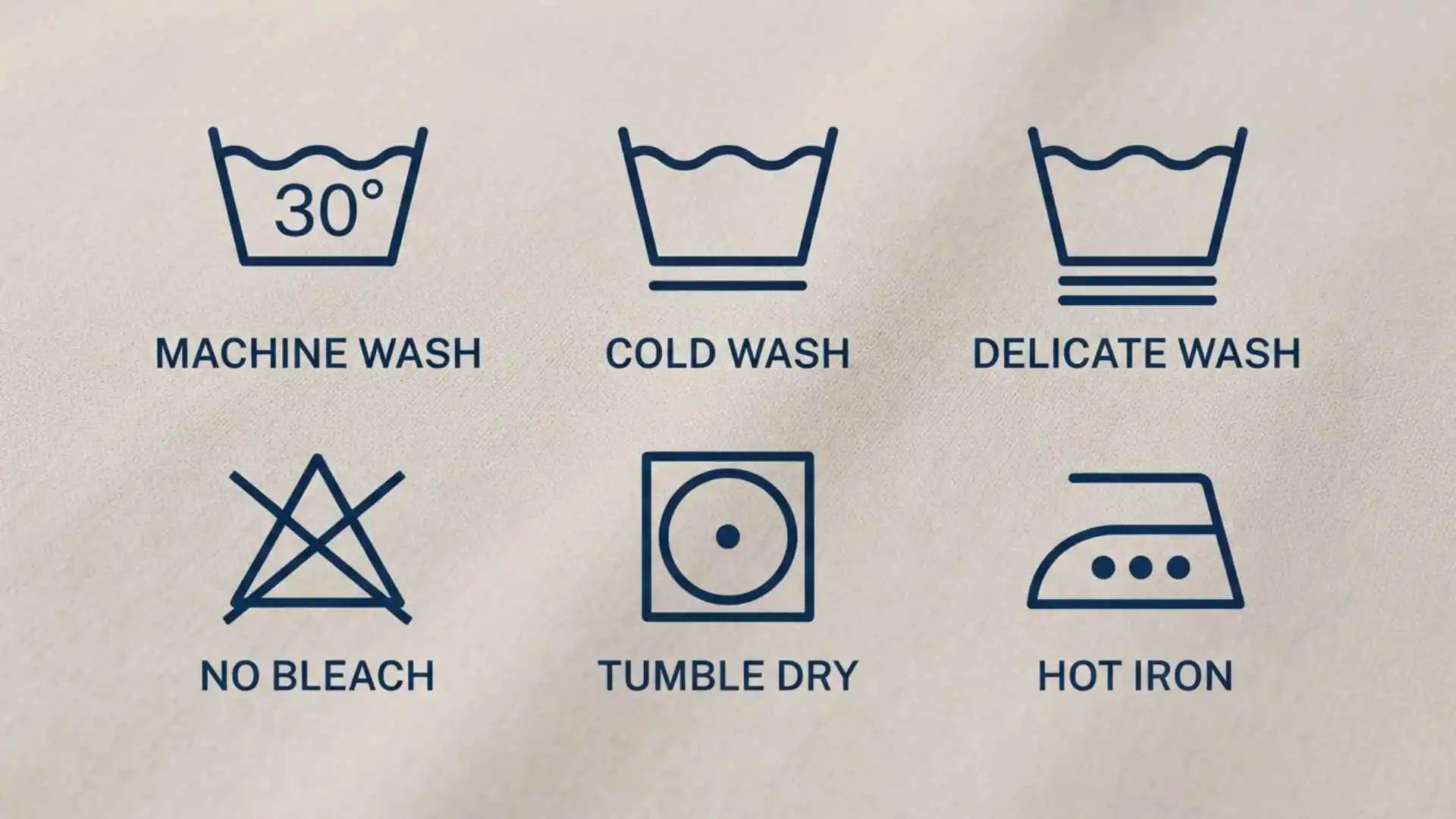
Laundry symbols are the small icons found on clothing and textile care labels that explain how an item should be washed, dried, bleached, ironed, or professionally cleaned. These symbols may look confusing at first, but once you understand their basic shapes and markings, they become much easier to read.
The easiest way to remember the main laundry symbols is to associate each shape with a particular task. A washing tub represents washing, a triangle represents bleaching, a square represents drying, an iron represents ironing, and a circle represents professional cleaning. Dots usually indicate heat levels, numbers indicate washing temperatures, and crossed-out symbols generally mean that a particular process should not be used.
Knowing what laundry symbols mean can help you avoid common problems such as shrinking, fading, stretching, fabric damage, and ruined clothing. This guide explains the most common laundry symbols in detail and shows you how to read an entire clothing care label correctly.
Laundry Symbols at a Glance
If you need a quick answer while doing laundry, this basic reference can help you identify the most common symbols.
| Laundry Symbol | Meaning | General Instruction |
| Washing tub | Washing | Follow the temperature and cycle instructions |
| Hand in washing tub | Hand wash | Wash gently by hand |
| Crossed washing tub | Do not wash | Do not wash with water |
| Number inside tub | Maximum wash temperature | Do not exceed the displayed temperature |
| Line under tub | Gentler treatment | Use an appropriate gentle cycle |
| Triangle | Bleaching permitted | Follow the applicable bleach instructions |
| Triangle with diagonal lines | Non-chlorine bleach | Use only suitable non-chlorine bleach |
| Crossed triangle | Do not bleach | Do not use bleach |
| Square with circle | Tumble dry | Dryer may be used according to the heat marking |
| One dot in dryer | Low heat | Use low dryer heat |
| Two dots in dryer | Medium heat | Use medium dryer heat |
| Three dots in dryer | High heat | Use high heat only when permitted |
| Crossed dryer | Do not tumble dry | Use an appropriate air-drying method |
| Horizontal line in square | Dry flat | Lay the garment flat to dry |
| Vertical lines in square | Drip dry | Allow the garment to drip dry |
| Diagonal lines | Dry in shade | Keep the garment away from direct sunlight |
| Do not wring marking | Do not wring | Avoid twisting the garment |
| Iron | Ironing permitted | Follow the temperature markings |
| One iron dot | Low heat | Use low ironing temperature |
| Two iron dots | Medium heat | Use medium ironing temperature |
| Three iron dots | High heat | Use high ironing temperature |
| Crossed iron | Do not iron | Do not apply an iron |
| Crossed steam | Do not steam | Do not use steam |
| Circle | Professional cleaning | Follow professional cleaning instructions |
| Circle with letter | Professional cleaning process | The letter provides cleaning information |
| Crossed circle | Do not dry clean | Do not use dry cleaning |
How to Read Laundry Symbols
Laundry labels often combine several symbols, so understanding the basic visual language makes them much easier to interpret.
The Shape Tells You the Type of Care
Start by identifying the main shape.
- Tub: Washing
- Triangle: Bleaching
- Square: Drying
- Iron: Ironing
- Circle: Professional cleaning
Once you identify the shape, you know which part of the garment-care process the symbol describes.
Dots Indicate Heat
Dots are commonly used to indicate the amount of heat that can be applied.
Generally:
- One dot means low heat.
- Two dots mean medium heat.
- Three dots mean high heat.
You can find dots in ironing and tumble-drying symbols.
Numbers Indicate Washing Temperature
A number inside the washing tub represents the maximum temperature associated with that washing instruction.
Common numbers include 30, 40, 60, and 95.
For example, a tub marked 40°C means the garment should not be washed above 40°C.
A Cross Means the Process Is Not Allowed
A crossed-out symbol is an important warning.
Examples include:
- Crossed washing tub = Do not wash
- Crossed triangle = Do not bleach
- Crossed dryer = Do not tumble dry
- Crossed iron = Do not iron
- Crossed circle = Do not dry clean
Never assume that using a gentler setting makes a crossed-out process acceptable.
Lines Can Indicate Special Treatment
Lines placed underneath or inside symbols can modify the care instruction.
For example, lines underneath a washing tub can indicate that a gentler cycle is required. Other line patterns are used with natural drying instructions.
The position of the line matters, so always interpret it together with the complete symbol.
Washing Symbols and Their Meanings
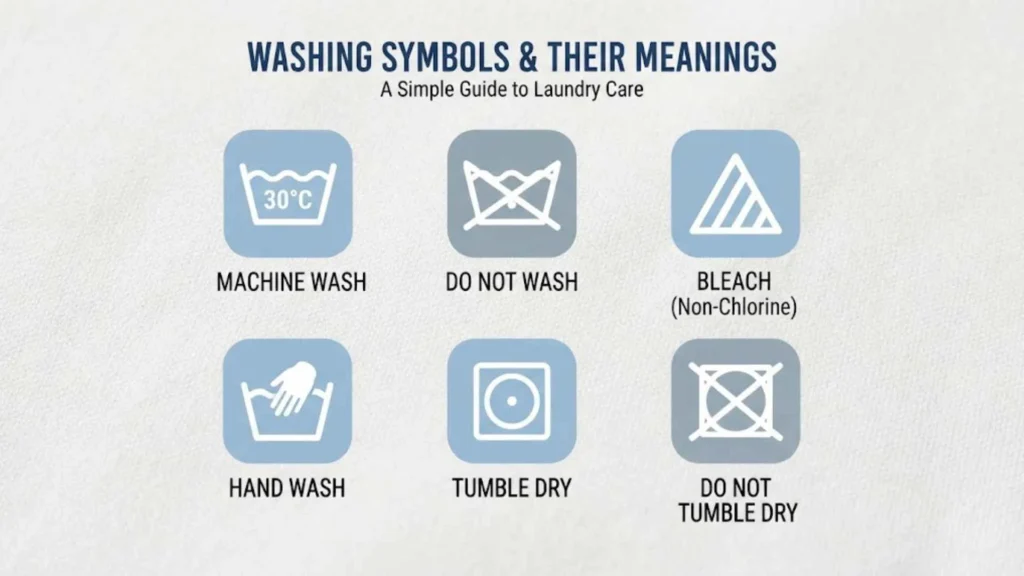
Washing symbols are represented by a tub filled with water. They tell you whether a garment can be washed and may also specify the temperature or washing method.
Machine Wash Symbol
A standard washing tub generally means the garment can be washed using a washing machine, subject to any additional markings.
Before choosing a cycle, check whether the tub contains a temperature number or has lines underneath it.
A garment can be machine washable while still requiring a delicate or reduced-agitation cycle.
30°C Washing Symbol
A washing tub marked 30°C means the garment can be washed at a maximum temperature of 30°C.
A cooler wash can be appropriate for many garments where excessive heat may cause unnecessary wear or affect colors.
40°C Washing Symbol
A 40°C washing symbol means the garment can be washed at temperatures up to 40°C.
This is a common care instruction for everyday washable clothing, although the appropriate cycle depends on the complete label.
60°C Washing Symbol
A 60°C symbol means the garment can tolerate washing at temperatures up to 60°C under the specified care conditions.
Do not assume that every durable-looking garment should be washed at 60°C. The care label should determine the temperature.
90°C or 95°C Washing Symbol
A very high temperature such as 90°C or 95°C indicates that the textile is designed to tolerate very hot washing.
Such temperatures are generally associated with particular durable textiles rather than ordinary clothing.
Hand Wash Symbol
A hand inside the washing tub means hand wash.
This instruction is commonly used for delicate garments that require gentler treatment than a standard machine cycle.
When hand washing:
- Use the temperature shown on the label.
- Avoid aggressive rubbing.
- Do not twist the garment unnecessarily.
- Rinse gently.
- Follow the recommended drying method.
Do Not Wash Symbol
A crossed-out washing tub means do not wash.
Do not put the garment in a washing machine or wash it by hand simply because the fabric looks washable.
Look for another cleaning instruction on the label.
Gentle Wash Symbol
A line underneath the washing tub generally indicates a gentler treatment than a normal wash cycle.
The purpose is to reduce mechanical action and protect garments that may be more vulnerable to stretching, abrasion, or distortion.
Very Gentle Wash Symbol
Two lines underneath the washing tub indicate an especially gentle treatment in care-label systems that use this marking.
Select the most suitable delicate or very gentle cycle available on your washing machine.
What Do 30, 40, and 60 Mean on Laundry Labels?
The numbers printed inside washing symbols refer to temperature limits.
What Does 30°C Mean?
A 30°C symbol means the maximum washing temperature is 30°C, or approximately 86°F.
What Does 40°C Mean?
A 40°C symbol means the maximum washing temperature is 40°C, or approximately 104°F.
What Does 60°C Mean?
A 60°C symbol means the maximum washing temperature is 60°C, or approximately 140°F.
Why Does Washing Temperature Matter?
Water temperature can affect fabric fibers, dyes, finishes, and the overall appearance of clothing.
Using a temperature higher than the care label allows can increase the risk of shrinking, fading, distortion, or other damage.
Washing Symbols by Shape
If you cannot remember the technical name of a laundry symbol, identifying its shape is often enough to determine what it represents.
Tub Symbol
A tub represents washing instructions.
Look inside or underneath it for additional information.
Tub With a Hand
A hand inside the tub means hand washing.
Tub With a Number
A number inside the tub indicates the maximum washing temperature.
Tub With Lines
Lines beneath the tub indicate a gentler washing treatment.
Crossed Tub
A crossed tub means do not wash.
Drying Symbols and Their Meanings
Drying symbols generally use a square as their basic shape.
A square by itself relates to natural or general drying instructions, while a circle inside the square indicates tumble drying.
Tumble Dry Symbol
A square containing a circle means tumble drying is permitted according to the additional markings.
The presence of a dryer symbol does not automatically mean that high heat is safe.
Low Heat Tumble Dry Symbol
One dot inside the tumble-dryer symbol generally means low heat.
Choose a low-temperature dryer setting.
Medium Heat Tumble Dry Symbol
Two dots generally indicate medium heat.
Use an appropriate medium-temperature setting when your dryer provides one.
High Heat Tumble Dry Symbol
Three dots indicate that high heat is permitted.
Even when this setting is allowed, follow the complete care label and avoid unnecessary heat exposure.
Do Not Tumble Dry Symbol
A crossed-out tumble-dryer symbol means do not put the garment in a tumble dryer.
Check the label for another drying method.
Line Dry Symbol
A line-drying instruction means the garment should be dried naturally while hanging or being supported in the manner indicated by the symbol.
Drip Dry Symbol
A drip-drying symbol means the garment should be allowed to dry naturally while water drains away.
Avoid twisting or aggressively squeezing the garment.
Dry Flat Symbol
A horizontal line within a square indicates dry flat.
The garment should be placed on a suitable flat surface while drying.
This can be particularly important for knitted garments that may stretch when hung while wet.
Dry in Shade Symbol
Diagonal lines associated with natural-drying symbols indicate that the garment should be dried in the shade.
This can help reduce prolonged exposure to direct sunlight.
Do Not Wring Symbol
A do-not-wring instruction means you should not twist the garment aggressively to remove water.
Wringing can stretch fabric, distort knitted clothing, and place stress on seams and delicate fibers.
Instead, remove excess water gently and follow the drying method shown on the label.
Drying Symbols Quick Reference
| Drying Instruction | Meaning |
| Square with circle | Tumble dry |
| One dot | Low heat |
| Two dots | Medium heat |
| Three dots | High heat |
| Crossed-out dryer | Do not tumble dry |
| Horizontal line | Dry flat |
| Vertical lines | Drip dry |
| Diagonal lines | Dry in shade |
| Do not-wring marking | Do not twist or wring |
Bleaching Symbols and Their Meanings
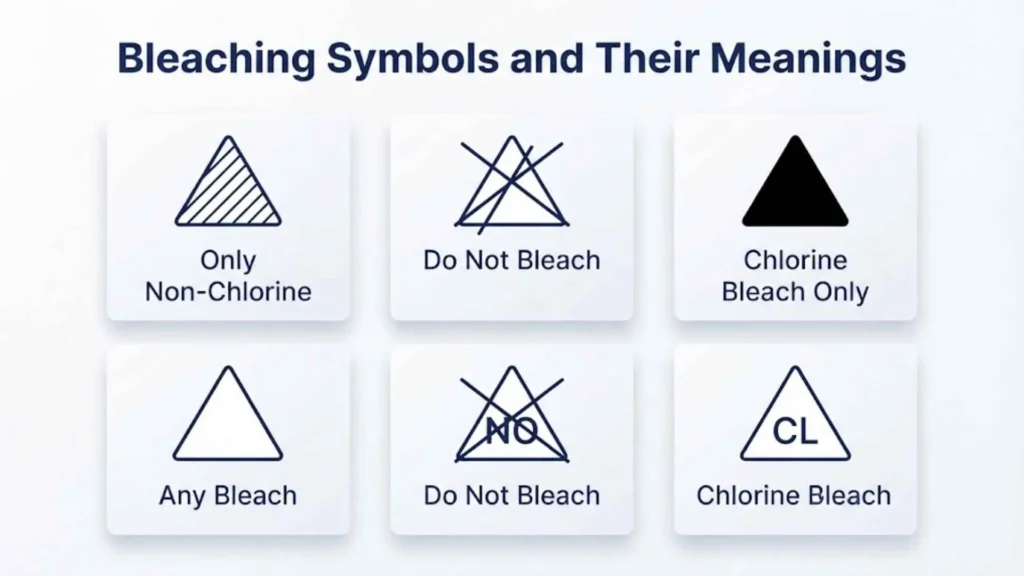
Bleaching instructions are represented by a triangle.
The triangle tells you whether bleaching is permitted and, when additional markings are present, what type of bleach may be appropriate.
Plain Triangle
A plain triangle generally indicates that bleaching is allowed under the applicable care system.
Always follow the instructions on the bleach product as well as the garment label.
Triangle With Diagonal Lines
A triangle containing diagonal lines generally indicates that only an appropriate non-chlorine or color-safe bleaching method should be used.
This should not be interpreted as unrestricted permission to use chlorine bleach.
Crossed-Out Triangle
A crossed-out triangle means do not bleach.
Do not add bleach to the wash when this symbol appears.
Why Is the Bleach Symbol Important?
Bleach can affect dyes and fibers differently.
Using bleach on a garment that prohibits it can cause discoloration, weakening, or permanent damage.
What Does a Triangle Mean on a Clothing Label?
The triangle is the laundry symbol associated with bleaching.
Its additional markings determine the restriction.
The easiest way to remember it is:
Triangle = Bleach
Then check whether the triangle is plain, marked with lines, or crossed out.
Ironing Symbols and Their Meanings
Ironing symbols use an icon that looks like an iron.
Dots inside the iron indicate the permitted temperature level.
Plain Iron Symbol
A plain iron means ironing is permitted, subject to any additional markings.
One-Dot Iron Symbol
One dot indicates low heat.
Use a low-temperature setting.
Two-Dot Iron Symbol
Two dots indicate medium heat.
Use a medium-temperature setting.
Three-Dot Iron Symbol
Three dots indicate high heat.
Only use high heat when the care label permits it.
Do Not Iron Symbol
A crossed-out iron means do not iron.
Do not place a heated iron directly on the garment.
Do Not Steam Symbol
A no-steam marking means steam should not be used.
This is different from a complete prohibition on ironing. If the garment can be ironed but steam is prohibited, use the permitted dry ironing temperature.
What Do the Dots Mean on Laundry Symbols?
Dots are generally a quick way of communicating heat levels.
One Dot
Usually means low heat.
Two Dots
Usually means medium heat.
Three Dots
Usually means high heat.
Remember that more dots generally indicate more heat, not a gentler treatment.
Dry Cleaning Symbols and Their Meanings
Dry-cleaning instructions are generally represented by a circle.
The circle can contain letters that provide information to professional cleaners.
Plain Circle
A plain circle generally indicates that professional cleaning is permitted under the relevant care system.
Crossed-Out Circle
A crossed-out circle means do not dry clean.
Do not assume that professional dry cleaning is suitable simply because it is often considered a gentle option.
What Does P Mean on a Laundry Label?
A P inside a circle provides information to a professional cleaner about the cleaning process and permitted solvent system.
It is not normally an instruction for consumers to perform a special chemical-cleaning procedure at home.
What Does F Mean on a Laundry Label?
An F inside a circle provides professional-cleaning information about the permitted solvent system.
The symbol is intended primarily for the person or business performing the professional cleaning.
What Does A Mean on a Laundry Label?
An A inside a circle provides information about the range of cleaning solvents permitted under the applicable care system.
The letters inside dry-cleaning circles should be treated as professional instructions rather than household cleaning recipes.
How to Read a Complete Laundry Care Label
A clothing label may contain several symbols. Read them together instead of focusing on just one.
Step 1: Check the Washing Symbol
Find the tub and determine whether the garment can be machine washed, hand washed, or should not be washed.
Step 2: Check the Temperature
If a number appears inside the tub, do not exceed that temperature.
Step 3: Look for Cycle Restrictions
Check for lines underneath the washing symbol.
These can indicate a gentler treatment.
Step 4: Check the Bleaching Symbol
Find the triangle and determine whether bleach is allowed, restricted, or prohibited.
Step 5: Check the Drying Symbol
Find the square.
Determine whether tumble drying or natural drying is appropriate.
Step 6: Check the Dryer Heat
If a circle appears inside the square, look for dots that indicate the permitted heat level.
Step 7: Check the Ironing Symbol
Look for the iron and count the dots.
Step 8: Check for Steam Restrictions
If steam is crossed out, do not use a steam function.
Step 9: Check for Professional Cleaning
Look for a circle and any letters inside it.
This sequence makes it easier to create a complete care routine without guessing.
How to Understand Laundry Symbol Combinations
Several markings can appear together to provide one complete instruction.
Tub With 30°C
The garment can be washed at a maximum temperature of 30°C.
Tub With 40°C and a Gentle Marking
The garment can be washed at up to 40°C, but a gentler cycle should be selected.
Tumble Dryer With One Dot
Tumble drying is permitted at low heat.
Tumble Dryer With Two Dots
Tumble drying is permitted at medium heat.
Crossed-Out Tumble Dryer
The garment should not be tumble dried, regardless of whether your dryer has a low-temperature setting.
Iron With Two Dots
Ironing is permitted at medium heat.
Iron With Crossed-Out Steam
Ironing may be permitted, but steam should not be used.
Crossed-Out Triangle
Bleach should not be used.
Circle With P
Professional cleaning is permitted under the cleaning conditions represented by the symbol.
The important point is that each part of the symbol contributes information. Temperature alone does not tell you the complete washing method.
What Happens If You Ignore Laundry Symbols?
Ignoring care instructions can sometimes result in damage that cannot be repaired.
Shrinking
Some fabrics can shrink when exposed to excessive heat during washing or drying.
Fading
High temperatures, harsh chemicals, and unsuitable washing conditions can contribute to color fading.
Stretching
Delicate or knitted garments may lose their shape through excessive agitation, hanging while wet, or improper drying.
Fabric Damage
Heat, friction, chemicals, and twisting can weaken or distort some fabrics.
Damaged Prints and Decorations
Printed designs, embellishments, elastic components, coatings, and decorative details may require special treatment.
Permanent Changes
Severe shrinkage, color loss, melting, or distortion may permanently change the garment.
Following the care label is therefore one of the simplest ways to reduce unnecessary clothing damage.
Common Laundry Symbol Mistakes
Even people who regularly do laundry can misread care symbols.
Mistaking a Square for a Washing Symbol
The tub represents washing.
The square represents drying.
Assuming More Dots Means Less Heat
More dots generally mean a higher permitted temperature.
Ignoring Lines Under the Washing Symbol
The temperature may be correct while the washing cycle is still too aggressive.
Using Bleach Without Checking the Triangle
Always check the bleach symbol before adding a bleaching product.
Putting Every Dryer-Safe Item on High Heat
A dryer symbol may allow tumble drying while dots restrict the heat level.
Hanging Everything to Dry
Some garments should be dried flat to help maintain their shape.
Wringing Delicate Clothing
Twisting wet garments can stretch or distort them.
Using Steam Without Checking the Iron Symbol
Some garments allow ironing but prohibit steam.
Assuming Dry Cleaning Is Always Safe
Professional cleaning is not automatically suitable for every garment. Check the care label.
What If the Laundry Label Is Missing?
Care labels can become faded, damaged, or removed from clothing.
If you cannot find the original instructions, take a cautious approach.
Identify the Fabric
Look for fiber information elsewhere on the garment if available.
Look for Product Information
A manufacturer, product name, or model number may help you find the original care instructions.
Avoid High Heat
When you are uncertain, excessive heat can be an unnecessary risk.
Avoid Unnecessary Bleach
Do not use bleach simply because an item is white.
Use Gentle Treatment When Appropriate
If you have no instructions and the garment is washable, a conservative approach may reduce the chance of damage.
Consider Professional Cleaning
For expensive, delicate, vintage, structured, or unusual garments, professional advice may be preferable to experimenting.
The garment’s actual care label should always take priority over general fabric-care rules when the label is available.
Laundry Symbols for Different Fabrics
Fabric information can help you understand why a garment has particular care requirements, but it should not replace the manufacturer’s care instructions.
Cotton
Cotton garments can have different care requirements depending on their construction, dye, finish, and blend.
Do not assume every cotton item should be washed at a high temperature.
Wool
Wool can be sensitive to heat, agitation, and improper drying.
Some wool garments require hand washing or a very gentle cycle and may need to dry flat.
Silk
Silk is delicate and may have specific washing, drying, ironing, or professional-cleaning requirements.
Polyester
Polyester is generally durable, but excessive heat can still be unsuitable for particular polyester garments.
Linen
Linen can wrinkle easily and may have specific ironing and drying instructions.
Rayon and Viscose
Rayon and viscose garments can be sensitive to water, agitation, and shape changes.
Follow the garment-specific instructions carefully.
Nylon
Nylon can tolerate many ordinary washing methods but may be sensitive to excessive heat.
Spandex and Elastane
Stretch fibers can be affected by excessive heat and harsh treatment, so the care label is particularly important.
Denim
Denim is durable, but washing temperature, drying method, and color-care requirements can vary between garments.
Laundry Symbols and Fabric Labels Are Not the Same
Clothing labels can contain both fabric information and care instructions.
Fabric Information
This tells you what the garment is made from.
Examples include:
- Cotton
- Polyester
- Wool
- Nylon
- Viscose
- Elastane
Care Information
The symbols tell you how the finished garment should be treated.
For example, seeing 100% cotton does not automatically tell you whether that particular shirt should be washed at 30°C, 40°C, or another temperature.
The care symbols provide the garment-specific instructions.
How to Choose the Right Washing Setting
Once you understand the label, match the instructions to your washing machine.
Start With the Temperature
Choose a temperature that does not exceed the garment’s stated limit.
Select the Appropriate Cycle
If the label indicates gentle treatment, select a suitable delicate or reduced-agitation cycle.
Avoid Overloading the Machine
Overloading can reduce cleaning performance and increase friction between garments.
Sort Laundry Carefully
Separate clothing according to color, fabric type, and care requirements where appropriate.
A garment-care routine should be based on both the clothing label and the capabilities of your washing machine.
How to Choose the Right Drying Method
Drying can be just as important as washing.
If Tumble Drying Is Allowed
Check the dots and select the permitted heat level.
If Tumble Drying Is Prohibited
Use the natural drying method indicated by the label.
If the Garment Must Dry Flat
Place it flat on a suitable surface rather than hanging it while wet.
If It Must Drip Dry
Allow water to drain naturally instead of aggressively wringing the garment.
If It Must Dry in Shade
Choose a location away from strong direct sunlight.
Laundry Symbols and Cold, Warm, and Hot Water
Temperature selection should be based on the care label rather than the assumption that hotter water is always better.
Cool Washing
Cooler washing can be appropriate for many garments and may reduce exposure to heat when the label permits it.
Warm Washing
Warm temperatures can be suitable for many everyday garments when specified or permitted by the care instructions.
Hot Washing
Hotter washing should only be used when the garment’s label allows it.
The goal is to clean the garment effectively without exposing it to unnecessary heat.
A Simple Laundry Symbol Decision Guide
When you are unsure how to treat a garment, work through these questions.
Can I Wash It?
Check the tub.
- Normal tub = washing permitted
- Hand = hand washing
- Crossed tub = do not wash
How Hot Can I Wash It?
Look for the number inside the tub.
Do not exceed the stated temperature.
Can I Use Bleach?
Check the triangle.
- Plain triangle = bleaching permitted under the applicable care system
- Restricted triangle = use the specified type
- Crossed triangle = do not bleach
Can I Put It in the Dryer?
Check the square.
- Square with circle = tumble drying permitted
- Crossed dryer = do not tumble dry
How Much Dryer Heat Can I Use?
Count the dots inside the dryer symbol.
Should I Air Dry It?
Look for instructions such as line dry, drip dry, dry flat, or dry in shade.
Can I Iron It?
Check the iron and count the dots.
Can I Use Steam?
Look for a steam restriction.
Does It Need Professional Cleaning?
Check for a circle and any letters inside it.
Practical Laundry Symbol Examples
Understanding complete combinations can make real clothing labels much easier to decode.
Example 1: Everyday Shirt
Suppose a shirt shows:
40°C wash + low-heat tumble dry + two-dot iron
The basic instructions are:
- Wash at up to 40°C.
- Tumble dry using low heat.
- Iron at a medium temperature.
Example 2: Delicate Sweater
Suppose a sweater shows:
Hand wash + do not tumble dry + dry flat
The garment should be:
- Washed gently by hand.
- Kept out of the tumble dryer.
- Dried flat.
Example 3: Garment That Cannot Be Bleached
Suppose a garment shows:
40°C wash + crossed triangle
This means:
- Wash at up to 40°C.
- Do not use bleach.
The bleach restriction remains important even though washing is permitted.
Example 4: Low-Heat Dryer Garment
Suppose the label shows:
Tumble dry + one dot
The garment can be tumble dried using low heat.
Example 5: Professional Cleaning
Suppose the label shows:
Circle + P
The symbol provides professional-cleaning instructions and should be shown to the cleaner when the garment is taken for professional care.
How to Remember Laundry Symbols
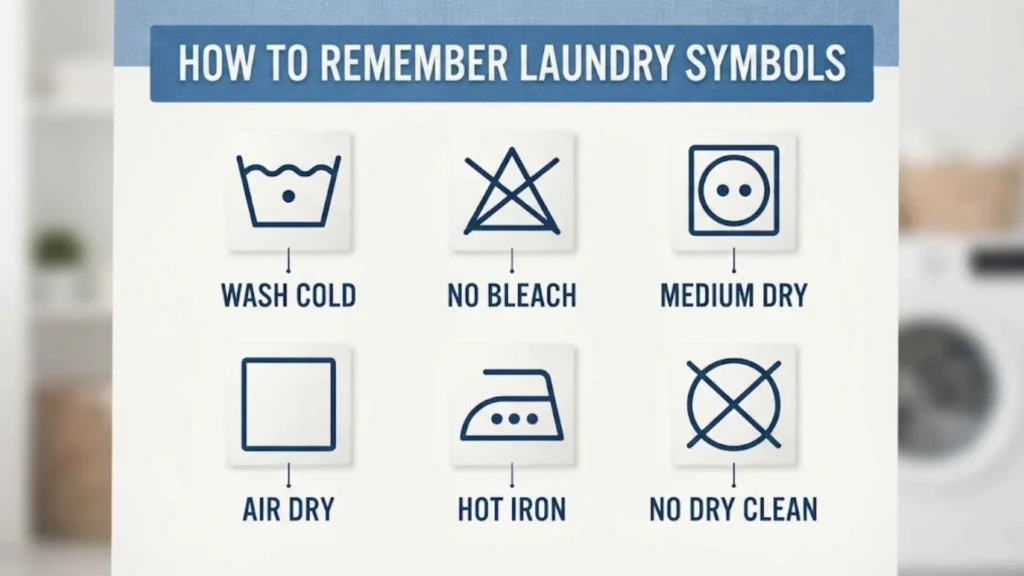
You do not need to memorize every symbol separately.
Start with the five main shapes:
Tub = Wash
Triangle = Bleach
Square = Dry
Iron = Iron
Circle = Professional Cleaning
Then remember:
Dots = Heat
X = Do Not
Numbers = Washing Temperature
Lines = Special or Gentler Treatment Depending on the Symbol
These simple associations make most ordinary clothing-care labels much easier to understand.
Frequently Asked Questions About Laundry Symbols
What are laundry symbols?
Laundry symbols are pictograms printed on clothing and textile care labels. They explain how an item should be washed, bleached, dried, ironed, or professionally cleaned.
What are the five main laundry symbols?
The five main symbol families are the washing tub, triangle, square, iron, and circle. They represent washing, bleaching, drying, ironing, and professional cleaning.
What does a washing tub symbol mean?
A washing tub indicates washing instructions. Numbers, lines, hands, or crosses provide additional information about temperature and washing treatment.
What does a hand inside a washing symbol mean?
It means the garment should be hand washed rather than treated using a normal machine-washing cycle.
What does a crossed-out washing symbol mean?
It means the garment should not be washed with water. Check the remaining care instructions for another cleaning method.
What do numbers mean on laundry symbols?
Numbers inside a washing tub indicate the maximum washing temperature associated with the instruction.
What does 30 mean on a clothing label?
A 30°C washing symbol means the garment should be washed at a maximum temperature of 30°C.
What does 40 mean on a clothing label?
A 40°C washing symbol means the garment can be washed at temperatures up to 40°C.
What does 60 mean on a clothing label?
A 60°C washing symbol means the garment can be washed at temperatures up to 60°C.
What does a triangle mean on a laundry label?
A triangle represents bleaching instructions.
What does a crossed-out triangle mean?
A crossed-out triangle means the garment should not be bleached.
What does a triangle with diagonal lines mean?
It generally indicates that an appropriate non-chlorine or color-safe bleaching method may be used rather than unrestricted chlorine bleach.
What does a square mean on a laundry label?
A square represents drying instructions.
What does a square with a circle mean?
A square containing a circle represents tumble drying.
What do dots mean on dryer symbols?
Dots generally indicate dryer heat. One dot means low heat, two dots mean medium heat, and three dots mean high heat.
What does a crossed-out dryer symbol mean?
It means the garment should not be tumble dried.
What does a dry-flat symbol mean?
It means the garment should be laid flat while drying rather than hung while wet.
What does a drip-dry symbol mean?
It means the garment should be allowed to drip dry naturally.
What does the do-not-wring symbol mean?
It means you should not twist or aggressively squeeze the garment to remove water.
What does an iron with one dot mean?
It means low ironing heat should be used.
What does an iron with two dots mean?
It indicates a medium ironing temperature.
What does an iron with three dots mean?
It indicates that a higher ironing temperature is permitted.
What does a crossed-out iron mean?
It means the garment should not be ironed.
What does a crossed-out steam symbol mean?
It means steam should not be used. If ironing is otherwise permitted, use a dry ironing method at the allowed temperature.
What does a circle mean on a clothing label?
A circle generally represents professional cleaning or dry-cleaning instructions.
What does P mean on a dry-cleaning symbol?
A P inside a circle provides professional-cleaning information about the permitted cleaning process or solvent system.
What does F mean on a dry-cleaning symbol?
An F inside a circle provides information to the professional cleaner about the permitted solvent system.
What does A mean on a dry-cleaning symbol?
An A inside a circle provides information about the permitted range of professional cleaning solvents under the applicable care system.
Can I ignore laundry symbols?
It is best not to ignore them. Incorrect washing, drying, bleaching, or ironing can increase the risk of shrinking, fading, stretching, and fabric damage.
Are laundry symbols universal?
Many laundry symbols are standardized or widely recognized, but labeling practices can vary. Always follow the complete care label supplied with the garment.
What should I do if I do not understand a laundry symbol?
Identify the main shape first, then look for numbers, dots, lines, letters, and crossed-out markings. These additional elements usually explain the specific treatment.
What should I do if my clothing label is missing?
Check for manufacturer or product information if available. If the garment is valuable or delicate, use a conservative care method or seek professional advice instead of guessing.
Conclusion
Laundry symbols provide a simple visual language for caring for clothing correctly. Once you understand the main shapes, most care labels become much easier to decode.
Remember the five basic symbols: the tub means washing, the triangle means bleaching, the square means drying, the iron means ironing, and the circle means professional cleaning. Dots generally indicate heat, numbers indicate washing temperatures, and crossed-out symbols indicate processes that should not be used.
When reading a clothing label, do not focus on just one symbol. Read the complete set of instructions, including temperature numbers, dots, lines, letters, and restrictions. A garment may be machine washable but require a gentle cycle, or it may be suitable for tumble drying but only at a low temperature.
Following these instructions can help protect clothing from shrinking, fading, stretching, excessive wear, and heat damage. Most importantly, when general fabric-care advice conflicts with a garment’s specific care label, the garment’s care label should take priority.

Hi, I’m Asher Monroe, a writer who believes that meaningful words have the power to inspire change and bring people closer to their dreams. I have always been fascinated by the beauty of quotes and the way a simple message can provide motivation, hope, and comfort.
I enjoy creating content around inspirational quotes, life lessons, success stories, and positive thoughts that help readers find encouragement in their everyday lives. My goal is to share words that connect with people and remind them of their inner strength.
Through my writing, I explore the ideas of personal growth, confidence, and the importance of staying inspired through every chapter of life.
I am the author of Words That Move the Soul and The Path of Endless Inspiration, two books focused on the power of wisdom, positivity, and meaningful thoughts.
 Sienna Brooks
 Rowan Sinclair Rowan Sinclair