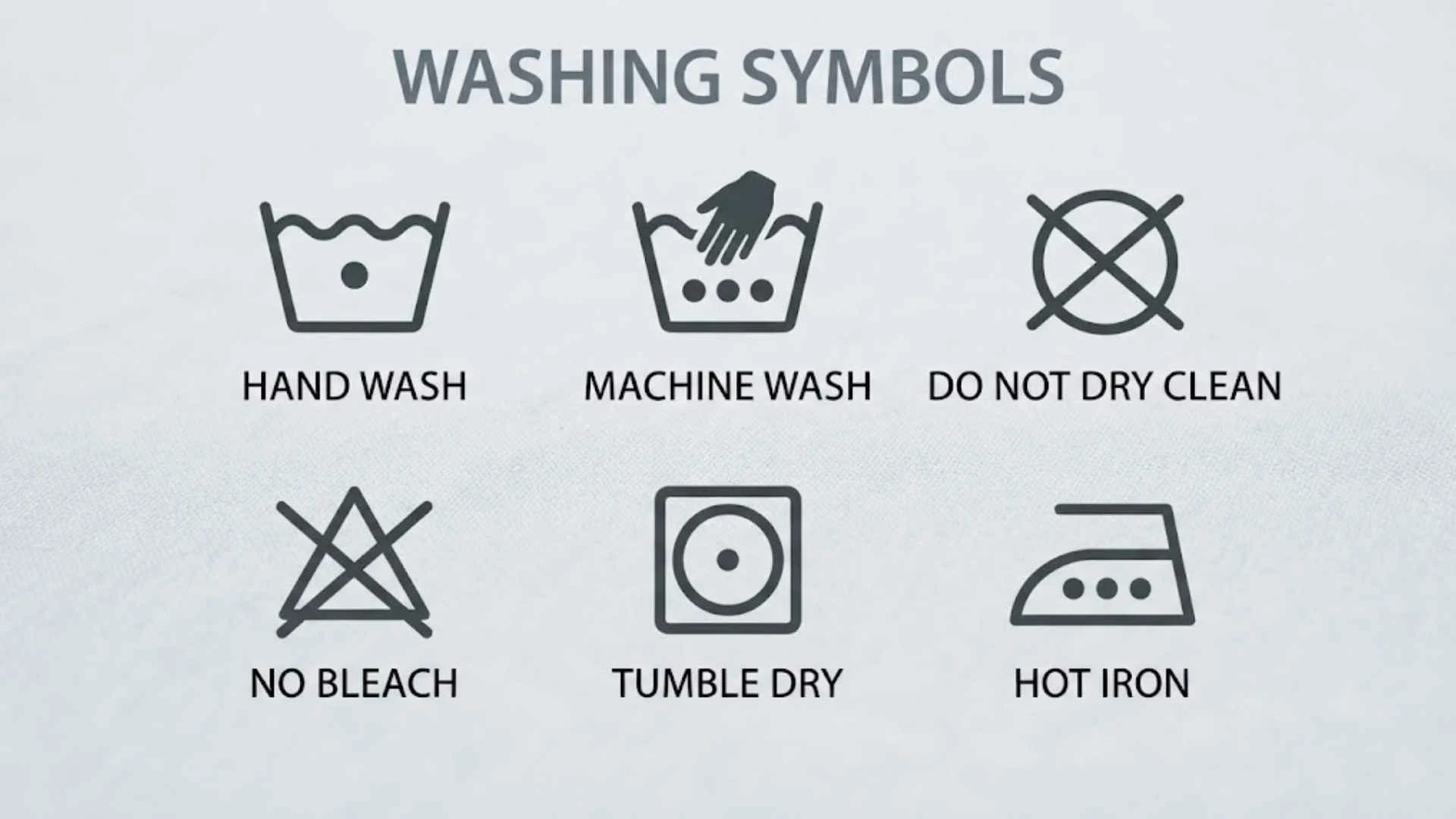
Washing symbols on clothing labels are small, but they can tell you a lot about how a garment should be washed, dried, ironed, or professionally cleaned. Learning these symbols can help you choose the right washing machine setting and avoid common laundry mistakes.
This guide explains washing symbols and meanings in simple language, with clear charts for common wash temperatures, machine cycles, tumble drying, permanent press, and clothing care labels. You will also learn how international and universal laundry symbols work.
From a washtub marked 30°C to a square with a circle for tumble drying, each symbol gives you a quick instruction. By the end, you should be able to read most clothing care labels without guessing.
Washing symbols and meanings
Washing symbols are standardized care-label icons that explain how a garment should be cleaned. The most common washing symbol is a washtub, which represents washing with water.
Here are some of the most useful washing symbols:
| Symbol | Meaning |
| 🛁 | Wash in water according to the instructions shown |
| 🛁 30° | Machine wash at up to 30°C |
| 🛁 40° | Machine wash at up to 40°C |
| 🛁 60° | Machine wash at up to 60°C |
| 🛁 with one line underneath | Use a permanent-press or easy-care cycle |
| 🛁 with two lines underneath | Use a delicate or very gentle cycle |
| 🛁 with a hand | Hand wash |
| 🛁 with a cross | Do not wash with water |
The actual care label may use a simple line drawing rather than an emoji. The number inside the washtub normally indicates the maximum washing temperature.
A symbol without a temperature number can also provide instructions through lines or a hand-wash indication.
What do the washing symbols mean
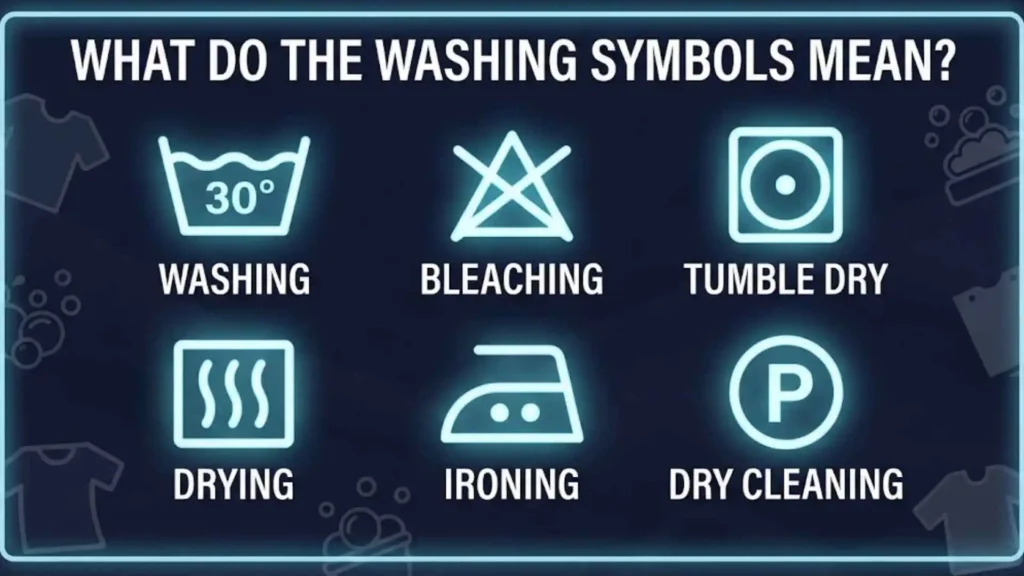
The washing symbol tells you how a garment should be cleaned in water. Start by looking for the washtub shape on the care label.
A number inside the tub indicates the maximum recommended washing temperature. For example, 30 means 30°C, while 40 means 40°C.
A hand inside the tub means hand washing is recommended. A cross through the tub means the garment should not be washed with water.
Lines underneath the tub affect the type of washing cycle rather than simply changing the temperature. One line generally indicates a gentler or permanent-press treatment, while two lines indicate an even more delicate treatment.
Washing symbols meaning
The meaning of a washing symbol depends on the details inside or around the washtub.
Temperature numbers
Common temperature markings include:
- 30 — Wash at a maximum of 30°C.
- 40 — Wash at a maximum of 40°C.
- 60 — Wash at a maximum of 60°C.
- 95 — Wash at a maximum of 95°C where the garment label permits it.
The number is not a recommendation to always use that exact temperature. It indicates the maximum washing temperature intended by the care label.
Lines underneath the tub
Lines underneath the washtub indicate special cycle treatment:
- No line — Normal washing cycle.
- One line — Permanent-press or easy-care treatment.
- Two lines — Delicate or very gentle treatment.
Hand and crossed symbols
- Hand in tub — Hand wash.
- Crossed tub — Do not wash.
These details are particularly useful when caring for wool, delicate fabrics, decorated clothing, and garments that can be damaged by normal machine agitation.
Laundry symbols chart
A laundry symbol chart is a quick reference for understanding clothing care labels.
| Care symbol | General meaning | What to do |
| Washtub | Machine wash | Wash according to temperature and cycle instructions |
| Washtub + 30 | Maximum 30°C | Use a cool wash |
| Washtub + 40 | Maximum 40°C | Use a warm wash if suitable |
| Washtub + 60 | Maximum 60°C | Use a hotter wash where permitted |
| Washtub + hand | Hand wash | Wash gently by hand |
| Washtub + one line | Permanent press/easy care | Select an appropriate reduced-agitation cycle |
| Washtub + two lines | Delicate | Use a gentle or delicate cycle |
| Crossed washtub | Do not wash | Avoid washing with water |
| Square + circle | Tumble dry | Suitable for tumble drying |
| Crossed square + circle | Do not tumble dry | Air dry instead |
| Triangle | Bleach | Bleaching is permitted according to the symbol |
| Crossed triangle | Do not bleach | Avoid bleach |
| Iron | Ironing permitted | Iron according to dots |
| Crossed iron | Do not iron | Avoid ironing |
| Circle | Professional cleaning | Follow dry-cleaning instructions |
Care labels often contain several symbols together. Reading the entire label gives a more complete picture of how to care for the garment.
Washing symbols chart
The most useful washing chart focuses on the washtub symbol and its variations.
| Symbol pattern | Meaning |
| 🛁 | Normal wash |
| 🛁 30 | Wash up to 30°C |
| 🛁 40 | Wash up to 40°C |
| 🛁 60 | Wash up to 60°C |
| 🛁 95 | Wash up to 95°C |
| 🛁 + hand | Hand wash |
| 🛁 + one underline | Permanent press/easy care |
| 🛁 + two underlines | Very gentle/delicate cycle |
| 🛁 + X | Do not wash |
Because care labels can use slightly different visual designs, concentrate on the structure of the symbol rather than relying only on its exact appearance.
Washing symbols on tags
Washing symbols on tags are designed to give quick care instructions without requiring long written directions.
You may find them printed on a small label sewn into the side seam, collar, waistband, or another less visible part of the garment.
A typical clothing tag may show several symbols in sequence:
Wash → Bleach → Dry → Iron → Professional cleaning
For example, a tag might show a 30°C wash symbol, a crossed triangle, a low-temperature tumble-dry symbol, and an iron with two dots. Together, these symbols provide much more information than the washing symbol alone.
Always check the entire care label before washing an unfamiliar garment.
Clothing washing symbols
Clothing washing symbols help protect garments from damage caused by excessive heat, agitation, unsuitable chemicals, or incorrect drying.
Common clothing-care instructions include:
- 30°C wash for many everyday garments.
- 40°C wash for items that allow a warmer cycle.
- Hand wash for garments requiring gentle handling.
- Permanent press for suitable easy-care fabrics.
- Delicate wash for more fragile items.
- Do not wash when water washing is unsuitable.
A shirt, sweater, sports garment, or decorative item may have completely different care requirements even if the materials look similar.
Laundry washing symbols
Laundry washing symbols form part of a larger care-label system. Washing is only one stage of garment care.
After checking the washing symbol, look for symbols covering:
- Washing — shown by the washtub.
- Bleaching — shown by the triangle.
- Drying — shown by the square.
- Ironing — shown by the iron.
- Professional cleaning — shown by the circle.
This system makes laundry instructions easier to understand across different languages.
Washing symbols and meaning
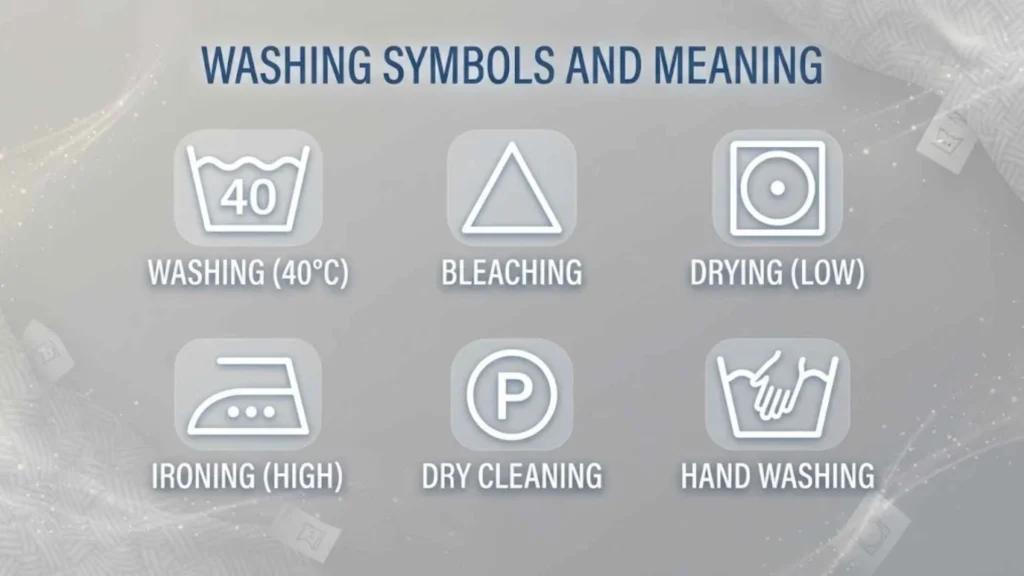
Washing symbols communicate instructions visually, but small details can change their meaning.
For instance, a plain washtub means something different from a washtub with one line underneath. Likewise, a hand inside the tub means hand washing, while a crossed tub means washing is prohibited.
The safest approach is to interpret the complete symbol rather than looking only at one part.
If the label says 30°C, do not assume that washing at 40°C is acceptable simply because the garment looks durable. The marked temperature represents the maximum temperature specified for that garment.
Washing symbols clothes
Washing symbols on clothes are particularly useful because many garments require different care.
For example, a cotton T-shirt may tolerate a regular machine cycle, while a delicate sweater may require hand washing or a gentle cycle.
Before putting clothes into the washing machine, check:
- The maximum wash temperature.
- Whether the item is machine washable.
- Whether a delicate cycle is required.
- Whether hand washing is required.
- Whether washing is prohibited.
- The drying instructions that follow washing.
Following the label can help maintain the garment’s shape, texture, and appearance.
Clothes washing symbols meaning
The meaning of clothes washing symbols becomes easier to understand when you break each icon into parts.
Washtub: Washing instructions.
Number: Maximum temperature.
Hand: Hand wash.
One line underneath: Permanent-press or easy-care treatment.
Two lines underneath: Delicate or very gentle treatment.
Cross: Do not use the process represented by the symbol.
This approach is more reliable than memorizing dozens of separate symbols because many care icons follow the same visual logic.
Cloth washing symbols
Cloth washing symbols are useful for fabrics ranging from everyday cotton to delicate and synthetic materials.
Different fabrics respond differently to heat and mechanical action. A care label therefore provides instructions for the finished garment rather than asking you to identify the fabric yourself.
If a fabric label says 30°C, use a cycle that does not exceed that temperature. If it shows a hand-wash symbol, avoid treating it like a normal machine-wash item unless the garment manufacturer specifically provides alternative instructions.
Machine washing symbols
Machine washing symbols indicate whether and how an item can be washed in a washing machine.
A normal washtub without an underline generally indicates a normal machine-washing process within the stated temperature limit.
An underline changes the recommended treatment:
- One line: Permanent press or easy-care cycle.
- Two lines: Delicate or very gentle cycle.
The washing machine’s exact program names vary between manufacturers. Look for settings such as Permanent Press, Easy Care, Delicates, or similar options that correspond to the care label.
Washing symbols clothes
The washing symbols found on clothes are part of a complete garment-care language.
A useful habit is to check the label before the first wash, especially for:
- New clothing.
- Dark or brightly dyed garments.
- Wool or delicate items.
- Clothing with prints or decorations.
- Structured garments.
- Items with special finishes.
Do not rely on the appearance of a garment alone. Two similar-looking shirts can have different care instructions.
Garment washing symbols
Garment washing symbols are intended to communicate care instructions consistently and visually.
The washing icon is normally the first symbol in a complete care-label sequence. Other symbols then explain bleaching, drying, ironing, and professional cleaning.
For example, a garment might allow a 40°C machine wash, prohibit bleaching, allow low-temperature tumble drying, and permit cool ironing. These instructions should be followed together rather than treating one symbol as the complete care guide.
International washing symbols
International washing symbols are designed to make garment-care instructions easier to understand across languages and markets.
Instead of writing instructions such as “wash at 30 degrees” in a particular language, a label can use a washtub containing 30.
The same visual system is used for other care processes, including:
- Washing.
- Bleaching.
- Drying.
- Ironing.
- Professional textile care.
Although the symbols are widely standardized, labels can vary in their presentation and local requirements. When in doubt, follow the specific instructions supplied with the garment.
Universal washing symbols
The phrase “universal washing symbols” is commonly used to describe recognizable care-label icons that communicate instructions without relying heavily on written language.
Some of the most recognizable forms are:
- Washtub — washing.
- Triangle — bleaching.
- Square — drying.
- Iron — ironing.
- Circle — professional cleaning.
The symbols are designed to be understood visually, but their details matter. Dots, lines, numbers, and crosses can significantly change the instruction.
Clothing tag washing symbols
Clothing tag washing symbols provide a compact set of instructions for caring for a garment.
When reading a tag, check the symbols from left to right or according to the label’s layout. Do not stop after finding the washing temperature.
For example:
🛁 30 → crossed triangle → square with circle → iron with one dot
This type of sequence could indicate a 30°C wash, no bleaching, tumble drying under the specified conditions, and low-temperature ironing.
The exact symbols on the physical tag should always take priority over a generalized chart.
Clothes washing symbols
Clothes washing symbols can answer several practical questions before you start laundry.
Can I machine wash it?
Look for the washtub symbol. If the tub is crossed out, do not machine wash or water-wash the garment.
What temperature should I use?
Check the number inside the tub. A number such as 30 or 40 indicates the maximum washing temperature.
Should I use a gentle cycle?
Check for one or two lines underneath the tub. These indicate reduced or more delicate treatment.
Can I wash it by hand?
A hand symbol inside the tub indicates hand washing.
These simple checks can prevent many common laundry-care mistakes.
Washing symbols on clothes
Washing symbols on clothes are especially important when garments have special construction or finishing.
A care label may tell you that an item can be washed but should not be exposed to high temperatures during drying. Another garment may tolerate a warm wash but prohibit tumble drying.
This is why washing and drying symbols should always be considered together.
For delicate clothing, it is also useful to pay attention to the detergent instructions, garment fastenings, and any additional written warnings supplied by the manufacturer.
Washing symbols 30 with line under
A 30°C washing symbol with one line underneath combines two pieces of information.
30 means the maximum washing temperature is 30°C.
One line underneath the tub indicates a permanent-press or easy-care treatment, generally involving gentler mechanical action than a normal cycle.
So this symbol does not simply mean “wash at 30°C.” It also tells you to select an appropriate reduced-agitation or permanent-press/easy-care program.
A typical interpretation is:
🛁 30 + one underline = maximum 30°C, permanent-press/easy-care treatment.
The exact machine setting may be named differently depending on the washing-machine manufacturer.
Washing symbols tumble dry
The tumble-drying symbol is different from the washing symbol. It is represented by a square containing a circle.
The common tumble-dry symbols include:
| Symbol | Meaning |
| Square with circle | Tumble dry permitted |
| Square with circle + one dot | Tumble dry at a lower temperature |
| Square with circle + two dots | Tumble dry at a higher temperature |
| Square with circle + cross | Do not tumble dry |
The dots indicate temperature levels. Always follow the symbol printed on the garment rather than assuming that every fabric can tolerate the same dryer setting.
If tumble drying is prohibited, use the drying method recommended by the rest of the care label.
Washing symbols permanent press
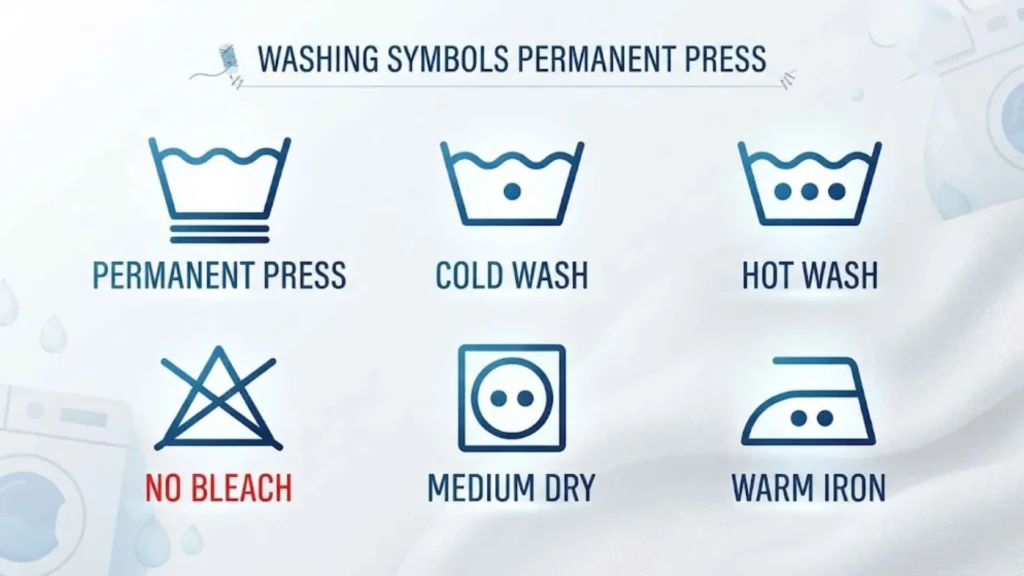
A single line underneath the washing tub is associated with permanent-press or easy-care treatment.
Permanent press is intended for garments that benefit from reduced mechanical action and a controlled wash process.
The important distinction is:
- No underline: Normal washing treatment.
- One underline: Permanent-press/easy-care treatment.
- Two underlines: Delicate or very gentle treatment.
If your washing machine has a Permanent Press or Easy Care setting, it may be the appropriate choice for a garment carrying the one-line washing symbol, subject to the machine’s own program specifications.
Fabric washing symbols
Fabric washing symbols tell you how the finished garment should be treated rather than simply identifying the fabric itself.
For example, two garments made from similar fibers can have different care requirements because of their construction, dyes, coatings, or finishing.
Common examples include:
| Fabric or garment type | Care commonly encountered |
| Cotton garments | Often machine washable, depending on label |
| Synthetic clothing | Often uses lower or moderate temperatures |
| Wool garments | May require hand washing or a specialized cycle |
| Delicate fabrics | Often require gentle handling |
| Blended fabrics | Follow the garment’s specific care label |
These are general examples, not replacements for the actual label.
Clothing washing symbols
Clothing washing symbols provide a fast way to check care requirements before laundering an item.
A useful routine is to read the label in this order:
- Check the washing symbol.
- Check the bleaching symbol.
- Check the drying symbol.
- Check the ironing symbol.
- Check the professional-cleaning symbol.
- Read any additional written instructions.
This gives you a complete picture of how the garment should be handled.
Wash care symbols PDF free download
A printable wash-care reference can be useful if you frequently check clothing labels. The easiest option is to save or print the washing-symbol chart in this article as a PDF from your browser’s Print or Save as PDF option.
For a useful reference sheet, include the following core symbols:
| Symbol | Quick reference |
| Washtub | Wash |
| Washtub + temperature | Maximum wash temperature |
| Washtub + one line | Permanent press/easy care |
| Washtub + two lines | Delicate |
| Washtub + hand | Hand wash |
| Crossed washtub | Do not wash |
| Square + circle | Tumble dry |
| Crossed square + circle | Do not tumble dry |
| Triangle | Bleach |
| Crossed triangle | Do not bleach |
| Iron + dots | Iron at indicated temperature |
| Crossed iron | Do not iron |
| Circle | Professional cleaning |
When making a personal PDF reference, keep the symbols large enough to recognize quickly and include their meanings beside them.
Washing symbols on tags
A care tag may contain several symbols that work as a complete set. The first symbol generally concerns washing, but the remaining icons can change how you should handle the garment after washing.
For example, washing at the correct temperature does not automatically mean the item can go into a hot dryer. The drying symbol must be checked separately.
Likewise, a garment that can be washed may still have restrictions on bleaching or ironing.
Treat the care label as a complete instruction system rather than selecting only the symbol that looks most familiar.
What do washing symbols mean
Washing symbols answer basic care questions through simple visual marks.
If you see a washtub, look inside it for a temperature or hand symbol. Then check underneath the tub for lines.
A quick interpretation is:
- Number in tub: Maximum washing temperature.
- Hand in tub: Hand wash.
- One line underneath: Permanent press/easy care.
- Two lines underneath: Delicate or very gentle treatment.
- Crossed tub: Do not wash.
Remember that a washing symbol does not describe every part of garment care. Drying, ironing, bleaching, and professional cleaning are represented by separate symbols.
What do washing symbols mean
The easiest way to understand washing symbols is to think of the washtub as the main category and the extra marks as additional instructions.
A 30°C tub tells you the maximum temperature. A 30°C tub with one underline adds a permanent-press/easy-care instruction. A hand inside the tub changes the method to hand washing.
Once you recognize these basic patterns, most washing labels become much easier to read.
The most important rule is simple: follow the garment’s own care label, especially when its instructions are more specific than a general laundry chart.
Frequently Asked Questions
What does a washing tub symbol mean?
A washing tub symbol means the garment has a water-washing instruction. The temperature, lines, hand symbol, or cross provide additional information about how it should be washed.
What does 30 mean on a washing symbol?
The number 30 inside a washing tub means the garment should be washed at a maximum temperature of 30°C. It does not mean that a hotter wash is automatically safe.
What does one line under a washing symbol mean?
One line under the washing tub generally indicates a permanent-press or easy-care treatment with reduced mechanical action compared with a normal cycle.
What does a crossed washing symbol mean?
A crossed washing tub means the garment should not be washed using the water-washing process represented by the symbol. Follow the other care instructions for the appropriate cleaning method.
Are washing symbols the same on every clothing label?
The basic care-symbol system is widely standardized, but labels can differ in design, wording, and additional instructions. Always follow the complete label attached to the garment.
Conclusion
Washing symbols turn detailed garment-care instructions into simple visual signs. The washtub tells you about washing, numbers show maximum temperatures, and lines underneath the tub indicate special cycle treatment. Hand and crossed symbols provide additional instructions.
Understanding these symbols also means looking beyond washing. Tumble-dry, bleach, iron, and professional-cleaning symbols complete the care-label system and help you avoid using an unsuitable process on your clothes.
Keep a washing-symbol chart nearby when needed, especially for unfamiliar garments. Once you understand the basic patterns, clothing tags become much easier to read and you can choose laundry settings with greater confidence.

Hi, I’m Sienna Brooks, and I believe that the right words can inspire, comfort, and empower people at every stage of life. For as long as I can remember, I’ve been drawn to meaningful quotes and the stories behind them. I love curating collections of inspirational, motivational, and heartfelt quotes that resonate with readers around the world.
Through my writing, I strive to help others find encouragement, whether they’re celebrating life’s happiest moments or navigating its biggest challenges. I believe that wisdom is timeless, and I’m passionate about sharing words that leave a lasting impact.
I am the author of Reflections in Words and The Journey of Inspiration, two books dedicated to exploring the beauty and power of timeless quotes.
 Rowan Sinclair Rowan Sinclair