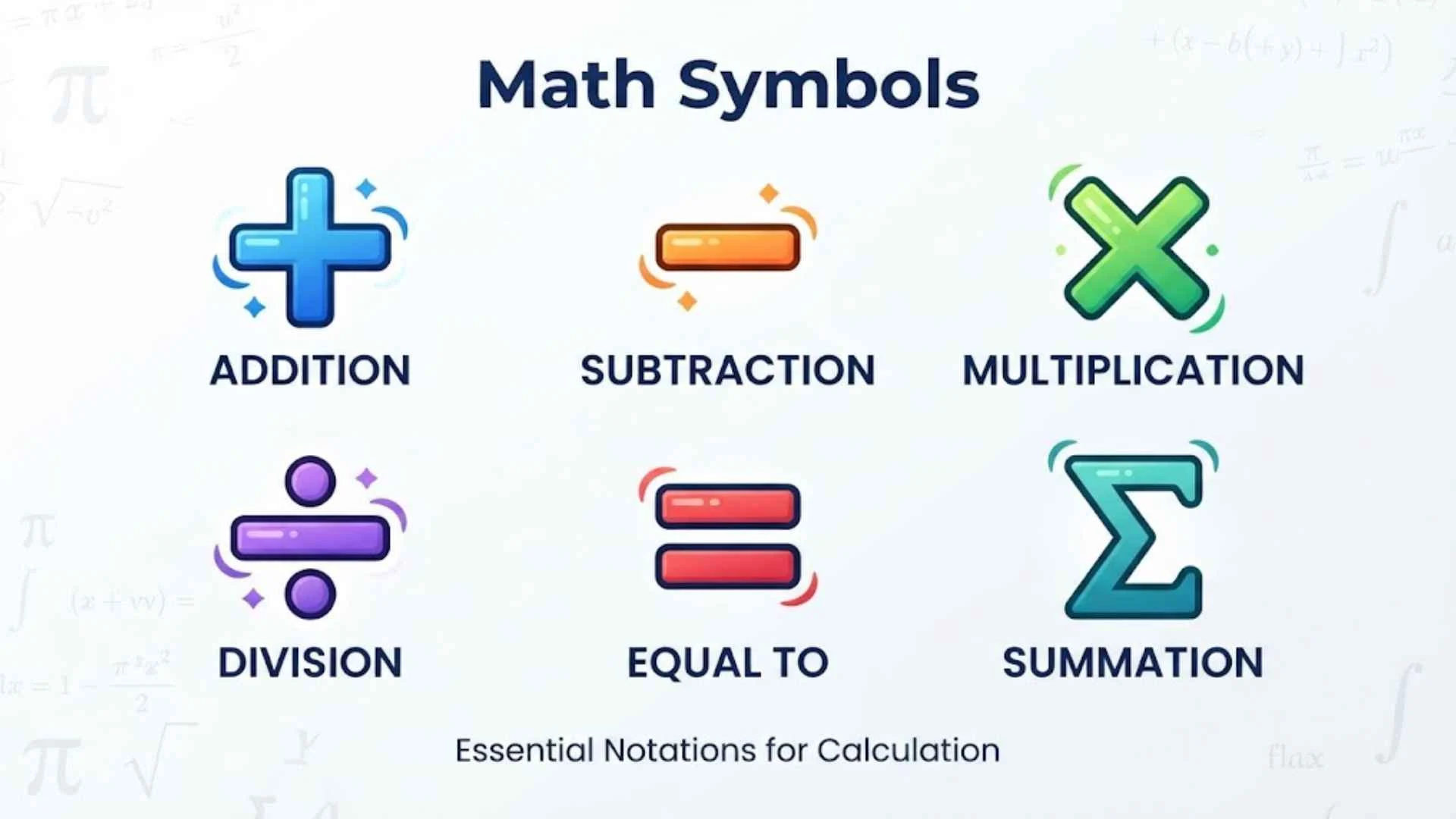
Mathematical symbols are special signs used to represent numbers, operations, relationships, quantities, and mathematical ideas. Instead of writing everything in words, mathematicians use symbols to make equations shorter, clearer, and easier to understand.
You may already know familiar symbols such as + for addition, − for subtraction, × for multiplication, and = for equality. However, mathematics uses hundreds of other symbols, including symbols for inequalities, fractions, geometry, algebra, calculus, probability, statistics, sets, and logic.
This complete guide to math symbols explains the most commonly used mathematical signs, what they mean, and where you may see them used.
Common Math Symbols and Their Meanings
The following table includes some of the most frequently used math symbols.
| Symbol | Name | Meaning | Example |
| + | Plus | Addition | 5 + 3 = 8 |
| − | Minus | Subtraction | 9 − 4 = 5 |
| × | Multiplication sign | Multiplication | 6 × 2 = 12 |
| ÷ | Division sign | Division | 12 ÷ 3 = 4 |
| = | Equal sign | Shows equality | 4 + 2 = 6 |
| ≠ | Not equal | Shows two values are different | 5 ≠ 7 |
| < | Less than | First value is smaller | 3 < 8 |
| > | Greater than | First value is larger | 9 > 4 |
| ≤ | Less than or equal to | Smaller or equal | x ≤ 10 |
| ≥ | Greater than or equal to | Larger or equal | x ≥ 5 |
| % | Percent | Per hundred | 25% |
| √ | Square root | Principal square root | √25 = 5 |
| ² | Squared | Raised to the second power | 5² = 25 |
| ³ | Cubed | Raised to the third power | 3³ = 27 |
| ± | Plus-minus | Positive or negative possibility | ±5 |
| ≈ | Approximately equal | Nearly equal | π ≈ 3.14 |
| ∞ | Infinity | Unbounded quantity | x → ∞ |
| π | Pi | Ratio of circumference to diameter | π ≈ 3.14159 |
These basic symbols form the foundation of many mathematical calculations.
Arithmetic Math Symbols
Arithmetic symbols are used for basic calculations involving numbers. They are among the first mathematical signs students learn.
Addition Symbol
The plus sign + represents addition.
For example:
7 + 5 = 12
The numbers being added are called addends, while the result is the sum.
Subtraction Symbol
The minus sign − represents subtraction.
For example:
15 − 6 = 9
The result of subtraction is called the difference.
The minus symbol can also indicate a negative number, such as −8.
Multiplication Symbol
Multiplication is commonly represented by ×.
For example:
8 × 4 = 32
In algebra, multiplication is often written without the multiplication sign. For example:
3x
means 3 × x.
A centered dot · may also represent multiplication:
5 · 6 = 30
Division Symbol
The division sign ÷ indicates division.
For example:
20 ÷ 5 = 4
Division can also be written using a fraction:
20/5 = 4
or
20 over 5 = 4.
Equals Symbol
The equal sign = means that the expressions on both sides have the same value.
For example:
10 − 4 = 6
It is also commonly used when solving equations:
x + 3 = 9
which gives:
x = 6
Comparison Math Symbols
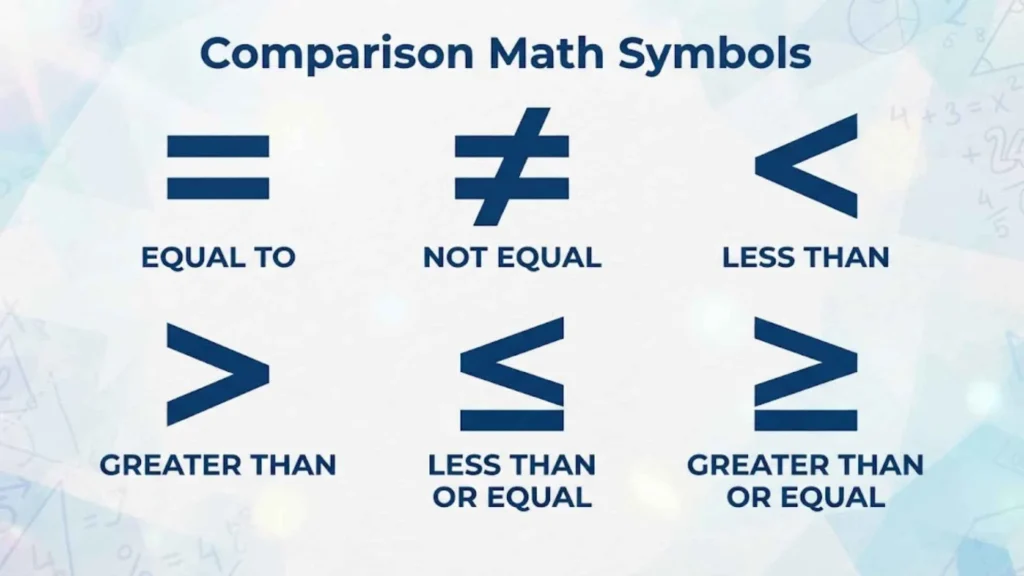
Comparison symbols are used to show relationships between two numbers or expressions.
Less Than Symbol
The symbol < means “less than.”
For example:
4 < 9
This means 4 is less than 9.
Greater Than Symbol
The symbol > means “greater than.”
For example:
12 > 7
This means 12 is greater than 7.
Less Than or Equal To
The symbol ≤ means that one value is either smaller than or equal to another.
For example:
x ≤ 20
This means x can be 20 or any number smaller than 20.
Greater Than or Equal To
The symbol ≥ means that one value is either greater than or equal to another.
For example:
x ≥ 10
This means x can be 10 or any number greater than 10.
Not Equal To
The symbol ≠ means that two values are not equal.
For example:
8 ≠ 5
This statement is true because 8 and 5 have different values.
Algebra Math Symbols
Algebra uses letters and symbols to represent unknown or variable quantities.
Variable Symbol
Letters such as x, y, and z are commonly used as variables.
For example:
x + 5 = 12
Here, x represents an unknown number.
Parentheses
Parentheses () are used to group mathematical expressions.
For example:
3 × (4 + 2) = 18
The parentheses indicate that the addition should be performed before multiplication.
Brackets
Square brackets [] can also group expressions.
For example:
2[5 + 3] = 16
Brackets are particularly useful when an expression already contains parentheses.
Exponent Symbol
An exponent indicates how many times a number or expression is multiplied by itself.
For example:
2³ = 2 × 2 × 2 = 8
The small number 3 is the exponent.
Superscript
A superscript is a character written above the normal line of text.
Examples include:
x²
x³
10⁵
Superscripts are commonly used for powers and scientific notation.
Subscript
A subscript is a character written below the normal text line.
For example:
x₁, x₂, x₃
Subscripts are frequently used to distinguish different variables or elements in a sequence.
Fraction and Ratio Symbols
Fractions and ratios use several mathematical symbols.
Fraction Bar
A horizontal line between two numbers represents a fraction.
For example:
½
means one-half.
The top number is the numerator, while the bottom number is the denominator.
Percent Symbol
The percent symbol % means “out of 100.”
For example:
25% = 25/100 = 0.25
Percentages are widely used in finance, statistics, discounts, grades, and everyday calculations.
Ratio Symbol
The colon : can represent a ratio.
For example:
2:3
means that for every 2 units of one quantity, there are 3 units of another.
Root and Radical Symbols
Radical symbols are commonly used to represent roots.
Square Root
The symbol √ represents a square root.
For example:
√36 = 6
because 6 × 6 = 36.
Cube Root
The cube root symbol is ∛.
For example:
∛27 = 3
because:
3 × 3 × 3 = 27
Fourth Root and Higher Roots
Higher roots can be written with an index.
For example:
∜16 = 2
The number or expression inside the radical is called the radicand.
Special Math Symbols
Some mathematical symbols represent important constants, concepts, or special relationships.
Pi Symbol
The Greek letter π represents pi.
Pi is approximately:
π ≈ 3.14159
It is especially important in geometry involving circles.
For a circle:
Circumference = 2πr
and:
Area = πr²
Infinity Symbol
The symbol ∞ represents infinity.
Infinity is used to describe something without an upper or lower bound.
For example:
x → ∞
means that x approaches infinity.
Infinity is a concept rather than an ordinary number.
Plus-Minus Symbol
The symbol ± means plus or minus.
For example:
x = 5 ± 2
means x may be 7 or 3.
The symbol is particularly common in equations involving square roots and measurements with uncertainty.
Approximately Equal Symbol
The symbol ≈ means approximately equal to.
For example:
π ≈ 3.14
It is used when a value is close to another value but not exactly equal.
Proportional To Symbol
The symbol ∝ means “is proportional to.”
For example:
y ∝ x
means that y changes in proportion to x.
Geometry Math Symbols
Geometry uses mathematical symbols to describe angles, lines, shapes, lengths, and measurements.
Angle Symbol
The symbol ∠ represents an angle.
For example:
∠ABC
means the angle formed by points A, B, and C.
Degree Symbol
The degree symbol ° is used to measure angles and temperature.
For example:
90°
represents a right angle.
Parallel Symbol
The symbol ∥ means parallel.
For example:
AB ∥ CD
means line AB is parallel to line CD.
Perpendicular Symbol
The symbol ⊥ means perpendicular.
For example:
AB ⊥ CD
means the two lines meet at a right angle.
Congruent Symbol
The symbol ≅ means congruent.
In geometry, two shapes are congruent when they have the same size and shape.
For example:
△ABC ≅ △DEF
Similar Symbol
The symbol ∼ can represent similarity in geometry.
For example:
△ABC ∼ △DEF
means the triangles are similar.
Set Theory Math Symbols
Set theory uses a specialized group of symbols to describe collections of objects and relationships between sets.
Element Of
The symbol ∈ means “is an element of” or “belongs to.”
For example:
3 ∈ {1, 2, 3, 4}
means 3 belongs to the set.
Not An Element Of
The symbol ∉ means “is not an element of.”
For example:
7 ∉ {1, 2, 3, 4}
Subset
The symbol ⊂ can indicate that one set is a subset of another.
For example:
A ⊂ B
means every element of A is also contained in B.
Subset or Equal To
The symbol ⊆ means that one set is a subset of another set and may be equal to it.
Union
The symbol ∪ represents the union of sets.
For example:
A ∪ B
contains elements that belong to A, B, or both.
Intersection
The symbol ∩ represents the intersection of sets.
For example:
A ∩ B
contains elements common to both sets.
Empty Set
The symbol ∅ represents the empty set.
An empty set contains no elements.
Calculus Math Symbols
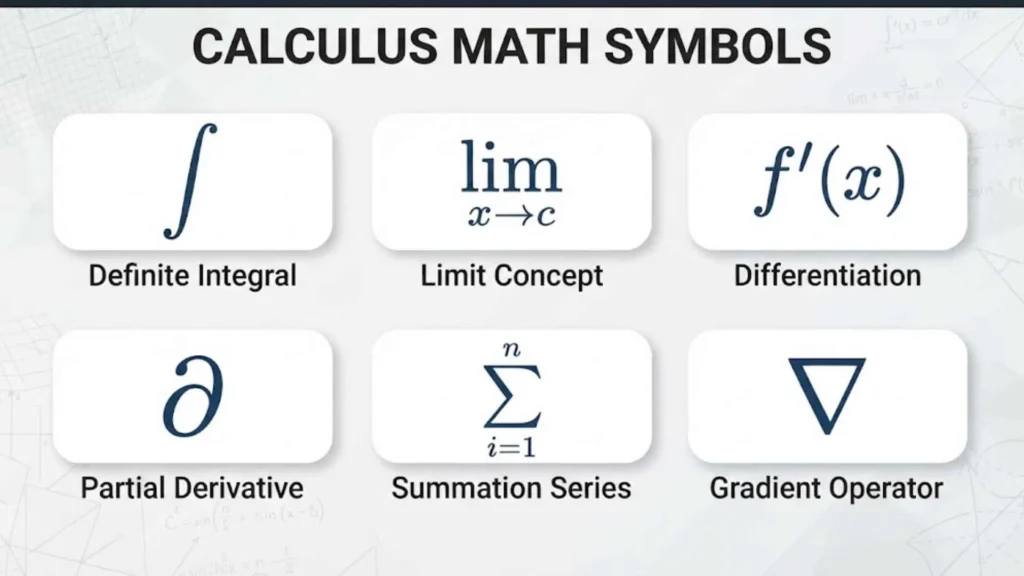
Calculus introduces symbols for limits, derivatives, integrals, and rates of change.
Derivative Symbol
The notation dy/dx represents the derivative of y with respect to x.
It describes how y changes as x changes.
Another common notation is:
f′(x)
Partial Derivative
The symbol ∂ is used for partial derivatives.
For example:
∂f/∂x
is the partial derivative of f with respect to x.
Integral Symbol
The symbol ∫ represents integration.
For example:
∫ x dx
is an integral involving x.
Integration is commonly used to find accumulated quantities and areas under curves.
Double Integral
The symbol ∬ represents a double integral.
It is commonly used when integrating over a two-dimensional region.
Limit
The notation lim represents a limit.
For example:
lim x→0 f(x)
describes the value that f(x) approaches as x approaches 0.
Summation and Product Symbols
Large mathematical expressions can be represented compactly with special symbols.
Summation Symbol
The Greek capital letter sigma Σ represents summation.
For example:
Σx
means to add a specified collection of values.
A more detailed expression might look like:
Σᵢ₌₁ⁿ i
which represents the sum of the integers from 1 through n.
Product Symbol
The capital Greek letter pi Π can represent a product of multiple values.
For example:
Πᵢ₌₁ⁿ aᵢ
means that the indicated values are multiplied together.
Probability and Statistics Symbols
Probability and statistics use symbols to represent averages, probabilities, populations, samples, and variation.
Probability Symbol
The notation P(A) commonly represents the probability of event A.
For example:
P(A) = 0.5
means event A has a probability of 0.5.
Mean Symbol
The sample mean is commonly represented by:
x̄
The bar over x indicates the average of the sample values.
Population Mean
The Greek letter μ commonly represents the population mean.
Standard Deviation
The Greek letter σ is commonly used for population standard deviation.
For a sample, s is often used.
Variance
Population variance is commonly represented by:
σ²
while sample variance is often represented by:
s²
Logic and Mathematical Reasoning Symbols
Mathematical logic uses symbols to represent statements and relationships between propositions.
Logical And
The symbol ∧ means logical AND.
For example:
P ∧ Q
is true when both P and Q are true.
Logical Or
The symbol ∨ means logical OR.
For example:
P ∨ Q
means P or Q, depending on the logical context.
Not Symbol
The symbol ¬ means logical NOT.
For example:
¬P
means “not P.”
Therefore Symbol
The symbol ∴ means “therefore.”
It is sometimes used to show a conclusion.
For example:
A = B, B = C, ∴ A = C
Because Symbol
The symbol ∵ means “because.”
It may be used to introduce a reason or explanation in mathematical writing.
Number System Symbols
Different types of numbers have their own common notation.
Natural Numbers
Natural numbers are often represented by:
ℕ
Depending on convention, natural numbers may begin with 0 or 1.
Integers
Integers are commonly represented by:
ℤ
They include positive and negative whole numbers and zero.
Rational Numbers
Rational numbers are commonly represented by:
ℚ
They can be expressed as a ratio of two integers with a nonzero denominator.
Real Numbers
Real numbers are represented by:
ℝ
They include rational and irrational numbers.
Complex Numbers
Complex numbers are commonly represented by:
ℂ
They include numbers involving the imaginary unit.
Greek Math Symbols
Greek letters are widely used throughout mathematics and related sciences.
| Symbol | Common Name | Common Mathematical Use |
| α | Alpha | Angles, coefficients |
| β | Beta | Angles, coefficients |
| γ | Gamma | Angles, functions |
| δ | Delta | Change, small quantity |
| ε | Epsilon | Small quantity, error |
| θ | Theta | Angles |
| λ | Lambda | Wavelength, eigenvalues |
| μ | Mu | Mean, coefficients |
| π | Pi | Circle constant |
| ρ | Rho | Density, correlation |
| σ | Sigma | Standard deviation |
| Σ | Capital sigma | Summation |
| φ | Phi | Angles, ratios, functions |
| ω | Omega | Angular frequency, final value |
| Δ | Capital delta | Change or difference |
The exact meaning of a Greek symbol depends on the mathematical field and the equation in which it appears.
Common Math Symbols for Students
Students commonly encounter the following symbols in elementary, middle-school, and high-school mathematics:
- + — addition
- − — subtraction
- × — multiplication
- ÷ — division
- = — equal
- ≠ — not equal
- < — less than
- > — greater than
- ≤ — less than or equal to
- ≥ — greater than or equal to
- % — percent
- √ — square root
- π — pi
- ² — squared
- ³ — cubed
- () — parentheses
- [] — brackets
- ± — plus or minus
- ≈ — approximately equal
Learning these symbols makes it easier to read mathematical problems and equations.
How to Remember Math Symbols Easily
Math symbols can seem difficult when you encounter many of them at once. Learning them by category is usually easier than trying to memorize a long list.
Learn Basic Operations First
Start with:
+ − × ÷ =
These symbols appear in almost every level of mathematics.
Learn Comparison Symbols Together
Group these symbols:
< > ≤ ≥ ≠
A useful way to remember < and > is to think of the wider side as pointing toward the larger number.
For example:
2 < 8
The wider opening faces 8.
Connect Symbols With Their Names
Instead of memorizing a symbol by itself, learn it with its meaning.
For example:
√ = square root
∞ = infinity
∑ = summation
∫ = integral
This creates a stronger connection between the visual symbol and its mathematical purpose.
Practice Symbols in Equations
Using symbols in actual equations is often more effective than simply reading a list.
For example:
3 + 4 = 7
10 > 6
x² = 25
√49 = 7
Math Symbols vs. Mathematical Notation
Math symbols and mathematical notation are closely related but are not exactly the same thing.
A math symbol is an individual sign such as +, =, √, or ∞.
Mathematical notation refers more broadly to the system used to represent mathematical ideas, including symbols, numbers, variables, expressions, equations, and specialized conventions.
For example:
x² + y² = z²
contains several pieces of mathematical notation, including variables, an exponent, an addition sign, and an equality sign.
Why Are Math Symbols Important?
Math symbols make mathematical communication faster and more precise.
Without symbols, a simple equation could require many words. Instead of writing “five added to three is equal to eight,” we can write:
5 + 3 = 8
Symbols also allow mathematicians to communicate complex concepts across languages.
A mathematical equation can often be understood regardless of whether the reader speaks English, Spanish, Arabic, Chinese, or another language.
Common Mistakes When Reading Math Symbols
Understanding the symbol alone is not always enough. Its position and context also matter.
Confusing Less Than and Greater Than
A common mistake is reversing < and >.
Remember:
3 < 7
means 3 is less than 7.
7 > 3
means 7 is greater than 3.
Confusing Minus With a Negative Sign
The symbol − can indicate subtraction or a negative value.
For example:
8 − 3
uses the symbol for subtraction.
But:
−3
represents a negative number.
Assuming Every Symbol Has Only One Meaning
Some symbols have different meanings in different mathematical fields.
For example, |x| commonly represents absolute value, but vertical bars can have other meanings in advanced mathematics.
Similarly, ∼ may represent similarity, approximation in some contexts, or other relationships depending on the subject.
Ignoring Context
The meaning of a mathematical symbol depends on the expression around it.
For this reason, when you encounter an unfamiliar symbol, look at the entire equation or mathematical topic rather than interpreting the sign in isolation.
Frequently Asked Questions
What are the basic math symbols?
The basic math symbols include + for addition, − for subtraction, × for multiplication, ÷ for division, and = for equality. Other common symbols include <, >, ≤, ≥, %, and √.
What does ∞ mean in math?
The symbol ∞ represents infinity. It describes something that has no finite bound rather than representing an ordinary number.
What does π mean in mathematics?
The symbol π represents pi, a mathematical constant equal to the ratio of a circle’s circumference to its diameter. Its approximate value is 3.14159.
What does √ mean in math?
The symbol √ represents the square root. For example, √64 = 8 because 8 × 8 equals 64.
What does ≠ mean?
The symbol ≠ means “not equal to.” It indicates that two values or expressions have different values.
What do ≤ and ≥ mean?
≤ means “less than or equal to,” while ≥ means “greater than or equal to.”
What does ± mean?
The symbol ± means “plus or minus.” It indicates that either the positive or negative version of a value may apply.
What does Σ mean?
The capital Greek letter Σ is commonly used as the summation symbol. It represents the addition of a specified collection of values.
What does ∫ mean?
The symbol ∫ represents an integral. Integration is an important concept in calculus and is used for finding accumulated quantities, areas, and other mathematical results.
Why are Greek letters used in math?
Greek letters are used extensively to represent constants, variables, angles, functions, coefficients, and other mathematical quantities. Their meaning depends on the context.
Conclusion
Math symbols provide a compact and powerful way to communicate mathematical ideas. From simple arithmetic signs such as +, −, ×, and ÷ to advanced symbols such as ∫, Σ, ∂, ∞, and ∈, each symbol helps represent a specific operation, relationship, quantity, or concept.
The easiest way to learn mathematical symbols is to study them by category, understand their meaning, and practice seeing them in real equations. Once the most common symbols become familiar, reading mathematical expressions becomes much easier.

Hi, I’m Asher Monroe, a writer who believes that meaningful words have the power to inspire change and bring people closer to their dreams. I have always been fascinated by the beauty of quotes and the way a simple message can provide motivation, hope, and comfort.
I enjoy creating content around inspirational quotes, life lessons, success stories, and positive thoughts that help readers find encouragement in their everyday lives. My goal is to share words that connect with people and remind them of their inner strength.
Through my writing, I explore the ideas of personal growth, confidence, and the importance of staying inspired through every chapter of life.
I am the author of Words That Move the Soul and The Path of Endless Inspiration, two books focused on the power of wisdom, positivity, and meaningful thoughts.
 Sienna Brooks
 Rowan Sinclair Rowan Sinclair