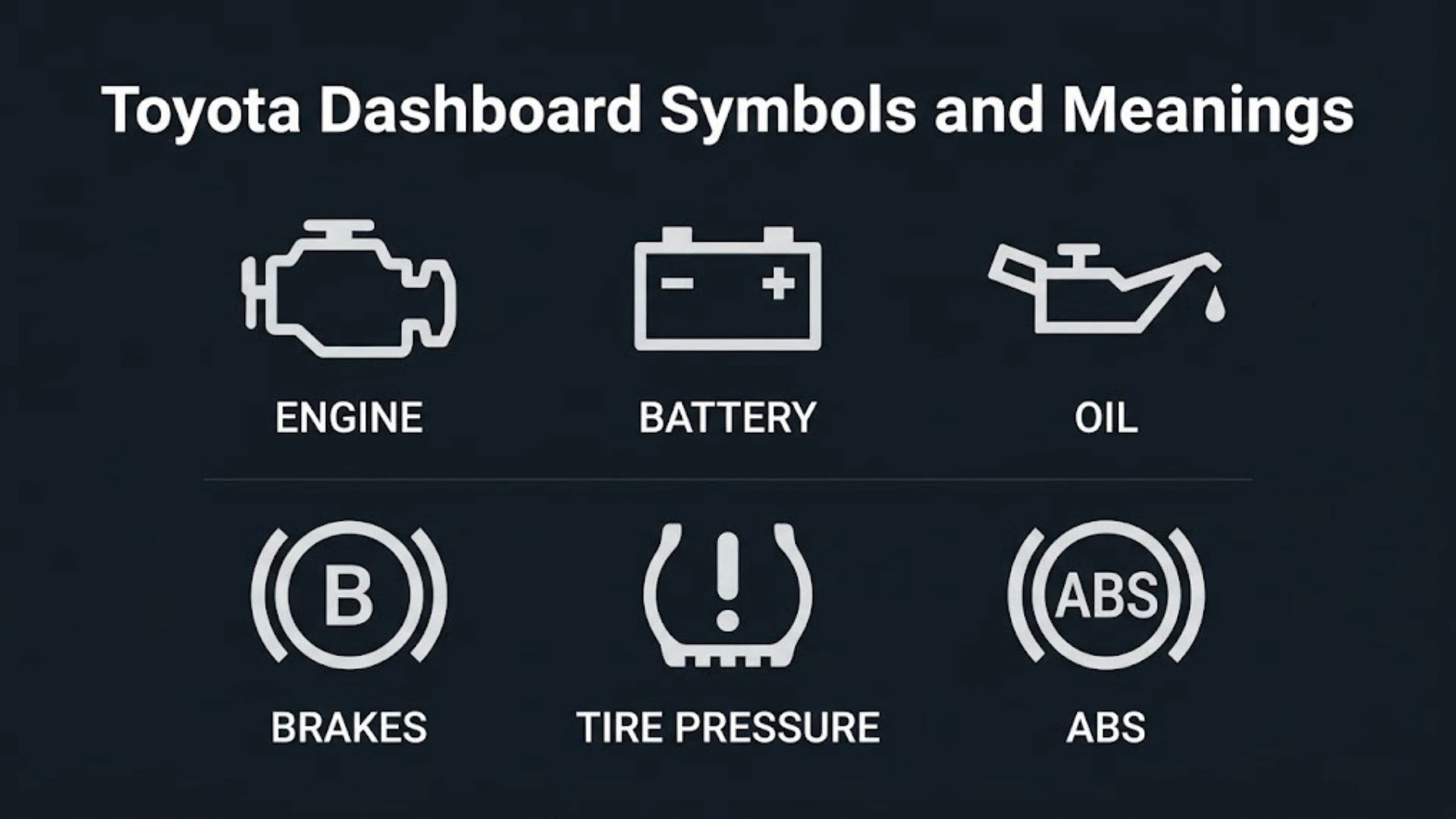
Toyota dashboard symbols help you understand your vehicle’s condition, safety systems, and maintenance needs. Some lights simply confirm that a feature is working. Others warn you about problems that could affect braking, steering, engine performance, or road safety.
Knowing what these symbols mean helps you respond quickly and avoid unnecessary repairs. For example, a green turn signal usually indicates normal operation, while a red oil pressure warning can signal a serious engine problem that requires you to stop safely.
This Toyota dashboard symbols and meanings guide explains common warning lights, their colors, what may trigger them, and what to do when they appear. It also covers Toyota RAV4 and Camry dashboard symbols, maintenance reminders, troubleshooting, and frequently asked questions.
Important: Dashboard symbols can vary by Toyota model, model year, trim, and powertrain. Always check your vehicle’s owner’s manual for the exact meaning and recommended response to a warning light.
Toyota Dashboard Symbols and Meanings: Quick Reference Chart
Use this chart to identify common Toyota dashboard warning lights and understand what action may be necessary. The descriptions are general guidance, not a substitute for the instructions in your vehicle’s manual.
| Dashboard symbol or light | General meaning | What you should do |
| Check engine icon | Possible engine, emissions, or powertrain issue | Arrange a diagnostic check; stop if the engine runs roughly or other serious symptoms appear |
| Flashing check engine light | Potentially serious engine misfire or related fault | Reduce engine load and stop safely if flashing continues; seek prompt professional help |
| Oil can symbol | Low engine oil pressure | Stop safely and switch off the engine as soon as possible |
| Battery symbol | Charging system problem | Turn off nonessential electrical accessories and arrange immediate assessment |
| Thermometer over waves | Engine coolant temperature is too high | Stop safely and follow the owner’s manual; never open a hot cooling system |
| Tire cross-section with an exclamation point | Low tire pressure or a tire pressure monitoring system issue | Check tire pressures when safe and inspect for damage |
| ABS letters | Anti-lock Braking System fault | Drive cautiously if braking feels normal and arrange inspection; follow any accompanying brake warnings |
| Brake symbol | Parking brake, brake fluid, or brake system warning | Confirm the parking brake is released; stop if the warning remains with abnormal braking |
| Person with a circle in front | SRS or airbag system warning | Arrange prompt inspection because some restraint features may not work correctly |
| Steering wheel with an exclamation point | Electric power steering system issue | Use caution because steering may require more effort |
| Red or yellow triangle with an exclamation point | Master warning or general alert, depending on model | Read the vehicle display for the specific message |
| TRAC OFF | Traction control has been switched off or is unavailable | Check the display and owner’s manual; reactivate the system if appropriate |
| Car with wavy lines | Traction or stability control activity, or a system warning | A flashing indicator may show system activity; a steady warning may need investigation |
| Seatbelt symbol | A seatbelt may be unfastened | Fasten seatbelts and check that occupants are properly secured |
| Fuel pump icon | Fuel level is low | Refuel soon |
| Blue headlamp symbol | High-beam headlights are on | Switch to low beams when required to avoid dazzling other drivers |
| Green turn arrows | Turn signals or hazard indicators are operating | Check that the signals switch off after the maneuver |
| Green cruise control indicator | Cruise control is active or a related function is enabled | Confirm the selected speed and remain attentive |
| Maintenance required reminder | Scheduled maintenance is due or approaching | Check the maintenance schedule and service reminder instructions |
A symbol’s color, whether it flashes or stays on, and any accompanying message can change the urgency. A warning that appears briefly when you start the vehicle may be part of a normal indicator check. A warning that stays on or appears while driving needs more attention.
For Toyota-specific guidance, consult the official Toyota warning light guide and your vehicle’s owner’s manual.
Understanding Toyota Dashboard Warning Light Colors
The color of a dashboard light provides a useful first clue about its urgency. However, dashboard warning light colors are not a universal diagnostic code. You still need to identify the symbol and read any message on the instrument panel.
Red dashboard warning lights
Red lights often indicate a serious condition that needs immediate attention. Examples can include low engine oil pressure, a brake system warning, or excessive engine temperature. Stop safely when the symbol or accompanying message calls for it.
Yellow or amber warning lights
These usually indicate a problem or condition that needs investigation. Common examples include the check engine light, tire pressure warning, and some driver assistance alerts. The right response depends on the specific warning.
Blue dashboard indicators
Blue lights often show that a feature is active. The best-known example is the high-beam indicator, which confirms that the headlights are using high beams.
Green dashboard indicators
Green lights usually confirm that a function is operating or switched on. Turn signals are a common example. A green indicator does not usually mean the vehicle has a fault.
What does a red warning light mean on a Toyota?
A red warning light often signals a condition that could affect vehicle safety or cause damage if you continue driving. Examples include low engine oil pressure, a serious brake warning, or engine overheating.
When a red warning appears:
- Find a safe place to stop if the manual or display instructs you to stop.
- Switch off the engine when the warning relates to a potentially damaging engine condition.
- Read the dashboard message and owner’s manual.
- Avoid restarting or driving the vehicle if doing so could cause further damage.
- Call roadside assistance or a qualified technician when necessary.
Don’t assume every red light has exactly the same meaning across the Toyota lineup. Check the specific symbol and message.
What does a yellow warning light mean on a Toyota?
A yellow warning light generally means the vehicle has detected a condition that needs attention. Some warnings allow you to drive cautiously to a repair facility, while others require you to stop or disable a feature.
For example, a tire pressure warning may mean one or more tires need air. A check engine light may indicate an emissions-related fault or another engine issue. If the vehicle loses power, shakes, smells unusual, or shows additional serious warnings, stop safely rather than continuing.
Are blue and green Toyota dashboard lights serious?
Blue and green indicators usually communicate vehicle status rather than an urgent fault. A blue high-beam indicator tells you that high beams are active. Green turn signal arrows show that the signals are operating.
Still, pay attention to what the light represents. High beams can dazzle oncoming drivers, and a turn signal left on after a maneuver can confuse other road users. Informational indicators still matter for road safety.
Toyota Engine and Powertrain Warning Lights
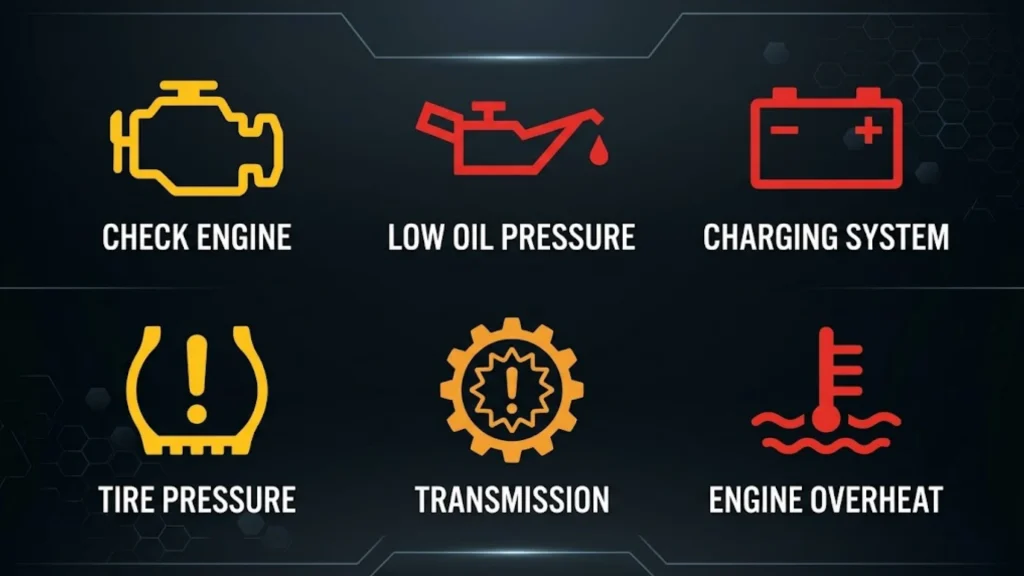
Engine-related dashboard icons help monitor combustion, lubrication, emissions, cooling, and other important systems. Some warnings indicate a relatively minor issue, while others can signal a fault that causes expensive damage if ignored.
Toyota check engine light
The Toyota check engine light usually appears as an engine-shaped icon. It is also called the malfunction indicator lamp. The light means the vehicle’s onboard monitoring system has detected a problem involving the engine, emissions equipment, or a related component.
Possible causes include:
- A loose, damaged, or improperly tightened fuel cap on vehicles that use one.
- A faulty oxygen sensor.
- An emissions control system problem.
- A malfunctioning mass airflow sensor.
- Worn spark plugs or ignition coils.
- An engine misfire or another engine management fault.
A steady check engine light does not automatically mean the car must be towed. If the vehicle runs normally, check the owner’s manual and arrange a diagnostic inspection promptly. If the light flashes, the engine shakes, or power drops noticeably, reduce engine load and stop safely if the problem continues.
A diagnostic scanner can retrieve trouble codes from the vehicle’s computer. These codes help a technician narrow down the cause, but a code alone does not always identify the failed part.
Toyota flashing check engine light
A Toyota flashing check engine light deserves more urgent attention than a steady light. A flashing light can indicate an engine misfire severe enough to damage the catalytic converter.
You may notice symptoms such as:
- Engine shaking or rough idling.
- Poor acceleration.
- Reduced engine power.
- Unusual exhaust smells.
- Increased fuel consumption.
Avoid hard acceleration and heavy loads. If the light continues flashing or the engine runs roughly, pull over somewhere safe and turn off the engine. Arrange professional assistance rather than continuing a long journey.
Do not assume replacing spark plugs will always solve the problem. Ignition coils, fuel delivery, wiring, and other engine components can also cause misfires.
Toyota low engine oil pressure warning light
The Toyota low engine oil pressure warning light often resembles an oil can with a drop. It warns that engine oil pressure may be too low to lubricate moving components properly.
Low oil pressure can cause serious engine damage because the engine relies on oil to reduce friction and carry heat away from critical parts.
Possible causes include:
- An oil level that is too low.
- An oil leak.
- A failing oil pump.
- A blocked oil pickup or oil passage.
- An internal engine problem.
What to do: Stop in a safe place and switch off the engine as soon as possible. Do not keep driving to see whether the light disappears.
After the engine has cooled and the vehicle is parked safely on level ground, check the oil level if your owner’s manual explains how to do so. Adding oil may help if the level is low, but it does not prove that oil pressure is normal. If the warning remains, do not restart the engine until the problem has been assessed.
Toyota high coolant temperature warning light
A thermometer over wavy lines is a common symbol for high engine coolant temperature. This Toyota dashboard warning light can mean the engine is overheating.
Potential causes include:
- Low coolant.
- A coolant leak.
- A malfunctioning thermostat.
- A radiator or cooling fan problem.
- A water pump fault.
- Heavy engine load in hot conditions.
If the high-temperature warning appears, stop safely and follow the vehicle’s instructions. Switch off the engine if directed. Never remove the radiator cap or open a pressurized cooling system while it is hot; escaping coolant or steam can cause severe burns.
Wait for the system to cool before checking anything. If coolant is leaking, steam is visible, or the warning returns, arrange roadside assistance or a professional inspection.
Toyota hybrid system warnings
Hybrid Toyotas may display additional warnings for the hybrid system, battery, or electric powertrain. A hybrid system warning does not necessarily mean the conventional 12-volt battery has failed.
Depending on the vehicle, the issue may involve the hybrid control system, cooling, power electronics, or another monitored component. Read the message on the vehicle display and consult the correct hybrid owner’s manual.
Do not touch orange high-voltage cables or attempt high-voltage repairs yourself. If the vehicle reports a serious hybrid system fault or will not enter READY mode, contact a qualified Toyota technician.
Toyota Battery and Electrical Warning Lights
The Toyota battery warning light usually resembles a battery with positive and negative signs. Despite its name, it commonly indicates a problem with the charging system rather than simply reporting that the battery is old.
Toyota battery or charging system warning light
The Toyota charging system warning light may appear if the alternator, wiring, belt drive, battery connections, or charging controls are not working correctly. The exact system differs by model, especially between conventional vehicles and hybrids.
Possible symptoms include:
- Headlights that become dim.
- Electrical accessories that stop working properly.
- Difficulty starting the vehicle.
- A warning message about the charging system.
- Other electrical warning lights appearing together.
If the warning appears while driving, turn off nonessential electrical accessories when safe and arrange immediate assessment. The vehicle may eventually lose electrical power or stop running.
Do not assume a jump-start fixes the underlying fault. It may provide temporary power, but a charging system problem can cause the battery to discharge again.
Other electrical system alerts
Modern Toyota vehicles use electronic modules to manage engine functions, steering, braking assistance, driver assistance features, and infotainment systems. An electrical fault can sometimes trigger several dashboard warnings at once.
Low battery voltage, loose connections, damaged wiring, or a failing battery can contribute to electrical problems. However, several warning lights appearing together do not prove the battery is responsible.
A technician can test the battery, charging system, electrical connections, and stored fault codes to identify the cause.
Toyota Tire Pressure Warning Light
The Toyota tire pressure warning light commonly looks like a cross-section of a tire with an exclamation point. It is associated with the Tire Pressure Monitoring System (TPMS), which checks tire pressure using sensors or another system-specific method.
The light may appear because:
- One or more tires are underinflated.
- A tire has lost air because of a puncture.
- Tire pressure has changed with temperature.
- A TPMS sensor or related component has a fault.
- The system needs to be initialized according to the owner’s manual after a tire-related change.
What should you do when the TPMS light comes on?
- Reduce speed and avoid sudden braking or sharp turns.
- Pull over safely if a tire looks flat or the vehicle handles differently.
- Check all tires, including the spare if your model monitors it.
- Use a reliable tire pressure gauge when the tires are cold.
- Inflate the tires to the pressure listed on the driver’s door-jamb label or specified in the owner’s manual.
- Follow the manual’s instructions if the warning needs to be reset or initialized.
Do not use the maximum pressure printed on a tire’s sidewall as the normal target. That figure is not necessarily the recommended pressure for your vehicle.
If the warning flashes before staying on, some Toyota systems use that pattern to indicate a TPMS malfunction. Check the manual for your model. If the tire pressure is correct but the light remains on, arrange an inspection.
Toyota Brake and ABS Warning Lights
Brake warnings deserve careful attention because they can affect your ability to stop safely. Toyota vehicles may use different symbols or colors depending on the model and market.
Toyota brake system warning light
A Toyota brake system warning light may look like an exclamation point inside a circle, sometimes with brackets or the word “BRAKE.” Depending on the vehicle, it can indicate that the parking brake is applied, brake fluid is low, or a brake system fault has been detected.
First, make sure the parking brake is fully released. If the warning stays on, consult the owner’s manual and follow its instructions.
Stop driving and seek assistance if the brake warning remains on and you notice a soft pedal, reduced braking, fluid leakage, unusual noises, or another warning indicating a serious brake fault. Do not assume the car is safe simply because it still moves.
Toyota ABS warning light
The Toyota ABS warning light usually displays the letters “ABS.” The Anti-lock Braking System helps prevent the wheels from locking during hard braking, helping the driver maintain steering control in appropriate conditions.
A steady ABS warning may indicate a fault involving wheel-speed sensors, wiring, the ABS control unit, or another component.
If the ABS light remains on, conventional braking may still work, but anti-lock functionality may be unavailable. Drive cautiously only if braking feels normal and the owner’s manual does not instruct you to stop. Arrange an inspection promptly.
If the ABS light appears with a red brake warning or braking feels abnormal, stop safely and seek professional help.
Toyota SRS and Airbag Warning Lights
The Toyota SRS warning light is commonly shown as a seated person with a circle representing an airbag. SRS stands for Supplemental Restraint System, which includes airbags and related safety components.
The warning may indicate a problem involving:
- Airbag modules or circuits.
- Seatbelt pretensioners.
- Occupant detection sensors.
- Wiring or connectors.
- Related restraint system components.
If the SRS or airbag warning remains on after the normal startup check, the system may not operate as designed in a crash. Arrange a prompt inspection at a qualified service center.
Do not remove airbag components or probe their wiring yourself. These systems contain safety devices that require appropriate diagnostic procedures.
Toyota seatbelt reminder light
A seatbelt symbol typically reminds the driver or passengers to fasten their seatbelts. Depending on the vehicle, an audible warning may also sound.
If the light remains on after everyone has buckled up, check whether an occupant has fastened the belt correctly and whether any item on a passenger seat is triggering an occupancy sensor. Follow the owner’s manual if the reminder continues unexpectedly.
Seatbelts remain essential even when airbags are fitted. Airbags are designed to work with seatbelts, not replace them.
Toyota Master Warning Light and Dashboard Triangle
A Toyota master warning light may appear as a triangle with an exclamation point or another general warning symbol. Its exact appearance and behavior vary by model.
The master warning system draws your attention to a detected condition or message. It does not necessarily identify the failed component on its own.
When this symbol appears:
- Check the multi-information display for a text message.
- Listen for a warning buzzer.
- Look for another illuminated warning light.
- Follow the instructions in the display and owner’s manual.
- Contact a service center if the message persists or the vehicle shows serious symptoms.
For example, a message may refer to engine oil, braking assistance, a driver assistance sensor, or a maintenance requirement. Treat the displayed message as the next diagnostic clue rather than guessing from the triangle alone.
Toyota’s official manuals explain that displayed messages can vary according to operating conditions and vehicle specifications. See the Toyota RAV4 warning message guidance.
Toyota TRAC OFF, VSC OFF, and Slip Indicator Lights
Toyota vehicles may use several symbols to show the status of traction and stability systems. These features can help maintain control when the tires lose grip, but they do not eliminate the risk of skidding.
What does TRAC OFF mean on a Toyota?
The Toyota TRAC OFF indicator means the Traction Control System has been switched off or is not operating normally, depending on the warning pattern and vehicle.
Traction control helps limit wheelspin when a driven wheel loses grip. It can be useful on wet roads, gravel, or slippery surfaces.
If TRAC OFF appears after you press a traction-control button, the system may have been intentionally disabled. Check the owner’s manual to learn how to turn it back on. If the light appears unexpectedly or stays on after you reactivate the system, arrange an inspection.
What does VSC OFF mean on a Toyota?
The Toyota VSC OFF indicator relates to Vehicle Stability Control. VSC can help reduce skidding by adjusting engine output and applying braking to individual wheels when necessary.
The light may appear when the driver switches the system off or when a related fault affects its operation. Some Toyota models link the operation of VSC and traction control, so the same action can affect both.
For everyday driving, leave these systems enabled unless the owner’s manual recommends temporarily changing their operation for a specific situation.
What does the Toyota slip indicator mean?
A Toyota slip indicator often looks like a car with wavy lines underneath it.
The light may flash when the vehicle’s traction or stability system is actively helping manage wheelspin or a loss of grip. A steady light, particularly when accompanied by another warning, may indicate that the system is disabled or needs inspection.
If the light flashes briefly on a slippery surface, ease off the accelerator and avoid sudden steering movements. If it stays on under normal driving conditions, check the display and owner’s manual.
Other Toyota Dashboard Indicators and Symbols
Not every icon indicates a mechanical fault. Many Toyota dashboard indicators show that a feature is operating, a routine reminder is due, or a system is temporarily unavailable.
| Indicator | What it generally means | Recommended response |
| Security indicator | The anti-theft or immobilizer system is active | A flashing light when parked may be normal; check the manual if the vehicle will not start |
| Low fuel symbol | Fuel level is low | Refuel as soon as practical |
| High-beam indicator | High-beam headlights are active | Switch to low beams when approaching other traffic or following another vehicle |
| Turn signal arrows | Left or right turn signal is operating | Confirm that the indicator switches off after turning |
| Cruise control indicator | Cruise control or a related feature is active or ready | Check the selected speed and remain alert |
| Maintenance required light | Scheduled service is due or approaching | Check the maintenance schedule and service instructions |
| Headlight or exterior lighting indicator | A lighting function is active | Confirm the lights are appropriate for visibility and road conditions |
| Lane or pre-collision system indicator | A driver assistance system is active, unavailable, or reporting a condition | Read the display and check the manual for the specific state |
| Parking assistance indicator | A parking sensor or related function is active or switched off | Check the vehicle display and feature settings |
Toyota security indicator light
A security indicator may flash when the vehicle is parked and the anti-theft system is armed. On many models, this is normal behavior rather than a sign of a problem.
If the vehicle does not recognize the key or refuses to start, follow the instructions for your key and immobilizer system. Do not assume that every flashing security light indicates a fault.
Toyota low fuel warning light
The Toyota low fuel warning light indicates that the remaining fuel level is low. The distance you can travel after it appears depends on the model, driving conditions, traffic, terrain, and fuel consumption.
Refuel promptly instead of relying on a fixed remaining-distance estimate. Repeatedly driving with very little fuel can also increase the chance of being stranded if traffic or a detour delays your trip.
Toyota high-beam and turn signal indicators
The blue high-beam symbol confirms that high-beam headlights are active. Switch to low beams when necessary to avoid dazzling other drivers.
Green turn signal arrows usually flash when the indicators are operating. If a turn signal blinks faster than usual, check the relevant exterior bulbs and lighting system. A failed bulb is one possible cause, but the exact explanation depends on the vehicle’s lighting design.
Toyota cruise control indicator
The Toyota cruise control indicator may show that cruise control has been enabled, selected, or set to a speed. Some models use separate symbols for standard cruise control and dynamic radar cruise control.
The indicator alone does not mean the vehicle can drive itself. Keep your attention on traffic, maintain a safe following distance, and be ready to brake or steer at all times.
Toyota Maintenance Required Light and Service Reminders
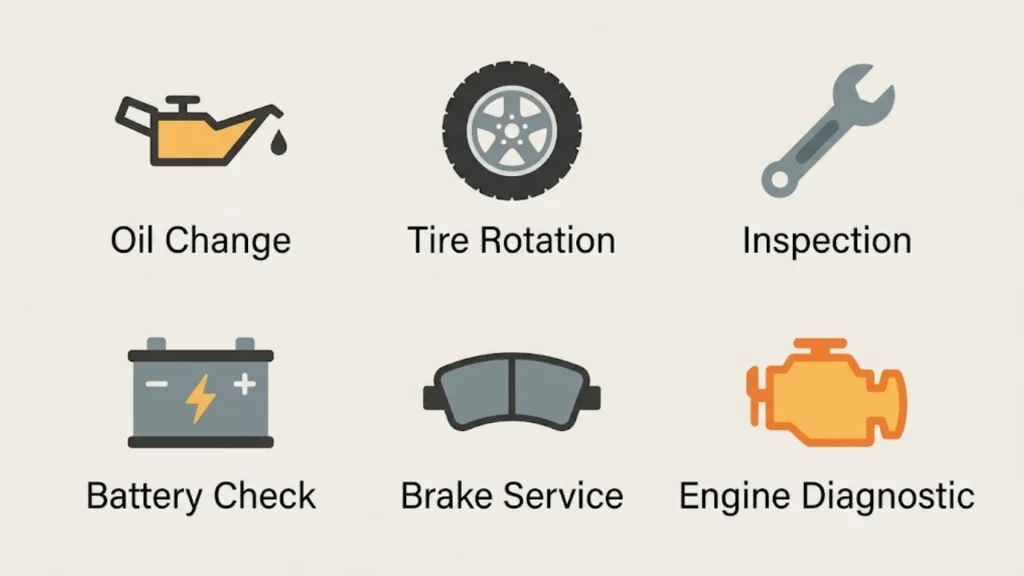
The Toyota maintenance required light is generally a scheduled service reminder. It is different from an oil pressure warning, which can indicate an urgent lubrication problem.
Depending on the model, the reminder may be based on mileage, time, or the maintenance schedule programmed for the vehicle. It may prompt you to arrange an oil change or other routine maintenance.
When the light appears:
- Check the service interval in your owner’s manual.
- Review the vehicle’s maintenance records.
- Arrange the required oil change or inspection.
- Confirm which services are actually due rather than assuming every fluid or component needs replacement.
- Reset the reminder only after completing the required maintenance, using the model-specific instructions.
Routine service can include engine oil and filter replacement, tire inspection, brake checks, fluid inspections, and other work specified in the maintenance schedule. The exact requirements vary by vehicle and driving conditions.
A maintenance reminder is not a substitute for responding to an unexpected warning light. If the oil pressure, brake, temperature, or charging system warning appears, treat it as a separate issue.
Toyota Dashboard Symbols by Model
Although many symbols appear across the Toyota lineup, their appearance, location, colors, and messages can differ by model year, trim, and powertrain. Hybrid vehicles may also display additional system indicators.
Toyota RAV4 dashboard symbols
The Toyota RAV4 dashboard symbols can include engine, oil pressure, charging system, tire pressure, ABS, brake, SRS, steering, and traction control warnings. Models equipped with driver assistance features may also display indicators for systems such as pre-collision assistance, lane tracing, and radar cruise control.
On a RAV4 Hybrid, you may see additional indicators related to hybrid operation, the READY state, EV driving, or hybrid system warnings.
If a warning appears with a message on the multi-information display, follow that message instead of relying on a symbol alone. Toyota’s 2023 RAV4 owner’s manual explains how the display communicates system malfunctions, incorrect operations, and maintenance needs.
Toyota Camry dashboard symbols
The Toyota Camry dashboard symbols include common engine, oil pressure, charging system, brake, ABS, SRS, tire pressure, seatbelt, fuel, and steering indicators. Depending on the model and equipment, additional indicators may relate to lane assistance, pre-collision features, cruise control, or stability control.
The 2025 Camry Hybrid manual, for example, lists warning lights and indicators for systems including high coolant temperature, hybrid system overheating, charging, oil pressure, ABS, SRS, tire pressure, and driver assistance. See the official 2025 Camry warning light guide.
How to find the correct symbols for your Toyota
Use these steps to identify symbols accurately:
- Confirm your Toyota’s model and model year.
- Identify whether it uses a gasoline engine, hybrid system, or another powertrain.
- Locate the warning lights section in the owner’s manual.
- Compare the exact symbol and color with the manual’s illustrations.
- Read any accompanying dashboard message.
- Follow the listed response, especially if the manual tells you to stop driving or arrange immediate service.
Avoid using a manual for a different year as your only reference. Even similar vehicles can have different instrument clusters, equipment, and warning messages.
Toyota Dashboard Warning Lights: Which Ones Mean Stop Driving?
Some Toyota warning lights require immediate attention because continuing to drive could cause an accident or serious mechanical damage. Others may allow cautious driving to a repair facility if the vehicle behaves normally and the owner’s manual permits it.
Use this guide to decide how urgently to respond.
| Warning or symptom | Recommended action |
| Low engine oil pressure warning | Stop safely and switch off the engine |
| High coolant temperature warning | Stop safely and follow the overheating instructions |
| Red brake warning with reduced braking or a soft pedal | Stop safely and request assistance |
| Flashing check engine light with engine shaking | Stop when safe and arrange prompt professional help |
| Charging system warning while driving | Turn off nonessential electrical accessories and seek immediate assessment |
| Tire pressure warning with a visibly flat tire | Stop safely; do not continue driving on a flat tire |
| SRS airbag warning | Arrange prompt inspection; restraint protection may be affected |
| ABS warning alone with normal braking | Drive cautiously only if the manual permits, and arrange an inspection |
| Yellow check engine light with normal performance | Arrange a diagnostic check promptly and watch for worsening symptoms |
| Low fuel warning | Refuel as soon as practical |
Important: A warning light’s color is only one part of the decision. A yellow light can still signal a serious problem, particularly when the engine runs roughly, the vehicle loses power, or the display tells you to stop.
If you notice smoke, a burning smell, fluid leaking, abnormal steering, or reduced braking, prioritize safety over trying to reach a repair shop.
How to Identify Toyota Dashboard Symbols Correctly
When an unfamiliar icon appears, guessing can lead to unnecessary repairs or unsafe decisions. A reliable identification process starts with the instrument cluster and the vehicle’s own documentation.
Check the instrument panel and vehicle display
Look at the complete message, not just the illuminated symbol. Toyota’s multi-information display may explain what triggered a warning and recommend a corrective action.
For example, a general warning triangle may accompany a message about a specific system. The message is often more useful than the triangle alone.
Use the correct Toyota owner’s manual
The owner’s manual provides model-specific definitions for Toyota dashboard symbols, warning lights, and operating indicators. It also explains whether a light should turn off after startup and what to do if it remains on.
You can access manuals through the official Toyota owner’s manual website.
Understand the startup light check
Many warning lights illuminate briefly when you switch the ignition or power system on. This startup check helps confirm that the instrument cluster and monitored systems are responding.
Some lights should switch off once the vehicle starts or after a short period. If a safety warning never illuminates during the expected check, or stays on when it should turn off, the system may need inspection.
Do not assume a warning system works correctly simply because no light is visible.
How to Troubleshoot Toyota Warning Lights
Toyota warning light troubleshooting begins with observing the warning, checking the vehicle’s symptoms, and following the owner’s manual. It should not begin with randomly replacing parts or clearing fault codes.
Use this practical process:
- Identify the warning: Note the icon, color, and whether it flashes or stays on.
- Read the message: Check the instrument panel for additional instructions.
- Observe vehicle behavior: Look for rough running, unusual noises, leaks, overheating, or changes in steering and braking.
- Check simple items safely: Depending on the warning, you may be able to inspect tire pressure, fuel level, or engine oil level.
- Decide whether to stop: Follow the manual’s instructions and do not continue if the vehicle appears unsafe.
- Arrange diagnostics: A qualified technician can check fault codes and test the affected system.
- Confirm the repair: Make sure the underlying issue has been resolved before treating the warning as fixed.
When should you take a Toyota to a mechanic?
Arrange professional inspection if a warning light remains on, repeatedly returns, or appears alongside unusual vehicle behavior.
Seek urgent assistance for warnings involving oil pressure, severe overheating, serious braking problems, or a flashing check engine light accompanied by rough running. Safety system warnings also deserve prompt attention because features such as airbags, ABS, and stability control may not work as intended.
A Toyota service center or qualified automotive technician can inspect the vehicle’s electrical system, engine, brakes, sensors, and other components using appropriate diagnostic equipment.
How to Reset Toyota Dashboard Warning Lights
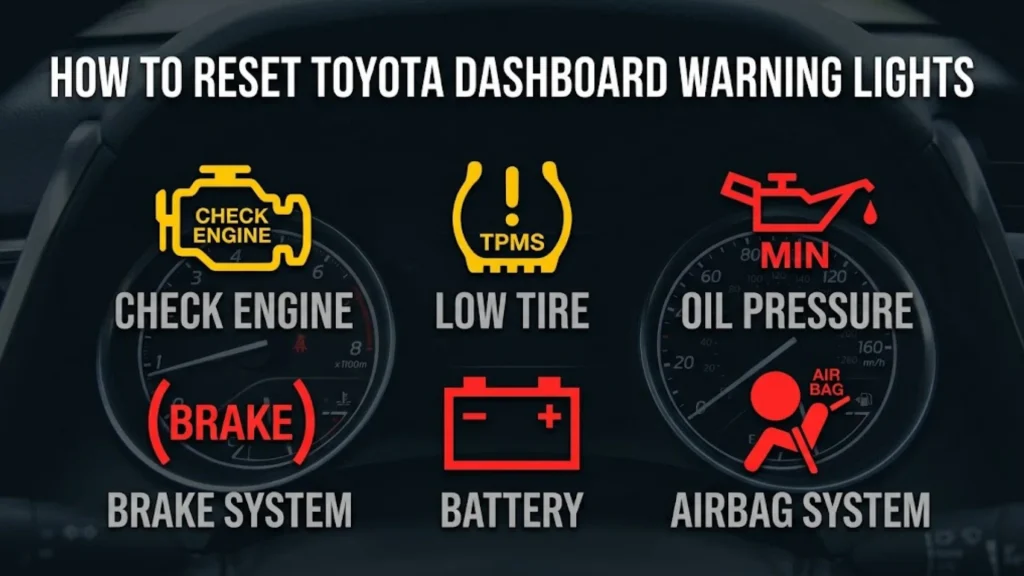
Drivers often search for ways to reset Toyota dashboard warning lights, but not every light should be reset manually. The correct method depends on what triggered it.
Resetting a maintenance reminder
A scheduled maintenance reminder may have a reset procedure in the vehicle’s settings or instrument cluster. Some models use buttons on the steering wheel, while others use a sequence described in the owner’s manual.
Only reset the reminder after completing the maintenance it represents. Otherwise, the reminder may no longer accurately reflect the vehicle’s service needs.
Can you reset the check engine light?
A check engine light may turn off after the underlying fault is repaired and the vehicle’s monitoring system confirms normal operation. However, some faults require specific drive cycles or additional diagnostic work before the light clears.
Do not disconnect the battery or clear diagnostic codes just to hide a warning. Doing so may erase useful diagnostic information, and the light may return if the problem remains.
Why warning lights come back after a reset
A warning can return when the vehicle detects the same fault again. For example, a damaged sensor, persistent emissions issue, or charging system problem may continue triggering the warning after a temporary reset.
The right approach is to identify and fix the cause rather than repeatedly clearing the warning.
Frequently Asked Questions About Toyota Dashboard Symbols
What do Toyota dashboard symbols mean?
Toyota dashboard symbols communicate vehicle status, system activity, maintenance needs, and possible faults. Their meanings depend on the icon, color, flashing pattern, model, and any accompanying message. Check the owner’s manual for the exact definition.
What does a red Toyota dashboard light mean?
A red light often indicates a serious condition requiring immediate attention. Examples include low engine oil pressure, a brake system warning, or excessive coolant temperature. Follow the vehicle’s instructions and stop safely when directed.
What does a yellow Toyota dashboard light mean?
A yellow or amber light usually indicates a condition that needs attention or investigation. Examples include the check engine light and tire pressure warning. Some yellow warnings allow cautious driving, but the correct response depends on the specific fault.
Can I drive with a Toyota warning light on?
It depends on the warning. Some indicators simply show that a feature is active, while other warnings indicate faults that affect safety or vehicle operation. Stop for serious warnings and follow the owner’s manual. If the car behaves abnormally, don’t continue driving just because the light is yellow.
Why is my Toyota check engine light flashing?
A flashing check engine light can indicate an engine misfire that may damage the catalytic converter. Reduce engine load and stop safely if the flashing continues or the engine runs roughly. Arrange prompt professional assistance.
What does the Toyota battery warning light mean?
It commonly indicates a charging system problem rather than simply a weak battery. Possible causes include a charging component fault, wiring problem, or battery connection issue. Arrange immediate assessment because the vehicle may lose electrical power.
Why is my Toyota oil pressure light on?
The oil pressure warning indicates that engine oil pressure may be too low. Stop safely and switch off the engine promptly. Check the oil level only when it is safe to do so, and do not keep driving if the warning remains.
What does the Toyota tire pressure warning light indicate?
It usually indicates low tire pressure or a fault in the tire pressure monitoring system. Check the tires when safe and use the pressure specifications on the driver’s door-jamb label. If the warning flashes or remains on despite correct pressure, consult the manual or arrange an inspection.
What does the Toyota ABS light mean?
The ABS light indicates a possible fault in the Anti-lock Braking System or a related component. Conventional braking may still function, but anti-lock assistance could be unavailable. Drive cautiously only if braking feels normal and the manual permits it.
What does the Toyota SRS airbag light mean?
The SRS warning light indicates a possible problem with the airbag or supplemental restraint system. Some restraint features may not work correctly during a crash. Arrange a prompt inspection and avoid attempting airbag repairs yourself.
What does the Toyota master warning triangle mean?
The master warning triangle draws attention to a vehicle condition or message. It does not identify the exact problem by itself. Read the multi-information display and follow the instructions shown there.
What does TRAC OFF mean on a Toyota?
TRAC OFF indicates that traction control has been switched off or is unavailable, depending on the model and circumstances. Check whether the system was intentionally disabled. If the warning appears unexpectedly or remains on, consult the owner’s manual.
What does VSC OFF mean on a Toyota?
VSC OFF indicates that Vehicle Stability Control has been switched off or is not operating normally. Because this system helps manage skidding, check the vehicle’s settings and manual. Arrange an inspection if the indicator appears unexpectedly.
How do I identify a Toyota dashboard symbol?
Compare the symbol with the illustrations in your vehicle’s owner’s manual. Check the icon’s color, whether it flashes or stays on, and any message on the display. Use the manual for your exact model year and powertrain.
Where can I find Toyota dashboard symbols in the owner’s manual?
Use the Toyota owner’s manual portal to find the manual for your vehicle. Look for the section titled “Warning lights and indicators” or a similar heading.
When should I take my Toyota to a dealership?
Seek urgent help for oil pressure warnings, severe overheating, serious brake problems, or a flashing check engine light with rough engine operation. Arrange prompt inspection for persistent ABS, SRS, steering, charging, or other system warnings. A qualified repair facility can diagnose the fault and recommend the correct repair.
Conclusion: Use This Toyota Dashboard Symbols Guide to Drive More Safely
Understanding Toyota dashboard symbols and their meanings helps you recognize normal indicators, maintenance reminders, and potentially serious vehicle problems. Red warning lights often require immediate attention, while yellow or amber lights commonly signal a condition that needs investigation. Blue and green indicators generally show that a feature is operating.
However, never rely on color alone. Check the exact symbol, read any dashboard message, and follow your vehicle’s owner’s manual. Stop safely when a warning indicates a serious problem, and arrange professional diagnostics when a light stays on or returns.
A quick response can help protect your vehicle, reduce the risk of further damage, and keep you and your passengers safer on the road

Hello, I’m Rowan Sinclair, a passionate writer and lifelong admirer of the wisdom found in great quotes. I believe that words have the ability to inspire change, spark creativity, and connect people across cultures and generations.
I enjoy writing about motivational quotes, famous sayings, and lessons from history’s most influential thinkers. Every article I create is driven by my desire to help readers discover meaningful insights that they can apply to their own lives.
When I’m not writing, I spend my time reading biographies, exploring classic literature, and collecting memorable quotes that deserve to be shared with the world.
I am the author of Voices That Inspire and A Collection of Timeless Thoughts, two books that celebrate the enduring power of words and the stories behind them.
 Asher Monroe
 Sienna Brooks