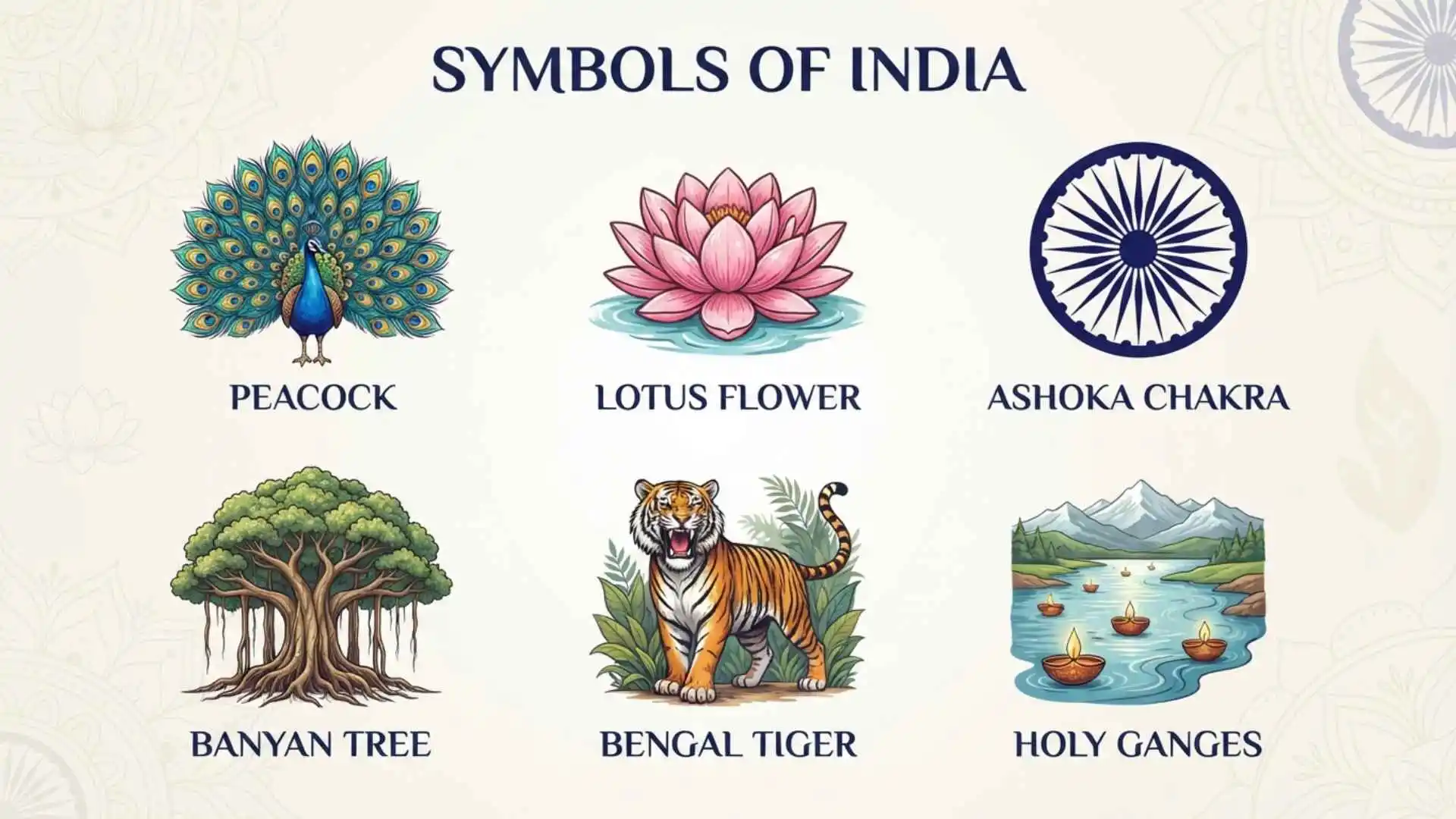
India is a land of extraordinary cultural diversity, ancient traditions, and a long history. From the Tiranga and Ashoka Chakra to the Bengal tiger, Indian peacock, lotus, banyan tree, and Ganga, many symbols represent different aspects of India’s national identity and heritage.
When people search for symbols of India, they may be looking for India’s official national symbols, the meanings behind them, or cultural and religious symbols commonly associated with Indian civilization. These categories are not always the same.
This guide explains the most important symbols of India and their meanings, while clearly distinguishing official national symbols from cultural, religious, historical, and natural symbols.
Symbols of India at a Glance
The following table provides a quick overview of some of the best-known symbols associated with India.
| Symbol | Category | Meaning or Significance |
| Tiranga | Official national symbol | National identity, pride, and sovereignty |
| Ashoka Chakra | National flag symbol | Dharma, movement, and progress |
| State Emblem | Official national symbol | India’s historical heritage and authority |
| Jana Gana Mana | National anthem | National unity and identity |
| Vande Mataram | National song | Love for the motherland |
| Bengal Tiger | National animal | Strength and wildlife heritage |
| Indian Peafowl | National bird | Beauty and cultural heritage |
| Lotus | National flower | Purity and spiritual significance |
| Banyan Tree | National tree | Longevity and stability |
| Mango | National fruit | Agricultural and cultural heritage |
| Ganga | National river | Cultural, historical, and environmental importance |
| Ganges River Dolphin | National aquatic animal | Freshwater biodiversity |
| Indian Elephant | Cultural and heritage symbol | Strength, wisdom, and tradition |
| Om | Religious symbol | Spiritual significance |
| Swastika | Ancient cultural symbol | Auspiciousness and well-being in Indian traditions |
| Trishul | Religious symbol | Associated with Shiva |
| Diya | Cultural symbol | Light, hope, and celebration |
| Namaste | Cultural symbol | Respect and traditional greeting |
What Are the Symbols of India?
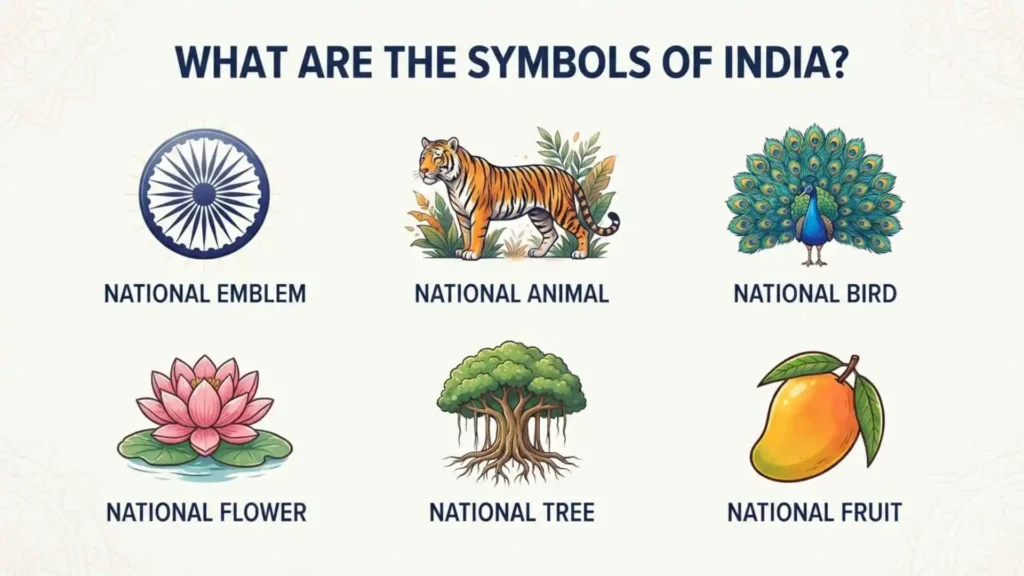
The term symbols of India can refer to several different types of representations.
Some have official national status and are recognized by the Government of India. Others are important because of their historical, cultural, religious, artistic, or environmental associations.
For example, the national flag is an official national symbol, whereas Om is a major religious and cultural symbol but is not an official national symbol of India.
This distinction is important because many websites incorrectly place every popular Indian symbol into a single list.
Official National Symbols
Official national symbols represent the Indian nation and its identity. These include elements such as the national flag, State Emblem, national animal, national bird, national flower, and other nationally recognized symbols.
Cultural Symbols
Cultural symbols represent Indian traditions and everyday cultural identity. Examples include Namaste, rangoli, diyas, traditional clothing, and certain artistic motifs.
Religious and Spiritual Symbols
India’s religious traditions have produced many influential symbols, including Om, the swastika in its traditional South Asian context, the trishul, and various lotus and chakra motifs.
These symbols are culturally important but should not automatically be described as official national symbols.
Official National Symbols of India
National Flag of India
The Tiranga, meaning “tricolour,” is the national flag of India.
It consists of three horizontal bands:
- Saffron at the top
- White in the middle
- Green at the bottom
- A navy-blue Ashoka Chakra in the center
The Constituent Assembly adopted India’s national flag on July 22, 1947, shortly before independence.
The Flag Code of India describes the national flag as a symbol of the hopes and aspirations of the people of India and a symbol of national pride.
Meaning of the Indian Flag Colors
The colors of the Tiranga have important symbolic associations.
Saffron is associated with renunciation, courage, and selflessness.
White represents light and the path of truth.
Green expresses India’s relationship with the soil and plant life.
The Ashoka Chakra represents the wheel of dharma and movement. The explanation traditionally associated with the adoption of the flag emphasizes that movement represents life and progress rather than stagnation.
Ashoka Chakra
The Ashoka Chakra is the navy-blue wheel at the center of India’s national flag.
It has 24 spokes and is based on the Dharma Chakra associated with the Lion Capital of Ashoka at Sarnath.
The wheel represents dharma and movement. It also connects India’s modern national identity with an important period of ancient Indian history.
The Ashoka Chakra is therefore both a visual element of the national flag and a powerful historical symbol.
State Emblem of India
The State Emblem of India is adapted from the Lion Capital of Ashoka at Sarnath.
The original sculpture dates to the Mauryan period and consists of four lions standing back-to-back. In the official emblem’s two-dimensional representation, three lions are visible.
The emblem also incorporates elements associated with the original sculpture, including the Dharma Chakra and representations of the horse and bull.
The words “Satyameva Jayate”, meaning “Truth Alone Triumphs,” appear below the emblem.
Meaning of Satyameva Jayate
“Satyameva Jayate” comes from the Mundaka Upanishad.
The phrase emphasizes the importance of truth and has become an important expression of India’s constitutional and national identity.
The State Emblem is used by the Government of India and is subject to legal rules governing its use. Government website guidelines also specify that use of the State Emblem must comply with the State Emblem of India (Prohibition of Improper Use) Act, 2005.
National Anthem of India
Jana Gana Mana, written by Rabindranath Tagore, is India’s national anthem.
It is an important symbol of national identity and is performed on significant national occasions and other appropriate events.
The National Portal of India recognizes the National Anthem as part of India’s national identity.
Why the National Anthem Matters
The anthem represents national unity and provides a shared expression of India’s identity across its many regions, languages, and communities.
National Song of India
Vande Mataram, written by Bankim Chandra Chattopadhyay, is India’s national song.
It played an important role in India’s freedom movement and became strongly associated with patriotic sentiment.
The National Portal of India identifies Vande Mataram as the National Song under India’s national identity.
National Animal of India: Bengal Tiger
The Bengal tiger is India’s national animal.
Its scientific name is Panthera tigris.
The tiger represents strength, courage, power, and India’s rich wildlife heritage.
Its status also highlights the importance of conserving India’s natural ecosystems.
Why Is the Tiger India’s National Animal?
The tiger is an iconic species of the Indian subcontinent and has played an important role in Indian art, mythology, literature, and history.
Its national status also reinforces the importance of protecting wildlife and maintaining healthy forest ecosystems.
National Bird of India: Indian Peafowl
The Indian peafowl, commonly known as the peacock, is India’s national bird.
Its scientific name is Pavo cristatus.
The peacock is famous for its colorful plumage and distinctive appearance.
It has been represented in Indian art, architecture, literature, and religious traditions for centuries.
What Does the Peacock Symbolize?
The peacock is commonly associated with:
- Beauty
- Grace
- Pride
- Cultural heritage
- India’s natural diversity
Its widespread cultural recognition makes it an especially powerful national symbol.
National Flower of India: Lotus
The lotus is India’s national flower.
Its scientific name is Nelumbo nucifera.
The lotus has a deep connection with Indian religious traditions, philosophy, art, and architecture.
It grows in muddy or wet environments while producing a clean and beautiful flower. For this reason, it is commonly associated with purity, spiritual development, resilience, and beauty.
Lotus in Indian Culture
Lotus imagery appears in temples, sculptures, paintings, textiles, jewelry, and decorative designs.
It is associated with several Hindu and Buddhist traditions and is one of the most recognizable floral motifs in South Asian art.
National Tree of India: Banyan
The banyan tree is India’s national tree.
Its scientific name is Ficus benghalensis.
The banyan is known for its aerial roots, which can develop into additional trunks and allow a single tree to spread over a large area.
It is commonly associated with longevity, stability, shelter, and continuity.
Large banyan trees have historically served as gathering places in many Indian communities.
National Fruit of India: Mango
The mango is India’s national fruit.
Its scientific name is Mangifera indica.
Mango cultivation has a long history in India, and the fruit is deeply connected with Indian cuisine, agriculture, literature, and seasonal traditions.
India is known for many varieties of mango, including Alphonso, Dasheri, Langra, Kesar, and Banganapalli.
The mango therefore represents both agricultural importance and cultural heritage.
National River of India: Ganga
The Ganga, or Ganges, is India’s national river.
The Ganga has played a major role in the development of settlements, agriculture, trade, culture, and religious traditions across northern India.
It is also one of India’s most culturally significant rivers.
Why Is the Ganga Important?
The river is important for several reasons:
- It supports large populations and agricultural areas.
- It has enormous cultural and historical significance.
- It is deeply connected with Indian religious traditions.
- Its ecosystem supports numerous species.
- Its conservation is an important environmental concern.
The Government of India has also undertaken major programs for conservation and rejuvenation of the Ganga, including the Namami Gange Programme.
National Aquatic Animal: Ganges River Dolphin
The Ganges river dolphin is India’s national aquatic animal.
Its scientific name is Platanista gangetica.
This freshwater dolphin is associated with river ecosystems in the Indian subcontinent.
Its status draws attention to freshwater biodiversity and the importance of maintaining healthy river environments.
National Calendar of India
India’s official national calendar is based on the Saka Era.
It was adopted for official purposes in 1957.
The national calendar is used alongside the Gregorian calendar in specified official contexts.
It is an example of how modern India incorporates elements of its historical calendar traditions into national life.
Indian Rupee Symbol
The Indian rupee symbol (₹) is the currency symbol of India’s rupee.
It combines visual elements associated with the Devanagari letter “र” and the Roman capital letter “R,” while its horizontal lines also evoke the Indian national flag.
The symbol was officially adopted in 2010.
It has become an important modern representation of India’s economic identity.
Symbols of India and Their Meanings
Different Indian symbols communicate different ideas.
| Symbol | Common meaning or association |
| Tiranga | National pride and identity |
| Ashoka Chakra | Dharma and movement |
| Lion Capital | Authority, heritage, and truth |
| Bengal Tiger | Strength and wildlife |
| Peacock | Beauty and cultural heritage |
| Lotus | Purity and spiritual growth |
| Banyan | Longevity and stability |
| Mango | Agriculture and cultural heritage |
| Ganga | Life, civilization, and spirituality |
| River Dolphin | Freshwater biodiversity |
| Om | Spiritual significance |
| Diya | Light and hope |
| Namaste | Respect and greeting |
| Trishul | Religious association with Shiva |
| Swastika | Auspiciousness in traditional Indian contexts |
Cultural Symbols of India
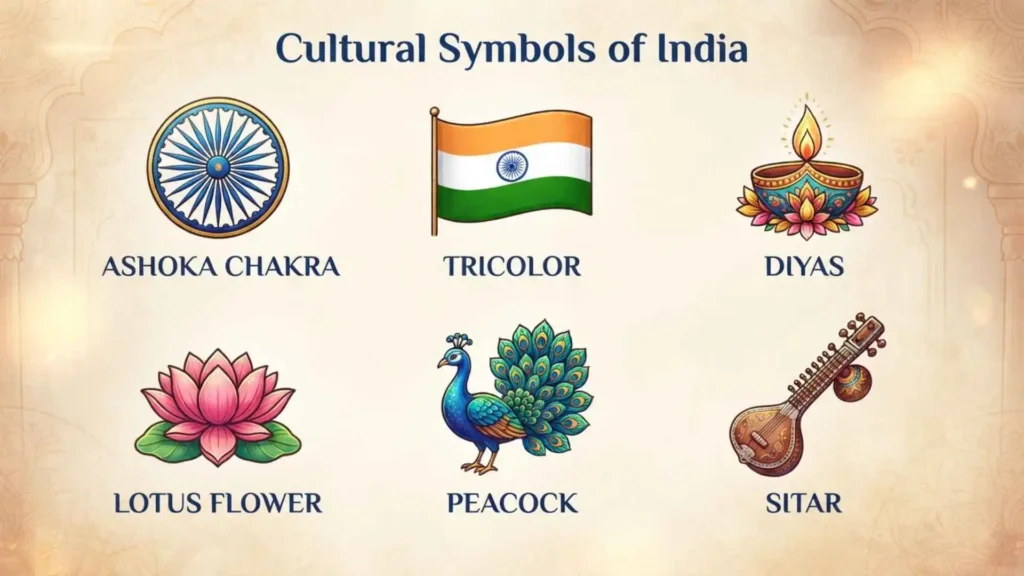
India’s identity cannot be represented only by official government symbols.
Its cultural traditions have produced many other symbols that are widely recognized in India and around the world.
Namaste
Namaste is a traditional Indian greeting commonly accompanied by bringing the palms together.
It is associated with respect, courtesy, and humility.
The gesture is used in many parts of India and has become internationally recognized as a symbol connected with Indian culture.
Diya
A diya, or traditional oil lamp, is an important cultural symbol.
It is particularly prominent during festivals such as Diwali.
The lamp is commonly associated with light, hope, knowledge, goodness, and the removal of darkness.
Rangoli
Rangoli is a traditional decorative art created on floors or entrances using materials such as colored powders, rice, flowers, or other natural materials.
Patterns vary across regions and communities.
Rangoli is commonly associated with festivals, hospitality, celebration, and auspicious occasions.
Peacock Feather
The peacock feather is a widely recognized motif in Indian art and religious traditions.
It is particularly associated with representations of Krishna.
The feather also appears in paintings, textiles, jewelry, decorations, and traditional crafts.
Religious and Spiritual Symbols of India
India is home to several major religious traditions, and their symbols have influenced Indian art, architecture, literature, and everyday life.
These symbols are culturally important but should not be confused with official national symbols.
Om
Om (ॐ) is one of the best-known sacred symbols in Indian spiritual traditions.
It is especially associated with Hindu traditions and appears in religious texts, meditation practices, temples, artwork, and devotional settings.
Om is commonly associated with sacred sound and profound spiritual concepts.
Swastika
The swastika is an ancient symbol with a long history in South Asian traditions.
In Hindu, Jain, and Buddhist contexts, it has traditionally been associated with auspiciousness, well-being, prosperity, and good fortune.
The symbol also has a very different modern association because Nazi Germany appropriated a similar symbol and turned it into an emblem of Nazism.
Therefore, when discussing the swastika in the context of India, its ancient South Asian history and cultural context should be clearly distinguished from its 20th-century European political appropriation.
Trishul
The trishul, or trident, is strongly associated with Shiva in Hindu traditions.
It commonly appears in temples, sculptures, paintings, religious objects, and cultural artwork.
Its three-pronged form has been given different symbolic interpretations within religious traditions.
Kalash
The kalash, or sacred vessel, is another important symbol found in Indian religious and cultural traditions.
It is commonly associated with auspiciousness, abundance, purity, and ceremonial occasions.
The kalash may be decorated with leaves, a coconut, cloth, or other traditional elements depending on the ritual and region.
Historical Symbols of India
India’s history provides many symbols that continue to influence its modern identity.
Lion Capital of Ashoka
The Lion Capital at Sarnath is one of the most important historical symbols connected with modern India.
It was commissioned during the reign of Emperor Ashoka and later became the basis for the State Emblem of India.
Its use connects the modern republic with the country’s ancient Mauryan heritage.
Dharma Chakra
The Dharma Chakra is an ancient Buddhist symbol associated with the teaching and practice of dharma.
The wheel also became a major element of India’s modern national identity through its inclusion in the national flag.
Ashokan Pillars
Ashoka’s pillars and inscriptions are important archaeological and historical evidence of the Mauryan Empire.
Their symbols and inscriptions provide insight into ancient Indian political history, ethics, and the spread of Buddhist ideas.
Indian Wildlife as National and Cultural Symbols
Animals have played an important role in Indian symbolism for thousands of years.
The tiger represents strength and wildlife conservation. The elephant has strong associations with wisdom, power, royalty, and religious traditions. The peacock represents beauty and cultural heritage.
Other animals also appear prominently in Indian mythology, sculpture, temple architecture, folk traditions, and literature.
This connection between wildlife and culture is one reason India’s symbols are closely linked to its natural environment.
Official vs Cultural Symbols of India
One of the easiest ways to avoid confusion is to distinguish official symbols from cultural associations.
| Symbol | Official national symbol? | Associated with Indian culture? |
| Tiranga | Yes | Yes |
| State Emblem | Yes | Yes |
| Bengal Tiger | Yes | Yes |
| Indian Peafowl | Yes | Yes |
| Lotus | Yes | Yes |
| Banyan Tree | Yes | Yes |
| Mango | Yes | Yes |
| Ganga | Yes | Yes |
| Om | No | Yes |
| Trishul | No | Yes |
| Diya | No | Yes |
| Namaste | No | Yes |
| Rangoli | No | Yes |
| Peacock Feather | No | Yes |
| Cricket | No | Yes |
This distinction is especially useful for students because popular websites sometimes mix official designations with commonly recognized cultural symbols.
Symbols Often Mistaken as Official National Symbols
Some things are widely associated with India but are not officially designated national symbols.
Is Hockey India’s National Sport?
No. Hockey is not officially India’s national sport.
It is an important sport in India’s sporting history, but there is no officially declared national sport.
Therefore, articles that simply state “hockey is India’s national sport” should be treated cautiously.
Is Cricket India’s National Sport?
No. Cricket is enormously popular in India, but it is not officially designated as India’s national sport.
Its popularity should not be confused with official national status.
Is Hindi India’s National Language?
India does not have a single national language declared by the Constitution.
Hindi is an official language of the Union, and English is also used for official purposes under the applicable legal framework.
India’s linguistic landscape is much broader, with numerous constitutionally recognized languages.
Therefore, calling Hindi “India’s national language” is inaccurate.
Is Om an Official National Symbol?
No.
Om is an extremely important religious and cultural symbol associated with Indian traditions, but it is not an official national symbol of India.
Is the Peacock a Cultural Symbol or Official Symbol?
Both descriptions can apply.
The Indian peafowl is India’s official national bird, while the peacock also has a much broader cultural and religious presence in Indian traditions.
Why Are Symbols Important to Indian Identity?
Symbols allow complex ideas to be communicated through recognizable images, sounds, objects, and traditions.
The national flag represents the country and its sovereignty. The State Emblem connects the modern republic with ancient Indian history. The tiger highlights wildlife heritage, while the lotus reflects deep cultural and spiritual associations.
Cultural symbols such as Namaste, rangoli, and diyas provide another layer of identity.
Together, these symbols show that Indian identity is shaped by both modern national institutions and thousands of years of cultural development.
Symbols of India for Students and Exams
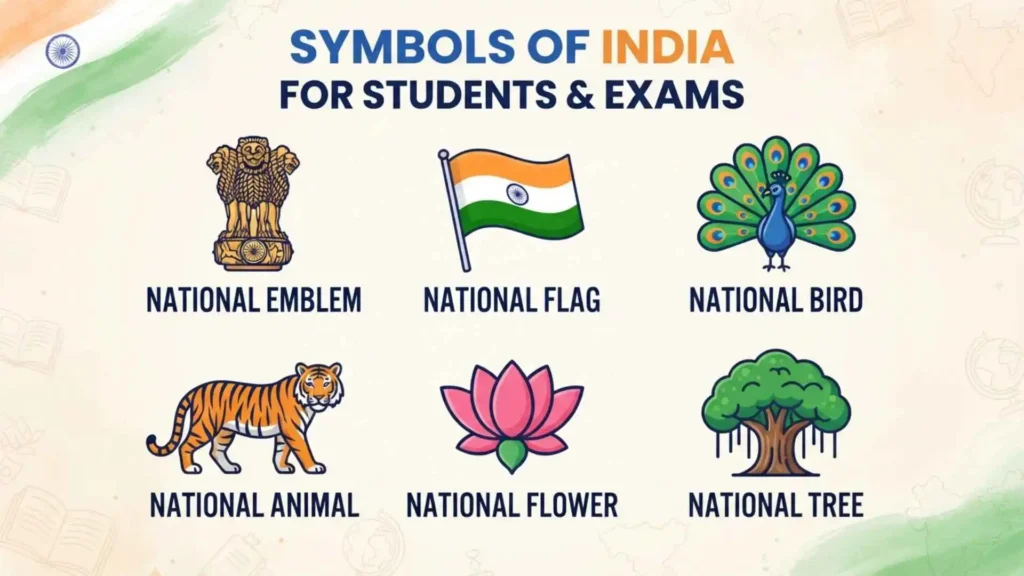
Students often encounter questions about Indian national symbols in general knowledge, school examinations, competitive examinations, and quizzes.
The most useful facts to remember are:
- National Flag: Tiranga
- National Emblem: Lion Capital-based State Emblem
- National Anthem: Jana Gana Mana
- National Song: Vande Mataram
- National Animal: Bengal Tiger
- National Bird: Indian Peafowl
- National Flower: Lotus
- National Tree: Banyan
- National Fruit: Mango
- National River: Ganga
- National Aquatic Animal: Ganges River Dolphin
- National Calendar: Saka Calendar
- Currency Symbol: ₹
- National Motto: Satyameva Jayate
Students should also remember the distinction between official national symbols and popular cultural symbols.
Frequently Asked Questions
What are the main symbols of India?
The main official symbols include the national flag, State Emblem, national anthem, national song, Bengal tiger, Indian peafowl, lotus, banyan tree, mango, Ganga, Ganges river dolphin, national calendar, and other recognized national identity elements.
What is the national symbol of India?
India does not have only one object that represents all national symbolism. It has several official national symbols and identity elements. The Tiranga is the national flag, while the Lion Capital-based State Emblem is another major official symbol.
What are the 17 national symbols of India?
Lists claiming that India has exactly 17 national symbols can vary because websites sometimes include items that do not have an official national designation. It is better to verify each claimed symbol against authoritative government sources rather than relying on a fixed number.
What does the Indian flag symbolize?
The Indian flag represents national pride and identity. Its saffron, white, and green colors and the Ashoka Chakra carry important symbolic associations related to sacrifice, truth, the land, dharma, and movement.
What does the Ashoka Chakra mean?
The Ashoka Chakra represents the wheel of dharma and movement. It is also a major historical connection between India’s modern national flag and the heritage of Ashoka.
Why is the tiger India’s national animal?
The Bengal tiger is a powerful symbol of India’s wildlife heritage and is associated with strength, courage, and conservation.
Why is the peacock India’s national bird?
The Indian peafowl is widely recognized for its beauty and has deep connections with Indian art and cultural traditions.
Why is the lotus India’s national flower?
The lotus has a long history in Indian art, religion, philosophy, and culture. It is commonly associated with purity, beauty, and spiritual growth.
Why is the banyan tree India’s national tree?
The banyan is known for its extraordinary longevity and extensive aerial roots. It is traditionally associated with stability, shelter, continuity, and community.
What does the Ganga symbolize in India?
The Ganga has cultural, historical, environmental, and religious significance. It has also supported settlements, agriculture, and civilization across a large part of northern India.
Is Om a national symbol of India?
No. Om is a major religious and cultural symbol associated with Indian traditions, but it is not an official national symbol.
Is the swastika an Indian symbol?
The swastika has an ancient history in South Asian religious and cultural traditions, where it has traditionally been associated with auspiciousness and well-being. Its traditional Indian context is distinct from its later appropriation by Nazi Germany.
Is hockey India’s national sport?
No. Hockey is not officially designated as India’s national sport.
Is Hindi India’s national language?
No. India has no single national language declared by the Constitution. Hindi is an official language of the Union, alongside English for specified official purposes.
What is India’s national motto?
India’s national motto is “Satyameva Jayate,” meaning “Truth Alone Triumphs.”
Conclusion
The symbols of India represent much more than a collection of national emblems. They reflect the country’s history, biodiversity, spirituality, cultural traditions, and modern national identity.
The Tiranga and Ashoka Chakra represent the nation and its ideals. The State Emblem connects modern India with the ancient Mauryan period. The Bengal tiger, Indian peafowl, lotus, banyan tree, mango, Ganga, and Ganges river dolphin represent important aspects of India’s natural and cultural heritage.
At the same time, symbols such as Om, the swastika, trishul, diya, rangoli, and Namaste demonstrate the richness of India’s cultural and spiritual traditions.
The most important point is to distinguish between official national symbols and symbols that are culturally associated with India. Once that distinction is understood, the many symbols of India become a fascinating way to explore the country’s history, traditions, people, and identity.

Hi, I’m Asher Monroe, a writer who believes that meaningful words have the power to inspire change and bring people closer to their dreams. I have always been fascinated by the beauty of quotes and the way a simple message can provide motivation, hope, and comfort.
I enjoy creating content around inspirational quotes, life lessons, success stories, and positive thoughts that help readers find encouragement in their everyday lives. My goal is to share words that connect with people and remind them of their inner strength.
Through my writing, I explore the ideas of personal growth, confidence, and the importance of staying inspired through every chapter of life.
I am the author of Words That Move the Soul and The Path of Endless Inspiration, two books focused on the power of wisdom, positivity, and meaningful thoughts.