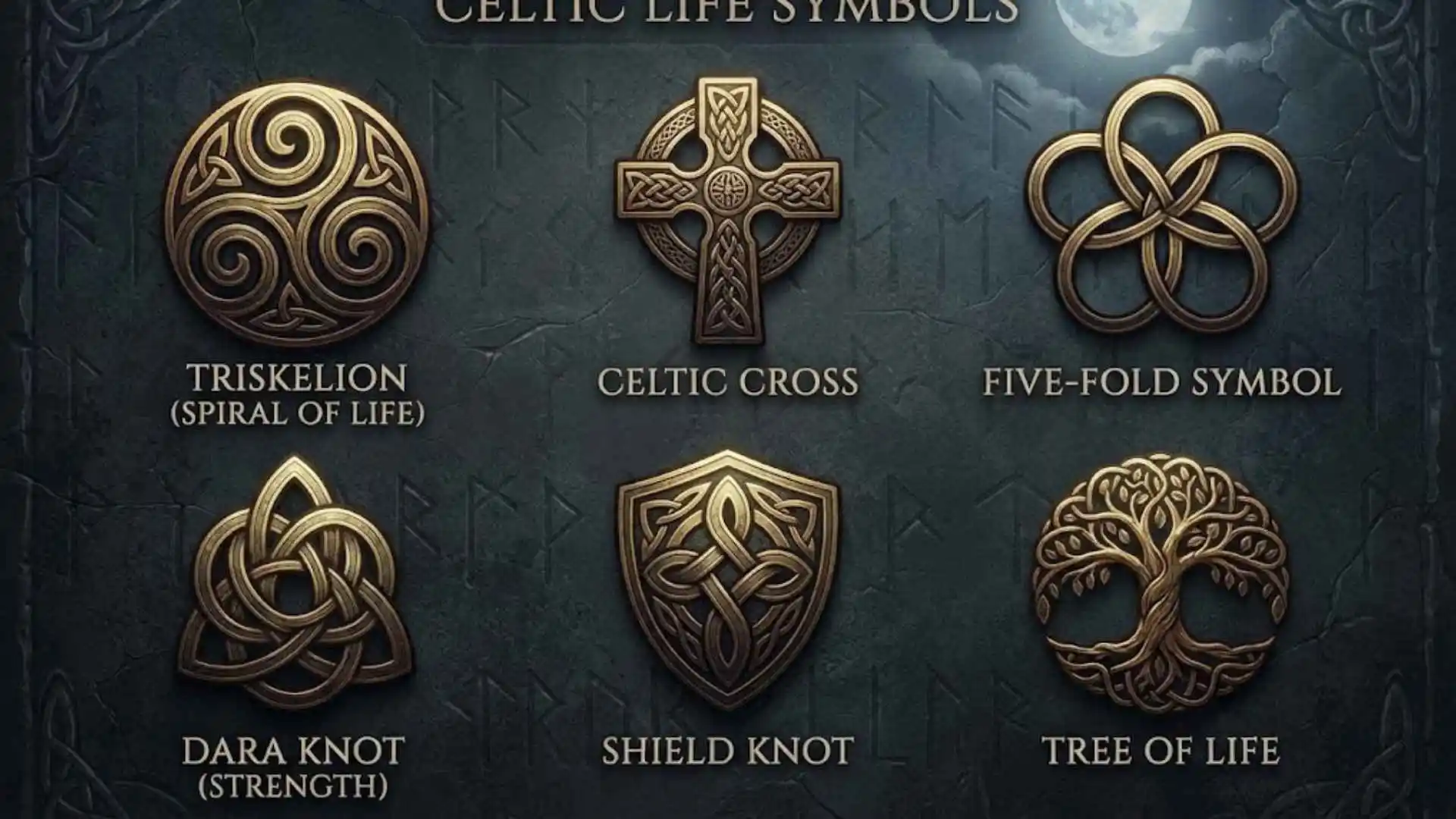
Celtic symbols have become popular in jewelry, tattoos, artwork, logos, decorations, and personal designs. From intricate knots to spirals, crosses, animals, and ancient motifs, these designs are often connected with ideas such as eternity, protection, love, family, strength, and nature.
The term “Celtic symbols” covers a wide range of historical and modern designs associated with Celtic-speaking peoples and later Celtic-inspired traditions. Some symbols have strong historical evidence, while others have meanings that were assigned or expanded much later. Knowing this difference helps you understand these designs without treating every modern interpretation as an ancient fact.
This guide explores Celtic symbols and their meanings, including Irish, Scottish, and Welsh examples. You will also find simple symbols, warrior and protection motifs, love and family designs, the four elements, ancient symbols, and ideas commonly used for Celtic tattoos.
Celtic Symbols And Meanings
Celtic symbolism is especially known for repeated patterns, natural imagery, and geometric designs. However, there was no single universal Celtic symbol system used by every Celtic community.
Some commonly discussed Celtic designs include:
| Symbol or design | Common modern association |
| Celtic knot | Eternity, continuity, interconnectedness |
| Triskelion / triskele | Movement, cycles, threefold patterns |
| Spiral | Growth, movement, cycles |
| Celtic cross | Christianity combined with Celtic artistic traditions |
| Claddagh | Love, loyalty, friendship |
| Tree of life | Growth, connection, family, nature |
| Celtic animal designs | Strength, protection, courage, or transformation |
| Dara knot | Often associated with the oak and strength |
| Triquetra | Threefold form; meanings vary by context |
The meanings above are common interpretations, especially in modern Celtic-inspired art. They should not all be presented as universally documented meanings from ancient Celtic society.
Ancient Celtic Symbols
Ancient Celtic communities left behind art, objects, inscriptions, and archaeological evidence, but many popular symbols found online are difficult to connect to one specific ancient meaning.
Spirals, geometric patterns, animals, weapons, plants, and repeated interlacing designs appear in Celtic and related Iron Age and later traditions. Some famous motifs became especially prominent in later Insular Celtic art.
The triskele, for example, is an ancient three-armed motif found in several historical contexts. Its exact meaning in ancient use is not known with certainty.
Similarly, interlaced patterns became highly developed in medieval Insular art. Their modern association with eternity and interconnectedness is widespread, but that does not mean every ancient artist used a knot with exactly that symbolic definition.
Celtic Symbols And Their Meanings
Different Celtic designs have accumulated different interpretations over time.
Celtic Knot
The Celtic knot is formed from interlacing lines. Modern interpretations often connect it with continuity, eternity, interconnectedness, and relationships because the lines appear to have no obvious beginning or end.
Triskele
The triskele, or triskelion, consists of three arms or spirals arranged around a central point. It is an ancient motif, although its original meaning is uncertain.
Celtic Cross
The Celtic cross combines a Christian cross with a circular ring and is strongly associated with medieval Celtic Christian art, particularly in Ireland and Britain.
Claddagh
The Claddagh design features a heart, hands, and crown. It is associated with love, friendship, and loyalty and has a specific Irish cultural history.
Spiral
Spiral motifs appear in ancient European art, including sites associated with prehistoric Ireland. Their exact original symbolism is not certain, although modern interpretations often connect them with cycles, movement, or life.
Celtic Symbols For The 4 Elements
Modern Celtic-inspired artwork sometimes connects Celtic motifs with the four classical elements: earth, air, fire, and water.
These associations are useful for decorative designs, but they should not be confused with a single historically documented Celtic four-element symbol system.
| Element | Celtic-inspired imagery | Common modern association |
| Earth | Oak, stones, roots, trees | Stability and strength |
| Air | Wind, birds, spirals | Freedom and movement |
| Fire | Flame, sun, red-colored motifs | Energy and transformation |
| Water | Waves, rivers, fish | Emotion and change |
Nature played an important role in Celtic cultures, but the modern practice of assigning particular Celtic knots to the four elements is often a contemporary interpretation.
Simple Celtic Symbols And Meanings
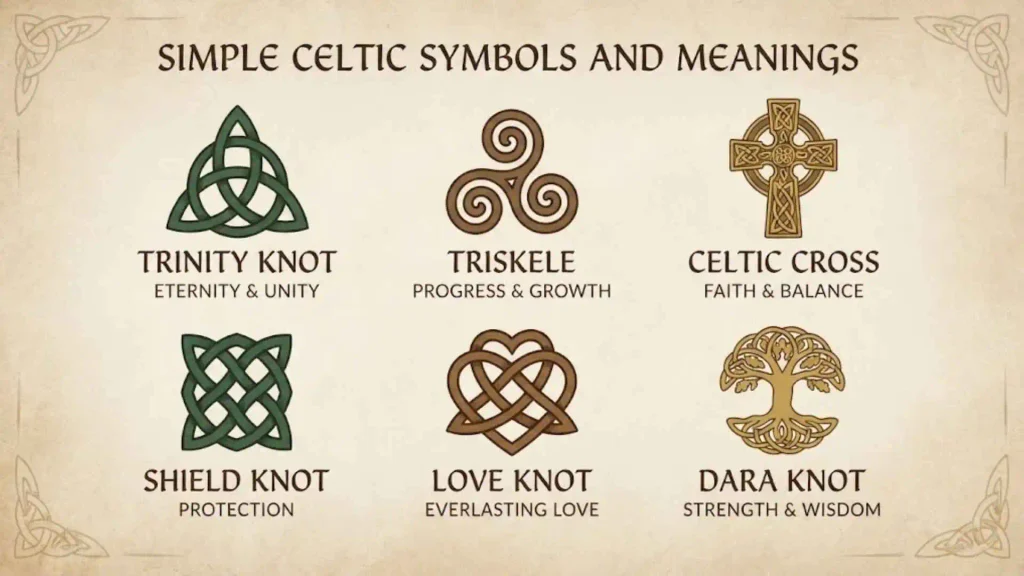
If you want a Celtic-inspired design that is easy to recognize, simple forms are often the best choice.
- ☘ — Shamrock or clover; strongly associated with Ireland
- Triskele — Three-armed spiral motif; ancient and associated with cycles or movement in modern interpretations
- Celtic knot — Interlaced design commonly associated with continuity
- Celtic cross — Cross with a surrounding ring, associated with Celtic Christian art
- Spiral — Ancient recurring motif often interpreted through ideas of movement and cycles
- Claddagh — Heart, hands, and crown representing love, friendship, and loyalty
The shamrock itself is not an ancient Celtic knot. Its modern Irish symbolism developed through later Irish cultural and historical traditions.
Celtic Symbols And Meanings Chart
The following chart provides a quick reference for some popular Celtic and Celtic-associated designs.
| Celtic symbol | Meaning or association | Historical note |
| Celtic knot | Eternity, continuity | Strongly associated with later Celtic-inspired art |
| Triskele | Threefold form, cycles, movement | Ancient motif with uncertain original meaning |
| Spiral | Cycles, movement, growth | Ancient motif found in prehistoric art |
| Celtic cross | Christian faith, Celtic artistic tradition | Prominent in medieval Insular art |
| Claddagh | Love, loyalty, friendship | Irish cultural symbol with later historical origins |
| Shamrock | Ireland, Irish identity | Strong later Irish cultural association |
| Oak | Strength and endurance | Important natural and cultural motif |
| Tree of life | Growth and connection | Modern Celtic-inspired symbolism |
| Celtic animal motifs | Strength, protection, transformation | Interpretations vary by animal and period |
Ancient Celtic Symbols
Ancient Celtic symbolism should be approached with some caution because written explanations from the people who created many of these designs are limited.
Archaeological finds provide evidence of recurring artistic motifs, including spirals, circles, animals, geometric forms, and triple patterns. Later Celtic Christian art added elaborate interlacing, manuscript decoration, crosses, and other designs.
Some motifs commonly discussed in connection with ancient Celtic art include:
- Triskele or triskele-like motifs
- Spirals
- Concentric circles
- Animal ornament
- La Tène-style curves and patterns
- Geometric decoration
Not every design marketed today as an “ancient Celtic symbol” can be traced directly to ancient Celtic people. Modern Celtic artwork often combines historical motifs with newer symbolic interpretations.
Celtic Symbols And Their Meanings
A useful way to understand these symbols is to separate their visual form from the meaning people attach to them today.
A knot visually emphasizes interlacing. Modern users may interpret this as an unbroken bond or eternity.
A triple spiral emphasizes three repeating arms. It is often associated today with cycles, movement, or threefold concepts, while its exact ancient meaning remains uncertain.
A cross has Christian meaning, but the distinctive Celtic cross also belongs to the history of medieval Celtic Christian art.
An animal motif can communicate strength, courage, protection, wisdom, or other qualities depending on the animal and the artistic context.
This approach helps prevent modern interpretations from being mistaken for proven ancient definitions.
Scottish Celtic Symbols
Scottish Celtic symbolism includes designs connected with Scotland’s Gaelic and broader Celtic heritage. Scotland also has its own distinct history, so not every Scottish symbol is necessarily ancient Celtic.
Commonly associated imagery includes:
- Celtic knots — interlaced decorative patterns
- Triskele motifs — three-part spiral forms
- Celtic crosses — especially in medieval Christian contexts
- Thistles — strongly associated with Scottish identity, although not an ancient Celtic symbol in the strict sense
- Oak and natural motifs — used in Celtic-inspired designs
- Animal patterns — particularly in historical decorative art
Scottish clan symbols, tartans, and national emblems should not automatically be described as ancient Celtic symbols. They belong to different historical traditions.
Celtic Symbols For Love
Several Celtic-associated designs are commonly chosen to represent love and relationships.
Claddagh
The Claddagh is one of the best-known Irish symbols connected with relationships. Its three components are traditionally interpreted as:
- Heart — love
- Hands — friendship
- Crown — loyalty
It is especially recognizable in rings and jewelry.
Celtic Love Knots
Modern Celtic-inspired love knots use interlaced lines to represent an enduring connection. Their symbolism is largely a modern interpretation of the knot’s continuous appearance.
Interwoven Designs
Two interlocking patterns can visually represent two lives or paths becoming connected. This makes them popular choices for wedding artwork, jewelry, and matching tattoos.
Celtic Symbols For Family
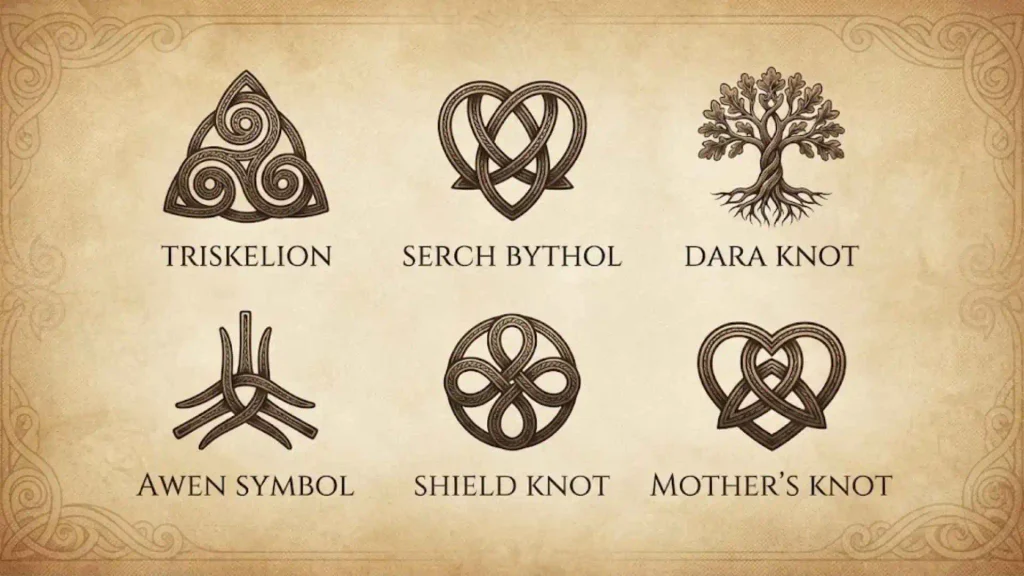
Celtic-inspired designs are often chosen to represent family bonds, heritage, ancestry, and connection.
Common choices include:
- Interlaced knot — family connection and continuity
- Tree designs — family roots and growth
- Claddagh — loyalty, friendship, and love
- Celtic cross — faith and heritage for people who connect it with their family tradition
- Circular knot designs — continuity and togetherness
The Celtic tree of life is particularly popular in modern designs. Its roots and branches provide an easy visual metaphor for ancestry, generations, and family connections, although the exact modern symbolism should not be presented as a single ancient Celtic doctrine.
Celtic Symbols And Meanings List
Here is a practical list of popular Celtic-associated symbols and their commonly understood meanings.
- Celtic knot — continuity and interconnectedness
- Triskele — cycles and threefold movement in modern interpretations
- Celtic cross — Christian faith and Celtic artistic heritage
- Claddagh — love, friendship, and loyalty
- Spiral — movement and cycles
- Tree of life — growth, roots, and connection
- Oak — strength and endurance
- Shamrock — Irish identity and cultural heritage
- Koi or other animal motifs — context-dependent symbolism
- Serpent — can represent different ideas depending on the tradition and artwork
- Sun motifs — light and life in modern symbolic designs
- Wave patterns — water, nature, and movement
Not all items on this list have the same historical status. Some are ancient motifs, while others became popular through later Irish, Scottish, Welsh, Christian, or modern Celtic-inspired traditions.
Warrior Protection Celtic Symbols
Celtic-inspired warrior designs often feature weapons, shields, animals, knots, and strong geometric forms.
Popular modern choices include:
- Celtic knotwork — endurance and interconnectedness
- Oak motifs — strength
- Wolf imagery — often used to represent loyalty, courage, and protection
- Boar imagery — associated in historical Celtic contexts with martial and elite symbolism
- Shield designs — protection and defense
- Sword motifs — strength, conflict, and warrior identity
It is better to describe these as Celtic-inspired warrior imagery rather than claiming that every design was a standardized ancient Celtic protection symbol.
Celtic Symbols Tattoos
Celtic tattoos commonly feature knots, crosses, spirals, animals, trees, and other interlaced designs.
Popular tattoo ideas include:
- Celtic knot bands
- Celtic crosses
- Triskele designs
- Tree designs
- Claddagh-inspired artwork
- Celtic animal motifs
- Interwoven family designs
- Simple spiral patterns
The shape of a tattoo can change how recognizable the original motif remains. Very complex knotwork may also become difficult to distinguish after years of skin changes, so clean linework and an experienced tattoo artist are important practical considerations.
Celtic Symbols Meanings
When someone searches for “Celtic symbols meanings,” they may actually be looking for several different things: historical symbolism, modern interpretations, tattoo meanings, or simply the name of a particular design.
A helpful distinction is:
Historical meaning: What can reasonably be supported by archaeological, artistic, or historical evidence.
Traditional association: A meaning connected with later cultural traditions.
Modern interpretation: A meaning commonly assigned by contemporary artists, tattoo designers, jewelry makers, or popular culture.
For example, Celtic knots are widely described today as symbols of eternity. That interpretation fits their continuous visual structure, but it should not automatically be treated as a proven statement about what every ancient Celtic artist intended.
Welsh Celtic Symbols
Wales has a rich Celtic linguistic and cultural heritage, but not every Welsh national symbol is an ancient Celtic symbol.
The Welsh dragon is one of the best-known symbols associated with Wales. The red dragon became an important national emblem through a long historical development.
Other imagery associated with Welsh and Celtic-inspired design includes:
- Celtic knotwork
- Interlaced patterns
- Spirals
- Celtic crosses
- Oak and natural imagery
- Traditional manuscript-style decoration
Welsh identity and Celtic identity overlap historically in important ways, but they should not be treated as identical categories.
Ancient Celtic Symbols And Meanings
Ancient Celtic motifs are especially interesting because their original meanings are often less certain than modern websites suggest.
Triskele
The triskele is a three-armed motif found in ancient contexts. Its exact original meaning is uncertain, so modern interpretations such as cycles, movement, or spiritual development should be presented as interpretations rather than proven translations.
Spiral Motifs
Spirals appear in prehistoric European art, including famous examples from Ireland. Their repeated curves have encouraged modern interpretations involving cycles, movement, and life.
Animal Motifs
Animals appear frequently in Celtic and related European art. Their meaning depended on the culture, period, object, and artistic context.
Interlacing
Highly developed interlacing became a major feature of medieval Insular art. Today it is strongly associated with Celtic design, especially through manuscripts, crosses, and carved stones.
Celtic Symbols Tattoo
A Celtic tattoo can be meaningful without being overly complicated. The best design depends on the idea you want to express.
For family, consider an interlaced knot or tree-inspired design.
For love, the Claddagh or an interwoven knot can provide a recognizable visual theme.
For strength, oak imagery, bold knotwork, or an animal motif may work well.
For heritage, a historically documented regional motif can be more appropriate than a generic “Celtic” design.
Before choosing a permanent tattoo, check the history and meaning of the exact design. This is especially useful when a design is described online as “ancient” or “traditional,” because modern Celtic tattoo art often combines several different traditions.
Celtic Symbols And Meaning
Celtic symbolism does not have one fixed dictionary where every knot, spiral, or animal has one universally accepted definition.
For example, a knot may suggest continuity because of its structure, while a tree may represent growth or ancestry in modern artwork. A triskele may suggest cycles or threefold movement, but its ancient purpose is not fully established.
The safest approach is to use historical descriptions where evidence exists and clearly identify modern interpretations where the evidence is less certain.
Celtic Symbols And Meanings
Celtic symbols can be understood through several broad themes:
- Connection — knots and interlacing
- Cycles — spirals and triple forms
- Faith — Celtic Christian crosses
- Love — Claddagh and modern knot designs
- Family — trees and interconnected patterns
- Strength — oak and warrior-inspired imagery
- Nature — plants, animals, water, and celestial motifs
- Heritage — regional Celtic art and cultural designs
This makes Celtic imagery flexible for jewelry, tattoos, illustrations, logos, crafts, and personal artwork.
Female Warrior Celtic Symbols
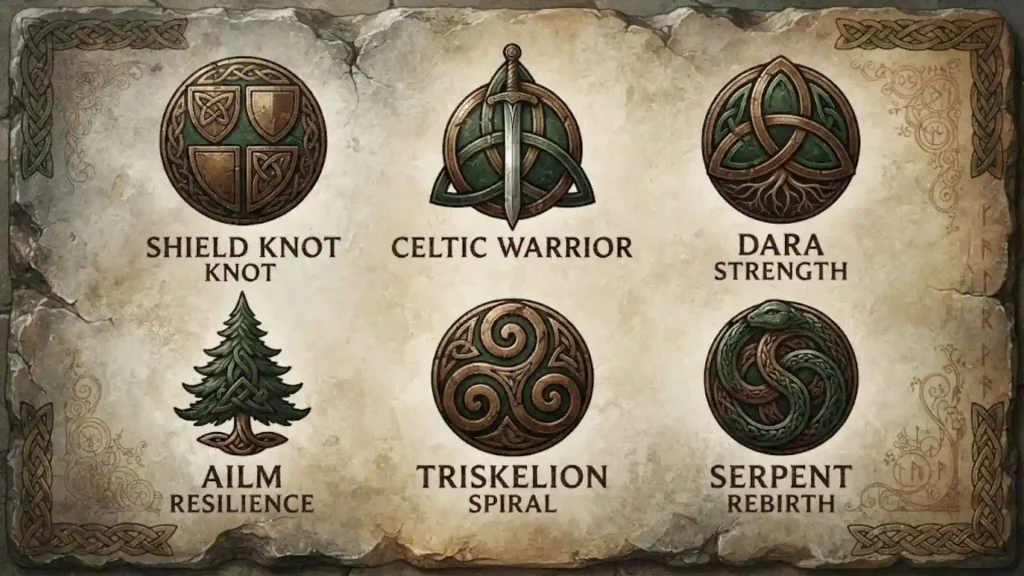
There is no single historically established Celtic symbol specifically meaning “female warrior.” Modern designs often use combinations of Celtic motifs and warrior imagery to create that theme.
Possible design elements include:
- Shield — defense and protection
- Sword — warrior identity and strength
- Oak — resilience and endurance
- Wolf — loyalty and courage in modern symbolic interpretations
- Knotwork — continuity and connection
- Triskele — movement or cycles
- Warrior-inspired animal designs — strength and determination
For a historically inspired design, it is better to identify the specific period and region rather than treating “female warrior Celtic symbol” as one established ancient category.
Protection Celtic Symbols
Protection is one of the most common themes in modern Celtic-inspired artwork.
Common choices include:
- Shield motifs — direct visual association with defense
- Oak imagery — strength and endurance
- Interlaced knotwork — continuity and connection
- Animal motifs — protection or courage depending on the animal and context
- Cross designs — spiritual protection for people who use them within Christian traditions
- Warrior imagery — defense and strength
Some modern jewelry and tattoo designs are marketed specifically as “Celtic protection symbols.” Their meanings should be checked individually rather than assuming that the label proves an ancient origin.
Irish Celtic Symbols
Ireland has many symbols and artistic traditions that are commonly associated with Celtic heritage.
Claddagh
The Claddagh is an Irish symbol featuring hands, a heart, and a crown. It is commonly associated with friendship, love, and loyalty.
Celtic Cross
The Celtic cross is strongly connected with Ireland and the medieval Christian art tradition. It appears on historic high crosses and in later Irish-inspired designs.
Shamrock
The shamrock is one of the most recognizable symbols of Irish identity. Its strong association with Ireland developed through later historical and cultural traditions.
Harp
The harp is a major Irish national symbol. It should be distinguished from specifically ancient Celtic motifs, as its historical symbolism developed across different periods.
Celtic Knotwork
Interlaced knotwork is strongly associated with Irish and broader Insular art. It is widely used today in manuscripts-inspired artwork, jewelry, tattoos, and decorative designs.
FAQ
What Is The Most Famous Celtic Symbol?
The Celtic knot and Celtic cross are among the most recognizable designs associated with Celtic heritage. The Claddagh is especially recognizable as an Irish symbol.
What Celtic Symbol Means Family?
There is no single ancient Celtic character universally defined as the symbol for family. Modern family designs often use trees, interlaced knots, and connected circular patterns to represent ancestry and family bonds.
What Celtic Symbol Represents Protection?
Modern Celtic-inspired protection designs often use shields, strong animal imagery, oak motifs, and warrior elements. However, there is no universal ancient Celtic protection symbol covering all these meanings.
What Celtic Symbol Means Love?
The Irish Claddagh is strongly associated with love, friendship, and loyalty. Modern Celtic knot designs are also frequently used to represent lasting relationships.
Are Celtic Symbols Historically Accurate?
Some Celtic motifs have strong archaeological or historical evidence, while others have modern meanings or later cultural associations. Checking the specific symbol and its historical period is the best way to separate documented history from modern interpretation.
Conclusion
Celtic symbols offer a wide range of visual ideas, from simple spirals and knots to crosses, animals, trees, and regional Irish, Scottish, and Welsh imagery. Their appeal often comes from the combination of strong shapes, cultural heritage, and meanings connected with relationships, nature, strength, and continuity.
For tattoos and personal designs, Celtic knots, Claddagh imagery, family trees, triskele forms, and warrior-inspired motifs can all provide meaningful starting points. The right choice depends on whether you care most about love, family, protection, heritage, strength, or another personal idea.
The most useful rule is to check the history behind a symbol before assigning it a meaning. Celtic traditions developed across different places and periods, so not every design found online has an ancient or universal interpretation. Understanding that distinction makes your chosen symbol more accurate as well as more meaningful.

Hi, I’m Asher Monroe, a writer who believes that meaningful words have the power to inspire change and bring people closer to their dreams. I have always been fascinated by the beauty of quotes and the way a simple message can provide motivation, hope, and comfort.
I enjoy creating content around inspirational quotes, life lessons, success stories, and positive thoughts that help readers find encouragement in their everyday lives. My goal is to share words that connect with people and remind them of their inner strength.
Through my writing, I explore the ideas of personal growth, confidence, and the importance of staying inspired through every chapter of life.
I am the author of Words That Move the Soul and The Path of Endless Inspiration, two books focused on the power of wisdom, positivity, and meaningful thoughts.
 Sienna Brooks
 Rowan Sinclair Rowan Sinclair