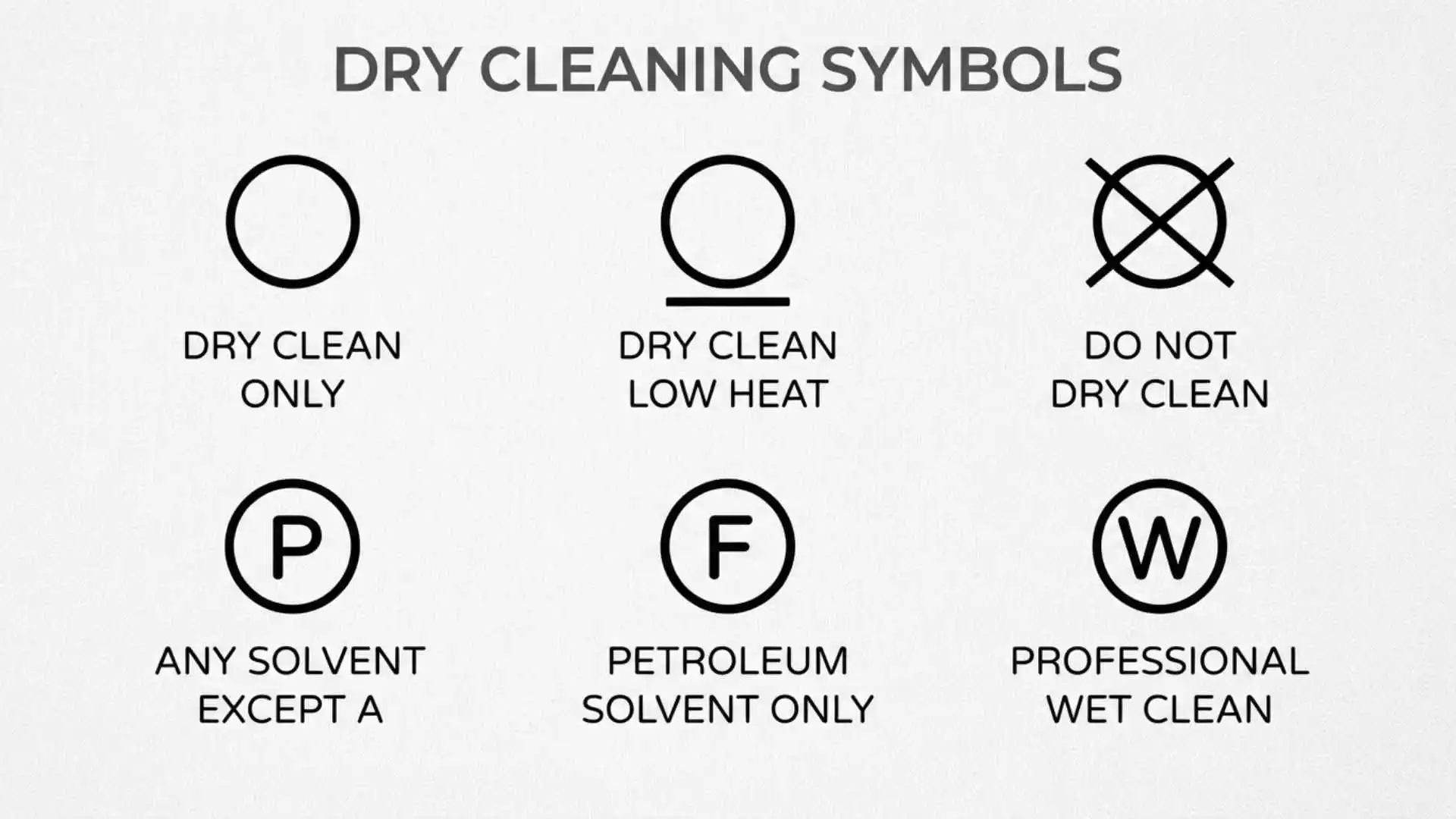
Dry cleaning symbols are the small circle-shaped markings found on clothing care labels. They tell you whether a garment can be professionally cleaned and, in some labeling systems, provide professional cleaners with information about the appropriate cleaning process.
If you have ever looked at a clothing tag and wondered “What does this circle mean?”, “What does P mean on a dry cleaning symbol?”, or “Can I wash this instead?”, this guide explains it all.
The most important thing to remember is that the circle represents professional cleaning, while a crossed-out circle means the garment should not be dry cleaned. Letters such as A, P, and F can provide additional information for professional cleaners. A W inside a circle refers to professional wet cleaning.
This complete guide covers the common dry cleaning symbols and meanings, how to read them, how they differ from other laundry symbols, and what you should actually do when you find them on your clothes.
Dry Cleaning Symbols at a Glance
If you need a quick answer, use this chart to identify the most common professional-cleaning symbols.
| Symbol | Meaning | What You Should Do |
| Circle | Professional cleaning permitted | Follow the complete care label |
| Circle with A | Specific professional cleaning process | Show the label to the cleaner |
| Circle with P | Professional dry-cleaning process using specified solvents | Let the professional cleaner select the process |
| Circle with F | Professional dry-cleaning process using specified hydrocarbon solvents | Take it to a professional cleaner |
| Circle with W | Professional wet cleaning | Use a professional wet-cleaning service |
| Crossed-out circle | Do not dry clean | Use another care method permitted by the label |
| Circle with a bar underneath | Gentler professional process | Cleaner should use reduced process conditions |
The exact symbols and meanings can vary depending on the care-label standard and country, so the complete garment label should always take priority.
What Are Dry Cleaning Symbols?
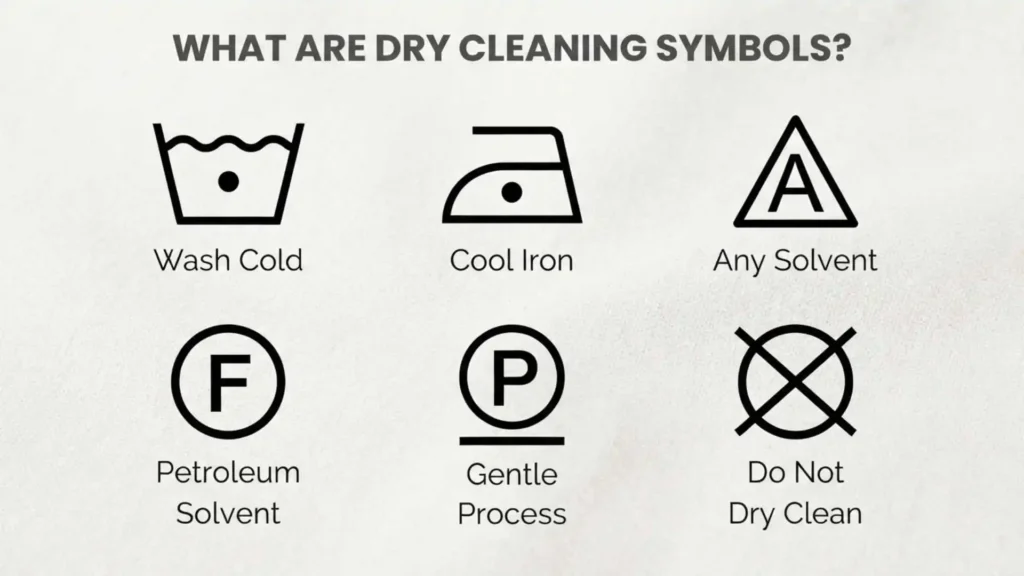
Dry cleaning symbols are part of a standardized system used to communicate textile-care instructions.
The symbols allow manufacturers to provide care information without relying entirely on written instructions.
The main symbol for professional cleaning is a circle.
What Does the Circle Mean?
A circle indicates that a professional cleaning process is permitted under the applicable care-label system.
However, a circle does not necessarily mean “dry clean only.”
A garment can have more than one permitted care method. For example, the label might provide washing instructions as well as professional-cleaning instructions.
Always read the entire label before deciding how to clean the garment.
Who Are the Letters Inside the Circle For?
Letters inside professional-cleaning symbols are primarily intended to communicate information to professional cleaners.
They can indicate which solvent or cleaning process is permitted.
Consumers generally do not need to purchase or select a particular solvent themselves. Instead, show the complete care label to the professional cleaner so they can determine the appropriate process.
Complete Dry Cleaning Symbols Chart
Understanding the shape and markings of each symbol makes clothing labels much easier to read.
Plain Circle
Symbol: ○
A plain circle indicates that professional cleaning is permitted.
It is not necessarily an instruction that the garment must always be dry cleaned.
What to do: Check the rest of the care label and, if professional cleaning is appropriate, take the garment to a qualified cleaner.
A Inside a Circle
Symbol: A inside a circle
In care-label systems that use this symbol, A indicates that professional dry cleaning with a broad range of solvents is permitted.
The exact treatment depends on the applicable labeling standard.
What to do: You normally do not need to interpret the solvent yourself. Give the garment and its complete care label to the professional cleaner.
P Inside a Circle
Symbol: P inside a circle
A P inside a circle indicates a particular category of professional dry-cleaning process using specified solvents.
The P designation is primarily useful to the professional cleaner because different cleaning solvents can affect textiles differently.
What to do: Do not attempt to reproduce the professional process at home. Show the care label to the cleaner.
F Inside a Circle
Symbol: F inside a circle
An F inside a circle indicates a professional dry-cleaning process using specified hydrocarbon-solvent conditions.
This designation helps a professional cleaner choose a compatible cleaning process.
What to do: Take the garment to a professional cleaner and allow them to follow the label’s requirements.
W Inside a Circle
Symbol: W inside a circle
A W inside a circle means professional wet cleaning.
This is different from conventional solvent-based dry cleaning.
Professional wet cleaning uses water together with specialized equipment, detergents, controls, and processes designed for garments that require professional care.
What to do: Use a professional cleaner that offers wet-cleaning services when this is the required care method.
Crossed-Out Circle
Symbol: circle with an X through it
A crossed-out circle means:
Do not dry clean.
This is one of the most important symbols to recognize.
If you see it on a garment, do not assume that professional dry cleaning is safe simply because the fabric itself seems durable.
What to do: Look at the washing, drying, and other care instructions to determine which alternative method is permitted.
Circle With a Line Underneath
A line underneath a professional-cleaning symbol can indicate that a milder or reduced process is required.
The restriction may involve factors such as mechanical action, moisture, temperature, or cleaning conditions, depending on the applicable standard.
What to do: Leave the professional process to the cleaner and make sure they can follow the complete care-label instructions.
What Do Dry Cleaning Symbols Mean?
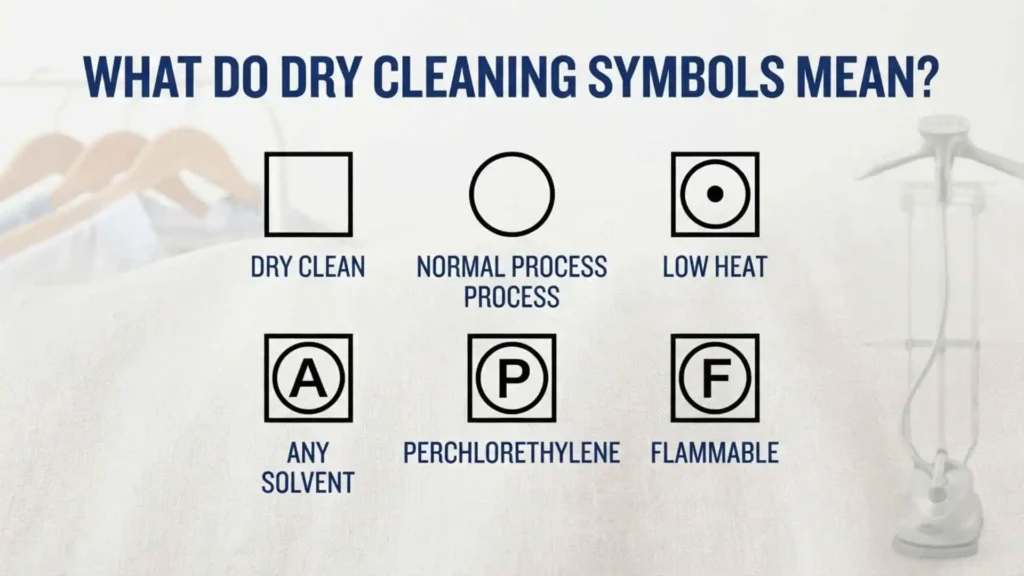
The easiest way to understand these symbols is to separate the basic shape from the additional markings.
What Does P Mean on a Dry Cleaning Symbol?
A P inside a circle identifies a permitted category of professional dry-cleaning process using specified solvents.
It is primarily a technical instruction for the professional cleaner.
You should not interpret P as meaning that the garment needs a particular product you can buy for home use.
What Does F Mean on a Dry Cleaning Symbol?
An F inside a circle indicates a professional dry-cleaning process using specified hydrocarbon solvents.
The symbol helps the cleaner determine an appropriate process for the garment.
What Does A Mean on a Dry Cleaning Symbol?
An A inside a circle is used in some care-label systems to indicate that a broad range of professional dry-cleaning solvents is permitted.
Because labeling standards differ between markets, the exact use of A should be interpreted according to the standard used on the garment.
What Does W Mean on a Dry Cleaning Symbol?
A W inside a circle means professional wet cleaning.
It does not mean that you can simply put the garment in a washing machine.
Professional wet cleaning is a controlled, water-based professional cleaning process.
What Does a Crossed-Out Circle Mean?
A crossed-out circle means do not dry clean.
If the symbol appears on your clothing, check the other care symbols for an approved cleaning method.
What Does a Line Under a Dry Cleaning Symbol Mean?
A line underneath the symbol generally indicates that a gentler professional cleaning process is required.
It should not be ignored simply because the garment has a normal-looking dry-cleaning circle.
Dry Clean vs Dry Clean Only
These terms are often confused.
A professional-cleaning symbol generally indicates that professional cleaning is permitted.
Dry clean only, on the other hand, is a written care instruction indicating that dry cleaning is the required care method.
A garment with a professional-cleaning symbol may also have washing or other care instructions.
Does a Circle Mean Dry Clean Only?
No.
A circle means professional cleaning is permitted under the applicable care-label system. It does not automatically mean that dry cleaning is the only possible method.
If the manufacturer says dry clean only, follow that written instruction.
Can You Wash Clothes With a Dry Cleaning Symbol?
Not automatically.
Seeing a dry-cleaning symbol does not provide enough information to determine whether a garment can safely be washed at home.
Check whether the garment also has a washing symbol.
If the label specifically says dry clean only, you should follow that instruction rather than assuming that machine washing is safe.
What Should You Check Before Washing?
Look for:
- The washing symbol
- The maximum washing temperature
- Whether hand washing is permitted
- Whether bleaching is permitted
- The drying instructions
- The ironing instructions
- Any written instructions such as “dry clean only”
The safest approach is to follow the manufacturer’s complete care label.
Can You Dry Clean Clothes at Home?
Traditional professional dry cleaning is not the same as ordinary household washing or a home laundry product.
Professional dry cleaning uses specialized equipment, controlled cleaning processes, extraction, and drying.
Some consumer products are marketed as home “dry-cleaning” alternatives, but they are not equivalent to professional dry cleaning.
When Should You Use a Professional Cleaner?
Professional cleaning is particularly useful when a garment is:
- Expensive
- Structured or tailored
- Delicate
- Heavily stained
- Decorated with difficult-to-clean details
- Made from materials requiring specialized treatment
- Labeled for professional cleaning
When in doubt, show the complete care label to a professional cleaner before treatment.
Professional Dry Cleaning vs Professional Wet Cleaning
Dry cleaning and wet cleaning are different professional processes.
| Feature | Dry Cleaning | Professional Wet Cleaning |
| Primary cleaning medium | Specialized solvent | Water |
| Main symbol | Circle | W inside a circle |
| Usually performed professionally | Yes | Yes |
| Equivalent to household washing? | No | No |
| Requires specialized process control | Yes | Yes |
Professional wet cleaning can be used for garments that require controlled water-based treatment.
Therefore, W inside a circle should not be confused with an ordinary washing-machine instruction.
How to Read a Complete Clothing Care Label
A clothing care label usually contains several categories of instructions.
Washing Symbol
The washing symbol looks like a tub.
It provides information about whether the garment can be machine washed, hand washed, or washed at a particular temperature.
Bleaching Symbol
The bleaching symbol is a triangle.
It provides information about whether bleaching is permitted and, depending on the marking system, whether only certain types of bleach may be used.
Drying Symbol
The drying symbol is generally a square.
A square containing a circle relates to tumble drying, while additional markings can specify heat or other restrictions.
Ironing Symbol
The ironing symbol looks like an iron.
Dots can indicate different temperature levels, while a crossed-out iron means ironing is prohibited.
Professional Cleaning Symbol
The professional-cleaning symbol is a circle.
Additional letters, bars, or a cross can provide more specific instructions.
How to Tell Dry Cleaning Symbols Apart From Other Laundry Symbols
If you remember the basic shapes, it becomes much easier to understand a care label.
| Shape | Care Category |
| Tub | Washing |
| Triangle | Bleaching |
| Square | Drying |
| Iron | Ironing |
| Circle | Professional cleaning |
This simple distinction can prevent one of the most common laundry mistakes: confusing a dry-cleaning symbol with a washing or drying instruction.
Dry Cleaning Symbols for Different Fabrics
A fabric’s fiber content can give you useful background information, but it should not replace the manufacturer’s care label.
Wool
Wool can shrink, stretch, felt, or change shape when treated incorrectly.
Some wool garments are washable, while others require professional cleaning.
Always follow the garment’s specific instructions.
Silk
Silk can be sensitive to heat, moisture, chemicals, and mechanical action.
Some silk garments can be washed under controlled conditions, while others require professional cleaning.
Linen
Linen is often washable, but its treatment depends on the garment’s construction, finishing, dye, and blend.
Check the label rather than assuming that all linen garments have identical care requirements.
Synthetic Fabrics
Materials such as polyester and nylon are often durable, but the finished garment may contain coatings, linings, adhesives, or other components that affect its care requirements.
Leather and Suede
Leather and suede should not be treated like ordinary washable fabrics.
Many leather and suede products require specialized cleaning methods.
Follow the manufacturer’s instructions and seek a specialist when necessary.
Common Mistakes When Reading Dry Cleaning Symbols
Understanding the symbols is useful, but misinterpreting them can still cause problems.
Mistake 1: Assuming Every Circle Means the Same Thing
A plain circle, a lettered circle, a crossed-out circle, and a circle with additional restrictions do not necessarily communicate the same instructions.
Pay attention to every marking.
Mistake 2: Ignoring the Crossed-Out Circle
A crossed-out circle means do not dry clean.
Do not ignore it because the garment looks like something that is normally dry cleaned.
Mistake 3: Treating P or F as Home-Cleaning Instructions
The letters are primarily professional-care information.
You generally should not try to purchase or use a corresponding solvent yourself.
Mistake 4: Looking at Only One Symbol
A garment’s care label is a complete set of instructions.
Checking only the dry-cleaning symbol while ignoring washing, bleaching, drying, or ironing instructions can lead to damage.
Mistake 5: Assuming Dry Clean Permitted Means Dry Clean Only
A professional-cleaning symbol does not automatically mean that no other care method is allowed.
Read the entire label.
Mistake 6: Assuming Fabric Type Determines the Cleaning Method
Two garments made from the same fiber can have different care instructions because their construction, dye, finish, lining, or decoration may differ.
Why Dry Cleaning Symbols Differ by Country
Care-label systems are standardized in many markets, but different countries and regions can use different standards or variations.
This is particularly relevant when interpreting letters inside professional-cleaning symbols.
For example, the meaning and use of certain symbols can differ between international standards and North American labeling practices.
What Should You Do With an Unfamiliar Symbol?
If a symbol looks different from the ones you normally see:
- Read any written instructions on the label.
- Check the manufacturer’s care information.
- Avoid guessing when the garment is valuable or delicate.
- Show the label to a professional cleaner if necessary.
This is safer than assuming that a symbol has exactly the same meaning in every labeling system.
Dry Cleaning Symbols Cheat Sheet
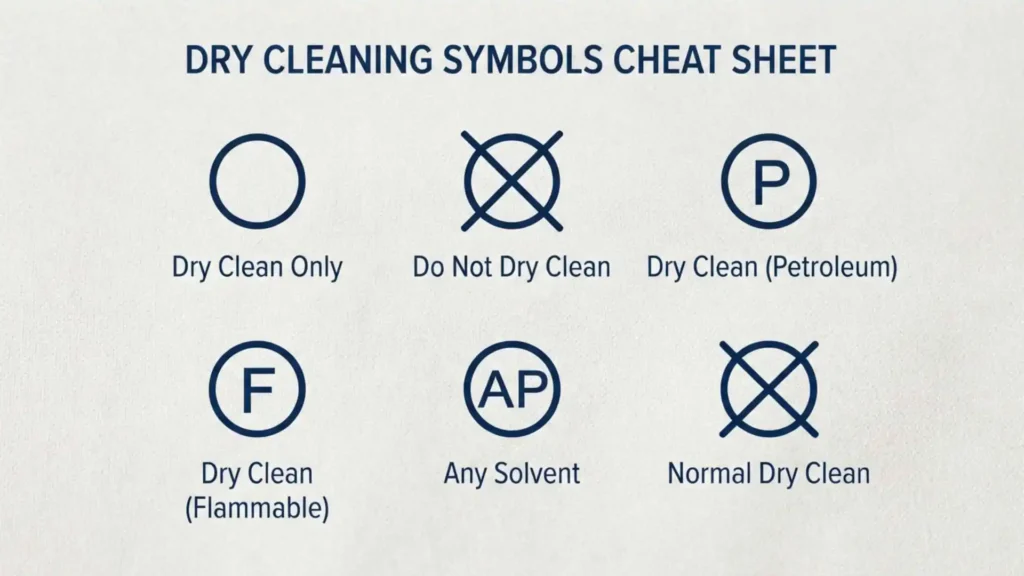
For quick reference, remember these basic rules:
Circle: Professional cleaning is permitted.
A inside a circle: A permitted professional dry-cleaning category in labeling systems that use this designation.
P inside a circle: Specified professional dry-cleaning process.
F inside a circle: Specified hydrocarbon-solvent professional dry-cleaning process.
W inside a circle: Professional wet cleaning.
Crossed-out circle: Do not dry clean.
Line underneath: Use a gentler professional process where specified.
The letters are primarily intended for professional cleaners, so consumers generally do not need to identify or handle the cleaning solvents themselves.
Frequently Asked Questions
What is the symbol for dry cleaning?
The basic dry-cleaning or professional-cleaning symbol is a circle.
What does a circle mean on a clothing label?
A circle indicates that professional cleaning is permitted under the applicable care-label system. It does not necessarily mean that dry cleaning is the only possible cleaning method.
What does P mean on a dry cleaning symbol?
P inside a circle identifies a particular permitted category of professional dry-cleaning process using specified solvents.
What does F mean on a dry cleaning symbol?
F inside a circle indicates a professional dry-cleaning process using specified hydrocarbon-solvent conditions.
What does A mean on a dry cleaning symbol?
A inside a circle can indicate that a broad range of professional dry-cleaning solvents is permitted in labeling systems that use this designation.
What does W mean on a clothing label?
W inside a circle means professional wet cleaning. It does not mean ordinary machine washing.
What does a crossed-out circle mean?
A crossed-out circle means do not dry clean.
What does a line under a dry cleaning symbol mean?
A line underneath a professional-cleaning symbol generally indicates that a gentler or reduced professional process is required.
Does a circle mean dry clean only?
No. A circle generally means professional cleaning is permitted. If the label specifically says dry clean only, follow that written instruction.
Can I wash something with a dry cleaning symbol?
Not necessarily. Check the washing symbol and all other care instructions before washing it. If the label says dry clean only, do not assume that home washing is safe.
Can I dry clean clothes at home?
Traditional dry cleaning is a professional process using specialized equipment and cleaning agents. Home products marketed as dry-cleaning alternatives are not necessarily equivalent to professional dry cleaning.
What is the difference between dry cleaning and wet cleaning?
Traditional dry cleaning uses specialized cleaning solvents rather than water as the primary cleaning medium. Professional wet cleaning uses water in a controlled professional process.
Do I need to understand the letters inside the circle?
You do not normally need to select the cleaning solvent yourself. The letters primarily provide technical information for professional cleaners.
Are dry cleaning symbols the same worldwide?
Many care symbols are standardized, but labeling systems and specific requirements can differ between countries and standards. When uncertain, follow the manufacturer’s instructions or consult a professional cleaner.
What is the most important dry cleaning symbol to know?
The most important symbols for consumers are the circle, which indicates professional cleaning, and the crossed-out circle, which means do not dry clean.
Conclusion
Understanding dry cleaning symbols can help you make better decisions about how to care for your clothes. The basic circle indicates professional cleaning, while letters such as A, P, and F provide additional information about permitted professional processes. A W inside a circle indicates professional wet cleaning, and a crossed-out circle means the garment should not be dry cleaned.
The most important rule is to read the entire care label rather than relying on one symbol. Washing, bleaching, drying, ironing, and professional-cleaning symbols work together to provide a complete set of instructions.
If you are unsure about a valuable or delicate garment, don’t guess. Take the garment and its complete care label to a professional cleaner and ask them to follow the manufacturer’s instructions. This simple habit can help prevent shrinkage, fading, distortion, and other avoidable clothing damage.

Hi, I’m Sienna Brooks, and I believe that the right words can inspire, comfort, and empower people at every stage of life. For as long as I can remember, I’ve been drawn to meaningful quotes and the stories behind them. I love curating collections of inspirational, motivational, and heartfelt quotes that resonate with readers around the world.
Through my writing, I strive to help others find encouragement, whether they’re celebrating life’s happiest moments or navigating its biggest challenges. I believe that wisdom is timeless, and I’m passionate about sharing words that leave a lasting impact.
I am the author of Reflections in Words and The Journey of Inspiration, two books dedicated to exploring the beauty and power of timeless quotes.
 Asher Monroe