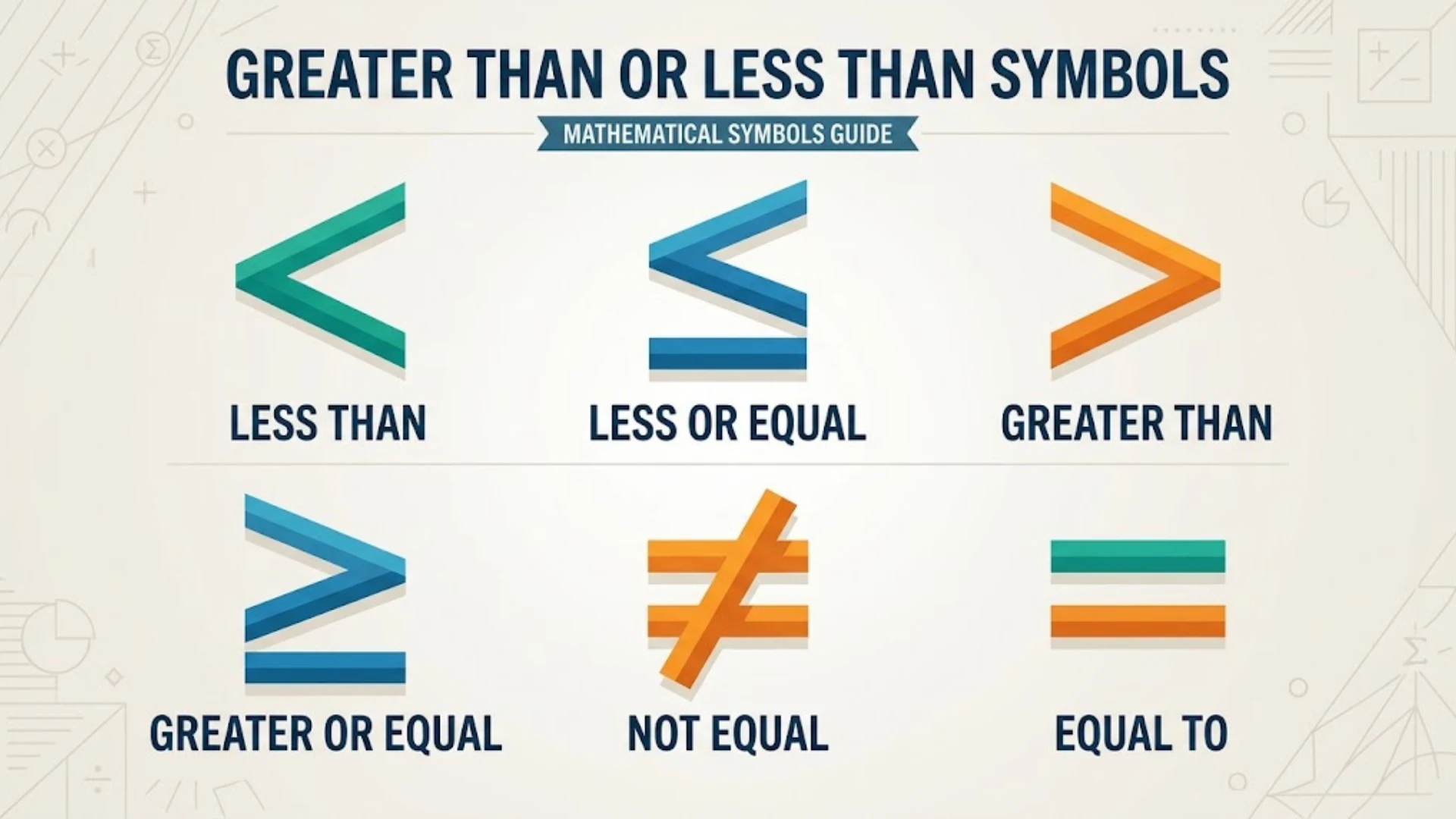
Have you ever looked at two numbers and wondered which mathematical symbol belongs between them? Greater than and less than signs make comparing numbers simple. However, their similar shapes can confuse students, especially when they first learn inequality symbols.
The greater than sign (>) means one number is larger than another. The less than sign (<) means one number is smaller than another. Their direction tells you how the two values compare.
For example, 8 > 5 means eight is greater than five. Similarly, 3 < 7 means three is less than seven.
These symbols are important in basic arithmetic, number comparison, and algebra. You’ll also encounter related symbols, including greater than or equal to (≥), less than or equal to (≤), equal to (=), and does not equal (≠).
This guide explains the meanings of greater than and less than signs, how to remember their directions, and how to use them correctly. You’ll also learn practical comparison methods, inequality rules, algebra examples, and easy tricks for students.
What Are Greater Than and Less Than Signs?
Greater than and less than signs are mathematical symbols used to compare two numbers, quantities, or expressions. They show whether one value is larger or smaller than another.
These symbols belong to a larger group called inequality symbols. Unlike an equal sign, which shows that two values are identical, inequality signs describe different relationships between values.
For example:
- 5 > 3 means five is greater than three.
- 2 < 6 means two is less than six.
- 7 = 7 means both numbers are equal.
- 4 ≠ 9 means four is not equal to nine.
The direction of each symbol matters. Its pointed end faces the smaller value, while its open side faces the larger value.
You’ll use these math comparison symbols when working with whole numbers, fractions, decimals, negative numbers, and algebraic expressions.
What Does the Greater Than Sign (>) Mean?
The greater than sign (>) shows that the value on its left is larger than the value on its right.
For example:
9 > 4
You read this mathematical statement as “nine is greater than four.”
The open side faces nine because nine is the larger number. The pointed end faces four because four is smaller.
Here are more greater than examples:
- 4 > 3 — Four is greater than three.
- 10 > 5 — Ten is greater than five.
- 20 > 12 — Twenty is greater than twelve.
- 50 > 25 — Fifty is greater than twenty-five.
- 100 > 99 — One hundred is greater than ninety-nine.
You can use this symbol with much larger values, fractions, decimals, and variables.
For example, 25 > 10 compares two whole numbers, while x > 5 describes all values of x that are greater than five.
Remember: The greater than symbol always opens toward the larger value.
What Does the Less Than Sign (<) Mean?
The less than sign (<) shows that the value on its left is smaller than the value on its right.
For example:
3 < 8
You read this statement as “three is less than eight.”
The open side faces eight because it is larger. The pointed end faces three because it is smaller.
Here are some less than examples:
- 2 < 3 — Two is less than three.
- 5 < 8 — Five is less than eight.
- 10 < 15 — Ten is less than fifteen.
- 25 < 40 — Twenty-five is less than forty.
- 75 < 100 — Seventy-five is less than one hundred.
The less than symbol works with different types of numbers. For example, 0.5 < 0.8 compares decimals, while -5 < -2 compares negative numbers.
Remember: The pointed end faces the smaller value, and the open side faces the larger value.
What Does the Equal Sign (=) Mean?
The equal sign (=) shows that two mathematical expressions have the same value.
Unlike greater than and less than signs, it doesn’t show that one number is larger or smaller. It tells you that both sides represent the same quantity.
Examples include:
- 5 = 5
- 10 = 10
- 4 + 3 = 7
- 12 – 5 = 7
- 3 × 4 = 12
The equal sign is essential in arithmetic and algebra. It connects expressions that have the same mathematical value.
For example, in x + 2 = 7, the value of x must be five to make the statement true.
Greater Than vs. Less Than: What’s the Difference?
The main difference between greater than and less than signs is the relationship they express.
The greater than symbol (>) identifies a larger value on the left. The less than symbol (<) identifies a smaller value on the left.
Their shapes are reversed, but both follow the same comparison principle.
| Symbol | Name | Meaning | Example |
| > | Greater than | Left value is larger | 8 > 5 |
| < | Less than | Left value is smaller | 3 < 7 |
| = | Equal to | Both values are the same | 6 = 6 |
Consider the numbers four and nine.
- 9 > 4 means nine is greater than four.
- 4 < 9 means four is less than nine.
Both statements describe the same relationship. The only difference is the order in which you write the numbers.
Which Way Does the Greater Than Sign Point?
The greater than sign looks like this: >.
Its pointed end faces left, while its open side faces right.
For example:
12 > 7
The open side faces twelve, the larger number. The pointed end faces seven, the smaller number.
You can remember this rule by looking at the two sides of the symbol:
- Open side: Larger value.
- Pointed end: Smaller value.
Which Way Does the Less Than Sign Point?
The less than sign looks like this: <.
Its pointed end faces right, while its open side faces left.
For example:
4 < 10
The open side faces ten, and the pointed end faces four.
The symbol tells you that the number on the left is smaller than the number on the right.
How to Read Greater Than and Less Than Inequalities
Read an inequality from left to right, just as you read an ordinary sentence.
For example:
| Inequality | How to read it |
| 7 > 2 | Seven is greater than two. |
| 4 < 9 | Four is less than nine. |
| 10 > 6 | Ten is greater than six. |
| 3 < 8 | Three is less than eight. |
| 5 = 5 | Five is equal to five. |
| 2 ≠ 7 | Two is not equal to seven. |
Reading the entire statement aloud can help you catch mistakes. If you read 5 < 8 as “five is greater than eight,” the sentence won’t match the numbers.
Greater Than or Equal To (≥) and Less Than or Equal To (≤) Signs
Some comparisons allow two possibilities: one number can be larger than another, or both numbers can be equal.
That’s why mathematics uses greater than or equal to (≥) and less than or equal to (≤) symbols.
The extra horizontal line underneath each symbol represents equality.
| Symbol | Name | Meaning | Example |
| > | Greater than | Larger, but not equal | 8 > 5 |
| < | Less than | Smaller, but not equal | 3 < 7 |
| ≥ | Greater than or equal to | Larger or equal | 5 ≥ 5 |
| ≤ | Less than or equal to | Smaller or equal | 4 ≤ 4 |
These symbols are especially useful in algebra, equations, mathematical statements, and real-life limits.
Greater Than or Equal To Sign (≥)
The greater than or equal to sign (≥) means the value on the left is either larger than or equal to the value on the right.
It combines two possible relationships:
- Greater than (>)
- Equal to (=)
For example:
- 5 ≥ 3 — Five is greater than three.
- 7 ≥ 7 — Seven is equal to seven.
- 10 ≥ 8 — Ten is greater than eight.
- 4 ≥ 1 — Four is greater than one.
The important difference is that equality is allowed.
Consider the statement x ≥ 10. Its solution includes ten and every number larger than ten.
Therefore, x could be 10, 11, 15, or 100.
Less Than or Equal To Sign (≤)
The less than or equal to sign (≤) means the value on the left is either smaller than or equal to the value on the right.
It combines these two relationships:
- Less than (<)
- Equal to (=)
Examples include:
- 2 ≤ 5 — Two is less than five.
- 6 ≤ 6 — Six is equal to six.
- 8 ≤ 12 — Eight is less than twelve.
- 1 ≤ 3 — One is less than three.
For example, x ≤ 5 means x can equal five or any number smaller than five.
Possible values include 5, 4, 3, 0, and -2.
Difference Between Greater Than (>) and Greater Than or Equal To (≥)
These symbols look similar, but they don’t express exactly the same relationship.
The greater than sign excludes equality. The greater than or equal to sign includes it.
| Comparison | Result | Explanation |
| 5 > 3 | True | Five is larger than three. |
| 5 > 5 | False | Five is not greater than itself. |
| 5 ≥ 3 | True | Five is greater than three. |
| 5 ≥ 5 | True | Equality is allowed. |
If a question says a student must score at least 70 points, the correct inequality is x ≥ 70.
A score of exactly 70 qualifies, as does any higher score.
Difference Between Less Than (<) and Less Than or Equal To (≤)
The less than symbol excludes equality, while the less than or equal to symbol allows it.
For example:
| Comparison | Result | Explanation |
| 3 < 5 | True | Three is smaller than five. |
| 5 < 5 | False | Five is not smaller than itself. |
| 3 ≤ 5 | True | Three is smaller than five. |
| 5 ≤ 5 | True | Equality is allowed. |
Suppose a competition accepts participants who are at most 18 years old.
You can write this condition as x ≤ 18. An 18-year-old qualifies, as does anyone younger.
Other Important Inequality Symbols in Mathematics
Greater than and less than signs are part of a larger group of math inequality symbols.
These symbols help describe relationships between numbers, variables, and mathematical expressions.
| Symbol | Name | Meaning | Example |
| > | Greater than | Left value is larger | 9 > 6 |
| < | Less than | Left value is smaller | 2 < 7 |
| ≥ | Greater than or equal to | Left value is larger or equal | 8 ≥ 8 |
| ≤ | Less than or equal to | Left value is smaller or equal | 4 ≤ 6 |
| = | Equal to | Both values are equal | 5 = 5 |
| ≠ | Does not equal | Both values are different | 5 ≠ 3 |
Does Not Equal Sign (≠)
The does not equal sign (≠) shows that two values are different.
It looks like an equal sign with a diagonal line through it.
For example:
- 2 ≠ 3
- 5 ≠ 8
- 10 ≠ 7
- 4 + 2 ≠ 9
You read 2 ≠ 3 as “two does not equal three.”
This symbol is useful when describing values that cannot be the same.
For example, if x ≠ 0, the variable x can represent any value except zero.
How Inequality Symbols Work Together
Mathematics uses different comparison symbols to express different relationships.
Consider these statements:
- 4 > 2 means four is greater than two.
- 2 < 4 means two is less than four.
- 4 ≥ 4 means four is greater than or equal to four.
- 2 ≤ 4 means two is less than or equal to four.
- 4 = 4 means both values are equal.
- 4 ≠ 2 means the values are different.
Choosing the correct symbol depends on what the mathematical statement needs to express.
How to Remember Greater Than and Less Than Signs
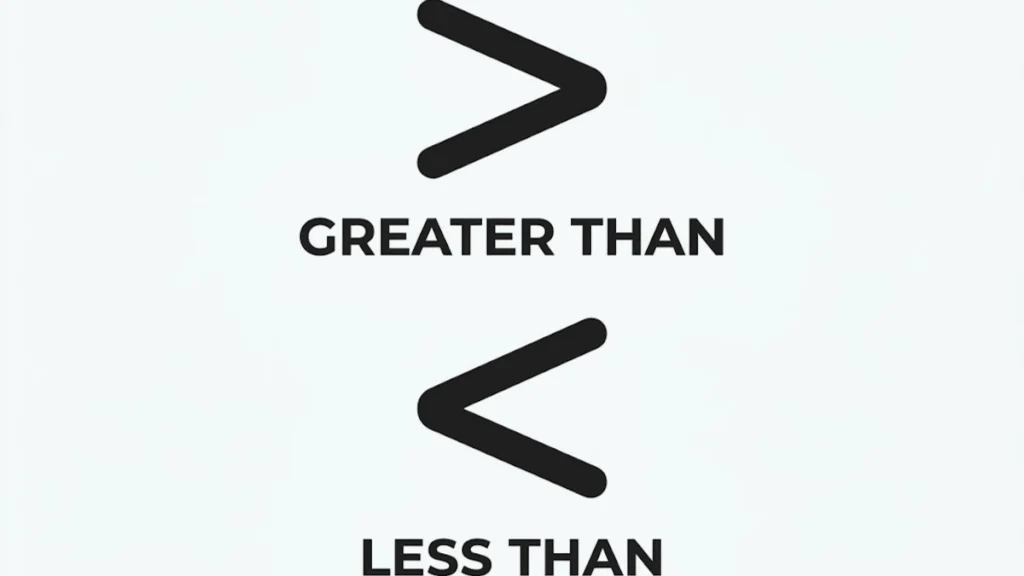
Many students understand the meanings of inequality signs but struggle to remember which direction each symbol faces.
Fortunately, several memory techniques make the symbols easier to recognize.
The most useful approach is to understand the open side and pointed end first. You can then use visual tricks to reinforce what you’ve learned.
The Alligator Method for Greater Than and Less Than
The alligator method is a popular way to teach inequality signs to younger students.
Imagine that the symbol is an alligator’s open mouth. The alligator always wants to eat the larger number.
For example:
8 > 3
Imagine an alligator opening its mouth toward eight because eight is larger than three.
For the comparison:
2 < 6
The open mouth faces six because six is the larger value.
The alligator trick helps children remember that the open side faces the bigger number.
However, it is a memory aid rather than a mathematical rule. Students should still learn the actual names and meanings of the symbols.
The Crocodile Mouth Math Trick
The crocodile method works in the same way as the alligator trick.
Imagine a crocodile opening its mouth toward the larger number. Its pointed end faces the smaller number.
For example:
5 < 9
The crocodile opens its mouth toward nine because nine is larger.
You can practice this method with number cards:
- Write two different numbers on separate cards.
- Place them side by side.
- Ask which number is larger.
- Put the correct inequality sign between them.
- Imagine the crocodile opening its mouth toward the larger value.
This activity makes number comparison more visual and interactive.
The L Method for Remembering the Less Than Sign
The L method uses the shape of the less than symbol as a memory clue.
The less than sign (<) can remind students of a lowercase L when they write it in a particular style.
You can use this association to remember that < means less than.
For example:
3 < 7
Three is less than seven.
This method is a simple visual reminder. It works best when students also practice reading the complete inequality.
The Open Side and Pointed End Method
This is one of the most reliable ways to remember both symbols.
The rule is simple:
The open side faces the larger number, and the pointed end faces the smaller number.
For example:
- 9 > 4: The open side faces nine.
- 2 < 6: The open side faces six.
- 15 > 10: The open side faces fifteen.
- 5 < 12: The open side faces twelve.
You don’t need to memorize two separate direction rules. Learn this one principle, and you can identify both signs.
The Equal Sign Method for Remembering ≥ and ≤
The extra line underneath ≥ and ≤ represents equality.
Think of it as adding an equal sign condition to the original comparison.
- > means greater than.
- ≥ means greater than or equal to.
- < means less than.
- ≤ means less than or equal to.
For example, x ≥ 5 allows x to equal five or be larger. Meanwhile, x ≤ 5 allows x to equal five or be smaller.
This method helps students understand why the extra line changes the meaning.
How to Compare Numbers Using Greater Than and Less Than Symbols
To compare two numbers, first determine which value is larger. Then place the correct symbol between them.
The process becomes easier when you understand place value and number relationships.
Comparing Whole Numbers
Whole numbers include zero and positive counting numbers such as 1, 2, 3, and 4.
When comparing whole numbers, look at their digits and place values.
For example:
45 < 60
Both numbers have two digits. Compare the tens digits first. Four tens are fewer than six tens, so 45 is smaller.
For numbers with different digit counts, the number with more digits is generally larger when both are positive whole numbers.
Examples:
- 12 > 9
- 125 > 99
- 450 < 500
- 1,000 > 999
For numbers with the same number of digits, compare the digits from left to right until you find a difference.
Comparing Positive Numbers
Positive numbers are values greater than zero.
When comparing positive numbers, the larger numerical value is greater.
Examples:
- 8 > 5
- 15 < 20
- 100 > 75
- 35 < 40
You can also use a number line to check your answer. Positive numbers farther to the right have greater values.
Comparing Negative Numbers
Negative numbers are smaller than zero. They can be confusing because the number with the larger absolute value is actually smaller.
For example:
-2 > -5
Negative two is greater than negative five because it is closer to zero and appears farther right on the number line.
Consider these comparisons:
- -1 > -4
- -3 > -8
- -10 < -5
- -7 < -2
Think about temperature to understand this relationship.
A temperature of -2°F is warmer than -5°F. Therefore, -2 is greater than -5.
The number line rule: Values increase as you move from left to right. This works for positive numbers, negative numbers, and zero.
Comparing Fractions and Rational Numbers
Fractions represent parts of a whole. They are also examples of rational numbers, which can be written as a ratio of two integers with a nonzero denominator.
To compare fractions, you can use common denominators or equivalent fractions.
For example:
1/2 > 1/4
One-half is greater than one-quarter.
You can also compare fractions by giving them a common denominator:
2/3 and 3/4
Their common denominator is 12.
- 2/3 = 8/12
- 3/4 = 9/12
Therefore:
2/3 < 3/4
The second fraction is larger because nine-twelfths is greater than eight-twelfths.
Comparing Decimal Numbers
Decimals represent values using a decimal point.
To compare decimals, align their decimal points and compare the digits from left to right.
For example:
0.5 > 0.3
Five-tenths is greater than three-tenths.
Consider another comparison:
2.75 > 2.70
Both values have the same whole-number part and tenths digit. Compare the hundredths digits: five is greater than zero.
Here are more examples:
- 0.8 > 0.6
- 0.25 < 0.50
- 1.75 > 1.5
- 3.40 = 3.4
You can add zeros to the end of a decimal without changing its value. For example, 3.4 and 3.40 are equal.
Using a Number Line to Compare Values
A number line comparison is a visual method for identifying which number is larger or smaller.
Numbers increase as you move from left to right. Numbers decrease as you move from right to left.
For example:
-3 < -1 < 0 < 2 < 5
This arrangement shows the values in increasing order.
A number line is especially useful when comparing negative numbers, fractions, and decimals.
Greater Than and Less Than in Algebra
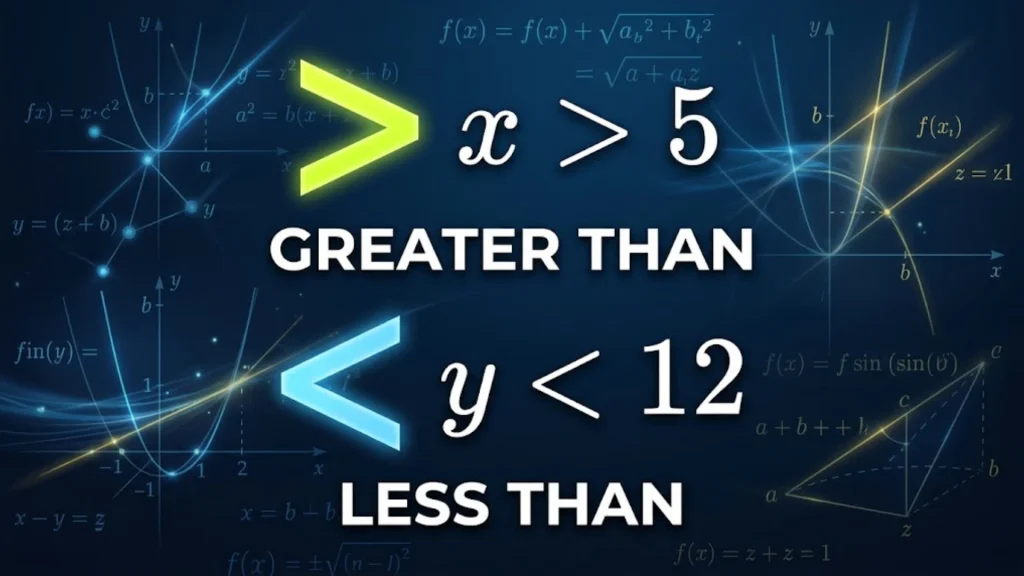
Greater than and less than symbols are not limited to basic arithmetic. They’re also essential in algebra.
In algebra, inequalities compare mathematical expressions that may contain unknown values called variables.
For example, x > 5 means x represents a value greater than five.
Understanding Inequality Expressions With Variables
A variable is a letter that represents an unknown or changing value.
Common variables include x, y, a, and b.
You can use inequality symbols to describe restrictions on these values.
Examples:
- x > 5 — x is greater than five.
- y < 10 — y is less than ten.
- a ≥ 3 — a is at least three.
- b ≤ 8 — b is no greater than eight.
An inequality can have many possible solutions.
For example, x > 5 is true when x equals 6, 7, 10, or 100. It is also true for values such as 5.5.
However, x cannot equal five because the greater than sign does not include equality.
Difference Between Equations and Inequalities
An equation states that two mathematical expressions have equal values. An inequality states that one expression is greater than, less than, or otherwise different from another.
| Feature | Equation | Inequality |
| Main purpose | Shows equality | Shows a comparison |
| Common symbols | = | >, <, ≥, ≤ |
| Example | x = 5 | x > 5 |
| Possible solutions | May have one or more | Often represents a range |
For example:
x = 5
This equation has one solution: x equals five.
Now consider:
x > 5
This inequality has infinitely many real-number solutions. Every real number greater than five satisfies it.
How to Solve Simple Inequalities
You can solve many inequalities using the same basic operations used to solve equations.
The goal is to isolate the variable while keeping the inequality true.
Example:
x + 2 > 5
Subtract two from both sides:
x + 2 – 2 > 5 – 2
Simplify:
x > 3
The solution is every value greater than three.
Another example:
x – 3 < 7
Add three to both sides:
x – 3 + 3 < 7 + 3
Simplify:
x < 10
The solution includes every value smaller than ten.
How to Isolate a Variable in an Inequality
To isolate a variable, use inverse operations to move other terms away from it.
Follow these basic rules:
- Add or subtract the same value on both sides.
- Multiply or divide both sides by the same positive number without changing the sign.
- Reverse the inequality sign when multiplying or dividing both sides by a negative number.
- Simplify the expressions after each operation.
Consider this example:
3x + 4 ≤ 16
Subtract four from both sides:
3x ≤ 12
Divide both sides by three:
x ≤ 4
The solution is every real number less than or equal to four.
You can check the result by substituting a possible value. If x equals four, the original inequality becomes:
3(4) + 4 ≤ 16
16 ≤ 16
This statement is true.
When Do You Flip the Inequality Sign?
One of the most important inequality rules involves multiplying or dividing by a negative number.
When you multiply or divide both sides of an inequality by a negative number, you must reverse the inequality sign.
For example:
2 < 5
Multiply both sides by -1:
-2 > -5
The sign changes from less than to greater than.
Why? Multiplying positive numbers by a negative number moves their results to the opposite side of zero on the number line. Their order reverses.
Here’s another example:
-2x > 6
Divide both sides by -2. Because you’re dividing by a negative number, reverse the sign:
x < -3
The correct answer is x is less than negative three.
Important inequality rules:
| Operation | What happens to the inequality sign? |
| Add a positive number to both sides | Stays the same |
| Subtract the same number from both sides | Stays the same |
| Multiply both sides by a positive number | Stays the same |
| Divide both sides by a positive number | Stays the same |
| Multiply both sides by a negative number | Reverses |
| Divide both sides by a negative number | Reverses |
The rule applies to both strict inequalities and inequalities containing equality.
For more worked examples, see OpenStax’s guide to solving linear inequalities.
Can You Multiply an Inequality by a Variable?
Yes, but you must be careful. An unknown variable might be positive, negative, or zero.
The sign of the variable determines what happens to the inequality direction.
Consider:
2 < 3
Suppose you multiply both sides by x.
There are three possible cases:
- If x > 0, the inequality direction stays the same: 2x < 3x.
- If x < 0, the inequality direction reverses: 2x > 3x.
- If x = 0, both sides become equal: 0 = 0.
This is why you cannot automatically multiply an inequality by an unknown variable and keep the original sign.
You must first determine the variable’s sign or separate the problem into possible cases.
Greater Than and Less Than Examples
Practice helps you recognize inequality symbols and use them correctly.
The following examples cover common comparisons involving whole numbers, equality, and different inequality signs.
Greater Than Sign Examples
| Example | Meaning |
| 4 > 3 | Four is greater than three. |
| 10 > 5 | Ten is greater than five. |
| 20 > 12 | Twenty is greater than twelve. |
| 50 > 25 | Fifty is greater than twenty-five. |
| 100 > 99 | One hundred is greater than ninety-nine. |
Less Than Sign Examples
| Example | Meaning |
| 2 < 3 | Two is less than three. |
| 5 < 8 | Five is less than eight. |
| 10 < 15 | Ten is less than fifteen. |
| 25 < 40 | Twenty-five is less than forty. |
| 75 < 100 | Seventy-five is less than one hundred. |
Greater Than or Equal To Examples
| Example | Meaning |
| 5 ≥ 3 | Five is greater than three. |
| 7 ≥ 7 | Seven is equal to seven. |
| 12 ≥ 10 | Twelve is greater than ten. |
| 20 ≥ 20 | Twenty is equal to twenty. |
Less Than or Equal To Examples
| Example | Meaning |
| 2 ≤ 5 | Two is less than five. |
| 6 ≤ 6 | Six is equal to six. |
| 8 ≤ 12 | Eight is less than twelve. |
| 15 ≤ 20 | Fifteen is less than twenty. |
Equal and Does Not Equal Examples
| Example | Meaning |
| 5 = 5 | Five equals five. |
| 10 = 10 | Ten equals ten. |
| 4 ≠ 6 | Four does not equal six. |
| 12 ≠ 15 | Twelve does not equal fifteen. |
True and False Inequality Examples
A true inequality correctly describes the relationship between two values. A false inequality uses a symbol that doesn’t match their actual relationship.
| Statement | Result | Reason |
| 2 < 3 | True | Two is smaller than three. |
| 3 > 2 | True | Three is larger than two. |
| 4 > 3 | True | Four is larger than three. |
| 5 < 8 | True | Five is smaller than eight. |
| 2 > 5 | False | Two is smaller than five. |
| 7 < 4 | False | Seven is larger than four. |
| 5 > 5 | False | Five equals five. |
| 6 ≤ 6 | True | Equality is allowed. |
To test an inequality, compare the actual values first. Then check whether the selected symbol correctly describes their relationship.
Common Mistakes When Using Inequality Symbols
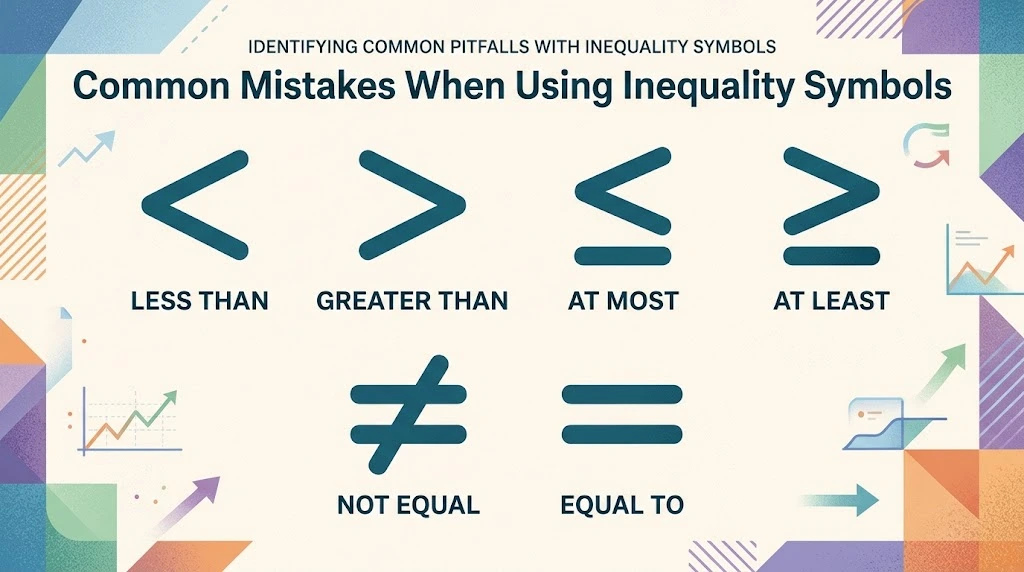
Students sometimes understand the basic meanings but still make mistakes when writing or solving inequalities.
Recognizing these errors can improve mathematical accuracy and build confidence.
Reversing Greater Than and Less Than Signs
The greater than and less than symbols have similar shapes. This makes them easy to confuse.
For example, a student might write 3 > 8 instead of 3 < 8.
To avoid this mistake, remember that the open side faces the larger value.
Thinking the Pointed End Faces the Larger Number
This is another common misunderstanding.
The pointed end actually faces the smaller value. The open side faces the larger value.
For example:
4 < 9
The pointed end faces four, while the open side faces nine.
Forgetting the Equal Part of ≥ and ≤
The extra line underneath these symbols means equality is allowed.
For example, 5 ≥ 5 is true, but 5 > 5 is false.
Always check whether the comparison includes equality before choosing a symbol.
Forgetting to Reverse an Inequality With a Negative Number
When multiplying or dividing both sides by a negative number, you must reverse the inequality sign.
For example:
-3x < 12
Divide both sides by -3 and reverse the sign:
x > -4
Keeping the original less than sign would produce an incorrect result.
Comparing Negative Numbers Incorrectly
A negative number with a larger absolute value is smaller on the number line.
For example:
-8 < -3
Negative eight is farther left than negative three. Therefore, it has the smaller value.
Greater Than and Less Than Worksheets and Practice Activities
Students can improve their number sense through regular comparison exercises.
Worksheets, flashcards, and simple math games provide opportunities to practice recognizing symbols and comparing values.
Greater Than and Less Than Practice for Kids
Start with small whole numbers before introducing fractions and negative values.
Useful activities include:
- Comparing two numbers and choosing the correct sign.
- Filling in missing inequality symbols.
- Matching symbols with their meanings.
- Arranging numbers from smallest to largest.
- Reading mathematical statements aloud.
- Finding and correcting false inequalities.
For example, ask students to complete these statements:
- 4 ___ 7
- 9 ___ 3
- 5 ___ 5
- 2 ___ 8
They must choose between >, <, and =.
This approach encourages students to understand the comparison instead of guessing the symbol.
Math Worksheets for Greater Than and Less Than Signs
Greater than and less than worksheets can help students practice different difficulty levels.
Consider organizing exercises into these groups:
| Level | Practice topic | Example |
| Beginner | Single-digit numbers | 3 < 7 |
| Elementary | Two-digit numbers | 45 > 32 |
| Intermediate | Fractions and decimals | 0.5 > 0.3 |
| Advanced | Negative numbers | -2 > -5 |
| Algebra | Variable inequalities | x + 2 > 5 |
Teachers and parents can use these activities for classroom lessons, homework, or individual practice.
Flashcards and Math Games
Flashcards are useful for practicing symbol recognition and mathematical vocabulary.
Create cards with a symbol on one side and its meaning on the other.
For example:
- Front: >
Back: Greater than. - Front: <
Back: Less than. - Front: ≥
Back: Greater than or equal to.
You can also make a number comparison game. Give students two number cards and ask them to place the correct inequality symbol between them.
For younger children, use the alligator method as a visual aid. For older students, include negative numbers, decimals, fractions, and simple algebraic expressions.
The goal is to build understanding through repeated practice, not just memorize symbol shapes.
Frequently Asked Questions About Greater Than and Less Than Signs
What Are Greater Than and Less Than Signs?
Greater than (>) and less than (<) are mathematical symbols used to compare two values. Greater than means the left value is larger, while less than means the left value is smaller.
What Are Greater Than and Less Than Signs Used For?
They’re used to compare numbers, quantities, variables, and mathematical expressions. Students use them in arithmetic and algebra, while more advanced mathematics uses them to describe ranges and restrictions.
How Do You Remember Greater Than and Less Than Signs?
Remember that the open side faces the larger number and the pointed end faces the smaller number. You can also use the alligator method, where an imaginary alligator opens its mouth toward the bigger value.
How Can You Tell Which Way the Greater Than Sign Goes?
The greater than sign looks like >. Its pointed end faces the smaller value on the right, while its open side faces the larger value on the left.
How Do You Know Which Number Is Greater?
Compare the numerical values. On a number line, the number farther to the right is greater. For positive whole numbers, place value can also help you identify the larger number.
Which Sign Means Greater Than?
The greater than sign is >. For example, 8 > 4 means eight is greater than four.
Which Sign Means Less Than?
The less than sign is <. For example, 3 < 7 means three is less than seven.
What Does the Symbol ≥ Mean?
The symbol ≥ means greater than or equal to. It allows the left value to be either larger than or equal to the right value.
What Does the Symbol ≤ Mean?
The symbol ≤ means less than or equal to. It allows the left value to be either smaller than or equal to the right value.
What Does the Symbol ≠ Mean?
The symbol ≠ means does not equal. It indicates that two mathematical values are different, such as 2 ≠ 5.
How Do You Read Inequality Symbols?
Read an inequality from left to right. For example, 6 > 2 means six is greater than two, while 4 ≤ 8 means four is less than or equal to eight.
How Does the Alligator Method Work?
Imagine the inequality symbol as an alligator’s open mouth. The mouth faces the larger number, while the pointed end faces the smaller number.
What Is the Alligator Trick in Math?
The alligator trick is a visual memory technique for learning greater than and less than signs. It helps students remember that the open side faces the larger value.
How Does the L Method Help Remember Less Than?
The less than sign (<) can resemble a lowercase L when written in a suitable style. This visual association helps some students remember its name and meaning.
How Do You Remember Greater Than or Equal To?
The symbol ≥ means greater than or equal to. Remember that its extra horizontal line adds the equality condition to the greater than symbol.
How Do You Remember Less Than or Equal To?
The symbol ≤ means less than or equal to. Its extra line means the two values can also be equal.
Why Does Multiplying by a Negative Number Flip the Inequality Sign?
Multiplying both sides by a negative number reverses their order on the number line. For example, 2 < 5 becomes -2 > -5 after multiplying both sides by -1.
Why Does Dividing by a Negative Number Reverse an Inequality?
Dividing by a negative number reverses the order of the values, just as multiplication by a negative number does. Therefore, the inequality sign must change direction.
How Do You Solve Inequalities With Variables?
Use inverse operations to isolate the variable. Add or subtract the same amount from both sides, and multiply or divide carefully. Reverse the inequality sign when multiplying or dividing by a negative number.
How Do You Isolate a Variable in an Inequality?
Use addition, subtraction, multiplication, or division to move other terms away from the variable. Keep both sides balanced and reverse the sign when multiplying or dividing by a negative value.
Can You Multiply an Inequality by a Variable?
Yes, but you must know whether the variable is positive, negative, or zero. A positive variable preserves the inequality direction, a negative variable reverses it, and zero makes both products equal.
What Happens When You Multiply an Inequality by a Negative Number?
The inequality sign reverses. For example, multiplying 3 < 7 by -1 gives -3 > -7.
What Is the Difference Between an Equation and an Inequality?
An equation uses an equal sign (=) to show that two expressions have the same value. An inequality uses symbols such as >, <, ≥, and ≤ to compare values.
Conclusion: Understanding Greater Than and Less Than Signs
Greater than and less than signs are basic mathematical tools that help you compare numbers and understand relationships between values.
The greater than symbol (>) means the left value is larger. The less than symbol (<) means the left value is smaller. Their open sides face the larger values, while their pointed ends face the smaller values.
You should also understand the related symbols:
- ≥ means greater than or equal to.
- ≤ means less than or equal to.
- = means equal to.
- ≠ means does not equal.
Memory tricks such as the alligator method and L method can help beginners recognize these symbols. However, understanding their mathematical meanings is more important than memorizing their shapes.
Practice comparing whole numbers, fractions, decimals, and negative numbers. Once you’re comfortable with these comparisons, you’ll find it easier to read inequality expressions, solve algebra problems, and apply mathematical rules correctly.

Hello, I’m Rowan Sinclair, a passionate writer and lifelong admirer of the wisdom found in great quotes. I believe that words have the ability to inspire change, spark creativity, and connect people across cultures and generations.
I enjoy writing about motivational quotes, famous sayings, and lessons from history’s most influential thinkers. Every article I create is driven by my desire to help readers discover meaningful insights that they can apply to their own lives.
When I’m not writing, I spend my time reading biographies, exploring classic literature, and collecting memorable quotes that deserve to be shared with the world.
I am the author of Voices That Inspire and A Collection of Timeless Thoughts, two books that celebrate the enduring power of words and the stories behind them.
 Asher Monroe
 Sienna Brooks