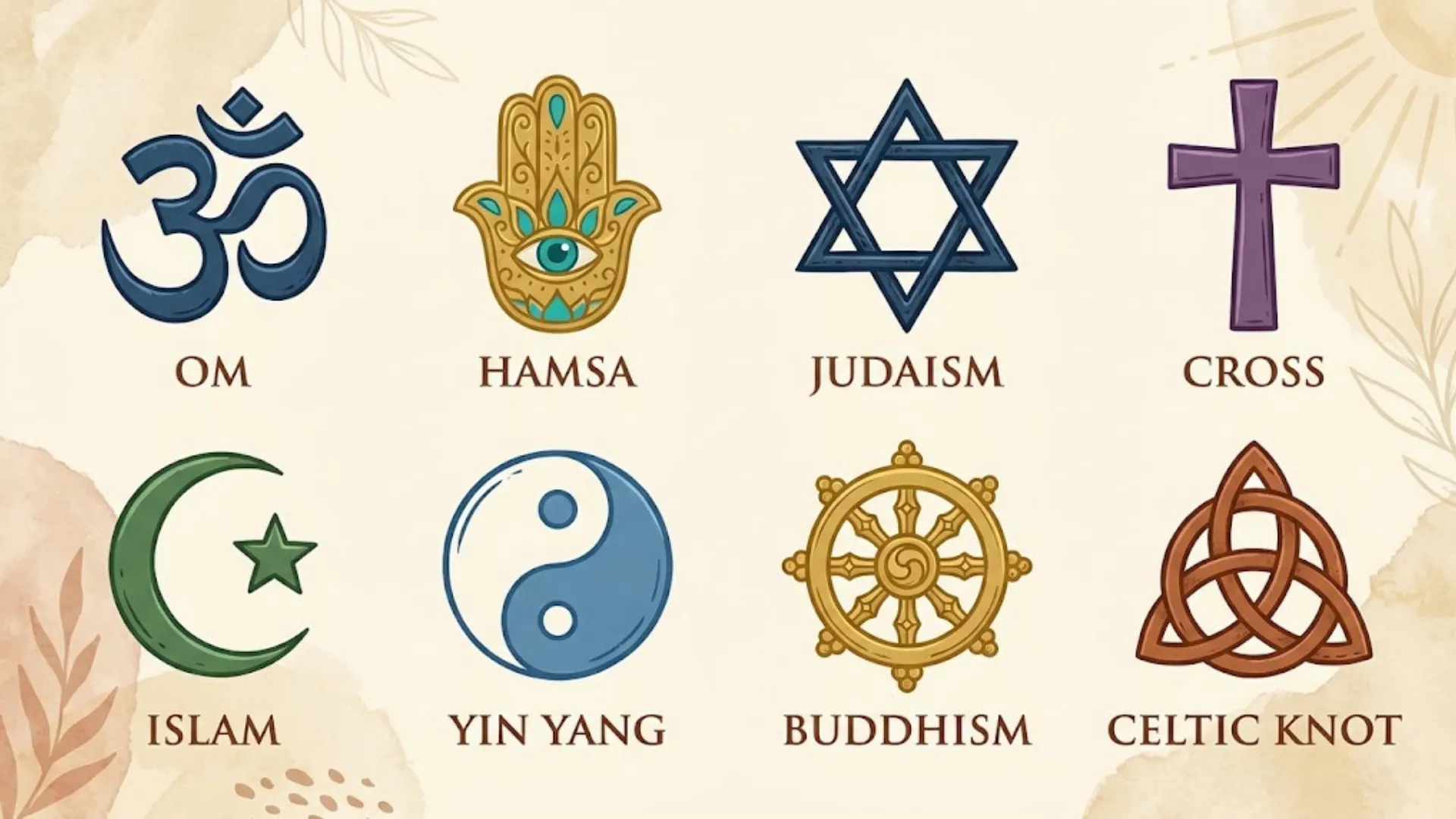
Spiritual symbols have helped people express faith, explore life’s mysteries, and represent ideas such as protection, wisdom, balance, and renewal. From the Christian cross and Buddhist lotus to the ancient Egyptian Ankh and the Taoist Yin Yang, these symbols carry meanings shaped by history, religion, and culture.
Some sacred symbols belong to specific religious traditions. Others appear in different cultures or have gained new meanings through modern spiritual practices. People may use them in meditation, religious ceremonies, jewelry, tattoos, or personal reflection.
In this guide, you’ll discover 21 spiritual symbols and their meanings, learn about their cultural backgrounds, and explore how people use them today. You’ll also find practical advice for choosing a symbol and understanding its significance without confusing traditional beliefs with modern interpretations.
A key point to remember: no single spiritual symbol has the same meaning for everyone. Its significance depends on the tradition, the person using it, and the context in which it appears.
What Are Spiritual Symbols?
Spiritual symbols are images, shapes, objects, or signs that represent beliefs, values, sacred ideas, or experiences that people consider meaningful. A symbol may represent a deity, a religious teaching, a connection with nature, or a personal goal.
For example, Christians commonly associate the cross with Jesus Christ and redemption. In ancient Egypt, the Ankh represented life. In Taoist philosophy, Yin Yang expresses the relationship between complementary forces.
The meaning of a symbol often comes from the stories, teachings, rituals, and communities connected to it. Some symbols have long histories, while others have gained popularity through modern spiritual movements.
Spiritual Symbols vs. Religious Symbols
These terms overlap, but they aren’t identical.
| Type | What it represents | Examples |
| Religious symbols | A particular faith, deity, teaching, or religious community | Cross, Khanda |
| Spiritual symbols | Ideas such as awareness, balance, transformation, or inner growth | Infinity symbol, lotus |
| Sacred geometry symbols | Geometric patterns with religious or spiritual significance | Sri Yantra, Bagua |
| Protective symbols | Objects or designs traditionally believed to offer protection | Hamsa, Evil Eye amulet |
| Cultural symbols | Stories, values, identity, or heritage within a community | Mjölnir, Dreamcatcher |
These categories can overlap. The Hamsa, for instance, has cultural and religious associations and is also used as a protective amulet.
Why Do People Use Spiritual Symbols?
People use symbols for several reasons:
- Faith and devotion: Expressing religious beliefs or remembering sacred teachings.
- Protection: Wearing an amulet associated with safety or good fortune.
- Meditation and mindfulness: Using a visual image to focus attention.
- Personal growth: Connecting a symbol with courage, patience, or another personal value.
- Cultural identity: Honoring family history, heritage, or community.
- Art and decoration: Displaying meaningful designs in jewelry, homes, or personal spaces.
Some people believe certain symbols influence spiritual energy or offer supernatural protection. These are religious or cultural beliefs, not scientifically established effects.
21 Spiritual Symbols and Their Meanings
The following guide explores 21 main symbols, including their historical backgrounds, traditional meanings, and modern uses. Related names are grouped together where they refer to the same symbol or a closely connected design.
The Cross: Faith, Love, and Redemption
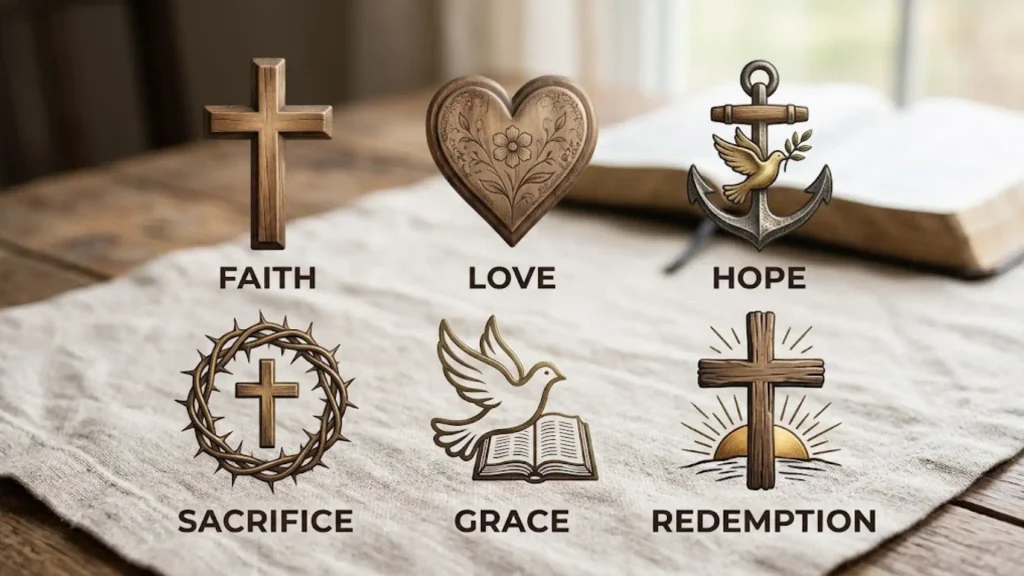
The Cross is one of the most recognizable Christian spiritual symbols. It represents the crucifixion of Jesus Christ and, within Christianity, is closely connected with sacrifice, redemption, faith, and hope.
Christians use the cross in churches, religious ceremonies, artwork, jewelry, and personal devotion. Different forms include the Latin cross, the Greek cross, and the crucifix, which depicts Jesus on the cross.
The cross can also appear in other historical and cultural settings. Its meaning therefore depends on its design and context.
Common meanings include:
- Faith and devotion to Christianity
- Sacrifice and redemption
- Love, hope, and spiritual commitment
- The relationship between suffering and renewal
For Christians, the cross is more than a decorative image. It represents central beliefs about Jesus and the possibility of salvation.
The Vajra or Dorje: Indestructibility and Spiritual Power
The Vajra, called Dorje in Tibetan, is a ritual object and symbol used in Vajrayana Buddhist traditions. The Sanskrit word vajra is associated with a diamond or thunderbolt, while dorje is the Tibetan term for the same object.
Its distinctive design often has a central grip and symmetrical prongs at both ends. In ritual imagery, it represents qualities such as indestructibility, spiritual power, and the union of wisdom and skillful means.
The Vajra is used in certain Buddhist ceremonies alongside a bell. Their pairing carries specific ritual meanings within those traditions.
Vajra symbol meaning:
- Indestructibility and clarity
- Spiritual discipline
- Wisdom and awakening
- The strength of enlightened understanding
Vajra and Dorje are not two separate main symbols. They are different language names for a related ritual object. Its significance comes from Buddhist teachings and practice, not simply from its shape.
The Hamsa Hand: Protection and Blessings
The Hamsa, also called the Khamsa, is a hand-shaped motif found in cultural and religious settings across the Middle East and North Africa. It is commonly associated with protection, blessings, and the belief in warding off the evil eye.
The design often shows an open hand with an eye in its center. It appears in jewelry, wall decorations, pendants, and amulets. The Victoria and Albert Museum documents the long history of gemstones and other objects being used for devotion and believed protection.
Related names include the Hand of Fatima in Islamic contexts and the Hand of Miriam in Jewish contexts. The name Hand of Mary is also used in some settings, but the terms aren’t interchangeable in every community.
Hamsa hand meaning:
- Protection against the evil eye
- Blessings and good fortune
- Safety and well-being
- Cultural identity and faith
Some people wear the Hamsa as a reminder of their beliefs or family heritage. Its traditional protective meaning should be understood as a cultural or spiritual belief rather than a guaranteed supernatural effect.
The Khanda: Sikh Faith and Spiritual Strength
The Khanda is an important symbol of Sikhism. Its design includes a central double-edged sword, a circular chakkar, and two curved swords known as kirpans.
These elements are interpreted in relation to Sikh beliefs about divine truth, spiritual commitment, justice, and responsibility. The Khanda appears in Sikh religious settings and is closely associated with Sikh identity.
Common associations include:
- Faith in one God
- Spiritual strength and discipline
- Justice and responsibility
- The connection between spiritual devotion and action in the world
The Khanda is not simply a generic symbol of power. Its meaning belongs to Sikh history, teachings, and community life.
The Lotus Flower: Purity and Enlightenment
The Lotus flower is a prominent spiritual image in Buddhist and Hindu traditions. Because the plant grows from muddy water and produces a flower above the surface, it is often used to represent purity, spiritual development, and the possibility of awakening.
In Buddhism, lotus imagery is connected with enlightenment and the path beyond ignorance. In Hindu traditions, the lotus appears in religious art and is associated with several deities, including Lakshmi and Brahma, in different contexts.
Lotus flower spiritual meaning:
- Purity and spiritual aspiration
- Enlightenment and awakening
- Resilience through difficulty
- Growth beyond challenging circumstances
The lotus is also a popular focus for meditation and a common motif in jewelry and tattoos. Its familiar modern interpretation as a symbol of personal growth draws on its natural appearance, but its specific religious meanings vary.
The Seal of Melchizedek: Sacred Geometry and Esoteric Meaning
The name Seal of Melchizedek is used for certain geometric designs in modern esoteric and spiritual contexts. Some versions feature an eight-pointed star or overlapping geometric shapes.
Melchizedek appears in biblical narratives as a priest and king. Later religious and esoteric traditions have interpreted his figure in different ways. However, claims that a particular geometric design has one universal ancient meaning or a direct, established connection to Jesus require careful sourcing.
Modern interpretations may associate the design with:
- Balance and unity
- Eternity and spiritual order
- Sacred geometry
- The relationship between spiritual and physical life
These interpretations aren’t shared by every religious tradition. When discussing the symbol, distinguish biblical references to Melchizedek from modern meanings assigned to specific geometric designs.
The Yin Yang Symbol: Balance and Interconnectedness
The Yin Yang symbol, also called the Taijitu, is associated with Chinese philosophy and Taoist thought. Its familiar form contains two curved halves, one dark and one light, with a small circle of the opposite color in each half.
Yin and Yang describe complementary aspects of existence. They aren’t simply labels for good and evil. The idea emphasizes how contrasting qualities can depend on one another and change in relation to circumstances.
For example, day and night, activity and rest, or warmth and coolness can be understood through this framework.
Yin Yang symbol meaning:
- Balance between complementary forces
- Harmony and interconnectedness
- Change and movement
- The relationship between contrasting qualities
The symbol appears in art, philosophy, and modern wellness settings. Although people sometimes associate it with Yin Yang yoga, the Taijitu itself represents a broader philosophical concept rather than one particular yoga method.
Antahkarana: The Inner Instrument and Modern Symbolic Uses
Antahkarana is a Sanskrit term traditionally translated as the inner instrument of the mind. In Indian philosophical traditions, it can refer to the internal faculties involved in thought, perception, memory, and self-understanding.
The term is also used for a particular geometric design in some modern Reiki and esoteric practices. That design is sometimes associated with meditation, healing, or the relationship between conscious and unconscious awareness.
It’s important to distinguish these uses. The traditional philosophical term and the modern geometric symbol aren’t automatically the same historical object, and claims that the design is an ancient Tibetan Buddhist symbol need reliable evidence.
In contemporary spiritual practice, the geometric version may serve as:
- A focus for meditation
- A reminder of self-awareness
- A visual aid for spiritual contemplation
- A symbol within a specific modern healing tradition
Its value to a practitioner depends on their beliefs and practice, not on an established medical effect.
The Tree of Life: Growth, Connection, and Unity
The Tree of Life appears in several religious, mythological, and cultural traditions. Although its form often includes roots, a trunk, and spreading branches, its meaning depends on the tradition in which it appears.
In general, the tree offers a powerful image of growth and connection. Roots represent grounding or ancestry, while branches suggest expansion and relationships. The trunk links these parts into one living structure.
In biblical traditions, the Tree of Life appears in the Garden of Eden narrative. In Jewish mysticism, the Tree of Life is associated with the ten sefirot, a framework used to describe divine attributes and their relationship to creation. Celtic-inspired and modern spiritual imagery often uses trees to represent nature, continuity, and interconnected life.
Tree of Life symbol meaning:
- Growth and personal development
- Connection between generations
- Unity and interconnectedness
- Nature, stability, and renewal
The Tree of Life is popular in necklaces, tattoos, and home decor. Before assigning it one meaning, identify which tradition or design you’re discussing.
The Eye of Horus: Protection and Restoration
The Eye of Horus is one of the best-known ancient Egyptian spiritual symbols. It represents the restored eye of Horus, a deity associated with kingship and the sky.
In Egyptian mythology, Horus’s eye was injured or lost during a conflict with Seth and later restored, with different accounts naming different deities as part of the restoration. The recovered eye became associated with wholeness, protection, and renewal.
Ancient Egyptians used the wedjat eye in amulets. The Metropolitan Museum of Art identifies it as a popular amulet associated with protection, healing, and rebirth.
Eye of Horus meaning:
- Protection and well-being
- Restoration and completeness
- Renewal and rebirth
- Safety in life and the afterlife
The Eye of Horus is sometimes confused with the Eye of Ra. They are related to Egyptian religious imagery but have distinct associations. The Eye of Horus is particularly connected with the myth of the injured and restored eye.
The Infinity Symbol: Eternity and Continuity
The Infinity symbol looks like a sideways figure eight. In mathematics, the symbol represents infinity. In modern personal and spiritual symbolism, it can represent endlessness, continuity, connection, or potential without a clear limit.
People use the infinity symbol to express enduring love, lifelong commitments, or the belief that certain connections continue beyond a single moment. Some associate it with eternal life or the continuity of the soul, but those interpretations are matters of personal or spiritual belief rather than one universal ancient meaning.
Infinity symbol spiritual meaning:
- Eternity and continuity
- Endless possibilities
- Lasting love and connection
- Renewal and ongoing growth
The design is widely used in tattoos, pendants, bracelets, and artwork. Its simplicity makes it easy to combine with names, hearts, or other personal motifs.
The Spiral Sun: Solar Imagery and Renewal
The term Spiral Sun can refer to different designs that combine a sun image with a spiral. Because similar shapes appear in different artistic and cultural settings, the name alone doesn’t establish one shared historical origin.
Sun imagery often represents light, warmth, life, seasonal cycles, and renewal. Spirals can suggest movement, growth, or recurring cycles. Together, these forms may be interpreted as symbols of vitality or transformation in particular modern spiritual settings.
However, it would be inaccurate to claim that every spiral sun is an ancient Native American symbol or that it universally represents a figure called The First Healer. Those claims need a specific cultural source.
When researching a Spiral Sun design, check:
- Where the exact design was documented
- Which community or tradition used it
- Whether its meaning comes from historical evidence or modern interpretation
- Whether the name has a recognized meaning within that tradition
This approach helps preserve cultural accuracy while allowing room for personal symbolism.
The Sri Yantra: Sacred Geometry and Meditation
The Sri Yantra is an important geometric diagram in Hindu spiritual practice, especially in traditions associated with Sri Vidya. It consists of nine interlocking triangles arranged around a central point called the bindu.
The triangles point upward and downward. In relevant Hindu interpretations, their arrangement is associated with Shiva and Shakti and with the relationship between complementary aspects of existence. The central bindu can represent the source or concentrated center of the diagram.
The Sri Yantra is used in worship, ritual, and meditation. Its geometric complexity encourages careful observation and concentration.
Sri Yantra meaning:
- Sacred order and interconnectedness
- The relationship between Shiva and Shakti
- Spiritual contemplation
- Unity represented by the central bindu
The Sri Yantra is often discussed as a sacred geometry symbol. Its meaning, however, comes from its place in Hindu traditions, not simply from the mathematical properties of its shape.
Some modern sources associate it with healing or prosperity. These should be presented as spiritual interpretations or beliefs, not guaranteed outcomes.
Reiki Symbols: Focus, Intention, and Healing Practice
Reiki symbols are used in some Reiki lineages as part of a spiritual or hands-on healing practice. Practitioners may draw, visualize, or mentally invoke them during a session. Their forms, names, and uses vary among Reiki schools, so there isn’t one universal set used by every practitioner.
Reiki is a complementary practice. Some people find sessions relaxing, but claims that Reiki symbols directly heal diseases, remove negative energy, or produce measurable supernatural effects aren’t established medical facts.
Five symbols are commonly discussed in certain Western Reiki systems.
Cho Ku Rei: The Power Symbol
Cho Ku Rei is commonly called the power symbol. Some Reiki practitioners use it to focus their attention or express an intention to strengthen the practice’s energy flow.
Its meaning depends on the Reiki lineage. It should be understood as part of the practitioner’s system of belief rather than a scientifically verified way to increase a measurable form of energy.
Sei He Ki: The Harmony Symbol
Sei He Ki is often associated with emotional harmony and mental balance in Reiki practice. Practitioners may use it during sessions intended to support relaxation or reflection.
Its traditional role doesn’t mean it can independently treat mental health conditions or replace professional care.
Hon Sha Ze Sho Nen: The Distance Symbol
Hon Sha Ze Sho Nen is associated with distance Reiki in some lineages. Practitioners who use it believe it helps them direct their practice beyond physical proximity.
Ideas about transmitting healing energy across distance belong to Reiki’s spiritual framework and aren’t established scientific mechanisms.
Dai Ko Myo: The Master Symbol
Dai Ko Myo is commonly known as the master symbol in certain Reiki systems. It is often taught in advanced training and associated with spiritual development or deeper practice.
The exact form and use depend on the Reiki tradition. Not all schools teach the same symbols in the same way.
Raku: Completion and Grounding
Raku is used in some Western Reiki lineages, particularly in connection with ending an attunement or completing a session. Some practitioners associate it with grounding or sealing the practice.
It isn’t a universal Reiki symbol. Its role depends on the particular teaching system.
| Reiki symbol | Common interpretation in some lineages |
| Cho Ku Rei | Focus or power |
| Sei He Ki | Harmony and emotional balance |
| Hon Sha Ze Sho Nen | Distance practice |
| Dai Ko Myo | Master-level practice and spiritual development |
| Raku | Completion or grounding |
If you’re learning Reiki, study the symbols through a qualified teacher within the lineage you choose. Their names and roles shouldn’t be treated as identical across every school.
The Ankh: Life and Rebirth
The Ankh is an ancient Egyptian sign shaped like a cross with a loop at the top. It is widely known as the key of life and was associated with life and continued existence.
In Egyptian artwork, gods and kings are often depicted holding an Ankh. The symbol also appears in temple imagery and funerary contexts. The U.S. National Park Service describes it as a symbol of eternal life in ancient Egypt.
Ankh symbol meaning:
- Life and vitality
- Continued existence after death
- Renewal and rebirth
- Divine life in ancient Egyptian religion
Modern spiritual communities sometimes interpret the Ankh as a symbol of the soul, transcendence, or the connection between physical and spiritual existence. Those interpretations should be distinguished from what can be established about ancient Egyptian use.
The Ankh remains popular in jewelry, tattoos, and artwork inspired by ancient Egypt.
The Bagua Map: Balance and Feng Shui
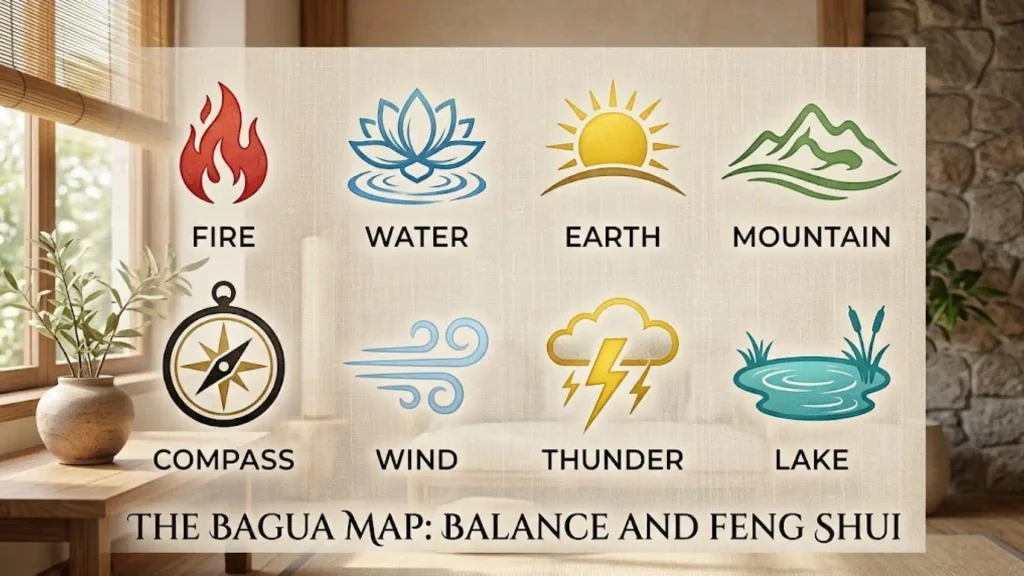
The Bagua Map is an octagonal arrangement used in Feng Shui and related Chinese traditions. The word bagua refers to the eight trigrams associated with Chinese cosmology and the Yijing, also known as the Book of Changes.
In Feng Shui practice, different Bagua systems connect areas of a space with themes such as relationships, work, knowledge, family, and prosperity. Practitioners use the map to interpret the arrangement of rooms, entrances, and other parts of a building.
The Bagua is more than a generic eight-sided decoration. Its meaning comes from a larger philosophical and practical system.
Bagua Map meaning and uses:
- Understanding spatial relationships
- Organizing a space according to a Feng Shui school
- Reflecting on areas of life and their associations
- Connecting design with traditional Chinese cosmology
Different Feng Shui schools may apply the Bagua differently. Claims that using it guarantees wealth, better relationships, or positive energy should be understood as traditional beliefs rather than proven outcomes.
The Dreamcatcher: Dreams and Cultural Heritage
The Dreamcatcher is closely associated with Ojibwe cultural tradition. Its familiar form includes a hoop, a woven web, and sometimes feathers and beads.
Traditional accounts connect dreamcatchers with protecting children and filtering dreams. The details and interpretations can differ, and the object has spread beyond its original cultural context through trade, tourism, and popular culture.
The Smithsonian Libraries and Archives documents the dreamcatcher’s Ojibwe origins, traditional associations, and later commercialization.
Dreamcatcher meaning:
- Protection during sleep in traditional accounts
- Cultural identity and heritage
- Care for children and family
- The importance of dreams in some cultural contexts
Dreamcatchers are now sold worldwide as decorative objects. Still, they shouldn’t be described as a universal symbol shared by every Native American or Indigenous nation. If you choose one, learn about its cultural background and support Indigenous makers where possible.
The Evil Eye: Protection From Envy and Harm
The Evil Eye refers to a belief that another person’s envious or harmful gaze can bring misfortune. Related beliefs have appeared across the Mediterranean, the Middle East, and other regions over many centuries.
The term can refer to the harmful gaze itself or, in everyday conversation, to the amulets people use for protection against it. A common amulet is the blue nazar, which features concentric circles resembling an eye.
Evil Eye meaning:
- Protection against envy, according to traditional belief
- A reminder of spiritual or cultural identity
- Good fortune and well-being in some interpretations
- A protective talisman worn as jewelry or displayed in a home
The Hamsa and Evil Eye sometimes appear together, but they’re different designs. The Hamsa takes the form of a hand, while the familiar nazar is usually circular.
People may wear Evil Eye bracelets, necklaces, or pendants because they value the tradition or find the symbol meaningful. There is no established scientific evidence that the amulet can prevent curses or control another person’s intentions.
The Helm of Awe: Courage and Protection
The Helm of Awe, also known as Ægishjálmur, is a symbol associated with Icelandic magical traditions. Modern depictions commonly show lines or prongs radiating outward from a central point.
The symbol is often described today as a Norse protection emblem. However, its history is more complex than the popular idea that it was a standard symbol used by all Viking warriors. Icelandic magical texts provide important context for understanding its documented use and later interpretations.
In modern Norse-inspired and esoteric settings, the Helm of Awe is commonly associated with:
- Courage in difficult situations
- Protection and personal resolve
- Strength and confidence
- Overcoming fear
These are common interpretations, not a single universally established meaning. The exact design and its historical context matter when researching the symbol.
The Helm of Awe is sometimes called Aegishjalmur, but spelling, design, and interpretation can vary between sources.
Mjölnir: Thor’s Hammer, Strength, and Protection
Mjölnir is the hammer of Thor, the thunder god in Norse mythology. It appears in medieval Norse literature and is also represented by archaeological finds, including hammer-shaped pendants from the Viking Age.
Thor is associated with thunder and protection in Norse mythology. Mjölnir is a powerful weapon in the myths, but it also had religious and cultural significance. Historical evidence for Norse beliefs comes from both written sources and archaeological discoveries, each of which has limitations.
Mjölnir meaning:
- Strength and power
- Protection in Norse religious and modern Heathen contexts
- Connection to Thor and Norse heritage
- Courage and resilience in modern interpretations
Today, some people wear Mjölnir pendants to express Norse cultural interest, religious commitment, or personal identity. Its meaning can differ between modern practitioners, historical interpretations, and decorative uses.
The Pentacle and Pentagram: Balance and Protection
A pentagram is a five-pointed star. A pentacle often refers to a pentagram enclosed within a circle, especially in modern Western esoteric traditions. The terms sometimes overlap in everyday use, but they don’t always mean exactly the same thing.
The five-pointed star has appeared in different historical contexts. In modern Pagan and Wiccan practices, the pentacle is often associated with spiritual protection and the elements. Some interpretations connect the five points with earth, air, fire, water, and spirit.
Pentacle meaning:
- Balance among elements or aspects of existence
- Spiritual focus and protection in some traditions
- Connection with Pagan or Wiccan identity
- Unity represented by the surrounding circle
The symbol’s meaning depends on its orientation, setting, and tradition. It isn’t accurate to assume that every pentagram is religious or that all cultures interpret it in the same way.
Pentacle vs. Pentagram: What’s the Difference?
| Term | Common meaning | Important detail |
| Pentagram | A five-pointed star | Can appear in many cultural and historical contexts |
| Pentacle | Often a pentagram enclosed in a circle | Common in modern Western esoteric and Pagan traditions |
If you’re choosing a design for a tattoo or pendant, check its meaning in the specific tradition you want to represent.
Spiritual Symbols by Meaning and Purpose
People often search for spiritual symbols for protection, healing, wisdom, or peace. The following table groups symbols by common traditional or modern interpretations. These associations aren’t universal, and they don’t guarantee particular results.
| Purpose | Symbols often associated with it | Common interpretation |
| Protection | Hamsa, Evil Eye, Eye of Horus | Safety or protection in traditional beliefs |
| Faith and devotion | Cross, Khanda | Religious commitment |
| Balance and harmony | Yin Yang, Bagua | Complementary forces or spatial relationships |
| Enlightenment | Lotus, Vajra, Sri Yantra | Spiritual understanding or contemplation |
| Strength and courage | Khanda, Mjölnir, Helm of Awe | Resolve, duty, or personal strength |
| Life and renewal | Ankh, Tree of Life, lotus | Life, growth, and renewal |
| Continuity | Infinity symbol, Tree of Life | Enduring connection or ongoing life |
| Meditation | Sri Yantra, lotus, Yin Yang | A visual focus for reflection |
| Cultural identity | Dreamcatcher, Mjölnir, Khanda | Heritage, religious identity, or community |
Spiritual Symbols for Protection
Protective symbols such as the Hamsa, Evil Eye, and Eye of Horus have histories connected with amulets and protective beliefs. The Khanda and Mjölnir can also carry meanings of faith, duty, and protection in their respective contexts.
Some people wear these symbols to feel connected with a tradition or to remind themselves of their values. Beliefs about protection from negative energy, curses, or harmful thoughts should be described as spiritual or cultural beliefs, not verified effects.
Spiritual Symbols for Healing and Well-Being
The lotus, Eye of Horus, and Sri Yantra have associations with renewal, restoration, or contemplation in particular traditions. Reiki symbols are used in some modern healing practices.
These symbols may help a person focus on an intention, express a belief, or create a calming ritual. However, a symbol itself isn’t a substitute for medical care, and spiritual healing claims shouldn’t be presented as proven treatments.
Spiritual Symbols for Balance and Harmony
The Yin Yang symbol is especially well known for expressing the relationship between complementary forces. The Bagua has a more specific role within Chinese cosmology and Feng Shui. The Sri Yantra’s geometric arrangement is used in Hindu religious practice and contemplation.
Modern interpretations may connect these designs with emotional balance, inner harmony, or the mind-body-spirit connection. Those meanings can be personally useful without being universal.
Spiritual Symbols for Wisdom and Enlightenment
The lotus is associated with enlightenment in Buddhist traditions. The Vajra has an important place in Vajrayana Buddhist ritual and symbolism, while the Sri Yantra is used in particular Hindu practices.
These symbols shouldn’t be treated as shortcuts to higher consciousness. Their meanings are rooted in religious teachings, practice, and study.
Spiritual Symbols Across Cultures and Religions
Spiritual symbols across cultures show that people have used images to express ideas about life, death, nature, faith, and the universe. However, similar shapes don’t necessarily have the same origin or meaning.
- Christianity: The cross is closely connected with Jesus Christ, sacrifice, redemption, and faith.
- Tibetan Buddhism: The Vajra or Dorje appears in ritual settings and carries meanings related to spiritual understanding.
- Hinduism: The lotus and Sri Yantra appear in religious imagery and practice.
- Sikhism: The Khanda represents Sikh identity and beliefs.
- Taoist philosophy: Yin Yang expresses complementary forces and their changing relationship.
- Ancient Egyptian religion: The Ankh is associated with life, while the Eye of Horus is linked with restoration and protection.
- Jewish and Muslim cultural contexts: The Hamsa appears in different communities, with names and interpretations that vary.
- Ojibwe tradition: The Dreamcatcher has specific cultural roots and should not be treated as a universal Indigenous symbol.
- Norse mythology and modern Heathen practice: Mjölnir is connected with Thor, while the Helm of Awe belongs to a more specific history of Icelandic magical symbolism.
- Modern Pagan and esoteric traditions: The pentacle and Reiki symbols may be used within particular contemporary practices.
Why Cultural Context Matters
A symbol may carry religious significance for one community and serve as decoration for another. Its use can also change over time.
For example, a Tree of Life design in modern jewelry might represent personal growth, while the Tree of Life in Jewish mysticism belongs to a specific religious framework. These meanings can coexist, but they shouldn’t be confused.
When researching religious symbols and meanings, ask three questions:
- Which community or tradition uses the symbol?
- What historical or religious sources explain its meaning?
- Is a claim documented, a modern interpretation, or a personal belief?
These questions help separate established history from assumptions.
Spiritual Symbols, Psychology, and Personal Meaning
Symbols can help people express complex ideas through a simple image. A person might associate the lotus with resilience, the infinity symbol with lasting connection, or the Tree of Life with family and growth.
In psychology, Carl Jung wrote about archetypes and the collective unconscious. His ideas explored recurring patterns and images in human experience. They can provide one framework for discussing symbolic imagery, but Jungian interpretations shouldn’t be used as proof that every symbol has a universal spiritual meaning.
A symbol’s personal significance can depend on memory, culture, religious upbringing, and individual experience.
For example, a cross might represent faith for one person and family heritage for another. Someone else may see it mainly as a historical or artistic object.
This is why spiritual awareness, intuition, and self-understanding can shape how people relate to symbols. Personal meaning matters, but it doesn’t replace the symbol’s documented cultural background.
Sacred Geometry and Spiritual Symbol Shapes
Sacred geometry refers to geometric forms and patterns that carry religious or spiritual significance in particular traditions. It doesn’t mean that every geometric shape is sacred or that a shape automatically produces a supernatural effect.
| Shape | Where it appears | Possible significance in context |
| Circle | Many artistic and religious traditions | Wholeness or continuity |
| Infinity loop | Modern mathematical and personal symbolism | Endless connection |
| Spiral | Various artistic and cultural contexts | Movement or recurring cycles |
| Five-pointed star | Multiple historical and modern traditions | Meanings vary by use and orientation |
| Eight-pointed star | Several cultural and religious settings | Depends on the specific design |
| Interlocking triangles | Sri Yantra and other geometric designs | Religious meanings tied to the tradition |
| Central point or Bindu | Sri Yantra and other Indian diagrams | Focus or source within the relevant tradition |
| Tree roots and branches | Tree of Life imagery | Growth and connection |
Always examine the design within its original context. Similar shapes may develop independently and carry very different meanings.
How to Use Spiritual Symbols in Everyday Life
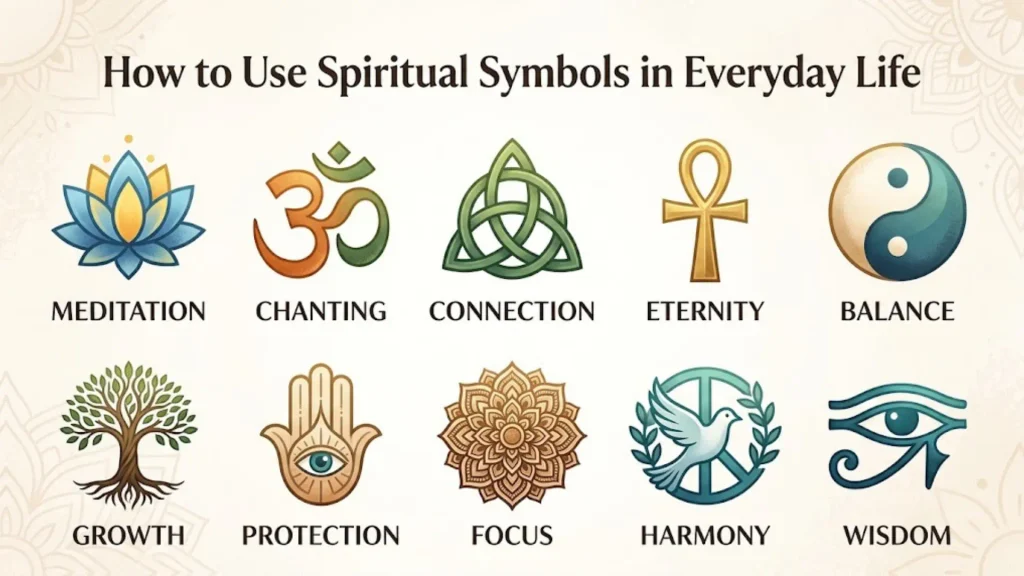
You don’t need to follow a particular religion or spiritual tradition to reflect on a symbol. However, learning its background helps you use it thoughtfully and respectfully.
How to Choose a Spiritual Symbol
Start by identifying what the symbol means within its original tradition. Then consider whether that meaning connects with your own values.
For example:
- Choose a lotus if its traditional associations with purity or enlightenment resonate with you.
- Explore the Tree of Life if you want to reflect on growth, family, or interconnectedness.
- Learn about the Yin Yang if you’re interested in Taoist ideas about complementary forces.
- Consider the Khanda if you’re studying Sikhism, while recognizing its importance to Sikh identity and faith.
- Explore the Ankh if you’re interested in ancient Egyptian religious imagery and its association with life.
Don’t choose a symbol based only on a social media post claiming it will bring instant wealth, protection, or success. Research the meaning and decide whether it fits your intentions.
How to Meditate With Spiritual Symbols
Spiritual symbols for meditation can serve as visual points of focus. You can use an image to support concentration, reflection, or mindfulness.
Try this simple practice:
- Choose a symbol whose meaning you understand.
- Sit comfortably, using a cross-legged meditation pose or another position that feels natural.
- Place an image of the symbol where you can see it without straining.
- Take a few slow, comfortable breaths.
- Reflect on the symbol’s meaning and how it relates to your life.
- When your attention wanders, gently return it to the image or your breathing.
- Finish by noting any thoughts or intentions you want to carry into your day.
You can also visualize the symbol with your eyes closed. Treat this as a mindfulness exercise, not a requirement for spiritual awakening or a guaranteed method of changing your energy.
How to Set Intentions With Spiritual Symbols
An intention is a statement about a value, goal, or behavior you want to focus on. A symbol can help you remember it.
For example, you might associate the lotus with resilience and write:
I will keep learning when something feels difficult.
You could place a small lotus image in your journal and review that intention when you face a challenge.
Other examples include:
- Tree of Life: Spend time nurturing important relationships.
- Infinity symbol: Make room for patience and long-term growth.
- Yin Yang: Look for balance between work and rest.
- Cross: Reflect on the Christian values that guide your faith, if you belong to that tradition.
The practical value comes from the reflection and actions you take, rather than any guaranteed supernatural effect.
Spiritual Symbols in Jewelry and Tattoos
Spiritual symbols in jewelry let people keep meaningful designs close to them. Popular choices include Hamsa pendants, Ankh necklaces, lotus jewelry, infinity bracelets, and Mjölnir pendants.
Tattoos can carry similar personal significance. Before choosing one, consider:
- Whether you understand the symbol’s history.
- Whether its meaning fits your intention.
- Whether the design belongs to a living religious or cultural tradition.
- Whether the symbol has associations you might not be aware of.
- Whether you’ll still feel comfortable with the design over time.
If a symbol has sacred or ceremonial importance, learn about any restrictions on its use. Respectful research is especially important when adopting designs from cultures other than your own.
Spiritual Symbols in Home Decor and Personal Altars
People sometimes display symbols in a quiet corner, meditation space, or personal altar. A meaningful object can act as a reminder to pause, pray, meditate, or reflect.
You might use a lotus image in a meditation area, a cross in a Christian devotional space, or a Tree of Life design to represent family connections.
Consider the purpose of the space and the meaning of each object. Candles, written intentions, or meaningful keepsakes can also support a personal ritual.
These practices can help establish a consistent routine. However, a symbol displayed at home doesn’t guarantee wealth, safety, or improved health.
Drawing and Visualizing Spiritual Symbols
Drawing spiritual symbols can be a focused creative exercise. It may help you learn a design’s structure and pay closer attention to its details.
For a simple practice:
- Find a reliable image of the symbol.
- Learn its name and cultural background.
- Draw it slowly, paying attention to its shape.
- Reflect on the meaning associated with it.
- Write down what you learned or what the symbol means to you personally.
Some religious or spiritual designs have specific rules for drawing or using them. Follow those practices when they apply, rather than assuming all symbols can be used in the same way.
Frequently Asked Questions About Spiritual Symbols
What Are Spiritual Symbols?
Spiritual symbols are images, objects, or signs that represent spiritual beliefs, religious teachings, cultural traditions, or personal values. Examples include the cross, lotus flower, Ankh, Yin Yang, and Tree of Life.
Their meanings depend on their historical background and the people who use them.
What Do Spiritual Symbols Represent?
Spiritual symbols can represent faith, protection, balance, wisdom, life, renewal, or enlightenment. Some are tied to specific religions, while others have broader modern interpretations.
A symbol’s meaning isn’t necessarily universal, even when the design is widely recognized.
What Are the Most Powerful Spiritual Symbols?
There is no objective ranking of the most powerful spiritual symbols. Their importance depends on the tradition and the individual.
The cross is central to Christianity, the Khanda is significant in Sikhism, and the Vajra plays an important role in Vajrayana Buddhism. The Hamsa and Evil Eye are associated with protective beliefs in several cultural settings.
What Is the Difference Between Sacred Symbols and Religious Symbols?
Sacred symbols carry special religious, spiritual, or ceremonial meaning. Religious symbols specifically express or represent a religion, its teachings, or its community.
The categories overlap. A cross is both a sacred symbol and a Christian religious symbol. A geometric design may be sacred within one tradition but simply decorative in another setting.
Which Spiritual Symbols Are Associated With Protection?
The Hamsa, Evil Eye amulet, and Eye of Horus are commonly associated with protection in particular cultural or historical contexts. Mjölnir also has protective associations in Norse-related religious and modern cultural settings.
These are traditional beliefs and interpretations, not guarantees that an object can prevent harm.
Which Spiritual Symbols Are Associated With Healing?
The Eye of Horus has historical associations with restoration and protection in ancient Egyptian religion. Reiki symbols are used in some modern Reiki practices, while the lotus is often associated with spiritual development.
These meanings don’t establish that symbols can medically heal the body or treat an illness.
What Is the Difference Between a Pentacle and a Pentagram?
A pentagram is a five-pointed star. A pentacle often refers to a pentagram enclosed in a circle, particularly in modern Western esoteric traditions.
Usage varies, so the context and specific design matter.
What Does the Tree of Life Symbolize?
The Tree of Life can represent growth, connection, continuity, and the relationship between different parts of existence. Its meaning differs across traditions, including biblical imagery, Jewish mysticism, Celtic-inspired spirituality, and modern personal symbolism.
What Does the Yin Yang Symbol Represent?
The Yin Yang symbol represents complementary forces and their relationship within Chinese philosophy, particularly Taoist thought. It illustrates how contrasting qualities can depend on each other and change over time.
It doesn’t simply mean good versus evil.
What Does the Lotus Flower Symbolize Spiritually?
The lotus flower is associated with purity, spiritual aspiration, and enlightenment in Buddhist and Hindu traditions. Its growth from muddy water is often used to illustrate the possibility of rising beyond difficult circumstances.
Specific meanings vary by religious context.
What Is the Spiritual Meaning of the Hamsa Hand?
The Hamsa hand is commonly associated with protection, blessings, and protection against the evil eye. It appears in Jewish, Muslim, and other cultural contexts, with different names and interpretations.
What Does the Eye of Horus Symbolize?
The Eye of Horus is an ancient Egyptian symbol associated with the restored eye of Horus. It is connected with wholeness, protection, healing, and rebirth in Egyptian religious imagery.
What Is the Meaning of the Ankh?
The Ankh is an ancient Egyptian sign associated with life and continued existence. It appears in religious artwork, amulets, and funerary imagery and is widely known today as the key of life.
What Does the Evil Eye Protect Against?
In traditional belief, the Evil Eye amulet is intended to protect against harm associated with envy or a harmful gaze. Its meaning varies across cultures, and its protective effect isn’t scientifically established.
What Are the Five Reiki Symbols and Their Meanings?
Five symbols commonly discussed in certain Western Reiki systems are:
- Cho Ku Rei: Often called the power symbol.
- Sei He Ki: Commonly associated with harmony.
- Hon Sha Ze Sho Nen: Used in some distance Reiki practices.
- Dai Ko Myo: Often called the master symbol.
- Raku: Used in some lineages for completion or grounding.
Not every Reiki lineage uses all five symbols or assigns them identical roles.
What Is the Meaning of the Sri Yantra?
The Sri Yantra is a geometric diagram used in particular Hindu spiritual traditions. Its nine interlocking triangles surround a central point called the bindu. Its symbolism is connected with Hindu religious ideas, including the relationship between Shiva and Shakti in relevant traditions.
What Does the Helm of Awe Symbolize?
The Helm of Awe, or Ægishjálmur, is associated with Icelandic magical traditions. Modern interpretations often connect it with courage, protection, and power, but its history shouldn’t be reduced to a universal Viking-age symbol.
What Is the Spiritual Meaning of Mjölnir?
Mjölnir is Thor’s hammer in Norse mythology. It is associated with Thor’s power and has become a symbol of Norse heritage, religious identity, strength, and protection in different historical and modern contexts.
Can Spiritual Symbols Help With Meditation and Mindfulness?
Yes. A symbol can serve as a visual focus for reflection or help you remember a personal intention. You can observe its shape, consider its traditional meaning, or use it as a prompt for journaling.
The symbol itself doesn’t guarantee spiritual transformation, healing, or a particular outcome.
Conclusion: Understanding Spiritual Symbols and Their Meanings
Spiritual symbols and their meanings connect art, belief, history, and personal experience. The cross represents central Christian beliefs, the lotus has important meanings in Buddhist and Hindu traditions, and the Ankh is associated with life in ancient Egyptian religion. Other symbols, such as the Yin Yang, Hamsa, and Tree of Life, carry different meanings across cultural and spiritual settings.
You can explore these symbols through meditation, reading, jewelry, artwork, or personal reflection. The most useful starting point is to understand a symbol’s history before deciding what it means to you.
Remember that spiritual growth doesn’t depend on collecting symbols or believing that they possess guaranteed powers. Learning about their origins, respecting the communities that use them, and reflecting on the values they represent can make your exploration more meaningful.

Hello, I’m Rowan Sinclair, a passionate writer and lifelong admirer of the wisdom found in great quotes. I believe that words have the ability to inspire change, spark creativity, and connect people across cultures and generations.
I enjoy writing about motivational quotes, famous sayings, and lessons from history’s most influential thinkers. Every article I create is driven by my desire to help readers discover meaningful insights that they can apply to their own lives.
When I’m not writing, I spend my time reading biographies, exploring classic literature, and collecting memorable quotes that deserve to be shared with the world.
I am the author of Voices That Inspire and A Collection of Timeless Thoughts, two books that celebrate the enduring power of words and the stories behind them.
 Asher Monroe
 Sienna Brooks