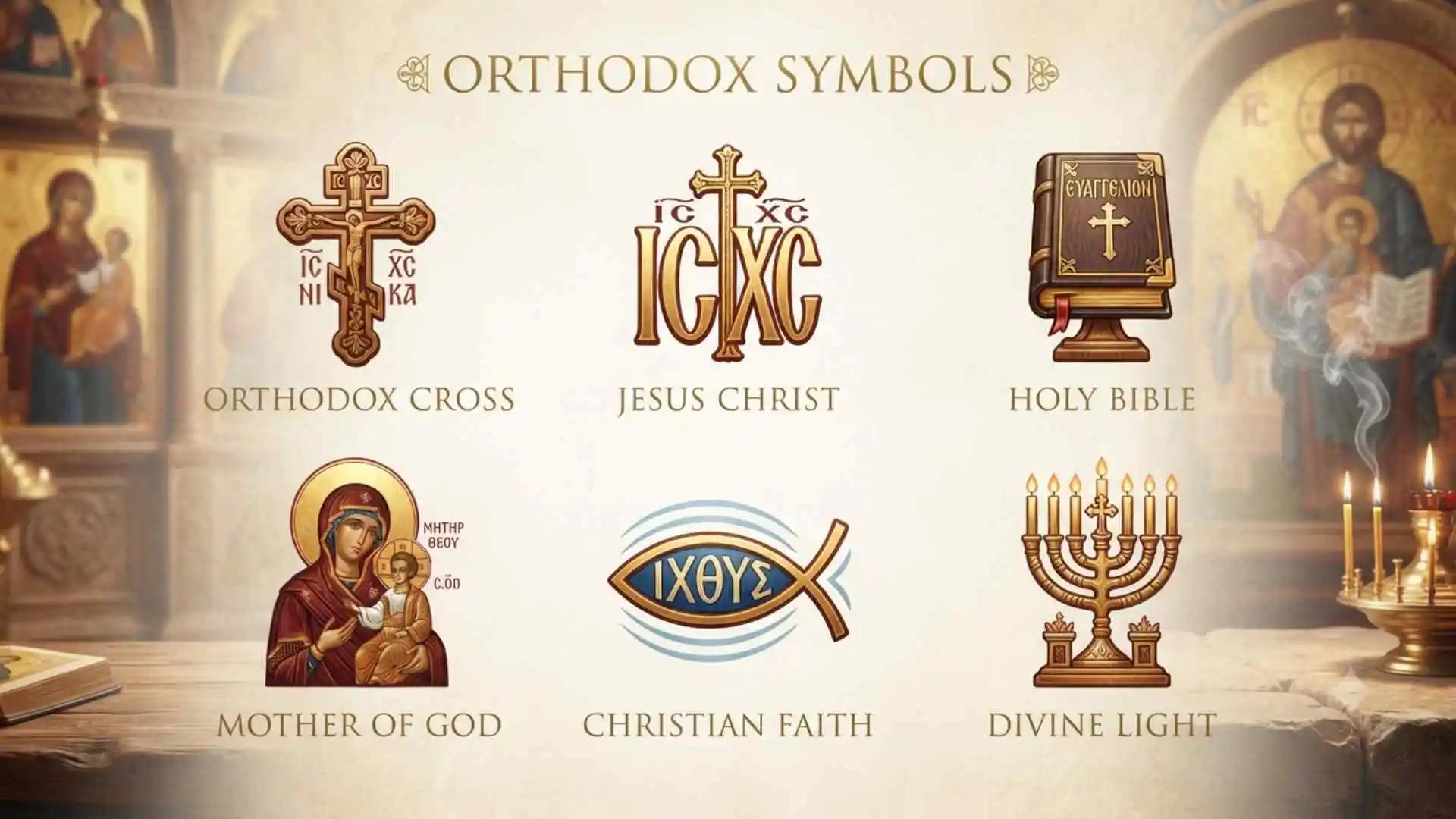
Orthodox symbols open a visual doorway into centuries of Christian faith, worship, suffering, and hope.
A cross carved into wood, a golden halo, or a small Greek inscription may appear simple, yet each detail can carry layers of theology and history.
These sacred signs connect believers with biblical events, the early Church, the Byzantine world, and the mystery of divine life.
By understanding them, we can see how color, gesture, shape, and image speak to the deepest needs of the human heart.
(Quick Answer) Orthodox Symbols
Orthodox symbols are sacred images, signs, colors, letters, objects, and gestures used in Eastern Orthodox Christianity to express biblical truths and spiritual realities. Common examples include the Orthodox cross, icons, halos, the Chi-Rho, IC XC NIKA, the double-headed eagle, candles, incense, and the sign of the cross.
Quick Facts About Orthodox Symbols
| Aspect | Information |
| Origin | Biblical imagery, early Christian art, Greco-Roman culture, and Byzantine worship |
| Historical Significance | Preserved Christian teaching through architecture, icons, manuscripts, vestments, and public worship |
| Main Meaning | The presence, victory, sacrifice, resurrection, and kingdom of Jesus Christ |
| Spiritual Meaning | Communion with God, transformation, prayer, holiness, and eternal life |
| Cultural Importance | Central to Greek, Russian, Serbian, Romanian, Georgian, Antiochian, and other Orthodox traditions |
| Modern Usage | Churches, home prayer corners, tattoos, jewelry, digital art, clothing, and personal devotion |
What Are Orthodox Symbols?
Orthodox symbols are visual and physical expressions of Eastern Orthodox Christian belief. They include crosses, icons, monograms, colors, animals, plants, liturgical objects, hand gestures, architectural forms, and sacred inscriptions.
These symbols are not merely decorations. They communicate theology.
In Orthodox Christianity, worship involves the whole person. Believers hear hymns, smell incense, see icons, touch sacred objects, taste the Eucharist, and make physical gestures such as bows and the sign of the cross. Symbolism brings the invisible truths of faith into the visible world.
Biblical Origins
Many Orthodox symbols come directly from the Bible.
The cross recalls the crucifixion of Jesus. The fish points to Christ and the early Christian community. The vine represents the relationship between Christ and His followers. The dove recalls the Holy Spirit. The lamb identifies Jesus as the Lamb of God.
Other images, such as the throne, rainbow, heavenly creatures, lampstands, scrolls, and Alpha and Omega, appear in prophetic books and the Book of Revelation.
Early Christian Background
Early Christians often used simple symbols in catacombs, homes, rings, lamps, and burial spaces. The fish, anchor, shepherd, dove, and Chi-Rho allowed them to express faith in a world where Christianity was sometimes misunderstood or persecuted.
After Emperor Constantine legalized Christianity in the fourth century, Christian symbols became more visible in churches, mosaics, imperial objects, coins, and public architecture.
Byzantine Development
The Byzantine Empire played a major role in shaping what people now recognize as Orthodox sacred art.
Artists developed formal ways of portraying Christ, the Virgin Mary, angels, saints, and biblical events. The purpose was not simply to copy natural appearances. It was to show people and events as illuminated by God’s kingdom.
This tradition reached a crisis during the Byzantine Iconoclast controversy of the eighth and ninth centuries. Some authorities ordered the destruction of religious images. Defenders of icons argued that Christ could be pictured because the invisible Son of God had truly become human.
The Seventh Ecumenical Council, held at Nicaea in 787, defended the veneration of icons while distinguishing veneration from the worship owed to God alone. Orthodox theology teaches that an icon portrays Christ according to His visible human nature, not His invisible divine essence.
Why Orthodox Symbols Became Important
For much of history, many people could not read. A church filled with icons, mosaics, crosses, and biblical scenes became a visual teaching space.
Yet Orthodox symbolism did more than educate. It created an experience of sacred presence.
The iconostasis, or icon screen, presents Christ, the Mother of God, angels, and saints as members of one worshipping community. According to the Orthodox Church in America, its purpose is to express unity with Christ and the heavenly Church, not simply to hide the sanctuary.
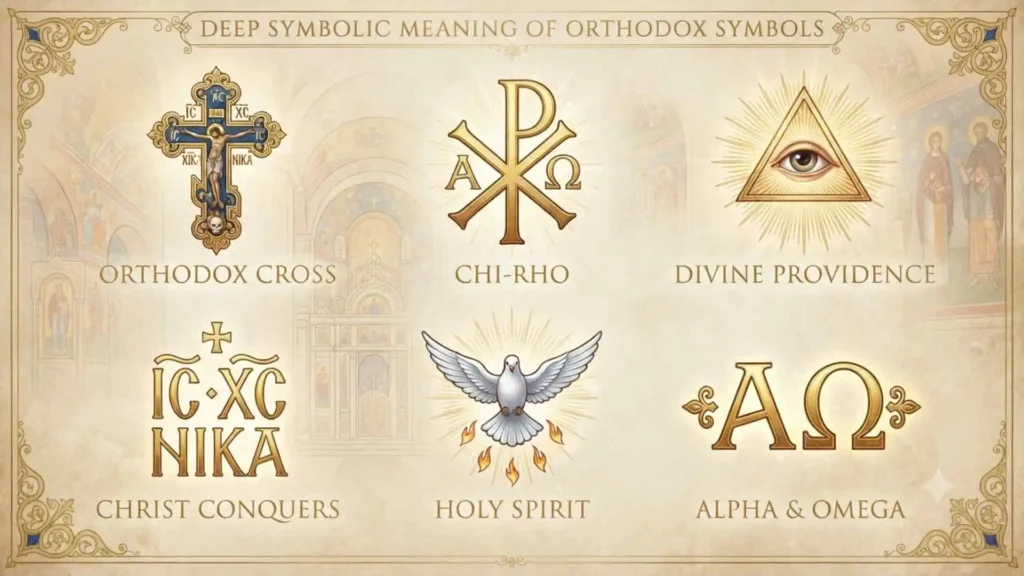
Deep Symbolic Meaning of Orthodox Symbols
Spiritual Level
Orthodox symbols point beyond themselves.
A candle is made of wax and flame, but it expresses prayer, sacrifice, purity, and the light of Christ. Incense is fragrant smoke, but it represents prayer rising toward heaven. An icon is wood and pigment, yet it invites the believer to encounter the person represented.
This does not mean that Orthodox Christians believe material objects contain magical power. Rather, material creation can become a bearer of grace because God entered the physical world through the incarnation of Christ.
The spiritual goal is transformation. Symbols help move the heart from distraction toward attention, from fear toward trust, and from isolation toward communion.
Psychological Level
Sacred symbols influence human emotion because the mind responds strongly to images, repetition, rhythm, and pattern.
A balanced icon can create a sense of order. A golden background can suggest timeless light. A dark cave can represent danger, death, or spiritual emptiness. An open hand may communicate blessing, while a bowed head suggests humility.
Orthodox writer Father John Breck described symmetry in icons as a source of beauty, peace, and harmony for those who pray before them.
From a Jungian perspective, some Orthodox images may resemble universal archetypes. Christ Pantocrator can evoke the wise king and righteous judge. The Theotokos holding the Christ Child reflects the mother-and-child pattern. The descent into Hades presents the hero entering darkness and returning with the captive.
However, Orthodox theology does not reduce these figures to psychological archetypes. Christ, Mary, and the saints are understood as real persons, not merely symbols created by the unconscious mind.
Cultural Level
Orthodox symbols also carry community memory.
For a Greek family, an icon may recall grandparents, village festivals, and Holy Week processions. For a Serbian believer, the four-firesteel cross may express both faith and national history. For a Russian Christian, a three-bar cross may recall monasteries, persecution, and survival.
These symbols can unite communities, especially during migration or political hardship. At the same time, religious signs can become confused with nationalism when cultural identity overshadows their spiritual meaning.
The healthiest interpretation keeps Christ at the center.
Types and Variations of Orthodox Symbols
The Orthodox Cross
Visual Description
The Orthodox cross often has three horizontal bars:
- A short upper bar
- A long central bar
- A lower slanted bar
Not every Orthodox church uses this form. Greek, Antiochian, Romanian, and other Orthodox communities may also use a simple Greek or Latin cross.
Meaning
The upper bar represents the sign placed above Jesus at the crucifixion, identifying Him as Jesus of Nazareth, King of the Jews.
The central bar represents the beam upon which Christ’s hands were nailed.
The lower bar represents a footrest. It is often slanted upward on Christ’s right and downward on His left.
Symbolism
One popular Orthodox interpretation connects the slanted footrest with the two thieves crucified beside Christ. One turned toward Him in repentance and received the promise of paradise. The other rejected Him.
The cross therefore becomes a spiritual balance showing that each person must respond to Christ.
Cultural Connection
The three-bar cross is especially associated with Russian and Slavic Orthodoxy, although it appears in other Orthodox settings.
Where It Appears
It appears on churches, graves, vestments, prayer ropes, jewelry, icons, manuscripts, and devotional art.
The Greek Cross
Visual Description
The Greek cross has four arms of equal length.
Meaning
Its balanced form suggests the universal reach of the Gospel in every direction.
Symbolism
It represents Christ’s sacrifice, divine harmony, and the meeting of heaven and earth.
Cultural Connection
The form appears in Byzantine architecture, mosaics, coins, church plans, and liturgical decoration.
Where It Appears
It is common on domes, vestments, altar cloths, church seals, and ecclesiastical flags.
The Budded Cross
Visual Description
A budded cross has three rounded ends at the tip of each arm.
Meaning
The groups of three are often connected with the Holy Trinity.
Symbolism
The buds may also suggest new life, flowering, resurrection, and the cross becoming a tree of life.
Where It Appears
It is frequently seen in altar crosses, processional crosses, church carvings, and priestly vestments.
The Cross of Golgotha
Visual Description
This detailed cross may stand over a skull, cave, spear, sponge, reeds, and abbreviated inscriptions.
Meaning
It portrays the crucifixion on Golgotha, also called Calvary.
Symbolism
The skull traditionally represents Adam. According to Christian tradition, Christ’s blood falls upon the place of Adam’s burial, showing that the new Adam heals the sin and death associated with the first Adam.
The spear and sponge recall the Passion narratives.
Where It Appears
It appears on monastic garments, schema crosses, church walls, icon backs, grave markers, and prayer objects.
IC XC NIKA
Visual Description
The inscription often appears in four sections around a cross:
IC XC
NI KA
Meaning
IC XC is a traditional Greek abbreviation for “Jesus Christ.” NIKA means “conquers” or “is victorious.”
Together, the phrase is commonly understood as “Jesus Christ conquers.”
Symbolism
It proclaims Christ’s victory over sin, death, evil, and the grave.
The letters IC XC appear on many Orthodox icons of Christ.
Where It Appears
It appears on icons, communion bread seals, crosses, church floors, vestments, and liturgical vessels.
The Chi-Rho
Visual Description
The Chi-Rho combines the Greek letters Chi and Rho, written as Χ and Ρ.
Meaning
They are the first two letters of the Greek word Christos, meaning Christ.
Symbolism
The monogram represents the identity, authority, and victory of Jesus Christ.
Historical Connection
The symbol became strongly connected with Emperor Constantine. According to Christian historical tradition, Constantine used a Christogram on military standards before his victory at the Battle of the Milvian Bridge in 312.
The Chi-Rho later appeared widely in Christian mosaics, sarcophagi, manuscripts, coins, and churches.
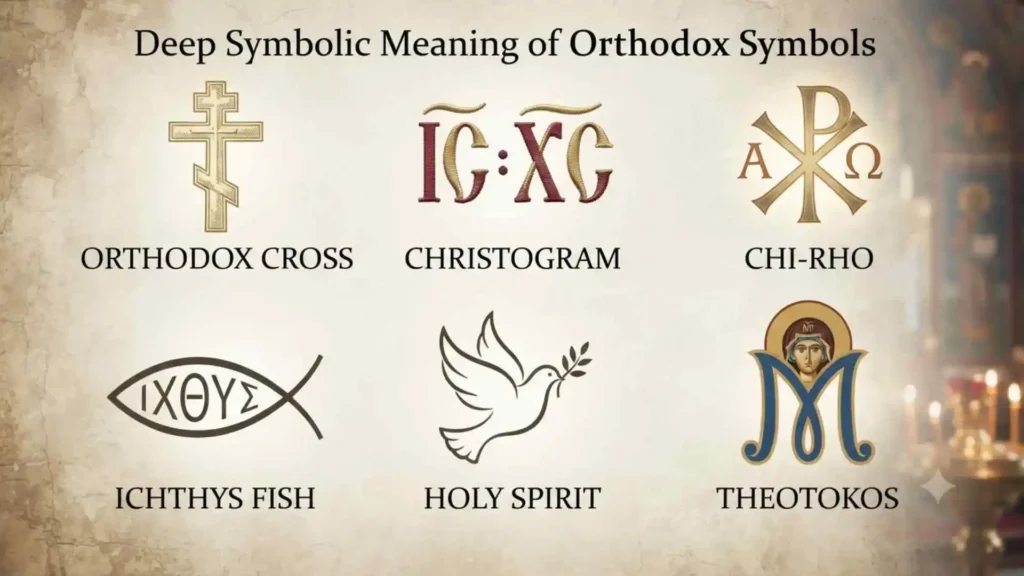
Alpha and Omega
Visual Description
The Greek letters Alpha and Omega may appear beside Christ, the cross, or the Chi-Rho.
Meaning
Alpha is the first letter of the Greek alphabet, while Omega is the last.
Symbolism
The letters identify God as the beginning and end of all things, drawing from the Book of Revelation.
They express eternity, completeness, divine sovereignty, and Christ’s presence throughout history.
The Fish or Ichthys
Visual Description
The ichthys is a simple outline shaped like a fish.
Meaning
The Greek word ichthys means fish. Early Christians used its letters as an acronym associated with the confession “Jesus Christ, Son of God, Savior.”
Symbolism
The fish recalls baptism, the calling of the apostles, Christ feeding the crowds, and the mission to become fishers of people.
Cultural Connection
The symbol appears in early Christian tombs and catacomb art. It was shared across ancient Christian communities and is not exclusive to Eastern Orthodoxy.
The Anchor
Visual Description
The anchor has a central shaft, curved arms, and often a cross-like upper structure.
Meaning
It represents spiritual stability and hope.
Symbolism
The Letter to the Hebrews describes hope as an anchor of the soul. Early Christians also appreciated that an anchor could discreetly resemble a cross.
Where It Appears
It appears in ancient funerary art, church carvings, jewelry, and modern Christian designs.
The Dove
Visual Description
A white dove may appear with open wings or descending from heaven.
Meaning
The dove represents the Holy Spirit, especially in images of Christ’s baptism.
Symbolism
It may also express peace, purity, divine presence, reconciliation, and the renewal of creation.
Important Distinction
Orthodox iconography usually depicts the Holy Spirit as a dove only when showing the Baptism of Christ, because that form is specifically described in the Gospel account.
The Lamb
Visual Description
A lamb may stand beside a cross, carry a banner, or appear in ancient Christian art.
Meaning
It represents Christ as the sacrificial Lamb of God.
Symbolism
The lamb expresses innocence, sacrifice, deliverance, Passover, and victory through self-giving love.
Orthodox Iconographic Caution
Later Orthodox practice generally favors depicting Christ in human form rather than replacing Him with an animal symbol, especially in central liturgical imagery. This reflects the importance of the incarnation.
The Peacock
Visual Description
A peacock appears with a long, patterned tail, sometimes beside a fountain or tree.
Meaning
In early Christian and Byzantine art, it became a symbol of immortality and resurrection.
Symbolism
Its renewed feathers and ancient beliefs about its flesh contributed to its association with incorruptibility and eternal life.
Where It Appears
Peacocks appear in Byzantine mosaics, church floors, fountains, tomb decoration, and manuscript borders.
The Vine and Grapes
Visual Description
The symbol includes twisting vines, green leaves, grape clusters, or branches growing from Christ.
Meaning
It recalls Christ’s words, “I am the vine; you are the branches.”
Symbolism
The vine represents communion with Christ, spiritual fruit, the Eucharist, shared life, and the unity of the Church.
Where It Appears
It appears on iconostases, chalices, church walls, Gospel covers, wood carvings, and vestments.
The Tree of Life
Visual Description
The tree may have symmetrical branches, abundant leaves, fruit, birds, or a cross rising from its center.
Meaning
It connects the Garden of Eden, the cross of Christ, and the restored creation described in Revelation.
Symbolism
The tree represents life, healing, wisdom, growth, resurrection, and humanity’s return to communion with God.
The Halo
Visual Description
A halo is a circle or disk of light surrounding the head of a holy person.
Meaning
It represents participation in divine glory and the light of God.
Symbolism
The halo does not suggest that saints create holiness by themselves. It shows that divine grace shines through transformed human life.
Christ’s halo usually contains a cross and the Greek letters meaning “He Who Is,” recalling God’s self-revelation to Moses.
The Double-Headed Eagle
Visual Description
The symbol shows an eagle with two heads facing opposite directions. It may carry a crown, orb, sword, or cross.
Meaning
Its interpretations vary by period and setting. It is often connected with imperial authority, spiritual and temporal responsibility, or an empire looking east and west.
Historical Connection
The double-headed eagle was used before Christianity in several ancient cultures. It later became a powerful Byzantine and post-Byzantine emblem.
After the fall of Constantinople in 1453, it remained important in Orthodox lands, including Russia, Serbia, Greece, and the Balkans.
Common Misconception
The double-headed eagle is not a central symbol of Christian doctrine like the cross. It is mainly a historical, imperial, ecclesiastical, and cultural emblem.
The Sign of the Cross
Visual Description
Orthodox Christians usually join the thumb, index finger, and middle finger. The ring finger and little finger rest against the palm.
They touch the forehead, chest, right shoulder, and then left shoulder.
Meaning
The three joined fingers represent the Father, Son, and Holy Spirit.
The two folded fingers commonly represent the two natures of Christ, divine and human.
Symbolism
The gesture places the cross over the body and expresses faith with both mind and movement. It can serve as prayer, blessing, confession, thanksgiving, and a request for protection.
The Prayer Rope
Visual Description
A prayer rope is made of knotted wool, beads, or cord. Common forms have 33, 50, 100, or more knots.
Meaning
It is used to count repetitions of the Jesus Prayer: “Lord Jesus Christ, Son of God, have mercy on me.”
Symbolism
The circular rope suggests continuous prayer. Wool can symbolize the believer as one of Christ’s flock. Each complex knot is traditionally tied with crosses woven into its structure.
Where It Appears
It is used especially in monastic life but also by laypeople.
Icons as Orthodox Symbols
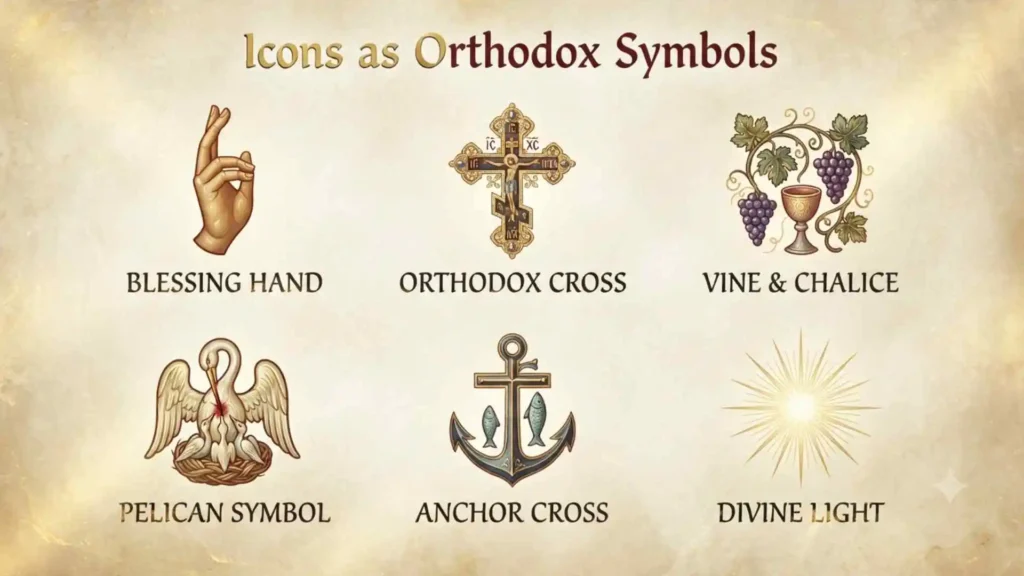
An Orthodox icon is a sacred image of Christ, the Theotokos, angels, saints, or events in salvation history.
Icons are sometimes called “windows to heaven,” but this phrase should not be taken to mean that the painted object is magical. The image directs attention toward the holy person or event represented.
Orthodox Christians venerate icons through bows, kisses, candles, and prayer. They do not worship wood and paint. Worship belongs to God alone.
The Orthodox Church in America explains that icons focus attention on God’s kingdom and recall the story of salvation.
Christ Pantocrator
Christ Pantocrator means Christ the Almighty or Ruler of All.
He usually holds a Gospel book and raises His right hand in blessing. His face may appear both compassionate and serious, expressing mercy and judgment.
This image is often placed in the central dome, showing Christ ruling over creation.
The Theotokos
Theotokos means “God-bearer” or “Mother of God.”
Icons of Mary do not present her as an independent goddess. Her dignity comes from her relationship with Christ. She often points toward Him, showing that her role is to lead humanity to her Son.
The Deesis
The Deesis usually shows Christ enthroned, with the Theotokos and Saint John the Baptist turned toward Him in prayer.
Its name is associated with supplication or intercession. It portrays the heavenly court and the Church’s prayer for humanity.
The Resurrection or Descent into Hades
In the traditional Orthodox Resurrection icon, Christ does not simply step out of an empty tomb.
He descends into the realm of death, breaks its gates, and pulls Adam and Eve from their graves. The image presents the resurrection as a cosmic rescue of humanity.
Broken locks and chains beneath Christ’s feet represent the defeat of death.
Orthodox Colors and Their Meanings
Color in Orthodox iconography and worship is symbolic, although practices may vary among local churches.
Gold
Gold represents divine light, heavenly glory, eternity, and the kingdom of God.
Gold backgrounds do not show an ordinary physical location. They suggest a world transformed by divine presence.
White
White represents purity, light, resurrection, joy, and divine glory.
It is strongly connected with feasts such as the Transfiguration, Nativity, Theophany, and Pascha in many Orthodox traditions.
Red
Red represents life, blood, sacrifice, love, martyrdom, and divine energy.
Christ may wear red to suggest His divine life, while martyrs often wear red because they gave their lives for the faith.
Blue
Blue is associated with heaven, mystery, creation, contemplation, and humanity.
In many icons, Mary wears a blue or dark inner garment with a red outer mantle. Interpretations vary, but the colors are often connected with her humanity and the grace given to her.
Green
Green represents life, renewal, creation, growth, and the work of the Holy Spirit.
It is frequently used around Pentecost in several Orthodox cultures.
Purple
Purple represents kingship, dignity, authority, wealth, and sacrifice.
It may appear in images of Christ the King, imperial saints, bishops, or solemn liturgical settings.
Black
Black represents death, mystery, spiritual darkness, mourning, or withdrawal from worldly vanity.
Monastics often wear black as a sign of repentance and death to worldly ambition.
In icons, black caves can symbolize the darkness into which Christ enters. Orthodox iconography sometimes uses the cave as an image of the fallen world, death, or the abyss that divine light comes to overcome.
Orthodox Symbols Across Different Cultures
Orthodox Christianity developed within a wide cultural world. However, it is important not to describe every ancient symbol as Orthodox. Many older cultures supplied artistic forms that Christians later reinterpreted.
Ancient Egypt
Ancient Egyptian civilization was not Orthodox Christian, but Egypt became one of the earliest centers of Christianity.
The cross-shaped ankh existed long before Christianity and represented life. Early Egyptian Christians, known as Copts, developed the Coptic cross, sometimes using shapes that visually echoed older Egyptian designs.
Egypt also gave Christianity the desert monastic tradition. The spiritual symbols of the desert, cave, palm branch, and monastic habit became deeply important throughout the Orthodox world.
Ancient Greece
Greek language and philosophy greatly influenced early Christian theology.
The New Testament was written in Koine Greek. Symbols such as Alpha and Omega, Chi-Rho, IC XC, and ichthys depend on Greek letters and words.
Greek artistic traditions also influenced the use of balanced proportions, robes, gestures, architectural columns, and formal portrait types.
Orthodox Christians transformed these inherited forms by placing them within a biblical understanding of creation, incarnation, and resurrection.
Roman and Byzantine Culture
Roman public art used emperors, thrones, halos, military standards, and formal gestures to communicate authority.
Christian artists adapted some of this visual language. Christ Pantocrator may appear enthroned like a ruler, but His kingdom is defined by truth, mercy, sacrifice, and eternal justice.
The Byzantine Empire developed a rich symbolic system across mosaics, domes, crosses, church plans, imperial ceremonies, and manuscript illumination.
The cross and Chi-Rho also became symbols of victory, though Christian theology eventually interpreted true victory as triumph over death rather than simple military conquest.
Eastern Christian Traditions
Eastern Christian cultures include Greek, Syriac, Georgian, Armenian, Coptic, Ethiopian, Slavic, Romanian, and Arab communities.
Not all belong to the same church communion or use identical theology, yet they share many ancient Christian symbols.
Syriac Christianity preserves poetic images of light, fire, medicine, the bridal chamber, and paradise.
Georgian and Armenian traditions developed distinctive cross forms and carved stone monuments.
Slavic Orthodoxy popularized the three-bar cross, richly layered iconostases, and regional icon styles.
Romanian Orthodox art often blends Byzantine structure with local floral, rural, and architectural details.
Indigenous Traditions
There is no single Indigenous interpretation of Orthodox symbolism.
When Orthodoxy entered Alaska, Siberia, and other Indigenous regions, missionaries and local believers sometimes translated Christian teaching through local language, music, materials, and artistic patterns.
Successful cultural exchange respected local dignity and allowed Christian worship to take root in native languages. Harmful encounters occurred when political power, colonial pressure, or cultural suppression replaced genuine spiritual dialogue.
Modern Orthodox communities continue to debate how sacred tradition can remain faithful while taking culturally meaningful forms.
Modern Interpretations
Today, Orthodox symbols appear far beyond church walls.
Young believers share icon details on social media. Designers use Byzantine patterns in clothing. Artists combine traditional halos and inscriptions with contemporary styles. Converts often wear crosses or prayer ropes as signs of newly discovered faith.
However, modern use can remove symbols from their original meaning. A sacred cross used only as an aesthetic object may still look powerful, but its theological depth can be lost.
Similar Symbols and Their Meanings
| Symbol | Main Meaning | Relationship to Orthodox Symbolism | Key Difference |
| Orthodox Cross | Crucifixion, judgment, repentance, resurrection | Widely used in Eastern Orthodoxy | Often has three bars and a slanted footrest |
| Latin Cross | Sacrifice and salvation | Also used by Orthodox Christians | Usually has one horizontal beam |
| Greek Cross | Universal reach and harmony | Common in Byzantine art | Four equal arms |
| Coptic Cross | Eternal life and Christian faith | Part of ancient Egyptian Christianity | Has distinctive regional forms |
| Celtic Cross | Christ, eternity, and cultural identity | Sometimes used by Western Orthodox communities | Commonly includes a ring |
| Chi-Rho | Name and victory of Christ | Ancient Christian monogram | Made from Greek letters rather than a cross shape |
| Ankh | Life in ancient Egyptian religion | Sometimes visually compared with Christian crosses | Predates Christianity and has a different original meaning |
| Double-Headed Eagle | Imperial and ecclesiastical identity | Associated with Byzantine heritage | Not a central symbol of salvation |
| Fish | Christ and early Christian identity | Shared across ancient Christianity | More discreet and less tied to liturgical architecture |
Orthodox Symbols in Mythology and Folklore
Orthodox symbols belong primarily to Christian theology, not mythology in the sense of fictional tales. Yet folklore grew around many sacred objects, saints, icons, and crosses.
The True Cross
Christian tradition tells that Saint Helena, mother of Emperor Constantine, traveled to Jerusalem and discovered the cross of Christ.
The Feast of the Exaltation of the Cross preserves this memory and celebrates the cross as a source of life and victory.
Historical details surrounding the discovery are debated, but the story profoundly shaped pilgrimage, relic devotion, church dedication, and Christian imagination.
Wonderworking Icons
Orthodox history contains accounts of icons associated with healings, protection, tears, fragrant oil, or deliverance during war and disaster.
Believers do not usually claim that paint itself performs miracles. Instead, such events are understood as acts of God connected with prayer and the intercession of the person shown.
Folklore can sometimes exaggerate these accounts, so careful Orthodox teaching places faith in God rather than superstition.
Saint George and the Dragon
Saint George is often shown riding a white horse and defeating a dragon.
The image reflects later legend more than the earliest historical record of his martyrdom. Symbolically, the dragon represents evil, chaos, fear, or oppressive power.
The icon does not simply celebrate physical violence. It shows faith overcoming forces that threaten innocent life.
The Cross as Protection
In Orthodox folklore, people have placed crosses over doors, fields, wells, cradles, and graves.
At its best, this practice expresses trust in Christ. When treated as an automatic charm with power independent of prayer and moral life, it can drift into superstition.
Orthodox Symbols in Art, Literature, Movies, and Pop Culture
Paintings and Mosaics
Orthodox icons differ from many Western religious paintings.
They often avoid dramatic realism, deep shadows, and ordinary perspective. Figures may appear elongated, frontal, and still. Space can seem reversed, as though the sacred scene opens toward the viewer.
The purpose is not to imitate a photograph. It is to reveal a transfigured reality.
Byzantine mosaics in places such as Hagia Sophia, Ravenna, and medieval monasteries demonstrate how gold, glass, architecture, and sacred images work together.
Literature and Poetry
Orthodox writers frequently use images of light, bells, incense, icons, deserts, pilgrimage, and resurrection.
Fyodor Dostoevsky explored sin, suffering, freedom, and redemption within a Russian Orthodox cultural world.
Nikolai Gogol, Leo Tolstoy, and later writers wrestled with Orthodox belief in different ways, even when they disagreed with church authority.
Modern Orthodox poetry often treats the icon as a meeting point between memory and eternity.
Movies and Television
Films set in Russia, Greece, Eastern Europe, or the Middle East often use Orthodox crosses, candles, chanting, and icons to create a mood of mystery or ancient tradition.
Sometimes these portrayals are respectful. At other times, they use Orthodox imagery merely to suggest darkness, fanaticism, or political intrigue.
Viewers should remember that an icon-filled church is not intended to feel sinister. For worshippers, it represents heaven, community, and the story of salvation.
Tattoos
Orthodox crosses, Christograms, archangels, prayer-rope designs, and icons have become popular tattoo subjects.
A tattoo may express faith, family heritage, repentance, protection, or remembrance. Yet sacred images are not casual decorations in Orthodox tradition.
Some priests strongly discourage tattoos, especially images placed disrespectfully or chosen without understanding. Practices and pastoral opinions vary, so believers commonly seek guidance from their own priest.
Fashion and Modern Design
Byzantine crosses, halos, black-and-gold patterns, and icon-inspired portraits appear in clothing and jewelry.
Such designs can introduce people to Orthodox art, but they can also commercialize sacred imagery. Context matters. A cross worn with reverence communicates something different from an icon printed carelessly on disposable products.
Spiritual and Dream Meaning of Orthodox Symbols
Orthodox Christianity does not treat dream dictionaries as reliable spiritual guides.
Dreams can arise from memory, stress, fear, imagination, physical conditions, or ordinary mental activity. Orthodox spiritual teachers commonly warn against assuming that every vivid dream contains a divine message.
Still, people often ask what Orthodox symbols might mean in dreams. The following interpretations belong to general psychological and popular symbolism, not official doctrine.
Dreaming of an Orthodox Cross
A cross may reflect:
- A burden you are carrying
- A call to sacrifice
- The need for courage
- Feelings of guilt
- Hope after suffering
- A desire for protection or faith
A bright cross may suggest hope and direction. A broken cross may reflect spiritual conflict, grief, or loss of trust.
Dreaming of an Icon
An icon may symbolize conscience, sacred memory, family identity, moral guidance, or a longing for spiritual connection.
Seeing a peaceful icon could reflect comfort. A damaged icon may express fear of losing faith, heritage, or personal values.
Dreaming of a Church
An Orthodox church may represent refuge, belonging, tradition, judgment, mystery, or the search for meaning.
The emotional atmosphere is important. A warm, illuminated church may suggest safety. An empty or dark church may reflect loneliness or spiritual distance.
Dreaming of Candles
A candle often symbolizes hope, prayer, remembrance, life, and fragile but persistent faith.
A candle going out might express fear, grief, exhaustion, or change. Many burning candles may represent community, intercession, or the memory of loved ones.
A Caution About Spiritual Encounters
Orthodox spirituality encourages humility and discernment.
A dream that produces pride, panic, obsession, or a sense of personal superiority should not automatically be treated as divine. A person troubled by recurring spiritual dreams may benefit from speaking with a trusted priest and, when needed, a qualified mental health professional.
Positive and Negative Meanings of Orthodox Symbols
| Positive Meaning | Negative or Cautionary Meaning |
| Faith | Faith used to judge others |
| Hope | Avoidance of real problems |
| Sacrifice | Unhealthy self-destruction |
| Community | Exclusion or nationalism |
| Tradition | Fear of all change |
| Sacred memory | Obsession with the past |
| Spiritual protection | Superstitious dependence on objects |
| Humility | Loss of healthy self-worth |
| Authority | Abuse of religious power |
| Beauty | Attraction to appearance without inner transformation |
A symbol can carry light or shadow depending on how people use it.
The cross may inspire mercy and courage, yet it can be misused as a political weapon. An icon may deepen prayer, yet a person can treat it superstitiously. Cultural emblems may protect identity, yet they can also be used to exclude outsiders.
Orthodox teaching repeatedly returns to the inner condition of the heart.
Why Humans Are Attracted to Orthodox Symbols
They Make Invisible Ideas Visible
Human beings struggle to understand abstract ideas such as eternity, grace, holiness, and resurrection.
Symbols give these ideas shape. Light becomes a sign of divine presence. A doorway becomes an image of passage. A circle becomes a sign of eternity.
They Create Emotional Memory
A person may forget a sermon but remember the glow of candles at a funeral or the sound of bells on Pascha.
Symbols join emotion with memory. Over time, a small cross inherited from a grandparent may hold an entire family story.
They Provide Order
Orthodox churches are filled with repeated forms, positions, colors, and movements.
This pattern can calm the mind. It tells worshippers where they are in the sacred story and helps them participate with the body rather than remain passive observers.
They Connect Generations
Many Orthodox symbols have been used for more than a thousand years.
When a believer makes the sign of the cross, lights a candle, or kisses an icon, that person repeats actions known to earlier generations.
This continuity can create a strong sense of belonging.
They Hold Suffering and Hope Together
Orthodox symbolism rarely ignores pain.
The cross remains visible, wounds remain on Christ’s risen body, martyrs carry signs of suffering, and dark caves appear in scenes of birth and resurrection.
Yet darkness is not the final message. The dominant movement is toward healing, light, and restored life.
Modern Uses of Orthodox Symbols
Tattoos
People choose Orthodox tattoos to express faith, ancestry, repentance, military identity, remembrance, or protection.
The most common designs include three-bar crosses, IC XC NIKA, Saint George, the Archangel Michael, prayer ropes, and small icon portraits.
Jewelry
Cross necklaces, rings, bracelets, and prayer-rope bracelets remain widely used.
Jewelry may serve as a quiet reminder to pray rather than merely an outward statement.
Fashion
Designers use Byzantine patterns, black-and-gold palettes, crosses, Greek lettering, and imperial motifs.
Respectful use preserves the dignity of sacred imagery and avoids placing holy faces on items likely to be discarded or treated carelessly.
Branding
Churches, charities, publishers, schools, and cultural organizations use Orthodox crosses, domes, eagles, and monograms in logos.
Clear branding should distinguish religious identity without turning sacred symbols into empty marketing devices.
Social Media
Icons and crosses appear in profile images, prayer posts, feast-day greetings, memorial messages, and educational content.
Digital sharing has made Orthodox art more accessible, but images are often reposted without naming the iconographer, monastery, museum, or source.
Contemporary Spirituality
Some people encounter Orthodox symbols through meditation, history, music, or art before entering an Orthodox church.
The beauty can open curiosity, but traditional Orthodox spirituality treats beauty as an invitation to prayer, repentance, love, and community rather than as an isolated aesthetic experience.
Home Decor and Prayer Corners
Orthodox homes often include a prayer corner with icons, a cross, candles, holy water, a Bible, and prayer books.
The space is usually placed in a quiet or east-facing area when possible. Its purpose is not decoration alone. It creates a regular place for family and personal prayer.
Interesting Facts About Orthodox Symbols
- Not every Orthodox cross has three bars. Simple Greek and Latin crosses are also widely used in Orthodox churches.
- Icons are traditionally described as being “written,” not only painted. This language emphasizes that they communicate theological truth, although both terms are used in everyday English.
- Christ’s blessing hand can form letters. In many icons, the fingers are arranged to suggest IC XC, the Greek abbreviation for Jesus Christ.
- Gold backgrounds do not represent ordinary sunlight. They symbolize uncreated divine glory and a reality beyond normal time and space.
- Orthodox perspective may appear reversed. Lines sometimes expand toward the viewer, creating the sense that sacred reality reaches outward.
- The iconostasis developed gradually. Its mature form grew from earlier sanctuary barriers and became especially elaborate in Byzantine and Slavic churches. The modern form developed around the medieval period rather than appearing fully formed in the earliest Christian communities.
- The double-headed eagle predates Christianity. Its Orthodox use comes mainly through Byzantine and imperial history.
- The cross is called life-giving. Orthodox hymns do not view it only as an instrument of execution. Through Christ’s resurrection, it becomes a sign of victory and restored life.
- Icons are usually unsigned. Traditional iconographers often avoid drawing attention to personal fame because the work serves worship and community.
- Darkness in icons is not always evil. A black cave may represent death, mystery, the fallen world, or the depths into which Christ brings light.
Frequently Asked Questions
What is the main symbol of the Orthodox Church?
The cross is the central Orthodox symbol because it represents the crucifixion, sacrifice, resurrection, and victory of Jesus Christ. Several cross forms are used, including the Greek cross, three-bar cross, budded cross, and simple Latin cross.
What do the three bars on an Orthodox cross mean?
The upper bar represents the inscription placed above Christ. The middle bar is the main crossbeam. The lower slanted bar represents the footrest and is often interpreted as pointing toward the different responses of the two thieves crucified beside Jesus.
What does IC XC NIKA mean?
IC XC abbreviates “Jesus Christ” in Greek. NIKA means “conquers” or “is victorious.” Together, the inscription means “Jesus Christ conquers,” referring especially to His victory over sin and death.
Do Orthodox Christians worship icons?
No. Orthodox teaching distinguishes worship, which belongs to God alone, from veneration or honor shown to holy persons and sacred images. Respect shown to an icon is directed toward the person represented, not the wood and paint.
What does the double-headed eagle mean in Orthodoxy?
The double-headed eagle is mainly a Byzantine imperial and cultural emblem. It has been interpreted as authority facing east and west or as the relationship between spiritual and temporal responsibility. It is not as central to Orthodox theology as the cross.
Can non-Orthodox people wear an Orthodox cross?
Yes, but it should be worn respectfully and with an understanding of its Christian meaning. Using it only as a fashion symbol may overlook its connection with Christ’s suffering, repentance, resurrection, and discipleship.
Conclusion
Orthodox symbols turn faith into a language that the eyes, mind, body, and heart can understand.
From the cross and sacred icons to candles, colors, Greek letters, and prayer ropes, each sign points beyond itself toward Christ and the hope of transformed life.
Their deepest meaning is not found in superstition, politics, or decoration, but in prayer, sacrifice, communion, and resurrection.
To understand these symbols is to enter a story where suffering is faced honestly and darkness is never allowed the final word.

Hi, I’m Sienna Brooks, and I believe that the right words can inspire, comfort, and empower people at every stage of life. For as long as I can remember, I’ve been drawn to meaningful quotes and the stories behind them. I love curating collections of inspirational, motivational, and heartfelt quotes that resonate with readers around the world.
Through my writing, I strive to help others find encouragement, whether they’re celebrating life’s happiest moments or navigating its biggest challenges. I believe that wisdom is timeless, and I’m passionate about sharing words that leave a lasting impact.
I am the author of Reflections in Words and The Journey of Inspiration, two books dedicated to exploring the beauty and power of timeless quotes.
 Rowan Sinclair Rowan Sinclair