Symbols for wisdom have guided humanity through the darkest ages, lighting our path toward truth and inner clarity. Whenever you feel lost or seek deeper answers, these timeless icons speak directly to your soul without needing a single word. By exploring these sacred marks, you connect with thousands of years of human experience and spiritual growth. Let us embark on a journey to uncover the hidden meanings, rich history, and psychological power of these beautiful tools of the mind.
Symbols for wisdom are sacred images, animals, or patterns that represent deep knowledge, intuition, and spiritual insight. Used across cultures for millennia, these icons help humans connect with their inner guidance, understand complex truths, and express the ultimate human pursuit of truth and understanding.
Quick Facts About Symbols for Wisdom
| Aspect | Information | Origin |
| Historical Significance | Guided ancient civilizations in governance, spirituality, and daily life. | Mesopotamia, Ancient Egypt, and Early Greece |
| Main Meaning | The integration of knowledge, experience, and intuitive understanding. | Global human consciousness |
| Spiritual Meaning | The awakening of the soul, inner light, and connection to higher consciousness. | Ancient mysticism and Eastern philosophies |
| Cultural Importance | Used as educational tools, tribal marks, and religious icons to pass down history. | Indigenous, Eastern, and Western societies |
| Modern Usage | Found in university logos, literature, modern jewelry, and popular tattoos. | Contemporary design and self-expression |
What Are Symbols for Wisdom?
A symbol for wisdom is more than just a decorative drawing. It is a visual container for complex human thoughts, spiritual insights, and lessons learned over thousands of years. Since the beginning of time, humans have looked at the world around them to find meaning. They noticed that certain animals, plants, and shapes perfectly mirrored the quiet strength of true understanding.
These symbols began as simple cave paintings and evolved into complex sacred geometry and religious icons. They became important because they allowed ancestors to pass down deep truths without relying solely on spoken or written language. Whether it is a quiet owl sitting in a dark forest or a lotus flower blooming in a muddy pond, these symbols remind us that true knowledge comes from looking beneath the surface of everyday life.
Deep Symbolic Meaning of Symbols for Wisdom
To truly understand these icons, we must look at them through three distinct lenses: the spiritual, the psychological, and the cultural.
The Spiritual Level
On a spiritual level, symbols for wisdom represent inner transformation. They are not about memorizing facts, but about the awakening of the soul. These symbols often show a transition from darkness to light, or from ignorance to enlightenment. When you meditate on these symbols, you are encouraged to quiet your mind and listen to your inner teacher, connecting your personal consciousness to the deeper universe.
The Psychological Level
Psychologically, these symbols represent what Carl Jung called archetypes: universal patterns residing in the collective human unconscious. The wise old man, the intuitive high priestess, and the observant owl are all part of our shared human mental landscape. They represent our natural desire to make sense of chaos, solve problems, and find emotional balance during difficult times.
The Cultural Level
On a cultural level, these symbols serve as the glue that holds communities together. They represent the shared values, stories, and traditional teachings of a society. By using these icons in ceremonies, art, and storytelling, cultures ensure that future generations understand the value of patience, deep reflection, and respect for elder teachings.
Types and Variations of Symbols for Wisdom
Throughout history, different symbols have emerged to represent different paths to knowledge. Here are some of the most famous and powerful variations:
The Owl
- Visual Description: A nocturnal bird with large, forward-facing eyes and a calm, watchful posture.
- Meaning: Silent observation, intuition, and the ability to see through deception.
- Symbolism: The owl represents the ability to navigate the darkness of ignorance and find hidden truths.
- Cultural Connection: Deeply tied to the Greek goddess Athena and Native American spirit guides.
- Where It Appears: Ancient Greek coins, children’s books, school emblems, and classic literature.
The Lotus Flower
- Visual Description: A beautiful flower with perfectly arranged petals blooming on top of murky, muddy water.
- Meaning: Spiritual purity, mental clarity, and triumph over obstacles.
- Symbolism: It represents the journey of the mind rising out of the mud of worldly confusion to bloom in the light of truth.
- Cultural Connection: Highly sacred in Buddhism, Hinduism, and Ancient Egyptian spirituality.
- Where It Appears: Meditation spaces, temple carvings, yoga studios, and ancient eastern art.
The Oak Tree
- Visual Description: A massive, ancient tree with deep, sprawling roots and a wide canopy of green leaves.
- Meaning: Endurance, deep-rooted knowledge, strength, and stability.
- Symbolism: The oak represents slow, steady growth and the accumulation of life experience over centuries.
- Cultural Connection: Revered by the Celtic Druids as a living temple of knowledge.
- Where It Appears: Family crests, European folklore, environmental logos, and ancient grove descriptions.
The Eye of Horus
- Visual Description: A stylized eye with distinct protective markings, mimicking a falcon’s eye.
- Meaning: Divine protection, royal power, and supreme spiritual insight.
- Symbolism: Represents the ability to see beyond the physical world and perceive the ultimate cosmic order.
- Cultural Connection: Ancient Egyptian mythology and religious rituals.
- Where It Appears: Papyri, tombs, protective amulets, and modern jewelry.
Symbols for Wisdom Across Different Cultures
Each major civilization developed its own unique visual language to express the concept of deep understanding.
Ancient Egypt
In the hot sands of Egypt, the god Thoth, often shown with the head of an ibis bird or as a baboon, was the guardian of wisdom and writing. The Egyptians also used the Eye of Horus, a powerful glyph representing healing, wholeness, and spiritual vision. To them, wisdom was a gift from the gods that allowed humans to live in harmony with the natural cosmic balance, known as Ma’at.
Ancient Greece
For the Greeks, wisdom was an active, intellectual pursuit. Athena, the goddess of practical wisdom and strategy, was always accompanied by her faithful little owl, Athene noctua. The Greeks believed that true understanding required sharp observation and logical thinking, which is why the owl, with its ability to see in the dark, became their ultimate symbol.
Roman Culture
The Romans adopted many Greek traditions, reinterpreting Athena as Minerva. Minerva was the patron deity of wisdom, medicine, commerce, and the arts. Her symbols remained the owl and the olive branch, representing the idea that wisdom leads to peaceful, prosperous, and proper societies.
Eastern Traditions
In Eastern philosophies, wisdom is deeply connected to inner peace and detachment from worldly desires. The Bodhi Tree is a legendary fig tree under which Siddhartha Gautama sat to achieve enlightenment and become the Buddha. Similarly, the Yin Yang symbol represents the balanced integration of opposites, proving that true wisdom lies in harmony rather than conflict.
Indigenous Traditions
Many Native American tribes view the Eagle as a supreme messenger of wisdom. Because the eagle flies higher than any other bird, it is believed to have a wide, unbiased perspective of the world. Its feathers are highly sacred, representing truth, honor, and a direct connection to the Creator.
Modern Interpretations
Today, our visual language has shifted. We often represent intelligence and creativity with a glowing lightbulb, an open book, or clean, minimalist geometric shapes. However, these modern icons still carry the same ancient desire to shed light on things that are hidden.
Similar Symbols and Their Meanings
It is easy to confuse wisdom with other qualities like intelligence or strength. Let us look at how these concepts differ.
| Symbol | Primary Representation | How It Differs From Wisdom |
| The Owl | Wisdom and Intuition | Represents deep reflection and looking beyond appearances. |
| The Book | Intelligence and Education | Represents gathered facts, academic learning, and raw data. |
| The Lion | Strength and Courage | Focuses on physical power, bravery, and leadership. |
| The Dove | Peace and Tranquility | Represents harmony, calm emotions, and gentle reconciliation. |
While intelligence is about gathering facts and learning how the physical world works, wisdom is knowing how to apply those facts with love, patience, and morality.
Symbols for Wisdom in Mythology and Folklore
In Norse mythology, the god Odin was so desperate for wisdom that he journeyed to Mimir’s Well, the well of ultimate knowledge. To take a single drink from its sacred waters, Odin had to sacrifice his own eye. This myth teaches us that true wisdom often requires personal sacrifice, letting go of how we normally see things to gain a deeper, inner vision.
In Hindu tradition, Goddess Saraswati is depicted wearing a pure white dress, sitting on a white lotus, and holding a musical instrument called a veena. She represents the flowing river of spiritual wisdom, art, and learning. Her companion is the sacred swan, which legend says can separate milk from water, symbolizing the intellectual ability to separate good from evil and truth from illusion.
Symbols for Wisdom in Art, Literature, Movies and Pop Culture
From ancient temple walls to modern movie screens, these icons continue to capture our imagination.
- Paintings: Renaissance artists loved to paint Minerva surrounded by books, scientific instruments, and her signature owl, symbolizing the triumph of reason over chaos.
- Literature and Movies: In modern storytelling, wise characters are always designed with classic symbolic traits. Think of Albus Dumbledore from Harry Potter with his pet phoenix and half-moon spectacles, or Yoda from Star Wars with his big, expressive eyes and calm, meditative movements.
- Tattoos and Fashion: Many people choose to get tattoos of the lotus, the tree of life, or geometric shapes to remind themselves to stay grounded, keep learning, and seek inner peace.
Symbols for Wisdom and Knowledge
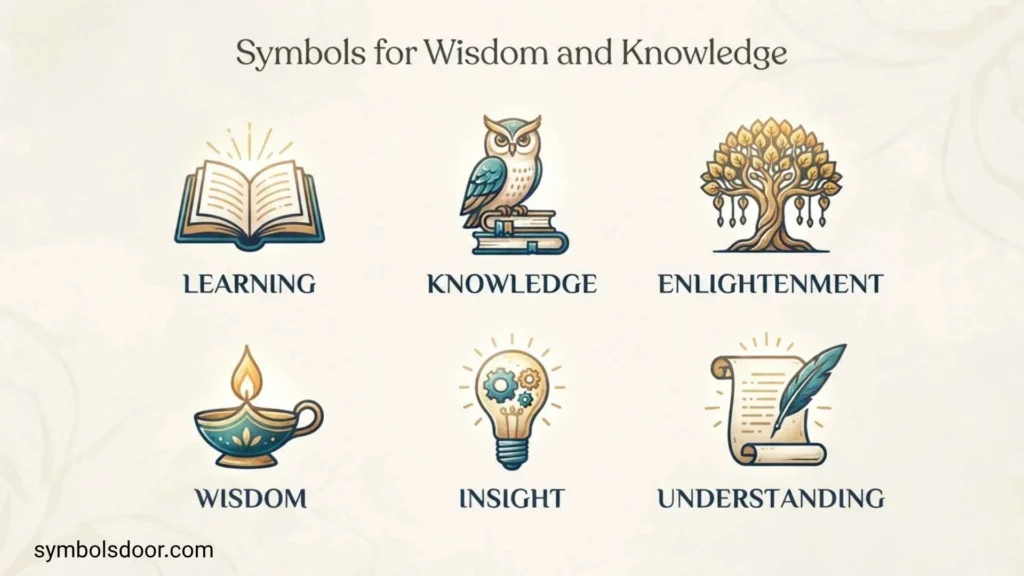
Symbols for wisdom and knowledge have been used across cultures to represent learning, insight, experience, truth, and sound judgment. Common examples include the owl, open book, lamp, tree of knowledge, key, eye, and scroll. The owl is often connected with wisdom because of its association with observation and thoughtful understanding, while a book represents accumulated knowledge and learning.
A lamp or light can symbolize the discovery of truth and the ability to see beyond confusion. Trees may represent growth, experience, and knowledge that develops over time. When choosing a symbol, consider whether you want it to represent intellectual learning, spiritual wisdom, life experience, or a combination of these ideas.
Tattoo Symbols for Wisdom
Wisdom-themed tattoos can combine meaningful imagery with a personal message. The owl is one of the most recognizable choices, often representing intelligence, observation, and thoughtful judgment. An open book can symbolize education, lifelong learning, and curiosity.
Other possibilities include a tree, representing growth through experience; a compass, representing guidance and good judgment; and a lamp, representing enlightenment. A small Greek or Roman-inspired symbol can also create a classic appearance. For a more personal tattoo, combine a wisdom symbol with a meaningful date, word, quote, or geometric design.
Greek Symbols for Wisdom
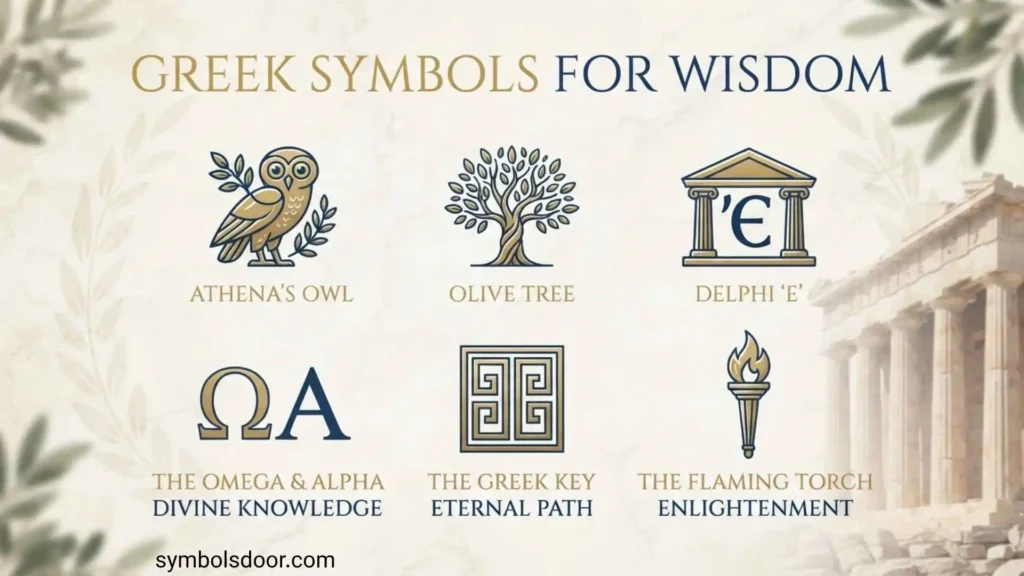
Ancient Greek culture associated wisdom with philosophy, learning, reason, and the pursuit of truth. Athena, the Greek goddess associated with wisdom and strategic thinking, is one of the strongest cultural references to wisdom. Her common symbols include the owl, olive tree, helmet, and spear.
The owl is particularly recognizable because it was associated with Athena. The olive branch can also represent peace, prosperity, and the cultural world surrounding ancient Greece. Greek columns, laurel wreaths, scrolls, and philosophical imagery can provide additional visual references to knowledge and intellectual achievement.
Chinese Symbols for Wisdom
Chinese traditions contain many ideas connected with wisdom, learning, balance, and understanding. The Chinese character 智 (zhì) is commonly associated with wisdom or intelligence. The bamboo plant is also culturally significant and can suggest resilience, humility, and inner strength.
The tortoise has long been associated in Chinese culture with longevity and wisdom, while the dragon can represent power, knowledge, transformation, and auspicious qualities depending on the cultural context. For tattoos, it is important to verify the exact character and intended meaning with a knowledgeable native speaker before using it permanently.
Japanese Symbols for Wisdom
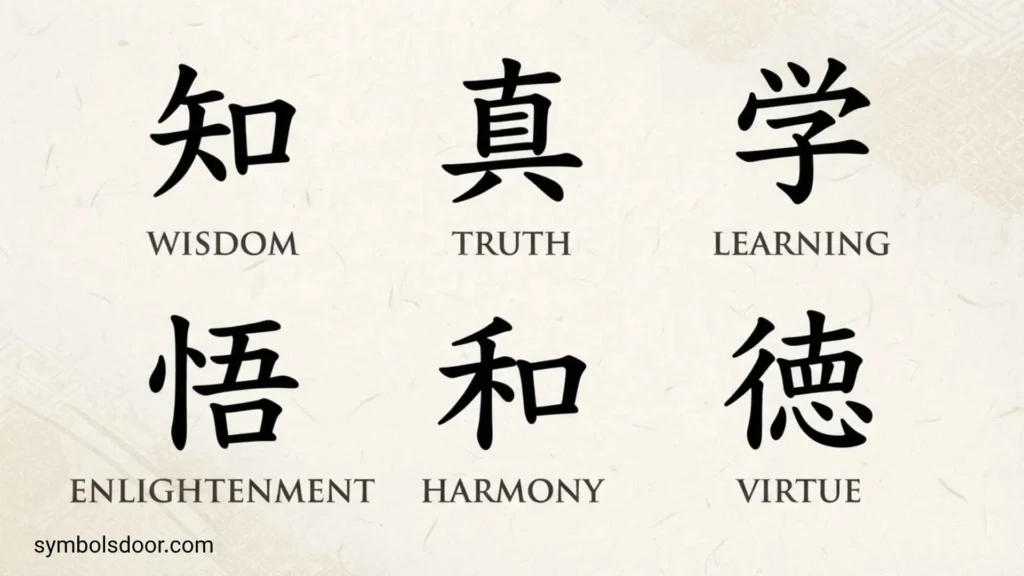
Japanese symbolism offers several images that can represent wisdom, knowledge, discipline, and insight. The owl is commonly used in Japanese culture as a symbol associated with good fortune and protection, while its wider symbolism can also connect with wisdom.
The turtle, particularly the traditional kame, can represent longevity and endurance. Zen-inspired imagery, such as a circle (ensō), can suggest enlightenment, completeness, and a state of understanding. Japanese calligraphy can also be used to express concepts such as wisdom, knowledge, learning, or enlightenment, but the exact word should be checked carefully before using it as a tattoo.
Ancient Symbols for Wisdom
Ancient civilizations used animals, celestial objects, plants, and written symbols to express ideas about wisdom and knowledge. The owl appears in ancient Greek symbolism, while the eye has been used in several ancient traditions to represent awareness, protection, or perception.
The scroll represents recorded knowledge and learning, while the lamp can symbolize illumination and understanding. The tree is another enduring symbol because its roots, trunk, and branches provide a natural metaphor for knowledge growing through generations.
Native American Symbols for Wisdom
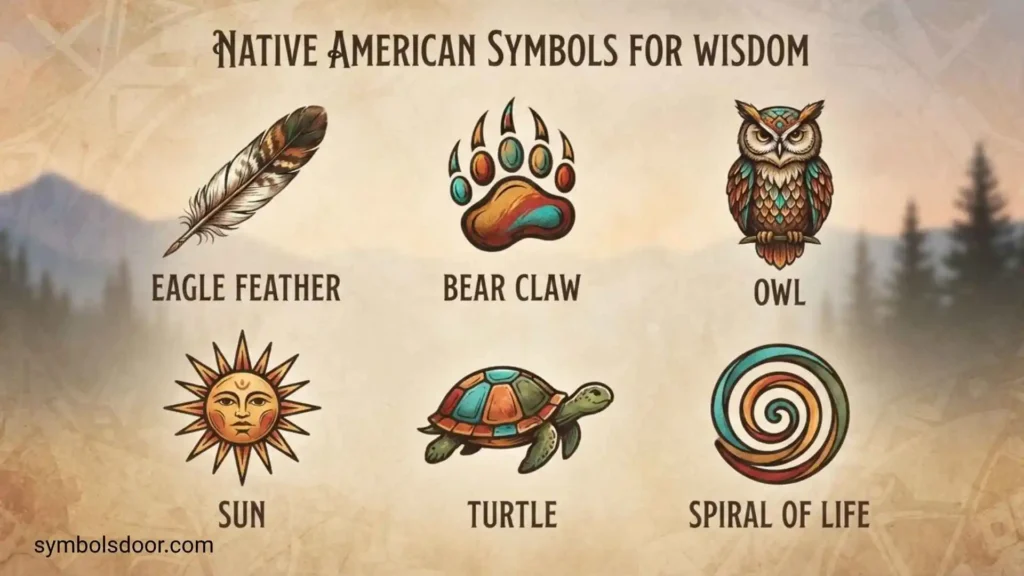
Native American cultures are diverse, and there is no single symbol that represents wisdom for all Indigenous peoples. Different nations have their own traditions, languages, sacred stories, and symbolic systems. For this reason, it is better to identify a specific nation or cultural tradition rather than describing an image as universally “Native American.”
Animals such as the owl, eagle, turtle, and wolf may carry important meanings in particular Indigenous traditions, but those meanings can vary significantly. If you are choosing a symbol for a tattoo or artwork, research the specific nation and cultural context behind the symbol instead of using a generalized interpretation.
Egyptian Symbols for Wisdom
Ancient Egyptian symbolism contains many images associated with knowledge, writing, protection, and divine understanding. Thoth, the ancient Egyptian deity associated with writing, knowledge, and wisdom, is especially relevant to this theme. He was traditionally represented with the head of an ibis or sometimes connected with a baboon.
The Eye of Horus is another famous Egyptian symbol, although its primary associations include protection, healing, and restoration rather than wisdom alone. The ankh represents life, while the scarab is associated with transformation and renewal. Egyptian hieroglyphs can create meaningful designs, but individual signs should be translated carefully rather than treated as generic decorative symbols.
Symbols for Wisdom and Strength
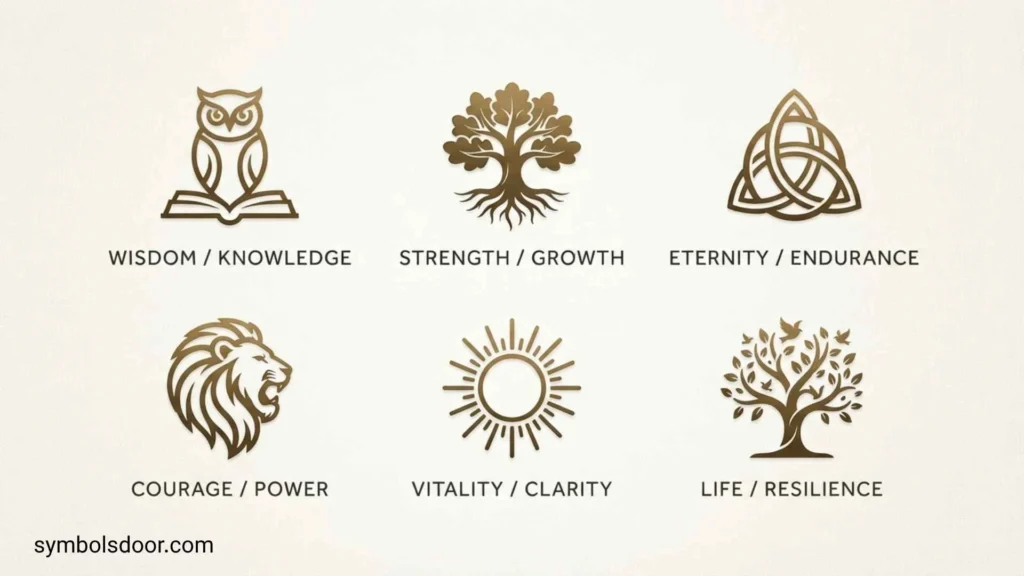
Some symbols combine intellectual wisdom with physical, emotional, or spiritual strength. The oak tree is a strong example because it can represent endurance, maturity, stability, and growth. The lion can symbolize courage and authority, while an owl adds the idea of wisdom and observation.
A mountain can represent strength, patience, and overcoming challenges. A compass can symbolize guidance and wise decisions. Combining two symbols can create a stronger personal message, such as an owl with a mountain to represent wisdom gained through difficult experiences.
Symbols for Wisdom in the Bible
The Bible frequently connects wisdom with understanding, instruction, discernment, and a relationship with God. One important biblical image is the tree of the knowledge of good and evil, which appears in Genesis. The lamp is also a meaningful biblical image because light is repeatedly used to represent guidance and truth.
The open book or scroll can represent God’s word, instruction, and learning. Proverbs is particularly associated with wisdom literature, offering teachings about knowledge, discipline, judgment, and righteous living. Biblical wisdom symbols should be interpreted in their scriptural context rather than assigned meanings that are not found in the text.
Christian Symbols for Wisdom
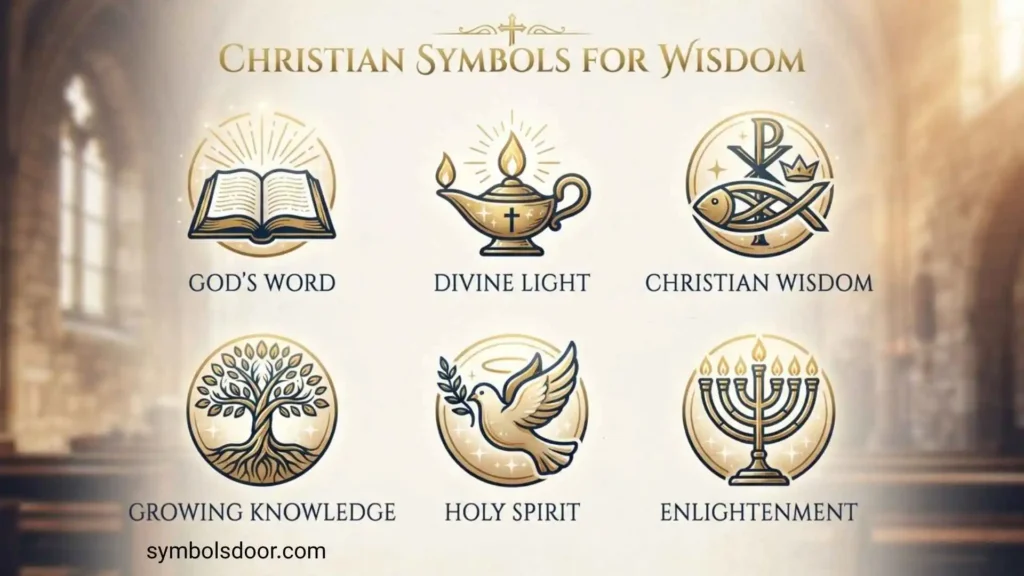
Christian symbolism includes several images that can express wisdom, truth, guidance, and spiritual understanding. The Bible or an open book can represent God’s word and instruction. A lamp or light can symbolize spiritual guidance and truth.
The cross is the central Christian symbol and can represent Christ, salvation, faith, and sacrifice. Although it is not exclusively a symbol of wisdom, it can represent the spiritual understanding gained through Christian faith. The dove, fish, and olive branch are other well-known Christian symbols, although their meanings focus on ideas such as peace, faith, the Holy Spirit, and Christian identity.
Celtic Symbols for Wisdom
Celtic-inspired symbolism often uses natural forms, animals, knots, and trees to express ideas of continuity, strength, and connection. The oak tree is particularly suitable for a wisdom theme because it can represent strength, longevity, and accumulated experience.
The Celtic knot is another popular design. Its continuous lines can symbolize eternity, interconnectedness, and the continuing nature of life. Some modern designs also use animals such as the owl or raven when creating Celtic-inspired wisdom artwork. Keep in mind that many meanings attached to modern Celtic symbols are later interpretations rather than universally documented ancient meanings.
African Symbols for Wisdom
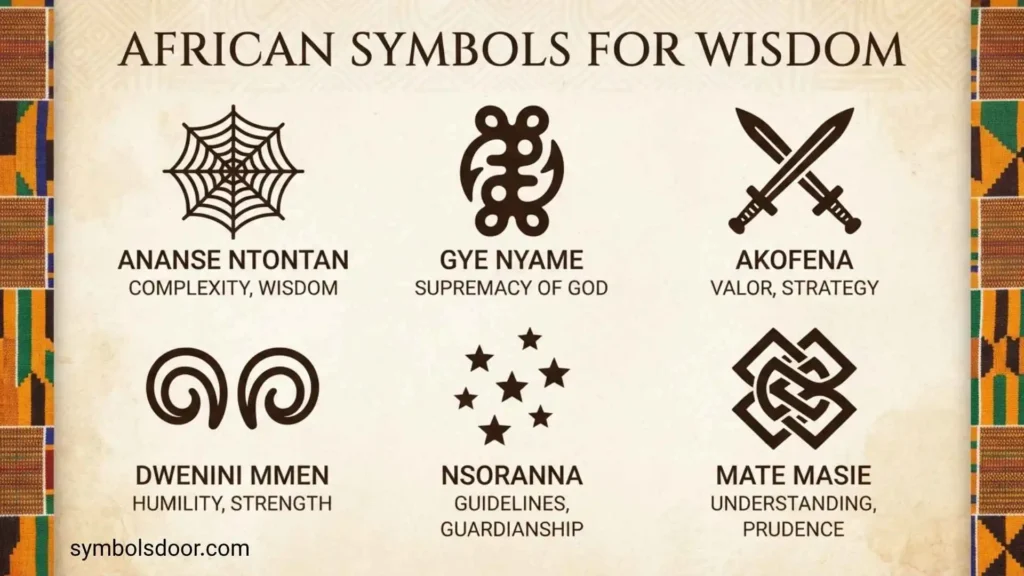
Africa contains thousands of cultures and many different symbolic traditions, so there is no single African symbol for wisdom. One well-known example comes from Adinkra symbolism of the Akan peoples of West Africa. Adinkra symbols communicate ideas, values, and teachings through distinctive visual forms.
The Adinkra symbol of wisdom is commonly known as Nyansapo, or “wisdom knot.” It is associated with wisdom, intelligence, patience, and the ability to make thoughtful decisions. Other African symbols may represent knowledge, leadership, strength, or learning, but their meanings depend on the particular culture and tradition.
Magic Symbols for Wisdom
Magic and occult traditions have used many symbols to represent knowledge, hidden understanding, transformation, and spiritual insight. The eye is often used as a general symbol of awareness and perception. The moon can represent intuition, mystery, cycles, and hidden knowledge.
The key is another useful symbolic image because it can represent access to secrets or understanding. Alchemical symbols, planetary symbols, geometric forms, and magical alphabets can also be used in fantasy or esoteric artwork. Their meanings vary considerably between traditions, so a symbol should be researched according to the specific magical system it comes from.
Symbol for Understanding
There is no single universal symbol for understanding, but several images communicate the idea effectively. An open book represents learning and acquired knowledge, while a light bulb is commonly used in modern culture to represent an idea or moment of understanding.
A lamp can symbolize enlightenment and clarity. An eye can represent perception and awareness, while a key can suggest discovering an answer or unlocking knowledge. For a simple tattoo or logo, an open book combined with a small light or key can create a clear visual representation of understanding.
Symbols of Knowledge and Learning
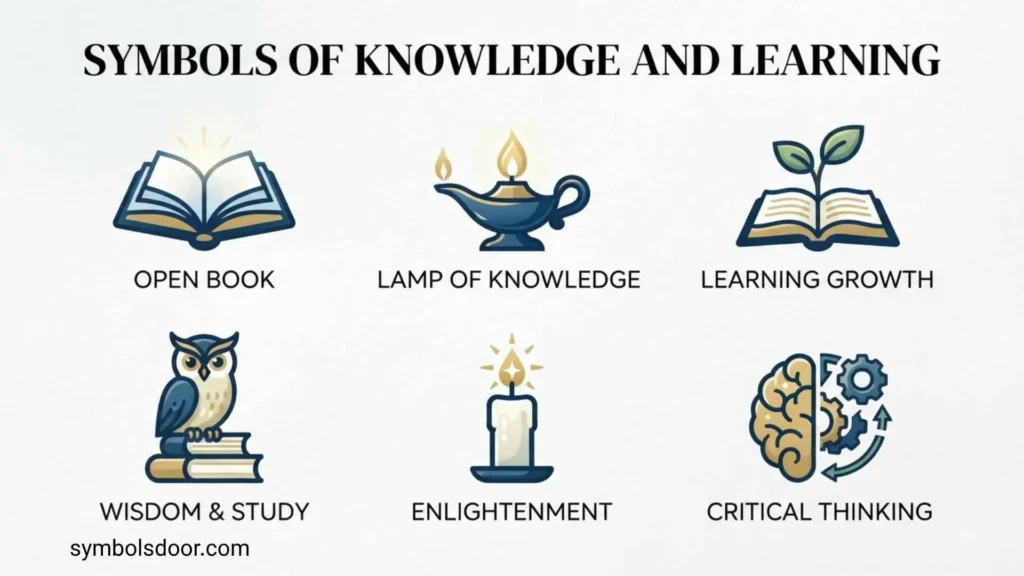
Knowledge and learning can be represented through symbols such as the book, scroll, pencil, graduation cap, lamp, owl, tree, and key. A book is perhaps the most direct symbol because it represents information that can be studied, preserved, and shared.
A graduation cap commonly represents education and academic achievement. A pencil suggests writing, creativity, and learning, while a scroll can give the design a historical or scholarly appearance. The owl adds a traditional association with wisdom, while a tree can represent knowledge that grows throughout a person’s life.
Spiritual and Dream Meaning of Symbols for Wisdom
Have you ever dreamt of a wise animal or a specific natural symbol? These dreams can carry deep personal messages.
- Dreaming of an Owl: This often suggests that your subconscious mind is telling you to look closer at a situation in your waking life. There might be a hidden truth you are ignoring.
- Dreaming of a Deep-Rooted Tree: This symbol indicates that you are growing stronger, becoming more grounded, and learning valuable life lessons.
- Meditation Experiences: Many people visualize a blooming lotus or a third eye during meditation to help clear mental clutter and tap into their natural intuition.
Positive and Negative Meanings of Symbols for Wisdom
Most symbols have a dual nature. They can represent both light and shadow depending on the context.
| Symbol | Positive Meaning (Light) | Negative Meaning (Shadow) |
| The Owl | Deep intuition, quiet insight, guidance. | Loneliness, cold detachment, warning of death. |
| The Serpent | Rebirth, healing, ancient knowledge. | Deception, dangerous temptation, hidden poison. |
| The Oak Tree | Unshakable strength, ancient heritage. | Inflexibility, stubbornness, refusal to change. |
This duality reminds us that even wisdom must be balanced. Knowing too much without compassion can lead to coldness, and standing too firm can make us break when the wind blows.
Why Humans Are Attracted to Symbols for Wisdom
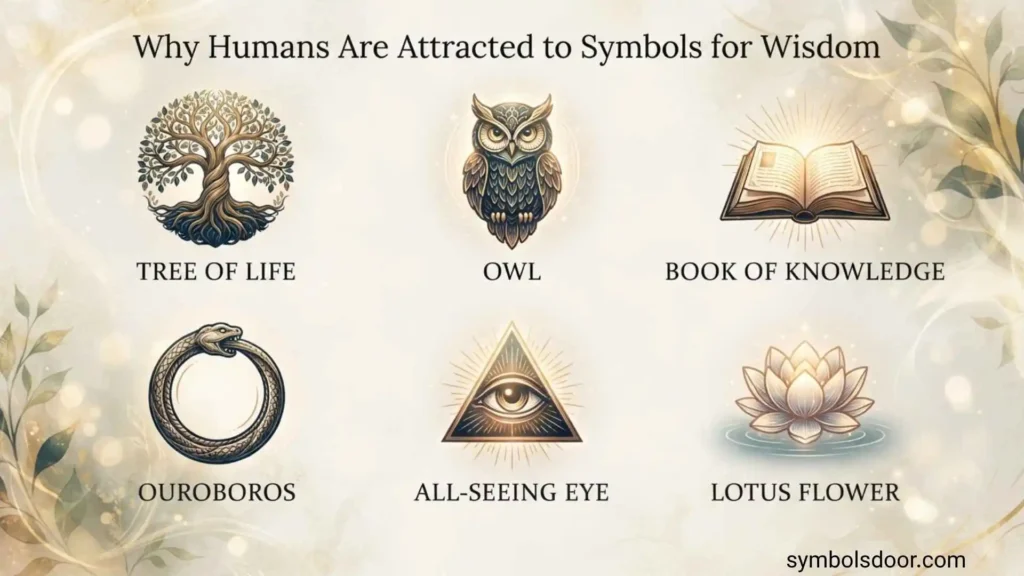
Our brains are naturally wired to recognize patterns and search for meaning. When we look at a symbol, our minds do not just see lines and colors. We feel a deep emotional connection to the generations of humans who looked at those same shapes before us.
In a fast-paced, noisy world, these symbols act as visual anchors. They cut through the mental chatter and remind us of who we want to be: calm, balanced, and deeply understanding. They connect us to a shared human memory, giving us comfort and a sense of direction when we face difficult choices.
Modern Uses of Symbols for Wisdom
Even in our digital age, ancient icons remain incredibly popular:
- Jewelry: Wearing a silver lotus necklace or an eye amulet helps people carry a sense of peace and protection throughout their busy days.
- Branding: Universities, publishers, and tech companies frequently use owls, books, and keys in their logos to show authority, reliability, and intellect.
- Home Decor: Beautiful tapestries of the Tree of Life or Zen gardens with lotus motifs are used to create calm, thoughtful spaces in modern homes.
Interesting Facts About Symbols for Wisdom
- The phrase “the wise old owl” actually comes from ancient Greek myths, not just modern nursery rhymes.
- In ancient Japan, owls were placed on homes to ward off famine and disease, acting as protective guardians of the household.
- The Bodhi Tree in India, where the Buddha sat, is still visited by millions of people today. A descendant of the original tree still grows in the same sacred spot.
- The Celtic Druids believed that eating acorns from a sacred oak tree would grant a person the gift of prophetic vision.
- In alchemy, the owl was used to represent the process of turning raw, unrefined thoughts into pure, golden wisdom.
Frequently Asked Questions

What is the most common symbol for wisdom?
The owl is widely considered the most common and universally recognized symbol for wisdom, especially in Western cultures, due to its deep historical connections to the Greek goddess Athena.
Why is the owl associated with wisdom?
Owls are associated with wisdom because of their quiet flight, sharp night vision, and calm, observant behavior, which humans compare to a thoughtful, wise person who watches and listens before speaking.
What is the spiritual symbol for inner wisdom?
The lotus flower and the Third Eye are the most common spiritual symbols for inner wisdom. They represent mental clarity, spiritual awakening, and the ability to look past physical illusions.
How do Eastern and Western symbols for wisdom differ?
Western symbols often focus on intellectual study, logic, and active strategy, represented by books and owls. Eastern symbols focus more on inner peace, balance, and quiet meditation, represented by the lotus and the Yin Yang.
Conclusion
Symbols for wisdom are beautiful, quiet reminders of our endless human journey toward truth, understanding, and peace. Whether you look to the watchful owl, the blossoming lotus, or the sturdy oak tree, these ancient icons show us that true knowledge is a quiet, inner light. By bringing these timeless symbols into your daily life, you honor the lessons of the past while lighting your own path toward a wiser, more thoughtful future.

Hi, I’m Asher Monroe, a writer who believes that meaningful words have the power to inspire change and bring people closer to their dreams. I have always been fascinated by the beauty of quotes and the way a simple message can provide motivation, hope, and comfort.
I enjoy creating content around inspirational quotes, life lessons, success stories, and positive thoughts that help readers find encouragement in their everyday lives. My goal is to share words that connect with people and remind them of their inner strength.
Through my writing, I explore the ideas of personal growth, confidence, and the importance of staying inspired through every chapter of life.
I am the author of Words That Move the Soul and The Path of Endless Inspiration, two books focused on the power of wisdom, positivity, and meaningful thoughts.
 Sienna Brooks
 Rowan Sinclair Rowan Sinclair