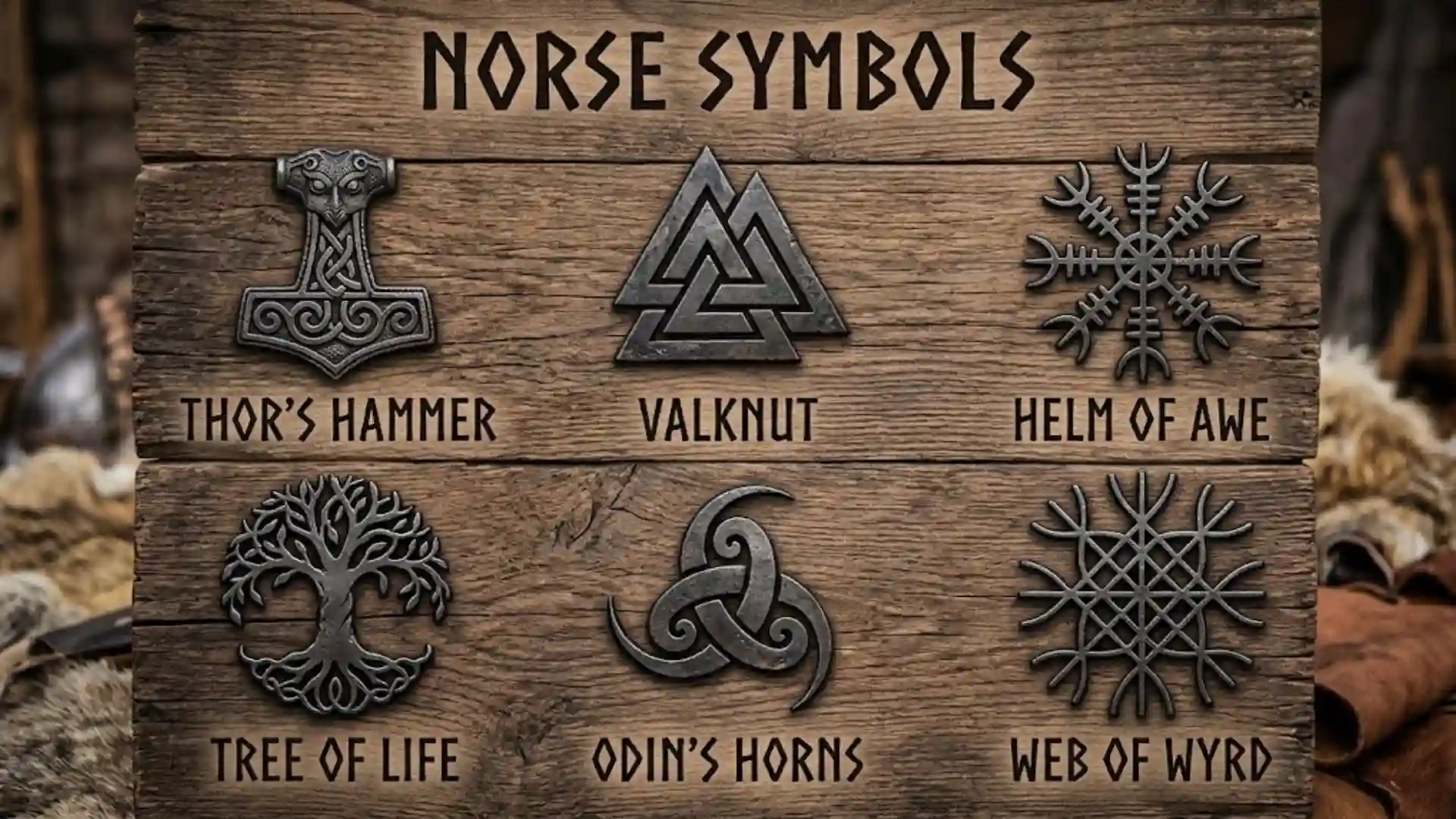
Norse symbols offer a fascinating glimpse into the beliefs, stories, and everyday lives of people in the ancient Nordic world. From Thor’s mighty hammer to the mysterious Valknut, these designs appear on archaeological finds, carved stones, jewelry, and modern tattoos. Each one carries a different history, and not every symbol means what popular websites claim.
Some Norse symbols have strong connections to Viking Age objects and surviving mythology. Others come from Icelandic magical manuscripts written centuries later. Understanding that difference helps you appreciate these designs without confusing historical evidence with modern interpretations.
Whether you’re researching Viking symbols, exploring Norse mythology, studying runes, or choosing a meaningful design, this guide explains the most recognizable signs and what historians can reasonably say about them.
What Are Norse Symbols?
Norse symbols are signs, images, and motifs associated with the cultures, religious traditions, mythology, and writing systems of the medieval Nordic world. They appear in different forms, including carved stones, metal pendants, decorated weapons, manuscripts, and works of art.
However, Norse symbolism doesn’t belong to one single, standardized system. A rune is a letter, for example, while Mjölnir is a mythological weapon represented in art and jewelry. Yggdrasil is a tree described in Norse cosmology, whereas Vegvísir is a magical stave documented in later Icelandic tradition.
These differences matter because modern designs often combine symbols from different periods as though Vikings used them all together.
Why Did Norse People Use Symbols?
Symbols could serve practical, religious, commemorative, or decorative purposes. Their exact roles depended on the object, location, and historical period.
Common examples include:
- Religious expression: Hammer pendants associated with Thor appear in archaeological finds from the Viking Age.
- Writing and communication: People carved runes into stones, wooden objects, weapons, and personal belongings.
- Memorials: Runestones often commemorate deceased people or record family relationships and achievements.
- Mythological storytelling: Animal figures, gods, and legendary creatures appear in Norse literature and artistic traditions.
- Personal decoration: Jewelry and other objects displayed craftsmanship, identity, wealth, and possibly religious affiliation.
Not every design had a hidden spiritual message. Sometimes an object served several purposes at once.
Norse Symbols and Their Meanings Chart
The following chart introduces major Norse symbols and distinguishes their traditional associations from uncertain interpretations.
| Norse symbol | Common association | Historical context |
| Mjölnir, Thor’s hammer | Thor, protection, divine power | Strong archaeological evidence from Viking Age hammer pendants |
| Valknut | Odin, death, the battle-slain | Ancient motif, but its exact meaning remains uncertain |
| Yggdrasil | The world tree and cosmic connections | Rooted in Norse mythological literature |
| Huginn and Muninn | Thought, memory, Odin | Described in Old Norse literary sources |
| Triple Horn of Odin | Mead of poetry and Odin | Three-horn motif appears on the Snoldelev runestone |
| Gungnir | Odin’s spear and authority | Mythological object described in Norse sources |
| Jörmungandr | The Midgard Serpent and Ragnarök | Major figure in Norse mythology |
| Norse runes | Writing, names, messages, inscriptions | Historically attested writing system |
| Vegvísir | Guidance and finding one’s way | Documented in a 19th-century Icelandic manuscript |
| Helm of Awe design | Awe, fear, magical protection | Familiar graphic belongs to later Icelandic magical traditions |
Important: A symbol’s modern meaning doesn’t automatically establish its original meaning. Some interpretations come from medieval stories, while others reflect scholarly theories or recent cultural use.
Most Famous Norse Symbols and Their Meanings
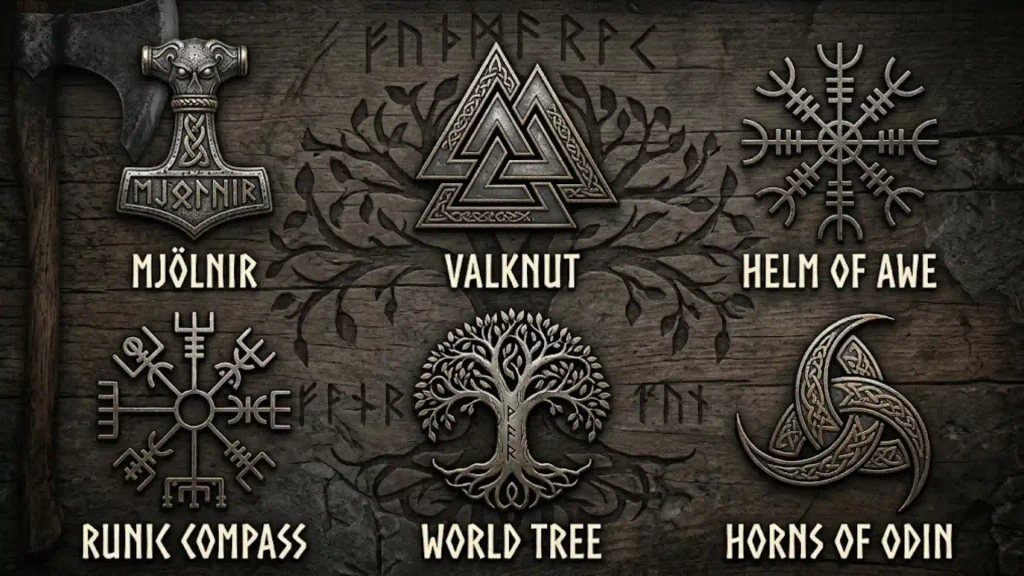
Mjölnir: Thor’s Hammer
Mjölnir is one of the best-known Norse symbols. In Norse mythology, it is the powerful hammer wielded by Thor, the god associated with thunder, storms, and the protection of gods and humans.
Mythological stories portray Mjölnir as an extraordinary weapon. Despite its short handle, the hammer possesses immense power and can return to Thor after he throws it. It plays an important role in conflicts between the gods and their enemies.
Archaeology also provides strong evidence for the hammer’s importance. Viking Age hammer-shaped pendants have been discovered across Scandinavia and other regions connected to the Viking world. These objects show that the hammer was more than a literary detail.
What Does Mjölnir Symbolize?
People commonly associate Thor’s hammer with:
- Protection: Thor frequently defends the gods and the world of humans.
- Strength: The hammer represents Thor’s extraordinary power.
- Divine authority: Mjölnir is one of the defining attributes of the thunder god.
- Religious identity: Hammer pendants may have expressed devotion to Thor or traditional Norse beliefs.
Some scholars have suggested that hammer pendants also helped people express pagan identity during the spread of Christianity in Scandinavia. However, the purpose of every pendant cannot be established with certainty.
Today, Mjölnir remains popular in necklaces, tattoos, artwork, and Norse-inspired jewelry. Its historical background makes it a particularly strong choice for anyone interested in a symbol with clear Viking Age connections.
Valknut: The Three Interlocking Triangles
The Valknut is a geometric design made from three interlocking triangles. It appears on several early medieval Scandinavian objects and picture stones, including imagery associated with Odin and scenes involving the dead.
Its modern name is commonly understood as combining Old Norse elements related to the slain and a knot. However, Valknut is a modern label, not a securely documented name used by Vikings for the design.
The motif’s historical presence is real. Its exact meaning, however, remains a matter of interpretation.
What Does the Valknut Mean?
The Valknut is often associated with:
- Odin and his connection to warriors.
- Death and the battle-slain.
- The transition between life and death.
- Binding, power, or the relationship between different states of existence.
These interpretations aren’t equally certain. The connection to Odin and death comes largely from the context of particular carvings and related imagery. No surviving Viking Age explanation establishes one definitive meaning.
You may also encounter claims that the three triangles represent the Nine Worlds or that the Valknut universally symbolizes protection. Those ideas should be treated as modern interpretations rather than established historical facts.
Today, the Valknut appears frequently in tattoos, pendants, and Norse-inspired designs. If you choose it, understanding its debated meaning is more informative than relying on a single simplified definition.
Yggdrasil: The Norse World Tree
Yggdrasil is the immense tree that connects different parts of the cosmos in Norse mythology. Often described as an ash tree, it stands at the center of a mythological world populated by gods, humans, giants, and other beings.
Old Norse literary sources describe the tree and the beings connected to it. The Poetic Edda and Prose Edda preserve important accounts of Norse cosmology, although these texts were recorded after the Viking Age and must be read in their historical context.
Yggdrasil isn’t simply a decorative tree. It provides a way to understand how the mythological universe relates to itself.
What Does Yggdrasil Symbolize?
In modern interpretations, Yggdrasil often represents:
- Connection: Different realms belong to one larger cosmic structure.
- Life and growth: The tree evokes living systems and continued growth.
- Continuity: Its place in Norse cosmology connects different beings and generations.
- Interdependence: The tree’s roots, branches, and inhabitants form a connected whole.
These ideas help explain why Yggdrasil remains popular in jewelry, tattoos, illustrations, and decorative artwork.
Still, it is worth separating the tree described in Norse mythology from modern diagrams that place the Nine Worlds in neat circles around its branches. Such diagrams can be useful visual interpretations, but they shouldn’t automatically be treated as exact ancient maps.
Huginn and Muninn: Odin’s Ravens
Huginn and Muninn are the two ravens associated with Odin, the chief god in much of Norse mythology. Their names are commonly translated as Thought and Memory.
According to the Poetic Edda, the ravens travel throughout the world and return to Odin with information. Their role connects the god with observation, knowledge, and awareness of distant events.
Ravens also appear in the wider cultural imagination surrounding warfare, death, and the natural world. Their intelligence and scavenging habits made them striking animals in a society familiar with battlefields and harsh environments.
What Do Odin’s Ravens Symbolize?
Modern designs often associate Huginn and Muninn with:
- Thought and memory.
- Knowledge and observation.
- Wisdom and awareness.
- Odin’s ability to gather information.
The first two associations come directly from the birds’ names. Broader meanings such as personal transformation or spiritual guidance are modern interpretations that may appeal to people today.
Raven imagery is especially common in Norse-inspired artwork, clothing, tattoos, and jewelry. However, not every raven illustration represents Huginn and Muninn specifically. A historical or mythological identification requires more than the presence of two black birds.
The Triple Horn of Odin
The Triple Horn of Odin consists of three interlocking drinking horns. It is commonly connected to Odin and the myth of the mead of poetry.
In Norse mythology, the mead of poetry grants extraordinary poetic ability and wisdom. The stories surrounding it involve divine knowledge, transformation, and the transfer of a powerful substance between different beings.
One important historical example is the Snoldelev runestone in Denmark. Its inscription includes a three-horn motif, making the stone a significant reference when discussing the symbol’s historical context.
What Does the Triple Horn Symbolize?
Modern interpretations commonly connect the design with:
- Poetry and artistic skill.
- Wisdom and knowledge.
- Odin and Norse mythology.
- Inspiration and creative expression.
Its connection to the mead of poetry makes it especially appealing to writers, artists, and people interested in Norse storytelling. However, the meaning of a particular three-horn design should still be considered in its own archaeological context.
The Triple Horn of Odin is also easy to confuse with other three-part Norse designs. It is not the same symbol as the Valknut, which consists of three interlocking triangles.
Gungnir: Odin’s Spear
Gungnir is Odin’s legendary spear. Norse mythological sources describe it as a remarkable weapon associated with the god’s power and authority.
Unlike Mjölnir, which belongs to Thor, Gungnir belongs to Odin. The distinction matters when identifying symbols in Norse-inspired artwork.
Modern representations of Gungnir often feature a decorated spearhead, sometimes accompanied by runes or other Nordic motifs. These designs are usually artistic interpretations rather than exact reproductions of a single ancient emblem.
Gungnir commonly represents:
- Odin and divine authority.
- Warfare and martial power.
- Determination and decisive action.
- The connection between mythology and heroic storytelling.
These associations are most useful when discussing the spear as a mythological object. A generic spear image found on an artifact cannot automatically be identified as Gungnir without supporting evidence.
The Sun-Wheel Motif
Circular designs with intersecting lines appear in many ancient European artistic traditions. Some are interpreted as solar motifs, while others may have served different decorative, religious, or practical purposes.
The phrase sun wheel is used for several related designs, not one universally standardized Norse symbol. Similar shapes can appear in different cultures without sharing the same origin or meaning.
When discussing a sun-wheel motif in a Norse context, it is important to identify the specific artifact or design rather than assuming that every circle with a cross represents the same belief.
Modern Norse-inspired artwork sometimes uses these designs to represent light, cycles, renewal, or the changing seasons. Those meanings can be meaningful today, but they shouldn’t be presented as proven interpretations of every historical example.
Serpents and Dragons in Norse Mythology
Serpents and dragons occupy important places in Norse stories and visual art. They can appear as dangerous creatures, mythological beings, or decorative figures woven into elaborate designs.
One of the most famous is Jörmungandr, also known as the Midgard Serpent. According to Norse mythology, this enormous serpent surrounds the human world and plays a major role in the events of Ragnarök.
Ragnarök describes a series of catastrophic events involving the gods, their enemies, and the world’s destruction and renewal. Thor and Jörmungandr are destined to confront each other during this final conflict.
Norse dragon imagery also appears in surviving artistic traditions. Interlaced animal forms, serpent-like bodies, and elaborate creatures decorate objects associated with early medieval Scandinavia.
Modern interpretations may associate these motifs with:
- Danger and formidable power.
- Chaos and cosmic conflict.
- Cycles of destruction and renewal.
- The dramatic creatures of Norse mythology.
However, a serpent motif isn’t automatically a picture of Jörmungandr. Specific identification depends on the context and supporting evidence.
Norse Runes and Their Meanings
Runes are among the most recognizable elements of Viking history. However, they are first and foremost letters in a historical writing system, not simply a collection of mystical symbols.
People used runes to write names, messages, memorial inscriptions, and other texts. They carved them into stone, wood, bone, metal, and personal objects. Some literary sources also connect runes with magical knowledge, so writing and ritual were not necessarily separate in every historical context.
The Viking Ship Museum’s guide to runes explains how runic writing developed and how people used it during the Viking Age.
What Is the Futhark?
The word futhark refers to a runic alphabet. It comes from the first six characters in the rune sequence.
Two major systems are especially important when studying Norse runes:
- Elder Futhark: A 24-rune system used before the Viking Age, with inscriptions dating from approximately the second century onward.
- Younger Futhark: A 16-rune system that developed around the beginning of the Viking Age and became the main runic alphabet in Scandinavia during that period.
The University of Copenhagen’s runology resources explain the different historical stages of runic writing.
The Younger Futhark may seem simpler because it has fewer characters. In practice, that creates a challenge: one rune could represent more than one sound. Translating modern English words into Viking Age runes therefore requires care.
Common Norse Runes and Their Associations
The following table gives examples from the Younger Futhark. Rune names and translations can vary slightly across scholarly conventions.
| Rune | Name | Traditional name meaning or association |
| ᚠ | Fé | Cattle, wealth |
| ᚦ | Þurs | Giant or supernatural being |
| ᚬ | Óss | God |
| ᚱ | Reið | Riding or a journey |
| ᚼ | Hagall | Hail |
| ᚾ | Nauðr | Need or distress |
| ᛁ | Íss | Ice |
| ᛅ | Ár | Year or harvest |
| ᛋ | Sól | Sun |
| ᛏ | Týr | The god Týr |
| ᛒ | Bjarkan | Birch |
| ᛘ | Maðr | Person or human being |
| ᛚ | Lögr | Water |
| ᛦ | Ýr | Yew |
These are rune names and their traditional linguistic associations, not guaranteed predictions or universal spiritual meanings.
For example, Fé is associated with cattle and wealth because livestock represented an important form of property in early Scandinavian society. Modern spiritual interpretations may extend that idea to prosperity or abundance, but those extensions should be identified as contemporary interpretations.
How Were Runes Used During the Viking Age?
Runic inscriptions served many purposes. Some recorded the names of people who commissioned or carved an object. Others commemorated the dead, described relationships, or marked ownership.
Runestones are particularly important historical sources. Many preserve memorial inscriptions, while others contain information about travel, family connections, and social status.
Runes could also appear on ordinary objects. A short inscription on a wooden stick or personal belonging might have served a practical purpose rather than expressing a grand religious message.
The surviving evidence also shows that runes changed over time. The 16-character Younger Futhark replaced the earlier 24-character Elder Futhark as the main Scandinavian runic system during the Viking Age.
How to Write a Name in Norse Runes
If you want to write your name using Norse runes, first choose the historical writing system you intend to represent.
A simple letter-for-letter conversion can produce misleading results because the runes represent sounds within older languages. The Younger Futhark also uses fewer characters than the modern English alphabet.
For a more historically informed result:
- Choose Elder Futhark or Younger Futhark deliberately.
- Decide whether you’re writing a modern name phonetically or reconstructing an Old Norse form.
- Check how the chosen system represented the sounds in your name.
- Verify the result with a reliable runology resource rather than trusting an automatic converter.
A modern rune rendering can work as a personal design. It just shouldn’t be presented as an exact historical Viking inscription unless the language and spelling support that claim.
Norse Symbols of Protection and Magic
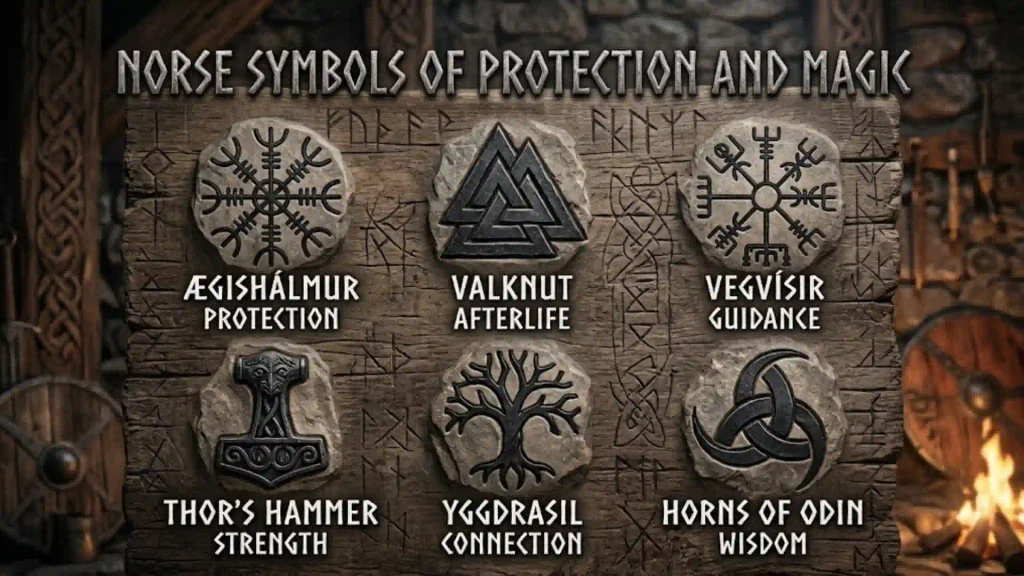
Protection is one of the most common themes in modern discussions of Norse symbols. Some objects have plausible protective or religious roles, while other designs come from later Icelandic magical traditions.
Understanding the dates and sources helps separate these categories.
Mjölnir as a Protective Symbol
Thor’s hammer has a strong archaeological connection to Viking Age material culture. Hammer-shaped pendants appear in finds from Scandinavia and regions connected to Viking activity.
These objects may have expressed devotion to Thor, protection, religious identity, or a combination of purposes. Their exact meaning likely varied between individuals and communities.
Because Mjölnir has both a clear mythological identity and strong archaeological evidence, it is one of the most historically grounded choices for someone interested in a Norse-inspired protective emblem.
The Helm of Awe (Ægishjálmr)
The Helm of Awe is widely presented online as an ancient Viking symbol of fearlessness, strength, and protection. Its history, however, is more complicated.
The name ægishjálmr appears in medieval Norse literary traditions. In the story of Fáfnir, a legendary dragon possesses a helm of awe associated with frightening or overpowering enemies.
But the familiar radial graphic commonly sold as the Helm of Awe is a different matter. Its documented forms belong to later Icelandic magical manuscript traditions rather than securely identified Viking Age artifacts.
This distinction is important: an old mythological name doesn’t prove that a modern drawing of the object existed in the Viking Age.
Today, the graphic is commonly associated with courage, defense, and personal strength. Those modern meanings can be described accurately as contemporary interpretations, not as proven Viking beliefs about that exact design.
Vegvísir: The Icelandic Wayfinding Stave
Vegvísir is often called a Viking compass. It is associated with guidance and finding one’s way through difficult weather, but its documented history does not support the claim that it was used during the Viking Age.
One well-known source is the Huld manuscript, compiled by Geir Vigfússon in Iceland in 1860. The manuscript connects the stave with the idea of not losing one’s way in storms or unfamiliar conditions.
That makes Vegvísir a genuine part of later Icelandic magical tradition. It does not make it a verified Viking Age symbol.
Modern designs often use Vegvísir to represent:
- Guidance during uncertain times.
- Direction and personal purpose.
- Safe travel.
- Finding your way through life’s challenges.
These are understandable modern interpretations. However, if historical accuracy matters to you, Vegvísir should be labeled as a later Icelandic magical stave rather than an authenticated Viking Age emblem.
Svefnthorn: The Sleep Thorn
Svefnthorn is a term associated with sleep-inducing or sleep-related magical motifs in later Norse literary traditions. In some stories, a character uses such an object or magical device to place someone into a deep sleep.
Modern illustrations of the Svefnthorn vary considerably. There is no single universally verified Viking Age design that can be confidently identified as the original symbol.
For that reason, it is better to discuss Svefnthorn as a literary motif and later symbol tradition than to present one modern drawing as a confirmed archaeological artifact.
Symbols with Uncertain or Modern Origins
Several popular designs are often grouped with Viking symbols despite limited or later evidence for their familiar forms.
- Web of Wyrd: A modern design associated with fate and interconnected events. Its familiar graphic should not be treated as a securely documented Viking Age emblem.
- Troll Cross: A design commonly associated with protection in modern Scandinavian folklore and jewelry. Claims about its widespread use by historical Vikings require stronger evidence.
- Vegvísir: Documented in later Icelandic magical tradition rather than the Viking Age.
- Modern Helm of Awe graphics: Related to an older mythological name but not securely established as Viking Age artwork.
These designs may have cultural, artistic, or personal value today. Historical accuracy simply requires explaining when the evidence begins.
Norse Symbols and Their Connections to the Gods
Norse mythology contains many divine figures, legendary weapons, and supernatural creatures. Some symbols have direct mythological connections, while others are associated with a god through interpretation or modern artistic convention.
Symbols Associated with Odin
Odin is associated with wisdom, poetry, warfare, magic, and the pursuit of knowledge.
Symbols and motifs linked to him include:
- Huginn and Muninn: His two ravens, commonly translated as Thought and Memory.
- Gungnir: His legendary spear.
- Valknut: A motif often associated with Odin and death, although the interpretation remains uncertain.
- Triple Horn of Odin: A three-horn design connected in modern interpretation to the mead of poetry.
The evidence varies across these examples. Huginn and Muninn and Gungnir have clear roles in mythological literature, whereas the Valknut’s precise meaning remains debated.
Symbols Associated with Thor
Thor is best known for Mjölnir, his hammer. He is a powerful defender of the gods and humanity in Norse mythology.
Hammer pendants provide a particularly strong connection between Thor’s mythological identity and archaeological evidence. Other artistic representations of Thor may appear in modern designs, but each image should be evaluated according to its source.
Symbols Associated with Freyja
Freyja is an important goddess in Norse mythology, associated with love, desire, fertility, and other aspects of divine life. She also has connections to warfare and the selection of some of the battle-dead.
Modern artwork often connects Freyja with cats, falcons, jewelry, and other motifs drawn from stories about her. These can be useful mythological references, but not every popular image marketed as Freyja’s personal symbol has a direct historical basis.
A careful explanation should distinguish what surviving texts say about Freyja from designs created by modern artists.
Symbols of the Norse Cosmos
Yggdrasil and Jörmungandr are especially important when exploring Norse ideas about the universe.
Yggdrasil connects different realms in the mythological cosmos. Jörmungandr, the Midgard Serpent, surrounds the human world and becomes an important figure in Ragnarök.
Together, these mythological figures help explain how Norse stories represented the structure of the universe, its dangers, and its eventual transformation.
Viking Symbols Found in Archaeological Discoveries
Archaeological objects are essential for understanding which Norse symbols people actually used. A carved stone or excavated pendant offers different evidence from a modern illustration or a story recorded centuries after the Viking Age.
Researchers examine an object’s material, date, location, decoration, and surrounding archaeological context. They may compare it with similar discoveries or consult inscriptions and literary sources.
Mjölnir Pendants
Hammer-shaped pendants are among the clearest examples of a recognizable Norse motif found in Viking Age material culture. Archaeologists have discovered examples made from different metals and in different styles.
Their existence supports the conclusion that hammer imagery mattered to some people during the period. It doesn’t reveal the personal beliefs of every wearer, but it provides stronger historical evidence than a symbol found only in a modern design collection.
Runestones
Runestones preserve inscriptions and artistic motifs. Many commemorate deceased people or describe relationships between families and communities.
Their inscriptions can also reveal details about language, names, travel, religious change, and social memory. However, a stone’s decorative imagery may remain difficult to interpret even when its runic text is readable.
The Snoldelev Runestone
The Snoldelev runestone in Denmark is particularly relevant to discussions of the Triple Horn of Odin. Its three-horn motif provides an actual historical example of the design.
The stone also demonstrates why archaeological context matters. Instead of relying only on a modern symbol chart, researchers can examine a surviving object and its inscription.
Why Historical Evidence Matters
When you encounter a symbol online, ask three questions:
- When does the design first appear? A Viking Age artifact provides different evidence from a manuscript created hundreds of years later.
- What did people call it? Modern names don’t always preserve historical terminology.
- What supports its proposed meaning? A surviving inscription may provide direct evidence, while a visual resemblance may support only a tentative interpretation.
These questions help you distinguish historically grounded Norse symbols from later designs inspired by Nordic culture.
Norse Symbols vs. Viking Symbols: What’s the Difference?
The terms Norse symbols and Viking symbols overlap, but they are not exactly interchangeable.
Norse is a broad term connected to the languages, mythology, and cultures of medieval Scandinavia. Viking Age refers to a particular historical period, conventionally dated around AD 800–1100.
The distinction matters because Norse mythology includes stories preserved in medieval manuscripts after the Viking Age ended. Later Icelandic magical symbols also belong to the broader history of Nordic culture, but they aren’t necessarily Viking Age designs.
| Category | What it includes | Example |
| Viking Age artifact | A surviving object from the period | Mjölnir pendant |
| Norse mythological figure | A being described in Norse stories | Jörmungandr |
| Runic writing | Letters used to record language | Younger Futhark |
| Later Icelandic magical symbol | A design documented in later manuscripts | Vegvísir |
| Modern Norse-inspired design | A contemporary interpretation or composition | Newly designed rune artwork |
The most accurate descriptions identify both the cultural connection and the historical period.
Norse Symbols in Tattoos, Jewelry, and Modern Design
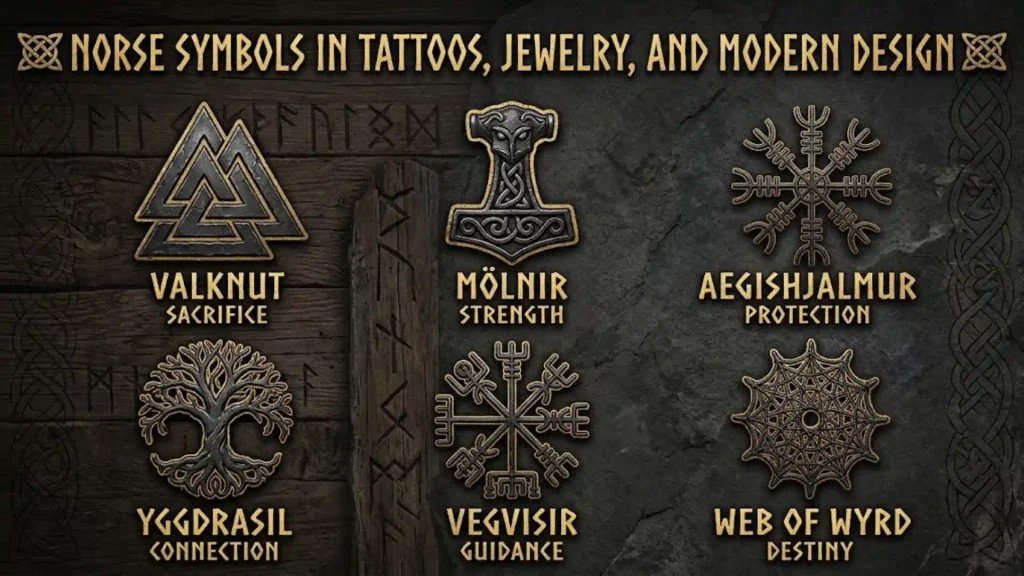
Norse symbols remain popular because their stories and visual forms offer many ways to express identity, interests, and personal values. Tattoos and jewelry often combine historical motifs with modern artistic choices.
There is nothing inherently wrong with a modern interpretation. The important thing is to understand what the design represents and avoid mistaking a contemporary creation for a verified ancient emblem.
Popular Norse Symbols for Tattoos
These designs are frequently chosen for Norse-inspired tattoos:
- Mjölnir: A hammer associated with Thor, strength, and protection.
- Valknut: A three-triangle motif often connected to Odin and death, with an uncertain original meaning.
- Yggdrasil: A world tree associated with Norse cosmology and the connection between realms.
- Huginn and Muninn: Ravens linked to thought, memory, and Odin.
- Norse runes: Historical letters that can be used in inscriptions or carefully designed modern compositions.
- Vegvísir: A later Icelandic magical stave commonly associated with guidance and direction.
- Helm of Awe: A design from later magical traditions commonly associated with awe, fear, and protection.
Before choosing a tattoo, verify the design’s history and spelling. If you’re using runes, make sure the intended language and writing system match your goal.
Norse Symbols in Jewelry
Historical hammer pendants demonstrate that Norse-inspired jewelry can draw on genuine archaeological finds. Modern craftspeople also create necklaces, rings, bracelets, and pendants featuring runes, ravens, serpents, and world-tree designs.
Some pieces reproduce historical artifacts, while others combine motifs from different periods. Both approaches can be valid artistic choices, but they serve different purposes.
If you want a historically grounded piece, look for the artifact or museum reference that inspired the design. If you prefer a personal interpretation, focus on the meaning you want the jewelry to express.
How to Choose a Norse Symbol
A thoughtful choice starts with research rather than a short list of supposed meanings.
- Choose a symbol connected to a story, deity, or historical object that interests you.
- Check whether its familiar form dates to the Viking Age or a later period.
- Learn the difference between an ancient motif and its modern name.
- Verify runic spellings before using them in permanent artwork.
- Consider whether the design is a historical reproduction or a contemporary creation.
This approach gives your design a clearer meaning and helps you explain its origins accurately.
How to Identify an Authentic Norse Symbol
Authenticity depends on evidence, not appearance. A design doesn’t become a Viking symbol simply because it looks old or includes angular lines.
Use these steps when researching a symbol:
Check dated examples. Look for archaeological artifacts, inscriptions, or manuscripts that contain the same design.
Consult reliable sources. Museums, universities, archaeological publications, and scholarly translations usually provide stronger evidence than unsourced image collections.
Verify the name. A symbol may be ancient even when its popular name is modern. The Valknut is a good example.
Separate the object from its interpretation. Archaeologists may identify a design confidently while remaining uncertain about its purpose.
Check the historical period. A symbol documented in a 19th-century Icelandic manuscript shouldn’t automatically be described as a Viking Age emblem.
For additional background, explore the Swedish History Museum’s guide to runes and its explanation of the sources for Norse mythology. The museum explains why historians must consider the dates and circumstances of surviving evidence when reconstructing older beliefs.
Frequently Asked Questions About Norse Symbols
What is the most famous Norse symbol?
Mjölnir, Thor’s hammer, is among the most recognizable Norse symbols. Its strong connection to Norse mythology and the discovery of Viking Age hammer pendants make it one of the best-supported choices for a historically grounded Norse design.
What does Mjölnir symbolize?
Mjölnir is Thor’s legendary hammer. It is commonly associated with Thor’s power, protection, and role as a defender of the gods and humanity. Archaeological hammer pendants show that the design also had a place in Viking Age material culture.
What does the Valknut mean?
The Valknut consists of three interlocking triangles. Scholars often associate it with Odin, death, and the battle-slain because of its archaeological context. However, no surviving Viking Age source establishes one definitive meaning.
Is Yggdrasil a Viking symbol?
Yggdrasil is a central feature of Norse mythology, where it represents the world tree connecting different parts of the cosmos. Its mythological role is well established in surviving literature, although modern visual diagrams vary in how they depict it.
What are the main Norse runes?
The Younger Futhark is the principal runic alphabet associated with the Viking Age. It contains 16 runes. The earlier Elder Futhark contains 24. Both are historical writing systems, and their characters shouldn’t be treated as interchangeable without considering their period and language.
Are Norse runes and Viking symbols the same thing?
No. Runes are letters used for writing. Viking symbols is a broader modern term that may include mythological motifs, decorative designs, and religious imagery. Some runes also had cultural or magical associations, but their basic function was linguistic.
Is Vegvísir an authentic Viking symbol?
Vegvísir is a genuine symbol from later Icelandic magical tradition, but its familiar design is not securely documented in the Viking Age. The well-known Huld manuscript containing it was compiled in 1860, long after the Viking Age ended.
Is the Helm of Awe from the Viking Age?
The name and concept of the Helm of Awe appear in medieval Norse literary traditions. However, the familiar radial symbol belongs to later Icelandic magical traditions and isn’t securely established as a Viking Age graphic.
Which Norse symbols are associated with protection?
Mjölnir has a strong historical connection to Viking Age hammer pendants and is commonly interpreted as protective. Vegvísir and the familiar Helm of Awe design also carry protective associations in later Icelandic magical traditions and modern culture, but they should not be presented as proven Viking Age symbols.
What is the difference between Norse and Viking symbols?
Norse symbols can refer broadly to designs connected with medieval Nordic culture, mythology, and writing. Viking symbols usually refers more specifically to imagery associated with the Viking Age, although modern usage often includes later designs inspired by Norse traditions.
Can Norse symbols be used in tattoos and jewelry?
Yes. People commonly use Norse motifs in tattoos, necklaces, rings, and other artwork. Before choosing a design, check its historical origins, intended meaning, and spelling if it includes runes. This is especially important when you want an accurate historical representation.
How can you tell whether a Norse symbol is historically authentic?
Look for dated archaeological examples, reliable museum records, inscriptions, or historical manuscripts. Check when the symbol first appears and whether its name and meaning come from ancient sources or modern interpretation. A genuine design may have an uncertain meaning, so authenticity and interpretation should be evaluated separately.
Conclusion
Norse symbols connect the modern world with the mythology, writing, art, and material culture of medieval Scandinavia. Mjölnir has strong archaeological support, Yggdrasil plays a central role in Norse cosmology, and runes provide direct evidence of historical writing practices. The Valknut offers a fascinating example of an ancient motif whose original meaning remains uncertain.
Other popular designs, including Vegvísir and the familiar Helm of Awe graphic, belong to later Icelandic magical traditions rather than securely documented Viking Age practice.
The most useful way to explore Norse symbols is to look beyond simplified meaning charts. Learn where each design appears, what surviving sources actually say, and which interpretations remain uncertain. That approach makes Norse history more interesting and helps you appreciate these symbols without losing sight of the evidence.

Hi, I’m Asher Monroe, a writer who believes that meaningful words have the power to inspire change and bring people closer to their dreams. I have always been fascinated by the beauty of quotes and the way a simple message can provide motivation, hope, and comfort.
I enjoy creating content around inspirational quotes, life lessons, success stories, and positive thoughts that help readers find encouragement in their everyday lives. My goal is to share words that connect with people and remind them of their inner strength.
Through my writing, I explore the ideas of personal growth, confidence, and the importance of staying inspired through every chapter of life.
I am the author of Words That Move the Soul and The Path of Endless Inspiration, two books focused on the power of wisdom, positivity, and meaningful thoughts.
 Sienna Brooks
 Rowan Sinclair Rowan Sinclair